What Does “Five Nines” Availability Mean?
You’ve probably heard someone brag that their system has “five nines” of uptime and wondered what on earth that means. It’s not a secret code — it’s one of the toughest, most respected promises in all of engineering. Let’s unpack it, piece by piece.
The Big Idea, in One Breath
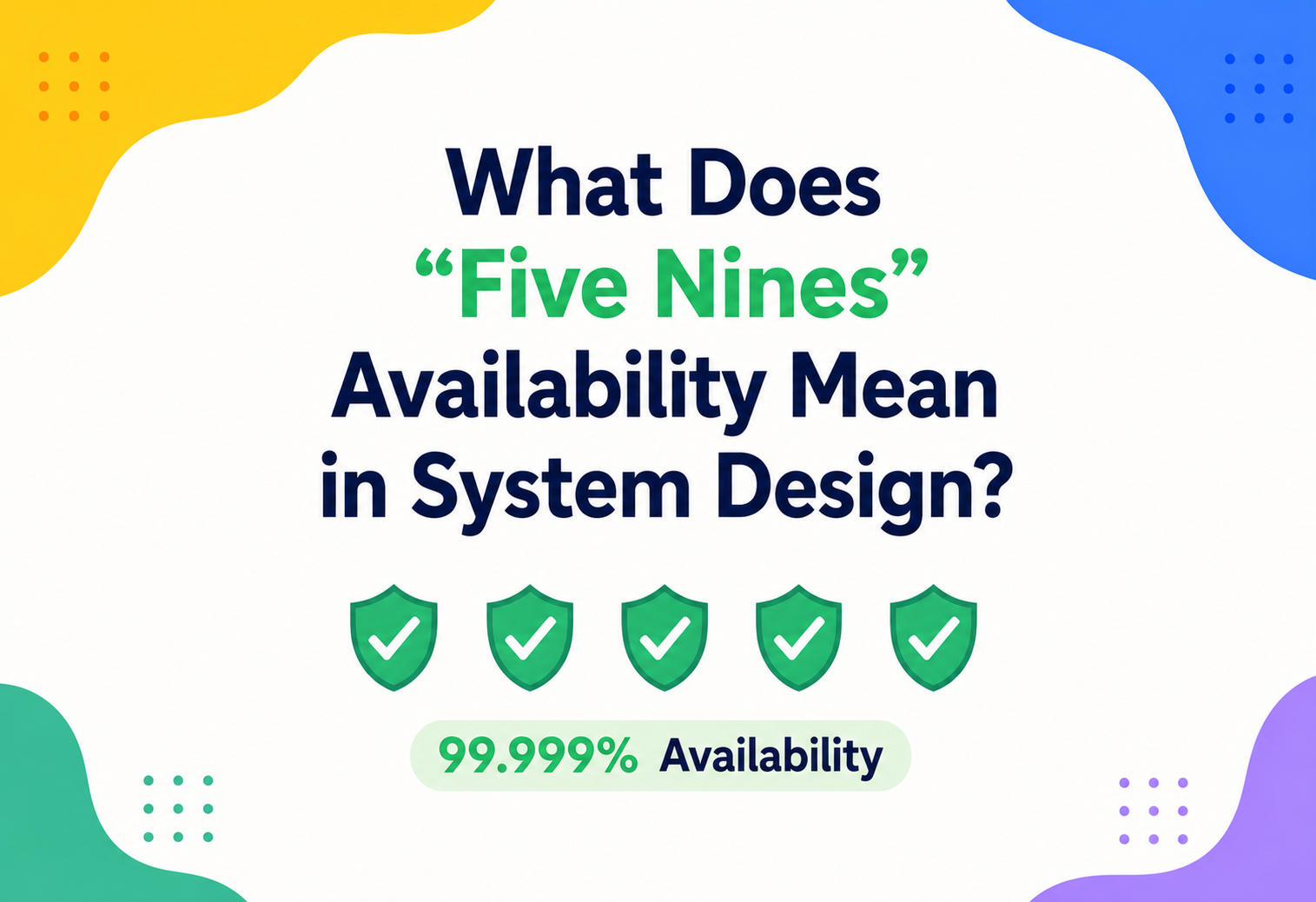
Five nines availability means a system is up 99.999% of the time — roughly five minutes of allowed downtime across an entire year. It’s a bar earned through disciplined design from day one, not a label bolted on later.
Imagine a school bell that’s supposed to ring at the start of every single class, every single day, for an entire year. Now imagine that bell is allowed to fail — to simply not ring — for a grand total of about five minutes across that whole year. Everywhere else, every single time, it rings exactly when it should. That’s an almost unbelievable level of dependability for a school bell, and it’s exactly the kind of promise engineers are making when they say a system has “five nines” of availability.
The phrase sounds mysterious the first time you hear it, but it’s really just a nickname. It comes from the digits in the number 99.999% — five 9s in a row. Each one of those nines represents a system being almost impossibly dependable, staying up and working for very nearly all of the time it’s expected to.
Think of a heartbeat. Your heart beats roughly 100,000 times a day, every day, without you ever having to think about it. If it skipped just one beat out of every 100,000, you’d probably never even notice. Five nines availability asks a computer system to be almost exactly that dependable — quietly doing its job over and over, with failures so rare they barely register.
This guide walks through exactly what that promise means, why it’s so difficult to keep, who actually needs it, and how engineering teams go about building systems trustworthy enough to earn that title.
Before diving in, it helps to set one expectation clearly: five nines is not a casual goal that any team can adopt just by trying harder. It’s closer to a black belt in martial arts than a simple checklist — it demands years of disciplined practice, careful design decisions made from the very first day, and constant, honest testing against real failures. Understanding what it actually takes is the first step toward knowing whether your own system genuinely needs it, or whether a more modest, far more achievable target would serve everyone just as well.
What “Five Nines” Really Means
Availability, at its core, is simply the fraction of time a system is up and working, out of all the time it was supposed to be working. Engineers write it as a percentage using this formula:
Availability = Uptime ÷ (Uptime + Downtime) — multiplied by 100 to get a percentage. “Five nines” simply means that percentage works out to 99.999%.
What makes that number so remarkable isn’t the percentage itself — it’s what remains once you subtract it from 100%. That tiny sliver, just 0.001%, is all the downtime a system is allowed across an entire year. When you actually convert that sliver into real clock time, it comes out to roughly five minutes and twenty-six seconds. Not five minutes a day. Not five minutes a month. Five minutes, across all of January through December, combined.
To put that in perspective, if you tried to personally watch a five-nines system every single second of the year to catch it failing, you’d have a better chance of missing the exact moment than catching it, simply because it’s over almost before it begins. This is precisely why engineers rely on automated monitoring rather than human eyes to track availability this precise — no person could realistically watch closely enough.
The phrase itself has roots in the world of telephone networks, from an era when a working phone line genuinely meant the difference between reaching help in an emergency or not. Traditional phone systems earned a reputation for being astonishingly dependable, and “five nines” became the informal gold standard that other industries — banking, aviation, and later, the internet itself — eventually borrowed and adopted as their own benchmark for “as dependable as a system can reasonably be expected to be.”
It’s also worth being precise about the time window being measured. Five nines is almost always calculated over a full year, because shorter windows can be misleading — a system that’s perfectly available for eleven months and then suffers one very bad day could still look impressive if you only glanced at last week’s numbers. Measuring over a full year forces the number to be honest about the bad days along with the good ones.
Climbing the Nines Ladder
Five nines doesn’t exist in isolation — it sits at the top of a ladder, with each rung below it representing a slightly less demanding, and slightly more achievable, promise. Climbing even one rung higher sounds small on paper but represents a huge jump in engineering effort.
| Availability | Nickname | Downtime / Year | Downtime / Month | Downtime / Day |
|---|---|---|---|---|
| 99% | Two nines | ~3.65 days | ~7.3 hours | 14.4 min |
| 99.9% | Three nines | ~8.76 hours | ~43.8 min | 1.44 min |
| 99.95% | “Three and a half” nines | ~4.38 hours | ~21.9 min | 43.2 sec |
| 99.99% | Four nines | ~52.6 min | ~4.38 min | 8.6 sec |
| 99.999% | Five nines | ~5.26 min | ~26.3 sec | 0.86 sec |
| 99.9999% | Six nines | ~31.5 sec | ~2.6 sec | 0.09 sec |
That “ten times harder for one more nine” pattern is one of the most important things to understand about this ladder. Going from 99% to 99.9% means becoming ten times more dependable. Going from 99.9% to 99.99% means becoming ten times more dependable again — on top of the first improvement. Each rung isn’t a small step; it’s a whole new level of engineering discipline stacked on everything below it.
Why Five Nines Is So Hard
It would be easy to assume that reaching five nines just means “trying a bit harder” than reaching four nines. In reality, the jump is enormous, for a handful of very human and very technical reasons.
No small mistake is forgiven
At five nines, a single mistyped configuration change can burn through an entire year’s downtime budget in one afternoon.
The weakest link decides the outcome
Servers, networks, databases, and even the software running on your visitor’s phone all have to cooperate — and each one adds its own small risk of failure.
People make mistakes under pressure
Even the best-trained engineers occasionally push the wrong button at 3 a.m., and five nines leaves almost no room to recover from that.
Disasters don’t check the calendar
Storms, power grid failures, and fibre cuts are individually rare, but across enough time, some combination of them is guaranteed to occur.
There’s also a subtler reason five nines is so tough: it isn’t something you can bolt on after the fact. A system built casually, without redundancy baked into its very foundations, can be patched and improved, but it will almost never climb all the way to five nines no matter how much money gets thrown at it later. Five nines has to be a decision made on day one, reflected in every architectural choice that follows — which database to use, how services talk to each other, where servers physically sit, and how failures are detected and handled automatically rather than manually.
Even a system that is broken 99.999% correctly built can still miss its five-nines target if just one dependency it relies on — like a single shared network link — isn’t held to the same standard.
There’s a useful way to think about why the difficulty grows so quickly: at lower levels of availability, teams are mostly fixing obvious, common problems — the equivalent of low-hanging fruit. By the time a system is already reaching four nines, most of the easy wins have already been claimed, and every further improvement means hunting down increasingly rare, increasingly unusual failure modes that only show up once in many months. Finding and fixing a problem that happens once a year takes far more patience and far more sophisticated tooling than fixing one that happens every week.
Do You Actually Need It?
Here’s a truth that surprises a lot of people: most software, even successful, widely used software, does not need five nines. Chasing that number when it isn’t truly necessary can waste enormous amounts of time and money that would have been far better spent building new features people actually want.
| Kind of System | Typical Target | Why |
|---|---|---|
| Personal blog or portfolio site | ~99% | An hour of downtime a month is a minor inconvenience, not a crisis. |
| Internal company tool | ~99.5%–99.9% | Employees can usually wait a few minutes, or switch to another task, if it briefly goes down. |
| E-commerce or booking platform | ~99.9%–99.95% | Downtime directly costs money and damages customer trust, but brief interruptions are survivable. |
| Banking, payments, telecom core | ~99.99%–99.999% | Outages can cause direct financial harm or cut off essential communication for large numbers of people. |
| Emergency services, air traffic, medical life-support systems | 99.999% or beyond | Downtime can put lives at risk, so cost is rightly treated as secondary to dependability. |
The healthiest way to decide is to ask a simple, honest question: “what actually happens, in real terms, if this system is down for five minutes right now?” If the answer is “someone gets mildly annoyed,” a lower target is usually the wiser, cheaper choice. If the answer involves real financial loss, safety risk, or a breach of a serious promise made to customers, that’s when the enormous cost of five nines starts to make genuine sense.
The Math Behind the Nines
One of the most eye-opening things about availability is how it behaves when several parts of a system depend on each other. Most real systems aren’t just one machine — they’re a chain of different pieces, like a web server, a database, a payment gateway, and a network connection, all needed together for a single request to succeed.
When Parts Depend on Each Other (Series)
If every one of those pieces must work for the whole request to succeed, their individual availabilities multiply together — and multiplying percentages below 100% always produces a smaller number. Three components, each individually reaching a respectable 99.9%, combine to give roughly 99.7% overall, not 99.9%. The chain is only as strong as the combined weakness of every single link in it.

When Parts Back Each Other Up (Parallel)
The opposite happens when two or more components are set up as backups for each other, so that the overall system only fails if all of them fail at the very same moment. Because independent failures are unlikely to line up perfectly, combining two 99% components this way can push the overall availability up past 99.99% — a dramatic improvement, achieved simply by adding a redundant partner rather than making the original component itself any better.
This single mathematical fact — that dependent parts multiply availability down, while backup parts multiply unavailability down even faster — is the entire reason redundancy is the number one tool in every five-nines engineer’s toolbox. You don’t reach five nines by building one flawless component; you reach it by combining several good-but-imperfect components so cleverly that their weaknesses rarely, if ever, line up.
MTBF and MTTR: The Other Side of the Coin
Availability is really the combined result of two separate questions: how often does something break, and how quickly does someone fix it? Engineers capture these two ideas with a pair of measurements that sound technical but are refreshingly simple once explained.
Mean Time Between Failures
On average, how long does a component keep working before it breaks? A higher number means it fails less often.
Mean Time To Recovery
On average, how long does it take to detect a failure and get things working again? A lower number means faster recovery.
Think of a family car. MTBF is how many kilometres it typically drives before something needs repair. MTTR is how long it sits in the workshop once it does break down. A car that breaks down often but gets fixed in an hour might actually be more available, over a full year, than a car that rarely breaks down but takes three weeks to repair each time it does. Availability cares about the combination of both numbers, not just one of them in isolation.
This is a genuinely useful insight for any team chasing higher nines: sometimes the fastest path to better availability isn’t making failures rarer at all — it’s making recovery dramatically faster. A five-nines system with automated failover that reacts in under a second can tolerate components that fail somewhat more often than a system relying on a human to notice and react over several minutes. Investing in faster detection and recovery is often cheaper, and more effective, than trying to build components that simply never fail.
You can reach higher availability either by failing less often or by recovering faster — and in practice, the fastest wins usually come from getting much better at the second one.
How Engineers Reach Five Nines
Knowing the math is one thing; actually building a system that lives up to it is another. Here are the practical techniques that show up again and again in real five-nines systems.
Redundancy at Every Layer
It’s not enough to have a backup server. Five-nines systems build backups into the power supply, the network connection, the physical building, and even the geographic region — because a single point of failure anywhere in the chain can undo all the careful redundancy everywhere else.

Automated Failover
Waiting for a human to notice a problem and manually switch to a backup takes minutes — and minutes are a luxury a five-nines system simply doesn’t have. Instead, these systems detect trouble and switch over automatically, usually within seconds, using constant health checks that quietly ask every component, many times a second, “are you still okay?”
Multi-Region Deployment
Spreading identical copies of a system across different cities or even different countries protects against the kind of large-scale event that no amount of redundancy inside one building can survive — a citywide power failure, a natural disaster, or a major internet outage affecting one region alone.
Strengths
- Survives disasters that take out an entire location
- Can serve visitors from whichever region is closest and healthiest
- Removes the “one building” risk completely
Trade-offs
- Keeping data consistent across distant regions is genuinely difficult
- Significantly higher infrastructure and coordination cost
- Requires a mature, well-tested automated failover process
Chaos Engineering and Rehearsed Failure
Five-nines teams don’t just hope their backups work — they prove it, on purpose, by deliberately breaking things during calm, controlled conditions. Turning off a server, cutting a network path, or simulating an entire region going dark, all while the system is being carefully watched, reveals hidden weaknesses long before a real emergency ever gets the chance to.
Careful, Gradual Releases
Since human-made changes are one of the most common causes of outages, five-nines teams roll out updates slowly and cautiously — releasing a change to a tiny slice of traffic first, watching closely, and only expanding it further once it’s proven safe, rather than pushing a new version everywhere all at once.
Generous Capacity Headroom
A system running comfortably at half its true capacity has plenty of room to absorb a sudden surge in visitors or the loss of some of its servers without buckling. Five-nines systems are deliberately over-provisioned, keeping spare capacity in reserve at all times, precisely because the worst moment for a traffic spike to happen is usually right when something else has already gone wrong.
Proving It: SLAs and Error Budgets
Claiming five nines is easy to say out loud; proving it is a different matter entirely. Teams that genuinely operate at this level rely on precise, ongoing measurement rather than a one-time claim.
Continuous Monitoring
Every request, every server, and every dependency is watched constantly, with results recorded automatically rather than checked by hand.
The Error Budget
Since even five nines allows roughly five minutes of downtime a year, that small allowance is treated as a real, trackable “budget” the team can knowingly spend — on planned maintenance, careful experiments, or absorbing the occasional surprise.
The Service Level Agreement (SLA)
A formal, often contractual promise made to customers, sometimes with financial penalties attached if the promised number isn’t met over a given period.
An error budget changes how a team thinks day to day. Instead of treating every single failure as an emergency, they ask a calmer question: “have we used up our small allowance of acceptable downtime this month, or do we still have room?” If the budget is nearly spent, the team slows down on risky changes and focuses on stability. If there’s plenty of budget left, they can move faster and take on more ambitious improvements. It turns an abstract promise into a practical, everyday decision-making tool.
Where Five Nines Really Matters
Five nines isn’t a target chosen for bragging rights — it tends to show up in industries where the cost of being wrong is measured in more than just inconvenience.
The original five-nines standard
Traditional phone networks were built to this level for decades, because a dial tone that doesn’t answer during an emergency call is far more than a minor annoyance.
Every second is money
Card networks and core banking systems process enormous volumes of transactions where even brief outages can mean real, immediate financial losses for many people at once.
Safety leaves no margin
Systems that track aircraft positions and guide landings are engineered with redundancy far beyond typical software, because the consequences of failure are measured in lives.
Someone’s worst moment
Systems that route emergency calls to the right responders are built to stay available specifically because they’re needed most exactly when everything else is going wrong.
It’s worth noticing a pattern across all of these examples: five nines shows up where a failure doesn’t just inconvenience one person quietly at their desk — it cascades outward, affecting many people at once, often at the worst possible moment. That’s the honest test for whether a system truly needs this level of dependability, rather than simply wanting the prestige that comes with the label.
Large cloud computing providers are another example worth mentioning, since so many other businesses now build directly on top of them. When a major cloud region experiences trouble, the effects don’t stay contained — they ripple outward into thousands of unrelated apps and websites that quietly depend on that same underlying infrastructure. This is exactly why cloud providers invest so heavily in multi-region redundancy: their own five-nines promise effectively becomes the foundation that countless other companies’ availability targets are built on top of, whether those companies realise it or not.

Common Myths and Pitfalls
Myth: “Five Nines Means It Never Breaks”
Five nines doesn’t mean perfection — it means failures are rare, brief, and recovered from so quickly that they barely register. Things still break behind the scenes constantly; the promise is about how fast and invisibly the system recovers, not about never having a problem in the first place.
Myth: “Once You Reach It, You Can Relax”
Availability isn’t a certificate earned once and kept forever — it’s closer to physical fitness, which fades the moment regular effort stops. A system that reached five nines last year but hasn’t been tested, monitored, or rehearsed since is very likely quietly drifting away from that standard without anyone noticing, until the day a real failure exposes the gap.
Myth: “More Servers Automatically Means More Nines”
Piling on extra servers without careful automated failover, monitoring, and testing doesn’t guarantee anything. In fact, a poorly coordinated set of redundant servers can sometimes fail together in ways a single, well-monitored server never would — for instance, if they all share the same power source or the same buggy configuration.
Pitfall: Measuring Availability Dishonestly
Some organisations quietly exclude “planned maintenance” or narrow their measurement window in ways that make the reported number look better than what customers actually experienced. This might satisfy an internal report, but it does nothing for the person who genuinely couldn’t use the service when they needed it.
Pitfall: Ignoring the Client’s Own Reliability
A system can be perfectly available on the server side and still feel broken to a user whose own internet connection, device, or app is having trouble. True end-to-end availability has to consider the entire journey, not just the part a company directly controls.
A five-nines claim that has never been tested against a real, large-scale failure is a promise on paper, not a proven fact.
The Cost-Benefit Curve
If five nines is so valuable, why doesn’t every system simply aim for it? The honest answer is cost — and not just money, but complexity, speed, and focus as well.
This relationship is sometimes described as a curve that gets steeper and steeper the further right you travel — each additional nine costs disproportionately more than the one before it, while the real-world benefit of that extra nine often shrinks the higher you climb. Going from 99% to 99.9% might genuinely transform how customers feel about a product. Going from 99.99% to 99.999% might only be noticed by a handful of the most demanding customers, at a vastly higher price.
This is exactly why experienced architects treat the choice of an availability target as a genuine business decision, made deliberately and revisited over time, rather than an automatic assumption that “higher is always better.” Spending a fortune chasing a nine nobody will ever notice is, in its own way, just as much a mistake as neglecting availability altogether.
A useful habit is to periodically ask whether the current target still matches reality. A system that started as an internal tool for a dozen employees might, years later, quietly become something the entire company depends on every single hour of the working day — and its availability target should grow to reflect that new importance. Equally, a system that was once mission-critical but has since been replaced by something newer might no longer justify the expensive infrastructure keeping it at five nines. Treating the target as fixed forever, in either direction, usually means either overspending or under-protecting something that has changed.
Building Toward It Over Time
Almost no system starts life at five nines. Most begin far simpler, running on a single server with no redundancy at all, because early on, speed of building and learning what customers actually want matters more than surviving a rare disaster. As a product proves itself and more people start depending on it, availability targets are usually raised in careful, deliberate stages.
Get It Working
Early on, the priority is simply proving the idea works and finding real users — availability targets stay modest and pragmatic.
Add Basic Redundancy
As real customers start relying on the system, a second server, automated backups, and simple monitoring are introduced.
Automate Recovery
Manual, human-triggered recovery gives way to automatic failover, health checks, and self-healing infrastructure.
Go Multi-Region and Rehearse
For the systems that truly need it, the final stage adds geographic redundancy and regular, deliberate failure drills.
Trying to skip straight to the last stage before a product has even found its first real customers usually wastes effort on problems that don’t exist yet. The wiser path is to treat five nines as a destination reached gradually, earned one deliberate improvement at a time, exactly in step with how much the business genuinely depends on that dependability.
It’s also worth remembering that reaching five nines once isn’t the same as keeping it forever. Systems grow, traffic patterns shift, new dependencies get added, and old assumptions quietly stop being true. The teams that hold onto five nines for years, rather than losing it after one bad quarter, are the ones who keep testing, keep rehearsing failure, and keep treating that hard-earned five minutes of yearly downtime as something to be protected continuously — not a trophy that, once won, takes care of itself.
Key Takeaways
Remember This
- “Five nines” means 99.999% availability — roughly five minutes and twenty-six seconds of allowed downtime across an entire year.
- Each extra nine represents roughly a tenfold increase in dependability, and a similarly large jump in engineering effort and cost.
- Components that depend on each other multiply their availability down; components that back each other up multiply their unavailability down even faster — this is the mathematical heart of redundancy.
- Most systems don’t need five nines, and chasing it without a genuine need wastes resources better spent elsewhere.
- Reaching five nines requires redundancy at every layer, automated failover, multi-region infrastructure, and rehearsed, tested failure drills — not just good intentions.
- Error budgets turn the small allowed downtime into a practical, everyday decision-making tool rather than an abstract promise.
- Five nines is a destination reached gradually and deliberately, in step with how much a business genuinely depends on that level of dependability.