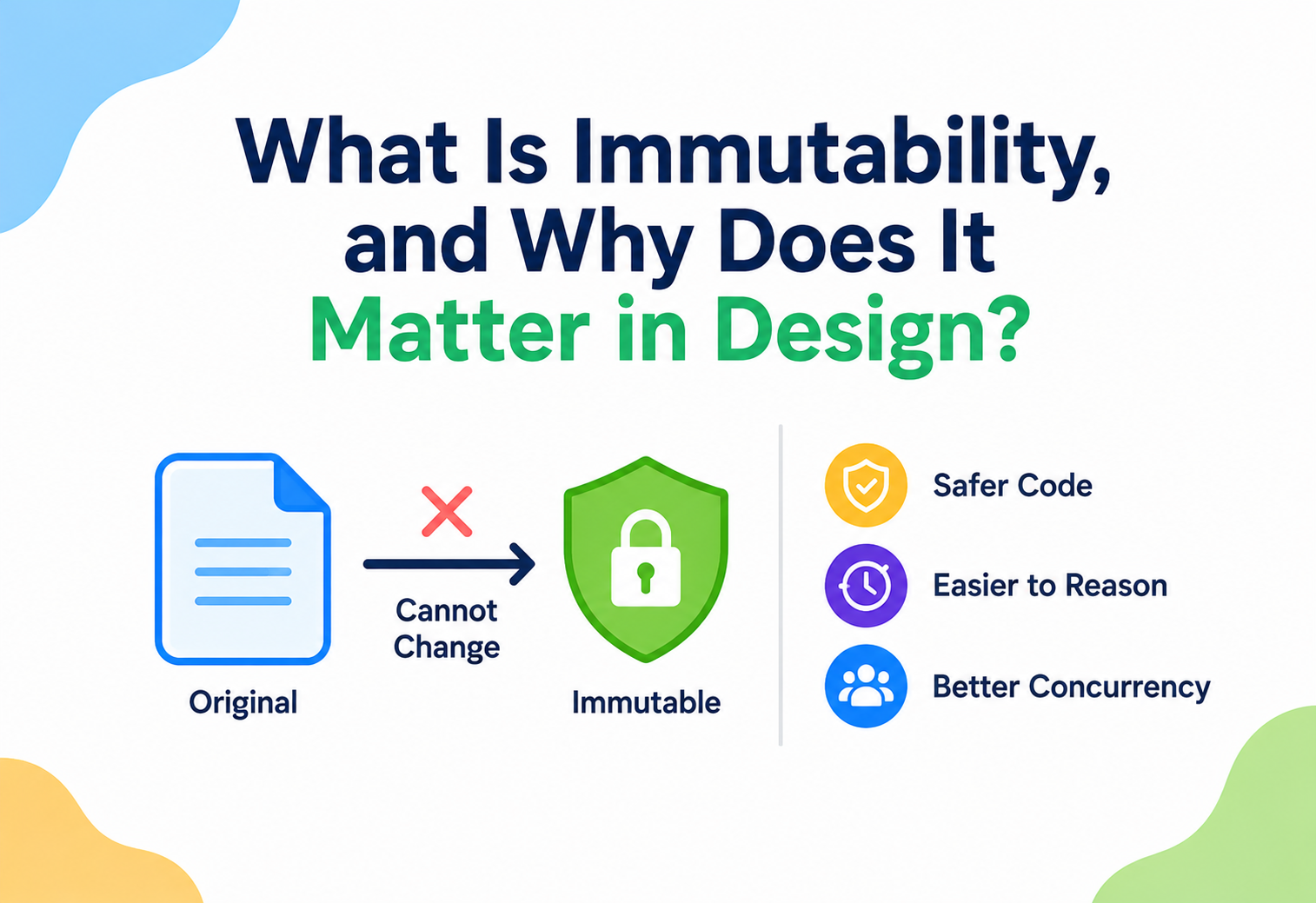
What Is Immutability, and Why Does It Matter in Design?
A calm, thorough walk through one of the quietest but most powerful ideas in software design — why so many experienced engineers prefer things that cannot change once they’re created, and what that preference actually buys them.
The Big Idea, in One Breath
Imagine two photographs of your family. The first is a printed photo, sealed in a picture frame — once it is developed, it stays exactly as it is, forever. Anyone who wants a different version has to take an entirely new photograph. The second is a shared, editable document that any family member can open and repaint at any time — someone could quietly change Grandma’s smile, move the dog to a different spot, or erase your little brother entirely, and there would be no simple way to know who changed what, or when. Both are technically “a family photo.” Only one of them can be trusted to still show you the truth the next time you look at it.
That difference — a fixed, sealed photograph versus an ever-editable shared document — is exactly what programmers are talking about when they discuss immutability. An immutable piece of data, once created, simply cannot be changed. If you need a different version, you don’t edit the original — you create a brand-new one, leaving the first completely untouched. A mutable piece of data, by contrast, can be changed in place, by anyone with access to it, at any time.
This might sound like a small, technical detail, barely worth a second thought. In practice, it turns out to be one of the most consequential decisions a software design can make, quietly shaping how easy a system is to understand, how safely it can be shared across many parts of a program running at once, and how confidently engineers can trust that the data in front of them is actually telling the truth.
Think about a signed, notarized contract versus a sticky note. The contract, once signed by everyone involved, cannot be secretly altered — any change requires a new, separately signed amendment, with its own clear record. A sticky note, on the other hand, can be scribbled on by literally anyone who walks past your desk, with no record of who changed what or when. You would never build a business on sticky notes for anything that truly mattered. Immutability is software’s way of insisting on contracts instead of sticky notes, for exactly the pieces of data that matter most.
What makes this idea worth a full guide, rather than a quick footnote, is how counterintuitive it feels at first to programmers trained to think of variables as boxes you can freely reach into and change. Mutability feels natural, even obvious, the first time anyone learns to code — you set a value, and later you change it, the same way you might update a number on a whiteboard. Immutability asks you to unlearn that reflex in the specific places where it quietly causes trouble, and to trust that “make something new” is often a safer, clearer habit than “change what’s already there.”

What Immutability Actually Means
Formally, an object or piece of data is called immutable when its internal state cannot be altered after it has been created. Every property, every field, every value inside it is fixed at the moment of creation, and stays that way for the entire time it exists. If a program needs a version of that data with something different about it, the only option is to build an entirely new object, with the new value baked in from the start, rather than reaching into the existing one and changing it directly.
This might sound restrictive at first, and in a narrow, technical sense, it is — you genuinely give up the ability to reach in and tweak something in place. What immutability offers in exchange is a much stronger, much simpler guarantee: once you have a reference to an immutable piece of data, you can trust, completely, that it will still look exactly the same the next time you check, no matter what else is happening elsewhere in the program, no matter how many other parts of the system also hold a reference to that same piece of data.
Immutability Is About the Object, Not the Variable
A common early confusion is mixing up an immutable object with an unchangeable variable. A variable that cannot be reassigned to point at something else — often called a constant — is a related but separate idea. You can have a constant that points at a mutable object, which can still be changed internally even though the variable itself can never point elsewhere. And you can have a perfectly ordinary, reassignable variable that currently happens to point at an immutable object, which cannot be changed internally even though the variable is free to later point at something else entirely. Keeping these two ideas distinct — “can this variable point elsewhere?” versus “can the thing it points at be changed?” — clears up a great deal of early confusion around immutability.
Immutability doesn’t mean “this value can never be updated in your program.” It means “this specific object, once built, will never quietly change out from under you.” Getting a new version always means creating something new, never editing the old thing in place.
It is worth sitting with this distinction for a moment, because it resolves a question that trips up many people encountering immutability for the first time: “if nothing can change, how does anything ever get updated in a real, working program?” The answer is that update and change in place are not the same thing. A program built around immutability updates constantly — a shopping cart gains new items, a user profile gets edited, a document accumulates changes — it simply does so by producing a fresh, new value at each step, rather than reaching backward in time to alter something that already exists.
Mutable vs. Immutable: A Direct Comparison
The clearest way to feel this distinction is to watch the same small task handled both ways.
| Action | Mutable Approach | Immutable Approach |
|---|---|---|
| Adding an item to a list | Modify the existing list in place | Create a new list containing the old items plus the new one |
| Updating a user’s name | Change the name field directly on the user object | Create a new user object, identical except for the new name |
| Sharing data across two functions | Both functions hold the same object; either can change it | Both functions hold the same object; neither can change it |
| Tracking what changed | Must be tracked manually, separately from the data itself | Naturally visible — the old and new versions simply exist side by side |
Notice the pattern running through every row: the mutable approach always changes something that already exists, while the immutable approach always produces something new. This single, consistent difference — edit in place versus create anew — is the seed from which almost every practical benefit and cost of immutability actually grows, and it is worth holding onto as this guide moves into more specific territory.
It is also worth noticing the fourth row a little more closely, since it points at something easy to overlook. With the mutable approach, “what changed” is not something the data itself remembers — it lives only in whatever logs, comments, or careful bookkeeping the team happens to maintain separately. With the immutable approach, the old and new versions simply coexist, side by side, and the difference between them can always be examined directly, with nothing extra required. This is a small detail with surprisingly large consequences for debugging, auditing, and simply understanding a system’s history over time.
Where Immutability Comes From
Immutability is not a recent invention dreamed up for modern web development — its roots reach back to the earliest days of computer science, and even further into mathematics itself. In mathematics, when you write that two plus two equals four, you are not describing a value that changes; you are describing a fixed, permanent fact. Functional programming, one of the oldest branches of programming language design, was deliberately built to mirror that mathematical spirit, treating data as fixed values rather than as boxes to be repeatedly overwritten.
One of the earliest and most influential functional languages, developed in the late 1950s, established many of the ideas that later generations of functional languages, and eventually mainstream languages borrowing from them, would build upon — among them, a strong preference for values that do not change once created. For decades, this style remained mostly confined to academic and specialized circles. As software systems grew larger, more concurrent, and more distributed over the following decades, the practical benefits of immutability — particularly around safety when many parts of a program run at the same time — became impossible for the wider industry to ignore.
Mainstream languages absorbed the idea gradually. Java, for instance, made one of its most fundamental building blocks — text strings — immutable from its very first release, a design decision that has quietly protected countless Java programs from an entire category of bugs ever since, whether or not the programmers writing that code were even aware immutability was the reason. In more recent years, functional languages built specifically around immutable data, and functional-inspired features added to mainstream languages, have brought the idea fully into everyday software engineering, well beyond its original academic home.
It is worth appreciating how much the surrounding conditions of software development have changed since immutability was first a niche, academic preference. Early programs typically ran as a single sequence of steps, one after another, on a single processor, with little concern for multiple things happening at once. As processors gained the ability to run many tasks in parallel, and as software systems grew to span many machines communicating over networks, the old assumption that “only one thing is touching this data at a time” quietly stopped being safe to make. Immutability, once a stylistic preference tied mostly to mathematical purity, became a genuinely practical necessity for building correct software at the scale modern systems now operate at.

The Building Blocks, Side by Side
A picture makes this contrast easy to feel. Below, the left side shows two parts of a program sharing a mutable object, where one part’s change silently affects the other. The right side shows the same scenario with an immutable object instead.
Notice that both diagrams start from the exact same situation: two independent parts of a program both holding a reference to the same shopping cart. The danger was never in the sharing itself — sharing data between parts of a program is completely normal and usually necessary. The danger lived entirely in what happened next: whether a change made by one holder was allowed to silently ripple out and affect the other, invisibly, without either side asking for that to happen.
It is worth imagining how this bug would actually be experienced by a real engineering team. In the mutable version, someone would eventually notice that carts were mysteriously emptying themselves at unpredictable moments, with no obvious pattern connecting the reports. Tracing the cause would likely mean stepping through code across two entirely unrelated parts of the application, since nothing in either file, read on its own, looks obviously wrong. In the immutable version, that entire investigation simply never needs to happen, because the underlying mechanism that made the bug possible was removed at design time, long before any user ever encountered it.
Why Immutability Matters So Much
It helps to be concrete about what immutability actually buys a team, since the benefits are easy to nod along to abstractly and far more convincing spelled out plainly.
What you see is what stays
Once you hold a reference to an immutable object, you can trust its contents completely, without worrying that some distant part of the program might quietly change it.
No locks, no coordination
Immutable data can be freely handed to many parts of a program, or many threads, at once, with no risk of one holder’s actions interfering with another’s.
The data never lies
When a value genuinely cannot change after creation, a whole category of “how did this become that?” bugs simply cannot occur in the first place.
Less to hold in your head
Understanding a piece of code that only ever creates new values, rather than editing existing ones in place, requires tracking far less mental state at once.
There is also a quieter, structural benefit worth naming directly: immutability turns an entire class of bugs from something that can happen at any time, anywhere in a program, into something that simply cannot happen at all. A shared mutable object is a standing invitation for one part of a system to accidentally affect another, unrelated part — an invitation that grows more dangerous as a codebase grows larger and more parts of it start touching the same shared data. Immutability withdraws that invitation entirely, closing off the bug category rather than merely making it less likely.
There is a genuine confidence benefit here, too, worth naming for anyone weighing whether the discipline is worth adopting. Engineers working in a codebase built around immutability tend to develop a distinct kind of trust in the data they are looking at — a trust that does not need to be re-earned every time they revisit a piece of code weeks or months later. That trust translates directly into speed: less time spent double-checking whether something could have changed unexpectedly, and more time spent actually solving the problem in front of them.
The safest way to prevent a bug caused by unexpected change is to remove the possibility of change entirely.
A Worked Example: Feeling the Difference
Let’s walk through a small, realistic scenario twice — once with a mutable object quietly causing trouble, and once with an immutable object preventing that same trouble entirely.
The Mutable Version
A shared discount object, quietly changed by one callerclass Discount {
    double percentage;
    Discount(double percentage) { this.percentage = percentage; }
}

class OrderService {
    Discount standardDiscount = new Discount(0.10);

    double applyDiscount(double price) {
        return price - (price * standardDiscount.percentage);
    }
}

class PromoWidget {
    void applySpecialOffer(Discount discount) {
        discount.percentage = 0.50;   // meant only for THIS one order,
                                       // but this is the SAME shared object
    }
}

// Somewhere else in the program, completely unrelated code just quietly
// changed the "standard" 10% discount into 50% for everyone, forever.
The Immutable Version
The same idea, built so this simply cannot happenfinal class Discount {
    private final double percentage;
    Discount(double percentage) { this.percentage = percentage; }
    double percentage() { return percentage; }
}

class OrderService {
    Discount standardDiscount = new Discount(0.10);

    double applyDiscount(double price) {
        return price - (price * standardDiscount.percentage());
    }
}

class PromoWidget {
    Discount applySpecialOffer() {
        return new Discount(0.50);   // a brand-new discount, just for this order
    }
}

// The original standardDiscount object can never be altered by anyone.
// PromoWidget creates its own separate object instead of reaching into the shared one.
In the mutable version, nothing about the code looks obviously wrong — PromoWidget is simply doing what it was asked to do, changing a discount’s percentage. The real problem is invisible at the point of the mistake: PromoWidget was handed a reference to the exact same object OrderService relies on for every other order, and changing it there changed it everywhere. In the immutable version, that entire category of mistake is not just unlikely — it is impossible. There is no method on Discount that could change its percentage after creation, because none exists.
The bug in the mutable version would likely pass a quick code review, since each individual line looks reasonable in isolation. The immutable version doesn’t just make the bug less likely — it removes the very possibility of writing that particular bug at all.
It is worth pointing out how differently these two versions would show up in a real bug report. The mutable version’s bug would likely be reported as something vague and hard to reproduce — “sometimes the discount seems wrong, but only occasionally, and we can’t tell why.” That vagueness is itself a signature of shared-mutability bugs: they depend on the exact order in which different parts of a program happen to run, which can vary from one execution to the next. The immutable version has no such uncertainty to offer, because the underlying mechanism that would have produced that vagueness was never given the chance to exist.
Techniques for Building Immutably
Achieving immutability is not one single trick — it is a small collection of habits that, together, close off every path by which an object’s state could otherwise be changed after creation.
Make Fields Final or Read-Only
Marking every field as unchangeable once set, using whatever mechanism a given language provides, is the most direct way to prevent accidental in-place edits.
Return New Objects Instead of Editing
Any method that would traditionally change an object’s state should instead return a brand-new object reflecting the desired change, leaving the original completely untouched, exactly as shown in the worked example above.
Avoid Exposing Mutable Internals
An object can look immutable on the surface while secretly leaking a mutable internal list or map that callers can reach in and change directly. Returning defensive, unmodifiable copies of any internal collections closes this common, easy-to-miss loophole.
Favor Immutable Collections
Many modern languages and libraries offer dedicated immutable versions of lists, sets, and maps, where any operation that would traditionally modify the collection instead returns a new one, leaving the original untouched.
Validate Completely at Construction Time
Since an immutable object can never be fixed up after the fact, all of its validation needs to happen once, at the moment it is built, ensuring every immutable object that exists is guaranteed to be in a genuinely valid state for its entire lifetime.
Building something immutable is really about closing every door that would otherwise let someone reach in and change it later — not adding new capability, but removing an old, quietly dangerous one.
These techniques work best when applied consistently, as a default habit for new code, rather than retrofitted occasionally onto a handful of especially troublesome classes. A team that treats immutability as the normal, expected starting point — reaching for mutability only with a clear, specific reason — tends to accumulate far fewer of the subtle sharing bugs described throughout this guide than a team that treats immutability as an occasional special case applied only after a painful bug has already occurred.
Immutability and Thread Safety
Perhaps the single most celebrated benefit of immutability shows up the moment a program starts doing more than one thing at the same time. When multiple threads run concurrently, each capable of reading and writing shared data whenever they happen to run, mutable data becomes a genuine hazard — two threads changing the same object at nearly the same moment can produce a corrupted, inconsistent result that neither thread intended, a problem generally known as a race condition.
Immutable data sidesteps this entire category of danger by construction. Since an immutable object can never be changed after creation, there is nothing for two threads to race over — every thread reading that object sees the exact same, permanently fixed contents, no matter how their timing happens to interleave. This means immutable data can be freely shared across as many threads as needed, with no locks, no synchronization mechanisms, and no careful coordination required at all, simply because there is no changing state left to protect.
With Immutable Data
- Safe to share across any number of threads, with zero locks.
- No race conditions possible on the shared data itself.
- Far simpler to reason about correctness under concurrency.
With Mutable Data
- Requires careful locking or synchronization to share safely.
- Genuine risk of race conditions if synchronization is missed.
- Concurrency bugs are often intermittent and painfully hard to reproduce.
This benefit alone explains why immutability has become especially prominent in languages and frameworks built for highly concurrent systems, and why teams building large-scale, multi-threaded software so often reach for immutable data structures specifically to sidestep an entire, historically painful class of bugs before it ever has a chance to appear.
It is worth appreciating just how disproportionately painful concurrency bugs caused by shared mutable state tend to be, compared to almost any other category of software defect. They frequently do not appear during normal testing at all, since reproducing a specific, unlucky timing of two threads racing against each other is inherently unreliable. They then show up unpredictably in production, sometimes only under real user load, and can take experienced engineers days to properly diagnose. Immutability’s promise to eliminate this entire category of risk, rather than merely reduce it, is precisely why so many teams consider it one of the highest-leverage design decisions available for any system that needs to do more than one thing at once.
Persistent Data Structures
A natural question follows quickly from everything above: if changing an immutable list means creating an entirely new list, doesn’t that waste a huge amount of memory and time, especially for large collections? In naive implementations, yes — but decades of computer science research have produced a clever answer to exactly this concern, known as persistent data structures.
The core idea is called structural sharing. Instead of copying an entire collection every time a small change is made, a persistent data structure copies only the small part that actually changed, and quietly reuses the rest of the original structure, unchanged, inside the new version. The old version and the new version end up sharing most of their internal structure in memory, even though each one, from the outside, behaves as a completely independent, fully immutable value.
Structural sharing is what makes immutability practical at real-world scale. Without it, immutable collections would be far too expensive to use for anything large. With it, updating even a very large immutable collection can be nearly as cheap as updating a mutable one.
These techniques are not exotic or rare — they sit quietly underneath many popular tools used in everyday application development, particularly in ecosystems built around functional programming and modern front-end state management, where large, frequently updated collections of data need to remain both immutable and genuinely efficient to work with.
A helpful way to picture structural sharing is to imagine a large family tree drawn on a big sheet of paper, where adding one new relative does not require redrawing the entire tree from scratch — you simply attach the new branch, while every existing branch stays exactly where it was. Persistent data structures apply this same intuition to a program’s data: the vast majority of an updated structure remains identical to the version before it, and only the small, genuinely new part needs to be freshly created.

Immutability in Frontend Development
Immutability plays an especially visible role in modern front-end web development, where user interfaces need to update reliably and predictably as underlying data changes. Popular front-end libraries and state-management tools frequently encourage, or outright require, that application state be treated as immutable — meaning every update to what the screen should display involves creating a new version of the application’s state, rather than editing the existing one directly.
This design choice unlocks a particularly elegant trick: because each new version of the state is a distinct, unchangeable object, a framework can check whether the screen actually needs to be redrawn by doing a very fast comparison — simply asking “is this the exact same object as before, or a genuinely new one?” — rather than the far more expensive process of comparing every single field inside the data one by one. This fast-comparison trick is a major reason many modern user interfaces feel snappy and responsive even as the underlying data grows large and complex.
State changes are traceable
Since every update produces a new state object rather than mutating the old one, it becomes far easier to trace exactly when and why the screen changed.
Old states are never lost
Because previous versions of state are never destroyed by an in-place edit, some development tools can let engineers step backward and forward through an application’s history, almost like rewinding a video.
Cheap comparisons
Comparing whether two objects are the identical object is dramatically faster than deeply comparing every field inside them.
No hidden shared edits
Components that only ever receive fresh, immutable data cannot accidentally corrupt state that some other, unrelated part of the interface still depends on.
This pattern has become common enough that it now shapes how many front-end engineers instinctively think about state, even before they have consciously studied the underlying principle. The habit of “never mutate state directly, always produce a new version” has become one of the most frequently repeated pieces of guidance in modern front-end development, precisely because ignoring it tends to produce exactly the kind of subtle, hard-to-trace rendering bugs this guide has described throughout — a screen that seems to update inconsistently, or that occasionally shows stale information, for reasons that are maddeningly difficult to reproduce reliably.
Immutability and Pure Functions
Immutability is closely tied to another important idea from functional programming: the pure function, a function whose output depends only on its inputs, and which never changes anything outside of itself while it runs. A pure function does not modify a shared variable, does not alter an object it was handed, and does not depend on any hidden state that might be different from one call to the next.
Immutability and pure functions reinforce each other naturally. A function that only ever works with immutable data has no opportunity to accidentally change something it was not supposed to touch, since none of the data it holds can be changed at all. This combination — pure functions working over immutable data — produces code that is remarkably easy to test, since calling the same function with the same input will always, reliably, produce the exact same output, with no hidden state anywhere to cause a different result on a second run.
A pure function working on immutable data is a little like a calculator: give it the same numbers twice, and it will give you the same answer twice, with absolutely nothing hidden that could quietly change the result in between.
This pairing matters practically, well beyond academic elegance. Code built this way tends to be dramatically easier to test in isolation, since a test simply needs to supply an input and check the output, with no need to carefully set up and tear down shared, mutable state before and after each test runs.
There is a broader lesson embedded in this relationship worth carrying forward: immutability and purity are not two unrelated techniques that happen to be occasionally mentioned together — they are two sides of the same underlying discipline, which is minimizing hidden, shared, changeable state wherever possible throughout a system. A codebase that embraces both tends to feel unusually calm to work in, in a way that is genuinely hard to appreciate until you have experienced the alternative: a codebase where almost anything could, in principle, be quietly changed by almost anything else.
The Performance Trade-Off
It would be dishonest to present immutability as a benefit with no cost at all. Creating a new object every time a change is needed, rather than editing an existing one in place, does have a real cost — more objects are created, and in languages with automatic memory management, more work eventually falls to the process responsible for cleaning up objects that are no longer needed.
For most everyday applications, this cost turns out to be small enough to be genuinely unnoticeable, particularly once structural sharing and other optimizations, discussed earlier in this guide, are taken into account. For a narrower set of especially performance-sensitive situations — very tight loops processing enormous amounts of data, or environments with extremely limited memory — the overhead of creating many new objects can become a real, measurable concern worth paying close attention to.
Where Immutability’s Cost Is Negligible
Where the Cost Deserves Real Attention
- Extremely tight, performance-critical inner loops.
- Systems processing very large volumes of data with strict memory limits.
- Real-time systems with hard, unforgiving timing requirements.
The practical, balanced approach many experienced teams settle on is to default to immutability everywhere it is not clearly, measurably too expensive, and to reach for carefully contained mutability only in the specific, narrow places where profiling has shown a genuine, real-world performance problem — rather than guessing about performance in advance and giving up immutability’s safety benefits prematurely, before any actual cost has been demonstrated.
It is worth remembering a well-known piece of engineering wisdom that applies directly here: premature optimization, made before any real measurement has taken place, is one of the most common ways teams end up with code that is both harder to understand and no faster in practice than the simpler version would have been. Immutability’s cost is real but frequently overestimated by intuition alone; measuring it honestly, in the specific part of a system where it might matter, is almost always a better guide than assuming the worst in advance.
When Mutability Still Makes Sense
Immutability is a strong default, not an absolute law. There are genuine, well-understood situations where mutability remains the right, deliberate choice.
Measured, not guessed
When careful profiling has shown that object creation is a genuine bottleneck in a specific, narrow part of a system, controlled mutability can be a reasonable, deliberate trade-off there.
Temporary, contained mutation
Many designs use a short-lived, intentionally mutable helper object to assemble something step by step, before finally producing an immutable result at the end.
Copying is genuinely too costly
Extremely large, frequently updated in-memory structures, especially without access to good structural-sharing tools, may genuinely need careful, contained mutability.
Direct hardware or memory concerns
Code working very close to hardware, with strict memory and timing constraints, sometimes needs the fine-grained control that in-place mutation provides.
Notice that even the “builders and buffers” case, one of the most common legitimate uses of mutability, still ends with an immutable result — the mutability is contained, temporary, and entirely hidden from the rest of the program, which never sees or depends on the intermediate, changing steps. This pattern, sometimes summarized as “mutate locally, share immutably,” captures how many experienced teams get the best of both approaches at once.
This pattern is worth remembering as the general shape most legitimate exceptions to immutability tend to follow: mutability contained tightly within a small, private boundary, with an immutable result handed out to the rest of the system once the work is done. Very rarely does a well-reasoned exception involve exposing raw, uncontrolled mutability broadly across a system — the exceptions that hold up well under scrutiny are almost always narrow, deliberate, and carefully fenced off from everything else.
A Recipe for Making a Class Immutable
When converting an existing mutable class into an immutable one, here is a calm, methodical way to make sure nothing is missed along the way.
This kind of conversion is usually best done gradually, one class at a time, starting with the classes that are shared most widely across a codebase, since those are exactly the ones where hidden mutability tends to cause the most damage. Trying to convert an entire large codebase in a single sweeping change carries real risk of missing a subtle dependency somewhere; a steady, class-by-class approach, verified with tests at each step, tends to produce far more reliable results.
Mark every field as final or read-only
Use your language’s mechanism for preventing a field from being reassigned after the object is constructed.
Remove or replace every setter
Any method that changes internal state after construction needs to be removed, or rewritten to return a new object instead.
Check for leaking internal collections
Make sure any list, set, or map returned to callers is either immutable itself or a defensive copy, so callers cannot reach in and mutate the original.
Validate everything in the constructor
Since the object can never be fixed up later, every rule it must satisfy needs to be checked once, completely, at the moment it is built.
Update every caller that used to mutate the object
Find every place in the codebase that used to call a setter or edit the object directly, and update it to build and use a new object instead.
Verify with tests, especially around sharing
Run the existing test suite, and specifically add tests confirming that changes made via one reference never affect another reference to what should be the same, unchanging data.
Step three, checking for leaking internal collections, is the step most commonly missed. A class can look perfectly immutable from the outside while still secretly allowing a caller to mutate a list it handed out — closing that gap is essential, not optional.
Side-by-Side Comparison
After walking through so many angles of this idea, it helps to see the practical differences summarized together in one place.
| Aspect | Mutable Design | Immutable Design |
|---|---|---|
| Changing a value | Edit the existing object in place | Create a new object with the change applied |
| Sharing across threads | Requires locks or synchronization | Safe with no coordination required |
| Debugging unexpected changes | Often difficult to trace the source | Rare, since the data cannot change unexpectedly |
| Memory and object creation | Generally lower overhead per change | More object creation, mitigated by structural sharing |
| Testing | Often requires careful setup and teardown | Simple — same input reliably gives the same output |
| Best suited for | Proven, narrow, performance-critical hot paths | The large majority of everyday application data |
As with the balanced approach described earlier in this guide, the goal of this table is not to declare mutability categorically wrong. It is simply an honest reflection of where the weight of evidence tends to fall for most everyday software, most of the time — a strong, deliberate default toward immutability, with mutability reserved for the narrower situations where it has genuinely earned its place.
Common Pitfalls
Even teams genuinely committed to immutability run into a handful of recurring, easy-to-miss traps. Knowing them in advance makes them far easier to catch early.
Shallow Immutability
Marking an object’s own fields as unchangeable does not automatically make everything it contains immutable too. An object can be superficially immutable while still holding a mutable list or nested object that callers can freely change, quietly undermining the guarantee the outer object appeared to offer.
Assuming Immutability Everywhere Is Free
As discussed earlier, immutability does carry a real, measurable cost in certain performance-sensitive situations. Applying it everywhere, without ever measuring the actual impact, can occasionally introduce real performance problems that a small, deliberate exception would have avoided.
Forgetting to Update Old Habits
Converting a class to be immutable but leaving behind code elsewhere that still tries to call a now-removed setter, or that still assumes it can edit an object in place, creates confusing errors that can be harder to diagnose than the original mutability ever was.
Confusing “Frozen at the Top” With “Frozen All the Way Down”
Some tools only prevent a collection’s top-level structure from changing — adding or removing items — while still allowing the individual items inside it to be mutated directly. Understanding exactly how deep a particular immutability guarantee actually goes is essential before relying on it.
An object that looks immutable from its public interface but quietly hands out a reference to a mutable internal list. That gap is one of the most common ways immutability quietly fails in real codebases.
What unites all four of these pitfalls is a shared root cause: immutability is a guarantee that only holds if it is enforced completely, everywhere a given piece of data travels through a system. A single overlooked seam — one leaked mutable list, one forgotten setter, one shallow check mistaken for a deep one — is enough to quietly undermine the entire guarantee for that piece of data, even while every other part of the system continues to trust it completely. Thoroughness, not cleverness, is what makes immutability reliable in practice.

A Few More Real-World Analogies
A printed store receipt
A printed receipt cannot be secretly altered after the fact. If a return happens, a new receipt documenting the return is issued — the original stays exactly as it was.
A physical coin
You cannot reach into a coin and change its value. If you need a different amount, you use a different coin, or a combination of coins — the original coin is untouched.
Court transcripts
An official court transcript is never edited after the fact. Corrections are added as new, separate entries, while the original record remains exactly as it was spoken.
A published book edition
Once a book edition is printed and distributed, it cannot be silently changed. A correction becomes a new, clearly labeled edition, while existing copies remain as they were.
Think about the difference between a photocopy and the original master document at a government records office. The original master is kept sealed, untouched, and trusted as the permanent source of truth. Every version anyone actually works with day to day is a fresh copy, made from that untouched master whenever it’s needed. Nobody scribbles directly on the master copy — if something needs to change, a new master is carefully created and archived instead. Immutability asks software to treat its important data the same protective way: keep the original safe and untouched, and build new versions whenever change is genuinely needed.
What ties every analogy in this section together is the same underlying instinct: the things people trust most in the real world — legal records, currency, printed receipts, official documents — are almost always things that resist being quietly altered after the fact. Software built around immutability is simply extending that same, deeply familiar trust-building pattern into the world of code, applying it to exactly the pieces of data a system depends on most.
Frequently Asked Questions
Does immutability mean my program can never update its data?
No. Your program can absolutely produce new, updated versions of its data whenever needed. Immutability only means those updates happen by creating something new, rather than editing the original in place.
Isn’t creating a new object every time wasteful?
For most everyday applications, the cost is small and often unnoticeable, especially with techniques like structural sharing. It becomes a real concern mainly in narrow, performance-critical situations, which is worth confirming through measurement rather than assuming in advance.
Is immutability only relevant to functional programming languages?
No. While immutability has deep roots in functional programming, it is a widely used, practical technique across nearly every mainstream language and paradigm today, including object-oriented languages like Java and C#.
How do I know if my “immutable” object is actually fully immutable?
Check every field, including nested objects and collections, and confirm that none of them can be changed after construction, either directly or through a returned reference. This is often called checking for “deep” versus “shallow” immutability.
Can immutability help with debugging even in single-threaded programs?
Yes. Even without any concurrency involved at all, immutability prevents an entire category of bugs caused by one part of a program unexpectedly changing data that another part still depends on.
Where did the idea of immutability in programming come from?
It traces back to functional programming languages developed starting in the late 1950s, which were themselves inspired by the fixed, unchanging nature of values in mathematics. Java’s decision to make its String type immutable from its earliest release helped bring the idea into mainstream, everyday software engineering.
Does immutability replace the need for good testing?
No, though it does make testing considerably easier. Immutability removes an entire category of bugs related to unexpected shared state, but it does not verify that your logic itself is correct, which is what tests are still needed for.
Glossary
A short reference of the terms used throughout this guide, useful to revisit whenever a design conversation with your own team turns to shared state and data safety.
| Term | Definition |
|---|---|
| Immutable | Unable to be changed after creation; any update produces a new object instead. |
| Mutable | Able to be changed in place after creation. |
| Race Condition | A bug caused by two threads changing shared mutable data at nearly the same time, producing an unpredictable result. |
| Persistent Data Structure | An immutable data structure designed so updates are efficient, typically through structural sharing. |
| Structural Sharing | A technique where a new, updated version of a data structure reuses the unchanged parts of the original, avoiding a full copy. |
| Pure Function | A function whose output depends only on its inputs, with no side effects on outside state. |
| Defensive Copy | A copy of a mutable object made specifically to prevent outside code from altering the original. |
| Shallow vs. Deep Immutability | Shallow immutability protects only an object’s top-level fields; deep immutability protects everything nested inside it as well. |
Key Takeaways
This guide has traveled from a simple photograph analogy through concurrency, persistent data structures, and modern frontend development, all circling the same core idea. The list below distills everything into what’s most worth carrying forward.
Remember This
- Immutable data cannot change after creation — any update produces a brand-new object, leaving the original untouched.
- Immutability traces back to functional programming and, ultimately, to the fixed nature of values in mathematics, and has become mainstream practice in modern software engineering.
- Immutability closes off entire categories of bugs caused by unexpected shared changes, rather than merely making them less likely.
- Immutable data can be shared safely across threads with no locks or synchronization, since there is no changing state to protect.
- Persistent data structures and structural sharing make immutability practical at scale, avoiding the cost of copying large collections on every change.
- Immutability plays a central, visible role in modern frontend development, enabling fast screen updates and predictable state changes.
- Immutability pairs naturally with pure functions, producing code that is easier to test, reason about, and trust.
- Immutability carries a real but usually small performance cost, worth measuring rather than assuming, with mutability remaining the right choice in narrow, proven situations.
- Watch for shallow immutability — an object can look unchangeable on the surface while still leaking a mutable internal collection to callers.