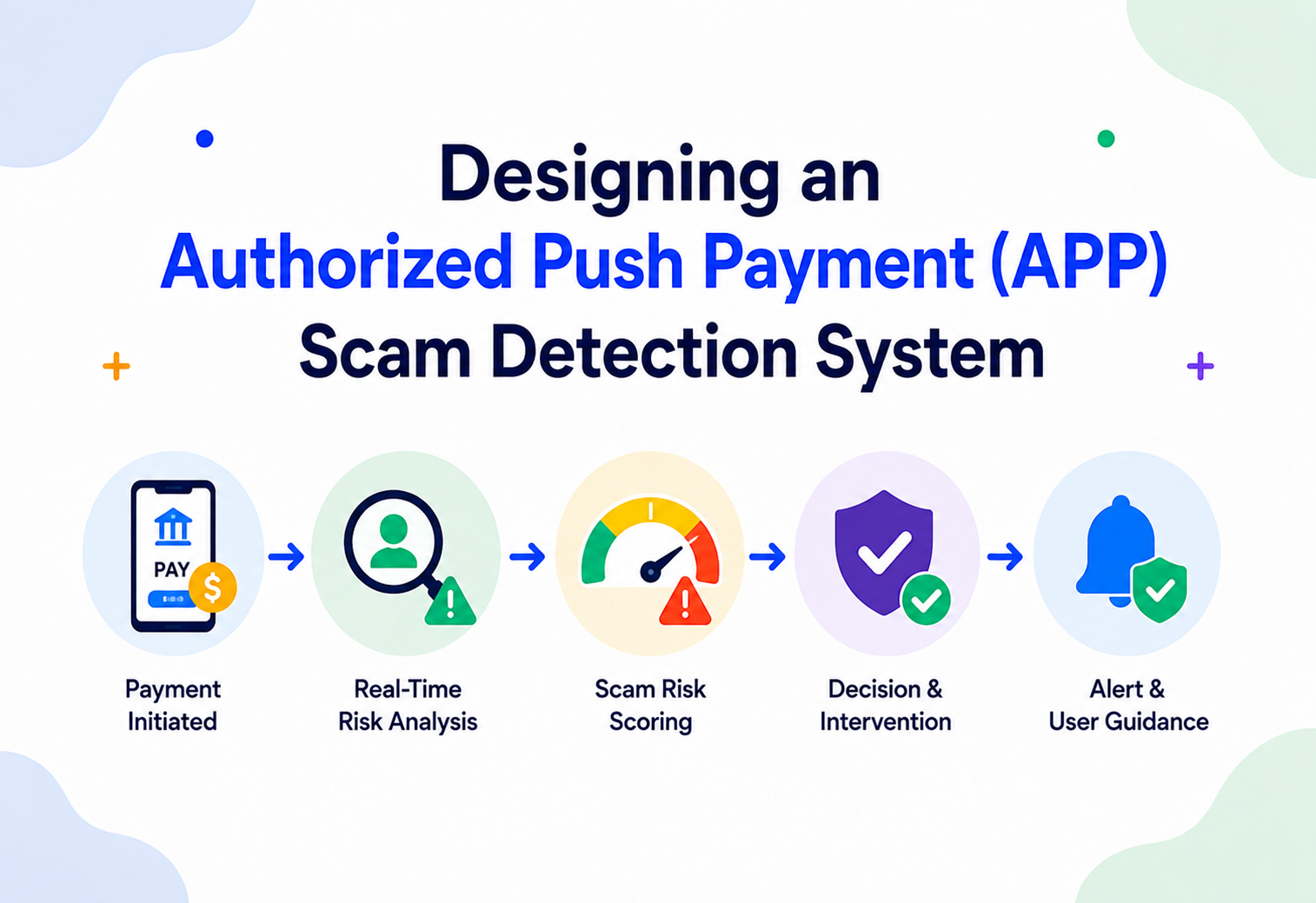
Designing an Authorized Push Payment Scam Detection System
A complete, beginner-to-production system design walkthrough: how to detect, in real time, when a genuine customer is being manipulated into authorizing their own fraudulent transfer — and how to intervene before the money is irreversibly gone — using behavioural profiling, graph-based payee intelligence, ML risk scoring, and graduated human-in-the-loop friction.
Introduction and History
Most fraud detection systems are built to answer one specific question: is the person initiating this transaction actually the account owner? That question is answered with device fingerprints, passwords, one-time codes, and behavioural biometrics designed to catch an impostor. An Authorized Push Payment scam — often shortened to APP scam or APP fraud — breaks that entire model wide open, because the account owner is genuinely the one pressing “send.” There is no impostor to catch.
The customer has been deceived — by someone posing as their bank’s own fraud team, by a romantic partner they have never met in person, by an “investment manager” promising outsized returns, by a fake landlord, or by a scammer impersonating the police or a government agency — into believing that sending money is the safe, correct, or necessary thing to do. Every authentication check passes cleanly; every security control does exactly what it was built to do; and yet the money still leaves for a criminal. That is what makes APP fraud one of the hardest problems in modern financial systems to solve well.
This category of fraud has grown explosively over the last decade alongside the rise of instant, irrevocable bank transfers. Faster payment rails — real-time payment schemes now common across the UK, EU, India, and elsewhere — were built to move money in seconds rather than days, which is a huge convenience for legitimate payments and an equally huge gift to scammers. A payment that used to take three days to clear (leaving a window for a bank to notice and reverse it) now settles before anyone has a chance to intervene at all. Regulators noticed the pattern first in the UK, where APP fraud losses came to rival or exceed traditional unauthorized fraud (card theft, account takeover) in scale, which eventually led to mandatory reimbursement rules that put direct financial liability on banks for failing to detect and prevent these scams — turning “can we detect this” from a nice-to-have fraud-prevention feature into a regulatory and balance-sheet imperative that boardrooms track directly.
This tutorial designs a real-time system that sits inside the payment initiation flow of a financial platform and asks a fundamentally different question than classic fraud detection: not “is this really the account owner,” but “does this look like a genuine customer who has been manipulated into sending this money?” — and, when the answer is yes, intervenes before the payment becomes irreversible.
“How is this different from a standard fraud detection system?” Standard fraud detection largely answers an identity question (is this the real account holder, using the real device, in the expected location). APP scam detection assumes identity is correct and instead models intent and context — is this specific payment, from this specific account holder, consistent with a scam pattern, even though every authentication check passes cleanly. This shifts the whole signal set from “verify who is at the keyboard” to “understand what has been happening to the person at the keyboard over the last few minutes, hours, and weeks.”
1.1 From Card Fraud to Manipulation Fraud
It is worth being explicit about how the industry arrived here. A decade ago, unauthorized card fraud dominated financial crime reporting: stolen card numbers, cloned magnetic stripes, and account takeovers driven by password reuse and phishing. The industry responded with EMV chips, 3-D Secure, tokenisation, device fingerprinting, and behavioural biometrics — each layer making impersonation measurably harder. Criminals, unable to easily pretend to be the customer, shifted to a strategy that side-steps the entire authentication stack: convince the real customer to send the money themselves. That shift is not a small change in tactics; it is a fundamental change in the shape of the problem, and it is why systems built purely around “catch the impostor” have started to miss an ever-larger share of real financial losses to consumers.
1.2 A Short Timeline of APP Scam Detection
Pre-2010 — Multi-Day Settlement, Reversible Payments
Bank transfers commonly took two to three business days to clear, giving banks a natural window during which suspicious payments could be flagged, held, or reversed by an investigator noticing a pattern after the fact.
2010s — Faster Payment Rails Everywhere
The UK’s Faster Payments Service, India’s UPI, the EU’s SEPA Instant, and comparable schemes globally shrink settlement time from days to seconds. Payment convenience explodes, but so does the criminal opportunity: a scam payment now clears before any human can plausibly notice it.
Late 2010s — The Rise of Manipulation Scams
Romance scams, investment scams, and impersonation scams (fake bank, fake police, fake courier) grow rapidly. APP fraud losses at UK banks come to rival or exceed traditional unauthorized fraud, catching both banks and regulators off guard.
2019–2023 — Confirmation-of-Payee and Voluntary Codes
Industry-level controls such as Confirmation-of-Payee name-matching, and voluntary reimbursement codes for scam victims, become baseline expectations, feeding structured payee-side risk signals directly into bank-side scoring pipelines.
Today — Mandatory Reimbursement, ML at the Core
Regulators in several markets make reimbursement of APP-scam victims mandatory under defined conditions, putting direct balance-sheet pressure on both sending and receiving institutions and driving investment into ML-based, context-aware, graduated-friction detection systems — the exact class of system this tutorial walks through end to end.
Problem and Motivation
Before designing anything, it is worth carefully unpacking what makes this problem genuinely difficult, and different from most other detection problems covered elsewhere in this tutorial series.
2.1 What We Are Building
A real-time decisioning system, embedded in the payment flow, that scores every outbound transfer for the likelihood that the customer is being scammed, and — depending on that score — allows the payment, inserts friction (a warning, a cooling-off delay, a verification step), or blocks it and routes it to a human fraud analyst, all within the tight time window a payment initiation flow allows.
2.2 Why This Is Hard
- No single “bad” signal exists. Every individual fact about a scam payment — a new payee, a large amount, an urgent tone — is also completely normal for millions of legitimate payments every day (paying a contractor for the first time, buying a car, sending a large gift). The system has to reason about combinations and context, not single flags in isolation.
- Scam typologies evolve constantly and adaptively. Romance scams, investment scams, impersonation scams (fake bank, fake police, fake courier), purchase scams, and invoice/business-email-compromise scams all have different behavioural signatures, and scammers actively coach victims to behave normally and to lie to the bank if questioned — meaning the system cannot simply rely on asking the customer “is everything okay?”
- The intervention itself has to work on a real, distressed human. A generic warning banner that a victim has been coached to click through is worthless. Effective friction has to be specific, hard to dismiss on autopilot, and sometimes needs a live human conversation.
- False positives have a real cost. Blocking or delaying a legitimate, urgent, first-time payment (a house deposit, a medical bill, a business payment with a deadline) causes genuine harm and erodes trust; a system that cries wolf on every large or unusual payment will be ignored or, worse, disabled.
- The decision window is short and shrinking. Instant payment rails settle in seconds; any detection and intervention has to happen inside the payment initiation flow itself, or in a very narrow post-authorization, pre-settlement hold window, not in an overnight batch review.
- Cross-institution visibility is limited. The sending bank can see the victim’s behaviour, but the receiving account (the “mule” account the money lands in) sits at a different institution, which the sending bank has no direct visibility into — unless it participates in cross-bank intelligence sharing.
2.3 Functional Requirements
- Score every outbound payment for APP scam risk in real time, before or immediately after authorization, before funds are irreversibly released.
- Combine transaction attributes, customer behavioural history, session/device signals, payee risk intelligence, and (where available) conversational signals from customer support interactions.
- Apply graduated interventions: allow, soft warning, hard warning with forced pause, mandatory callback/human verification, or block-and-hold pending fraud review.
- Route high-risk cases to a human fraud operations queue with full context for rapid review.
- Support a feedback loop where confirmed outcomes (scam vs. legitimate) retrain and improve the models over time.
- Integrate with cross-bank mule-account and scam-intelligence data sharing where available.
- Produce an auditable, explainable record of every decision for regulatory and dispute purposes.
2.4 Non-Functional Requirements
- Latency: a risk decision must be available within the payment initiation flow, typically under 300–500 ms for the automated scoring step, so it does not visibly slow down the vast majority of legitimate payments.
- Scale: capable of scoring millions of payments per day across a large retail banking population, with traffic peaking around paydays and end-of-month cycles.
- Precision under class imbalance: genuine scam payments are a tiny fraction of total volume, so the system must be tuned and evaluated for extreme class imbalance, not generic accuracy.
- Explainability: every block or friction decision must be explainable in terms a fraud analyst, an auditor, and eventually a regulator can understand — “black box” scores alone are not sufficient.
- Adaptability: new scam typologies must be detectable within days of emerging, not months, given how quickly scam scripts evolve and spread across the criminal ecosystem.
This design focuses on detection and intervention at the sending institution. It intentionally does not cover the separate (and equally important) problem of asset recovery once funds have already left the bank — that is a downstream process involving cross-bank fund recall requests and law enforcement, outside the scope of the real-time detection system itself.
“Why can’t we just tighten identity and authentication controls further and be done with it?” A strong answer highlights that APP fraud specifically defeats identity-and-authentication controls by using the real customer as the attack surface. No amount of stronger login security helps when the account holder is voluntarily typing in the payment details themselves — the problem is not who is at the keyboard but why.
Architecture and Components
The system is organized around a real-time decisioning core, fed by several independent signal sources, wrapped by an intervention layer that actually changes what the customer experiences, and backed by a human review and feedback loop that keeps the models honest over time.
3.1 Component-by-Component Explanation
Payment Orchestration Service
The entry point for any outbound transfer, regardless of channel (mobile app, web, call center, branch). It is responsible for pausing the payment flow just long enough to obtain a risk decision from the Risk Scoring Engine before letting the payment proceed to settlement, and for enforcing whatever intervention the Decision Orchestrator returns.
Real-Time Risk Scoring Engine
The computational core. On every payment initiation event, it pulls together features from the customer’s behavioural history, evaluates deterministic rules, runs one or more machine learning models, and incorporates payee-side and (where available) conversational risk signals, producing a single risk score and a set of contributing reason codes.
Customer Behaviour Feature Store
A continuously maintained profile per customer: typical payment amounts and frequency, established payee list and how long each payee has been known, typical times and channels used, device and location history, and recent account activity (e.g., a large incoming deposit followed shortly by an outgoing transfer — a very common precursor to investment and romance scams). This is conceptually similar to the materialized-profile pattern used in general fraud detection, but tuned specifically toward the behavioural precursors of manipulation-based fraud rather than identity fraud.
Rules Engine
Encodes deterministic, explainable heuristics and regulatory-mandated checks — for example, “first payment to a new payee, above a threshold amount, initiated within minutes of a Confirmation-of-Payee name mismatch being overridden by the customer.” Rules are fast, fully explainable, and easy for regulators and auditors to reason about, and they act as a safety net that does not depend on a model having seen a similar pattern before.
ML Scam Propensity Model
A learned model (or ensemble of models) trained on historical confirmed-scam and confirmed-legitimate outcomes, designed to catch the subtler, higher-dimensional patterns that fixed rules miss — combinations of dozens of weak signals (payee account age, time-of-day, session hesitation patterns, deviation from the customer’s own historical behaviour) that in combination indicate elevated risk even when no single rule fires.
Payee / Mule Account Intelligence Service
Assesses the risk of the receiving account itself: has this account been flagged by other institutions as a suspected mule account, was it opened very recently, has it received an unusual concentration of first-time inbound payments from many different unrelated senders (a classic mule-account fan-in pattern). This service typically draws on cross-bank intelligence sharing consortiums where the sending bank alone would have no visibility into the receiving account’s history.
Conversation Signal Service
An optional but powerful layer that applies natural-language analysis to customer support chat and call transcripts (with appropriate consent and privacy safeguards) to detect coaching language and scam-typology indicators — phrases suggesting the customer believes they are moving money to “protect” it, or repeating back instructions attributed to a third party. This service produces a risk signal that feeds into the same scoring pipeline as transactional signals.
Decision Orchestrator
Combines the rules output, the ML score, the payee risk signal, and any conversational signal into a single graduated decision, and is the one component responsible for translating a numeric risk score into a concrete action: allow, soft friction, hard friction, or block-and-escalate.
Friction / Intervention Layer
Responsible for actually changing the customer’s experience: rendering a specific, typology-matched warning (not a generic “are you sure?”), enforcing a mandatory cooling-off delay before the payment can be confirmed, or triggering a live callback from a fraud specialist.
Fraud Ops Case Management
A queue and workspace for human fraud analysts to review high-risk cases with full context — the customer’s history, the specific signals that fired, the payee’s risk profile — and make a final call within a tight time window, since the payment is on hold awaiting their decision.
Feedback and Retraining Pipeline
Captures the eventual outcome of every scored payment (confirmed scam, confirmed legitimate, or unresolved) and feeds it back into periodic model retraining, so the system’s understanding of what a scam looks like keeps pace with evolving scam typologies rather than steadily drifting out of date.
“Why use both a rules engine and an ML model, rather than just one or the other?” Rules provide fast, fully explainable, regulator-friendly coverage for known, well-understood patterns and can be deployed within hours of a new scam typology being identified. ML models catch subtler, higher-dimensional combinations of weak signals that would require an impractically large and brittle set of hand-written rules to approximate, and they generalize better to variations of known scam patterns. Running both in parallel, and combining their outputs, gives you the explainability and speed of rules plus the pattern-recognition power of ML, without depending entirely on either.
Internal Working
The internal logic of this system centres on one core idea: a payment’s risk cannot be judged from the transaction alone. It has to be judged against the customer’s own established behaviour, against what is known about the receiving account, and — where available — against what the customer has actually said about why they are sending the money.
4.1 Feature Categories
The scoring engine draws on four broad feature families, each capturing a different dimension of scam risk:
- Behavioural deviation features — how far this payment deviates from the customer’s own history: is this payee new, is the amount far outside their typical range, is the time of day or channel unusual for them specifically. These are computed relative to each individual customer’s baseline, not a population-wide average, since “normal” varies enormously between customers.
- Payee/destination features — signals about the receiving account: how recently was it opened, how many unrelated senders have sent it first-time payments recently (fan-in pattern typical of mule accounts), has it been flagged by the cross-bank intelligence consortium, did a Confirmation-of-Payee name-match check fail or get overridden by the customer.
- Session and contextual features — signals from the digital session itself: was there a recent password reset or new device registration, is there evidence of screen-sharing or remote-access software (common in impersonation scams where a fraudster “helps” the victim navigate their banking app), unusual navigation patterns suggesting hesitation or being talked through steps by someone else.
- Conversational features — where the customer has interacted with a call center or chat channel around the time of the payment, NLP-derived signals indicating scam-coaching language, urgency framing, or third-party instruction narratives.
4.2 Combining Rules and Model Scores
The Rules Engine and the ML model run independently and in parallel against the same feature set, rather than one feeding into the other sequentially — this means a slow-changing or briefly unavailable ML model never blocks the deterministic rules from firing, and vice versa. The Decision Orchestrator then combines both outputs, typically using a layered approach: certain rules are treated as hard overrides (an unambiguous, high-confidence pattern triggers a block regardless of what the model says), while everything else is blended into a single continuous risk score that maps to a graduated response tier.
4.3 Graduated Response Tiers
Rather than a binary allow/block decision, the Decision Orchestrator maps the combined risk score onto a small number of graduated response tiers, each with a specific, escalating action:
- Low risk — payment proceeds with no visible friction.
- Elevated risk (soft friction) — a specific, typology-matched warning is shown (for example, referencing investment scams if the payee and pattern match that typology), with a simple acknowledgment required to continue.
- High risk (hard friction) — a mandatory cooling-off delay is enforced (funds are not released for a fixed period, commonly used for suspected romance or investment scams where victims benefit from time and distance from the pressure), and the customer may be required to complete a short, deliberately-worded confirmation flow designed to interrupt autopilot behaviour rather than simply be dismissed.
- Critical risk (block and escalate) — the payment is held entirely, routed to a human fraud analyst, and the customer is proactively contacted, often by phone, before the payment is either released or permanently stopped.
4.4 Why Graduated Friction Matters More Than a Single Threshold
A system with only two outcomes — allow or block — forces an impossible trade-off: a threshold loose enough to avoid blocking large numbers of legitimate payments will also let through a large share of real scams, while a threshold tight enough to catch most scams will block an unacceptable number of legitimate customers. Graduated friction breaks this trade-off by giving the system a middle path: for the large population of medium-risk payments, insert enough friction to interrupt a scam in progress (a warning a genuine customer shrugs off in five seconds, but a manipulated victim — often coached to rush — may pause on) without fully blocking a payment that turns out to be legitimate.
4.5 Handling the “Coached to Lie” Problem
Scammers frequently coach victims in advance to answer bank security questions in specific ways — to say the payment is for a legitimate purpose, to deny being pressured if asked directly. This is precisely why the system cannot rely solely on self-reported answers during a friction step. Effective warning content is designed around this reality: rather than asking “has someone told you to make this payment,” typology-matched warnings state specific, verifiable facts about how the relevant scam works (e.g., “your bank will never ask you to move money to a ‘safe account'”) that a genuine legitimate payment simply does not trigger any anxiety about, while giving a coached victim new information their coach did not prepare them for.
“If scammers coach victims to lie during verification, how can any friction step actually work?” By shifting from asking the customer to self-report intent (which a coached victim will answer incorrectly) to presenting specific, factual, typology-matched information the victim likely has not been prepared to counter, and by using behavioural signals (hesitation, re-reading the warning, contacting support) rather than the customer’s stated answer as an input back into the risk score.
4.6 Modelling Scam Typologies as Distinct Sub-Problems
Not all APP scams look alike, and a single generic “scam score” tends to underperform a design that explicitly recognizes distinct typologies, each with its own characteristic signal pattern. Romance scams typically unfold over weeks or months, with a slowly built relationship followed by an escalating series of payments, often framed as helping someone through a hardship or funding a trip to finally meet in person — the behavioural signature is less about a single large payment and more about an escalating pattern across many payments to the same relatively new payee. Investment scams often follow a very different arc: a large initial deposit into what looks like a trading or crypto platform, sometimes preceded by a small “test” withdrawal that appears to succeed (to build the victim’s confidence), followed by increasingly large transfers as the victim is convinced their returns are growing. Impersonation scams (a fraudster posing as the bank’s own fraud team, the police, or a government agency) tend to be fast-moving and urgent, often involving the victim being instructed to move money to a “safe account” within minutes, frequently while remaining on a phone call with the scammer throughout the banking session. Purchase scams (a fake seller for a car, concert tickets, or a rental property) typically involve a single payment to a brand-new payee for an amount that roughly matches a public listing price. Because each typology has a distinguishable shape, the ML model is often structured as a multi-headed or typology-aware classifier — predicting not just a single risk score but a likely typology alongside it — which then allows the Friction Layer to select warning content specific to that typology rather than a one-size-fits-all message.
4.7 The Role of Velocity and Escalation Patterns
Beyond any single payment, the system tracks velocity patterns across a customer’s recent payment history: a sequence of payments to the same new payee with increasing amounts, or a rapid succession of transfers shortly after a large balance increase, are both strong precursors regardless of typology. These sequence-level features require the Feature Store to maintain not just point-in-time snapshots but short rolling windows of recent activity, so the scoring engine can recognize an escalating pattern building across several payments, not only flag any single payment in isolation.
Data Flow and Lifecycle
To make the architecture concrete, let us walk through three separate lifecycles the system has to support smoothly: the common low-risk case, the high-risk case that triggers hard friction, and the escalated human-review case that ends with a labelled outcome feeding retraining.
5.1 Lifecycle: A Payment Scored as Low Risk (the Common Case)
- Customer initiates a payment through any channel.
- Payment Orchestration Service emits a payment initiation event and requests a risk decision synchronously.
- Risk Scoring Engine pulls the customer’s behavioural profile from the feature store, evaluates rules, scores with the ML model, and checks payee risk — all in parallel.
- Decision Orchestrator combines the signals; risk is low; no friction is applied.
- Payment proceeds to settlement through the normal payment rail.
- The scoring event and outcome (no intervention triggered) are logged for later analysis, even though nothing changed for the customer.
5.2 Lifecycle: A Payment Scored as High Risk
- Same initial steps, but the combined score crosses the high-risk threshold.
- Decision Orchestrator returns a hard-friction action; Payment Orchestration Service holds the payment and instructs the client app to display a typology-matched warning and enforce a cooling-off delay.
- Customer behaviour during the delay (do they cancel, do they contact support, do they re-attempt immediately after the delay expires) is captured as an additional signal and can escalate the case further.
- After the delay, the customer must actively re-confirm; this re-confirmation event is re-scored (not simply auto-approved), since new signals may have emerged during the delay window (for example, a support interaction with coaching language detected by the Conversation Signal Service).
- If the re-scored risk remains high, the case escalates to a human fraud analyst rather than proceeding automatically.
5.3 Lifecycle: Human Review and Case Resolution
5.4 Lifecycle: Cross-Bank Mule Account Intelligence
When a case is confirmed as a scam, the receiving account details are contributed (subject to data-sharing agreements and privacy regulation) to the shared consortium intelligence pool, so that other banks scoring payments toward the same receiving account benefit from this institution’s finding — and vice versa. This lifecycle operates on a slower, batched cadence than the real-time scoring path, but its output (the payee risk signal) is consumed synchronously by every institution’s real-time scoring engine, making it one of the highest-leverage signals in the entire system precisely because no single bank can see a mule account’s full fan-in pattern on its own.
Advantages, Disadvantages and Trade-offs
Every design choice in this system carries a specific trade-off, and being explicit about them — instead of pretending they do not exist — is essential to defending the design in both an interview room and a regulator’s audit.
| Design Choice | Advantage | Trade-off |
|---|---|---|
| Graduated friction instead of binary allow/block | Balances scam prevention against customer experience and false-positive harm | More complex to design, tune, and explain than a single threshold |
| Parallel rules + ML scoring | Combines explainability with pattern-recognition power; resilient to either component’s failure | Requires careful design of how the two outputs are combined and reconciled |
| Cross-bank mule account intelligence | Dramatically improves detection of the receiving side of a scam, which a single bank cannot see alone | Depends on external data-sharing agreements, consortium participation, and legal/privacy frameworks |
| Conversational NLP signals | Captures scam-coaching evidence that transactional data alone would miss | Requires careful privacy and consent handling, and only covers customers who interact with support channels |
| Human-in-the-loop for high-risk cases | Catches nuance and context automated systems miss; provides accountability for a block decision | Limited by fraud-ops staffing capacity; can become a bottleneck at scale or during scam spikes |
| Typology-matched warning content | Interrupts a coached victim with new, specific information their coach did not prepare them for | Requires per-typology content curation and ongoing rewriting as scam scripts evolve |
| Shadow-mode deployments for rule/threshold changes | Prevents a misconfigured change from causing immediate scam losses or legitimate-customer harm | Slows the rollout of urgent responses to newly observed typologies compared with direct deployment |
The central trade-off running through the entire design is friction versus freedom. Every point of intervention that increases the odds of stopping a real scam also increases the odds of inconveniencing, delaying, or upsetting a legitimate customer making an unusual but genuine payment. The graduated-tier approach exists specifically to manage this trade-off continuously rather than resolve it with one fixed threshold — but it can never eliminate it, and tuning where each tier’s boundary sits is as much a risk-and-customer-experience policy decision as it is a modelling problem.

Where This Design Shines
- Detecting manipulation-based fraud that identity-focused controls structurally miss
- Adapting quickly to newly observed typologies via rule updates alongside slower model retraining
- Providing a defensible, auditable trail for each decision, satisfying regulators and disputes
- Sharing risk intelligence across institutions to see patterns no single bank could see alone
Where It Struggles
- Sophisticated victims who have already been fully coached to ignore every friction cue
- Very first-time customers with almost no behavioural baseline to compare against
- Cross-border scams involving receiving institutions outside any shared consortium
- Highly targeted, low-volume scam scripts that never accumulate enough data to train against
Performance and Scalability
Because this system sits synchronously inside the customer’s payment initiation flow, its performance and scaling properties directly shape the customer experience for every payment on the platform — not just for the tiny fraction that end up being scored as high risk.
7.1 Meeting the Latency Budget
The Risk Scoring Engine’s biggest constraint is that it sits synchronously in the payment initiation path for the majority of payments, which means its total latency budget — feature lookup, rules evaluation, ML inference, payee risk lookup, and decision combination — must fit within a few hundred milliseconds to avoid noticeably slowing down the customer experience for the overwhelming majority of low-risk payments. This is achieved by running the rules engine, the ML model, and the payee intelligence lookup concurrently rather than sequentially, and by ensuring the customer behavioural profile is served from a low-latency feature store (precomputed and continuously updated, never computed on the fly from raw transaction history at request time).
7.2 Precomputing the Behavioural Profile
Just as a materialized view avoids recomputing an expensive aggregate on every read, the customer behavioural profile (average payment size, established payee list, typical channel and timing patterns) is maintained incrementally as a streaming computation over the customer’s transaction history, so that a risk-scoring request never has to scan raw historical transactions — it simply reads an already-current profile.
7.3 Scaling ML Inference
The ML model is served through a dedicated low-latency inference layer, typically with models kept warm in memory across a horizontally scaled fleet, partitioned to handle peak traffic (paydays, month-end, and known high-volume periods) without cold-start latency spikes. Feature computation for the model is designed to reuse the same precomputed behavioural profile used by the rules engine, avoiding duplicate feature engineering pipelines that could silently drift out of sync with each other.
7.4 Handling the Conversation Signal Path Asynchronously
Unlike transactional and behavioural features, NLP analysis of a customer support conversation is comparatively expensive and does not always need to block the initial payment decision — it is often computed asynchronously and, when it produces a high-risk signal, can trigger a re-score or an escalation even for a payment that already received an initial low-risk decision, rather than being forced into the synchronous critical path for every payment.
7.5 Handling Scam-Spike Scenarios
Certain events (a widely publicized data breach, a new scam script going viral) can cause a sudden, correlated spike in scam attempts across many customers simultaneously, which is very different load-wise from steady-state fraud traffic. The system needs headroom not just in raw request throughput but in fraud-ops review capacity — a spike in high-risk-tier cases that outpaces analyst capacity is exactly the situation graduated friction with automated cooling-off delays exists to buy time for, reducing pressure on the human review bottleneck during a spike.
synchronous path
large retail bank scale
new emerging typology
“What happens if the ML model service is slow or unavailable when a payment needs to be scored?” The Decision Orchestrator should never let a single component’s unavailability silently default to “allow” for a high-value payment. A well-designed fallback applies a more conservative rules-only decision (potentially defaulting to a higher friction tier than usual) when the ML signal is missing, rather than either blocking all payments or silently skipping the missing signal — the fallback policy itself should be an explicit, tested part of the design, not an accident of how the code happens to handle a timeout.
High Availability and Reliability
Reliability here is not just a service-uptime property. Failing open lets a scam through; failing closed blocks a legitimate customer at the moment they most need to move money. Both directions of failure carry real, measurable harm, which shapes every reliability decision in this system.
8.1 No Single Point of Failure in the Decision Path
Because a failure in this system has real financial and safety consequences in both directions — failing open lets a scam through, failing closed blocks legitimate payments — every component in the scoring path is deployed with redundancy, and the Decision Orchestrator has an explicit, tested fallback policy for every possible partial failure (rules engine down, ML model down, payee intelligence service down, feature store degraded).
8.2 Circuit Breakers with Conservative Fallbacks
Each external dependency the Risk Scoring Engine calls (the payee intelligence service, the conversation signal service) is wrapped in a circuit breaker. Critically, the fallback behaviour when a circuit breaker trips is not simply “skip this signal” — for a component as consequential as payee risk intelligence, a fallback might instead apply a slightly elevated default friction tier for new-payee payments until the dependency recovers, reflecting the fact that the missing signal specifically increases uncertainty about risk.
8.3 Consistency Requirements for the Feature Store
The customer behavioural profile needs to be current enough to reflect very recent activity (a large inbound deposit ten minutes ago is highly relevant context for an outbound transfer happening now), which means the streaming pipeline maintaining it needs low end-to-end lag and cannot rely on a nightly batch refresh. At the same time, brief staleness (a few seconds) is tolerable, so this store favours availability and low latency over strict consistency, consistent with how a fast-changing behavioural signal should be treated.
8.4 Idempotency and Duplicate Payment Events
Payment initiation events, like any distributed event, can be delivered more than once due to retries. The Payment Orchestration Service and Risk Scoring Engine both treat payment events idempotently, keyed by a unique payment intent identifier, so that a retried event never triggers a duplicate risk decision or a duplicate hold on funds.
8.5 Fraud Ops Capacity as a Reliability Concern
Reliability in this system is not purely a software property — the human review queue is itself a resource that can become unavailable under load in the same way a service can. Capacity planning for fraud operations staffing, and automated tier-based prioritization within the queue (the highest-confidence, highest-value cases reviewed first), are treated as first-class reliability concerns, not just an operational afterthought.
Security
The data this system handles — behavioural profiles, support-conversation content, cross-institution flags — is unusually sensitive even by financial-services standards, which raises the bar on every security decision it makes.
9.1 Protecting Behavioural and Conversational Data
The customer behavioural profile and conversation transcripts analyzed by the NLP service are highly sensitive — they can reveal financial distress, relationships, and personal circumstances well beyond the payment itself. Access is restricted to the services and personnel that genuinely need it (the scoring engine and fraud analysts working an escalated case), encrypted at rest and in transit, and subject to strict retention limits rather than indefinite storage.
9.2 Consent and Privacy for Conversational Analysis
Analyzing customer support conversations for scam-coaching signals requires a clear legal and consent basis, appropriate for the jurisdiction the platform operates in, and should be scoped narrowly to fraud-prevention purposes rather than general behavioural profiling. Transparency with customers about this kind of monitoring (even in general terms, without revealing detection specifics that scammers could exploit) is both a trust consideration and, in many jurisdictions, a legal requirement.
9.3 Protecting the Models and Rules from Adversarial Probing
Because scammers actively adapt their scripts, there is a real risk of adversaries probing the system to learn what triggers friction and what does not — for example, by testing many small payment patterns to a mule account to find amounts that fly under detection thresholds. Rate limiting and anomaly detection on unusual probing-like patterns (many small test transactions from related accounts, systematic threshold-testing behaviour) are themselves signals fed back into the risk model, and thresholds and rule logic are treated as sensitive, access-controlled configuration rather than something visible even internally to broad engineering teams.
9.4 Explainability Versus Signal Secrecy
There is an inherent tension between the explainability required for regulators and customer disputes, and the operational security risk of revealing exactly which signals and thresholds trigger detection, which scammers could use to evade the system. This is managed by separating two audiences: regulators and internal fraud teams get full, detailed reason codes for any decision; customer-facing warning content is deliberately generic about the underlying detection logic while still being specific about the scam typology itself, so it protects the victim without handing scammers a blueprint.
9.5 Access Control for Fraud Operations Tooling
Fraud analysts working escalated cases have access to sensitive customer data (transaction history, behavioural profile, conversation content) through purpose-built, audit-logged tooling, with every access to a customer’s case recorded, since fraud operations access is itself a meaningful insider-risk surface in a financial institution.
“How would you prevent an insider (an employee) from misusing the fraud detection system’s data or from tipping off a scammer?” Enforce least-privilege, purpose-scoped access to case data with full audit logging of every record accessed; require access to be tied to an actively assigned case rather than open browsing; and monitor access patterns themselves for anomalies (an employee accessing an unusual volume of unrelated cases) using the same anomaly-detection philosophy the system applies to customers.
9.6 Data Minimization in Cross-Institution Sharing
Contributing confirmed scam and mule-account intelligence to a cross-bank consortium necessarily involves sharing sensitive data across institutional boundaries, which raises its own privacy and security surface distinct from any single institution’s internal data handling. Well-designed consortium integrations share the minimum necessary information to identify risky accounts (account identifiers, risk flags, typology tags) rather than full transaction detail or customer personal information, often using privacy-preserving techniques such as hashed identifiers so that participating institutions can match against a shared risk list without directly exposing raw account numbers to every other participant. Governance of who can contribute data, who can consume it, and how disputes over incorrectly flagged accounts are resolved is as important to get right as the technical integration itself.
9.7 Protecting Against False-Flagging Abuse
Because a mule-account flag from one institution can influence risk decisions at many others, the integrity of the flagging process itself needs safeguarding — both against honest errors (an account incorrectly flagged based on a false-positive internal investigation) and against deliberate abuse (a bad actor attempting to get a competitor’s legitimate customer wrongly flagged). This is typically addressed with a confidence-weighted intelligence model, where flags carry a source-institution confidence level and an expiry, and a dispute/correction process exists for accounts to be cleared once new evidence emerges.
Monitoring, Logging and Metrics
Monitoring for this system means watching two very different populations at once: the scam attempts you managed to stop, and the legitimate customers you accidentally interrupted — and neither number, on its own, tells you whether the system is working.
10.1 Metrics That Matter for This System
- Detection rate (recall) on confirmed scam cases — the fraction of eventually-confirmed scams that were flagged at any friction tier, tracked by scam typology, since detection rates often vary significantly across romance, investment, impersonation, and purchase scams.
- False positive rate by tier — how often each friction tier is applied to payments later confirmed legitimate, since this directly measures customer-experience cost.
- Scoring latency — end-to-end time from payment initiation to decision, tracked as a percentile distribution, since this system sits synchronously in a customer-facing flow.
- Fraud ops queue metrics — case volume, time-to-first-contact, time-to-resolution, and queue backlog, since a growing backlog directly increases the window during which a scam payment could otherwise settle.
- Model and rule drift indicators — tracking whether the distribution of triggering signals is shifting over time, an early warning that a new scam typology may be emerging that existing rules and models do not yet capture well.
10.2 Explainable Decision Logging
Every scored payment logs not just the final decision but the full set of contributing reason codes and feature values at the time of decision — this is essential both for the human fraud analyst reviewing an escalated case and for after-the-fact regulatory review or customer dispute resolution, where the institution needs to demonstrate what it knew and why it acted (or did not act) at the time.
10.3 Feedback Loop Monitoring
Because the entire system depends on eventually-labelled outcomes (confirmed scam vs. confirmed legitimate) to retrain and improve, the health of the feedback loop itself is monitored — how many cases remain unresolved beyond an expected window, and whether labelling delays are creating a lag between when a new scam pattern emerges and when the models actually learn from it.
10.4 Alerting on Typology Spikes
Beyond standard system-health alerting, this platform alerts specifically on sudden increases in a particular scam typology’s confirmed rate — a spike in confirmed investment scams within a short window, for example, is both an operational signal (fraud ops may need extra staffing) and a modelling signal (existing detection may be missing a new variant of that typology).
Deployment and Cloud
Deployment for this system is dominated by one non-negotiable principle: an untested change to detection logic can translate into either a spike in scam losses or a spike in legitimate customer harm within hours — so every change is proven before it is trusted.
The Risk Scoring Engine and Decision Orchestrator are deployed as horizontally scaled, stateless services behind the Payment Orchestration Service, with the ML inference layer scaled independently given its distinct resource profile (memory and, where applicable, GPU/accelerator needs for larger models) compared to the largely CPU-bound rules engine.
Given the regulatory sensitivity of this system, deployments follow a strict canary and shadow-mode discipline: any change to rules, model versions, or friction-tier thresholds is first run in shadow mode — scoring live traffic and logging what decision it would have made, without actually affecting the customer — for a defined evaluation period, compared against the currently live version’s outcomes, before being promoted to make live decisions. This is arguably more important here than in almost any other system in this tutorial series, because an untested change to thresholds can directly translate into either a spike in scam losses or a spike in legitimate customer harm within hours of deployment.
The system is typically deployed within the institution’s own regulated environment (rather than a general-purpose public cloud region shared broadly) given data residency and financial-services compliance requirements, with the cross-bank intelligence integration handled through a dedicated, heavily governed connection to the consortium’s data-sharing infrastructure rather than a general internet-facing API.
11.1 Progressive Rollout for Threshold and Rule Changes
Beyond standard canary deployment for code changes, this system needs a parallel, slower-moving rollout process specifically for risk thresholds and rule configuration, since these are often adjusted more frequently than the underlying code by fraud strategy teams rather than engineers. A configuration-as-code approach — where threshold and rule changes go through the same review, shadow-mode evaluation, and staged rollout discipline as a code deployment, rather than being adjustable through an unaudited admin panel — keeps this operationally fast for the fraud team while preserving the auditability regulators expect.
11.2 Regional and Regulatory Variation
Institutions operating across multiple regulatory jurisdictions often need meaningfully different rule sets, reimbursement policies, and consortium integrations per region, since APP scam regulation (mandatory reimbursement rules, data-sharing frameworks, consumer protection requirements) varies significantly by country. The deployment architecture typically isolates region-specific configuration and consortium connections behind a common core scoring engine, so that the shared detection logic can be reused globally while region-specific policy and legal requirements are layered on top rather than duplicated into separate systems per region.
Databases, Caching and Load Balancing
Different parts of this system have very different data-access shapes — low-latency behavioural lookups, graph-shaped payee queries, transactional case management, and cross-service caching — so no single storage technology fits all of them well.
12.1 Behavioural Profile Store
The customer behavioural feature store favours a low-latency key-value or wide-column store, read on nearly every payment (a very high read-to-write ratio), updated incrementally by a streaming pipeline processing the customer’s own transaction and session events — architecturally similar to the fast-read materialized-profile pattern used broadly across real-time fraud and risk systems.
12.2 Payee Risk and Mule Account Intelligence Store
Payee-side risk data is naturally modelled as a graph — accounts, the payments flowing between them, and shared attributes (device fingerprints, IP ranges) that link seemingly unrelated accounts together. A graph database, or a graph-oriented layer over a more general store, is well suited to answering questions like “how many unrelated first-time senders has this account received from in the last 30 days,” which is exactly the kind of fan-in pattern that flags a mule account.
12.3 Case Management Store
Fraud ops case data — the queue of escalated payments, analyst notes, contact attempts, and final outcomes — is a relatively low-volume, transactional workload well suited to a standard relational store, prioritizing strong consistency (a case should never be picked up by two analysts simultaneously) over raw throughput.
12.4 Caching Strategy
Payee risk lookups and behavioural profile reads are both cached aggressively given how frequently the same payees and customers recur across payments, using short TTLs appropriate to how quickly each signal can meaningfully change — payee risk intelligence changes on the order of hours as new consortium data arrives, while a customer’s own behavioural profile can meaningfully change within minutes after a large transaction.
12.5 Load Balancing
Standard request-based load balancing across the stateless scoring services is sufficient for this system, since — unlike a system with long-lived client connections — every risk decision is a single, self-contained request-response interaction, with no need for connection-aware or sticky routing.
APIs and Microservices
The API surface exposed by this system is deliberately narrow — four externally visible endpoints only — while its internal service topology is deliberately fine-grained, so each internal service can evolve, scale, and fail independently of the others.
The external-facing surface of this system is intentionally narrow:
- Risk Decision API — called synchronously by the Payment Orchestration Service on every payment initiation, returning a decision, a friction tier, and reason codes.
- Case Management API — used by fraud ops tooling to retrieve, update, and resolve escalated cases.
- Outcome Feedback API — used to record the eventual confirmed outcome of a scored payment, feeding the retraining pipeline.
- Consortium Intelligence API — a tightly governed integration point for contributing to, and consuming from, cross-bank mule account intelligence.
Internally, the service boundaries follow the same principle used throughout this tutorial series: split along different rates of change and different failure domains. The Rules Engine changes frequently (new rules deployed in response to emerging typologies) and needs to be fast and simple to reason about; the ML model changes on a slower retraining cadence and needs heavier infrastructure; the Payee Intelligence Service depends on an external data-sharing relationship and needs to be isolated so that its availability does not couple tightly to internal service health. Keeping these as separate services, combined synchronously only at the Decision Orchestrator layer, lets each evolve, scale, and fail independently.
Design Patterns and Anti-Patterns
The patterns used in this design are not novel — they are the disciplined re-application of well-understood building blocks — and the anti-patterns to avoid are the ones teams keep re-discovering the hard way.
14.1 Patterns Used
- Ensemble Decisioning — combining independent rules-based and ML-based signals rather than relying on a single model, improving both robustness and explainability.
- Circuit Breaker with Conservative Fallback — every external dependency degrades to a safer, more cautious default rather than silently skipping a missing signal.
- Materialized Profile / Feature Store — the customer behavioural profile is continuously maintained rather than recomputed per request, the same pattern used for fast reads throughout real-time financial systems.
- Human-in-the-Loop Escalation — automated systems handle the volume; humans handle the judgment calls at the tail where context and nuance matter most.
- Shadow Mode Deployment — new models, rules, and thresholds are evaluated against live traffic without affecting real decisions before being promoted, a risk-mitigation pattern especially important for a system with direct financial and customer-harm consequences.
- Feedback Loop / Online Learning Pipeline — confirmed outcomes continuously retrain and improve the models, closing the loop between detection and ground truth.
14.2 Anti-Patterns to Avoid
- Treating this as a standard fraud/identity detection problem. Reusing device-fingerprint and login-anomaly-focused fraud models wholesale, without building behavioural-deviation and payee-intelligence signals specific to manipulation-based scams, will systematically miss APP fraud, since the authenticating identity is genuinely correct.
- A single global risk threshold applied uniformly to all customers. A payment that is wildly unusual for one customer may be completely normal for another; scoring against each customer’s own baseline, not a population-wide average, is essential.
- Relying on the customer’s self-reported answer during a friction step as ground truth. As discussed, coached victims will answer confidently and incorrectly; the friction step should be designed to inform and interrupt, not merely to ask and trust.
- Building the human review queue as an afterthought. A detection system that generates escalations faster than fraud ops can review them does not actually stop fraud — it just relocates the bottleneck; queue capacity and prioritization need to be designed alongside the detection logic itself, not bolted on later.
- Ignoring the receiving side of the payment entirely. A design that only models the sending customer’s behaviour, without any payee/mule-account risk signal, is working with roughly half the available information — receiving-account intelligence is consistently one of the highest-value signals available.
Best Practices and Common Mistakes
The best practices below are the ones that experienced teams keep converging on across very different institutions, and the common mistakes are the ones that keep appearing in post-incident reviews after a preventable scam loss.
15.1 Best Practices
- Design friction content around specific, verifiable facts about how each scam typology actually operates, rather than generic “are you sure” prompts that a coached or rushed victim will dismiss without absorbing.
- Treat every automated decision as needing an explanation a human (analyst, auditor, regulator) can follow, not just a numeric score — reason codes are a first-class output of the system, not a debugging afterthought.
- Invest early in cross-institution mule-account intelligence sharing; the receiving side of a scam payment is information no single bank can fully reconstruct alone, and it is consistently one of the strongest available signals.
- Build the feedback loop and outcome-labelling process before scaling up the model, since a model trained on stale or sparse labelled outcomes will drift out of sync with how scam typologies are actually evolving.
- Run every rule and model change in shadow mode against live traffic before it is allowed to make real decisions, given the direct financial and human-harm consequences of a misconfigured threshold.
- Design the fallback behaviour for every dependency failure explicitly and test it, rather than letting a timeout implicitly determine whether the system fails open or fails closed.
15.2 Common Mistakes
- Optimizing purely for detection recall without tracking the false-positive cost on legitimate customers, leading to a system that technically “works” but gets disabled or bypassed due to customer complaints.
- Underinvesting in the human fraud-ops capacity and tooling needed to actually act on escalated cases within the narrow time window before funds settle irreversibly.
- Building conversational NLP analysis without adequate privacy, consent, and data-minimization safeguards, creating regulatory and trust risk disproportionate to the marginal detection benefit.
- Letting rules and thresholds become sensitive-but-undocumented “tribal knowledge,” making the system hard to audit, hard to hand over to new team members, and hard to defend to a regulator after the fact.
15.3 A Pre-Launch Readiness Checklist
| Check | Question to Confirm Before Launch |
|---|---|
| Fallback Policy | Is there a documented, tested fallback for every scoring-path dependency, and does it explicitly say whether the system fails open, fails closed, or applies elevated friction? |
| Shadow Mode | Have new rules, models, and thresholds been run in shadow mode against live traffic long enough to compare decisions against the currently live version? |
| Explainability | Does every decision emit reason codes rich enough for a fraud analyst, an auditor, and a regulator to reconstruct why the system acted or did not act? |
| Ops Capacity | Is fraud-ops staffing sized against realistic projected escalation volume, including scam-spike scenarios, before launch rather than discovered afterward? |
| Consortium Integration | Have data-sharing, dispute, and correction processes with the cross-bank consortium been reviewed and signed off by legal and compliance? |
| Consent Basis | Is the consent and legal basis for conversational NLP analysis explicit, scoped narrowly, and reviewed by privacy counsel? |
“If you could add only one automated test to this system before shipping, what would it be?” A strong answer is a synthetic-scam-replay test: injecting a known confirmed scam pattern (romance escalation, investment onboarding, impersonation urgency) end-to-end through the full pipeline in a staging environment and asserting the correct friction tier is triggered with the correct typology-matched warning — because that single test directly validates the detection capability the system exists to provide, not just individual component correctness.
Real-World Industry Examples
The design principles above are not theoretical: they are the shape real institutions and regulators have converged on across multiple markets, driven by very concrete scam-loss and reimbursement pressures.
UK Banking & Mandatory Reimbursement
The UK banking market is the most visible real-world driver of this system category, given both the scale of APP fraud losses reported industry-wide and the introduction of mandatory reimbursement requirements that put direct financial liability on sending (and, under the current framework, receiving) institutions for failing to prevent these scams — a regulatory structure that turned APP scam detection from a discretionary fraud-prevention investment into a mandated capability for retail banks operating in that market.
Confirmation-of-Payee as an Industry Control
Confirmation-of-Payee style name-matching checks (verifying that the name on a receiving account matches what the sender expects before a payment is confirmed) emerged directly out of this environment as a foundational, industry-wide control that feeds directly into the kind of risk-scoring pipeline described in this tutorial, providing one of the highest-signal features the Rules Engine and ML model can consume.
Cross-Institution Intelligence Consortia
Payment networks and card schemes globally have invested heavily in shared fraud-intelligence consortiums, reflecting the same core insight this design relies on: no single institution has full visibility into both sides of a scam payment, and pooled, cross-institution intelligence about receiving accounts consistently outperforms any single bank’s internal-only data.
Faster Payment Rails as the Common Substrate
Regardless of geography, the shared driver behind these systems is the same: faster payment rails have made almost every consumer payment effectively irreversible within seconds, so any effective control has to sit inside the initiation flow itself, not in overnight review — and that constraint shows up identically in the design choices banks in the UK, EU, India, Singapore, and Australia have all converged on.
This tutorial’s architecture — a real-time scoring core, graduated friction, human escalation, and cross-institution payee intelligence — reflects the general shape these systems take across the industry, generalized from first principles rather than describing any single company’s proprietary implementation. Where specific institutions differ is largely in operational particulars (which cloud environment, which vendor’s ML tooling, which consortium they participate in), not in the underlying architectural pattern.
Industry-level bodies in the UK regularly publish APP-scam loss statistics running into the hundreds of millions of pounds annually, and reimbursement obligations under recent regulatory changes place a significant share of those losses directly on the sending and receiving institutions — giving a concrete sense of the scale at which real production systems of the shape described in this tutorial operate every single day.
FAQ, Summary and Key Takeaways
The most common questions engineers ask when first approaching this design — followed by a compact summary of everything the tutorial has covered, and the ideas most worth carrying forward into any conversation about manipulation-based financial fraud.
No — the core difference is that traditional fraud detection assumes an impostor is acting, while APP scam detection assumes the account owner genuinely authorized the action but was manipulated into doing so. This shifts the entire signal set from identity verification toward behavioural deviation, payee-side intelligence, and (where available) conversational context.
Because first-time payments to new payees are extremely common for entirely legitimate reasons (paying a new contractor, splitting a bill, buying something from an individual seller), blocking all of them would create unacceptable friction for the vast majority of genuine customers while only marginally improving scam detection — this is exactly why the system scores a combination of signals rather than acting on any single attribute.
Primarily through two counterbalanced metrics tracked together: the share of confirmed scam losses prevented (detection effectiveness) and the false-positive rate experienced by legitimate customers at each friction tier (customer-experience cost) — reporting either metric alone gives a misleading picture of whether the system is actually well-tuned.
No single technical system can eliminate manipulation-based fraud entirely, since it exploits human trust and urgency rather than a technical vulnerability. The realistic goal is to substantially reduce losses and give victims more chances to pause and reconsider, combined with customer education, cross-industry intelligence sharing, and coordination with law enforcement — the detection system is one layer in a broader defence, not a complete solution by itself.
Repeated overrides are themselves a meaningful signal, not something to ignore. A customer who dismisses multiple typology-matched warnings in a short period, especially toward the same or similar payees, should trigger progressively stronger intervention rather than being allowed to simply click through indefinitely — for example, escalating from a self-service warning to a mandatory live conversation with a fraud specialist before the payment can proceed. The system should also distinguish this pattern from a customer who legitimately and repeatedly pays the same trusted new payee (a new landlord, a new contractor across several instalments), where the risk score should naturally decay as a payee relationship becomes established over time.
Even though the sending bank cannot directly control the receiving account, knowing that account has a suspicious profile (very new, high fan-in from unrelated first-time senders, previously flagged by another institution) is one of the strongest available predictors that the specific outbound payment in question is part of a scam, regardless of what the sending customer’s own history looks like. It also enables a genuinely cross-institutional response: a sending bank that detects a high-risk payee can notify the receiving institution, which can freeze or delay the incoming funds on its side even though it has no relationship with the victim — this coordinated response is often more effective than either institution acting alone.
Full automation at the highest risk tier is generally avoided by design, not just due to accuracy limits, but because a block decision that turns out wrong has real consequences (a legitimate, time-sensitive payment failing) and a missed scam has severe consequences for a vulnerable customer — both of which benefit from a human able to gather context an automated system cannot, such as directly asking the customer open-ended questions and listening for hesitation or distress rather than only classifying a fixed answer. Automation’s role at this tier is to prioritize and pre-brief the analyst with the specific evidence, not to replace the analyst’s judgment entirely.
17.1 Summary
This system reframes fraud detection around intent and manipulation rather than identity. It combines fast, explainable rules with pattern-recognition ML models, enriches decisions with payee-side risk intelligence that no single institution can fully see alone, and — critically — replaces a binary allow/block decision with graduated friction designed to interrupt a scam in progress without needlessly obstructing genuine customers. Human fraud analysts remain essential for the highest-risk cases, and a continuous feedback loop keeps the system adapting as scam typologies evolve. Every architectural decision, from parallelizing the signal sources for latency to shadow-mode-deploying every threshold change, exists to manage the same underlying tension: catching more scams without causing more legitimate-customer harm than the scams themselves would.
Key Takeaways
- APP scam detection is a behavioural and contextual problem, not an identity-verification problem — the account owner is genuinely the one authorizing the payment.
- No single signal is reliable on its own; risk must be assessed from combinations of behavioural deviation, payee intelligence, session context, and conversational signals.
- Graduated friction (soft warning, cooling-off delay, mandatory human review) resolves the impossible trade-off a single allow/block threshold creates.
- Payee/receiving-account intelligence, often only available through cross-bank data sharing, is one of the highest-leverage signals since no single institution sees the full picture alone.
- Friction content must be designed around specific, factual, typology-matched information, not generic prompts a coached victim will dismiss.
- Explainability and shadow-mode testing are not optional extras — they are core requirements given the direct financial, regulatory, and human-harm stakes of this system.
- A continuous feedback loop from confirmed outcomes back into rules and model retraining is essential, since scam typologies evolve faster than any static rule set.
For anyone approaching this as a system design interview question, the strongest signal is recognising early that this is not simply a scaled-up version of a single-transaction fraud check, but a categorically different kind of problem — one that requires reasoning about time, context, network position, and human manipulation as first-class architectural concerns from the very beginning. Candidates who jump straight to “add more servers” without first identifying that the core challenge is behavioural and relational, not purely computational, tend to miss the heart of what makes this problem genuinely interesting, and genuinely important, both as an engineering challenge and as a real safeguard protecting vulnerable customers from serious financial and psychological harm.
The best APP scam detection systems are not built by trying to guess whether the person at the keyboard is really the customer — that is a given. They are built by giving the system enough context, enough memory, and enough humility to recognise when the real customer is being used against themselves, and to intervene in a way that is specific enough to break the spell without disrespecting the customer’s autonomy in every ordinary payment they make.