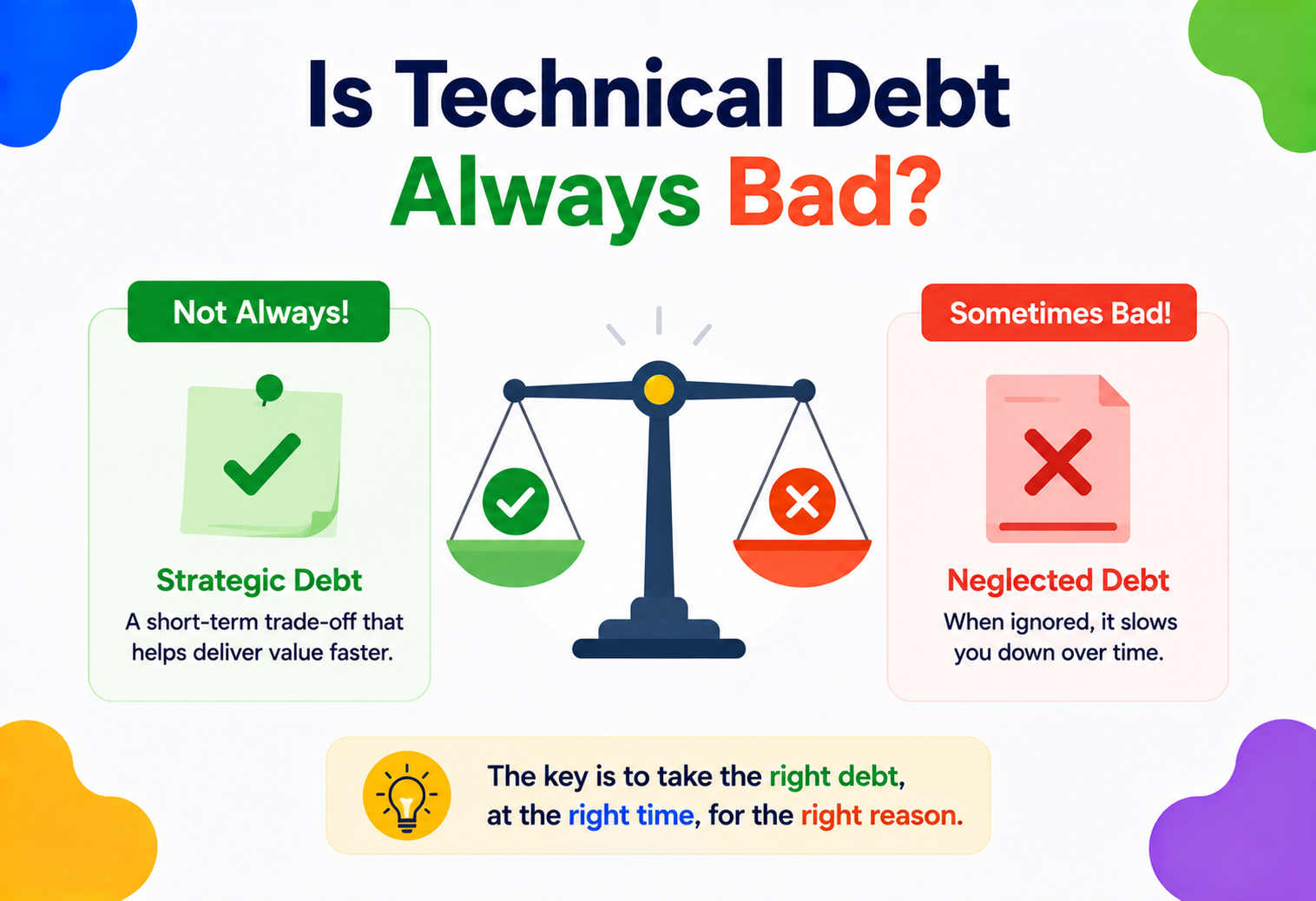
Is Technical Debt Always Bad?
Ask ten engineers this question and you’ll get ten different answers — some will say debt is a natural part of building anything, others will say it’s a slow-motion disaster waiting to happen. Both are a little bit right. Here’s the honest, balanced answer a senior architect actually gives.
The Big Idea, in One Breath
Technical debt isn’t automatically good or bad — like a financial loan, what matters is why it was taken, whether there is a plan to repay it, and whether that plan ever actually gets carried out.
Imagine two kids who each borrow money from their parents in the same week. The first one borrows to buy a school textbook they genuinely need, and pays it back a little at a time from their allowance, exactly as planned. The second one borrows on a whim for a toy they’ll forget about by Friday, never mentions it again, and quietly keeps borrowing more every time they want something new. Both kids technically did the same thing — they borrowed money. But only one of them is heading somewhere they’ll regret.
Technical debt works the same way. The word “debt” makes it sound automatically bad, the way a scary word like “storm” does. But a loan isn’t good or bad on its own — what matters is why it was taken, whether there’s a real plan to repay it, and whether it ever actually gets paid back. Software teams borrow time constantly, on almost every project ever built. The honest question was never “should we ever take on technical debt?” It’s “which kind of borrowing are we doing right now, and do we have a plan?”
A mortgage on a house you can actually afford is considered smart, responsible borrowing. Maxing out a credit card on things you can’t pay back is considered reckless. Both are technically “debt.” The difference isn’t the borrowing itself — it’s the plan behind it. Technical debt deserves exactly the same nuance.
This question matters more than it might first appear, because how a team answers it shapes almost everything else about how they build software. Teams that believe “all debt is evil” often end up over-engineering simple features, spending weeks perfecting something that only needed to work well enough for now. Teams that believe “debt doesn’t really matter” often end up buried under a codebase nobody wants to touch, watching simple requests take weeks instead of days. The healthiest teams sit somewhere in the middle — comfortable taking on debt when it makes sense, and equally comfortable paying it back before it becomes a burden.

The Two Camps
Spend enough time around engineering teams and you’ll notice the technical debt conversation tends to split into two very confident, very opposite camps.
Camp One: “All Debt Is Dangerous”
This camp treats every shortcut as a ticking time bomb. To them, any compromise on quality is a mistake waiting to surface, and the only responsible path is to build things properly the first time, every time. There’s real wisdom buried in this view — sloppy, unplanned debt genuinely does cause outages, slowdowns, and burnt-out engineers. But taken too far, this mindset can trap a team in endless polishing, never actually shipping anything a customer can use.
Camp Two: “Technical Debt Is a Myth”
The opposite camp argues that “technical debt” is really just a convenient excuse — a fancy term managers invented to blame engineers for the natural, ordinary cost of building software, or a phrase engineers use to justify perfectionism. There’s a kernel of truth here too: the term does get overused, sometimes stretched to cover anything an engineer personally dislikes about the codebase, which drains the word of any real meaning.
The honest answer sits between these two extremes. Technical debt is real, it’s measurable, and it has genuine business consequences — but it is also completely normal, and sometimes it’s the smartest possible decision a team can make. The rest of this guide is about learning to tell the difference.
Nobody who has ever shipped real software has zero technical debt. The question was never “how do we avoid it entirely?” — it’s “how do we make sure the debt we’re carrying is the kind we chose on purpose?”
Interestingly, both camps are usually reacting to real pain, just from opposite directions. The “all debt is dangerous” camp has often lived through a project that spiraled out of control because nobody managed the shortcuts being taken. The “technical debt is a myth” camp has often lived through the opposite experience — watching the term get weaponized by a manager who used it to dismiss legitimate engineering concerns, or to avoid taking responsibility for unrealistic deadlines. Both experiences are valid, and both point toward the same underlying lesson: the problem was never the debt itself, it was the absence of an honest, shared process for deciding when to take it on and when to pay it back.
When Debt Is Actually a Smart Move
There are real, well-reasoned situations where taking on technical debt is the more responsible choice — not the lazy one.
Proving an idea first
Before investing months into a perfectly engineered product, a team can build a simpler version fast to see if anyone actually wants it — and throw it away cheaply if they don’t.
Being first matters
In some markets, arriving a few months earlier than a competitor is worth far more to the business than arriving with slightly cleaner code.
You don’t know the future yet
Early in a project, nobody fully understands the problem. Building the “perfect” structure before you understand what you’re building often wastes more effort than it saves.
Small teams, real constraints
A two-person startup simply doesn’t have the time or headcount of a hundred-person company. Choosing pragmatic shortcuts can be the only realistic option available.
There’s also a subtler version of good debt worth naming: the debt a team accepts specifically to free up time for something more valuable right now, like fixing a customer-facing bug, responding to an urgent security report, or supporting a major client through a critical launch week. In these moments, choosing the “good enough” version of a feature isn’t a failure of discipline — it’s a correct read of what actually matters most in that particular week. A good architect doesn’t treat every deadline the same; they weigh what’s genuinely time-sensitive against what can comfortably wait.
In every one of these cases, the shortcut isn’t a mistake — it’s a calculated trade, made with open eyes. The team isn’t ignorant of the cost; they’ve simply decided the benefit of moving now outweighs the cost of cleaning up later, and — crucially — they intend to actually do that cleanup once the picture becomes clearer.
Picture a small team building a booking app for local dance classes. Instead of building a fully flexible payment system that supports every currency and every payment method on day one, they wire up just one simple payment option to get the first version in front of real dance studios within a month. That decision saves weeks of work up front. If the app takes off, they’ll go back and build the more flexible payment system properly, now armed with real knowledge of what studios actually need. That’s technical debt working exactly the way it’s supposed to — a temporary, deliberate simplification that buys valuable time to learn.

When Debt Turns Genuinely Bad
On the other side of the coin, there are situations where technical debt stops being a clever trade-off and starts being a genuine liability — the kind that keeps a team, and sometimes an entire company, stuck.
Debt That Stays Healthy
- Taken on knowingly, with everyone aware
- Written down somewhere the whole team can see
- Has a rough plan and rough timeline to fix it
- Doesn’t touch security, data safety, or core stability
Debt That Turns Harmful
- Nobody remembers it was ever taken on
- It exists only in one engineer’s memory
- There’s no plan, and no intention of ever fixing it
- It compounds faster than the team can keep up
The danger isn’t the debt itself — it’s debt that’s invisible, unplanned, and left to compound quietly for years. Just like ignoring a financial loan doesn’t make the balance disappear, ignoring technical debt doesn’t make the underlying problem go away. It just keeps growing interest in the dark, until one day a routine bug fix takes three weeks instead of three hours, and nobody can quite explain why.
Debt that touches security. A shortcut in how passwords are stored, or how access is controlled, isn’t the kind of debt you can responsibly “pay back later” — the risk it carries is too serious to treat casually, even temporarily.
Unhealthy debt also tends to have a social cost that’s easy to overlook. Engineers who spend their days navigating a codebase full of hidden landmines start to dread their own work. New team members take far longer than they should to feel confident making changes, because nothing behaves quite the way the documentation — if it even exists — says it should. Over time, this kind of environment pushes skilled people to look for opportunities elsewhere, taking with them the very knowledge that would have made the debt easier to fix. In this sense, bad technical debt doesn’t just cost time and money; it slowly erodes the team’s own ability to fix the problem it created.
The Quadrant That Actually Decides It
So how does an architect tell good debt from bad debt in the moment, rather than in hindsight? The clearest tool is a simple 2×2 grid: was the decision made knowingly or not, and was it made sensibly or carelessly?
Notice something important here: the actual code in the “Good Debt” box and the “Bad Debt” box could, in theory, look identical. What separates them isn’t the code at all — it’s whether the team knew what they were doing, and whether they wrote down a plan to fix it. This is exactly why the honest answer to “is technical debt always bad?” has to be “it depends on the box it’s sitting in,” not a flat yes or no.
In practice, applying this quadrant is less about labeling old decisions and more about catching new ones as they happen. A useful habit is asking the question in the moment a shortcut is being considered, not months later during a retrospective. “Are we choosing this knowingly, and are we choosing it sensibly?” — asked out loud, in the moment, before the code is written — is often enough on its own to nudge a team away from the two dangerous boxes and toward the two healthy ones.

| Quadrant | Best Response |
|---|---|
| Bad Debt (known, careless) | Address the root cause — usually unrealistic deadlines or a culture that rewards shortcuts without ever revisiting them |
| Good Debt (known, sensible) | Track it in the open and schedule the repayment; this is the target state for most teams |
| Worst Debt (unknown, careless) | Invest in mentoring, training, and code review so the gap in knowledge closes over time |
| Growing-Pains Debt (unknown, sensible) | Celebrate the learning, then fold the new insight into future design decisions |
How Much Debt Is “Acceptable”?
If some debt is fine and too much debt is dangerous, the natural next question is: where’s the line? There’s no single magic number that fits every project, but industry benchmarking research does offer some useful ranges to reason from.
It helps to think of this less like a strict speed limit and more like a fuel gauge. Nobody panics the moment a car’s tank drops below full — the useful moment to act is well before it hits empty, with enough runway to refuel calmly rather than coasting to a stop on the highway. A rising debt ratio works the same way: the goal isn’t to hit zero, it’s to notice the trend early enough to respond on your own schedule, rather than being forced into an emergency fix under pressure.
| Approach | How It Works | Best Fit For |
|---|---|---|
| The 80/20 Rule | 80% of time goes to new features, 20% is permanently reserved for debt and quality work | Established products with steady, ongoing delivery |
| The 10% “Leave It Cleaner” Habit | A smaller slice of every task is spent quietly improving the code immediately around it | Any team, as a daily built-in habit |
| Dedicated Debt Sprints | Occasional sprints focused entirely on repayment, with no new features shipped | Teams facing a large backlog of long-postponed debt |
What matters far more than hitting a precise percentage is simply tracking the number at all, consistently, release after release. A team that measures a rising debt ratio can act before it becomes a crisis. A team that never measures it only finds out the number was too high once a project has already started slipping.
It’s also worth remembering that the “right” number changes depending on where a project sits in its life. A brand-new prototype trying to validate a business idea can reasonably tolerate a much higher debt ratio, because speed of learning matters more than long-term maintainability at that stage. A mature system processing real customer payments every day needs a much lower tolerance, because the cost of an outage or a bug is far higher than the cost of moving a little slower. Comparing a scrappy three-month-old startup to a ten-year-old banking platform using the same debt threshold makes little sense — context should always shape the target, not the other way around.

The Tipping Point: When Good Debt Turns Bad
Even genuinely smart, deliberate debt has a shelf life. There’s a moment — different for every project — where the interest being paid quietly overtakes the speed that was originally gained, and from that point onward, the “shortcut” is actually slowing the team down more than doing it properly would have.
The tricky part is that this crossing point rarely announces itself with a warning bell. It’s usually only visible in hindsight — a team notices, months later, that a “temporary” shortcut has quietly become the single most expensive part of the codebase to work in. This is exactly why regularly revisiting old debt — not just creating a plan once and forgetting it — is such an important habit for architects to build into a team’s routine.
A helpful early-warning sign is watching how often a particular piece of code shows up in bug reports, urgent fixes, or “can someone explain how this works” questions from new engineers. When the same file or module keeps appearing again and again in these conversations, that’s usually a strong signal the tipping point has already been crossed, even if nobody has said so out loud yet. Treating that repeated pattern as data, rather than as background noise, is one of the simplest ways an architect can catch the crossover before it turns into a genuine crisis.
Making Debt Visible: A Simple Technique
One of the simplest, most effective ways teams keep debt in the “good” quadrant is by making it impossible to ignore. A well-known lightweight technique for this is often called a Wall of Technical Debt — and it needs nothing more complicated than sticky notes.
Pick a Visible Wall
Choose a spot in the shared workspace (physical or digital) where every engineer will actually see it during their normal day.
Note It When It Slows You Down
Whenever a piece of messy code costs someone real time, they write it on a sticky note: what slowed them down, and roughly how long it cost.
Let Repeat Offenders Stack Up
If the same problem trips someone up again, another mark gets added to the same note — turning gut feeling into real, visible, repeated evidence.
Negotiate Openly
The team reviews the wall together regularly, deciding as a group which notes are worth fixing now and which can reasonably wait.
What makes this approach so effective isn’t any clever technology — it’s that it turns technical debt from a private frustration into a shared, visible, data-backed conversation. Decisions about what to fix stop being one engineer’s opinion and start being something the whole team, and often the whole business, can reason about together.
This same principle scales up well beyond sticky notes. Larger organizations often build digital equivalents — a shared debt register inside their issue tracker, or a dashboard fed by automated code-quality tools — but the underlying idea stays identical: debt that’s written down somewhere visible gets fixed eventually, while debt that only lives inside someone’s head almost never does. The specific tool matters far less than the habit of writing it down the moment it’s noticed, rather than trusting anyone to remember it later.

“Technical Debt Is a Myth”? A Fair Hearing
It’s worth taking the contrarian view seriously rather than dismissing it outright, because it does contain a genuinely useful warning. Critics of the term argue that “technical debt” sometimes gets used as a vague, catch-all excuse — a label slapped onto anything an engineer personally finds unpleasant, or a convenient way for managers to explain away delays without ever getting specific about the actual cause.
It’s worth remembering that even Ward Cunningham, the person who coined the term, later said he regretted how loosely it came to be used. His original point was narrow and specific: a team ships a first version of an idea, learns from real users, and then goes back and reshapes the code to reflect what they’ve learned — much like a sketch that gets refined into a finished drawing once you can see the whole picture. Over the years, “technical debt” drifted from that precise meaning into a much broader, fuzzier catch-all for “code I don’t like,” which is exactly the drift the skeptics are reacting to.
That criticism lands hardest when the term is used loosely. If “technical debt” means something different in every conversation — sometimes a genuine architectural flaw, sometimes just a coding style someone dislikes — then the word has stopped being useful, and the critics are right to be frustrated by it. The fix for this isn’t to throw the concept away entirely; it’s to use it more precisely. A shortcut only deserves the label “technical debt” if it’s specific, if it’s actually slowing down real work, and if fixing it has a genuine, describable payoff.
If every single chore in the house gets labeled “urgent,” the word “urgent” stops meaning anything. The same happens to “technical debt” if it’s used to describe every minor annoyance instead of genuine, measurable, business-relevant cost.
There’s a useful test for telling a genuine debt complaint apart from a vague one: can the person raising it point to a specific, recent instance where it actually cost real time? “This module is a mess” is an opinion. “This module has caused three separate bugs this quarter, and the last fix took four days instead of the usual half-day” is evidence. Architects who insist on that second, more specific standard tend to get taken far more seriously by the rest of the business — and, just as importantly, they end up fixing the debt that actually matters most, rather than whatever happens to be the loudest complaint in the room that week.
An Architect’s Framework for Deciding
When faced with a choice between the quick way and the careful way, a senior architect usually runs through a short mental checklist before deciding which one to take.
- Is this reversible? A shortcut that’s easy to undo later carries far less risk than one that locks the system into a hard-to-change shape.
- Does it touch safety or security? If yes, the shortcut probably isn’t worth taking at all, regardless of how much time it saves.
- How often will this code be touched? Debt hiding in a rarely-used corner barely matters. Debt sitting in the busiest, most frequently changed part of the system matters enormously.
- Is there an honest plan to repay it? “We’ll fix it later” without a real date, owner, or ticket almost never actually happens — write it down properly, or don’t take the debt at all.
- Does everyone who needs to know actually know? A shortcut hidden from the rest of the team isn’t a strategic trade-off — it’s a risk being quietly passed on to someone else’s future.
If you can honestly answer all five questions out loud to your whole team without wincing, the debt you’re about to take on is very likely the healthy kind.
This checklist works best as a quick, five-minute conversation rather than a heavy formal process — the goal is to build the habit of asking, not to create another slow approval step that tempts people to skip it under pressure. Over time, teams that practice this kind of quick, honest reflection tend to develop a shared instinct for it, reaching for the right question almost automatically, the same way an experienced driver checks their mirrors without consciously thinking through each step.

Common Pitfalls
Even teams who genuinely understand the nuance in this debate can still stumble into a handful of recurring traps. Recognizing them in advance is often the difference between a healthy, ongoing relationship with technical debt and a slow slide back into the two dangerous quadrants.
Treating “It Depends” as a Non-Answer
Some teams hear “it depends” and use it as an excuse to never actually decide anything. “It depends” isn’t a shrug — it’s an invitation to actually go through the checklist above and land on a real decision, every single time.
Confusing Speed With Recklessness
Moving fast and being careless are not the same thing. A team can move quickly and still be deliberate about what they’re trading away — speed becomes dangerous only when it stops being a conscious choice.
Forgetting the Plan Ever Existed
The single most common way healthy debt turns unhealthy isn’t a bad decision at the start — it’s simply forgetting that a decision was ever made, because it was never written down anywhere the whole team could see.
Letting the Debate Become Personal
Debt conversations sometimes turn into blame — “who wrote this?” instead of “how do we fix it?” The healthiest teams treat past shortcuts as decisions made with the information available at the time, not as evidence of anyone’s competence.
A team culture where admitting “I took a shortcut here” feels risky or embarrassing. That kind of silence is exactly what pushes debt from the visible, healthy quadrant into the invisible, dangerous one.
Key Takeaways
So, is technical debt always bad? No — and pretending otherwise leads teams to either freeze up in endless polishing, or swing the opposite way and dismiss a real business cost as imaginary. The far more useful question, the one worth asking on every project from here on, is simply this: is the debt we’re carrying right now the kind we chose on purpose, or the kind that chose us?
Remember This
- Technical debt is not automatically good or bad — like financial debt, what matters is why it was taken and whether there’s a real plan to repay it.
- Debt that’s deliberate, visible, and planned is a legitimate strategy. Debt that’s invisible, unplanned, and forgotten is a genuine liability.
- The same shortcut can be “good debt” or “bad debt” depending only on whether the team knew what they were choosing.
- There’s no universal “safe” percentage, but tracking a debt ratio over time — rather than guessing — lets a team catch trouble early.
- Even smart, deliberate debt has a tipping point where its cost quietly overtakes the benefit it originally bought — which is why it deserves to be revisited, not just planned once and forgotten.
- The honest answer to “is technical debt always bad?” is no — but unmanaged, invisible, and unplanned debt very reliably becomes bad, given enough time.