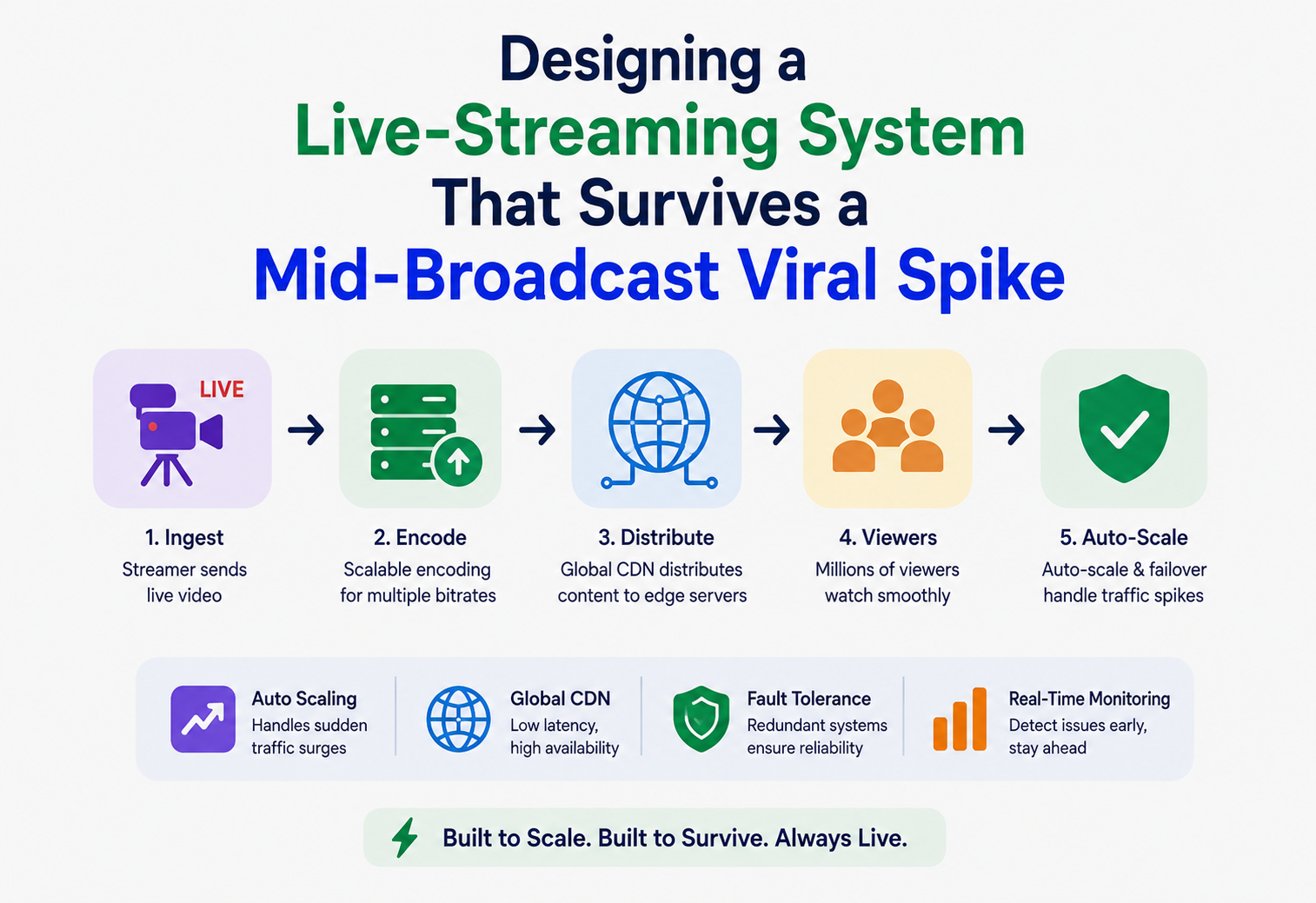
Designing a Live-Streaming System That Survives a Mid-Broadcast Viral Spike
A production-grade blueprint for scaling a single live stream from a few hundred viewers to millions within minutes — without buffering, without falling behind, and without the broadcaster ever noticing.
Introduction & History
Every live-streaming platform eventually faces the same terrifying, wonderful moment: a stream that started with three hundred viewers suddenly has three hundred thousand, because a clip got reposted somewhere with a huge audience, or a celebrity dropped into someone’s chat, or breaking news is unfolding live on camera. This is the moment the entire platform either proves it was built correctly, or falls over in front of the largest audience it has ever had. Designing a live-streaming system that survives a sudden, mid-broadcast viral spike means building infrastructure that can scale a single live video feed from hundreds to millions of concurrent viewers in minutes, without the broadcaster’s stream dropping, without viewers seeing a spinning buffer wheel, and without the underlying delivery infrastructure buckling under a load pattern that looks nothing like its normal, predictable traffic.
Picture a live stream like a single water pipe feeding an entire city’s plumbing system. Under normal conditions, a modest, predictable amount of water flows through it, and the pipe network is sized comfortably for that. A viral spike is like every household in the city suddenly turning on every faucet at once, all drawing from that same single source pipe. If the system was only built for the original small trickle, the pressure collapses everywhere at once. A well-designed live-streaming architecture instead works like a modern water utility: a small number of source pipes (the broadcaster’s upload) feed into a vast, tree-shaped distribution network of local reservoirs and pumping stations (edge servers and CDN nodes) positioned close to consumers, so that a sudden demand spike is absorbed by rapidly provisioning more local distribution capacity — never by asking the single source pipe to somehow carry the entire city’s load directly.
A Short History of Live-Streaming at Scale
Justin.tv and the RTMP era
Early live-streaming services (Justin.tv, the ancestor of Twitch) rely on Flash-based RTMP delivery, with relatively small, predictable audiences and limited tooling for handling sudden traffic surges.
Twitch and HTTP adaptive streaming take over
Twitch spins out as a dedicated live game-streaming platform. HTTP-based adaptive streaming protocols (HLS, and later DASH) begin replacing RTMP for viewer-facing delivery, because they scale far better over standard CDN and HTTP caching infrastructure than a persistent RTMP connection per viewer would.
Mainstream mobile live streaming arrives
Facebook Live, YouTube Live, and Periscope launch mainstream, mass-audience live streaming from ordinary consumer phones. Platforms are forced to engineer specifically for the “surprise viral moment” pattern — a completely ordinary broadcaster’s stream suddenly drawing an enormous, unplanned audience.
Low-latency HLS and DASH emerge
Chunked, low-latency variants of HLS and DASH (LL-HLS, LL-DASH) emerge to shrink glass-to-glass latency from the 15-to-30-second range typical of classic HLS down toward a few seconds, closing the gap with the near-instant feel viewers expect for live interaction.
Algorithmic discovery reshapes traffic patterns
TikTok Live, Instagram Live, and similar short-form-first platforms push live streaming into an even more unpredictable traffic pattern — algorithmically surfaced streams can go from a handful of viewers to a massive audience within seconds purely from recommendation-feed placement, with essentially zero advance warning, making auto-scaling edge delivery and elastic transcoding capacity a hard operational requirement rather than a nice-to-have.
Think of a popular restaurant with one small kitchen. On a normal night, the kitchen (the broadcaster’s single video upload) cooks meals to order for a modest dining room. A viral spike is like a bus of five hundred tourists suddenly arriving. A smart restaurant doesn’t try to have the same single small kitchen cook five hundred meals from scratch simultaneously — it has a system where a small number of master dishes get rapidly plated, boxed, and handed off to a large, flexible team of servers who can multiply out to serve however many tables show up. Live-streaming delivery works the same way: one broadcaster’s upload becomes a small number of encoded video renditions, which a large, elastic network of edge servers then replicates and serves outward to however many viewers appear, without ever needing the original “kitchen” to work any harder no matter how large the audience gets.
This tutorial builds that system end to end: what actually happens between a broadcaster hitting “Go Live” and a viewer seeing video, how to architect a pipeline that can absorb a hundred-times traffic increase in minutes without any manual intervention, how transcoding and adaptive bitrate delivery work together to serve a hugely diverse set of viewer devices and network conditions simultaneously, how to keep the stream available and low-latency during the spike itself, how to secure the pipeline, and how real platforms — Twitch, YouTube Live, TikTok Live, Instagram Live, and Amazon IVS — have solved this exact problem in production.
Problem & Motivation
Before designing the system, it’s worth being precise about exactly what makes a viral mid-broadcast spike different from — and harder than — ordinary high-traffic scaling problems most engineers are used to reasoning about.
What Makes This Specific Scenario Hard
- No warning. Unlike a planned event (a scheduled product launch, a major sports final with a known start time), an organic viral moment can happen to any ordinary broadcaster’s stream at any time, with essentially zero lead time to pre-provision capacity for that specific stream.
- Extreme, sudden growth rate. A stream can go from a few hundred viewers to hundreds of thousands within minutes, not hours — traditional auto-scaling systems tuned for gradual traffic ramps can be too slow to react before viewers already start experiencing degraded quality.
- The source is unchanged. The broadcaster is still uploading from the same phone or the same modest home internet connection they started with. All the additional capacity has to come from the delivery and distribution side of the system, not from the broadcaster somehow producing more or higher-quality source video.
- Live means no do-overs. Unlike on-demand video, where a slow request can simply be retried or served slightly later from a fully pre-processed file, a live viewer joining right now needs video that reflects what’s happening right now — the system has almost no slack to “catch up” gracefully.
- Real-time interactivity compounds the load. Live chat, reactions, and viewer counts must also scale with the same suddenness as the video itself, and these real-time side-channels have their own, different scaling characteristics from video delivery.
- Global, unpredictable audience distribution. A viral clip can be reshared into an entirely different region or country than the broadcaster’s usual audience, meaning the geographic distribution of demand — and therefore which edge locations need capacity — can’t be predicted from the broadcaster’s historical viewer geography.
Why this differs from a normal traffic spike
A viral spike on a news website can often be absorbed by simply serving more copies of the same cached static page. A live video stream has no single static artifact to cache in advance — new video segments are being produced continuously, seconds after they’re captured, for as long as the broadcast continues.
Why “just add more servers” isn’t sufficient on its own
Adding delivery capacity matters, but it has to happen fast enough — often within tens of seconds — and it has to happen at the right network edge locations, not just anywhere in the fleet, since video delivery is extremely latency- and bandwidth-sensitive per viewer.
The business stakes
A viral moment is often the single highest-value moment a broadcaster and platform will ever experience together — new user acquisition, press coverage, and creator loyalty are all disproportionately shaped by whether the stream held up smoothly under that exact spotlight.
- “Why can’t you just scale the origin server that receives the broadcaster’s video?” — the origin is a single, small-scale ingestion point by design; scaling has to happen on the distribution side (CDN/edge), not by asking the origin to somehow serve millions of direct connections.
- “How is this different from scaling a normal read-heavy web service?” — the content itself is continuously and freshly generated, not a static cacheable artifact prepared in advance, and the correctness bar (staying “live”) is much stricter than eventual consistency would allow.
- “What’s the hardest part of this problem: compute scaling, network scaling, or something else?” — a strong answer highlights that it’s genuinely all three plus the propagation delay of provisioning new capacity fast enough to matter within the spike’s own timescale.
“A live-streaming platform isn’t tested by its average Tuesday afternoon traffic — it’s tested by the five minutes nobody scheduled, when one ordinary broadcaster’s stream becomes the biggest thing happening on the internet.” — common framing among video infrastructure engineering teams
Thinking About the Cost of Getting This Wrong
It’s worth being concrete about what actually happens when this system fails during a real spike, since the failure modes aren’t abstract. Viewers who hit buffering or a dropped stream at the exact moment a broadcast is at its most exciting don’t typically wait patiently for it to recover — a meaningful fraction simply leave and don’t come back for that broadcast, permanently losing the platform whatever engagement, advertising, or purchase moment that viewer represented. For the broadcaster, a technical failure during their single biggest audience moment can be genuinely damaging to their relationship with the platform, especially for creators who depend on the platform for their livelihood. And for the platform itself, a viral moment is disproportionately likely to also be a moment of outside press and social-media attention — meaning a visible technical failure during exactly that moment carries reputational cost well beyond the immediate lost viewership. This is precisely why the engineering investment described throughout this tutorial — predictive scaling, standing warm capacity, careful graceful-degradation planning — is treated as a core, ongoing priority at major live-streaming platforms rather than a nice-to-have optimization.
Core Concepts
Before diving into architecture, let’s build the vocabulary this system depends on, each explained with an analogy, a beginner example, and a production example.
3.1 Ingest
What: The process of receiving the broadcaster’s raw live video stream from their encoder (OBS software, a phone’s camera app, a professional camera rig) into the platform’s infrastructure, typically over a protocol like RTMP or the newer SRT and WebRTC-based ingest protocols.
Why: This is the single narrow entry point for the entire broadcast — everything downstream depends on reliably receiving this one upload, no matter how many viewers eventually watch it.
Analogy: Ingest is the single water source pipe from our earlier analogy — one connection, one source, regardless of how large the eventual distribution network becomes.
3.2 Transcoding & Adaptive Bitrate Ladders
What: Converting the broadcaster’s single raw video feed into multiple different quality versions (renditions) — for example 1080p, 720p, 480p, and 360p — each at different bitrates, so viewers on different devices and network conditions can each get a version suited to their situation.
Why: A viewer on a fast home Wi-Fi connection wants the sharpest picture available; a viewer on a crowded mobile network wants a lower-bitrate version that won’t constantly buffer. Producing this ladder of renditions once, centrally, is far more efficient than expecting every viewer’s device to somehow adapt to receiving the single original high-bitrate source.
Beginner example: This is exactly like a video-sharing app offering a quality picker (Auto, 1080p, 480p) — except for live content, the player usually switches automatically and continuously based on real-time measured network conditions, rather than the viewer picking manually.
Production example: Twitch transcodes a broadcaster’s incoming stream into several renditions in near real time so viewers around the world, on wildly different networks, all get a smooth, appropriately-sized stream rather than everyone receiving the broadcaster’s original raw quality regardless of their connection.
3.3 Segmenting & Adaptive Streaming Protocols (HLS/DASH)
What: Rather than streaming one continuous connection per viewer, modern live video is broken into short segments (typically 1 to 6 seconds each) which are described in a regularly-updated manifest file. Viewer players download this manifest, then request individual segments over ordinary HTTP, just like fetching any other web file.
Why: This is the single most important architectural decision that makes massive live-viewer scaling possible at all — because segments are just regular HTTP files, they can be cached and replicated across a standard CDN exactly like any other web content, rather than requiring the origin to maintain a dedicated, stateful streaming connection to every individual viewer.
Analogy: It’s the difference between a single radio tower trying to broadcast directly to every individual receiver in the country (doesn’t scale) versus that tower feeding a small number of regional relay stations, which each independently rebroadcast to their local area (scales beautifully) — HTTP segment caching through a CDN is the modern, internet-native version of that relay network.
3.4 Glass-to-Glass Latency
What: The total time from a moment being captured by the broadcaster’s camera (“glass” of the lens) to that same moment appearing on a viewer’s screen (“glass” of their device).
Why: For interactive live content — viewers chatting in real time, a broadcaster responding to comments live — high latency (15 to 30 seconds, typical of older HLS setups) makes the experience feel disconnected and stale. Low-latency variants (LL-HLS, LL-DASH, WebRTC-based delivery) push this down to a few seconds or less.
Analogy: This is the live-video equivalent of the delay on an old international phone call — a delay that’s barely noticeable for a one-way lecture becomes deeply awkward and disruptive for a real back-and-forth conversation.

3.5 Edge Caching & CDN Fan-Out
What: Positioning copies of each video segment on servers geographically close to viewers (edge nodes), so that most viewer requests are served from a nearby cache rather than traveling all the way back to a central origin server for every single request.
Why: This is precisely the mechanism that lets one broadcaster’s single transcoded output serve millions of simultaneous viewers — the origin only needs to serve each unique segment to the CDN edge layer a small number of times; the CDN then fans that same segment out to an effectively unlimited number of viewers from cache.
Production example: A viral stream might have its most recent video segment requested by hundreds of thousands of viewers within the same few seconds — a well-designed CDN edge layer serves the overwhelming majority of those requests from a local cache hit, with only a tiny handful of “first” requests per edge location ever needing to reach back toward the origin.
3.6 Auto-Scaling & Pre-Warming
What: Automatically increasing the number of active transcoding workers, edge cache capacity, and supporting services (chat, viewer-count aggregation) in response to real-time demand signals, ideally fast enough to stay ahead of a rapidly growing viewer count rather than reacting after viewers have already started seeing degraded quality.
Why: A viral spike’s growth curve can outpace naive, purely reactive auto-scaling that waits for sustained high load before adding capacity — production systems instead use predictive and leading-indicator signals (rate of viewer-count growth, not just absolute viewer count) to begin scaling out before the system is already under strain.
3.7 Multi-CDN & Traffic Steering
What: Using more than one CDN provider simultaneously for the same platform, with intelligent routing logic that decides, often per-request or per-region, which provider should serve a given viewer, based on real-time measured performance and health rather than a fixed, static assignment.
Why: No single CDN provider has uniformly excellent performance in every region of the world at every moment, and relying on exactly one provider creates a single point of failure for the entire viewer-facing delivery layer. Traffic steering lets a platform shift load away from a provider experiencing degraded performance in a specific region without any visible interruption to viewers.
Analogy: This is like a package delivery company that works with several different couriers rather than just one, dynamically choosing whichever courier can currently get a package to a specific neighborhood fastest and most reliably, rather than being stuck with one courier’s performance everywhere regardless of local conditions.
3.8 Origin Shield
What: An intermediate caching layer that sits between the many geographically distributed edge nodes and the true origin server, consolidating what would otherwise be many separate “first request” cache misses from different edge locations into a much smaller number of actual origin requests.
Why: Without an origin shield, a viral spike causing simultaneous first-time cache misses across dozens or hundreds of edge locations worldwide could generate a surprisingly large burst of direct origin load, right at the exact moment the system is least able to absorb one. An origin shield absorbs and deduplicates that burst before it ever reaches origin.
Beginner example: Picture ten different local libraries in a city all discovering they need the same newly published book at once — instead of each library separately contacting the publisher directly, they all go through one regional distribution warehouse, which contacts the publisher only once and then supplies all ten libraries from its own stock.
3.9 Presence & Real-Time Viewer Counting
What: The system responsible for tracking, in near real time, how many viewers currently have a given stream open, and for reflecting that count back to viewers as a live-updating number.
Why: This sounds simple but is deceptively hard at scale: naively recalculating an exact count from scratch on every viewer join or leave event doesn’t scale to millions of concurrent connection changes per minute. Production systems instead use approximate, eventually-consistent counting techniques (distributed counters that periodically reconcile, or probabilistic cardinality estimators) that trade perfect real-time exactness for the ability to scale to enormous numbers of simultaneous viewer state changes.
Production example: A viewer count shown on a wildly popular live stream is typically a close, frequently-updated approximation rather than a perfectly exact real-time count, precisely because computing and propagating a perfectly exact number at that scale, on every single join or leave, would itself become a significant engineering bottleneck for very little practical benefit to the viewer experience.
- “Why does breaking live video into small HTTP-fetchable segments matter so much for scalability?” — it turns live video delivery into a standard, cacheable HTTP content-serving problem that ordinary CDN infrastructure already knows how to scale enormously, instead of a stateful, per-viewer streaming connection problem.
- “What’s the trade-off between segment length and latency?” — shorter segments reduce glass-to-glass latency but increase the number of requests and manifest updates per second, adding overhead; longer segments are more efficient to cache and deliver but add latency.
- “Why might a platform show an approximate viewer count instead of a perfectly exact one?” — exact real-time counting across millions of simultaneous connection changes doesn’t scale efficiently; approximate counting techniques trade small, imperceptible inaccuracy for much better scalability.
Architecture & Components
We’ll now design the full system. The central architectural idea is a fan-out pipeline: a narrow, tightly controlled ingest and transcoding stage at the center, feeding an elastic, geographically distributed edge delivery layer that does the actual work of scaling to match viewer demand — with a separate, independently-scaling real-time layer handling chat and viewer counts, since those have very different scaling characteristics from video itself.
Component Breakdown
Ingest Service
Receives the broadcaster’s live upload over RTMP, SRT, or WebRTC, authenticates the stream key, and forwards the raw feed into the transcoding pipeline. Kept deliberately simple and highly available, since every viewer ultimately depends on this one connection staying healthy.
Transcoding Pipeline
Converts the single incoming feed into the full adaptive bitrate ladder of renditions in near real time, using a fleet of transcoding workers that can scale out horizontally as needed.
Segmenter & Manifest Generator
Packages each rendition into short HTTP-servable segments and continuously updates the HLS/DASH manifest files that tell viewer players which segments are currently available.
Origin Storage
A short-lived, high-throughput store holding the most recent segments and manifests — live content typically only needs to be retained here for a rolling window (minutes), not indefinitely, since older segments are no longer “live.”
CDN Edge Network
The primary scaling mechanism for viewer-facing delivery — a globally distributed network of caching edge servers that serves the overwhelming majority of viewer segment requests without hitting the origin.
Stream Health Monitor
Continuously tracks ingest stability, transcoding pipeline lag, and edge cache hit rates, feeding real-time signals to the auto-scaler and viral spike detector.
Viral Spike Detector
Watches the rate of change in concurrent viewer count (not just the absolute count) to recognize an accelerating spike early and trigger pre-emptive scaling before viewers experience degraded quality.
Auto-Scaler
Provisions additional transcoding capacity and pre-warms additional CDN edge capacity in the regions where the spike’s demand is concentrated, based on signals from the health monitor and spike detector.
Chat Service & Viewer Count Aggregator
Independently-scaling systems handling live chat messages and the live viewer counter, both of which must also scale suddenly during a spike but have very different technical characteristics (many small, frequent messages, and a single rapidly-updating counter) from video segment delivery.
Pub/Sub Fan-out Layer
Distributes chat messages and viewer-count updates to all currently connected viewers efficiently, typically via WebSocket or similar persistent connections fanned out through a publish-subscribe messaging backbone.
The broadcaster’s ingest and the transcoding pipeline should never need to know or care how many viewers are watching. All viewer-count scaling happens entirely in the CDN edge and real-time layers, downstream of a fixed, small amount of transcoding work per broadcast — this decoupling is what makes 100x viewer growth in minutes survivable without touching the fragile, single-source ingest path at all.
Internal Working
Let’s trace exactly what happens, step by step, from the moment a broadcaster goes live through the moment a viewer joining mid-spike sees smooth video.
Step 1: Stream Authentication & Ingest
The broadcaster’s encoder connects to the ingest service using a private stream key. The ingest service authenticates the key, opens a persistent connection, and begins receiving the raw video and audio stream, typically encoded once at a single high-quality source bitrate by the broadcaster’s own software.
Step 2: Real-Time Transcoding
The raw feed is immediately passed into the transcoding pipeline, which decodes it and re-encodes it into the full adaptive bitrate ladder simultaneously — this must happen with only a small, bounded delay (typically a couple of seconds) to keep the overall glass-to-glass latency low.
Step 3: Segmentation & Manifest Update
Each rendition’s continuous encoded output is chopped into short segments (commonly 2 to 6 seconds for standard low-latency HLS, or sub-second chunks for the most aggressive low-latency configurations). Every time a new segment is finalized, the manifest file for that rendition is updated to reference it, and older segments beyond a short rolling window are dropped from the manifest, since live viewers only ever need the most recent content.
Step 4: Origin Publish & Edge Pre-Positioning
New segments and manifest updates are published to origin storage, from where the CDN edge network can pull them. For very large, actively spiking streams, the system can additionally proactively push fresh segments toward edge locations already serving the bulk of that stream’s traffic, rather than waiting passively for the first viewer request at each edge to trigger a cache pull — shaving critical seconds off delivery latency exactly when it matters most.
Step 5: Viewer Join & Adaptive Playback
A new viewer’s player first requests the manifest, then begins requesting segments, continuously measuring its own download speed and adjusting which rendition it requests next — stepping down to a lower-bitrate rendition automatically if network conditions degrade, and stepping back up when conditions improve, all without the viewer needing to do anything manually.
Step 6: Spike Detection & Pre-Emptive Scaling
Throughout the broadcast, the stream health monitor tracks the rate of viewer-count growth for each active stream. When growth accelerates past a defined threshold — for example, viewer count more than doubling within a two-minute rolling window — the viral spike detector fires an early signal to the auto-scaler, which begins provisioning additional edge capacity and, if needed, additional transcoding capacity in advance of viewers actually experiencing any degradation, rather than waiting for cache-miss rates or transcoding queue depth to already be climbing.
Step 7: Chat and Viewer-Count Fan-Out
In parallel, the real-time chat service and viewer-count aggregator scale their own connection-handling and message-fan-out capacity independently, since a spike in video viewers produces a correlated but architecturally separate spike in chat connections and message volume that must be handled by its own elastic infrastructure.
Step 8: Origin Shield Absorption
During the earliest moments of a spike spreading to new geographic regions, many edge locations may independently experience a cache miss on the same newly-published segment at nearly the same time. Rather than each of these misses traveling all the way back to true origin storage independently, they pass through an origin shield layer first, which deduplicates concurrent requests for the same segment into a single actual origin fetch, then serves all the waiting edge requests from that one result — protecting origin storage from an avoidable multiplication of load during exactly the moment it matters most.
Step 9: Approximate Viewer Counting
As viewers join and leave throughout the spike, the presence and viewer-counting system tracks these events through a distributed, approximate counting mechanism rather than maintaining one single, globally-locked exact counter, which would become a severe bottleneck under millions of near-simultaneous state changes. Regional counters aggregate locally and periodically reconcile into a platform-wide approximate total, which is what viewers actually see displayed and updating live.
public class OriginShield {

    private final Map<String, CompletableFuture<Segment>> inFlightRequests =
        new ConcurrentHashMap<>();
    private final OriginClient originClient;

    // Deduplicates concurrent requests for the same segment across many edge nodes
    public CompletableFuture<Segment> fetchSegment(String segmentKey) {
        return inFlightRequests.computeIfAbsent(segmentKey, key -> {
            CompletableFuture<Segment> future = originClient.fetchAsync(key);
            future.whenComplete((result, error) -> inFlightRequests.remove(key));
            return future;
        });
    }
}
This simplified example shows the core idea: if a second, third, or thousandth request for the same segment key arrives while an origin fetch for that exact key is already in flight, it’s attached to the same pending future rather than triggering a redundant fetch — collapsing what could otherwise be an enormous multiplication of near-simultaneous origin requests down to exactly one per unique segment.
- “How do you detect a viral spike early enough to matter?” — track the rate of change in viewer count, not just the absolute count, and trigger scaling on accelerating growth rather than waiting for a fixed high-water-mark threshold.
- “Why push segments proactively to edge nodes instead of waiting for cache misses to pull them?” — shaves latency off the critical path exactly during the highest-stakes moments, when every additional round trip to origin matters most.
- “How would you prevent many edge nodes from all hitting origin for the same brand-new segment at once?” — request deduplication/collapsing at an origin shield layer, coalescing concurrent misses for the same key into a single origin fetch.
Data Flow & Lifecycle
Understanding how a single video segment and a single viewer’s connection each move through their own lifecycle clarifies why the architecture is shaped this way.
Lifecycle of a Video Segment
Encoding
Raw video is encoded into a specific rendition as part of the continuous transcoding output.
Segmentation
A short, fixed-duration chunk of that encoded output is finalized as a discrete, independently-requestable segment file.
Publish to origin
The segment is written to origin storage and referenced in the updated manifest.
First edge fetch (cache miss)
The first viewer request for that segment at a given edge location triggers a fetch back to origin, populating that edge’s local cache.
Mass edge fan-out (cache hits)
Every subsequent request for the same segment at that edge location — potentially hundreds of thousands of them during a viral spike — is served directly from the local cache, without touching origin again.
Expiry
After a short rolling window (long enough to cover typical viewer buffering and any brief backfill needs, but no longer), the segment is dropped from the manifest and eventually evicted from both origin and edge caches, since it’s no longer part of the “live edge” of the broadcast.
Lifecycle of a Viewer Connection
- Join: Viewer requests the manifest for the stream, typically routed to a nearby edge location via DNS-based or Anycast-based geographic routing.
- Initial buffering: Player downloads a small number of initial segments to build a short playback buffer before starting playback.
- Steady-state playback: Player continuously requests new segments as the manifest updates, adjusting rendition choice based on measured network conditions.
- Real-time side-channel connection: In parallel, the player opens a separate connection (typically WebSocket) to the real-time layer for chat and live viewer-count updates.
- Leave/disconnect: When the viewer navigates away or closes the stream, both the video-segment requests and the real-time connection are torn down, and the viewer is removed from the live count.
Why Short Retention Windows Matter
Because live segments are only useful for a short rolling window, the system can be far more aggressive about cache eviction and storage cost than an on-demand video platform would be — there’s no need to retain live segments indefinitely at the edge, and this short-lived nature is itself part of what keeps edge cache capacity requirements manageable even at massive concurrent-viewer scale, since the total working set of “currently relevant” data per stream stays bounded regardless of how many viewers are watching it.
- “Why doesn’t edge cache storage grow unbounded even with millions of viewers?” — the total unique content per stream (the rolling window of recent segments across all renditions) stays constant regardless of viewer count; only the number of cache-hit reads grows, not the amount of unique cached data.
- “What happens to a viewer’s playback when their network briefly degrades?” — the player detects it, steps down to a lower-bitrate rendition, and rebuffers briefly if needed, recovering automatically as conditions improve.
Advantages, Disadvantages & Trade-offs
Advantages of this fan-out design
- Origin and transcoding load stay roughly constant per broadcast regardless of viewer count, since scaling happens entirely at the CDN edge layer.
- Standard HTTP-based CDN infrastructure — mature, well-understood, and already built for massive fan-out — does the heaviest lifting of viewer-facing scaling.
- Adaptive bitrate delivery means the system gracefully serves an enormous diversity of viewer devices and network conditions from one shared set of renditions.
- Short retention windows keep storage and cache footprint bounded even during extreme viewer growth.
Disadvantages & costs
- Segment-based delivery inherently trades some latency for cacheability — pure WebRTC-style direct connections can achieve lower latency but scale far worse for massive fan-out.
- Real-time chat and viewer-count systems don’t benefit from the same HTTP-caching trick, since each viewer’s chat feed is personalized and interactive, requiring a fundamentally different, more expensive scaling approach.
- Pre-emptive scaling based on early spike signals can occasionally over-provision for a spike that fizzles out, trading some wasted cost for reduced risk of under-provisioning during a real one.
- Global edge pre-positioning adds meaningful engineering and operational complexity compared to a simpler, single-region delivery design.
Key Trade-off: Latency vs. Scalability
This is the single most important trade-off in live-streaming architecture. WebRTC-based direct peer or server-relayed connections can achieve sub-second glass-to-glass latency, but scale poorly to massive simultaneous audiences because each viewer connection consumes dedicated server resources rather than benefiting from shared HTTP caching. HLS/DASH segment-based delivery scales beautifully to millions of viewers via ordinary CDN caching, but even the most aggressive low-latency variants typically can’t match WebRTC’s raw latency floor. Most large-scale platforms use HLS/DASH-style segment delivery as the default for mass-audience live streaming, reserving WebRTC-style delivery for smaller-scale, latency-critical use cases like one-on-one or small-group live interaction.
Key Trade-off: Segment Length
Optimizes for latency
Sub-second to 2s segments minimize glass-to-glass latency at the cost of more requests and manifest updates per second, adding real overhead across the pipeline and the player.
Balanced default
Balances latency against delivery efficiency; the most common production default for standard HLS-based live streaming, especially for chat-connected content.
Optimizes for delivery efficiency
Maximizes caching and delivery efficiency at the cost of higher latency — acceptable for essentially one-way broadcast content but feels less “live” for interactive experiences.
Key Trade-off: Predictive Scaling Sensitivity
Tuning how aggressively the spike detector reacts to early growth signals is itself a genuine trade-off, not a parameter with one obviously correct value. A highly sensitive detector, tuned to fire on even modest early growth, minimizes the risk of ever being caught behind a genuine fast-moving spike, but at the cost of more frequent false triggers on ordinary, non-viral traffic fluctuations, each of which carries some real infrastructure cost to act on. A less sensitive detector reduces wasted scaling actions on false alarms but increases the risk of reacting too slowly to a spike that turns out to be real. Most platforms tune this sensitivity empirically against their own historical data, and often make it configurable per content category or per broadcaster tier, since the acceptable trade-off point can reasonably differ for a small personal broadcaster’s stream compared to a professionally produced, high-value live event.

- “Why not just use WebRTC for everything, since it has the lowest latency?” — WebRTC’s per-viewer resource cost doesn’t scale to millions of simultaneous viewers the way HTTP-cacheable segment delivery does; it’s the right tool for small-scale, latency-critical scenarios, not mass broadcast.
- “How would you decide on segment length for a new platform?” — weigh the interactivity needs of the content (a casual chat-heavy stream wants lower latency) against delivery efficiency at scale, and note that many platforms let this vary by content type.
Performance & Scalability
The core scalability challenge is reacting to viewer growth that can be genuinely exponential over a very short timescale — minutes, not hours — which places unusual demands on both the auto-scaling logic and the underlying capacity planning.
Predictive, Not Purely Reactive, Auto-Scaling
Traditional auto-scaling reacts to a metric crossing a threshold (say, CPU utilization above 70%). For a viral spike, this is often too slow: by the time transcoding queue depth or edge cache-miss rate has clearly crossed a concerning threshold, viewers may already be experiencing degraded quality. Instead, the system tracks the second derivative of viewer count — not just how many viewers there are, but how quickly that number is accelerating — and begins provisioning additional capacity based on projected near-future demand, trading a small amount of extra cost for meaningfully faster response during genuine spikes.
Applying Little’s Law to the Transcoding Pipeline
Little’s Law (L = λ × W) helps size the transcoding worker pool. If new broadcast segments arrive for processing at rate λ, and each segment takes average processing time W to transcode across the full rendition ladder, the pipeline needs enough concurrent worker capacity L to hold λ × W segments in flight at any moment without falling behind. Crucially, a single viral stream doesn’t actually increase λ or W for transcoding at all — the broadcaster is still producing one source feed regardless of viewer count — which is precisely why the transcoding pipeline’s capacity planning is driven by the number of concurrent broadcasts platform-wide, not by any single stream’s viewer count. This is a deliberately different scaling axis from the CDN edge layer, which does scale directly with viewer count.
Edge Capacity Planning
Unlike transcoding, CDN edge capacity genuinely must scale with viewer count, and specifically with viewer count concentrated in specific geographic regions. A worked example: if a stream’s viewers are growing at a rate of 50,000 new concurrent viewers per minute, and a single edge node in the relevant region can comfortably serve 20,000 concurrent viewers of a given rendition from cache, the system needs to provision roughly 2.5 additional edge-serving capacity units per minute just to keep pace with new demand — and because provisioning and cache-warming a new edge capacity unit isn’t instantaneous, the predictive scaling described above needs enough lead time built in to stay ahead of this curve rather than merely matching it after the fact.
Java Example: Viewer Growth Rate Spike Detector
public class ViralSpikeDetector {

    private final Map<String, Deque<ViewerSample>> recentSamples = new ConcurrentHashMap<>();
    private static final Duration WINDOW = Duration.ofMinutes(2);
    private static final double GROWTH_TRIGGER_RATIO = 2.0; // double in window = spike

    public void recordSample(String streamId, int currentViewerCount) {
        Deque<ViewerSample> samples =
            recentSamples.computeIfAbsent(streamId, k -> new ArrayDeque<>());
        samples.addLast(new ViewerSample(Instant.now(), currentViewerCount));

        // Drop samples older than the rolling window
        while (!samples.isEmpty()
                && Duration.between(samples.peekFirst().timestamp, Instant.now()).compareTo(WINDOW) > 0) {
            samples.removeFirst();
        }

        if (isSpiking(samples)) {
            AutoScaler.preEmptivelyScale(streamId, currentViewerCount);
        }
    }

    private boolean isSpiking(Deque<ViewerSample> samples) {
        if (samples.size() < 2) return false;
        int earliest = samples.peekFirst().viewerCount;
        int latest = samples.peekLast().viewerCount;
        return earliest > 0 && ((double) latest / earliest) >= GROWTH_TRIGGER_RATIO;
    }
}
This detector tracks viewer-count samples per stream over a rolling two-minute window and fires a pre-emptive scaling trigger the moment viewer count roughly doubles within that window — deliberately reacting to the growth rate rather than waiting for an absolute viewer-count threshold, which lets genuinely small streams and genuinely enormous streams both get appropriately fast scaling response relative to their own trajectory.
- “Why key the spike detector on growth rate instead of an absolute viewer-count threshold?” — an absolute threshold either fires too late for huge spikes or never fires for smaller but still-significant relative spikes; rate-of-change generalizes across stream sizes.
- “Walk me through capacity planning for the transcoding pipeline versus the CDN edge layer.” — be ready to explain why these scale on different axes (concurrent broadcasts vs. concurrent viewers) and why that distinction matters for provisioning.
High Availability & Reliability
A live stream that drops during its own viral moment is close to the worst possible outcome for both the broadcaster and the platform. Reliability here means the system must gracefully absorb both extreme, sudden viewer growth and the ordinary set of infrastructure failures, without ever taking the live broadcast itself down.
Redundant Ingest
The ingest service, despite being architecturally narrow by design, is not a single point of failure in practice — broadcasts are typically accepted by redundant ingest endpoints (often geographically distributed, with the broadcaster’s encoder configured to fail over automatically), and the transcoding pipeline reads from whichever ingest endpoint is currently healthy, so a single ingest node failure doesn’t interrupt the broadcast.
Transcoding Pipeline Failover
Transcoding workers are stateless with respect to any individual segment — if a worker crashes mid-segment, the work is simply picked up by another available worker, at the cost of a small, bounded delay for that specific segment, rather than any risk of losing the stream entirely. Multiple transcoding workers can also run redundantly in parallel for especially high-value broadcasts, with the segmenter selecting from whichever completes first.
CDN Multi-Provider & Multi-Region Strategy
For platforms operating at the largest scale, relying on a single CDN provider creates a single point of failure for the entire viewer-facing delivery layer. A common pattern is running with two or more CDN providers simultaneously, with traffic-steering logic that can shift load away from a provider experiencing degradation in a specific region, without any visible interruption to viewers — since the player’s manifest and segment-request logic can be made CDN-agnostic at the URL level.
Treating auto-scaling as purely reactive and assuming it will always keep pace with an accelerating spike is a common and costly mistake. Real production incidents have occurred where reactive scaling technically worked correctly but simply wasn’t fast enough relative to a spike’s growth rate — the predictive, rate-of-change-driven approach described in the scalability section exists specifically to avoid this failure mode.
Graceful Degradation Under Extreme Load
If capacity genuinely cannot keep up with an extraordinary spike even with predictive scaling, the system is designed to degrade gracefully rather than fail completely: dropping the highest-bitrate renditions first (since most viewers on constrained networks weren’t using them anyway), briefly extending segment cache TTLs to reduce origin load, and prioritizing keeping the core video stream itself alive and smooth over maintaining the lowest possible latency — a deliberately ordered set of trade-offs decided in advance, rather than left to chance during an actual incident.
Disaster Recovery Drills Specific to Spike Scenarios
Beyond generic infrastructure disaster-recovery practices, this system benefits from drills specifically simulating a viral-spike-shaped failure: deliberately injecting a synthetic, rapidly accelerating viewer-growth pattern against a test stream in a staging or canary environment, and verifying that the predictive spike detector, auto-scaler, and warm-pool activation path all behave as designed under realistic timing pressure — not just that they work correctly given unlimited time to react, but that they work correctly within the specific, tight timescale this problem actually unfolds on. A scaling mechanism that’s only ever been validated against a slow, gentle traffic ramp provides limited real confidence about its behavior against the sharp, compressed growth curve of a genuine viral moment.
Multi-Region Coordination During a Spike
When a viral moment spreads across multiple geographic regions simultaneously — which happens often, since social sharing doesn’t respect regional boundaries — the spike detector and auto-scaler need a consistent, shared view of a given stream’s overall growth trajectory across all regions, not just an isolated per-region view that might each individually look modest while the platform-wide total is accelerating sharply. This typically means aggregating viewer-growth signals for a given stream centrally (or through a lightweight, fast-converging distributed aggregation mechanism) even though the actual scaling actions taken in response are executed regionally, close to where the additional edge capacity is actually needed.
- “What happens if your primary CDN provider has a regional outage during a viral moment?” — traffic-steering logic shifts load to a secondary CDN provider, ideally transparently to the viewer player.
- “If capacity truly can’t keep up with an extreme spike, what degrades first?” — highest-bitrate renditions are dropped first, since they affect the fewest viewers on constrained networks, prioritizing keeping the stream itself alive over preserving peak quality for everyone.
Security
A live-streaming platform faces security concerns specific to both the ingest side (protecting the broadcaster’s stream) and the delivery side (protecting against abuse of the very scaling mechanisms designed to handle legitimate viral growth).
Stream Key Protection
The broadcaster’s stream key functions like a password granting the ability to publish video under their identity — if leaked, an attacker could hijack the broadcast or publish unauthorized content under the broadcaster’s name. Stream keys are treated as sensitive secrets: never exposed in client-side code or logs, rotatable by the broadcaster at any time, and ideally scoped to expire automatically if unused for an extended period.
Content Protection & Unauthorized Restreaming
Especially for paid or exclusive live content, segment URLs and manifests are often protected with short-lived, signed tokens rather than being freely guessable or permanently valid — preventing a viewer from trivially sharing a raw segment URL that lets others bypass authentication entirely, and limiting the window during which a leaked URL remains useful to an attacker.
Distinguishing Legitimate Viral Growth from Attack Traffic
A sudden, extreme increase in viewer requests looks structurally similar whether it’s caused by genuine organic virality or by a distributed denial-of-service attack aimed at overwhelming the platform’s delivery infrastructure. The system needs to distinguish these cases without over-throttling real viral moments: legitimate growth typically shows realistic viewer-behavior patterns (players correctly requesting manifests, then sequential segments, with plausible geographic and device diversity), while attack traffic often shows telltale signs like requests skipping the manifest entirely, implausibly uniform request patterns, or concentration from a narrow set of source networks — these behavioral signals feed into rate-limiting and anomaly-detection logic that sits in front of the origin and edge layers, protecting the more expensive parts of the pipeline (transcoding, origin storage) even during a load pattern that superficially resembles a viral spike.
Protecting the Auto-Scaler from Being Gamed
Because the auto-scaler provisions real infrastructure cost in response to detected spikes, it’s itself a potential target — an attacker simulating a fake viewer-growth pattern against a low-value or attacker-controlled stream could attempt to trigger unnecessary, costly scaling actions purely to drive up the platform’s infrastructure spend. Mitigations include requiring a minimum baseline of authenticated, behaviorally-plausible viewer sessions before fully trusting a growth signal, and capping the maximum scaling response per individual stream within any given time window pending broader validation.
Geographic and Regulatory Access Controls
Some live content is subject to geographic licensing restrictions or regulatory requirements limiting which regions may legally view it. This is enforced at the edge layer itself — viewer requests are checked against a geographic access policy before a segment is served, rather than relying only on client-side enforcement that a modified or malicious client could bypass. During a viral spike specifically, this matters more than usual, since the sudden, unplanned nature of viral growth means the audience’s geographic distribution is unpredictable and may well include regions the content wasn’t originally intended or licensed for, making robust server-side enforcement (rather than an assumption that the “normal” audience geography will simply continue to hold) an important safeguard.
Token Expiry Windows and Their Trade-offs
Signed segment and manifest URLs need an expiry window short enough to meaningfully limit the value of a leaked URL, but long enough that legitimate viewers with normal playback buffering and brief network hiccups don’t experience authentication failures mid-stream. This is a genuine, carefully-tuned trade-off rather than an obvious default — too short a window risks legitimate viewers seeing authentication errors during ordinary playback; too long a window meaningfully weakens the protection the signing mechanism is meant to provide in the first place.
- “How do you tell the difference between a real viral spike and a DDoS attack that looks similar at first glance?” — behavioral signal analysis (realistic request sequencing, geographic and device diversity) distinguishes plausible organic viewer growth from attack traffic patterns.
- “How would you protect paid live content from being restreamed without authorization?” — short-lived, signed segment and manifest URLs rather than permanently valid, guessable ones.
Monitoring, Logging & Metrics
Because a viral spike unfolds over just minutes, monitoring for this system has to support extremely fast detection and diagnosis — dashboards and alerts that are only useful on a five-minute refresh cycle are close to useless for an incident that fully plays out in that same window.
Key Metrics to Track
Concurrent viewer count & growth rate
The primary input to spike detection; tracked per stream, per region, at near-real-time granularity.
Edge cache hit ratio
A dropping hit ratio during a spike signals that edge capacity isn’t keeping pace with demand and more origin load is being generated than intended.
Transcoding pipeline lag
The delay between a segment being captured and being available for delivery; rising lag directly increases glass-to-glass latency for every viewer.
Rebuffering rate
The fraction of viewer sessions experiencing playback stalls; the single most direct proxy for actual viewer-perceived quality.
Rendition distribution
Which quality renditions viewers are actually receiving; a sudden shift toward lower renditions platform-wide can indicate delivery capacity strain rather than genuine viewer network conditions.
Scale-out reaction time
The time between the spike detector firing and additional capacity actually becoming available and serving traffic — a key measure of whether predictive scaling is fast enough in practice.
Per-Stream, Real-Time Dashboards
Unlike many systems where aggregate, platform-wide dashboards are sufficient, this system specifically needs high-fidelity, near-real-time dashboards scoped to an individual actively-spiking stream, since platform-wide aggregate metrics can look perfectly healthy while a single specific broadcast is struggling — averaging across thousands of ordinary, unremarkable streams easily masks a serious problem concentrated in the one stream currently experiencing the viral moment that matters most.
Alerting Philosophy
Given the short timescale involved, alerting for this system favors automated response over purely human-in-the-loop escalation wherever safely possible — the spike detector triggering auto-scaling directly is itself a form of automated alerting-and-response combined into one step. Human on-call escalation is reserved for cases the automated system can’t resolve on its own: a CDN provider-wide outage, a transcoding pipeline bug surfacing only under extreme load, or scale-out actions that aren’t successfully resolving rising rebuffering rates within an expected time window.
Distributed Tracing Across the Pipeline
Because a single video segment passes through several distinct services (transcoding, segmenting, origin publish, origin shield, edge cache) before reaching a viewer, distributed tracing that follows an individual segment’s journey end to end is invaluable for diagnosing exactly where latency is being introduced during a real incident. Without this, it’s easy to know that overall glass-to-glass latency has risen without being able to quickly pinpoint which specific stage of the pipeline is responsible — a distinction that matters enormously for how quickly an on-call engineer can act correctly during a live, time-pressured incident rather than needing to investigate each stage sequentially by process of elimination.
Synthetic Spike Testing in Production
Beyond staging-environment chaos drills, some platforms run carefully controlled synthetic load tests directly against production infrastructure during low-traffic periods, injecting an artificial, realistic viewer-growth pattern against a dedicated test stream to continuously validate that the full monitoring, detection, and scaling pipeline still behaves correctly as the underlying system evolves over time. This closes an important gap that staging-only testing can’t fully cover, since staging environments rarely have perfectly identical scale, configuration, and real-world network characteristics to production.
- “What’s the single best proxy metric for actual viewer-perceived quality during a spike?” — rebuffering rate; it directly reflects what viewers experience, unlike more indirect infrastructure metrics.
- “Why do you need per-stream dashboards instead of relying on platform-wide aggregates?” — aggregate metrics across many ordinary streams can mask a serious problem concentrated in the one high-value stream currently spiking.
Deployment & Cloud Architecture
This system is deployed across a combination of centrally-managed core infrastructure and a globally distributed edge layer, using cloud-native patterns tuned specifically for the fast-reaction requirements of viral-spike handling.
Deployment Topology
- Ingest and transcoding: deployed in a small number of well-provisioned regional clusters, since this layer’s load scales with concurrent broadcasts platform-wide rather than any single stream’s viewer count, making its capacity needs far more predictable than the edge layer’s.
- CDN edge network: either a managed third-party CDN, a self-operated points-of-presence network, or (commonly, for the largest platforms) a hybrid of both, with the auto-scaler and traffic-steering logic able to shift load between providers and regions dynamically.
- Real-time chat and viewer-count services: deployed as auto-scaled container groups, typically using WebSocket-capable load balancers and a horizontally-scalable pub/sub backbone, scaling independently from the video delivery layer.
- Spike detector and auto-scaler: a lightweight, extremely low-latency service, since any delay here directly adds to the platform’s overall reaction time during a real spike.
Pre-Warming Strategies
Because provisioning genuinely new edge infrastructure from zero takes meaningfully longer than the timescale of a fast-moving spike, mature platforms maintain a standing pool of warm, ready-but-currently-idle edge capacity in major regions, which the auto-scaler can activate near-instantly rather than needing to provision from a true cold start. This standing warm pool is a deliberate cost-versus-responsiveness trade-off: it costs more to run idle capacity around the clock than to provision purely on demand, but it’s what makes truly fast reaction to an accelerating spike possible at all.
Cost Optimization
The standing warm-pool strategy is the main cost lever specific to this system: sizing the warm pool too small risks slow reaction to genuine spikes, while sizing it too large means paying for idle capacity that rarely gets used. Platforms typically size warm pools based on historical spike frequency and severity data per region, and treat this sizing as a continuously-tuned parameter rather than a fixed, one-time decision — reviewing it periodically as the platform’s content mix and audience geography evolve over time.
Infrastructure as Code for a Fast-Moving System
Because this system’s configuration — warm-pool sizing, spike-detection thresholds, graceful-degradation ordering — is genuinely something that gets tuned and adjusted over time as the platform learns from real incidents, all of it is defined as version-controlled infrastructure-as-code and configuration, rather than manually adjusted settings scattered across dashboards. This matters especially here because a configuration regression (an accidentally lowered warm-pool size, a mistakenly disabled predictive-scaling trigger) might not be noticed at all during normal, non-spiking traffic, and would only surface as a real problem during the next actual viral moment — exactly the worst possible time to discover a silent configuration regression.
Regional Failover Testing
Regularly and deliberately failing traffic away from a healthy region to verify that remaining regions can absorb the redirected load without themselves becoming overwhelmed is a standard reliability practice adapted specifically for this system’s needs — since a regional CDN or transcoding outage happening to coincide with an active viral spike in that same region is exactly the kind of compounding, worst-case scenario worth explicitly testing for in advance rather than discovering during a real, simultaneous double-failure incident.
- “Why maintain a standing pool of idle warm capacity instead of purely scaling on demand?” — true cold-start provisioning is too slow relative to a fast-moving spike’s timescale; the warm pool trades some ongoing cost for dramatically faster reaction time.
- “How would you decide how large to make the warm pool in a given region?” — based on historical spike frequency and severity data for that region, reviewed periodically rather than fixed permanently.
Databases, Caching & Load Balancing
Origin Storage Choice
Origin storage for live segments favors a high-throughput, short-retention object store or in-memory-backed store over a traditional database — the access pattern is simple key-based writes (new segments) and reads (edge cache-fill requests), with no need for complex queries, and the short retention window means the system can be aggressive about automatic expiry rather than needing durable, long-term storage guarantees for this particular data.

Caching Layers
The CDN edge layer itself is the dominant cache in this system, but a secondary, smaller cache tier often sits directly in front of origin storage as well, absorbing the “first fetch” load from many different edge locations requesting the same newly-published segment at nearly the same moment — without this intermediate cache tier, a viral spike’s very first wave of edge cache misses across dozens of edge locations could otherwise all hit origin storage simultaneously, creating an avoidable load spike precisely at the moment the system is least able to absorb one.
Load Balancing Ingest and Real-Time Connections
Ingest connections are load-balanced across regional ingest clusters using geographic routing, so a broadcaster’s upload naturally lands on infrastructure close to them, minimizing upload latency and jitter. Real-time chat and viewer-count WebSocket connections are load-balanced using connection-aware balancing (accounting for the number of currently-open persistent connections per node, not just instantaneous request rate), since a WebSocket-heavy service’s real bottleneck is usually concurrent open connections rather than raw request throughput.
Live video segments
Short-retention object store + CDN edge cache. Simple key-based access, bounded working set, no long-term durability needed — ideal for the append-mostly, short-lived nature of live segments.
Broadcaster ingest connections
Geographic load balancing to nearest regional cluster minimizes upload latency and jitter for the single most latency-sensitive link in the pipeline.
Chat / viewer-count WebSockets
Connection-aware load balancing across pub/sub-backed nodes, since the bottleneck is concurrent open connections rather than raw request rate.
Stream metadata (title, broadcaster, start time)
Conventional relational or document database — low write volume, benefits from structured queries for discovery and search rather than fitting into a key-value store.
Partitioning the Presence/Viewer-Count Store
The distributed viewer-presence counters described in the core concepts section are partitioned by stream ID and further sharded by region, so that a single extremely popular stream’s presence-tracking load is itself spread across many shards rather than concentrated on one, avoiding a scenario where the very success of a viral stream creates a hot-partition bottleneck in the presence-tracking layer specifically. Regional shard totals are periodically aggregated into the platform-wide approximate count shown to viewers, using a lightweight, eventually-consistent aggregation process rather than a synchronous, globally-locked one.
Read/Write Patterns and Why They Shape the Storage Choice
It’s worth being explicit about why different pieces of this system’s data land on such different storage technologies. Live segments are write-once, read-extremely-many-times, short-lived, and never updated after creation — a profile that favors simple object storage and aggressive caching over anything resembling a general-purpose database. Stream metadata, by contrast, is written rarely (once when a broadcast starts, occasionally updated during it) but needs to support flexible, structured queries for features like stream discovery and search — a profile that favors a conventional database instead. Recognizing that different data in the same overall system can have wildly different access patterns, and choosing storage technology per data type accordingly rather than forcing everything into one uniform data store, is a deliberate and important design discipline running throughout this architecture.
- “Why does origin storage need an intermediate cache tier if the CDN edge is already caching?” — protects against many edge locations independently missing on the same brand-new segment simultaneously and all hitting origin at once during the critical first moments of a spike.
- “How is load balancing different for the ingest layer versus the real-time chat layer?” — ingest favors geographic proximity to minimize broadcaster upload latency; chat favors connection-count-aware balancing since its bottleneck is concurrent persistent connections, not request throughput.
APIs & Microservices
The system is decomposed into independently deployable and independently scalable microservices, cleanly separated along the same lines as their very different scaling characteristics.
Core Service Boundaries
- Ingest API — accepts broadcaster stream connections; simple, highly available, deliberately minimal surface area given how critical it is that this stays stable.
- Transcoding Service — internal job-based API accepting raw segments and returning the full rendition ladder; scales with concurrent broadcasts platform-wide.
- Manifest & Segment Delivery API — the public-facing, CDN-fronted API viewer players interact with; deliberately designed to be as cacheable as possible, since this is the API that must scale to potentially millions of requests per second during a spike.
- Spike Detection & Auto-Scaling API — internal control-plane API that provisions additional capacity; extremely low-latency by design.
- Chat & Presence API — public-facing, WebSocket-based API for real-time chat messages and viewer presence, scaling independently from video delivery.
Example: Manifest Delivery API Contract
public interface ManifestService {

    // Highly cacheable, CDN-fronted read; short TTL reflects live nature
    ManifestResponse getManifest(String streamId, String renditionId);
}

public class ManifestResponse {
    private final List<SegmentReference> recentSegments;
    private final int targetDurationSeconds;
    private final boolean isLowLatencyEnabled;
    // getters omitted for brevity
}

public class SegmentReference {
    private final String segmentUrl;
    private final double durationSeconds;
    private final long sequenceNumber;
    // getters omitted for brevity
}
Note that this API’s response is designed from the ground up to be aggressively cacheable at the CDN edge with a very short TTL (matching the live segment duration) — the API contract itself is one of the key levers that makes massive fan-out possible, since a poorly designed, non-cacheable manifest API would force every single viewer’s manifest refresh straight back to origin, defeating the entire point of the CDN edge layer.
Backpressure Between Transcoding and Segmenting
The Segmenter applies backpressure toward the Transcoding Service if it falls behind — rather than transcoding racing ahead and buffering an unbounded amount of unsegmented output in memory, the pipeline is designed so a temporarily slow downstream stage naturally throttles the upstream stage, keeping the pipeline’s overall memory footprint bounded even under unusual load conditions.
Rendition Negotiation Between Player and Delivery API
The manifest itself is what enables adaptive bitrate switching to work without any special negotiation protocol between player and server: the manifest simply advertises every available rendition and its bitrate, and the player independently decides which one to request next based on its own local measurement of recent download performance. This keeps the Delivery API itself completely stateless with respect to any individual viewer’s specific network conditions — the server doesn’t need to track or reason about what quality any specific viewer is currently receiving, which is precisely what allows the same cached manifest and segment responses to be shared identically across every viewer requesting them, regardless of how many different quality levels different viewers are individually choosing to play back.
API Versioning for a Continuously Evolving Pipeline
Because transcoding profiles, segment formats, and low-latency delivery techniques all continue to evolve over a platform’s lifetime, the Manifest and Segment Delivery API is versioned carefully to avoid breaking older, still-in-use viewer player versions when new capabilities are introduced — new manifest fields are added in a strictly backward-compatible way wherever possible, and genuinely breaking changes are rolled out behind capability negotiation (the player advertising what manifest features it understands) rather than a hard cutover that would risk breaking playback for any viewer running an older client version during the transition.
- “Why does the manifest API’s cacheability matter so much architecturally?” — it’s the single design choice that determines whether the CDN edge layer can actually absorb massive viewer fan-out, or whether every viewer’s periodic manifest refresh ends up hitting origin directly.
- “How do you prevent a slow transcoding stage from causing unbounded memory growth upstream?” — backpressure from the segmenter naturally throttles the transcoder, keeping the pipeline’s footprint bounded rather than letting output buffer without limit.
Design Patterns & Anti-patterns
Patterns Used
Fan-Out via Caching
The entire scaling strategy rests on turning live delivery into a cacheable, fan-out-friendly HTTP problem rather than a stateful per-viewer connection problem.
Backpressure
The segmenter throttles the transcoder rather than letting unprocessed output buffer without bound during temporary slowdowns.
Bulkhead
Transcoding, edge delivery, and real-time chat are isolated from each other so that strain in one doesn’t cascade into failure of the others.
Predictive Auto-Scaling
Scaling decisions are driven by leading indicators (growth rate) rather than purely lagging indicators (current load), specifically because the spike’s own timescale is too fast for purely reactive scaling to keep pace.
Warm Pool / Pre-Provisioning
Standing idle capacity trades ongoing cost for dramatically faster activation time compared to true on-demand cold provisioning.
Graceful Degradation
A deliberately pre-decided ordering of what quality gets sacrificed first under extreme, capacity-exceeding load, rather than an undefined failure mode discovered live during an actual incident.
Anti-patterns to Avoid
Common Mistakes
- Coupling transcoding capacity to viewer count. Transcoding load should scale with concurrent broadcasts, not viewers — conflating the two leads to wildly over-provisioned or under-provisioned transcoding capacity.
- Purely reactive auto-scaling with no leading indicators. Waiting for load metrics to already be elevated before scaling is frequently too slow relative to a genuine spike’s growth rate.
- Non-cacheable manifest or segment APIs. Any design choice that forces viewer requests back to origin defeats the core mechanism that makes massive fan-out possible in the first place.
- No standing warm capacity anywhere. Pure on-demand provisioning from a cold start is usually too slow for the specific timescale a viral spike unfolds on.
- Treating video delivery and real-time chat as one scaling problem. They have fundamentally different technical characteristics and need independently-tuned scaling strategies.
- “What’s the danger of coupling transcoding capacity planning to viewer count?” — it’s the wrong scaling axis; transcoding load tracks concurrent broadcasts platform-wide, not any single stream’s audience size, leading to poorly calibrated capacity if conflated.
- “Why is a non-cacheable manifest API such a serious design mistake here?” — it removes the entire mechanism (CDN edge fan-out) that this whole architecture depends on to scale past a small number of viewers.
Best Practices & Common Mistakes
Best Practices
- Design for cacheability from day one. Every viewer-facing API decision should be evaluated against “does this stay cacheable at the CDN edge under massive fan-out,” since retrofitting cacheability into a system not designed for it is far harder than building it in from the start.
- Track growth rate, not just absolute load. Leading indicators are what make fast-enough reaction to a fast-moving spike possible at all.
- Maintain standing warm capacity in proportion to historical spike patterns. Pure on-demand provisioning is too slow for this specific problem’s timescale.
- Decide the graceful-degradation order in advance. Don’t leave “what breaks first under extreme load” as an undefined outcome discovered live during a real incident.
- Load-test specifically for spike scenarios, not just sustained high load. A system that handles a gradual ramp to a million concurrent viewers over an hour can still fail differently than one asked to absorb the same growth in five minutes; test the actual shape of the traffic pattern this system is built for, not just its eventual magnitude.
- Keep the real-time chat/presence layer architecturally separate from video delivery. They scale differently and fail differently; coupling them tightly makes both harder to reason about and harder to scale independently.
Common Mistakes Teams Make
- Under-investing in low-latency delivery until a specific high-profile interactive stream exposes just how disconnected classic HLS’s 15-to-30-second latency feels for real-time audience interaction.
- Sizing CDN and edge capacity based only on average or typical traffic, without explicitly planning for the tail-risk scenario this entire tutorial is about.
- Not separating transcoding capacity planning from viewer-count-driven capacity planning, leading to confused, poorly calibrated scaling decisions.
- Neglecting graceful-degradation planning, so that when capacity genuinely is exceeded, the system fails in an unpredictable, worse-than-necessary way instead of a deliberately chosen, less-bad way.
- Testing only with synthetic, gradually-ramping load rather than load patterns that actually mimic the sudden, accelerating shape of a real viral spike.
When load-testing this system, don’t just test “can it handle a million concurrent viewers” — test “can it handle going from ten thousand to a million concurrent viewers within five minutes.” The second test is dramatically harder to pass and far more representative of what a real viral moment actually looks like.
Organizational Practices That Help
Beyond the purely technical design choices, a few organizational habits consistently separate video infrastructure teams that handle viral moments smoothly from ones that struggle: conducting a genuine, blameless post-incident review after every notable spike — including ones that were handled successfully — specifically to capture what the reaction timeline actually looked like and where the margin was thinner than comfortable, even in a technical “success”; maintaining close, ongoing collaboration between the infrastructure team and whichever team owns content discovery and recommendation systems, since those systems are often the actual trigger mechanism behind a sudden, unplanned traffic surge and understanding their behavior helps infrastructure teams anticipate rather than only react; and treating warm-pool sizing, spike-detection thresholds, and graceful-degradation ordering as living parameters that get revisited on a regular cadence as the platform’s own traffic patterns and audience geography evolve, rather than values set once during initial system design and left unexamined afterward.
Real-World & Industry Examples
Twitch
Twitch’s infrastructure is built specifically around the reality that any of its enormous number of concurrent broadcasts could become a breakout hit at any moment. Its transcoding and delivery architecture separates per-broadcast processing from viewer-facing delivery scaling precisely along the lines described in this tutorial, and it has published extensively on how its low-latency HLS work reduced glass-to-glass latency to make live chat interaction feel meaningfully more connected to the broadcast itself.
YouTube Live
YouTube Live benefits from Google’s globally distributed edge infrastructure, originally built for YouTube’s on-demand video catalog, repurposed and extended for live delivery’s short-retention, rapidly-updating manifest requirements — illustrating how a platform’s existing large-scale CDN investment for one product can be substantially leveraged for a related but architecturally distinct live-streaming product.
TikTok Live
TikTok Live operates in a particularly unpredictable traffic environment because streams are frequently surfaced through algorithmic recommendation feeds rather than only through a broadcaster’s existing follower base — meaning a stream’s audience can grow suddenly from a source entirely disconnected from the broadcaster’s typical traffic pattern, making predictive, rate-of-change-based auto-scaling especially important compared to platforms where audience growth is more tied to a broadcaster’s own established following.
Instagram Live
Instagram Live is deeply integrated with Instagram’s broader Stories and feed ecosystem, meaning a live broadcast can be surfaced to a viewer’s network suddenly and at any moment through multiple different discovery surfaces simultaneously (a Stories tray notification, a feed placement, a direct share) — each of which can independently drive a burst of new viewers, requiring the underlying delivery infrastructure to handle demand spikes originating from several different, uncoordinated discovery channels at once.
Amazon IVS (Interactive Video Service)
Amazon IVS is a notable example of a platform explicitly productized around exactly this problem — it’s offered as managed infrastructure specifically so that smaller platforms and individual application developers, who couldn’t reasonably build and operate this kind of elastic, spike-resilient live-streaming pipeline themselves, can still offer live streaming with the same fundamental scaling characteristics described throughout this tutorial, without needing to build the underlying ingest, transcoding, and edge-delivery architecture from scratch.
What These Examples Have in Common, and Where They Differ
Across all of these platforms, what varies is largely where unpredictable demand tends to originate — a broadcaster’s own following, algorithmic recommendation, or cross-surface social sharing — and how tightly latency requirements are tied to real-time interactivity in each product’s core experience. What stays constant is the underlying architectural shape: a narrow, stable ingest and transcoding core, an elastic CDN-backed edge delivery layer doing the actual work of absorbing viewer growth, and predictive rather than purely reactive scaling logic tuned to react within the tight timescale a genuine viral moment unfolds on.
It’s also worth noting what tends to differentiate platforms that handle this well from those that struggle, based on the pattern visible across public engineering write-ups from these companies: the strongest implementations treat the viral-spike scenario as a first-class, explicitly designed-for case from the start, with dedicated detection, pre-provisioning, and degradation logic built specifically for it — rather than treating extreme scale as simply “more of the same” traffic that existing, more general-purpose auto-scaling infrastructure will handle adequately without any spike-specific tuning. The gap between those two approaches is usually invisible during ordinary operation and becomes very visible, very quickly, during the exact moment it matters most.
Every platform operating at this scale has independently converged on the same core insight: video delivery scaling and content transcoding are fundamentally different problems that scale along different axes, and treating them as architecturally separate concerns — rather than one monolithic “live streaming” system — is what makes surviving a sudden, unplanned viral spike achievable in practice.
- “Why might TikTok Live need more aggressive predictive auto-scaling than a platform where audiences grow mainly through a broadcaster’s existing followers?” — algorithmic recommendation can drive audience growth suddenly and from sources entirely disconnected from the broadcaster’s historical traffic pattern, giving less advance signal than follower-driven growth would.
- “What does a managed service like Amazon IVS tell you about this problem’s difficulty?” — it’s hard and specialized enough that it’s productized as standalone managed infrastructure, rather than something every platform is expected to build from scratch.
Frequently Asked Questions
Can this system truly guarantee zero disruption during any viral spike, no matter how extreme?
No system can offer an absolute guarantee against an arbitrarily large and fast spike, but the combination of predictive scaling, standing warm capacity, and a deliberately pre-decided graceful-degradation order together minimize both the likelihood and the severity of any disruption, and specifically avoid the worst outcome — a fully dropped stream — even under extreme, capacity-exceeding conditions.
How is this different from designing for a planned, scheduled high-traffic event like a major sports final?
A planned event allows pre-provisioning capacity well in advance of the known start time, which is a meaningfully easier problem than reacting to an unplanned spike with no advance notice. The architecture described in this tutorial handles both cases, but the unplanned, organic viral spike is the harder and more general scenario, since a system built to handle that case handles planned high-traffic events comfortably as a simpler special case.
Why not just always run at maximum possible capacity to avoid needing to scale at all?
The cost of continuously running enough capacity to handle the largest conceivable spike, for every single one of a platform’s enormous number of concurrent ordinary broadcasts, would be economically unworkable. The whole point of elastic, predictive scaling combined with a right-sized standing warm pool is capturing most of the responsiveness benefit of “always maximum capacity” at a small fraction of the cost.
Does lower latency always mean a better viewer experience?
Not universally — for highly interactive content (live chat-driven streams, real-time Q&A), lower latency clearly improves the experience. For more passive viewing (a large one-way broadcast with minimal viewer interaction), viewers are often far less sensitive to an extra few seconds of latency, and platforms may reasonably prioritize delivery efficiency and stability over shaving additional latency in that case.
How do smaller platforms without Twitch- or YouTube-scale engineering teams handle this problem?
Most smaller platforms build on top of managed live-streaming infrastructure services (like Amazon IVS, Mux, or Cloudflare Stream) that already implement this elastic, spike-resilient architecture, rather than building and operating the underlying ingest, transcoding, and edge-delivery pipeline themselves.
What’s the single highest-leverage architectural decision in this entire system?
Making viewer-facing delivery fundamentally HTTP-cacheable through segment-based adaptive streaming. Nearly every other capability described in this tutorial — CDN fan-out, predictive scaling of edge capacity independent from transcoding, graceful degradation — depends on that one foundational choice being made correctly.
Is it worth building low-latency delivery (LL-HLS/LL-DASH or WebRTC) if most of a platform’s content is passive viewing rather than highly interactive?
It depends heavily on the platform’s content mix, and it’s a genuinely defensible decision either way. Investing heavily in low-latency delivery for content where viewers aren’t meaningfully interacting in real time adds engineering complexity without a correspondingly large experience benefit. Many platforms instead offer low-latency delivery selectively — for interactive or chat-heavy content types specifically — while using more standard, higher-latency but more efficient delivery for primarily passive broadcast content, rather than treating low latency as a uniform requirement across every stream on the platform.
Summary & Key Takeaways
Designing a live-streaming system that survives a sudden, mid-broadcast viral spike means architecting around one central insight: viewer-facing delivery scaling and source-side transcoding are fundamentally different problems that scale along entirely different axes, and treating them as cleanly separated concerns — connected by a cacheable, HTTP-based segment delivery layer — is what makes absorbing a hundred-times viewer increase within minutes achievable without the broadcaster’s stream ever being affected.
No individual technique described here is exotic in isolation — HTTP caching, adaptive bitrate encoding, predictive auto-scaling, and graceful degradation are all well-understood tools. What makes this problem genuinely hard is the combination of an extremely compressed timescale (minutes, not hours), a source that cannot itself scale to match demand, a strict real-time correctness requirement that rules out simply retrying or delaying work the way an on-demand system could, and the need to hold all of this together while a system’s biggest possible audience is watching in the moment it matters most.
The engineering discipline this problem ultimately rewards is preparation over improvisation: the platforms that handle a viral moment smoothly are, almost without exception, the ones that treated this exact scenario as a deliberately designed-for case well before it happened — with detection logic, warm capacity, and degradation ordering all decided and tested in advance — rather than platforms hoping their general-purpose infrastructure would simply rise to the occasion when the moment eventually arrived.
Key Takeaways
- Separate transcoding scale from viewer scale. Transcoding load tracks concurrent broadcasts platform-wide; delivery load tracks concurrent viewers per stream — conflating the two leads to poorly calibrated capacity planning.
- Make delivery cacheable by design. Segment-based adaptive streaming turns live video into a standard, CDN-friendly HTTP-caching problem, which is the single architectural decision that makes massive fan-out possible at all.
- Scale predictively, not just reactively. Tracking viewer-count growth rate, not just absolute count, is what lets the system stay ahead of a spike instead of chasing it.
- Maintain standing warm capacity. True cold-start provisioning is too slow relative to how quickly a genuine viral spike unfolds; a right-sized warm pool trades modest ongoing cost for dramatically faster reaction time.
- Decide graceful degradation in advance. A pre-planned, deliberate ordering of what quality gets sacrificed first under extreme load beats an undefined failure mode discovered live during a real incident.
- Keep real-time chat and video delivery architecturally separate. They scale differently, fail differently, and benefit from being reasoned about and provisioned independently.
- Test for the shape of a spike, not just its eventual size. A system proven at a large sustained viewer count isn’t automatically proven against the same growth happening in five minutes instead of an hour.