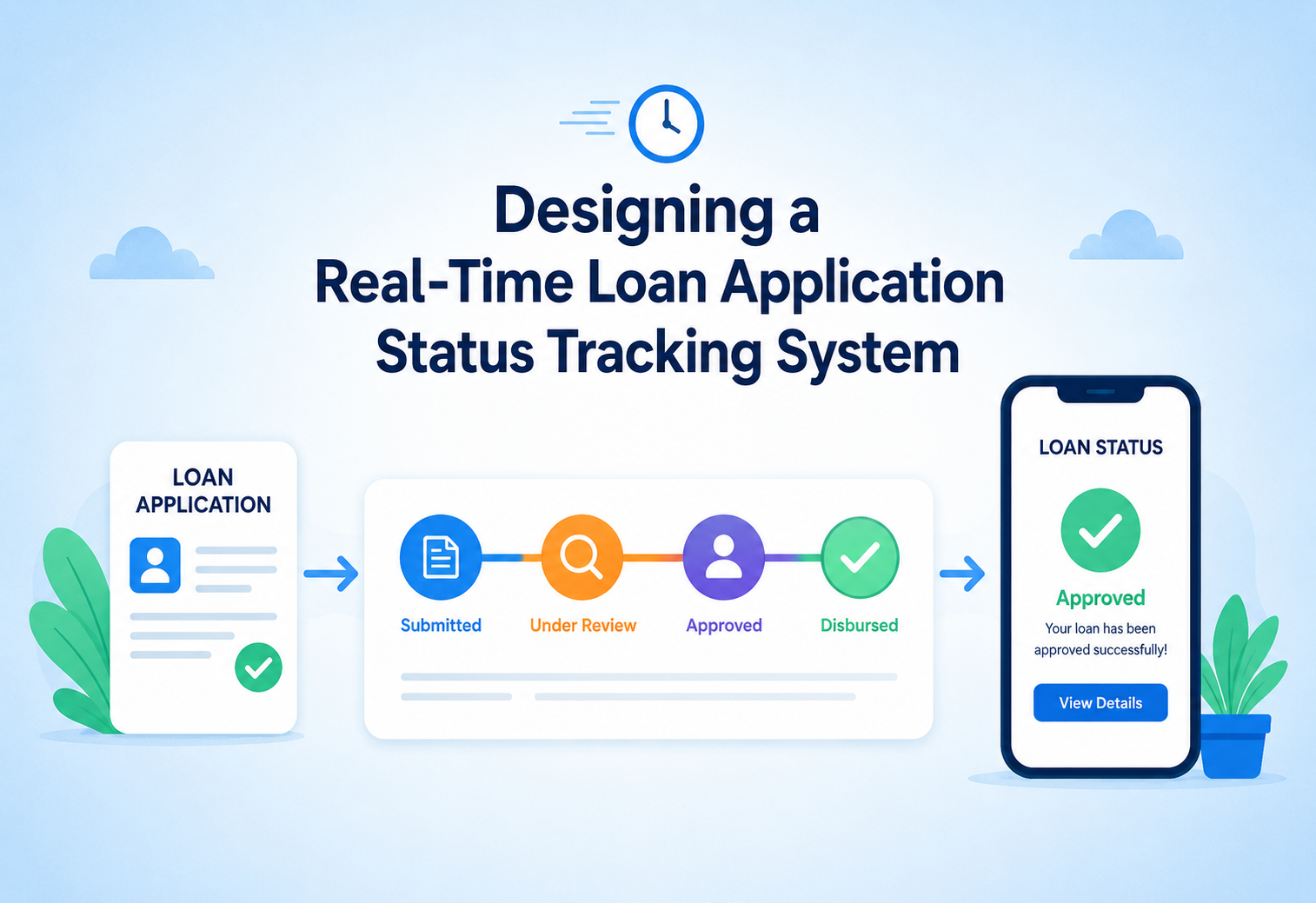
Designing a Real-Time Loan Application Status Tracking System
A deep, production-grade system-design walkthrough covering how a lending platform aggregates credit checks, document verification, and underwriting into one consistent, real-time, customer-facing status view — without ever showing two different truths on two different screens.
Introduction and History
When someone applies for a loan — a personal loan, a mortgage, an auto loan, a small business loan — that single application quietly kicks off work in several completely separate internal systems. A credit bureau needs to be queried to pull the applicant’s credit report and score. A document verification system needs to check the pay stubs, bank statements, or identity documents the applicant uploaded. An underwriting system needs to evaluate all of that against the lender’s risk policy and either approve, deny, or ask for more information. Each of these systems was often built at a different time, by a different team, sometimes even acquired from a different company entirely, and each has its own idea of what “status” means.
The customer, meanwhile, does not care about any of that internal complexity. They opened an app or a web page, and they want one honest answer to one simple question: “Where is my loan application right now, and what, if anything, do I need to do next?” The system this tutorial designs is the layer that sits between all of those fragmented back-office systems and that one simple, real-time, trustworthy status view.
1.1 A Brief History of the Problem
Traditionally, loan processing was almost entirely manual and disconnected from the customer entirely — an applicant submitted paperwork and then waited, sometimes for weeks, calling a loan officer for updates. As lending moved online through the 2000s and 2010s, banks and lenders digitized each stage individually: credit pulls became API calls to bureaus, document collection moved to upload portals, and underwriting became rules engines and later machine learning models. But these were digitized as separate systems solving separate problems, not built together — so a customer’s true end-to-end status often existed only in the heads of loan officers checking multiple internal screens, not as a single queryable fact anywhere in the technology stack.
The rise of fintech lenders and digital-first banks in the 2010s made real-time, self-service status tracking a competitive necessity rather than a nice-to-have — customers who could watch a delivery driver’s location on a map in real time had no patience for a loan process that felt like shouting into a void. That expectation is what turned “aggregate internal system state into one live customer view” from a reporting afterthought into a first-class piece of core lending infrastructure, which is the system we design in this article.
Pre-Digital Era — Paper Files and Phone Calls
An applicant submitted paperwork in person and then waited, sometimes for weeks. “Status” existed only in a loan officer’s head or a paper folder in a filing cabinet.
2000s — Digitizing Each Stage Separately
Credit pulls became API calls to bureaus, document collection moved to upload portals, and underwriting became rules engines — each digitized in isolation, without a common customer-facing view.
2010s — Fintech Sets a New Bar
Digital-first lenders and neobanks made self-service, real-time status tracking a competitive necessity, mirroring the “watch your delivery driver on a map” expectation set by consumer apps.
Today — First-Class Status Aggregation Platforms
Modern lenders treat “aggregate internal state into one live, trustworthy customer view” as a first-class piece of core lending infrastructure, with its own team, SLAs, and audit surface — not a reporting afterthought.
- Why is unifying loan application status considered harder than just building a good dashboard on top of existing systems?
- What does “real-time” actually mean for a status this customer will look at only a handful of times a day?
- Why did this become a “first-class infrastructure” concern in the fintech era rather than remaining an internal reporting concern?
Architecture and Components
The system’s core job is aggregation: many internal systems of record, each independently updating at their own pace, need to be fused into one coherent, low-latency status per application, without ever showing the customer conflicting or stale information.
2.1 Core Components
- API Gateway: single entry point for the customer app, handling routing, authentication checks, and rate limiting.
- Status Query Service: a lightweight, read-optimized service that serves the current status of an application directly from the Unified Status Store, so customer-facing reads never touch the slower internal source systems directly.
- Source Adapters (Credit, Document, Underwriting): one adapter per internal system, translating that system’s native events, webhooks, or polling results into a common, normalized event format. Adapters isolate the rest of the platform from each source system’s quirks and change management.
- Event Streaming Bus: the backbone connecting adapters to the aggregation engine, decoupling the pace of each source system from the pace of the aggregator, and providing a durable, replayable history of every status-relevant event.
- Status Aggregation Engine: the core logic that takes in normalized events from all three domains and computes the single, authoritative, customer-facing status for an application.
- Unified Status Store: the system of record for “what should the customer see right now” — a denormalized, fast-read store optimized for point lookups by application ID.
- Notification Service: pushes proactive updates to the customer (push notification, SMS, email) when their status changes, rather than requiring them to keep refreshing the app.
- Audit and Event Log: an immutable record of every status transition and the underlying source event that caused it, essential for compliance, dispute resolution, and debugging.
“Why introduce a Unified Status Store at all — why not have the Status Query Service call the credit, document, and underwriting systems live, on every customer request?” A strong answer: those three systems have wildly different latency, availability, and rate-limiting characteristics — a credit bureau API might take seconds and has strict usage quotas. Calling all three synchronously on every customer page load would make the customer’s experience only as fast and as reliable as the slowest and flakiest of the three, and could exhaust rate limits on systems that were never designed for high-frequency polling. Precomputing and storing the aggregated status decouples customer-facing read performance from internal system reliability entirely.
Internal Working
The Status Aggregation Engine is where the real design challenge lives: three independent systems, each with their own internal state machine, need to be combined into one coherent customer-facing status without contradicting each other or confusing the customer.
3.1 Step 1 — Normalizing Source Events
Each adapter translates its source system’s native status codes into a small, shared vocabulary of domain events — for example, CreditCheckStarted, CreditCheckCompleted, DocumentUploaded, DocumentVerified, DocumentRejected, UnderwritingStarted, UnderwritingApproved, UnderwritingDenied, UnderwritingNeedsInfo. This normalization step is what allows the aggregation logic to be written once, generically, instead of needing special-case code for every internal system’s idiosyncratic status naming.
3.2 Step 2 — Maintaining Per-Domain State
The aggregation engine keeps a small state machine for each of the three domains (credit, document, underwriting) per application. Each domain’s state machine has a well-defined set of valid states and transitions — for example, documents move through NotSubmitted → Submitted → UnderReview → Verified / Rejected. This per-domain state is stored alongside the unified status, both to compute the top-level status and to power a more detailed “view details” screen if the customer wants to drill in.
3.3 Step 3 — Deriving the Unified Status
The unified, customer-facing status is computed from the combination of all three domain states using an explicit priority and mapping table — not ad hoc conditional logic scattered through the codebase. This mapping table is the single most important artifact in the whole system, because it encodes the actual business rules about what the customer should be told.
| Credit State | Document State | Underwriting State | Unified Customer Status |
|---|---|---|---|
| Not Started | Not Submitted | Not Started | Application Received |
| Completed | Under Review | Not Started | Verifying Your Documents |
| Completed | Rejected | Not Started | Action Needed: Document Issue |
| Completed | Verified | In Progress | Underwriting In Progress |
| Completed | Verified | Needs Info | Action Needed: More Information |
| Completed | Verified | Approved | Approved |
| Completed | Verified | Denied | Not Approved |
Notice that the unified status is not simply “whichever domain updated most recently” — it follows a deliberate precedence: any domain that requires customer action (a rejected document, a request for more information) takes priority over showing a more generic “in progress” message, because the customer’s most urgent need is always to know what they must do next.
“What happens if the underwriting system sends an event out of order — say, an Approved event arrives before the Documents Verified event has been processed, because of a network delay?” This is why each domain’s state machine enforces valid transitions and the aggregator uses event timestamps (or better, a monotonically increasing sequence number from the source system) rather than arrival order. If an event would represent an invalid transition given the current known state, the engine holds it in a short reordering buffer keyed by application ID and re-attempts after a brief delay, rather than either dropping it or applying an inconsistent state. This is a classic out-of-order event handling problem, and it is exactly the kind of subtlety interviewers probe for in a system with multiple independent upstream producers.
3.4 Step 4 — The Reordering Buffer in Detail
The reordering buffer deserves a closer look, because it is a small piece of logic that quietly prevents a large class of bugs. For each application, the aggregator tracks the last-applied sequence number per domain. When an incoming event’s sequence number is exactly one greater than the last-applied number, it is applied immediately. When it is greater by more than one, it implies an earlier event for that domain has not arrived yet, so the new event is placed in a short-lived, time-bounded holding area rather than applied out of turn. A background sweep periodically checks the holding area: if the missing predecessor arrives within a configured window (typically a few seconds, tuned against the observed delivery characteristics of each source system), the buffered events are applied in the correct order; if the window expires without the predecessor arriving, the system applies what it has, flags the gap for reconciliation follow-up, and moves on rather than blocking that application’s status indefinitely on a single missing event.
This design deliberately favors eventual correctness with a bounded worst case over strict, unbounded ordering guarantees. Waiting indefinitely for perfect order would mean a single slow or lost event from one source system could freeze status updates for that application forever, which is a worse outcome for the customer than a rare, quickly-corrected inconsistency caught by reconciliation.

3.5 Step 5 — Duplicate Suppression
Because most event delivery systems provide at-least-once rather than exactly-once guarantees, the same event can legitimately be delivered more than once. The aggregator maintains a short-term deduplication window per application, keyed by the event’s unique identifier, and silently discards any event whose ID it has already processed. This is intentionally simple — a set lookup, not a distributed transaction — because idempotent event processing combined with sequence-number gating (described above) already provides the correctness guarantee; deduplication is purely an optimization to avoid redundant work, not a correctness requirement on its own.
“How long should the reordering buffer’s waiting window be, and how would you tune it?” Frame it as an empirical, per-source-system decision rather than a single global constant: instrument the actual observed delay distribution between an event being generated and being delivered for each source system, and set the window at a percentile (commonly p99) of that observed distribution, with alerting on how often events fall outside it. A single global timeout risks being too short for a chronically slower source system and unnecessarily long for a fast, reliable one.
Data Flow and Lifecycle
Tracing a single loan application from submission to decision shows how data flows through every layer of the system.
4.1 Push vs. Pull for the Customer
The system supports both patterns deliberately. When the customer has the app open, a lightweight real-time channel (WebSocket or Server-Sent Events, subscribed by application ID) pushes status changes the instant they are written to the Status Store, giving the “live tracking” feeling customers now expect. When the customer is not actively connected, the Notification Service sends a push notification, SMS, or email so they learn about important updates without needing to keep the app open, and when they do reopen the app, a simple pull-based read from the Status Store shows the current state immediately.
4.2 Lifecycle of a Status Record
Every application’s status record moves through a small number of well-defined unified states: Received → Verifying Documents → Underwriting In Progress → (possibly looping through Action Needed states) → Approved or Not Approved. Each transition is recorded as an immutable event in the audit log with a timestamp, the triggering source event, and which domain adapter produced it, so that any status shown to a customer can be explained and reconstructed later, which matters enormously for regulatory and dispute-handling purposes in lending.
Digital lenders and fintech loan platforms commonly describe presenting applicants with a simplified, plain-language progress view (such as “documents received,” “under review,” “final decision”) that deliberately hides the complexity of the multiple backend checks happening simultaneously — reflecting the same normalize-and-aggregate philosophy modeled by the mapping table in this design.
Advantages, Disadvantages and Trade-offs
Every aggregation architecture involves trade-offs. A strong design does not pretend they do not exist — it names them clearly and picks the ones the product can genuinely absorb.
Advantages
- Gives customers one trustworthy, real-time answer instead of forcing them to interpret multiple disconnected internal statuses or call support.
- Decouples customer-facing performance and availability from the reliability of individual back-office systems.
- Centralizes the business logic for “what does this combination of states mean” in one auditable place instead of scattering it across teams.
- Creates a natural, reusable audit trail of every status change for compliance and dispute resolution.
- New source systems (a new document type, a new underwriting model) can be added by writing one new adapter, without touching customer-facing code.
Disadvantages / Challenges
- Introduces a translation and aggregation layer that must itself be kept correct and in sync — a bug here can show every customer an incorrect status.
- There is inherent latency between an internal system’s true state changing and the unified view reflecting it, however small; the system trades perfect real-time truth for architectural decoupling.
- Requires ongoing coordination with the owning teams of each source system whenever their internal status model changes.
- Handling out-of-order or duplicate events correctly adds real complexity that is easy to underestimate.
- The unified mapping table can grow complex as more domains and edge cases are added, requiring careful ownership and testing discipline.
5.1 Key Trade-offs
| Trade-off | Option A | Option B | Typical Choice |
|---|---|---|---|
| Source integration | Live synchronous calls to each system | Event-driven asynchronous ingestion | Event-driven, for decoupling and resilience |
| Status granularity | Expose raw internal states to customers | Simplified, curated customer-facing states | Simplified — raw states are for internal support tools only |
| Real-time delivery | Persistent live connection (WebSocket) | Simple polling | Hybrid: live connection when app is open, push notification otherwise |
| Consistency | Strong consistency on every status read | Eventual consistency with brief propagation delay | Eventual consistency, kept within a low, defined latency budget |
| Ownership of mapping logic | Owned by each source team independently | Owned centrally by the aggregation platform team | Centrally owned, with source teams as reviewers |
“Why not just show the customer the raw status from whichever system is currently ‘active’ for their application?” Because raw internal statuses are written for internal operational purposes and rarely make sense to a customer — an underwriting system’s status of Queued: Tier 2 Manual Review means nothing to an applicant and can even cause unnecessary anxiety or support calls. The curation layer exists specifically to translate operational truth into customer-appropriate communication, which is a product and legal-communications decision as much as a technical one.
Section takeaway
The system trades a little bit of “always perfectly fresh” and “always perfectly simple” for a lot of “predictable, explainable, and safely evolvable.” In regulated financial systems, predictability and auditability of the customer experience are usually worth more than shaving off the last few milliseconds of staleness.
Performance and Scalability
Consider the scale: a large lender processing millions of active applications at various stages, with spikes around marketing campaigns, tax season, or promotional rate periods, and a customer base that increasingly expects sub-second status updates.
6.1 Partitioning by Application ID
Nearly every operation in this system — ingesting a source event, recomputing unified status, serving a read — is scoped to a single application ID. This makes the workload naturally shardable: both the event stream and the Status Store are partitioned by application ID (or a hash of it), so that processing and storage scale horizontally simply by adding more partitions and consumer instances, with no cross-partition coordination needed for the common case.
6.2 Read Path Optimization
Customer-facing status reads are extremely read-heavy relative to writes — an applicant might refresh or reopen the app dozens of times while waiting for a decision that changes only a handful of times total. The Status Query Service sits behind an aggressive read cache (keyed by application ID, invalidated the instant a new status is written), ensuring that repeated customer polling never puts meaningful load on the underlying Status Store or, worse, on the original source systems.
6.3 Handling Bursty Ingestion
During high-volume periods (a promotional campaign driving a surge of new applications), the volume of source events spikes correspondingly. Because ingestion is decoupled through a durable, partitioned event stream, the aggregation workers can fall behind briefly during a burst without losing data or blocking the source systems — they simply catch up by consuming the backlog, and the system can auto-scale the worker pool based on consumer lag as a scaling signal.
“How would you estimate the read-to-write ratio for this system, and why does it matter?” A reasonable estimate: a typical applicant might check their status 10 to 30 times over the life of an application, while the unified status itself might only change 5 to 8 times. That is roughly a 3:1 to 6:1 read-to-write ratio at the individual application level, but because status checks cluster heavily around when customers expect news (mornings, right after a notification), the effective peak read QPS can be far higher than the average suggests — which is exactly why an aggressive, invalidation-driven cache in front of the Status Store, rather than scaling the store itself, is the more cost-effective lever.
6.4 Cost Considerations at Scale
At millions of active applications, the dominant cost driver is usually not the aggregation compute itself but the fan-out of notifications and the volume of source-system events, particularly if a source system is chatty and emits many low-value intermediate events. A practical mitigation is to have adapters apply their own filtering and debouncing before publishing to the shared event bus — for example, collapsing several rapid internal progress updates from a document verification vendor into a single meaningful Verified or Rejected event, rather than forwarding every internal micro-update downstream. This keeps the shared event bus focused on customer-relevant signal and materially reduces both processing cost and notification noise.
Storage cost for the audit log also warrants deliberate tiering: recent, frequently-accessed history stays in a fast, queryable store, while older records (for applications closed months or years ago) are moved to cheaper, colder object storage, retrievable on demand for compliance or dispute purposes but not adding ongoing cost to the hot path. This tiering decision should be automated and driven by application status and age, not left as manual cleanup.
“A single source system starts emitting ten times more events than usual after a vendor change. How does this system stay resilient to that?” Because ingestion is decoupled through a partitioned, durable event stream, a surge from one source does not directly overload the aggregation workers synchronously — they simply process the backlog at sustainable throughput, and autoscaling reacts to increased consumer lag. Independently, per-adapter rate limiting and event filtering caps how much noise from any single misbehaving source can reach the shared pipeline in the first place, protecting the rest of the system from one integration’s problem becoming everyone’s problem.
High Availability and Reliability
An incorrect or stale status is not just a UX annoyance in lending — showing “Approved” before underwriting has actually finished, or failing to show a needed action, has real financial and legal consequences and erodes customer trust in a regulated product.
7.1 Idempotent Event Processing
Source systems can and will occasionally redeliver the same event (due to their own retries or at-least-once delivery guarantees). Every event carries a unique identifier, and the aggregation engine tracks processed event IDs so that reprocessing the same event is a safe no-op rather than a duplicate status transition or notification.
7.2 Never Regress a Status Without Explicit Cause
Because events can arrive out of order across independent source systems, the aggregation engine must guard against a stale event overwriting a more advanced, already-correct status. Each domain’s state carries a monotonically increasing version or sequence number from its source system, and the aggregator only applies an incoming event if its sequence number is newer than what is already recorded for that domain — preventing, for example, a delayed “Document Under Review” event from incorrectly reverting a status that has already progressed to “Approved.”
7.3 Fallback When a Source System Is Degraded
If the underwriting system, for instance, becomes temporarily unavailable, the aggregator should not fail to serve status at all — it continues serving the last known good status for that domain, optionally flagged internally as “possibly stale,” while a circuit breaker prevents the adapter from hammering the degraded system with retries. This graceful degradation matters more here than a hard failure, since customers checking on a life decision like a loan should never see an error page when the underlying issue is a temporary internal outage.
7.4 Reconciliation
Beyond real-time event processing, a periodic reconciliation job independently re-queries each source system’s current state for a sample (or all) open applications and compares it against what the aggregator has recorded, surfacing and alerting on any drift. This acts as a safety net against silently dropped events, adapter bugs, or edge cases the real-time pipeline might have missed.
“How do you guarantee the customer never sees a status that is inconsistent with reality?” Be honest that you cannot guarantee zero latency between reality and the displayed status in an eventually consistent, event-driven design — but you can guarantee bounded staleness (a defined maximum propagation delay, monitored and alerted on) and you can guarantee the displayed status is never logically invalid, through sequence-number-gated updates and a strict per-domain state machine that rejects impossible transitions. The combination of bounded staleness plus logical validity is the realistic, achievable reliability target here, not impossible perfect real-time accuracy.
Security
This system aggregates some of a customer’s most sensitive data — credit information, identity documents, financial details — into one place, which makes it a natural target and a focal point for regulatory obligations like fair lending and data privacy laws.
8.1 Key Security Controls
- Strict access scoping: a customer’s status API calls are authorized only for their own application, enforced by verifying the authenticated user ID against the application’s owner on every single request, not just at login.
- Data minimization in the unified view: the Status Store and customer-facing API expose only the curated, simplified status — never raw credit scores, full document contents, or internal underwriting reasoning — keeping sensitive source data properly contained within its owning system.
- Encryption in transit and at rest: all events on the bus and all data in the Status Store and audit log are encrypted, given the sensitivity of financial and identity data flowing through this pipeline.
- Tokenized references, not raw sensitive data: where the aggregator needs to reference a document or credit report, it stores a secure reference or token rather than the underlying sensitive artifact itself, so a breach of the Status Store does not directly expose documents or credit data.
- Immutable, tamper-evident audit log: every status change is logged with its cause, supporting fair-lending audits and dispute investigations, and the log itself is append-only and protected from retroactive modification.
- PII-aware logging discipline: application-level debug and operational logs are scrubbed of personally identifiable information, since a system this central touches so much sensitive data that ordinary debug logging habits become a real compliance risk.
“A support agent needs to see more detail than the customer does when helping with a call. How do you handle that without weakening the customer-facing security model?” The right answer is a separate, more privileged internal view backed by its own stricter role-based access control and full audit logging of every agent access, rather than simply loosening what the general Status Query Service returns. The customer-facing API and an internal support API should be entirely separate services with different authorization models, even if they read from overlapping underlying data.
Monitoring, Logging and Metrics
Because this system’s job is to reflect truth from many upstream systems, monitoring here is less about “is the server up” and more about “is what the customer sees actually true right now.”
9.1 What to Monitor
- End-to-end propagation latency: time from a source system emitting an event to the unified status reflecting it and, if applicable, a notification being delivered — the most direct measure of whether the system is delivering on its “real-time” promise.
- Event processing lag: consumer lag on each partition of the event stream, an early warning signal for aggregation workers falling behind under load.
- Reconciliation drift rate: how often the periodic reconciliation job finds a mismatch between the aggregator’s recorded state and a source system’s true state — ideally trending toward zero, and any sustained increase is a signal of a bug or missed events.
- Notification delivery success rate: whether customers are actually receiving the status updates the system believes it sent, broken down by channel (push, SMS, email).
- Per-adapter health: error rates, timeout rates, and circuit breaker state for each source system integration, since a degrading adapter is often the earliest sign of trouble.
9.2 Logging and Auditability
Every status transition is logged with a correlation ID tying it back to the specific source event and adapter that triggered it, enabling any customer-reported discrepancy (“the app said I was approved but then it changed”) to be fully reconstructed. Given the regulated nature of lending, these audit records are retained for extended, legally mandated periods, distinct and separate from more routine operational logs with shorter retention.
Lending and financial services platforms commonly maintain a detailed, immutable decision and status history for every application specifically to satisfy fair-lending and consumer-protection regulatory requirements, which require the ability to explain, on request, exactly what happened and when during an application’s lifecycle.
“What is the highest-value single metric to alert on in this system?” A strong answer is reconciliation drift rate, because it is the closest thing to a direct measurement of “is the customer seeing the truth right now.” Latency and error-rate metrics tell you the pipeline is running, but drift rate tells you the pipeline is producing correct output, which is ultimately the entire point of the system.
Deployment and Cloud
The platform is deployed as a set of independently scalable microservices — adapters, aggregation workers, the query service, and the notification service — typically containerized and orchestrated across multiple availability zones.
10.1 Deployment Practices
- Independent adapter deployment: each source-system adapter is deployed and versioned independently, so integrating a new document verification vendor or updating the credit bureau integration never requires redeploying the core aggregation engine.
- Canary releases for the mapping logic: because the status mapping table directly controls what millions of customers see, changes to it are rolled out gradually with close monitoring of the resulting status distribution for anomalies, before being applied to all traffic.
- Schema evolution discipline: the normalized event format is versioned and evolved in a backward-compatible way, since adapters and the aggregation engine are deployed independently and must tolerate temporarily running different versions during a rollout.
- Infrastructure as code: event stream topics, partition counts, and service scaling policies are defined declaratively, enabling consistent, auditable environments across staging and production.
10.2 Cloud Considerations
Given the regulated, sensitive nature of the data, deployment must account for data residency requirements and often for specific compliance certifications the hosting environment must hold. The event stream and Status Store are typically deployed within a private network boundary with no direct public exposure, reachable only through the tightly controlled API gateway.
| Deploy-time gate | Why include it on every rollout |
|---|---|
| Shadow-mode run of any mapping-table change | Computes what the new mapping would produce for real traffic without serving it, so divergence surfaces before customers see it. |
| Adapter schema backward-compat check | Adapters and aggregators run on independent release trains; a breaking event schema change would silently corrupt the pipeline mid-rollout. |
| Canary shard subset for the aggregation engine | Blast radius of a bad deploy is capped at the canary shard, never the whole fleet. |
| Rehearsed reconciliation replay drill | Reconciliation must actually catch and repair drift under realistic outage patterns, not just look green on a dashboard. |
| Data-residency verification | Storage class and region must match the applicant’s jurisdictional requirement, not just the primary region default. |
“How would you roll out a change to the status mapping table without risking showing incorrect statuses to real customers?” Beyond a standard canary rollout, a strong approach is to run the new mapping logic in shadow mode first — computing what it would produce for real, live traffic without actually serving those results to customers — and comparing its output against the current production logic for a sample of applications, surfacing any divergence for review before the new logic is ever allowed to affect what a customer sees.
Databases, Caching and Load Balancing
Storage, cache and load-balancing choices interact tightly with the correctness and performance of the whole system — picking the wrong store for the wrong dataset does not merely slow the system down, it can quietly break auditability.
11.1 Database Choices
| Data | Access Pattern | Typical Store |
|---|---|---|
| Unified status per application | Extremely read-heavy, simple key lookup by application ID | Document or key-value store, sharded by application ID |
| Per-domain state (credit, document, underwriting) | Read and updated together with unified status | Same store as unified status, denormalized alongside it |
| Event stream / normalized events | Append-only, high throughput, replay-able | Distributed log (Kafka or equivalent) partitioned by application ID |
| Audit and status history | Append-only, long retention, occasional analytical queries | Append-only table or object storage, indexed for lookup by application ID and date |
| Read cache | Very high read throughput, invalidated on write | In-memory cache (Redis or similar) |
11.2 Why a Denormalized Store for Status
The Unified Status Store deliberately denormalizes: rather than joining across separate credit, document, and underwriting tables on every read, it stores the already-computed unified status and per-domain summaries together in one record per application. This trades some storage duplication and write-time computation for dramatically simpler, faster reads — the right trade-off here, since the read path is customer-facing and latency-sensitive, while the write path (event processing) has more slack to do the extra work.
11.3 Caching Strategy
The read cache sits directly in front of the Status Query Service, keyed by application ID, with a short time-to-live as a safety net combined with active invalidation the instant a new status is written — giving both strong staleness guarantees and very low latency for the overwhelmingly common case of a customer repeatedly checking a status that has not changed.
11.4 Load Balancing
The API Gateway and Status Query Service are stateless and sit behind standard load balancers. The more interesting balancing problem is in the event-consumption layer: partitions of the event stream are distributed across aggregation worker instances using the stream platform’s native consumer-group rebalancing, ensuring that as worker instances are added or removed (for scaling or during a deployment), partition ownership redistributes automatically without manual intervention or event loss.
“Would you use a relational database for the Unified Status Store?” It is a defensible choice for smaller scale or where strong transactional guarantees across multiple related records are needed, but at large scale a key-value or document store is usually preferred here because the access pattern is overwhelmingly simple point lookups by application ID with no need for complex joins or cross-application transactions, and such stores offer better horizontal read scalability and lower latency for that specific pattern than a general-purpose relational database would.
APIs and Microservices
The API surface for this system splits into two very different contracts: a narrow, stable, customer-facing read API, and a wider set of internal integration contracts between adapters, the bus, and the aggregation engine.
12.1 API Design Principles
- Read-optimized, minimal customer-facing contract: the status API returns a small, stable, well-documented shape (unified status, a short customer-friendly message, and an optional “next action” field), deliberately hiding the underlying domain complexity from API consumers.
- Real-time subscription support: alongside a simple polling GET endpoint, the API offers a subscription mechanism (WebSocket or Server-Sent Events) so client apps can receive push updates without inefficient tight polling loops.
- Adapter contracts are internal, not customer-facing: each source-system adapter exposes its own internal event schema and versioning independent of the customer-facing API, so internal system changes never leak into or break the public contract.
- Backward-compatible evolution: as new domains are added (for example, a future “funds disbursement” stage), the customer-facing status vocabulary is extended additively rather than through breaking changes to existing status values that client apps already handle.
12.2 Internal Microservice Communication
Source-system adapters communicate with the aggregation engine exclusively through the asynchronous event bus, never through direct synchronous calls, which is what allows each source system’s team to deploy, scale, and even experience outages independently without directly impacting customer-facing status availability. The Status Query Service, by contrast, uses a fast synchronous read path against the Status Store, since customers expect an immediate answer when they open the app.
“If the underwriting system does not natively emit events and only supports being polled, how do you fit it into an event-driven architecture?” The underwriting adapter itself absorbs that mismatch: it polls the underwriting system on an appropriate interval (or via a webhook if one exists), detects meaningful state changes, and is responsible for translating those into the same normalized event format and publishing them to the event bus — so the polling-versus-push distinction is fully contained within that one adapter and invisible to the rest of the system.
Design Patterns and Anti-patterns
The patterns worth applying, and the ones worth explicitly avoiding, in a real-time status aggregation platform.
13.1 Patterns Used
- Adapter Pattern: each source-system integration is wrapped in an adapter that translates its native interface into the platform’s common normalized event format, isolating the rest of the system from external change.
- Event Sourcing: the unified status is derived from an append-only sequence of normalized domain events, giving a complete, replayable audit history and the ability to reconstruct status as of any point in time.
- CQRS (Command Query Responsibility Segregation): writes (event ingestion and aggregation) and reads (customer status queries) are handled by entirely separate paths optimized independently — a read-optimized denormalized store for queries, and an event-driven pipeline for writes.
- Circuit Breaker: protects the aggregation pipeline from a degraded or unavailable source system, allowing graceful fallback to last-known-good state instead of cascading failure.
- Saga-style Compensation for Multi-Domain Consistency: because the “unified status” spans three independently-evolving domains, the aggregator effectively runs a long-lived choreographed process per application, reacting to whichever domain event arrives next rather than orchestrating a rigid, centrally-controlled sequence.
13.2 Anti-patterns to Avoid
- Direct, tight coupling to source system internals: having the customer-facing status API call each source system’s native API directly, using its native status codes, creates fragility — any internal change in any source system becomes a customer-facing outage risk.
- Silent last-write-wins without sequence checking: naively overwriting the unified status with whatever event arrived most recently, without checking sequence numbers per domain, risks regressing a customer’s status due to network delays or reordering.
- One giant shared mutable status field with no domain breakdown: collapsing everything into a single opaque status string, without retaining per-domain state, makes debugging discrepancies and evolving the mapping logic far harder than necessary.
- Treating notifications as fire-and-forget: sending a push notification without tracking delivery success and having a fallback channel risks customers missing critical updates, such as being told they need to take action.
- Skipping reconciliation because “the event pipeline should always be correct”: assuming the real-time pipeline never drops or mishandles events removes the single most effective safety net for catching subtle bugs before they erode customer trust at scale.
“Where exactly would CQRS apply in this design, and why does it matter here specifically?” The write side (adapters publishing events, the aggregation engine processing them) is optimized for correctness, ordering, and durability under bursty, asynchronous load. The read side (the Status Query Service) is optimized purely for low-latency point lookups under extremely high read volume. Forcing both concerns through the same data model and code path would mean every read pays the cost of the write side’s more complex consistency logic, and every write is constrained by the read side’s caching and denormalization choices — separating them lets each side be optimized for what it actually needs to do.
13.3 Choreography vs. Orchestration
It is worth being explicit about why this design leans toward choreography (each domain adapter independently publishes events whenever its own state changes, and the aggregator simply reacts) rather than orchestration (a central controller explicitly calling out to credit, then documents, then underwriting, in a defined sequence). Orchestration would be a more natural fit if the three domains had a strict, always-the-same sequential dependency, but in practice a lender’s real workflow is often more flexible than that — document verification and credit checks frequently happen in parallel, and underwriting can sometimes begin evaluating what is available before every document type is finalized, then pause and re-trigger if something is still missing. Choreography accommodates this naturally, since each domain simply reports its own state changes whenever they happen, and the aggregator’s mapping table — not a rigid orchestrated sequence — is what encodes the business rules about what combination of states means what to the customer.
The trade-off is that choreography makes the overall workflow logic more implicit, spread across the mapping table and each domain’s own state machine rather than visible in one central orchestrator script. This is a reasonable price to pay for the flexibility gained, but it does mean the mapping table must be treated as genuinely authoritative documentation of the business workflow, kept rigorously reviewed and tested, rather than an incidental implementation detail.
“If you did need a strict, sequential dependency between domains — say, underwriting must never start before both credit and documents are complete — how would you enforce that in a choreographed design?” The aggregator itself can enforce sequencing gates within its own logic without needing a central orchestrator: it simply does not signal the underwriting adapter to begin (or does not apply an underwriting event as customer-visible) until the credit and document domain states satisfy the required precondition. The enforcement lives in the aggregator’s mapping and gating logic rather than in a separate orchestration layer, keeping the single-source-of-truth property intact.
Best Practices and Common Mistakes
Practical wisdom that separates a status platform that works in a demo from one that works on a bad Monday morning during a partial outage.
14.1 Best Practices
- Keep the customer-facing status vocabulary small, stable, and centrally owned, treating any addition or change to it as a deliberate product and legal-review decision, not just an engineering one.
- Always retain per-domain detail behind the unified status, even though customers only see the simplified view, since internal support and debugging depend on it.
- Build reconciliation into the system from day one rather than as an afterthought — it is the cheapest and most reliable way to catch aggregation bugs before customers do.
- Design the notification system with delivery tracking and multi-channel fallback, since a status update the customer never actually sees provides no real value.
- Version the normalized event schema explicitly and enforce backward compatibility, since adapters and the aggregation engine will inevitably be deployed on independent schedules.
14.2 Common Mistakes
- Exposing raw internal status codes to the customer “temporarily” during early development, which then leaks into production and confuses or worries customers.
- Assuming events from all source systems will always arrive in the correct order, and only discovering the out-of-order edge cases after a visible customer-facing regression.
- Under-provisioning the event stream’s partition count early on, making it expensive to reshard later as the system needs to scale beyond the original design.
- Not distinguishing between “this status changed” and “this status change is customer-notification-worthy,” leading to either notification fatigue or customers missing genuinely important updates.
- Building the mapping table as scattered conditional logic across the codebase instead of one explicit, testable, centrally reviewed table, making it very hard to reason about all the state combinations that can occur.
| Pre-launch checklist | Why it belongs on every launch |
|---|---|
| Chaos test each source-system adapter | The whole design exists to survive one source going degraded — validate under it, not against a clean environment. |
| Reconciliation drift alert wired to on-call | Silent status regressions are the worst customer experience; they should be one of the loudest alarms you own. |
| Rehearsed mapping-table rollback drill | Rollback works on paper. Rehearsal is what proves it works during a 3 AM incident. |
| Notification delivery-rate SLO in place | An “Approved” or “Action Needed” status the customer never actually receives is not really delivered. |
| Load test at campaign-launch scale | Averages hide the case that actually breaks — the sudden promotional spike. |
Digital lending platforms frequently emphasize giving applicants clear, jargon-free next steps rather than raw operational statuses, reflecting the industry’s understanding that a technically accurate but confusing status update generates more customer support burden than it saves.
Section takeaway
Most production incidents in systems like this trace back to one of two root causes: a source system starting to behave worse than expected, or a mapping / notification change rolling out without adequate guardrails. Investing early in reconciliation, delivery tracking, and shadow-mode rollout pays for itself many times over.
Real-World Industry Examples
Variations of this aggregation pattern show up across lending and adjacent regulated industries, each shaped by their own scale and constraints.
Digital-First Personal and Auto Lenders
Built self-service, real-time status tracking as a core product differentiator from the start, integrating credit, document, and underwriting systems that were often designed together with the customer-facing experience in mind — a direct real-world instance of the architecture described in this tutorial.
Traditional Banks Adding Digital Mortgage Tracking
Had to build an aggregation layer on top of long-established, siloed back-office systems (some decades old) originally built only for internal loan-officer use, making the adapter layer’s role in isolating legacy quirks especially critical to any modern customer-facing status experience.
Buy-Now-Pay-Later & POS Lenders
Operate under much tighter latency expectations, since a checkout-time credit decision needs a similar aggregation pattern compressed into seconds rather than days, pushing more of the “aggregation” logic toward synchronous, low-latency paths for the initial decision while still using the asynchronous event pattern for any post-approval steps.
Package and Delivery Tracking Systems
Outside lending entirely, systems like parcel tracking solve a structurally similar problem — aggregating scan events from many independent handling facilities into one simple, customer-facing “Out for Delivery” status — and are a useful reference architecture for the same event-driven aggregation pattern.
Insurance Claims Status Portals
Modern insurers face an almost identical problem when giving policyholders one live view of a claim that touches many internal systems — adjuster notes, documentation intake, fraud checks, payment authorization. The same adapter + event-bus + aggregation-engine + mapping-table skeleton applies directly, which is a strong hint that this is a genuine architectural blueprint, not a lending-specific accident.
Common Threads Across the Industry
Nearly all mature real-time customer-status platforms in regulated industries share the same skeleton: normalize source events through adapters, decouple through a durable event bus, aggregate via a centrally-owned mapping table, denormalize for fast reads, and add reconciliation as the primary correctness safety net. The specifics of the source systems and the customer vocabulary change; the shape of the platform generalizes remarkably well.
- How would a point-of-sale (checkout-time) lending status flow differ architecturally from a standalone loan application status flow? (Even tighter latency budgets, heavier reliance on pre-cached / pre-approved data where possible, and tighter fraud checks given the instant, high-pressure purchase context.)
Frequently Asked Questions
The questions that come up most often in interviews, design reviews, and internal support conversations for a real-time loan application status system.
That would tightly couple every client app version to the internal APIs and status vocabularies of three independent, evolving systems, make the customer experience only as reliable as the least reliable of the three, expose more internal detail than customers should see, and make it very hard to change internal systems without breaking every client in the field. Centralizing aggregation on the server side avoids all of these problems.
In practice, “real-time” here means bounded, low-latency propagation — typically low seconds from a source event to an updated customer-facing status — rather than literal zero-latency, which is not achievable or necessary. The system defines and monitors an explicit propagation latency target rather than an informal, undefined notion of “real-time.”
The mapping table’s precedence rules handle this explicitly — a terminal state like “Denied” is generally treated as final, and later events for other domains on a terminated application are recorded for audit purposes but do not reopen or change the customer-facing unified status, since the business decision itself is already made.
No — it purely aggregates and presents status from systems that make the actual decisions (credit scoring, document verification, underwriting). Keeping decision logic and status presentation cleanly separated is itself a deliberate architectural choice that keeps this system simpler, more auditable, and safer to change.
The core aggregation architecture stays the same, but the status mapping table and notification content become region-aware, typically parameterized by jurisdiction rather than hardcoded, since disclosure requirements, allowed messaging, and even which domains apply (some markets may not use a traditional credit bureau check, for instance) can differ by regulatory regime. The adapter layer’s isolation of source-system quirks also extends naturally to isolating region-specific source systems, so adding a new country often means adding new adapters rather than restructuring the aggregation engine itself.
Yes — the core skeleton (adapters + normalized event bus + a centrally owned mapping table + a denormalized read store + reconciliation) applies directly to insurance claim tracking, order fulfilment tracking, KYC onboarding tracking, and many other multi-system customer-facing status problems in regulated or high-scale contexts. The domain-specific pieces (which source systems, which customer vocabulary) change; the shape of the platform does not.

Summary and Key Takeaways
Designing a real-time loan application status tracking system is fundamentally an aggregation and curation problem: turning many independent, asynchronously updating internal systems into one coherent, trustworthy, real-time customer view — and making sure the customer is never shown two different truths at the same moment.
The core mental model
This system is really a translation and aggregation layer wearing one name: adapters normalize each source system into a common vocabulary, a durable event bus decouples upstream pace from downstream pace, a centrally owned mapping table encodes the business rules for “what does this combination of states mean,” and a denormalized read store plus aggressive caching keeps the customer-facing read path fast and independent of any single source system’s reliability. Reconciliation is the safety net that catches whatever the event-driven pipeline eventually gets wrong.
Key takeaways
- The core challenge is translating multiple independent, asynchronously updating internal systems into one coherent, trustworthy, real-time customer view — an aggregation and curation problem as much as a technical one.
- An explicit, centrally owned status mapping table, not scattered conditional logic, is what makes the business rules for “what does the customer see” auditable and safely evolvable.
- Event-driven ingestion through adapters decouples customer-facing reliability and performance from the reliability of the underlying source systems.
- Sequence-number-aware processing is essential to prevent out-of-order events from regressing a customer’s displayed status.
- CQRS-style separation of the write path (event aggregation) from the read path (status queries) lets each be optimized for its very different performance characteristics.
- Reconciliation against source systems is not optional polish — it is the primary safety net that catches the aggregation bugs a purely event-driven pipeline will eventually produce.
- Because this system touches sensitive financial and identity data and operates in a regulated industry, data minimization, access scoping, and immutable audit trails are first-class design requirements, not afterthoughts.
- Choreography over orchestration lets independently-evolving domains report their own state naturally, while the centrally owned mapping table remains the single, testable source of truth for what those combined states mean to the customer.
Built this way, the system can genuinely deliver on the promise a customer sees on their screen — one honest, jargon-free answer to “where is my application right now, and what do I need to do next?” — while, behind the curtain, safely combining the independently evolving signals of many internal systems into that single trustworthy view.
The best real-time status platforms are not the ones with the cleverest event pipeline, but the ones whose engineering discipline — mapping-table ownership, reconciliation, sequence gating, delivery tracking, and immutable audit — is boring enough to be trustworthy. In a regulated system where every status the customer sees may one day need to be defended in front of a regulator or a customer, “boring, explainable, and reproducible” is the highest possible compliment.