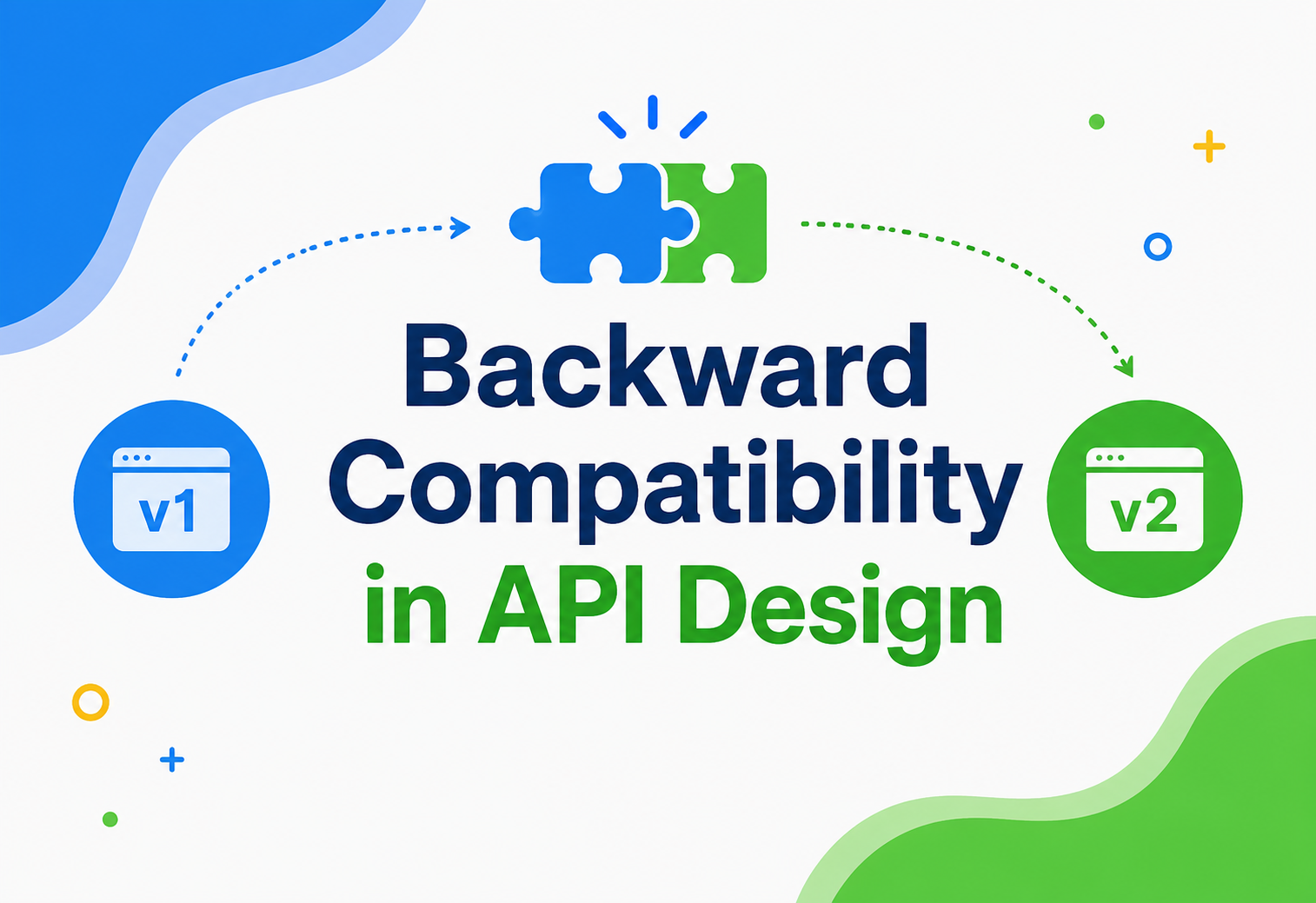
Backward Compatibility in API Design
A ground-up, no-assumptions tutorial on why old clients must keep working when your API grows up — with diagrams, Java code, and stories from Google, Stripe, Netflix, and Amazon.
Introduction & History
Before any code or theory, a simple household story that captures the exact idea this entire tutorial is built on.
Picture a TV remote you bought back in 2015. Fast forward to 2026 and you finally treat yourself to a brand-new Smart TV. You point that same old remote at it, thumb the power button, and — magically — the screen wakes up. In that moment, your ancient remote is still compatible with the new television. If nothing had happened, the TV would have effectively “broken” a remote it never even touched.
That everyday question — “does the old thing still work with the new thing?” — is the beating heart of this entire tutorial. The only difference is that we’re not talking about remotes and televisions. We’re talking about software programs speaking to each other over the internet through something called an API.
Term · API (Application Programming Interface)
- What
- A set of rules that lets one piece of software ask another piece of software to do something and get an answer back.
- Why
- Without a shared rulebook, two programs written by two different teams (or two different companies) would have no way to talk to each other.
- Where
- Everywhere — a weather app calling a weather server, a food delivery app calling a restaurant’s ordering system, a banking app calling the bank’s server.
- Analogy
- A restaurant menu. You (the customer) never walk into the kitchen; you just read the menu (the API), pick “Item #4” (the request), and the kitchen sends back your food (the response). You never need to know how the kitchen actually cooks it.
- Example
- When you open Instagram and it shows your feed, your phone sent a request like
GET /v1/feedto Instagram’s servers, which replied with a list of posts in a structured format (JSON).
Now here’s the twist: software is never really finished. Companies keep improving their APIs — adding features, fixing mistakes, tightening performance. The trouble is that millions of other programs (mobile apps, websites, other companies’ servers) are already built against the old menu. If you suddenly print a completely new menu overnight, every customer holding the old one gets confused and their orders start failing.
Backward compatibility is the discipline of changing your API’s “menu” in a way that customers holding the old menu can still order successfully, even though you’ve quietly added new dishes, renamed some ingredients, or refurbished the kitchen behind the scenes.
1.1 · A short history
None of this is new — the problem is as old as computing itself:
- 1960s–70s, Mainframes: IBM’s System/360 family became legendary for keeping the same instruction set across generations of hardware, so a program written for one machine ran on the next. That was revolutionary at the time and is often cited as the birth of “compatibility” as a formal engineering value.
- 1980s–90s, Operating systems & libraries: Windows became notorious — and successful — because Microsoft went to extreme lengths to keep old software running on new versions of Windows, sometimes even faithfully re-creating quirks and bugs from earlier releases because some program somewhere depended on that behaviour.
- 2000s, Web APIs (SOAP, then REST): Once companies began exposing services over HTTP, “breaking the API” started breaking other companies’ businesses overnight, not just internal programs.
- 2010s–today, Public APIs at scale: Firms like Stripe, Twilio, Google and Amazon now run APIs used by millions of external developers they’ve never met. A single careless change can break thousands of unrelated businesses at once. This forced the industry to treat API compatibility as a formal contract, with versioning schemes, deprecation policies and automated compatibility-checking tools.
Stripe (the payment company) has kept API versions running for its customers since 2011. If a business integrated with Stripe in 2015 and never touched their code again, their integration still works today, over a decade later, because Stripe pins every customer to the exact API version they started on and guarantees it will not break.
Think of a busy public library that keeps upgrading — new shelving, new self-checkout kiosks, a modern digital catalog. It cannot suddenly demand that every book returned tomorrow use a new format, because thousands of books were borrowed years ago under the old rules. The library has to accept those old books back and keep old library cards working, even while rolling out shiny new features for new members. Your API is that library.
The Problem & Motivation
Let’s build the motivation from the ground up with a very small story that goes very badly.
Imagine you built a small app called WeatherNow. You expose one single API:
GET /weather?city=Delhi

Response:
{
  "city": "Delhi",
  "temperature": 32
}
A thousand apps around the world now hit this endpoint every day: mobile apps, smartwatches, websites, even a farmer’s SMS alert system. None of them know anything about how your server works internally — they only know the “shape” of the answer: a city name and a number.
You decide to improve things. Temperature should be more precise, so you rename the field:
New response:
{
  "city": "Delhi",
  "temp_celsius": 32.4
}
The instant you deploy this, every one of those thousand apps that were reading response.temperature now sees undefined or null, because the field is gone. Weather widgets go blank. The farmer’s SMS system crashes at 5 AM. None of those developers received any warning — their code just stopped working, and they didn’t change anything on their end.
A breaking change is any change to an API that causes existing, correctly-written client code to fail or behave differently than before — without the client changing anything.
2.1 · Why does this problem exist at all?
It exists because of one fundamental fact of distributed software: the people who write the server and the people who write the clients are almost never the same people, and they almost never deploy their code at the same time.
- Inside a single company, the mobile team ships app updates every two weeks — but not everyone updates their phone right away. Some users stay on an old app version for months.
- Across companies, a partner business might integrate with your API once and then never touch that code again for five years.
- You, the API owner, usually cannot force anyone to upgrade. You don’t control their release schedule, their budget, or their priorities.
The result is a permanent situation where many versions of “the outside world” are talking to your one, single, currently-running server at the same time. Backward compatibility is how you serve all of them successfully, using one system.
Think of a public library. The library keeps upgrading — new shelving system, new self-checkout machines, new digital catalog. But it cannot suddenly demand that every book returned tomorrow must be in a new format, because thousands of books were borrowed years ago under the old rules. The library has to accept old books back and still let old library cards work, even while rolling out new features for new members.
2.2 · The business cost of getting this wrong
| Consequence | Real impact |
|---|---|
| Client apps crash | Users see errors, uninstall the app, leave 1-star reviews |
| Partner integrations fail silently | A payment fails, an order doesn’t get placed, and nobody notices for hours |
| Support tickets spike | Engineering time gets pulled into firefighting instead of building |
| Trust is damaged | Developers become afraid to integrate with your API at all, or add excessive defensive code, slowing everyone down |
| Legal / financial exposure | For banking, healthcare, or payment APIs, a broken integration can mean real financial loss or regulatory violations |
So the motivation is simple: backward compatibility protects the trust between you and everyone who depends on your software, while still letting you improve that software.
Core Concepts
Before we go deeper, let’s build a solid vocabulary. Every term is explained the way you’d explain it to someone who has never written a line of code.
Term · Contract
- What
- The agreed-upon shape of requests and responses between a client and a server — what fields exist, what type they are, what’s required, what URL to call.
- Why
- Both sides need to agree in advance, because they can’t ask each other questions in real time the way two humans can.
- Analogy
- A legal contract between two businesses. Once signed, both sides plan their operations around it. If one side quietly changes the terms, the other side’s plans fall apart.
- Example
- An API contract might say: “
POST /usersrequires a JSON body with a string fieldnameand returns a JSON object with an integer fieldid.”
Term · Backward Compatibility
- What
- A new version of an API (or software) continues to work correctly for clients that were written against an older version.
- Why
- So existing users, clients and integrations don’t break when the provider improves the system.
- Analogy
- A new electrical socket in your wall still accepts your old phone charger’s plug.
- Example
- You add a new optional field
"humidity"to the weather API response. Old clients that don’t look forhumiditykeep working exactly as before; only new clients that want humidity data use it.
Term · Forward Compatibility
- What
- The opposite direction: an older version of software can still handle data or requests created by a newer version, at least without crashing.
- Why
- Useful when you can’t guarantee everyone upgrades at the same time — sometimes an old server has to survive receiving a message from a newer client.
- Analogy
- An old radio that can still play a station broadcasting in a slightly newer format, even if it can’t use every new feature.
- Example
- A message queue format designed so that old consumers simply ignore unknown new fields, instead of crashing when they see them.
Backward compatible = new server, old client, still works. Forward compatible = old server (or old client), new data, still works (doesn’t crash, even if it ignores the new part). Most real-world API design focuses primarily on backward compatibility, because that’s the direction that breaks the most often in practice.
3.1 · Breaking vs. non-breaking changes
This is the single most important distinction in this entire tutorial. Every change to an API falls into one of two buckets.
| Change | Type | Why |
|---|---|---|
| Adding a new optional field to a response | Non-breaking | Old clients simply ignore fields they don’t know about |
| Adding a new optional request parameter with a default value | Non-breaking | Old clients that don’t send it still get the old default behavior |
| Adding a brand-new endpoint | Non-breaking | No one was calling it before, so nothing can break |
| Removing or renaming a field | Breaking | Old clients reading that field now get nothing |
| Changing a field’s data type (string → number) | Breaking | Old parsing code may throw a type error |
| Making an optional field required | Breaking | Old clients that never sent it now get rejected |
| Changing the URL path or HTTP method | Breaking | Old clients literally can’t find the endpoint anymore |
| Changing error codes or status codes for the same situation | Breaking | Old error-handling logic stops matching correctly |
| Changing the meaning of a field without changing its name | Breaking | The “silent” breaking change — hardest to catch, most dangerous |
Changing what a field means without renaming it is far more dangerous than deleting it. If you delete a field, old clients get an obvious error. If you silently change "amount" from “dollars” to “cents” and keep the field name identical, old clients keep running — just with numbers that are now 100x wrong. No crash, no error, just silently wrong money. This is why teams that handle payments are extremely paranoid about field semantics.
3.2 · Semantic Versioning (SemVer)
Term · Semantic Versioning
- What
- A numbering convention:
MAJOR.MINOR.PATCH, e.g.2.4.1. - Why
- So anyone can look at a version number and instantly know how risky it is to upgrade, without reading the whole changelog.
- Where
- Used for libraries, SDKs, and increasingly for public APIs.
- Analogy
- A traffic light on a version number: MAJOR = red (stop and check, things may break), MINOR = yellow (proceed with awareness, new stuff added), PATCH = green (safe, just a bug fix).
- Example
1.2.3 → 1.3.0means new features were added, nothing broke.1.3.0 → 2.0.0means something broke, read the migration guide before upgrading.
3.3 · Deprecation
Term · Deprecation
- What
- Officially marking a feature, field, or endpoint as “still working today, but scheduled for removal in the future.”
- Why
- It gives consumers advance warning and time to migrate, rather than breaking them with no notice.
- Analogy
- An airport announcing “Gate 12 will permanently close in 3 months, please use Gate 14 for future flights” — instead of just locking Gate 12’s doors one random morning.
- Example
- A response header like
Deprecation: trueandSunset: 2027-01-01tells the client exactly when the field will actually be removed.
Architecture & Components
Vocabulary in hand, let’s see how a real system is actually assembled to deliver backward compatibility. It isn’t one trick — it’s several parts co-operating.
4.1 · Versioning strategy
The mechanism by which a client tells the server “which contract I expect.” Common approaches:
| Strategy | How it looks | Notes |
|---|---|---|
| URI versioning | /v1/users, /v2/users | Very visible, easy to cache and debug, most common for public APIs |
| Header versioning | Accept: application/vnd.company.v2+json | Keeps URLs clean, but harder to test in a browser directly |
| Query parameter | /users?version=2 | Simple but easy to forget or omit accidentally, defaults can be risky |
| Date-based versioning | Stripe-Version: 2024-06-20 | Used by Stripe; each account is pinned to the API “shape” from a specific date |
| No versioning, additive-only | Same URL forever, only additive changes allowed | GraphQL APIs and some internal APIs favor this — see later section |
4.2 · Schema / contract definition
A machine-readable description of what a valid request and response look like. Common formats: OpenAPI / Swagger (for REST), Protocol Buffers (for gRPC), GraphQL SDL (for GraphQL) and Avro / JSON Schema (for event and message systems).
An OpenAPI schema snippet is like a nutrition label on food packaging. It formally states: “this response object has a field called calories, it’s a whole number, it will always be present.” Tools can then automatically check whether a proposed change would violate that label.
4.3 · Compatibility checker (schema diffing tool)
Automated tooling that compares the “old” schema and the “new” schema and flags anything that would break existing consumers, before the code is ever deployed. Popular examples: openapi-diff, buf breaking (for Protobuf), and Confluent Schema Registry’s compatibility mode (for Avro and Kafka).
4.4 · API Gateway
A single front door that all client traffic passes through before reaching your actual backend services. The gateway can translate between an old contract and a new internal implementation, so your internal code can move fast while external consumers see a stable shape.
4.5 · Adapter / translation layer
Code that sits between the “new” internal model and the “old” external contract, converting one into the other on the fly.
4.6 · Deprecation registry & sunset policy
A tracked list of what’s deprecated, when it was deprecated, and when it will actually be removed — usually enforced with a documented notice period (e.g., “we guarantee 12 months’ notice before removing any field”).
Internal Working — How Compatibility Is Actually Achieved
Now let’s step through the actual engineering techniques used to make a change without breaking anyone. Think of this as your practical toolbox.
-
Technique 1 · Additive-only changes
The golden rule: only add, never remove or repurpose. If you need new behaviour, add a new optional field or endpoint instead of modifying an existing one. Old clients simply never look at the new keys — those keys just sit there quietly. New clients that were updated to use them get the extra data. Nobody breaks.
-
Technique 2 · Tolerant Reader (be lenient in what you accept)
Client code that reads only the specific fields it needs and ignores everything else, instead of validating the entire structure strictly. If a client validates every single field strictly, the server can never add a new field without the client’s validation rejecting the whole response.
-
Technique 3 · Default values for new required-sounding fields
If a new field is functionally needed but you can’t force old clients to send it, give it a sensible default on the server side instead of rejecting requests that omit it.
-
Technique 4 · Expand–Contract (Parallel Change)
Add the new alongside the old, migrate consumers over time (tracked with metrics), and only remove the old once nobody is using it. It lets you change your mind about a design without ever having a moment where things are broken for anyone.
-
Technique 5 · Content negotiation / multi-version serving
The same running server process responds differently based on what version the caller asked for — using small adapter functions per version rather than duplicating the whole service.
-
Technique 6 · Feature flags / gradual rollout
New, potentially risky behaviour is hidden behind a flag and enabled for a small percentage of traffic first, so if it turns out to break something, the blast radius is small and the flag can be turned off instantly without a redeploy.
5.1 · Additive-only changes (in code)
// BEFORE
{ "city": "Delhi", "temperature": 32 }

// AFTER — additive, backward compatible
{ "city": "Delhi", "temperature": 32, "humidity": 58, "unit": "celsius" }
Old clients simply never look at humidity or unit — those keys just sit there unused. New clients that were updated to look for them get the extra data.
5.2 · Tolerant Reader pattern in Java
Term · Tolerant Reader Pattern
- What
- Client code that only reads the specific fields it needs and ignores everything else in a response, instead of validating the entire structure strictly.
- Why
- If the client validates every single field strictly, then the server can never add a new field without the client’s validation rejecting the whole response.
- Analogy
- Reading a newspaper for the sports score — you don’t reject the whole newspaper because it also contains a new advertisement you weren’t expecting.
- Example
- In JSON parsing, this means using libraries configured to ignore unknown properties instead of throwing an error on them.
@JsonIgnoreProperties(ignoreUnknown = true)
public class WeatherResponse {
    private String city;
    private double temperature;
    // New fields like "humidity" added by the server
    // are safely ignored by old clients using this class.
}
That single annotation (from the popular Java library Jackson) is a working example of the Tolerant Reader pattern. Without it, Jackson throws an exception the moment it sees a field it doesn’t recognize — silently making every future addition a breaking change, which is exactly what we want to avoid.
5.3 · Server-side defaults for new fields
@PostMapping("/orders")
public OrderResponse createOrder(@RequestBody OrderRequest req) {
    // "priority" is new. Old clients never send it.
    // Instead of rejecting them, default to "STANDARD".
    String priority = req.getPriority() != null
            ? req.getPriority()
            : "STANDARD";
    return orderService.create(req, priority);
}
5.4 · Expand–Contract in practice
Term · Expand–Contract Pattern
- What
- A three-phase migration technique: (1) Expand — add the new field or behavior alongside the old one, both working simultaneously; (2) Migrate — move all consumers over to the new one, tracked with metrics; (3) Contract — once nobody is using the old one anymore, remove it.
- Why
- It lets you change your mind about a design without ever having a moment where things are broken for anyone.
- Analogy
- Building a new bridge right next to the old one, letting traffic use either bridge for a while, and only demolishing the old bridge once every car has switched over and traffic on it is zero.
temp to temperature_celsius, without ever breaking a client.5.5 · Content negotiation with version-aware handlers
@GetMapping("/users/{id}")
public ResponseEntity<?> getUser(
        @PathVariable Long id,
        @RequestHeader(name = "API-Version", defaultValue = "1") int version) {

    UserInternal user = userService.findById(id);

    if (version == 1) {
        return ResponseEntity.ok(UserV1Mapper.from(user)); // old shape
    }
    return ResponseEntity.ok(UserV2Mapper.from(user)); // new shape
}
Notice how the internal model (UserInternal) can evolve freely — only the two small mapper classes need to know about the external contracts. This isolates “internal freedom to change” from “external promise to stay stable,” which is the central architectural idea behind almost every technique in this tutorial.
5.6 · Feature flags for safe rollout
New, potentially risky behavior is hidden behind a flag and only turned on for a small percentage of traffic first. If it does turn out to break something unexpected, the blast radius stays small and the change can be turned off instantly without a redeploy.
Data Flow & Lifecycle
Every API field, endpoint, or version goes through a predictable life story. Understanding that lifecycle helps you plan changes instead of reacting to them in a panic.
6.1 · Stage-by-stage explanation
- Design & Review: The proposed change is checked against the current schema using automated compatibility tooling before a single line of production code is written.
- Active: The new version (or new additive field) is live, fully supported, and recommended for new integrations.
- Deprecated: The old version still works exactly as before, but is publicly marked as scheduled for removal, with a clear sunset date communicated via docs, headers, emails, or dashboards.
- Sunset warning period: Automated warnings (HTTP headers, dashboard banners, emails to API key owners) increase in frequency as the sunset date approaches. Usage of the old version is actively monitored.
- Retired: Requests to the old version now return a clear error (commonly
410 Gone) pointing to migration documentation, rather than a confusing generic failure.
6.2 · A single request’s journey (data flow)
Walking through this sequence in plain words:
- The client sends a request and includes its version, either in the URL, a header, or implicitly (by using an old API key that’s pinned to an old version).
- The API Gateway reads that version marker and routes or tags the request accordingly.
- The core business logic runs once, using the latest, most current internal data model — it does not duplicate itself per version.
- A thin “response shaper” (mapper / adapter) transforms the current internal model into the exact contract shape the requesting version expects.
- The client receives a response indistinguishable from what it always received, even though the internals have moved on.
Good backward-compatible systems almost never maintain multiple copies of business logic per version. They maintain one current implementation and several small, cheap “shape adapters” at the edge. Duplicating logic per version is expensive to maintain and is where most real-world compatibility bugs are actually born.
Advantages, Disadvantages & Trade-offs
Backward compatibility is powerful — but nothing in engineering comes free. Here’s an honest ledger.
PROSWhy It’s Worth It
- Trust: Developers integrate with confidence, knowing their code won’t randomly break.
- Lower operational risk: Fewer emergency incidents, fewer 3 AM pages.
- Faster ecosystem growth: Third parties build tools, integrations, and businesses on top of a stable API, because the ground under them doesn’t shift.
- Smoother internal releases: Teams can deploy independently without needing to coordinate a “flag day” where everyone upgrades at once.
- Better reputation: Companies known for compatibility (Stripe, AWS) attract more developers than ones known for surprise breakage.
CONSWhat It Costs
- Accumulated complexity: Old fields, old endpoints, and old code paths pile up over time and must still be tested and maintained.
- Slower iteration on core design mistakes: A poorly designed field from years ago may need to be supported for a long time because “just remove it” isn’t a safe option.
- Engineering overhead: Building schema checkers, adapters, gateways, and deprecation tooling takes real, ongoing investment.
- Testing surface grows: Every supported version needs its own test coverage, multiplying QA effort.
- Documentation burden: Multiple active versions mean multiple sets of docs to keep accurate.
7.1 · The trade-off, stated plainly
Backward compatibility is a trade between short-term development speed and long-term ecosystem trust. Moving fast and breaking things is genuinely faster in the short term — that’s why early-stage startups with zero external users often skip formal versioning entirely. But the moment real, paying customers or partners depend on your API, that speed advantage flips into a liability, because every “quick fix” now risks breaking someone else’s business.
Renovating a house you live in alone is fast — knock down any wall you want. Renovating an apartment building full of tenants is slow and careful — you plan around their schedules, give notice, and never cut off water without warning. Public APIs are apartment buildings, not private houses.
7.2 · Full compatibility matrix
Performance & Scalability
Backward compatibility isn’t just a “correctness” concern — it has real, measurable effects on performance and how well your system scales.
8.1 · Where the cost shows up
- Adapter / mapping overhead: Converting an internal model into an old external shape costs CPU cycles on every request. Usually tiny (microseconds), but at very high scale (millions of requests per second, e.g. large ad-tech or payment platforms) this adds up and needs to be profiled.
- Larger payloads over time: Additive-only design means responses tend to grow fields over the years. Old clients ignore the extra bytes, but bandwidth and serialization cost is still paid on the server.
- Multiple code paths to keep warm: If old and new logic paths diverge significantly (which good design tries to avoid), caches, JIT compilation, and connection pools may need to serve more distinct code shapes.
- Schema registry lookups: Systems like Kafka + Avro perform a schema-compatibility check per message in high-throughput pipelines; this is usually cached but still a real cost to design around.
8.2 · Scaling strategies that pair well with compatibility work
| Strategy | How it helps compatibility work scale |
|---|---|
| Response shaping at the edge (API Gateway) | Keeps version-specific logic out of the core service, so the core service scales independently of how many versions exist |
| Caching per-version responses | If v1 and v2 responses are both frequently requested, cache both shapes separately instead of re-computing the transform every time |
| Async / event-driven schema evolution | Systems like Kafka use a Schema Registry so producers and consumers negotiate compatibility without a synchronous, blocking handshake |
| Contract testing in CI | Catches costly production incidents before deploy, which is far cheaper than firefighting broken traffic at scale |
Netflix operates thousands of internal microservices, many written and deployed independently by different teams. To avoid a scaling nightmare where every service has to coordinate deploys with every other service, Netflix leans heavily on additive, backward-compatible API changes and automated contract tests, so hundreds of deploys per day can happen without a central “release train” slowing everyone down.
High Availability & Reliability
Backward compatibility is one of the most underrated contributors to system uptime. Here’s the connection most people miss.
A huge share of real-world production outages are caused not by servers crashing, but by two versions of software disagreeing about the shape of data.
9.1 · How compatibility supports availability
- Zero-downtime deployments become possible. If v2 of your server can safely handle requests shaped for v1 (and vice versa, briefly), you can roll out new code to some servers while old code is still running on others — a rolling deployment — without any customer-visible downtime.
- Safe rollbacks. If a new deployment misbehaves, you need to roll back to the previous version. If the new version already wrote data or changed schemas in a way the old version can’t read, rollback itself becomes a second incident. Backward-and-forward compatible data formats make rollback truly safe.
- Blast radius containment. A breaking change tends to affect all clients simultaneously and unpredictably; a well-managed compatible rollout affects a controlled, monitored subset.
A classic reliability incident: Team A deploys a new server version that writes a new required database field. Team A forgets that the old server version (still running on some pods during the rolling deploy) doesn’t know how to read that new field and throws an error. Result: intermittent 500 errors for several minutes, caused entirely by a backward/forward compatibility gap between two versions of the same service talking to the same database.
9.2 · The “N-1 compatibility” rule
Most large-scale systems enforce a rule: every service must be able to run correctly alongside the immediately previous version of itself (N-1), and every database schema change must be readable by both the current and previous application version. This single rule is what makes rolling deployments and safe rollbacks possible at all.
Security
Backward compatibility and security sometimes pull in opposite directions. Knowing when to break compatibility on purpose is an important skill.
10.1 · Where compatibility helps security
- Predictable, well-tested contracts reduce the chance of ambiguous parsing behavior that attackers exploit (e.g., a field that means one thing to the client and another to the server — a classic source of request-smuggling-style bugs).
- Gradual, monitored rollouts (made possible by compatibility) mean security teams can catch anomalies in a small percentage of traffic before a change reaches everyone.
10.2 · Where you must intentionally break compatibility for security
- Deprecating weak authentication: If an old API version only supports an outdated, insecure authentication method (e.g., API keys sent in plain query strings, or weak TLS versions), continuing to support it “for compatibility” becomes a genuine security liability. Security exceptions to compatibility promises are standard and expected.
- Fixing a vulnerability that lives in the contract itself: For example, if an old field accidentally exposed sensitive data (like full card numbers instead of masked ones), you don’t preserve that field “for compatibility” — you remove or redact it immediately, treat it as a security incident, and communicate an accelerated, forced migration.
- Input validation tightening: Sometimes an old contract was too permissive (e.g., allowed unbounded string lengths, enabling denial-of-service attacks). Tightening this is technically a breaking change but is usually justified and rolled out with clear communication.
Compatibility is a promise you keep by default. Security is a boundary you don’t compromise, even if it means breaking that promise. Reputable API providers document a clear “security exception” clause in their compatibility policy so this isn’t a surprise when it happens.
10.3 · Version-aware security surface
Every actively-supported old version is also an actively-supported piece of attack surface. Security patching, dependency updates and monitoring must be applied to every live version, not just the newest one — a real, ongoing cost of long compatibility windows and one reason companies eventually force-sunset very old versions.
Monitoring, Logging & Metrics
You cannot manage what you don’t measure. A mature backward-compatibility program always includes dedicated observability around versions.
11.1 · What to track
| Metric | Why it matters |
|---|---|
| Requests per API version, over time | Tells you if a deprecated version’s usage is actually dropping — the core signal for deciding when it’s safe to sunset it |
| Unique clients (API keys) still on old versions | Raw request count can hide “this one abandoned script still calls us every night” — you need to know how many distinct consumers are affected |
| Error rate split by version | A spike specific to one version usually points to a compatibility bug introduced in a recent change |
| Deprecated-field usage | Logging when a response includes a field that’s marked for removal tells you if anyone is still relying on it, even at the field level, not just the version level |
| Schema validation failures | Counts of requests rejected by contract validation — a leading indicator of clients that are out of sync |
| Sunset header delivery / acknowledgement | Whether deprecation warnings are actually reaching consumers (e.g., are they reading response headers at all?) |
11.2 · Practical logging technique: “ghost field” tracking
Before removing a field, instrument the server to log (or increment a counter) every time that field is read by identifiable client traffic patterns, or every time it’s populated in a response that actually gets consumed. Only once usage drops to zero (or an acceptable, explicitly accepted risk threshold) do teams proceed with actual removal.
Google Maps Platform publishes clear deprecation and version-usage monitoring internally before shutting down old endpoints, and famously kept some legacy Maps API behaviors alive far longer than planned specifically because monitoring showed meaningful continued usage — illustrating that the decision to sunset is data-driven, not calendar-driven.
Deployment & Cloud
Modern cloud deployment techniques are deeply intertwined with compatibility guarantees — in fact, most of them are only safe because of backward and forward compatibility.
12.1 · Blue-Green Deployment
Term · Blue-Green Deployment
- What
- Two identical production environments (“blue” = current, “green” = new). Traffic is switched from blue to green all at once, after green is verified healthy.
- Why
- Enables instant rollback (just switch traffic back to blue) and near-zero downtime deploys.
- Analogy
- Keeping two identical stage sets ready backstage at a theatre — you can switch which one the audience sees between acts instantly, and switch back instantly if something goes wrong with the new one.
This only works safely if the database and any shared state are compatible with both blue and green simultaneously during the (brief) transition — another real-world application of the N-1 compatibility rule.
12.2 · Canary Releases
Term · Canary Release
- What
- A new version is rolled out to a small percentage of real traffic (e.g., 1–5%) first, monitored closely, then gradually increased.
- Why
- Limits the blast radius of any undiscovered compatibility problem to a small, monitored slice of users instead of everyone.
- Analogy
- Named after canaries once used in coal mines — a small, sensitive, early warning signal before risking the whole group.
12.3 · Rolling Deployment
Instances are updated one batch at a time, so old and new versions coexist for the duration of the rollout — again, only safe with N-1 compatibility guarantees, as discussed in the High Availability section.
12.4 · API Gateways in the cloud
Managed gateway products (AWS API Gateway, Google Cloud Apigee / Endpoints, Azure API Management, Kong) provide built-in support for:
- Routing by version (path, header, or query string) to different backend deployments
- Request / response transformation without touching backend code
- Automatic deprecation headers and usage analytics per version
- Rate limiting and throttling per API key / version, useful for gently nudging stragglers off old versions
AWS itself famously maintains extremely long backward compatibility windows for its own APIs — some AWS SDK calls from over a decade ago still function today, because breaking a customer’s infrastructure automation script could mean breaking their production environment with zero warning, at massive scale.
Databases, Caching & Load Balancing
Compatibility isn’t only an “API surface” concern — it runs all the way down into your data layer.
13.1 · Database schema migrations
The same expand-contract idea applies directly to databases:
Expand
Add the new column as nullable, alongside the old one. Both old and new application code can run against this schema.
Dual-write / backfill
New code writes to both old and new columns; a background job backfills historical rows into the new column.
Migrate reads
Switch application read paths over to the new column, monitored carefully.
Contract
Once no code reads the old column anymore, drop it — usually weeks or months later, and only after a final verification.
Renaming a database column directly (ALTER TABLE ... RENAME COLUMN) in a single deploy step is a classic reliability trap: if old application code (still running on some servers during a rolling deploy) queries the old column name, it crashes immediately. Always go through expand-contract instead of a direct rename, even though it feels slower.
13.2 · Caching layers
- Cache key versioning: Include the schema / contract version in the cache key (e.g.,
user:123:v2) so that a newly deployed shape never accidentally serves stale, old-shaped data to a client expecting the new shape, or vice versa. - Cache invalidation on schema change: Any breaking change to cached object structure must trigger a full cache flush or a key-namespace bump — otherwise you serve corrupted-looking data from cache even after the “real” backend has been fixed.
- TTL as a safety net: Shorter cache TTLs during a migration period reduce the window where a stale, incompatible cached response could be served.
13.3 · Load balancing across versions
During rolling or canary deployments, the load balancer is actively distributing live traffic across multiple simultaneously-running versions of your service. Health checks must be version-aware — a load balancer that doesn’t understand this can route “old contract” traffic to a “new contract only” instance and get failures that look like a capacity problem but are actually a compatibility problem.
APIs & Microservices
In a microservices architecture, backward compatibility isn’t just about external, public-facing APIs — it’s the glue that lets dozens or hundreds of internal teams deploy independently without a central coordination bottleneck.
14.1 · Consumer-Driven Contract Testing
Term · Consumer-Driven Contract (CDC) Testing
- What
- Each consumer (client service) publishes a small file describing exactly what it expects from a provider (server) API. The provider’s CI pipeline runs all consumers’ contracts against every proposed change, before deploying.
- Why
- It catches breaking changes automatically, before release, without requiring every consumer team to manually test against every provider change.
- Where
- Common tooling: Pact, Spring Cloud Contract.
- Analogy
- Instead of the kitchen guessing what allergies every regular customer has, each regular customer files a card with the restaurant (“I’m allergic to peanuts”). The kitchen checks every new recipe against all filed cards before serving it to anyone.
- Example
- The
order-servicedepends oninventory-service’sGET /stock/{sku}returning a fieldavailable: boolean. This expectation is recorded as a contract; ifinventory-servicetries to remove that field, its own test suite fails immediately, long before deploy.
14.2 · Java example — a version-aware DTO with safe evolution
// Internal, freely-evolving model — can change any time
public class Order {
    private Long id;
    private BigDecimal totalAmount;
    private String currency;
    private String priority;    // added later
    private String giftMessage; // added even later
    // getters/setters omitted
}

// Public v1 contract — frozen in time, never changes
public class OrderV1Response {
    public Long id;
    public BigDecimal totalAmount;
    public String currency;

    public static OrderV1Response from(Order o) {
        OrderV1Response r = new OrderV1Response();
        r.id = o.getId();
        r.totalAmount = o.getTotalAmount();
        r.currency = o.getCurrency();
        return r; // priority & giftMessage never leak into v1
    }
}

// Public v2 contract — includes newer fields
public class OrderV2Response {
    public Long id;
    public BigDecimal totalAmount;
    public String currency;
    public String priority;
    public String giftMessage;

    public static OrderV2Response from(Order o) {
        OrderV2Response r = new OrderV2Response();
        r.id = o.getId();
        r.totalAmount = o.getTotalAmount();
        r.currency = o.getCurrency();
        r.priority = o.getPriority();
        r.giftMessage = o.getGiftMessage();
        return r;
    }
}
The internal Order class can gain fields freely, forever. The v1 mapper simply never copies new fields across, so v1 consumers are permanently protected from ever seeing them — this is the practical, code-level version of the “one internal model, many thin adapters” architecture discussed earlier.
14.3 · GraphQL’s approach — no versions at all
GraphQL takes an interesting stance: it discourages URL versioning entirely (no /v1, /v2) and instead relies purely on the additive-only rule, plus a formal @deprecated directive on individual fields:
type Weather {
  city: String!
  temperature: Float! @deprecated(reason: "Use temperatureCelsius instead")
  temperatureCelsius: Float!
}
Old clients keep querying temperature and it keeps working (marked deprecated, not removed), while new clients adopt temperatureCelsius. The entire schema is one single “living document,” evolved field-by-field, rather than versioned wholesale.
Design Patterns & Anti-patterns
A quick, opinionated reference of what to reach for — and what to run from.
15.1 · Patterns (do these)
| Pattern | One-line description |
|---|---|
| Additive-only evolution | Only ever add new optional fields / endpoints; never remove or repurpose existing ones directly |
| Tolerant Reader | Clients read only what they need and ignore unknown fields |
| Expand–Contract | Introduce new alongside old, migrate consumers, then remove old — never a single risky flip |
| Adapter / Anti-Corruption Layer | Thin translation layer isolates external contracts from internal model changes |
| Consumer-Driven Contracts | Automated tests, driven by real consumer expectations, gate every provider change |
| Deprecation with Sunset headers | Machine-readable, standardized signals (Deprecation, Sunset HTTP headers) instead of just a blog post nobody reads |
| Feature flags / gradual rollout | New behavior ships dark, is enabled for a small percentage first, monitored, then expanded |
| Semantic Versioning | Version numbers communicate risk level at a glance |
15.2 · Anti-patterns (avoid these)
| Anti-pattern | Why it hurts |
|---|---|
| Silent field repurposing | Changing what a field means without renaming it — the most dangerous, hardest-to-detect breaking change discussed earlier |
| Strict, “reject unknown fields” client validation | Makes every future additive server change a breaking change for that client |
| Versioning the whole API for a tiny change | Forces every consumer to migrate even when 99% of the contract didn’t change; increases maintenance burden unnecessarily |
| No deprecation window (“just delete it”) | Removes trust instantly; consumers get zero time to react |
| Duplicating full business logic per version | Multiplies bugs and maintenance cost; logic drifts apart between versions over time |
| Undocumented, implicit contracts | If the “contract” only lives in someone’s memory or in client code that happens to work, any change is a guessing game |
| Ignoring usage data before removing something | Removing a field / endpoint because “surely nobody uses this anymore” without checking metrics — a frequent cause of real incidents |
| Skipping automated compatibility checks in CI | Relying purely on manual review to catch breaking changes doesn’t scale and reliably misses things |
A well-known category of real incidents: a team changes an enum field’s set of allowed values (e.g., adding a new order status like "PARTIALLY_REFUNDED") assuming it’s “just adding a value, so it’s safe.” But if old client code uses a strict switch statement with no default case, receiving an unrecognized enum value crashes it. This shows that even “additive” changes need to be evaluated against how tolerant the actual client code is — the safety of an additive change is not automatic, it depends on the reader being tolerant too.
Best Practices & Common Mistakes
Ten habits to build, and five ways teams still trip over themselves.
16.1 · Best-practices checklist
Publish a formal compatibility policy
State clearly, in writing, what you promise (e.g., “no breaking changes without a major version bump and 12 months’ notice”).
Version from day one
Even if you only ever ship
v1for years. Retrofitting versioning onto an unversioned API already used by others is far harder than starting with it.Automate compatibility checking in CI
So a human reviewer isn’t the last line of defense against a breaking change slipping through.
Design DTOs / response objects explicitly per version
Rather than serializing internal models directly — this single habit prevents most accidental breakage.
Use standardized deprecation signals
HTTP
Deprecation/Sunsetheaders, changelogs, and dashboards instead of relying on customers reading emails.Track real usage before removing anything
Data, not assumptions, should drive sunset timing.
Write and rehearse a rollback plan
For every deploy that touches shared data, not just the API layer.
Keep client parsing tolerant
Ignore unknown fields, default missing enum values gracefully — a defensive habit, even as a client, not just as a provider.
Communicate early and often
Migration guides, code samples, and a clear “why” reduce resistance and mistakes during a transition.
Treat security-driven exceptions explicitly
Documented separately from ordinary compatibility promises.
16.2 · Common mistakes and how to avoid them
| Mistake | Fix |
|---|---|
| Testing only the “happy path” with the newest client | Include old client versions / fixtures in your automated test suite permanently |
| Treating documentation as optional | Auto-generate docs from the same schema used for compatibility checks, so they can never drift apart |
| Assuming “nobody could still be using this ancient version” | Check real telemetry — legacy usage is almost always higher than engineers expect |
| Deploying database and API changes in the same step | Separate schema migration from code deploy using expand-contract, deployed as distinct steps |
| One giant version bump per year, big-bang style | Prefer many small, additive, low-risk changes over rare, large, breaking ones |
Real-World & Industry Examples
How some of the most-integrated-against APIs on the planet actually keep this promise, year after year.
Every Stripe account is pinned to the exact API version active when the account was created (a date, like 2024-06-20). Even as Stripe’s API evolves for new accounts, an old account’s integration keeps receiving the exact same response shapes it was built for, forever, unless the business explicitly opts in to upgrade. This date-based versioning is widely regarded as one of the most disciplined public API compatibility systems in the industry.
AWS maintains an extraordinarily long compatibility tail. Automation scripts written by customers a decade ago against core services often continue to function without modification, because a huge share of the global economy runs infrastructure automation directly against these APIs — breaking them could mean breaking production systems for banks, hospitals, and governments with no warning.
Google publishes formal deprecation notices with fixed migration windows (commonly 12 months) before retiring old endpoints or SDK versions, and closely monitors real usage data to judge whether it’s actually safe to proceed with a sunset, sometimes extending timelines when adoption of the replacement lags behind expectations.
With a large microservices footprint and hundreds of independent deploys per day, Netflix’s engineering culture leans on additive API evolution and automated contract verification so that teams can move fast independently, without a slow, centrally-coordinated “everyone upgrade together” release process.
The Kubernetes project uses an explicit maturity-and-versioning system for its own APIs (alpha → beta → stable / GA), with formal deprecation policies stating exactly how many releases a stable API must remain supported before it can be removed — a widely studied example of compatibility governance for a huge, multi-vendor open-source ecosystem.
Twilio documents a clear, public “Changelog” and version-support policy for its communications APIs (SMS, Voice), giving businesses that built automated customer communication systems years of predictable, stable behavior — critical because these integrations often touch time-sensitive, revenue-impacting workflows like order confirmations and appointment reminders.
Frequently Asked Questions
The questions that come up most often in real design reviews, in code reviews, and in interviews.
Q · Is adding a new required field ever backward compatible?
No. If old clients don’t send that field, and the server now rejects requests without it, that’s a breaking change by definition. The safe pattern is to add it as optional with a sensible server-side default, then — only much later, if truly necessary — require it in a new major version.
Q · How long should a deprecated version stay alive before removal?
There’s no universal number — it depends on your audience. Internal-only APIs between teams you control might allow a few weeks. Public APIs used by thousands of external businesses often commit to 12 months or more. The right number is whatever lets real, monitored usage drop to near zero before removal, backed by data, not a fixed calendar guess.
Q · Does REST or GraphQL handle backward compatibility better?
Neither is automatically better — it depends on discipline, not the protocol. REST commonly uses explicit version numbers in the URL; GraphQL commonly uses a single evolving schema with field-level @deprecated markers. Both can be done well or badly; the underlying principles (additive changes, tolerant readers, clear deprecation) apply to both.
Q · What’s the difference between an API “version” and an API “revision”?
“Version” usually refers to a distinct, separately-maintained contract (e.g., v1 vs v2) that a client explicitly opts into. “Revision” is sometimes used more loosely for any deployed change, including small non-breaking ones, and doesn’t necessarily require the client to do anything.
Q · Can microservices skip formal versioning if they’re “internal only”?
They can relax some formality (e.g., shorter deprecation windows), but the underlying discipline still matters enormously — internal services are often called by many other internal teams, and an internal breaking change can cause an outage just as real as an external one. Consumer-driven contract testing is especially popular here precisely because it works well without heavy version-number ceremony.
Q · Is it ever acceptable to just break compatibility and force everyone to upgrade at once?
Sometimes — usually for critical security fixes, or for very early-stage products with few or no external users, where the cost of maintaining compatibility outweighs the benefit. Even then, the best practice is to be transparent about it, give whatever advance notice is realistically possible, and treat it as a deliberate, documented exception rather than an accident.
This tutorial covers a purely technical engineering topic. If any part of your work involves safety-critical or regulated systems (medical devices, financial infrastructure, aviation), API compatibility policies there are typically governed by formal standards and regulatory review in addition to the engineering practices described here.
Summary & Key Takeaways
One promise, kept at scale, for years — that’s the whole story.
Backward compatibility is fundamentally about respecting a simple promise: “code that worked yesterday against my API should still work today, unless I’ve clearly warned you otherwise.” Everything in this tutorial — versioning schemes, tolerant readers, expand-contract migrations, contract testing, deprecation headers — exists to make that promise practical to keep at real-world scale, across teams, companies, and years.
One-sentence definition to remember
Every field you don’t rename, every endpoint you don’t silently remove, every deprecation header you actually send — each one is a small deposit into a trust bank. Companies that make those deposits consistently, over years, end up with an ecosystem of developers, partners and customers that keep building on them — because the ground under their feet doesn’t shift.