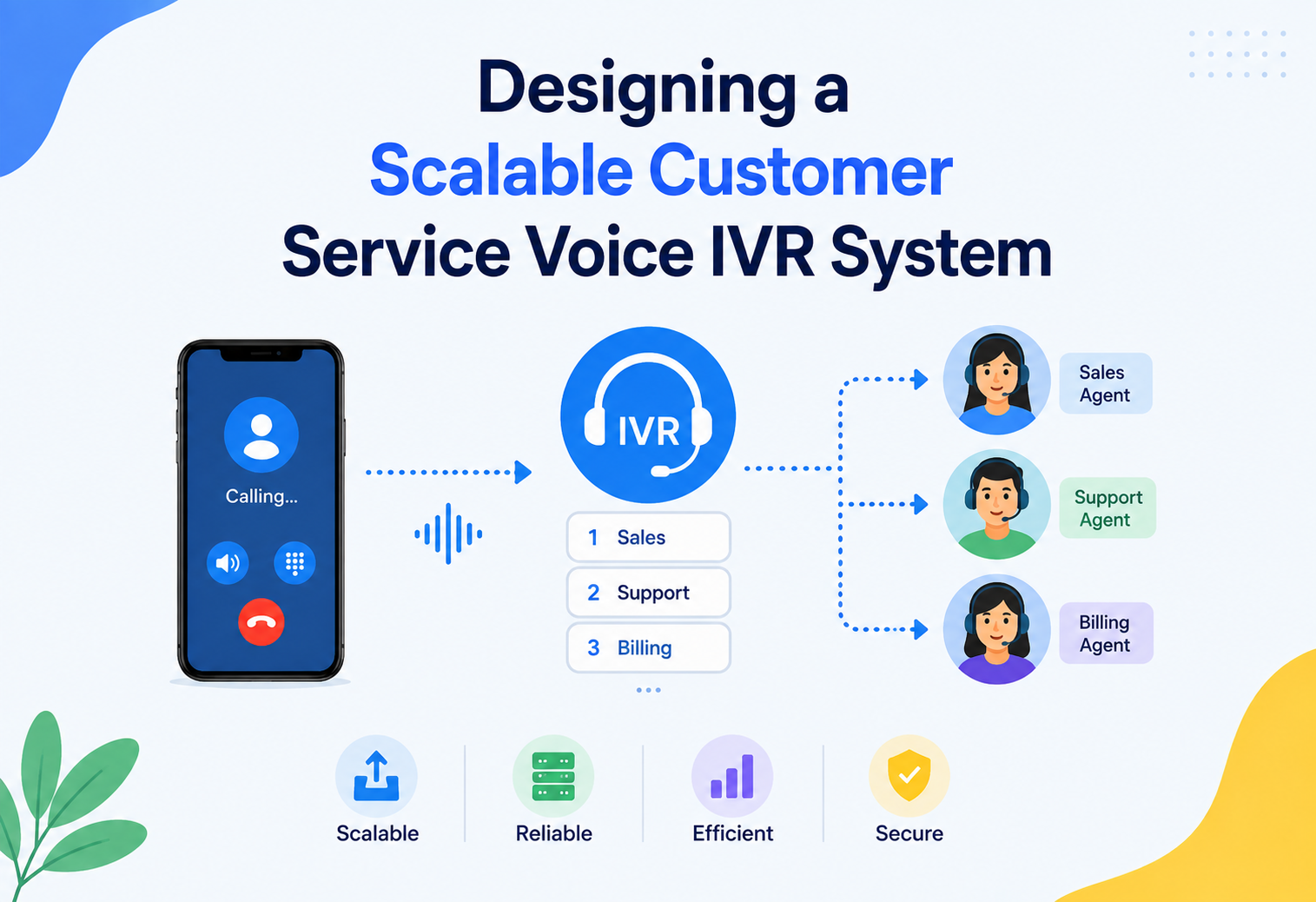
Designing a Scalable Customer Service Voice IVR System
How to architect an Interactive Voice Response platform that handles millions of concurrent calls, routes each caller dynamically based on identity, history, and intent, and stays reliable when call volume spikes 10x without warning — where every architectural choice traces back to a single hard constraint: a human is on the other end of the line, in real time, waiting.
Introduction & History
Before IVR existed, calling a large company meant reaching a human switchboard operator who manually connected your call to the right department — a model that simply could not scale as call volumes grew into the millions. The first Interactive Voice Response systems emerged in the 1970s and 1980s, built on top of the telephone network’s DTMF (dual-tone multi-frequency) signaling — the tones your phone makes when you press a button. “Press 1 for sales, press 2 for support” was, and in many ways still is, the defining interaction pattern of IVR: a caller navigates a fixed menu tree using keypad input, and the system routes them based on which branch they selected.
This model worked, but it was rigid. Every caller navigated the same static tree regardless of who they were, why they were calling, or what had happened the last time they called. Over the following decades, three major shifts transformed IVR from a static menu system into the dynamic, intelligent routing platform this document describes.
1.1 The three shifts that made modern IVR possible
Transport moves to VoIP
The underlying transport moved from circuit-switched telephony to VoIP (Voice over IP), letting call systems run on standard IP networks and cloud infrastructure rather than dedicated telephony hardware. Signaling and media were suddenly ordinary IP flows an engineering team could reason about with standard distributed-systems tools.
Speech recognition & NLU mature
Speech recognition and natural language understanding matured enough to let callers simply say what they want (“I need to check my order status”) instead of navigating nested keypad menus, collapsing the “where in this menu tree does my problem live” step for the caller.
Real-time identity & history-aware routing
IVR systems gained the ability to look up caller identity and history in real time and use that context to route dynamically — a returning customer with an open support ticket gets routed differently than a brand-new caller, without either of them navigating an explicit menu to get there.
The engineering challenge this document works through is building a system that does all of this — real-time voice handling, speech and DTMF input processing, live lookups against customer data, and dynamic routing decisions — reliably, at a scale of millions of concurrent calls, where every additional second of latency is a caller sitting in silence.
1.2 Why voice imposes such strict latency discipline
It is worth being precise about why voice, specifically, imposes such a strict latency discipline compared to other real-time systems. Human conversational turn-taking has a well-studied natural rhythm — listeners expect a response gap of roughly 200 milliseconds in normal conversation, and gaps beyond about 500 milliseconds to a second start to feel distinctly awkward, even if the listener cannot consciously articulate why.
That is the reason this document keeps returning to the same latency budget for routing decisions — it is not an arbitrary engineering target, it is derived directly from how conversational turn-taking actually works, and every architectural choice downstream of it exists to protect that budget.
- What fundamentally changed when IVR moved from circuit-switched telephony to VoIP?
- Why is “static menu tree” IVR insufficient for a modern, personalized customer service experience?
- What makes voice systems uniquely latency-sensitive compared to, say, a web request?
- Where does the ~200 – 500 ms routing latency budget actually come from?
Architecture & Core Components
A modern IVR platform is really a real-time media processing system fused with a decisioning engine. Every call is simultaneously an audio stream that must be processed with near-zero perceptible delay, and a routing decision that depends on data the system may need to fetch in real time.
2.1 The four architectural layers
Telephony Ingress Layer
SIP trunking / carrier gateway and Session Border Controllers (SBCs) that terminate inbound calls from the public telephone network and normalize them into the platform’s internal call-handling protocol.
Media Processing Layer
Media Servers handling real-time audio: DTMF detection, speech-to-text (ASR), text-to-speech (TTS) prompt playback, and call recording.
Routing & Decisioning Layer
The Call Routing Engine, Caller Identity Service, and Personalization / Context Service that decide, in real time, where each call should go.
Destination Layer
Agent Queueing System, Automated Self-Service Modules (bots, bill-pay, status-check flows), and the Agent Desktop that receives routed calls with full context attached.
graph TB
    subgraph NET["Public Network"]
        PSTN["Public Telephone Network"]
    end

    PSTN --> SBC["Session Border Controller"]
    SBC --> SIP["SIP Trunk Gateway"]
    SIP --> MEDIA["Media Server Cluster"]

    MEDIA --> ASR["Speech Recognition Service"]
    MEDIA --> DTMF["DTMF Detection"]
    MEDIA --> TTS["Text to Speech Service"]

    ASR --> NLU["Intent and NLU Engine"]
    DTMF --> ROUTER["Call Routing Engine"]
    NLU --> ROUTER

    ROUTER --> IDSVC["Caller Identity Service"]
    IDSVC --> CRM["Customer Profile Store"]
    ROUTER --> CONTEXT["Personalization Context Service"]
    CONTEXT --> HISTORYDB["Interaction History Store"]
    CONTEXT --> RULES["Routing Rules Engine"]

    ROUTER --> DECISION{"Routing Decision"}
    DECISION --> SELFSERVE["Self Service Module"]
    DECISION --> QUEUE["Agent Queueing System"]

    QUEUE --> AGENTDESK["Agent Desktop"]
    SELFSERVE --> TTS

    ROUTER --> METRICS["Call Metrics and CDR Store"]
2.2 Component responsibilities
| Component | Responsibility |
|---|---|
| Session Border Controller (SBC) | The security and normalization boundary between the public telephone network and internal infrastructure — handles SIP signaling, protects against telephony-layer attacks, and normalizes codecs. |
| Media Server Cluster | Terminates the actual audio stream per call, runs DTMF detection, streams audio to ASR, and plays back TTS prompts — this is the real-time, latency-critical heart of the system. |
| Speech Recognition (ASR) / Intent (NLU) Engine | Converts spoken audio into text and then into a structured intent (billing_inquiry, report_outage) the Routing Engine can act on. |
| Caller Identity Service | Resolves the caller’s phone number (via Automatic Number Identification) and / or spoken or entered account information into a known customer profile, in real time, without making the caller wait noticeably. |
| Personalization Context Service | Assembles a routing-relevant context bundle for the call: recent interaction history, open tickets, account tier, preferred language, and any active routing rules that apply to this customer. |
| Call Routing Engine | The decision-making core: given intent, identity, and context, decides whether to route to self-service, a specific agent skill group, a priority queue, or a specialized flow — and does so within a strict latency budget. |
| Agent Queueing System | Manages the pool of routed-but-not-yet-connected calls, applying skill-based and priority-based queueing logic while agents become available. |
2.3 Why separate the Personalization Context Service from the Routing Engine?
It would be simpler on paper to fold context assembly directly into the Routing Engine — one service, one code path. The reason to keep them separate mirrors the same logic that motivates separating fan-out from dispatch in a push-notification architecture: these two responsibilities have genuinely different scaling and failure characteristics.
The Context Service’s job is I/O-bound — fetching profile data, interaction history, and applicable rules from various stores, potentially in parallel — and its failure mode should be graceful degradation (return partial or default context, never block indefinitely). The Routing Engine’s job is compute-bound — evaluating rules against whatever context it received — and needs a hard, predictable latency ceiling regardless of what happened upstream. Combining them makes it much harder to enforce that ceiling, because a slow context fetch would directly stall routing logic that should otherwise be fast and deterministic. Keeping them separate lets the Routing Engine apply a strict timeout to context assembly and proceed with whatever context arrived in time — a design pattern sometimes called “best-effort enrichment with a hard deadline.”
2.4 The Agent Desktop as a first-class architectural component
The Agent Desktop is easy to think of as “just a UI,” but it plays a structural role in this architecture: it is the final consumer of the context bundle the entire upstream pipeline exists to assemble. If the Agent Desktop cannot render or act on that context quickly and reliably, the personalization work done everywhere else in the system is wasted — the agent ends up asking the caller to repeat information anyway. This is why context delivery to the Agent Desktop is treated as a latency-sensitive, first-class API call in this design, running in parallel with call connection rather than as an afterthought fetched once the agent is already on the line.
- Why does the Session Border Controller exist as a distinct component rather than letting the Media Server directly face the public network?
- Why is the Personalization Context Service separated from the Call Routing Engine rather than combined into one service?
- What is the latency budget you would target for the Routing Engine’s decision, and why does it matter so much here specifically?
- What does “best-effort enrichment with a hard deadline” mean, and why is it the right pattern for context assembly?
Internal Working — Call Setup, Routing, and Voice Processing
Understanding what happens between the moment a caller dials in and the moment they are connected to the right destination is where the design becomes concrete rather than abstract.
3.1 Call setup: SIP signaling and media negotiation
When a customer dials in, the call arrives over the carrier’s network using SIP (Session Initiation Protocol) for signaling — establishing, modifying, and tearing down the call — while the actual audio flows separately over RTP (Real-time Transport Protocol). The Session Border Controller terminates the inbound SIP session, performs security checks (rejecting malformed or malicious signaling traffic), and hands the call off to a Media Server, which negotiates the audio codec and begins receiving the RTP audio stream. This separation of signaling from media is fundamental to how telephony systems scale — the lightweight SIP signaling plane can be handled by relatively small, fast-failing components, while the heavier, stateful RTP media plane is handled by a purpose-built, horizontally scaled media server fleet.
3.2 Real-time audio processing
Once media is flowing, the Media Server does several things concurrently on the live audio stream: it monitors for DTMF tones (keypad presses, detected either in-band or via the more modern, more reliable RFC 2833 / 4733 out-of-band signaling), and it streams audio to the ASR engine for continuous speech recognition. Both paths feed into a unified “what did the caller just communicate” signal that the Routing Engine consumes — critically, the system must handle a caller switching between speaking and pressing keys mid-call without breaking the interaction flow, since real callers do this constantly (speaking a request, then pressing a digit to confirm).
3.3 The routing decision itself
This is where “dynamic, personalized routing” actually happens. When enough signal has accumulated — a recognized intent, a caller identity resolution, or both — the Call Routing Engine evaluates a routing decision using several inputs simultaneously:
- Caller identity: resolved via ANI (the calling number, available immediately at call setup) cross-referenced against the Customer Profile Store, or via spoken or entered account verification for higher-confidence identification.
- Interaction history: has this caller called recently about an unresolved issue? Do they have an open ticket that should route them directly back to the agent or team already handling it?
- Detected intent: what does the caller actually want, from ASR / NLU or DTMF menu selection?
- Business rules and priority tiers: account value, SLA commitments, current queue depths and wait times across agent skill groups, and any active promotional or crisis-response routing overrides (for example, “route all outage-related calls to the outage response team, bypassing normal queueing”).
The Routing Engine combines these into a single decision — self-service, or a specific agent skill group with a priority level — and this decision must complete within roughly 200 to 500 milliseconds to avoid the caller perceiving an awkward pause, which means every data lookup in this path (identity resolution, interaction history, rules evaluation) has to be aggressively optimized for low-latency reads, typically served from cache rather than a live database query on the hot path.
3.4 Self-service vs. agent handoff
Not every call needs a human agent. A significant fraction of routed calls terminate in a self-service module — an automated flow that can check an account balance, confirm a delivery, or reset a password entirely through voice / DTMF interaction with backend systems, using TTS to read results back to the caller. When a call does need a human agent, the routing decision carries a rich context bundle to the Agent Desktop — caller identity, detected intent, relevant history — so the agent does not have to ask the customer to repeat information the system already gathered, which is one of the most important perceived-quality factors in customer service interactions.
3.5 Barge-in and interruption handling
A subtle but important real-time processing requirement is “barge-in” — allowing a caller to interrupt a TTS prompt mid-playback by speaking or pressing a key, rather than forcing them to listen to the entire prompt before responding. Supporting this well requires the Media Server to continuously monitor the inbound audio stream for speech or DTMF activity even while outbound TTS audio is playing, and to be able to immediately stop playback and hand control to the input-processing path the instant activity is detected. Getting barge-in wrong is one of the most common sources of caller frustration in poorly built IVR systems — a caller who already knows what they want and tries to skip ahead, only to be ignored until the full prompt finishes, forms an immediate negative impression of the whole system.
3.6 Language and accent handling
At global scale, the ASR / NLU layer needs to support multiple languages and handle a wide range of accents within each language reliably. A common approach is language identification early in the call (either from caller-selected preference stored in their profile, an explicit language-selection prompt, or automatic language detection from the first few seconds of speech), after which the rest of the pipeline — ASR model selection, TTS voice selection, and even routing rules — can branch accordingly. Treating language as a first-class routing input, resolved as early as possible, avoids the common failure mode of forcing every caller through an English-first flow regardless of their actual preference.
- Why does out-of-band DTMF detection (RFC 2833 / 4733) tend to be preferred over in-band detection?
- Walk through what data needs to be available, and how quickly, for the routing decision to complete within its latency budget.
- Why does passing context to the Agent Desktop matter as much as the routing decision itself?
- Why is barge-in support important, and what does implementing it well actually require from the Media Server?
- How would you architect language detection and selection so it does not force every caller through an English-first flow?
Data Flow & Call Lifecycle
Following a single call end-to-end — from carrier hand-off through agent connection — makes the coordination between SBC, media, ASR, routing, and destination concrete.
sequenceDiagram
    participant Caller
    participant SBC as Session Border Controller
    participant Media as Media Server
    participant ASR as Speech DTMF Recognition
    participant Router as Routing Engine
    participant Context as Context Service
    participant Queue as Agent Queue
    participant Agent

    Caller->>SBC: Inbound call SIP INVITE
    SBC->>Media: Establish media session
    Media->>Caller: Play greeting via TTS
    Caller->>Media: Speech or DTMF input
    Media->>ASR: Stream audio and DTMF events
    ASR->>Router: Recognized intent
    Router->>Context: Resolve identity and history
    Context->>Router: Customer profile open tickets tier
    Router->>Router: Evaluate routing rules
    Router->>Queue: Route to skill group with context
    Queue->>Agent: Assign call when available
    Agent->>Caller: Connected context pre loaded
4.1 Lifecycle stages
- Call ingress: SIP INVITE arrives at the SBC, security and rate checks applied, call handed to an available Media Server.
- Greeting and initial prompt: TTS plays an opening prompt, potentially already personalized if ANI-based identity resolution completed instantly (for example, “Welcome back, is this call about your recent order?”).
- Input capture: caller speaks or presses keys; Media Server streams this to ASR / DTMF detection in real time, with partial results available for low-latency responsiveness.
- Intent and context resolution: recognized intent combines with identity and interaction history, fetched from fast caches, to build a complete routing context.
- Routing decision: the Routing Engine evaluates rules and produces a destination — self-service module or a specific agent skill group with priority.
- Queueing (if applicable): if routed to an agent, the call enters a skill-based queue; hold-time announcements and position updates play while waiting.
- Agent connection: when an agent becomes available, the call connects and the full context bundle is pushed to the Agent Desktop simultaneously.
- Call completion and logging: call detail record (CDR) is finalized, capturing routing decisions made, wait time, handling agent, and outcome for analytics and compliance.
- How would you personalize the greeting itself, before the caller has said anything, using only the ANI?
- What happens if identity resolution is still in progress when the caller starts speaking their request?
- What is captured in a Call Detail Record, and why does it matter for both analytics and compliance?
Advantages, Disadvantages & Trade-offs
Every design choice here is a bet on which trade-off is worth accepting. Understanding both sides sharpens the design and the interview answer alike.
Dynamic routing reduces handle time
Meaningfully reduces average handle time and improves first-call resolution by connecting callers to the right destination faster.
Independent scaling
Separating signaling from media lets each scale independently according to its own load characteristics.
Context handoff to agents
Context passed to agents eliminates redundant caller questioning, directly improving customer satisfaction.
Self-service deflection
Automated resolution reduces load on human agents for routine, automatable requests.
Real-time voice compute is expensive
ASR and TTS are computationally expensive and add infrastructure cost proportional to concurrent call volume.
Harder to test and reason about
Dynamic routing logic is harder to test, debug, and reason about than a static menu tree — routing bugs can silently misroute callers for a long time before being noticed.
Identity-resolution risk
Personalization depends on identity resolution accuracy — a false match risks routing a caller (or worse, exposing context) incorrectly.
Telephony is its own domain
Telephony infrastructure (SIP trunking, carrier relationships, regulatory compliance) is a genuinely different operational domain from typical web / mobile backend engineering.
5.1 Key trade-offs
| Trade-off | Option A | Option B | What to consider |
|---|---|---|---|
| Identity resolution confidence | ANI-only (instant, low-confidence) | Verified (account number / PIN, slower, high-confidence) | ANI-only enables instant personalization but risks misidentifying shared or spoofed numbers; verified identity is safer for sensitive actions but adds friction and latency before routing can begin. |
| Routing decision timing | Route as early as possible (ANI + minimal input) | Route after full intent capture | Early routing minimizes perceived wait but risks routing on incomplete information; waiting for full intent is more accurate but adds call duration. |
| Self-service vs. agent default | Aggressive self-service deflection | Conservative, agent-biased routing | Aggressive deflection cuts cost but can frustrate callers with complex or emotionally charged issues; conservative routing costs more but protects customer experience for high-stakes calls. |
| Context store consistency | Strongly consistent reads | Eventually consistent, cached reads | Strong consistency guarantees the freshest context but adds latency on the hot path; cached reads meet the latency budget but risk acting on slightly stale interaction history. |
- When would you choose to wait for verified identity before routing, even though it adds latency?
- Why might slightly stale interaction history be an acceptable trade-off for the routing decision, when it might not be for, say, a payment record?
Performance & Scalability
Assume a platform serving multiple large enterprise customers with a combined 3 million concurrent calls at global peak (for example, major outage events, billing cycle spikes, holiday season for retail).
3,000,000 concurrent calls, average call duration ~4 minutes (240 seconds). Call arrival rate at steady state ≈ 3,000,000 ÷ 240 ≈ ~12,500 new calls per second sustained. Each concurrent call requires: 1 active RTP media stream, continuous ASR processing (if speech is active), and at least one routing decision — meaning the Media Server fleet alone must sustain 3 million simultaneous real-time audio sessions, and the Routing Engine must handle bursts of tens of thousands of decisions per second during peak call-arrival windows.
6.1 Where the bottlenecks actually are
- Media server capacity: each media server instance can handle a bounded number of concurrent RTP streams before CPU and network saturation — horizontal scaling here is about adding more media server instances, each handling a slice of total concurrent calls, behind a call-admission-aware load balancer.
- ASR compute cost: speech recognition is CPU / GPU-intensive per active stream; at millions of concurrent calls, ASR compute is often the single largest infrastructure cost line item, and is a natural candidate for aggressive autoscaling tied to concurrent-active-speech metrics rather than raw call count.
- Identity and context lookups on the hot path: if these fall back to a live database query per call instead of a cache hit, the database becomes the bottleneck well before the media layer does, given the sheer number of lookups at this call volume.
- Routing rule evaluation complexity: a routing rules engine with many overlapping, complex business rules can itself become a latency bottleneck if not compiled or optimized ahead of time rather than interpreted per call.
6.2 Scaling techniques
- Horizontal media server scaling with call admission control: new calls are only accepted onto media servers with available capacity headroom, with graceful overflow routing to less-loaded regions or clusters rather than accepting calls that would degrade audio quality.
- Regional / edge media termination: terminating media as close to the caller’s geographic origin as possible minimizes RTP latency and jitter, which directly affects perceived call quality — a global platform typically operates media server clusters in many regions.
- Caching identity and context aggressively: a fast, distributed cache in front of the Customer Profile and Interaction History stores, with short TTLs balanced against staleness tolerance, keeps the routing hot path off the primary database almost entirely.
- Pre-compiled routing rules: compiling business rules into an efficient decision structure (for example, a decision tree or compiled expression) ahead of time, rather than evaluating raw rule definitions per call, keeps routing evaluation fast even as rule complexity grows.
- Autoscaling ASR compute independently from media serving: since ASR load correlates with active speech, not raw concurrent call count, it benefits from its own autoscaling signal distinct from the Media Server fleet’s.
- Why is ASR compute often the single largest cost line item at this scale, and how would you optimize it?
- How would you design call admission control to avoid degrading audio quality for already-connected calls during a traffic spike?
- Why does regional media termination matter for call quality, not just for latency numbers on a dashboard?
6.3 Sizing the Media Server fleet
A useful capacity-planning exercise: if a single media server instance can reliably sustain, say, 2,000 concurrent RTP streams before audio quality degrades under CPU or network pressure, then 3 million concurrent calls requires roughly 1,500 media server instances at steady state — before accounting for regional distribution, headroom for traffic spikes, and N+1 (or greater) redundancy per region for failover. This is a meaningfully different sizing exercise than a typical stateless web service, because each “unit of capacity” here is a long-lived, resource-intensive real-time session rather than a quick request / response — a media server instance that is 90 percent full behaves very differently under load than a web server at 90 percent CPU, since audio quality degradation is often non-linear near saturation rather than degrading gracefully.
6.4 CAP-theorem trade-offs for the context store
Similar to the reasoning applied to a device token registry in push-notification systems, the Customer Profile and Interaction History stores here should lean AP (available, eventually consistent) rather than CP. A routing decision made against slightly stale interaction history — missing an update from the last few seconds — is a low-severity problem; the caller experience is marginally less personalized, but the call still connects and gets handled. Refusing to make a routing decision at all because the context store is enforcing strict consistency during a partition, on the other hand, would mean the call simply cannot be routed — a far worse outcome.
High Availability & Reliability
A dropped or badly degraded call is a uniquely visible failure — the caller experiences it immediately and viscerally, unlike a background job failing silently. Reliability engineering here has to account for both infrastructure failures and the perceptual reality of live audio.
7.1 Reliability techniques
- Redundant SBCs and carrier trunk diversity: multiple carrier connections and geographically redundant SBCs so a single carrier or data center failure does not drop inbound call capacity entirely.
- Graceful degradation for the Routing Engine: if the Context Service or Customer Profile Store is unavailable or too slow, the Routing Engine should fall back to a safe default (for example, route to a general queue) rather than blocking the call indefinitely waiting for a response.
- Mid-call failover: if a Media Server instance fails mid-call, the platform should attempt seamless failover to a healthy instance where technically possible, or at minimum fail predictably and fast rather than leaving the caller in silence.
- Circuit breakers around downstream dependencies: the Customer Profile Store, Interaction History Store, and any external CRM integrations should each be wrapped in circuit breakers so a slow or failing dependency degrades personalization gracefully instead of taking down call routing entirely.
7.2 Failure-mode table
| Failure | Impact | Mitigation |
|---|---|---|
| Context Service unavailable | Routing loses personalization signal. | Fallback to intent-only routing to a general queue; log for reconciliation. |
| ASR service degraded / slow | Speech-based input stops working reliably. | Fallback prompt to DTMF-only input (“please press 1 for …”). |
| Media server capacity exhausted in a region | New calls cannot be admitted locally. | Overflow routing to adjacent region’s media server fleet. |
| Agent Queueing System outage | Routed calls cannot reach agents. | Fail toward an announced callback-request flow rather than silent hold indefinitely. |
- What should happen to an in-progress call if the Context Service becomes unavailable mid-decision?
- Why is a graceful DTMF fallback important even in a platform designed primarily around speech recognition?
- How would you design mid-call failover for the Media Server tier without the caller noticing?
7.3 Defining an honest SLA
Because this system spans both infrastructure the platform fully controls (Routing Engine, Context Service) and infrastructure it depends on but does not own (carrier networks, public telephone infrastructure), an honest SLA separates the two explicitly: something like “99.95 percent of calls that reach our SBCs will receive a routing decision within 500 ms and be connected to an appropriate destination,” which says nothing about whether the call successfully traversed the carrier network to reach the SBC in the first place — that portion of the journey depends on infrastructure outside the platform’s operational control, similar in spirit to how a push notification system cannot promise device-side delivery once a notification leaves for APNs or FCM.
7.4 Disaster recovery for telephony infrastructure
Regional disaster recovery here means more than failing over compute — it means having pre-negotiated carrier relationships and SIP trunk capacity in multiple regions so that if an entire data center or even an entire region becomes unavailable, inbound call traffic can be rerouted at the carrier level to a healthy region’s SBCs. This is a genuinely different disaster-recovery discipline than typical cloud application failover, since it involves coordination with external telecom providers and often DNS / routing changes that operate on timescales and mechanisms outside a typical application deployment pipeline — worth rehearsing explicitly rather than assuming it will simply work when needed.
- How would you word an SLA for this system that is honest about the parts of the call path outside your direct control?
- Why does disaster recovery for telephony ingress require coordination beyond typical cloud infrastructure failover?
Security
This platform combines a public-facing telephony surface, sensitive customer data, and automated flows capable of taking real actions — each of which has its own distinctive threat model.
SBC as First Defense
SBCs must defend against SIP-layer attacks (toll fraud, call flooding, spoofed signaling) before traffic ever reaches internal infrastructure — this is a distinct threat surface from typical web application security.
Beyond ANI Verification
ANI alone is not proof of identity (caller ID can be spoofed), so any routing decision that grants access to sensitive account actions must require stronger verification (PIN, account number, voice biometrics where legally permitted) before proceeding.
Recordings & Transcripts
ASR transcripts and call recordings often contain sensitive personal and financial information — these need encryption at rest, strict access controls, and retention policies aligned with relevant regulations (for example, PCI-DSS for payment-related audio, which typically requires muting or excluding card-number capture from recordings entirely).
Recording Disclosure
Many jurisdictions require call recording disclosure or consent, and the system needs to enforce jurisdiction-appropriate consent prompts before recording begins, not as an afterthought.
Self-Service Fraud Detection
Automated self-service modules that can take real actions (password resets, balance transfers) are natural targets for automated abuse and need the same fraud-detection rigor as any other authenticated action surface.
8.1 Voice biometrics and continuous authentication considerations
Some platforms use voice biometrics as an additional identity signal — matching a caller’s voice characteristics against a previously enrolled voiceprint. This can strengthen identity confidence without requiring the caller to recite an account number or PIN, but it introduces its own security and privacy considerations: voiceprints are biometric data subject to stricter regulatory handling in many jurisdictions than typical account credentials, enrollment requires clear consent, and the matching system itself needs to be resilient to spoofing attempts (recorded audio replay, synthetic voice generation) that have become increasingly sophisticated. Any platform considering voice biometrics should treat it as a genuine security-sensitive subsystem requiring its own threat model, not a drop-in convenience feature.
- Why cannot ANI (caller ID) be trusted as proof of caller identity?
- What special handling does PCI-DSS compliance require for call recordings that include payment information?
- How would you rate-limit and fraud-detect abuse of an automated self-service flow that can perform real account actions?
- What additional threat model considerations come with adding voice biometrics as an identity signal?
Monitoring, Logging & Metrics
Traditional application dashboards are necessary but not sufficient here — a voice platform needs perceptual and outcome-based metrics that generic backend systems do not track.

9.1 Key metrics
- Call setup latency — time from inbound SIP INVITE to media session established.
- Routing decision latency — time from intent or identity resolution to a routing decision being produced; this is the metric most directly tied to caller-perceived responsiveness.
- ASR accuracy and confidence distribution — tracked to catch degradation (for example, accent or language coverage gaps, background noise handling issues) before it silently misroutes callers.
- Self-service deflection rate and containment rate — how many calls resolve without reaching a human agent, and of those, how many actually resolved the caller’s need versus abandoning the call.
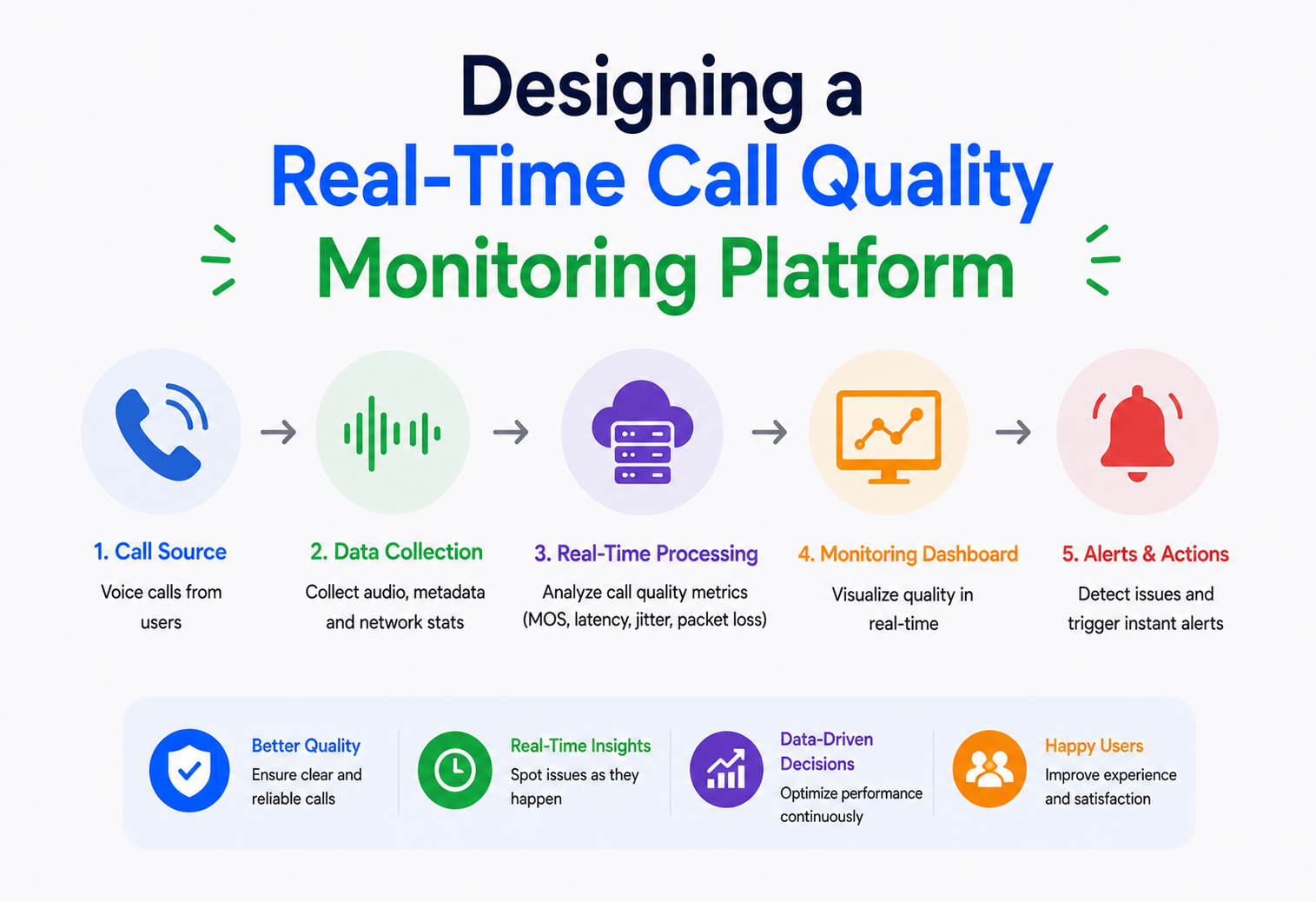
- Audio quality metrics (MOS, jitter, packet loss) — perceptual call quality indicators that traditional application metrics do not capture but are critical to this domain specifically.
- Misrouting rate — calls that were transferred again shortly after initial routing, a strong proxy for routing decision quality.
9.2 Logging and tracing
Every call generates a Call Detail Record (CDR) capturing the full routing decision trail — what identity was resolved, what intent was detected, what rules fired, and where the call ultimately landed — essential for both operational debugging (“why was this VIP customer routed to the general queue”) and for continuously improving the routing rules themselves using real outcome data.
- Why is Mean Opinion Score (MOS) or a similar audio-quality metric something this system needs to track that a typical backend system would not?
- How would you use “was this call transferred again shortly after routing” as a signal to catch routing bugs?
Deployment & Cloud Architecture
Deployment topology reflects the fact that different layers have very different scaling signals, and that telephony ingress depends on relationships and infrastructure outside the platform’s direct control.
- Multi-region media server deployment close to major caller populations, minimizing RTP latency and supporting regional failover.
- Stateless Routing Engine and Context Service instances behind autoscalers keyed on call-arrival rate and decision-latency SLOs.
- Elastic ASR / TTS compute — GPU-backed where applicable — autoscaled independently, since speech processing demand does not scale linearly with raw call count.
- Carrier and SIP trunk redundancy across multiple providers, since telephony ingress is an external dependency outside the platform’s direct control, similar in spirit to depending on an external push notification gateway.
- Careful, staged rollout of routing rule changes — a bad routing rule deployed platform-wide can misroute a large fraction of live traffic instantly, so canary rollout by traffic percentage or by customer segment is essential.
- Why does ASR / TTS compute need its own autoscaling signal separate from the Media Server fleet’s?
- How would you canary a routing rule change without risking misrouting a large fraction of live callers?
Databases, Caching & Load Balancing
Storage choices here follow the same principle: the routing hot path must almost never touch a primary database, and stateful media sessions need connection-aware load balancing that stateless services do not require.
11.1 Customer Profile and Interaction History stores
The Customer Profile Store needs fast point lookups by phone number and / or account ID at very high read QPS — a natural fit for a distributed key-value or wide-column store, partitioned by customer ID, optimized heavily for read latency over write throughput, since profile updates are relatively infrequent compared to routing-path reads. The Interaction History Store, tracking recent tickets and prior calls, has a similar read pattern but benefits from being modeled as a recent, bounded window (for example, last 90 days) rather than unbounded history, since only recent context is typically relevant to a live routing decision.
11.2 Caching
- Identity / profile cache: a distributed, low-latency cache in front of the Customer Profile Store, since this lookup sits directly on the routing hot path and cannot tolerate primary-database latency at this call volume.
- Compiled routing rules cache: pre-compiled rule sets cached in memory across Routing Engine instances, refreshed on a short interval or via explicit invalidation when rules change, rather than re-fetched per call.
- Queue state cache: current agent availability and queue depth per skill group, cached and updated in near-real-time, since this drives routing decisions and must reflect current reality closely enough to avoid systematically over- or under-loading specific queues.
11.3 Load balancing
SIP-aware load balancing at the SBC / media tier (routing new calls to media servers with available capacity), combined with standard layer-7 load balancing for the stateless Routing Engine and Context Service tiers. Because media sessions are stateful for the duration of a call, media-tier load balancing decisions are made once at call setup and generally are not rebalanced mid-call except during explicit failover.
- Why does the Interaction History Store benefit from being modeled as a bounded recent window rather than unbounded history?
- Why cannot media-tier load balancing rebalance an active call the way a stateless API request could be rebalanced?
APIs & Microservices Design
The APIs on the call path are deliberately synchronous and latency-optimized, standing in sharp contrast to the asynchronous, queue-based patterns that dominate less time-sensitive systems.
Call Control API
Internal API the Media Server and Routing Engine use to signal call state transitions (answered, routed, queued, connected, ended).
Identity Resolution API
Resolves ANI or spoken / entered credentials into a customer profile, designed for extremely low-latency responses since it is squarely on the hot path.
Routing Decision API
The core decisioning service, accepting intent + identity + context and returning a destination — deliberately kept narrow and fast rather than doing heavy computation inline.
Agent Desktop Context API
Pushes the assembled context bundle to the Agent Desktop application the moment a call connects, so this can happen in parallel with, not after, the audio connection being established.
These services are deliberately kept synchronous and latency-optimized on the call path itself, in contrast to the asynchronous, queue-based patterns favored in less time-sensitive systems — this is one of the clearest illustrations of how a system’s latency requirements should directly shape whether synchronous or asynchronous integration patterns are appropriate.
- Why is the call-routing path built synchronously rather than using the async, queue-based patterns common elsewhere in distributed systems?
- Why push Agent Desktop context in parallel with call connection rather than sequentially after?
Design Patterns & Anti-Patterns
The patterns that keep recurring in production IVR platforms — and the recognizable failure modes that keep sinking the platforms that skip them.

13.1 Patterns that work
Signaling / Media Separation
Lets the lightweight SIP control plane and the heavy RTP media plane scale independently.
Circuit Breakers + Safe Fallbacks
Ensures a downstream dependency failure degrades personalization rather than breaking call routing entirely.
Pre-Compiled Decision Rules
Keeps routing evaluation fast and predictable even as business rule complexity grows over time.
Call Admission Control
Protects already-connected call quality by refusing new calls onto saturated infrastructure rather than degrading everyone equally.
Context Bundling at Handoff
Passing a complete context package to whatever destination (self-service module or agent) receives the call, rather than making the destination re-fetch or re-ask for information already known.
13.2 Anti-patterns to avoid
- Block the routing decision on a slow, uncached database query. Even a well-designed routing engine becomes unusable if its identity or context lookups hit a live database on every call at this volume — this single mistake accounts for a large share of real-world IVR latency complaints.
- Treat ANI as verified identity. Routing sensitive account actions or exposing personal information based on caller ID alone, without stronger verification, is both a security and a customer-trust risk.
- Deploy routing rule changes platform-wide with no staged rollout. A single rule mistake can misroute a large fraction of concurrent traffic before anyone notices, unlike a typical software bug that might only affect a specific code path.
- Over-index on self-service deflection metrics without measuring actual resolution. A self-service flow that “contains” calls by frustrating the caller into hanging up looks good on a deflection dashboard while actively harming the customer relationship.
- Why is “deflection rate” alone a dangerous metric to optimize for in isolation?
- What is the real-world cost of routing decisions depending on a live, uncached database query at millions of concurrent calls?
13.3 A note on testing at this scale
Testing a dynamic routing system well requires going beyond typical unit and integration tests. Load testing needs to simulate realistic call-arrival patterns (including sudden spikes, not just steady-state ramps), synthetic audio needs to exercise both clean and noisy or accented speech to validate ASR robustness, and chaos testing should deliberately degrade or fail individual dependencies (Context Service, ASR, Customer Profile Store) one at a time to verify the graceful-degradation paths actually behave as designed under real failure conditions rather than only in the happy path they were originally written for. Teams that skip this category of testing tend to discover their fallback logic does not actually work correctly only during a live production incident, which is the worst possible time to find out.
Best Practices & Common Mistakes
The habits below separate mature IVR platforms from ones that look correct in staging and quietly hurt customers in production.
- Design the routing hot path around cached, pre-fetched, or pre-compiled data wherever possible — every millisecond on this path is directly perceptible to a live human on the phone.
- Always provide a DTMF fallback path even in a speech-first design, since ASR reliability varies with accent, background noise, and connection quality, and some callers simply prefer keypad input.
- Canary and stage routing rule changes by traffic percentage, exactly as you would a risky code deployment, since routing rules are effectively business-critical logic even though they are often authored outside a traditional engineering workflow.
- Measure resolution outcomes, not just containment / deflection, to keep self-service optimization honest about actual customer experience.
- Under-provisioning ASR / TTS compute relative to media server capacity, since the two do not scale linearly together and ASR is often the more expensive, more elastic-demand resource.
- Designing routing rules as deeply nested conditional logic that becomes unmaintainable and slow to evaluate as business requirements grow, instead of investing early in a proper rules engine with compiled evaluation.
- Not planning for regional carrier or SBC failure, treating telephony ingress as a solved, always-available layer rather than an external dependency requiring the same redundancy discipline as any other critical infrastructure.
14.1 Treating routing rules as software, not configuration
A pattern worth calling out explicitly: routing rules, because they are often authored by business or operations teams through a rules-configuration UI rather than by engineers writing code, can drift toward being treated as “just configuration” — deployed without code review, testing, or staged rollout discipline. This is a mistake at this scale. A routing rule is business-critical logic with the same blast-radius potential as any application code change, and mature platforms apply equivalent rigor: version control for rule changes, automated validation (does this rule set contain unreachable branches or conflicting priorities), simulation against historical call data before deployment, and staged rollout with automatic rollback triggers tied to the misrouting-rate metric discussed earlier.
- Why does routing rule complexity tend to grow unmanageable over time if not deliberately engineered against?
- Why should telephony ingress redundancy be treated with the same rigor as any other critical external dependency?
- Why should routing rules receive the same engineering rigor (review, testing, staged rollout) as application code, even when authored by non-engineers?
Real-World Industry Examples
Every major cloud contact center and every large customer-facing enterprise runs some version of this system, adapted to its own call volume, regulatory profile, and product surface.
Amazon Connect
A cloud-based contact center platform built around exactly this pattern — dynamic, rules-driven call routing integrated with customer data, designed to scale elastically with call volume rather than requiring fixed on-premise telephony hardware.
Twilio Flex / Twilio Voice
Provides the building blocks (SIP trunking, programmable voice, ASR / TTS integration) that many companies use to build custom IVR and routing logic on top of, illustrating the layered, API-driven approach modern platforms take instead of monolithic legacy IVR hardware.
Airlines & Banks
Commonly implement priority routing based on account tier or active-issue detection (for example, a caller whose flight was just cancelled gets routed differently than a general inquiry) — a direct real-world instance of the context-driven routing described throughout this document.
Carriers’ Own Support Lines
Frequently combine ANI-based instant recognition with network-status awareness, personalizing the very first prompt based on whether the calling number currently has a known service outage — a strong example of routing decisions informed by real-time operational data, not just static customer profile data.
15.1 A common pattern: crisis-mode routing overrides
A pattern worth calling out that recurs across airlines, utilities, banks, and telecoms alike is the ability to activate a temporary, high-priority routing override during a known crisis event — a major outage, a severe weather event affecting flights, a widespread service disruption — that bypasses normal skill-based queueing for calls matching the crisis’s signature intent. This typically works by pre-building a “break glass” rule set that operations teams can activate quickly (often via a dashboard rather than a full deployment cycle) which temporarily reprioritizes or reroutes matching calls to a dedicated response team, or diverts them to an automated status-update flow that can absorb enormous call volume without needing proportionally more human agents. Building this capability in advance, rather than improvising it during an actual crisis, is a recurring lesson from real-world incident postmortems across the industry.
- How would a telecom carrier’s IVR use real-time network status data to influence routing, beyond static customer profile information?
- Why do platforms like Twilio expose IVR / voice capabilities as composable building blocks rather than a single fixed product?
- Why should crisis-mode routing overrides be pre-built rather than improvised during an actual incident?
Frequently Asked Questions
The questions that recur in interviews and design reviews of this system, with the shortest defensible answers.
Using the caller’s ANI (phone number), resolved instantly against the Customer Profile Store cache at call setup — this allows a greeting like “Welcome back” or a targeted prompt about a known open issue, without waiting for the caller to speak or press anything.
Well-designed flows include confirmation steps for high-stakes intents (“I heard you want to report a lost card, is that correct?”) and always offer a fallback to DTMF input or a “say or press 0 for an agent” escape hatch, since no ASR system is perfectly accurate across all accents, background noise conditions, and phrasings.
The core personalization logic is conceptually similar, but the latency requirements are dramatically stricter — a web page can tolerate a few hundred milliseconds of extra load time largely unnoticed, while a live voice call makes any noticeable pause immediately, viscerally apparent to the caller, which drives much more aggressive caching and pre-computation on the routing hot path.
Yes — this is a standard and important capability. Self-service flows should always support an explicit or implicit escalation path (for example, saying “agent” or pressing 0) that hands the call, along with whatever context was gathered during the self-service attempt, to the Routing Engine for agent routing, rather than forcing the caller to restart from scratch.
Through a combination of call admission control (protecting already-connected call quality), elastic autoscaling of media and ASR capacity, and often pre-defined crisis-routing rules that can be activated to bypass normal queueing entirely for outage-related intents, routing them directly to a dedicated response team or an automated status-update flow that can absorb very high volume without human agent capacity.
Yes, and that is the point — two callers with identical spoken requests may be routed differently based on their account tier, open ticket status, or current queue conditions elsewhere in the system. This is a deliberate departure from the old static-menu-tree model, though it does mean testing and QA need to account for a much larger space of possible call paths than a fixed menu tree would require.
This is more of a product and conversation-design question than a pure infrastructure one, but architecturally, the system needs to support natural-sounding TTS, responsive barge-in handling, and context-aware prompts (referencing what the system already knows rather than asking the caller to repeat themselves) — all of which depend on the low-latency, well-integrated architecture described throughout this document. A technically excellent but conversationally clumsy IVR will still frustrate callers, so this remains a genuine cross-functional design concern, not solved by infrastructure alone.
Summary & Key Takeaways
Every design decision in this tutorial follows from one central observation: voice is an unforgiving medium for latency and failure. There is no loading spinner, no retry button a caller can quietly click.
Key takeaways an interviewer wants to hear
- An IVR platform is simultaneously a real-time media processing system and a low-latency decisioning system — both halves have to be engineered to the strictest of their respective requirements.
- Separating signaling (SIP) from media (RTP) lets the lightweight control plane and heavy media plane scale independently, which is foundational to handling millions of concurrent calls.
- The routing decision’s latency budget (roughly 200 – 500 ms) drives nearly every downstream architectural choice — caching, pre-compiled rules, and avoiding live database queries on the hot path.
- ANI-based identity is useful for instant, low-stakes personalization but must never be treated as verified identity for sensitive actions.
- Graceful degradation — falling back to intent-only routing, DTMF-only input, or a general queue — is what keeps the system usable when any single dependency degrades, rather than failing the call outright.
- Self-service deflection metrics must be paired with actual resolution measurement, or optimization can silently harm the customer experience while looking successful on a dashboard.
- Telephony ingress (carriers, SBCs, SIP trunks) is an external dependency requiring the same redundancy discipline as any other critical infrastructure the platform does not fully control.
The unifying idea across this entire design is that voice is an unforgiving medium for latency and failure — there is no loading spinner, no “retry” button a caller can quietly click. Every architectural decision here, from caching identity lookups to compiling routing rules ahead of time to building graceful fallbacks for every dependency, ultimately traces back to a single constraint: a human being is on the other end of that line, in real time, waiting.
For an interview setting, the most valuable habit is connecting each design choice back to that constraint explicitly. It is not enough to say “we would cache the customer profile lookup.” That causal chain — from a physiological fact about conversational turn-taking, through a concrete latency budget, to specific architectural decisions like caching, pre-compiled rules, and graceful degradation — is what separates a candidate who has memorized the components of an IVR system from one who understands why those components exist in the first place.