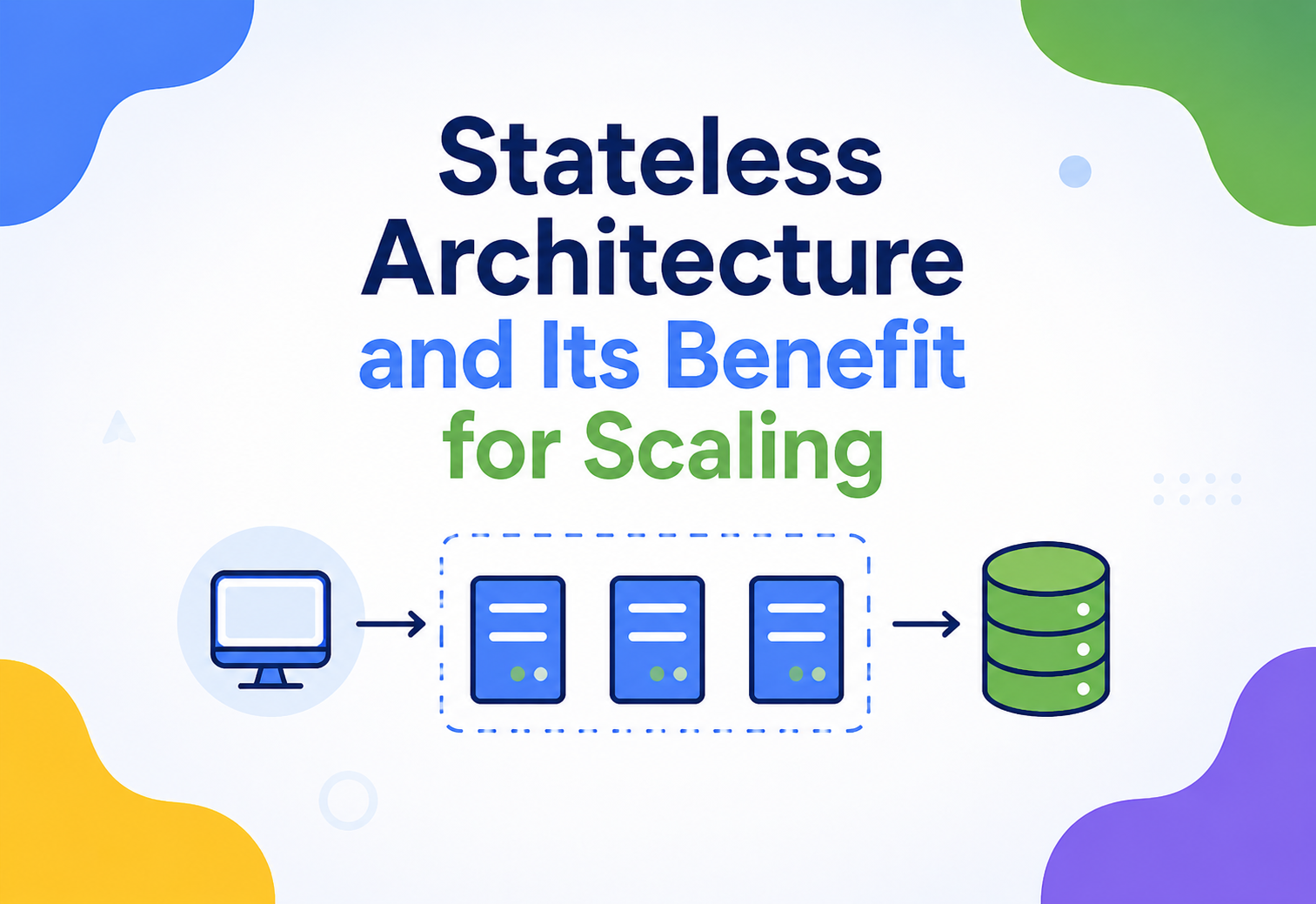
Stateless Architecture and Its Benefit for Scaling
A ground-up, no-assumptions guide to why servers that “remember nothing” between requests are the single biggest enabler of effortless, elastic, horizontal scale — from the original design of HTTP in the 1990s to modern serverless platforms.
Interchangeable Servers, Interchangeable Baristas
Before any code, let’s build the idea in plain words.
Imagine a busy coffee shop with ten identical baristas behind the counter. You walk up, order a latte, and whichever barista is free makes it for you. Next time you visit, a completely different barista might serve you — it doesn’t matter, because none of them need to “remember” you personally to make your coffee correctly. Your order itself (a latte, oat milk, extra shot) contains everything any barista needs to know. Now imagine the opposite: a coffee shop where only “your” one specific barista, Dave, knows your usual order, and if Dave is busy or goes home sick, nobody else can serve you properly. That second coffee shop cannot easily grow — you can’t just hire nine more Daves who instantly know every customer’s history.
That first coffee shop is the essence of stateless architecture. A stateless server doesn’t rely on anything remembered from a customer’s (client’s) previous interactions — every request arrives complete with everything needed to handle it, so any available server can process any request. This single property turns out to be one of the most powerful ideas in building systems that scale to millions of users, and it’s the subject of this entire guide.
A stateless server is like a hotel’s identical rooms, freshly reset after every guest — any guest can be assigned to any room, and any room works for any guest. A stateful server is like a personal butler who has built up months of knowledge about one specific family — invaluable, but utterly non-substitutable, and impossible to “clone” on demand when ten more families show up at once.
1.1 What Does “State” Mean, Precisely?
State, in computing, refers to any data that persists and influences future behavior — information that was created or changed by past interactions and needs to be remembered. A shopping cart’s contents, a logged-in user’s session, an in-progress multi-step form, a chat conversation’s history — all of this is state. The question “where does the state live?” turns out to be one of the most consequential architectural decisions in any system that needs to grow.
1.2 A Short History
Statelessness as a deliberate architectural principle traces directly back to the design of the web itself. When Tim Berners-Lee and later Roy Fielding shaped HTTP (HyperText Transfer Protocol) in the early-to-mid 1990s, they made a foundational choice: HTTP would be a stateless protocol. Every HTTP request would be independent and self-contained; the web server would not be required to retain any memory of previous requests from the same browser. This was a deliberate trade-off, chosen specifically because it made web servers dramatically simpler to build, and — crucially for what would become the internet’s explosive growth — trivially easy to add more of.
Of course, real applications very quickly needed some notion of “who is this user and what have they already done” — logging in, shopping carts, multi-page checkouts. Early web developers bolted this on using cookies (introduced by Netscape in 1994) and server-side sessions, where the server would keep a little notebook of per-user state, identified by a cookie. This reintroduced statefulness at the application layer, and, as we’ll explore throughout this guide, quietly reintroduced many of the scaling headaches that the stateless HTTP protocol had been specifically designed to avoid.
Roy Fielding’s 2000 doctoral dissertation formally defined REST (Representational State Transfer), explicitly naming “stateless interactions” as one of REST’s core constraints, and providing a rigorous argument for why stateless communication between client and server is essential for building systems that scale, evolve, and remain reliable over time. As cloud computing and horizontal scaling became dominant in the 2000s and 2010s, the industry rediscovered — often through painful, expensive lessons — just how right that original design instinct was, and “keep your services stateless” became one of the most consistently repeated pieces of scalability advice across the industry.
Early 1990s — HTTP as a Stateless Protocol
Berners-Lee and Fielding deliberately design HTTP so each request is independent, making web servers simpler and trivially easy to replicate.
1994 — Cookies Introduced by Netscape
Applications need a notion of “who is this user”; server-side sessions keyed by a cookie quietly reintroduce statefulness at the app layer.
2000 — REST Formalized
Fielding’s dissertation names statelessness as a core REST constraint, arguing formally that it’s essential for scalable, reliable systems.
2000s–2010s — Cloud & Horizontal Scaling
The industry rediscovers, through outages and painful lessons, why the original stateless design instinct was right.
Today — Statelessness Everywhere
From REST APIs to Kubernetes Deployments to serverless functions, “keep it stateless” is one of the most consistently repeated pieces of scalability advice in the industry.
Why State Ties a Client to One Specific Server
Why does this distinction matter so much? What goes wrong with stateful servers as a system grows?
2.1 The Core Problem
Let’s build intuition with a concrete, beginner-friendly example. Imagine a simple web application that lets users log in and add items to a shopping cart. A very natural, seemingly harmless first implementation: when a user logs in, the server creates an in-memory object holding their session data (who they are, what’s in their cart) and keeps it in that server’s own RAM for as long as they’re browsing.
This works perfectly — as long as there’s exactly one server. The moment traffic grows and a second server is added to share the load, a serious problem appears: if user Alice’s next request happens to land on the second server, that server has never heard of Alice. It has no idea she’s logged in, and her shopping cart appears empty, because that data only ever existed in the first server’s memory. This is the core, concrete failure mode that motivates everything in this guide.
A stateful server creates an invisible, undeclared dependency: “this particular user’s next request must be routed back to this particular server.” That dependency, called session affinity or “sticky sessions,” has to be engineered in deliberately (usually via special load balancer configuration), and even when it works, it directly undermines the two things horizontal scaling exists to provide: even load distribution, and resilience to any single server failing.
2.2 A Real Motivating Scenario
Picture an e-commerce platform during a major holiday sale. Traffic surges to ten times normal levels, and the operations team spins up twenty additional application servers to absorb the load — a routine, expected horizontal-scaling response. But because the application stores session state (cart contents, login status) in each server’s local memory, the load balancer must now pin every user to the exact one server that first served them, for their entire visit. If that specific server becomes overloaded, or crashes, or needs to be replaced during the sale (a routine deployment or a hardware failure), every user pinned to it either experiences severe slowness or is unceremoniously logged out with an empty cart — at the worst possible moment, during the highest-value traffic of the year.
Now imagine the same scenario with a stateless application: cart and session data live in a shared, external store (like Redis) that every server can read from, and any incoming request — no matter which of the twenty servers happens to receive it — can serve it correctly, because the request (via a token or session ID) carries enough information to look up everything needed. A server can crash, be replaced, or be added, entirely transparently to the user, and the load balancer can spread traffic using the simplest, most effective strategy available (like round robin or least-connections) rather than being constrained by sticky routing rules.
Twenty New Servers, Slow Relief
Existing users stay pinned to the original servers; new capacity only helps brand-new sessions. A crash or replacement during the sale logs users out with empty carts.
Twenty New Servers, Instant Relief
Any incoming request goes to any healthy server; state lives in Redis. Server failures are invisible to users, and load balances by capacity and health.
Without statelessness, “add more servers” doesn’t cleanly translate into “handle more traffic,” because traffic can’t actually be freely distributed across those servers. Statelessness is the property that makes horizontal scaling simple instead of a constant, fragile balancing act.
Defining Every Term Carefully
Let’s define every term carefully before going further.
3.1 Stateless vs. Stateful
A stateless component processes each request using only the information contained in that request (plus data it fetches fresh from an external, shared store), retaining nothing in its own local memory between requests. A stateful component retains information locally between requests, and that retained information influences how it handles future requests.
3.2 Session
A session represents a period of continued interaction between a specific client and the application — typically spanning a login, some browsing, and eventually a logout or timeout. The question of where session data is stored is the single most common place the stateless-vs-stateful distinction shows up in real web applications.
3.3 Session Affinity / Sticky Sessions
Session affinity (or “sticky sessions”) is a load balancer configuration that routes all requests from a given client to the same specific backend server, typically to work around that server holding session state locally. It’s a workaround for statefulness, not a solution to the underlying scaling problem it creates — as we’ll see throughout this guide, it trades away load-balancing flexibility and fault tolerance in order to keep a stateful design working.
3.4 Idempotency (A Quick Refresher, Relevant Here Too)
An operation is idempotent if repeating it produces the same result as doing it once. Stateless services, because they don’t accumulate hidden local state, tend to be much easier to make idempotent — there’s no lingering local memory that could cause a repeated call to behave differently the second time.
3.5 Externalized State
Externalizing state means moving data that would otherwise live in a server’s local memory out to a separate, shared, durable store — a database, a distributed cache like Redis, or a client-held token — that every server instance can access equally. This is the standard technique for converting a stateful design into a stateless one: the servers themselves become stateless, while state simply moves somewhere else, specifically designed to be shared.
Externalizing state is like a hotel staff no longer trying to personally remember each guest’s preferences in their own heads, and instead writing everything into a shared guest-profile system that any staff member on any shift can look up. The knowledge doesn’t disappear — it just moves from being trapped in one person’s memory to being available to the whole team.
3.6 Client-Side State (Tokens)
An alternative to storing session state on the server at all (even externally) is to let the client hold it — commonly via a JWT (JSON Web Token), a signed, tamper-evident piece of data the client stores (e.g., in a cookie or local storage) and sends with every request. The server can verify and read it without needing to look anything up in shared storage at all, making the server truly stateless with zero external dependency for that piece of data.
3.7 Horizontal Scalability (A Quick Refresher)
Horizontal scalability is the ability to handle more load by adding more machines/instances that share the work, as opposed to making one machine bigger (vertical scaling). Statelessness, as this guide will show in depth, is the property that makes horizontal scalability practically achievable and simple to operate.
Stateless doesn’t mean “no state exists.” It means “the state doesn’t live inside the server that’s handling this request.”
What a Stateless Architecture Actually Looks Like
What does a stateless architecture actually look like structurally, compared to a stateful one?
Fig 1 — Stateful architecture: a client is pinned to one specific server holding its session data locally.
Fig 2 — Stateless architecture: any server can handle any request, reading shared state from an external store when needed.
4.1 Components Involved
Stateless Application Servers
Any number of identical, interchangeable server instances, none of which retain client-specific data locally between requests.
Load Balancer (Simple Routing)
Distributes incoming requests using straightforward strategies (round robin, least connections) rather than needing to track and enforce affinity to a specific server.
Shared / External State Store
A database, distributed cache (Redis, Memcached), or similar system that holds any data needing to persist across requests, accessible equally by every server instance.
Client-Held State (Optional)
Tokens (like JWTs) or cookies that carry state directly with the client, removing the need for a shared server-side store for that particular data entirely.
4.2 Minimal Java Example: A Stateless REST Endpoint
@RestController
@RequestMapping("/cart")
public class CartController {

    private final CartRepository cartRepository; // backed by external DB, not local memory

    public CartController(CartRepository cartRepository) {
        this.cartRepository = cartRepository;
    }

    @PostMapping("/{userId}/items")
    public CartResponse addItem(
            @PathVariable String userId,
            @RequestHeader("Authorization") String authToken,
            @RequestBody ItemRequest item) {

        // 1. Verify identity from the token itself - no local session lookup needed
        User user = TokenValidator.verifyAndExtractUser(authToken);

        // 2. Read/write cart state from a SHARED external store, not this server's memory
        Cart cart = cartRepository.findByUserId(userId);
        cart.addItem(item);
        cartRepository.save(cart);

        // 3. Any server instance could have handled this exact request identically
        return new CartResponse(cart);
    }
}
Notice what’s absent: no HttpSession, no instance field remembering “the current user,” nothing stored in this server’s own memory that the next request depends on. Every piece of information this method needs arrives with the request itself (the token, the path variable, the request body) or is fetched fresh from a shared store.
Step by Step Through a Single Request
What actually happens, step by step, when a stateless server handles a request — and how does that differ internally from a stateful one?
Request Arrives
At whichever server instance the load balancer happened to route it to — chosen freely, with no constraints.
Identity / Context Extraction
The server reads any needed identity or context directly from the request itself — typically a token in an HTTP header, or a session ID used to look up data externally.
External State Retrieval (If Needed)
If the operation depends on previously stored data (like cart contents), the server fetches it from a shared store (database, cache) — not from its own memory, since it may never have seen this client before.
Processing
The server performs the actual logic using only the request data and whatever it just fetched externally.
State Update (If Needed)
If the operation changes persistent data, the server writes the update back to the shared external store — again, not to its own local memory.
Response Returned
The server instance now holds absolutely nothing client-specific in memory — it’s immediately, fully available to handle a completely unrelated request from a different client next, with zero cleanup needed.
Fig 3 — The internal lifecycle of a single stateless request: all needed context comes from the request or a shared store, never from server memory.
5.1 Comparing What a Stateful Server Does Differently
Internally, a stateful server, by contrast, typically maintains an in-memory map (often literally a hash map keyed by session ID) tying each active client to their accumulated data. Every request first looks up this local map; if the request lands on a server whose map doesn’t contain that session (because the client was previously served by a different instance), the operation fails or behaves as if the client is brand new — exactly the bug scenario described in Chapter 2.

5.2 How Token-Based Statelessness Avoids Even the Shared-Store Lookup
When state is carried entirely in a signed client-side token (a JWT, for example), step 3 above (“external state retrieval”) can be skipped for identity/authorization purposes entirely — the server verifies the token’s cryptographic signature and reads the claims embedded directly inside it, with no network call to any store at all. This pushes statelessness even further, eliminating not just local server memory but also any shared-store dependency for that specific piece of data, which is why JWT-based authentication is so common in highly scalable API designs.
{
  "sub": "user_48213",
  "role": "premium_subscriber",
  "cartSessionId": "cs_9f12a",
  "exp": 1735689600
}
// Signed by the server; any server instance can verify this signature
// and trust these claims without looking anything up locally.How State Flows Across an Entire Session
Let’s trace how state itself flows through a stateless architecture across an entire user session, from login to logout.
Fig 4 — The lifecycle of a user’s session in a stateless architecture: identity travels with the client, not with any one server.
6.1 Stage by Stage
- Login: The client submits credentials; whichever server receives the request verifies them (typically against a shared user database) and issues a token, or creates a session record in a shared, external session store.
- Token / Session ID Delivery: The token (or session ID) is handed back to the client, which stores it (a cookie, local storage, or in-memory in a mobile app) and includes it with every subsequent request.
- Subsequent Requests: Each request carries the token/session ID. Any available server can validate it and, if necessary, fetch associated state from the shared store — no server “remembers” this client from before.
- State Updates: Any changes (adding a cart item, updating a preference) are written to the shared store, immediately visible to whichever server handles the client’s next request, even if it’s a different instance entirely.
- Logout / Expiry: The token is invalidated (via a blocklist, short expiry, or simply discarded client-side) or the session record in the shared store is deleted — and the lifecycle ends cleanly, with no per-server cleanup required, because no server ever held anything client-specific to begin with.
At every single stage, “which specific server instance” is irrelevant to the correctness of the flow. This is precisely the property that makes horizontal scaling — adding, removing, or replacing server instances freely — completely safe to do at any point during this lifecycle, even mid-session, without disrupting a single user.
Advantages, Disadvantages & Trade-offs
Statelessness pays off dramatically for scale, but it isn’t a free lunch. Naming the trade-offs directly makes them easier to manage deliberately.
Advantages
- Effortless horizontal scaling: any server instance can handle any request, so adding capacity is as simple as adding more identical instances — the central theme of Chapter 8.
- Simple, effective load balancing: no need for sticky sessions or complex routing logic; simple strategies like round robin work perfectly.
- Fault tolerance: if a server instance crashes, in-flight requests to it fail, but no client-specific data is permanently lost, because nothing important was stored only there — a replacement instance picks up seamlessly.
- Simplified deployments: rolling deployments are safe and transparent to users, since no instance is uniquely responsible for anyone’s ongoing session.
- Easier testing and reasoning: a stateless function’s behavior depends only on its inputs, making it far easier to test, debug, and reason about than code with hidden internal state.
- Better resource utilization: load balancers can distribute traffic purely based on current capacity and health, rather than being constrained by where a client “happens” to be pinned.
Disadvantages
- State has to live somewhere: statelessness doesn’t eliminate state — it relocates it to an external store, which itself needs to be built, operated, and scaled (often becoming the new focal point of scaling effort, as covered in Chapter 13).
- Added latency for external lookups: fetching state from a shared store on every request (rather than reading it instantly from local memory) introduces a network round trip, typically small but non-zero.
- Increased architectural complexity upfront: deciding what state to externalize, choosing a store, and handling its own scaling and availability is more design work than simply keeping everything in local memory.
- Token size and overhead: client-held tokens (like JWTs) are sent with every request; if they grow large, this adds bandwidth overhead across potentially millions of requests.
- Revocation challenges: a self-contained token can’t be instantly invalidated the way a server-side session record can — usually requiring additional mechanisms like short expiry times or a blocklist.
7.1 Trade-off Summary
| Dimension | Stateful (in-memory sessions) | Stateless (externalized / token-based) |
|---|---|---|
| Horizontal scaling | Constrained — needs sticky sessions | Simple — any instance handles any request |
| Fault tolerance | Poor — losing a server loses its sessions | Strong — no server is uniquely critical |
| Per-request latency | Very low (local memory read) | Slightly higher (external lookup, or token verification) |
| Deployment simplicity | Harder — rolling deploys risk dropping sessions | Easy — instances are freely replaceable |
| Operational surface area | Lower (no external store needed) | Higher (external store to run and scale) |
The Core Benefit, In Depth
This is the chapter that directly answers our title question. Let’s build the answer precisely.
8.1 The Core Benefit, Stated Precisely
This single property is what allows horizontal scaling — the strategy with, as covered in a companion guide on vertical scaling, no fundamental hard ceiling — to actually work smoothly in practice, rather than in theory only.
8.2 Why Interchangeability Is the Key Mechanism
Recall Little’s Law from queueing theory: the number of concurrent operations a system must support equals the arrival rate multiplied by how long each operation takes. To handle a growing arrival rate, a system needs more concurrent processing capacity — more servers. But “more servers” only translates into “more effective capacity” if a load balancer can actually distribute incoming requests evenly across all of them. Statelessness is precisely what permits even distribution: because no request has a hidden requirement to land on one particular server, a load balancer is free to use the simplest, most effective distribution strategy — spreading load exactly according to current capacity and health, not historical accident.
Contrast this with a stateful, sticky-session architecture: even if you add ten new servers, existing users remain pinned to their original servers until their session ends. The new capacity only helps new sessions — existing load remains concentrated on the original, already-loaded servers. This means stateful systems scale out slowly and unevenly, with new capacity taking a long time to actually relieve pressure on existing hotspots, while stateless systems scale out immediately and evenly — new capacity starts absorbing load on literally the very next request routed to it.
Fig 5 — Stateful/sticky scaling only slowly shifts load to new capacity as old sessions gradually expire; stateless scaling shifts load instantly and evenly.
8.3 Autoscaling Becomes Genuinely Automatic
Cloud autoscaling groups work by monitoring a metric (like CPU utilization or request rate) and automatically launching new instances when load rises, or terminating instances when load falls. This automation is only safe and effective when instances are stateless: an autoscaler can terminate an instance at any moment (to save cost as demand drops) without needing to know or care whether any user’s important, unsaved data lives only on that specific instance. With a stateful design, autoscaling down risks silently discarding active users’ data — a risk severe enough that many stateful systems disable automatic scale-down entirely, giving up a major cost and elasticity benefit specifically because statelessness wasn’t designed in.
8.4 Quantifying the Effect: A Capacity-Planning Example
Suppose a service needs to handle a traffic spike that’s 5x normal load, lasting two hours (a flash sale, a viral event). With a stateless architecture, the operations team (or an autoscaler) can launch four times the normal instance count moments before the spike, let the load balancer spread the surge evenly across all of them immediately, and terminate the extra instances the moment the spike subsides — capacity that’s used only exactly when needed, at a cost roughly proportional to that two-hour window. With a stateful, sticky-session architecture, launching those same extra instances helps only with new sessions starting after the additions — existing sessions remain concentrated on the original servers for as long as those sessions last, meaning the extra capacity delivers only a fraction of its theoretical benefit exactly when it’s needed most.
Modern serverless computing (AWS Lambda, Google Cloud Functions) takes statelessness to its logical extreme: each function invocation runs in a fresh (or freshly reused, but functionally stateless-from-the-caller’s-perspective) execution environment, with literally no guarantee the same underlying instance will ever be reused. This is only possible — and only scales to the “run a function billions of times a day across a vast, dynamically managed fleet” model that serverless platforms rely on — because the entire computing model assumes functions are stateless by design, externalizing anything that needs to persist to services like DynamoDB or S3.
8.5 The Bottleneck Shifts, But Total System Capacity Improves
It’s worth being precise: statelessness doesn’t make state disappear — it relocates the scaling challenge to the external store holding that state (covered in depth in Chapter 13). But this relocation is a genuine net win for overall system scalability, because a purpose-built, specialized data store (a distributed cache, a horizontally-scalable database) is generally far better engineered to scale under concurrent access from many clients than an ad hoc collection of per-server in-memory maps ever could be — and, critically, that one specialized scaling problem only needs to be solved once, rather than being tangled into the scaling story of every single application server.

Beyond Raw Capacity — Resilience
Statelessness’s benefits extend well beyond raw scaling capacity into availability and resilience.
9.1 No Single Point of Failure for Session Data
In a stateful architecture, each server holding session data locally is, for the users pinned to it, effectively a single point of failure — if it crashes, their in-progress work is gone. In a stateless architecture, session data lives in a shared, typically replicated external store, meaning any single application server’s failure has zero impact on data durability — only on the small number of requests that happened to be in-flight to it at the exact moment of failure, which the client can simply retry against a different, equally capable instance.
9.2 Safe, Transparent Rolling Deployments
Deploying a new version of a stateless service is straightforward: bring up new instances running the new code, gradually shift traffic to them, and terminate old instances — all with zero impact on users, because no instance holds anything uniquely important. Stateful services, by contrast, need careful, often manual coordination (draining sessions, waiting for them to naturally expire, or building complex session-migration logic) to deploy safely without disrupting active users.
9.3 Graceful Handling of Instance Failure
Health checks in a stateless architecture can be aggressive and simple: if an instance fails a health check, the load balancer just stops routing to it and routes to any of the other, equally capable instances instead — no data recovery or migration step is needed, because there was never anything irreplaceable stored there. This directly contributes to higher overall availability, since recovery from an individual instance failure is close to instantaneous from the user’s perspective.
Statelessness moves the availability burden to the external state store — that store now needs its own replication, failover, and durability strategy, since it has effectively become the single place holding data that matters. Statelessness doesn’t eliminate the need for careful reliability engineering; it concentrates that engineering effort into one well-understood, specialized component instead of spreading fragile, ad hoc reliability gaps across every application server.
A stateless fleet is like a rental-car counter with a hundred identical cars — one breaking down is barely inconvenient, because any other car will do. A stateful fleet is like a hundred custom-built vehicles each tuned for one specific driver’s preferences — when one breaks down, only that one driver is stranded, but nothing else in the fleet can substitute for it.
The Security Trade-offs of Going Stateless
Stateless architecture, and token-based statelessness in particular, introduces its own set of security considerations.
- Token theft and replay: because a client-held token (like a JWT) is self-contained proof of identity, if it’s stolen (e.g., via a cross-site scripting attack), an attacker can use it directly without needing to compromise the server at all — tokens should be stored securely (e.g., HttpOnly cookies), transmitted only over HTTPS, and given short expiry times to limit the damage window.
- Revocation difficulty: as mentioned in Chapter 7, a self-contained token can’t be instantly invalidated the way a server-side session record can simply be deleted — systems needing immediate revocation (e.g., after a password change or a detected compromise) typically need a supplementary token blocklist or very short-lived tokens paired with refresh tokens.
- Signature verification is mandatory: a stateless server trusts a token’s contents only because it’s cryptographically signed; any implementation bug that skips or weakens signature verification (a well-documented, real-world class of vulnerability in JWT libraries) allows an attacker to forge arbitrary claims, including elevated privileges.
- Sensitive data in tokens: because tokens are often stored client-side and may be logged by intermediate systems (proxies, browser extensions), sensitive personal data should generally not be embedded directly in token claims — only identifiers and non-sensitive authorization data.
- Shared state store access control: since the external state store (Chapter 13) becomes the single, shared source of truth accessed by every server instance, it becomes an especially high-value target — strong authentication, network isolation, and encryption at rest for that store are essential.
Historically, some JWT libraries accepted tokens with a header specifying “no signature required,” letting an attacker forge any claims they wanted. Any implementation that treats a token as trusted before validating its signature against an expected algorithm is fundamentally broken. Verification, then reading — never the other way around.
What’s Worth Watching in a Stateless Fleet
Stateless architectures shift what’s worth watching closely, compared to stateful ones.
| Metric | Why It Matters |
|---|---|
| Per-instance request distribution evenness | In a truly stateless architecture, load should distribute close to evenly across healthy instances; persistent unevenness suggests a hidden stateful dependency (e.g., accidental local caching) undermining the design. |
| External state store latency | Since every stateful lookup now goes over the network, the shared store’s latency directly becomes part of every affected request’s latency — a critical metric to watch closely. |
| Autoscaling event frequency and speed | A healthy stateless system should scale in and out smoothly and frequently in response to demand; frequent failed or delayed scaling events suggest a lingering stateful bottleneck. |
| Token validation failure rate | Spikes can indicate expired tokens (a UX issue), clock-skew problems across servers, or potential attack attempts using forged/tampered tokens. |
| Session store hit/miss rate (if caching sessions) | Helps tune cache sizing and expiry policy for the shared state store, balancing cost against lookup latency. |
11.1 Detecting “Hidden State” That Undermines Statelessness
A subtle but important monitoring practice: watch for signs that a nominally “stateless” service has quietly accumulated local state anyway (a common real-world anti-pattern, covered further in Chapter 15) — for example, an in-memory cache that’s never externalized, or a background job scheduler running independently per-instance. Symptoms include inconsistent behavior depending on which instance handles a request, or problems that mysteriously disappear after restarting a specific instance — both strong signals that state has crept back into what was supposed to be a stateless design.
If a bug ever “fixes itself” when a specific instance restarts, treat that as a smoke alarm: something client-specific was living locally on that instance and got wiped along with everything else.
How Statelessness Shows Up in Modern Cloud
How does statelessness show up concretely in modern cloud and container deployments?
12.1 Kubernetes: Deployments vs. StatefulSets
Kubernetes explicitly models this distinction at the infrastructure level. A Deployment manages a set of interchangeable, identical pod replicas — ideal for stateless services, since pods can be freely created, destroyed, and rescheduled onto any node without special handling. A StatefulSet, by contrast, is specifically designed for workloads that need stable, unique identities and persistent per-instance storage (like a database cluster) — an explicit acknowledgment that stateful workloads need fundamentally different, more careful orchestration than stateless ones.
apiVersion: apps/v1
kind: Deployment
metadata:
  name: cart-service
spec:
  replicas: 6
  selector:
    matchLabels:
      app: cart-service
  template:
    metadata:
      labels:
        app: cart-service
    spec:
      containers:
        - name: cart-service
          image: registry.example.com/cart-service:1.4.2
          env:
            - name: REDIS_URL
              value: "redis://shared-session-store:6379"
Notice there’s no persistent volume attached to the pods themselves — all state lives at shared-session-store, external to the pods. This is exactly what allows replicas to be freely increased or decreased (manually or via a Horizontal Pod Autoscaler) with zero special handling.

12.2 Load Balancer Configuration Simplification
Cloud load balancers (AWS ALB, Google Cloud Load Balancing) support session affinity as an optional feature specifically because it’s sometimes still needed for legacy stateful applications — but the default, recommended, simplest configuration for modern services is to leave it off entirely, distributing requests purely by capacity and health, which only works correctly for genuinely stateless backends.
12.3 Serverless Platforms as Statelessness Taken to Its Extreme
As introduced in Chapter 8, serverless compute platforms are built around the assumption that individual execution environments are fully interchangeable and disposable — the platform itself may create, reuse, or destroy the underlying compute resource for any given invocation without notice, which is only safe because the entire programming model expects functions to externalize any state that needs to persist.
Where Externalized State Actually Lives
13.1 Where Externalized State Actually Lives
As emphasized throughout this guide, statelessness relocates state rather than eliminating it. Common destinations include: a relational or NoSQL database for durable, important data (user accounts, orders); a distributed in-memory cache like Redis for fast-access, semi-transient data (session data, shopping carts) that benefits from lower latency than a full database round trip; and the client itself, via signed tokens, for identity/authorization data that doesn’t need centralized storage at all.
Relational / NoSQL Database
User accounts, orders, and anything that must survive independently of any cache. Slowest but most reliable option.
Distributed Cache (Redis, Memcached)
Session data, shopping carts, and semi-transient state that benefits from sub-millisecond lookups while still being shared across all instances.
Client-Held Tokens (JWT)
Identity and authorization data signed by the server and carried by the client — verified locally, no shared-store round trip at all.
13.2 Redis as the Classic Shared Session Store
Redis, an in-memory data store, is a particularly common choice for externalized session state specifically because it offers very low latency (often sub-millisecond) while still being shared and accessible by every application server instance — striking a good balance between the near-zero latency of true local memory and the necessity of a shared store for statelessness to work.
13.3 The Shared Store’s Own Scaling Story
Because every stateless application instance depends on the shared store, that store’s own scalability and availability become critical. Redis itself, for example, can be scaled horizontally via clustering (sharding keys across multiple nodes) and made highly available via replication with automatic failover — meaning the “solve statelessness by externalizing state” strategy ultimately depends on that external store being built with genuinely robust scaling and reliability characteristics of its own, which is exactly why purpose-built systems for this (rather than ad hoc solutions) are almost always the right choice.
13.4 Load Balancing Without Affinity
As covered in Chapters 4 and 8, a stateless backend allows a load balancer to use the simplest, most effective distribution algorithms — round robin (cycle through instances in order) or least connections (send new requests to whichever instance currently has the fewest active connections) — without any need for the more complex, less-optimal routing logic that session affinity requires.
Introducing a local, per-instance cache “just for performance” (e.g., caching a user’s profile in a simple in-memory map to avoid a database call) is one of the most common ways statelessness quietly breaks in real systems. It looks harmless and often is, in isolation — but it reintroduces exactly the same “this instance knows something others don’t” problem this entire guide is about, causing subtle inconsistencies (a user’s profile update visible on one instance but not another) that can be very difficult to track down later.
Statelessness at the Service Boundary
14.1 REST’s Statelessness Constraint
As referenced in Chapter 1, Roy Fielding’s original REST architectural style explicitly requires that “each request from client to server must contain all of the information necessary to understand the request,” with the server storing no client context between requests. This isn’t an arbitrary rule — Fielding’s dissertation argues directly that statelessness improves visibility (each request is independently understandable), reliability (easier recovery from partial failures), and — most relevant here — scalability, since servers freed from retaining per-client state can be freely replicated.
14.2 Microservices and Statelessness
In a microservices architecture, statelessness is typically applied even more rigorously: each individual service is designed to be independently, horizontally scalable, meaning every one of them needs to follow the same “externalize anything that must persist” discipline. A single stateful service hidden inside an otherwise stateless microservices architecture becomes that architecture’s specific scaling bottleneck and single point of fragility — exactly the “bottleneck shifts to whichever tier holds state” theme explored throughout this guide, now visible at the level of an individual service rather than a whole monolith.
14.3 API Design Implications
Designing APIs to be genuinely stateless in practice means: authentication via tokens sent with every request (not server-side login sessions), avoiding APIs that implicitly depend on call ordering or prior calls (e.g., “call /start before you can call /step2” without step2 accepting all necessary context itself), and ensuring pagination, filtering, and other multi-step interactions carry enough information in each request (like a cursor or page token) rather than relying on server-remembered “where the client left off.”
14.4 gRPC and Stateless Service Design
Modern RPC frameworks like gRPC are commonly used to build stateless microservices, with each call expected to be self-contained; even gRPC’s support for long-lived streaming connections is typically designed so that the underlying service logic itself remains stateless, with any needed persistent context stored externally rather than in the connection-handling code itself.

If you can’t swap the server handling a client’s next request with a freshly booted one and have that request still succeed correctly, the API isn’t truly stateless — it’s carrying hidden per-instance context somewhere that will eventually bite the scaling story.
Patterns to Reach For, Anti-patterns to Avoid
15.1 Useful Patterns
- Externalized session store: moving session data to a shared store like Redis, as detailed throughout this guide.
- Token-based authentication: using signed, self-contained tokens (JWTs) to carry identity and authorization, avoiding even shared-store lookups for that specific data.
- Cursor-based pagination: rather than a server remembering “where a client’s listing left off,” each response includes an opaque cursor the client sends back on the next request, keeping pagination fully stateless.
- Idempotency keys: a client-generated unique key sent with a request, letting a stateless server safely handle retries of the same logical operation without needing to remember prior attempts locally.
- Immutable request context: treating each incoming request as a complete, self-contained unit of work, deliberately avoiding any code path that depends on “what happened last time,” reinforcing statelessness at the code level.
15.2 Anti-patterns to Avoid
- Local in-memory session storage: the classic anti-pattern this entire guide is built around avoiding — storing session data in a server’s own process memory.
- Treating sticky sessions as a permanent architecture: using session affinity as a long-term solution rather than recognizing it as a workaround that fundamentally limits scaling flexibility, as detailed in Chapters 2 and 8.
- Hidden local caches: as covered in Chapter 13’s pitfall callout, “innocent” per-instance caching that quietly reintroduces instance-specific state and inconsistency.
- Server-side multi-step wizard state: implementing a multi-page form or workflow by having the server remember “which step” a client is on in local memory, rather than having each step’s request carry (or fetch from a shared store) its own full context.
- Assuming statelessness means “no state exists”: forgetting that state still needs a well-engineered home (Chapter 13) and treating the external store as an afterthought rather than a first-class, carefully scaled component.
Habits That Keep Statelessness Real
16.1 Best Practices
- Default to statelessness for any new service, and treat introducing local, per-instance state as a deliberate, carefully justified exception rather than the default.
- Externalize session and cart-like data to a purpose-built, horizontally-scalable store (like Redis) rather than local memory, from the very first version of a service.
- Use short-lived tokens with a refresh mechanism to balance the convenience of stateless, self-contained authentication against the need for reasonably quick revocation.
- Design APIs so every request is genuinely self-contained, carrying (or able to fetch) everything needed to process it correctly, regardless of which instance receives it.
- Test by deliberately randomizing routing (or explicitly disabling any session affinity in staging environments) to catch hidden statefulness before it reaches production.
- Monitor for uneven load distribution across instances as an early warning sign that statelessness has been compromised somewhere.
16.2 Common Mistakes
- Reaching for sticky sessions as a “quick fix” the first time a stateful bug appears in production, rather than addressing the underlying local-state issue.
- Adding a local cache for a performance quick-win without considering that it silently reintroduces per-instance state and inconsistency risk.
- Storing large or sensitive data directly in client-side tokens, causing both bandwidth bloat and security exposure.
- Assuming a database alone “solves” statelessness without considering the added latency of every request needing an external round trip — sometimes a hybrid approach (short-lived local caching of non-critical, non-user-specific data, combined with shared storage for anything client-specific) is the right balance.
- Underestimating the engineering investment the external state store itself needs — treating it as a simple bolt-on rather than a critical, carefully scaled and made highly-available piece of infrastructure in its own right.
Randomly terminate an application instance in staging with active traffic. If any users experience anything worse than a single retried request, something client-specific was still living locally. That’s the whole test.
Statelessness in the Wild
Netflix
Netflix’s streaming API and edge services are built as largely stateless services running across thousands of interchangeable instances, with session and personalization data externalized to shared, purpose-built data stores — a design that allows Netflix to scale instance counts up and down dramatically as viewing demand shifts throughout the day and across time zones.
AWS Lambda / Serverless Platforms
As discussed in Chapters 8 and 12, serverless computing represents statelessness pushed to its logical conclusion: functions are assumed disposable and interchangeable, letting cloud providers pack and schedule an enormous, dynamically-changing fleet of underlying compute resources far more efficiently than would ever be possible if functions needed to retain identity or memory.
Twitter/X’s Early Scaling Struggles
Twitter’s early years are a widely discussed case study in scaling pains, and stateful bottlenecks (including how certain data was held and accessed) were a recurring theme in its well-documented journey toward the horizontally-scalable architecture it needed to survive rapid, unpredictable growth.
Modern API Gateways (Kong, AWS API Gateway)
These are built as explicitly stateless request routers, verifying tokens and applying policy per-request with no memory of prior calls, specifically so they can scale to handle enormous request volumes as thin, horizontally-replicated layers in front of backend services.
17.1 A Generic Case Study: Migrating a Legacy Monolith Off Sticky Sessions
Consider a company running an older web application originally built with server-side sessions stored in local memory, relying on sticky-session load balancing to function correctly across its (relatively small) fleet of servers. As traffic grows and the team wants to take advantage of cloud autoscaling to handle daily and seasonal demand swings, they discover the sticky-session dependency is actively blocking that goal — new auto-scaled instances sit mostly idle, since existing users remain pinned to the original servers for the duration of their sessions.
The typical remediation path: introduce a shared Redis instance to hold session data, change the application to read/write sessions from Redis instead of local memory (often a relatively contained code change, especially with frameworks that support pluggable session stores), and finally remove the session-affinity configuration from the load balancer. The result is immediate and measurable: new instances added by the autoscaler begin absorbing traffic instantly rather than gradually, deployments no longer require careful session-draining choreography, and the team can finally scale down aggressively during low-traffic periods to control cost — all directly attributable to the single architectural change of removing local, per-instance state.
Frequently Asked Questions
Does “stateless” mean an application can’t have any state at all?
No — nearly every real application has state somewhere (user accounts, orders, preferences). “Stateless architecture” specifically means the application servers don’t hold that state locally between requests; the state itself is externalized to a shared store or carried by the client, so the servers themselves remain interchangeable.
Isn’t a database call slower than reading from local memory? Doesn’t that hurt performance?
Yes, a network round trip to an external store is typically slower than an in-process memory read — this is a genuine trade-off, not a free lunch. In practice, using a very low-latency shared store (like Redis) keeps this overhead small, and the scalability, fault-tolerance, and deployment benefits described throughout this guide usually far outweigh the modest added per-request latency for most applications operating at meaningful scale.
Are sticky sessions always bad?
Not inherently evil, but they’re a workaround with real costs, not a scaling solution. For small-scale systems, or specific legacy constraints, sticky sessions can be a pragmatic short-term choice. But as covered in Chapter 8, they fundamentally limit how quickly and evenly new capacity can relieve load, and undermine fault tolerance and deployment flexibility — most systems benefit from moving away from them as they grow.
Is a stateless server the same thing as a “serverless” function?
Related but not identical. Statelessness is a design property any server (traditional or serverless) can have. Serverless computing (like AWS Lambda) is a deployment/execution model that assumes and enforces statelessness by design — every serverless function is expected to be stateless, but plenty of traditional, long-running servers are also designed to be fully stateless without being “serverless” in the platform sense.
How do WebSockets or long-lived connections fit into a stateless architecture?
Long-lived connections (WebSockets, gRPC streams) do inherently tie a client to one specific server instance for the duration of that connection — a form of unavoidable, short-term statefulness at the connection level. Well-designed systems minimize the impact by keeping the connection-handling layer thin and stateless in terms of application data (any data needing persistence is still externalized), and by designing for graceful reconnection to a different instance if the original connection drops, rather than treating the connection itself as a repository of important, unrecoverable state.
Interchangeable Servers, Effortless Scale
Stateless architecture — designing servers to retain nothing client-specific between requests — is one of the most consequential, foundational decisions in building a system that scales gracefully. Its core benefit is interchangeability: when any server instance can handle any request equally well, capacity can be added, removed, or replaced freely, letting horizontal scaling actually deliver on its promise instead of being constrained by hidden per-server dependencies.
Key Takeaways
- Statelessness doesn’t eliminate state — it relocates it to a shared external store or the client itself, converting a scattered, fragile scaling problem into one well-engineered, centralized one.
- The core scaling benefit is that new capacity is immediately and evenly usable, unlike stateful, sticky-session architectures where new instances only gradually absorb load as old sessions naturally expire.
- Statelessness also delivers major availability and operational benefits: no single point of failure for session data, safe rolling deployments, and simple, aggressive autoscaling — including scaling all the way down to save cost during quiet periods.
- The trade-offs are real: externalized state adds network latency per request, and the shared store itself becomes a critical, carefully-scaled piece of infrastructure — but these costs are consistently outweighed by the scalability and resilience gained, for systems operating at any meaningful scale.
- This principle, first embedded deliberately into the design of HTTP itself in the 1990s and formalized in REST, remains one of the most reliably repeated pieces of guidance across the entire history of building large-scale systems — from early web servers to modern serverless platforms.
If there’s one habit worth carrying forward: whenever you’re about to store something in a variable that will live for longer than a single request, pause and ask where that data should really live. That one habit, applied consistently, is most of what it takes to build systems that scale as effortlessly as adding one more identical, interchangeable server to the pool.