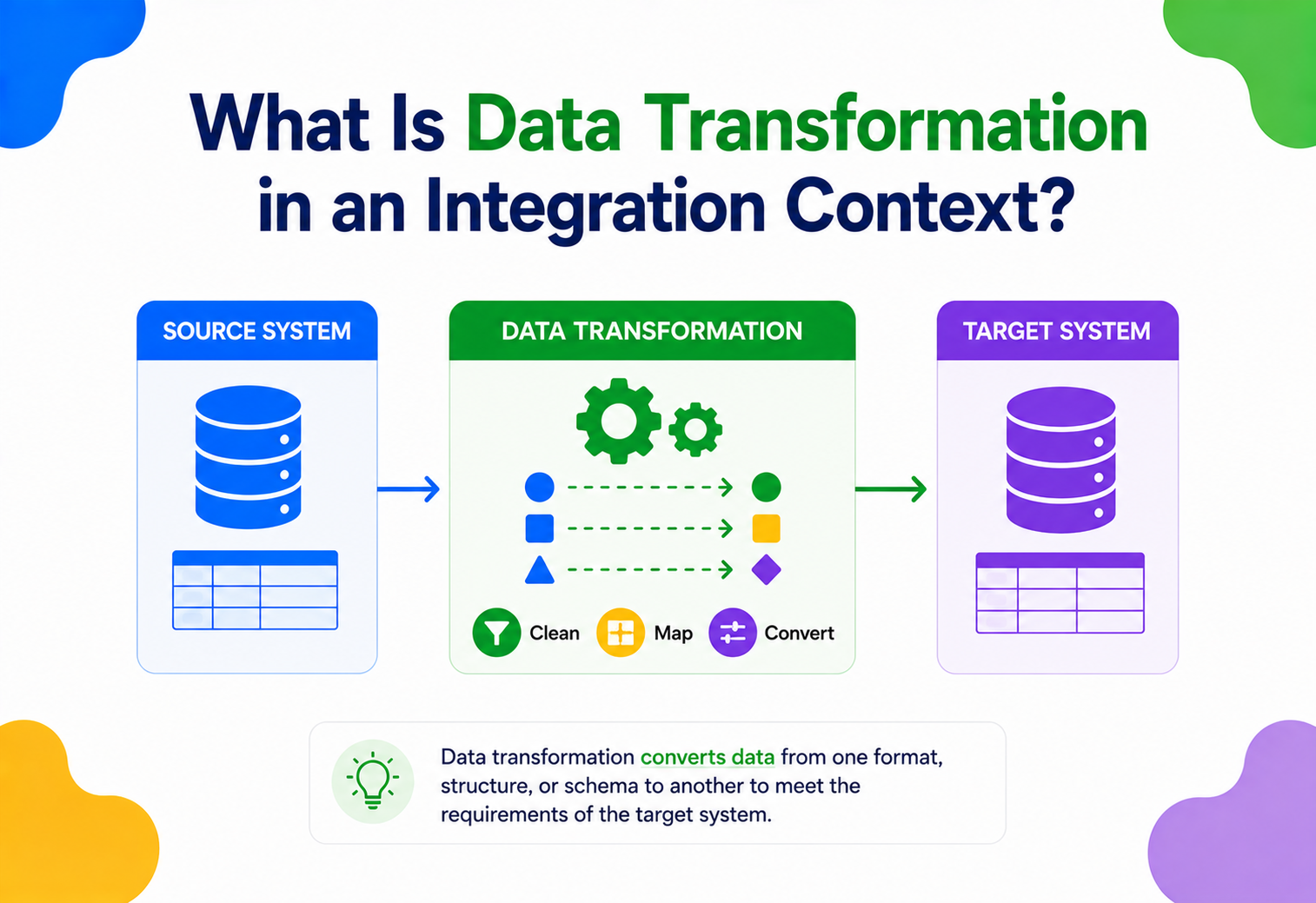
What Is Data Transformation in an Integration Context?
A ground-up tour of how systems reshape, reformat, and reconcile data as it moves between applications — covering six decades of history, the mechanics inside a transformation engine, ETL vs ELT vs streaming, performance at scale, security, deployment models, and the real production patterns used by Netflix, Amazon, Uber, Google, banks, and hospitals.
Introduction & History
Imagine you and a friend both keep diaries, but you write in English using the 12-hour clock (“3:45 PM”), and your friend writes in French using the 24-hour clock (“15h45”). If you wanted to combine your diaries into one shared calendar, someone would need to translate the words and convert the time format so both entries line up correctly. That act of “translating and reshaping” is exactly what data transformation does for computer systems.
In an integration context, data transformation is the process of converting data from the format, structure, or meaning used by a source system into the format, structure, or meaning required by a target system, so the two systems can understand each other and work together. Integration is simply the act of connecting separate systems so they can share data and functionality — and transformation is the translator that makes that connection meaningful rather than garbled.
1.1 A short history
Data transformation is not a new idea invented for modern cloud software — it is as old as computing itself. Here is how it evolved:
- 1960s-1970sBatch file conversion. Early mainframes exchanged data using flat files (fixed-width text files). Programs called “converters” or “translators” reformatted punch-card and tape data between incompatible systems. This was manual, slow, and highly custom-coded.
- 1970s-1980sEDI (Electronic Data Interchange). Businesses began exchanging standardised documents (purchase orders, invoices) electronically. EDI required strict, agreed-upon transformation rules between trading partners — an early form of formal, contract-based mapping.
- 1990sData warehousing & ETL. As companies built centralised data warehouses for reporting, the term ETL (Extract, Transform, Load) became mainstream. Tools like Informatica and DataStage emerged specifically to move and reshape data at scale on a schedule (nightly batch jobs).
- 2000sSOA, ESBs & XML. Service-Oriented Architecture popularised the Enterprise Service Bus (ESB) — a central hub that transformed messages (often XML) between services in near real time, decoupling systems from knowing each other’s formats.
- 2010sAPIs, JSON & cloud iPaaS. REST APIs and JSON overtook SOAP/XML for lightweight integration. Cloud-based Integration Platform as a Service (iPaaS) tools (MuleSoft, Dell Boomi, Zapier) made transformation accessible via drag-and-drop mapping rather than heavy code.
- 2020sStreaming, ELT & AI-assisted mapping. With big data and real-time analytics, transformation increasingly happens continuously on streaming data (Kafka, Flink) or after loading into cheap cloud storage (ELT — Extract, Load, Transform, popularised by tools like dbt). AI now assists in suggesting field mappings automatically.
Despite six decades of change in tools and buzzwords, the underlying problem has stayed the same: different systems store and represent the same real-world information differently, and something has to reconcile those differences. That “something” is data transformation.
The Problem & Motivation
Why does transformation need to exist at all? Because no two systems — even from the same vendor — are ever built with identical assumptions about how data should look. Consider a simple example: an e-commerce website captures an order, and that order needs to reach a warehouse shipping system, an accounting system, and a customer analytics platform.
E-commerce
One-field name
Stores the customer name as a single field: “Jane A. Doe”.
Warehouse
Split-name form
Requires separate fields: firstName, middleInitial, lastName.
Accounting
Cents, not dollars
Needs prices in cents as integers, not dollars as decimals (1999 instead of 19.99).
Analytics
ISO-8601 dates
Expects dates as 2026-07-19T14:00:00Z, not “07/19/2026 2:00 PM”.
Without transformation, the order data would either fail to load into these systems, load with errors, or — worse — load silently with wrong meaning (imagine a warehouse shipping to “A.” because it assumed the middle initial was the first name). Data transformation exists to prevent exactly this kind of breakage, and to do it consistently, at scale, for millions of records, without a human manually re-typing anything.
2.1 The three root causes transformation solves
- Structural differences. One system nests data in objects, another expects flat rows (like the difference between a folder of folders and one long spreadsheet).
- Syntactic differences. Same meaning, different representation, like date formats, units of measurement, or character encoding (UTF-8 vs. Latin-1).
- Semantic differences. The trickiest kind: the same word can mean different things. One system’s “active customer” might mean “logged in within 30 days,” while another’s means “has an open subscription.” Transformation must encode the correct business meaning, not just reshape data.
Core Concepts
Before going deeper, let’s build a shared vocabulary. Think of these as the building blocks — like learning the alphabet before reading a sentence.
3.1 Schema
A schema is the blueprint that describes what fields exist in a piece of data, their names, and their types (text, number, date, etc.). It’s like a form template that says “Name: [text box], Age: [number box].” Transformation converts data from a source schema to a target schema.
3.2 Mapping
A mapping is the explicit rule that says which source field(s) become which target field(s), and how. For example: target.fullName = source.firstName + ” ” + source.lastName. Mappings can be one-to-one (simple rename), one-to-many (splitting a field), many-to-one (combining fields), or involve calculations, lookups, and conditional logic.
3.3 ETL vs. ELT vs. streaming transformation
| Approach | Order of operations | Best for |
|---|---|---|
| ETL (Extract, Transform, Load) | Data is transformed in a separate processing engine before it lands in the target | Traditional data warehouses, strict data quality control before storage |
| ELT (Extract, Load, Transform) | Raw data is loaded first, then transformed inside the target (often a cloud data warehouse) using its own compute power | Big data, cloud-native analytics, when storage/compute is cheap and flexible |
| Streaming transformation | Data is transformed continuously, record by record or in small batches, as it flows through a message pipeline | Real-time systems: fraud detection, live dashboards, IoT |
3.4 Format conversion vs. semantic transformation
Format conversion changes the “packaging” — e.g., converting XML to JSON, or CSV to a database row — without changing meaning. Semantic transformation changes or derives meaning — e.g., converting a raw timestamp into a “customer lifetime stage” category, or converting country-specific tax codes into a unified international code. Most real integration projects require both.
3.5 Idempotency
A transformation is idempotent if running it multiple times on the same input always produces the same result, without unwanted side effects (like duplicating a record). This matters enormously in integration, because network failures often cause the same message to be delivered and reprocessed more than once.
Architecture & Components
A production-grade data transformation layer is rarely a single script. It’s typically composed of several cooperating components, whether it lives inside an ETL tool, an iPaaS, or custom-built microservices.
Fig 4.1 · a typical transformation pipeline: data is extracted, staged, transformed according to mapping rules, validated, and loaded — with a safety net for records that fail.
Boundary
Connectors / adapters
Handle the mechanics of talking to a specific system (a database driver, an API client, a file reader) so the rest of the pipeline doesn’t need to know those details.
Buffer
Staging area
A temporary holding zone (often a table or file) where raw extracted data sits before transformation — useful for retries and auditing.
Core
Transformation engine
The core software that actually applies mapping rules — could be a scripting runtime, a visual mapper, or a distributed compute engine like Spark.
Config
Mapping rules repository
Where the “recipes” live — version-controlled configuration or code describing field mappings and business logic, separate from the engine itself.
Gatekeeper
Validation layer
Checks transformed data against rules (required fields present, correct types, values in range) before it’s allowed to load.
Safety net
Error / dead-letter queue
Where records that fail transformation or validation are routed for review, instead of silently disappearing or crashing the whole pipeline.
4.1 A minimal transformation in Java
To make this concrete, here is a small but realistic example: transforming a source “customer” record into a target shape, including a nested address and a derived field.
CustomerTransformer.java · rename, merge, convert, derive, nest
public class CustomerTransformer {

    public TargetCustomer transform(SourceCustomer source) {
        TargetCustomer target = new TargetCustomer();

        // Simple rename mapping
        target.setCustomerId(source.getId());

        // Combine two fields into one (many-to-one)
        target.setFullName(source.getFirstName() + " " + source.getLastName());

        // Format conversion: dollars (double) -> cents (long)
        target.setBalanceCents(Math.round(source.getBalanceUsd() * 100));

        // Semantic transformation: derive a category from raw data
        target.setLoyaltyTier(deriveLoyaltyTier(source.getTotalOrders()));

        // Nested structure mapping
        Address addr = new Address();
        addr.setLine1(source.getStreet());
        addr.setCity(source.getCity());
        addr.setPostalCode(normalizePostalCode(source.getZip()));
        target.setAddress(addr);

        return target;
    }

    private String deriveLoyaltyTier(int totalOrders) {
        if (totalOrders >= 50) return "PLATINUM";
        if (totalOrders >= 20) return "GOLD";
        if (totalOrders >= 5)  return "SILVER";
        return "STANDARD";
    }

    private String normalizePostalCode(String zip) {
        return zip == null ? null : zip.trim().toUpperCase();
    }
}
Notice how each line represents a different kind of transformation: a rename, a merge, a unit conversion, a derived business rule, and a nested structural mapping — all living inside one method. In real systems, these rules are usually externalised into configuration so business analysts (not just engineers) can adjust them.
Internal Working
What actually happens, step by step, inside a transformation engine when it processes one record? Let’s trace it like a factory assembly line.
- 1
Parsing
Raw input (a JSON string, a database row, an XML document) is parsed into an in-memory object the engine can work with — like unpacking a sealed box before you can inspect what’s inside.
- 2
Schema binding
The engine matches the parsed data against the expected source schema, so it knows “this field is a number, this one is a date.”
- 3
Rule resolution
The engine looks up which mapping rules apply — sometimes based on record type, sometimes based on a routing condition (e.g., “if country = US, apply the US tax mapping”).
- 4
Function / expression evaluation
Each mapping rule is executed — this can be as simple as a copy, or as complex as calling a lookup table, an external reference-data API, or a custom function.
- 5
Type coercion
Values are converted to the target’s expected data types (string to integer, string to date object, etc.), often with explicit format instructions (e.g., “parse using pattern MM/dd/yyyy”).
- 6
Validation
The resulting object is checked against target constraints (non-null fields, allowed value lists, numeric ranges).
- 7
Serialisation
The validated in-memory object is converted into the output format the target expects (JSON, a SQL INSERT statement, an XML payload).
- 8
Delivery / acknowledgment
The output is handed to the target connector, and (in reliable systems) an acknowledgment is recorded so the source knows the record was successfully processed.
Fig 5.1 · the lifecycle of a single record moving through a transformation engine.
5.1 Where complexity actually lives
The steps above sound simple, but real-world complexity hides in a few specific places:
- Lookups and reference data. Transforming a raw country code into a full country name, or a product SKU into a category, often requires calling out to another data source mid-transformation.
- Conditional and nested logic. “If the order has more than 3 items AND is international, apply a different tax mapping” quickly becomes intricate business logic that must be tested like any other code.
- Schema drift. Source systems change their data shape over time (a new field appears, a field is renamed). Engines need strategies (like schema versioning) to avoid silently breaking.
- Ordering and dependencies. Some fields can only be computed after others (e.g., total price depends on line items being transformed first), requiring a dependency graph rather than a flat list of rules.
Data Flow & Lifecycle
Zooming out from a single record, let’s look at how transformation fits into the full lifecycle of an integration — from the moment data is born in a source system to the moment it’s consumed downstream.
Fig 6.1 · two common triggers for transformation: event-driven (real-time) and scheduled (batch), converging on the same target.
Two triggering models dominate:
- Batch. Transformation runs on a schedule (e.g., every night at 2 AM), processing all records that changed since the last run. Simple to reason about, but introduces latency — data can be up to 24 hours stale.
- Event-driven / streaming. Transformation runs the moment a change happens, often triggered by Change Data Capture (CDC) reading a database’s transaction log, or by an application publishing an event to a message broker like Kafka. Low latency, but requires more careful engineering (ordering, exactly-once semantics, backpressure handling).
Regardless of trigger, the lifecycle typically includes these stages: capture (detecting the data exists/changed) → extract (pulling it out) → transform (reshaping it) → validate → load/deliver → acknowledge → monitor. A mature integration platform treats every stage as observable and recoverable, not just the transformation step itself.
6.1 Data lineage across the lifecycle
Data lineage is the recorded history of where a piece of data came from and every transformation step it passed through to reach its current form — like a shipping label that lists every warehouse a package moved through. Mature integration platforms automatically capture lineage metadata at each lifecycle stage (which source record, which mapping version, which run, at what time) so that when a target value looks wrong, an engineer can trace it backward step by step instead of guessing. Lineage is also frequently a hard regulatory requirement — auditors in finance and healthcare routinely ask “show me exactly how this number was derived,” and without captured lineage, that question can be nearly impossible to answer after the fact.
Types of Data Transformation
Not all transformations are the same shape of problem. It helps to categorise them so you can recognise which technique to reach for.
7.1 Structural transformation
Changing how data is organised — flattening nested JSON into rows, converting a hierarchical XML tree into a relational table, or pivoting rows into columns. Example: turning a JSON order with an array of line items into one row per line item in a database table.
7.2 Syntactic (format) transformation
Changing the surface representation without changing meaning: date formats, number formats (decimal comma vs. decimal point), character encodings, units of measurement (miles to kilometres), or file formats (CSV to Parquet).
7.3 Semantic transformation
Changing or deriving meaning: mapping a source system’s status code “S” to a target’s human-readable “SHIPPED”, or computing a derived field like “customer age” from a birthdate. This category is where business rules live, and it’s the hardest to automate because it requires domain knowledge.
7.4 Enrichment
Adding information that wasn’t originally present, usually by looking it up elsewhere — e.g., adding a customer’s loyalty tier by querying a CRM, or adding geolocation data from an IP address.
7.5 Aggregation & summarisation
Combining many records into fewer, more meaningful ones — e.g., turning thousands of individual transaction records into one “daily total spend per customer” record for a reporting system.
7.6 Filtering & cleansing
Removing records that shouldn’t propagate (test accounts, duplicates) and cleaning up bad data (trimming whitespace, fixing casing, removing invalid characters) before it reaches the target.
01
Structural
Nested → flat, rows → columns.
02
Syntactic
Date, number, encoding formats.
03
Semantic
Codes → business meaning.
04
Enrichment
Add data from elsewhere.
05
Aggregation
Many records → summarised one.
06
Cleansing
Fix, filter, deduplicate.
Advantages, Disadvantages & Trade-offs
Data transformation is not free — it adds a layer of processing, complexity, and potential failure points. Understanding the trade-offs helps you design it deliberately rather than accidentally.
Advantages
- Enables otherwise-incompatible systems to work together
- Centralises business rules in one auditable place instead of scattered across apps
- Improves data quality via validation and cleansing
- Decouples systems — source and target can evolve independently as long as the mapping is updated
- Enables analytics and reporting by reshaping operational data into analysis-friendly forms
Disadvantages / trade-offs
- Adds latency — every hop through a transformation engine takes time
- Adds a point of failure and a debugging layer (“is the bug in the source, the mapping, or the target?”)
- Mapping logic can silently drift out of sync with evolving source/target schemas
- Complex transformations become their own maintenance burden — effectively a codebase to test and version
- Over-transformation can obscure the original data’s meaning, making debugging and audits harder
8.1 ETL vs ELT trade-off in more depth
ETL transforms before loading, which keeps the target clean but requires provisioning separate transformation compute and tends to be slower to adapt (schema changes require redeploying transformation jobs). ELT loads raw data first and transforms afterward using the target’s own power (e.g., a cloud warehouse’s SQL engine), which is more flexible and allows re-running transformations differently later, at the cost of storing more raw, potentially messy data.
Performance & Scalability
As data volume grows from thousands to billions of records, transformation logic that worked fine in a demo can become the bottleneck of an entire integration. Here’s what matters at scale.
9.1 Parallelism
Because most record-level transformations are independent of each other (transforming customer #1 doesn’t depend on customer #2), transformation is a naturally parallelisable problem. Engines like Apache Spark or Flink split large datasets into partitions and transform them concurrently across many machines.
9.2 Streaming vs. batch performance characteristics
| Concern | Batch | Streaming |
|---|---|---|
| Throughput | High (optimised for bulk) | Moderate, tuned for low latency |
| Latency | Minutes to hours | Milliseconds to seconds |
| Resource usage | Spiky (runs then idles) | Continuous, steady-state |
| Backpressure handling | Not usually needed | Critical — must slow down if downstream is overwhelmed |
9.3 Common performance techniques
- Partitioning. Splitting data by key (e.g., customer region) so chunks can be transformed independently and in parallel.
- Streaming instead of loading everything into memory. Processing records one-at-a-time or in small batches rather than materialising an entire dataset in RAM.
- Caching lookups. If a transformation repeatedly looks up the same reference data (like a country-code table), caching it in memory avoids expensive repeated calls.
- Pushdown. In ELT, pushing transformation logic down into the target database’s own query engine (SQL) instead of pulling data out to transform it externally.
- Avoiding row-by-row network calls. Batch enrichment lookups (fetch 1,000 records’ worth of reference data in one call) instead of one network round-trip per record.
9.4 Concurrency & the algorithms underneath
Under the hood, high-performance transformation engines lean on well-known concurrency and data structure techniques rather than inventing new ones:
- Thread pools / worker pools. A fixed number of reusable threads pull records from a queue and transform them, avoiding the overhead of creating a new thread per record — similar to how a restaurant keeps a fixed number of cooks rather than hiring a new one for every dish.
- Concurrent hash maps. Shared in-memory caches (for lookups like currency rates) use thread-safe data structures so multiple worker threads can read and update them at the same time without corrupting the data.
- Producer-consumer queues. A bounded queue sits between the stage that reads raw data and the stage that transforms it, smoothing out speed differences between the two and providing natural backpressure — if the queue fills up, the reader slows down automatically.
- Sorting and merge algorithms. Transformations that need to join two large datasets (like matching orders to customers) often rely on classic merge-join or hash-join algorithms, choosing between them based on whether the data is already sorted and how much fits in memory.
- Windowing algorithms. Streaming transformations that aggregate over time (e.g., “total sales in the last 5 minutes”) use sliding or tumbling window algorithms to group unbounded data into finite, calculable chunks.
Choosing the right data structure matters more than it might seem: a lookup implemented as a linear list scanned record-by-record might be fast enough for 50 reference values, but becomes a serious bottleneck at 500,000 — swapping it for a hash map (constant-time lookup) is often the single biggest performance win available in a transformation pipeline.
High Availability & Reliability
Because transformation sits directly in the path between systems, if it goes down, data stops flowing — which can silently stall an entire business process (orders not shipping, invoices not generated). Reliability engineering for transformation pipelines focuses on a few core guarantees.
10.1 Delivery guarantees
- At-most-once. A record is delivered zero or one times — fast, but data can be lost. Rarely acceptable for business-critical flows.
- At-least-once. A record is guaranteed to be delivered, but might be delivered (and transformed) more than once during retries — requires the transformation to be idempotent so duplicates don’t cause harm.
- Exactly-once. The gold standard — each record is transformed and delivered exactly one time, even across failures. Achieved through techniques like transactional writes and deduplication IDs; harder and more expensive to guarantee.
10.2 Failure handling patterns
Ride out blips
Retry with backoff
Automatically re-attempt a failed transformation after a delay that increases each time, to ride out temporary issues.
Contain damage
Dead-letter queue
Records that repeatedly fail are set aside for manual inspection instead of blocking the whole pipeline.
Fail fast
Circuit breaker
If a downstream system (e.g., a lookup service) keeps failing, temporarily stop calling it to avoid making things worse, and fail fast instead.
Resumable
Checkpointing
Streaming engines periodically save “how far we’ve gotten” so a crash can resume instead of reprocessing everything from the start.
10.3 Redundancy
Running multiple instances of the transformation engine (active-active or active-passive) across different servers or availability zones ensures that the failure of one machine doesn’t stop the whole pipeline — the workload shifts to healthy instances.
10.4 The CAP theorem, applied to transformation pipelines
The CAP theorem states that any distributed system can only fully guarantee two out of three properties at the same time: Consistency (every reader sees the same, most up-to-date data), Availability (every request gets a response, even during failures), and Partition tolerance (the system keeps working even if network connections between nodes break). Since network partitions are unavoidable in any real, distributed transformation pipeline spanning multiple machines or data centres, the real-world choice is usually between consistency and availability during a partition.
In practice, most transformation pipelines lean toward availability — it’s usually more important to keep processing records (even if a few workers temporarily see slightly stale reference data) than to halt the entire pipeline waiting for perfect consistency. Pipelines that touch financial ledgers or regulatory reporting, however, often lean toward consistency, accepting temporary unavailability rather than risk transforming data incorrectly.
10.5 Replication & partitioning
Replication means keeping copies of the same data (such as reference/lookup tables used during transformation) on multiple nodes, so a single node failure doesn’t stop the pipeline and reads can be served locally, faster. Partitioning (also called sharding) means splitting a large dataset into smaller chunks, usually by a key such as customer ID or region, so different transformation workers can each own and process a subset independently, in parallel, without stepping on each other.
These two techniques are often combined: data is partitioned across many workers for parallel throughput, while each partition (and important reference data) is also replicated for fault tolerance — a pattern borrowed directly from distributed databases and message brokers like Kafka, which partitions topics and replicates each partition across multiple brokers.
10.6 Consensus & failure recovery
When multiple transformation workers must agree on shared state — such as “which worker owns this partition right now” or “has this batch already been committed?” — the pipeline needs a consensus mechanism. Distributed coordination systems (like ZooKeeper, etcd, or a Raft-based consensus protocol built into the streaming platform) let workers agree reliably on this shared state even if some workers crash or the network is flaky, preventing two workers from processing the same partition simultaneously and producing duplicate or conflicting output.
Failure recovery in transformation systems typically relies on checkpointing (periodically saving progress, such as “we’ve successfully transformed and delivered everything up to record #48,201”) combined with a durable, replayable source (like a Kafka topic with retention, or a database transaction log). If a worker crashes, a new worker can be assigned the same partition, read the last checkpoint, and resume exactly where the failed worker left off — turning what would otherwise be a data-loss incident into a brief, self-healing blip.
Security Considerations
Transformation pipelines often have broad access to sensitive data flowing between systems, which makes them a meaningful part of an organisation’s security surface.
11.1 Key concerns
- Data exposure in staging areas. Intermediate storage used during transformation can become an overlooked copy of sensitive data if not properly secured and cleaned up.
- PII handling. Personally Identifiable Information (names, emails, government IDs) often needs to be masked, tokenised, or encrypted during transformation — especially when moving data into lower-trust environments like test systems or analytics platforms.
- Injection risks. If transformation logic dynamically builds queries or commands from source data (e.g., constructing SQL strings), it can be vulnerable to injection attacks unless properly parameterised.
- Credentials management. Connectors need credentials to reach source and target systems; these must be stored in secrets managers, not hardcoded in mapping configuration.
- Audit trails. Regulated industries (finance, healthcare) often require proof of exactly what transformation was applied to what data and when, for compliance (e.g., GDPR, HIPAA, SOX).
11.2 Common mitigations
Encrypt
Field-level encryption
Encrypt sensitive fields during transformation before they land in less-trusted targets.
Hide
Data masking / tokenisation
Replace real values with realistic-looking fakes or tokens for non-production environments.
Restrict
Least-privilege connectors
Each connector only has the minimum access it needs to its specific system.
Protect
Encrypted transit & at rest
TLS for data in motion, encryption for staging storage and logs.
Monitoring, Logging & Metrics
Because transformation is invisible “plumbing” between systems, teams that don’t monitor it well often find out something broke only when a business user notices missing or wrong data — sometimes days later. Good observability turns that into an alert within minutes.
12.1 What to measure
| Metric | Why it matters |
|---|---|
| Records processed / second | Detects throughput drops that indicate a bottleneck or partial outage |
| Error / rejection rate | Sudden spikes often mean an upstream schema change broke mappings |
| End-to-end latency | Time from source event to target availability — critical for real-time use cases |
| Dead-letter queue size | Growing backlog signals unresolved data quality or mapping issues |
| Schema drift events | Flags when source data no longer matches the expected shape |
| Data freshness / lag | How far behind the target is from the source, especially in batch pipelines |
12.2 Logging practices
- Structured logging. Emit logs as structured JSON with consistent fields (record ID, pipeline stage, timestamp) rather than free-text, so they’re searchable and machine-parseable.
- Correlation IDs. Tag each record with a unique ID that follows it through every stage, so a failure can be traced end-to-end across systems.
- Sampling with redaction. Log a sample of transformed records for debugging, but redact or mask sensitive fields.
12.3 Alerting
Effective pipelines set alert thresholds on the metrics above (e.g., “alert if error rate exceeds 2% over 5 minutes” or “alert if no records processed in 30 minutes for a pipeline that normally runs continuously”) and route them to the team that owns the pipeline, ideally with enough context (which mapping, which record type) to start debugging immediately.
12.4 Debugging & distributed tracing
When a transformation pipeline spans multiple services — an extractor, a message broker, a transformation engine, and a loader, possibly running on different machines — a single failure can be genuinely hard to locate without help. Distributed tracing tools (like OpenTelemetry, Jaeger, or Zipkin) solve this by attaching a trace ID to a record as it enters the pipeline and propagating that ID through every subsequent hop, so an engineer can pull up one trace and see a timeline of exactly which service touched the record, how long each step took, and precisely where it failed or slowed down.
Good debugging practice also means being able to replay a single problematic record through the transformation logic in isolation, with verbose logging enabled, rather than needing to reproduce an issue across the entire live pipeline — which is why durable, replayable staging areas and message logs (not just fire-and-forget streaming) remain valuable even in real-time architectures.
Deployment & Cloud
Where and how transformation logic actually runs has evolved significantly, and modern teams have several deployment models to choose from.
Legacy hub
Enterprise Service Bus (ESB)
A centralised, self-hosted hub (e.g., MuleSoft on-prem, IBM Integration Bus) that routes and transforms messages between systems. Common in large, established enterprises with heavy legacy systems.
Low-code SaaS
iPaaS (Integration Platform as a Service)
Cloud-hosted, often low-code platforms (Dell Boomi, Workato, Zapier, Microsoft Power Automate) where transformation mappings are configured visually rather than coded from scratch.
Managed compute
Cloud-native data pipelines
Managed services like AWS Glue, Google Dataflow, or Azure Data Factory that run transformation jobs as scalable, serverless or auto-scaling compute.
Custom code
Custom microservices
Purpose-built services (often containerised, e.g., in Kubernetes) that own a specific transformation responsibility, deployed and scaled independently.
Real-time
Streaming platforms
Apache Kafka with Kafka Streams or ksqlDB, or Apache Flink, running continuous transformation jobs on unbounded data streams.
SQL-native
In-warehouse (ELT) tools
Tools like dbt that define transformations as SQL models executed directly inside the cloud data warehouse (Snowflake, BigQuery, Redshift).
13.1 Cloud-specific considerations
- Elastic scaling. Cloud platforms can automatically add compute during a large nightly batch and scale down afterward, avoiding the cost of always-on infrastructure.
- Managed connectors. Cloud iPaaS tools maintain pre-built connectors to hundreds of common SaaS systems (Salesforce, SAP, Workday), reducing custom integration code.
- Serverless transformation functions. Small transformation steps can run as functions (AWS Lambda, Azure Functions) triggered directly by events, without managing servers.
- Multi-region considerations. Data residency laws (e.g., GDPR) may require transformation to happen within a specific geographic region, influencing deployment topology.
13.2 Cost optimisation
Transformation workloads can quietly become one of the largest line items in a cloud bill, especially for large batch jobs or always-on streaming pipelines, so cost awareness is a real production concern rather than an afterthought. A few practical levers teams use:
- Right-sizing compute. Matching the number and size of workers to actual data volume rather than over-provisioning “just in case,” and using auto-scaling so idle time doesn’t cost the same as peak time.
- Choosing the cheaper trigger model where acceptable. Batch processing is almost always cheaper per record than always-on streaming, because streaming infrastructure runs continuously even when there’s little data to process — so it’s worth asking whether a use case genuinely needs real-time freshness or whether hourly batch would serve the business just as well at a fraction of the cost.
- Efficient file formats. Using columnar, compressed formats (like Parquet or ORC) for staged or intermediate data dramatically reduces both storage cost and the amount of data that must be read during later transformation steps.
- Avoiding redundant re-transformation. Caching or persisting intermediate results so that a downstream change doesn’t force re-processing an entire historical dataset from scratch.
- Spot / preemptible compute for batch jobs. Large, fault-tolerant batch transformation jobs are often good candidates for discounted, interruptible cloud compute, since a job can simply retry a lost chunk rather than needing guaranteed uptime.
Fig 13.1 · a typical cloud iPaaS setup: managed connectors feed an auto-scaling transformation engine that fans out to multiple targets.
Databases, Caching & Load Balancing
Transformation doesn’t happen in isolation — it constantly interacts with data storage and infrastructure components that shape how it performs and scales.
14.1 Databases in the transformation pipeline
- Staging databases. Often a simple relational database or object storage bucket used to temporarily hold raw or intermediate data.
- Reference / lookup databases. Store the “dictionaries” transformation relies on — country codes, currency rates, product catalogs — usually read-heavy and benefit from caching.
- Target databases. The final destination, which may require specific write patterns (bulk inserts vs. row-by-row upserts) for performance.
14.2 Caching strategies
| Strategy | Use case |
|---|---|
| In-memory cache (e.g., a local hash map) | Small, mostly-static reference data used within a single transformation job |
| Distributed cache (e.g., Redis) | Reference data shared across many transformation workers/instances |
| Time-to-live (TTL) expiry | Balances freshness against performance for data that changes occasionally (like exchange rates) |
| Write-through cache | Keeps cache and source-of-truth in sync as new reference data is added |
14.3 Load balancing
When transformation runs as a fleet of workers (e.g., multiple containers consuming from a message queue), a load balancer or the queue’s own partitioning distributes records evenly across workers, preventing any single instance from becoming a bottleneck. For streaming systems, this is often achieved by partitioning by key (e.g., all events for a given customer go to the same partition, preserving order for that customer while still parallelising across customers).
APIs & Microservices
In modern architectures, transformation is frequently embedded directly into API layers and microservices, rather than living only in a separate batch tool.
15.1 API gateway transformation
API gateways (like Kong, Apigee, or AWS API Gateway) often perform lightweight transformation as requests and responses pass through — for example, converting an internal service’s response format into the shape a specific external partner expects, without changing the underlying service.
15.2 The Anti-Corruption Layer pattern
Borrowed from Domain-Driven Design, an Anti-Corruption Layer is a dedicated component that translates between a microservice’s clean internal model and a messy external system’s model, so the external system’s quirks don’t “leak” into and corrupt the microservice’s own domain logic.
LegacyOrderAdapter.java · an Anti-Corruption Layer in practice
// A simple Anti-Corruption Layer example in Java
public class LegacyOrderAdapter {

    private final LegacySystemClient legacyClient;

    public LegacyOrderAdapter(LegacySystemClient legacyClient) {
        this.legacyClient = legacyClient;
    }

    // Converts our clean internal Order model into whatever
    // shape the legacy system requires, isolating that mess here.
    public void submitOrder(Order order) {
        LegacyOrderRequest legacyRequest = new LegacyOrderRequest();
        legacyRequest.setCustNo(order.getCustomerId());
        legacyRequest.setOrdDate(formatLegacyDate(order.getCreatedAt()));
        legacyRequest.setLineItems(convertLineItems(order.getItems()));

        legacyClient.submit(legacyRequest);
    }

    private String formatLegacyDate(java.time.Instant instant) {
        // Legacy system expects DDMMYYYY as a plain string
        java.time.format.DateTimeFormatter fmt =
            java.time.format.DateTimeFormatter.ofPattern("ddMMyyyy")
                .withZone(java.time.ZoneOffset.UTC);
        return fmt.format(instant);
    }

    private java.util.List<LegacyLineItem> convertLineItems(java.util.List<OrderItem> items) {
        java.util.List<LegacyLineItem> result = new java.util.ArrayList<>();
        for (OrderItem item : items) {
            LegacyLineItem li = new LegacyLineItem();
            li.setSku(item.getProductCode());
            li.setQty(item.getQuantity());
            result.add(li);
        }
        return result;
    }
}
15.3 Event-driven microservices & message translation
In event-driven architectures, services publish events onto a broker (Kafka, RabbitMQ), and consuming services often need their own transformed view of that event. A common pattern is a lightweight “translator” consumer that subscribes to a raw event topic, transforms it, and republishes it to a topic in a format tailored for a specific set of downstream consumers — keeping producers decoupled from every consumer’s exact needs.
Design Patterns & Anti-patterns
16.1 Recommended patterns
01
Canonical Data Model
Define one neutral, internal format that all systems transform to/from, rather than building a direct mapping between every pair of systems (avoids the “N-squared” mapping explosion).
02
Pipes and Filters
Break transformation into small, single-purpose, chainable steps (parse → clean → enrich → validate) that can be tested and reused independently.
03
Schema Registry
A central service that tracks valid schema versions for each data type, letting producers and consumers evolve safely and detect incompatible changes early.
04
Idempotent Consumer
Design transformation logic to safely process the same message more than once without duplicating side effects, using unique record IDs to detect repeats.
05
Strangler Fig for legacy migration
Gradually route transformed traffic from an old system to a new one, transforming data at the boundary until the legacy system can be fully retired.
16.2 Canonical Data Model, visualised
Fig 16.1 · a canonical model turns a tangle of point-to-point mappings into a manageable hub-and-spoke design.
16.3 Anti-patterns to avoid
Anti-patterns
- Point-to-point spaghetti. Direct custom mappings between every pair of systems, which becomes unmanageable as the number of systems grows.
- Hidden business logic in mappings. Critical business rules buried inside obscure transformation expressions that nobody outside the integration team understands or can audit.
- Silent data loss. Transformations that quietly drop fields they don’t recognise instead of flagging them — leading to slow, undetected data quality erosion.
- No versioning of mappings. Changing a mapping in place with no history, making it impossible to know what logic produced last month’s data.
- Transformation as an afterthought. Bolting transformation logic onto brittle, hard-coded scripts rather than treating it as a first-class, tested, monitored part of the system.
Best Practices & Common Mistakes
17.1 Best practices
- Version and test mappings like code. Store mapping rules in source control, write unit tests for transformation logic (including edge cases like nulls and unexpected values), and review changes before deploying.
- Fail loudly, not silently. Reject or flag records that don’t match expectations rather than guessing or dropping fields quietly.
- Design for idempotency from day one. Assume retries and duplicate deliveries will happen.
- Separate mapping logic from engine code. Keep business rules externalised and configurable so they can change without a full redeploy.
- Document field-level lineage. Know, for every target field, exactly which source field(s) and rule produced it — essential for debugging and audits.
- Monitor data quality continuously, not just pipeline uptime — a “successful” run can still produce wrong data.
- Plan for schema evolution. Use a schema registry or versioning strategy so new fields or renamed fields don’t silently break the pipeline.
17.2 Common mistakes
Common mistakes
- Hardcoding transformation logic that only handles the “happy path” and crashes on nulls or unexpected formats
- Ignoring time zones — assuming all timestamps are in the same zone as the developer’s machine
- Assuming character encoding is always UTF-8 without validating it
- Testing only with small, clean sample data instead of realistic, messy production-like data
- Not planning for what happens when the target system is temporarily unavailable
Real-World Industry Examples
Streaming · personalisation
Netflix
Netflix’s data platform ingests massive streams of viewing events and transforms them in real time (via tools like Apache Flink) into formats used for personalised recommendations, A/B testing analysis, and content licensing reports — the same raw “play” event is reshaped differently for each downstream consumer.
Retail · multi-consumer
Amazon
Amazon’s order fulfillment pipeline transforms a single customer order into distinct formats needed by inventory systems, third-party seller systems, shipping carriers, and financial reconciliation systems — each with different schemas, units, and required fields.
Mobility · low-latency
Uber
Uber transforms raw GPS and trip event streams into standardised formats for real-time pricing (surge calculation), driver payment systems, and long-term analytics — often using stream-processing transformation to keep latency low for pricing decisions.
Ads · unified schema
Google’s advertising systems transform raw ad-click and impression events, arriving from many different platforms and formats, into a unified schema used for billing, reporting, and fraud detection — at a scale of billions of events per day.
Finance · regulated
Banking & finance
Banks transform transaction data between core banking systems (often decades-old mainframes using fixed-width formats) and modern digital banking apps, carefully preserving exact monetary precision and full audit trails required by regulation.
Health · interoperability
Healthcare
Hospital systems transform patient data between different Electronic Health Record (EHR) systems using standards like HL7 and FHIR, translating between different hospitals’ internal codes for diagnoses, medications, and procedures.
Across every one of these examples, the same underlying pattern holds: a single piece of real-world data (a video play, an order, a trip, an ad click, a transaction, a diagnosis) needs to be reshaped multiple different ways for multiple different systems — and data transformation is the discipline that makes that reshaping reliable, auditable, and fast enough to matter.
Analogy. The best-run integration teams treat transformation the way a great newsroom treats translation: not a mechanical conversion of words, but a careful preservation of meaning across audiences that read very differently — and always with a record of exactly what was translated, when, and by which rule, so any disputed phrase can be traced back to its source.
Frequently Asked Questions
Is data transformation the same as data mapping?
They’re closely related but not identical. Mapping is the specification — the rules that say which source field goes to which target field. Transformation is the broader process of actually applying those rules (and other logic like validation and enrichment) to real data.
Do I need a dedicated tool, or can I just write custom code?
It depends on scale and team composition. Custom code offers maximum flexibility and is often right for a small number of complex, unique integrations. Dedicated tools (iPaaS, ETL platforms) shine when you have many integrations, want non-engineers to manage mappings, or need built-in monitoring, retries, and connectors out of the box.
What’s the difference between transformation and data cleansing?
Cleansing (fixing typos, removing duplicates, standardising casing) is actually one specific type of transformation focused on improving data quality, rather than reshaping data for a different system’s structure.
How do I handle a source field that doesn’t exist in older records?
Define an explicit default or “unknown” handling strategy for missing fields as part of the mapping rule itself, rather than letting the transformation engine crash or silently insert nulls that confuse the target system.
Should transformation logic live in the source system, the target system, or in between?
Generally, it’s healthiest for transformation logic to live in a neutral, dedicated layer “in between” (a canonical model, an ETL job, a translator service) rather than baked into either endpoint — this keeps both systems free to evolve independently.
Is ELT replacing ETL entirely?
Not entirely. ELT has become dominant for analytics workloads in cloud data warehouses because storage and compute there are cheap and flexible. ETL still remains common for operational integrations, real-time pipelines, and cases where data must be validated or masked before it’s allowed to land anywhere.
How do I test transformation logic properly?
Treat it like any other business-critical code: write unit tests covering typical records, edge cases (nulls, empty strings, extreme values), and known historical bugs, and run those tests automatically whenever the mapping changes.
What happens if the source and target teams disagree on what a field means?
This is a common, very real problem — and it’s a business conversation, not just a technical one. The transformation layer can encode whichever definition the organisation agrees on, but someone needs to make that decision explicitly and document it, rather than letting whoever wrote the mapping code decide by default. A canonical data model, owned by a cross-team data governance group, helps prevent this ambiguity from recurring for every new integration.
Can data transformation introduce bugs that are hard to detect?
Yes, and this is one of the more dangerous aspects of transformation work. Because a transformation can run successfully (no errors, no crashes) while still producing subtly wrong output — like swapping two similarly-named fields, or applying a rounding rule that loses a fraction of a cent per transaction — data quality monitoring (comparing statistical patterns of output data against expectations) is just as important as error-rate monitoring.
How does data transformation relate to master data management (MDM)?
Master Data Management is the broader discipline of maintaining one trusted, authoritative version of key business entities (like “customer” or “product”) across an organisation. Data transformation is one of the key mechanisms MDM relies on — reshaping and reconciling data from many source systems into that single trusted master record, and then transforming the master record back out into whatever format each consuming system needs.
Summary & Key Takeaways
Data transformation is the essential translation layer that lets fundamentally different systems — with different schemas, formats, and business meanings — exchange data safely and usefully. It’s not a single technique but a discipline spanning structural reshaping, format conversion, semantic mapping, enrichment, and quality control, implemented through architectures ranging from simple batch scripts to distributed streaming engines running across the globe.
20.1 Key takeaways
- 01Transformation exists because no two systems represent the same real-world information identically — structurally, syntactically, or semantically.
- 02Core building blocks are schema, mapping, and the engine that executes those mappings reliably and repeatably.
- 03Choose ETL, ELT, or streaming based on how fresh the business actually needs the data to be — not just what’s trendy.
- 04Idempotency, validation, and dead-letter handling are what turn a fragile pipeline into a production-grade one.
- 05Performance at scale comes from parallelism, batching lookups, and pushing work down to powerful compute engines when possible.
- 06Security and compliance concerns (PII, audit trails, encryption) must be designed into transformation, not bolted on afterward.
- 07Patterns like the canonical data model and anti-corruption layer prevent the “point-to-point spaghetti” that plagues growing systems.
- 08Across every industry — streaming, e-commerce, ride-sharing, advertising, banking, healthcare — the same core problem repeats: reshape data reliably so separate systems can genuinely work together.