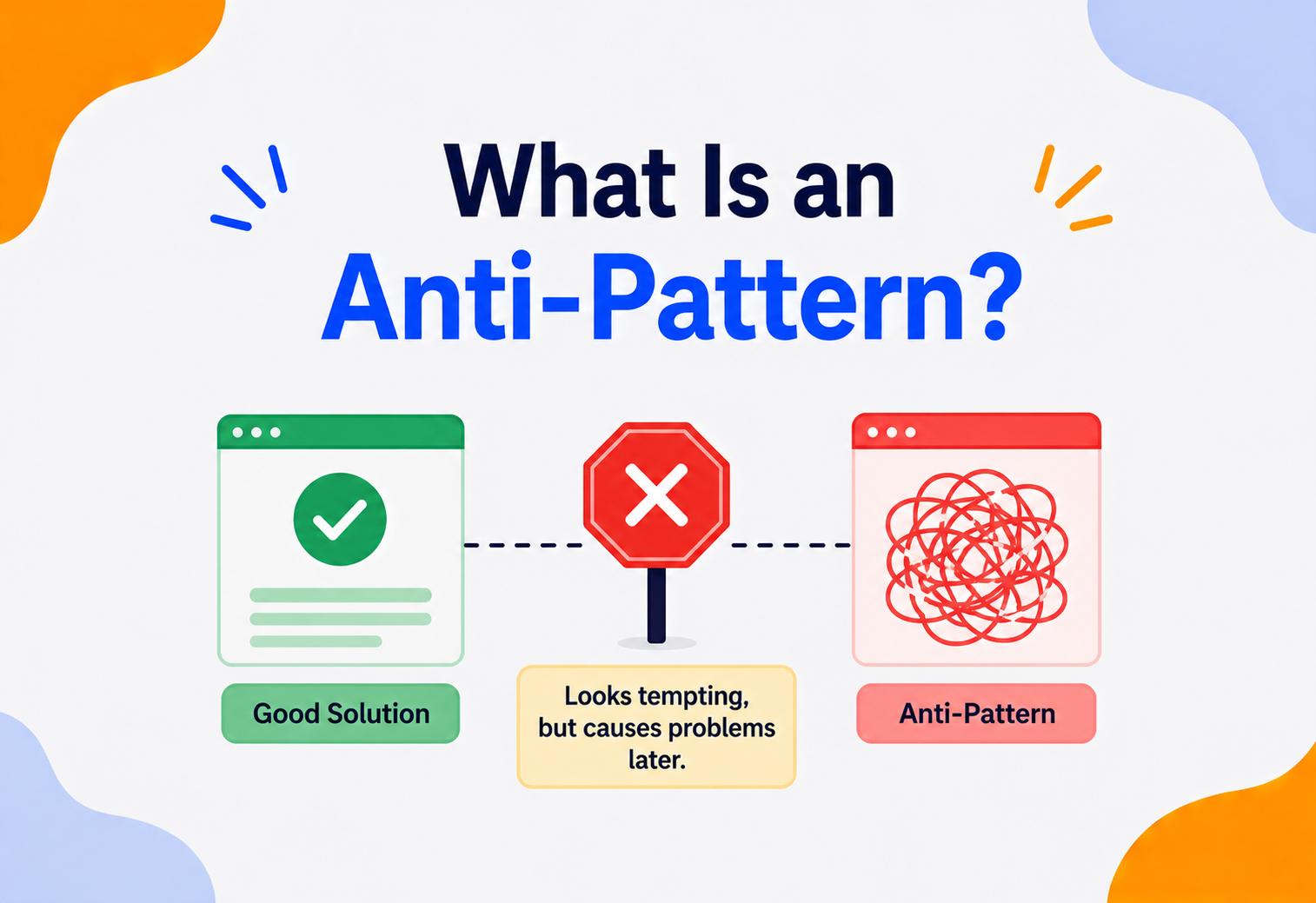
What Is an Anti-Pattern?
Taking the elevator down one floor feels faster than the stairs — until you count the waiting time, and realize you’d have already arrived on foot. An anti-pattern is software’s version of that elevator: a habit that looks like the smart, easy choice in the moment, and quietly costs far more than it saves.
The Big Idea, in One Breath
Imagine a hiking trail with a small, well-worn shortcut cutting across a switchback. It looks like a clever time-saver — a straight line instead of a winding path. Enough hikers take it that the shortcut becomes an obvious, tempting little trail of its own. The trouble is, that shortcut erodes the hillside, creates a muddy mess after every rainstorm, and over the years, causes far more damage and far more maintenance work than the extra two minutes it ever saved anyone. Park rangers even have a name for this exact pattern of behavior, precisely because it happens so predictably, on so many trails, in so many parks.
Software has its own version of that eroded shortcut, and it’s called an anti-pattern. An anti-pattern is a common, recognizable way of solving a recurring problem that looks reasonable, even clever, in the moment — but that reliably leads to more pain than it prevents, once its real costs show up down the road. Just like the hiking shortcut, anti-patterns aren’t usually created by careless or lazy people. They’re created by reasonable people, under reasonable pressure, reaching for what looks like the obvious solution at the time.
Think about eating fast food every single day because it’s quick and it tastes good right now. Nobody sits down and decides “I will now damage my long-term health for short-term convenience” — the decision feels perfectly sensible in the moment, meal by meal. It’s only after months of the same habit that the real cost becomes obvious: less energy, worse health, and a much harder road back to feeling good. An anti-pattern works exactly the same way in code — each individual shortcut feels harmless, even smart, and the real cost only reveals itself after the habit has repeated for a while.
What makes the term genuinely useful, rather than just a fancy way of saying “bad code,” is that anti-patterns are recognizable and recurring. The same handful of tempting-but-troublesome habits show up again and again, across different companies, different teams, and different decades, which is exactly why software engineers eventually started giving them names — so a team could spot one forming and say, plainly, “we’ve seen this before, and we know how it ends.”
There’s something genuinely comforting hidden inside this idea, too. If a mistake is common enough to have its own name, then whoever’s currently wrestling with it isn’t uniquely careless or uniquely unlucky — they’ve simply walked into a well-worn trap that countless capable engineers have walked into before them. That reframing matters. It turns a moment of frustration or embarrassment into a moment of recognition, and recognition is the first real step toward doing something about it.

What an Anti-Pattern Really Is
Formally speaking, an anti-pattern is a commonly occurring response to a recurring problem that appears, on the surface, to be an effective solution, but that in practice produces consequences which outweigh whatever benefits it seemed to offer. The term deliberately echoes “design pattern” — the proven, reusable solutions covered elsewhere in this series — because an anti-pattern is genuinely a pattern in its own right. It’s just a pattern that leads somewhere bad, rather than somewhere good.
Two ideas anchor this concept, and they’re worth holding onto through the rest of this guide:
- It has to be common and repeatable, not just a single mistake. One person writing one messy function on one bad day isn’t an anti-pattern — it’s just a mistake. An anti-pattern is a recognizable habit that keeps showing up across many different projects and teams.
- It has to look reasonable at the time. A genuinely obvious bad idea rarely spreads far enough to earn a name. Anti-patterns are dangerous precisely because they look like sensible, even clever, choices in the moment they’re made.
If someone asks “what’s an anti-pattern?”, the honest short answer is: it’s a popular shortcut that feels smart today and causes real trouble tomorrow, common enough that people gave it a name so it could be spotted early.
The term itself has an interesting origin. It’s often traced back to a 1995 book called AntiPatterns, written by William Brown, Raphael Malveau, Hays McCormick, and Thomas Mowbray, which cataloged a whole collection of these recurring, tempting-but-troublesome habits across software development and project management. The idea built directly on the success of the “design patterns” concept popularized just a year earlier by the Gang of Four’s own influential book — once engineers had a shared vocabulary for good solutions, it was only natural to develop a matching vocabulary for the bad ones too.
It’s worth noting that the concept didn’t stay confined to software for long. Project management, business strategy, and even parenting and personal productivity communities have since borrowed the “anti-pattern” framing for their own recurring, tempting-but-troublesome habits — a sign of just how universally useful the underlying idea turned out to be. Whenever a group of people keeps falling into the exact same reasonable-seeming trap, giving that trap a name tends to be the fastest way to help people recognize and avoid it going forward.

How Anti-Patterns Actually Form
It’s tempting to imagine anti-patterns as the result of carelessness or inexperience, but the truth is more interesting, and more humbling: most anti-patterns are created by capable, well-intentioned engineers making a locally reasonable decision under real-world pressure.
“We’ll clean it up later”
A rushed shortcut ships to meet a deadline, with every intention of fixing it properly afterward — an intention that quietly never gets acted on.
Cargo-culting a solution
A pattern that worked well in one specific context gets copied into a completely different context, where its original reasoning no longer applies.
Solving today’s problem, creating tomorrow’s
A fix that genuinely solves the immediate problem in front of an engineer, while quietly making the overall system harder to work with later.
The cost shows up too late
The real damage of a shortcut often doesn’t appear until months later, by which point nobody connects it back to the original decision.
That last point deserves special attention, because it’s the real engine behind why anti-patterns keep happening even to experienced teams. A shortcut’s benefit — shipping today, meeting the deadline, closing the ticket — is immediate and obvious. Its cost — a codebase that’s harder to change, a bug that’s harder to trace, a team that’s slower six months from now — is delayed, diffuse, and easy to misattribute to something else entirely. Human brains, and engineering teams built out of human brains, are naturally better at weighing immediate, visible rewards than delayed, invisible costs, and anti-patterns thrive in exactly that gap.
It’s also worth acknowledging that anti-patterns sometimes form for reasons that have nothing to do with any individual’s judgment at all. A system built by a small team can develop a perfectly reasonable structure at that scale, only to become a textbook anti-pattern once the team, the user base, and the feature set have all grown tenfold. The original decision wasn’t wrong for the situation it was made in — it simply didn’t scale, and nobody could have reasonably been expected to design for a scale that hadn’t arrived yet. Recognizing this helps keep the conversation focused on fixing the problem going forward, rather than assigning blame for a decision that was genuinely sound at the time it was made.
Anti-Pattern vs. Related Terms
A handful of nearby terms get used almost interchangeably in casual conversation, but each one actually means something slightly different, and it’s worth keeping them straight.
| Term | What It Actually Means |
|---|---|
| Anti-Pattern | A common, tempting, recurring “solution” to a problem that reliably causes more harm than good. |
| Code Smell | A small, specific warning sign in the code itself — like an unusually long method — that hints a deeper problem, possibly an anti-pattern, might be present. |
| Technical Debt | The accumulated cost of past shortcuts, whether or not any single shortcut counts as a recognized anti-pattern. |
| Bug | A specific, usually unintentional error that makes software behave incorrectly — quite different from an anti-pattern, which is often technically “working” software built the wrong way. |
| Design Pattern | A proven, reusable, generally beneficial solution to a recurring problem — an anti-pattern’s positive counterpart. |
A helpful way to see the relationships: a code smell is a small clue, an anti-pattern is the larger, recognizable habit that clue often points toward, and technical debt is the accumulated financial-style cost that anti-patterns, among other things, tend to generate over time. None of these terms fully substitute for another, and using the right one helps a team communicate precisely about exactly what kind of problem they’re actually looking at.

A pattern is a solution worth repeating. An anti-pattern is a mistake worth recognizing.
The Anatomy of an Anti-Pattern
Most well-documented anti-patterns share the same basic four-part structure, borrowed directly from how design patterns themselves are typically documented — just aimed at the opposite outcome.
The Recurring Problem
A common situation many teams eventually run into — for example, “one class keeps needing to know about everything else in the system.”
The Tempting “Solution”
The obvious, easy-looking response — for example, “just let that one class hold references to everything and do everything itself.”
The Negative Consequences
What actually happens over time — the class balloons in size, becomes impossible to test, and every new feature risks breaking three unrelated ones.
The Refactored, Better Solution
A documented, genuinely healthier way to solve the original problem — usually involving breaking responsibilities apart more deliberately.
This four-part structure is exactly what separates a well-documented anti-pattern from a vague complaint about “bad code.” A genuine anti-pattern doesn’t just point at a problem — it names the specific temptation that causes it, explains specifically why that temptation backfires, and usually points toward a specific, better alternative. That completeness is what makes the concept genuinely actionable, rather than just a way of shaming past decisions.
The Three Big Categories
Anti-patterns tend to cluster into a few broad categories, depending on where in a project they typically show up.
Structural, system-wide habits
Problems with how major components of a system are organized and connected — the “big picture” mistakes.
Habits inside individual classes
Problems within a single class, function, or small group of files — the “small picture” mistakes.
Team and process habits
Problems with how a team plans, communicates, or manages a project — mistakes that aren’t code at all, but still cause real damage.
Habits that blur the lines
Some well-known anti-patterns genuinely straddle more than one category, showing up as both a technical and an organizational problem at once.
Knowing which category a particular anti-pattern belongs to helps a team figure out who’s actually positioned to fix it. An architectural anti-pattern usually needs a deliberate design conversation among senior engineers. A code-level anti-pattern can often be fixed by an individual contributor during a normal refactoring pass. An organizational anti-pattern usually can’t be fixed with code at all — it needs a genuine change in how the team works together.
A Tour of Famous Anti-Patterns
A handful of anti-patterns have become so well known that most experienced engineers recognize them by name on sight. Here’s a quick tour of some of the most notorious ones.
The God Object
One class quietly grows to know about, and control, nearly everything else in the system, becoming an unmanageable single point of fragility.
Spaghetti Code
Logic with no clear structure, jumping unpredictably from place to place, making it nearly impossible to trace how one part affects another.
Copy-Paste Programming
The same block of logic duplicated in many places instead of written once and reused, meaning every future fix has to be repeated everywhere it was copied.
The Golden Hammer
Reaching for one familiar tool or pattern to solve every problem, regardless of whether it’s actually the right fit for the situation at hand.
Magic Numbers and Strings
Unexplained raw values scattered through code — like a mysterious “86400” instead of a clearly named constant for seconds in a day.
The Boat Anchor
Unused code, libraries, or systems kept around “just in case,” adding weight and confusion without ever being used again.
Analysis Paralysis
A team so afraid of choosing the wrong approach that it delays every decision, endlessly debating instead of building anything at all.
The Mythical Man-Month
Assuming that adding more people to a late project will automatically speed it up, when in practice the added coordination overhead often slows it down further.
Notice how each of these follows the same shape covered earlier — a recurring problem, a tempting shortcut, and a predictable downside. The God Object emerges from a genuinely real problem (something needs to coordinate the whole system) answered with a genuinely tempting shortcut (just let one class do it all) that predictably backfires (that one class becomes unmanageable). Every well-known anti-pattern follows this same honest, recognizable arc.
A few of these deserve one extra sentence of context, since their names alone don’t fully explain the trap. The Golden Hammer takes its name from the old saying that to someone holding a hammer, every problem starts to look like a nail — an engineer who’s mastered one particular tool or pattern can start reaching for it reflexively, even in situations a different approach would genuinely serve better. The Mythical Man-Month borrows its name from a famous 1975 book on software project management, which observed that adding people to an already-late project tends to make it later still, since new team members need time and attention from existing ones just to get up to speed, temporarily slowing everyone down rather than speeding things up.

Step by Step: Watching One Form and Get Fixed
Let’s trace the God Object anti-pattern from its innocent beginning to its eventual, healthier resolution, using simple pseudocode.
Step 1 — An innocent beginning
v1.tsclass AppManager {
    loginUser(credentials) { /* ... */ }
}
A single class handling login duty seems perfectly reasonable at this size — nothing alarming yet.
Step 2 — “Just add it here for now”
v2.tsclass AppManager {
    loginUser(credentials) { /* ... */ }
    sendWelcomeEmail(user) { /* ... */ }
    chargeSubscription(user) { /* ... */ }
    generateMonthlyReport() { /* ... */ }
    exportUserDataToCsv() { /* ... */ }
}
Each individual addition felt small and convenient — “the class is already here, why create a whole new file for one method?” Multiply this reasoning by a dozen well-intentioned decisions over a year, and the class quietly becomes the God Object.
Step 3 — The consequences arrive
- A small change to email logic now risks accidentally breaking subscription billing, since both live in the same enormous class.
- Testing “does login work” means loading a class that also knows how to generate reports and export data.
- New engineers have to read hundreds of unrelated lines just to understand one small piece of behavior.
Step 4 — The healthier alternative
v3.tsclass AuthService { loginUser(credentials) { /* ... */ } }
class EmailService { sendWelcomeEmail(user) { /* ... */ } }
class BillingService { chargeSubscription(user) { /* ... */ } }
class ReportingService { generateMonthlyReport() { /* ... */ } }
Each class now has exactly one clear job. A change to email logic can no longer accidentally break billing. Testing login means only ever loading login-related code. This is the documented, healthier resolution most God Object write-ups point toward — not a clever trick, just an honest return to giving each responsibility its own clearly named home.
Notice that no single step along the way felt reckless. That’s exactly the point — anti-patterns rarely arrive through one bad decision. They accumulate through many individually reasonable ones.
Why Bother Knowing About Them
An anti-pattern itself doesn’t have genuine “pros” — by definition, it causes more harm than good. But knowing the concept, and knowing specific, well-documented anti-patterns by name, carries real, tangible benefits for a team.
Benefits of Knowing Them
- Gives a team shared, precise vocabulary to flag a forming problem early.
- Makes it easier to explain “why” a shortcut is risky, not just “that it is.”
- Helps new engineers recognize familiar traps faster, using others’ hard-earned experience.
- Turns a vague complaint into a specific, actionable conversation during code review.
Risks of Overusing the Label
- Calling everything unfamiliar “an anti-pattern” can shut down reasonable discussion.
- Rigid rule-following can sometimes replace genuine judgment about a specific situation.
- Not every shortcut taken under real deadline pressure is automatically a mistake.
- A label can feel like a personal criticism if used carelessly toward a teammate.
The goal of naming anti-patterns isn’t to shame people for past decisions — it’s to give a team a shared, calm vocabulary for catching the same trap earlier next time.
How to Spot and Avoid Them
Ask “Who Else Will Feel This Later?”
A shortcut that only affects the person taking it right now is a very different risk than one that will quietly affect five other engineers in six months. Getting in the habit of asking this question before taking a shortcut catches a surprising number of anti-patterns before they ever start.
Watch for Growing, Not Just Big
Many anti-patterns, like the God Object, aren’t dangerous at their starting size — they’re dangerous because of the direction they’re growing in. A class that’s gained three unrelated responsibilities in the last two months is a stronger warning sign than a class that’s simply large but stable.
Use Code Review as an Early Warning System
A second pair of eyes, unfamiliar with the specific pressure that led to a shortcut, is often much better positioned to spot a forming anti-pattern than the person who made the decision under deadline pressure in the first place.
Revisit “Temporary” Decisions on a Schedule
The phrase “we’ll fix it later” is one of the most reliable early signs of a forming anti-pattern, precisely because “later” so rarely arrives on its own. Deliberately scheduling a follow-up review of known shortcuts — even a simple recurring reminder — dramatically increases the odds they actually get revisited before they calcify into something much harder to undo.
When you catch yourself thinking “this is the easy way,” pause and ask whether it’s easy because it’s genuinely simple, or easy because it’s postponing a cost onto someone else, or onto your future self.
Give Your Team Permission to Name It Kindly
Teams that can casually say “heads up, this is starting to look like a God Object” during a normal code review, without it landing as an insult, tend to catch anti-patterns far earlier than teams where naming a problem feels like a personal accusation. Building that kind of low-stakes, matter-of-fact vocabulary into a team’s everyday conversation is, in itself, one of the most effective long-term defenses against anti-patterns quietly taking root.
Real-World Examples
Anti-patterns aren’t just an academic concept — they show up constantly in real, well-known software history, and in everyday project life.
Decades-old “temporary” fixes
Many long-running enterprise systems contain shortcuts originally meant to last a few weeks that are still running, unexamined, years later.
Speed-first architecture debt
Early-stage companies often accept anti-patterns deliberately, trading long-term cleanliness for the speed needed to find product-market fit — a genuinely reasonable trade, as long as it’s a conscious one.
The God Object in core systems
Many large organizations have at least one central class or service that “everyone knows” has become too large, yet remains too risky to safely refactor.
Analysis paralysis on major decisions
Large organizations sometimes spend months debating an architecture decision that a smaller, more decisive team would have made, tested, and adjusted within weeks.
Perhaps the most reassuring real-world truth about anti-patterns is this: nearly every experienced engineer has personally created at least one, at some point in their career, usually under exactly the same reasonable pressures described throughout this guide. Recognizing an anti-pattern in your own past work isn’t a sign of failure — it’s usually a sign of enough experience to finally see the pattern clearly, which is precisely the first step toward avoiding it next time.
Key Takeaways
Remember This
- An anti-pattern is a common, tempting response to a recurring problem that reliably causes more harm than good once its real costs appear.
- They’re created by reasonable people under reasonable pressure — not by carelessness — which is exactly why they’re so easy to fall into.
- A well-documented anti-pattern follows a four-part shape: the recurring problem, the tempting shortcut, the negative consequences, and a better, refactored alternative.
- Anti-patterns cluster into architectural, code-level, and organizational categories, each needing a different kind of fix.
- Well-known examples include the God Object, Spaghetti Code, the Golden Hammer, and Analysis Paralysis — each following the same recognizable arc.
- The value of knowing anti-patterns isn’t to shame past decisions, but to give a team a shared, calm vocabulary for catching the same trap earlier next time.