What Is Data Governance?
A complete, beginner-friendly guide to data governance — what it is, why it exists, how modern data platforms build ownership, catalogs, lineage, quality, classification, and policy into everyday engineering, and how it connects to real disciplines like security, compliance, and machine learning.
Introduction & History
The library analogy — and how data governance grew out of decades of real business pain.
Imagine a school library with ten thousand books, but no catalogue, no librarian, and no rule about who can borrow what. Some books are duplicated five times under different names. Nobody knows which copy is the “real” one. A few books have torn-out pages with wrong facts, and nobody has corrected them in years. Anyone can walk in and take any book — including the confidential ones meant only for teachers. That library is chaos, even though every single book inside it might be valuable.
Now replace “library” with “company,” and “books” with “data.” That is exactly what happens inside organizations that don’t have data governance. They may have enormous amounts of valuable data, spread across databases, spreadsheets, cloud storage, and applications — but nobody agrees on which copy is correct, who is allowed to see what, or how the data should be protected. Data governance is the “librarian system” for a company’s data: the catalogue, the rules, the librarians, and the security guard, all working together.
Simple analogy
Think of a big shared kitchen used by ten different chefs. Without rules, chefs would grab the same ingredient without checking if it’s expired, mislabel jars, and let anyone touch the poison cabinet. Data governance is the kitchen’s rulebook: label every jar, check expiry dates, decide who can enter the storeroom, and write down who is responsible for restocking salt. The kitchen still works — it just works safely, predictably, and without anyone accidentally poisoning dinner.
1.1 · A formal definition
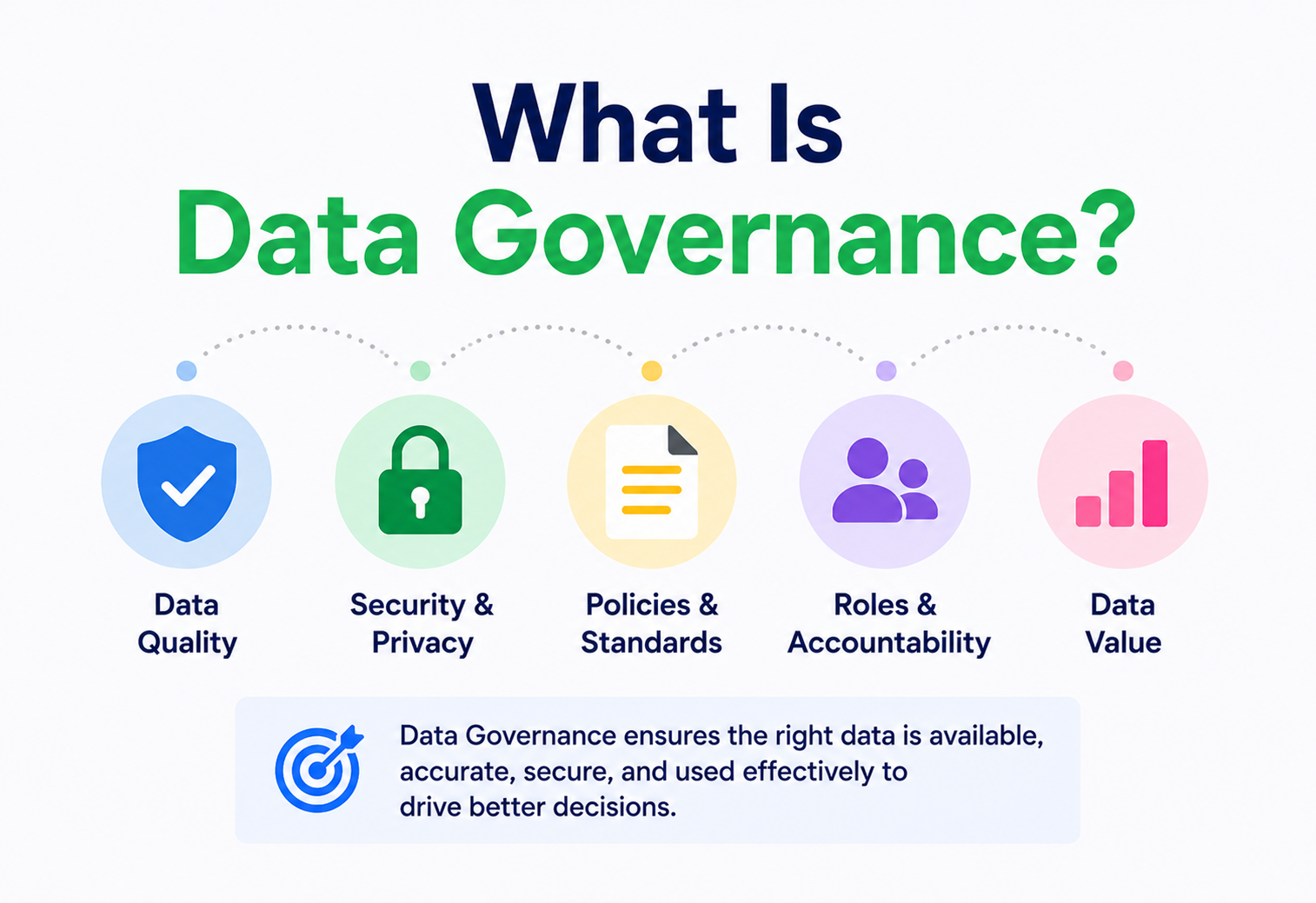
Data governance is the overall system of rules, roles, processes, and technology that an organization uses to make sure its data is accurate, secure, consistent, and used responsibly throughout its entire life — from the moment it is created to the moment it is deleted.
It is not a single tool you install. It is not a single team’s job either. It is a combination of four things working together:
- People — who owns which data, who is accountable when something goes wrong.
- Policies — written rules about quality, access, retention, and privacy.
- Processes — the repeatable steps used to classify, approve, and monitor data.
- Technology — catalogs, lineage trackers, access-control systems, and quality-monitoring tools.
1.2 · A short history
Data governance did not appear overnight. It evolved as the amount and importance of digital data exploded, and each major turning point added a new layer to the discipline.
| Era | What happened | Why governance mattered |
|---|---|---|
| 1970s–1980s | Relational databases (like IBM’s System R and later Oracle) became common in businesses. | Companies needed basic rules for who could read/write specific tables. |
| 1990s | Data warehousing emerged (Bill Inmon, Ralph Kimball) to combine data from many systems for reporting. | Combining data from many sources exposed inconsistencies — the same customer had three different addresses in three systems. |
| 2002 | The Sarbanes-Oxley Act (SOX) was passed in the US after major accounting scandals (Enron, WorldCom). | Companies were legally required to prove their financial data was accurate and traceable — this pushed “governance” into a formal discipline. |
| 2010s | Big data platforms (Hadoop, Spark) let companies store almost unlimited raw data cheaply. | Without governance, this became “data swamps” — huge lakes of data nobody could trust or find. |
| 2018 | The European Union’s GDPR (General Data Protection Regulation) took effect. | Companies had to know exactly what personal data they held, where it lived, and be able to delete it on request — governance became a legal necessity, not a nice-to-have. |
| 2020s | Cloud data platforms, data mesh architecture, and AI/ML models trained on company data became mainstream. | Governance now also covers AI model inputs, data products owned by decentralized teams, and automated policy enforcement. |
Today, data governance sits at the intersection of law, engineering, and business strategy. A software architect who understands it well is far more valuable, because almost every serious system eventually needs to answer governance questions: Who owns this table? Can this field be logged? Can this dataset train a machine learning model? Data governance turns those informal questions into an engineered, auditable system.
Problem & Motivation
What actually goes wrong without governance — and why the pain shows up as real, measurable cost.
Let’s understand why data governance became necessary by looking at what happens without it. Picture a mid-sized company, “BrightCart,” an online retailer.
Problem 1 — Duplicate truth
The marketing team’s database says BrightCart has 2.3 million customers. The finance team’s spreadsheet says 1.9 million. Nobody knows which number is correct because both teams pulled from different, unsynced exports.
Problem 2 — No ownership
A critical customer_status field starts returning wrong values. Three different teams touch that table. Nobody is officially responsible, so the bug survives for six months.
Problem 3 — Accidental exposure
An intern building a sales dashboard accidentally gets read access to a table containing customer credit-card tokens, because access control was “give everyone broad access, it’s easier.”
Problem 4 — Legal risk
A customer in Germany asks BrightCart to delete all their personal data (a legal right under GDPR). Nobody can say for certain where all copies of that customer’s data live — some are in backups, some in a marketing tool, some in a data scientist’s personal CSV file.
None of these problems are about “bad people.” They are about the absence of a system. Data governance exists to solve exactly these four categories of pain:
- Trust — can people rely on the numbers to make decisions?
- Accountability — is there a named owner for every important dataset?
- Access control — is sensitive data only visible to people who are supposed to see it?
- Compliance — can the company prove, to a regulator or a court, exactly what data it has and what it did with it?
Why this matters to engineers
Data governance is often treated as a “compliance team problem,” but in practice it is deeply architectural. Deciding how a schema is designed, how a table is tagged, how an event is logged, and how a service authenticates data access — these are all engineering decisions that either support or undermine governance. A software architect who ignores governance ends up building systems that have to be re-engineered later at huge cost.
2.1 · The real cost of poor governance
These problems are not just theoretical annoyances — they show up as real, measurable costs across an organization:
- Wasted engineering time. Studies of data teams consistently find that engineers and analysts spend a large share of their week just hunting for the right dataset or double-checking whether numbers are trustworthy, time that could have gone into building new features.
- Bad business decisions. If a company’s leadership makes a pricing or inventory decision based on a number that turns out to be wrong, the financial impact can be far larger than the cost of the governance program that would have prevented it.
- Regulatory fines. GDPR fines alone have reached hundreds of millions of euros for individual companies that mishandled personal data or couldn’t demonstrate proper controls.
- Reputational damage. A publicized data breach or privacy failure can damage customer trust for years, well beyond the direct financial penalty.
Seen this way, data governance isn’t overhead bolted onto “real” engineering work — it’s risk management and quality assurance applied to one of a company’s most valuable assets: its data.
Core Concepts
The shared vocabulary of governance — explained the way you’d explain it to a smart ten-year-old, then connected to real engineering.
Before we look at architecture, we need a shared vocabulary. Below are the building-block concepts of data governance, each explained the way you’d explain it to a smart 10-year-old, and then connected to real engineering practice.
3.1 · Data ownership & stewardship
Data owner: the person (usually a business leader) who is ultimately accountable for a dataset — its accuracy, its proper use, and its protection. Think of the owner as the “principal” of a school: responsible for everything happening inside, even if they don’t personally teach every class.
Data steward: the person who does the day-to-day work of maintaining data quality, fixing definitions, and answering “what does this column mean?” questions. If the owner is the principal, the steward is the head teacher who actually manages the classroom rules.
Simple analogy
In a housing society, the “owner” of the community garden is the resident’s welfare association — they’re accountable if it’s neglected. The “steward” is the gardener who waters the plants every day and knows exactly which flower bed is which. Data works the same way: someone is accountable (owner), someone does the hands-on care (steward).
3.2 · Metadata
Metadata is “data about data.” It doesn’t contain the actual information — it describes it. A library catalogue card is metadata: it tells you the book’s title, author, and shelf location, without containing the book’s actual text.
In software terms, metadata for a database table might include: table name, column names, column data types, who created it, when it was last updated, and a plain-English description of what each column means.
3.3 · Data catalog
A data catalog is a searchable inventory of all the datasets an organization has, along with their metadata. It’s Google Search, but for your company’s internal tables, files, and dashboards. Popular tools include Collibra, Alation, and open-source options like DataHub and Apache Atlas.
3.4 · Data lineage
Data lineage traces where a piece of data came from and everywhere it has traveled — which source systems fed it, which transformations touched it, and which reports or models consume it. It’s like a family tree, but for data: “this revenue number in the CEO’s dashboard originated from the orders table, was joined with the refunds table, and aggregated by a nightly Spark job.”
3.5 · Data quality
Data quality measures whether data is fit for its purpose, usually judged across six dimensions:
| Dimension | Meaning | Example failure |
|---|---|---|
| Accuracy | Does the data reflect reality? | A customer’s age is recorded as 200. |
| Completeness | Is required data missing? | 30% of orders have no shipping address. |
| Consistency | Does the same fact match across systems? | Customer’s name is “Raj Kumar” in one system, “R. Kumar” in another. |
| Timeliness | Is data updated when it should be? | Inventory count hasn’t refreshed in 3 days. |
| Uniqueness | Is the same real-world entity duplicated? | Same customer has 4 different customer IDs. |
| Validity | Does data conform to defined formats/rules? | Email field contains “not-an-email”. |
3.6 · Data classification & sensitivity levels
Not all data is equally risky. Data classification sorts data into tiers based on sensitivity, so protection effort is spent where it matters most.
| Tier | Example | Typical control |
|---|---|---|
| Public | Marketing blog content | No restriction |
| Internal | Internal sales targets | Employee login required |
| Confidential | Salary data, contracts | Role-based access, approval needed |
| Restricted / PII | Social security numbers, health records, card numbers | Encryption, strict access logging, masking |
3.7 · Master data management (MDM)
MDM is the discipline of creating a single, trusted, “golden record” for core business entities — like customer, product, or supplier — so that every system in the company refers to the same definitive version, instead of scattered, conflicting copies.
3.8 · Policies, standards, and data contracts
A policy is a rule (“PII must never leave the EU region”). A standard is a technical specification for meeting policies (“all timestamps must be stored in UTC ISO-8601 format”). A modern addition is the data contract: a formal, machine-checkable agreement between the team producing data and the teams consuming it, specifying schema, quality guarantees, and update frequency — much like an API contract, but for data.
Beginner tip
If you remember nothing else from this section, remember this chain: Ownership tells you who is responsible. Metadata and catalogs tell you what exists. Lineage tells you where it came from. Quality rules tell you if you can trust it. Classification and policy tell you how carefully to protect it.
3.9 · Data governance vs. related disciplines
People often confuse data governance with three neighboring fields. Understanding the boundary between them makes it much easier to know which team should own which decision.
| Discipline | Core question it answers | Example decision |
|---|---|---|
| Data Governance | Who is accountable, and what are the rules? | “Only the Finance team can approve access to revenue tables.” |
| Data Management | How is data stored, moved, and processed? | “We’ll use a columnar warehouse and nightly ELT jobs.” |
| Data Security | How is data protected from unauthorized access or attack? | “Encrypt this table with AES-256 and rotate keys every 90 days.” |
| Data Architecture | How are systems structured to store and connect data? | “Use a data mesh with domain-owned data products.” |
In practice, these four disciplines overlap heavily and depend on each other. A good governance policy is meaningless if the underlying architecture can’t technically enforce it, and a beautifully engineered platform without governance quickly turns into the messy library from the very first paragraph of this guide.
3.10 · Data governance maturity levels
Organizations don’t jump straight from chaos to a fully automated federated governance model. Maturity typically develops in stages:
| Level | Characteristics |
|---|---|
| 0 — Ad hoc | No catalog, no defined owners, tribal knowledge lives in people’s heads and Slack threads. |
| 1 — Reactive | Governance activity happens only after an incident (a breach, a bad report to the board). |
| 2 — Defined | Written policies exist; a catalog tool is deployed; ownership is assigned for critical datasets. |
| 3 — Managed | Quality and access checks are automated; metrics are tracked on dashboards; policy violations trigger alerts. |
| 4 — Optimized / Federated | Governance is embedded in engineering workflows (policy-as-code, shift-left checks); domain teams self-serve within central guardrails. |
Most large enterprises today sit somewhere between Level 2 and Level 3, actively working toward Level 4. Knowing which level your organization is at helps you propose realistic next steps instead of jumping straight to an ambitious federated model that the culture and tooling aren’t ready to support.
Architecture & Components
Data governance is a layer of capability that runs across the entire data platform — not a single application.
Data governance isn’t implemented by a single application — it’s implemented as a layer of capability that sits across an organization’s entire data platform. Below is a reference architecture typical of a modern (2025–2026) cloud-based data platform.
4.1 · Metadata store & data catalog
This is the “brain” of governance. It stores metadata about every table, file, dashboard, and pipeline: names, descriptions, owners, sensitivity tags, and freshness. Engineers and analysts search this catalog the same way they’d search Google, instead of asking around in Slack “does anyone know what this column means?”
4.2 · Lineage tracker
This component automatically (or semi-automatically) records how data flows: source table → transformation job → destination table → dashboard. It’s usually built by parsing SQL queries, pipeline configuration (like Airflow DAGs or dbt models), and job logs.
4.3 · Policy & access control engine
This enforces “who can do what.” It typically implements Role-Based Access Control (RBAC) (permissions tied to job roles) or the more granular Attribute-Based Access Control (ABAC) (permissions computed dynamically from attributes like user department, data sensitivity, and even time of day).
4.4 · Data quality monitor
This runs automated checks (completeness, format validity, freshness, anomaly detection) against datasets, similar to unit tests but for data instead of code. Tools like Great Expectations, dbt tests, or Monte Carlo are common here.
4.5 · Classification & tagging engine
This scans data (often using pattern matching or machine learning) to automatically detect sensitive fields — like credit card numbers or emails — and tags them, so downstream policy engines know to protect them.
4.6 · The governance council / operating model
Technology alone doesn’t create governance — an organizational structure does. Most mature companies run a lightweight governance council: a small cross-functional group (legal, security, data engineering, business owners) that sets policy, resolves disputes about ownership, and reviews major changes.
Data owner
Business-accountable person for a domain (e.g., VP of Sales owns customer data).
Data steward
Hands-on caretaker who fixes definitions and quality issues day to day.
Governance council
Cross-functional group setting and reviewing policy.
Platform / data engineering
Builds the catalog, lineage, and enforcement tooling.
Data Flow & Lifecycle
Every piece of data has a life — and governance applies different rules at every stage.
Every piece of data goes through a lifecycle, and governance applies different rules at each stage — just like a food product goes through growing, packaging, selling, and eventual expiry, with safety rules at each step.
| Stage | What happens | Governance activity |
|---|---|---|
| Create / Capture | Data enters the system — a user signs up, a sensor sends a reading, an order is placed. | Define schema, assign an owning system, validate format at entry point. |
| Classify & Tag | The data is inspected for sensitivity (Is it PII? Financial? Public?). | Auto-classification tools tag fields; owners confirm tags. |
| Store | Data lands in a database, warehouse, or lake. | Encryption at rest, retention policy assignment, access control lists set up. |
| Process / Transform | ETL/ELT jobs clean, join, and aggregate data. | Lineage capture, quality tests run at each transformation step. |
| Use / Consume | Analysts query it, dashboards display it, ML models train on it. | Access approvals, masking of sensitive fields, usage logging/audit trail. |
| Archive | Data becomes cold — rarely accessed but still needed for compliance. | Move to cheap cold storage, apply legal hold flags if under investigation. |
| Delete / Purge | Data reaches end of its retention period, or a user requests erasure. | Verified, logged deletion across all copies including backups. |
Why “delete” is surprisingly hard
A user asking to delete their data sounds simple, but in a real distributed system their data might exist in: the primary database, three read replicas, a nightly backup, a data warehouse copy, a search index, a cache, an analytics event stream, and a third-party email tool. Good governance architecture designs deletion (sometimes called the “right to erasure workflow”) as a first-class system capability, not an afterthought.
5.1 · A practical Java example: tagging data at ingestion
Here’s a simplified example showing how an ingestion service might attach classification metadata the moment a record is created — putting governance directly into the data pipeline instead of treating it as a separate, later process.
public class CustomerRecord {
    private String customerId;
    private String email;      // classified as PII
    private String country;
    private Instant createdAt;

    // Metadata attached at creation time, not bolted on later
    public static final Map<String, String> FIELD_CLASSIFICATION = Map.of(
        "email", "PII_RESTRICTED",
        "customerId", "INTERNAL",
        "country", "INTERNAL"
    );
}

public class DataIngestionService {

    private final GovernanceTagger tagger;
    private final AuditLogger auditLogger;

    public void ingest(CustomerRecord record, String sourceSystem) {
        // 1. Attach classification tags based on field-level rules
        Map<String, String> tags = tagger.classify(record);

        // 2. Record lineage: where did this record come from?
        LineageEvent lineage = new LineageEvent(
            sourceSystem, "customer_records_table", Instant.now()
        );

        // 3. Persist record + tags + lineage together
        repository.save(record, tags);
        lineageStore.record(lineage);

        // 4. Emit an audit trail entry for compliance
        auditLogger.log("INGEST", record.getCustomerId(), sourceSystem);
    }
}
This short example shows the key idea: governance is not a separate batch job that runs “sometime later.” Classification and lineage capture happen inline, as part of the same code path that writes the data — this is what “governance built into the architecture” looks like in practice.
Advantages, Disadvantages & Trade-offs
The honest two sides of investing in a governance program.
Advantages
- Trustworthy decisions — leaders make decisions on numbers everyone agrees are correct.
- Reduced legal risk — the company can prove compliance with laws like GDPR, HIPAA, and CCPA.
- Faster onboarding — new engineers and analysts find and understand data quickly via the catalog, instead of asking around for weeks.
- Better AI/ML outcomes — models trained on well-governed, well-labeled data perform more reliably and are easier to audit for bias.
- Reduced duplicate work — teams stop rebuilding the same dataset because they can’t find the existing one.
Disadvantages / Costs
- Slower initial velocity — adding classification, approval, and documentation steps takes real engineering time.
- Tooling and headcount cost — catalog and lineage platforms, plus data stewards, are not free.
- Risk of over-governance — excessive approval layers can turn into bureaucracy that frustrates engineers and slows innovation.
- Cultural resistance — teams used to “just grab the data” often resist new access request processes.
6.1 · Key trade-offs
| Trade-off | Too little governance | Too much governance |
|---|---|---|
| Speed vs. control | Teams move fast but produce untrustworthy, risky data. | Every dataset needs three approvals; engineers work around the system. |
| Centralization vs. autonomy | No consistency; every team invents its own rules. | A central team becomes a bottleneck for every data change. |
| Automation vs. human review | Sensitive data slips through unnoticed. | Manual review queues pile up and delay everything. |
Architectural guidance
The best modern approach (seen in “data mesh” style architectures at companies like Netflix and Spotify) is federated governance: a small central team defines global, non-negotiable policies (security, legal, privacy), while individual domain teams own their own data quality and cataloging — enforced through automated tooling rather than manual committee review. This balances speed with control.
Scalability & Performance
Ten tables becomes one hundred thousand — and manual governance stops working long before that.
As an organization grows from 10 tables to 100,000 tables, governance approaches that worked at a small scale break down. Here’s what changes and how architecture must adapt.
7.1 · The manual approach doesn’t scale
At a startup, one engineer can remember what every table means. At a company with thousands of tables and hundreds of pipelines, human memory fails completely. This is why automated metadata harvesting is essential at scale — tools that automatically scan schemas, sample data, and infer classification, instead of relying on someone to manually fill out a spreadsheet.
7.2 · Automated classification at scale
Modern platforms use pattern matching (regular expressions for emails, card numbers) combined with machine learning classifiers to scan petabytes of data and flag sensitive fields automatically. This is far faster and more consistent than manual tagging, though it requires human review of edge cases to avoid false positives/negatives.
7.3 · Decentralized ownership (data mesh)
A single central “data governance team” becomes a bottleneck once an organization has hundreds of data-producing teams. The data mesh approach, introduced by Zhamak Dehghani around 2019, solves this by treating data as a product owned by the team that produces it, governed under shared platform standards rather than centralized manual review.
7.4 · Performance considerations
Governance controls (like row-level masking or access checks) must not introduce unacceptable query latency. Common performance techniques include:
- Caching access decisions — instead of re-evaluating a user’s permissions on every single row, permission decisions are cached briefly.
- Pre-computed masked views — creating a masked version of a sensitive table upfront, rather than masking on every read.
- Metadata indexing — catalogs use search-optimized indexes (similar to Elasticsearch) so searching across millions of assets stays fast.
- Sampling for quality checks — instead of validating every single row in a 5-billion-row table on every run, quality tools often sample statistically, trading a small amount of precision for a big performance gain.
7.5 · CAP theorem and governance metadata stores
The catalog and policy engine are themselves distributed systems, so they’re bound by the same laws as any other distributed database — most notably the CAP theorem, which states that during a network partition, a distributed system must choose between Consistency (every node sees the same data) and Availability (every request gets a response, even if some nodes can’t communicate).
For a policy engine deciding “can this user access this data right now,” the safer choice is usually to favor consistency — it’s better to briefly deny access (or serve a slightly stale but conservative decision) than to risk granting access based on outdated permissions during a network split. For the catalog’s search and browse functionality, however, favoring availability is usually fine — showing a slightly stale table description to someone browsing the catalog is a low-risk trade-off.
7.6 · Replication, partitioning & consensus
To handle scale and stay available, catalog and policy stores use the same core distributed-systems techniques used elsewhere in engineering:
- Replication — the metadata store keeps multiple copies of data across different nodes (and often different data centers), so a single node failure doesn’t take down the whole system. Leader-follower replication is common, where writes go to a leader and are copied to followers.
- Partitioning (sharding) — as the catalog grows to millions of assets, data is split across multiple nodes by key (for example, by business domain or region), so no single machine becomes a bottleneck.
- Consensus protocols — when multiple replicas need to agree on the current, authoritative version of a policy (for example, “has this access-control rule been updated yet?”), consensus algorithms like Raft or Paxos ensure all nodes agree on the same sequence of changes, even if some nodes are slow or temporarily unreachable.
Simple analogy
Imagine three security guards at three different gates of the same building, all needing to agree on today’s guest list. If a phone line between two guards goes down, they must decide: keep letting people in based on possibly outdated lists (availability), or stop admitting anyone until they can re-sync the list (consistency). For something as sensitive as “who is allowed to see confidential salary data,” most companies choose to pause rather than risk letting the wrong person in.
High Availability & Reliability
If the governance layer goes down, does the platform fail open or fail closed?
The governance layer itself (catalog, policy engine, lineage store) must be reliable — if the access-control engine goes down, does data access fail open (everyone gets in — dangerous) or fail closed (nobody gets in — safe but disruptive)? Well-designed governance systems almost always fail closed for security decisions but design for high uptime so this rarely happens.
8.1 · Replication of metadata & policy stores
Just like any critical production database, the metadata catalog and policy engine are typically deployed with multi-node replication and automated failover, following the same principles used for any highly available service: multiple replicas, health checks, and leader election (commonly via consensus protocols like Raft).
8.2 · Disaster recovery for governance metadata
Losing the metadata catalog is almost as damaging as losing the data itself — without it, nobody knows what data exists or who owns it. DR plans for governance platforms typically include:
- Regular automated backups of metadata stores with tested restore procedures.
- Cross-region replication for the catalog and policy engine.
- A defined Recovery Time Objective (RTO) and Recovery Point Objective (RPO), just like any Tier-1 production system.
Common mistake
Many companies invest heavily in protecting their production databases with backups and replicas, but treat the governance/catalog system as a “nice to have” side tool with no DR plan. When it goes down, engineers lose the ability to know what’s safe to query, and incident response slows dramatically.
Security & Compliance
The highest-stakes, most visible part of governance — from access-control models to anonymization.
Security is arguably the most visible, highest-stakes part of data governance. This section covers the core mechanisms and the major regulations that shape them.
9.1 · Access control models
| Model | How it works | Example |
|---|---|---|
| RBAC (Role-Based) | Permissions attached to a job role. | “Sales Analyst” role can read the sales table but not the payroll table. |
| ABAC (Attribute-Based) | Permissions computed dynamically from user, data, and context attributes. | “Allow read if user.department == data.owning_department AND time is business hours.” |
| Row-Level Security | Restricts which rows a user can see within the same table. | Regional manager sees only rows for their region. |
| Column-Level Masking | Hides or obfuscates specific sensitive columns. | Customer support agent sees “XXXX-XXXX-XXXX-1234” instead of the full card number. |
9.2 · Encryption
Two layers matter: encryption at rest (data is encrypted while stored on disk, so a stolen hard drive is useless) and encryption in transit (data is encrypted while traveling over the network, typically via TLS, so it can’t be intercepted). Well-governed platforms also use tokenization for highly sensitive fields like card numbers — replacing the real value with a reference token that’s meaningless outside the secure vault that issued it.
9.3 · Auditability
Every access to sensitive data should generate an immutable audit log entry: who accessed what, when, and why. This is essential both for detecting misuse and for proving compliance during an audit.
9.4 · Major regulations every engineer should know
| Regulation | Region | Core requirement |
|---|---|---|
| GDPR | European Union | Users can request access to, correction of, or deletion of their personal data; companies must report breaches within 72 hours. |
| CCPA / CPRA | California, USA | Similar rights to GDPR — consumers can request their data be deleted or not sold. |
| HIPAA | USA (healthcare) | Strict controls on Protected Health Information (PHI); breach notification required. |
| SOX | USA (public companies) | Financial data must be accurate, controlled, and auditable. |
| India’s DPDP Act (2023) | India | Consent-based processing of personal data, with rights to access and erasure similar to GDPR. |
9.5 · A simple Java access-control example
public class AccessDecisionEngine {

    public boolean canAccess(User user, DataAsset asset, String action) {
        // 1. Deny by default -- fail closed
        if (asset.getSensitivity() == Sensitivity.RESTRICTED
                && !user.hasRole("DATA_ADMIN")) {
            auditLogger.logDenied(user, asset, action);
            return false;
        }

        // 2. Attribute-based check: same department + business hours
        boolean sameDepartment = user.getDepartment()
                .equals(asset.getOwningDepartment());
        boolean withinHours = BusinessHours.isNow();

        boolean allowed = sameDepartment && withinHours;

        // 3. Always log the decision for audit trail
        if (allowed) {
            auditLogger.logGranted(user, asset, action);
        } else {
            auditLogger.logDenied(user, asset, action);
        }
        return allowed;
    }
}
Notice the “deny by default” pattern in step 1 — this is the fail-closed principle mentioned earlier. If nothing explicitly grants access, the system assumes no.
9.6 · Concurrency and audit log integrity
Audit logs are frequently written from many concurrent requests at once — hundreds of users querying sensitive tables simultaneously. Two engineering concerns matter here:
- Write ordering and atomicity — audit entries must be written as atomic, ordered events (typically append-only, using techniques similar to write-ahead logs in databases) so that concurrent writes from different threads or services never interleave into corrupted or incomplete records.
- Immutability — once written, an audit record should never be editable, even by administrators. This is usually enforced with append-only storage (such as object storage with write-once-read-many locks, or blockchain-inspired hash chaining) so that tampering is detectable.
A useful mental model: audit logging in a governance system should behave like a black box flight recorder on an airplane — every event is captured in order, nothing can be quietly deleted, and it must survive even if the rest of the system crashes.
9.7 · Data anonymization techniques
Beyond masking and tokenization mentioned earlier, governance programs commonly use these anonymization techniques for analytics and machine learning use cases:
| Technique | What it does | Example |
|---|---|---|
| Pseudonymization | Replaces identifying fields with a consistent fake identifier, but a mapping back to the real identity still exists somewhere secure. | “John Smith” becomes “USER_88213” everywhere in analytics, with the real name kept in a locked vault. |
| Generalization | Reduces precision so individuals can’t be singled out. | Exact birthdate becomes just “born in the 1990s.” |
| K-anonymity | Ensures each combination of attributes matches at least K people, so no individual is uniquely identifiable. | A dataset ensures at least 5 people share the same age, city, and job title combination. |
| Differential Privacy | Adds carefully calibrated statistical noise to query results, so individual records can’t be reverse-engineered, while aggregate trends remain accurate. | Apple and Google use this in some telemetry collection to protect individual user data. |
Monitoring, Logging & Metrics
You can’t govern what you can’t measure.
You can’t govern what you can’t measure. Mature data governance programs track specific, quantifiable metrics, not just “vibes.”
10.1 · Key data quality metrics
- Completeness rate — percentage of required fields that are non-null.
- Freshness / staleness — how far behind real-time is a dataset (e.g., “last updated 4 hours ago”).
- Schema drift events — number of times a table’s structure changed unexpectedly.
- Anomaly count — statistical outliers flagged (e.g., row count suddenly dropped 80%).
- Duplicate rate — percentage of records identified as duplicates of another record.
10.2 · Governance program metrics
- Catalog coverage — percentage of production datasets that have an assigned owner and description.
- Classification coverage — percentage of tables that have been scanned and tagged for sensitivity.
- Access request turnaround time — how long it takes to approve/reject a data access request.
- Policy violation count — number of detected breaches of governance rules (e.g., PII found in an unencrypted bucket).
10.3 · Alerting & observability tools
Modern “data observability” platforms (Monte Carlo, Bigeye, Metaplane) apply the same philosophy as application observability (think Datadog or New Relic, but for data): continuous monitoring, automatic anomaly detection using statistical baselines, and alerting integrated into tools engineers already use, like Slack and PagerDuty.
Deployment, Cloud & Tooling
Where data lives shapes how governance is implemented — the 2026 tooling landscape.
Data governance is implemented differently depending on where an organization’s data lives. Here’s an overview of the modern tooling landscape as of 2026.
| Category | Tools | Purpose |
|---|---|---|
| Data catalog | Collibra, Alation, Atlan, Microsoft Purview, open-source DataHub | Central searchable inventory with ownership and descriptions. |
| Cloud-native governance | AWS Lake Formation & Glue Data Catalog, Google Cloud Dataplex, Azure Purview | Native governance tightly integrated with each cloud’s storage and compute services. |
| Data quality | Great Expectations, dbt tests, Monte Carlo, Soda | Automated validation and anomaly detection. |
| Access control / policy | Apache Ranger, Immuta, AWS Lake Formation permissions | Fine-grained, centrally managed access enforcement. |
| Lineage | OpenLineage, Marquez, native lineage in dbt/Airflow | Tracking data flow across pipelines. |
11.1 · Cloud-native governance pattern
On AWS, for instance, a common pattern is: data lands in Amazon S3, gets cataloged automatically by AWS Glue Crawlers, access is controlled centrally through AWS Lake Formation permissions (instead of scattered per-bucket IAM policies), and lineage is captured through Glue job metadata. This “cloud-native governance” approach means governance rules are enforced by the platform itself rather than by each team building their own custom checks.
11.2 · Governance as code
A significant modern shift is treating governance policies as version-controlled code (similar to Infrastructure as Code with Terraform), rather than settings clicked manually in a UI. Policies are written in files, reviewed via pull requests, tested in CI, and deployed automatically — bringing software engineering discipline to governance itself.
-- Example: a data contract defined as code (YAML), checked in CI
dataset: orders.customer_orders
owner: team-orders@company.com
schema:
  - name: order_id
    type: string
    nullable: false
  - name: customer_email
    type: string
    classification: PII_RESTRICTED
    nullable: false
quality_checks:
  - completeness: order_id >= 99.9%
  - freshness: max_delay_minutes = 30
retention_days: 2555   # 7 years, per finance policy
This file lives in the same repository as the pipeline code, gets reviewed like any code change, and is automatically validated in the CI pipeline before deployment — governance becomes part of the engineering workflow rather than a separate manual process.
APIs, Microservices & Databases
Data isn’t in one big database anymore — and governance must follow it.
In a microservices world, data governance gets more complex because data isn’t in one big database anymore — it’s scattered across dozens or hundreds of independently owned services.
12.1 · Database-per-service and governance
The common microservices pattern of “each service owns its own database” is great for team autonomy, but it multiplies the number of places governance must be applied. Each service team effectively becomes a data owner and must independently classify, protect, and document its own data — which is exactly why the data mesh / federated governance model (covered in Section 7) became popular alongside microservices architecture.
12.2 · Governance at the API layer
APIs are often the best enforcement point for governance, because they are a natural chokepoint through which all external data access flows. Good practice includes:
- API gateways that enforce field-level masking based on caller identity (e.g., an internal analytics service gets full data; a partner API gets masked data).
- Schema registries (like Confluent Schema Registry for Kafka events) that enforce data contracts on every message, rejecting malformed or non-compliant events before they spread.
- Rate limiting and access logging built into the gateway, generating the audit trail automatically.
12.3 · Databases & caching considerations
Governance rules must extend to caches too — a common gap. If a customer’s PII is masked in the database but cached unmasked in Redis for performance, the masking is effectively bypassed. Well-governed systems apply classification tags consistently across the primary database, replicas, caches, and search indexes, not just the “main” data store.
Design Patterns & Anti-Patterns
The good habits that scale — and the traps that quietly kill governance programs.
13.1 · Design patterns
Golden record
Maintain one authoritative, deduplicated version of each core entity (customer, product) that all systems reference, resolving conflicts through defined merge rules.
Policy-as-code
Define access and quality rules in version-controlled files, tested and deployed like application code.
Shift-left governance
Apply classification and quality checks at data creation time (in the application code), rather than after data has already spread across the company.
Data contract
Producers and consumers of a dataset agree on an explicit, machine-checked schema and quality guarantee, similar to an API contract.
Federated governance
Central team sets non-negotiable global policy; domain teams own day-to-day data quality and cataloging within those guardrails.
13.2 · Anti-patterns to avoid
The data swamp
Dumping raw data into a data lake with no catalog, no ownership, and no classification — turning a valuable lake into an unusable swamp nobody trusts.
Governance theater
Writing beautiful policy documents that nobody actually enforces technically — governance that exists on paper but not in the running system.
Bottleneck committee
Requiring every single data change to go through a slow, manual central committee, creating a queue that pushes teams to bypass governance entirely.
Tag-and-forget
Classifying data once at creation but never re-scanning as schemas evolve, leaving new sensitive fields untagged and unprotected.
Best Practices & Common Mistakes
Habits that keep a governance program alive — and the failures that quietly kill it.
14.1 · Best practices
- Start with the highest-risk data first. Don’t try to catalog everything on day one — classify and protect PII and financial data before anything else.
- Automate classification and quality checks. Manual tagging doesn’t scale past a few hundred tables.
- Make governance easy, not just mandatory. If requesting data access takes three weeks, people will find workarounds. Self-service tooling with fast automated approval for low-risk requests keeps people inside the system.
- Assign a named owner to every dataset. “Owned by the data team” is not an owner — pick an actual accountable person.
- Build governance into the pipeline, not after it. Shift-left: validate schemas and tag sensitivity as data is created, not months later.
- Treat policies as code. Version, review, and test governance rules the same way you do application code.
- Measure and report metrics regularly. Catalog coverage, quality scores, and access turnaround time should be visible dashboards, not one-time audits.
14.2 · Common mistakes
- Treating governance as a one-time project instead of an ongoing operating capability — data keeps changing, so governance must too.
- Over-restricting access “to be safe,” which pushes analysts to export data into unmanaged spreadsheets, actually increasing risk.
- Ignoring backups and caches when applying classification and retention rules, leaving sensitive data exposed in secondary copies.
- No executive sponsorship — without a senior leader championing governance, it loses budget and priority within a year.
- Buying a catalog tool and assuming the problem is solved — tools support governance; they don’t replace the people, policy, and process pieces.
14.3 · A practical 90-day roadmap for getting started
If you’re an architect or engineering lead asked to “improve our data governance” with no prior program in place, here’s a realistic phased approach rather than trying to boil the ocean:
| Phase | Focus | Typical output |
|---|---|---|
| Days 1–30 | Discovery | Inventory the highest-risk datasets (PII, financial, health data); identify current owners informally; pick a lightweight catalog tool. |
| Days 31–60 | Foundation | Assign formal owners and stewards for top-priority datasets; write down 5–10 non-negotiable policies (encryption, retention, access approval); automate classification scanning. |
| Days 61–90 | Automation & rollout | Wire quality checks and access controls into existing pipelines; publish the first governance metrics dashboard; run a training session so engineers know the new self-service workflow. |
This phased approach matters because governance programs that try to cover every dataset and every rule on day one almost always stall — teams get overwhelmed, executive patience runs out, and the program quietly dies. Starting narrow, on the highest-risk data, and proving value early is what makes governance programs survive their first year.
Real-World & Industry Examples
How the largest platforms actually run governance at petabyte scale.
NetflixPetabyte-scale self-serve platform
Operates a large-scale internal data platform with automated data discovery and lineage tools, enabling thousands of engineers to self-serve access to petabyte-scale datasets while maintaining strong classification of sensitive viewing and payment data.
UberDatabook — catalog for microservices
Built internal tools (including its well-known “Databook” metadata platform) to catalog datasets across its many microservices, helping engineers understand data ownership and lineage across a highly decentralized architecture.
JPMorgan ChaseRegulated financial lineage
As a heavily regulated financial institution, invests significantly in data lineage and access auditability to satisfy regulators (like SOX and Basel III reporting requirements), where every reported number must be traceable back to its source.
AmazonFine-grained lake access control
Uses fine-grained, automated access control (via services like AWS Lake Formation, which Amazon itself uses internally) to manage governance at massive scale across countless internal data lakes and warehouses.
A common thread across all of these companies: governance succeeded when it was built as self-service, automated infrastructure that engineers could use without slowing down, rather than a slow, manual approval bureaucracy layered on top of engineering.
Frequently Asked Questions
The questions that come up in every design review, every vendor evaluation, and every audit kickoff.
Is data governance the same as data management?
No. Data management is the broader discipline of handling data throughout its life (storage, integration, processing). Data governance is the subset focused specifically on rules, ownership, accountability, and control over how that data is used and protected. Think of data management as “running the kitchen,” and data governance as “the kitchen’s safety and hygiene rulebook.”
Is data governance the same as data security?
They overlap but aren’t identical. Data security focuses specifically on protecting data from unauthorized access, breaches, and attacks (encryption, firewalls, access control). Data governance is broader — it also covers data quality, ownership, and compliant use, of which security is one important pillar.
Do small startups need data governance?
Yes, but in a lightweight form. A five-person startup doesn’t need a governance council and a $200,000 catalog tool, but it absolutely benefits from simple practices: naming a clear owner for each core dataset, documenting what tables mean, and being deliberate about who has access to customer data from day one. It’s far cheaper to build these habits early than to retrofit them after the company has grown to hundreds of tables.
Who is typically responsible for data governance in a company?
Larger organizations often have a Chief Data Officer (CDO) or a dedicated data governance team, supported by data owners and stewards across business units, with technical enforcement built by data/platform engineering. In smaller companies, this responsibility is usually shared informally among engineering leadership and department heads.
How does data governance relate to AI and machine learning?
AI models are only as trustworthy as the data they’re trained on. Good governance ensures training data is accurately labeled, free of unintended bias where possible, properly licensed, and compliant with privacy law (for example, ensuring personal data isn’t used to train a model without proper consent). Governance also increasingly tracks “model lineage” — which datasets and versions trained which model — for auditability.
What’s the difference between a data catalog and a data dictionary?
A data dictionary is a simpler, often static document listing table and column definitions. A data catalog is a dynamic, searchable, often automated system that includes not just definitions but also ownership, lineage, quality scores, classification tags, and usage statistics — essentially a data dictionary that’s alive and constantly updated.
How is data governance different for structured vs. unstructured data?
Structured data (rows and columns in a database) is easier to classify and monitor because its shape is predictable — a script can reliably check “is this column an email address?” Unstructured data (documents, images, chat transcripts, audio) is harder to govern because sensitive information can be buried anywhere inside free-form text or media. This is why unstructured data governance increasingly relies on machine learning-based scanning — for example, natural language processing models that read through documents to detect embedded personal information, rather than simple pattern matching.
Can data governance slow down a fast-moving engineering team?
It can, if implemented poorly — for example, requiring a two-week manual approval for every new table. Implemented well, though, governance should feel closer to automated linting or CI checks: fast, automated, and mostly invisible for low-risk, everyday work, while adding friction only where the risk genuinely justifies it, such as access to highly sensitive data. The goal is to make the safe path the fast path.
Summary & Key Takeaways
Data governance as living infrastructure — not a slow manual approval process.
Data governance is the system of people, policies, processes, and technology that ensures an organization’s data is accurate, secure, well-understood, and used responsibly across its entire lifecycle. It grew out of real business pain: duplicate and conflicting numbers, unclear ownership, accidental data exposure, and legal requirements like GDPR. It’s implemented through a layered architecture of catalogs, lineage trackers, policy engines, and quality monitors — most effectively when treated as automated, self-service infrastructure rather than a slow manual approval process.
Key takeaways
- Data governance = people + policy + process + technology working together, not a single tool.
- Core concepts: ownership, stewardship, metadata, catalogs, lineage, quality, classification, and data contracts.
- Governance applies across the full data lifecycle: create, classify, store, process, use, archive, delete.
- At scale, manual governance fails — automated classification and federated (data mesh) ownership models are essential.
- Security and compliance (GDPR, HIPAA, SOX, CCPA, DPDP) are major drivers, but so is simple internal trust in data.
- Best practice: shift governance left into the pipeline and application code, treat policy as version-controlled code, and measure it with concrete metrics.
- Companies like Netflix, Uber, and Amazon succeed by making governance self-service and automated, not bureaucratic.
For a software architect or engineer, understanding data governance is no longer optional — it shapes schema design, API contracts, logging practices, and system boundaries. Systems designed with governance in mind from the start are dramatically cheaper to operate, safer to run, and easier to trust than those where governance is bolted on after the fact.