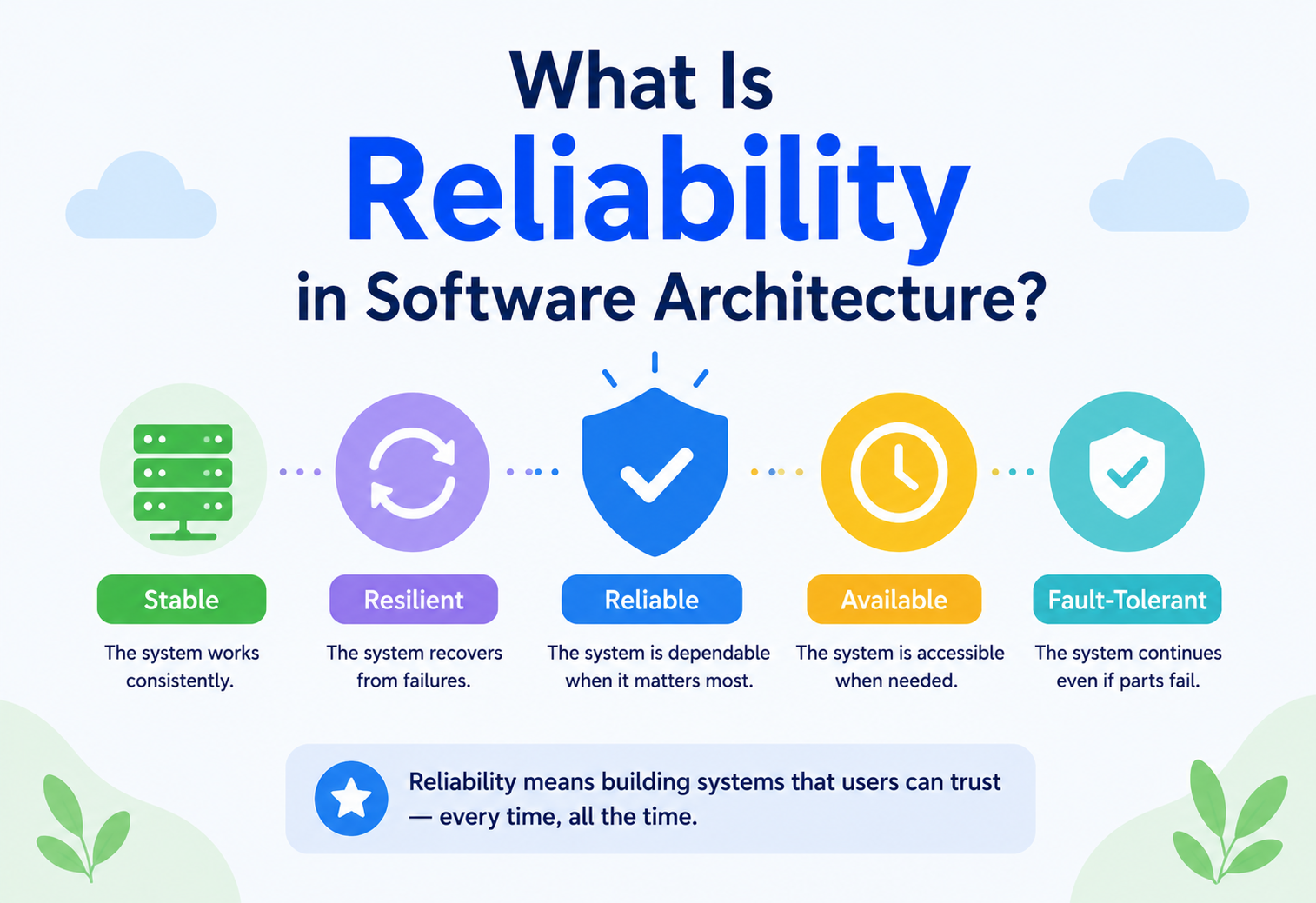
What Is Reliability in Software Architecture?
An app can be up and running, and still lie to you. It can respond instantly, and still get the answer wrong. Reliability is the quiet promise that when a system does respond, you can actually trust what it tells you.
The Big Idea, in One Breath
Reliability is the promise that a system keeps doing exactly what it’s supposed to do, correctly, every time — even on the days when a server crashes, a network hiccups, or ten times the usual number of people show up at once.
Think about a friend who always keeps their promises. If they say they’ll pick you up at 4 o’clock, they’re there at 4 o’clock — not just most of the time, but every time, rain or shine, even on the days when everything else in their life is going wrong. You trust them not because they’re never inconvenienced, but because they’ve shown, again and again, that they’ll do exactly what they said they would do.
That’s the essence of reliability in software. A reliable system is one that keeps doing exactly what it’s supposed to do, correctly, every single time — even on the days when a server crashes, a network hiccups, or ten times the usual number of people show up at once. It’s a slightly different promise than simply “being online.” A system can technically be online and still be unreliable, if it starts giving wrong answers, losing information, or behaving inconsistently the moment things get difficult.
Picture a bridge that’s crossed by thousands of cars every day. The bridge doesn’t need to be flashy or fast — it just needs to hold up exactly the way it’s supposed to, every single time a car drives across it, regardless of the weather, the number of cars, or how many years have passed since it was built. Reliable software is engineered with that same quiet, unglamorous determination: do the job correctly, every time, no exceptions.
What makes reliability such a fascinating engineering challenge is that it can’t simply be tested once and declared finished. A bridge engineer doesn’t build a bridge, drive one car across it, and call it proven — they calculate how it behaves under wind, under heavy trucks, under years of wear, and under the rare, unlucky combination of several problems happening at once. Reliable software is approached the exact same way: not “does it work right now?” but “will it keep working right, correctly, no matter what combination of bad luck shows up next month?”

What Reliability Really Is
Formally, reliability is the probability that a system will perform its intended function correctly, for a specified period of time, under stated conditions. That’s a mouthful, so let’s break it into the four ideas hiding inside it.
Right answers, not just any answer
The system must actually do what it claims to do — a login screen that lets in the wrong password isn’t reliable just because it responded quickly.
The same input, the same result
Given identical conditions, a reliable system behaves the same way every time, rather than occasionally producing a surprising or contradictory outcome.
Not just on a good day
Reliability isn’t proven in one lucky test run — it’s proven by holding up across weeks, months, and years of real, messy use.
Including the tough days
The true test of reliability is what happens when a dependency fails, traffic spikes, or something unexpected goes wrong nearby.
If someone asks “how reliable is this system?”, they’re really asking: “If I use this the exact same way tomorrow, next month, and next year, can I count on getting the correct result every single time?”
It’s worth noting that reliability is always defined relative to something specific — a stated function, under stated conditions, for a stated period. A calculator app is only expected to be reliable at doing arithmetic correctly; nobody judges its reliability by whether it can also send emails, because that was never its job in the first place. This might sound obvious, but it matters in practice, because teams sometimes stretch a system to handle situations it was never actually designed or tested for, and then act surprised when it behaves unreliably in exactly those unfamiliar conditions.
It’s tempting to think speed and features are what make software great. In practice, trust is the quiet foundation everything else is built on — and trust is earned almost entirely through reliability, one correct, predictable interaction at a time.
People stop double-checking
A reliable system earns the right to be believed. People stop screenshotting “just in case” and start trusting the number on the screen.
Wrong answers can be dangerous
In medical devices, financial systems, and industrial controls, an incorrect result can cause real harm — far worse than a slow one.
Mistakes are expensive to undo
Fixing bad data after it has already spread through a system, or been acted on by real people, often costs far more than preventing it in the first place.
Unreliability is remembered
Users forgive a slow app more easily than they forgive one that quietly gave them the wrong information, even once.
There’s a subtle but important distinction worth sitting with here: an unavailable system frustrates people, but an unreliable one can actively mislead them. A banking app that’s down for ten minutes is annoying. A banking app that’s up the whole time but occasionally shows the wrong balance is far more dangerous, precisely because nothing about the experience signals that something has gone wrong. The failure is invisible until real damage has already been done.
This is exactly why many experienced architects consider reliability the quieter, more demanding sibling of availability. Availability problems tend to announce themselves loudly — a page that won’t load, a spinning wheel that never stops. Reliability problems can hide in plain sight for a long time, wearing the appearance of a perfectly normal, working system, right up until someone notices that the numbers don’t add up, or that two people were somehow charged for the same order. Catching that kind of quiet failure requires far more deliberate effort than simply watching whether a server responds.
Reliability vs Its Close Cousins
Reliability sits inside a small family of related words that constantly get mixed up, even by experienced engineers. Sorting them out clearly makes the rest of this guide much easier to follow.
| Term | Core Question |
|---|---|
| Reliability | Does it produce the correct result, consistently, over time? |
| Availability | Is it reachable and responding right now? |
| Fault Tolerance | Can it keep working correctly even while a part of it is actively broken? |
| Resilience | Can it absorb a shock and recover its normal behaviour afterward? |
| Durability | Is stored data safe from being permanently lost? |
Fault tolerance and resilience are especially close relatives of reliability, and it helps to picture the difference using a small boat. Fault tolerance is the boat having enough separate, sealed compartments that punching one hole doesn’t sink it — the boat keeps floating, correctly, while damaged. Resilience is the crew’s ability to notice the leak, patch it, pump out the water, and get the boat back to full strength afterward. Reliability is the promise that, through all of it, the boat kept carrying its passengers safely the whole time.
Fault tolerance and redundancy are two of the main tools used to achieve reliability. Reliability itself is the outcome — the actual, measurable trustworthiness those tools produce.
It’s worth being precise about durability too, since it’s often lumped in with reliability without much thought. Durability is specifically about data surviving physically — not being lost even if a hard drive is destroyed. A system can be extremely durable, never losing a single stored record, while still being unreliable in how it processes that data, occasionally miscalculating a total or applying an update to the wrong account. Keeping these words distinct isn’t pedantry for its own sake — each one points toward a different set of engineering techniques, and confusing them can lead a team to solve the wrong problem entirely.

The Fault → Error → Failure Chain
To design reliable systems, it helps to understand exactly how things go wrong in the first place. Engineers describe this using three connected stages, and the distinction between them matters far more than it might first appear.
A fault is a hidden flaw sitting quietly inside a system — a bug in the code, a worn-out disk, a miscalculated edge case. On its own, a fault might sit there for months without causing any visible trouble. An error happens when that fault actually gets triggered and corrupts something inside the system’s internal state — a wrong number gets calculated, a value gets overwritten incorrectly. A failure is what happens when that internal error finally becomes visible to the outside world — the user sees the wrong balance, the app crashes, the report shows nonsense.
This chain matters because it reveals exactly where reliability engineering can intervene. A fault that’s caught and corrected before it ever becomes an error never has the chance to become a visible failure at all. This is precisely why techniques like input validation, defensive programming, and automated testing are so valuable — they’re not really about eliminating every fault (which is impossible), but about catching faults early, before they can travel any further down the chain toward the user.
A concrete example helps make this less abstract. Imagine a shopping app where a rare bug quietly miscounts stock whenever two people buy the exact same item within the same second — that’s the fault, sitting invisibly in the code, possibly for months. The moment two such purchases finally do happen together, the internal stock count silently becomes wrong — that’s the error, still invisible to anyone outside the system. Only when a third customer later tries to buy that same item, is told it’s in stock, and then discovers at checkout that it isn’t, does the problem finally become a failure the customer actually experiences. Tracing failures like this back to their original fault, rather than just patching the visible symptom, is what separates a durable fix from a temporary one.
Measuring Reliability
Just like availability has its “nines,” reliability has its own set of numbers engineers use to turn a vague feeling of trustworthiness into something concrete and trackable.
| Metric | What It Tells You |
|---|---|
| MTBF — Mean Time Between Failures | On average, how long does the system run correctly before something goes wrong? Higher is better. |
| Failure Rate | How many failures happen per unit of time or per number of requests — a direct, simple measure of how often things go wrong. |
| Defect Density | How many known bugs exist per thousand lines of code — a rough proxy for how much hidden risk is sitting inside the system. |
| Error Rate | The percentage of requests that return an incorrect or failed result out of all requests handled. |
| Mean Time To Detect (MTTD) | How long it typically takes to even notice something has gone wrong — a slow detection time means a fault can quietly cause damage for a long while before anyone reacts. |
These numbers work best together, not alone. A system with a low failure rate but a very slow detection time can still cause serious harm, simply because nobody realises anything is wrong until the damage has already spread. A mature reliability practice tracks the entire journey — how rarely things break, how quickly problems are noticed, and how completely the system recovers once they are.
Reliability metrics exist to answer one honest question: “if I use this system a thousand times, roughly how many of those times will it actually get things right?”
It’s worth adding one more measurement that often gets overlooked: Mean Time To Recovery, the average time it takes to fully fix a problem once it’s been detected. Together, detection time and recovery time describe the entire window during which a failure is quietly affecting real people — and shrinking that window, even without reducing how often failures happen in the first place, can dramatically improve how reliable a system actually feels to the people using it.

Technique: Redundancy and Fault Tolerance
The single most powerful idea in reliability engineering is refreshingly simple: don’t depend on any one thing behaving perfectly. Instead, build enough overlap and backup that one part being wrong doesn’t drag the whole system down with it.
This particular pattern — running the same calculation through several independently built components and trusting whichever answer the majority agree on — is used in some of the highest-stakes software in the world, including aircraft flight control systems, precisely because it protects against one component being subtly, silently wrong in a way that a simple backup server wouldn’t catch. If Calculator A makes a rare mistake, Calculators B and C most likely still agree with each other, and the system quietly ignores the odd one out.
More everyday systems use simpler, but related, versions of this idea — running the same service on multiple independent servers, storing the same data across multiple independent databases, or checking a critical calculation two different ways before trusting the result. The underlying principle stays the same: correctness that depends on exactly one thing going right, every single time, is fragile. Correctness that survives one part being wrong is genuinely reliable.
It’s worth being honest that redundancy isn’t free, and blindly adding more copies of something doesn’t automatically make a system more reliable. If every copy shares the exact same hidden bug, all of them will produce the exact same wrong answer at the exact same time, and the redundancy provides no real protection at all. Genuine reliability gains usually come from diverse redundancy — different implementations, different hardware, or different assumptions — precisely so that the same rare mistake is unlikely to strike every copy simultaneously.
Technique: Isolation and Graceful Degradation
Redundancy protects against one part failing outright. Isolation protects against one part’s failure spreading into parts that were otherwise perfectly healthy — a problem that’s arguably even more common, and easier to overlook.
This idea is often called the bulkhead pattern, borrowed directly from shipbuilding. Ships are divided into sealed compartments so that a hole in one section floods only that section, rather than sinking the entire vessel. Software borrows the same trick — giving each major feature its own dedicated resources, so a struggling search feature, for instance, can’t starve checkout and payments of the capacity they need to keep working correctly.
Closely related is graceful degradation — designing a system to intentionally offer a slightly reduced experience rather than a complete failure when something goes wrong. A video app that can’t fetch personalised recommendations right now might quietly fall back to showing trending videos instead of the personalised list, keeping the person watching something useful rather than staring at a broken screen. The core promise of reliability isn’t “nothing ever goes wrong” — it’s “even when something does go wrong, what you experience stays correct and sensible.”
Deciding what a system should fall back to, when its ideal path isn’t available, is itself a design decision worth making deliberately, well before an actual failure forces the issue. A thoughtful fallback preserves what matters most to the user, even if it quietly sacrifices something less essential — showing slightly outdated prices rather than none at all, for instance, or allowing someone to browse a catalogue even while the checkout system is briefly recovering. Systems that never planned for this moment tend to fail in the least helpful way possible: all or nothing, with no graceful middle ground.

Reliability Patterns Every Architect Uses
Beyond the big structural ideas, a handful of smaller, everyday patterns show up constantly in reliable systems, quietly doing a lot of the real work.
Retries with Backoff
When a request fails, instead of giving up immediately or hammering the same struggling service over and over, a reliable system waits a little longer each time before trying again — a pattern called exponential backoff. This gives a temporarily overwhelmed component breathing room to recover, rather than making its problem worse with a flood of impatient retries.
Timeouts
Waiting forever for a slow response isn’t patience — it’s a trap. A reliable system sets a clear limit on how long it will wait for another part to respond, and gives up gracefully once that limit passes, rather than getting stuck indefinitely and dragging everything waiting behind it down too.
Idempotency
An operation is idempotent if doing it once and doing it five times, by accident, produces exactly the same result. This matters enormously alongside retries — if a payment request is idempotent, safely retrying it after a network hiccup won’t accidentally charge someone’s card five times instead of once.
Circuit Breakers
When a dependency starts failing repeatedly, a circuit breaker temporarily stops sending it requests altogether, protecting both the struggling dependency and the rest of the system from wasting effort on calls that are very likely to fail anyway.

Health Checks and Self-Healing
Rather than waiting for a failure to be reported by a frustrated user, reliable systems constantly ask their own components a simple question — “are you still working correctly?” — many times a minute. A component that answers incorrectly, or doesn’t answer at all, can be automatically removed from service and replaced, often before a single real request is ever affected by it.
What These Patterns Buy You
- Failures stay contained instead of cascading
- Temporary hiccups resolve themselves automatically
- Users experience far fewer visible errors
What They Require
- Careful tuning — too aggressive a retry can make things worse
- Extra logic and testing effort
- Monitoring to know when these safety nets are actually triggering
Proving It: Testing for Reliability
A reliable system isn’t one that’s never been tested against failure — it’s one that’s been tested against failure constantly, on purpose, until the team has real evidence rather than just hope.
Unit and Integration Testing
Checks that individual pieces, and the connections between them, behave correctly under normal, everyday conditions.
Load Testing
Deliberately sends far more traffic than usual, to see whether correctness holds up when the system is under real pressure, not just when it’s calm.
Fault Injection
Deliberately breaks a dependency, delays a response, or corrupts a piece of data, purely to observe whether the rest of the system reacts safely.
Chaos Engineering
Runs controlled, real-world failure experiments against a live system, treating resilience as something to be proven repeatedly, not assumed.
This kind of testing can feel uncomfortable, because it means intentionally causing the very problems a team spends most of its time trying to prevent. But it’s precisely this discomfort that makes it valuable — a weakness discovered during a calm, planned Tuesday afternoon experiment is infinitely cheaper than the same weakness discovered during an actual, unplanned emergency at the worst possible moment.
A useful habit borrowed from mature reliability teams is keeping a running list of “known unknowns” — situations the team suspects could cause trouble but hasn’t yet tested directly. Working steadily through that list, one experiment at a time, slowly converts vague worry into either solid confidence or a clearly identified fix that’s actually needed. Over months and years, this steady habit compounds into a system whose reliability rests on genuine evidence, rather than the comforting but unproven assumption that everything is probably fine.
Real-Life Examples
A well-built ride-booking app
Even if the payment service briefly struggles, the app still lets you book a ride and settles the payment safely afterward, using idempotent retries, rather than silently double-charging or losing the booking.
A poorly-built inventory system
A network hiccup during checkout occasionally causes the same order to be recorded twice, silently overselling products that were never actually available.
Industries where reliability is treated with the utmost seriousness — aviation, medical devices, nuclear power control, and financial clearing systems — tend to share a common thread: they assume, from the very first design meeting, that something will eventually go wrong, and they build every layer of the system around surviving that moment correctly, rather than hoping it simply never arrives. That mindset, more than any specific tool or pattern, is really what separates a reliable system from a fragile one.
Even outside these extreme examples, the same lesson shows up in ordinary, everyday software. A messaging app that occasionally delivers messages out of order, or a to-do list that sometimes forgets a task was completed, might seem like minor annoyances individually — but multiplied across millions of small interactions, they quietly erode the exact trust that keeps people using a product in the first place. Reliability, at every scale, is really about consistently keeping small promises, because small broken promises add up into a big loss of confidence.
A system that has never encountered a real failure hasn’t necessarily proven it’s reliable — it may simply have been lucky so far.
Common Pitfalls
Confusing Uptime with Correctness
A dashboard showing “99.9% uptime” can create false confidence, while quietly hiding a much lower rate of actually correct responses. Teams that only watch availability numbers can be blindsided by a reliability problem hiding in plain sight.

Retrying Without Idempotency
Adding automatic retries without first making the underlying operation safe to repeat is one of the most common — and most damaging — reliability mistakes, often turning a minor network hiccup into duplicated orders, double payments, or corrupted records.
Silent Failures
A system that catches an error internally and simply carries on, without logging it or alerting anyone, might look healthy on every dashboard while quietly losing data or serving wrong answers underneath. Failures that fail silently are often the most dangerous kind, precisely because nobody knows to go looking for them.
Testing Only the Happy Path
It’s tempting to only test that a system works when everything goes right. Real reliability is proven by testing what happens when a dependency times out, a database briefly disconnects, or the same request arrives twice — the situations that don’t show up in a quick demo, but absolutely show up in real life.
Assuming Your Dependencies Are as Reliable as You Are
A system can be built with tremendous care and still inherit unreliability from a third-party service, external API, or shared piece of infrastructure it depends on. Reliable architecture treats every external dependency as a potential source of trouble, wrapping it in timeouts, retries, and fallback behaviour, rather than trusting it blindly simply because it worked fine yesterday.
Any error-handling code that was written but has never actually been triggered in a real test is, in practice, unverified guesswork wearing the disguise of a safety net.
Building a Reliability Culture
Just like maintainability and availability, reliability isn’t something a team achieves once and keeps forever — it’s a habit, practised continuously, that either strengthens or quietly erodes depending on how seriously it’s treated day to day.
Treat Every Incident as a Lesson
Write honest, blame-free reports after real failures, focused on what will change, not on who to blame.
Test the Unhappy Paths on Purpose
Regularly and deliberately simulate failures, rather than waiting for real ones to teach the same lessons the hard way.
Make Failures Visible, Not Silent
Ensure every error is logged, tracked, and reviewed — a quiet failure today is tomorrow’s mysterious, hard-to-trace bug.
Revisit Assumptions as the System Grows
A pattern that kept a small system reliable may quietly stop being enough once traffic, data, and complexity grow tenfold.
The teams that sustain genuine reliability over many years share a particular kind of humility: they never fully trust that yesterday’s careful engineering is automatically enough for tomorrow’s conditions. They keep testing, keep watching their numbers, and keep treating every small, quiet warning sign as worth a second look — because in reliability engineering, the small warning signs are almost always cheaper to fix than the big failures they eventually turn into.
Perhaps the most telling sign of a strong reliability culture is what a team does the moment things go quiet. In a weak culture, a stretch of calm without incidents is treated as proof that the system has been solved, and vigilance quietly relaxes. In a strong culture, that same calm stretch is treated as exactly the right, low-pressure time to run another deliberate failure test, review an old assumption, or double-check that yesterday’s fix actually addressed the root cause rather than just the visible symptom. Reliability rewards teams who stay a little suspicious of their own good luck.
Key Takeaways
Remember This
- Reliability is the probability a system performs correctly, consistently, over time — a different promise than simply being available.
- Faults become errors, and errors become failures — good design catches problems as early in that chain as possible.
- MTBF, failure rate, and detection time turn reliability from a vague feeling into something measurable and trackable.
- Redundancy protects against one part being wrong; isolation protects against that wrongness spreading to everything else.
- Retries, timeouts, idempotency, and circuit breakers are the everyday, practical tools that keep small hiccups from becoming big failures.
- Reliability can only be proven through deliberate testing of failure conditions — a system untested against failure is unproven, not reliable.
- Like any good habit, reliability has to be practised continuously; it’s a culture, not a one-time achievement.