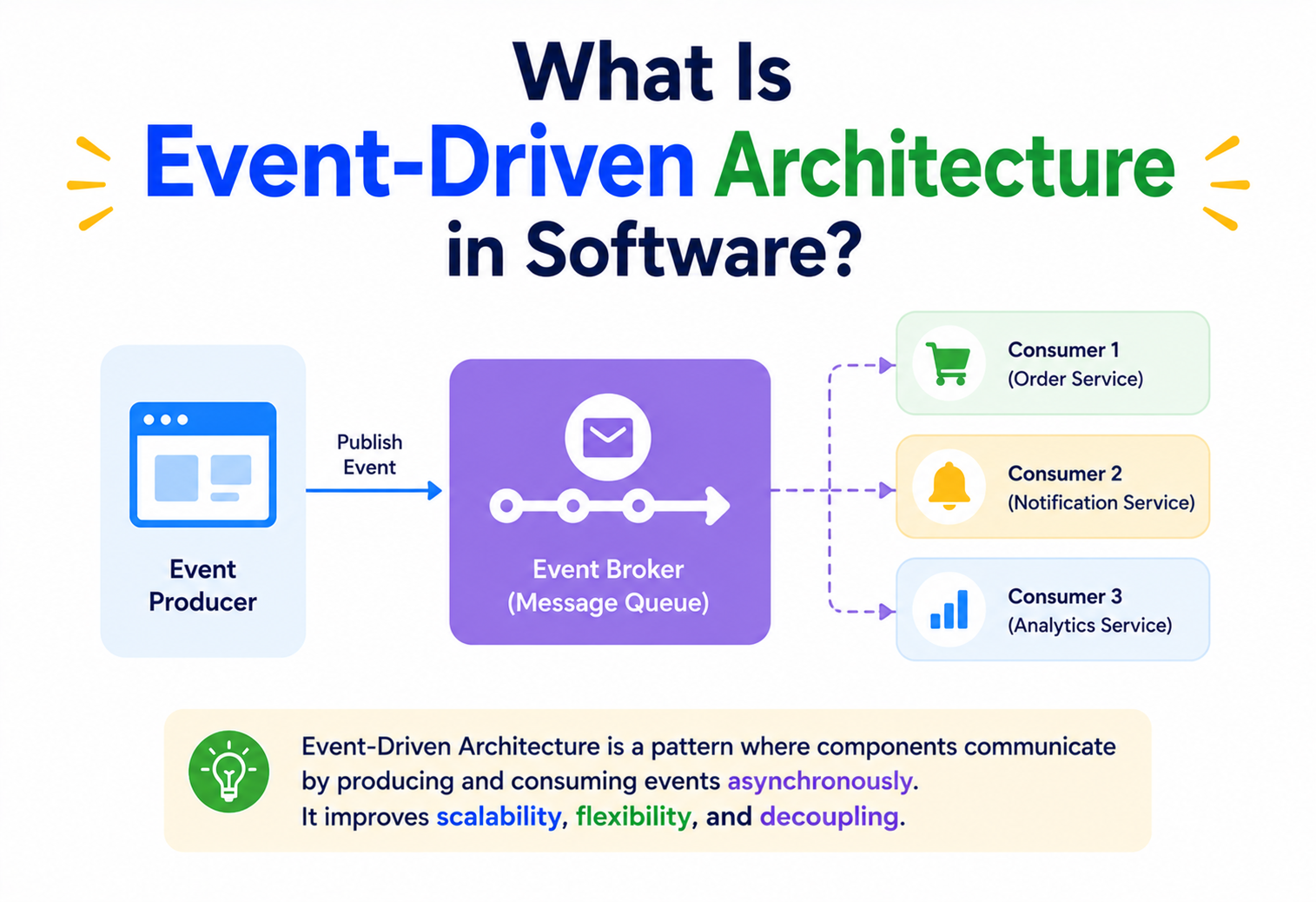
What Is Event-Driven Architecture in Software?
A doorbell doesn’t know who is about to answer it, and it doesn’t need to. It just rings the moment something happens, and lets whoever is listening decide what to do next. This guide explains how that simple idea — reacting to things as they happen — quietly runs some of the fastest, busiest software in the world.
The Big Idea, in One Breath
A doorbell announces that someone is at the door. It doesn’t chase you down; it just rings. Software built on this same instinct is called event-driven — and it powers a surprising amount of the modern internet.
Think about a doorbell. When someone presses it, the doorbell doesn’t walk into the kitchen, find you personally, and hand you a note. It simply rings — loudly, for anyone in the house to hear. Maybe you answer it. Maybe your sibling does. Maybe the dog just barks and nobody answers at all. The doorbell doesn’t know or care who reacts; its only job is to announce that something happened.
A huge number of modern applications are built around this exact same habit. Instead of one piece of software directly calling another and waiting for it to finish, a piece of software simply announces, “something happened” — this announcement is called an event — and lets any other piece of software that cares about it react in its own time, at its own pace. This way of building systems is called event-driven architecture, and it is the quiet engine behind everything from instant messaging to fraud detection to live sports scores.
Imagine a school notice board in the hallway. A teacher pins up a notice that says “Football practice moved to 4 PM.” The teacher doesn’t personally track down every single player to tell them. Students simply walk past, read the board when it is convenient for them, and react however they need to — some rearrange their afternoon, some tell a friend, some do nothing because they are not even on the team. The notice board is the event; each student reacting in their own way is exactly how event-driven systems behave.
What makes this idea so quietly powerful is how naturally it lets a system grow. In a world of direct calls, adding one new reaction to an existing action often means opening up old, working code and carefully inserting a new instruction — a little risky every single time. In an event-driven world, adding a new reaction is closer to simply pinning up a new pair of ears next to the notice board. The board itself never has to change, and nobody who was already listening is disturbed in the slightest.
What Event-Driven Architecture Really Is
A precise definition, plus the one small distinction — between an event and a command — that separates the whole style from every other way of connecting components.
Formally, an event is simply a record that something meaningful has happened — a customer placed an order, a temperature sensor crossed a limit, a user clicked “like.” An event is always something that has already happened, described in the past tense; it never asks anyone to do anything, it only reports a fact. Event-driven architecture is the overall style of building a system around producing, sharing, and reacting to these events, rather than components calling each other directly and waiting around for replies.
This is a genuinely different mindset from most other architectural styles, which are built around direct requests — “do this now, and tell me when you are done.” Event-driven systems flip that around: “this happened — anyone who cares can react whenever they are ready.” Nobody is kept waiting, and nobody needs to know in advance who else might be listening.
If someone asks “what is event-driven architecture?”, the simplest honest answer is: it is a way of building software where things announce what just happened, instead of ordering each other around.
It is worth sitting with the difference between an event and a command for a moment, because mixing the two up is one of the most common sources of confusion for anyone new to this style. A command says “please do this,” and expects someone specific to carry it out — it is a direct instruction with an intended receiver in mind. An event simply says “this happened,” with no expectation that anyone in particular will act on it, and no assumption about how many listeners, if any, are even out there. That subtle difference in tone — ordering versus announcing — is really the whole philosophy of event-driven design in a single sentence.
Why This Idea Was Invented
Direct calls worked fine when there were a few components. They got fragile the moment one thing needed to trigger several unrelated reactions. Event-driven thinking fixed the tangle by letting the producer stop caring who was listening.
Older styles of software often connected components with direct calls — component A calls component B, and A must wait patiently until B finishes before it can move on. This works fine when there are only a few components and everything happens in a predictable order. But as systems grew larger, and as more and more things needed to react to the very same happening — a new order might need to trigger an email, update inventory, notify a delivery service, and update a dashboard, all at once — direct calling started to create tangled, fragile chains where every new reaction meant editing old, working code just to add one more call.
Event-driven thinking solved this by letting the source of an event stay completely unaware of who is listening. The order-processing system doesn’t need to know that an email service, an inventory system, and a dashboard all care about new orders — it just announces “new order placed,” and each interested party quietly subscribes to hear about it on their own. New reactions can be added later without ever touching the original code that raised the event in the first place.
The underlying idea is actually much older than modern software itself — factory floors, stock exchanges, and even simple household alarms have relied on “something happened, react accordingly” thinking for a very long time. What changed in recent years is that the tools for delivering events reliably across huge, distributed systems — brokers capable of handling millions of events a second without losing a single one — matured enough to make this approach practical at a massive scale, not just inside a single small program.
Nobody waits on anybody
The part announcing an event doesn’t freeze while others process it — it moves straight on to its next task.
New reactions, zero old code touched
Adding a brand-new reaction to an existing event usually means writing new code, not editing old code.
Naturally soaks up sudden activity
A flood of events can be processed steadily over time instead of overwhelming the system all at once.
Reactions happen almost instantly
Because nobody has to be asked directly, interested parties can react the moment an event appears.
The Building Blocks of Event-Driven Systems
Four pieces make the whole style work: producers, events, a broker, and consumers. Each one has one clear job, and none of them need to know much about the others.
Event Producers
A producer is whatever part of the system notices that something worth announcing has happened, and raises the event. It might be a payment system noticing money has changed hands, a sensor noticing a temperature change, or a person clicking a button. A producer’s job ends the moment it announces the event — it never needs to know what happens next.
The Event Itself
An event is simply a small, structured piece of information describing what happened — usually including what kind of event it is, when it happened, and any relevant details, like an order number or a customer name. A well-designed event contains everything a consumer would reasonably need, without forcing that consumer to go and ask further questions elsewhere.
The Event Broker (or Channel)
Sitting between producers and consumers is a broker — sometimes called an event bus, message queue, or streaming platform. Its job is to receive events from producers and reliably deliver them to every consumer who is interested, even if that consumer happens to be busy, temporarily offline, or simply slower than the others.
A good broker behaves a little like a very patient, very reliable post office. It doesn’t just fling an event out into the void and hope for the best — it holds onto the event safely, sometimes for hours or even days, until every consumer who needs it has actually picked it up. This patience is what allows producers and consumers to be completely out of sync in time, without anything ever getting lost along the way.
Event Consumers
A consumer is anything that has expressed interest in a particular kind of event and reacts to it when it arrives — sending an email, updating a dashboard, adjusting stock levels. Multiple consumers can react to the very same single event, completely independently of one another, without ever needing to coordinate directly.
How an Event Actually Travels
Let’s follow a familiar moment — someone completing an online purchase — and watch a single event ripple outward through several independent services.
Let’s follow a familiar moment — someone completing an online purchase — and watch the event ripple outward.
Notice what is missing from this picture: the checkout service never directly tells the email service to send anything. It never even knows the email service exists. All it did was announce a fact — “Order Placed” — and walked away to handle the next customer. Everything that happens afterward is entirely between the broker and whichever consumers chose to listen.
This same shape repeats everywhere. A weather sensor crossing a dangerous temperature raises an event; an alarm system, a logging tool, and a cooling system might all react to that single announcement, each doing its own job, none of them coordinating with each other directly. The event is the only thing they truly share.
It is worth noticing, too, what happens if one of those three listeners is momentarily unavailable — say, the cooling system is mid-restart when the temperature event arrives. A well-built broker simply holds that event safely until the cooling system comes back and asks for what it missed. Nothing is lost, nothing needs to be repeated by hand, and the alarm and logging tool were never affected at all by the cooling system’s brief absence. That quiet resilience, almost invisible when everything is working, is precisely what makes this style so dependable under real-world, imperfect conditions.
Different Flavours of Event-Driven Design
A handful of well-known variations have emerged over the years, each suited to slightly different needs. Knowing them by name pays off the first time you sit in a design conversation.
Not every event-driven system is built the same way. A handful of well-known variations have emerged, each suited to slightly different needs, and it is genuinely useful to know them by name when discussing a design with a team.
Publish-Subscribe (Pub/Sub)
In this common pattern, producers “publish” events to a named channel or topic, and consumers “subscribe” to whichever topics interest them. A weather app might publish to a “temperature-updates” topic; an alarm system and a dashboard might both subscribe to that same topic, each receiving a copy of every event published to it.
Event Streaming
Rather than treating each event as a one-time announcement that is discarded once delivered, event streaming keeps a running, ordered log of everything that has happened, which consumers can read through — even re-reading older events if they need to catch up, replay history, or recover from an error. It is the difference between a live radio broadcast and a recorded playlist you can rewind.
Event Sourcing
This is a slightly deeper idea: instead of just storing the current state of something — like a bank balance — the system stores every single event that ever led up to that state — every deposit, every withdrawal — and can always recalculate the current balance by replaying them in order. It is similar to keeping a full diary of everything that happened, rather than just a single note saying how things currently stand.
Choreography vs. Orchestration
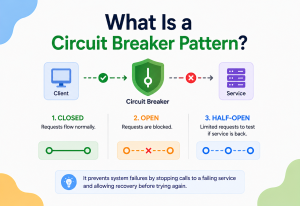
In choreography, there is no single conductor — each service reacts to events and raises its own new events in turn, and the overall behaviour emerges naturally from everyone following their own steps, much like dancers who have each learned their part without a conductor waving a baton. In orchestration, one central coordinator explicitly tells each service what to do and in what order, more like a conductor directing an orchestra. Both are valid, and many real systems blend a little of each.
None of these choices are permanent, either. A team might begin with simple pub/sub messaging for a small feature and later adopt full event streaming once the business genuinely needs to replay history or analyse trends over time. The underlying philosophy — reacting to what happened rather than being told what to do — stays the same throughout; only the sophistication of the machinery underneath tends to grow as the need for it grows.
Strengths That Made This Style So Popular
A side-by-side look at what event-driven design gives back — and where it quietly asks a team to spend its energy in return.
What It Gets Right
- Producers and consumers stay loosely connected, needing to know almost nothing about each other
- New reactions can be added at any time without touching existing, working code
- Naturally absorbs sudden bursts of activity instead of falling over
- Feels fast and responsive, since consumers react the moment an event appears
- Well suited to systems where many different things need to happen after one action
Where It Struggles
- Harder to trace exactly what happened, and in what order, after the fact
- Different parts of the system can briefly show slightly different, out-of-date information
- Debugging requires good tools for tracking events, not just reading code line by line
- Testing the whole flow end-to-end is trickier than testing a simple direct call
- Needs careful thought about what happens if a consumer is slow, offline, or fails partway through
A radio station broadcasts the news without knowing exactly who is tuned in. That is wonderfully flexible — anyone can start listening, anyone can stop, and the broadcaster never has to keep track of any of it. But it also means the station can’t easily prove exactly who heard which broadcast, or confirm that everyone tuned in got the full story. Event-driven systems share this exact trade-off — freedom and flexibility, in exchange for a little less certainty about who received what, and when.
What ties every strength on this list together is the deliberate choice to loosen the connections between parts of a system. Loosening those connections is precisely what makes new growth so painless and sudden bursts so survivable — and, honestly, it is also exactly what creates the harder-to-trace, harder-to-test nature covered in the next section. As with client-server and layered architecture before it, this is less a flaw to be fixed and more a trade a team is choosing to make, with eyes open, in exchange for something valuable.
A Closer Look at the Trade-offs
Four honest trade-offs to keep in mind before wiring your first broker, and one clear warning about the assumption that trips up almost every new team.
Eventual Consistency
Because consumers react at their own pace, there is often a brief window where different parts of the system disagree slightly — an order might show as “placed” on one screen a fraction of a second before the inventory count updates elsewhere. This is called eventual consistency: everything does line up correctly, just not necessarily in the very same instant. For most everyday uses, this tiny delay is completely unnoticeable, but for situations demanding split-second accuracy everywhere at once, it needs careful design.
The “Where Did This Come From?” Problem
In a system with direct calls, tracing a problem is often as simple as reading the code from top to bottom. In an event-driven system, an action can trigger a chain of events across many independent services, and figuring out exactly which event caused which downstream effect can feel like untangling a long, invisible thread. Good tooling — often called distributed tracing — becomes essential rather than optional.
Handling Failure Gracefully
What should happen if a consumer crashes halfway through reacting to an event? Should the event be tried again automatically? Could trying it again cause the same action to happen twice, like sending the same confirmation email three times? These questions don’t have automatic answers — they require deliberate, thoughtful design from the very beginning.
Ordering Isn’t Always Guaranteed
In systems with many producers and many consumers spread across different machines, events can occasionally arrive in a slightly different order than they were originally raised. For most everyday cases this barely matters, but for situations where order genuinely changes the outcome — like processing a deposit before a withdrawal — teams need to deliberately design for correct ordering, rather than assuming the broker will always sort it out perfectly on its own.
Assuming an event will always be delivered exactly once. In the real world, events can sometimes arrive twice, arrive late, or very rarely not arrive at all — and a well-built system plans for all three possibilities.
When to Use It — and When Not To
Three quick signals that tell you an event-driven design is likely to shine, plus a small, honest test for spotting where it probably isn’t the right tool.
Event-driven architecture shines whenever a single happening needs to trigger several unrelated reactions, whenever a system needs to absorb sudden, unpredictable bursts of activity gracefully, or whenever near-instant responsiveness genuinely matters to the people using it — think live chat, live sports scores, or fraud alerts that need to fire within milliseconds of something suspicious occurring.
It is a weaker fit for small, simple systems where a handful of direct, predictable calls would be far easier to build, test, and understand. It also demands more caution in situations requiring absolute, immediate consistency everywhere at once — such as certain financial transactions where even a split-second of disagreement between two numbers simply isn’t acceptable.
If you find yourself asking “what else needs to happen after this?” and the honest answer is “several different, unrelated things,” event-driven design is very likely worth serious consideration.
A quick, honest test also helps here: imagine the reaction you are about to build simply failed to happen for thirty seconds — would anyone notice, or would it still be perfectly fine as long as it eventually happened? If a short delay would genuinely go unnoticed, that is usually a strong signal an event fits nicely. If even a one-second delay would be unacceptable — someone needs an answer right now, on the spot — a direct call is probably still the better tool for that particular moment.
Common Mistakes Teams Make
Event-driven systems are wonderfully flexible, which is exactly why a handful of avoidable mistakes tend to show up again and again as teams get comfortable with the style.
Event-driven systems are wonderfully flexible, which is exactly why a handful of avoidable mistakes tend to show up again and again as teams get comfortable with the style. Most of them share a common root: forgetting that once an event has been sent, several independent, unpredictable things may now be happening at once, in ways a simple direct call would never have allowed.
Events That Are Secretly Commands
An event should describe something that already happened — “Order Placed” — not secretly order someone around, like “Send Email Now.” Naming and designing events as commands in disguise quietly reintroduces the tight coupling this whole style was meant to avoid in the first place.
Too Many Tiny Events
Breaking every single small action into its own separate event can flood the system with noise, making it genuinely hard to tell which events actually matter. Grouping related information into one clear, meaningful event is usually far easier to work with than scattering the same information across five tiny ones.
No Plan for Duplicate or Missing Events
Assuming every event will arrive exactly once, in perfect order, is a common and costly mistake. Real networks occasionally deliver things twice, out of order, or not at all, and a system that hasn’t planned for this will eventually be surprised by it, usually at the worst possible moment.
Skipping Observability
Without good logging, tracing, and monitoring built in from the start, a genuinely useful event-driven system can quickly become a black box that even its own engineers struggle to understand when something goes wrong. Observability isn’t a nice extra here — it is close to a requirement.
Letting the Event Broker Become a Silent Bottleneck
It is easy to assume the broker itself will simply scale forever without attention, since it sits quietly in the background doing its job. In reality, a broker under genuinely heavy load needs the same careful capacity planning and monitoring as any other critical piece of infrastructure — treating it as an afterthought is one of the more painful surprises teams discover only once traffic has already grown large.
Best Practices for Building It Well
Five habits that quietly separate a healthy, calm event-driven system from a noisy, fragile one — without demanding any expensive tooling to get started.
Name events as facts, not orders
Use past-tense names like “PaymentReceived” rather than command-like names such as “ProcessPayment.”
Make reactions safe to repeat
Design consumers so that handling the same event twice by accident causes no harm — this single habit prevents a huge share of real-world bugs.
Agree on the shape of events
Document exactly what information each event contains, and change that shape carefully, so consumers aren’t broken by surprise.
Follow the thread end-to-end
Attach a shared identifier to related events so the full journey of one action can be reconstructed later when needed.
Have a plan for events that fail
Route events that repeatedly fail to process into a separate holding area for a human to review, rather than letting them silently vanish or endlessly retry.
It also helps to start smaller than feels necessary. A team new to this style often benefits from picking just one or two genuinely good use cases for events — rather than converting every single interaction in the system to an event overnight — and growing outward from there once the pattern, the tooling, and the team’s instincts all feel comfortable and well understood. Trying to convert an entire system to event-driven thinking in one enormous leap is one of the more common ways teams end up overwhelmed by complexity they didn’t yet need to take on.
Quick Questions, Straight Answers
Short, honest answers to the questions engineers ask most often once event-driven thinking has clicked into place.
Is event-driven architecture the same as messaging?
They are closely related but not identical. Messaging is the general technique of sending information between systems through queues or channels; event-driven architecture is a broader style of designing a whole system around reacting to things that have happened, which very often uses messaging as the underlying delivery mechanism.
Do all consumers have to react immediately?
No. One of the quiet strengths of this style is that a consumer can be busy, temporarily offline, or simply slower than others, and still catch up later once it is ready, without the producer ever being affected or even aware of the delay.
Can a system be partly event-driven and partly not?
Yes, and this is extremely common in practice. Many real systems use direct request-and-response calls for anything requiring an immediate answer, like checking if a username is available, while using events for anything that can happen slightly after the fact, like sending a welcome email once signup is complete.
Is event-driven architecture only for huge companies?
Not at all. Even a small application can benefit the moment one action genuinely needs to trigger more than one independent reaction. The scale of the company matters far less than the shape of the actual problem being solved.
What happens if two consumers react to the same event differently and cause a conflict?
This is a genuine design challenge, and thoughtful teams handle it by being very clear about which service actually “owns” a particular piece of information and is allowed to change it, while other consumers are only allowed to read and react, never to overwrite. Keeping ownership boundaries clean, even in a loosely connected system, is what keeps everyone’s reactions from stepping on each other.
Compared to Other Architectural Styles
A side-by-side look at where event-driven design sits alongside client-server and microservices — followed by three real-world examples of the pattern quietly at work.
| Style | Shape | Best For | Main Limitation |
|---|---|---|---|
| Event-Driven | Announce, then anyone reacts | Real-time, reactive, bursty systems | Harder to trace and debug |
| Client-Server | One asks, one answers, directly | Simple, predictable request-and-response tasks | Tightly couples asker and answerer |
| Microservices | Many small independent services | Large products, many teams | Operationally complex to run |
These styles aren’t rivals so much as tools for different moments. It is extremely common for a microservices system to use direct client-server calls for anything needing an instant answer, while using events for anything that can ripple outward afterward — the two ideas working together rather than competing for the same job.
Instant messaging apps
The moment you hit send, that action becomes an event that updates delivery ticks, notifies the recipient, and syncs your other devices — all independently.
Fraud detection systems
Every transaction raises an event; a fraud-checking service listens to every single one, reacting within milliseconds if something looks unusual, without ever slowing down the original payment.
Smart home devices
A motion sensor raising an event might trigger a light, a camera, and a notification to your phone, all reacting to the very same single happening, entirely independently of each other.
Across all three examples, the same quiet advantage keeps showing up: nobody had to design the whole chain of reactions in advance, and nobody has to redesign anything just to add one more. That is ultimately the promise event-driven architecture makes to a growing system — the ability to keep adding new behaviour for years to come, without the weight of everything that came before it getting in the way.
Key Takeaways
If you remember only six ideas from this guide, let it be these. Together they cover most of the situations where event-driven thinking actually matters in day-to-day engineering practice.
Remember This
- Announce, don’t order. Event-driven architecture is built around producers announcing facts, and consumers reacting to them independently.
- Four pieces make it work. The core building blocks are producers, events, a broker or channel, and consumers.
- Know the flavours. Pub/sub, event streaming, event sourcing, choreography, and orchestration are the main variations worth knowing.
- Great strengths, honest costs. It excels at responsiveness, flexibility, and handling sudden bursts, but trades away some ease of tracing and immediate consistency.
- Discipline keeps it healthy. Naming events as facts, planning for duplicates, and investing in good tracing are what keep these systems healthy long-term.
- It plays well with others. It rarely stands alone — most real systems blend event-driven thinking with direct client-server calls, using each where it fits best.