What Is a Message Broker?
A message broker is the postal system of distributed software — it takes a message from one service, holds it safely, and delivers it to another, so the two never have to talk to each other directly. This guide takes you from “what does that even mean” to running one in production.
Introduction & History
Imagine two people who need to exchange letters but never see each other in person. They don’t hand letters to each other directly — that would mean both of them have to be at the same place at the same time. Instead, they use a post office. One person drops a letter in a mailbox; the post office stores it, routes it, and eventually delivers it to the other person’s mailbox — whenever that person is ready to check it.
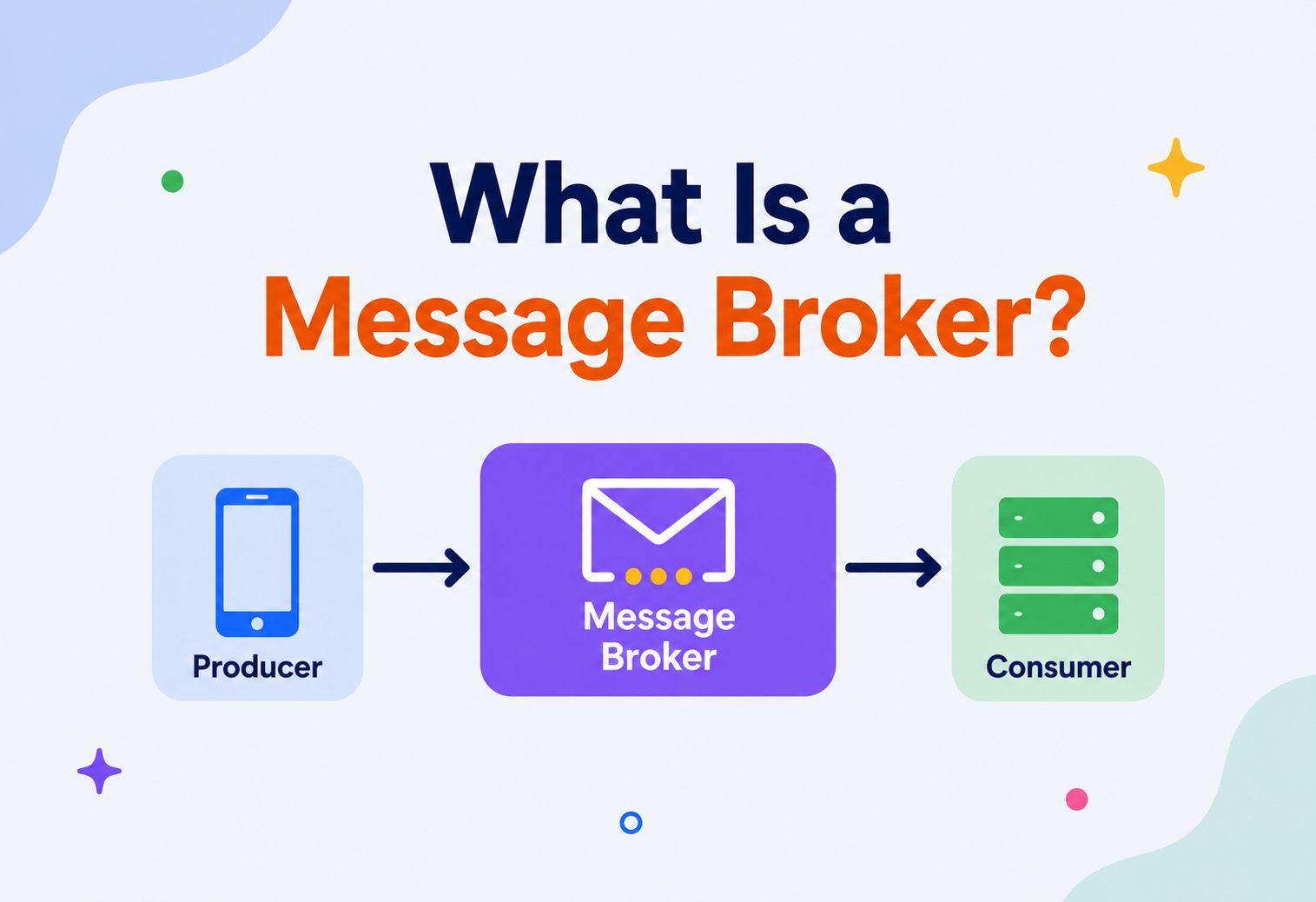
A message broker is exactly this post office, but for software. It is a piece of infrastructure that sits between two or more applications (or “services”) and lets them exchange data — called messages — without those applications needing to know where each other are, whether they’re online right now, or how fast they can process things.
A message broker is a middleman server that receives messages from “sender” applications (called producers), stores them temporarily, and delivers them to “receiver” applications (called consumers) — decoupling the two sides completely.
1.1 A short history
The idea of decoupled, asynchronous communication is old — much older than microservices or even the web. In the 1980s and 1990s, large enterprises (banks, airlines, telecom companies) needed different mainframe systems to exchange transaction data reliably, even if one system was temporarily down for maintenance. This gave rise to Message-Oriented Middleware (MOM), with IBM’s MQSeries (later IBM MQ) released in 1993 being one of the earliest and most influential products.
In 2001, the messaging world got a common language when several vendors and users came together to define the Advanced Message Queuing Protocol (AMQP), an open standard so that brokers and client applications from different vendors could interoperate. RabbitMQ, built on Erlang and released in 2007, became one of the most popular open-source brokers implementing AMQP.
Then, around 2010–2011, LinkedIn faced a new kind of problem: not just passing individual business messages between two systems, but capturing a continuous, high-volume stream of events — every page view, every click, every log line — and feeding it to many different downstream systems (analytics, search indexing, monitoring) in near real time. Existing brokers weren’t built for that throughput. This led to the creation of Apache Kafka, open-sourced in 2011, which reimagined the broker not as a queue but as a durable, replayable, distributed commit log. Kafka’s log-based model became the backbone of “event streaming” and heavily influenced how the whole industry now thinks about brokers.
Today, cloud providers offer fully managed broker services — Amazon SQS/SNS/MSK, Google Cloud Pub/Sub, Azure Service Bus/Event Hubs — so most teams no longer run their own broker cluster from scratch; they consume it as a managed service, the same way they consume a database.
Real-life analogy
A message broker is a post office. You (the producer) drop a letter in a mailbox. You don’t need to know if the recipient (the consumer) is home. The post office stores the letter and delivers it when the recipient checks their mailbox.
Beginner example
A “Contact Us” form on a website. When a visitor submits it, instead of sending the email directly (which could fail if the mail server is slow), the web server drops a “send-email” message onto a broker. A separate small worker program picks it up and sends the email.
The Problem & Motivation
To understand why message brokers exist, it helps to see the problem they solve — by first looking at life without one.
2.1 Direct calls: the naive approach
Imagine an e-commerce checkout flow built as a set of separate services: OrderService, PaymentService, InventoryService, EmailService, and ShippingService. The simplest way to connect them is direct, synchronous HTTP calls — OrderService calls PaymentService, which calls InventoryService, and so on, each one waiting for the previous one to finish.
This works fine on a whiteboard, but it quietly creates several serious problems as the system grows:
2.2 Tight coupling
Every service must know the network address of every other service it talks to, and their APIs must stay compatible. Change one service’s contract, and every caller might break.
2.3 Cascading failures
If EmailService is slow or down, the whole chain stalls, because each call is waiting synchronously for the next. A single flaky service can take down the entire checkout flow, even though sending a confirmation email has nothing to do with whether the order should succeed.
2.4 No buffering for traffic spikes
During a flash sale, order volume might jump 50x for ten minutes. A direct call chain has no way to absorb that burst — every downstream service must scale instantly, or requests start failing and timing out.
2.5 Sender and receiver must both be available at the same time
This is the crux of it: direct calls require both sides to be up, reachable, and fast simultaneously. That’s a very fragile assumption in any system with more than a handful of services.
When a rider requests a trip, dozens of internal systems care about that event: matching, pricing, fraud detection, driver notifications, analytics, and more. If Uber’s ride-request service called all of them synchronously, a single slow fraud-check service could delay every ride request in the city. Instead, an event (“ride requested”) is published to a broker, and each interested system consumes it independently, at its own pace.
2.6 The message broker solution
A message broker breaks the direct chain. OrderService simply publishes a message — “order #4521 placed” — to the broker and moves on immediately. Any number of other services can independently subscribe to that message and react whenever they’re ready, without OrderService ever knowing they exist.
This single architectural shift — from “call and wait” to “publish and move on” — is what unlocks scalability, resilience, and independent deployability in modern distributed systems. It’s the foundational motivation for almost every asynchronous, event-driven architecture in production today.
Core Concepts
Before going further, let’s define the vocabulary precisely — these terms get used loosely in casual conversation, but they mean specific things.
Message
A message is a self-contained unit of data sent through the broker. It typically has a header (metadata like message ID, timestamp, content type) and a body (the actual payload, often JSON, Avro, or Protobuf).
Producer (Publisher)
The application that creates and sends a message into the broker. In our example, OrderService is a producer.
Consumer (Subscriber)
The application that receives and processes a message from the broker. EmailService is a consumer.
Queue
A queue is a linear structure where each message is typically delivered to exactly one consumer (even if many consumers are listening — they compete for messages, and each message goes to only one of them). This is the classic point-to-point model.
Topic (Publish/Subscribe)
A topic broadcasts each message to every subscriber that’s listening, not just one. If three services subscribe to the “order-placed” topic, all three get a copy of every message.
Queue analogy
A single ticket counter with one line. Each customer (message) is served by exactly one teller (consumer), even if there are five tellers working the line — nobody gets served twice.
Topic analogy
A radio station. Everyone tuned to that frequency hears the same broadcast. The broadcaster doesn’t know or care who’s listening, and each listener gets the full message independently.
Exchange (in AMQP/RabbitMQ terms)
In brokers like RabbitMQ, producers don’t send messages directly to a queue — they send them to an exchange, which then routes the message to one or more bound queues based on rules (a routing key, a pattern match, or a broadcast to everyone).
Partition (in Kafka terms)
Kafka splits a topic into ordered, append-only partitions distributed across brokers. Order is only guaranteed within a partition, not across the whole topic — this is a key design choice that trades global ordering for horizontal scalability.
Acknowledgment (ACK)
A signal a consumer sends back to the broker confirming “I successfully processed this message; you can delete it (or advance my offset).” Without acknowledgments, the broker cannot safely know whether it’s okay to remove a message.
Offset
In log-based brokers like Kafka, each consumer tracks a numeric position — the offset — marking how far it has read into a partition. This lets a consumer resume exactly where it left off after a restart, or even intentionally “rewind” and reprocess old messages.
Dead-Letter Queue (DLQ)
A special holding queue where messages get moved after repeated failed processing attempts, so a single “poison” message doesn’t block the whole queue forever and can be inspected later.
| Term | What it means | Everyday analogy |
|---|---|---|
| Producer | Sends messages | Person mailing a letter |
| Consumer | Receives & processes messages | Person checking their mailbox |
| Queue | One message → one consumer | Single-line ticket counter |
| Topic | One message → many subscribers | Radio broadcast |
| Broker | Stores & routes messages | The post office itself |
| ACK | “I got it, you can delete it” | Signing for a delivery |
| DLQ | Holding pen for failed messages | Undeliverable-mail bin |
3.1 Putting the vocabulary to work — a worked example
Let’s connect all of these terms to one concrete scenario so they stop being abstract definitions and start being a mental model you can reuse. Suppose OrderService at an online bookstore just finished saving a new order to its database. It now needs to tell the rest of the company that this happened.
Beginner example
OrderService is the producer. It builds a small JSON message — {"orderId": 4521, "status": "PLACED"} — and sends it to a topic called order-events on the broker. It doesn’t know or care who’s listening.
Software example
Three separate teams each run a consumer: the email team’s service formats and sends a confirmation, the warehouse team’s service reserves stock, and the analytics team’s service records the sale for dashboards. Each is in its own consumer group, so all three receive an independent copy of every message.
At Amazon’s scale, a single “order placed” business event realistically fans out to dozens of internal consumers — fraud scoring, recommendation-model training data, fulfillment routing, tax calculation, seller notifications, and more — all subscribing independently to essentially the same underlying event stream, without the order-placement code needing to know any of them exist.
Architecture & Components
Let’s zoom into what a broker looks like on the inside. While every product (RabbitMQ, Kafka, ActiveMQ, SQS) implements this differently, the conceptual pieces are largely the same.
4.1 Broker Nodes
The actual server processes that accept connections, store messages, and hand them out. In production, you almost always run a cluster of multiple nodes rather than a single node — this provides both extra capacity and fault tolerance.
4.2 Storage Layer
Messages must be written somewhere durable, typically to disk, so they survive a broker restart. RabbitMQ writes to per-queue storage; Kafka writes to append-only segment files, treating the disk essentially like a sequential log — a design choice that makes writes extremely fast because sequential disk I/O is much faster than random I/O.
4.3 Routing Layer
Decides which queue(s) or partition a given message should land in. In RabbitMQ, this is the exchange with its binding rules. In Kafka, this is a partitioner function (often a hash of the message key).
4.4 Metadata / Coordination Service
Distributed brokers need a way to agree on cluster state — which node is the leader for a partition, which nodes are alive. Kafka historically used Apache ZooKeeper for this; newer Kafka versions use a built-in consensus protocol called KRaft (based on Raft) to remove the ZooKeeper dependency entirely.
4.5 Client Libraries
Producer and consumer applications don’t talk raw TCP to the broker; they use a client SDK (e.g., the Kafka Java client, the RabbitMQ AMQP client) that handles connection management, retries, serialization, and batching.
4.6 Queue-based vs. log-based brokers
It’s worth being explicit about two dominant architectural philosophies, since they lead to very different guarantees:
| Aspect | Queue-based (RabbitMQ, ActiveMQ, SQS) | Log-based (Kafka, Pulsar, Kinesis) |
|---|---|---|
| Once consumed | Message is typically removed from the queue | Message stays in the log until retention expires |
| Replay | Generally not possible after ACK | Consumers can rewind and reread by offset |
| Fan-out to many consumer groups | Needs separate queues per consumer group | Native — many groups read the same log independently |
| Best for | Task queues, RPC-style workloads, complex routing | Event streaming, analytics, event sourcing, high throughput |
Internal Working
Let’s go one level deeper and trace how a message actually moves through a broker internally.
Connection & Session
A producer opens a persistent TCP connection to a broker node. Protocols like AMQP layer “channels” over that single connection so many logical streams can share one socket efficiently.
Serialization
The producer’s client library serializes the message object (a Java
OrderEventobject, say) into bytes — commonly JSON, Avro, or Protocol Buffers. Avro and Protobuf are popular in production because they enforce a schema and are far more compact than JSON.Routing decision
The broker examines the message (its topic name, routing key, or partition key) and decides exactly which internal queue or partition it belongs in.
Durable write
The message is appended to disk (and, in a properly configured cluster, replicated to follower nodes) before the broker considers the write “acknowledged” back to the producer. This is controlled by durability settings — for example, Kafka’s
acksproducer setting.Consumer polling / pushing
Depending on the broker, delivery to consumers is either push-based (the broker sends messages to the consumer as they arrive — RabbitMQ’s default) or pull-based (the consumer repeatedly asks “give me the next batch” — Kafka’s model). Pull-based systems give the consumer full control of its own pace, which is important for backpressure.
Acknowledgment & cleanup
Once the consumer confirms success (an ACK in RabbitMQ, or a committed offset in Kafka), the broker either deletes the message (queue model) or simply advances the tracked offset while the message itself remains for other consumer groups or future replay (log model).
5.1 The partitioning idea in code
// Kafka partitioning — simplified idea of what happens internally
int partition = Math.abs(key.hashCode()) % numberOfPartitions;
This is why choosing a good partition/routing key matters: all messages with the same key (e.g., the same orderId or customerId) always land on the same partition — which is what gives you ordering guarantees for that specific entity.
5.2 A Kafka producer with durability turned on
Properties props = new Properties();
props.put("bootstrap.servers", "broker1:9092,broker2:9092");
props.put("key.serializer", "org.apache.kafka.common.serialization.StringSerializer");
props.put("value.serializer", "org.apache.kafka.common.serialization.StringSerializer");
props.put("acks", "all");                    // wait for all in-sync replicas
props.put("retries", 5);
props.put("enable.idempotence", "true");     // avoid duplicate writes on retry

KafkaProducer<String, String> producer = new KafkaProducer<>(props);
ProducerRecord<String, String> record =
        new ProducerRecord<>("order-events", "order-4521", "{"status":"PLACED"}");

producer.send(record, (metadata, exception) -> {
    if (exception == null) {
        System.out.println("Delivered to partition " + metadata.partition()
                + " at offset " + metadata.offset());
    } else {
        exception.printStackTrace();
    }
});
producer.close();
5.3 A Kafka consumer with manual commits
Properties props = new Properties();
props.put("bootstrap.servers", "broker1:9092,broker2:9092");
props.put("group.id", "email-service-group");
props.put("key.deserializer", "org.apache.kafka.common.serialization.StringDeserializer");
props.put("value.deserializer", "org.apache.kafka.common.serialization.StringDeserializer");
props.put("enable.auto.commit", "false");    // commit manually after processing

KafkaConsumer<String, String> consumer = new KafkaConsumer<>(props);
consumer.subscribe(Collections.singletonList("order-events"));

while (true) {
    ConsumerRecords<String, String> records = consumer.poll(Duration.ofMillis(500));
    for (ConsumerRecord<String, String> r : records) {
        sendConfirmationEmail(r.value());    // do the actual work
    }
    consumer.commitSync();                    // only commit offset AFTER successful processing
}
5.4 Rebalancing — what happens when a consumer joins or leaves
One of the trickiest internal mechanics to understand is rebalancing. When you run three consumer instances sharing a group ID and reading a six-partition topic, the broker’s group coordinator assigns two partitions to each instance. If one instance crashes, the coordinator detects the missed heartbeat, and reassigns its two partitions to the two survivors — a rebalance. During a rebalance, message consumption briefly pauses across the whole group while the new assignment is agreed on, which is why frequent, unnecessary rebalances (e.g., caused by consumers that are too slow and get evicted for missing heartbeats) can quietly hurt throughput.
Real-life analogy
Think of partitions as checkout lanes in a supermarket and consumers as cashiers. If a cashier goes on break mid-shift, the store manager (the coordinator) reassigns their lane’s customers to the remaining cashiers so no lane is left unattended — but there’s a brief pause while everyone shuffles.
Software example
A payments-processing service running five pods reads a 10-partition topic, two partitions per pod. During a rolling Kubernetes deployment, as each old pod terminates and each new pod starts, the group rebalances repeatedly — which is why production teams tune session timeouts and use cooperative rebalancing strategies to minimize disruption during routine deploys.
5.5 Serialization formats in practice
While JSON is the easiest format to start with because it’s human-readable and needs no special tooling, production systems handling high volume very often move to a binary format:
- Avro — compact, schema-driven, widely used with Kafka via a schema registry; supports schema evolution rules (backward/forward compatibility).
- Protocol Buffers (Protobuf) — similarly compact and schema-driven, popular because the same
.protodefinitions can generate client code for many languages, useful when producers and consumers are written in different languages. - JSON — simplest to debug and log, but larger on the wire and has no built-in schema enforcement unless you layer JSON Schema on top.
The choice matters more than it first appears: a compact binary format can cut network and storage costs meaningfully at high message volume, while JSON’s readability can save significant debugging time on lower-volume systems. Many teams start with JSON and migrate to Avro or Protobuf once volume or cross-team schema governance becomes a real concern.
Data Flow & Message Lifecycle
6.1 Delivery guarantees
This is one of the most commonly misunderstood — and most commonly interview-relevant — aspects of message brokers. There are three levels of guarantee:
At-most-once
The message is sent once and never retried, even if delivery fails. You might lose messages, but you’ll never get duplicates. Rarely desirable except for things like non-critical metrics.
At-least-once
The broker keeps retrying until it gets an acknowledgment. You will never silently lose a message, but the same message might be delivered more than once (e.g., if the ACK itself gets lost on the network even though processing succeeded). This is the most common default in production systems.
Exactly-once
Each message is processed once and only once, with no loss and no duplication. This is the hardest guarantee to provide and usually requires coordination between the broker and the consumer’s own storage (e.g., Kafka’s transactional producer/consumer APIs, or idempotent consumer logic).
Think of at-least-once delivery like a courier who keeps re-attempting delivery until you sign for the package. If you sign, but the courier’s scanner glitches and doesn’t record it, they might come back tomorrow with the same package — you now have two. Your job (the consumer) is to notice “wait, I already have this one” — that’s called idempotent processing.
6.2 Idempotency in practice
// Idempotent consumer pattern: dedupe using a processed-messages table
@Transactional
public void handleOrderEvent(OrderEvent event) {
    if (processedEventRepository.existsById(event.getEventId())) {
        return; // already handled — safe to ignore duplicate delivery
    }
    fulfillOrder(event);
    processedEventRepository.save(new ProcessedEvent(event.getEventId()));
}
6.3 Consumer groups and fan-out
In Kafka, multiple consumers can share the same group.id to split the work of a topic among themselves (each partition is read by exactly one consumer in the group), while a completely separate group.id reads the same topic independently from the start — this is how one event (say, “order placed”) can simultaneously trigger email, analytics, and fraud-check pipelines without those systems interfering with each other’s read progress.
Pros, Cons & Tradeoffs
Advantages
- Decoupling — producers and consumers don’t need to know about each other’s existence, location, or even whether they’re currently online.
- Resilience to downstream failure — if a consumer service is down, messages simply wait in the broker instead of causing the producer to fail.
- Load leveling — a burst of 100,000 messages can be buffered and drained by consumers at a sustainable rate, instead of overwhelming a downstream system instantly.
- Scalability — you can add more consumer instances to process a queue/topic faster, without touching the producer at all.
- Auditability & replay — log-based brokers let you replay historical events, which is invaluable for debugging, backfilling a new service, or rebuilding state (event sourcing).
Disadvantages
- Operational complexity — running a broker cluster reliably (or paying for a managed one) is an extra piece of infrastructure with its own failure modes to learn and monitor.
- Eventual consistency — because processing is asynchronous, there’s a window where the “source of truth” and downstream systems are out of sync. This is a real tradeoff, not a free lunch.
- Harder debugging — tracing a request across a synchronous call chain is easier than tracing it across a broker, where you need correlation IDs and distributed tracing to reconstruct the flow.
- Message ordering complexity — global ordering is hard or impossible at scale; you typically only get ordering guarantees within a partition or a single queue.
- At-least-once means you must design for duplicates — idempotency isn’t optional in most real systems; it’s homework you can’t skip.
If Service A needs an immediate answer from Service B to return a response to a user right now (e.g., “is this password correct?”), a synchronous call (REST/gRPC) is usually the right tool, not a broker. Brokers shine for work that can happen “a little later,” not work that blocks a user-facing response.
7.1 A simple decision framework
When deciding whether a given interaction between two services should go through a broker or a direct synchronous call, a few questions usually settle it quickly:
- Does the caller need the result immediately to respond to a user? If yes, lean synchronous.
- Could there be more than one interested party in the future? If yes, a broker’s fan-out avoids having to add more direct calls later.
- Is it acceptable for processing to happen a few seconds (or minutes) later? If yes, a broker lets you absorb load spikes gracefully.
- Does the downstream system’s availability matter to the caller’s success? If the caller shouldn’t fail just because a downstream system is briefly down, a broker decouples that failure.
Most mature systems end up as a hybrid: synchronous APIs at the “front door” for user-facing requests, and an asynchronous broker-driven backbone for everything that happens as a consequence of those requests.
Performance & Scalability
8.1 Throughput vs. latency
Message brokers are often tuned for one of two goals, and you frequently have to pick a point on the spectrum:
- Latency-optimized — deliver each message as fast as possible, even if that means smaller batches and more network round trips (good for order confirmations, chat apps).
- Throughput-optimized — batch many messages together, compress them, and accept slightly higher per-message latency in exchange for handling millions of messages per second (good for clickstream/log ingestion).
8.2 Horizontal scaling via partitioning
The core scaling trick in modern brokers is partitioning (Kafka) or sharding (a similar idea in other systems): a single topic is split across many partitions, each of which can live on a different broker node and be read by a different consumer instance in parallel.
The rule of thumb: you cannot have more active consumers in a group than partitions — extra consumers beyond the partition count just sit idle. This is why choosing the right partition count up front (or being able to grow it later) matters a lot for scalability planning.
8.3 Batching & compression
Producers typically buffer several messages and send them together in one network request, and often compress the batch (e.g., with Snappy, LZ4, or gzip). This dramatically reduces both network overhead and disk I/O on the broker side.
8.4 Backpressure
When consumers can’t keep up with producers, the broker acts as a buffer — but that buffer isn’t infinite. Good systems apply backpressure: slowing producers down, alerting operators, or scaling out consumers automatically when queue depth or consumer lag crosses a threshold.
Kafka was originally built at LinkedIn specifically because existing brokers couldn’t sustain the throughput of hundreds of billions of events per day generated by user activity tracking. Its log-based, partition-parallel design was a direct response to a real throughput ceiling the team hit with earlier messaging systems.
8.5 Capacity planning basics
Before going live, it’s worth doing rough back-of-envelope sizing so you’re not surprised in production:
- Estimate peak messages per second, not average — flash sales, month-end batch jobs, and marketing campaigns can produce spikes many times larger than typical daily traffic.
- Estimate average and maximum message size — a broker sized for 1 KB messages will behave very differently if someone accidentally starts sending 500 KB payloads.
- Decide retention — how long must messages be kept? Longer retention on a log-based broker means more disk, which is a direct cost and capacity input.
- Plan partition count for your target parallelism, not just current load — increasing partitions later is usually possible, but changes key-to-partition mapping and can disturb ordering assumptions, so it’s cheaper to slightly over-provision up front than to redesign later.
If a small SaaS app expects 50 sign-up emails per minute at peak, a single partition and a couple of consumer instances is plenty — there’s no need to reach for a 50-partition topic “just in case.” Right-sizing avoids paying for and operating capacity you’ll never use.
High Availability & Reliability
9.1 Replication
Just like a database, a broker replicates each partition/queue across multiple broker nodes. One node is the leader for a given partition (handling all reads/writes for it), and the others are followers that continuously copy data from the leader. If the leader node dies, one of the in-sync followers is promoted automatically.
9.2 CAP theorem, applied to brokers
Message brokers are distributed systems, so they’re subject to the same CAP theorem tradeoffs as distributed databases: during a network partition, you must choose between Consistency (every replica agrees on the latest state before acknowledging a write) and Availability (keep accepting writes even if some replicas are unreachable).
Kafka lets you tune this explicitly with the acks and min.insync.replicas settings: acks=all with a higher min.insync.replicas favors consistency (a write isn’t acknowledged until enough replicas confirm it), while acks=1 favors availability and lower latency at the cost of a small window of potential data loss if the leader crashes right after acknowledging.
9.3 Consensus
Deciding which node is the leader for each partition — and keeping that decision consistent even during failures — requires a consensus protocol. Historically Kafka delegated this job to ZooKeeper (itself built on the Zab consensus protocol); newer Kafka deployments use KRaft, based on the well-known Raft consensus algorithm, built directly into the brokers themselves.
9.4 Failure recovery
- Broker node failure — leader election promotes a follower; producers/consumers reconnect to the new leader automatically via the client library.
- Consumer crash — because the offset/ACK wasn’t committed for in-flight messages, they are redelivered to another consumer in the group once a rebalance happens.
- Disaster recovery across regions — production setups often use cross-region/cross-datacenter replication (e.g., Kafka’s MirrorMaker 2, or cloud-native cross-region replication) so an entire region outage doesn’t mean total data loss.
Netflix runs infrastructure across multiple AWS regions and designs for entire-region failure. Event streams that matter (e.g., viewing activity) are replicated so a regional outage doesn’t silently drop data — a direct application of the replication and disaster-recovery principles above.
Security
10.1 Authentication
Every producer and consumer connecting to the broker should prove who it is. Common approaches include SASL (Simple Authentication and Security Layer) mechanisms like SASL/SCRAM or SASL/OAUTHBEARER, mutual TLS (mTLS) with client certificates, or IAM-based authentication in managed cloud brokers (e.g., AWS IAM policies for SQS/MSK).
10.2 Authorization (ACLs)
Once authenticated, a client should only be allowed to do what it needs — e.g., OrderService can produce to order-events but shouldn’t be able to consume from payment-secrets. Kafka implements this with Access Control Lists (ACLs) tied to principals, topics, and operations (READ, WRITE, DESCRIBE, etc.).
10.3 Encryption
- In transit — TLS between clients and brokers, and between brokers themselves in a cluster.
- At rest — disk-level or filesystem-level encryption for stored messages, particularly important for regulated data (PII, payment details).
10.4 Data sensitivity & payload design
A subtle but important security practice: don’t put raw sensitive data (credit card numbers, passwords) directly into messages if you can avoid it. Prefer tokenized references, and fetch sensitive details from a secured system only when strictly required — this limits the blast radius if a topic is ever misconfigured or a consumer is compromised.
// Secured Kafka producer config — SASL/SCRAM over TLS
Properties props = new Properties();
props.put("bootstrap.servers", "broker1:9093");
props.put("security.protocol", "SASL_SSL");
props.put("sasl.mechanism", "SCRAM-SHA-512");
props.put("sasl.jaas.config",
    "org.apache.kafka.common.security.scram.ScramLoginModule required "
    + "username="order-service" password="${env:KAFKA_PASSWORD}";");
props.put("ssl.truststore.location", "/etc/kafka/truststore.jks");
10.5 Multi-tenancy and blast-radius control
In a large organization, dozens of teams may share the same broker cluster. Without guardrails, one team’s misbehaving producer (say, accidentally publishing at 100x its normal rate) can degrade performance for every other team on the cluster. Production-grade deployments typically apply:
- Quotas — per-client byte-rate limits so no single producer or consumer can monopolize broker bandwidth.
- Resource isolation — dedicating separate clusters (or at least separate broker pools) to workloads with very different criticality, such as keeping payment events off the same physical cluster as low-priority clickstream logging.
- Input validation at the edge — rejecting malformed or oversized messages as early as possible (ideally at the producer’s client library or an API gateway) rather than letting bad data propagate downstream to every consumer.
Think of quotas like a shared office printer with a daily page limit per employee — without it, one person printing a 2,000-page document could leave everyone else waiting all day.
Monitoring, Logging & Metrics
A broker sitting silently between services can become a hidden bottleneck if you’re not watching the right numbers. Key metrics to track:
| Metric | Why it matters |
|---|---|
| Consumer lag | How far behind a consumer is from the latest message — rising lag means consumers can’t keep up |
| Queue depth / backlog size | How many messages are waiting; a growing backlog signals a downstream slowdown |
| Broker CPU / disk I/O / disk usage | Broker nodes running hot risk latency spikes or storage exhaustion |
| Under-replicated partitions | Partitions with fewer in-sync replicas than expected — an early warning of reduced fault tolerance |
| End-to-end latency | Time from message produced to message fully processed by the consumer |
| Dead-letter queue size | A growing DLQ means messages are failing processing repeatedly and need investigation |
11.1 Distributed tracing & correlation IDs
Because a single business transaction (e.g., “place an order”) now spans multiple asynchronous hops through a broker, you need a correlation ID attached to every message so you can stitch together the full journey across services in your tracing tool (e.g., Jaeger, Zipkin, or a vendor APM).
// Attaching a correlation ID as a Kafka message header
ProducerRecord<String, String> record =
        new ProducerRecord<>("order-events", "order-4521", payload);
record.headers().add("correlationId", correlationId.getBytes(StandardCharsets.UTF_8));
producer.send(record);
11.2 Alerting
Good practice is to alert on trends, not just static thresholds — e.g., “consumer lag has been continuously increasing for 10 minutes” is a stronger signal than a fixed lag number, since normal traffic spikes can cause temporary, self-resolving lag.
Deployment & Cloud
12.1 Self-hosted
Running your own broker cluster (e.g., Kafka on Kubernetes via the Strimzi operator, or RabbitMQ on VMs) gives full control over configuration and cost at scale, but requires real operational expertise — capacity planning, patching, backup/restore drills, and on-call ownership for the cluster itself.
12.2 Managed / Cloud-native
| Provider | Service | Style |
|---|---|---|
| AWS | SQS | Simple managed queue |
| AWS | SNS | Managed pub/sub fan-out |
| AWS | MSK | Managed Kafka |
| Google Cloud | Pub/Sub | Globally distributed pub/sub |
| Azure | Service Bus | Enterprise queue/topic broker |
| Azure | Event Hubs | Kafka-compatible event streaming |
| Confluent | Confluent Cloud | Fully managed Kafka + ecosystem tooling |
12.3 Containerization & orchestration
Most self-hosted broker deployments today run on Kubernetes using an operator pattern — a controller that understands broker-specific operations (rolling upgrades, adding brokers, rebalancing partitions) far better than generic Kubernetes primitives alone could.
12.4 Infrastructure as code
Topics, partitions, retention policies, and ACLs are typically defined declaratively (Terraform, Kubernetes CRDs, or GitOps pipelines) so broker configuration changes go through the same review and audit trail as application code.
Databases, Caching & Load Balancing
13.1 How brokers relate to databases
A broker is not a database, even though log-based brokers like Kafka look database-ish (durable, replicated, ordered storage). The key difference is access pattern: databases are optimized for arbitrary random-access queries (“find all orders for customer X placed last month”), while brokers are optimized for sequential append and sequential read (“give me everything from offset N onward”).
A very common production pattern is streaming database changes into a broker using CDC tools (e.g., Debezium), so downstream services can react to data changes in a source-of-truth database without polling it directly or coupling to its schema.
13.2 Caching alongside brokers
Consumers often maintain a local cache (in-memory, or Redis) built from the stream of events they consume — this is the essence of the CQRS pattern (Command Query Responsibility Segregation), where a fast, purpose-built read cache is kept in sync via events rather than by querying the write-side database directly.
13.3 Load balancing producers and consumers
Producers are typically load-balanced across broker nodes by the client library itself (it knows the current partition leaders). Consumers within a group are automatically load-balanced across partitions by the broker’s group coordinator, which triggers a rebalance whenever a consumer joins or leaves the group.
APIs & Microservices
14.1 Event-driven microservices
In a microservices architecture, the message broker often becomes the primary nervous system connecting services, complementing (not replacing) synchronous REST/gRPC APIs. A common split: use synchronous APIs for “I need an answer right now” interactions, and the broker for “notify others that something happened.”
14.2 Spring Boot example — a producer service
@Service
public class OrderEventPublisher {

    private final KafkaTemplate<String, OrderEvent> kafkaTemplate;

    public OrderEventPublisher(KafkaTemplate<String, OrderEvent> kafkaTemplate) {
        this.kafkaTemplate = kafkaTemplate;
    }

    public void publishOrderPlaced(Order order) {
        OrderEvent event = new OrderEvent(order.getId(), "PLACED", Instant.now());
        kafkaTemplate.send("order-events", order.getId().toString(), event);
    }
}
14.3 Spring Boot example — a consumer service
@Component
public class EmailNotificationListener {

    @KafkaListener(topics = "order-events", groupId = "email-service-group")
    public void onOrderEvent(OrderEvent event) {
        if ("PLACED".equals(event.getStatus())) {
            emailService.sendOrderConfirmation(event.getOrderId());
        }
    }
}
14.4 Contracts between services
Because producers and consumers are deployed independently, the message schema becomes a public contract, just like a REST API’s request/response shape. Production systems typically enforce this with a schema registry (e.g., Confluent Schema Registry for Avro/Protobuf), which rejects incompatible schema changes before they can break downstream consumers.
Design Patterns & Anti-Patterns
15.1 Patterns
Outbox Pattern
Writing to your database and publishing an event are two separate operations — if the process crashes between them, you get inconsistency. The outbox pattern solves this by writing the event into an “outbox” table in the same database transaction as the business change, then a separate relay process reads the outbox and publishes to the broker, guaranteeing the event is never lost or published without the underlying change.
Saga Pattern
Coordinates a multi-step business transaction across services using a sequence of events and compensating actions, since distributed transactions (two-phase commit) don’t scale well across independently owned services.
Competing Consumers
Multiple identical consumer instances read from the same queue/partition set to parallelize work — the core mechanism behind horizontal scaling of consumers.
Event Sourcing
Instead of storing only current state, you store the full sequence of events that led to it, using the broker’s log as the append-only source of truth, and derive current state by replaying events.
Claim Check Pattern
When the actual payload is large (a video file, a large document), don’t put it directly in the message — store it in object storage (like S3) and put only a reference (“claim check”) in the message itself. Consumers use the reference to fetch the full payload only when needed, keeping the broker fast and lean, since brokers are optimized for many small messages, not a few huge ones.
Real-life analogy
It’s exactly like checking a coat at a theater: you get a small claim ticket (the message) instead of carrying the coat (the payload) around with you everywhere.
Software example
A video-processing pipeline uploads a raw video to S3, then publishes a small message like {"videoId": "abc123", "s3Path": "raw/abc123.mp4"}. The transcoding consumer fetches the actual file from S3 only when it’s ready to process it.
15.2 Anti-patterns
Using a queue/topic as your primary, queryable data store (instead of a proper database) — brokers aren’t built for arbitrary queries, and retention policies mean data can silently expire.
Dumping every kind of event into a single topic with no clear schema, forcing every consumer to filter out what it doesn’t care about — this destroys the benefits of clear service boundaries.
Assuming “the broker guarantees exactly-once so I don’t need to worry about duplicates” — in practice, most real deployments provide at-least-once, and skipping idempotent design leads to double-charging customers, duplicate emails, and similar production incidents.
Forcing a broker into a synchronous request/reply pattern (producer blocks and waits for a reply message) for latency-sensitive user-facing calls, when a direct API call would be simpler and faster.
Best Practices & Common Mistakes
Best practices
- Design message schemas deliberately, version them, and enforce compatibility with a schema registry rather than “whatever JSON shape the producer felt like sending.”
- Always design consumers to be idempotent — assume duplicate delivery will happen eventually, because it will.
- Set sensible retention and DLQ policies so failed messages are visible and actionable, not silently dropped or stuck forever.
- Choose partition/routing keys thoughtfully — they determine both your ordering guarantees and your scalability ceiling.
- Monitor consumer lag as a first-class metric, not an afterthought — it’s usually the earliest signal of trouble.
- Keep messages reasonably small and store large payloads (files, images) externally (e.g., in object storage), passing only a reference in the message.
- Use correlation IDs everywhere so you can trace a business transaction across every asynchronous hop.
Common mistakes
- Treating “message sent” as “message processed” — the message might still fail downstream, and your monitoring needs to reflect that distinction.
- Under-provisioning partitions early, then discovering you can’t easily reduce ordering-sensitive rework later (increasing partitions is usually possible, but it can change which keys map to which partition).
- Not testing failure scenarios — broker node loss, network partition, consumer crash mid-processing — until they happen for real in production.
- Coupling consumers too tightly to a producer’s internal object model instead of a stable, versioned public event schema.
- Forgetting that a growing backlog eventually becomes a capacity and retention problem, not just a “consumers will catch up eventually” problem.
16.1 Testing strategies
Message-driven systems deserve their own testing approach, distinct from testing a synchronous API:
- Contract tests verify that a producer’s message schema and a consumer’s expected schema stay compatible, catching breaking changes before deployment rather than in production.
- Local broker instances (via Docker Compose or Testcontainers) let you run realistic integration tests against a real broker rather than mocking it away entirely, catching serialization and configuration issues mocks would miss.
- Chaos testing — deliberately killing a broker node, disconnecting a consumer mid-processing, or injecting network latency — validates that your failure-recovery assumptions (retries, rebalances, DLQs) actually work the way you designed them to, rather than just the way you hoped they would.
Teams that skip this kind of testing often discover their assumptions about delivery guarantees and failure recovery were subtly wrong only after a real incident in production — by which point the cost of that gap is much higher than it would have been in a test environment. A modest investment in these three testing layers early on tends to pay for itself many times over the lifetime of a message-driven system, precisely because failures in asynchronous systems are so much harder to reproduce and diagnose after the fact than failures in a simple synchronous call stack.
Real-World & Industry Examples
17.1 Ride-sharing telemetry & IoT
Beyond ride-hailing apps, message brokers are the standard backbone for Internet-of-Things telemetry — fleets of vehicles, industrial sensors, or smart-home devices continuously publish small events to lightweight broker protocols like MQTT (a protocol specifically designed for constrained devices and unreliable networks), which are then bridged into larger brokers like Kafka for downstream analytics.
FAQ, Summary & Key Takeaways
Is a message broker the same as a message queue?
Not exactly — a queue is one specific data structure a broker can offer (point-to-point delivery). A broker is the overall system, which may offer queues, topics, or both.
Do I need a message broker for a small application?
Usually not right away. If you have one or two services with simple, fast interactions, direct API calls are simpler to build, deploy, and debug. Brokers earn their complexity when you have multiple independent consumers, need to absorb traffic spikes, or need resilience to downstream outages.
Kafka or RabbitMQ — which should I use?
RabbitMQ tends to shine for complex routing and traditional task-queue workloads with moderate throughput. Kafka tends to shine for high-throughput event streaming, replay, and when many independent consumer groups need the same event stream. Many production systems use both, for different jobs.
Can a message broker guarantee message order?
Only within a single queue or a single partition — not across an entire topic with multiple partitions. If strict ordering matters for a given entity (e.g., all events for one order), route all its messages to the same partition using a consistent key.
What happens if a consumer never acknowledges a message?
Depending on configuration, the broker will eventually redeliver it (to the same or another consumer), and after enough failed attempts, route it to a dead-letter queue for manual inspection.
Is a message broker a single point of failure?
It can be, if you run a single node. That’s exactly why production deployments always run a replicated cluster of broker nodes with automatic leader election — the goal is that no single node’s failure can take down the whole system or lose data.
How is a message broker different from a REST API?
A REST API is synchronous and pull-style — the caller asks a question and waits for an answer right now. A broker is asynchronous and push/stream-style — the sender fires off a message and moves on, and one or many receivers process it independently, on their own schedule. Most real systems use both, for different kinds of interactions.
Can message brokers lose messages?
Yes, if misconfigured — for example, if you don’t wait for enough replica acknowledgments before considering a write durable, a crash right after that write can lose it. This is a deliberate tunable tradeoff between durability and latency/throughput, not an inherent flaw, and it’s why understanding settings like acks and min.insync.replicas matters for anyone operating a broker in production.
What’s the difference between a message broker and an event bus?
The terms overlap heavily in casual usage. “Event bus” usually emphasizes the publish/subscribe, many-consumers-per-event style of usage (often within a single application or a tightly related set of services), while “message broker” is the broader infrastructure term covering both queue-style and topic-style delivery across an entire organization’s systems.
18.1 Summary
A message broker decouples the applications that produce data from the applications that consume it, buffering, routing, and reliably delivering messages between them. This unlocks resilience to downstream failures, the ability to absorb traffic spikes, and independent scalability of producers and consumers — at the cost of added operational complexity and the need to design carefully for eventual consistency and duplicate delivery.
Key takeaways
- A message broker is middleware that decouples producers and consumers — they never need to be online at the same time or know about each other.
- The core primitives are queues (one-to-one) and topics (one-to-many), plus supporting concepts like exchanges, partitions, offsets, and ACKs.
- Two dominant styles: queue-based (RabbitMQ, SQS — delete after ack) and log-based (Kafka, Kinesis — retain and replay).
- Almost all production systems provide at-least-once delivery, so consumer idempotency is mandatory, not optional.
- Horizontal scale comes from partitioning; high availability comes from replication + consensus (Raft, ZooKeeper/KRaft).
- The single most valuable operational metric is consumer lag — if it’s rising, everything else eventually breaks.
- Use the Outbox pattern whenever a database write and a message publish must be effectively atomic.
- Reach for synchronous APIs when a user is waiting; reach for a broker when work can happen “a little later.”