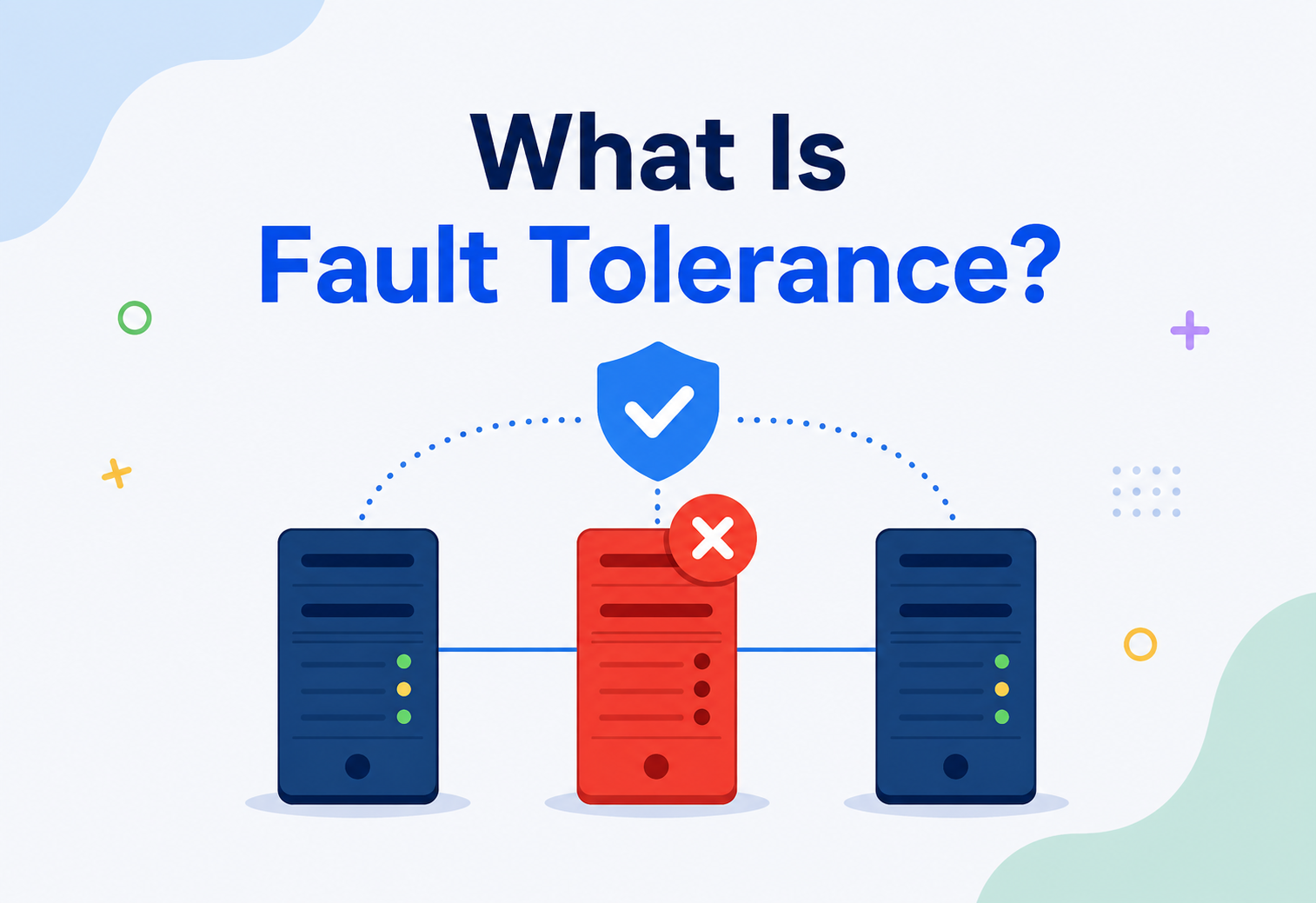
What Is Fault Tolerance?
Every real system fails eventually — a disk dies, a server loses power, a network cable gets unplugged, a data center loses electricity. Fault tolerance is the engineering discipline of building software that keeps working anyway. This guide walks through what it means, why it exists, how it is built, and how companies like Netflix, Amazon, and Google use it to stay online every single day.
Introduction & History
Imagine you are riding in an airplane. One of the four engines suddenly stops working. Does the plane fall out of the sky? No. Commercial airplanes are built so that they can lose an engine — sometimes even two — and still land safely. The plane does not work quite as well with three engines as it does with four, but it keeps flying. That idea, something keeps working even when a piece of it breaks, is the entire idea behind fault tolerance.
In computer science, fault tolerance is the property of a system that lets it continue operating properly even when one or more of its components fail. The system does not need to be perfect or untouched by failure. It only needs to keep doing its job, possibly a little slower or with reduced features, while the failure is detected and fixed.
Hospital backup power
A hospital keeps backup generators. If the city power goes out, the generators switch on automatically within seconds so that life-support machines never stop.
One web server dies
If one web server in a group of ten crashes, the other nine keep serving website visitors. Most users never notice anything happened.
1.1 Where the Idea Came From
Fault tolerance is not a new idea invented for the internet. It goes back to the 1950s and 1960s, when engineers building the earliest computers noticed that vacuum tubes and relays failed constantly — sometimes several times a day. If a machine had thousands of these parts, and any single failure could stop the whole machine, the computer would almost never be usable. Engineers like John von Neumann began studying how to build reliable machines out of unreliable parts. His 1956 paper on “Probabilistic Logics” is one of the earliest serious studies of this exact question: how do you get trustworthy output when the pieces underneath cannot be trusted to always work?
In the 1970s and 1980s, this thinking moved into real hardware. Companies like Tandem Computers built machines specifically for banks and stock exchanges — places where a computer crashing for even one minute could cost millions of dollars. Tandem’s “NonStop” systems duplicated every important part of the computer: two processors, two power supplies, two disks, all working at the same time, so that if one failed, the other kept going without even a blip.
Then came the internet age. Suddenly, software was not running on one carefully maintained mainframe in a locked room. It was running across thousands of ordinary, cheap servers spread across many buildings, cities, and even countries. At that scale, hardware fails constantly — not as a rare event but as a daily certainty. Google engineers have said openly that in a data center with tens of thousands of machines, you should expect multiple server failures every single day, just as a matter of statistics. This changed fault tolerance from “an advanced feature for special systems” into “a basic requirement for anything running at scale.” Netflix, Amazon, Google, and virtually every large technology company today build fault tolerance into the foundation of their systems, not as an afterthought.

Probabilistic Logics
John von Neumann’s paper on building reliable machines from unreliable parts — one of the earliest serious studies of tolerating failure in computing hardware.
Tandem NonStop systems
Purpose-built duplicated hardware — two processors, two power supplies, two disks — for banks and stock exchanges where a minute of downtime cost millions.
Byzantine Generals problem formalised
Lamport, Shostak and Pease publish the classic paper defining what it means to tolerate not just crashes but actively misleading nodes — the theoretical basis for later blockchain consensus.
Paxos enters mainstream use
Consensus algorithms move from academic papers into production distributed systems, letting groups of nodes agree on facts even while some are failing.
Google’s commodity-hardware philosophy
Google publishes the design of GFS and MapReduce, popularising the idea of building fault tolerance into software so it can run reliably on cheap, expected-to-fail hardware.
Netflix releases Chaos Monkey
Deliberately killing production servers becomes an engineering practice, formalising chaos engineering as a way to verify fault tolerance actually works.
Raft consensus published
Ongaro and Ousterhout release an easier-to-understand alternative to Paxos, later adopted by etcd (Kubernetes), Consul and CockroachDB as the coordination backbone for modern platforms.
Multi-region as baseline
Deploying critical workloads across multiple cloud regions with automated failover moves from “advanced practice” to “baseline expectation” for anything customer-facing.
A simple way to remember the goal of fault tolerance: it is not about preventing failure — failure is assumed to be inevitable. It is about making sure failure does not turn into an outage that users can see.
Problem & Motivation
Why does this topic matter so much? Because software today is built out of many moving parts, and every single one of those parts can, and eventually will, break. Consider a typical online shopping website. Behind the scenes there might be: web servers, a database, a payment processor, a shipping service, a recommendation engine, a caching layer, and a network connecting all of them. Each of those is a potential point of failure.
2.1 What Can Actually Go Wrong
| Category | Example failure | How often it happens |
|---|---|---|
| Hardware | A hard disk fails, memory chip becomes faulty, a fan stops and the machine overheats | Daily, at large scale |
| Network | A cable is cut, a router misconfigures, packet loss between data centers | Frequent, especially across regions |
| Software | A bug causes a crash, memory leak fills up RAM, deadlock freezes a service | Common after every deployment |
| Human | An engineer pushes a bad configuration, deletes the wrong database table | Surprisingly common — a leading cause of major outages |
| Environmental | Power outage, fire, flood, earthquake affecting a data center | Rare per building, but happens somewhere every year |
| Dependency | A third-party API you rely on goes down or becomes slow | Regular occurrence for any system with external integrations |
If a system is not designed with fault tolerance in mind, any one of these ordinary events can turn into a full outage. Without fault tolerance, a single disk failure could mean your entire website goes down. With fault tolerance, that same disk failure is a non-event: a spare disk or replica takes over, an alert fires for an engineer to replace the hardware later, and customers keep shopping without ever knowing anything happened.
Bicycle training wheels
Think about a bicycle with training wheels. If the bike starts to tip to one side, the training wheel catches it before the rider falls. The bike does not become perfect, but the fall — the real failure — is prevented.
Every millisecond costs money
Amazon has said that for every 100 milliseconds of extra page-load delay, they can lose measurable percentages of sales. An unhandled failure that causes a page to hang or error out is not just an inconvenience — it is a direct loss of revenue.
2.2 The Business Cost of Not Being Fault Tolerant
Downtime is expensive. Studies commissioned by companies like Gartner have estimated that for large enterprises, the average cost of IT downtime can run into the tens of thousands of dollars per minute, and for e-commerce or financial companies it can be dramatically higher. Beyond the direct dollar cost, there is a slower and more damaging cost: loss of user trust. If a banking app is frequently unavailable, customers start to wonder if their money is safe with that bank at all, even though the money itself was never actually at risk. Fault tolerance protects both the immediate revenue and the long-term reputation of a system.
“Everything fails, all the time.” — describing the mindset every engineer at Amazon is taught to build with.
Core Concepts
Before going further, it helps to get precise about a few words that people often use interchangeably but that actually mean different things in reliability engineering: fault, error, and failure.
The chain of events
- Fault — the root cause. A bug in code, a worn-out disk, a loose network cable. It exists but may not have caused a problem yet.
- Error — the fault produces an incorrect internal state. The disk starts returning corrupted data, or a variable holds a wrong value.
- Failure — the error becomes visible to the outside world. The user sees “500 Internal Server Error” or the app crashes.
Why the distinction matters
- Fault tolerance aims to stop a fault from ever becoming an error.
- Where that is not possible, it aims to stop the error from ever becoming a visible failure.
- A well-designed system can have faults happening constantly, with zero visible failures.
3.1 Redundancy
What it is: Keeping more than one copy of something — a server, a database, a network path — so that if one copy fails, another is ready to take over immediately.
Why it exists: A single copy of anything is a single point of failure. If that one thing breaks, everything depending on it breaks too.
Where it’s used: Everywhere in distributed systems — multiple web servers behind a load balancer, multiple copies of a database (replicas), multiple network cables between buildings, even multiple power supplies in one physical server.
Analogy: A football team keeps substitute players on the bench. If the starting striker gets injured, a substitute steps in and the game continues.
Practical example: A company runs three identical copies of its checkout service across three different servers. A load balancer sends traffic to whichever ones are healthy. If one server dies, the load balancer simply stops sending it traffic — customers keep checking out normally.
3.2 Replication
What it is: A specific kind of redundancy where data itself, not just the code that processes it, is copied to multiple locations and kept in sync.
Why it exists: Redundant servers are useless if they cannot access the same data. If your database lives on only one machine and that machine dies, having ten web servers does not help — none of them can read or write your data anymore.
Analogy: A student keeps a copy of their essay on their laptop and also emails a copy to themselves. If the laptop is stolen, the essay is not lost.
Practical example: Most production databases keep at least one “primary” copy that accepts writes, and one or more “replica” copies that continuously receive updates from the primary. If the primary fails, a replica is promoted to become the new primary.
3.3 Graceful Degradation
What it is: When part of a system fails, the rest of the system keeps functioning, possibly with reduced features, instead of failing completely.
Why it exists: Not every failure can be fully hidden. Sometimes the best outcome is not “nothing happened” but “something still works.”
Analogy: If the elevator in a building breaks, people take the stairs. The building still works. It is slower and less convenient, but nobody is stuck.
Practical example: If Netflix’s personalized recommendation service is down, the home page can still show a generic “Popular right now” row instead of a personalized one, rather than showing a blank page or an error.
3.4 Fail-Fast vs. Fail-Safe
What it is: Two different philosophies for how a component should behave the moment it notices something is wrong. Fail-fast means stopping immediately and loudly reporting the problem, rather than continuing in an unknown, possibly dangerous state. Fail-safe means, when failure happens, defaulting to the safest possible state.
Analogy: A microwave that stops instantly when you open the door mid-cook is fail-safe — the safest state (radiation off) is chosen automatically. A smoke detector that beeps loudly the moment it senses smoke, rather than waiting to “double check,” is fail-fast — it prefers to alert early rather than stay silent and risk being wrong.
3.5 Idempotency
What it is: An operation is idempotent if performing it multiple times has exactly the same effect as performing it once.
Why it exists: Fault-tolerant systems often retry operations that might have failed. But what if the operation actually succeeded, and only the confirmation message was lost? Without idempotency, retrying could charge a customer’s credit card twice for one purchase.
Analogy: Pressing an elevator call button five times does not call five elevators. The building is designed so that repeating the action has no extra effect.
Practical example: Payment APIs commonly require an “idempotency key” — a unique ID sent with each request — so that if the same request arrives twice because of a retry, the server recognizes it and only processes the payment once.
3.6 Isolation
What it is: Keeping components separated from each other so that a problem in one cannot spread into another. This is the underlying idea behind the bulkhead pattern discussed later in this guide.
Why it exists: Without isolation, components that share resources — like a single database connection pool, a single thread pool, or a single physical machine — can pass failure from one to another even when they were never designed to depend on each other at all.
Analogy: Apartment buildings have fire-rated walls between units. A fire that starts in one apartment is contained there instead of spreading through the whole building.
Practical example: Running the “search” feature and the “checkout” feature of an online store on completely separate servers means a bug that crashes search cannot also take down checkout.
3.7 Self-Healing
What it is: The ability of a system to detect a problem and automatically repair itself, without a person needing to intervene.
Why it exists: Human response, even from a fast, well-trained on-call engineer, typically takes minutes. Automated self-healing can often respond in seconds, dramatically shrinking how long a failure is visible to users.
Analogy: Human skin heals a small cut on its own, sealing the wound and fighting infection, without the person needing to consciously direct the process.
Practical example: An orchestration platform noticing that a container has stopped responding to its health check, and automatically killing and restarting it, is a textbook case of self-healing infrastructure.
3.8 Split-Brain
What it is: A dangerous situation in a distributed system where a network problem causes two parts of the same system to each believe they are the sole active leader, both accepting writes independently.
Why it matters: Split-brain can silently corrupt data, since two “leaders” may accept conflicting updates that later cannot be cleanly merged. This is one of the trickiest failure modes to design around, and it is precisely why consensus algorithms like Raft, discussed in the Internal Working section, are built so carefully around the idea of requiring a strict majority before any node is allowed to act as leader.
Analogy: Imagine two co-pilots on the same plane, each convinced the other has lost contact, both trying to steer at the same time based on different information. Clear, agreed rules about who is really in charge prevent this kind of confusion.
A very common beginner mistake is assuming that “fault tolerant” means “never fails.” No real system can promise zero failures. Fault tolerance is about controlling the blast radius and the visibility of failure, not eliminating failure itself.
Architecture & Components
A fault-tolerant system is not one single piece of technology. It is a combination of several building blocks that work together. Let’s look at the pieces that typically show up in a production architecture designed to survive failure.
4.1 Load Balancer
A load balancer sits in front of a group of servers and decides which server should handle each incoming request. It constantly checks whether each server is healthy, and if one stops responding, the load balancer simply removes it from the pool of servers it sends traffic to.
4.2 Health Checks
A health check is a small, regular test — often a simple network request like GET /health — sent to a server to ask, “Are you still working correctly?” If the server does not answer correctly, or does not answer at all within a set time, it is marked unhealthy.
4.3 Redundant Nodes / Replicas
Instead of running one copy of a service, fault-tolerant architectures run several identical copies, often called nodes or replicas, usually spread across different physical machines, and ideally across different data centers or “availability zones.”
4.4 Failover Mechanism
Failover is the automatic process of switching from a failed component to a working backup. This can happen at many levels: a database failover promotes a replica to primary; a DNS failover redirects traffic to a backup region; an application failover routes a request to another instance.
4.5 Circuit Breaker
A circuit breaker is a software component that watches calls to a dependency (like another microservice or a database). If that dependency starts failing repeatedly, the circuit breaker “opens” and stops sending it any more requests for a while, giving it time to recover, instead of hammering it with more traffic that would likely fail anyway. We cover this in detail in the Design Patterns section.
4.6 Message Queue / Buffer
A queue sits between two services so that if the receiving service is temporarily down or slow, the messages simply wait in the queue instead of being lost. This decouples the sender’s speed from the receiver’s availability.
4.7 DNS-Based Failover
DNS, the system that translates human-readable addresses like example.com into the numeric addresses computers use, can itself be used as a fault tolerance tool. A DNS failover service continuously checks whether a primary data center or region is healthy, and if it stops responding, automatically updates DNS records to point users toward a healthy backup region instead, without any change needed on the user’s side.
4.8 Backpressure
Backpressure is a signal sent backward through a system, from an overloaded component to whatever is sending it work, saying “slow down, I cannot keep up.” Rather than silently dropping requests or crashing under load, a component that applies backpressure asks upstream callers to reduce their rate, which keeps the whole chain of services stable rather than allowing one overloaded link to collapse and take the rest down with it.
4.9 Putting the Components Together
In a real production system, these pieces are layered on top of each other. A request from a user’s browser first hits a global DNS layer that can route to a healthy region. Inside that region, a load balancer routes to a healthy server. That server may call several other internal services, each protected by its own circuit breaker and retry logic. Any writes to the database go through a system that replicates data to at least one standby copy. If anything anywhere in that chain fails, there is a designed response: skip it, retry it, fall back to a cached value, or degrade gracefully.
Emergency room
Think of a hospital emergency room. There is a triage nurse (load balancer) directing patients to available doctors (servers), backup doctors on call (redundant nodes), and a strict protocol for what to do if the main generator fails (failover). Every layer has a plan.
Netflix on AWS
Netflix’s architecture spreads services across multiple AWS Availability Zones and Regions, uses load balancers at every layer, and famously tests failure on purpose using a tool called Chaos Monkey, discussed later in this guide.
Internal Working
How does a system actually detect that something has failed, and how does it decide what to do next? This happens in three broad stages: detection, decision, and recovery.
5.1 Stage 1 — Detection
A system cannot tolerate a fault it does not know about. Detection typically relies on:
- Heartbeats — a component regularly sends a small “I’m alive” signal. If the signal stops arriving for a certain period, the component is presumed dead.
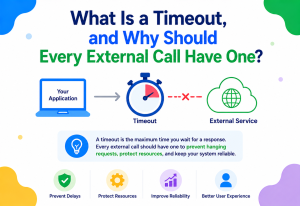
- Timeouts — if a response to a request does not arrive within an expected time, the caller assumes something is wrong rather than waiting forever.
- Health checks — active probes sent on a schedule to check component status, as discussed earlier.
- Error rate monitoring — if the percentage of failed requests to a service crosses a threshold, the system treats that service as unhealthy even if it is technically still responding.
5.2 Stage 2 — Decision (Consensus)
In a distributed system with many machines, deciding “is this node actually dead, or is it just slow?” is surprisingly hard, because network delays can make a healthy node look dead and vice versa. This is where consensus algorithms come in — protocols that let a group of machines agree on a single, shared fact (such as “node 4 is down” or “node 2 is now the leader”) even when some machines might be slow, unreachable, or lying.
Two of the most widely used consensus algorithms are Paxos and Raft. Raft, in particular, was designed to be easier to understand than Paxos while providing the same guarantees, and it is used inside many real systems including etcd (which powers Kubernetes), Consul, and CockroachDB.
5.3 Stage 3 — Recovery
Once a failure is detected and, if needed, a decision has been reached about what changed (like who the new leader is), the system takes action:
- Failover — traffic is rerouted to a healthy replica or standby.
- Retry — the failed operation is attempted again, often against a different node.
- Self-healing — an orchestration system like Kubernetes automatically restarts a crashed container or replaces a failed machine.
- Data reconciliation — once a failed node comes back online, it needs to catch up on any data it missed while it was down.
Class monitor rule
Think of a classroom where the teacher steps out. If a designated “class monitor” does not hear from the teacher within a set time, the monitor takes charge temporarily, following a rule everyone already agreed on in advance.
Kubernetes liveness probe
In a Kubernetes cluster, if a container stops responding to its liveness probe (a type of health check), Kubernetes automatically kills and restarts it — often before a human even notices.
Data Flow & Lifecycle
It helps to walk through exactly what happens, step by step, during a real failure event in a fault-tolerant web application.
User clicks “Place Order”
The request leaves the browser and arrives at the load balancer.
Load balancer forwards to Server B
Server B was healthy the last time it was checked, so it is chosen from the pool.
Payment Service does not respond
Server B tries to call the Payment Service to charge the customer’s card, but the Payment Service does not respond — it has crashed.
Client-side timeout fires
Server B’s request to the Payment Service times out after a configured 2-second limit, rather than waiting indefinitely.
Circuit breaker records the failure
A circuit breaker wrapping the Payment Service call records this failure. Since this is only the first failure, the circuit stays closed and the request is retried with exponential backoff.
Retry succeeds against a healthy instance
The retry reaches a different, healthy instance of the Payment Service behind its own load balancer. The order completes successfully. The user sees a small delay but no error at all.
Health check removes crashed instance
Meanwhile, the health check system notices the crashed Payment Service instance is not responding and removes it from rotation.
Orchestrator starts a replacement
An orchestration system detects the missing instance and automatically starts a replacement container to restore full capacity.
New instance passes health check
The new instance is added back into the pool. The system is fully back to its original capacity, and an alert has been logged for engineers to review later — but no human had to act during the incident itself.
Notice that in this entire timeline, the user experienced, at most, a couple of extra seconds of delay. That is the entire point of fault tolerance: turning what could have been a failed order and an angry customer into a barely noticeable hiccup.
Design Patterns & Anti-Patterns
Over decades of building distributed systems, engineers have converged on a set of well-known, reusable patterns for handling failure. Let’s go through the most important ones, with Java examples.
7.1 Circuit Breaker Pattern
A circuit breaker works exactly like the electrical circuit breaker in your house. If too much current flows (too many failures happen), it “trips” and cuts off the circuit, protecting the system from further damage, and only lets current flow again after things have calmed down.
public class CircuitBreaker {
    private enum State { CLOSED, OPEN, HALF_OPEN }

    private State state = State.CLOSED;
    private int failureCount = 0;
    private final int failureThreshold = 5;
    private long openedAt = 0;
    private final long resetTimeoutMillis = 10_000; // wait 10s before trying again

    public synchronized boolean allowRequest() {
        if (state == State.OPEN) {
            if (System.currentTimeMillis() - openedAt > resetTimeoutMillis) {
                state = State.HALF_OPEN; // give it one cautious try
                return true;
            }
            return false; // still cooling down, fail fast
        }
        return true; // CLOSED or HALF_OPEN trial in progress
    }

    public synchronized void recordSuccess() {
        failureCount = 0;
        state = State.CLOSED;
    }

    public synchronized void recordFailure() {
        failureCount++;
        if (state == State.HALF_OPEN || failureCount >= failureThreshold) {
            state = State.OPEN;
            openedAt = System.currentTimeMillis();
        }
    }
}
In practice, teams rarely write this from scratch — libraries like Resilience4j provide production-ready circuit breakers with metrics and configuration built in. But understanding the logic above is exactly what those libraries do under the hood.
7.2 Retry Pattern (with Exponential Backoff and Jitter)
Sometimes a failure is temporary — a brief network blip. Retrying the operation shortly afterward often succeeds. But retrying too fast, and too many times, can make things worse by overwhelming an already struggling service. That is why retries usually wait progressively longer between attempts (exponential backoff), and add a small random amount of extra wait time (jitter) so that many clients do not all retry at exactly the same moment.
public class RetryHelper {

    public static <T> T callWithRetry(Callable<T> task, int maxAttempts) throws Exception {
        int attempt = 0;
        long baseDelayMillis = 200;

        while (true) {
            try {
                return task.call();
            } catch (Exception e) {
                attempt++;
                if (attempt >= maxAttempts) {
                    throw e; // give up after max attempts, let the caller decide fallback
                }
                long backoff = (long) (baseDelayMillis * Math.pow(2, attempt));
                long jitter = (long) (Math.random() * 100);
                Thread.sleep(backoff + jitter);
            }
        }
    }
}
7.3 Bulkhead Pattern
Named after the watertight compartments in a ship’s hull, a bulkhead isolates resources so that if one part of the system is overwhelmed, it cannot drain resources away from the rest. If the Titanic’s compartments had all been connected, one hole would have flooded the entire ship. Because they were isolated, the ship could survive several compartments flooding.
ExecutorService paymentPool = Executors.newFixedThreadPool(10);
ExecutorService recommendationPool = Executors.newFixedThreadPool(5);

// If the recommendation service becomes slow and its pool fills up,
// paymentPool still has its own separate 10 threads and is unaffected.
Future<String> paymentResult = paymentPool.submit(() -> callPaymentService());
Future<String> recResult = recommendationPool.submit(() -> callRecommendationService());
7.4 Timeout Pattern
Never wait forever. Every network call should have a maximum time it is allowed to take. Without a timeout, one slow dependency can cause every thread in your application to get stuck waiting, eventually freezing the entire service — a scenario sometimes called “thread pool exhaustion.”
7.5 Fallback Pattern
When an operation ultimately fails even after retries, a fallback provides an alternative response instead of an error — a cached value, a default value, or a simplified result. This is what allows graceful degradation, discussed earlier, to actually happen in code.
7.6 Rate Limiting and Load Shedding
Rate limiting caps how many requests a client can send in a given period. Load shedding means a system, when overwhelmed, deliberately rejects some incoming requests to protect its own ability to serve the rest, rather than trying to serve everyone and collapsing under the load.
7.7 Dead Letter Queue
What it is: A special holding queue where messages are placed after they have failed to be processed successfully a certain number of times, instead of being retried forever or silently discarded.
Why it exists: Some failures are not temporary — a message might be malformed, or reference data that no longer exists. Continuing to retry these “poison messages” forever wastes resources and can even block healthy messages from being processed behind them in the same queue.
Analogy: A post office that cannot deliver a letter after several attempts does not keep trying forever. It sets the letter aside in a special pile for a human clerk to review later, so it does not hold up the rest of the mail.
Practical example: An order-processing queue might retry a failed order three times, and if it still fails, move that specific order to a dead letter queue, where an engineer or an automated alert can investigate the root cause without blocking the thousands of other orders behind it.

7.8 Saga Pattern
What it is: A way of managing a single business transaction that spans multiple services, where each service performs its own local step and publishes an event, and if any step later fails, previously completed steps are undone using compensating actions.
Why it exists: In a microservices architecture, a single “place an order” action might need to reserve inventory, charge a payment, and schedule shipping, each handled by a different service with its own separate database. There is no single database transaction that can cover all three at once, so the saga pattern provides a structured way to keep them consistent even when one step fails partway through.
Analogy: Booking a vacation package that includes a flight, a hotel, and a rental car is like a saga. If the hotel booking fails after the flight is already booked, the whole trip-planning process cancels the flight too, rather than leaving the traveler with a flight but nowhere to stay.
Practical example: An e-commerce order saga might reserve inventory, then attempt payment; if the payment step fails, a compensating action automatically releases the reserved inventory back into stock, so the system never ends up in a stuck, half-completed state.
7.9 Common Anti-Patterns to Avoid
Anti-patterns
- Retry storms — many clients retrying failed requests at the same time and same interval, which can turn a small outage into a much bigger one.
- Single point of failure (SPOF) — any one component that, if it fails, brings down the whole system, such as a single un-replicated database.
- Cascading failure — one overloaded service causes callers to time out and retry, which increases load further, spreading the failure to more services.
- No timeouts — a call with no timeout can hang forever, eventually exhausting all available threads or connections.
- Ignoring idempotency — retries that are not idempotent can cause duplicate charges, duplicate emails, or duplicate orders.
How to avoid them
- Use exponential backoff with jitter for all retries.
- Add redundancy to every critical component; never rely on a single instance of anything important.
- Combine circuit breakers, bulkheads, and timeouts together, not just one in isolation.
- Always set a sensible timeout on any network call.
- Design write operations to be idempotent using unique request IDs.
Advantages, Disadvantages & Trade-offs
Fault tolerance is a lever, not a free upgrade. Every technique buys some resilience at some price — naming both sides of that trade explicitly is what separates a deliberate design from a hopeful one.
Advantages
- Higher availability — the system stays usable during partial failures.
- Better user trust and retention, since outages are rare and often invisible.
- Reduced financial loss from downtime.
- Operational calm — engineers are not woken up for every small hiccup, since the system self-heals many issues.
- Easier scaling, since redundancy for fault tolerance often naturally supports handling more traffic too.
Disadvantages / costs
- Extra infrastructure cost — running redundant servers, replicas, and standby regions costs real money even when nothing is failing.
- Added complexity — more moving parts, more configuration, more ways for something to be set up incorrectly.
- Harder debugging — a failure that is automatically handled can hide a real underlying problem until it grows bigger.
- Consistency trade-offs — as covered in the CAP theorem discussion later, some fault tolerance choices trade off strict data consistency for availability.
- Testing difficulty — proving that failure-handling code actually works requires deliberately causing failures, which is uncomfortable and risky if done carelessly.
8.1 The Core Trade-off: Cost Versus Risk
Fault tolerance is never “free.” Every layer of redundancy, every extra replica, every circuit breaker and retry mechanism costs engineering time to build, and infrastructure money to run. The real engineering skill is not simply “add more fault tolerance everywhere” — it is deciding how much fault tolerance is appropriate for a given system, based on how costly a failure would actually be.
A personal blog with a few hundred visitors a month does not need multi-region database replication; if it goes down for five minutes, the cost is nearly zero. A payment processing system handling millions of transactions per second needs extremely aggressive fault tolerance, because even a few seconds of downtime can mean enormous financial and reputational damage. This is why the first step in any real fault tolerance design is always to ask, “What does failure actually cost us here?”
Performance & Scalability
Fault tolerance and performance are deeply connected, sometimes helping each other and sometimes pulling in opposite directions.
9.1 Where They Help Each Other
Redundancy built for fault tolerance also increases capacity. If you run three servers so that you can survive losing one, those three servers can also handle roughly three times the traffic of one server during normal operation. Load balancing, which distributes traffic across healthy nodes, also naturally distributes load evenly, improving performance under high demand.
9.2 Where They Conflict
Some fault tolerance techniques add latency. Every retry adds delay before a final answer is returned. Every extra network hop, such as writing data to two replicas before confirming a write is successful, adds time. Circuit breakers, health checks, and consensus protocols all add some overhead compared to a simplified, single-node system with no safety mechanisms at all.
~1–3 ms
Typical overhead of a circuit breaker check per call.
2–5x
Common redundancy factor for critical production services.
99.99%
A common “four nines” availability target for major platforms.
< 1 s
Typical failover time target for well-tuned systems.
9.3 Designing for Scale Without Sacrificing Resilience
- Horizontal scaling — adding more machines rather than making one machine bigger — naturally supports fault tolerance, because losing one of many machines matters far less than losing one of very few.
- Statelessness — designing application servers to not hold important data locally means any server can handle any request, and losing one server loses nothing important.
- Caching — reduces load on databases and other backend systems, meaning fewer requests are affected if a backend has a temporary problem.
- Auto-scaling — automatically adding more instances when load increases, which also helps absorb the loss of capacity when some instances fail.
Fault tolerance is what keeps a system correct and available; performance and scalability are about how fast and how much it can do. A well-designed system treats these as one combined problem, not two separate ones, because the techniques for both overlap heavily.
High Availability & Reliability
Fault tolerance is one of the main tools used to achieve a broader goal: high availability, meaning a system is up and usable an extremely high percentage of the time. High availability and fault tolerance are frequently mentioned together, but it is worth being precise about how they relate: a system can be highly available without being fully fault tolerant, for example by recovering from failures within an acceptable time window rather than hiding them completely, and this softer, more affordable goal is exactly what most real production systems actually aim for, rather than the far more expensive ideal of surviving every conceivable failure with zero visible impact whatsoever.
10.1 Understanding “The Nines”
| Availability | Nickname | Downtime per year |
|---|---|---|
| 99% | Two nines | ~3.65 days |
| 99.9% | Three nines | ~8.76 hours |
| 99.99% | Four nines | ~52.6 minutes |
| 99.999% | Five nines | ~5.26 minutes |
Each additional nine is dramatically harder and more expensive to achieve than the last. Going from three nines to four nines might mean rearchitecting an entire system around redundancy and automated failover, rather than simply “trying harder.”
10.2 Key Reliability Metrics
- MTBF (Mean Time Between Failures) — the average time a system runs correctly before experiencing a failure. Higher is better.
- MTTR (Mean Time To Recovery/Repair) — the average time it takes to restore service after a failure happens. Lower is better. Fault tolerance techniques like automatic failover are specifically designed to drive MTTR down toward zero.
- SLA (Service Level Agreement) — a formal, often contractual promise to customers about availability, such as “99.9% uptime, or you receive a service credit.”
- SLO (Service Level Objective) — an internal target a team aims for, usually stricter than the public SLA, giving some safety margin.
- SLI (Service Level Indicator) — the actual measured metric, like real observed uptime or real observed latency, used to check whether the SLO is being met.
MTBF and MTTR as a car
Think of MTBF as “how long does this car usually run before it needs any repair,” and MTTR as “how long does the mechanic take to fix it once it breaks.” A great car has both a long MTBF and a short MTTR.
AWS S3 SLA
Amazon’s AWS publishes SLAs for services like Amazon S3, promising specific uptime percentages, and issues service credits to customers automatically when those targets are not met.
10.3 Replication Strategies for High Availability
There are two broad replication approaches: active-passive, where one node handles all traffic and a standby node takes over only if the primary fails, and active-active, where multiple nodes handle traffic simultaneously and share the load, providing both fault tolerance and extra capacity at the same time. Active-active is more complex to build correctly, especially for keeping data consistent, but it wastes no idle capacity and generally recovers from failure faster, since there is no need to “wake up” a standby.
10.4 Synchronous Versus Asynchronous Replication
Replication can happen in two different ways, and the choice between them is one of the most consequential decisions in a fault-tolerant data system. With synchronous replication, a write is only confirmed as successful once it has been copied to one or more replicas, guaranteeing that no acknowledged write is ever lost, at the cost of extra latency on every write and reduced availability if a replica is temporarily unreachable. With asynchronous replication, a write is confirmed immediately after reaching the primary, and copies are sent to replicas shortly afterward in the background, which is faster and keeps working smoothly even if a replica briefly falls behind, but carries a small risk that the very latest writes could be lost if the primary fails before those writes are copied.
Many production systems use a hybrid approach: synchronous replication to at least one nearby replica, for strong durability with acceptable latency, combined with asynchronous replication to more distant replicas in other regions, for disaster recovery without paying the full latency cost of waiting for a response from the other side of the world on every single write.
10.5 Leader Election in Practice
When the active node in an active-passive setup fails, something has to decide which standby becomes the new leader, and that decision itself needs to be fault tolerant, since the very mechanism used to recover from failure cannot itself be a single point of failure. This is precisely why the consensus algorithms discussed in the Internal Working section, such as Raft, exist: they let a group of nodes agree on exactly one new leader even while some nodes are unreachable, avoiding the split-brain problem where two nodes could otherwise both believe they are in charge at the same time.
Security
Fault tolerance and security overlap more than people often expect. A system that cannot handle failure gracefully is also a system that is easier to attack.
11.1 Denial of Service Resilience
A Denial of Service (DoS) attack deliberately tries to overwhelm a system with traffic so that it fails for legitimate users. The same techniques used for fault tolerance — rate limiting, load shedding, circuit breakers, and redundancy across multiple regions — are also front-line defenses against this kind of attack. A system already built to survive a sudden, unexpected spike in failed or slow requests is naturally more resistant to an attacker trying to cause exactly that kind of spike on purpose.
11.2 Fail-Safe Defaults for Security
When a security check fails — for example, a system cannot reach the authentication server to verify a user’s identity — the safe default is always to deny access, not to grant it. This is the security equivalent of the fail-safe idea introduced earlier. A poorly designed fault-tolerant system might “gracefully degrade” by skipping authentication when the auth service is down, which would be a serious security hole disguised as a resilience feature.
Never let “keep the system available” quietly become “skip the security check.” Availability and security sometimes pull in different directions during an incident, and security must win when in doubt.
11.3 Byzantine Fault Tolerance
Most of the fault tolerance discussed so far assumes components fail by simply stopping or going silent — this is called a “crash fault.” But in some environments, especially ones involving multiple independent organizations, such as blockchain networks, a component might fail in a malicious or misleading way, sending incorrect information on purpose. Tolerating this kind of failure is called Byzantine fault tolerance (BFT), named after a classic thought experiment about generals trying to coordinate an attack when some of the generals might be traitors. Systems like blockchain consensus protocols are specifically designed to keep working correctly even when some participants are actively dishonest, not just accidentally broken.
11.4 Backups and Disaster Recovery as Security Controls
Ransomware attacks encrypt or destroy data, effectively causing a targeted “fault.” Reliable, regularly tested backups — kept isolated from the main system so an attacker who compromises the main system cannot also destroy the backups — are one of the most effective defenses. This connects directly to the disaster recovery practices covered in the deployment section.
11.5 Least Privilege and Reducing the Blast Radius
The security principle of least privilege, giving every service and every person only the minimum access needed to do their job, directly supports fault tolerance goals as well. If a service account used by one small internal tool is compromised or misconfigured, strict least-privilege boundaries limit what that single failure can touch, in exactly the same way that isolation and the bulkhead pattern limit how far a technical fault can spread. Security boundaries and fault tolerance boundaries, in a well-designed system, very often end up drawn in the same places, because both disciplines are ultimately answering the same underlying question: if this one thing goes wrong, how much of the rest of the system does it drag down with it?
Monitoring, Logging & Metrics
You cannot tolerate faults you do not know are happening. Observability — the combination of metrics, logs, and traces — is what makes fault tolerance possible in practice, not just in theory.
12.1 Metrics
Metrics are numeric measurements collected over time, such as request count, error rate, and response latency. Tools like Prometheus collect these numbers, and dashboards like Grafana visualize them, letting engineers see trends and spot problems quickly.
12.2 Logging
Logs are detailed, timestamped text records of individual events, useful for understanding exactly what happened during a specific request or error. In distributed systems, “structured logging” — logs written in a consistent, machine-readable format like JSON — makes it possible to search and correlate millions of log lines quickly during an incident.
12.3 Distributed Tracing
A single user request in a microservices architecture might pass through a dozen different services. Distributed tracing, using tools like Jaeger or Zipkin, follows one request across every service it touches, showing exactly where time was spent and where a failure occurred, using a shared “trace ID” attached to the request as it travels.
12.4 Alerting
Alerting turns monitoring data into human action. A well-designed alerting system pages an engineer only when something needs a human decision, and lets automated systems, like the circuit breakers and failover mechanisms discussed earlier, handle everything that can be resolved without one. Poorly tuned alerting — paging engineers for every tiny blip — leads to “alert fatigue,” where real problems get ignored because there is too much noise.
Smoke detector
A smoke detector (monitoring) beeping (alerting) tells you there is smoke somewhere in the house before the fire itself is visible, giving you time to act.
Google’s error budget
Google’s Site Reliability Engineering practice popularized the idea of an “error budget” — a small, allowed amount of unreliability each quarter, tracked through metrics, that teams can spend on shipping new features versus spend on stability work.
Deployment & Cloud
Cloud infrastructure and modern deployment practices give engineers powerful primitives for building fault-tolerant systems — but only when they are used deliberately. This section walks through the shape of a resilient cloud deployment.
13.1 Availability Zones and Regions
Cloud providers like AWS, Google Cloud, and Microsoft Azure organize their data centers into Regions (large geographic areas, like “US East”) which are further divided into Availability Zones — physically separate data centers within a region, each with independent power, cooling, and networking. Deploying across multiple Availability Zones protects against a single data center having a problem. Deploying across multiple Regions additionally protects against a problem affecting an entire geographic area, such as a regional power grid failure or a natural disaster.
13.2 Container Orchestration and Self-Healing
Kubernetes, the most widely used container orchestration platform, has fault tolerance built into its core design. If a container crashes, Kubernetes restarts it automatically. If an entire physical machine dies, Kubernetes reschedules its containers onto healthy machines. Engineers describe the desired state — “I want 5 copies of this service running at all times” — and Kubernetes continuously works to keep reality matching that desired state, which is itself a form of automated fault tolerance.
13.3 Blue-Green and Canary Deployments
Deployments themselves are a common source of faults, since new code often contains new bugs. A blue-green deployment keeps two full environments — one live (“blue”) and one idle with the new version (“green”) — and switches traffic over only after the green environment is verified healthy, with an instant rollback available by switching back. A canary deployment sends a small percentage of real traffic, like 5%, to the new version first, watching closely for errors before gradually increasing that percentage, which limits the “blast radius” if the new version has a serious bug.
13.4 Disaster Recovery
Disaster recovery planning answers the question, “What do we do if an entire region, or our whole primary cloud provider, becomes unavailable?” Two key metrics guide this planning:
- RPO (Recovery Point Objective) — how much data, measured in time, can we afford to lose? An RPO of 5 minutes means backups or replication must happen at least every 5 minutes.
- RTO (Recovery Time Objective) — how quickly must the system be restored after a disaster? An RTO of 1 hour means the full recovery process, from detection to restored service, must complete within an hour.
Common disaster recovery strategies range from “backup and restore” (cheapest, slowest recovery) to “pilot light” (a minimal always-on copy that can be scaled up quickly) to “multi-site active-active” (most expensive, fastest recovery, since a full duplicate environment is always running and already serving traffic).
Databases, Caching & Load Balancing
The data layer is where fault tolerance decisions have the sharpest consequences, because losing data or serving inconsistent data is often far worse than briefly losing availability. This section covers the core ideas that shape how resilient data systems are built.
14.1 The CAP Theorem
The CAP theorem, formulated by computer scientist Eric Brewer, states that a distributed data system can only guarantee two out of three properties at the same time: Consistency (every read gets the latest write), Availability (every request gets a response, even if it’s not the latest data), and Partition tolerance (the system keeps working even when network communication between nodes is broken).
In practice, network partitions do happen, so partition tolerance is not really optional for a distributed system — the real, everyday choice is between consistency and availability when a partition occurs. Systems that prioritize consistency, like traditional relational databases configured for strict correctness, may refuse to answer a request rather than risk returning stale data. Systems that prioritize availability, like many NoSQL databases used for things like shopping carts, will answer with whatever data they have, accepting a small risk of that data being slightly out of date.
Shared whiteboard, broken intercom
Imagine two people writing on the same shared whiteboard, but standing in different rooms with a broken intercom. They can either both stop writing until the intercom is fixed (consistency over availability), or both keep writing separately and reconcile any conflicts later (availability over consistency).
Amazon DynamoDB
Amazon’s DynamoDB, described in Amazon’s own published work, was explicitly designed to favor availability, allowing systems like the shopping cart to always accept a new item even during a network partition, resolving any conflicts afterward.
14.2 Quorum-Based Replication
A common technique for balancing consistency and availability is the quorum: a write is only considered successful once it has been confirmed by a majority of replicas, and a read is only trusted once a majority of replicas agree on the value. This tolerates the failure of a minority of nodes while still protecting against most kinds of data corruption or staleness.
public boolean quorumWrite(String key, String value, List<ReplicaNode> replicas) {
    int required = (replicas.size() / 2) + 1; // majority
    int successCount = 0;

    for (ReplicaNode replica : replicas) {
        try {
            replica.write(key, value);
            successCount++;
        } catch (Exception e) {
            // this replica is down or unreachable, skip it and continue
        }
        if (successCount >= required) {
            return true; // majority achieved, write is durable enough
        }
    }
    return false; // could not reach enough replicas, write failed
}
14.3 Caching for Fault Tolerance
Caches, like Redis or Memcached, do more than improve speed — they also act as a safety net. If a database becomes slow or briefly unavailable, a system can serve slightly older cached data instead of failing completely, another real example of graceful degradation.
14.4 Load Balancing Algorithms
| Algorithm | How it works | Good for |
|---|---|---|
| Round robin | Sends each new request to the next server in a repeating list | Simple setups where all servers are roughly equal |
| Least connections | Sends each request to whichever healthy server currently has the fewest active connections | Requests that vary a lot in how long they take |
| Weighted | Sends more traffic to more powerful servers, based on assigned weights | Mixed hardware or mixed instance sizes |
| Consistent hashing | Maps each request to a server based on a hash of some key, like user ID, minimizing redistribution when servers are added or removed | Caching layers and systems needing “sticky” routing |
APIs & Microservices
Microservices architecture splits one large application into many small, independently deployable services that communicate over the network. This brings real benefits — teams can work independently, and a single service can be scaled or fixed without touching the rest of the system — but it also multiplies the number of network calls, and therefore the number of places where a fault can occur.
15.1 Service Mesh
A service mesh, such as Istio or Linkerd, is infrastructure that handles cross-cutting concerns like retries, timeouts, circuit breaking, and traffic encryption for every service-to-service call, without requiring each individual service’s code to implement that logic itself. This means fault tolerance patterns can be applied consistently across an entire microservices architecture, configured centrally rather than duplicated in every service’s codebase.
15.2 API Gateway
An API gateway sits at the edge of a system, in front of all the microservices, and can apply rate limiting, authentication, and fallback responses for the whole system in one place, protecting internal services from being directly exposed to failure-inducing traffic patterns from the outside world.
15.3 Contract-Based Resilience
Well-designed APIs specify clear timeouts, clear error formats, and clear versioning so that when one service changes or fails, the services calling it can respond predictably rather than crashing on an unexpected response shape. Techniques like “consumer-driven contract testing” catch these kinds of failures before they ever reach production.
Restaurant kitchen stations
A restaurant kitchen has separate stations for grilling, salads, and desserts. If the dessert station has a problem, customers can still order and receive their main course without any delay.
Uber’s microservices
Uber’s engineering blog has described how their platform, built from thousands of microservices, relies heavily on timeouts, retries, and circuit breakers configured at the infrastructure level so individual teams do not each have to reinvent this logic.
Best Practices & Common Mistakes
The concise operational checklist experienced reliability engineers keep in their head when reviewing a fault-tolerance program. Most real-world outages come from doing one of these things slightly wrong.
16.1 Best Practices
- Design for failure from the start, rather than adding fault tolerance as an afterthought once an outage has already happened.
- Eliminate single points of failure at every layer — compute, database, network, even the DNS provider and the cloud region itself for the most critical systems.
- Set explicit timeouts on every network call, and pick numbers deliberately rather than leaving default, often very long, values in place.
- Make operations idempotent wherever retries are possible, which is almost always.
- Test failure on purpose, using chaos engineering practices, rather than only discovering weaknesses during a real incident.
- Automate recovery wherever it is safe to do so, and reserve human involvement for judgment calls automation cannot make.
- Write clear runbooks — step-by-step guides for on-call engineers describing exactly what to do for known failure scenarios.
- Practice incident response, through drills or “game days,” so the team is calm and fast during a real event.
16.2 Common Mistakes
- Assuming the network is reliable. It is not. Treat every network call as something that can fail, be slow, or arrive twice.
- Forgetting about the “thundering herd” problem, where many clients or caches expire or retry at exactly the same moment, causing a sudden traffic spike.
- Testing only the happy path. Code that works when everything succeeds is not the same as code that behaves well when something fails.
- Over-engineering low-value systems. Adding multi-region, five-nines fault tolerance to an internal tool used by five people wastes time and money that could go elsewhere.
- Ignoring monitoring until after an incident. Fault tolerance without visibility into what is happening is guesswork.
- Not testing the failover itself. A backup system that has never actually been switched to in practice often fails the first time it is truly needed.
16.3 Chaos Engineering
Chaos engineering is the practice of deliberately injecting failure into a system — killing a random server, adding artificial network latency, simulating a full region outage — in a controlled way, to verify that the fault tolerance mechanisms actually work as designed, rather than assuming they do. Netflix pioneered this practice with a tool called Chaos Monkey, discussed in the next section.
Chaos engineering should always start in non-production, controlled environments, with a clear hypothesis and an easy way to stop the experiment (“the abort button”), before ever being run against systems handling real user traffic.
16.4 Blameless Postmortems
After any significant failure, well-run engineering teams write a “postmortem,” a detailed, honest account of what happened, why the fault tolerance mechanisms did or did not work as expected, and what specific changes will prevent a similar incident. The word blameless matters: the goal is to understand the system’s weaknesses, not to punish the individual who happened to be involved, because punishing people for honest mistakes only teaches everyone to hide problems rather than report them, which makes the whole system less reliable over time, not more.
16.5 The Cost of Skipping This Discipline
Teams that skip these practices often learn the hard way, during a real, high-pressure outage, that a failover they assumed would work does not, that a retry mechanism they thought was safe is not idempotent, or that a “redundant” database was quietly sharing the same physical power supply as its primary all along. Investing in fault tolerance before it is needed is almost always far cheaper, in both money and stress, than rebuilding trust with customers after a major, avoidable outage.
Real-World & Industry Examples
Looking at how the largest technology companies actually apply these ideas is one of the fastest ways to internalise which parts of the theory matter most in practice.
Chaos Monkey
Netflix built a tool called Chaos Monkey that randomly terminates virtual machine instances in its production environment during business hours, on purpose. The philosophy behind it is simple but powerful: if engineers know failures will be deliberately caused regularly, they are forced to build every system to handle failure gracefully, rather than assuming, often wrongly, that a particular server will always stay up. This later grew into a full suite of tools called the “Simian Army,” including tools that simulate an entire data center outage.
Cellular architecture
Amazon has publicly described designing some of its systems using a “cell-based architecture,” where the overall user base is split into independent groups, or cells, each with its own complete, isolated copy of the infrastructure. If one cell has a problem, only the users assigned to that cell are affected, while all other cells continue operating normally — limiting the blast radius of any single failure to a fraction of all users rather than everyone.
Spanner and global consistency
Google’s Spanner database is a widely cited example of a globally distributed database that provides strong consistency guarantees across data centers around the world, using a specialized time-synchronization system called TrueTime alongside Paxos-based replication. It demonstrates that with enough engineering investment, some of the traditional trade-offs described by the CAP theorem can be pushed further than was once thought possible, though not eliminated entirely.
Thousands of microservices
Uber’s engineering organization has written extensively about operating a platform made of thousands of microservices, where matching riders and drivers reliably depends on a deep, consistent application of timeouts, retries, and circuit breakers across an enormous number of internal service calls, along with heavy investment in distributed tracing to debug issues across that many moving parts.
Multi-AZ as baseline
Amazon Web Services strongly recommends, and its own internal services follow, deploying across multiple Availability Zones as a baseline practice, not an advanced option. Many AWS outages that have made headlines over the years affected specific zones or services, while customers who had properly architected multi-zone or multi-region redundancy experienced little to no disruption, showing very concretely why these practices matter.
Cost of a single misconfiguration
In October 2021, Facebook, Instagram, and WhatsApp, all owned by Meta, went offline for roughly six hours after a routine maintenance command accidentally disconnected the company’s own data centers from the rest of the internet at the network configuration level. The incident is widely studied because it showed that even a company with enormous engineering resources can be brought down by a single change to foundational infrastructure, and it accelerated the industry’s focus on safer rollout practices, such as more gradual, staged configuration changes with automatic rollback, rather than applying changes everywhere all at once.
Edge network resilience
Cloudflare operates a network of data centers spread across hundreds of cities worldwide, routing traffic for a large share of the internet’s websites. Its architecture is built so that if one data center becomes unavailable, nearby data centers automatically absorb its traffic through the same kind of DNS and routing-based failover discussed earlier in this guide, allowing the overall network to keep serving customer websites even while individual locations are being repaired or upgraded.
Idempotent payments
Stripe, a major payment processing company, has written publicly about requiring an idempotency key on payment-related API requests specifically so that if a network failure causes a client to retry a request, the payment is processed exactly once rather than multiple times. This is a direct, real-world application of the idempotency concept introduced earlier in this guide, and it illustrates why that concept is not just theoretical — it protects real money in real transactions every day.
17.1 The Common Thread
Across every one of these examples, the same pattern shows up: fault tolerance is built in from the beginning rather than bolted on, tested actively rather than assumed, and treated as an ongoing engineering discipline rather than a one-time architecture decision. The specific tools differ from company to company, but the underlying commitment to expecting failure and designing for it is remarkably consistent.
1000s
Of independent microservices at companies like Uber and Netflix.
24/7
Continuous chaos testing philosophy pioneered by Netflix.
Multi-region
Standard baseline for critical services at major cloud-native companies.
Hundreds
Of edge data center locations in networks like Cloudflare’s.
Frequently Asked Questions
A handful of questions come up more often than others when engineers first start designing for failure. This section collects the ones worth answering carefully.
Is fault tolerance the same thing as high availability?
They are related but not identical. Fault tolerance is a technique — a way of building systems to survive failures. High availability is a goal — keeping a system usable a very high percentage of the time. Fault tolerance is one of the main ways to achieve high availability, alongside other practices like careful capacity planning and good deployment processes.
Does fault tolerance mean a system never has bugs?
No. Fault tolerance is about handling failure gracefully when it happens, not about preventing every possible bug from existing. A fault-tolerant system can still contain bugs; the goal is that a single bug or hardware problem does not cascade into a full outage.
Is fault tolerance only relevant for huge companies like Netflix or Amazon?
No, though the amount of fault tolerance appropriate scales with how costly downtime is for a given system. Even a small application can benefit from basic practices like database backups, health checks, and simple retries, without needing the elaborate, multi-region infrastructure that a company operating at massive scale requires.
What is the difference between fault tolerance and disaster recovery?
Fault tolerance usually refers to handling smaller, more frequent failures automatically and quickly, often within seconds, without any human involvement. Disaster recovery usually refers to a broader, sometimes partly manual, process for recovering from a much larger event, like an entire region becoming unavailable, and can take longer, from minutes to hours, depending on the plan in place.
Can a system be too fault tolerant?
Yes. Excessive redundancy and overly complex failure-handling logic can add unnecessary cost, operational complexity, and even new sources of bugs. The right amount of fault tolerance always depends on weighing the real cost of failure against the cost of preventing it.
What is the difference between a circuit breaker and a retry?
A retry tries the same operation again, hoping the problem was temporary. A circuit breaker watches the pattern of failures over time and, once a dependency looks consistently broken, stops sending requests to it entirely for a while, avoiding wasted retries against something known to be down. They are usually used together, with retries handled inside the circuit breaker’s closed state.
Why is idempotency so important for fault-tolerant systems?
Because fault-tolerant systems often cannot be completely sure whether an operation succeeded or failed when a network problem occurs — the request might have gone through, and only the confirmation was lost. Idempotency ensures that safely retrying, “just in case,” never causes unwanted side effects like a duplicate charge or duplicate order.
What is a “single point of failure” and how do you find them?
A single point of failure is any one component whose failure would bring down the whole system. Teams find them by mapping out every component and dependency in an architecture and asking, for each one, “What happens if this specific piece disappears right now?” Anywhere the honest answer is “everything breaks” is a single point of failure that needs redundancy.
How does fault tolerance relate to the CAP theorem?
Fault tolerance is largely about surviving the “partition” part of CAP — keeping a system running even when parts of it cannot talk to each other. The CAP theorem is a reminder that once a network partition happens, a fault-tolerant distributed system must choose, at least temporarily, between staying perfectly consistent and staying fully available, and that choice should be made deliberately as part of the system’s design rather than discovered by accident during an outage.
Should every service have a circuit breaker?
Not necessarily. Circuit breakers are most valuable around calls to external dependencies that can genuinely fail independently of your own service, such as another microservice, a third-party API, or a database. Wrapping every trivial in-memory operation with a circuit breaker adds complexity without meaningful benefit, since those operations rarely fail in the same partial, network-related ways that circuit breakers are designed to handle.
How do you test that fault tolerance actually works?
Through deliberate, controlled failure injection, commonly called chaos engineering. Teams intentionally kill instances, add artificial latency, or block network calls between services in a test or carefully monitored production environment, and then verify that the expected fallback, retry, or failover behavior actually triggers, rather than assuming the code that is supposed to handle failure has never actually been exercised.
Summary & Key Takeaways
Fault tolerance is the practice of designing systems that keep working correctly even when parts of them fail, because in any large enough system, failure is not a rare exception — it is a routine, expected event. The discipline traces back to early computing hardware and has grown, through the rise of the internet and cloud computing, into a foundational requirement for virtually every serious production system today.
Key Takeaways
- Fault tolerance does not prevent failure — it prevents failure from becoming a visible, damaging outage.
- Redundancy and replication are the foundation: never depend on a single copy of anything critical.
- Core patterns like circuit breakers, retries with backoff, bulkheads, timeouts, and fallbacks work together, not in isolation.
- Detection (heartbeats, health checks, timeouts) must happen before recovery (failover, self-healing) can happen.
- High availability, measured in “nines,” and reliability metrics like MTBF, MTTR, RPO, and RTO give concrete targets to design toward.
- The CAP theorem reminds us that in a distributed system, consistency and availability must sometimes be traded off against each other during network partitions.
- Monitoring, logging, and tracing are not optional extras — they are what makes fault tolerance possible to build, verify, and trust.
- Fault tolerance always has a cost. The right amount depends on how expensive failure actually is for the specific system in question.
- Companies like Netflix, Amazon, Google, and Uber treat fault tolerance as a first-class engineering discipline, testing it proactively through practices like chaos engineering rather than waiting to discover weaknesses during a real incident.