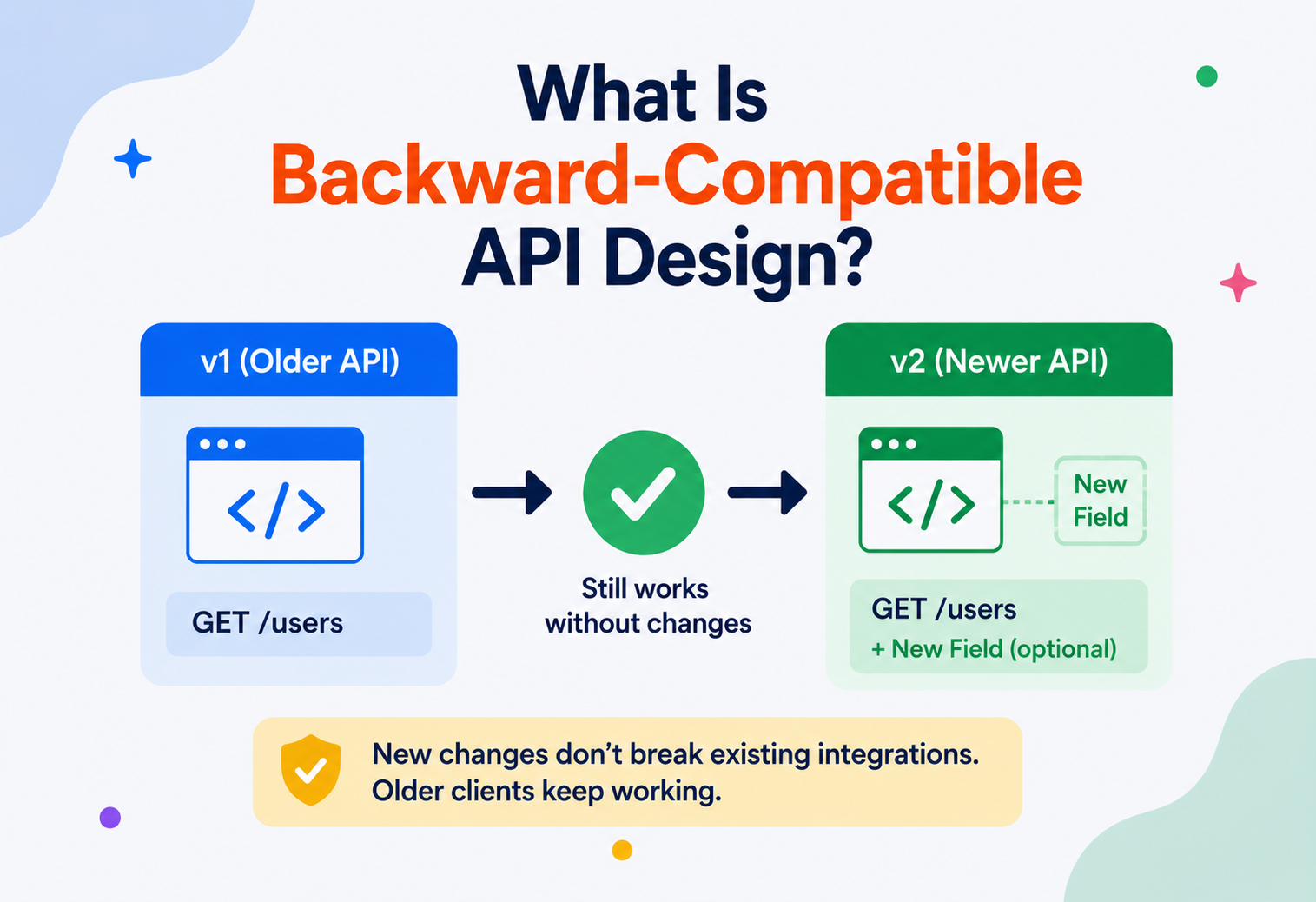
What Is Backward-Compatible API Design?
A complete, beginner-to-production walkthrough of how to evolve an API — adding features, fixing mistakes, improving performance — without ever disconnecting the phone number that existing callers already dialled. Real Java and Spring Boot examples, versioning strategies, and the mistakes that quietly wreck production systems.
Introduction & History
A postal-address analogy, and sixty years of software history that turned “don’t break your callers” into a survival requirement.
Imagine you publish a public phone number for your business. Thousands of customers save it in their contacts. One day, without warning, you change the number. Every customer who calls the old number gets silence. That is exactly what happens when an API changes in a way that breaks the applications calling it. Backward-compatible API design is the discipline of evolving an API — adding features, fixing mistakes, improving performance — without ever disconnecting the phone number that existing callers already dialled.
In plain terms: an API (Application Programming Interface) is a contract. It is a set of promises a service makes to anyone who wants to talk to it — “send me data in this shape, and I will respond in that shape.” Backward compatibility means that when the service changes internally, everyone who relied on the old contract keeps working exactly as before, even if they never update their code.
This guide walks through backward-compatible API design from first principles all the way to the practices used by large-scale production systems, with concrete Java and Spring Boot code, so that by the end you can confidently judge whether a proposed API change is safe to ship, and know exactly which tools and patterns to reach for when it isn’t.
1.1 · A short history of why this became a big deal
In the early days of software, most “APIs” were function calls inside a single program, compiled and shipped together. If you changed a function’s signature, you simply recompiled everything that used it. There was no such thing as “someone else’s code depending on your function without you knowing.”
That changed with three waves of software history.
Shared libraries & OS APIs
Windows Win32 and POSIX taught the industry that once you publish an interface, millions of programs depend on it — and Microsoft famously spent decades preserving compatibility so old software kept running on new Windows versions.
The rise of the public web API
Amazon, Twitter, Google Maps, Stripe, and Salesforce (2000s onwards) meant an API was no longer just internal — thousands of external companies, each with their own release schedules, wired their businesses directly into your endpoints.
The microservices era
Netflix, Amazon, and Uber from roughly 2010 onwards multiplied the problem internally: one company might have hundreds of services calling each other’s APIs, and even an “internal” breaking change could take down dozens of teams’ systems at once.
OpenAPI & contract diffing
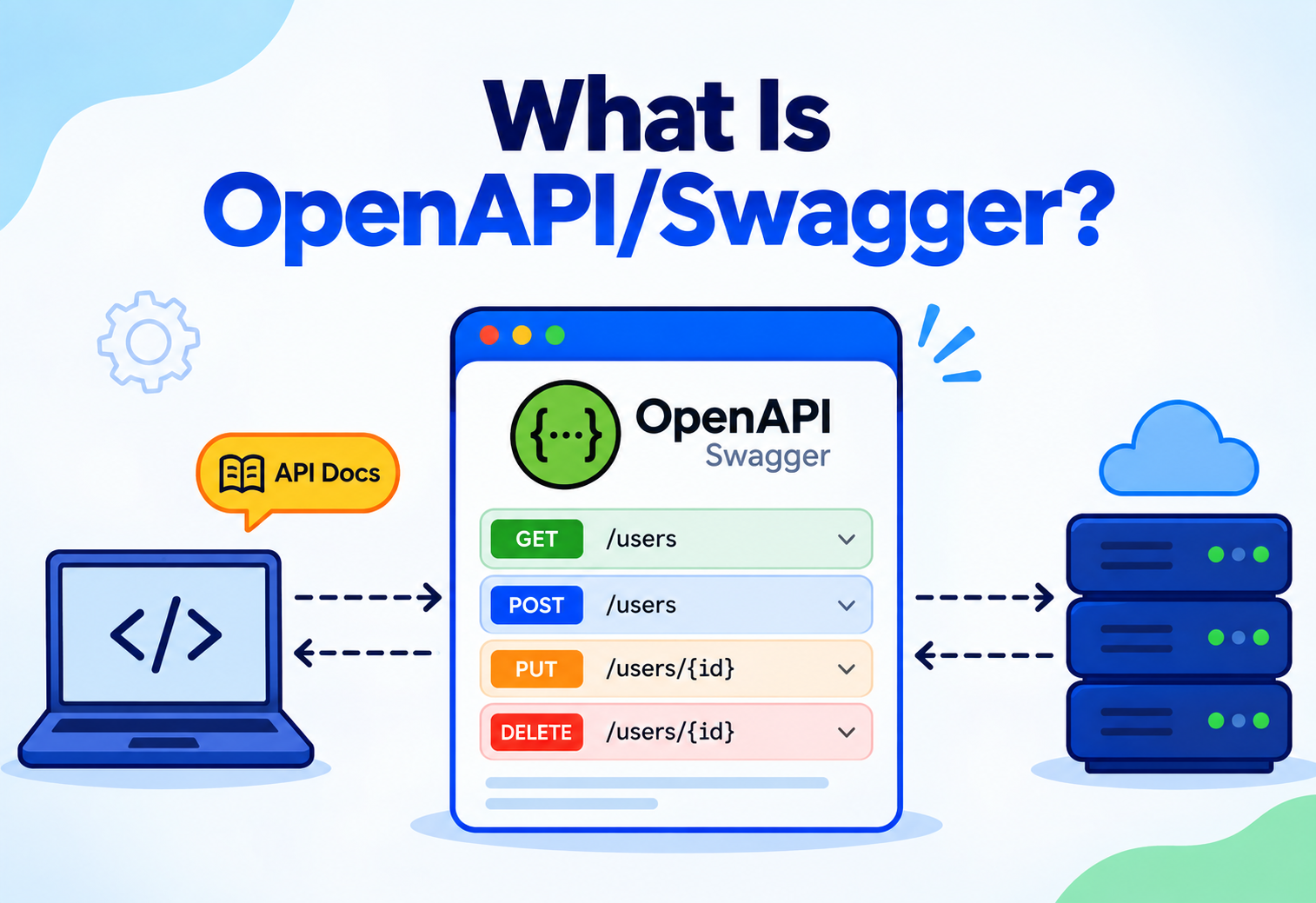
Tools like WSDL for SOAP and later the OpenAPI Specification (originally Swagger, donated to the Linux Foundation in 2016) gave teams a machine-readable document describing exactly what a contract promised. Suddenly a CI pipeline could catch breaking changes automatically, before a human reviewer even looked at the code.
Event-driven schemas & registries
Message brokers like Apache Kafka introduced consumers that might replay messages from months earlier. Confluent Schema Registry and AWS Glue Schema Registry mechanically enforce compatibility rules on every new schema version before it is allowed to be published at all.
By the time REST APIs and JSON became the default way services talk to each other, backward compatibility had gone from “a nice practice” to “a survival requirement.” A single breaking change published to a popular public API can generate thousands of support tickets, break customer billing systems, or — in the case of payment and healthcare APIs — cause real financial and legal damage.
Analogy · the postal address
Think of an API endpoint like your home’s postal address. People send you letters (requests) addressed to that exact street and number. You can renovate your house, repaint it, add a new room — none of that matters to the postal service or your friends, as long as the address stays valid and letters still reach you and get a response. Backward compatibility means: never change the address without leaving a working forwarding system behind.
The Problem & Motivation
Because the team that owns the API almost never controls when the callers upgrade.
Why does this deserve an entire discipline instead of “just be careful”? Because of a structural reality of distributed systems: the team that owns an API almost never controls when — or whether — the teams and applications consuming that API will update their code.
- Mobile apps. A user might not update their banking app for two years. The backend cannot force them to upgrade, yet it must keep serving them.
- Third-party integrations. A partner company plugged your payments API into their checkout flow. Changing your API’s request format means asking dozens of external engineering teams to redeploy, on their own schedule, which you don’t control.
- Internal microservices. In a large company, Service A calling Service B might be maintained by a completely different team, in a different time zone, with its own release calendar.
- IoT and embedded devices. A smart thermostat or car’s onboard computer might run the same firmware for a decade, calling the same API version the whole time.
The core motivation
If an API breaks every consumer whenever it changes, then evolving the API becomes terrifying — engineers stop improving it out of fear, or every change becomes a slow, coordinated, multi-team project. Backward compatibility exists so that the API can keep evolving quickly and safely, without becoming everyone else’s emergency.
2.1 · What “breaking” actually means
A change is “breaking” if any existing, correctly-written client, calling the API exactly as it did yesterday, would now get an error, wrong data, or different behaviour it did not ask for. This is a stricter bar than most engineers assume — even something as small as renaming a JSON field, changing a date format, or making an optional field required can break real production clients.
Beginner example renaming a param
You built a simple /greet?name=Amit endpoint that returns “Hello, Amit”. If you rename the query parameter from name to username, every existing caller using name now gets an error or an empty greeting — a breaking change.
Production example Stripe since 2011
Stripe’s payments API has supported dozens of versions since 2011. Merchants can be on a version from years ago while Stripe’s internal systems have moved far ahead — Stripe transforms requests and responses at the edge so old integrations keep working untouched.
Core Concepts
Ten terms — contract, breaking vs. additive, versioning, deprecation, SemVer, tolerant reader, Postel’s law, content negotiation, idempotency, consumer-driven contracts.
Before going further, let’s build a precise vocabulary. These terms will be used constantly throughout the rest of this guide.
3.1 · API contract
What. The formal or informal agreement describing the shape of requests and responses — field names, types, required/optional status, status codes, and behaviour.
Why. It is the thing you are promising never to silently violate.
Analogy. A restaurant menu is a contract — if the menu says “comes with fries,” the kitchen cannot start serving salad instead without telling anyone.
Example. An OpenAPI/Swagger specification file is a machine-readable version of this contract.
3.2 · Breaking vs. non-breaking (additive) change
What. A breaking change invalidates an existing client’s assumptions. A non-breaking (additive) change extends the contract without touching what already existed.
Why. This distinction is the single most important judgment call in API design.
| Change | Breaking? | Reason |
|---|---|---|
| Adding a new optional field to a JSON response | SAFE | Old clients ignore fields they don’t recognise. |
| Adding a new endpoint | SAFE | Nobody was calling it before. |
| Removing a field from a response | BREAKING | Clients reading that field now get null / undefined. |
| Renaming a field | BREAKING | Old field name disappears. |
| Making an optional request field required | BREAKING | Old requests that omitted it now fail validation. |
| Changing a field’s data type (string → number) | BREAKING | Deserialisation fails on the client. |
| Changing default sort order or pagination size | RISKY | Not a schema break, but changes observable behaviour clients may depend on. |
| Adding a new required header with a sensible default when absent | SAFE | Old requests still work via the default. |
| Changing an error’s HTTP status code (404 → 410) | BREAKING | Clients often branch logic on exact status codes. |
3.3 · API versioning
What. Explicitly labelling different iterations of an API (v1, v2…) so multiple versions can run side by side.
Why. Sometimes a breaking change is genuinely necessary; versioning lets you introduce it without forcing every consumer to move on day one.
Analogy. Think of it like editions of a textbook — the 3rd edition can reorganise chapters entirely, but bookstores keep selling the 2nd edition to students who already started their course with it.
Beginner example. GET /v1/users/42 vs GET /v2/users/42.
Production example. GitHub’s REST API is versioned via a date-based header (e.g. X-GitHub-Api-Version: 2022-11-28), letting GitHub ship changes while old integrations pin themselves to a known-good date.
3.4 · Deprecation
What. The formal process of marking an old API version or field as “going away soon,” giving consumers a runway to migrate before it is removed.
Why. You cannot support every version forever; deprecation is the humane way to eventually retire something.
Example. Twitter/X announcing “API v1.0 will be shut down on this date; migrate to v1.1,” with a long notice period and migration guide.
3.5 · Semantic versioning (SemVer)
What. A numbering convention MAJOR.MINOR.PATCH (e.g. 2.4.1) where MAJOR means breaking changes, MINOR means backward-compatible additions, and PATCH means backward-compatible bug fixes.
Why. It lets consumers instantly judge the risk of upgrading just by reading the version number.
Analogy. It’s like a food expiry label system — a quick glance tells you whether it’s safe to consume as-is or needs care.
3.6 · Tolerant reader pattern
What. A design principle for API clients — parse only the fields you need, and ignore anything unexpected, rather than validating the entire payload strictly.
Why. A strict client that rejects any unknown field will break the moment the server adds a harmless new field. Tolerant clients make the whole ecosystem more resilient.
Analogy. A tolerant reader is like someone who reads a letter for the key information and shrugs off unfamiliar handwriting flourishes, rather than refusing to read the letter because the signature style changed.
3.7 · Postel’s law (the robustness principle)
What. “Be conservative in what you send, be liberal in what you accept.” A foundational networking principle from early internet protocol design (Jon Postel, RFC 761, 1980).
Why. It underlies almost every backward-compatibility technique in this guide — send predictable, well-formed data yourself, but don’t be brittle about what you’ll tolerate from others.
3.8 · Content negotiation
What. A mechanism where the client and server agree on the exact representation of a resource using HTTP headers like Accept and Content-Type, rather than encoding the version in the URL.
Why. It lets one logical resource URL (/orders/42) serve multiple response shapes depending entirely on what the caller asks for, keeping URLs stable forever.
Beginner example. A browser sends Accept: text/html and gets a web page; an API client sends Accept: application/json and gets JSON — the same underlying resource, two representations.
Production example. GitHub’s API lets clients specify Accept: application/vnd.github.v3+json to pin exact behaviour without ever touching the URL structure.
3.9 · Idempotency and compatibility
What. An idempotent operation produces the same result no matter how many times it’s repeated (e.g. PUT requests, or POST requests carrying an idempotency key).
Why it matters here. When you introduce retries, timeouts, or new failure-handling logic as part of an API evolution, changing whether an operation is idempotent is itself a subtle breaking change — clients that safely retried a call before may now accidentally duplicate an order or a payment.
Analogy. Pressing an elevator call button five times doesn’t summon five elevators — pressing it repeatedly is idempotent. If a redesign suddenly made repeated presses call multiple elevators, that would be a dangerous, breaking change in behaviour, even though the button looks the same.
3.10 · Consumer-driven contracts
What. Instead of the API provider guessing what matters to consumers, each consumer explicitly publishes a small, executable specification of exactly which fields and behaviours it depends on.
Why. It flips the responsibility — the provider’s CI/CD pipeline runs every registered consumer’s contract before every deploy, so “did I just break someone” becomes a fast, automated, precise answer instead of a guess.
Production example. Tools like Pact are widely used in microservices teams (including at companies like Atlassian and REA Group) specifically to implement this pattern at scale.
Beginner takeaway
If you remember only one sentence from this section: additive changes are (usually) safe, and anything that removes, renames, restricts, or repurposes an existing field or behaviour is (usually) breaking. Everything else in this guide is built on that one rule.
Architecture & Components
Gateway, version router, adapters, schema registry, deprecation metadata, contract tests — the pieces working together.
Backward compatibility isn’t a single feature you switch on — it’s the outcome of several architectural pieces working together. Here’s what a backward-compatibility-aware API architecture typically looks like.
4.1 · Key components
1 · API Gateway / Version Router Entry point
The entry point that inspects the incoming request — URL path, header, or query parameter — and decides which version of behaviour to apply. This keeps versioning logic out of core business code.
2 · Response/Request Transformers Adapters
Small translation layers that convert between the API’s external contract (what version 1 clients expect) and the internal canonical model (what the current code actually works with). Instead of maintaining three separate codebases for v1, v2, v3, you maintain one modern core and thin adapters at the edges.
3 · Schema Registry Guardrail
A central, often machine-enforced catalog of every schema version ever published (common in event-driven systems like Kafka using Avro/Protobuf, and in REST via OpenAPI specs). It mechanically checks whether a proposed schema change is backward-compatible before it’s allowed to be deployed.
4 · Deprecation & Sunset Metadata Runway
HTTP headers (like Deprecation and Sunset, defined in RFC 8594) or documentation flags that tell consumers, programmatically, “this version still works today but will stop on this date.” Mature teams even build automated tooling that scans these headers across their own internal service calls, opening tickets for teams still calling a soon-to-be-retired endpoint, rather than relying purely on humans reading changelogs.
5 · Contract Tests CI/CD gate
Automated tests (e.g. using Pact or Spring Cloud Contract) that run in CI/CD and fail the build if a proposed code change would break the published contract that consumers rely on — catching breaking changes before they ever reach production.
Real-life analogy
Think of a large train station with multiple platforms for different eras of trains — steam-era platforms are long retired, but the station didn’t tear down the whole building each time technology changed. It added new platforms, kept clear signage about which platform serves which route, and eventually closed old platforms only after posting clear, long-advance notices.
How It Works Internally
A concrete Java / Spring Boot walkthrough — from a v1 DTO to a modern canonical model with per-version adapters, tolerant deserialisation, and a CI schema-diff gate.
Let’s go under the hood with a concrete Java / Spring Boot example. Suppose we run an e-commerce order API. Version 1 was designed simply; over time we need to evolve it.
5.1 · The original v1 contract
// v1 response DTO
public class OrderResponseV1 {
    private String orderId;
    private String customerName;   // single combined name field
    private double totalAmount;    // in whatever currency, implicitly USD
    private String status;         // "PENDING", "SHIPPED", "DELIVERED"
    // getters and setters
}
5.2 · Business needs evolve
Now the business wants to split customerName into firstName/lastName, add explicit currency support, and add a new “REFUNDED” status. Splitting a field and adding a currency requirement are breaking changes if done carelessly. Here’s how to do it safely.
5.3 · Introduce an internal canonical model
// Internal, version-agnostic domain model — the "source of truth"
public class Order {
    private String orderId;
    private String firstName;
    private String lastName;
    private Money total;           // Money{ amount, currencyCode }
    private OrderStatus status;    // enum: PENDING, SHIPPED, DELIVERED, REFUNDED
    // ...
}
5.4 · Write an adapter that reconstructs the old v1 shape
@Component
public class OrderV1Adapter {

    public OrderResponseV1 toV1(Order order) {
        OrderResponseV1 dto = new OrderResponseV1();
        dto.setOrderId(order.getOrderId());
        // Recombine split fields so old clients see the old shape
        dto.setCustomerName(order.getFirstName() + " " + order.getLastName());
        dto.setTotalAmount(order.getTotal().getAmount()); // assume USD for legacy
        // Map new status back into one the old client understands
        dto.setStatus(mapStatusForV1(order.getStatus()));
        return dto;
    }

    private String mapStatusForV1(OrderStatus status) {
        // v1 clients have never heard of REFUNDED — degrade gracefully
        if (status == OrderStatus.REFUNDED) {
            return "DELIVERED"; // closest known-safe status, documented behavior
        }
        return status.name();
    }
}
5.5 · Route by version at the controller layer
@RestController
public class OrderController {

    private final OrderService orderService;
    private final OrderV1Adapter v1Adapter;

    @GetMapping(value = "/v1/orders/{id}")
    public OrderResponseV1 getOrderV1(@PathVariable String id) {
        Order order = orderService.findById(id);
        return v1Adapter.toV1(order); // old shape, guaranteed stable
    }

    @GetMapping(value = "/v2/orders/{id}")
    public OrderResponseV2 getOrderV2(@PathVariable String id) {
        Order order = orderService.findById(id);
        return OrderResponseV2.fromDomain(order); // new, richer shape
    }
}
What’s really happening internally
The business logic and database only ever know about ONE modern model (Order). Version compatibility is handled entirely at the edges by lightweight, well-tested adapter classes. This is what lets teams move fast internally while honouring old contracts externally — you’re not maintaining three parallel systems, just three thin translation layers over one system.
5.6 · Handling unknown fields gracefully (the tolerant reader, server-side)
When deserialising incoming JSON requests, configure your JSON library to ignore fields it doesn’t recognise, rather than throwing an error — this lets newer clients send extra fields without breaking older server code that hasn’t caught up yet.
@Bean
public ObjectMapper objectMapper() {
    ObjectMapper mapper = new ObjectMapper();
    // Do NOT fail when the JSON has fields the DTO doesn't declare
    mapper.configure(DeserializationFeature.FAIL_ON_UNKNOWN_PROPERTIES, false);
    return mapper;
}
5.7 · Seeing it end-to-end from the client’s perspective
Here’s what the same resource looks like across two live versions, side by side, from a plain HTTP client’s point of view:
$ curl https://api.gauravsinghtech.com/v1/orders/42
{
  "orderId": "42",
  "customerName": "Priya Sharma",
  "totalAmount": 1499.00,
  "status": "DELIVERED"
}

$ curl https://api.gauravsinghtech.com/v2/orders/42
{
  "orderId": "42",
  "firstName": "Priya",
  "lastName": "Sharma",
  "total": { "amount": 1499.00, "currencyCode": "INR" },
  "status": "DELIVERED",
  "refundEligible": true
}
Notice both requests hit the same underlying order record in the database — the difference is entirely produced by which adapter the controller routed the request through. Nothing about the v1 caller’s experience changed, even though the v2 shape is meaningfully richer and more precise (explicit currency, split name fields, a brand-new refundEligible flag).
5.8 · Validating compatibility automatically with schema diffing
Beyond manual review, many teams wire an OpenAPI diff tool directly into CI/CD so that a pull request modifying the API spec is automatically checked against the previously published spec:
# Example CI step using an OpenAPI breaking-change detector
openapi-diff previous-spec.yaml new-spec.yaml --fail-on-incompatible

# Typical output on a violation:
# BREAKING: Property 'customerName' was removed from OrderResponseV1
# BREAKING: Property 'status' enum values changed (removed: 'DELIVERED')
# Build failed: 2 incompatible changes detected
This turns backward compatibility from a matter of individual engineer diligence into a mechanically enforced build gate — the same way unit tests prevent logic regressions, schema diffing prevents contract regressions.
Data Flow & Lifecycle
From “propose a change” to “retire the old version” — the six stages a mature API change actually walks through.
Let’s trace the full lifecycle of an API change, from proposal to eventual sunset of the old version — this is the process, not just the code.
6.1 · The typical lifecycle stages
Design & review
The proposed change is checked against the existing contract — often mechanically, using schema-diff tools.
Additive rollout
If possible, the change ships as a pure addition (new optional field, new endpoint) with zero impact to existing consumers.
Parallel versions (if breaking is unavoidable)
A new version is introduced alongside the old one; both are served simultaneously.
Deprecation announcement
The old version is marked deprecated with a clear sunset date, communicated via headers, docs, changelogs, and often direct emails to registered API consumers.
Migration window
Consumers are given weeks, months, or years (depending on the API’s criticality) to move to the new version, often with usage dashboards showing which clients are still on the old path.
Sunset
The old version is finally turned off, sometimes after final warning emails to the small number of remaining callers.
Pros, Cons & Trade-offs
Compatibility is not free — every kept-alive version is code someone must still test, secure, and reason about.
| Benefit | Cost / Trade-off |
|---|---|
| Consumers never experience surprise outages from your changes. | Requires maintaining adapter / translation code for old versions, adding complexity. |
| Teams can ship improvements faster, without fear of breaking others. | Multiple live versions increase testing surface and infrastructure cost. |
| Builds trust with external partners and API consumers. | Deprecated code paths can linger for years, becoming technical debt. |
| Enables independent deployability in microservices (a core promise of the architecture). | Requires discipline: contract tests, schema registries, review processes. |
| Reduces “big bang” coordinated release pain across teams. | Slower to fully remove a genuinely bad early design decision. |
The honest trade-off
Backward compatibility is not free. Every old version you keep alive is code someone must still test, secure, and reason about. The skill is not “never break anything ever” — it’s knowing when a breaking change is worth the coordinated migration cost, and doing it deliberately, with versioning and communication, rather than accidentally.
Performance & Scalability
Adapter overhead, cache-key explosion, bulk-operation blast radius, and the “number of live versions” metric mature teams actively manage.
Maintaining backward compatibility has real, measurable performance implications, especially at scale.
8.1 · Adapter overhead
Every request through a translation layer costs CPU cycles and adds latency — usually microseconds for simple field mapping, but it can add up under very high throughput. Netflix and similar large-scale API providers typically keep these transformers extremely lightweight (pure in-memory mapping, no extra database calls) precisely because they run on every request, at massive scale.
8.2 · Multiplied testing and infrastructure surface
If you support v1, v2, and v3 simultaneously, your load tests, canary deployments, and monitoring dashboards must all account for three behaviourally-different code paths, not one. This is a real scaling cost on engineering time, not just servers.
8.3 · Caching implications
Different API versions returning different response shapes for “the same resource” means cache keys must include the version (e.g. cache:orders:42:v1 vs cache:orders:42:v2), roughly multiplying cache memory usage by the number of live versions.
Production example
Large-scale API providers like Amazon and Stripe run version-routing logic at the edge / gateway layer — geographically distributed and horizontally scaled — specifically so that version-translation overhead never becomes a bottleneck for the core business logic behind it.
8.4 · Scaling the number of supported versions, not just the traffic
There’s a second, less obvious scalability dimension: as an API matures, the number of simultaneously supported versions tends to grow, and each one adds a small but real tax — extra branches in routing logic, extra rows in monitoring dashboards, extra paths in load tests, extra entries in on-call runbooks. Mature API teams treat “number of live versions” as a metric to actively manage and minimise, the same way they’d manage server cost or latency, rather than letting it grow unboundedly. A healthy target many teams use is supporting no more than two or three versions at any given time, with a firm policy to retire the oldest one before a new one ships.
8.5 · Batch and bulk operations amplify compatibility costs
For APIs supporting bulk operations (e.g. uploading a batch of 10,000 records in one call), a subtle compatibility issue in the per-item schema gets multiplied enormously — a single incompatible field can cause thousands of records to fail validation in one request, rather than a single failed request. This is why high-throughput, bulk-oriented APIs (billing systems, ETL pipelines, ad-serving platforms) tend to be especially conservative about backward compatibility, since the “blast radius” of a mistake scales directly with batch size.
High Availability & Reliability
A silent breaking change is, functionally, an outage — even though your servers are technically up.
Backward compatibility and high availability reinforce each other in an important way: a breaking change deployed without warning is, functionally, an outage for every client that depended on the old behaviour — even though your servers are technically “up.”
9.1 · Reliability practices tied to compatibility
- Canary releases. Roll a new API version out to a small percentage of traffic first, watching error rates before a full rollout — this catches accidental breaking changes before they hit everyone.
- Feature flags for API behaviour. Gate new response shapes behind flags so they can be instantly rolled back if consumers report problems.
- Blue-green deployment of API gateways. Keep the previous gateway version running and ready to receive traffic instantly if the new routing logic misbehaves.
- Consumer-driven contract testing. Real consumer teams publish their expectations (e.g. via Pact), and the API provider’s CI/CD runs those tests before every deploy — turning “did we break someone” from a guess into an automated check.
Analogy
A hospital doesn’t rewire its emergency room’s call button system during business hours without a backup system in place. High availability for APIs means the “call button” (your endpoint) keeps working through every renovation happening behind the wall.
9.2 · Graceful degradation for partially-failed adapters
A well-built compatibility layer should fail safely. If the adapter that translates the modern internal model back into a v1 response encounters unexpected data (say, a new order status the v1 adapter was never taught to map), the right behaviour is a documented fallback — mapping to the closest known-safe value and logging a warning — rather than throwing a 500 error and taking down an otherwise healthy request. Treating compatibility adapters as a first-class part of your reliability surface, with their own tests and alerts, is what separates mature API platforms from ones where “it happened to still work” was never actually verified.
Security Considerations
The one narrow case where breaking faster is the right answer, and the zombie v1 endpoints attackers love.
Backward compatibility and security occasionally pull in opposite directions, and knowing how to resolve that tension matters.
10.1 · Security fixes sometimes must break compatibility
If v1 of an API has an authentication flaw (e.g. accepting weak tokens, or leaking a field it shouldn’t), the safe fix may genuinely require breaking old behaviour. In this narrow case, security wins — you deprecate and force migration faster than you normally would, with clear, urgent communication.
10.2 · Long-lived old versions become attack surface
Every old API version you keep alive for compatibility is also a code path that must keep receiving security patches, dependency updates, and monitoring. Abandoned “zombie” v1 endpoints that nobody actively maintains are a common source of real-world breaches.
10.3 · Don’t leak internal implementation details through compatibility shims
Adapter / translation layers sometimes accidentally expose internal field names, stack traces, or debug data while trying to “preserve” old behaviour. Always apply the same input validation, authentication, and rate-limiting uniformly across every supported version.
Common mistake
Teams sometimes keep an old, insecure authentication method alive indefinitely purely “for backward compatibility,” creating a permanent weak entry point. The correct pattern is a time-boxed exception — supported temporarily, with an enforced, published sunset date — not a permanent one.
10.4 · Rate limiting and abuse controls across versions
Rate limits, authentication requirements, and abuse-detection rules should generally be enforced consistently regardless of which API version a request targets. A common gap is that a legacy v1 endpoint, kept alive purely for a small number of old integrations, quietly falls outside newer security tooling (like updated WAF rules or bot detection) that was only wired up to the newer v2 / v3 paths — silently turning the “harmless old version” into the weakest link an attacker will specifically look for.
10.5 · Versioning your security posture, not just your data shapes
It’s worth explicitly separating two different kinds of “version” that sometimes get conflated: the data-shape version (v1 vs. v2 JSON schema) and the security-policy version (which TLS versions, token formats, or password hashing algorithms are accepted). A field-level breaking change and a security-policy breaking change require different handling — the former usually deserves a long, gentle migration window, while the latter, once a real vulnerability is confirmed, usually deserves a short, firm one, communicated as an urgent security advisory rather than a routine changelog entry.
Monitoring, Logging & Metrics
You cannot safely deprecate what you cannot measure.
You cannot safely deprecate what you cannot measure. Effective backward-compatibility programs are built on solid observability.
11.1 · What to track
- Per-version traffic volume. How many requests per second are hitting
/v1vs./v2? This tells you when it’s actually safe to sunset an old version. - Per-consumer version usage. Which specific API keys, client IDs, or partners are still using the old version? This lets you reach out directly instead of guessing.
- Deprecated field usage. Logging (sampled, for cost reasons) which deprecated response fields are actually being read by clients versus silently ignored.
- Error rate deltas after deploys. A spike in 400 / 422 errors immediately after a deploy is often the first sign of an accidental breaking change.
- Schema validation failures. In event-driven systems, a schema registry logging rejected messages tells you exactly which producer sent an incompatible payload.
// Example: structured logging to track version usage per request (Spring Boot)
@Component
public class ApiVersionMetricsFilter extends OncePerRequestFilter {

    private final MeterRegistry meterRegistry;

    @Override
    protected void doFilterInternal(HttpServletRequest request,
                                     HttpServletResponse response,
                                     FilterChain chain) throws IOException, ServletException {
        String version = extractVersion(request.getRequestURI()); // "v1", "v2"...
        meterRegistry.counter("api.requests.by_version", "version", version).increment();
        chain.doFilter(request, response);
    }
}
Beginner example
Even a simple dashboard counting “requests to /v1 per day” over a few months, trending toward zero, is enough evidence to confidently retire an old version — without it, teams either sunset too early (breaking real users) or never sunset at all (accumulating debt forever).
Deployment & Cloud
Gateway routing, canary rollouts, and feature-flagged schema fields.
How you deploy backward-compatible APIs in the cloud matters as much as how you design them.
12.1 · API gateway-based version routing
Cloud API gateways (AWS API Gateway, Azure API Management, Kong, Apigee) natively support routing by path (/v1, /v2), by header, or by the Accept media-type — letting you deploy new backend versions without touching how clients already address the API.
12.2 · Rolling and canary deployments
Kubernetes-based deployments commonly use canary rollouts (via Istio, Argo Rollouts, or native Kubernetes deployments) to send a small percentage of live production traffic to a new API version, watching real error rates and latency before shifting 100% of traffic over.
12.3 · Feature-flagged schema changes
Tools like LaunchDarkly let teams turn a new response field on for specific consumers first (e.g. internal QA, then a friendly beta partner) before a global rollout — catching integration issues with real traffic at low risk.
Production example
Google Cloud’s APIs are versioned and deployed such that older client libraries, generated years earlier, continue to work against current backend services — Google’s deployment pipeline enforces compatibility checks before any API change reaches production, catching accidental breaks automatically rather than relying purely on manual review.
Databases, Caching & Load Balancing
Expand-contract migrations, version-aware cache keys, per-version LB rules, and the eventual-consistency gotcha in read replicas.
13.1 · Database schema evolution mirrors API evolution
The same principles apply one layer down. Adding a nullable column is safe; renaming or dropping a column that old application code still reads is breaking. Techniques like the expand-contract pattern (also called parallel change) directly mirror API versioning:
Expand
Add the new column alongside the old one; write to both.
Migrate
Backfill data, update readers to use the new column, verify.
Contract
Once nothing reads the old column, safely drop it.
13.2 · Caching across versions
As mentioned earlier, cache keys must be version-aware. A common mistake is caching a transformed v1 response under the same key as the v2 response for “the same resource,” causing one version’s clients to silently receive the wrong shape of data.
13.3 · Load balancing by version
Path- or header-based routing rules at the load balancer (not just the application layer) let operations teams scale v1 and v2 traffic independently — useful when v1 traffic is a tiny, steady trickle while v2 traffic is growing fast and needs more compute.
13.4 · Read replicas and eventual consistency during migrations
During an expand-contract database migration, it’s common to have write traffic hit a primary database while read traffic is served from replicas that may lag by a few hundred milliseconds. If an API’s v2 response depends on newly migrated columns, but a read replica hasn’t caught up yet, clients can briefly see inconsistent or partially-migrated data. Careful teams either route “just written” reads to the primary temporarily, or explicitly document this brief eventual-consistency window as part of the migration’s known limitations, rather than treating it as a surprise bug reported by confused API consumers.
APIs & Microservices
Compilers stop being your safety net — runtime contracts, schema registries, and consumer-driven Pact tests take their place.
Backward compatibility is arguably more critical inside a microservices architecture than for public APIs, because the number of internal consumers can be enormous and mostly invisible to the team making a change.
14.1 · Why microservices raise the stakes
In a monolith, if you change a function signature, the compiler tells you immediately, in the same codebase, which callers break. In microservices, Service B’s contract with Service A is checked at runtime, across a network, often without the Service B team even knowing every consumer that exists.
Common failure mode
Team A changes an internal event schema, assuming “only Team B consumes this.” In reality, Team C added a listener eight months ago without telling anyone. Team A’s “safe” change silently breaks Team C’s service in production — a classic argument for schema registries and event contracts, not just tribal knowledge.
14.2 · Techniques specific to microservices
Consumer-driven contracts Pact
Each consuming service publishes exactly what fields / behaviours it depends on; the provider’s CI runs all these contracts before every deploy.
Schema registries for events Kafka + Avro/Protobuf
Enforce compatibility rules (BACKWARD, FORWARD, or FULL compatibility modes) mechanically at publish time — an incompatible schema simply cannot be registered.
API gateways as a compatibility firewall Version-aware
Internal gateways can enforce that services never call each other’s endpoints directly, always through a version-aware router.
Service meshes Istio · Linkerd
Provide fine-grained, version-aware traffic routing between services without changing application code.
14.3 · Java example — a Kafka consumer tolerant of schema evolution
// Avro-generated OrderEvent class evolves over time.
// Using Avro's schema resolution, old consumers reading new-schema
// messages simply ignore fields they don't know about — as long as
// the schema evolution follows BACKWARD compatibility rules
// (new fields must have defaults; no required-field removal).

@KafkaListener(topics = "order-events", groupId = "billing-service")
public void handleOrderEvent(OrderEvent event) {
    // Even if the producer added new fields last week,
    // this older consumer code keeps working unmodified
    processBilling(event.getOrderId(), event.getTotalAmount());
}Design Patterns & Anti-Patterns
Five proven patterns, four anti-patterns that quietly wreck production.
15.1 · Proven patterns
1 · URI Versioning Visible
/v1/orders, /v2/orders. Simple, highly visible, easy to route at the gateway / CDN layer. Downside: technically, the “same resource” now has multiple URLs.
2 · Header / Media-Type Versioning RESTful
Accept: application/vnd.gauravsinghtech.v2+json. Keeps URLs stable while versioning the representation — RESTfully “correct,” but less visible / discoverable and harder to test by just pasting a URL in a browser.
3 · Additive-Only Evolution The strongest
The strongest pattern of all: design fields so you almost never need to remove or rename anything — only add optional fields and new endpoints. This avoids the need for versioning entirely for a long time.
4 · Expand-Contract (Parallel Change) Migration
Covered above for databases; applies equally to APIs — add the new field / endpoint, run both in parallel, migrate consumers, then remove the old one only after usage hits zero.
5 · Strangler Fig Rewrite
When migrating an entire legacy API to a new architecture, route traffic gradually — some endpoints go to the new system, others still hit the old one — until the old system can be fully “strangled” and retired, with backward compatibility maintained throughout via the gateway.
15.2 · Anti-patterns to avoid
Anti-pattern · silent field repurposing
Reusing an existing field for a new, different meaning (e.g. a status field that used to mean “shipping status” now means “payment status” in a new deploy). This is invisible in a diff review and devastating in production, because old clients keep parsing the field successfully — just with the wrong meaning.
Anti-pattern · “we’ll just tell everyone to update”
Assuming all consumers will update instantly upon announcement. In reality, migration always takes far longer than expected — plan and monitor for a long tail of stragglers, not a clean cutover.
Anti-pattern · version sprawl
Keeping every version ever released alive forever “just in case,” with no monitoring or sunset plan. This eventually makes the system unmaintainable and insecure (see the Security section).
Anti-pattern · breaking changes disguised as bug fixes
Treating a behaviour fix (e.g. “we fixed a bug where discounts were applied twice”) as a patch-level change without realising some consumers built logic that depended on the buggy behaviour. Communicate behaviour changes with the same care as schema changes.
Best Practices & Common Mistakes
Nine habits, five recurring mistakes, and a six-question pre-release checklist.
16.1 · Best practices
Default to additive changes
Before reaching for a new version, ask: can this be a new optional field or new endpoint instead?
Make unknown fields safe by default
Configure clients and servers to ignore fields they don’t recognise (tolerant reader pattern) rather than failing strictly.
Use explicit, machine-readable versioning
Path- or header-based, backed by an OpenAPI spec or schema registry — not tribal knowledge.
Automate contract testing in CI/CD
Let the build fail loudly, before deploy, rather than letting a real consumer discover the break.
Publish a clear deprecation policy up front
“We support each major version for at least 18 months after a new one ships” sets expectations before you ever need to break anything.
Monitor per-version and per-consumer usage
Never sunset a version you haven’t verified is actually unused.
Communicate early, often, and through multiple channels
Changelog, deprecation headers, direct emails to registered API keys, dashboard banners.
Provide migration guides and, ideally, tooling
Codemods, SDK updates, or side-by-side comparison docs dramatically speed up consumer migration.
Treat behaviour changes with the same rigour as schema changes
Sort order, rounding behaviour, timezone handling, and error message wording can all be “breaking” even if the JSON schema is untouched.
16.2 · Common mistakes
| Mistake | Why it hurts |
|---|---|
Changing a date format from “DD-MM-YYYY” to ISO 8601 without versioning, assuming “it’s just a format tweak.” | Every client’s date parser breaks or silently misparses the date (e.g. swapping day and month), which is far more dangerous than an obvious error — it’s wrong data, not a failure. |
| Forgetting that pagination defaults (like page size) are part of the contract. | A client that assumed 20 items per page and manually loops “until fewer than 20 come back” breaks silently if you quietly change the default page size to 50. |
| Not versioning error responses. | Clients often branch on specific error codes or messages; changing an error’s shape or wording can break error-handling logic just as badly as breaking a success response. |
| Tightening validation rules on an existing field (e.g. a phone-number field that used to accept any string now requires strict E.164 format). | Requests that were previously accepted now get rejected with a 400 error, even though nothing about the client’s code changed — the contract quietly got stricter underneath them. |
| Assuming internal APIs don’t need the same discipline as public ones, “since we control both sides.” | In any organisation past a handful of engineers, “we control both sides” quickly becomes false — other teams add consumers without informing the API owner, exactly as described in the microservices section above. |
16.3 · A simple pre-release checklist
Before shipping any API change, teams that take backward compatibility seriously typically walk through a short checklist like this one:
- Does this change add something new, or does it remove / rename / restrict something that already existed?
- Have I run the change through an automated schema diff or contract test suite?
- If this is breaking, is a new version genuinely warranted, or can it be made additive instead?
- Have I checked real traffic / logs for whether any consumer relies on the specific behaviour I’m changing?
- Is there a documented deprecation and sunset plan, with a realistic migration window, if an old version is being replaced?
- Have error responses, status codes, and edge-case behaviours been reviewed with the same care as the “happy path” response shape?
Real-World / Industry Examples
Stripe, GitHub, Google Maps, Netflix, Kubernetes, AWS — six ways big companies turn compatibility into policy.
Stripe Per-merchant pinning
Stripe pins each merchant account to the API version active when they first integrated, and transforms requests / responses at the edge so that a merchant integrated in 2015 keeps receiving the exact response shape their code expects, even as Stripe’s internal models evolve continuously underneath.
GitHub Date-based headers
GitHub’s REST API uses date-based versioning via a header, allowing changes to ship on specific dates while integrations explicitly opt in by specifying which date’s behaviour they want, rather than being forced onto the newest behaviour automatically.
Google Maps Platform Long deprecation
Google maintains long-term support for older versions of its Maps JavaScript API and mobile SDKs, publishing clear deprecation timelines (often a year or more) before retiring an old version, given how many production applications embed map integrations that are rarely revisited.
Netflix Device fan-out
Netflix’s internal microservices architecture, serving devices ranging from smart TVs to game consoles with wildly different update cycles, relies heavily on API gateway-level adaptation so that older device firmware — sometimes years old — continues to receive a response shape it can parse, even as Netflix’s backend services evolve continuously.
Kubernetes Alpha/Beta/GA
The Kubernetes API famously follows a strict deprecation policy: a stable (GA) API version must be supported for a minimum guaranteed period after being marked deprecated, with clear rules published for how long alpha, beta, and stable APIs are each supported before removal — giving the entire ecosystem of tools built on Kubernetes predictable migration windows.
AWS Near-absolute stance
AWS operates hundreds of public service APIs consumed by millions of customer applications, many of them mission-critical. AWS’s long-standing public commitment is that existing API operations and parameters are not removed or changed in incompatible ways once released — new functionality is added as new API operations, new optional parameters, or entirely new API versions, precisely so that infrastructure-as-code and automation scripts written years ago keep working without modification. This near-absolute stance on compatibility is a major reason large enterprises trust AWS as a foundation for critical infrastructure.
The common thread
Every one of these companies treats backward compatibility not as an occasional courtesy, but as a formal, documented, monitored policy — with explicit support windows, automated enforcement, and dedicated tooling. That’s the level of discipline production-grade API design requires.
FAQ, Summary & Key Takeaways
Eight recurring questions, one paragraph summary, and nine ideas to carry away.
Q1 · Is backward compatibility the same as backward-compatible database migrations?
They’re closely related but not identical. Database schema compatibility is about not breaking application code that reads / writes the database directly; API compatibility is about not breaking any external caller of the API. Well-designed systems apply the same expand-contract discipline to both.
Q2 · Do I need versioning if my API has only one internal consumer?
Often not — if you truly control every caller and can coordinate a synchronised deploy, you can make breaking changes without formal versioning. But “only one consumer today” often becomes “several consumers, discovered too late” as systems grow — many teams version defensively for this reason.
Q3 · How long should a deprecated API version stay alive?
It depends entirely on your consumer base. Public, high-traffic consumer APIs (payments, mobile app backends) often need 12–24 months. Tightly coordinated internal microservices might safely retire an old version in weeks. The right answer is: as long as real, measured usage remains non-trivial.
Q4 · Is GraphQL immune to this problem?
No — GraphQL reduces some versioning pain because clients request only the fields they need (so unused field removal is safer), but removing or changing the type of a field still breaks any client that queries it. GraphQL schemas still need the same additive-first discipline and deprecation directives (@deprecated).
Q5 · What’s the difference between backward compatibility and forward compatibility?
Backward compatibility means new server code still works with old clients. Forward compatibility means old server code can gracefully handle data sent by newer clients (e.g. by ignoring unknown fields). Robust systems aim for both wherever possible.
Q6 · Should every API change go through a full versioning process?
No — that would make evolution painfully slow. Reserve full versioning for genuinely breaking changes. Purely additive changes (new optional fields, new endpoints, new enum values that clients are documented to tolerate) can usually ship directly into the current version without any version bump at all.
Q7 · How do mobile apps handle backward compatibility differently from web apps?
Web apps are usually reloaded on every visit, so users are almost always on the latest client code. Mobile apps can lag for months or years behind app-store approval cycles and users who simply never update. This is why mobile-facing APIs typically need much longer support windows and more conservative deprecation timelines than purely web-facing ones.
Q8 · What is a “breaking change” from an event-driven system’s perspective?
In addition to the usual schema rules, event systems have an extra wrinkle: consumers may replay old messages long after they were produced. A change is safe only if both old and new message formats remain readable by both old and new consumer code for as long as replay is possible — which is why schema registries formally define compatibility modes like BACKWARD, FORWARD, and FULL, and enforce them mechanically.
18.1 · Summary
Backward-compatible API design is the practice of evolving an API’s contract — adding features, fixing bugs, restructuring internals — without breaking the applications that already depend on it. It rests on a clear vocabulary (breaking vs. additive changes, versioning, deprecation), a small set of architectural tools (adapters, gateways, schema registries, contract tests), and organisational discipline (monitoring usage, communicating early, giving real migration windows). Every major technology company running at scale — Stripe, GitHub, Google, Netflix, Kubernetes, AWS — treats this as a formal, documented, and automated policy, not an informal best-effort courtesy.
18.2 · Key takeaways
- An API is a contract; backward compatibility means never silently violating that contract for existing callers.
- Additive changes (new optional fields, new endpoints) are almost always safe; removing, renaming, restricting, or repurposing anything is almost always breaking.
- Use explicit versioning (URL path or headers) plus a documented deprecation policy when a breaking change is genuinely unavoidable.
- Keep one modern internal model and translate to old contracts at thin adapter layers — don’t maintain N parallel codebases.
- Automate the safety net: contract tests, schema registries, and CI/CD checks catch breaking changes before real consumers do.
- Monitor per-version and per-consumer traffic before sunsetting anything — never guess.
- Security exceptions are the one case where breaking compatibility faster is justified — but still do it with clear, urgent communication.
- The goal isn’t “never change anything” — it’s evolving quickly and confidently, because you know exactly who depends on what, and you’ve built the tooling to protect them.
- Backward compatibility is a habit reinforced continuously — through code review culture, automated CI/CD gates, and how a team defines “done” for any change — not a single decision made once and forgotten.