Certifications That Matter for Architect Roles in India
A practical, no-fluff walkthrough of which certifications actually move the needle for Solution, Enterprise, Cloud, and Technical Architect roles across Indian IT — and which ones are mostly resume decoration.
Introduction & Evolution
From scar tissue to paper trail — how the “architect” title in Indian IT went from something you earned by surviving outages to something clients ask you to prove on paper.
Twenty years ago, “architect” in Indian IT usually meant one thing: a senior developer who had survived enough production outages to be trusted with the whole system diagram. There was no standard credential for it. You earned the title through scar tissue — failed deployments, 3 a.m. war rooms, and years of being the person everyone called when nobody else knew why the system was down.
That started changing in the mid-2000s when large Indian IT services firms — TCS, Infosys, Wipro, HCL, Cognizant — began scaling globally and needed a way to certify architectural competence at volume, across thousands of engineers, in a way clients could verify. Around the same time, The Open Group’s TOGAF framework and vendor programs like Sun / Oracle’s Java Enterprise Architect track gave the role its first widely recognised paper trail.
The real inflection point came with the cloud. Once AWS, Microsoft Azure, and Google Cloud became the default deployment targets for new systems (roughly 2015 onwards in India), their certification programs — especially the AWS Certified Solutions Architect and Azure Solutions Architect Expert — became the fastest, most externally legible way to prove you could design a system that a hyperscaler platform would actually run well. Today, a working architect in India is expected to hold some blend of a cloud certification, a framework-level credential like TOGAF, and increasingly a security or data specialisation, depending on the domain.
1.1 · A short timeline of the shift
Scar tissue is the credential
“Architect” is a title earned by senior developers who’ve seen enough production incidents to be trusted with the whole system diagram. No formal certification exists.
Services firms need to certify at volume
TCS, Infosys, Wipro, HCL, and Cognizant scale globally and need a way to prove architectural competence to clients across thousands of engineers.
TOGAF and Sun / Oracle Java EA
The Open Group’s TOGAF and vendor tracks like Sun / Oracle’s Java Enterprise Architect give the role its first widely recognised paper trail.
Cloud becomes the default target
AWS, Azure, and GCP become the default deployment platforms; their architect certifications rapidly become the most requested single credential in Indian job postings.
Specialisations arrive
Security (CISSP, CCSP), data platforms (Databricks, SnowPro), and cloud specialties layer on top of the cloud + framework baseline, driven by regulated industries and data-heavy transformations.
Where this guide fits
This is not a list of every certification that exists. It’s a filtered view of what recruiters, CTOs, and hiring panels in India actually weight when evaluating someone for an Architect-level role in 2026.
Why Certifications Matter (and When They Don’t)
Certifications don’t prove you can architect. They prove something narrower — and, used right, more useful.
An architect’s job is to make decisions that are expensive to reverse — choosing a database, a deployment topology, a security boundary, an integration pattern — and to be right often enough that the business trusts those decisions without re-litigating them every sprint. Certifications don’t prove you can do that job. What they prove, credibly, is narrower and more useful than people assume:
- Vocabulary and pattern fluency. You can discuss a well-architected framework, a reference architecture, or a compliance boundary using terms a client’s own architects already use.
- Breadth across a platform. Cloud certifications in particular force you to at least touch services you’d never use day-to-day, which matters when you’re designing rather than implementing.
- A filter for recruiters and staffing pipelines. In Indian services companies bidding on large contracts, certain client RFPs literally require a minimum count of certified architects on the bench before the company can even bid.
What certifications don’t prove: judgment under ambiguity, the ability to negotiate trade-offs with a CFO, or the scar tissue that tells you a “simple” migration is going to blow past its timeline. That’s why certifications work best as an accelerant alongside real project experience, not a replacement for it.
A common misread
Treating a certification as the finish line rather than a checkpoint is the single most common reason people collect three or four credentials and still get rejected at the architect interview stage — the panel probes for reasoning, not recall.
Architect Role Tracks in India
“Architect” is an umbrella term. The certifications that matter shift with the actual job.
“Architect” is an umbrella term covering several distinct jobs, and the certifications that matter shift depending on which track you’re actually in.
Solution Architect Most common title
Owns the technical design of a specific project or product — the most common architect title in Indian services and product companies alike.
Enterprise Architect Above projects
Works above individual projects, aligning technology strategy with business strategy across an entire organisation or business unit.
Cloud Architect Platform-deep
Specialises in designing for a specific cloud platform — infrastructure, cost, resilience, and migration strategy.
Technical / Application Architect Hands-on
Deep in a specific stack (Java / .NET, data platforms, integration) — the hands-on-keyboard architect on large builds.
Data / Security Architect Specialised
Increasingly separate specialisations — data platform design, or security-by-design across systems and compliance regimes.
Most people don’t pick a track deliberately at first — they back into one based on what their current project needs. The certification strategy below is organised by track so you can match it to where you actually are.
Certification Categories at a Glance
Four buckets. One cloud + one framework is the anchor most strong profiles rest on.
Broadly, the certifications that carry weight for architect roles in India fall into four buckets:
| Category | Examples | Best for |
|---|---|---|
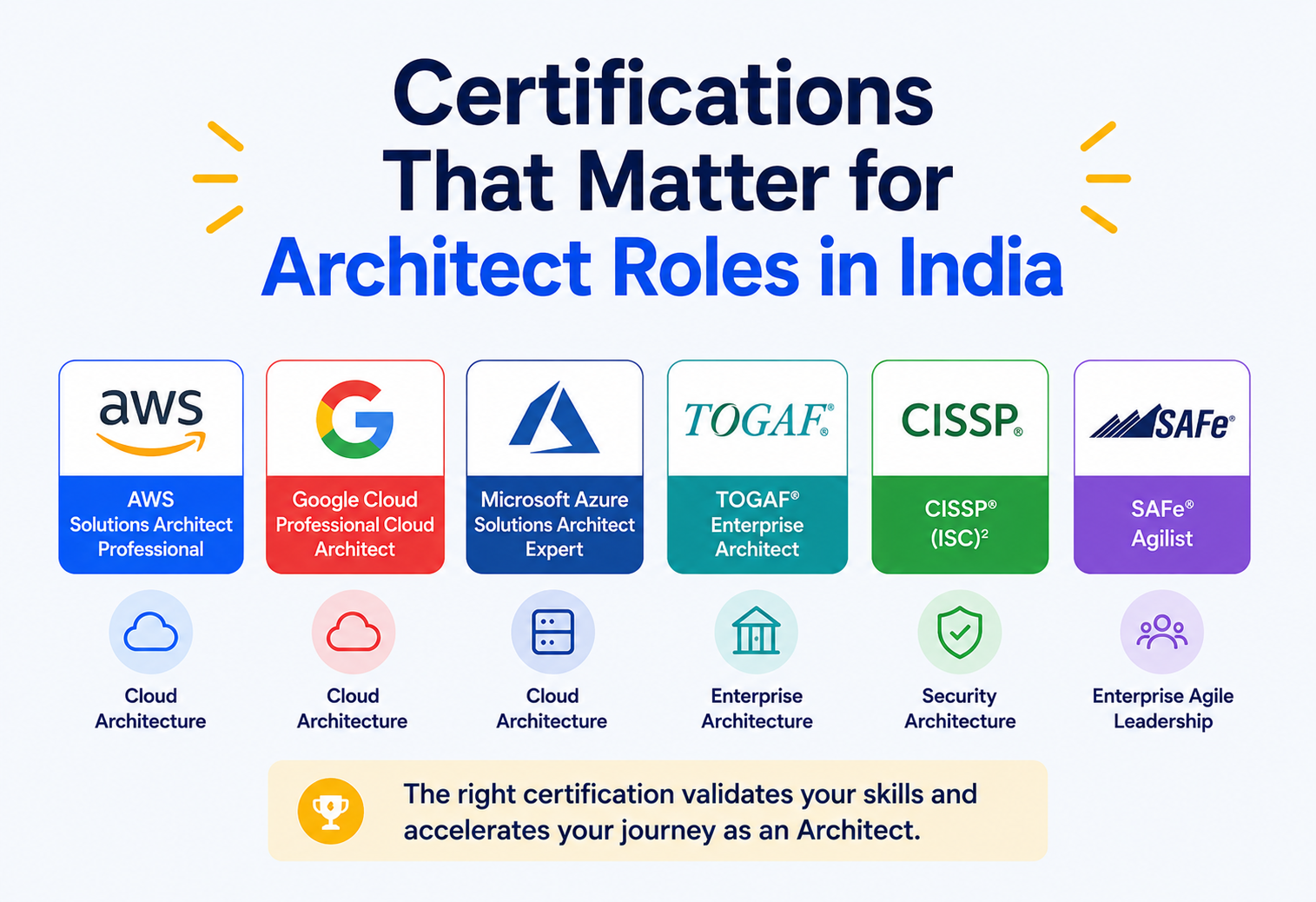
| Cloud Platform | AWS SA-Pro, Azure Solutions Architect Expert, GCP Professional Cloud Architect | Cloud & Solution Architects |
| Framework / Methodology | TOGAF 10 Certified, ArchiMate | Enterprise Architects |
| Security | CISSP, AWS Security Specialty, CCSP | Security Architects, regulated industries |
| Data & Integration | AWS Data Analytics Specialty, Databricks Architect, Snowflake SnowPro | Data Architects |
Rather than chasing every credential in every row, the strongest architect profiles in India typically anchor on one cloud certification + one framework certification, and add a specialisation (security or data) only once their domain actually demands it.
Cloud Certifications
The single most requested credential line in Indian architect job postings — and where over-investment is the classic mistake.
Cloud certifications are, by a wide margin, the most commonly requested credential in Indian architect job postings today — largely because most new systems are cloud-native by default, and clients want assurance the architect designing their AWS or Azure footprint actually knows the platform’s guardrails.
5.1 · AWS
AWS holds the largest market share among Indian enterprises and GCCs (Global Capability Centres), which makes its architect track the single most requested certification line in job postings.
AWS Certified Solutions Architect — Associate Entry
The baseline credential most hiring managers expect before even considering someone for a mid-level architect role.
AWS Certified Solutions Architect — Professional Senior
The one that actually signals architect-level thinking — multi-account strategy, cost optimisation, migration at scale.
AWS Security / Data Analytics Specialty Specialty
Worth adding once you’re specialising, not before — a common over-investment mistake is doing these too early.
5.2 · Microsoft Azure
Azure dominates in Indian enterprises with existing Microsoft investments — banking, insurance, and large traditional enterprises especially.
Azure Administrator / Developer Associate Core
Common stepping stone before the architect-level exam; not required if you already have hands-on Azure project time.
Azure Solutions Architect Expert Architect
The direct Azure equivalent of AWS’s Professional-level credential — heavily weighted in banking and insurance job postings.
5.3 · Google Cloud
Smaller footprint in India but growing fast in data-heavy and AI-forward organisations.
Professional Cloud Architect Architect
GCP’s flagship architect exam — valuable specifically in data platform and analytics-heavy organisations using BigQuery and Vertex AI.
Multi-cloud note
Holding certifications in two clouds rarely doubles your value — one deep, current certification plus demonstrated project depth almost always beats two shallow ones on a resume.
Enterprise Architecture — TOGAF
Vendor-neutral, methodology-heavy, and disproportionately weighted in Indian consulting.
TOGAF (The Open Group Architecture Framework) remains the dominant credential once you move from “designs one system” to “aligns technology across a business.” It’s less about specific tools and more about a repeatable method — the ADM (Architecture Development Method) — for moving from business strategy to technical implementation in a traceable way.
TOGAF matters disproportionately in Indian IT services and consulting firms (TCS, Infosys, Accenture, Capgemini, Deloitte) because it’s a vendor-neutral credential that client procurement teams recognise regardless of which cloud or stack the engagement uses. It’s less commonly required in product startups, where architecture decisions move faster and less formally.
| Level | What it covers | Who needs it |
|---|---|---|
| TOGAF Foundation | Core concepts and vocabulary of the ADM | Anyone entering an EA-adjacent role |
| TOGAF Certified (combined) | Foundation + practitioner-level application | Enterprise Architects, EA consultants, architecture leads in consulting firms |
Honest caveat
TOGAF is widely criticised for being process-heavy and light on hands-on technical depth. It signals you can operate in a structured enterprise environment — it does not, by itself, prove technical design skill. Pair it with a technical credential.
Security & Data Architecture Specialisations
Only invest here once your domain forces the issue.
These matter once your domain forces the issue — BFSI (banking, financial services, insurance), healthcare, and government-adjacent work in particular.
7.1 · Security
- CISSP (Certified Information Systems Security Professional) — the most recognised security leadership credential; expected for Security Architect roles in regulated industries and GCCs handling sensitive data.
- CCSP (Certified Cloud Security Professional) — the cloud-specific counterpart, increasingly requested alongside CISSP for cloud-native security architecture roles.
- AWS / Azure Security Specialty — platform-specific, useful as a complement rather than a substitute for CISSP.
7.2 · Data
- Databricks Certified Data Engineer / Architect — relevant given Databricks’ fast growth in Indian enterprise data platforms.
- SnowPro Advanced Architect (Snowflake) — valuable in organisations standardising on Snowflake for their data warehouse.
- AWS Certified Data Analytics — Specialty — a solid generalist option if your organisation is AWS-first.
Signal vs. noise
Only invest in a security or data specialty certification once you can point to at least one real project where you applied that specialisation — otherwise it reads as breadth-chasing rather than depth.
Are Certifications Actually Worth It?
Yes — conditionally.
The honest answer is: it depends heavily on where you work and how you use the credential. Here’s the balanced view.
In favour
- Fast-tracks resume shortlisting at large services firms and GCCs with formal skill-matrix hiring.
- Often tied directly to internal promotion criteria and billing rate bands in services companies.
- Forces structured breadth across a platform you might otherwise learn unevenly on the job.
- Useful negotiating leverage when moving between companies, especially cross-industry.
Against
- Exams test recall of service limits and edge cases more than design judgment.
- Cloud certifications expire (typically 2–3 years) and require paid recertification.
- Product companies and startups often weight system design interviews and past project outcomes far more heavily than certificates.
- Easy to over-invest in credentials as a substitute for shipping real systems.
Real-World Industry Patterns
Same country, very different weightings by employer type.
How certification expectations actually play out differs sharply by employer type in India.
9.1 · IT Services firms
Certifications are often formally tied to career-level frameworks and client-facing credibility. Firms frequently sponsor and even mandate cloud certifications for architects staffed on cloud-migration engagements, because client contracts sometimes require a minimum certified headcount.
9.2 · Global Capability Centres (GCCs)
GCCs of companies like Goldman Sachs, JPMorgan, Walmart, and Target have grown enormously as India-based engineering hubs. They tend to mirror the certification expectations of their global parent — often a strong preference for AWS or Azure architect-level certification plus, in regulated GCCs, CISSP.
9.3 · Product companies & startups
Here certifications carry the least independent weight. A system design interview and a portfolio of real architectural decisions (with trade-offs explained) typically matter far more than a certificate. That said, a cloud certification can still help a resume clear an initial automated or recruiter screen.
9.4 · BFSI & regulated industries
Security and compliance-adjacent certifications (CISSP, CCSP) carry real weight here because regulators and auditors expect documented competence, not just project experience.
A Practical Roadmap
One sequencing that tends to work for engineers moving from senior developer or tech lead into a working architect role in India.
A sequencing that tends to work well for engineers moving from senior developer or tech lead into an architect role in India:
Build 2–3 years of design-adjacent project experience
Own at least one system end-to-end before chasing certifications — the exam content will make far more sense once you’ve hit the trade-offs it describes.
Get your primary cloud’s Associate-level certification
AWS Solutions Architect Associate or Azure Administrator Associate, matched to whichever platform your organisation actually runs on.
Move to the Professional / Expert-level exam
This is the credential that actually gets read as “architect-level” by hiring panels — AWS SA-Professional or Azure Solutions Architect Expert.
Add TOGAF if you’re heading toward Enterprise Architecture
Especially relevant in consulting and large enterprise IT — less critical if you’re staying technical / product-focused.
Specialise only once your domain demands it
CISSP for regulated-industry security architecture, or a data platform certification (Databricks / Snowflake) if you’re moving into data architecture.
- Certification stacking without project depth. Five certificates and zero design stories is a red flag interviewers notice quickly.
- Chasing every cloud at once. Spreads effort thin; better to go deep on the platform your target employers actually use.
- Letting certifications lapse silently. Cloud certifications expire; an expired credential on a resume without renewal can read worse than not listing it.
- Treating TOGAF as a technical credential. It’s a methodology and vocabulary framework, not a substitute for hands-on system design skill.
- Ignoring soft-skill preparation. Architect interviews test communication and trade-off reasoning as much as technical depth; certification prep alone won’t cover this.
Frequently Asked Questions
Five recurring questions from engineers weighing the architect track in India.
Q1 · Do I need a certification to become an architect in India?
No — plenty of architects, especially in product companies, get there purely through project ownership and internal promotion. But in IT services and GCCs, a certification often accelerates the timeline and clears formal screening criteria.
Q2 · Which single certification has the best return for a generalist Solution Architect?
AWS Certified Solutions Architect — Professional (or the Azure equivalent, Solutions Architect Expert) is currently the most broadly recognised single credential across Indian employers.
Q3 · Is TOGAF worth it if I’m not in consulting?
It’s optional outside consulting and large enterprise IT. If you’re staying deeply technical in a product company, a cloud or data certification will usually serve you better.
Q4 · How long does it realistically take to prepare for an Architect-level cloud exam?
With solid hands-on project experience already in place, 6–10 weeks of focused study is typical for the Professional / Expert-level exams; without that experience, expect considerably longer.
Q5 · Do certifications expire, and does that matter to employers?
Yes — most cloud certifications are valid for 2–3 years. Most employers care more about current, active certifications than a lapsed one from several years ago, so recertification timing matters if you’re job-hunting.
Summary & Key Takeaways
One page of ideas to carry away.
The Indian architect certification landscape is not a puzzle to be solved by collecting the most credentials. It’s a landscape to be navigated deliberately — anchoring on one deep cloud certification, layering in TOGAF if the enterprise or consulting side is where you’re heading, and adding a security or data specialisation only once your domain actually demands it. Every credential you pick up should be the paper trail behind a real system you can talk about with conviction.
- Cloud certifications (AWS SA-Professional, Azure Solutions Architect Expert) are currently the most broadly requested credential for architect roles across Indian IT.
- TOGAF matters most in consulting and large enterprise IT — it signals methodology fluency, not technical depth, so pair it with a technical certification.
- Security (CISSP, CCSP) and data platform certifications (Databricks, SnowPro) are specialisations worth adding only once your domain genuinely requires them.
- Employer type changes the weighting enormously: IT services and GCCs value certifications more formally; product companies and startups weight system design interviews and real project history more heavily.
- The strongest profiles anchor on one deep, current cloud certification plus demonstrated project ownership — not a long list of credentials with shallow hands-on backing.
The one idea to remember
Certifications open the door to the interview. Project stories and design reasoning are what get you through it. Sequence your credential investments so that every one of them sits on top of a real system you shipped, not the other way round.