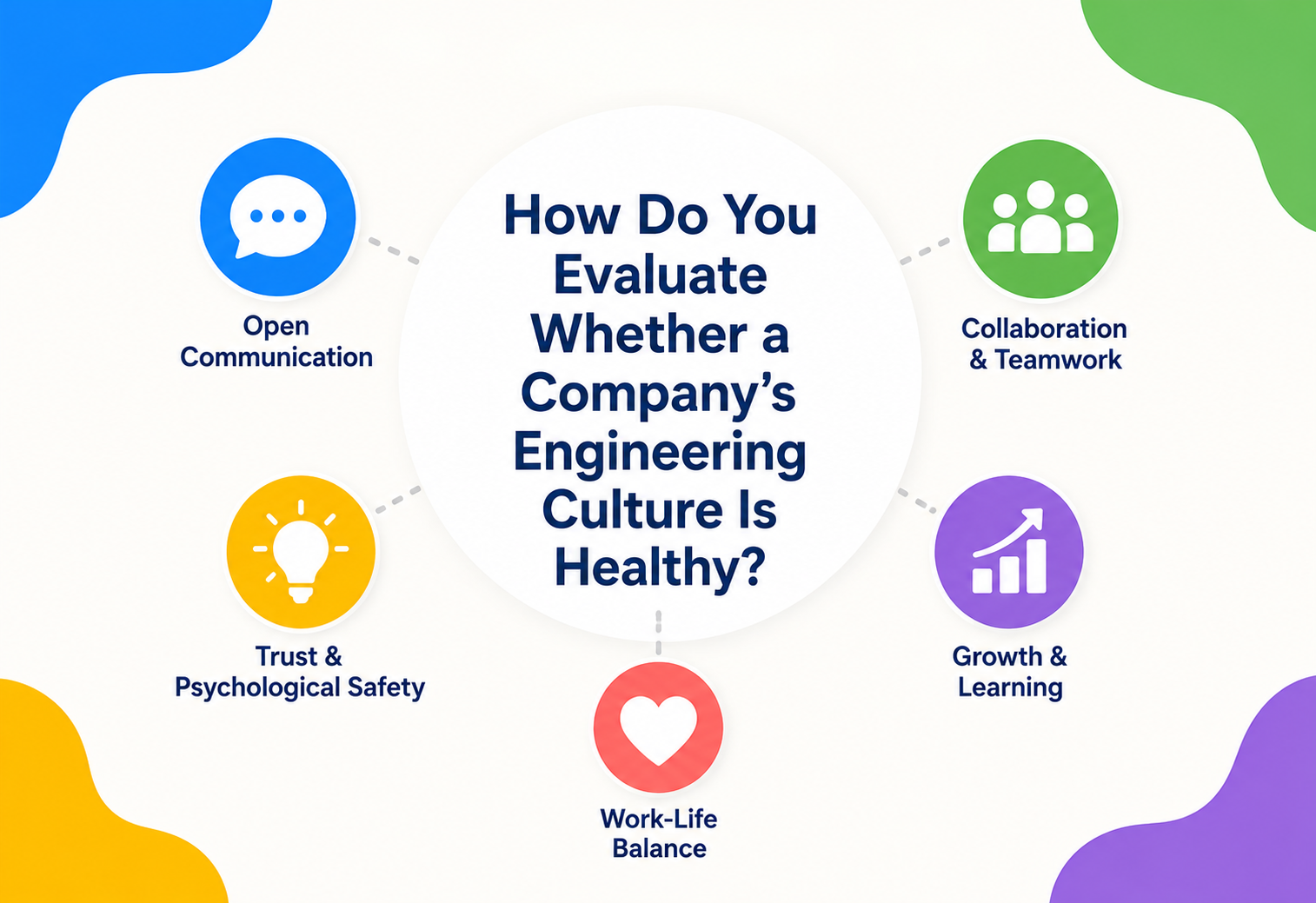
How Do You Evaluate Whether a Company’s Engineering Culture Is Actually Healthy?
Every careers page says the same warm things. The truth about a culture rarely lives in the words a company chooses about itself — it lives in the small, ordinary moments nobody bothers to write down. Thirteen chapters, one steady discipline: watch more than you ask, trust specific stories over general reassurance, and let the evidence — not the marketing — do the deciding.
The Invisible Thing You Are Actually Trying to Judge
You can read a hundred engineering blog posts about a company’s “values” and still walk into your first week genuinely surprised by what the place is actually like. That gap between the story a company tells and the way it actually behaves is where most career disappointments quietly come from. This piece is about closing that gap — not with a checklist you tick off in a single interview, but with a way of paying attention that keeps working long after you have said yes.
Culture is a strange thing to evaluate, because it rarely announces itself directly. Nobody schedules a meeting called “here is how we treat each other when things go wrong.” You mostly find out by living inside it — by watching how a disagreement in a pull request gets resolved, by noticing whether the on-call engineer sounds exhausted or steady on a Tuesday standup, by clocking who gets credit when a project ships and who quietly absorbs the blame when it does not.
This is exactly why so many smart, careful people still end up somewhere that does not fit them. Not because they did not ask questions in the interview, but because the questions they asked were answered with the company’s rehearsed best self, and rehearsed best selves are, understandably, not where the truth tends to live. A healthy culture and an unhealthy one can sound almost identical when a hiring manager is trying to make a good impression. The difference shows up in behaviour, not in language — and behaviour is exactly what an interview process is designed to hide, gently, on both sides.
None of this means interviews are useless, or that companies are lying to you. Most people describing their team’s culture genuinely believe what they are saying; they are just describing it from the inside, where blind spots are hardest to see. Your job, as someone evaluating a culture from the outside, is to look past the description and toward the evidence sitting quietly underneath it.
It also helps to remember that culture is not one single thing spread evenly across an entire company. A large organisation can hold several genuinely different cultures inside it at once — one team that is thoughtful and calm, another two floors away that is chaotic and anxious, both technically operating under the same set of company values printed on the same wall. When you evaluate “a company’s culture,” you are really evaluating the specific team, the specific manager, and the specific slice of the organisation you would actually be joining. Broad reputation matters less than most people assume; the immediate, local reality matters far more.

Judging a company’s culture from its careers page is a little like judging a restaurant from the photographs in the window. The photos are not lies, exactly — they are the best version of what the kitchen can produce on a good day, arranged carefully. The meal you actually get depends on who is cooking that evening, how tired the room is, and whether the ingredients arrived fresh. Culture, like a meal, is finally what shows up on the plate in front of you — not what was pictured in the window.
Watch Before You Ask
The single biggest shift you can make in how you evaluate a company’s culture is small but powerful: spend more of your energy watching, and less of it asking. A direct question — “is your culture healthy?” — will almost always get you a direct, positive answer, because it is an easy question to answer well regardless of what is actually true. What you want instead are situations where the answer reveals itself without anyone needing to perform it.
During interviews, this means paying attention to things most candidates barely notice. How does your interviewer talk about a teammate who is not in the room — with warmth and specificity, or with vague, careful diplomacy that feels rehearsed? When you ask about a recent project that did not go well, does the answer include what was learned, or does it quietly deflect blame onto “the business” or “leadership” in a way that suggests a habit, not a one-off? Does anyone laugh, genuinely, at any point in the conversation? Small, ordinary human warmth is surprisingly hard to fake convincingly across an entire interview loop.
If you get the chance to sit in on any real working moment — a team standup, a pairing session, even a few minutes shadowing a code review — take it seriously, even if it feels like a small, informal part of the process. Five minutes of watching a team actually work together often tells you more than forty-five minutes of a curated conversation about how they work together.
After every interview conversation, write down one specific moment — a phrase, a tone shift, a story someone told — rather than a general impression like “they seemed nice.” General impressions fade and get overwritten by later, louder interviews. Specific moments hold their shape and are much easier to compare honestly once the whole process is over.
Remote interviews add their own small wrinkle worth watching for. Without the hallway chatter, the shared lunch, or the incidental five minutes waiting for a meeting room, you lose a lot of the ordinary texture that used to reveal culture almost by accident. It is worth deliberately asking for the remote equivalent — a short informal call with a would-be teammate, a look at how the team communicates asynchronously, even a sample of a real internal document if the company is comfortable sharing one. The goal is the same either way: find any window, however small, into how the team behaves when nobody is specifically performing for a candidate.
There is also something quietly useful in what you do not see or hear. If nobody mentions a customer by name across an entire interview loop, that absence is a data point. If nobody references a real, specific colleague on another team, that is a data point too. Healthy cultures tend to leak specifics almost without meaning to — the person one desk over gets mentioned, the last outage gets remembered, the customer who wrote the funny bug report gets brought up. Interview loops that stay entirely abstract are often abstract for a reason, whether or not anyone in the room realises it.
Signals Worth Trusting More Than Words
A handful of concrete, observable signals hold far more weight than any stated value, because they are expensive to fake and cheap to notice if you know to look. None of these alone tells the whole story, but together they paint a picture that is very hard for a company to dress up convincingly.
How incidents and mistakes get discussed
Ask, plainly, what happens after something breaks in production. A healthy answer usually involves a blameless review focused on the system and the process, not the person who happened to be holding the pager. An unhealthy one often includes a story, told half-jokingly, about someone who “should have known better” — a small tell that mistakes are quietly tracked against individuals, even when nobody says so directly.
The tone inside code reviews
If you can see any real pull request history — sometimes shared during interviews, sometimes visible on an open-source project the company maintains — read a few comment threads closely. Healthy review culture tends to sound curious: questions, suggestions, the occasional compliment on a clean solution. Unhealthy review culture tends to sound territorial or clipped, with terse corrections and very little acknowledgement of effort.
Who does the talking in group settings
In any interview involving more than one person from the company, notice the balance of voices. Does one senior person answer every question while everyone else nods along quietly, or does the group naturally pass the conversation between them, each adding something the others did not? The second pattern, more often than not, reflects a team where opinions genuinely get heard day to day, not just in front of a candidate.
How on-call and after-hours work is described
Ask specifically what a bad on-call week looks like, not just what the rotation schedule is. A team with a healthy relationship to on-call will usually be able to describe concrete steps they have taken to reduce alert fatigue — better runbooks, saner thresholds, a genuine effort to fix root causes instead of just silencing the noise. A team without that story often reveals, without meaning to, that on-call pain is simply accepted as the cost of the job.
Tenure, and the honesty around it
Short average tenure is not automatically a red flag — some fields and career stages naturally involve more movement — but it is worth asking about directly, and watching closely for how comfortable the person answering seems with the question. A team that can talk plainly about turnover, including the reasons behind it, tends to be healthier than one that visibly bristles or deflects when the topic comes up.
| Signal | What a healthier version sounds like | What a shakier version sounds like |
|---|---|---|
| Discussing a past incident | “We changed our alerting after that, here is what we learned” | “Yeah, that was a rough week for [person]” |
| Talking about disagreement | “We argue in the doc, then commit together once it is decided” | “Whoever is more senior usually just decides” |
| Describing on-call | “We track alert volume and actively work to bring it down” | “It is rough some weeks, but that is the job” |
| Explaining turnover | Specific, comfortable, a little reflective | Vague, quick, subject visibly changed |
| Group interview dynamic | Multiple voices, natural back-and-forth | One person answers everything |
Read the table sideways rather than top to bottom. Any single row can go either way for perfectly innocent reasons — someone was tired, someone was new, someone was uncomfortable on camera. What matters is whether the column on the left keeps showing up across several different conversations, or whether the column on the right keeps quietly reappearing in different rooms with different people. A pattern is much harder to fake, in either direction, than any single sentence.
Questions That Open Doors Instead of Closing Them
The way you phrase a question shapes how honest the answer can be. A question that sounds like an exam — “how would you describe your culture?” — invites a rehearsed, polished response. A question that sounds like genuine curiosity about a real moment tends to invite a real story instead, because it is harder to have a rehearsed answer ready for it.
A recent disagreement
“Tell me about a recent disagreement on the team, and how it got resolved.” This surfaces both how conflict is handled and whether the person can recall a specific example at all — a vague answer here is its own small signal.
A change of mind
“What is something the team changed its mind about in the last year?” Healthy teams evolve their practices based on evidence; the ability to name a real course correction suggests a team that reflects rather than one that has simply always been right.
A rough first month
“If I joined and had a rough first month, what would that most likely look like?” This gently invites honesty about real friction points, in a way that feels safer to answer than a blunt “what are your weaknesses?”
The flow of feedback
“How does feedback flow between engineers and their managers here?” Listen for whether feedback sounds like a two-way habit or a once-a-year formality wrapped around a performance review.
Why good people leave
“What would make someone leave this team who was otherwise doing well?” A thoughtful, specific answer suggests real self-awareness. A blank or defensive one is worth noting.
None of these questions are traps, and they should not be asked like one. Asked with genuine warmth and curiosity, they usually get warmth and honesty back — and even the discomfort of an evasive answer tells you something real and useful about what you would be walking into.
Any of these questions can land badly if it is delivered like a checklist item. Ask one, listen fully, and let the follow-up be genuine — a real “oh, that is interesting, what happened next?” opens more doors than three prepared questions in a row ever will. The point is not to run a script; it is to make room for a real conversation to happen inside a structured process.
Red Flags That Quietly Disguise Themselves as Strengths
The trickiest warning signs are the ones that arrive wrapped in genuinely pleasant-sounding language. They are not lies; they are just phrases that can mean either something healthy or something rougher underneath, and the difference is worth learning to hear.
“We are like a family here”
Often said with real warmth and good intentions, but in practice it sometimes signals blurred boundaries — unclear expectations around hours, guilt-based loyalty, or discomfort with the normal, healthy give-and-take of an employment relationship. Gently probe what the phrase actually means in practice: does it come with generous flexibility, or with an unspoken expectation that you will always say yes because “that is not how family treats each other”?
“We move incredibly fast here”
Speed itself is neutral, even admirable in the right context. But if every story about speed comes paired with stories of burnout, skipped testing, or constantly shifting priorities with no space to catch up, the pace may be less a strength and more a symptom of something under strain. Ask what slows the team down on purpose, and see if anyone can name something.
“Our best people just figure it out”
Sometimes a compliment to self-reliance, sometimes a quiet way of saying that documentation is thin, onboarding is sink-or-swim, and support for people still learning the ropes is minimal. Ask directly what onboarding actually looks like in the first month, and listen for real structure versus a shrug.
Universal, uncomplicated praise
If every single person you talk to describes the team in identical, glowing terms with no texture or nuance at all, it is worth a small amount of healthy scepticism — not because positivity is suspicious, but because real teams, even good ones, usually have at least one honest wrinkle they are willing to name. A little texture in the answers is often a better sign than uniform shine.
Any phrase that would sound perfectly at home on a poster deserves a second, slower look — not because posters are wrong, but because language that is easy to print is language that is easy to say without meaning very much by it. The real test of any of these phrases is what the day-to-day behaviour looks like once you strip the phrase away.
Green Flags That Are Easy to Walk Right Past
Just as some warning signs hide inside pleasant-sounding phrases, some of the healthiest signals are easy to miss because they do not announce themselves at all — they show up as small, understated moments that a distracted candidate might not even register.
An unprompted admission
Someone admits a mistake, unprompted, mid-interview. “Honestly, we got that wrong the first time” is a small sentence that reveals a surprising amount of psychological safety, especially when it is said casually, without visible discomfort.
Public respectful disagreement
Interviewers disagree with each other, respectfully, in front of you. This is a rare and genuinely encouraging sign — it means differing opinions are normal enough that nobody feels the need to present a united, scripted front.
Real curiosity about you
Someone asks you a real question back, out of curiosity. Genuine interest in how you think, beyond just evaluating you, often reflects a team that treats colleagues as whole people, not just resources to be assessed.
A clear boring process
The team can describe a boring, unglamorous process clearly. A clear, specific answer about something as mundane as “how do you decide what to work on next sprint” often reflects more organisational health than an inspiring answer about “moving fast and shipping value.”
Unhurried room for questions
You are given time and space to ask your own questions, unhurried. How much genuine room you are given to be curious back is, itself, a small but real reflection of how much the team values two-way conversation over one-way evaluation.
The healthiest cultures rarely sell themselves loudly, because they do not need to. A team that is genuinely comfortable in its own skin often talks about itself with more nuance, more honesty, and less polish than a team that is still trying to convince itself, and you, that everything is fine.
None of these green flags is proof on its own; the point is to notice how many of them show up naturally, without you having to steer the conversation to reach them. One or two across a long interview loop is fairly ordinary. Four or five, arriving without prompting, is a small quiet chorus worth listening to carefully.

What the First Few Weeks Quietly Reveal
Even the most careful evaluation before joining is still an evaluation from the outside, and the first few weeks on the inside will teach you things no interview could. It is worth paying attention on purpose, rather than simply letting the onboarding blur happen to you.
Notice how your first pull request gets reviewed. Is feedback specific and kind, or sparse and cold? Notice whether anyone checks in on you without being asked to, and whether that check-in feels genuine or like a box being ticked on an onboarding checklist. Notice how the team talks about customers, about leadership, about each other, when they think the conversation is just ordinary and unremarkable — those unremarkable moments are usually the most honest data you will ever get.
Give yourself permission to trust what you observe during this period, even if it contradicts the story you were told during hiring. It is uncomfortable to admit a mismatch that early, especially after all the effort of getting the offer, but the discomfort of noticing early is almost always smaller than the cost of ignoring it for a year.
It is also worth keeping a small, private note of your own early impressions — not to build a case against anyone, just to protect your own memory from the natural pull toward rationalisation. A few months into any job, it is remarkably easy to talk yourself into believing a rough start was normal, or that you simply had not adjusted yet. Sometimes that is true. But a short list written honestly in week two is a much more reliable witness than a memory reshaped, gently and understandably, by the desire for the decision to have been the right one.
At the end of your second week, write two short paragraphs to yourself: one describing the moments that surprised you in a good way, one describing the moments that surprised you in a rougher way. Do not read them again for a month. When you do, you will know instantly whether the pattern is holding, softening, or hardening — and future-you will be quietly grateful that past-you took the trouble.
A Story From the Field
A single small moment inside an otherwise unremarkable interview can, sometimes, tell you more than the entire rest of the process combined. Here is one such moment, from a real engineer weighing two nearly identical offers.
A software engineer I know — call her Meera — once interviewed at two companies in the same month, for nearly identical roles. Both interview loops were polished, both teams described themselves as collaborative and low-ego, and both offers landed within a few thousand dollars of each other. On paper, the decision looked like a coin flip.
What tipped it, in the end, was not anything either company said directly. In her final round at the first company, she asked about a recent project that had slipped its deadline. The engineer answering paused, genuinely thought about it, and described exactly what had gone wrong — an underestimated integration, a dependency they had not accounted for — and what they had since changed about how they scoped similar work. It felt like a real memory, not a rehearsed one.
At the second company, the same question got a smoother, more polished answer: “we are pretty good about hitting our deadlines, and when we do not, we just communicate early and reset expectations.” Technically a fine answer. But it had no texture to it — no specific project, no specific lesson, nothing that felt like it had actually happened to a real team of real people.
Meera took the first offer. Eight months in, she told me the honesty in that one small answer had turned out to be a genuinely accurate preview of the team — a place where mistakes got named plainly and fixed, rather than smoothed over with reassuring language. She still does not know what the second team was actually like day to day. But she is fairly confident that the difference in how they answered one ordinary interview question told her something true, long before she could have proven it any other way.
What stayed with her afterward was not the specific answer itself, but the realisation that she had almost missed it — that in the moment, both answers had sounded perfectly reasonable, and it was only in comparing the texture of one against the other that the real difference became visible. She has since made a habit of asking the same kind of question in every interview she takes, not because it guarantees a right answer, but because it reliably tells her something the polished parts of the conversation never quite manage to.

Culture Is Not the Same Thing as Perks
It is easy to let a genuinely nice benefits package quietly stand in for a real answer about culture, especially when you are tired of interviewing and the offer looks good on paper. Free lunches, a generous learning budget, a beautiful office — none of these are bad things, and none of them tell you much at all about how people actually treat each other under pressure.
Perks are visible, easy to list on a careers page, and relatively cheap for a company to offer compared to the harder, slower work of building genuine trust and psychological safety across a team. A company can have wonderful perks and a genuinely difficult culture underneath them; the perks, if anything, can sometimes function as a kind of glossy distraction from that gap, whether or not that is anyone’s intention.
This is not a reason to dismiss perks entirely — they are a real, legitimate part of compensation and daily quality of life. It is simply a reminder to evaluate them as their own separate category, not as evidence about culture. A team can be wonderful with a modest benefits package, and a team can be unhealthy with an extraordinary one. Keep the two questions distinct in your own mind, even when a company’s marketing tries hard to blur them together.
Perks Genuinely Give You
- Daily quality of life improvements you feel every week
- Concrete, negotiable elements of a total offer
- A small measure of how the company treats its people materially
- Something legitimate to weigh alongside base pay
Perks Do Not Tell You
- How mistakes are handled when the stakes are high
- Whether disagreement is safe or quietly punished
- What on-call actually feels like in the third bad week
- Whether the team you would join is thriving or exhausted
The clearest way to keep them separate in your own head is to answer them as two independent questions, in writing, before comparing offers. What is the compensation and benefits picture on its own terms? And — entirely separately — what have you seen about how the team actually behaves? Blending the two saves time and reliably regretted decisions in roughly equal measure.
Talking to People Who Have Actually Been There
If you can find a way to talk with a current employee outside the official interview process, or a former one who is willing to be candid, take that conversation seriously — it is often the single richest source of honest information available to you. People tend to speak far more freely once they are not being evaluated, or once they no longer have anything at stake in how the company is perceived.
Approach these conversations with genuine curiosity rather than a hunt for gossip. Ask what a normal Tuesday looks like, rather than asking directly “is the culture good?” Ask what they would tell a friend who was considering an offer there. Ask, gently, what they wish they had known before joining. People are usually generous with honest answers when a question feels like real curiosity rather than an attempt to extract a verdict.
Weigh what you hear with a little care, the same way you would any single data point. One person’s difficult experience might reflect a genuine, widespread pattern, or it might reflect a particular team, a particular manager, or a particular season the company was going through. Where possible, look for the pattern across a few different conversations rather than resting your whole decision on any single account — including a glowing one.
Try opening with “I am considering their offer and I would love your honest take — the good and the rough — nothing you say gets back to anyone.” It signals that you are prepared for a real answer, that you know one exists, and that you are not going to punish the person for giving it. Most people, offered that kind of frame, respond in kind.
It is also worth being generous back. If someone takes twenty minutes of their evening to talk honestly with you about a company they used to work at, remember that generosity later — introduce them to someone useful, answer their questions the same way if the roles ever reverse, thank them specifically rather than generically. The small ecosystem of people willing to speak plainly about their workplaces runs on that kind of quiet reciprocity, and it is worth participating in with real care.

If You Are the One Shaping the Culture, Not Just Judging It
Everything so far has been written from the vantage point of someone evaluating a culture from outside it — a candidate, a curious observer, someone deciding whether to say yes. But if you lead a team, the same lenses are worth turning inward, on a regular basis, before an outsider ever has to figure them out for themselves through careful detective work.
The uncomfortable truth is that most leaders have a distorted view of their own team’s culture, for a very ordinary reason: people tend to soften what they say to the person who holds power over their role, their raise, and their next promotion. If you only ever hear about your team’s culture from your team’s culture, you are hearing an edited version, filtered through exactly the same instinct to present a polished best self that shows up in interviews. This is not dishonesty on anyone’s part — it is just how hierarchy quietly shapes what feels safe to say out loud.
Ask the same questions of yourself that a candidate would ask of you
Sit down, honestly, with the questions from earlier in this piece. What would your team actually say happened after your last production incident — a calm, blameless review, or a story about who “should have known better”? Could every person on your team describe a real moment where the group changed its mind about something, based on evidence rather than seniority? If you are not confident in the answer, that uncertainty is itself worth taking seriously.
Create moments where honesty costs less
Anonymous, genuinely acted-upon feedback channels; skip-level conversations that are not secretly reported back; exit interviews conducted by someone outside the direct reporting line — all of these exist to lower the cost of honesty, because honesty that costs something will always be rationed. The specific mechanism matters less than the underlying intention: making it genuinely safer for the truth to reach you, even when the truth is uncomfortable to hear.
Watch what you reward, not just what you say you value
A team learns its real values by watching who gets promoted, who gets praised in public, and whose work quietly goes unrecognised — far more than by reading a values document, however well written. If a document says “we value sustainable pace” while the person who burns themselves out delivering a rushed feature gets celebrated in the next all-hands, the document will lose every single time. Culture is built from what gets rewarded in practice, not from what gets written down with good intentions.
Once a quarter, ask a handful of people on your team the same open, specific questions a thoughtful candidate might ask you — about disagreement, about mistakes, about what a rough week looks like. You will not always like every answer. That discomfort is usually a sign the exercise is working, not a sign it has gone wrong.
Evaluating a culture honestly, whether you are joining it or building it, takes the same basic ingredient either way: a willingness to look past the comfortable, polished version of the story and toward the smaller, quieter evidence sitting underneath it. That willingness is rarer than it should be, and it is worth practising deliberately, in both directions.
A Few Questions People Often Ask
Short, direct answers to the questions that come up most often when engineers start taking culture evaluation seriously as a discipline of its own — on both sides of the interview table.

What if I cannot get an honest read at all during the interview process?
This happens, especially with very polished, high-volume hiring processes where every interviewer is trained to say the same reassuring things. If nothing you ask produces a specific, textured answer anywhere in the loop, treat that flatness itself as information. A healthy culture usually leaves at least a few small cracks of honesty somewhere in the process, even by accident.
Is a small startup automatically riskier on culture than an established company?
Not automatically, in either direction. Small teams can have unusually tight, honest, low-ego cultures precisely because there is nowhere for dysfunction to hide — or they can have deeply unhealthy ones built entirely around one founder’s temperament, with no HR structure to soften it. Size changes the shape of the risk, not whether the risk exists. The same careful observation applies either way.
How much weight should online reviews carry in this evaluation?
Treat them as one more data point, not a verdict. Anonymous review platforms tend to attract disproportionately strong feelings, both glowing and furious, and rarely reflect the quiet, ordinary middle where most people’s actual daily experience lives. Look for recurring, specific themes across many reviews rather than trusting any single dramatic one.
What if the culture seems healthy but the technical work itself does not excite me?
These are genuinely separate questions worth answering on their own terms, and it is worth being honest with yourself about which one matters more to you at this point in your career. A healthy team doing less exciting work is, for many people, a better place to spend a few years than an unhealthy team doing dazzling work — but that trade-off is personal, and there is no universally correct answer.
Can a healthy culture turn unhealthy later, even after I have verified it carefully?
Yes, and it is worth holding that possibility honestly rather than treating any single evaluation as permanent. Leadership changes, acquisitions, and periods of rapid growth can shift a culture meaningfully, sometimes quickly. The same quiet, ongoing attention you used to evaluate a culture before joining is worth keeping up gently after joining too, not as anxiety, just as steady awareness.
What if I only have one or two interview rounds to work with, not a long process?
Shorter processes simply mean being more deliberate with the limited time you have, rather than giving up on evaluation altogether. Pick two or three of the questions from earlier in this piece and ask them with real intention rather than trying to cover everything. A single well-asked, specific question about a real moment often reveals more in ninety seconds than a dozen generic ones spread thin across an hour.
Does any of this change if I am evaluating a fully remote team?
The signals are the same; the surfaces you read them on are different. Instead of watching a hallway conversation, you read the tone of a shared document or a written message thread. Instead of noticing who talks in a meeting, you notice who participates in a written discussion and whether replies feel curious or clipped. The underlying question — is this a team where honesty and care are ordinary — is unchanged. Only the evidence looks slightly different.
Closing Thoughts
There is no single question, no perfect script, that guarantees you will see a company’s culture clearly before you have actually lived inside it for a while. What careful attention can offer instead is something more modest and more useful: a much better guess, built on real evidence rather than polished language, and a habit of noticing that keeps serving you well past the interview itself.
What is worth carrying with you
- Watch more than you ask — small, unrehearsed moments almost always carry more truth than direct questions about culture.
- Trust specific stories over general reassurance — texture and detail are what separate a real answer from a polished one.
- Notice the small, unremarkable moments — the tone of a code review, the way a mistake gets described, who does the talking in a group setting.
- Let perks be perks, and let culture be something else entirely — evaluate the two categories independently in your own head.
- Talk to people who no longer have anything to gain by telling you what you want to hear, and weigh their answers with the same care as anything else.
- Trust what the first weeks show you, even — especially — when it contradicts the story you were told during hiring.
- If you are shaping a team, not just joining one, turn the same honest attention inward on a schedule, before someone from outside has to piece it together for themselves.
The gap between the culture a company describes and the culture it actually lives is rarely a gap of dishonesty. It is usually just a gap of attention — and attention, unlike so much else in this work, is something you can choose to give more of, starting today.