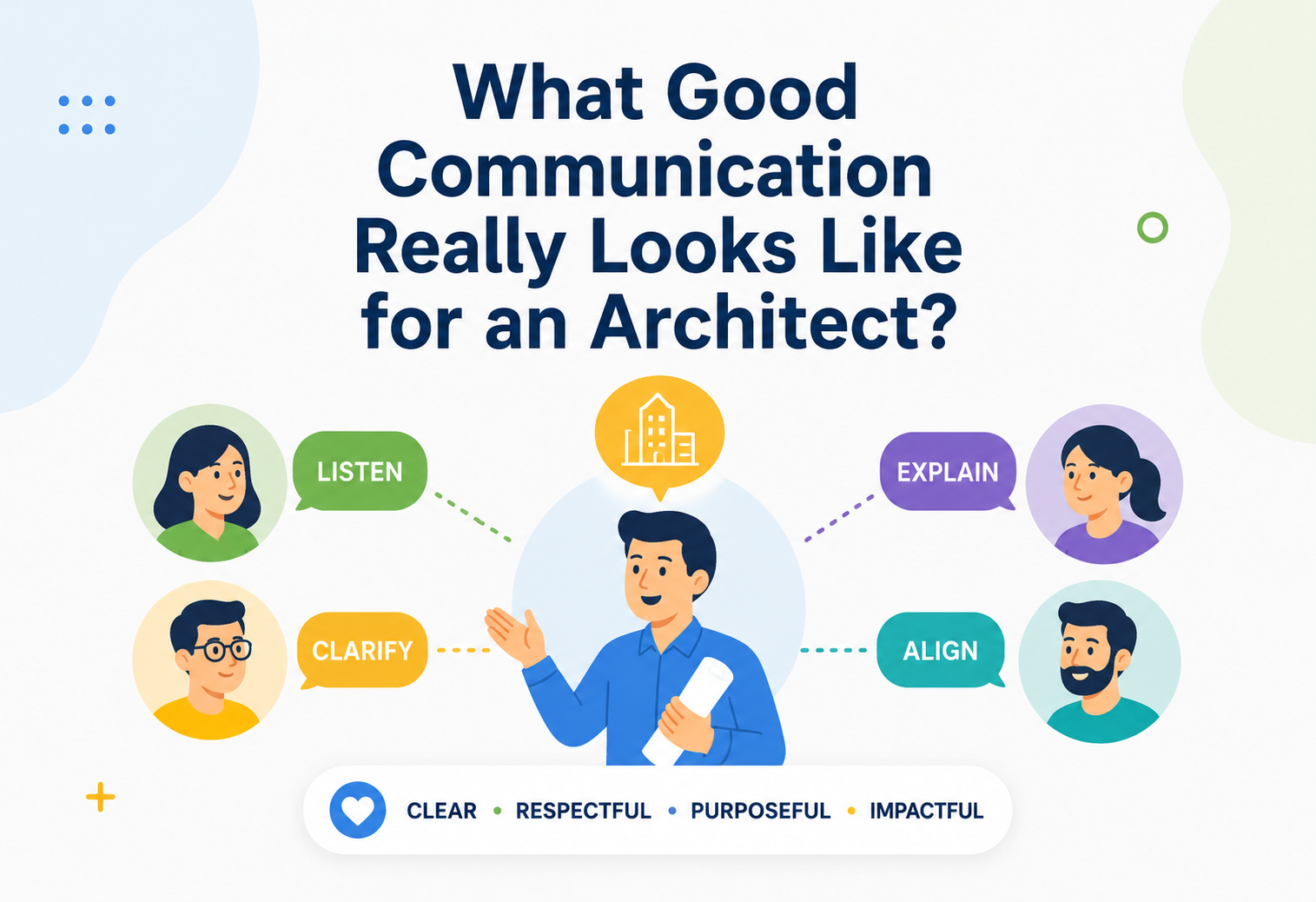
What Good Communication Really Looks Like for an Architect
Not the ability to talk well in a meeting — the quieter, harder skill of making sure the building in your head and the building in someone else’s head are the same building.
The Strange Myth About Architects
There is a strange myth about architects — that the job is mostly about drawing. Sketching elegant lines, choosing beautiful materials, imagining spaces no one has thought of before. And yes, that is part of it.
But if you ask anyone who has actually practiced architecture for a while, they will tell you something quieter and more honest: most of the job is conversation. It is explaining, listening, translating, reassuring, negotiating, and sometimes simply sitting with someone while they figure out what they actually want. Good communication is not a soft extra skill you pick up on the side. For an architect, it is the work.
A Building Is a Promise, Made Twice
Think about what actually happens when a building gets made. First, an idea is described — in words, in sketches, in half-finished sentences over coffee. Then, months or years later, that idea is described again, this time in steel, concrete, glass, and light.
Between those two moments sits every conversation an architect has: with the family who will live in the house, with the structural engineer who has to make the roof stand up, with the contractor pouring the foundation, with the city official checking the paperwork, with the electrician wondering where the switch should go.
If any one of those conversations goes wrong — if something is misunderstood, left vague, or assumed instead of confirmed — the building itself absorbs that mistake. A wall ends up in the wrong place. A budget quietly doubles. A family moves into a home that technically matches the drawings but somehow does not feel like the life they described. None of this happens because the architect could not design. It happens because somewhere along the way, communication broke down.
What follows is not a checklist of things to memorize before an exam. It is closer to a walk through the different rooms an architect’s voice has to enter — the anxious first meeting, the noisy construction site, the tense budget conversation, the quiet email at eleven at night. Each one asks for a slightly different version of the same underlying skill: paying close enough attention to make sure the person on the other side of the conversation feels genuinely understood.

Listening, Before Anything Else
Every architecture school teaches you how to draw, model, and calculate loads. Very few teach you how to listen — really listen — to a client who is trying to describe a feeling they have never had to put into words before.
Someone might say “I want the kitchen to feel warm,” and it is tempting to hear that as a request for a particular shade of wood. Sometimes it is. But sometimes “warm” means they grew up in a house where the kitchen was the one room everyone gathered in, and what they are really asking for is a kitchen that can hold a family, not just a countertop.
Good architects learn to listen underneath the words. They ask a second question instead of nodding at the first answer. They notice when a client goes quiet at a certain drawing, or lights up unexpectedly at a detail that seemed minor. They resist the urge to immediately solve, because the first job in any design conversation is not solving — it is understanding.
In your next client meeting, try saying almost nothing for the first ten minutes. Just ask open questions — “What does a good morning in this house look like for you?” — and write down the exact words people use. Their own language, not your professional translation of it, is often the clearest brief you will ever get.
This kind of listening also matters with the people you rarely think of as “clients” — a site supervisor mentioning, almost in passing, that the soil looked different near the north corner. A junior colleague hesitating before agreeing with a decision. The best architects treat every hesitation as information, not noise.
Listening well also means being comfortable with silence. Many architects, especially early in their careers, feel a nervous pull to fill every pause with reassurance or explanation. But a pause is often exactly where a client is doing their most honest thinking — deciding whether to admit they do not actually like the design they just praised politely, or working up the courage to say the budget feels tighter than they let on earlier. Rushing to fill that silence can accidentally close a door that was just about to open. Learning to simply wait, with a calm and attentive face, is its own small act of communication.
Turning Technical Thought into Human Words
An architect’s brain works in a very particular vocabulary — FAR, load-bearing walls, mullions, cantilevers, RCC slabs, setback lines. This language is precise and necessary, but it is also completely foreign to most clients.
A homeowner does not need to understand what a cantilever is; they need to understand that part of their balcony will appear to float without a visible support underneath, and that this is both possible and safe.
Good communication here is not about dumbing anything down. It is about translation — carrying the full meaning of a technical decision across into plain, human language, without losing the substance. The best architects can explain a complex structural choice to a ten-year-old and to a structural engineer, in the same afternoon, without either conversation feeling incomplete.
The engineered version
“We are proposing a 300mm RCC transfer slab at level one to redistribute the point loads from the upper floors.”
The translated version
“There is a thick concrete slab hidden inside the first floor that quietly carries the weight of everything above it, so the ground floor can stay open without extra columns in the middle of your living room.”
Notice that the second version is not less accurate. It simply respects the listener enough to meet them where they are. This single habit — checking who is in the room and adjusting your vocabulary without changing your meaning — is one of the most underrated skills in the entire profession.

Talking to the People Who Actually Build It
There is a particular kind of communication that happens far from any client meeting — the daily back-and-forth with contractors, site engineers, masons, plumbers, and electricians.
This conversation has almost nothing to do with vision or emotion. It is about precision, sequence, and clarity, because a missing detail here does not stay abstract for long. It becomes a wrongly placed drain, or a beam poured a foot off from where it should be.
Architects who communicate well on site tend to share a few habits. They give instructions that are specific rather than general — “raise the plinth by 450mm” instead of “raise the plinth a bit.” They confirm understanding out loud, asking the site team to repeat back what they heard, not because they do not trust them, but because construction sites are loud, hurried places where a sentence can travel through three people before it reaches the mason with the trowel in his hand.
They also know when to put things in writing. A verbal instruction on site is fine for something reversible. But a decision that affects cost, safety, or something that will be buried under concrete tomorrow deserves a written note, a marked-up drawing, or a dated site instruction — not because paperwork is glamorous, but because memory is unreliable and disagreements six months later are far more painful than five minutes of documentation today.
Respect on a construction site is earned through clarity, not authority. A site supervisor who has poured a hundred foundations will trust an architect who explains the “why” behind a decision far more than one who simply insists on the “what.” Explaining your reasoning, even briefly, turns instructions into collaboration.
There is also a quiet humility required here that many young architects take time to learn. A mason who has been laying brick for thirty years often knows things about how materials actually behave that no drawing can fully capture. Good site communication is not a one-way broadcast of instructions from architect to worker — it is a genuine exchange, where asking “how would you approach this joint?” can surface a better solution than the one on the drawing, and where the architect is secure enough in their own role to happily say “that’s a better idea, let’s do it your way.”
Sketches, Models, and the Language Without Words
Sometimes the clearest communication an architect can offer has no words in it at all.
A rough sketch drawn in front of a client, right there in the meeting, can settle a disagreement that twenty minutes of talking could not. A simple cardboard model passed around a table lets people feel scale in a way no floor plan ever will. A section drawing showing how light moves through a home at different times of day can answer the question “will it feel bright?” far better than any adjective.
Visual communication works because it removes ambiguity. Words like “spacious,” “cozy,” or “modern” mean different things to different people. A drawing, at least, shows one specific version of an idea, which gives everyone something concrete to react to — to like, dislike, or adjust.
Architects who communicate well do not just draw for themselves; they draw for the conversation. They know when a quick freehand sketch will unlock a decision faster than a polished render, and when a detailed 3D walkthrough is worth the extra hours because the client genuinely cannot picture the space otherwise.
Knowing what not to show yet. Presenting five wildly different options to an anxious first-time homeowner can overwhelm rather than help. Sometimes the kindest communication is narrowing the choices down first, and only opening the door wider once someone feels steady enough to walk through it.
Disagreement Is Not a Failure of Communication — Silence Is
No architecture project moves forward without friction somewhere.
A client wants something the budget cannot support. A structural engineer overrules a design move for safety reasons. Two family members disagree on whether the staircase should be at the front or back of the house. These moments make some people uncomfortable, but they are completely normal, and good communication does not try to avoid them — it moves through them, gently.
The instinct to smooth over disagreement by simply agreeing with whoever spoke last is understandable, but it usually causes bigger problems later, once the disagreement resurfaces at a more expensive stage of the project. Far better is to name the disagreement plainly and kindly: “It sounds like the two of you want different things here — let’s talk through both, and I’ll share what I think works best and why.” This does two things at once. It shows people they were heard, and it gives the architect room to offer real professional judgement instead of just picking a side to keep the peace.
Tone matters enormously here. The same piece of difficult news — a cost overrun, a design change forced by a soil report, a delay caused by a permit issue — can be delivered in a way that feels like an accusation or in a way that feels like a team facing a problem together. Good architects tend to lead with the shared goal (“we both want this house finished well and on budget”) before laying out the difficult part, so the conversation feels collaborative rather than confrontational.

Talking Honestly About Money
If there is one topic that tests an architect’s communication skills more than any other, it is money.
Budgets are emotional in a way that few other parts of a project are — they touch on what a family can afford, what a client is willing to admit they cannot afford, and what happens when a beautiful idea quietly costs more than anyone expected. Handled badly, money conversations create more bitterness in this profession than almost anything else. Handled well, they can actually deepen trust.
The architects who do this well share a habit: they talk about cost early and often, in small honest doses, rather than saving it all for one uncomfortable meeting near the end. A rough number shared at the sketch stage — “a kitchen like this typically runs somewhere in this range, and we can adjust as we go” — lets a client absorb reality gradually instead of all at once. Silence about money, on the other hand, tends to feel like betrayal later, even when nobody meant any harm by it.
It also helps to separate the feeling of the conversation from the number itself. A cost increase delivered with genuine empathy — “I know this is not what either of us wanted to see, let’s look at where we can adjust together” — lands completely differently than the same number delivered defensively. Clients rarely remember the exact figure years later. They remember whether they felt like a partner in the decision or a bystander watching it happen to them.
“Here are three ways we could handle this — I have a recommendation, but I would like to know which trade-offs matter most to you first.” It turns a difficult number into a shared decision instead of a verdict.
Writing That Protects the Relationship, Not Just the Record
A surprising amount of an architect’s communication happens through writing — emails confirming a decision, meeting minutes, design notes, proposal documents, specifications, and the endless back-and-forth of project correspondence.
It is easy to treat this writing as an afterthought, something dashed off between “real” work. But written communication carries weight precisely because it lasts. A rushed, curt email can sour a relationship that took months to build in person.
The best written communication in architecture tends to share a few qualities. It is specific — dates, dimensions, and decisions are stated plainly, not implied. It is warm without being vague — a note that says “As discussed, we’ll go ahead with the teak flooring in the living room; I’ll send the updated cost sheet by Friday” gives someone both clarity and reassurance. And it closes loops. Nothing erodes trust faster than a question that quietly disappears into an inbox and is never answered.
- Confirm decisions in writing soon after they are made verbally, while memory is still fresh for everyone.
- Keep meeting notes short and readable — a client should be able to skim them in under a minute and know exactly what was agreed.
- When delivering difficult news in writing, keep the tone human. A well-placed “I understand this is not the news you were hoping for” does more good than a paragraph of technical justification.
- Read anything difficult once more before sending it, out loud if possible. Tone often hides in sentences that look fine on screen but sound sharp when spoken.
It is worth remembering, too, that a specification document or a set of drawing notes is also a form of communication with people you may never meet in person — the contractor’s estimator pricing the job, the site engineer reading it at six in the morning before the crew arrives. Writing for these unseen readers with the same clarity and generosity you would offer someone across a table is a habit that quietly prevents an enormous number of future misunderstandings.

Presenting an Idea So People Can Feel It, Not Just See It
There is a particular kind of nervousness in the room right before an architect unveils a design — whether it is a family seeing their future home for the first time, or a jury reviewing a competition entry, or a client committee deciding whether to greenlight a project.
This is where storytelling quietly becomes part of the job description.
Good architectural presentations rarely start with the floor plan. They start with the story the design is trying to tell — the way morning light was the priority for a family who always eats breakfast together, or how a courtyard was placed at the center of a school so that every classroom could share a little bit of the same sky. Once people understand the “why,” the “what” — the walls, the materials, the layout — becomes much easier to follow and to trust.
Pace matters too. Architects who communicate well in presentations resist the urge to explain every decision in the same breath. They pause. They let a striking image sit on the screen for a moment before speaking over it. They watch the room, and if faces look confused rather than delighted, they slow down and check in rather than plowing ahead to the next slide.
You are not just presenting a design. You are asking someone to trust you with something enormous — their savings, their family’s future mornings, sometimes their sense of identity. A little warmth in how you present goes a long way toward earning that trust.
It also helps to remember who is not speaking in the room. In a family presentation, one partner might do most of the talking while the other sits quietly, nodding along out of politeness rather than genuine agreement. In a committee review, the most senior person in the room might dominate the conversation while a junior member with a sharper eye for detail stays silent out of deference. A good presenter gently makes space for these quieter voices — a simple, direct “I would love to hear your thoughts on this too” can surface a concern that would otherwise only appear much later, at a far more expensive stage of the project.
Working Well with the Rest of the Team
Architecture is often imagined as a solitary act of vision, but almost every real project is a long collaboration between structural engineers, interior designers, landscape architects, MEP consultants, cost estimators, and more.
Communicating well within this team is its own quiet discipline. It means sharing information early rather than protectively — sending a structural engineer the design intent before the drawings are “perfect,” so problems can be caught while they are still cheap to fix. It means giving credit generously, because a project that goes well is never the result of one person’s brilliance alone.
It also means managing the very human dynamics of a team — a junior architect who is afraid to point out a clash between the plumbing layout and the ceiling design, a consultant who feels their input was ignored in the final drawings. Architects who lead well tend to build a culture where raising a concern early is treated as helpful, not as troublemaking. That culture is built entirely through how people are spoken to, especially in the small, unglamorous moments — a quick “good catch, thank you for flagging that” does more for a team’s openness than any formal review meeting.
There is also a particular kind of communication involved in coordinating between consultants who rarely speak to each other directly, with the architect quietly acting as translator and referee. A structural engineer’s constraint has to be explained to an interior designer in terms of layout, not load calculations. An MEP consultant’s requirement for a service duct has to be woven into a design conversation about ceiling heights without turning into a purely technical argument that leaves the client confused about why their vaulted ceiling suddenly shrank by thirty centimeters. Holding all of these translations in your head at once, and knowing which one needs to happen first, is a skill that only comes with practice — but it is very much a communication skill, not just a technical one.
Communicating Across Culture, Context, and Comfort
An architect designing a home in a small town speaks differently than one designing a corporate headquarters, and both speak differently than one working with a community on a public building meant to serve hundreds of families with very different backgrounds and expectations.
Good communication adapts to context without becoming inconsistent in its honesty.
This might mean recognizing that a client from a joint family expects the design conversation to include grandparents and in-laws, not just the young couple signing the cheque. It might mean understanding that in some communities, a direct “no” feels rude, and a design concern needs to be raised through gentler, more indirect phrasing before it lands. It might simply mean noticing that an older client is more comfortable with a printed drawing than a tablet, and adjusting the meeting accordingly instead of insisting on the “efficient” digital version.

Speaking to Committees, Boards, and Whole Neighborhoods
Not every architectural conversation happens across a coffee table.
Sometimes it happens across a podium, in front of a planning board deciding whether a design fits the character of a street, or in a community hall full of neighbors who are worried, fairly or not, about how a new building will change the place they have lived in for decades. This is a different kind of communication altogether, because the audience is not one family with one set of hopes — it is dozens of people, each carrying a slightly different fear or expectation into the room.
Architects who handle these moments well tend to do a few things differently than in a private client meeting. They open by naming the concerns they expect people to have, before anyone has to raise a hand and ask — “I know some of you are wondering about the shadow this building might cast on the park in winter, so let’s start there.” This single move does something powerful: it tells a skeptical room that they were thought about before the meeting even began, not just reacted to during it.
They also resist the temptation to over-defend the design at the first sign of pushback. A community member’s blunt comment about a building being “too tall” or “out of place” is rarely really about the exact number of floors — it is usually about feeling that a familiar place is slipping out of their control. Acknowledging that feeling directly, before getting into the technical justification, tends to calm a room far faster than data ever could. Committees and regulatory bodies, meanwhile, respond best to architects who are transparent about constraints rather than persuasive about outcomes — clearly showing how a design meets a rule, rather than arguing that the rule should not apply.
These larger, more public conversations are a reminder that communication for an architect is not only a private craft between two people. Sometimes it is public service, in the truest sense — helping a whole community feel informed and respected about a change to the place they call home.
Communication in the Age of Video Calls and Shared Screens
A growing share of architectural conversation now happens over video calls, shared drawing links, and messaging apps, often with a site engineer in one city, a client in another, and a consultant in a third, all trying to look at the same drawing at the same time.
This has made projects faster in many ways, but it has also introduced new ways for meaning to get lost — a hesitant “I think that’s fine” typed into a chat can hide a concern that would have surfaced instantly in person.
Architects who navigate this well tend to overcompensate slightly for the missing warmth of a room. They start virtual meetings with a minute of genuine, unhurried small talk rather than diving straight into the agenda. They ask directly, “does anyone have a concern with this before we move on?” instead of assuming silence means agreement. They follow up important virtual decisions with a short written summary, since a decision made on a call with a shaky connection can otherwise vanish as easily as it appeared.
On your next video call with a client, turn your camera on even if theirs is off, and narrate what you are doing on screen a little more than feels natural — “let me just scroll down to the section you asked about.” It costs nothing, and it quietly rebuilds some of the warmth a screen takes away.
A Few Common Mistakes, and Gentler Alternatives
Even careful communicators fall into a small number of predictable habits worth naming out loud.
Assuming silence means agreement
Quiet clients are often the ones with the most unspoken concerns. Ask directly, more than once, in different ways.
Over-explaining the technical side
Long justifications can sound like defensiveness. Share the reasoning briefly, then check what the person actually wants to know more about.
Delivering bad news too late
A cost or timeline problem rarely gets better with time. The earlier it is shared, kindly and clearly, the more trust survives it.
Treating every meeting the same way
A first meeting needs listening. A site review needs precision. Using the same tone for both flattens two very different conversations.
None of these are marks of a bad architect. They are simply the small drifts that any thoughtful communicator has to keep noticing and gently correcting across a career, because it is far easier to slip into any of them than to stay out of them entirely.

How to Actually Get Better at This, on Purpose
Communication is sometimes treated as a personality trait — you either have it or you do not. It is not.
It is closer to a craft, built slowly through small, deliberate practice, the same way you would get better at detailing a staircase or rendering a perspective.
- Write it down before you say it. Before an important conversation, jot down the two or three things that genuinely need to be understood. This keeps you from either freezing up or wandering into unrelated details.
- Ask someone to repeat what they heard. Not as a test, but as a habit — “just so we are on the same page, what is your understanding of the next step?” This surfaces misunderstandings while they are still small and easy to fix.
- Sit in on someone else’s meeting. Watching a senior colleague handle a tense client call or a tricky site conversation teaches things no textbook can. Notice their pacing, their pauses, what they choose not to say.
- Read your own emails after a day, not before sending them. Tone is much easier to catch with a little distance. If something reads slightly cold or defensive to you a day later, it likely read that way to the recipient immediately.
- Practice saying difficult things out loud, alone, first. Rehearsing a hard conversation — a cost overrun, a design rejection, a delay — in private, even just once, makes the real version noticeably calmer and clearer.
None of this makes the difficult conversations disappear. It simply makes you steadier inside them, which is really all good communication ever asks of anyone.
A Few Honest Answers
These are the questions architects most often bring up off the record, once the safer surface conversation is over. Each one deserves a direct answer.
Can a naturally quiet or introverted person still be a great communicator as an architect?
Absolutely, and often more easily than a naturally talkative one. Good communication is far more about listening carefully and choosing words with care than it is about being the loudest voice in a room. Some of the most trusted architects are quiet by nature — their strength lies in asking the right question at the right moment, not in filling every silence.
How do you communicate a mistake to a client without losing their trust?
Quickly, plainly, and with a solution already in hand if possible. Say what happened without hiding behind jargon, take responsibility for the part that was yours, and immediately move the conversation toward what happens next. Clients rarely lose trust because of a mistake itself — they lose trust when a mistake is hidden or minimized.
What is the single fastest way to improve as a communicator in this field?
Spend more time listening in your next ten meetings than you think you should, and notice what you learn that you would have otherwise talked over. It sounds almost too simple to matter, but very few architects actually do it consistently, which is exactly why it stands out so much when someone does.
The Last Drawing You Will Ever Need
If there is one thing worth carrying away from all of this, it is that good communication for an architect is not a performance skill you switch on for presentations and switch off afterward.
It is a way of paying attention — to what a client means underneath what they say, to what a contractor needs to hear to build safely, to what a junior colleague is too nervous to bring up on their own.
The buildings that feel truly good to be inside are rarely the ones with the cleverest technical trick. They are the ones where every person involved — the family who lives there, the mason who laid the bricks, the engineer who checked the beams — felt genuinely heard somewhere along the way. That feeling does not show up in a floor plan. But it is, in its own quiet way, the most important thing an architect ever draws.
Key Takeaways
- A building is a promise made twice — once in words, once in materials — and every conversation in between decides whether the two match.
- Listening comes before solving. The first job in any design conversation is understanding, not answering.
- Translation, not simplification. Carry the full meaning of a technical decision into human language without losing its substance.
- Site respect is earned through clarity, not authority — explain the “why” behind an instruction, and expect to learn from the people building it.
- Disagreement is normal; silence is the real failure. Name it plainly, kindly, and share your judgement instead of picking sides.
- Talk about money early, often, and with empathy. Clients remember whether they felt like partners, not the exact number.
- Written communication protects relationships, not just records — specific, warm, and closing every loop.
- Presentations start with the story, not the floor plan — and make room for the quieter voices.
- Adapt to context — culture, family structure, public forums — without ever compromising your honesty.
- Video calls need extra warmth. Overcompensate for what the screen takes away.
- Communication is a craft, not a personality trait, and it responds to deliberate, small, patient practice.
None of this asks you to become someone you are not. It does not require charisma, or a talent for small talk, or the ability to command a room. It only asks that you keep noticing — the hesitation before an answer, the question someone was too shy to ask directly, the sentence in an email that might land harder than you intended. Communication, practiced this way, stops being a separate skill you switch on for meetings and becomes simply a part of how you design: with your ears as open as your eyes, and your words chosen with the same quiet care you would give to a beam that has to hold real weight.