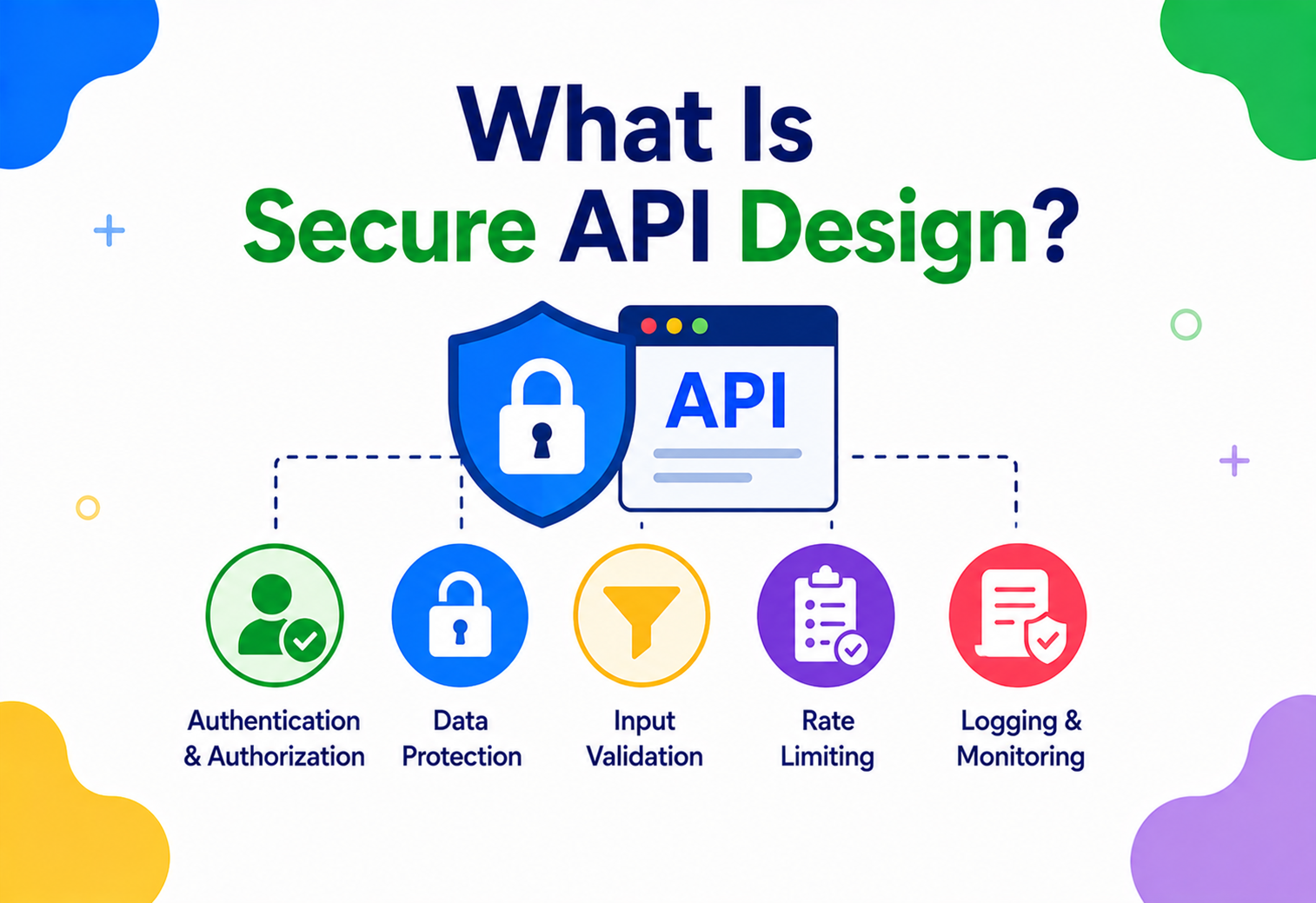
What Is Secure API Design?
A complete, beginner-to-production guide to designing APIs that are safe by default — covering authentication, authorisation, transport security, input validation, rate limiting, secrets management, and the real-world engineering practices companies like Netflix, Amazon, and Stripe use to protect billions of API calls every day.
Where the Idea of API Security Comes From
APIs are the front door of modern software. Secure API design is the discipline of making sure that door only opens for the right people, in the right ways, with a clear log of who came in.
Every time you open a food-delivery app, check your bank balance, or log into an online course platform, you are triggering an API call — a request that travels across the internet, is processed by a server, and returns a response. An Application Programming Interface, or API, is simply a contract that lets two pieces of software talk to each other. Secure API design is the discipline of building that contract so that only the right people and systems can use it, only in the right ways, and so that a malicious actor cannot use it to steal data, disrupt service, or take over accounts.
Think of an API as a hotel’s front desk. The front desk (the API) lets guests (client applications) request services — checking in, ordering room service, requesting a wake-up call — without needing to walk into the hotel’s back office and operate the systems themselves. A well-secured front desk checks identification before handing over a room key, does not let one guest order room service for another guest’s room, and has cameras and logs so that if something goes wrong, the hotel can figure out what happened. A poorly secured front desk hands out master keys to anyone who asks nicely. Secure API design is the set of practices that keeps the front desk from doing that.
A secure API is like a hotel front desk with ID checks (authentication), a policy of only letting you access your own room (authorisation), a locked drawer for master keys (secrets management), a visitor log (audit logging), and a rule that limits how many times a delivery person can buzz the intercom per minute (rate limiting) before staff get suspicious.
A Brief History
APIs are almost as old as computing itself, but the idea of exposing them openly over the internet is much newer. In the 1990s, software components talked to each other through tightly coupled, proprietary interfaces such as CORBA and DCOM, and security was often an afterthought because these systems mostly lived inside a company’s own network, protected by a firewall. The rise of SOAP web services in the early 2000s introduced formal specifications like WS-Security, but the XML-heavy tooling was heavy and slow to adopt.
Everything changed after Roy Fielding described REST (Representational State Transfer) in his year-2000 doctoral dissertation, and companies such as Salesforce, eBay, and Amazon began exposing REST APIs to external developers between 2000 and 2006. Amazon Web Services in particular showed the industry that an API could be a product in itself. As APIs moved from “internal integration tool” to “the primary way a business exposes itself to the world,” the attack surface exploded. Mobile apps, single-page web applications, IoT devices, and partner integrations all started talking to backend systems directly over the public internet, and every one of those API endpoints became a potential door for attackers.
This shift is why organisations such as OWASP created a dedicated API Security Top 10 list, separate from the general OWASP Top 10 for web applications, because APIs fail in specific, recurring ways — broken object-level authorisation, broken authentication, excessive data exposure, and lack of rate limiting, among others. Secure API design today is a mature discipline with its own patterns, tools, and industry standards such as OAuth 2.0, OpenID Connect, and mutual TLS.
In 2023, API-related breaches affected major companies including Twitter/X (exposed data of over 200 million users through an API flaw) and T-Mobile (a single misconfigured API endpoint exposed data of 37 million customers). These were not exotic attacks — they were failures of the basic principles covered in this guide.
From Perimeter Security to API-Centric Security
For decades, the dominant security mental model was the castle-and-moat approach: build a strong perimeter firewall around the corporate network, and trust everything inside that perimeter. APIs quietly dismantled that model. A mobile banking app running on a customer’s personal phone is, by definition, outside the corporate network, yet it needs to talk directly to backend systems holding real money. A partner integration running in another company’s cloud account needs the same direct access. There is no longer a single moat to defend, because the front door of the application has moved from a login page rendered on a company-owned server to an API endpoint that any properly formed HTTP request can reach from anywhere on earth.
This is the deeper reason the industry moved toward standards like OAuth 2.0 and toward architectural philosophies like zero trust, which assumes no request — whether it originates from the public internet or from inside your own data centre — should be automatically trusted. Every request must prove who it is and what it is allowed to do, every single time. Secure API design is, in many ways, the practical engineering expression of the zero-trust philosophy applied to the exact place where most modern applications actually do their work: the API layer.
It also helps to understand who typically attacks APIs and why. Attackers range from opportunistic bots running automated scanners across the entire internet looking for common misconfigurations, to competitors scraping pricing or inventory data at scale, to organised criminal groups targeting financial APIs for direct monetary gain, to independent security researchers probing for bug bounties. Each of these actors has different goals, but they share one thing: they interact with your system exclusively through its APIs, never through a human-facing login screen, which is exactly why API-specific security thinking is required rather than simply reusing web-application security checklists that were originally built for browser-rendered pages.
Why APIs Deserve a Security Discipline of Their Own
APIs have a specific set of properties that make them uniquely attractive — and uniquely dangerous — targets. Those properties are why they need their own security thinking, not a bolted-on copy of web-app security.
Why does secure API design need to be its own topic, separate from “general security”? Because APIs have a unique set of properties that make them attractive and dangerous targets:
- They are machine-to-machine and often undocumented for the public, so developers sometimes assume “nobody will find this endpoint” — an assumption attackers exploit constantly through automated scanning.
- They expose structured, predictable data — unlike a web page rendered for humans, an API response is often clean JSON that is trivial for a script to parse and exfiltrate at scale.
- They are the backbone of mobile and single-page applications, meaning the “client” is code running on a device the attacker fully controls, so any security logic that lives only in the client (like hiding a button) is not real security.
- They are composed into chains — one microservice calls another, which calls a third — so a single weak link can expose an entire system, not just one endpoint.
What Happens Without Secure Design
Consider a beginner example: an online bookstore builds an endpoint GET /api/orders/{orderId} that returns order details. If the backend only checks “does this order ID exist?” and never checks “does this order belong to the logged-in user?”, then any authenticated user can simply change the number in the URL and read another customer’s order — name, address, and purchase history. This exact flaw, called Broken Object Level Authorisation (BOLA), is consistently ranked the number-one API vulnerability in the industry, because it is easy to introduce and easy to exploit.
Imagine a bank’s mobile app calls GET /accounts/1024/balance to show your balance. If you can change the URL to /accounts/1025/balance and see someone else’s balance, the bank has a BOLA vulnerability. This is not a theoretical bug — it is one of the most common real-world API flaws found in security audits every year.
The Business Motivation
Beyond the technical risk, there is a direct business case for secure API design:
Regulatory Exposure
Laws such as GDPR in the EU, the DPDP Act in India, and HIPAA in the US impose direct financial penalties for data breaches, many of which originate from insecure APIs.
Trust and Reputation
A single publicised API breach can erode years of customer trust; users rarely distinguish between “the app was hacked” and “the company was careless.”
Operational Cost
Fixing security after a breach — incident response, forensics, customer notification, legal fees — routinely costs 10 to 100× more than designing it in from the start.
APIs Are the Primary Target
APIs are now the primary attack surface of modern software, and the vast majority of API breaches trace back to a small, well-understood set of design mistakes. Learning to avoid them is one of the highest-leverage skills a software architect or backend engineer can develop.
The Vocabulary of API Security
Before diving into architecture, let’s build a shared vocabulary. Secure API design rests on a handful of foundational concepts, each answering a different question.
Authentication vs. Authorisation
These two terms are the most frequently confused in the entire field, so it is worth getting them exactly right.
| Concept | Question It Answers | Real-Life Analogy |
|---|---|---|
| Authentication (AuthN) | Who are you? | Showing your passport at an airport counter |
| Authorisation (AuthZ) | What are you allowed to do? | Your boarding pass only lets you board flight AI-202, not any flight |
A system can authenticate you perfectly (it knows exactly who you are) and still be insecure if its authorisation logic is broken (it lets you do things you should not be allowed to do). Most serious API breaches are authorisation failures, not authentication failures.
When you log into Netflix, authentication confirms you are “Priya’s account.” Authorisation is the separate check that decides whether Priya’s plan allows 4K streaming on this device, and whether this particular profile is allowed to watch mature-rated content — two different questions, two different checks.
Confidentiality, Integrity, and Availability (the CIA Triad)
This classic security model applies directly to APIs:
- Confidentiality — only authorised parties can read the data (achieved through encryption in transit like TLS, encryption at rest, and proper authorisation).
- Integrity — data cannot be tampered with in transit or at rest without detection (achieved through checksums, digital signatures, and HMAC-signed tokens).
- Availability — the API stays up and responsive even under load or attack (achieved through rate limiting, redundancy, and DDoS protection).
Statelessness and Tokens
Modern REST APIs are typically stateless: the server does not remember who you are between requests. Instead, every request carries proof of identity, usually a token — a signed, tamper-evident piece of data. The most common format is the JSON Web Token (JWT), which packs a user’s identity and permissions into a compact, digitally signed string that the server can verify without a database lookup.
// A decoded JWT payload (the middle segment of the token)
{
  "sub": "user_48213",
  "role": "customer",
  "scope": "orders:read orders:write",
  "iat": 1737360000,
  "exp": 1737363600
}
// This payload is signed with a secret key on the server.
// Any tampering with the payload invalidates the signature,
// so the server can detect if a client tried to change "role"
// from "customer" to "admin".
A JWT’s payload is signed, not encrypted, by default. Anyone can base64-decode a JWT and read its contents in plain text. Never put secrets, passwords, or sensitive personal data directly inside a JWT payload — only put identity and permission claims there.
The Principle of Least Privilege
Every user, service, and API key should be granted the minimum set of permissions needed to do its job — nothing more. If a reporting microservice only ever needs to read order data, it should hold a credential that can only read order data, not one that can also delete customer accounts. This single principle, applied consistently, eliminates entire categories of blast radius when a credential is inevitably leaked.
Defense in Depth
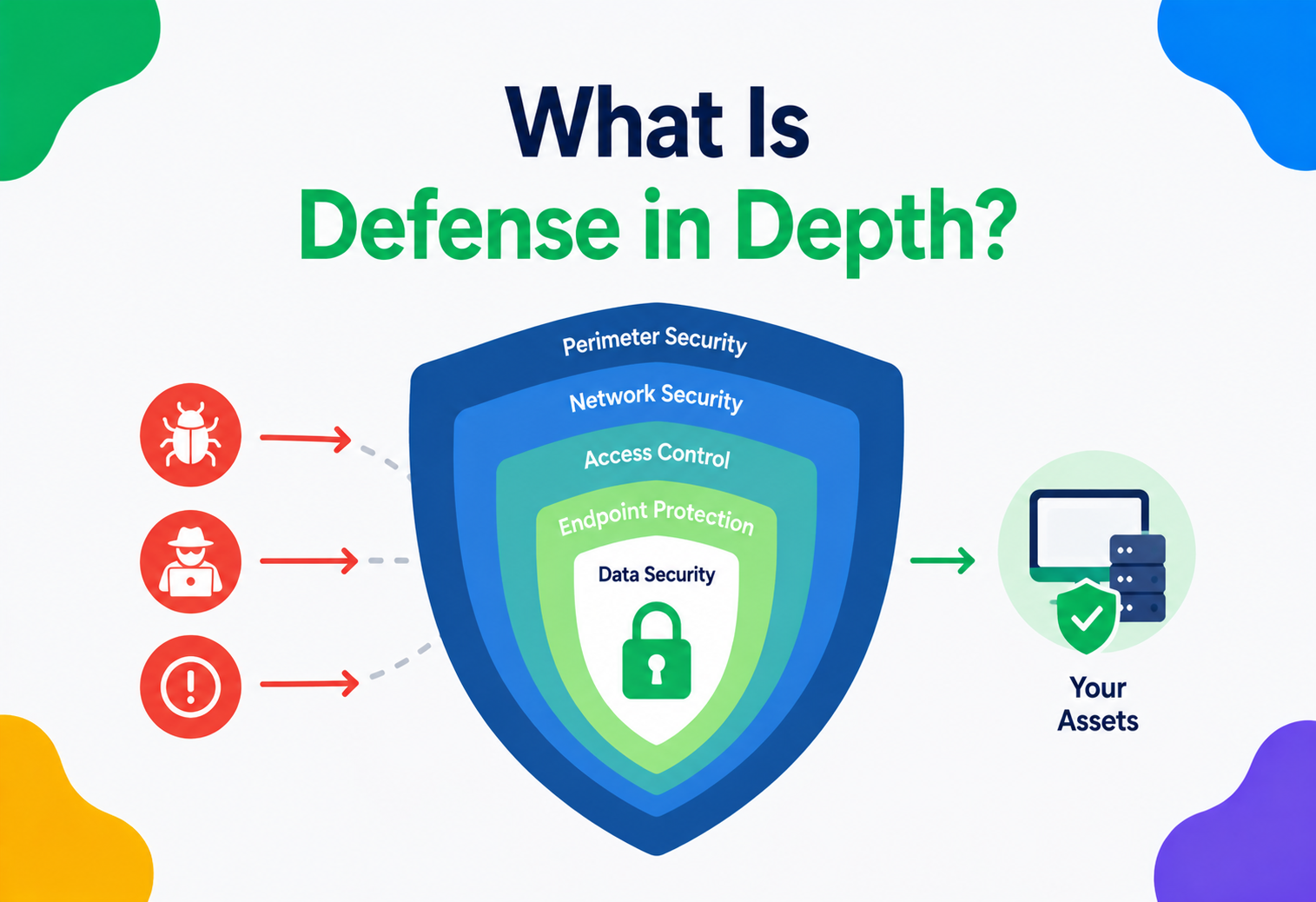
Secure API design never relies on a single control. Instead, it layers multiple independent defences so that if one fails, others still hold: network firewall, API gateway, TLS, authentication, authorisation, input validation, rate limiting, and logging all work together. This layered approach is why a single missed validation check does not automatically mean total compromise in a well-designed system.
Trust Boundaries
A trust boundary is any point where data crosses from a less-trusted zone into a more-trusted one — for example, from the public internet into your API gateway, or from a third-party partner’s system into your internal network. Secure API design treats every trust-boundary crossing as an opportunity to re-verify identity, re-validate data, and re-check permissions, because you can never fully trust data that originated outside your own system, even if it claims to be “already validated.”
API Keys, Tokens, and Certificates — Knowing Which Credential to Use
Beginners often use the terms “API key” and “token” interchangeably, but they solve different problems and carry different risk profiles.
| Credential Type | Typical Lifespan | Best Used For |
|---|---|---|
| API Key | Long-lived, often permanent until manually rotated | Server-to-server integrations; identifying a project or application |
| Access Token (JWT) | Minutes to hours | Representing a logged-in user’s identity and permissions for a session |
| Refresh Token | Days to months, revocable | Obtaining new access tokens without asking the user to log in again |
| Client Certificate (mTLS) | Months to years, tied to a specific service | Proving the identity of a service or device at the network layer |
A useful beginner rule of thumb: API keys identify what application is calling you, while tokens identify which user, on whose behalf, the call is being made. A single application might hold one API key but issue thousands of different tokens over time as different users log in and out through it. Confusing the two often leads to a design where a leaked API key grants far more access than it should, because it was mistakenly treated as if it also carried user-level authorisation.
Encryption in Transit vs. Encryption at Rest
These are two distinct protections that are frequently confused. Encryption in transit (TLS) protects data while it travels across a network, preventing anyone intercepting the traffic — on a coffee-shop Wi-Fi network, at an internet service provider, or on a compromised router — from reading or altering it. Encryption at rest protects data while it is stored on disk, whether in a database, a backup, or a log file, preventing someone who gains physical or administrative access to the storage medium from reading it directly. A secure API needs both: TLS alone does nothing to protect a stolen database backup, and disk encryption alone does nothing to protect data actively flowing across the internet.
The Pipeline Behind Every Secure API
A production-grade secure API is not a single server handling requests — it is a pipeline of specialised components, each responsible for one layer of defence.
Component Breakdown
1. Web Application Firewall (WAF). Sits at the network edge and filters known attack patterns — SQL-injection strings, cross-site-scripting payloads, and known malicious IP ranges — before traffic ever reaches your application code. Cloud providers offer this as a managed service, such as AWS WAF or Cloudflare’s WAF.
2. API Gateway. The single, controlled entry point for all API traffic. It centralises cross-cutting concerns so that individual microservices do not each need to reinvent them: TLS termination, authentication token verification, rate limiting, request/response logging, and routing to the correct backend service. Popular implementations include Kong, Amazon API Gateway, Apigee, and Spring Cloud Gateway.
3. Identity Provider / Auth Service. A dedicated service (or third-party provider like Auth0, Okta, or AWS Cognito) that handles user login, issues tokens, and manages the OAuth 2.0 / OpenID Connect flows. Centralising authentication means every downstream service trusts one verified source of identity instead of each service implementing its own — and often inconsistent — login logic.
4. Secrets Manager. A dedicated vault (such as HashiCorp Vault, AWS Secrets Manager, or Azure Key Vault) that stores database passwords, API keys, and signing keys outside of source code and configuration files, rotating them automatically and granting access only to the specific services that need them.
5. Backend Services. The actual business-logic microservices (order service, payment service, inventory service) that never trust the gateway blindly — each still performs its own authorisation checks, because an internal network compromise should not automatically mean full application compromise.
6. Centralised Logging and SIEM. Every authentication attempt, authorisation decision, and API call is logged to a centralised system (such as the ELK stack, Splunk, or Datadog) that security teams can query and set alerts on — this is what turns “we might have been breached” into “we know exactly what happened, when, and to which records.”
Netflix’s API architecture uses an edge gateway called Zuul in front of hundreds of microservices. Every request passes through authentication and rate-limiting filters at the edge before it ever reaches a business-logic service, so individual engineering teams building new microservices inherit strong security defaults automatically rather than having to re-implement them.
Why Centralisation at the Gateway Matters Architecturally
A recurring theme across all of these components is centralisation of cross-cutting security concerns rather than duplicating them inside every individual service. Consider the alternative: if each of thirty different microservices independently implemented its own token-verification logic, a security fix — say, patching a vulnerability in how expired tokens are handled — would require thirty separate code changes, thirty separate deployments, and thirty separate opportunities for a team to make a mistake or simply forget. By contrast, when that logic lives once in a shared gateway or a shared library maintained by a platform team, a single fix protects the entire system at once. This is the same reasoning that led large organisations to build dedicated platform or security engineering teams whose primary output is exactly these kinds of shared, centrally maintained security building blocks, rather than expecting every individual product team to become security experts in isolation.
A Spring Boot Example of a Layered Security Configuration
@Configuration
@EnableWebSecurity
public class SecurityConfig {

    @Bean
    public SecurityFilterChain filterChain(HttpSecurity http) throws Exception {
        http
          .csrf(csrf -> csrf.disable()) // disabled only because we use stateless JWTs
          .sessionManagement(sm -> sm.sessionCreationPolicy(SessionCreationPolicy.STATELESS))
          .authorizeHttpRequests(auth -> auth
              .requestMatchers("/api/public/**").permitAll()
              .requestMatchers("/api/orders/**").hasAuthority("SCOPE_orders:read")
              .requestMatchers("/api/admin/**").hasRole("ADMIN")
              .anyRequest().authenticated()
          )
          .oauth2ResourceServer(oauth2 -> oauth2.jwt(Customizer.withDefaults()))
          .headers(headers -> headers
              .contentSecurityPolicy(csp -> csp.policyDirectives("default-src 'self'"))
              .frameOptions(frame -> frame.deny())
          );
        return http.build();
    }
}
This configuration shows several architectural principles in one place: statelessness (no server-side sessions), a resource-server pattern (the API validates JWTs issued by a separate auth service), fine-grained route-level authorisation, and secure HTTP response headers.
Tracing a Single Authenticated Request
To really understand secure API design, it helps to trace what happens, step by step, inside the system when a single authenticated request is processed.
TLS Handshake
Before any application data is exchanged, the client and server perform a TLS handshake. The server presents a digital certificate proving its identity; the client verifies this certificate against a trusted certificate authority; both sides negotiate a shared symmetric encryption key using asymmetric cryptography, and all further communication in that session is encrypted with that key. This is what turns http:// into https:// and prevents anyone eavesdropping on the network from reading the request or response.
Token Issuance (Login)
When a user logs in, the authentication service verifies their password (checked against a securely hashed value, never plaintext, using an algorithm like bcrypt or Argon2) and, if valid, issues an access token — typically a short-lived JWT — and a longer-lived refresh token.
Client Attaches the Token to Every Request
Every subsequent API request carries the token in the Authorization header, so the server can verify identity without a login redirect on every call.
Gateway Verifies the Token
The API gateway extracts the token, checks its digital signature against the auth service’s public key (proving it was not forged or altered), confirms it has not expired, and extracts the claims — who the user is and what scopes they hold. This verification happens without a network call to the auth service on every request, because the signature alone proves authenticity — the core efficiency benefit of JWTs.
Authorisation Decision
With identity established, the service checks: does this specific user have permission to access this specific resource? This is where object-level checks happen — for example, confirming that order 48213 actually belongs to the requesting user, not just that the user is logged in.
Input Validation and Sanitisation
Before any request data touches business logic or a database query, it is validated against strict rules — type, length, format, and allowed character sets — and parameterised so that user input can never be interpreted as executable code (preventing SQL injection and similar attacks).
Response Filtering
Finally, before sending a response, the system strips any field the requesting user should not see — a practice that prevents excessive data exposure, another top API vulnerability, where an API returns a full database object (including internal IDs, password hashes, or another user’s data) and simply trusts the client to only display the “safe” fields.
POST /oauth/token
Content-Type: application/x-www-form-urlencoded

grant_type=password&username=asha&password=**********

// Response
{
  "access_token": "eyJhbGciOiJSUzI1NiIsInR5cCI6IkpXVCJ9...",
  "refresh_token": "def502004f2f6f...",
  "expires_in": 900,
  "token_type": "Bearer"
}

// Subsequent authenticated request
GET /api/orders/48213 HTTP/1.1
Host: api.utivra.com
Authorization: Bearer eyJhbGciOiJSUzI1NiIsInR5cCI6IkpXVCJ9...
@GetMapping("/api/orders/{orderId}")
public ResponseEntity<OrderDto> getOrder(
        @PathVariable Long orderId,
        @AuthenticationPrincipal Jwt jwt) {

    Long currentUserId = Long.valueOf(jwt.getSubject());
    Order order = orderRepository.findById(orderId)
        .orElseThrow(() -> new ResourceNotFoundException("Order not found"));

    // Object-level authorisation check - the missing step that causes BOLA
    if (!order.getUserId().equals(currentUserId)) {
        throw new AccessDeniedException("Not authorised to view this order");
    }

    return ResponseEntity.ok(OrderMapper.toDto(order));
}
public record CreateOrderRequest(
    @NotNull @Size(max = 50) String productId,
    @Min(1) @Max(100) Integer quantity,
    @Pattern(regexp = "^[A-Z]{2}[0-9]{6}$") String couponCode
) {}

// Using parameterised queries, never string concatenation:
String sql = "SELECT * FROM orders WHERE user_id = ? AND status = ?";
jdbcTemplate.query(sql, new Object[]{userId, status}, rowMapper);
Notice that across all seven steps, no single step is solely responsible for security — each one assumes the previous steps might have failed and re-checks what it reasonably can. The TLS layer does not assume the token is valid; the token-verification layer does not assume the object-level check will happen downstream; the object-level check does not assume the input has already been sanitised. This overlapping, slightly redundant structure is exactly what defence in depth looks like when traced through a single real request rather than described abstractly, and it is precisely why a bug in any one layer, on its own, rarely leads to a full compromise in a well-designed system.
Sensitive Data From Entry to Deletion
Zooming out from a single request, it is useful to see the full lifecycle of a piece of sensitive data — say, a customer’s payment detail — as it flows through a secure API system from entry to storage to eventual deletion.
User Device → API Gateway (HTTPS + Bearer Token)
The request enters the system only over TLS, carrying an access token in the Authorization header.
Gateway → Auth Service
The gateway verifies the token’s signature and receives back the token’s scope (e.g. payments:write).
Gateway → Payment Service (mTLS)
The gateway forwards the request over mutual TLS, so even the internal hop is authenticated on both sides.
Payment Service Validates Input and Authorisation
Schema validation runs, and an object-level check confirms the requesting user is entitled to make this payment.
Payment Service → Payment Vault (Tokenisation)
The raw card number is exchanged for an opaque token; the application never stores the real number.
Audit Log Entry Written
An immutable record is written to the SIEM: user, action, timestamp, correlation ID — but no raw card data.
Response Flows Back Masked, Over TLS
The response returns a masked representation (e.g. last 4 digits only) and travels back through the gateway to the user over TLS.
Lifecycle Stages Explained
Ingress and transport. Data enters the system only over encrypted channels (TLS 1.2 or higher), and increasingly through mutual TLS (mTLS) for service-to-service calls, where both sides present certificates so that even internal network traffic cannot be spoofed.
Validation and normalisation. Raw input is validated against a strict schema, then normalised into an internal representation — this is also the point where malformed or oversized payloads are rejected before they can consume excessive resources (a denial-of-service vector).
Tokenisation and minimisation. Highly sensitive fields, like a credit card number, are often never stored directly by the application at all. Instead, a specialised payment vault returns an opaque token that stands in for the real value everywhere else in the system — so even if the application database is breached, no raw card numbers are exposed. This is the same principle behind PCI-DSS-compliant architectures used by Stripe and Razorpay.
Storage with encryption at rest. Whatever sensitive data does need to be stored is encrypted at rest, with encryption keys managed separately from the data itself (often in a hardware security module or managed key service), so a stolen database backup alone is not enough to read the data.
Access and audit. Every read or write of sensitive data is logged with who accessed it, when, and why — creating an audit trail that supports both security investigations and regulatory compliance (such as showing a GDPR auditor exactly who accessed a specific customer’s data).
Retention and deletion. Data is retained only as long as necessary for its stated purpose, and secure deletion processes (including from backups and logs) fulfil “right to be forgotten” obligations under laws like GDPR and India’s DPDP Act.
Stripe’s API famously never lets a merchant’s server touch raw card numbers if they use Stripe Elements or Stripe.js — the card details go directly from the customer’s browser to Stripe’s PCI-compliant vault, and the merchant’s backend only ever receives a token. This data-flow design decision, not just a firewall rule, is what keeps merchants out of the highest tier of PCI-DSS compliance burden.
Pros, Cons & What Security Costs
Secure API design is not free — every control has a cost, and mature engineering teams make these trade-offs deliberately rather than by accident.
Benefits of Investing in Secure Design
- Dramatically reduced breach probability and blast radius
- Easier regulatory compliance (GDPR, DPDP, HIPAA, PCI-DSS)
- Higher partner and enterprise-customer trust, often a sales requirement
- Fewer emergency incident-response fire drills
- Cleaner audit trails that speed up debugging, not just security investigations
Costs and Trade-offs
- Added latency from extra verification hops (auth checks, token validation)
- Increased engineering and operational complexity (key rotation, gateway config)
- Slower initial development velocity, especially for small teams or MVPs
- Additional infrastructure cost (WAF, secrets manager, SIEM licensing)
- Requires ongoing expertise — security is not a one-time setup
Common Trade-off Decisions
Stateless JWTs vs. server-side sessions. JWTs scale horizontally without a shared session store and work well across microservices, but they are hard to revoke instantly — once issued, a JWT remains valid until it expires, even if you “log the user out” server-side, unless you build an additional token-blacklist mechanism. Server-side sessions are trivially revocable but require a shared, low-latency session store, adding infrastructure dependency and a potential bottleneck.
Strict rate limiting vs. user experience. Aggressive rate limits stop automated abuse and credential-stuffing attacks, but overly strict limits can lock out legitimate power users, such as a small business using your API heavily through a third-party integration.
Fine-grained permissions vs. development speed. A rich, granular permission model (dozens of specific scopes) gives precise least-privilege control, but is significantly more work to design, test, and reason about than a simple “admin vs. regular user” model. Many teams start coarse and refine as real abuse patterns emerge.
“We’ll add security later” is the single most expensive trade-off decision in this list. Retrofitting authorisation checks, encryption, and audit logging onto a live system with real user data is far more expensive — and far riskier — than designing them in from day one, because it usually requires touching every existing endpoint at once under production pressure.
Making Security Cheap at Millions of Calls per Second
Security controls interact directly with performance, and a well-designed system optimises both together rather than treating them as opposing forces.
Where Security Adds Latency
- TLS handshake — adds round trips on connection setup, mitigated with TLS session resumption and HTTP/2 connection reuse.
- Token verification — JWT signature checks are CPU-bound but fast (microseconds) and require no network call, unlike opaque tokens that need a database or introspection-endpoint lookup on every request.
- Authorisation lookups — checking fine-grained permissions can require database queries; caching permission sets (with short TTLs) avoids hitting the database on every single request.
- Rate-limiting counters — typically implemented with an in-memory store like Redis using atomic increment operations, adding sub-millisecond overhead.
Scaling Secure Authentication
A naive design that calls the central auth service to validate every single token creates a bottleneck and a single point of failure as traffic grows. The standard scalable pattern is: the auth service issues JWTs signed with a private key; the public key is published via a JWKS endpoint; the API gateway caches that public key and verifies signatures locally without a network call. This scales linearly with gateway instances.
Auth Service Issues Signed JWT
The auth service signs each JWT with a private key that never leaves the service.
Public Key Published via JWKS
The corresponding public key is exposed at a well-known JWKS endpoint that any service can fetch.
Gateway Caches the Public Key
Each API-gateway instance fetches the key once and caches it in memory.
Signature Verified Locally
Every incoming JWT is verified against the cached key locally — no network call to the auth service.
Scales Linearly with Gateway Instances
Thousands of gateway instances can verify millions of tokens per second while the auth service handles only login and refresh traffic.
Because signature verification uses only the cached public key, thousands of gateway instances can verify millions of tokens per second without ever contacting the auth service directly, which only needs to handle login and token-refresh traffic, a much smaller volume.
Rate-Limiting Strategies at Scale
| Algorithm | How It Works | Best For |
|---|---|---|
| Fixed window | Counts requests in fixed time buckets (e.g. per minute) | Simplicity; can allow bursts at window edges |
| Sliding window log | Tracks exact timestamps of recent requests | Precision; higher memory cost |
| Token bucket | Tokens refill at a steady rate; requests consume tokens | Allowing controlled bursts (used by Stripe, AWS) |
| Leaky bucket | Requests processed at a constant output rate | Smoothing traffic to protect downstream systems |
GitHub’s API uses a token-bucket model, publishing remaining quota directly in response headers (X-RateLimit-Remaining, X-RateLimit-Reset) so client applications can back off proactively instead of discovering the limit only after being rejected — a design choice that improves both security posture and developer experience simultaneously.
Caching and Security Together
Caching authorisation decisions or user permission sets in Redis with a short TTL (say, 60 seconds) dramatically reduces database load while keeping the security-freshness window small enough that a revoked permission takes effect almost immediately — a good example of tuning a trade-off rather than picking an extreme.
Connection Reuse and Encryption Overhead at Scale
At very high request volumes, even small per-request costs compound into meaningful infrastructure spend, which is why production systems invest specifically in reducing repeated cryptographic overhead. HTTP keep-alive and connection pooling let a client reuse an already-negotiated TLS connection across many requests instead of repeating the full handshake each time. TLS session resumption, using session tickets or session IDs, lets a returning client skip much of the expensive asymmetric-cryptography negotiation on reconnect. Hardware acceleration for cryptographic operations, offered by most modern cloud load balancers, further reduces the CPU cost of terminating TLS for millions of concurrent connections, which is one of the main reasons large-scale API providers terminate TLS at a dedicated load-balancer or gateway tier rather than inside every individual application instance.
A Secure API That Is Frequently Down Is Not Secure
Availability is one-third of the CIA triad, and attackers specifically target availability through denial-of-service attacks. High availability of the security layer itself is often the piece teams forget until it fails.
Distributed Denial of Service (DDoS) Protection
Large-scale attacks flood an API with traffic from thousands of distributed sources, aiming to exhaust server or network capacity. Defence operates in layers:
- Edge / CDN layer — services like Cloudflare or AWS Shield absorb volumetric traffic before it reaches your infrastructure at all.
- Gateway layer — rate limiting and connection throttling per client IP or API key.
- Application layer — circuit breakers that stop calling an overwhelmed downstream dependency, preventing cascading failure.
Redundancy for the Security Components Themselves
It is a common oversight: teams make the business logic highly available but leave the auth service or secrets manager as a single point of failure. If the auth service goes down, and every API call requires a fresh token validation against it, the entire system goes down even though the business-logic servers are healthy. The fix is to run authentication and authorisation components with the same redundancy — multiple availability zones, health checks, and automatic failover — as the core business services.
Circuit Breakers and Graceful Degradation
If a downstream authorisation service becomes slow or unresponsive, a well-designed API should fail in a controlled, secure way — typically by rejecting requests (fail closed) rather than allowing them through unchecked (fail open). This is a deliberate design decision: for most security-critical checks like authorisation, failing closed (denying access when uncertain) is safer than failing open (granting access when uncertain), even though it briefly reduces availability.
@CircuitBreaker(name = "authzService", fallbackMethod = "denyByDefault")
public boolean checkPermission(String userId, String resource) {
    return authzClient.check(userId, resource);
}

// Fail closed: when the circuit is open, deny access rather than allow it
private boolean denyByDefault(String userId, String resource, Throwable t) {
    log.warn("AuthZ service unavailable, denying by default for user {}", userId);
    return false;
}
Disaster Recovery for Credentials and Keys
Signing keys and secrets need their own backup and recovery plan, distinct from general database backups — losing a signing key without a recovery process means every issued token becomes unverifiable and every user is instantly logged out system-wide, which is itself an availability incident.
Testing Failure Scenarios Deliberately
Mature teams do not simply hope their redundancy and fail-closed logic will behave correctly during a real incident; they test it deliberately through practices often called chaos engineering. This can involve intentionally terminating an authentication service instance in a staging environment and confirming that traffic fails over correctly to a healthy replica, or deliberately expiring a signing key ahead of schedule to confirm that key-rotation tooling and monitoring alerts fire as expected rather than silently failing. Running these exercises regularly, before a real outage forces the question, is one of the more reliable ways organisations discover that a supposedly redundant security component actually has a hidden single point of failure, such as a shared configuration file or a shared upstream dependency that both replicas quietly depend on.
The OWASP API Top 10 and How to Defeat Each Item
This section focuses specifically on the concrete controls and the OWASP API Security Top 10, the industry-standard reference for what actually goes wrong in real APIs.
The OWASP API Security Top 10 (Condensed)
| # | Risk | What It Means in Practice |
|---|---|---|
| 1 | Broken Object Level Authorisation | Not checking that a resource actually belongs to the requester |
| 2 | Broken Authentication | Weak password policies, no MFA, predictable tokens |
| 3 | Broken Object Property Level Authorisation | Letting users read or write fields they should not (e.g. changing their own “role” field) |
| 4 | Unrestricted Resource Consumption | No limits on request size, pagination, or rate, enabling denial of service |
| 5 | Broken Function Level Authorisation | Regular users able to call admin-only endpoints because the check is missing |
| 6 | Unrestricted Access to Sensitive Business Flows | Automating flows like ticket purchasing or coupon redemption at abusive scale |
| 7 | Server-Side Request Forgery (SSRF) | API fetches a URL supplied by the user, allowing internal network scanning |
| 8 | Security Misconfiguration | Default credentials, verbose error messages, missing security headers |
| 9 | Improper Inventory Management | Forgotten old API versions or debug endpoints still live in production |
| 10 | Unsafe Consumption of APIs | Blindly trusting data returned from third-party APIs you integrate with |
Authentication Done Right
- Password hashing with a slow, salted algorithm — bcrypt, scrypt, or Argon2 — never MD5 or SHA-1, which are fast and thus easy to brute-force.
- Multi-factor authentication (MFA) for sensitive operations, adding a second independent proof of identity beyond the password.
- Short-lived access tokens (minutes, not days) paired with longer-lived, revocable refresh tokens.
- Account lockout and exponential backoff after repeated failed login attempts, to blunt brute-force and credential-stuffing attacks.
Authorisation Patterns
Role-Based Access Control
Permissions attached to roles (admin, editor, viewer), users assigned to roles. Simple to reason about; can get unwieldy with many fine-grained needs.
Attribute-Based Access Control
Decisions based on attributes of the user, resource, and context (e.g. “finance team members can approve invoices under $10,000 during business hours”). More flexible, more complex to implement and audit.
OAuth 2.0 and OpenID Connect in One Picture
User Clicks “Login with Google”
The client app redirects the user’s browser to the authorisation server (Google, in this example).
User Authenticates & Consents at the Auth Server
The user enters their credentials directly with the auth server — the client app never sees the password.
Auth Server Returns an Authorisation Code
A short-lived code is redirected back to the client app.
Client Exchanges the Code for Tokens
Server-to-server, the client swaps the code for an access token and (via OpenID Connect) an ID token.
Client Calls the Resource API with the Access Token
The resource server validates the token’s signature and scope, then serves the protected resource.
OAuth 2.0 handles authorisation — granting a client app limited access to resources on a user’s behalf — while OpenID Connect (built on top of OAuth 2.0) adds a standard way to handle authentication, providing a verified identity token. This is exactly the mechanism behind every “Sign in with Google/GitHub/Microsoft” button.
Input Validation and Injection Prevention
Every attacker-controlled input — path parameters, query strings, headers, and body fields — is a potential injection vector. The universal defence is: validate strictly against an allow-list of expected formats, and never build queries or commands through string concatenation.
// VULNERABLE - never do this
String query = "SELECT * FROM users WHERE email = '" + userInput + "'";

// SECURE - parameterised query
String query = "SELECT * FROM users WHERE email = ?";
PreparedStatement stmt = connection.prepareStatement(query);
stmt.setString(1, userInput);
Transport and Header Security
- TLS everywhere, with HSTS headers forcing browsers to always use HTTPS.
- Strict Content-Security-Policy and X-Content-Type-Options: nosniff to reduce injection and content-sniffing risks for any HTML surfaces near the API.
- CORS configured with an explicit allow-list of trusted origins, never a wildcard (
*) alongside credentialed requests.
Secrets Management
API keys, database passwords, and signing keys must never live in source code or environment files committed to version control. Instead, they belong in a dedicated secrets manager, retrieved at runtime, rotated on a schedule, and scoped narrowly to the service that needs them — so a leaked service credential cannot be used to access unrelated systems.
Hardcoding an API key in a mobile app’s source code is a frequent, serious mistake — the app binary can be decompiled, and the key extracted, by anyone. Sensitive operations should always go through a backend that holds the real credential; the mobile client should hold only a scoped, revocable token.
Cross-Site Request Forgery (CSRF) and Why It Matters Differently for APIs
CSRF tricks a logged-in user’s browser into unintentionally sending a request to an application on their behalf, exploiting the fact that browsers automatically attach cookies to any request sent to the matching domain. Traditional server-rendered web applications, which rely on cookies for session identification, are highly exposed to this. Modern APIs that use a Bearer token in an Authorization header rather than a cookie are naturally more resistant, because a malicious page on another site has no way to read or attach your token to its own forged request. However, any API that does use cookies for authentication — common in first-party single-page applications for convenience — still needs explicit CSRF tokens or the SameSite=Strict cookie attribute to close this gap.
Server-Side Request Forgery (SSRF)
SSRF occurs when an API accepts a URL or hostname from user input and then makes a server-side request to it — for example, a “fetch a preview image from this link” feature. Without careful restriction, an attacker can supply an internal address like http://169.254.169.254/ (a common cloud-metadata endpoint) or a private IP address, tricking your own server into making requests to internal systems that should never be reachable from the outside, potentially leaking cloud credentials or scanning your internal network. The defence is to validate and restrict any user-supplied URL against a strict allow-list of expected domains, and to block requests to private IP ranges and metadata endpoints at the network level as well as the application level.
Security Headers Checklist
| Header | Purpose |
|---|---|
Strict-Transport-Security | Forces browsers to only ever connect over HTTPS, even if a user types http:// |
X-Content-Type-Options: nosniff | Stops browsers from guessing content types, reducing certain injection risks |
X-Frame-Options: DENY | Prevents the API’s responses from being embedded in a hidden iframe (clickjacking defence) |
Content-Security-Policy | Restricts which sources of scripts, styles, and content a page is allowed to load |
Access-Control-Allow-Origin | Explicitly names trusted origins allowed to make cross-origin requests, never a blanket wildcard for credentialed calls |
API Abuse and Business-Logic Security
Not every attack targets a technical flaw. Some abuse perfectly correct, bug-free code in unintended ways — for instance, an attacker scripting thousands of coupon-redemption calls to drain a promotional budget, or automating a ticket-purchasing API to buy out inventory for resale before real customers can act. Defending against this requires business-aware controls layered on top of standard authentication and rate limiting: per-user purchase limits, CAPTCHA challenges at suspicious thresholds, and anomaly detection that flags behaviour statistically inconsistent with normal human usage patterns.
You Cannot Secure What You Cannot See
Monitoring turns security from a one-time design exercise into an ongoing, observable practice.
What to Log
- Every authentication attempt (success and failure), with timestamp, source IP, and user agent
- Every authorisation denial, which often indicates either a bug or an active attack attempt
- Requests to sensitive endpoints (password change, permission change, data export)
- Rate-limit violations and their source
- Anomalous patterns: a single account querying thousands of different order IDs in a minute
Never log raw passwords, full credit-card numbers, access tokens, or other secrets — even in “temporary” debug logs. Logs are often less protected than the primary database and are a common source of accidental data exposure.
Key Metrics to Track
| Metric | Why It Matters |
|---|---|
| Authentication failure rate | A spike often signals a credential-stuffing attack in progress |
| 401 / 403 response rate per endpoint | High rates can reveal broken client logic or active probing |
| p95 / p99 latency on auth checks | Detects performance regressions in the security layer itself |
| Rate-limit rejection count | Tracks abuse pressure and helps tune limits accurately |
| Token refresh failure rate | Can indicate expired keys, clock skew, or session-fixation issues |
Correlation IDs for Tracing
In a microservices architecture, a single user request can fan out into a dozen internal calls. Attaching a unique correlation ID at the gateway and propagating it through every downstream call lets engineers reconstruct the complete path of a request across services — essential both for debugging and for reconstructing what happened during a security incident.
@Component
public class CorrelationIdFilter extends OncePerRequestFilter {
    @Override
    protected void doFilterInternal(HttpServletRequest req, HttpServletResponse res,
                                     FilterChain chain) throws IOException, ServletException {
        String correlationId = req.getHeader("X-Correlation-Id");
        if (correlationId == null) {
            correlationId = UUID.randomUUID().toString();
        }
        MDC.put("correlationId", correlationId);
        res.setHeader("X-Correlation-Id", correlationId);
        try {
            chain.doFilter(req, res);
        } finally {
            MDC.remove("correlationId");
        }
    }
}
Alerting and SIEM Integration
Raw logs are only useful if someone — or something — is watching them. Security Information and Event Management (SIEM) tools like Splunk or Datadog Security Monitoring ingest logs in real time and trigger alerts on defined patterns, such as “more than 20 failed logins for one account in 5 minutes” or “a service account suddenly accessing an endpoint it has never called before.”
Where and How You Deploy Matters
How and where an API is deployed has direct security implications, from the network topology down to the CI/CD pipeline that ships the code.
Network Segmentation
Production cloud deployments separate resources into public and private subnets: the API gateway and load balancer sit in a public subnet reachable from the internet, while databases, internal services, and secrets managers sit in private subnets, reachable only from within the cloud network — so even if an attacker compromises the gateway, they cannot directly reach the database without passing through additional internal controls.
Secure CI/CD Pipelines
- Static Application Security Testing (SAST) tools scan code for known vulnerable patterns on every commit.
- Dependency-scanning tools flag libraries with known CVEs before they reach production.
- Secrets scanning prevents accidental commits of API keys or passwords into version control.
- Infrastructure-as-code (Terraform, CloudFormation) is reviewed like application code, since a misconfigured security group is as dangerous as a code vulnerability.
Container and Kubernetes Security
When APIs run in containers, additional controls apply: images are scanned for vulnerabilities before deployment, containers run as non-root users, Kubernetes network policies restrict which pods can talk to which other pods (so a compromised front-end pod cannot directly reach the database pod), and secrets are mounted from a secrets manager rather than baked into container images.
API Gateway Configuration as a Security Control
Cloud-managed API gateways (AWS API Gateway, Azure API Management) let teams enforce security policy declaratively — request-validation schemas, throttling limits, and required authentication — as configuration, reducing the chance that an individual microservice team forgets to implement a control that should be universal.
Deploying a small personal project’s API on a platform like Render or Railway still benefits from the same principles at small scale: enabling HTTPS (usually automatic), setting environment variables for secrets instead of hardcoding them, and enabling the platform’s basic rate limiting — good habits that scale up naturally as the project grows.
Security Decisions Extend Into the Data Layer
Security decisions extend into the data layer, where APIs ultimately read and write persistent state.
Database-Level Security
- Least-privilege database accounts — the API’s database user should have only the specific table permissions it needs (e.g. no
DROP TABLEpermission for a service that only ever reads and writes rows). - Encryption at rest for the entire database volume, plus field-level encryption for especially sensitive columns like national ID numbers.
- Row-level security in databases that support it (like PostgreSQL) can enforce that a query can only ever return rows belonging to the authenticated tenant, as a defence-in-depth backstop even if application code has a bug.
Caching Securely
Caching improves performance but introduces a specific risk: caching a response that contains user-specific or sensitive data at a shared cache key can leak one user’s data to another. The fix is to always include the user or tenant identity as part of the cache key, and to never cache sensitive responses (like payment details) at all, or only in short-lived, per-user caches.
// UNSAFE - same cache key regardless of requesting user
String cacheKey = "order:" + orderId;

// SAFE - cache key scoped to the requesting user
String cacheKey = "order:" + orderId + ":user:" + currentUserId;
Load-Balancer Considerations
Load balancers terminate TLS, distribute traffic across healthy backend instances, and are often the first point where rate limiting and IP-based blocking can be applied cheaply, before a request consumes any application-server resources. Health checks ensure traffic is only routed to instances that are actually able to serve requests correctly, which also prevents a partially-compromised or misbehaving instance from silently serving a large share of traffic.
Read Replicas and Consistency
Distributing reads across database replicas improves scalability, but security-sensitive reads — such as checking a user’s current permission level right before a privileged action — should sometimes be routed to the primary database or a replica with minimal lag, to avoid a narrow window where a just-revoked permission is still visible on a stale replica.
Every Internal Call Is Also an API Call
In a microservices architecture, “the API” is not one thing — it is a mesh of internal and external APIs, each needing its own security posture.
North-South vs. East-West Traffic
North-south traffic flows between external clients and the system (through the API gateway), while east-west traffic flows between internal services. A common and serious mistake is securing north-south traffic carefully while leaving east-west traffic completely open, on the assumption that “it’s all inside our network, so it’s safe.” Modern zero-trust architecture rejects that assumption: any service, including internal ones, should authenticate its calls to any other service.
Service-to-Service Authentication
The standard pattern is mutual TLS (mTLS), where every service holds its own certificate and both the caller and callee verify each other’s identity on every connection, often managed transparently by a service mesh like Istio or Linkerd, so individual application code does not need to implement this logic manually.
API Gateways Per Boundary
Larger systems often use a public-facing API gateway for external clients, and separate internal gateways or a service mesh for service-to-service calls, each with policies tuned to their trust level — external traffic gets stricter validation and rate limiting, while internal traffic still gets authentication and authorisation but can trust payload shapes more, since they originate from your own deployed code.
The Backend-for-Frontend (BFF) Pattern
Rather than exposing dozens of fine-grained microservice APIs directly to a mobile app, a BFF layer aggregates and shapes data specifically for that client, which also creates a natural place to enforce client-specific security policy and hide internal service topology from the outside world entirely.
API Versioning as a Security Practice
Old, unmaintained API versions are a common source of breaches (OWASP’s “Improper Inventory Management” risk) because they often lack security patches applied to newer versions. A disciplined versioning and deprecation policy — with a firm sunset date, monitoring for which clients still use old versions, and eventual hard removal — is itself a security control, not just an engineering convenience.
The Shortlist Worth Memorising
Every secure-API toolkit boils down to a short list of proven patterns worth reaching for by default, and an equally important short list of shapes to steer clear of.
Proven Design Patterns
Gateway Aggregation
Centralise authentication, rate limiting, and logging at the gateway so individual services inherit strong defaults automatically instead of each reimplementing the same logic inconsistently.
Token Introspection / JWKS
Auth service publishes its public signing key at a well-known endpoint; every consuming service fetches and caches it, enabling stateless, scalable token verification everywhere.
Scoped, Short-Lived Credentials
Issue narrowly-scoped, short-lived tokens for specific operations (e.g. a pre-signed URL valid for 5 minutes to upload one file) instead of long-lived, broad-access credentials.
Sidecar / Service Mesh
Offload mTLS, retries, and traffic policy to a sidecar proxy running alongside each service, keeping security concerns out of application business logic.
Common Anti-Patterns to Avoid
Relying on an endpoint being “hard to guess” instead of enforcing real authentication and authorisation. Automated scanners find undocumented endpoints routinely.
Hiding a button or disabling a form field in the UI while the backend API still accepts the underlying request from anyone who calls it directly.
Accepting a userId field from the request body to decide whose data to return, instead of deriving identity only from the verified token.
A single, all-powerful internal service credential used by every microservice, so any one compromised service can access everything.
// ANTI-PATTERN: trusting a client-supplied user ID
@GetMapping("/api/profile")
public ProfileDto getProfile(@RequestParam Long userId) {
    return profileService.findById(userId); // attacker just changes userId
}

// CORRECT PATTERN: identity always comes from the verified token
@GetMapping("/api/profile")
public ProfileDto getProfile(@AuthenticationPrincipal Jwt jwt) {
    Long userId = Long.valueOf(jwt.getSubject());
    return profileService.findById(userId);
}
The “Fail Closed” Pattern
Whenever a security check cannot be completed with confidence — a downstream service timing out, a malformed token, an unexpected exception — the system should default to denying the request rather than allowing it. This single pattern, applied consistently, prevents a huge class of bugs from silently becoming security holes.
Best Practices & Common Mistakes
Best practices are only as useful as the habits that make engineers reach for them automatically, under deadline pressure, without needing a checklist pinned to the wall.
Building a Security-First Mindset
Teams that consistently ship secure APIs tend to share a few cultural traits rather than just a list of technical rules: they treat every new endpoint’s authorisation logic as worthy of the same code-review scrutiny as its business logic, they threat-model new features before writing code rather than after a vulnerability is reported, and they make it easy to do the secure thing by default — for example, providing a shared library that automatically enforces object-level checks, so individual engineers do not have to remember to write that check correctly every single time from scratch. The checklist below captures the concrete, testable outcomes of that mindset.
Best-Practices Checklist
- Enforce HTTPS everywhere, with HSTS enabled, and disable older TLS versions.
- Authenticate every request; treat “internal” traffic with the same suspicion as external traffic (zero trust).
- Check authorisation at the object level on every single request that reads or modifies a specific resource, not just at the endpoint level.
- Validate all input against a strict allow-list schema, and reject anything that doesn’t match rather than trying to “clean” it.
- Return the minimum data necessary in every response; avoid dumping full internal database objects.
- Apply rate limiting and payload-size limits on every public endpoint by default.
- Store secrets in a dedicated secrets manager, rotate them regularly, and never commit them to source control.
- Log security-relevant events centrally and set up alerting on anomalies.
- Keep dependencies patched and scan for known vulnerabilities continuously.
- Version your API deliberately and retire old versions on a published timeline.
Common Mistakes (by Frequency of Real Breaches)
- Missing object-level authorisation checks — the single most common root cause of API breaches in industry reports.
- Overly permissive CORS configuration — allowing any origin (
*) alongside credentialed requests, letting any website make authenticated calls on a victim’s behalf. - Verbose error messages — stack traces or internal system details leaked in API error responses, handing attackers a roadmap of your internals.
- No rate limiting on authentication endpoints — leaving login and password-reset endpoints open to brute-force and credential-stuffing at unlimited speed.
- Long-lived, unscoped API keys — a single leaked key that grants full access indefinitely, with no expiry and no way to scope it down.
- Forgotten staging or debug endpoints deployed to production with weaker or no authentication.
Mass assignment — binding an entire request body directly onto a database entity, including fields the client should never be able to set, like isAdmin — has caused real breaches where a user simply added "role": "admin" to a profile-update request and the backend happily saved it. Always use an explicit allow-list DTO instead of binding directly to the persistence entity.
// VULNERABLE: binding directly to the entity allows mass assignment
@PutMapping("/api/profile")
public User updateProfile(@RequestBody User user) {
    return userRepository.save(user); // client could set user.role = "ADMIN"
}

// SECURE: explicit DTO with only the fields users are allowed to change
public record UpdateProfileRequest(String displayName, String bio) {}

@PutMapping("/api/profile")
public ProfileDto updateProfile(@RequestBody UpdateProfileRequest req,
                                 @AuthenticationPrincipal Jwt jwt) {
    User user = userRepository.findById(Long.valueOf(jwt.getSubject())).orElseThrow();
    user.setDisplayName(req.displayName());
    user.setBio(req.bio());
    return ProfileMapper.toDto(userRepository.save(user));
}
How the Industry Actually Practises API Security
A short tour of how well-known engineering organisations translate the ideas in this guide into daily practice — including two famous cautionary tales.
Token-based payment security
Stripe’s API design keeps merchants from ever needing to handle raw card data directly by tokenising it client-side, drastically shrinking the PCI-DSS compliance burden for anyone integrating their API and reducing the blast radius of any single merchant’s breach.
Scoped personal access tokens
GitHub allows developers to generate personal access tokens scoped to exactly the permissions needed (e.g. read-only access to a single repository) rather than a single all-powerful credential, directly applying the principle of least privilege at the product level.
Edge security at massive scale
Netflix’s API gateway layer (historically Zuul, now evolved further) applies authentication, rate limiting, and request routing at the edge across a system handling requests from hundreds of millions of devices, demonstrating that centralising security concerns at the gateway scales to enormous traffic volumes without every downstream microservice team needing to reimplement it.
Business-logic abuse prevention
Beyond standard authentication, Uber’s APIs incorporate business-logic-aware protections — detecting abnormal patterns like impossible travel speeds between requests or automated ride-booking scripts — showing that mature API security extends past classic authentication and authorisation into behavioural anomaly detection tailored to the specific business.
A cautionary tale
In a widely reported 2023 incident, a single API endpoint at T-Mobile allowed data belonging to millions of customers to be retrieved without adequate rate limiting or anomaly detection, illustrating that even well-resourced organisations can suffer major breaches from a single overlooked endpoint — reinforcing why systematic API inventory management and consistent policy enforcement at the gateway matter so much.
DPDP-Act-driven redesign
Following India’s Digital Personal Data Protection Act, 2023, many Indian fintech and e-commerce platforms have had to redesign APIs to support explicit consent tracking, data minimisation in responses, and verifiable audit trails for personal-data access — a concrete example of regulation directly shaping API design decisions in production systems.
UPI and India’s Account-Layer APIs
India’s Unified Payments Interface ecosystem is an instructive real-world case study in API security at national scale. Every payment app — whether built by a bank, a start-up, or a large technology company — integrates through a common, tightly specified API layer that enforces device binding, mandatory multi-factor authentication through a personal identification number, transaction-level rate limiting, and strict daily transaction caps. The architecture demonstrates that even an extremely high-volume, real-time financial API surface — processing billions of transactions monthly — can be made secure through consistent, centrally enforced design standards applied uniformly across every participating institution, rather than leaving security posture to each individual bank’s discretion.
Facebook’s 2018 Access-Token Breach
In 2018, a vulnerability in Facebook’s “View As” feature, combined with a flaw in its access-token generation logic, allowed attackers to steal access tokens for around 50 million accounts, effectively letting attackers log in as those users. The root cause traced back to a subtle interaction between three separate features, each individually reasonable, that combined to leak valid session tokens. This incident is frequently cited in security training as an example of why security reviews must consider how features interact with each other, not just whether each feature is secure in isolation — a lesson directly applicable to how modern APIs compose authentication, authorisation, and business logic across many independently developed endpoints.
Peloton’s Leaky API
Security researchers discovered that Peloton’s fitness API allowed any authenticated user to query detailed profile data belonging to other users, including private information such as age, gender, and location, simply by supplying a different user ID — a textbook broken-object-level-authorisation flaw affecting a company with millions of paying subscribers. The case is a useful reminder that this specific vulnerability class recurs across industries as different as fintech, social media, and connected fitness hardware, precisely because it stems from a missing check rather than a sophisticated attack technique.
Frequently Asked Questions
The questions engineers, product leads, and interviewers ask most often once the topic of API security is on the table.
Summary
Secure API design is not a single feature you bolt on — it is a set of layered, mutually reinforcing practices spanning transport encryption, authentication, fine-grained authorisation, strict input validation, rate limiting, secrets management, and continuous monitoring. It draws on foundational principles like least privilege, defence in depth, and failing closed, applied consistently across every layer of the architecture: the network edge, the API gateway, individual microservices, and the data layer itself. The most damaging real-world breaches, from T-Mobile to Twitter/X, rarely stem from exotic cryptographic attacks — they stem from a missing object-level authorisation check, an overly permissive CORS policy, or a forgotten debug endpoint. Mastering secure API design means internalising these recurring failure patterns well enough to design around them by default, not just knowing the theory behind OAuth or TLS.
For a working software architect or backend engineer, the practical path forward is incremental rather than all-at-once: pick the single highest-risk gap in an existing system — often missing object-level authorisation checks or an unmonitored authentication endpoint — fix it first, add the corresponding logging and alerting so a regression is caught automatically in the future, and only then move to the next item on the checklist. Treating secure API design as a continuously improving discipline, rather than a one-time audit to pass, is ultimately what separates systems that stay secure over years of feature growth from systems that were secure only on the day they first shipped.
Key Takeaways
- Authentication answers “who are you,” authorisation answers “what can you do” — both must be checked, and authorisation must be checked at the individual resource level, not just the endpoint level.
- Never trust client-supplied identity fields; always derive identity from a verified token.
- Layer defences (defence in depth) so that no single missed check leads to full compromise.
- Default to failing closed when a security check cannot be completed confidently.
- Rate limiting, input validation, and secrets management are not optional extras — they are core parts of the API contract.
- Centralised logging and monitoring turn security from a one-time design exercise into an ongoing, observable practice.
- The OWASP API Security Top 10 remains the most reliable, field-tested checklist for where real APIs actually fail.
- Security and good architecture are not competing goals — centralising authentication, authorisation, and validation logic at the gateway or in shared libraries tends to improve both consistency and long-term maintainability at once.