What Is Role‑Based Access Control (RBAC)?
A beginner‑to‑production guide to RBAC — how it works internally, how to design a role hierarchy, and how companies like Netflix, Amazon, and Google enforce it at massive scale.
Introduction & History
What RBAC is, in plain language, and how it evolved from ad‑hoc permission lists into a formal security model.
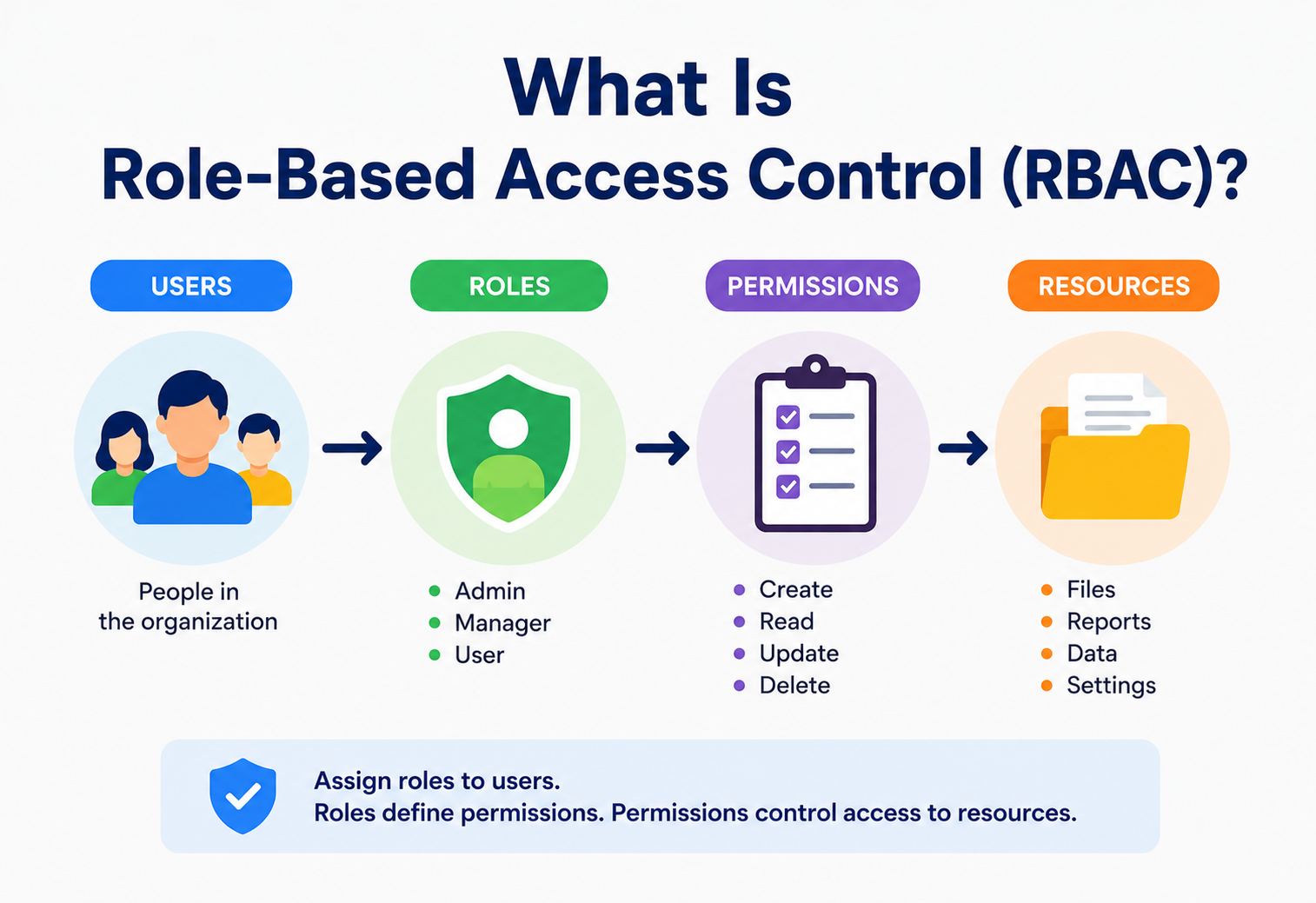
Imagine a hospital. A nurse can view a patient’s vitals and administer medication. A doctor can do everything a nurse can, plus write prescriptions and order surgery. A billing clerk can view invoices but has no access to medical records at all. Nobody hands each of the hospital’s thousand employees an individually customized list of permissions — instead, the hospital defines a handful of roles (“Nurse,” “Doctor,” “Billing Clerk”) and assigns each employee to one or more of those roles. Permissions are attached to the role, not to the person. This is exactly the idea behind Role‑Based Access Control (RBAC): a security model where access rights are granted to roles, and users gain permissions by being assigned to those roles, rather than having permissions assigned to them individually.
1.1 A short history
- 1970s–80sACLs and DAC dominate. Access Control Lists (ACLs) and Discretionary Access Control (DAC) dominate early computing. Each resource (a file, a record) has its own list of which users can do what — powerful but unmanageable as organizations grow past a few dozen users.
- 1992Ferraiolo & Kuhn (NIST) publish the foundational paper formalizing “Role‑Based Access Control” as a distinct model, arguing that most real‑world organizations naturally organize access around job functions, not individuals.
- 1996The RBAC96 model is introduced, defining the now‑standard building blocks: users, roles, permissions, and sessions, along with role hierarchies and constraints.
- 2001NIST RBAC standard is formally adopted (later ANSI INCITS 359‑2004), giving the industry a common reference model that vendors and enterprises could implement consistently.
- 2000sEnterprise adoption accelerates as ERP systems (SAP), operating systems (Windows Active Directory groups), and databases (Oracle, PostgreSQL roles) bake RBAC directly into their access control layers.
- 2010s+Cloud‑native RBAC becomes ubiquitous: AWS IAM roles, Kubernetes RBAC, Google Cloud IAM, and Azure RBAC all use this model as the default way to govern who can do what across cloud infrastructure, and it increasingly co‑exists with newer models like Attribute‑Based Access Control (ABAC) for more nuanced, context‑aware decisions.
The core insight that made RBAC so durable is simple: permissions naturally cluster around job functions, not individual people. As an organization scales from 10 to 10,000 people, managing access per‑individual becomes an administrative nightmare, but managing access per‑role scales gracefully, because the number of distinct roles grows far more slowly than the number of people.
Think of RBAC like uniforms and badges at a large office building. Security guards don’t memorize ten thousand individual faces and decide access floor‑by‑floor for each person — they recognize a badge color (the role) and know instantly which floors it unlocks. When someone changes jobs, you swap their badge, not redesign the entire building’s security system.
1.2 Why architecture, not just a database table
It’s tempting to think of RBAC as “just a permissions column in the users table,” but at production scale it becomes a genuine architectural concern spanning the database schema, the application’s authorization middleware, caching strategy (permission checks happen on nearly every request), auditing/compliance requirements, and how roles propagate across dozens of interdependent microservices. Getting this right — or wrong — has direct consequences for both security and performance across an entire system.
The Problem & Motivation
What breaks without RBAC, and why nearly every serious system eventually needs it.
2.1 The problem with per‑user permissions
Before RBAC, the natural first instinct is to give each user a list of specific permissions: can_edit_invoice, can_view_reports, can_delete_user. This works fine for five users. It becomes unmanageable fast:
- Onboarding is slow and error‑prone: A new hire needs the same 15 permissions as their teammate, so someone manually copies them — and inevitably misses one, or adds an extra one by mistake.
- Offboarding is dangerous: When someone leaves, every individually granted permission must be found and revoked. Miss one, and a former employee retains access indefinitely — a very common real‑world security incident.
- Auditing is nearly impossible: “Who can delete a customer record?” requires scanning every single user’s individual permission list, rather than checking one role definition.
- Permissions drift over time: Ad‑hoc grants (“just give Priya temporary access to fix this bug”) are rarely cleaned up, so real‑world permission sets slowly diverge from what anyone actually intended.
2.2 Beginner example
A student builds a simple blogging platform as a college project with just two flags on the user table: is_admin (boolean). Admins can do everything; everyone else can only read and comment. This works fine at first, but the moment the student wants a “moderator” who can delete spam comments but not touch site settings, the boolean model breaks down — there’s no way to express “some but not all admin powers” without hacking in more booleans, and each new boolean multiplies the combinations that have to be tested and reasoned about.
2.3 Software / mid‑size example
A project management SaaS tool initially checks permissions with scattered if (user.email.equals(“admin@company.com”)) style logic hardcoded directly into controllers. As the company grows and adds enterprise customers who want to designate their own internal admins, project leads, and read‑only viewers, this hardcoded logic becomes both a security liability (every new permission check requires a code change and redeploy) and a support burden (customers can’t self‑serve role assignment at all).
2.4 Production example: Netflix, Amazon, Google‑scale motivation
At companies operating cloud infrastructure and internal tooling at massive scale, RBAC isn’t optional — it’s a compliance and safety requirement. Amazon’s internal engineering systems and AWS itself use RBAC (via IAM roles) so that thousands of engineers and automated systems can be granted exactly the access their job requires and nothing more — a principle known as least privilege. Without a role‑based model, ensuring that a payments engineer cannot accidentally (or maliciously) access unrelated customer data across a company with tens of thousands of employees and services would be operationally impossible to audit or maintain.
RBAC is one of the few security decisions that touches nearly every layer of a system at once: schema design, API authorization middleware, caching, auditing, and compliance reporting. Get the role model wrong early, and retrofitting it later — after hundreds of scattered permission checks have been hardcoded throughout the codebase — is one of the most painful refactors a growing engineering team can face.
2.5 Compliance motivation
Beyond pure engineering convenience, RBAC is frequently a legal and regulatory requirement. Standards like SOC 2, HIPAA (healthcare data in the U.S.), PCI‑DSS (payment card data), and India’s own DPDP Act 2023 all expect organizations to demonstrate that access to sensitive data is restricted based on job function and can be audited — precisely what a well‑implemented RBAC system provides as a natural byproduct of its design.
Core Concepts
The vocabulary you need before any RBAC architecture diagram makes sense.
3.1 The four building blocks (from the NIST RBAC96 model)
Fig 3.1 — NIST RBAC96: users are assigned to roles; roles are granted permissions; permissions act on resources. Sessions activate a subset of the roles a user holds.
WhatA human, service account, or automated system that needs to interact with the system.
WhyA single user might hold multiple roles (a person could be both “Project Lead” on one team and “Viewer” on another), and roles must exist independently of any one user so they can be reused and reasoned about consistently.
WhatA named collection of permissions representing a job function (“Editor,” “Admin,” “Support Agent”).
WhyRoles are the layer of indirection that makes RBAC scale — instead of managing N users × M permissions individually, you manage a much smaller number of roles, each mapped once to its permission set.
WhatAn approval to perform a specific operation on a specific type of resource, typically expressed as an (action, resource) pair — e.g., edit:invoice, delete:user, view:report.
WhyPermissions are the actual atomic unit of “can do X” — roles are just convenient bundles of these atoms.
WhatA specific period of activity during which a user has activated some subset of the roles available to them.
WhyA user with both “Admin” and “Auditor” roles might, per the principle of least privilege, choose to operate in a session using only the “Auditor” role most of the time, reducing the chance of accidental destructive actions, and only activating “Admin” when truly needed.
3.2 Role hierarchy
Real organizations rarely have flat, unrelated roles — a “Senior Editor” typically can do everything a regular “Editor” can, plus more. RBAC models this with role hierarchies, where a role can inherit permissions from another role, avoiding duplicated permission definitions.
Fig 3.2 — In this hierarchy, “Admin” automatically has everything “Editor” and “Viewer” have, plus its own additional permissions — you only ever define the incremental permissions at each level.
3.3 Static vs. dynamic separation of duty (SoD)
What: A constraint preventing a single user from holding two roles that would create a conflict of interest — for example, the same person should not be able to both create a payment and approve that payment. Static SoD prevents the conflicting role assignment from ever existing at all. Dynamic SoD allows a user to hold both roles but prevents both from being active in the same session simultaneously. Why: This is a foundational fraud‑prevention control required by many financial and compliance regulations.
Think of a company checkbook that requires two different signatures — one person writes the check, a different person must sign it. RBAC’s separation‑of‑duty constraint enforces this same “two‑person rule” in software: the “Requester” role and “Approver” role can be defined so that no single user account can hold both for the same workflow.
3.4 RBAC vs. related access control models
| Model | How access is decided | Best suited for |
|---|---|---|
| DAC (Discretionary Access Control) | Resource owner decides who else gets access, per resource | File sharing, personal documents (Google Drive sharing) |
| MAC (Mandatory Access Control) | A central authority assigns fixed security labels/clearance levels; users cannot change them | Government/military classified systems |
| RBAC (Role‑Based Access Control) | Permissions attached to roles; users assigned to roles | Most business applications, enterprise software, cloud IAM |
| ABAC (Attribute‑Based Access Control) | Access decided dynamically from attributes of user, resource, and context (time, location, department) | Fine‑grained, context‑aware policies; complements RBAC at scale |
| ReBAC (Relationship‑Based Access Control) | Access decided by relationships between entities (e.g., “owner of this document,” “member of this team”) | Social platforms, collaborative tools (Google Docs sharing, GitHub repo permissions) |
In practice, many production systems use RBAC as the backbone (coarse‑grained: “what can an Editor generally do?”) combined with ABAC or ReBAC rules layered on top for fine‑grained, contextual exceptions (e.g., “an Editor can edit any document, except documents marked confidential unless they’re also in the Legal department”).
Architecture & Components
How RBAC is actually wired into a real application, end to end.
Fig 4.1 — A client request first passes authentication (who are you?), then authorization (are you allowed?), then either executes the application logic or receives a 403. Every decision is written to the audit log.
4.1 Component breakdown
Authentication layer
Confirms who the user is (login, token validation) — this is a prerequisite for RBAC but is a distinct concern from authorization. RBAC only begins once identity is established; a common architecture is to encode the user’s roles directly into a signed token (like a JWT) at login time, so downstream services don’t need to re‑query a database on every single request just to know “who is this and what roles do they have.”
Authorization layer / policy engine
Given an authenticated identity and a requested action, this layer answers the binary question: allowed or denied? It looks up the user’s roles, resolves the role hierarchy, and checks whether any of those roles grant the required permission for the requested resource.
Permission store
The source of truth mapping roles to permissions — typically a relational database table structure (see Section 13), sometimes supplemented by a fast in‑memory cache since this lookup happens on nearly every request.
Audit log
Records every access decision (especially denials, and especially for sensitive resources) — essential for both security investigation and compliance reporting (Section 10 and 11 cover this in depth).
4.2 Database schema for RBAC
The canonical relational schema uses a many‑to‑many relationship at two points: users‑to‑roles, and roles‑to‑permissions.
Fig 4.2 — The five‑table RBAC schema: users, roles, permissions, and two many‑to‑many join tables. The roles table has a self‑reference (parent_role_id) to model the role hierarchy.
CREATE TABLE users (
    id BIGSERIAL PRIMARY KEY,
    email VARCHAR(255) UNIQUE NOT NULL,
    created_at TIMESTAMP DEFAULT now()
);

CREATE TABLE roles (
    id BIGSERIAL PRIMARY KEY,
    name VARCHAR(100) UNIQUE NOT NULL,      -- e.g. 'EDITOR'
    parent_role_id BIGINT REFERENCES roles(id)  -- enables hierarchy
);

CREATE TABLE permissions (
    id BIGSERIAL PRIMARY KEY,
    action VARCHAR(100) NOT NULL,           -- e.g. 'edit'
    resource VARCHAR(100) NOT NULL,         -- e.g. 'invoice'
    UNIQUE(action, resource)
);

CREATE TABLE user_roles (
    user_id BIGINT REFERENCES users(id),
    role_id BIGINT REFERENCES roles(id),
    PRIMARY KEY (user_id, role_id)
);

CREATE TABLE role_permissions (
    role_id BIGINT REFERENCES roles(id),
    permission_id BIGINT REFERENCES permissions(id),
    PRIMARY KEY (role_id, permission_id)
);
4.3 Java / Spring Boot example: a role‑checking authorization filter
Here’s a simplified but realistic Spring Security‑style authorization check, evaluated on every incoming request after authentication has already resolved the user’s roles:
@Component
public class RoleAuthorizationInterceptor implements HandlerInterceptor {

    private final PermissionService permissionService;

    public RoleAuthorizationInterceptor(PermissionService permissionService) {
        this.permissionService = permissionService;
    }

    @Override
    public boolean preHandle(HttpServletRequest request,
                              HttpServletResponse response,
                              Object handler) throws IOException {

        if (!(handler instanceof HandlerMethod method)) return true;

        RequiresPermission required =
            method.getMethodAnnotation(RequiresPermission.class);
        if (required == null) return true; // no restriction on this endpoint

        AuthenticatedUser currentUser = SecurityContext.getCurrentUser();
        boolean allowed = permissionService.hasPermission(
                currentUser.getRoles(),
                required.action(),
                required.resource());

        if (!allowed) {
            response.setStatus(403);
            response.getWriter().write("{"error":"forbidden"}");
            return false;
        }
        return true;
    }
}

// Usage on a controller method:
@RequiresPermission(action = "delete", resource = "invoice")
@DeleteMapping("/invoices/{id}")
public ResponseEntity<Void> deleteInvoice(@PathVariable Long id) {
    invoiceService.delete(id);
    return ResponseEntity.noContent().build();
}
The key architectural idea here is declarative authorization: the controller method simply states what permission it requires via an annotation, and a centralized interceptor handles how that’s checked — meaning permission logic lives in one place, not scattered across every controller method as ad‑hoc if‑statements.
Internal Working
What actually happens, step by step, when an authorization check is evaluated.
5.1 Step 1 — Identity and role resolution
When a user authenticates (say, via username/password or SSO), the system resolves their full set of assigned roles. This can happen in one of two ways architecturally: eager resolution, where roles are baked directly into the auth token (e.g., a JWT claim “roles”: [“EDITOR”, “BILLING_VIEWER”]) at login time, or lazy resolution, where the token only carries a user ID, and roles are looked up fresh from a database or cache on every request.
| Approach | Pros | Cons |
|---|---|---|
| Eager (roles in token) | No database lookup needed per request; very fast | Role changes don’t take effect until the token is refreshed/re‑issued; token can grow large with many roles |
| Lazy (roles looked up per request) | Role changes take effect immediately | Requires a fast lookup (usually cached) on every single request |
5.2 Step 2 — Role hierarchy expansion
If the role model supports hierarchy (Section 3), the system must expand a user’s directly‑assigned roles into the full effective set including all inherited roles, before checking permissions. This expansion is typically precomputed and cached rather than recalculated on every request, since the hierarchy itself changes rarely.
Fig 5.1 — A permission check sequence with a cache. On a hit the middleware returns instantly; on a miss it falls back to the database, populates the cache, and only then decides allow vs. deny.
5.3 Step 3 — The actual permission check
At its core, the check is a set‑membership test: does the user’s fully expanded permission set contain the specific (action, resource) pair the requested operation needs? This is typically implemented as either a fast hash‑set lookup (if permissions were pre‑loaded into memory/cache) or a single indexed database query joining user_roles → role_permissions → permissions.
public boolean hasPermission(Set<Role> userRoles, String action, String resource) {
    Set<Role> expandedRoles = expandHierarchy(userRoles); // include inherited roles

    return expandedRoles.stream()
            .flatMap(role -> role.getPermissions().stream())
            .anyMatch(p -> p.getAction().equals(action)
                        && p.getResource().equals(resource));
}

private Set<Role> expandHierarchy(Set<Role> directRoles) {
    Set<Role> result = new HashSet<>(directRoles);
    Deque<Role> toProcess = new ArrayDeque<>(directRoles);

    while (!toProcess.isEmpty()) {
        Role current = toProcess.poll();
        if (current.getParentRole() != null
                && result.add(current.getParentRole())) {
            toProcess.add(current.getParentRole());
        }
    }
    return result;
}
5.4 Step 4 — Resource‑scoped checks (where RBAC alone isn’t enough)
A pure role check answers “can Editors edit invoices in general?” but not “can this specific Editor edit this specific invoice?” — the latter often requires an additional ownership or tenant‑scoping check layered on top of the role check (this is where RBAC commonly blends with ABAC/ReBAC concepts, discussed further in Section 3 and revisited in Section 15).
@RequiresPermission(action = "edit", resource = "invoice")
@PutMapping("/invoices/{id}")
public ResponseEntity<Invoice> editInvoice(@PathVariable Long id,
                                            @RequestBody InvoiceUpdate update,
                                            @AuthenticationPrincipal AuthenticatedUser user) {
    Invoice invoice = invoiceService.findById(id);

    // RBAC confirms the role CAN edit invoices;
    // this extra check confirms THIS invoice belongs to the user's tenant.
    if (!invoice.getTenantId().equals(user.getTenantId())) {
        throw new ForbiddenException("Invoice does not belong to your organization");
    }

    return ResponseEntity.ok(invoiceService.update(id, update));
}Data Flow & Lifecycle
Tracing a request end‑to‑end, and how roles themselves are created, assigned, and retired over time.
6.1 Request‑time data flow
A single request travels: Client → Login/Authenticate → Token issued with roles (or user ID) → Subsequent API request → Authorization middleware → Permission check → either Business logic (allow) or 403 + audit log (deny) → Response + audit log. Fig 4.1 and Fig 5.1 together show this flow with cache hits, misses, and audit fan‑out.
6.2 Role lifecycle
Beyond the per‑request flow, roles themselves have a lifecycle that architects must design for:
- Role definition: A new role is created, typically by a system administrator, with an initial set of permissions.
- Role assignment: Users are granted the role — ideally through a self‑service or approval‑based workflow rather than direct database edits, so the assignment itself is audited.
- Role usage: The role is actively used in authorization checks, as covered in Section 5.
- Role modification: Permissions attached to a role change over time as the product evolves — this is powerful (one change affects every user with that role instantly) but also risky (a mistake affects every user with that role instantly).
- Role revocation / user offboarding: When a user leaves or changes jobs, their role assignment is removed — this should be a single, auditable action, which is precisely the operational win RBAC provides over per‑user permissions.
- Role deprecation: Old roles that are no longer needed should be identified (ideally via periodic access reviews) and retired, rather than accumulating indefinitely.
Think of role lifecycle like managing building access badges rather than individual door keys. Defining a role is like designing a new badge type; assigning it is issuing that badge to an employee; modifying a role’s permissions is like reprogramming what every badge of that color unlocks overnight; and offboarding is simply deactivating one badge — instantly cutting off access to every door it used to open, without hunting down physical keys.
6.3 Time‑bound and just‑in‑time (JIT) role activation
A more advanced lifecycle pattern grants a role only temporarily — for example, a support engineer might request “Production Database Read Access” for a two‑hour window to debug an incident, after which the role assignment automatically expires. This limits the window of risk from over‑provisioned standing access, a pattern increasingly favored in cloud environments (AWS IAM’s temporary session credentials work exactly this way).
Pros, Cons & Tradeoffs
RBAC is powerful but not free — understanding its limits is as important as understanding its strengths.
Simplicity & manageability
Pros: Easy to reason about, easy to audit (“who can delete users?” = “who holds a role with that permission?”), maps naturally to how organizations already think about jobs. Cons: Can become rigid when real‑world access needs don’t cleanly map to a single job title.
Role hierarchy
Pros: Avoids duplicating permission definitions across similar roles. Cons: Deep hierarchies become hard to reason about (“wait, which of these five inherited roles actually grants this permission?”).
Coarse‑grained permissions
Pros: Fast to implement, fast to check at runtime. Cons: Struggles with fine‑grained, contextual rules (“Editors can edit posts, except during a freeze window, except for their own posts”) without bolting on ABAC‑style logic.
Centralized permission store
Pros: Single source of truth, consistent enforcement everywhere. Cons: Becomes a critical dependency and potential bottleneck/single point of failure if not designed with caching and redundancy (Section 9).
7.1 Role explosion (the classic RBAC failure mode)
The most commonly cited real‑world weakness of RBAC is role explosion: as an organization tries to model increasingly specific access requirements purely through more roles (“Editor‑Region‑North,” “Editor‑Region‑South‑TemporaryContractor”), the number of distinct roles can grow to rival or exceed the number of users, defeating the entire point of the model. This typically happens when teams try to force fundamentally attribute‑based or relationship‑based access needs into a pure role structure.
The fix for role explosion is rarely “add more roles” — it’s usually to recognize that some access dimensions (region, time window, ownership) are better modeled as attributes checked alongside a smaller, cleaner set of roles, rather than multiplied into the role names themselves. This is why mature systems often combine RBAC (coarse‑grained job function) with a thin layer of ABAC/ReBAC rules (fine‑grained context) rather than choosing one model exclusively.
7.2 Static vs. dynamic tradeoff
RBAC’s strength — permissions are stable and centrally defined — is also its weakness in fast‑changing, highly contextual environments. A purely static role model can’t easily express “this manager can approve expenses only for their direct reports” without either extra logic layered on top, or an explosion of per‑manager roles. Architects should treat RBAC as the right default for the 80% of access decisions that genuinely map to job function, while planning for a complementary mechanism for the remaining 20% that are inherently contextual.
Performance & Scalability
Authorization checks happen on nearly every request in the system — they must be fast.
8.1 Why this is a hot path
Unlike many features that run occasionally, permission checks execute on the vast majority of API calls a system serves. Even a small amount of added latency per check (say, an uncached database round trip) multiplied across millions of daily requests becomes a very real performance cost — this is why caching the permission set is not an optional optimization but close to a hard requirement at scale.
8.2 Caching strategy
| Layer | What’s cached | Typical TTL / invalidation |
|---|---|---|
| Token claims (JWT) | User’s role list, baked in at login | Token expiry (minutes to hours); revoked on refresh |
| In‑memory application cache | Expanded role → permission mappings | Short TTL (seconds to minutes) + explicit invalidation on role changes |
| Distributed cache (Redis) | Same as above, shared across service instances | Explicit invalidation on role/permission changes, published via pub/sub |
@Service
public class CachedPermissionService {

    private final RedisTemplate<String, Set<String>> redisTemplate;
    private final PermissionRepository repository;
    private static final Duration CACHE_TTL = Duration.ofMinutes(5);

    public boolean hasPermission(Long userId, String action, String resource) {
        String cacheKey = "perms:user:" + userId;
        Set<String> permissions = redisTemplate.opsForValue().get(cacheKey);

        if (permissions == null) {
            permissions = repository.loadExpandedPermissions(userId);
            redisTemplate.opsForValue().set(cacheKey, permissions, CACHE_TTL);
        }

        return permissions.contains(action + ":" + resource);
    }

    // Called whenever an admin changes a user's roles or a role's permissions
    public void invalidateUserPermissions(Long userId) {
        redisTemplate.delete("perms:user:" + userId);
    }
}
8.3 Cache invalidation is the hard part
The classic challenge — “there are only two hard things in computer science: cache invalidation and naming things” — applies directly here. When a role’s permission set changes, every user holding that role needs their cached permissions invalidated, not just the one admin who made the change. A common pattern is to cache by role rather than by individual user (roles change far less often than users log in), and compose a user’s effective permissions by combining their (small number of) cached role permission sets at request time.
8.4 Scaling the permission store itself
As request volume grows, the underlying permission data (Section 4’s schema) benefits from the same scalability techniques used for any hot relational data: read replicas for the permission tables (since reads vastly outnumber writes — roles change rarely, but are checked constantly), and denormalized read‑optimized views that pre‑join role hierarchies rather than resolving them relationally on every request.
8.5 Batch vs. per‑request checks
For endpoints that return lists of resources (e.g., “list all invoices”), naively checking permission per‑item in a loop is a common performance trap. Better architectures filter at the query level (only fetch resources the user’s role already permits) or batch‑check permissions once per request rather than once per resource in the response.
A small internal tool checking “can this user see this row?” for each of 500 rows returned from a database query, one permission‑service call at a time, will feel painfully slow. Restructuring the query to filter by role‑permitted resource types directly in SQL (via a WHERE clause) turns 500 checks into effectively zero extra checks.
High Availability & Reliability
What happens when the authorization system itself is unavailable — and why that failure mode deserves special care.
9.1 Fail‑open vs. fail‑closed
This is one of the most consequential design decisions in any access control system: if the permission store or cache is unreachable, should the system fail open (allow the request, assuming access, to avoid breaking the product) or fail closed (deny the request, assuming no access, to avoid a security gap)?
For virtually all production systems, RBAC should fail closed. A temporary outage that denies legitimate users access is an availability incident — annoying, but recoverable. A temporary outage that silently grants unauthorized access is a security incident that could cause irreversible damage before anyone notices. The one narrow exception is for extremely low‑risk, purely cosmetic UI decisions (e.g., whether to show a disabled button) where fail‑open causes no real harm.
9.2 Redundancy for the permission store
Because the authorization layer sits in the hot path of essentially every request, it must be designed with the same reliability rigor as the core application itself:
- Redis Cluster or a managed distributed cache, rather than a single Redis instance, to avoid the cache becoming a single point of failure.
- Database read replicas for the underlying role/permission tables so a spike in permission checks doesn’t compete with the primary’s write traffic.
- Circuit breakers around the permission service (if it’s a separate microservice) so that its failure degrades gracefully — falling back to a conservative fail‑closed default — rather than cascading failure into every dependent service.
9.3 Consistency considerations
Role assignment changes are a good example of where eventual consistency is often an acceptable, even necessary, tradeoff: if an admin revokes a user’s “Admin” role, it’s usually acceptable for that change to take a few seconds to propagate across all cached copies and active sessions, rather than requiring a synchronous, strongly consistent update across every service instance globally (which would hurt the performance of the far more common “check permission” read path). The important exception is high‑risk revocations (e.g., firing an employee for cause) where systems may deliberately force an immediate, synchronous cache‑bust rather than waiting for the normal TTL.
9.4 Disaster recovery for the identity/access system
Because the permission store is foundational infrastructure that every other service depends on, it deserves disaster recovery planning at least as rigorous as the core product database: regular backups, tested restore procedures, and — critically — a clearly defined “break glass” emergency access procedure for administrators to regain control if the normal RBAC system itself becomes unavailable (e.g., during a botched migration), without that emergency path becoming a standing security hole.
Security
RBAC is fundamentally a security control — here’s how to avoid undermining it.
10.1 Principle of least privilege
Every role should be granted the minimum set of permissions required to perform its job function, and nothing more. This isn’t just theoretical hygiene — it directly limits the “blast radius” if any single account is compromised (through phishing, leaked credentials, or a malicious insider), since the attacker inherits only that role’s limited permission set rather than broad access.
10.2 Privilege escalation risks
A subtle but critical class of vulnerability occurs when the RBAC system itself has a flaw allowing a low‑privileged user to grant themselves (or another account) a higher‑privileged role — for example, an “Editor” endpoint for updating their own user profile that accidentally also accepts a role field in the request body, letting a malicious user simply set their own role to “Admin.” Defenses include:
- Strict allowlisting of which fields a given role is permitted to modify on any resource, including on their own user record.
- Role assignment endpoints requiring a higher privilege level than the role being granted (you cannot grant a role you don’t yourself possess or exceed).
- Mandatory approval workflows for sensitive role changes (dual control, echoing the separation‑of‑duty concept from Section 3).
10.3 Insecure direct object reference (IDOR) alongside RBAC
A frequent real‑world gap: an application correctly checks “does this user’s role permit editing invoices in general?” but fails to check “does this specific invoice ID belong to this user’s organization?” — allowing a legitimate Editor at Company A to edit or view Company B’s invoice simply by guessing or incrementing an ID in the URL. As shown in Section 5, RBAC’s role check must always be paired with resource‑level (tenant/ownership) scoping for multi‑tenant systems.
10.4 Token security
If roles are embedded in a JWT (the eager‑resolution pattern from Section 5), the token must be properly signed and verified on every request — an attacker who can forge or tamper with an unsigned or weakly‑signed token could simply add “Admin” to their own role claim. Tokens should also have short expiries specifically because role changes (especially revocations) only take effect once a token is refreshed.
10.5 Auditability as a security control, not just a compliance checkbox
Every role assignment, role modification, and permission‑denied event should be logged with enough context (who, what, when, from where) to reconstruct exactly what access existed at any point in time — this is what allows a security team to answer “could this compromised account have accessed our customer database?” definitively after an incident, rather than guessing.
Treating role names as a security boundary in the UI only (“hide the delete button for non‑admins”) while leaving the underlying API endpoint completely unprotected. Client‑side role checks are a usability nicety, never a substitute for enforcing the permission check on the server, since any API endpoint is directly reachable by a technically capable attacker regardless of what the UI shows.
10.6 Default‑deny posture
New endpoints, new resource types, and new roles should default to granting no access until explicitly configured otherwise — the opposite default (new things are accessible to everyone unless explicitly restricted) is a common source of accidental over‑exposure as systems grow and evolve.
Monitoring, Logging & Metrics
Observability turns RBAC from a black box into something you can actually audit, debug, and improve.
11.1 Key metrics to track
| Metric | Why it matters |
|---|---|
| Permission denial rate (overall + per role/endpoint) | A sudden spike can indicate a misconfigured role, a broken deployment, or an attempted attack probing for access |
| Cache hit ratio for permission lookups | Directly affects request latency; a dropping hit ratio signals a cache invalidation or sizing problem |
| Role assignment/revocation events per day | Unusual spikes may indicate a compromised admin account or a runaway automation script |
| Number of users per role, and roles per user | Tracks role sprawl over time and highlights candidates for the periodic access reviews covered below |
| Time since last access review per role | A compliance‑critical metric ensuring stale, unused permissions are periodically re‑validated |
11.2 Audit log design
A well‑designed audit trail for RBAC captures, at minimum: who performed the action (actor), what action was taken (grant, revoke, permission check denied), on whom/what (target user, target resource), when (precise timestamp), and from where (IP address, and ideally which service/endpoint triggered the check). These logs should be treated as append‑only and tamper‑evident — a system where an admin could quietly edit their own audit trail defeats the entire purpose of auditing.
{
  "timestamp": "2026-07-21T09:14:32Z",
  "event": "PERMISSION_DENIED",
  "actor_user_id": 48213,
  "actor_roles": ["SUPPORT_AGENT"],
  "requested_action": "delete",
  "requested_resource": "invoice",
  "resource_id": "inv_88213",
  "source_ip": "203.0.113.14",
  "endpoint": "DELETE /api/invoices/inv_88213"
}
11.3 Alerting
Not every permission denial needs to page someone (a user clicking a button they shouldn’t have is routine and expected). Alerting should be tiered around genuinely anomalous patterns:
- Informational: Normal background rate of 403s from routine UI mistakes — dashboard only.
- Warning: A single account generating an unusually high volume of denied requests in a short window — possible credential compromise probing for access, or a misconfigured integration.
- Critical: Any role escalation to a highly sensitive role (e.g., “Super Admin”) outside of the normal approval workflow, or a spike in successful accesses to a resource type flagged as highly sensitive.
11.4 Periodic access reviews
Beyond real‑time monitoring, mature organizations run scheduled (often quarterly) access reviews: a manager or system owner is presented with the list of who currently holds access to a given resource or role, and must explicitly re‑certify or revoke each one. This process is what actually catches the slow permission drift described in Section 2 — access nobody remembers granting, still sitting active months or years later.
Deployment & Cloud
How RBAC shows up as a first‑class concept in AWS, Kubernetes, and other cloud platforms.
12.1 Cloud provider RBAC systems
| Platform | RBAC mechanism | Notes |
|---|---|---|
| AWS | IAM Roles & Policies | Roles can be assumed temporarily by users or services; policies define fine‑grained permissions on specific resources (ARNs) |
| Kubernetes | Native RBAC API (Roles, ClusterRoles, RoleBindings) | Governs which users/service accounts can perform which operations (get, list, create, delete) on which cluster resources (pods, secrets, deployments) |
| Azure | Azure RBAC | Built on Azure Active Directory identities, scoped at subscription, resource group, or individual resource level |
| Google Cloud | Cloud IAM | Roles bundle permissions (“predefined roles”) that can be granted to users, groups, or service accounts at project or resource level |
12.2 Kubernetes RBAC example
Kubernetes’ own RBAC system is a clean real‑world illustration of the exact model described throughout this guide — Roles bundle permissions, and RoleBindings assign roles to users or service accounts:
apiVersion: rbac.authorization.k8s.io/v1
kind: Role
metadata:
  namespace: production
  name: deployment-viewer
rules:
- apiGroups: ["apps"]
  resources: ["deployments"]
  verbs: ["get", "list", "watch"]   # read-only, no create/update/delete
---
apiVersion: rbac.authorization.k8s.io/v1
kind: RoleBinding
metadata:
  name: bind-deployment-viewer
  namespace: production
subjects:
- kind: User
  name: priya@company.com
roleRef:
  kind: Role
  name: deployment-viewer
  apiGroup: rbac.authorization.k8s.io
This maps directly onto the NIST model from Section 3: the Role object defines permissions (verbs on resources), and the RoleBinding is the user‑to‑role assignment — proof that RBAC as a concept is genuinely portable across wildly different systems, from application‑level authorization to infrastructure orchestration.
12.3 Infrastructure as Code for role definitions
Just as with DDoS protection rules, RBAC configuration should be version‑controlled rather than manually clicked through a console — this gives you code review on sensitive permission changes, a full history of who changed what role and when (complementing the audit log from Section 11), and reproducibility across environments.
resource "aws_iam_role" "billing_readonly" {
  name = "billing-readonly-role"

  assume_role_policy = jsonencode({
    Version = "2012-10-17"
    Statement = [{
      Effect    = "Allow"
      Principal = { Service = "ec2.amazonaws.com" }
      Action    = "sts:AssumeRole"
    }]
  })
}

resource "aws_iam_role_policy" "billing_readonly_policy" {
  name = "billing-readonly-policy"
  role = aws_iam_role.billing_readonly.id

  policy = jsonencode({
    Version = "2012-10-17"
    Statement = [{
      Effect   = "Allow"
      Action   = ["ce:Get*", "ce:List*"]   # read-only cost explorer access
      Resource = "*"
    }]
  })
}
12.4 Multi‑environment role separation
A common and important deployment practice is maintaining entirely separate role definitions per environment (development, staging, production) rather than one shared role set — a “Developer” role in a sandboxed dev environment can safely be far more permissive than the equivalent role in production, and accidentally granting production‑level access through a shared role definition is a well‑documented category of real‑world security incidents.
Even a small team on a single AWS account gets meaningful RBAC benefit for free by using IAM’s built‑in AWS‑managed policies (like ReadOnlyAccess or PowerUserAccess) as starting roles, rather than granting every team member the sweeping AdministratorAccess policy out of convenience — a very common early‑stage mistake that quietly persists long after the team has outgrown it.
Databases, Caching & Load Balancing
The data‑layer decisions that determine whether RBAC scales gracefully or becomes a bottleneck.
13.1 Schema design revisited: normalization vs. denormalization
The fully normalized schema from Section 4 (separate users, roles, permissions, user_roles, role_permissions tables) is ideal for administration (editing roles is simple and consistent) but requires multiple joins to answer “what can this user do?” — a query that runs extremely often. Production systems commonly maintain a denormalized, precomputed view specifically optimized for the read path:
-- Materialized view, refreshed whenever roles/permissions change
CREATE MATERIALIZED VIEW user_effective_permissions AS
SELECT
    ur.user_id,
    p.action,
    p.resource
FROM user_roles ur
JOIN role_permissions rp ON rp.role_id = ur.role_id
JOIN permissions p ON p.id = rp.permission_id;

CREATE INDEX idx_user_effective_permissions_user
    ON user_effective_permissions (user_id);
This trades a small amount of staleness (the view must be refreshed on role/permission changes — an acceptable eventual‑consistency tradeoff, as discussed in Section 9) for dramatically faster reads on the system’s hottest query path.
13.2 Caching layers for permission data
Building directly on Section 8’s caching strategy, the data layer typically implements a two‑tier cache: a fast, small in‑process cache per application instance (for extremely hot, frequently repeated lookups within a single request or short window) backed by a shared distributed cache like Redis (for consistency across instances), backed finally by the database as the ultimate source of truth. This mirrors the general cache‑aside pattern covered in other Gauravsinghtech architecture guides, applied specifically to the authorization domain.
13.3 Load balancing considerations
Because permission checks happen on nearly every request, the authorization logic (whether embedded in the application or split into a dedicated authorization microservice) must scale horizontally just like any other hot‑path component. If authorization is implemented as a separate service (common in large microservice architectures — see Section 14), it should be load‑balanced with the same rigor as any critical backend service: multiple instances, health checks, and — since a failure here can effectively deny access to the entire platform — even more conservative failover behavior than typical services, given the fail‑closed principle from Section 9.
13.4 Connection pooling for the permission store
Just as with any hot relational data path, the database connection pool serving permission queries should be sized and monitored independently from other application traffic, since a burst of unrelated application load exhausting the shared connection pool could inadvertently starve authorization checks — turning an unrelated performance issue into what looks like a security/availability incident (nobody can access anything, because nobody can be authorized).
Think of the permission cache like a bouncer’s memorized guest list versus calling the venue owner on the phone for every single person at the door. The memorized list (cache) is fast but needs to be updated whenever the guest list changes (invalidation); calling the owner every time (uncached database hit) is always accurate but would create an impossibly long line during a busy night.
APIs & Microservices
RBAC gets architecturally more interesting — and more important to get right — once a single application becomes many independently deployed services.
14.1 Centralized vs. distributed authorization
Two broad architectural patterns exist for enforcing RBAC across microservices:
Fig 14.1 — A centralized authorization service is the single source of truth for permission decisions; the gateway consults it before forwarding requests to downstream services.
| Pattern | How it works | Tradeoff |
|---|---|---|
| Centralized (dedicated authorization service) | A single service owns all permission checks; other services call it (or the gateway calls it once) before proceeding | Consistent, single source of truth, easy to audit — but adds a network hop and a critical dependency every request relies on |
| Distributed (embedded in each service) | Each microservice independently validates a token’s role claims and enforces its own local rules | No extra network hop, more resilient to a single service’s failure — but risks inconsistent enforcement logic drifting across services over time |
Most large‑scale systems land on a hybrid: the API gateway performs coarse‑grained role checks once at the edge (does this role even have the general right to call this type of endpoint?), while individual services perform their own fine‑grained, resource‑scoped checks locally (does this role, for this specific tenant/resource, get this specific action?) — combining the consistency benefits of centralization with the resilience and performance benefits of local enforcement.
14.2 Propagating identity and roles across service boundaries
When Service A calls Service B on behalf of a user, Service B needs to know both who the original user is and what roles they hold, without blindly trusting a claim sent by Service A. The common solution is passing the original signed JWT (or a similarly verifiable token) through the entire call chain, so every service in the chain can independently verify the token’s authenticity and extract the same trusted role information — rather than each service having to trust an unverifiable “trust me, this user is an Admin” header from its caller.
@Service
public class InventoryClient {

    private final RestTemplate restTemplate;

    public InventoryLevel checkStock(String productId, String originalAuthToken) {
        HttpHeaders headers = new HttpHeaders();
        // Forward the original signed token — NOT a locally re-derived claim —
        // so the downstream service can independently verify roles itself.
        headers.set("Authorization", "Bearer " + originalAuthToken);

        HttpEntity<Void> entity = new HttpEntity<>(headers);
        return restTemplate.exchange(
                "http://inventory-service/api/stock/" + productId,
                HttpMethod.GET, entity, InventoryLevel.class).getBody();
    }
}
14.3 Service‑to‑service (machine) roles
RBAC isn’t only for human users — internal service‑to‑service calls should also carry their own machine identity and roles (often called “service accounts”), scoped just as tightly as human roles under the principle of least privilege. A reporting service that only ever needs to read order data should hold a role that permits exactly that, so that a compromise of the reporting service can’t be leveraged to write or delete data in the orders service.
14.4 API Gateway as the RBAC enforcement point
Building on the fan‑out and gateway concepts from other Gauravsinghtech system‑design guides, the gateway is a natural place to reject obviously unauthorized requests before they consume any downstream service capacity at all — both a security control and, incidentally, a helpful defense against wasted internal traffic under load.
Design Patterns & Anti‑patterns
Recognized good patterns to reach for, and common anti‑patterns that quietly undermine an RBAC system.
15.1 Recommended patterns
Role hierarchy with minimal depth
Model inheritance (Section 3) to avoid duplication, but keep hierarchies shallow (2–3 levels is typical) — deep hierarchies become as hard to reason about as no hierarchy at all.
RBAC + ABAC hybrid
Use roles for the coarse‑grained, stable 80% of access decisions, and a thin layer of attribute‑based rules (ownership, tenant, time window) for the remaining contextual 20% — directly addressing the role‑explosion tradeoff from Section 7.
Declarative, annotation/policy‑based enforcement
Express permission requirements declaratively at the point of use (as shown in Section 4’s @RequiresPermission example) rather than scattering imperative if‑statements throughout business logic — keeps the “what’s required” visible and consistent, separate from “how it’s checked.”
Separation of duty constraints
Explicitly model conflicting role combinations (Section 3) for any workflow with real financial or safety consequences, enforced at role‑assignment time, not just hoped for through process.
Just‑in‑time, time‑bound elevation
For high‑privilege roles, prefer temporary, explicitly requested and audited elevation (Section 6) over permanent standing access — dramatically shrinks the average “attack surface” of privileged accounts.
15.2 Anti‑patterns to avoid
Checking only “does this role permit this action in general?” without also checking “does this specific resource belong to this user/tenant?” (Section 5 and 10) — a very common source of real‑world IDOR vulnerabilities layered on top of an otherwise correct RBAC implementation.
Treating role assignment as “set once, forget forever.” Without scheduled recertification (Section 11), permission drift silently accumulates until an audit or incident forces an unpleasant discovery.
Best Practices & Common Mistakes
A practical checklist distilled from the sections above.
Role design
- Model roles around real job functions, not individual people
- Keep hierarchies shallow; prefer composition over deep inheritance
- Introduce ABAC/ReBAC for contextual needs instead of exploding role count
Enforcement
- Enforce server‑side, always — client‑side checks are UX only
- Pair role checks with resource/tenant‑level scoping
- Centralize enforcement logic; declare requirements, don’t scatter if‑statements
Performance
- Cache expanded permissions; invalidate on role/permission changes
- Cache by role, not per‑user, where possible
- Filter at the query level for list endpoints, not per‑item in a loop
Operations & compliance
- Fail closed on any authorization system failure
- Log every grant, revoke, and denial with full context
- Run periodic access reviews; retire unused roles
16.1 Common mistakes (and their fixes)
Mistake — broad roles granted “temporarily”
Roles are granted “just for this incident” with no expiry set. The user keeps the elevated access indefinitely, silently persisting through org changes and re‑orgs.
Fix — time‑bound JIT elevation
Use time‑bound / JIT role activation (Section 6) with an automatic expiry recorded in the assignment record itself, so revocation happens even if nobody remembers to run it.
Mistake — role names as documentation
The permission set behind “Manager” drifts over years. Nobody remembers exactly what it grants today, so every audit becomes an archaeology exercise.
Fix — explicit permission mappings
Maintain explicit, reviewable role‑to‑permission mappings in version control, not tribal knowledge; treat role definitions like any other reviewable code artifact.
Mistake — skipping resource‑level checks
An endpoint correctly verifies the role can “edit invoices” but does not check the invoice belongs to the user’s tenant. An IDOR bug quietly leaks cross‑tenant data (Section 10).
Fix — always pair role check with scoping
Every controller that touches a specific resource pairs the role check with an explicit ownership or tenant assertion, as in the Section 5 editInvoice example.
Mistake — no separation of duty for money paths
The same account can create and then approve a payment or wire transfer. A single compromised or malicious insider can move funds unchecked (a textbook fraud scenario).
Fix — enforce SoD constraints in RBAC
Explicitly model and enforce Requester vs. Approver as mutually exclusive at assignment time (static SoD) or activation time (dynamic SoD), per Section 3.
Mistake — fail‑open during outages
The permission service fails and the app quietly treats every request as allowed. A security gap opens exactly when the system is most stressed and least closely watched.
Fix — default to fail‑closed
Default to fail‑closed (Section 9); reserve fail‑open for purely cosmetic UI choices where fail‑open causes no real harm.
Mistake — no audit trail for role changes
Nobody can reconstruct who had access when. After an incident it’s impossible to answer “could this compromised account have reached our customer data?”
Fix — log every grant / revoke / denial
Log every grant, revoke, and denial with actor, target, timestamp, IP, and endpoint (Section 11). Treat the audit stream as append‑only and tamper‑evident.
Treat your role model as a living design artifact, not a one‑time schema decision. Revisit it as the product and organization evolve — new features often introduce new resource types that need explicit permission definitions, and org changes often make old roles stale. RBAC systems that are periodically reviewed stay clean; those that aren’t slowly accumulate the exact permission drift RBAC was meant to prevent in the first place.
Real‑World / Industry Examples
How the concepts above show up in the architecture of companies operating at massive scale.
Amazon Web Services (AWS IAM)
AWS IAM is one of the most widely used real‑world RBAC implementations on earth, governing access for millions of accounts across every AWS service. It embodies nearly every concept in this guide: roles that can be assumed temporarily (Section 6’s JIT pattern), granular permission policies (fine‑grained action + resource pairs, Section 3), and a strong default‑deny posture where a request is denied unless an explicit policy allows it (Section 10).
Kubernetes
As shown in Section 12, Kubernetes bakes RBAC directly into its core API — every operation any user or automated controller performs against a cluster passes through an RBAC check, making it one of the clearest, most inspectable real‑world reference implementations of the NIST RBAC96 model in widespread production use today.
Salesforce
Salesforce’s platform, used by enormous enterprise customer bases with deeply customized organizational structures, layers a role hierarchy (mirroring a company’s management structure) on top of profile‑based permissions (closely analogous to this guide’s “roles”) — a well‑known real‑world example of combining role hierarchy with additional sharing rules (a form of ABAC/ReBAC) to handle exactly the fine‑grained exceptions discussed in Section 7.
GitHub
GitHub’s repository permission model demonstrates the RBAC‑plus‑relationship hybrid pattern from Section 3 directly: organization‑level roles (Owner, Member) combine with repository‑level roles (Read, Triage, Write, Maintain, Admin) and team‑based relationships, allowing fine‑grained access that still stays manageable at the scale of organizations with thousands of repositories and contributors.
Banking & financial services
Core banking platforms are frequently cited as the textbook real‑world case for separation‑of‑duty enforcement (Section 3 and 15): regulations in most jurisdictions explicitly require that the person who initiates a wire transfer cannot be the same person who approves it, enforced directly through role constraints in the access control system rather than relying purely on process or trust.
Every one of these systems reinforces the same core idea: roles map to real functional needs (a job, a team’s job, a workflow step), permissions are defined once per role rather than per person, and the model stays legible enough that “who can do what, and why” remains answerable even as the organization scales into the thousands or millions of identities.
FAQ, Summary & Key Takeaways
Quick answers to common questions, and the core ideas to walk away with.
Is RBAC the same thing as a “permissions system”?
RBAC is one specific, well‑defined model for building a permissions system — the key characteristic being that permissions attach to roles, and users get permissions indirectly through role assignment. Many systems that loosely call themselves “permission‑based” are actually a mix of RBAC with attribute‑ or relationship‑based rules layered on top, as discussed in Section 3 and 7.
How many roles should a typical application have?
There’s no universal number, but a useful heuristic from Section 7 is: if your role count is approaching your user count, or if you’re regularly creating new roles for single individuals, that’s a signal of role explosion — a sign to introduce attribute‑based rules rather than continuing to multiply roles.
Can a user have more than one role?
Yes — this is a normal and expected part of the RBAC96 model (Section 3). A user can be assigned multiple roles, and depending on the system, may activate a subset of them per session (Section 3’s session concept) or have all assigned roles active simultaneously.
Is RBAC still relevant now that ABAC and more dynamic models exist?
Very much so. RBAC remains the dominant default for the majority of business applications because it maps naturally to how organizations already think about access (“what’s your job?”), and it’s simpler to implement, audit, and reason about than a purely attribute‑driven system. The more accurate framing, covered in Section 3 and 7, is that mature systems typically use RBAC as the backbone and add ABAC/ReBAC selectively for genuinely contextual exceptions — not that one model replaces the other.
Does RBAC alone protect against IDOR (Insecure Direct Object Reference) vulnerabilities?
No — this is one of the most important nuances in this guide (Section 5 and 10). RBAC answers “can this role generally perform this action?” but a separate resource‑level ownership or tenant check is required to answer “can this specific user access this specific resource instance?” Skipping the second check is a very common real‑world vulnerability even in systems with otherwise correct RBAC.
Should permission checks fail open or fail closed if the system is down?
For virtually all production systems: fail closed. Denying legitimate access during an outage is recoverable; silently granting unauthorized access is not. See Section 9 for the full reasoning and the narrow exception for cosmetic‑only UI decisions.
18.1 Summary
Role‑Based Access Control solves a problem every growing system eventually faces: managing who can do what, in a way that scales with the organization rather than the headcount. By attaching permissions to roles instead of individuals, RBAC turns access management from an unmanageable per‑person exercise into a small, auditable, centrally‑defined structure that mirrors how organizations already think about job functions. Implementing it well requires attention across the whole stack — schema design, caching for performance, fail‑closed reliability, resource‑level scoping alongside role checks, and rigorous auditing — but the payoff is a system where “who can access what, and why” remains a question you can actually answer, even at massive scale.
Permissions attach to roles, users attach to roles — and that layer of indirection is what makes access control scale.
18.2 Key takeaways
- Takeaway 1RBAC’s core idea is indirection: permissions attach to roles, users attach to roles, and that layer of indirection is what makes access management scale.
- Takeaway 2Role hierarchies avoid duplicated permission definitions, but should stay shallow to remain understandable.
- Takeaway 3RBAC alone isn’t enough for multi‑tenant or ownership‑sensitive resources — pair role checks with resource‑level scoping to avoid IDOR vulnerabilities.
- Takeaway 4Performance depends heavily on caching the (often database‑heavy) permission resolution path, with careful attention to cache invalidation.
- Takeaway 5Authorization systems should fail closed, be redundant, and be as reliably engineered as the core product itself, since nearly every request depends on them.
- Takeaway 6Watch for role explosion — when roles multiply faster than users, it’s time to introduce attribute‑based rules rather than more roles.
- Takeaway 7Auditability (who has access, who granted it, who was denied) is not optional — it’s what turns RBAC into a real, defensible security and compliance control.