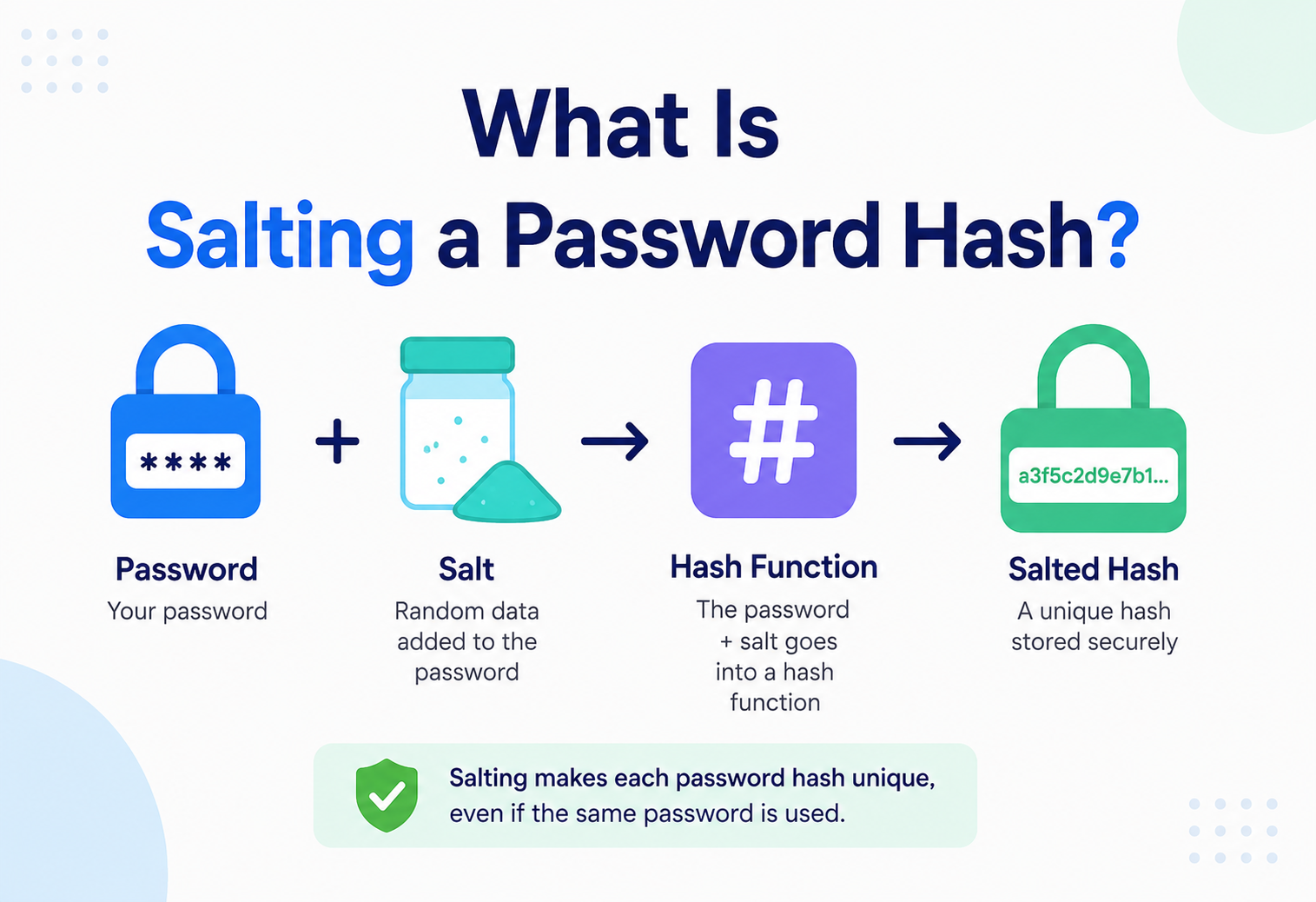
What Is Salting a Password Hash?
A deep, beginner-friendly walkthrough of one of the simplest yet most important ideas in authentication security — from the history of cracked password databases to how modern systems like bcrypt and Argon2 actually implement it.
Introduction & History
Imagine you have a locker at a gym. Instead of writing your actual combination on a sticky note taped to the locker (a terrible idea!), you scramble it using a secret rule only you know. A salt in password security is a little bit like that scrambling rule — except every single locker in the gym gets its own unique, random scrambling rule, even if two people happen to pick the exact same combination.
Salting a password hash means adding a random, unique piece of data (the “salt”) to a password before it gets hashed and stored. This one small trick defeats entire classes of attacks that would otherwise let a hacker crack thousands of passwords at once.
1.1 A Short History
Salting is not a new invention born out of modern web apps — it is one of the oldest tricks in computer security, dating back to the 1970s.
1976 — Unix Password Salting
Robert Morris Sr. and Ken Thompson introduced salting into the Unix crypt() function. Back then, storage was expensive, so precomputed “dictionary” tables of hashed passwords were already a real threat. A 12-bit salt was added specifically to make precomputation dramatically harder.
1990s — Rise of Rainbow Tables
As hashing algorithms like MD5 and SHA-1 became common for storing passwords, attackers built massive precomputed lookup tables (rainbow tables) that could reverse unsalted hashes in seconds.
2000s — Salting Becomes Standard Practice
Security guidance from bodies like OWASP and NIST began explicitly requiring salts for any stored password hash, alongside slow hashing algorithms.
2013 — The Password Hashing Competition
A public competition run by cryptographers to find the best modern password hashing algorithm. It concluded in 2015 with Argon2 as the winner — an algorithm that builds salting in by design.
Today
Salting is a baked-in, non-negotiable feature of every modern password hashing function: bcrypt, scrypt, Argon2, and PBKDF2 all generate and store a unique salt automatically.
Salting is one of those rare security concepts that is both conceptually simple and extremely effective. Understanding it deeply will make you a better engineer no matter what language or stack you work in.
The Problem & Motivation
To understand why salting exists, you first need to understand what goes wrong without it — and the failure modes turn out to be very concrete, not abstract.
2.1 Storing Passwords in Plain Text (the Worst Option)
The naive approach is to store the password exactly as the user typed it: password123 sits in your database, in plain view. If that database is ever leaked — through a bug, an insider, or a breach — every single account is instantly compromised, and because people reuse passwords, so are their accounts on other websites.
2.2 Hashing Alone (Better, But Still Broken)
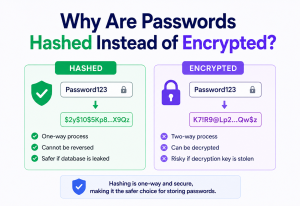
A hash function takes an input (like a password) and produces a fixed-size, seemingly random string of characters called a digest. Hash functions are one-way: easy to compute forward, practically impossible to reverse. So instead of storing password123, you store something like ef92b778bafe771e89245b89ecbc08a.
That sounds safe — until you realise two critical weaknesses:
Identical Passwords → Identical Hashes
- If two users both choose “password123”, their stored hashes will be byte-for-byte identical.
- An attacker who cracks one hash instantly knows every account sharing it.
Precomputation Attacks
- Attackers can hash millions of common passwords once, in advance, and build a lookup table.
- This is called a rainbow table — a leaked hash database can be cracked almost instantly by matching hashes against it.
This is exactly the gap salting closes. By mixing in random, unique data before hashing, we guarantee that even identical passwords produce completely different stored hashes, and precomputed rainbow tables become useless.
Core Concepts
Let us build up the vocabulary needed to talk about salting precisely, one term at a time. Getting these clear at the outset saves an enormous amount of confusion later.
3.1 What Exactly Is a Salt?
A salt is a random string of bytes (typically 16–32 bytes, i.e. 128–256 bits) generated fresh for every single password. It is not secret — it is stored right alongside the hash in the database. Its job is not to hide anything; its job is to guarantee uniqueness.

Password
The secret the user knows and types in — e.g. “Tr0ub4dor&3”.
Salt
A random value generated per user, per password. Not secret, but must be unique and unpredictable.
Hash Function
A one-way function like bcrypt or Argon2 that turns “password + salt” into a fixed-length digest.
Stored Value
The salt and the resulting hash, stored together — never the raw password.
3.2 Salting vs. Hashing vs. Encryption — Do Not Confuse Them
| Concept | Reversible? | Purpose | Typical Use |
|---|---|---|---|
| Encryption | Yes (with the key) | Protect data you need to read again later | Credit card numbers, messages |
| Hashing | No (one-way) | Verify data without storing the original | Passwords, file integrity checks |
| Salting | N/A — it is an input, not a function | Make each hash unique, defeat precomputed attacks | Always paired with password hashing |
Salting is not a hashing algorithm by itself. It is an ingredient you mix into the hashing process. You still need a strong, slow hash function (bcrypt, scrypt, Argon2) — salting alone does not make a weak hash function safe.
3.3 Salt vs. Pepper
A related but different concept is a pepper: a single secret value shared across all passwords in the system, usually stored outside the database (e.g. in an environment variable or secrets manager) rather than alongside the hash. Unlike a salt, a pepper is meant to be secret, and it adds an extra layer of protection even if the database itself is fully compromised — as long as the pepper is not compromised too.
Architecture & Components
Let us break down the moving parts of a salted-password system, the way you would design it in a real authentication service.
4.1 Key Components
- Random Number Generator (CSPRNG): Produces the salt. Must be cryptographically secure (e.g.
SecureRandomin Java, notMath.random()). - Key Derivation Function (KDF): The actual hashing engine — bcrypt, scrypt, Argon2, or PBKDF2. Intentionally slow and memory-hard to resist brute force.
- Credential Store: A database table (or user directory) holding
username,salt,hash, and metadata like the algorithm version and cost parameter. - Verification Service: Recomputes the hash at login time and performs a constant-time comparison against the stored value.
4.2 A Typical Database Row
| user_id | username | password_hash                                              | algorithm | cost |
|---------|----------|------------------------------------------------------------|-----------|------|
| 1001    | alice    | $2b$12$KIXQ7Z8n1p... (salt embedded in this string)        | bcrypt    | 12   |
| 1002    | bob      | $argon2id$v=19$m=65536,t=3,p=4$c2FsdHNhbHQ$hashhashhash... | argon2id  | -    |
Notice something important: in bcrypt and Argon2, the salt is not stored in a separate column at all — it is encoded directly inside the hash string itself, along with the algorithm name and cost parameters. This is a deliberate design choice that makes the stored value self-describing and much harder to misconfigure later.
Internal Working
Now let us walk through, step by step, exactly what happens on both a fresh registration and a subsequent login attempt.
5.1 Step by Step — Registration
- User submits a plaintext password over an encrypted connection (HTTPS/TLS).
- The server generates a cryptographically random salt (e.g. 16 bytes).
- The server feeds
password + saltinto the chosen hashing algorithm, along with a configured “cost” or “work factor.” - The algorithm runs many internal rounds (thousands to millions) of mixing to intentionally slow itself down.
- The resulting hash — plus the salt and parameters — is stored. The plaintext password is discarded from memory immediately.
5.2 Step by Step — Login
- User submits their plaintext password again.
- The server looks up the stored salt (and algorithm parameters) for that username.
- It recomputes the hash using the same salt and parameters.
- It compares the newly computed hash to the stored hash using a constant-time comparison function (to prevent timing attacks).
- Match → authenticated. No match → rejected, ideally with a generic error message and rate limiting.
5.3 Java Example — Salting & Hashing with PBKDF2
Below is a minimal, illustrative example using Java’s built-in PBKDF2 support. In production, prefer a dedicated library implementation of bcrypt or Argon2, but this shows the core mechanics clearly.
import javax.crypto.SecretKeyFactory;
import javax.crypto.spec.PBEKeySpec;
import java.security.SecureRandom;
import java.util.Base64;

public class PasswordHasher {

    private static final int SALT_LENGTH_BYTES = 16;
    private static final int ITERATIONS = 210_000; // work factor
    private static final int KEY_LENGTH_BITS = 256;

    // Generates a fresh, random salt for a new password
    public static byte[] generateSalt() {
        SecureRandom random = new SecureRandom(); // CSPRNG, never Math.random()
        byte[] salt = new byte[SALT_LENGTH_BYTES];
        random.nextBytes(salt);
        return salt;
    }

    // Hashes a password with the given salt
    public static String hashPassword(char[] password, byte[] salt) throws Exception {
        PBEKeySpec spec = new PBEKeySpec(password, salt, ITERATIONS, KEY_LENGTH_BITS);
        SecretKeyFactory factory = SecretKeyFactory.getInstance("PBKDF2WithHmacSHA256");
        byte[] hash = factory.generateSecret(spec).getEncoded();
        return Base64.getEncoder().encodeToString(hash);
    }

    // Verifies a login attempt against a stored salt + hash
    public static boolean verify(char[] attempt, byte[] salt, String storedHash) throws Exception {
        String candidateHash = hashPassword(attempt, salt);
        return constantTimeEquals(candidateHash, storedHash);
    }

    // Prevents timing attacks by always comparing the full length
    private static boolean constantTimeEquals(String a, String b) {
        if (a.length() != b.length()) return false;
        int result = 0;
        for (int i = 0; i < a.length(); i++) {
            result |= a.charAt(i) ^ b.charAt(i);
        }
        return result == 0;
    }
}Never compare hashes with String.equals() or ==. These short-circuit on the first mismatched character, leaking timing information an attacker can use to guess the hash byte by byte.
Data Flow & Lifecycle
A salted password hash has a full lifecycle, not just a one-time creation event — and thinking about it this way makes the operational decisions much clearer.

Creation
Generated at signup or password reset. The salt is random and unique every time — even if the user reuses the same password.
Storage
Persisted in the credential store, usually as a single encoded string containing the algorithm, cost, salt, and hash.
Verification
Recomputed on every login attempt using the stored salt — never regenerated on the fly.
Rotation
When a user changes their password, or the system upgrades its hashing algorithm/cost factor, a brand-new salt and hash are generated.
Retirement
Old hashes for deleted accounts should be securely deleted, not left to linger in backups indefinitely.
A great pattern is lazy re-hashing: when a user logs in successfully with an old, weaker hash (e.g. an outdated bcrypt cost factor), transparently re-hash their password with current parameters and update the stored value — all without the user noticing anything changed.
Advantages, Disadvantages & Trade-offs
Salting is one of the highest-value-per-line-of-code techniques in all of security engineering — but it is worth being honest about exactly what it does and does not solve.
Advantages
- Defeats rainbow table and precomputed hash attacks entirely.
- Identical passwords produce different stored hashes, hiding password-reuse patterns.
- Cheap to implement — a few bytes of randomness and one extra concatenation step.
- Modern KDFs (bcrypt/Argon2) bake it in automatically — very little for developers to get wrong.
Trade-offs & Limitations
- Salting alone does not stop brute-force attacks against a single, targeted account — that requires a slow hash function too.
- Does not protect against phishing, keyloggers, or credential stuffing on other sites (password reuse across sites remains a user-side risk).
- Requires slightly more storage (salt + metadata) per user — negligible in practice.
- A pepper adds protection but introduces key-management complexity (where do you store the shared secret?).
128–256 bits
Typical salt length — enough entropy that no two users will realistically ever collide.
~10 ms
Typical bcrypt hash time at cost factor 12 on modern server hardware — slow enough to deter attackers, fast enough for real logins.
1010+
The precomputed-hash count an attacker would need per salt before precomputation is even worth attempting — effectively infeasible.
Performance & Scalability
Salting itself adds essentially zero performance overhead — generating 16 random bytes and concatenating them is nanoseconds of work. The real performance conversation is about the hashing algorithm and its cost/work factor, which is intentionally slow by design.
8.1 Tuning the Work Factor
Every modern password KDF exposes a tunable “cost”: bcrypt’s cost factor, Argon2’s memory/time/parallelism parameters, PBKDF2’s iteration count. Higher cost = harder for attackers to brute-force = slower for your server to compute. Choosing the right value is a deliberate trade-off between user-facing login latency and attacker economics.
| Algorithm | Tunable Parameter | Typical Setting (2026) |
|---|---|---|
| bcrypt | cost factor (log₂ rounds) | 12–14 |
| scrypt | N (CPU/memory cost), r, p | N=217, r=8, p=1 |
| Argon2id | memory, iterations, parallelism | 64 MB, 3 iterations, 4 threads |
| PBKDF2 | iteration count | 210,000+ (SHA-256) |
Because hashing is deliberately CPU/memory expensive, a login endpoint can become a target for denial of service via CPU exhaustion if an attacker floods it with login attempts. Rate limiting and CAPTCHA are essential companions to salted hashing, not optional extras.
8.2 At Scale
In large systems handling millions of logins, hashing work is often offloaded to dedicated worker pools or async queues so it does not block the main request thread pool, and cost parameters are periodically re-tuned as hardware gets faster — what was “expensive enough” five years ago may be crackable today.
High Availability & Reliability
Salting does not directly affect availability, but the authentication service around it does need to be resilient — because if it goes down, nobody can log in at all.
- Redundant credential stores: Replicate the salt+hash table across multiple database replicas so a single node failure does not lock every user out.
- Idempotent salt generation: Salt generation must happen exactly once per password creation — never regenerate a salt on retry, or you will orphan the original hash.
- Graceful algorithm migration: When migrating from one hashing scheme to another (e.g. PBKDF2 → Argon2id), support verifying against both during a transition window, upgrading hashes lazily on successful login.
- Failover consistency: If your auth service fails over to a secondary region, ensure salts and hashes are consistently replicated — a stale replica with an outdated hash will reject valid logins.
Security Deep Dive
Salting is a defence against a specific, well-defined set of attacks — and being crisp about exactly which attacks it stops (and which it does not) is the difference between a secure design and false confidence.

10.1 What Salting Protects Against
Rainbow Table Attacks
Precomputed hash lookup tables become useless once every hash needs its own unique salt applied.
Duplicate Password Detection
Attackers can no longer spot which users share a password just by comparing hash values.
Bulk Precomputation
Attackers cannot hash a dictionary once and reuse it against your whole database.
10.2 What Salting Does NOT Protect Against
Targeted Brute Force
An attacker who knows one user’s salt can still brute-force that specific account if the hash function is fast or the password is weak.
Phishing
If a user types their real password into a fake login page, salting the stored hash does not help at all.
Credential Stuffing
Reused passwords across sites remain vulnerable if any one site is breached in plaintext, or if the user’s password is weak.
10.3 Salt Generation Requirements
- Must come from a cryptographically secure random number generator (CSPRNG) — e.g.
java.security.SecureRandom, never a general-purpose PRNG. - Should be at least 16 bytes (128 bits) — enough entropy that no two users will realistically ever collide.
- Must be unique per password, not reused across users or even across a single user’s password history.
- Does not need to be secret — it can be stored in plaintext right next to the hash.
Using a fixed, hardcoded salt for every user in the system defeats the entire purpose of salting — it is functionally identical to having no salt at all, since attackers can just precompute a single rainbow table for that one salt value.
Monitoring, Logging & Metrics
Authentication systems built on salted hashing benefit from a focused, deliberately narrow set of observability signals — and a strict discipline about what should never appear in logs.
- Failed login rate per account: Spikes can indicate brute-force or credential-stuffing attempts.
- Hash computation latency: Track p50/p95/p99 time for the hashing step — sudden slowdowns may signal misconfigured cost parameters or resource contention.
- Algorithm/version distribution: A dashboard showing what percentage of stored hashes still use a legacy algorithm, to track migration progress.
- Alerting: Alert on abnormal spikes in authentication failures, unusual geographic login patterns, or unexpected drops in successful re-hash-on-login events.
Never log plaintext passwords, salts, or full hash values in application logs — even in debug mode. Log usernames, timestamps, outcome (success/fail), and IP/context only.
Deployment & Cloud Considerations
In cloud-native deployments, salted password hashing typically lives inside an authentication microservice or is delegated to a managed identity provider entirely.
- Managed Identity Providers: Services like AWS Cognito, Auth0, or Okta handle salting and hashing internally — you often never touch a raw salt yourself.
- Self-managed auth: If you run your own auth service (e.g. on Kubernetes), ensure the hashing library is a maintained, audited dependency (e.g. Spring Security’s
BCryptPasswordEncoder) rather than a hand-rolled implementation. - Secrets management: If using a pepper in addition to a salt, store it in a secrets manager (AWS Secrets Manager, HashiCorp Vault) — never in source code or environment files committed to git.
- Autoscaling impact: Because hashing is CPU-intensive, autoscaling policies for auth services should factor in hashing load, not just request count.
Databases, Caching & Load Balancing
The storage and networking around salted hashes is refreshingly straightforward — but there are a few subtle rules that separate a robust design from a leaky one.
13.1 Storage Schema
Most systems store the salt embedded inside a single “encoded hash” string (as bcrypt and Argon2 do), rather than as a separate column. This keeps the algorithm, cost parameters, salt, and hash bundled together atomically — reducing the risk of mismatched metadata down the line.
13.2 Caching Caveats
Never cache plaintext passwords or successful hash comparisons in a way that could leak them. It is fine to cache “is this session token valid,” but never cache raw credential material in shared caches like Redis without encryption.
13.3 Load Balancing
Since hashing is CPU-bound and stateless (given the salt), authentication requests distribute well across a load-balanced pool of stateless auth service instances — any instance can verify any user’s credentials as long as it can reach the credential store.
APIs & Microservices
In a microservices architecture, password salting and hashing usually lives entirely inside a dedicated Auth/Identity service, exposing a small, carefully scoped set of endpoints:
POST /auth/register     { username, password }         -> creates salt+hash, returns success
POST /auth/login        { username, password }         -> verifies, returns JWT/session token
POST /auth/change-pass  { username, oldPass, newPass } -> generates NEW salt+hash
Other microservices (billing, profile, notifications) never see the raw password or the salt — they only receive a signed token after successful authentication. This isolates the highest-risk logic (credential handling) into one auditable, tightly-scoped service, and keeps the “blast radius” of any credential-related bug as small as possible.
Design Patterns & Anti-Patterns
A short, opinionated list of the shapes that recur in every well-designed salted-hash system, and the ones that quietly break security in nearly every troubled one.
Good Patterns
- Use a well-vetted library (bcrypt/Argon2 implementation) — never write your own hashing algorithm.
- Store the algorithm name and cost parameters alongside the hash for future-proof migrations.
- Lazy re-hash on successful login when parameters are outdated.
- Combine salting with rate limiting and account lockout policies.
Anti-Patterns
- Reusing the same salt across all users (“global salt”).
- Using fast general-purpose hashes (MD5, SHA-1, SHA-256) alone for passwords — they are built for speed, which is the opposite of what you want here.
- Storing the salt encrypted with a key that is harder to protect than just storing it in plaintext (unnecessary complexity).
- Truncating hashes or salts to save storage space.
Best Practices & Common Mistakes
If a code or architecture review turns up any of the mistakes listed here, treat it as a real security risk waiting to surface, rather than a purely cosmetic issue.
16.1 Best Practices
- Use Argon2id (or bcrypt if Argon2 is not available) as your hashing algorithm — both handle salting internally.
- Generate salts with a CSPRNG, at least 128 bits.
- Store the algorithm name and cost parameters with each hash for smooth future upgrades.
- Always compare hashes in constant time.
- Rate-limit and monitor login attempts — salting does not replace these defences.
16.2 Common Mistakes
- Rolling your own crypto: Writing a custom “salting” scheme instead of using an established library.
- Using the username as the salt: Predictable salts are barely better than no salt at all.
- Forgetting to re-salt on password change: Reusing the old salt when a user updates their password.
- Confusing salting with encryption: Trying to “decrypt” a hash — hashes are one-way by design.
Real-World / Industry Examples
Abstract advice gets much sharper once you see how the decisions play out in real, publicly-known incidents and platforms.
LinkedIn (2012 Breach)
Passwords were stored as unsalted SHA-1 hashes. Over 6 million hashes were cracked rapidly using precomputed tables — a textbook example of why salting matters.
Dropbox
Migrated legacy SHA-1 hashes to bcrypt with per-user salts, using a wrapped double-hashing approach during the transition to avoid forcing every user to reset their password at once.
Adobe (2013 Breach)
Used symmetric encryption instead of salted hashing for passwords, and reused an encryption key — attackers could group identical passwords across the entire dataset by matching ciphertext, defeating the purpose entirely.
Modern Identity Platforms
AWS Cognito, Okta, and Auth0 all use per-user salts combined with adaptive hashing (bcrypt/PBKDF2 family) as a baseline, invisible to the developers building on top of them.
Frequently Asked Questions
A few of the questions that come up most often the first time an engineer works seriously with salted password hashing.
No. A salt’s job is to guarantee uniqueness, not secrecy. It is completely fine — and standard practice — to store it in plaintext right next to the hash.
No. A salt is unique per password and stored openly. A pepper is a single shared secret across the whole system, kept outside the database, adding defence-in-depth if the database alone is compromised.
No — this completely defeats the purpose. A shared salt lets attackers build one rainbow table that works against your entire user base.
No. Salting must be combined with a slow, memory-hard hashing algorithm (bcrypt, scrypt, or Argon2id), rate limiting, and strong password policies. Salting solves the precomputation problem; it does not make brute force impossible on its own.
Almost never. Modern libraries like bcrypt and Argon2 generate and manage salts automatically as part of their hashing API — you typically just call hash(password) and the library handles the rest.

Summary & Key Takeaways
Salting is a small piece of randomness with an outsized security impact. By ensuring every password — even identical ones — produces a completely unique stored hash, it neutralises precomputed attacks and makes bulk password cracking dramatically harder.
Key Takeaways
- A salt is random, unique-per-password data mixed in before hashing — not secret, just unique.
- Salting defeats rainbow tables and prevents attackers from spotting duplicate passwords across users.
- Salting must be paired with a slow, memory-hard hash function (Argon2id, bcrypt, scrypt) — it is not a substitute for one.
- Modern libraries handle salt generation and storage automatically — never hand-roll your own scheme.
- Salting protects the stored data; it does not protect against phishing, weak passwords, or credential reuse across sites.
Almost every high-profile password breach in the last two decades has a moment in its story where salting (or the lack of it) determined how bad things got. A dozen bytes of well-chosen randomness, generated at the right moment and stored in the right place, is one of the highest-leverage decisions any engineer can make on behalf of the users who trust them.