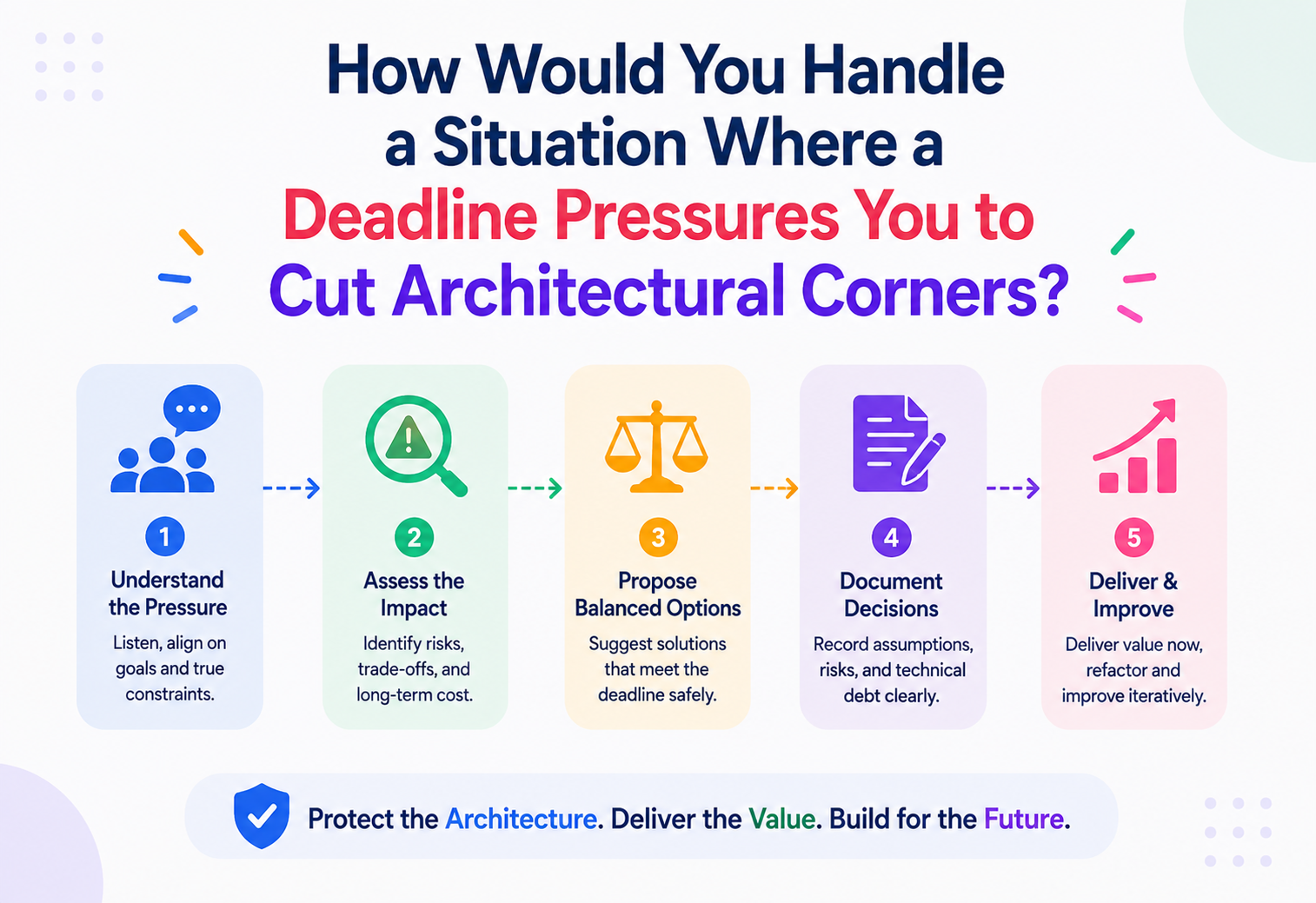
How Would You Handle a Situation Where a Deadline Pressures You to Cut Architectural Corners?
A complete, beginner-friendly guide to one of the most common and most misunderstood questions in software architecture — what do you do when “ship it now” collides with “build it right”? We build the concept from first principles, assemble a mental framework you can actually use, and look at how real companies have gotten this right — and badly wrong.
Introduction & Why This Situation Keeps Happening
Imagine you are building a treehouse with a friend. Your friend says, “the neighborhood party is this weekend — we need it done by Saturday!” You have two choices. You can nail the boards together quickly, skip the diagonal support beams, and have something that looks like a treehouse by Saturday morning. Or you can tell your friend, “if we skip the support beams, it might collapse when five kids climb on it at once. Let’s either get more help, or push the deadline by two days.”
This tiny treehouse story is, in essence, exactly what happens inside every software company, every single week, at every level from junior developers to Chief Technology Officers. A deadline shows up. The “proper” way to build something takes longer than the time available. Someone has to decide: do we cut a corner, or do we push back?
This situation is so common that it has become one of the most frequently asked interview questions for Software Architects, Tech Leads, Engineering Managers, and Senior Engineers. Interviewers do not ask it because they want to hear a rehearsed speech about “quality.” They ask it because how you answer reveals something much deeper: how you think, how you communicate, how you handle conflict, and whether you understand that software architecture is not just about writing correct code — it is about managing trade-offs between people, time, money, and risk.
Think of architectural quality like the foundation of a house, and a deadline like a wedding date that cannot move. You can absolutely build a house faster by pouring a thinner foundation. It will still look like a house on the wedding day. The problem shows up two years later, when the walls start cracking. Good architects know how to spot this trade-off before it becomes invisible.
In this guide, we are going to break this topic down completely — starting from “what actually is architectural quality,” moving through “why do deadlines create pressure to cut it,” building a step-by-step decision framework you can use in real life and in interviews, and finishing with real stories from companies like Netflix, Amazon, and a very expensive lesson from a trading firm called Knight Capital. By the end, you will not just have an “interview answer.” You will have a working mental model you can use the next time your own project manager says the dreaded words: “can we just ship it as-is for now?”

The Problem & Motivation: Why Does This Conflict Exist At All?
To understand why this situation is so common, we need to understand something basic about how software projects work. Every software feature has three competing forces pulling against each other, often called the “Iron Triangle” of project management.
Scope
What exactly are we building? How many features, how complete, how polished?
Time
When does it need to be live? Is there a hard external date, like a product launch or a legal deadline?
Quality / Cost
How well-engineered is it underneath the surface — how much testing, how much good design, how many engineers are working on it?
Here is the key beginner insight: you can almost never fix all three. If a business stakeholder shortens the time, then either the scope must shrink, or more people/money must be added, or the quality underneath has to absorb the difference — and quality is the one that is easiest to quietly sacrifice, because nobody outside the engineering team can see it on day one.
A cracked foundation does not show up during the open house. It shows up during the first earthquake. Similarly, a rushed architecture does not usually break on launch day — it breaks six months later, when ten times as many users show up, or when someone tries to add a new feature and discovers the entire codebase has to be rewritten first.
The people asking for the deadline (product managers, business stakeholders, founders) are usually optimizing for a visible, near-term outcome: revenue, a demo, a competitor beating them to market. The people worried about architecture (engineers, architects) are usually optimizing for an invisible, long-term outcome: maintainability, stability, scalability. Neither side is wrong. They are simply looking at different time horizons of the same problem.
This is why the interview question is not really testing “do you know good architecture.” It is testing whether you can hold both time horizons in your head at once, and negotiate a path that respects both — instead of blindly agreeing to the deadline (which builds resentment and technical debt) or blindly refusing it (which makes you look inflexible and disconnected from business reality).
Core Concepts You Need to Know
Before we can build a framework for handling this situation, let’s clearly define every term involved. We will explain each one like you are hearing it for the first time.
3.1 What is “Architecture” in Software?
Software architecture is the set of important, hard-to-reverse decisions about how a system is structured: how its pieces talk to each other, where data lives, how it handles failure, and how easy it will be to change later. Think of it like the blueprint and skeleton of a building — not the paint color (easy to change later) but the placement of load-bearing walls (extremely expensive to change later).
3.2 What Does “Cutting an Architectural Corner” Mean?
Cutting a corner means deliberately choosing a simpler, faster, but structurally weaker solution instead of the more robust one, in order to save time. Examples include: hardcoding a value instead of building a configuration system, skipping automated tests, putting logic directly in a database trigger instead of a proper service layer, or letting two services talk directly instead of going through a message queue that handles failures gracefully.
3.3 What is “Technical Debt”?
Technical debt is a metaphor invented by software pioneer Ward Cunningham in 1992. He compared taking a shortcut in code to taking out a financial loan: you get something valuable right now (speed), but you owe “interest” on it later in the form of extra effort every time someone touches that code, until the “principal” is paid off by going back and doing it properly.
Imagine you owe a friend ₹500 that you promised to pay back “sometime.” Every week you do not pay it, your friend trusts you a little less, and it becomes a little more awkward to ask for another favor. Technical debt works the same way — except instead of trust, what erodes is your codebase’s flexibility, and instead of a friend, it is your future self and your teammates who feel the awkwardness.
3.4 What is “Deadline Pressure”?
Deadline pressure is the psychological and organizational force that pushes a team toward faster delivery, usually driven by an external commitment: a client contract, a marketing launch date, a regulatory deadline, competitive pressure, or a promise made to leadership before the engineering work was even scoped.
3.5 What is a “Reversible” vs “Irreversible” Decision?
Amazon’s founder Jeff Bezos popularized a very useful mental model here, sometimes called “one-way doors” and “two-way doors.” A two-way door decision is easy to undo — if it is wrong, you just walk back through the door. A one-way door decision is expensive or impossible to undo — once you are through, you are committed. This distinction turns out to be the single most important idea for deciding when it is safe to cut a corner and when it is dangerous.
| Decision Type | Example | Safe to Rush? |
|---|---|---|
| Two-way door | Choosing a button color, a variable name, an internal helper function’s structure | Yes — easy to change later |
| One-way door | Database schema for core entities, choice of message broker, authentication model, public API contract | No — very expensive or risky to change later |
3.6 Putting It All Together With Everyday Analogies
Let’s ground every one of these definitions with the four-part explanation this guide promises: a real-life analogy, a beginner example, a software example, and a production-scale example.

Architecture
- Real-life analogy: The load-bearing walls and foundation of a house — invisible once the interior is decorated, but everything else depends on them.
- Beginner example: Deciding whether a school library organizes books by subject or by author before a single book is shelved.
- Software example: Deciding whether an application stores user sessions in memory on a single server, or in a shared, external store like Redis.
- Production example: Amazon’s decision to split its monolithic retail platform into independently deployable services in the early 2000s — a foundational architectural shift that enabled the company to later launch AWS.
Technical Debt
- Real-life analogy: Borrowing your neighbor’s ladder without asking, planning to return it “soon” — every day it stays in your garage, the awkwardness (and risk they need it) grows.
- Beginner example: Writing an essay by copy-pasting the same paragraph in three places instead of writing a clean, reusable summary — fine once, painful when you need to edit all three later.
- Software example: Copy-pasting a validation function into five different files instead of extracting it into one shared utility function.
- Production example: Twitter’s early “Fail Whale” era, where the platform’s original Ruby on Rails monolith struggled to scale under rapid user growth, eventually forcing a large, expensive re-architecture effort.
Deadline Pressure
- Real-life analogy: A school project due tomorrow morning that you only started thinking about tonight — the finished product might look fine, but the depth of research and revision inevitably suffers.
- Beginner example: Rushing to finish a jigsaw puzzle before a guest arrives, and forcing pieces that do not quite fit just to make the picture look complete.
- Software example: A marketing team announcing a feature launch date on social media before engineering has finished estimating the work.
- Production example: Many e-commerce companies rush major platform changes to be ready before a fixed calendar event like a Black Friday sale, where the date cannot move under any circumstances.
Architecture & Components of a Good Decision Framework
Now that we understand the vocabulary, let’s build the actual framework — the “components” you assemble every time you face this situation. Think of this as a checklist your brain runs through, almost automatically, once you have practiced it enough.
4.1 Component One: Classify the Corner
Ask: is this a one-way door or a two-way door? If it is reversible (a two-way door), the cost of being wrong is low, so it is often fine to move fast and fix it later. If it is irreversible (a one-way door) — like a core data model, a security boundary, or a public API — treat it with far more caution.
4.2 Component Two: Quantify the Real Cost
Instead of arguing in vague terms like “this is risky,” translate the shortcut into concrete numbers: “Skipping input validation here means a malformed request could corrupt 40% of our order records,” or “Without caching, this endpoint will time out once we pass 2,000 requests per minute, and marketing expects a traffic spike of 5,000 next month.” Numbers turn an abstract disagreement into a shared, factual conversation.
4.3 Component Three: Offer Options, Not Ultimatums
A senior architect rarely says just “yes” or just “no.” They present two or three concrete paths with honest trade-offs, and let the business stakeholder make an informed choice. This respects that the business owns the risk tolerance, while engineering owns the technical truth.
“We can ship the full version with proper retry-and-recovery logic in 3 weeks. Or we can ship a simpler version without automatic retries in 1 week, which means if the payment provider goes down, some orders may need manual follow-up — I’d estimate maybe 5–10 a day during an outage. If that is an acceptable risk for the launch, we can go with the fast path and schedule the retry logic for right after.”
4.4 Component Four: Make the Debt Visible
If a shortcut is taken, it must be written down somewhere everyone can see — a ticket, a design doc, a “TODO” comment linked to a tracked issue. Invisible debt is the most dangerous kind, because nobody remembers to pay it back.
4.5 Component Five: Set a Repayment Trigger
Instead of a vague “we will fix it later” (which almost never happens), attach the fix to a concrete trigger: a metric threshold (“fix before we cross 10,000 daily users”), a calendar date, or the next planning cycle. This turns a good intention into an accountable commitment.
The Deadline-Pressure Decision Flow
- Deadline pressure appears. A stakeholder asks for a shortcut or an aggressive date.
- Classify: is this a one-way door or a two-way door?
- Two-way door → estimate cost of being wrong.
- Cost is low → take the shortcut, document as tech debt.
- Cost is high → present options to stakeholders with real trade-offs.
- One-way door → escalate, treat with high caution, and present options to stakeholders.
- Two-way door → estimate cost of being wrong.
- Stakeholder decision:
- Accept the risk → take the shortcut, document as tech debt.
- Push the deadline → build it properly.
- Log a debt ticket + repayment trigger for anything shipped as a shortcut.
- Track the debt on the engineering dashboard.
- Repay the debt when the trigger is hit.
How the Reasoning Actually Works Internally
Let’s go one level deeper and look at what a skilled architect is actually thinking, step by step, in the thirty seconds after someone says “we need this by Friday.”
- Step 1 — Understand the actual deadline, not the assumed one. Many “hard” deadlines are softer than they appear. Ask: what happens, specifically, if we miss it by two days? Sometimes the honest answer is “nothing terrible” — the date was picked arbitrarily. Sometimes it is “we lose a signed contract with a penalty clause” — a genuinely hard constraint. You cannot negotiate well until you know which one you are facing.
- Step 2 — Separate the “must-have” from the “nice-to-have.” Often the fastest way to hit a deadline without cutting architectural corners is to cut product scope instead — ship fewer features, but built correctly, rather than all features built shakily.
- Step 3 — Identify exactly which corner is being proposed. “Cutting corners” is vague. Get specific: are we skipping tests? Skipping code review? Hardcoding configuration? Skipping a proper database migration? Each has a very different risk profile.
- Step 4 — Estimate the blast radius. If this shortcut fails, who is affected — one internal team, or every paying customer? Is the failure mode a minor bug, or a data loss / security incident?
- Step 5 — Decide who should own this decision. A good architect rarely makes a business-risk trade-off unilaterally. They present the trade-off clearly to whoever owns the business risk (a product manager, an engineering director) and let that person make the final call, with full information.
- Step 6 — Communicate the decision and the follow-up plan in writing. A shared document or ticket removes ambiguity and protects everyone — the business gets speed, engineering gets a documented plan to fix it, and nobody is surprised later.
A trauma surgeon under time pressure does not do “sloppy” surgery — they do triage. They quickly decide which wounds are life-threatening and must be handled now, and which can be stabilized and properly treated later. That is exactly the skill a software architect uses under deadline pressure: not “throw quality away,” but “triage quality intelligently.”
Data Flow & Lifecycle of a Deadline-Pressure Decision
Let’s visualize the entire lifecycle of a single shortcut, from the moment it is proposed to the moment it is finally paid off (or, in the worst case, causes an incident).
Lifecycle of a Single Shortcut
| Step | Actor | What Happens |
|---|---|---|
| 1 | Product Manager | Tells the architect: “we need this live by Friday.” |
| 2 | Architect | Classifies the corner (one-way vs two-way door). |
| 3 | Architect → PM | Presents two options with explicit trade-offs. |
| 4 | Product Manager | Approves the fast option and accepts the named risk. |
| 5 | Architect → Team | Delegates the simplified version to engineering. |
| 6 | Engineering Team | Logs a tech debt ticket with a trigger condition on the debt board. |
| 7 | Engineering Team | Deploys the simplified version to production. |
| 8 | Production System | Emits metrics that are tracked against the trigger. |
| 9 | Debt Board | Trigger is hit — repayment is scheduled. |
| 10 | Engineering Team | Ships the proper, hardened version. |
Notice that the shortcut is never the end of the story — it is one stage in a longer lifecycle that must include tracking and repayment. A shortcut without a tracked lifecycle is simply called “bad code,” while a shortcut with a tracked lifecycle is a deliberate, professional engineering trade-off.
Advantages, Disadvantages, and Trade-offs
Every shortcut is a bet on the future. Naming both sides of that bet honestly — the win it buys and the cost it invites — keeps the conversation grounded in reality rather than in optimism or fear.
Pros of cutting the corner
- Meets a genuinely important external deadline (contract, launch event, compliance date).
- Delivers real user or business value sooner, generating faster feedback.
- Keeps team morale high by shipping visible progress.
- Preserves a competitive first-mover advantage.
Cons of cutting the corner
- Slower future development, as the codebase becomes harder to change.
- Increased risk of production incidents, outages, or data issues.
- Compounding technical debt — one shortcut often forces the next one.
- Erodes trust if the debt is hidden or the promised repayment never happens.
7.1 The Compounding Interest Problem
The financial metaphor of “debt” is useful precisely because debt compounds. A single hardcoded value is trivial to fix. But if five different hardcoded values pile up across a service, and then a sixth engineer builds a new feature on top of all five, untangling the mess later can take far longer than doing it right the first time would have. This is why senior architects care less about any single shortcut, and much more about the accumulated pattern of shortcuts across a system.
7.2 The Trade-off Is Not Always “Speed vs Quality”
It is worth noting that sometimes the “corner” being suggested is not really an architectural risk at all — it is just an aesthetic preference, like naming conventions or folder structure. Part of the architect’s skill is recognizing when a proposed shortcut has real long-term cost, versus when engineers are simply being perfectionistic about something that genuinely does not matter. Not every hill is worth dying on.
Communicating Trade-offs to Non-Technical Stakeholders
Even a perfect technical framework fails if it cannot be explained to the people who do not write code but who own the budget, the deadline, and the business risk. This is one of the most underrated skills in the entire discipline of software architecture — and it is very often what interviewers are secretly listening for.
7a.1 Translate Technical Risk Into Business Language
Product managers and executives think in outcomes: revenue, customer trust, support tickets, churn, legal exposure. When you describe a shortcut, translate its technical risk into one of these business outcomes instead of using engineering jargon.
| Technical Framing (avoid) | Business Framing (use instead) |
|---|---|
| “We are skipping idempotency keys on this endpoint.” | “There is a small chance a customer gets charged twice if their network drops mid-payment. We can add a fix within two weeks after launch.” |
| “We do not have a circuit breaker around the third-party API.” | “If our shipping partner’s system goes down, our checkout page could also go down with it, instead of just showing a temporary delay message.” |
| “There is no schema migration strategy.” | “If we need to add a new field later, it could require a few hours of downtime instead of being instant.” |
7a.2 Use a Simple Risk Matrix in Conversations
A quick, visual way to align a room full of different stakeholders is a two-axis risk matrix: how likely is this shortcut to cause a problem, and how bad would that problem be if it happened? This turns a fuzzy debate into a shared picture everyone can point at.
Shortcut Risk Matrix
| Low Likelihood | High Likelihood | |
|---|---|---|
| High Impact | Fix Before Launch — e.g. weak auth shortcut. Low chance, catastrophic if it lands. | Watch Closely — e.g. missing retry logic on a critical dependency. Both likely and painful. |
| Low Impact | Safe to Defer — e.g. a hardcoded config value. Low chance, low blast radius. | Monitor After Launch — e.g. no caching layer. Likely to happen, but survivable. |
Notice how this simple chart instantly shows that the “weak auth shortcut” deserves the most attention, even though it might feel less urgent day-to-day than something more visible like a missing cache. Visualizing the decision this way helps non-technical stakeholders participate as equal partners in the trade-off, instead of simply trusting engineering’s word blindly or overriding it blindly.
7a.3 Avoid the Two Extremes of Communication
There are two common communication failures worth naming explicitly. The first is catastrophizing — describing every shortcut as an imminent disaster, which trains stakeholders to stop believing engineering’s warnings altogether, the same way a smoke alarm that goes off constantly gets ignored. The second is minimizing — downplaying real risk to avoid an uncomfortable conversation, which erodes trust the moment something actually breaks. The healthiest communication style sits calmly in the middle: clear, specific, and proportionate.
Long-Term Performance & Scalability Impact
Some architectural shortcuts have a delayed-fuse effect on performance. A system that works fine with 100 users can fall over completely at 100,000 users if certain shortcuts were taken early on. Common examples:
- Skipping database indexing — queries that felt instant during development can take seconds or minutes once the table has millions of rows.
- Synchronous chains of service calls — a quick way to connect two services, but as more services are chained together, response times add up and a single slow dependency can freeze the entire request.
- No caching layer — fine at low traffic, but a huge cost multiplier once traffic scales, both in latency and in infrastructure bill.
- Tight coupling between services — quick to wire up, but makes it impossible to scale one part of the system independently from another.
When evaluating a shortcut’s performance impact, always ask: “at what scale does this break?” A shortcut that breaks at 10x current traffic, with 10x traffic six months away, is a very different risk than one that breaks at 10x traffic when you are already growing 10x every quarter.
8.1 A Worked Example: Estimating When a Shortcut Will Break
Suppose a team skips adding a database index on a “search by email” query to save half a day of work before a launch. At 10,000 rows, this query might run in a comfortable 15 milliseconds — invisible to any user. The team can estimate the breaking point with a simple back-of-envelope calculation instead of guessing:
// Rough estimate: query time grows roughly linearly without an index,
// since the database must scan every row to find a match
double timePerRowMs      = 15.0 / 10_000;   // ~0.0015 ms per row
double acceptableLatencyMs = 300;            // team's SLA target
double breakingPointRows  = acceptableLatencyMs / timePerRowMs;
// breakingPointRows ≈ 2,000,000 rows
With this simple estimate in hand, the conversation changes completely. Instead of an abstract worry, the team can say with confidence: “This shortcut is safe until we cross roughly two million user records — at our current growth rate of 50,000 signups a month, that gives us about three years before this becomes a real problem, well past our next planned re-architecture.” That single calculation turns a vague technical anxiety into a concrete, schedulable piece of future work — exactly the kind of trigger described in Section 4.5.
High Availability & Reliability Considerations
Reliability shortcuts are often the most dangerous, because they are invisible until the exact moment something goes wrong — which is usually the worst possible moment (peak traffic, a holiday sale, a big product launch).
9.1 Common Reliability Corners That Get Cut
- Skipping retry logic and circuit breakers around external dependencies.
- No graceful degradation path — the whole system crashes instead of serving a reduced experience.
- Missing health checks, so a broken instance keeps receiving traffic.
- No rollback plan for a risky deployment.
A circuit breaker is a good example worth understanding on its own. It is a design pattern that detects when a downstream service is failing and “opens the circuit” — temporarily stopping calls to it — so that the failure does not cascade and take down the entire system, the same way an electrical circuit breaker in your house trips to prevent a fire instead of letting the wiring overheat.
Circuit Breaker State Machine
| From State | To State | Trigger |
|---|---|---|
| Closed | Closed | Requests flow normally, failures below threshold. |
| Closed | Open | Failures exceed threshold within the observation window. |
| Open | Half-Open | Cooldown period expires; system is ready to probe. |
| Half-Open | Closed | Test request succeeds — dependency looks healthy again. |
| Half-Open | Open | Test request fails — dependency is still unhealthy. |
Skipping this kind of protection to save a day of work is a classic “invisible until the outage” corner — it costs nothing on a calm Tuesday, and costs everything during a real dependency failure.
9.2 Graceful Degradation: Failing Small Instead of Failing Big
Graceful degradation is the practice of designing a system so that when one part fails, the overall experience gets slightly worse instead of completely breaking. Think of an airplane with four engines — losing one engine is a serious but survivable event, because the plane was designed with redundancy in mind, rather than being built with a single engine that guarantees a total loss if it fails.
Graceful Degradation in Four Layers
- Real-life analogy: A restaurant that runs out of one menu item still serves everything else, rather than closing the entire kitchen.
- Beginner example: A weather app that shows yesterday’s cached forecast with a small “may be outdated” note, instead of a blank error screen, when the live weather service is down.
- Software example: An e-commerce homepage that hides the “recommended for you” section if the recommendation service times out, while still letting users browse and check out normally.
- Production example: Netflix’s recommendation and personalization systems are explicitly designed to fail independently from its core video-streaming path, so a failure in “what to watch next” never prevents an already-selected video from playing.
Deciding not to invest in graceful degradation under deadline pressure is a very common architectural corner — and one of the highest-leverage ones to protect, because the cost of building it properly is usually much smaller than the cost of a full outage caused by one failing dependency.
Security Implications of Rushed Architecture
Security is the category of architectural corner that should almost never be cut for a deadline, because the downside is not “slower code” — it is data breaches, legal liability, and loss of user trust. Common security corners include:
| Shortcut | Real Risk |
|---|---|
| Skipping input validation “just for now.” | SQL injection, corrupted data, crashed services. |
| Storing secrets/API keys directly in code. | Credential leaks if the code repository is ever exposed. |
| Using a weak or default authentication setup. | Unauthorized access to user accounts or admin panels. |
| Skipping encryption of data in transit or at rest. | Data exposure during a breach or network interception. |
Performance and reliability shortcuts usually create a slow-burning cost. Security shortcuts can create a single catastrophic event. As a rule, treat any proposed shortcut touching authentication, authorization, encryption, or data validation as a “one-way door,” almost regardless of deadline pressure.
10.1 A Worked Example: The Temptation to Skip Password Hashing
Imagine a team building a login system for a client demo happening tomorrow. It would technically be faster to store passwords as plain text in the database, skipping the extra library and configuration needed for proper hashing. This is a textbook example of a shortcut that looks harmless in the moment — the demo will work perfectly either way — but is catastrophic the instant the database is ever exposed, leaked, or accessed by an unauthorized party, since every single user’s real password would be immediately readable.
Password Storage in Four Layers
- Real-life analogy: Writing your house key’s shape directly on your front door, instead of keeping it separately — convenient, but it defeats the entire purpose of having a lock at all.
- Beginner example: A school locker combination written on a sticky note attached to the locker itself.
- Software example: Using a fast, one-way hashing algorithm like bcrypt or Argon2 to store a transformed, unreadable version of a password, instead of the password itself.
- Production example: Numerous well-documented historical data breaches — including major, widely reported incidents at large consumer platforms — were made dramatically worse specifically because passwords had been stored without proper hashing, turning a bad breach into a catastrophic one.
This is exactly the kind of shortcut where the “cost” of doing it properly (a few extra hours integrating a well-tested hashing library) is so disproportionately small compared to the downside risk, that almost no deadline can reasonably justify skipping it — which is precisely why experienced architects treat security fundamentals as close to a hard boundary, rather than a negotiable trade-off like most other architectural decisions in this guide.
Monitoring, Logging & Tracking Technical Debt
You cannot manage what you cannot see. Mature engineering teams treat technical debt the same way they treat production bugs — as tracked, visible, prioritized work items, not as vague guilt sitting in the back of someone’s mind.
11.1 Practical Ways to Track Debt
- A dedicated “tech debt” label in the issue tracker (Jira, GitHub Issues), so it can be filtered, reported on, and reviewed in planning meetings.
- Code comments linked to ticket IDs, e.g.
// TODO(ARCH-482): replace hardcoded retry count with configurable policy, so anyone reading the code sees both the shortcut and where it is tracked. - A debt dashboard showing count of open debt items, average age, and which ones are linked to a repayment trigger.
- Static analysis tools (SonarQube, CodeClimate) that automatically flag code smells, complexity, and duplication as a proxy for accumulating debt.
11.2 Observability as a Safety Net
When a team does decide to cut a corner, strong observability — metrics, logs, distributed tracing, alerting — becomes the safety net that catches problems early, before they become outages. If you cannot invest in the “proper” architecture right now, investing in visibility into the shortcut’s behavior is the next best thing.
11.3 Metrics That Actually Matter for Debt Health
Not every metric is equally useful. A few that experienced teams track consistently:
| Metric | What It Tells You |
|---|---|
| Open debt items with no repayment trigger. | How much debt is currently “invisible” and at risk of being forgotten entirely. |
| Average age of open debt tickets. | Whether debt is actually being repaid, or just accumulating indefinitely. |
| Percentage of incidents traced back to a known, tracked shortcut. | Whether the team’s risk estimates during the original trade-off decision were realistic. |
| Ratio of new debt created vs debt repaid per quarter. | Whether the codebase’s overall health is improving, stable, or declining over time. |
A useful habit, borrowed directly from personal finance, is to treat this ratio the same way you would treat a monthly budget: taking on some new debt is fine, as long as you are also paying down roughly as much as — or more than — you take on. A team that only ever adds debt and never repays it is on a trajectory toward the same outcome as a household that only ever borrows and never pays down a credit card: eventually, the “interest” (in this case, developer time lost to complexity and bugs) consumes more and more of every sprint, until very little capacity is left for building anything new at all.
A Java Example: Making Technical Debt a First-Class, Trackable Concept
Talk is easy — professional teams often go one step further and encode the “make debt visible” principle directly into their code and CI pipeline. Below is a simple Java example of a custom annotation, @TechDebt, that developers attach directly to shortcuts. A build script can then scan the codebase and automatically generate a live debt report, so nothing gets forgotten.
import java.lang.annotation.*;

@Retention(RetentionPolicy.RUNTIME)
@Target({ElementType.METHOD, ElementType.TYPE})
public @interface TechDebt {
    String ticket();               // linked tracking ticket, e.g. "ARCH-482"
    String reason();               // why the shortcut was taken
    String repayBy() default "unspecified"; // trigger or date to fix it
}
public class PaymentRetryPolicy {

    @TechDebt(
        ticket  = "ARCH-482",
        reason  = "Hardcoded 3 retries instead of configurable backoff policy, " +
                  "to hit the Friday launch deadline",
        repayBy = "before daily order volume exceeds 5000"
    )
    public boolean shouldRetry(int attemptNumber) {
        return attemptNumber < 3; // TODO: replace with configurable policy
    }
}
import java.lang.reflect.Method;
import java.util.*;

public class TechDebtScanner {

    public static List<String> scanForDebt(Class<?> targetClass) {
        List<String> report = new ArrayList<>();

        for (Method method : targetClass.getDeclaredMethods()) {
            TechDebt debt = method.getAnnotation(TechDebt.class);
            if (debt != null) {
                report.add(String.format(
                    "[%s] %s.%s -> %s (repay by: %s)",
                    debt.ticket(),
                    targetClass.getSimpleName(),
                    method.getName(),
                    debt.reason(),
                    debt.repayBy()
                ));
            }
        }
        return report;
    }

    public static void main(String[] args) {
        List<String> debtReport = scanForDebt(PaymentRetryPolicy.class);
        debtReport.forEach(System.out::println);
        // Output:
        // [ARCH-482] PaymentRetryPolicy.shouldRetry -> Hardcoded 3 retries instead of
        // configurable backoff policy, to hit the Friday launch deadline
        // (repay by: before daily order volume exceeds 5000)
    }
}
This is a small pattern, but it demonstrates something important: turning an abstract promise (“we will fix it later”) into a concrete, automatically-tracked, code-level artifact that shows up in every build and every planning meeting until it is resolved. Production companies like Uber and Airbnb use variations of this idea at a much larger scale, integrated with their internal debt-tracking dashboards.
Best Practices & Common Mistakes
A short catalogue of habits worth building — and habits worth quietly noticing and unlearning — when this situation arrives on your desk.
13.1 Best Practices
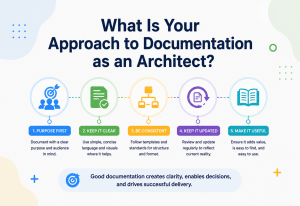
- Negotiate scope before you negotiate quality. Reducing what gets built is almost always healthier than reducing how well it is built.
- Always attach a number to the risk. “This is risky” is an opinion; “this will fail at 3x current load” is a fact people can act on.
- Write the trade-off down, even in one paragraph. A short design note prevents future arguments about “who decided this and why.”
- Separate reversible from irreversible decisions early, and spend your negotiating capital protecting the irreversible ones.
- Treat security and data-integrity shortcuts as almost non-negotiable.
- Revisit debt on a schedule, not just “whenever we have free time” (which in practice means never).
13.2 Common Mistakes
- Saying yes to every deadline without pushing back at all — this trains the organization to believe engineering estimates are negotiable fiction, and debt silently piles up.
- Saying no to every deadline on principle — this makes engineering look disconnected from business reality and erodes trust in the opposite direction.
- Cutting the corner and telling no one — the most dangerous pattern, because the debt becomes invisible and unmanaged.
- Confusing “fast” with “reckless.” Skilled teams can move fast on reversible decisions while being careful on irreversible ones — speed and care are not opposites.
- Framing the conversation as engineering vs business. The healthiest framing is “we are jointly deciding how much risk to accept,” not “engineering wants quality and business wants speed.”
13.3 The Role of Psychological Safety
None of the practices above work if engineers are afraid to speak up. Psychological safety — a term popularized by Harvard researcher Amy Edmondson — describes a team environment where people feel safe raising concerns, admitting uncertainty, or disagreeing with a plan, without fear of being punished or dismissed for it. In teams with low psychological safety, engineers learn to simply nod along with unrealistic deadlines, and technical debt accumulates silently because nobody feels safe naming it out loud. In teams with high psychological safety, a junior engineer can say “I’m worried this shortcut is risky” in a planning meeting and be taken seriously, which is often the single biggest factor separating organizations that manage technical debt well from those that do not.
Ask yourself honestly: if I raised a concern about a proposed shortcut in front of my manager’s manager, would I feel safe doing so? If the honest answer is no, that discomfort itself is useful information about the environment you are operating in — and it is worth naming, even carefully, rather than just working around it forever.
13.4 Building a “Shortcut Review” Habit Into the Team’s Workflow
Some of the strongest engineering teams build a lightweight, recurring habit directly into their existing rituals — for example, a two-minute “any shortcuts taken this sprint?” check-in during sprint retrospectives, or a mandatory field in the pull request template asking “does this change introduce any tracked technical debt?” Small, repeatable habits like this outperform occasional, heroic clean-up efforts, for the same reason flossing daily beats a single deep dental cleaning once a year — consistency compounds, just like debt itself does.
13.5 Anti-Patterns to Recognize
| Anti-Pattern | Why It Is Dangerous |
|---|---|
| The “Silent Hero.” | An engineer quietly absorbs deadline pressure by cutting corners alone, without telling anyone, to avoid conflict — leaving no record for the next person who touches the code. |
| The “Permanent Temporary Fix.” | A shortcut is labeled “temporary” but has no tracked ticket or repayment trigger, so it silently becomes permanent by default. |
| The “Boy Who Cried Wolf” Architect. | Every single shortcut is treated as an emergency-level risk, so stakeholders eventually stop trusting or listening to risk warnings at all. |
| The “Analysis Paralysis” Architect. | Every decision is treated as a one-way door requiring weeks of review, even trivial reversible ones, grinding delivery to a halt unnecessarily. |
Real-World & Industry Examples
This is not academic theory. The same trade-off shows up, at very different scales, in some of the most famous engineering stories of the last two decades — and a few quieter ones happening at every startup right now.
14.1 Knight Capital — When a Shortcut Under Pressure Went Catastrophically Wrong
In 2012, a trading firm called Knight Capital deployed new trading software under significant time pressure. During deployment, old, unused code was left active on one production server instead of being properly removed and tested across the full fleet — a classic deployment shortcut. The old code began executing millions of unintended trades. In about 45 minutes, the company lost roughly $440 million and nearly collapsed. This remains one of the most cited cautionary tales in software engineering about what happens when deployment and testing rigor is cut under time pressure, specifically for irreversible, high-stakes systems.
14.2 Netflix — Deliberately Engineering for Safe Corners
Netflix is famous for a different approach: rather than avoiding all risk, they built tools (like Chaos Monkey) specifically to discover which parts of their system are fragile before a real deadline or real failure forces the discovery on them. This reflects a mature version of the framework in this guide — proactively identifying which “corners” in their architecture are dangerous, so that when deadline pressure does appear, they already know exactly which shortcuts are safe two-way doors and which are risky one-way doors.
14.3 Amazon — The “Two-Pizza Team” and One-Way Door Discipline
Amazon’s internal engineering culture explicitly separates decisions into one-way and two-way doors, encouraging teams to move fast and independently on two-way-door decisions, while requiring more senior review and caution for one-way-door decisions like core data models or public APIs that external partners depend on. This lets Amazon’s thousands of engineering teams ship quickly without a central bottleneck, while still protecting the architecture in the places that matter most.
14.4 A Common Pattern Across Startups
Countless early-stage startups deliberately build their first version as a “monolith” — a single, simpler codebase — even though a microservices architecture might scale better in theory. This is often a smart, deliberate corner-cutting decision: at low traffic and small team size, the complexity of microservices costs more than it delivers, and the monolith can later be split apart once real scale and real team-size pressure justifies the investment.
14.5 Facebook’s “Move Fast and Break Things” — and Why the Company Later Changed Its Own Motto
For much of its early history, Facebook’s internal engineering motto was literally “Move Fast and Break Things,” reflecting a culture that deliberately favored speed and iteration over upfront caution. This philosophy helped the company grow extremely quickly during a period when speed of iteration mattered more than anything else. However, by 2014, as the platform’s scale and the stakes of failure grew enormous — with billions of users depending on stability — the company officially retired that motto in favor of “Move Fast With Stable Infrastructure.” This shift is a clean, well-known illustration of a core idea in this guide: the right amount of caution is not fixed, it should scale with the blast radius of failure. A five-person startup and a billion-user platform should not make identical trade-off decisions, even if the underlying architectural question looks the same on paper.
14.6 Healthcare and Fintech — Industries Where the Framework Shifts
In heavily regulated industries like healthcare and financial technology, the calculus around cutting corners changes substantially, because certain “shortcuts” are not just risky — they are illegal. Skipping proper audit logging in a system that handles patient records, for example, can violate healthcare data regulations regardless of how low the technical probability of a problem seems. This is a good reminder that the one-way-door/two-way-door framework must also account for regulatory and compliance boundaries, not just technical reversibility — some doors are locked by law, not just by engineering difficulty.
Building Your Own Interview Answer
Now let’s connect everything back to the practical moment: you are in an interview, and you are asked this exact question. A strong answer generally follows the STAR structure (Situation, Task, Action, Result), layered on top of the framework from Section 4.
A strong answer sounds something like this in structure (fill in your own real details):
“We were two weeks from a client launch, and the integration required a new authentication flow. Building the full OAuth-based flow properly would take three weeks. I first checked whether the deadline was truly fixed — it was, due to a signed contract. I then separated the decision into what was reversible versus not: the UI polish was a two-way door, we could ship a simpler version and improve it after launch. But the authentication model was a one-way door — a security-related, hard-to-reverse decision. I presented two options to the product lead: launch two days late with proper authentication, or launch on time with a temporary, less secure flow that we would replace within one week post-launch, with the risk explicitly documented. We chose the two-day delay, since the security risk was judged too high. On a separate feature in the same project, we did knowingly ship a simpler caching layer and logged it as tracked technical debt, which we paid down a month later once traffic data confirmed it was needed.”
Notice what this answer demonstrates, beyond the actual decision: the candidate understands trade-offs, communicates with stakeholders instead of deciding alone, distinguishes reversible from irreversible risk, and follows through with tracking and repayment — exactly the framework built throughout this guide.
Frequently Asked Questions
These are the questions that come up most often once the safer surface conversation is finished. Each one deserves a direct answer.
Should I ever just say “no” to a deadline outright?
Rarely, and only when the risk is extremely severe (major security or data-loss risk) and no acceptable middle ground exists. Even then, framing it as “here is the risk, and here is what I recommend instead” is stronger than a flat refusal, because it keeps the business stakeholder in the decision rather than excluding them.
What if my manager insists on cutting a corner I think is dangerous?
Document your concern clearly and in writing, propose a mitigation (monitoring, a fast-follow fix, a rollback plan), and escalate to whoever owns the risk if it is severe enough. Ultimately, once you have clearly communicated the risk, the business often has the right to accept it — your responsibility is to make sure that acceptance is informed, not accidental.
Is technical debt always bad?
No. Deliberate, tracked technical debt taken on with full awareness of the trade-off is a normal and often smart part of building software quickly. It only becomes a serious problem when it is accidental, hidden, or never repaid.
How do I estimate the “cost” of a shortcut if I am not sure?
Use ranges instead of false precision: “this will likely need rework within 3 to 6 months if traffic doubles” is honest and useful, even without an exact number. Where possible, tie the estimate to a concrete metric like requests-per-second, data volume, or number of active users.
Does this framework apply outside of software?
Yes — the same one-way-door/two-way-door thinking, and the same “make trade-offs visible and track them” discipline, applies to any engineering discipline, and even to non-technical business decisions under time pressure.
How do junior engineers apply this framework differently from architects?
A junior engineer usually does not have the authority or full context to unilaterally accept a risky trade-off, and that is completely normal. Their version of this skill is recognizing when a shortcut feels risky, and raising it clearly and early to a tech lead or architect, rather than either silently complying or silently refusing. Simply asking “is this a corner we are okay cutting, and does anyone know about it?” is often enough to trigger the right conversation.
What is the difference between “MVP thinking” and “cutting architectural corners”?
They are related but not identical. A true Minimum Viable Product intentionally narrows scope — fewer features — while still building what it does include on a solid foundation. Cutting architectural corners narrows quality instead, keeping the same scope but weakening the structure underneath. The healthiest deadline response usually leans on MVP thinking first, and treats architectural corner-cutting as a last resort, not the default lever.
How often should a team formally review its technical debt backlog?
Many mature engineering organizations review tracked technical debt on a regular cadence — often during sprint planning or a dedicated monthly “health” review — rather than waiting for it to cause an incident. Treating debt review as a routine, unglamorous habit, similar to financial bookkeeping, is far more effective than an occasional emergency clean-up.
What should I do if I inherit a codebase full of undocumented shortcuts from a previous team?
Rather than trying to fix everything at once, start by making the existing debt visible: audit the codebase, tag the riskiest shortcuts (especially security and data-integrity ones), and build a prioritized, trigger-based repayment plan, exactly as described in Section 4. Turning invisible, inherited debt into a visible, owned plan is itself a major architectural contribution, even before a single line of the debt is actually repaid.
Summary & Key Takeaways
A compact set of ideas from this guide, worth carrying into the next real conversation about a deadline that does not quite fit the work behind it.
Key Takeaways
- Deadline pressure and architectural quality are not simply “enemies” — they represent two different, equally valid time horizons that must be balanced deliberately, not accidentally.
- Classify every proposed shortcut as a reversible (“two-way door”) or irreversible (“one-way door”) decision before deciding how much caution it deserves.
- Quantify risk with real numbers wherever possible, instead of arguing in vague terms.
- Present stakeholders with real options and trade-offs rather than silently complying or flatly refusing.
- Never let technical debt become invisible — track it with tickets, code annotations, and dashboards, and attach a concrete repayment trigger.
- Treat security and data-integrity shortcuts with special caution, since their downside is catastrophic rather than gradual.
- Real companies — from Knight Capital’s costly lesson to Amazon’s door-based decision culture to Netflix’s proactive resilience testing — show this is not academic theory, but a daily, high-stakes practice in the real engineering world.
- In an interview, demonstrate this entire thought process, not just the final decision — that is what separates a senior architect’s answer from a junior one.
Every deadline you meet with a calm, honest, well-reasoned answer builds a small amount of credit in the trust account you share with the rest of your organization. Over a career, that account is what buys you the freedom to protect the architectural decisions that truly matter — not because you refused every shortcut, but because when you said “this one is worth protecting,” you had earned the right to be believed.