What Is a Security Audit?
A ground-up, beginner-friendly deep dive into how security audits actually work — who performs them, what they check, how findings flow into fixes, and how large organisations run this process continuously rather than as a once-a-year fire drill.
Walking Through The House Like A Burglar Would
A security audit is a structured, evidence-based review of an organisation’s systems, policies, and practices, measured against a defined set of security requirements — the systematic walk-through the person who built the house is usually the worst person to perform.
Imagine you own a house, and you have lived in it for years. You have added a new lock here, patched a window there, maybe let a contractor keep a spare key “just for a few weeks” that you forgot to ask back for. You feel safe, because nothing bad has happened yet — but you have never actually walked through the whole house from the outside, checking every door, window, and hidden gap, the way a burglar would.
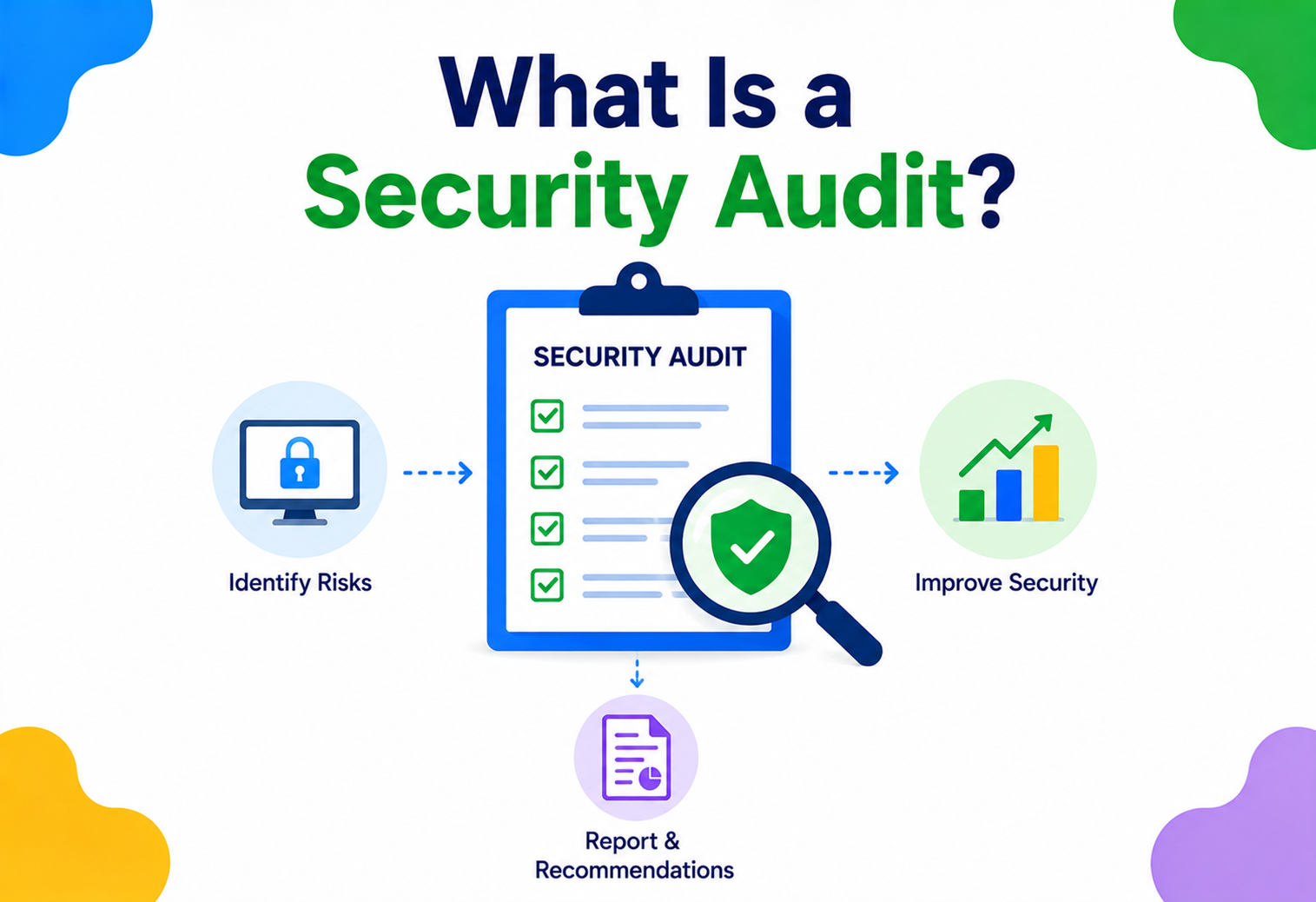
A security audit is exactly that walk-through, done systematically and often by someone other than you — because the person who built and lives in the house is usually the worst person to spot its own blind spots. Formally, a security audit is a structured, evidence-based review of an organisation’s systems, policies, and practices, measured against a defined set of security requirements, standards, or best practices, resulting in a report of findings and recommendations.
These words get used loosely, but they mean different things. A security assessment is a broad evaluation of risk and posture, often informal. A penetration test is a hands-on attempt to actually break in, simulating a real attacker. A security audit specifically means checking compliance against a defined standard or set of controls, with documented evidence, usually by an independent party — it is less “can we hack in?” and more “can we prove, with evidence, that the right controls actually exist and work?”
Security auditing has roots in the much older discipline of financial auditing. Long before computers, businesses were required to have independent accountants verify their financial records, precisely because a company grading its own homework creates an obvious conflict of interest. As computers took over financial record-keeping in the 1960s and 1970s, auditors realised they also needed to verify that the computer systems producing those records were trustworthy — leading to the emergence of IT audit as its own specialty, and organisations like ISACA (originally the EDP Auditors Association, founded in 1969) forming to professionalise the field.
As computer systems moved from simply producing financial reports to storing sensitive customer data, processing payments, and running critical infrastructure, the scope of auditing expanded from “is the accounting software correct?” to “is this entire system secure against attackers?” Landmark regulations accelerated this shift: the Sarbanes-Oxley Act of 2002 (following major corporate accounting scandals) mandated rigorous internal control audits for public companies; the Payment Card Industry Data Security Standard (PCI-DSS), introduced in 2004, required regular security audits for any business handling credit card data; and frameworks like SOC 2, ISO 27001, and HIPAA brought structured security auditing to cloud providers, healthcare, and beyond.
1969 — EDP Auditors Association founded
The organisation that later became ISACA begins professionalising the review of computerised data processing systems.
1996 — HIPAA enacted
U.S. healthcare law introduces mandatory security safeguards and audit requirements for protected health information.
2002 — Sarbanes-Oxley Act
Post-scandal legislation requires public companies to undergo rigorous internal control audits, elevating IT audit’s importance.
2004 — PCI-DSS introduced
Card networks jointly mandate security audits and controls for any business handling payment card data.
2013 — ISO/IEC 27001:2013
A major revision cements ISO 27001 as the leading international standard for information security management system audits.
2017–Present — Continuous & automated auditing
Cloud-native compliance automation platforms (Vanta, Drata, Secureframe) shift auditing from an annual event toward continuous, always-on evidence collection.
Assumption Is Not The Same As Evidence
Why cannot an organisation just trust its own engineers to build things securely and call it a day? Because good intentions and even genuine competence are not the same thing as verified, evidenced security.
Why cannot an organisation just trust its own engineers to build things securely and call it a day? Because good intentions and even genuine competence are not the same thing as verified, evidenced security — and several structural problems make external verification necessary.
Blind spots
The team that builds a system is often too close to it to spot its own weaknesses — the same cognitive bias that makes it hard to proof-read your own writing applies to security design.
Misaligned incentives
Engineering teams are usually measured on shipping features, not on the absence of vulnerabilities — security work competes for the same time and attention as everything else on a roadmap.
Regulatory requirements
Laws and industry standards (HIPAA, PCI-DSS, GDPR, SOX) legally require independent verification for organisations handling certain kinds of sensitive data.
Customer trust
B2B customers, especially enterprises, increasingly require a vendor to produce an audit report (like a SOC 2 Type II) before they will sign a contract at all.
Configuration drift
Systems that were secure when built can silently become insecure over time as configurations change, dependencies age, and new features are bolted on without revisiting old assumptions.
Insurance & liability
Cyber-insurance providers frequently require evidence of a recent security audit before issuing or renewing a policy, since it materially affects the likelihood and cost of a claim.
Absence of evidence is not evidence of absence. An organisation can go years without a known breach purely due to luck, or because an attacker has not yet found (or bothered to exploit) an existing vulnerability. A security audit exists precisely to surface the gap between “nothing bad has happened yet” and “we have verified, documented evidence that the right protections actually exist and function as intended.”
The motivation for a security audit, then, is to replace assumption with evidence. It forces an organisation to actually demonstrate — not just assert — that access controls are enforced, that data is encrypted, that incident response plans exist and have been tested, and that all of this holds up under independent, sceptical scrutiny rather than the organisation’s own self-assessment.
This shift from assertion to evidence also changes internal behaviour in a subtler way worth noting. Once an organisation knows a specific control will need to be independently verified with concrete proof, teams tend to build that control more carefully and document it more thoroughly from the start, rather than relying on tribal knowledge or informal habits that happen to work most of the time. In this sense, a well-designed audit program has a beneficial side effect beyond simply catching existing gaps — it shapes how security gets built in the first place, because engineers and administrators know their work will eventually need to withstand independent scrutiny rather than just their own judgment of “good enough.”
The Vocabulary An Audit Actually Runs On
An audit is always measured against something — a defined set of expectations called a framework or standard — using controls, evidence and findings as its primary units of work.
Frameworks and standards
An audit is always measured against something — a defined set of expectations called a framework or standard. Common ones include:
| Framework | Focus | Common in |
|---|---|---|
| SOC 2 | Security, availability, confidentiality, processing integrity, privacy — evaluated against the AICPA’s Trust Services Criteria | SaaS and cloud service providers, especially selling to enterprises |
| ISO/IEC 27001 | A comprehensive information security management system (ISMS) covering policy, risk management, and controls | Internationally operating companies, especially in Europe and Asia |
| PCI-DSS | Protecting cardholder data specifically | Any business that stores, processes, or transmits credit card data |
| HIPAA | Protecting health information (in the U.S.) | Healthcare providers, insurers, and their vendors |
| NIST 800-53 / CSF | A broad catalogue of security controls, widely referenced by U.S. federal agencies and contractors | Government and government-adjacent organisations |
Controls, evidence, and findings
A control is a specific safeguard the organisation claims to have in place — for example, “all production database access requires multi-factor authentication.” Evidence is the proof that the control actually exists and works — screenshots of MFA enforcement settings, access logs, configuration exports, or interview notes from staff. A finding (sometimes called an exception or deficiency) is a gap the auditor identifies — either a control that does not exist, or one that exists on paper but is not actually functioning as described.
Type I vs. Type II audits
Type I — point-in-time
Verifies that controls are designed appropriately as of a specific date — like a photograph of the security posture at one moment. Faster and cheaper, but does not prove the controls actually operated correctly over time.
Type II — period of time
Verifies that controls were designed appropriately and operated effectively over an extended period, typically 3–12 months — like a video rather than a photograph. Far more rigorous and much more trusted by enterprise customers, but requires sustained evidence collection throughout the entire period.
Internal vs. external audits
An internal audit is performed by the organisation’s own staff (often a dedicated internal audit or security team), useful for continuous self-improvement but lacking full independence. An external audit is performed by an independent third-party firm, carrying far more weight with regulators and customers precisely because the auditor has no stake in a favourable outcome. Most compliance frameworks that matter for customer trust (SOC 2, ISO 27001 certification) specifically require external audits performed by accredited firms.
Audit opinions
At the end of a formal audit, the auditor renders an opinion — a formal statement about how well the organisation’s controls held up. For a SOC 2 report, this typically comes in a few flavours: an unqualified opinion means the auditor found no material exceptions and controls operated effectively throughout the period; a qualified opinion means most controls passed, but one or more specific exceptions were noted and described in detail; and in rare, serious cases, an adverse opinion means the auditor concluded the controls, taken as a whole, did not meet the standard. Understanding which opinion a report carries matters enormously to anyone relying on it — a qualified opinion is not automatically disqualifying, but the specific exceptions need to be read and evaluated in context, not just glossed over because a report exists at all.
Risk-based scoping
Not every system an organisation runs needs to be included in every audit, and treating all systems as equally critical wastes effort while diluting focus from what actually matters. Mature audit programs perform a risk assessment first, classifying systems by the sensitivity of the data they handle and their exposure to the outside world, then scoping the audit to prioritise the systems that would cause the most harm if compromised. A public marketing website with no customer data, for instance, warrants far less audit depth than the production database storing customer payment details — this risk-based lens is what keeps an audit program efficient and genuinely focused on reducing real-world risk, rather than spreading effort evenly regardless of actual stakes.
An Audit Program Is A System, Not An Event
Just as a WAF or an authentication system has an architecture of cooperating components, so does a mature security audit program — it is not a single event but a system with defined roles, inputs, and outputs.
Breaking down each piece:
- Scoping: defines exactly which systems, data flows, teams, and controls the audit will cover — a poorly scoped audit can create a false sense of comprehensive assurance while quietly excluding a risky system.
- Evidence collection: gathering proof that controls exist and function — increasingly automated via continuous compliance platforms that pull configuration data directly from cloud providers, identity systems, and ticketing tools.
- Auditor review: the independent party examines evidence, interviews staff to verify processes match documentation, and often performs direct technical testing (like attempting to access a system without proper authorisation to confirm access controls actually work).
- Findings documentation: every gap is documented with enough detail to be independently verifiable — not just “access control is weak” but specifically which control failed, what evidence was reviewed, and why it did not meet the standard.
- Report & management response: the organisation typically gets a chance to respond to findings, describing remediation plans, before the final report is issued.
- Remediation tracking: findings from one audit cycle become tracked action items feeding into the next, closing the loop rather than treating each audit as an isolated event.
It is worth noting that these components do not operate in strict sequence in a mature program the way the diagram above might suggest at first glance — in practice, remediation tracking, evidence collection, and even preliminary auditor conversations often run in parallel and continuously, with the formal “fieldwork” phase simply being the point where an independent party formally reviews and signs off on a stream of evidence that has been accumulating all along. Thinking of the diagram as a single linear pipeline is a useful starting mental model, but the reality in a well-run program looks more like several of these stages running as ongoing, overlapping processes throughout the year, with the audit report itself acting as a periodic checkpoint rather than the sole trigger for any of this work.
Types of security audits by method
Compliance audit
Checks adherence to a specific external standard or regulation (SOC 2, PCI-DSS, HIPAA) — the most common type for customer-facing trust requirements.
Technical / vulnerability audit
Focuses on scanning systems and code for specific technical weaknesses, often overlapping with penetration testing.
Code audit
A focused review of source code, often for a specific application or before a major release, looking for insecure patterns.
Policy & process audit
Reviews whether documented security policies (like an incident response plan) actually exist, are current, and are followed in practice.
How An Auditor Actually Verifies A Control
It is worth walking through, concretely, how an auditor moves from “the organisation claims this control exists” to “I have independent, verifiable proof that it does.” This is the heart of what makes an audit different from simply trusting a checklist someone filled out themselves.
Control definition review
The auditor first reviews the organisation’s documented policy for a given control — for example, “all employee laptops must have disk encryption enabled before being issued.” This establishes what is being tested against.
Evidence request
The auditor requests concrete evidence, not a verbal assurance — in this example, an exported report from the organisation’s device management system (like Jamf or Intune) showing encryption status across all managed devices, ideally covering the entire audit period rather than a single snapshot.
Sampling
For controls affecting many items (hundreds of employees, thousands of servers), auditors typically cannot check every single instance, so they use statistically justified sampling — reviewing a representative subset (commonly 25–40 items depending on the population size and risk level) and extrapolating confidence about the whole population from that sample, following established audit sampling methodology (such as AICPA guidance) rather than picking arbitrarily.
Independent verification
Wherever possible, the auditor does not just trust the exported report — they verify it against an independent source. For the encryption example, this might mean directly querying a sample of laptops’ management records through an API, or asking a staff member to demonstrate the encryption status live during a screen-share, rather than relying solely on a report the organisation itself generated and could, in theory, have altered.
Documenting the finding
Whether the control passes or fails, the auditor documents exactly what evidence was reviewed, what method was used (full population review vs. sampling), and the precise result — this documentation is itself later reviewable, which is what gives an audit report its credibility rather than being just an opinion.
Here is a simplified illustration of how a continuous-compliance tool might automate part of this evidence-gathering step — pulling live configuration data via an API rather than waiting for a human to manually export a report once a year:
import java.net.http.HttpClient;
import java.net.http.HttpRequest;
import java.net.http.HttpResponse;
import java.net.URI;
import java.time.Instant;
import java.util.List;

public class ControlEvidenceCollector {

    record DeviceComplianceRecord(String deviceId,
                                   boolean diskEncrypted,
                                   boolean screenLockEnabled,
                                   Instant lastChecked) {}

    private final HttpClient client = HttpClient.newHttpClient();

    // Pulls live device compliance data from an MDM (mobile device
    // management) API, rather than trusting a manually-produced spreadsheet.
    public List<DeviceComplianceRecord> fetchDeviceComplianceEvidence(String apiToken) throws Exception {
        HttpRequest request = HttpRequest.newBuilder()
                .uri(URI.create("https://mdm.example.com/api/v1/devices/compliance"))
                .header("Authorization", "Bearer " + apiToken)
                .GET()
                .build();

        HttpResponse<String> response = client.send(request, HttpResponse.BodyHandlers.ofString());
        return parseComplianceRecords(response.body());
    }

    // Evaluates the fetched evidence against the stated control:
    // "100% of managed devices must have disk encryption enabled."
    public AuditFinding evaluateEncryptionControl(List<DeviceComplianceRecord> records) {
        long nonCompliant = records.stream().filter(r -> !r.diskEncrypted()).count();

        if (nonCompliant == 0) {
            return new AuditFinding("PASS",
                "All " + records.size() + " sampled devices have disk encryption enabled.");
        } else {
            return new AuditFinding("EXCEPTION",
                nonCompliant + " of " + records.size() + " devices do not have disk encryption enabled.");
        }
    }

    record AuditFinding(String status, String detail) {}

    private List<DeviceComplianceRecord> parseComplianceRecords(String json) {
        // JSON parsing omitted for brevity — in practice, use a library like Jackson
        return List.of();
    }
}
A deeper look at sampling methodology
Sampling deserves a closer look, because it is one of the more counter-intuitive parts of how audits actually work at scale. If an organisation has 3,000 employees, an auditor almost never reviews access records for all 3,000 individually — instead, they draw a statistically justified sample, commonly following guidance that scales sample size with population size but not linearly (a common rule of thumb used across the industry starts around 25 items for populations in the hundreds, growing to 40 or more for populations in the thousands, though exact numbers vary by firm methodology and the specific control’s risk level). The logic mirrors quality control in manufacturing: you do not need to test every single item off an assembly line to have justified confidence about the whole batch, provided the sample is drawn without bias (not, for example, cherry-picked by the organisation being audited) and the sample size is large enough to detect a meaningful failure rate. If even one sampled item fails, the auditor typically does not just note that single failure — they investigate whether the failure suggests a broader, systemic gap that likely affects unsampled items too, often expanding the sample specifically around the failure to determine its true extent before finalising the finding.
The Full Lifecycle Of A Formal External Audit
Here is the typical end-to-end lifecycle of a formal external security audit, such as a SOC 2 Type II engagement — a process that increasingly runs continuously rather than as a single dated event.
Readiness assessment
Before the formal audit, many organisations run an internal or consultant-led “pre-audit” to identify and fix obvious gaps ahead of time, avoiding wasted findings on issues that could have been quickly resolved.
Scoping & kickoff
The auditor and organisation agree on which systems, controls, and time period the audit will cover.
Evidence collection period
For a Type II audit, this spans months, during which the organisation must continuously operate its controls and retain proof — not just fix things right before the audit starts.
Fieldwork
The auditor reviews evidence, conducts interviews, and performs technical testing, documenting findings as they go.
Draft report & management response
The organisation reviews preliminary findings and typically documents its remediation plan for any exceptions identified.
Final report issuance
The auditor issues a signed, final report — often shared directly with customers or regulators as proof of compliance.
Remediation & continuous monitoring
Findings are tracked and resolved, feeding directly into readiness for the next audit cycle, which typically begins again within 6–12 months.
Notably, for a Type II audit, this is not a linear one-time process at all — evidence collection for the next audit period often begins the moment the current one ends, which is exactly why continuous compliance tooling has become so valuable: it removes the painful “evidence scramble” that used to happen right before each audit.
It is also worth understanding what happens when something goes wrong mid-cycle — say, a control that was operating correctly for the first four months of a Type II observation period silently breaks in month five (a misconfigured firewall rule gets accidentally reverted, for instance). A rigorous audit does not simply check the control’s status at the end of the period; the whole point of the “period of time” methodology is to catch exactly this kind of lapse, which is why continuous evidence collection throughout the observation window matters so much more than a single end-of-period check. If the auditor’s sampled evidence happens to fall within that broken window, it surfaces as a finding even though the control was fine both before and after — a reminder that Type II audits are specifically designed to detect transient failures that a point-in-time Type I audit would completely miss.
A Point-In-Time Statement, Not A Guarantee
A clean audit is a powerful trust signal — but it is a statement about a defined scope and a defined time window, not a promise about tomorrow.
Advantages
- Provides independent, credible evidence of security posture, valuable to customers, regulators, and insurers.
- Surfaces blind spots that internal teams, too close to their own systems, tend to miss.
- Creates external accountability and a forcing function for fixing known gaps.
- Often required to close enterprise sales deals or maintain certain industry licences.
- A well-run audit program strengthens documentation and process maturity as a side effect.
Disadvantages & trade-offs
- Can be expensive and time-consuming, especially for smaller organisations.
- A passed audit is a point-in-time (or period-of-time) statement — it does not guarantee security the day after the report is issued.
- Risk of “checkbox compliance” — satisfying the letter of a control without the underlying security intent.
- Scope limitations mean an audit can miss systems or risks that fall just outside the defined boundary.
- Evidence-gathering overhead can distract engineering teams from actual security work if not automated well.
Scaling An Audit Program Beyond The Fire Drill
Just as technical systems need to be efficient, audit programs need to scale sensibly as an organisation grows — a process that worked fine for a 20-person startup can become an unmanageable burden at 2,000 employees if it is not re-engineered along the way.
Key scaling considerations:
- Automated evidence collection: manually screenshotting settings and emailing spreadsheets does not scale past a handful of engineers. Continuous compliance platforms integrate directly with cloud providers, identity systems, and code repositories via API, pulling fresh evidence automatically and flagging control drift in near real time rather than only once a year.
- Control reuse across frameworks: many controls overlap between SOC 2, ISO 27001, and HIPAA (e.g., “access is reviewed quarterly” satisfies similar requirements in all three) — mature programs map controls once and satisfy multiple frameworks from the same underlying evidence, rather than duplicating effort per framework.
- Sampling methodology: as the population of things being tested grows (more employees, more servers), statistically sound sampling lets auditors maintain confidence in their conclusions without linearly increasing review effort with organisation size.
- Risk-based prioritisation: not every system needs the same audit depth — critical, customer-data-touching systems warrant more thorough review than an internal tool with no sensitive data, letting audit effort scale with actual risk rather than uniformly across everything.
Think of the shift from a once-a-year fire drill (manually gathering evidence right before an audit) to smoke detectors wired into a central monitoring system (continuous, automated evidence collection) — the underlying goal is the same, but one approach scales gracefully as the building grows and the other does not.
The real cost drivers of an audit program
Organisations preparing their first formal audit are often surprised by where the actual effort goes. It is rarely the auditor’s fieldwork itself that consumes the most time — a well-prepared organisation can often get through fieldwork interviews and technical testing in a matter of days. The larger cost driver is almost always the upfront work of actually building the controls, writing the policies that describe them accurately, and instrumenting evidence collection so it does not require heroic manual effort every time. A second major driver is remediation — fixing whatever gaps a readiness assessment surfaces before the formal audit clock starts, which can range from a quick configuration change to a multi-month project (like migrating to a proper identity provider with centralised access reviews) depending on how mature the organisation’s existing practices are. Recognising this cost structure up front helps organisations budget realistically rather than being blindsided by how much of the “audit” work actually happens well before an auditor is ever engaged.
An Audit Program Itself Needs To Be Resilient
A gap in evidence collection, a departed employee who was the sole owner of a key control, or a missed audit renewal can create real business risk — a lapsed SOC 2 report, for instance, can jeopardise active customer contracts.
- Control ownership redundancy: every control should have a documented owner and at least one backup, so evidence collection and control operation do not silently break when one person leaves or goes on leave.
- Continuous monitoring alerts: automated compliance tooling should alert immediately when a control drifts out of compliance (e.g., an S3 bucket becomes publicly accessible), rather than waiting for the next audit cycle to discover it.
- Audit calendar management: renewal dates for certifications and audit reports need active tracking well in advance, since a lapsed SOC 2 report can block procurement processes with existing or prospective customers.
- Auditor relationship continuity: switching audit firms year to year can introduce inconsistency in how findings are interpreted; many organisations deliberately maintain a multi-year relationship with the same firm for consistency, while still periodically re-evaluating whether that firm remains the right fit.
The Audit Process Handles Very Sensitive Data
The audit process handles some of an organisation’s most sensitive information — access credentials, architecture diagrams, vulnerability details — so the process itself needs to be protected.
- Evidence access control: compliance platforms and shared evidence repositories should be tightly access-controlled, since they often aggregate sensitive details (like a list of unpatched vulnerabilities) that would be extremely valuable to an attacker if leaked.
- Auditor vetting: because auditors are granted deep visibility into systems, organisations should verify the auditing firm’s own security practices and confidentiality commitments before granting access.
- Secure evidence transmission: sensitive artefacts (configuration exports, vulnerability scan results) should be shared through encrypted, access-controlled channels rather than ordinary email attachments.
- Findings confidentiality: draft findings, especially unresolved critical ones, represent a roadmap of exploitable weaknesses and should be handled with the same sensitivity as the vulnerabilities they describe until remediated.
Treating a passed audit as proof of ongoing security rather than a snapshot (or period-bound) statement. Organisations that stop actively maintaining controls the day after an audit concludes often find themselves out of compliance well before the next audit cycle begins.
The auditor independence requirement
A subtle but important detail of how credible audits work is the concept of auditor independence — rules governing what relationships an auditing firm can and cannot have with the organisation it audits, to prevent conflicts of interest from compromising the report’s objectivity. An auditor generally cannot, for example, also be paid to design and implement the very controls it later audits, since that would let it effectively grade its own work. Professional standards bodies (like the AICPA for SOC 2 engagements) publish detailed independence rules covering permissible consulting relationships, required rotation of engagement partners after a period of years, and disclosure requirements for any other business relationship between the firm and the client. Understanding these rules matters when evaluating how much weight to place on any given audit report — a report from a firm with a compromised independence relationship, even if never formally flagged, deserves more scrutiny than one from a firm with no such entanglements.
Compliance As An Ongoing, Measurable Process
A mature audit program treats compliance as an ongoing, measurable process rather than a once-a-year event — and that means measuring it the same way engineering teams measure everything else.
Control health dashboard
A real-time view of which controls are currently passing, failing, or drifting, rather than only discovering issues during formal audit fieldwork.
Finding remediation tracking
Every identified gap is tracked to resolution with an owner and a due date, similar to how engineering teams track bugs.
Time-to-remediate metrics
Tracking how quickly findings get resolved reveals whether the organisation treats audit findings as genuinely urgent or perpetually deprioritised.
Recurring finding analysis
The same finding appearing audit after audit is a strong signal of a systemic process problem, not just an isolated technical gap.
Findings and control status are often integrated directly into the same ticketing systems engineering teams already use (like Jira), so remediation work competes for prioritisation visibly alongside other work rather than living in a separate, easily-ignored compliance spreadsheet.
Leading vs. lagging indicators in compliance monitoring
Mature audit programs distinguish between lagging indicators (like the number of open findings from the last audit) and leading indicators that predict future audit outcomes before a formal audit even begins. A leading indicator might be the percentage of controls currently showing as “passing” in a continuous compliance dashboard, or the average age of unresolved access-review tickets — metrics that reveal whether the organisation’s day-to-day operations are quietly drifting away from stated policy long before that drift shows up as a formal finding months later. Programs that only look at lagging indicators tend to be perpetually surprised by audit results, since by the time a finding is formally documented, the underlying gap may have existed unnoticed for months. Tracking leading indicators continuously turns audit preparation from a reactive scramble into an ongoing, low-drama part of daily operations.
Modern Audits Lean Heavily On Specialised Tooling
Modern security audit programs lean heavily on specialised tooling rather than manual spreadsheets and screenshots — and those tools plug directly into the cloud APIs the systems being audited already expose.
| Category | Examples | Purpose |
|---|---|---|
| Continuous compliance platforms | Vanta, Drata, Secureframe | Automate evidence collection across cloud providers, identity systems, and HR tools; track control status in real time. |
| Vulnerability scanners | Nessus, Qualys, Tenable | Identify technical vulnerabilities feeding into technical audit findings. |
| GRC platforms | OneTrust, ServiceNow GRC | Manage policies, risk registers, and audit workflows at enterprise scale. |
| Cloud-native config auditing | AWS Config, Azure Policy, GCP Security Command Center | Continuously check infrastructure configuration against defined security baselines. |
These tools integrate directly with cloud provider APIs, identity providers, and version control systems, automatically pulling configuration snapshots as evidence rather than relying on engineers to manually document their own compliance — reducing both the burden on staff and the risk of stale or manually falsified evidence.
Teams that define infrastructure as code (Terraform, CloudFormation) gain an important audit advantage almost for free: the code itself becomes reviewable evidence of what configuration is supposed to exist, and version history shows exactly when and why it changed — turning infrastructure changes into naturally auditable events.
The Evidence Itself Has Its Own Lifecycle
The evidence an audit produces and consumes has its own data lifecycle worth understanding — retention windows, chain of custody, minimisation, and centralised repositories.
- Evidence retention: regulations and frameworks typically require retaining audit evidence and reports for a defined period (often several years), both for regulatory defence and to demonstrate a consistent compliance history over time.
- Chain of custody: for evidence supporting a finding, especially in a compliance or legal context, maintaining a clear record of who collected it, when, and how, matters for the evidence’s credibility if it is later challenged.
- Sensitive data minimisation: evidence collection should pull only what is needed to verify a control — exporting an entire customer database as “proof” of an access control, for instance, creates unnecessary risk compared to exporting just the access log entries relevant to the control being tested.
- Centralised evidence repository: mature programs maintain a single, access-controlled system of record for all compliance evidence, rather than evidence scattered across individual engineers’ laptops, email threads, and personal cloud drives.
Auditing A Monolith vs. Auditing A Fleet
As organisations adopt microservices and infrastructure-as-code, audits have had to adapt beyond reviewing a single monolithic system.
API-driven evidence collection
- Compliance platforms query cloud provider APIs directly to verify configuration (e.g., “are all S3 buckets encrypted?”) across potentially hundreds of accounts and services automatically.
- CI/CD pipeline integration lets automated security checks (dependency scanning, static analysis) themselves become auditable evidence of a “secure development lifecycle” control.
- Infrastructure-as-code repositories serve as a living, version-controlled record of intended configuration, simplifying evidence for change-management controls.
Microservices challenges
- Dozens or hundreds of independently deployed services multiply the number of systems that must be scoped, evidenced, and tested — a linear headcount increase in audit effort unless heavily automated.
- Ownership fragmentation (different teams owning different services) can make it harder to get a single, consistent answer about whether a given control is uniformly applied.
- Ephemeral infrastructure (auto-scaling instances, short-lived containers) complicates traditional evidence-gathering approaches designed around long-lived, individually identifiable servers.
This has driven the adoption of policy-as-code tools (like Open Policy Agent) that continuously and automatically verify configuration across an entire microservices fleet against defined security rules — turning what used to be a periodic manual review into an always-on, API-driven control that itself becomes strong, continuously-refreshed audit evidence.
What Works, And What Repeatedly Undermines Audits
A short round-up of the patterns mature audit programs converge on, and the anti-patterns that reliably produce reports without producing real security.
Continuous compliance
Treat evidence collection as an always-on, automated process rather than a frantic scramble in the weeks before an audit begins.
Control mapping across frameworks
Map a single set of underlying controls to multiple compliance frameworks (SOC 2, ISO 27001, HIPAA) to avoid duplicated effort.
Findings-to-tickets integration
Feed audit findings directly into the same engineering ticketing system used for regular work, so remediation gets real prioritisation.
Audit theatre
Satisfying the literal wording of a control without addressing its underlying security intent — technically compliant, but not actually secure.
Point-in-time scramble
Fixing everything right before the audit begins, then letting controls lapse immediately afterward — a pattern auditors are increasingly trained to detect and flag.
Siloed evidence
Scattering compliance evidence across individual employees’ personal files rather than a centralised, access-controlled system of record.
Preparing For The Audit Long Before The Auditor Arrives
A short, portable checklist for running an audit program that stays healthy year-round — and a worked readiness workflow that shows how to sequence the preparation.
- Start audit readiness early. Beginning evidence collection and gap remediation months before a formal audit avoids the costly last-minute scramble that often produces weak, hastily-assembled evidence.
- Automate evidence collection wherever possible. Manual, screenshot-based evidence does not scale and is prone to becoming stale or inconsistent across different reviewers.
- Assign clear control ownership. Every control needs a named, accountable owner — “everyone’s responsibility” in practice often means no one’s responsibility.
- Treat findings as a prioritised backlog, not a document to file away — integrate them into the same workflow tools used for regular engineering or operations work.
- Choose frameworks deliberately, not reactively. Understand which framework(s) your customers, regulators, or industry actually require before investing in a broad, unfocused compliance effort.
- Common mistake — treating the audit as the goal. A clean report should be a by-product of genuinely good security practice, not the primary objective that practice bends around.
- Common mistake — under-scoping to avoid findings. Deliberately excluding a risky system from an audit’s scope to avoid uncomfortable findings undermines the entire point of independent verification, and sophisticated customers and regulators increasingly scrutinise scope statements for exactly this kind of gap.
A practical audit readiness workflow
Select the right framework(s)
Determine which standard(s) actually matter based on customer, regulatory, and industry requirements before committing resources.
Run a gap assessment
Compare current practices against the chosen framework’s requirements to identify what is missing before the formal audit clock starts.
Remediate and instrument
Fix identified gaps and put automated evidence collection in place, ideally months before the formal observation period begins.
Run the formal audit
Engage an accredited independent auditor for the formal evidence review, interviews, and technical testing.
Remediate and repeat
Address any findings from the final report and carry the same continuous evidence collection straight into the next audit cycle.
Communicating findings without triggering defensiveness
One under-appreciated skill in running a healthy audit program is how findings get communicated internally. Engineering teams that feel audit findings are used to assign blame tend to become defensive, minimise issues, or quietly work around the audit process rather than genuinely engaging with it — undermining the whole point of independent verification. Programs that succeed long-term tend to frame findings the same way a good engineering team frames a production incident: as a systems problem to solve collaboratively, with blameless language, clear ownership, and a shared understanding that the goal is a more secure organisation, not a scorecard for any individual team. This cultural framing often matters as much as the technical remediation itself in determining whether an audit program actually improves security over time, or simply generates a report that gets filed away and forgotten.
Where Audits Actually Show Up In The Wild
Security audits have moved from a niche regulatory obligation to a fundamental piece of how trust is established between businesses.
SaaS & cloud providers
Nearly every enterprise SaaS vendor today maintains a current SOC 2 Type II report, since large enterprise customers routinely require it as a prerequisite before signing a contract, making it a de facto market requirement rather than purely a regulatory one.
Healthcare organisations
Hospitals, insurers, and their technology vendors undergo regular HIPAA security audits, often triggered or reinforced by government enforcement actions following reported breaches in the industry.
Payment processors & retailers
Any business handling credit card transactions must maintain PCI-DSS compliance, verified through annual audits (for larger merchants) or self-assessment questionnaires (for smaller ones), with card networks able to impose significant penalties for non-compliance following a breach.
Public companies
Sarbanes-Oxley requires public companies to maintain and audit internal controls over financial reporting, which in practice includes substantial IT general controls covering access management and change control for financial systems.
Across these examples, a consistent theme emerges: security audits have moved from a niche regulatory obligation to a fundamental piece of how trust is established between businesses — a prospective customer, insurer, or regulator increasingly expects to see independent, documented proof rather than simply taking an organisation’s word for its own security posture.
A closer look: the rise of continuous compliance platforms
It is worth understanding why companies like Vanta, Drata, and Secureframe grew so quickly in the 2020s, because it reflects a genuine shift in how audits are practically conducted. Before these platforms existed, a startup pursuing its first SOC 2 report often spent weeks manually gathering screenshots, writing policies from templates, and coordinating evidence across a patchwork of tools and spreadsheets — a process painful and error-prone enough that it actively deterred smaller companies from pursuing certification at all, even when their actual security practices were reasonably strong. By directly integrating with cloud providers, identity systems, and HR platforms via API, these tools automated the bulk of evidence collection, turning what was once a multi-month manual fire drill into a continuously updated dashboard that is essentially audit-ready at any given moment. This did not just make audits faster — it fundamentally changed the economics of who could realistically pursue formal compliance, making it accessible to much smaller and earlier-stage companies than before.
Lessons from high-profile audit failures
It is also instructive to look at cases where an audit or certification later turned out not to reflect reality, because these cases shaped much of today’s stricter auditing practice. Several well-publicised breaches over the years occurred at organisations that held current, seemingly clean compliance certifications at the time of the incident — a reminder that a passed audit describes a defined scope and time period, and an attacker exploiting something just outside that scope, or a control that degraded shortly after the observation period ended, is not something the report could have caught. These incidents pushed both auditors and standards bodies toward tighter scoping requirements, more frequent surveillance reviews between full audits, and growing scepticism among sophisticated customers toward treating a compliance badge as a substitute for their own vendor risk due diligence, rather than one input among several.
The Questions People Actually Ask About Audits
Short, opinionated answers to the security-audit questions that come up in customer diligence, procurement calls, and internal design reviews.
How is a security audit different from a penetration test?
A penetration test actively tries to break into systems the way a real attacker would, focused on finding exploitable technical weaknesses. A security audit verifies compliance against a defined set of controls and standards, with an emphasis on documented evidence and process, often including but not limited to technical testing.
How often should a company undergo a security audit?
It depends on the framework and business context — SOC 2 Type II reports are typically renewed annually to remain useful to customers, while internal audits or vulnerability assessments might happen quarterly or continuously alongside automated monitoring.
Does passing a security audit mean a company cannot be breached?
No. It means a defined set of controls were verified to exist and function during the period reviewed. Attackers can still exploit vulnerabilities outside the audit’s scope, newly discovered weaknesses, or simple human error — an audit reduces risk and demonstrates diligence, but does not eliminate risk entirely.
Who actually performs external security audits?
Accredited independent firms — for SOC 2, this must be a licensed CPA firm; for ISO 27001 certification, an accredited certification body; for PCI-DSS, a Qualified Security Assessor (QSA) for larger merchants.
What happens if an audit finds problems?
Findings are documented in the report along with the organisation’s remediation plan. Minor findings do not necessarily prevent a report from being issued, but significant, unresolved issues can result in a qualified opinion or, in serious cases, prevent certification until fixed.
Is a self-assessment the same as an audit?
No. A self-assessment (like a PCI-DSS Self-Assessment Questionnaire for smaller merchants) is completed by the organisation itself, lacking the independence that gives a true third-party audit its credibility, though it can still be a useful internal exercise.
Can a small startup realistically pursue a formal security audit?
Yes, and increasingly this is common — continuous compliance platforms have significantly lowered the cost and effort of pursuing a first SOC 2 report, and many enterprise customers now expect even early-stage vendors to have one before signing a contract. Startups often start with a Type I report to establish a baseline quickly, then move to a Type II report once they have a track record of sustained control operation.
What is the difference between certification and an audit report?
A certification (like ISO 27001) is a formal credential issued by an accredited certification body confirming an organisation meets a standard, typically renewed on a multi-year cycle with periodic surveillance audits in between. An audit report (like a SOC 2 report) is a detailed document describing the auditor’s findings and opinion, usually shared directly and selectively with customers or partners rather than functioning as a public badge.
The Short Version, In One Portable Frame
A security audit is a structured, evidence-based review of an organisation’s systems and practices against a defined standard, typically performed by an independent party specifically to overcome the blind spots and misaligned incentives that make self-assessment unreliable.
A security audit is a structured, evidence-based review of an organisation’s systems and practices against a defined standard, typically performed by an independent party specifically to overcome the blind spots and misaligned incentives that make self-assessment unreliable. It works by defining controls, collecting verifiable evidence (increasingly through automated, API-driven tooling rather than manual screenshots), sampling and independently verifying that evidence, and documenting findings that feed directly into an ongoing remediation and continuous-monitoring cycle.
Modern audit programs have shifted from an annual fire drill toward continuous compliance — automated evidence collection running constantly in the background, control drift detected in near real time, and findings tracked with the same rigour as engineering bugs — reflecting a broader industry recognition that a point-in-time snapshot alone provides limited real assurance in a constantly changing technical environment.
Whether an organisation is pursuing its very first SOC 2 report or maintaining a decade-long history of ISO 27001 certification, the underlying discipline is the same: define what “secure” concretely means through explicit controls, gather honest evidence rather than convenient assertions, invite independent scrutiny rather than avoiding it, and treat every finding as an input to genuine improvement rather than a box to check and forget. Organisations that internalise this discipline tend to find that the audit itself becomes almost anticlimactic — a confirmation of practices they already trust, rather than a stressful annual reckoning with problems they would rather not have looked at too closely.
Key takeaways
- A security audit verifies controls against a defined external standard using documented, independently reviewed evidence — it is distinct from a penetration test or an informal assessment.
- Type II audits verify controls operated effectively over an extended period, providing far stronger assurance than a Type I point-in-time snapshot.
- Independence matters: audits performed by the organisation itself lack the credibility that external, accredited third-party review provides.
- Modern programs rely heavily on continuous, automated evidence collection rather than manual, once-a-year evidence gathering.
- A passed audit is a compensating trust signal, not a guarantee — controls must be actively maintained after the report is issued, not treated as a one-time achievement.
- Findings should feed into the same prioritised workflow as other engineering or operational work, not sit isolated in a compliance-only document.
An audit is what happens when you stop trusting your own answers and invite someone with no stake in the outcome to check them — and then wire the answer back into how you build things every day.