Why Is the Principle of Least Privilege Important?
A complete, beginner‑friendly guide to the security principle that quietly protects every system you use — from your phone’s app permissions to the servers running the world’s largest banks. We’ll build it up from first principles, all the way to how Netflix, AWS, and Google apply it in production.
Introduction & History
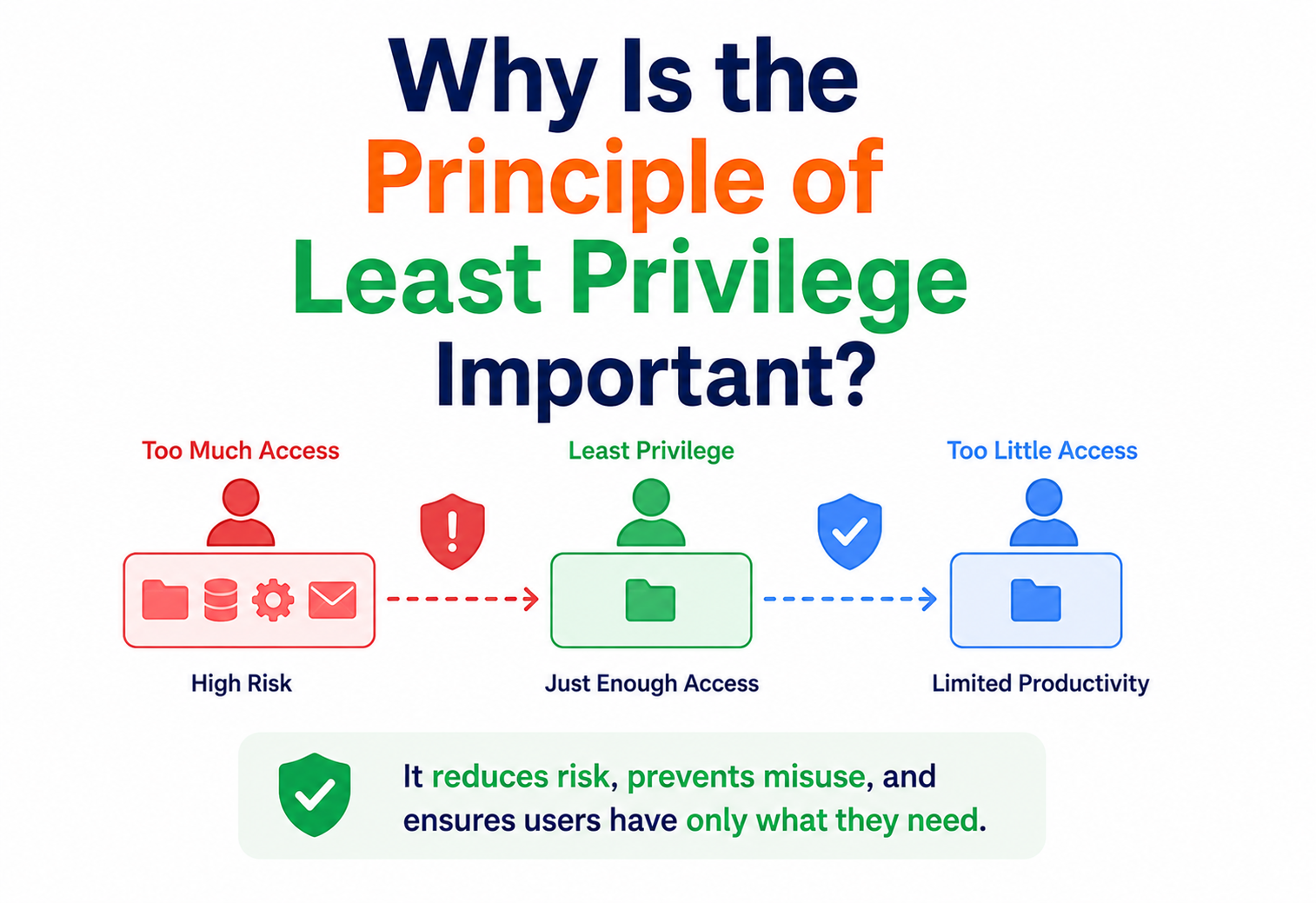
Imagine you hire a plumber to fix a leaky faucet in your kitchen. Would you hand them the keys to your entire house, your car, your bank vault, and your diary — just so they can reach the kitchen? Of course not. You’d give them access to the kitchen, and nothing more. That’s it. That’s the whole idea behind the principle of least privilege (PoLP), sometimes called the principle of minimal privilege or least authority.
In computing terms: every user, program, or process should be granted only the minimum access rights necessary to perform its job — and nothing more. Not “might need someday.” Not “easier to just give them everything.” Only what’s needed, only for as long as it’s needed.
1.1 Where Did This Idea Come From?
The principle of least privilege was formally articulated in 1975 by computer scientists Jerome Saltzer and Michael Schroeder in their landmark paper “The Protection of Information in Computer Systems.” At the time, computers were shared mainframes used by many people at once, and researchers were grappling with a very practical question: how do you let hundreds of people use the same machine without letting them accidentally (or intentionally) destroy each other’s work or peek at each other’s secrets?
Saltzer and Schroeder laid out several design principles for secure systems, and least privilege was one of the most important. Their insight was simple but profound: the smaller the “blast radius” of any single account or program, the smaller the damage when something goes wrong. And something always eventually goes wrong — a password gets guessed, a laptop gets stolen, a piece of software has a bug that an attacker exploits.
A hotel doesn’t give every guest a master key that opens every room in the building. Each guest gets a key that opens exactly one room, maybe the gym and the pool. If a guest’s key is lost or stolen, the hotel only has to worry about one room — not the whole hotel. That’s least privilege, in physical form.
Fifty years later, this principle hasn’t aged a day. If anything, it has become more important, because modern systems are far more interconnected: a single compromised laptop can now potentially reach cloud databases, payment systems, and customer records halfway across the world in seconds. Least privilege is one of the very few security ideas that appears, in some form, in literally every major security framework: NIST, ISO 27001, SOC 2, PCI‑DSS, HIPAA, CIS Controls, and the Zero Trust security model.
1.2 From Mainframes to the Cloud: How the Idea Evolved
It’s worth walking through how the practical meaning of “least privilege” has shifted over the decades, because the idea itself hasn’t changed but the systems it protects have changed enormously.
- 1970s–80sMainframes. A handful of operators shared one giant computer. Least privilege mostly meant separating “user mode” from “supervisor mode,” so an ordinary program couldn’t directly touch hardware or other users’ memory.
- 1990sClient‑server & early networks. Companies started running dozens of servers. Least privilege expanded to mean file permissions, user groups, and the beginning of role‑based thinking — “accounting” users versus “engineering” users.
- 2000sWeb apps & databases. As applications moved online, least privilege had to cover database accounts, application service accounts, and network firewalls — not just individual human logins.
- 2010sCloud computing. Suddenly a single misconfigured permission could expose data to the entire internet, not just a local network. Cloud providers built entire product lines (AWS IAM, GCP IAM, Azure RBAC) purely around expressing least privilege at scale.
- 2020sMicroservices, containers & AI agents. Today, a “principal” might be a short‑lived container that exists for eight seconds, or an AI agent calling dozens of internal tools on a person’s behalf. Least privilege now has to be enforced automatically, in code, because there are simply too many principals for a human to manage by hand.
Through every one of these eras, the underlying question never changed: what is the smallest set of permissions that lets this principal do its job, and how do we make sure it never quietly accumulates more than that? Only the tools available to answer that question have gotten more sophisticated.
Least privilege is not a product you install — it is a design goal you deliberately maintain, forever, across every principal in your system: users, service accounts, containers, third‑party integrations, and increasingly, AI agents.
The Problem & Motivation
To understand why least privilege matters, you first need to understand the problem it solves: privilege creep and over‑permissioning.
Here’s how it happens in almost every real organisation. A new employee joins. To get them working quickly, an admin gives them broad access — maybe even admin rights “just to be safe.” Over the years, the employee changes teams, picks up side projects, gets added to more groups. Nobody ever removes the old access, because removing access feels risky (“what if they still need it?”) while granting access feels safe. The result: five years later, that employee — or worse, their now‑compromised account — has access to dozens of systems they haven’t touched in years.
Now multiply that by every employee, every service account, every API key, every microservice, every third‑party integration in a company. You get a sprawling web of unnecessary access that nobody fully understands, let alone monitors. Security professionals have a term for this: the attack surface — the total sum of all the points where an attacker could potentially get in or do damage. Every unnecessary permission is one more point on that surface.
2.1 Why Does This Actually Matter?
Because attackers don’t need to compromise the “important” accounts directly. They need to compromise any account, and then move sideways — a technique called lateral movement — until they find something valuable. If every account only has the bare minimum it needs, lateral movement becomes very hard: compromising the intern’s laptop gets you… the intern’s very limited stuff. If every account has broad access “just in case,” compromising that same laptop might get you the keys to the whole kingdom.
Security isn’t just about stopping the initial break‑in — you can never guarantee that 100% of break‑ins are stopped. Least privilege is about limiting the damage once a break‑in inevitably happens somewhere.
This is sometimes summarised with the phrase: “assume breach.” Modern security thinking has shifted from “build a strong wall around everything” (the old castle‑and‑moat model) to “assume someone will eventually get past the wall, so make sure that when they do, they can’t reach everything inside.” Least privilege is the primary mechanism for making that true.
2.2 Why Organisations Keep Over‑permissioning Anyway
If least privilege is such an obviously good idea, why do so many real organisations still get it wrong? The honest answer is that every incentive in day‑to‑day operations pushes in the opposite direction:
Everyday pressure to over‑grant
- Granting access is fast; removing it is slow. A manager can approve a broad request in thirty seconds. Figuring out exactly which of forty permissions someone actually still needs takes real investigation — so it rarely happens until an audit forces the question.
- Broad access avoids awkward follow‑up requests. Nobody wants to be the reason a colleague’s project is blocked because a permission request is stuck in a queue, so admins learn to over‑grant “to be safe,” which quietly becomes the default culture.
- Ownership of access is diffuse. Often no single person is accountable for a given permission long after it’s granted — the requester’s manager changes, the approving admin leaves the team, and the grant simply persists, unowned, indefinitely.
- Tooling historically made fine‑grained access hard. Many older systems only supported coarse “admin or nothing” toggles, so teams defaulted to admin just to unblock work, even when a narrower option would have been safer.
Why the discipline is worth it
- Every unnecessary permission is a permanent, silent liability — useful to an attacker every second it exists.
- Once the culture flips, narrow grants become normal and requests for broad access get proper scrutiny.
- Audits and compliance reviews become cheaper and less stressful because the answer to “who has access to X, and why?” is always available.
- Blast radius stays small even when a mistake — a lost laptop, a leaked token, a phished login — inevitably happens.
None of these pressures are irrational in isolation — they’re each individually reasonable trade‑offs for speed. The problem is that they compound, silently, across thousands of small decisions, until an organisation’s actual access footprint bears little resemblance to what anyone intended. This is precisely why least privilege has to be treated as an ongoing operational discipline, not a one‑time configuration task.
Core Concepts You Must Understand
Before we go deeper, let’s define the vocabulary clearly. These terms get used loosely in casual conversation, but they mean specific things.
Principal
Any entity that can request access to a resource — a human user, a service account, an application, or a device.
Resource
Anything being protected — a file, a database table, an API endpoint, a server, a cloud bucket.
Permission
A specific allowed action on a resource, like “read this file” or “delete this row.”
Role
A named bundle of permissions assigned to principals, like “Billing Analyst” or “Database Admin.”
Authentication (AuthN)
Proving who you are — logging in with a password, fingerprint, or key.
Authorisation (AuthZ)
Determining what you’re allowed to do once your identity is known.
Privilege escalation
When a principal gains more access than intended — either by exploiting a bug (vertical) or by hopping between similarly‑privileged accounts (horizontal).
Blast radius
The scope of damage possible if a given principal is compromised.
3.1 Least Privilege vs. Related Principles
People often confuse least privilege with a few closely related — but distinct — ideas:
| Principle | What it means |
|---|---|
| Least Privilege | Grant only the minimum access needed to perform a task. |
| Need to Know | A narrower cousin — restricts access to information specifically, not just system actions. Common in military/intelligence contexts. |
| Separation of Duties | No single person should be able to complete a sensitive transaction alone (e.g., the person who requests a payment can’t also approve it). |
| Zero Trust | A broader architectural philosophy: never automatically trust any request, verify continuously — least privilege is one of its foundational pillars. |
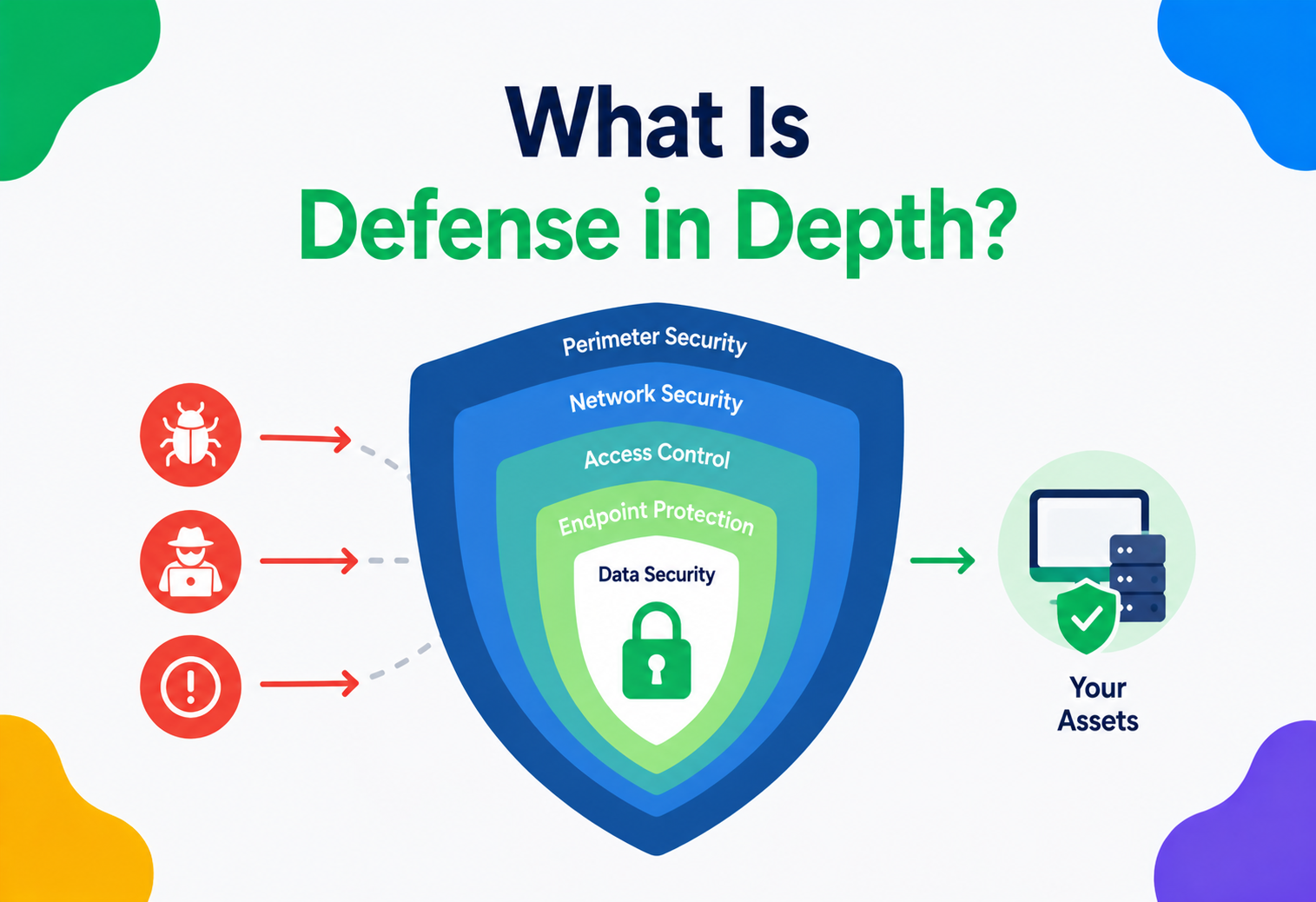
| Defence in Depth | Layer multiple independent security controls, so that no single failure compromises everything. Least privilege is one of those layers. |
Least privilege is the narrow, actionable rule; zero trust and defence in depth are the broader philosophies that least privilege helps implement.
One more distinction worth internalising: least privilege is about what a principal is allowed to do, while authentication strength (passwords, multi‑factor authentication, biometrics) is about how confidently the system knows who’s asking. These are complementary, not substitutes — a beautifully minimal permission set is still dangerous if anyone can authenticate as any user with a guessed password, and conversely, extremely strong authentication doesn’t help much if, once logged in, every user can touch every system in the company regardless of their actual job.
Architecture & Components
Least privilege isn’t a single tool you install — it’s a design goal achieved through several concrete access‑control mechanisms working together. Let’s walk through the main architectural building blocks.
4.1 Access Control Models
These are the “shapes” that permission systems can take:
DAC — Discretionary Access Control
The resource owner decides who gets access (e.g., sharing a Google Doc with specific people). Flexible, but easy to over‑share.
MAC — Mandatory Access Control
A central policy — not the owner — decides access, based on classification labels (e.g., “Top Secret”). Common in government/military systems.
RBAC — Role‑Based Access Control
Permissions are attached to roles, and users are assigned roles. The most common model in business software today.
ABAC — Attribute‑Based Access Control
Access decisions are computed dynamically from attributes (user department, resource sensitivity, time of day, location). More flexible and fine‑grained than RBAC.
PBAC / ReBAC
Policy‑Based and Relationship‑Based Access Control — newer models used by systems like Google Zanzibar to express complex, graph‑like permission relationships (e.g., “can view if a friend of the owner”).
4.2 Key Architectural Components
- Identity Provider (IdP): The system that authenticates who a principal is (e.g., Okta, Azure AD, AWS IAM Identity Center).
- Policy Decision Point (PDP): The brain that evaluates “is this request allowed?” against defined policies.
- Policy Enforcement Point (PEP): The gatekeeper embedded in the application, API gateway, or proxy that actually blocks or allows the request based on the PDP’s decision.
- Policy Administration Point (PAP): The interface (console, config files, IaC templates) where admins define and manage the policies.
- Policy Information Point (PIP): Supplies extra context/attributes the PDP needs (user’s department, resource tags, current time).
Fig 4.1 — The standard access‑control architecture. Every request flows through an enforcement point that consults a decision point before granting minimal, task‑specific access.
Notice something important here: least privilege isn’t enforced by wishing it into existence — it’s enforced by this pipeline actually checking every single request. If any component in this chain is missing (say, an internal admin tool that bypasses the PEP), least privilege silently breaks down.
4.3 Where Enforcement Points Actually Live
In a real system, the “Policy Enforcement Point” from the diagram above isn’t one single thing — it’s a role that gets played by different components depending on where the request is coming from:
- API gateways enforce coarse‑grained checks (does this token have any valid scope at all?) before a request even reaches application code, cutting off obviously invalid requests cheaply and early.
- Application middleware (like the Spring Security example later in this guide) enforces business‑specific, fine‑grained rules that depend on the specific resource being touched.
- Database engines enforce their own independent layer of grants — a final backstop that holds even if application code has a bug, as we’ll see in the databases section.
- Network and infrastructure layers (firewalls, service meshes, cloud IAM) enforce which services and machines can even establish a connection in the first place, regardless of what the application would otherwise allow.
This layering matters because no single enforcement point is perfectly reliable on its own — code has bugs, configurations get typo’d, and edge cases get missed. Least privilege, done well, doesn’t depend on any one of these layers being flawless; it relies on several independent layers each doing their own narrow, minimal‑access check, so a mistake in one layer doesn’t automatically become a full breach.
Internal Working: How a Permission Check Actually Happens
Let’s trace exactly what happens, step by step, when a user clicks a button that says “Delete Invoice.”
- Authentication check: The system first confirms the request carries a valid session token or credential — “who are you?”
- Identity resolution: The token is mapped to a principal ID (e.g., user_48213) and their associated roles/groups are loaded.
- Policy lookup: The system looks up what permissions are attached to those roles — does any role grant invoice:delete?
- Context evaluation (for ABAC systems): Additional conditions are checked — is this invoice in the user’s own department? Is it outside the “locked” accounting period? Is the request coming from an approved IP range?
- Decision: Allow or deny. If denied, the system fails safely — it does not partially execute the action.
- Audit log: Regardless of outcome, the decision is logged with a timestamp, principal ID, resource ID, and result — critical for detecting misuse later.
A well‑designed permission system should deny by default when something is ambiguous or when the policy engine itself errors out. “Fail open” (defaulting to allow when unsure) is a classic and dangerous mistake.
5.1 A Concrete Java Example (Spring Security)
Here’s a simplified example using Spring Security’s method‑level authorisation — a common way Java applications enforce least privilege in code, right next to the business logic it protects.
@Service
public class InvoiceService {

    // Only users holding the ACCOUNTANT role AND who own
    // the invoice's department may delete it.
    @PreAuthorize("hasRole('ACCOUNTANT') and " +
                  "@invoiceGuard.isSameDepartment(#invoiceId, authentication)")
    public void deleteInvoice(Long invoiceId) {
        Invoice invoice = invoiceRepository.findById(invoiceId)
            .orElseThrow(() -> new InvoiceNotFoundException(invoiceId));

        // Business logic runs ONLY after authorization passes
        invoiceRepository.delete(invoice);
        auditLogger.log("INVOICE_DELETED", invoiceId,
                         SecurityContextHolder.getContext()
                             .getAuthentication().getName());
    }
}

@Component("invoiceGuard")
public class InvoiceGuard {
    public boolean isSameDepartment(Long invoiceId, Authentication auth) {
        String userDept = ((AppUserDetails) auth.getPrincipal()).getDepartment();
        String invoiceDept = invoiceRepository.findDepartmentById(invoiceId);
        return userDept.equals(invoiceDept);
    }
}
Notice two layers of least privilege here: a coarse‑grained role check (ACCOUNTANT) and a fine‑grained attribute check (same department). This is a very common real‑world pattern — combine RBAC for broad strokes with ABAC‑style checks for precision.
5.2 Building Your Own Lightweight Enforcement Layer
Not every project uses a full framework like Spring Security. Sometimes teams build a small, explicit enforcement layer of their own, which is a great way to actually see least privilege happening in code rather than hidden behind an annotation. Here’s a minimal Java example of a hand‑rolled policy checker:
public interface Permission {
    String action();   // e.g. "invoice:delete"
    String resourceId();
}

public class PolicyEngine {
    private final Map<String, Set<String>> rolePermissions;

    public PolicyEngine(Map<String, Set<String>> rolePermissions) {
        this.rolePermissions = rolePermissions;
    }

    // Deny by default: only an explicit match returns true.
    public boolean isAllowed(Set<String> userRoles, String requiredAction) {
        for (String role : userRoles) {
            Set<String> grants = rolePermissions.getOrDefault(role, Set.of());
            if (grants.contains(requiredAction)) {
                return true;
            }
        }
        return false; // fail closed
    }
}

public class InvoiceController {
    private final PolicyEngine policyEngine;

    public void handleDeleteRequest(User user, Long invoiceId) {
        boolean allowed = policyEngine.isAllowed(user.getRoles(), "invoice:delete");
        if (!allowed) {
            auditLogger.logDenied(user.getId(), "invoice:delete", invoiceId);
            throw new AccessDeniedException("Missing required permission");
        }
        invoiceService.delete(invoiceId);
    }
}
Two details matter enormously here, even in this tiny example. First, isAllowed returns false by default — there is no code path where an unrecognised role or action silently falls through to “allowed.” Second, denied attempts are logged just as carefully as successful ones, because a spike in denied requests against a particular resource is often the very first sign of an attacker probing for weaknesses.
Data Flow & Lifecycle of a Privilege
Access rights aren’t granted once and forgotten — they have a full lifecycle, and least privilege has to be enforced at every stage, not just at creation time.
- 1
Provisioning
A new principal (employee, service, API key) is created. It should start with zero access, then be granted only what’s needed for its immediate task — never a broad default role “to save time.”
- 2
Request & Grant
Additional access is requested through a formal, auditable process — ideally with approval workflows and automatic expiration dates (called time‑bound or just‑in‑time (JIT) access).
- 3
Usage
The access is actually used to perform the job. This is the stage where monitoring matters most — usage patterns reveal whether granted access is even necessary.
- 4
Review & Recertification
Periodically (often quarterly), managers or automated tools review who has access to what, and confirm it’s still needed. This is where “privilege creep” gets caught and reversed.
- 5
Revocation
When a task ends, a role changes, or an employee leaves, access is removed — promptly, and ideally automatically, not “eventually, when someone remembers.”
Step 5 — revocation — is, by a wide margin, where organisations fail most often. Studies of breach post‑mortems repeatedly find former employees or long‑dormant service accounts still holding valid credentials months or years after they should have been cut off.
Advantages, Disadvantages & Trade‑offs
Every serious security control has costs. Understanding when least privilege helps — and when the discipline required to sustain it feels painful — is what separates security theatre from real, working security.
Advantages
- Shrinks the blast radius of any single compromised account or bug.
- Makes lateral movement far harder for attackers.
- Limits damage from insider threats, malicious or accidental.
- Simplifies audits and compliance (SOC 2, ISO 27001, PCI‑DSS all require it).
- Reduces the chance of catastrophic human error (e.g., an accidental DROP TABLE from someone who never needed write access).
- Makes systems easier to reason about — fewer “who can touch this?” unknowns.
Trade‑offs & costs
- Requires ongoing operational effort — permissions must be actively maintained, not “set and forget.”
- Can slow down legitimate work if access requests are slow or overly bureaucratic.
- Fine‑grained permission systems (ABAC, ReBAC) are more complex to design and debug than “give everyone admin.”
- Under‑provisioning can cause production outages (a service missing a permission it actually needs).
- Requires cultural buy‑in — teams must resist the urge to over‑grant “to be safe.”
This is the honest trade‑off: least privilege isn’t free. It costs engineering time, process discipline, and occasional friction. The mature answer, used by every serious security team, is to invest in automation — self‑service, time‑bound, auditable access requests — so that the security benefit doesn’t come at the cost of developer velocity.
“Least privilege is a discipline, not a checkbox — every unused permission is a tomorrow‑you problem waiting to happen.”
Performance & Scalability Considerations
At small scale — a handful of engineers and a few servers — you can manage permissions by hand in a spreadsheet, and it mostly works. That approach collapses completely once an organisation has thousands of employees, tens of thousands of service accounts, and millions of API calls per day. A few scalability concerns matter here.
8.1 Permission‑Check Latency
Every single API call may require a permission check. If that check involves a slow database query or a network hop to a remote policy server, it adds latency to everything. Production‑grade authorisation systems solve this with:
- Local caching of policy decisions with short TTLs, refreshed asynchronously.
- Embedded policy engines (like Open Policy Agent, OPA) that evaluate rules in‑process, in microseconds, instead of over the network.
- Pre‑computed permission indexes for common queries (e.g., Google Zanzibar‑style systems that pre‑materialise “who can access X” relationships at massive scale).
8.2 Managing Scale of Policies Themselves
With thousands of roles and millions of resources, the policies themselves become a management problem. This is why most large organisations move from flat, hand‑managed permission lists toward:
- Role hierarchies — roles that inherit from other roles, reducing duplication.
- Attribute‑based rules — one rule (“engineers can read logs for services they own”) replaces thousands of individual grants.
- Infrastructure as Code (IaC) for permissions — access policies defined in version‑controlled files (e.g., Terraform, AWS IAM policy JSON), reviewed like code, rather than clicked together in a console.
Google’s internal Zanzibar authorisation system, described in a 2019 paper, handles over 10 million authorisation checks per second across the company’s products (including YouTube and Drive) with a median latency around 5 milliseconds — proof that fine‑grained least privilege can scale to planetary size when engineered properly.
8.3 The Organisational Scaling Problem
There’s a second, less technical kind of scale that matters just as much: organisational scale. A five‑person startup can keep track of who has access to what in someone’s head. A five‑thousand‑person company cannot. As headcount grows, three things tend to happen simultaneously: the number of distinct systems grows, the number of teams requesting access grows, and the average tenure of any single person’s knowledge about “why does this account have this permission” shrinks, because people change roles and teams far more often than access records get updated. This is precisely why larger organisations invest specifically in identity governance tooling and dedicated access‑review processes — not because the underlying principle changes at scale, but because manual tracking simply stops being physically possible past a certain size.
High Availability & Reliability
Because authorisation sits directly in the critical path of nearly every request, the systems that enforce least privilege must themselves be extremely reliable — if the permission checker goes down, does the whole application go down too?
9.1 Fail‑Safe vs Fail‑Static Design
The safest default, as mentioned earlier, is to deny access when the decision system is unreachable (“fail closed”). But this creates an availability trade‑off: a security system outage becomes a full application outage. Production systems typically balance this with:
- Local decision caching — recently‑approved permissions remain valid for a short grace window even if the central policy service is briefly unreachable.
- Redundant policy servers across multiple availability zones/regions.
- Graceful degradation for genuinely low‑risk, read‑only operations, while keeping strict fail‑closed behaviour for sensitive writes.
Some teams, under pressure to keep things running during an authorisation‑service outage, quietly configure a “fail open” fallback for convenience — and forget to remove it. This has been the root cause of several real breaches where the fallback path was discovered and exploited by attackers.
9.2 Testing That Access Controls Actually Work
Reliability isn’t only about uptime — it’s also about correctness under change. A permission system that worked perfectly on day one can silently break as the codebase evolves: a new API endpoint gets added without a corresponding authorisation check, or a refactor accidentally removes a guard clause. Mature teams treat authorisation logic the same way they treat any other critical business logic:
- Automated authorisation tests that explicitly assert both the positive case (“an accountant can delete an invoice in their own department”) and the negative case (“an accountant cannot delete an invoice in a different department”) — negative tests are frequently the ones teams forget to write, yet they’re the ones that actually catch privilege‑escalation regressions.
- Periodic penetration testing and red‑team exercises that specifically try to move laterally or escalate privileges, rather than only testing whether the front door can be broken into.
- Chaos‑style “access drills,” where a team deliberately simulates a compromised low‑privilege account and verifies how far it can actually reach in practice, rather than how far the documentation claims it should reach.
Security Deep Dive
This is the heart of the whole topic, so let’s go further than the surface‑level “give people less access” idea and look at the specific attack techniques least privilege defends against.
10.1 Privilege Escalation
There are two flavours:
- Vertical escalation: A low‑privilege account exploits a bug to gain admin‑level rights (e.g., exploiting a buggy sudo configuration on Linux).
- Horizontal escalation: A compromised account accesses another account’s data at the same privilege level (e.g., User A viewing User B’s private records through an insecure direct object reference).
Least privilege reduces the payoff of both: if the compromised account had almost nothing to begin with, there’s little for either type of escalation to reach.
10.2 Lateral Movement
In a real intrusion, attackers rarely land directly on their target. They typically compromise a low‑value entry point (a phishing victim’s laptop, an exposed dev server) and then hop from system to system, using whatever credentials and network access they find, until they reach something valuable — a customer database, a code‑signing key, a payroll system. Least privilege chokes off this path by ensuring compromised low‑value accounts simply cannot reach high‑value systems in the first place.
Fig 10.1 — The same initial compromise leads to catastrophic breach or contained incident, depending entirely on whether least privilege was enforced.
10.3 Standing Privileges vs. Just‑in‑Time Access
A standing privilege is access that exists all the time, whether or not it’s actively being used — e.g., an engineer who permanently has production database admin rights, used maybe twice a year. Standing privileges are dangerous because they’re valuable to an attacker every single second they exist, even when the legitimate owner isn’t using them.
Just‑in‑Time (JIT) access flips this: privileges are granted only for a defined window, automatically expiring afterward, often requiring a fresh approval or a valid business justification each time. This dramatically shrinks the total “time‑weighted” attack surface, even for legitimately necessary high‑level access.
10.4 Least Privilege and Malware / Software Supply Chain
This principle isn’t just about human users. It’s equally critical for software itself. A dependency in your package.json or pom.xml that gets compromised (a “supply chain attack”) only does as much damage as the privileges of the process running it. This is why sandboxing, containerisation with minimal Linux capabilities, and read‑only filesystems are all least‑privilege techniques applied to code rather than people.
10.5 The Confused Deputy Problem
There’s a classic, subtle failure mode worth understanding on its own: the confused deputy problem. Imagine a print service that has legitimate access to a print‑queue directory, and also accepts a filename from any caller to log print jobs. If it never checks whether the calling user is actually authorised to write to that specific file, an attacker can trick the trusted print service — which has broad file‑system privileges — into overwriting a file the attacker themselves has no permission to touch. The print service becomes a “confused deputy,” using its own excessive privilege on behalf of someone who shouldn’t have had that power at all.
This pattern shows up constantly in modern systems: a backend service with broad database access that blindly executes a query built from unvalidated user input (classic SQL injection), or an internal API with wide network access that fetches a URL supplied by an untrusted caller (server‑side request forgery, exactly what happened in the Capital One breach discussed later in this guide). The fix in every case is the same: the deputy’s privilege should be scoped down to match what the original, less‑privileged caller is actually allowed to do — not left at the deputy’s own broader level.
10.6 Capability‑Based Security
A more rigorous academic approach to least privilege, called capability‑based security, avoids the confused deputy problem structurally. Instead of a principal holding a broad, ambient set of rights checked at the moment of use (as in traditional RBAC), a principal holds unforgeable, specific “capability tokens” — each one representing exactly one permission on exactly one resource, and nothing more. You cannot accidentally use a capability you don’t possess, because there’s no ambient authority to fall back on. Object‑capability languages and systems (like early work on the E programming language, and modern examples such as signed, narrowly‑scoped cloud pre‑signed URLs) apply this idea in practice, even if most everyday business systems still rely on the simpler role‑and‑permission‑check model described earlier in this guide.
Monitoring, Logging & Metrics
You cannot maintain least privilege without visibility. In practice, this means treating access itself as something to be continuously measured, not just configured once.
11.1 What to Log
- Every permission grant and revocation, with who approved it and why.
- Every access decision (allow and deny) for sensitive resources, with principal, resource, action, and timestamp.
- Anomalous access patterns — e.g., a service account suddenly calling an API it has never called before.
11.2 Key Metrics Security Teams Track
This discipline has its own name: Cloud Infrastructure Entitlement Management (CIEM) in cloud environments, and more broadly Identity Governance and Administration (IGA). These tools continuously scan real usage logs against granted permissions and flag the gap — often surfacing that the average cloud identity uses less than 5% of the permissions it’s been granted.
If you can’t answer “who has access to this, and why” within a few minutes for any sensitive system in your organisation, that’s a strong signal least privilege isn’t actually being enforced — only assumed.
Deployment & Cloud
Cloud platforms have made least privilege both more critical and, thankfully, much easier to implement with the right tooling.
12.1 AWS IAM Example
A poorly‑scoped policy might attach AdministratorAccess to a Lambda function “just to get it working.” A least‑privilege version instead grants exactly the actions the function performs:
{
  "Version": "2012-10-17",
  "Statement": [
    {
      "Effect": "Allow",
      "Action": [
        "s3:GetObject"
      ],
      "Resource": "arn:aws:s3:::invoice-uploads/*",
      "Condition": {
        "StringEquals": { "s3:ExistingObjectTag/status": "pending" }
      }
    },
    {
      "Effect": "Allow",
      "Action": ["dynamodb:PutItem"],
      "Resource": "arn:aws:dynamodb:us-east-1:111122223333:table/InvoiceIndex"
    }
  ]
}
This function can read tagged S3 objects and write to one specific DynamoDB table — nothing else. If this function is ever compromised through a code vulnerability, the attacker inherits exactly these two narrow abilities, not the whole AWS account.
12.2 Kubernetes RBAC Example
The same idea applies inside a Kubernetes cluster. A monitoring pod that only needs to read pod status should never be given cluster‑admin:
apiVersion: rbac.authorization.k8s.io/v1
kind: Role
metadata:
  namespace: production
  name: pod-reader
rules:
- apiGroups: [""]
  resources: ["pods"]
  verbs: ["get", "list", "watch"]
---
apiVersion: rbac.authorization.k8s.io/v1
kind: RoleBinding
metadata:
  name: monitoring-read-pods
  namespace: production
subjects:
- kind: ServiceAccount
  name: monitoring-agent
roleRef:
  kind: Role
  name: pod-reader
  apiGroup: rbac.authorization.k8s.io
12.3 Cloud‑Specific Tools Worth Knowing
AWS IAM Access Analyzer
Automatically identifies unused permissions and generates a right‑sized policy based on actual usage logs.
GCP IAM Recommender
Suggests removing permissions that haven’t been used in the last 90 days.
Azure PIM
Privileged Identity Management — enables just‑in‑time, time‑bound elevation to admin roles.
HashiCorp Vault
Issues short‑lived, dynamically generated database and cloud credentials instead of long‑lived static secrets.
Databases & Data Access
Databases are frequently the crown jewels attackers are after, which makes least privilege here especially important — and especially often ignored.
13.1 Common Database Anti‑pattern
A very common shortcut: every application connects to the database using a single shared account with full read/write/admin rights, because it’s simpler to configure once. This means a SQL injection bug in a low‑stakes “contact us” form could, in theory, let an attacker read or modify the entire customer database.
13.2 The Least‑Privilege Alternative
-- Create a narrowly-scoped role for the reporting service
CREATE ROLE reporting_readonly;

GRANT SELECT ON invoices, customers, payments TO reporting_readonly;
-- Explicitly no INSERT, UPDATE, DELETE, or DDL rights

CREATE USER reporting_svc WITH PASSWORD '...' IN ROLE reporting_readonly;

-- A separate, narrower role for the invoice-writing service
CREATE ROLE invoice_writer;
GRANT SELECT, INSERT, UPDATE ON invoices TO invoice_writer;
-- No DELETE - invoices are voided, never removed, by policy
REVOKE DELETE ON invoices FROM invoice_writer;
Now a bug in the reporting dashboard cannot possibly modify data, even in the worst case — the database itself enforces the boundary, independent of application code correctness. This is sometimes called defence at the data layer, and it matters because application‑level bugs are common; you don’t want the database to blindly trust the application to have already checked everything.
Treat “which service needs write access to this table” as a design question to answer explicitly during schema design — not an afterthought resolved by giving every service the same superuser credentials.
13.3 Going Further: Row‑Level Security
Table‑level grants (can this role touch the invoices table at all) are a good start, but sometimes least privilege needs to go down to the level of individual rows — for example, a multi‑tenant SaaS application where every customer’s data lives in the same table, and each customer’s application connection should only ever see its own rows. Modern databases like PostgreSQL support this natively:
ALTER TABLE invoices ENABLE ROW LEVEL SECURITY;

CREATE POLICY tenant_isolation ON invoices
    USING (tenant_id = current_setting('app.current_tenant')::uuid);

-- Now, even a query with no WHERE clause at all --
-- SELECT * FROM invoices; --
-- silently returns only the rows belonging to the
-- tenant set in the current session, enforced by the
-- database itself, not by application-level filtering
-- that a future bug could accidentally remove.
This is a powerful example of least privilege applied at the most granular level possible: even if every other layer of the application has a bug that forgets to filter by tenant, the database itself refuses to return data the current connection isn’t entitled to see.
APIs & Microservices
In a microservices architecture, “least privilege” applies not just to humans but to every service talking to every other service — often called service‑to‑service authorisation.
14.1 Scoped API Tokens
Rather than every internal service holding a single all‑powerful API key, modern systems issue narrowly scoped tokens — often using OAuth 2.0 scopes:
// Requesting a token scoped to exactly one capability
POST /oauth/token
{
  "grant_type": "client_credentials",
  "client_id": "notification-service",
  "client_secret": "***",
  "scope": "email:send"
}

// The resulting token can ONLY call the email-sending endpoint -
// attempting to call, say, /users/delete with this token
// returns 403 Forbidden, even with a technically "valid" token.
14.2 Service Mesh Enforcement
Tools like Istio or Linkerd let teams define explicit, auditable rules for which services may even establish a network connection to which other services — a mutual‑TLS‑enforced allowlist rather than a flat internal network where every service can reach every other service by default.
Fig 14.1 — Even inside a trusted internal network, each service can reach only what it explicitly needs.
This matters enormously for microservices because a single compromised service (through a dependency vulnerability, for example) should not become a stepping stone to every other service in the fleet.
14.3 Propagating the Original Caller’s Identity
A subtle but important detail in microservice authorisation: when Service A calls Service B on behalf of a specific end user, Service B should ideally know who the original human user is — not just that “Service A, a trusted internal service, is asking.” Otherwise you recreate the confused‑deputy problem discussed in the security section: Service A ends up able to do anything Service A is broadly allowed to do, on behalf of any user, without Service B ever checking whether that specific user should be allowed that specific action. Patterns like OAuth 2.0 token exchange and JWT claims that carry the original user’s identity through the whole call chain (sometimes called “identity propagation” or “delegated authorisation”) solve this by letting each downstream service enforce least privilege relative to the actual end user, not just the calling service.
14.4 Rate Limiting as a Least‑Privilege Adjacent Control
Even a correctly‑scoped permission can be abused through sheer volume — a service with legitimate access to “read one customer record” shouldn’t be able to silently read ten million records per minute. Rate limiting and query quotas are often deployed alongside least‑privilege authorisation for exactly this reason: they bound not just what a principal can do, but how much of it they can do in a given window, which limits the damage even from a correctly‑scoped credential that ends up in the wrong hands.
Design Patterns & Anti‑patterns
A small number of patterns keep showing up around least privilege because they answer recurring problems well. An equally small number of anti‑patterns keep showing up because they’re the shortcuts everyone is tempted to take.
15.1 Good Patterns
Role explosion prevention
Use attribute‑based conditions instead of creating a new narrow role for every single edge case.
Just‑in‑Time elevation
Grant temporary, time‑boxed elevated access with automatic expiry and a required justification.
Break‑glass accounts
A small number of tightly monitored emergency‑only accounts for true incidents, with mandatory post‑use review.
Immutable / short‑lived credentials
Dynamically generated, auto‑expiring secrets (via tools like Vault) instead of static long‑lived passwords or keys.
15.2 Anti‑patterns to Avoid
Common mistakes
- “God mode” service accounts shared across many applications for convenience.
- Copy‑pasting a coworker’s role when onboarding, instead of granting access based on actual job needs.
- Never revoking access after a project or role change ends.
- Wildcard permissions (e.g. Action: "*" in a cloud policy) used as a shortcut during development and never tightened before shipping to production.
- Hardcoded, long‑lived credentials checked into source code or config files.
The fix
- Start every new principal at zero access, add narrowly as needed.
- Base access on documented job function, not on copying an existing account.
- Automate expiry and periodic recertification.
- Replace wildcards with explicit, minimal action lists before production.
- Use short‑lived, dynamically issued credentials wherever possible.
Best Practices & Common Mistakes
The gap between an implementation that scales gracefully and one that quietly collapses under load is rarely a technology gap — it’s a discipline gap. These are the habits successful teams share.
- Default to zero access. Every new account, role, or service starts with nothing, and access is added deliberately.
- Automate access reviews. Quarterly, automated recertification catches drift long before an audit or a breach does.
- Prefer roles and attributes over individual grants. Individually‑granted, one‑off permissions are the hardest thing to track and the first thing to be forgotten.
- Make revocation as easy as granting. If removing access requires a ticket and three approvals while granting it takes one click, over‑permissioning is the path of least resistance — and people will take it.
- Treat service accounts and API keys as first‑class identities subject to the exact same lifecycle discipline as human users.
- Log every access decision — not just successful ones. Denied attempts are often the earliest signal of a probing attacker or a misconfigured integration.
- Separate duties for sensitive actions — e.g., require a second approver for production database schema changes.
“Grant access like you’re going to have to explain every single permission to an auditor next Tuesday — because eventually, you will.”
16.1 A Practical Rollout Playbook
Teams inheriting a messy, over‑permissioned system often ask the same question: where do we even start? Trying to fix everything at once tends to fail. A more realistic sequence looks like this:
- Inventory first. You cannot fix what you can’t see. Enumerate every principal (human, service account, API key) and every permission it currently holds before changing anything.
- Find the highest‑risk excess access. Prioritise standing admin rights on your most sensitive systems (production databases, payment processing, customer PII) rather than trying to tighten everything simultaneously.
- Switch to “detect, don’t block” mode. Turn on detailed logging of what’s actually being used before removing anything, so you have real usage data instead of guesswork about what’s safe to revoke.
- Right‑size gradually, in reviewable batches. Remove unused permissions in small, easily reversible changes, communicated ahead of time, rather than one enormous “lockdown day” that breaks things unpredictably.
- Automate the steady state. Once the backlog is cleared, the real win is preventing drift from recurring — automatic expiration, scheduled recertification, and infrastructure‑as‑code reviews for any new grant.
Real‑World Examples
Almost every major security incident of the last decade has a least‑privilege lesson buried in it. Here’s a quick tour of the most cited cases.
17.1 Target (2013)
Attackers stole credentials from a third‑party HVAC (heating and cooling) vendor. That vendor’s account — meant only for billing and project management — had network access reaching all the way into Target’s payment card processing systems. Roughly 40 million credit card numbers were stolen. A least‑privilege network segmentation would have confined the HVAC vendor’s compromised credentials to HVAC‑related systems only.
17.2 Edward Snowden / NSA (2013)
As a systems administrator, Snowden had far broader access to classified documents than his specific role required — access seemingly granted for operational convenience. This incident became one of the most cited real‑world case studies for why “need to know” and least privilege matter even for highly vetted, trusted insiders.
17.3 Capital One (2019)
A misconfigured web application firewall on AWS had overly broad IAM permissions attached to it — far more than the firewall actually needed to do its job. An attacker exploited a server‑side request forgery vulnerability to use those excess permissions to reach and exfiltrate data from S3 storage buckets, affecting over 100 million customers.
17.4 Uber (2022)
An attacker who compromised an employee’s credentials found hardcoded, highly privileged admin credentials for internal tools (including a privileged access management tool) sitting in a network share — again, standing, overly broad credentials that shouldn’t have been reachable or persistent in that form.
17.5 CI/CD Pipeline Compromises (Ongoing Pattern)
A recurring pattern across many software supply‑chain incidents in recent years involves build pipelines (like GitHub Actions or Jenkins jobs) that are granted broad, long‑lived tokens with write access to source repositories, package registries, or cloud infrastructure — far beyond what a single build step actually needs. When a third‑party action or plugin used inside that pipeline is compromised, the attacker inherits whatever the pipeline itself could do. Organisations that scope CI/CD tokens narrowly — read‑only by default, write access only to the specific package being published, credentials that expire the moment the job finishes — consistently contain these incidents to a single package or repository, rather than an entire organisation’s source code and release infrastructure.
Notice the pattern across all four cases: in every one, the actual initial compromise was relatively mundane — a stolen password, a misconfigured firewall, a phished employee. The severity of each breach was determined almost entirely by how much excess access was reachable once inside. That’s the whole argument for least privilege in one sentence: it doesn’t prevent every break‑in, but it consistently determines whether a break‑in stays small or becomes historic.
Frequently Asked Questions
A short set of the questions engineers, students, and interviewers ask most about least privilege.
Does least privilege mean nobody can ever have broad access?
No. Some roles genuinely need broad access (a database administrator, an incident responder during a live outage). Least privilege doesn’t forbid this — it insists that broad access be deliberate, justified, monitored, and ideally time‑bound, rather than the unmonitored default.
Isn’t this the same thing as “zero trust”?
They’re related but not identical. Zero trust is a broader architectural philosophy — never implicitly trust a request based on network location alone, verify continuously. Least privilege is one of the concrete rules that a zero‑trust architecture applies at the authorisation layer.
How do you apply least privilege without slowing engineers down?
Automation is the answer used by mature organisations: self‑service access requests with automatic time‑bound approval for low‑risk resources, infrastructure‑as‑code for permissions so grants are reviewed like any other code change, and tooling that recommends right‑sized permissions based on actual usage rather than guesswork.
What’s the difference between least privilege and role‑based access control (RBAC)?
RBAC is a mechanism — a way of organising permissions into named roles. Least privilege is a goal — that whatever mechanism you use, the resulting access should be minimal. You can implement RBAC badly (broad, catch‑all roles) and violate least privilege, or implement it well (narrow, task‑specific roles) and satisfy it.
Does least privilege apply to personal devices and home networks?
Yes, the same logic scales down. Running your everyday computer as a non‑admin account, only granting apps the specific phone permissions they need (a flashlight app doesn’t need your contacts), and using separate accounts for sensitive activities are all least‑privilege practices anyone can apply personally.
How does least privilege apply to AI agents and automation?
The same way it applies to any other principal, arguably with even more urgency. An AI agent that can browse the web, run code, and call internal tools on a person’s behalf should be scoped to only the specific tools and data it needs for its current task, ideally with time‑bound, revocable access rather than a permanent standing credential — since an agent’s actions can be triggered by content it reads, not just by direct human instruction, which creates new avenues for a “confused deputy”‑style problem.
Is least privilege only relevant to large enterprises?
No — the principle scales down just as usefully as it scales up. A two‑person startup benefits from not sharing one shared admin login across every cloud service, and from giving their marketing intern access only to the analytics dashboard rather than the production database. The tooling required is simpler at small scale, but the underlying discipline is identical.
Summary & Key Takeaways
Least privilege is the security principle that quietly determines whether an inevitable break‑in stays a footnote or becomes a headline. It doesn’t stop the initial compromise — nothing reliably does. What it does is guarantee that when a compromise happens, the damage is bounded by the smallest, most deliberately chosen set of permissions the affected principal ever needed.
Fifty years after Saltzer and Schroeder first wrote it down in 1975, the idea has only become more consequential, because modern systems have far more principals to keep honest: users, service accounts, containers, third‑party integrations, CI/CD pipelines, and now AI agents. In every one of these categories, the same question quietly decides how bad tomorrow’s incident will be: what is the smallest set of permissions that lets this principal do its job today, and how do we make sure it never accumulates more than that?
Key Takeaways
- 01Grant only the minimum access a principal needs — no more, and only for as long as it’s needed.
- 02Formally described in 1975 by Saltzer & Schroeder, but even more relevant today in cloud‑connected, microservice‑heavy systems.
- 03It does not prevent the initial compromise — it limits the blast radius once a compromise inevitably happens somewhere.
- 04Implemented through concrete mechanisms: RBAC, ABAC, scoped API tokens, database‑level grants, and network segmentation — not through good intentions alone.
- 05Access has a full lifecycle — provisioning, granting, usage, review, and revocation — and most real‑world failures happen at the revocation stage.
- 06The biggest real‑world breaches (Target, Capital One, Uber, ongoing CI/CD supply‑chain incidents) all share the same root pattern: a mundane initial compromise turned catastrophic because of excess standing access.
- 07The main trade‑off is operational effort — the fix is automation, not abandoning the principle.
- 08Layer it: API gateway, application middleware, database, and network — each independently enforcing minimal access so a bug in any single layer doesn’t become a full breach.
“Assume breach. Then design so that when it happens, the blast radius fits in your palm.”