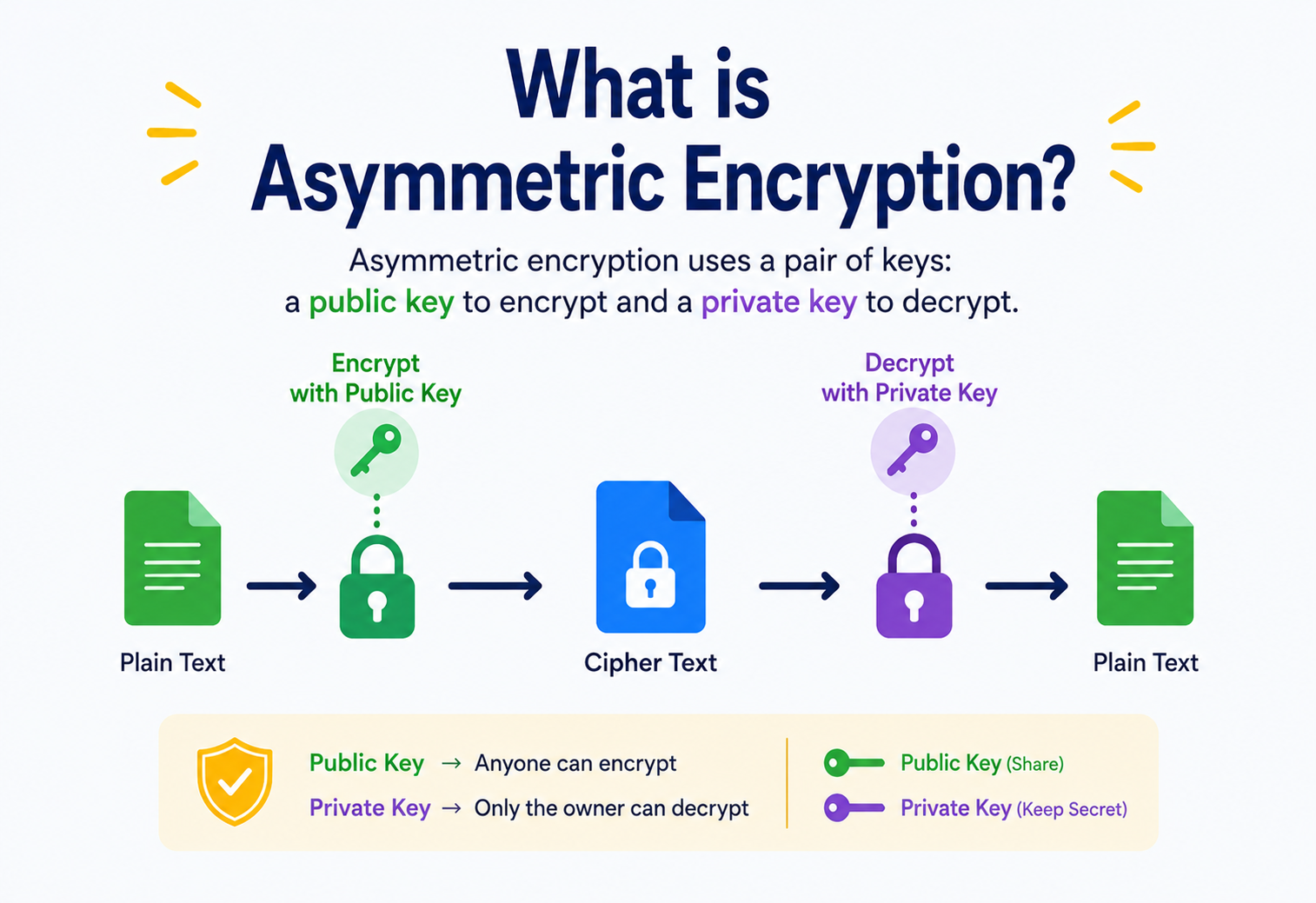
What is Asymmetric Encryption?
A complete beginner‑to‑production tour of public‑key cryptography — the math intuition, the algorithms, how HTTPS and digital signatures actually work, and how real systems manage keys at scale.
Introduction & History
Asymmetric encryption — also called public‑key cryptography — is a way to encrypt and decrypt data using two mathematically related but different keys instead of a single shared secret. One key is published to the world; the other is kept private and never leaves its owner. What one key locks, only the other key can unlock.
Picture a special mailbox with a letter slot on the front and a locked door on the back. Anyone walking past can drop a letter through the slot — that slot is the public key, and anyone is welcome to use it to “lock” a message inside. Only the person with the physical key to the back door can actually open it and read what was dropped in — that back‑door key is the private key. You can publish the mailbox’s address to the whole world without ever giving away the ability to open it.
Where It Came From
For most of human history, cryptography was symmetric — the same key encrypted and decrypted a message, from Caesar’s shift ciphers in Roman times to the Enigma machine in World War II. The single biggest weakness of symmetric cryptography was never the math; it was key distribution. Two parties who had never met could not securely agree on a shared secret without already having a secure channel — a chicken‑and‑egg problem that plagued cryptography for two thousand years.
The breakthrough came in 1976, when Whitfield Diffie and Martin Hellman published “New Directions in Cryptography,” introducing the idea of a key exchange that let two strangers agree on a shared secret over a public channel without ever transmitting the secret itself. Around the same time, at the British intelligence agency GCHQ, James Ellis, Clifford Cocks, and Malcolm Williamson had secretly discovered similar ideas years earlier, but their work stayed classified until 1997.
In 1977, three MIT researchers — Ron Rivest, Adi Shamir, and Leonard Adleman — turned the Diffie‑Hellman concept into a full, practical encryption algorithm now known by their initials: RSA. RSA remains one of the most widely deployed asymmetric algorithms in the world today, alongside newer, faster alternatives like Elliptic Curve Cryptography (ECC), introduced independently by Neal Koblitz and Victor Miller in 1985.
1976 · Diffie‑Hellman Key Exchange
The first published way for two strangers to agree on a shared secret over a public channel — without ever transmitting the secret itself.
1977 · RSA Algorithm
Rivest, Shamir, and Adleman turn the Diffie‑Hellman idea into a complete encryption & signing algorithm still in wide use today.
1985 · Elliptic Curve Cryptography
Neal Koblitz and Victor Miller independently propose using elliptic curves — smaller keys, comparable security.
1991 · PGP
Phil Zimmermann’s “Pretty Good Privacy” brings public‑key email encryption to ordinary users for the first time.
1994 · Netscape / SSL
SSL introduces RSA‑based key exchange to the browser — the ancestor of modern HTTPS.
2008 · Bitcoin
Bitcoin uses ECDSA for digital signatures, putting elliptic‑curve crypto at the heart of the first widely adopted cryptocurrency.
2018 · TLS 1.3
Standardises a leaner, ECC‑friendly TLS with forward secrecy as the default — the foundation of today’s secure web.
Today, asymmetric encryption underpins almost every secure interaction on the internet: the padlock icon in your browser, the “Verified” badge on a signed software update, the way your banking app confirms it is really talking to your bank, and the digital signatures that secure cryptocurrency transactions.
The Problem & Motivation
Before asymmetric cryptography existed, if Alice wanted to send Bob an encrypted message, both needed to already possess the same secret key. That key had to be exchanged somehow — in person, by trusted courier, or over some other channel assumed to be secure. This simply does not scale.
The Key Distribution Problem
- If a company has 1,000 employees who all need to communicate securely with each other, symmetric cryptography alone would require roughly 499,500 unique shared keys (n(n−1)/2) to cover every possible pair.
- Every new key must be exchanged over a channel that is itself secure — but if you already had a secure channel, you might not need the key in the first place.
- There was no way to prove a message truly came from a specific sender; anyone holding the shared key could have written it.
Imagine you want to send a locked box to a pen pal you have never met, in a country you cannot visit. With a normal padlock, you both need a copy of the same key — but how do you get them a copy without the box being intercepted along the way? Asymmetric encryption solves this: they mail you an open, unlocked padlock (their public key). You lock your box with it and mail it back. Only they have the matching key to open it — even though the open padlock itself traveled through insecure channels the whole time.
What Asymmetric Encryption Solves
| Problem | How asymmetric encryption solves it |
|---|---|
| Secure key exchange over insecure networks | Public keys can be broadcast openly; no secret ever needs to travel. |
| Authentication (“is this really from Bob?”) | Digital signatures let a private‑key holder prove authorship. |
| Non‑repudiation (Bob cannot deny sending it) | Only Bob’s private key could have produced a valid signature. |
| Scaling secure communication to millions of users | Each party needs only one key pair, not one shared secret per contact. |
Every time your browser connects to a site over HTTPS, it uses asymmetric cryptography (typically inside the TLS handshake) to establish trust and securely agree on a temporary symmetric key — without you and the server ever having met before or shared a secret in advance.
When you push code to GitHub over SSH, you never send your password over the network. Instead, your local machine holds a private key, and GitHub stores the matching public key on your account. GitHub sends a random challenge; your machine signs it with the private key; GitHub verifies the signature with the public key it already has. Your secret never travels — only proof that you possess it.
Core Concepts
A key pair consists of two keys generated together using a mathematical algorithm, such that they are related but neither can be feasibly derived from the other.
Public Key vs. Private Key
Public Key
Shared freely with anyone. Used to encrypt data intended for the owner, or to verify a signature the owner produced.
Private Key
Kept secret, never shared. Used to decrypt data sent to the owner, or to create a signature that proves origin.
Think of the private key as a rubber stamp only you own, and the public key as a laminated reference card showing what your stamp’s impression looks like. Anyone with the card can check “yes, this was stamped by that exact stamp” — but the card alone can never be used to create a new stamped impression.
Encryption vs. Digital Signatures — Two Different Use Cases
People often assume asymmetric cryptography does only one thing, but it actually solves two distinct problems, and the key roles reverse depending on which you are doing:
| Goal | Who encrypts / signs | Who decrypts / verifies | Purpose |
|---|---|---|---|
| Confidentiality | Sender encrypts with recipient’s public key. | Recipient decrypts with their own private key. | Only the recipient can read it. |
| Authenticity (signing) | Sender signs with their own private key. | Anyone verifies with sender’s public key. | Proves who sent it, and that it was not altered. |
A very common mistake is thinking “the private key encrypts, the public key decrypts” as a universal rule. It is the opposite for confidentiality: you encrypt with the public key so only the private‑key holder can read it. The private‑key‑first pattern only applies to signing, where the goal is proof of origin, not secrecy.
The Mathematical Intuition (No Heavy Math Required)
Asymmetric algorithms rely on trapdoor functions — mathematical operations that are easy to compute in one direction but extremely hard to reverse without a special piece of information (the private key).
Multiplying two large prime numbers together is fast and easy, even for enormous numbers. But given only the resulting product, figuring out which two primes were multiplied together (called factoring) is extraordinarily slow using classical computers once the numbers get large enough — even the fastest supercomputers would take longer than the age of the universe for sufficiently large keys. RSA’s security rests on this asymmetry: multiplication is a one‑way street that is easy to walk forward and brutally hard to walk backward.
Elliptic Curve Cryptography (ECC) uses a different trapdoor: given a point on a curve and the result of “adding” that point to itself many times, it is easy to compute the result forward, but recovering how many times the addition happened (the private key) is the hard discrete logarithm problem on elliptic curves. ECC achieves equivalent security to RSA with much smaller keys — a 256‑bit ECC key is roughly as strong as a 3072‑bit RSA key.
Key Terminology Glossary
| Term | What it means |
|---|---|
| Key pair | A mathematically linked public + private key generated together. |
| Plaintext | The original, readable data before encryption. |
| Ciphertext | The scrambled, unreadable output of encryption. |
| Digital signature | A cryptographic proof created with a private key, verifiable with the matching public key. |
| Certificate | A public key bundled with identity information and signed by a trusted authority. |
| Certificate Authority (CA) | A trusted organisation that verifies identities and signs certificates. |
| Key exchange | A protocol (like Diffie‑Hellman) for two parties to agree on a shared secret over a public channel. |
| Hybrid encryption | Using asymmetric crypto to exchange a symmetric key, then using that symmetric key for the actual bulk data. |
| Trapdoor function | A function that is easy to compute forward, hard to reverse without a secret. |
| PKI (Public Key Infrastructure) | The full ecosystem of certificates, CAs, and trust chains that make public keys verifiable. |
Architecture & Components
A production asymmetric‑cryptography system is rarely just “two keys.” It is an ecosystem of interacting components, each with a job that maps directly onto a stage of the key’s life.
Key Generation Module
Produces the key pair using a cryptographically secure random number generator (CSPRNG) and the chosen algorithm’s parameters (e.g., RSA modulus size, or an elliptic curve like P‑256 or Curve25519). Weak randomness here compromises everything downstream — this is the single most security‑critical component in the whole system.
Private Key Storage
Private keys should never sit in plaintext in application code, config files, or environment variables in production. They are typically stored in a Hardware Security Module (HSM), a cloud KMS, or an encrypted secrets vault (like HashiCorp Vault) with strict access control.
Certificate Authority & PKI
A CA is a trusted third party that verifies “this public key really belongs to this identity” and signs a certificate attesting to that fact. Your browser trusts a small set of root CAs pre‑installed by the OS / browser vendor; those roots sign intermediate CAs, which sign the actual website certificates you see day to day — forming a chain of trust.
Public Key Distribution
Public keys need to reach anyone who wants to use them. Mechanisms include TLS certificates served during a handshake, JWKS (JSON Web Key Set) endpoints used by OAuth / OIDC identity providers, PGP keyservers, and DNS‑based key records (DANE).
Signing / Decryption Service
The component that actually holds and operates the private key — ideally isolated behind an API so the raw key material never leaves the secure boundary. Applications send “please sign this” or “please decrypt this” requests; the key never leaves the HSM / KMS.
Verification / Client Side
Every party that needs to check a signature or encrypt to the owner uses the public key from the trust chain or JWKS endpoint. Verification is deliberately cheap so it can be repeated on every request without becoming a bottleneck.
AWS Key Management Service never exposes raw private‑key bytes to any caller, even the AWS account owner. Applications call an API like Decrypt or Sign; the operation happens inside AWS’s HSM boundary, and only the result is returned. This design pattern — “bring the operation to the key, not the key to the operation” — is the gold standard for production key management.
Internal Working
The best way to develop intuition for asymmetric cryptography is to look at how the three most influential families actually work under the hood — RSA, Diffie‑Hellman, and elliptic curves — without needing to memorise any equations.
How RSA Actually Works (Simplified)
- Key generation: Pick two large random prime numbers,
pandq. Compute their productn = p × q(this becomes part of both keys). Compute a value derived from p and q, and use it to generate a public exponenteand a private exponentdthat are mathematically linked. - Public key = (n, e). Private key = (n, d).
- Encryption: ciphertext = plaintexte mod n
- Decryption: plaintext = ciphertextd mod n
The security relies entirely on the fact that recovering d from the public values requires factoring n back into p and q — computationally infeasible for sufficiently large keys (2048 bits or more, as of current recommendations).
How Diffie‑Hellman Key Exchange Works
Remarkably, an eavesdropper who intercepts A, B, p, and g still cannot compute the shared secret without solving the discrete logarithm problem — recovering a or b from the public values, which is computationally infeasible at proper key sizes.
How Digital Signatures Work Internally
- The sender computes a cryptographic hash (e.g., SHA‑256) of the message — a short, fixed‑size fingerprint.
- The sender encrypts (technically, “signs”) that hash using their private key, producing the signature.
- The sender transmits the original message plus the signature.
- The receiver independently hashes the received message, then decrypts the signature using the sender’s public key to recover the original hash.
- If the two hashes match, the message is both authentic (came from the private‑key holder) and unaltered (hash matches exactly).
How Elliptic Curve Cryptography Works Internally (Intuition)
An elliptic curve is a specific type of mathematical curve with a special “addition” rule: given any two points on the curve, there is a well‑defined way to combine them into a third point that is also on the curve. Starting from a fixed, publicly agreed‑upon point G, you can define “multiplication” as repeated addition: k × G means adding G to itself k times.
- Private key: a randomly chosen large number
k. - Public key: the resulting point
P = k × Gon the curve.
Computing P from k and G is fast. But going backward — recovering k given only P and G — is the elliptic curve discrete logarithm problem, and it is believed to be extremely hard for well‑chosen curves, even for numbers much smaller than RSA requires. This is precisely why ECC keys can be so much shorter than RSA keys while offering comparable security.
Imagine mixing a known base colour with a secret number of drops of tint. Given the final mixed colour and the base colour, you cannot easily work out exactly how many drops were added — mixing is easy, “un‑mixing” to recover the exact count is not. Elliptic‑curve math has a similar one‑way character: combining points is simple, reversing the process to find the secret multiplier is not.
Java Example · RSA Key Generation, Encryption, and Decryption
import javax.crypto.Cipher;
import java.security.*;
import java.util.Base64;

public class RsaBasicsExample {

    public static void main(String[] args) throws Exception {
        // 1. Generate an RSA key pair (2048-bit is the current minimum recommended size)
        KeyPairGenerator keyGen = KeyPairGenerator.getInstance("RSA");
        keyGen.initialize(2048);
        KeyPair keyPair = keyGen.generateKeyPair();

        PublicKey publicKey  = keyPair.getPublic();
        PrivateKey privateKey = keyPair.getPrivate();

        // 2. Encrypt with the PUBLIC key
        String message = "Gauravsinghtech: this stays confidential in transit";
        Cipher encryptCipher = Cipher.getInstance("RSA/ECB/OAEPWithSHA-256AndMGF1Padding");
        encryptCipher.init(Cipher.ENCRYPT_MODE, publicKey);
        byte[] cipherBytes = encryptCipher.doFinal(message.getBytes());

        System.out.println("Ciphertext (Base64): " +
                Base64.getEncoder().encodeToString(cipherBytes));

        // 3. Decrypt with the PRIVATE key
        Cipher decryptCipher = Cipher.getInstance("RSA/ECB/OAEPWithSHA-256AndMGF1Padding");
        decryptCipher.init(Cipher.DECRYPT_MODE, privateKey);
        byte[] plainBytes = decryptCipher.doFinal(cipherBytes);

        System.out.println("Decrypted: " + new String(plainBytes));
    }
}
What this shows: the public key locks the data (ENCRYPT_MODE with publicKey), and only the matching private key can unlock it. Note the use of OAEP padding — raw “textbook RSA” without proper padding is insecure and must never be used directly in production.
Java Example · Signing and Verifying with RSA
import java.security.*;
import java.util.Base64;

public class DigitalSignatureExample {

    public static void main(String[] args) throws Exception {
        KeyPairGenerator keyGen = KeyPairGenerator.getInstance("RSA");
        keyGen.initialize(2048);
        KeyPair keyPair = keyGen.generateKeyPair();

        String document = "Invoice #1042: pay $4,500 to Gauravsinghtech Technologies";

        // Sign with the PRIVATE key
        Signature signer = Signature.getInstance("SHA256withRSA");
        signer.initSign(keyPair.getPrivate());
        signer.update(document.getBytes());
        byte[] signatureBytes = signer.sign();

        System.out.println("Signature: " +
                Base64.getEncoder().encodeToString(signatureBytes));

        // Verify with the PUBLIC key
        Signature verifier = Signature.getInstance("SHA256withRSA");
        verifier.initVerify(keyPair.getPublic());
        verifier.update(document.getBytes());
        boolean isValid = verifier.verify(signatureBytes);

        System.out.println("Signature valid? " + isValid); // true

        // Tamper test: change one character and re-verify
        String tampered = "Invoice #1042: pay $9,500 to Gauravsinghtech Technologies";
        verifier.initVerify(keyPair.getPublic());
        verifier.update(tampered.getBytes());
        System.out.println("Tampered doc valid? " + verifier.verify(signatureBytes)); // false
    }
}Data Flow & Lifecycle
Now that we know how the keys work in isolation, let us watch them in motion — first through the TLS / HTTPS handshake that secures the web, and then through the seven distinct stages every real key passes through from birth to destruction.
The TLS / HTTPS Handshake, Step by Step
Notice the pattern: asymmetric cryptography is used only briefly, to establish trust and agree on a key. Once that is done, the connection switches to a much faster symmetric cipher (like AES) for the actual bulk data transfer. This combination is called hybrid encryption and is used almost everywhere asymmetric crypto appears in practice — pure asymmetric encryption of large payloads is rare because it is computationally expensive.
Key Lifecycle Stages
Generation
Key pair created using a secure algorithm and sufficient entropy.
Distribution
Public key shared; certificate issued / signed by a CA if applicable.
Storage
Private key secured in an HSM, KMS, or encrypted vault.
Usage
Key used for encryption, decryption, signing, or verification operations.
Rotation
Periodic replacement with a new key pair to limit exposure from potential compromise.
Revocation
If a private key is suspected compromised, its certificate is revoked (via CRL or OCSP) before its natural expiry.
Expiration / Destruction
Old keys are securely destroyed or archived per compliance policy once no longer needed.
Many teams design key generation and rotation carefully but forget to build a revocation path. If a private key leaks, you need a fast way to tell every relying party “stop trusting this key immediately” — not just “we will rotate it at the next scheduled cycle.”
Pros, Cons & Trade‑offs
Asymmetric cryptography solved problems symmetric crypto could not touch. It also introduced its own costs. Here they are, laid out plainly.
Advantages
- No pre‑shared secret needed — two strangers can establish secure communication from scratch.
- Enables digital signatures — authentication and non‑repudiation that symmetric crypto cannot provide alone.
- Scales better for large networks — each participant needs only one key pair, not one key per relationship.
- Public keys can be freely distributed without weakening security.
Disadvantages
- Much slower than symmetric encryption — often 100–1000× slower for equivalent security, because it relies on expensive modular exponentiation over very large numbers.
- Larger key sizes for equivalent security (though ECC narrows this gap significantly compared to RSA).
- Complex infrastructure requirements — certificate authorities, revocation systems, and trust chains add operational overhead.
- Vulnerable to quantum computing (long‑term risk) — Shor’s algorithm, on a sufficiently large quantum computer, could break RSA and ECC by efficiently solving factoring and discrete‑logarithm problems.
Asymmetric vs. Symmetric Encryption Compared
| Aspect | Symmetric encryption | Asymmetric encryption |
|---|---|---|
| Keys used | One shared secret key. | Public + private key pair. |
| Speed | Very fast. | Much slower (100–1000×). |
| Key distribution problem | Hard — needs a secure channel. | Solved — public key can travel openly. |
| Typical key size (equiv. security) | AES‑256: 256 bits. | RSA: 3072 bits, ECC: 256 bits. |
| Common algorithms | AES, ChaCha20. | RSA, ECC (ECDSA / ECDH), Ed25519. |
| Enables digital signatures | No (not directly). | Yes. |
| Typical real‑world use | Bulk data encryption. | Key exchange, authentication, signing. |
Because of this speed trade‑off, virtually no real system encrypts large amounts of data directly with RSA or ECC. Instead, they use asymmetric crypto to securely exchange a much shorter symmetric key, then use fast symmetric encryption (like AES‑256‑GCM) for the actual data. This “hybrid” approach captures the best of both worlds: easy key exchange plus fast bulk encryption.
Performance & Scalability
RSA operations involve modular exponentiation on numbers hundreds of digits long — a computationally heavy process compared to the simple bit‑shuffling operations symmetric ciphers use. Signing and decryption (which use the private exponent) are typically more expensive than encryption / verification (which often use a small public exponent like 65537).
| Operation | RSA‑2048 (approx.) | ECDSA P‑256 (approx.) |
|---|---|---|
| Key generation | Slow (finding large primes). | Fast. |
| Sign | Moderate. | Fast. |
| Verify | Fast. | Moderate. |
| Key / signature size | Large (256+ bytes). | Small (64–96 bytes). |
Exact benchmarks vary by hardware and library, but the general pattern holds across implementations: ECC offers comparable security with smaller keys, faster signing, and less bandwidth overhead — which is why it has become the default choice for new systems, including TLS 1.3, SSH, and blockchain platforms.
Scaling Strategies in Production
- Hybrid encryption: use asymmetric crypto only for key exchange / signing; switch to symmetric AES for bulk data.
- Session resumption: TLS session tickets and session IDs let clients skip the expensive full handshake on reconnect.
- Hardware acceleration: dedicated crypto chips (AES‑NI, HSM co‑processors) offload expensive operations from the CPU.
- Connection pooling / keep‑alive: amortise the cost of the handshake across many requests instead of repeating it per request.
- Choosing ECC over RSA for new systems where compatibility allows, due to smaller keys and faster operations.
CDN and edge networks serving millions of TLS handshakes per second lean heavily on ECC (particularly Curve25519 / X25519 for key exchange) precisely because of the CPU and bandwidth savings versus RSA at equivalent security levels — this matters enormously when multiplied across billions of daily connections.
High Availability & Reliability
If the service holding your private keys goes down, every operation depending on it — TLS termination, token signing, database decryption — can grind to a halt. Key management is a classic single point of failure if not designed carefully.
Strategies for HA Key Infrastructure
- Multi‑region KMS / HSM replication: cloud KMS services (AWS KMS, GCP Cloud KMS, Azure Key Vault) replicate keys across availability zones and sometimes regions, so a zone outage does not take down signing capability.
- Key sharding / threshold cryptography: splitting a private key into multiple shares (using schemes like Shamir’s Secret Sharing) so that no single compromised node holds the whole key, while still tolerating the loss of some shares.
- Certificate expiry monitoring with automated renewal: tools like Let’s Encrypt’s ACME protocol (via Certbot or cert‑manager in Kubernetes) auto‑renew certificates well before expiry to prevent outages caused by an expired cert.
- Graceful key rotation: overlapping validity periods where both old and new keys are accepted briefly during rollover, so in‑flight operations do not break.
A surprising number of major production outages across the industry have been traced back to a simple cause: a TLS certificate silently expired and nobody renewed it in time. This is why automated renewal and expiry alerting (well ahead of the deadline — not just the day before) is considered a baseline reliability practice, not an optional nicety.
Disaster Recovery for Key Material
Losing access to a critical private key permanently — through hardware failure, accidental deletion, or a natural disaster affecting a physical HSM — can be just as damaging as a security breach, since it can mean permanently losing the ability to decrypt existing data or issue valid signatures. Disaster‑recovery plans for cryptographic key material typically include:
- Encrypted, geographically distributed backups of key material, protected by strict access controls separate from day‑to‑day operational access.
- Documented and periodically tested recovery procedures — a backup that has never been tested for restoration is not a reliable backup.
- Split‑knowledge / dual‑control procedures for the most sensitive root keys, requiring multiple authorised individuals to jointly perform a recovery, preventing any single person from unilaterally accessing critical key material.
- Clear escalation runbooks defining who is authorised to approve emergency key recovery or rotation, and under what circumstances.
Think of a root signing key like the master key to a bank vault. You would not hand one employee a copy to keep in their desk drawer “just in case.” Real disaster recovery for a vault key involves controlled procedures — often requiring two or more trusted people together — and the same principle scales up to how organisations protect their most critical cryptographic keys.
Security
Naming the specific ways an asymmetric‑crypto system can fail is the first step toward defending against them. Real‑world breaches almost never involve breaking the math — they exploit implementations, keys, and processes.
Threats to Asymmetric Cryptography Systems
| Threat | Description | Mitigation |
|---|---|---|
| Weak key generation | Poor randomness produces predictable or reused keys. | Use vetted CSPRNGs; never generate keys with weak entropy sources (e.g., embedded devices without proper entropy). |
| Private key exposure | Key leaked via logs, source control, misconfigured storage. | Store in HSM / KMS / vault; never commit to source control; scan repos for secrets. |
| Man‑in‑the‑middle (MITM) | Attacker substitutes their own public key without detection. | Certificate validation, chain‑of‑trust verification, certificate pinning where appropriate. |
| Padding oracle attacks | Exploiting error messages during decryption to leak plaintext bit‑by‑bit. | Use authenticated, well‑vetted padding schemes like OAEP; use constant‑time implementations. |
| Quantum computing (future risk) | Sufficiently powerful quantum computers could break RSA / ECC via Shor’s algorithm. | Monitor and plan migration to post‑quantum cryptography (e.g., NIST‑standardised lattice‑based algorithms). |
| Downgrade attacks | Forcing a connection to use a weaker, breakable cipher suite. | Disable legacy protocols / ciphers server‑side; enforce modern TLS versions. |
One of the most repeated pieces of security advice in the industry: do not write your own encryption algorithm, and be extremely cautious about writing your own cryptographic protocol logic. Subtle implementation bugs — timing differences, incorrect padding, weak randomness — have compromised systems that used mathematically sound algorithms but flawed implementations. Use established, audited libraries (Java’s JCE providers, OpenSSL, libsodium, BouncyCastle) instead.
Certificate Validation Checklist
- Is the certificate signed by a trusted CA, forming a valid chain to a trusted root?
- Has the certificate expired, or is it not yet valid?
- Does the certificate’s domain name match the one being connected to?
- Has the certificate been revoked (checked via CRL or OCSP)?
- Is the key size and algorithm still considered secure by current standards?
Monitoring, Logging & Metrics
You cannot secure what you cannot see. In a crypto or PKI system, monitoring both the operational health of key services and the events flowing through them is what turns “we probably have good security” into “we can prove it and page someone when something moves.”
What to Monitor
Certificate Expiry Dates
Alert 30 / 14 / 7 / 1 days before expiry, escalating in urgency — day‑before alerts alone have caused too many real outages.
Key Usage Rates
Sudden spikes in sign / decrypt calls can indicate misuse or a compromised credential being abused programmatically.
Failed Verification / Decryption
Repeated failures can indicate an attack, misconfiguration, or a client using a stale or revoked key.
HSM / KMS Availability & Latency
These sit on the critical path of many operations — slow signing is often the first sign of an overloaded key service.
Private Key Access Logs
Who requested a sign or decrypt operation, when, and from where — the raw material of every forensic investigation.
TLS Handshake Failure Rate
Spikes often reveal cert issues, cipher mismatches, or client‑side breakage before users start opening support tickets.
A typical production signing microservice might expose metrics like crypto_sign_requests_total, crypto_sign_latency_seconds, crypto_key_rotation_last_success_timestamp, and certificate_expiry_seconds_remaining — feeding dashboards and alert rules so operators get paged well before a certificate‑driven outage happens.
Auditability
Regulated industries (finance, healthcare) often require an immutable audit log of every cryptographic operation touching sensitive data — who signed what, when, using which key version — both for compliance (e.g., PCI‑DSS, HIPAA) and for forensic investigation if a key is later suspected compromised.
Deployment & Cloud
Almost nobody builds asymmetric‑crypto infrastructure from scratch anymore. Managed services exist specifically because getting this wrong is expensive, and every major cloud provider offers one.
Managed Key Management Services
KMS & CloudHSM
KMS for managed keys with IAM integration; CloudHSM for dedicated, customer‑controlled HSMs when regulatory constraints require it.
Cloud KMS & Cloud HSM
Integrates with IAM and supports customer‑managed encryption keys (CMEK) for envelope‑encrypted data stored in Google services.
Key Vault & Managed HSM
Stores keys, secrets, and certificates with fine‑grained access policies and per‑operation audit logging.
HashiCorp Vault
Self‑hosted or managed secrets and key management, usable identically across AWS, Azure, GCP and on‑prem.
Certificate Management in Kubernetes
The cert‑manager project has become the de facto standard for automating TLS certificate issuance and renewal inside Kubernetes clusters. It integrates with ACME‑based issuers like Let’s Encrypt to request, renew, and inject certificates into services automatically — eliminating a huge class of manual, error‑prone certificate management work.
Let’s Encrypt, launched in 2015, made free, automated TLS certificates available to anyone, dramatically accelerating HTTPS adoption across the web by removing both the cost and the manual friction of certificate issuance — a huge factor in the modern internet’s shift toward “HTTPS everywhere.”
Deploying Asymmetric Crypto in Code — Dependency & Provider Considerations
- Use platform‑native crypto providers where possible (Java’s built‑in JCE, or BouncyCastle for algorithms not natively supported).
- Pin library versions and monitor CVEs for cryptographic libraries closely — vulnerabilities here are especially high‑impact.
- Prefer FIPS‑validated modules in regulated environments where compliance mandates it.
Databases, Caching & Key Storage
Where you put a key matters at least as much as which algorithm you use. The overwhelming majority of real‑world “crypto breaches” are actually storage breaches.
Where Keys Should — and Should Not — Live
| Storage location | Appropriate for |
|---|---|
| Hardware Security Module (HSM) | Highest‑sensitivity root / signing keys; keys never leave the hardware boundary. |
| Cloud KMS | Application‑level keys with good IAM‑based access control and audit logging. |
| Encrypted secrets vault (Vault, Secrets Manager) | Application secrets, API keys, short‑lived credentials. |
| Environment variables | Acceptable only for very low‑sensitivity, non‑production values — never for private keys. |
| Plaintext files / source control | Never — this is one of the most common real‑world breach causes. |
Caching Public Keys and Certificates
Public keys and certificates are safe to cache aggressively since they are not secret, but caches must respect expiry and revocation. A common pattern for OAuth / OIDC systems is caching a provider’s JWKS (JSON Web Key Set) for a bounded period (e.g., 24 hours) with a background refresh job, rather than fetching it on every single token verification.
If a JWKS cache never refreshes, tokens signed with a newly rotated key will fail verification until the cache eventually expires — causing confusing, intermittent authentication failures. Always cache with a sensible TTL and a fallback fetch‑on‑miss strategy for unrecognised key IDs.
Databases and Encryption at Rest — Envelope Encryption
Asymmetric crypto is rarely used to encrypt entire database columns directly (too slow); instead, a common “envelope encryption” pattern uses asymmetric or KMS‑managed keys to encrypt a symmetric data encryption key (DEK), which then encrypts the actual data. Only the encrypted DEK is stored alongside the data; the KMS holds the key needed to unwrap it.
APIs & Microservices
In a microservices architecture, asymmetric cryptography shows up in three foundational places: mutual TLS between services, asymmetrically signed JWTs, and centralised TLS termination at the API gateway.
Service‑to‑Service Authentication with mTLS
In a microservices architecture, mutual TLS (mTLS) extends the usual one‑way HTTPS trust model so that both client and server present certificates and verify each other — meaning Service A proves its identity to Service B, and vice versa, before any data is exchanged. This is a foundational building block of zero‑trust networking, where no service implicitly trusts another just because it is on the internal network.
Service meshes like Istio and Linkerd automatically provision short‑lived certificates for every pod / service and enforce mTLS between them transparently, without application code needing to manage certificates directly — the sidecar proxy handles the cryptographic handshake.
JWTs and Asymmetric Signing
Many APIs use JSON Web Tokens (JWTs) signed with an asymmetric algorithm (RS256 or ES256) rather than a shared secret (HS256). This lets the identity provider hold the private key and sign tokens, while any number of downstream microservices can independently verify tokens using only the public key — without ever needing access to a shared secret that, if leaked, would let them forge tokens too.
// Example: verifying a JWT signed with RS256 (conceptual, using a JJWT-style library)
import io.jsonwebtoken.Jwts;
import java.security.PublicKey;

public class JwtVerificationExample {
    public boolean verifyToken(String token, PublicKey issuerPublicKey) {
        try {
            Jwts.parserBuilder()
                .setSigningKey(issuerPublicKey)   // only the public key is needed here
                .build()
                .parseClaimsJws(token);
            return true;  // signature valid, token untampered
        } catch (Exception e) {
            return false; // invalid signature, expired, or tampered
        }
    }
}With RS256 / ES256 JWTs, a payments microservice, an inventory microservice, and a notifications microservice can all independently verify a user’s identity token using a shared public key — without any of them being able to mint new tokens themselves, since only the auth service holds the private key. This limits the blast radius if any one downstream service is compromised.
OAuth 2.0, OpenID Connect, and JWKS Endpoints
Identity providers implementing OpenID Connect (OIDC) typically publish a JWKS endpoint — a well‑known URL (often /.well-known/jwks.json) that lists the current set of public keys used to verify tokens the provider issues. Client applications and resource servers fetch this endpoint, cache the keys, and use them to validate incoming tokens without ever contacting the identity provider synchronously on every request. Each key in the set is tagged with a Key ID (kid), which lets verifiers pick the right public key even while multiple keys are valid simultaneously during a rotation window.
Major identity providers such as Google and Auth0 rotate their signing keys periodically and publish the current set through a JWKS endpoint. Client libraries are expected to handle an unrecognised kid gracefully by re‑fetching the JWKS rather than failing outright, since a key rotation happening mid‑session is expected, routine behaviour rather than an error condition.
API Gateway‑Level TLS Termination
In many microservice architectures, an API gateway or load balancer handles the expensive asymmetric TLS handshake at the network edge, then forwards traffic internally either in plaintext (within a trusted private network segment) or over a second, internally‑managed mTLS layer. This centralises certificate management to one place instead of spreading it across every individual service, simplifying rotation and reducing operational overhead — though it also means the gateway itself becomes a high‑value target that must be hardened carefully.
Design Patterns
A handful of patterns show up over and over in well‑built systems. They are not clever tricks — they are what serious teams settle on after every naive approach has bitten them at least once.
Hybrid Encryption
Asymmetric crypto for key exchange, symmetric crypto for bulk data — used almost universally, because pure asymmetric encryption of large payloads is prohibitively slow.
Envelope Encryption
A KMS‑managed key encrypts a per‑object data key, which in turn encrypts the actual data — balances performance and centralised key control.
Key Rotation with Overlap
Old and new keys both remain valid briefly during rollover to avoid breaking in‑flight operations — verifiers use the kid to pick the right one.
Certificate Pinning
Hard‑coding or restricting which certificate(s) / CAs a client will trust for a specific service, reducing MITM risk from a compromised or rogue CA — used carefully, since it can cause outages if not maintained alongside legitimate cert rotations.
Zero‑Trust mTLS
Every service call is mutually authenticated, regardless of network location — no service is trusted just because it happens to be on the internal network.
Crypto Agility
Abstract algorithm choice behind an interface so migrating (for example, to a post‑quantum algorithm later) does not require a full architectural rewrite.
Best Practices
The disciplines that repeatedly separate teams that avoid breaches from teams that make headlines. Nothing here is exotic — each item is boring, well‑known, and skipped constantly under deadline pressure.
Use Current Key Sizes
RSA ≥ 2048 bits (3072+ preferred for long‑term security); ECC with curves like P‑256 or Curve25519.
Always Use Proper Padding
OAEP for encryption, PSS for signatures — never “textbook” RSA without padding.
Store Private Keys in HSM / KMS / Vault
Never in source control or plaintext config, ever — not even in a “temporary” branch.
Automate Certificate Renewal
Set up expiry alerting well before the deadline — day‑before alarms alone have caused too many real outages.
Rotate Keys on a Schedule
Use overlap periods so active clients are not broken by a hard cutover.
Use Hybrid Encryption for Anything Non‑Trivial
Do not RSA‑encrypt large files directly; wrap a symmetric key instead.
Prefer ECC / Ed25519 for New Systems
Smaller keys, faster operations, and fewer implementation pitfalls than legacy RSA — where compatibility allows.
Log & Audit Every Private‑Key Operation
Immutable audit trails turn incident forensics from guesswork into a straightforward query.
Design for Crypto Agility
Abstract algorithm choice so migrating to post‑quantum algorithms later does not require rewriting the world.
The 2014 Heartbleed vulnerability in OpenSSL did not break the RSA or ECC math at all — it was a memory‑handling bug in the implementation that let attackers read chunks of server memory, sometimes including private keys. It is a powerful reminder that cryptographic algorithms being sound is not the same as an implementation being secure; both matter, and keeping crypto libraries patched is non‑negotiable.
Real‑World / Industry Examples
The theory lands harder when you can name the systems already running on it. Every example below leans on the same building blocks — key pairs, signatures, PKI, hybrid encryption — wired up in slightly different shapes.
HTTPS Everywhere
Every secure website relies on asymmetric cryptography during the TLS handshake to authenticate the server (and optionally the client) and establish a symmetric session key — the foundation of trust for online banking, e‑commerce, and virtually all sensitive web traffic.
Signal & End‑to‑End Encryption
Signal and WhatsApp use the Signal Protocol, which combines asymmetric key exchange (X3DH) with a continuously ratcheting key derivation scheme — so even if one message’s key is compromised, past and future messages remain protected. That property is called forward secrecy.
Cryptocurrency & Blockchain
Bitcoin and Ethereum wallets are, at their core, asymmetric key pairs. The public key (or an address derived from it) is where funds are sent; the private key is what signs the transactions that spend them. Lose the private key and the funds are permanently unreachable — there is no password reset.
Code Signing
Publishers sign their applications and updates with a private key; operating systems and package managers verify that signature with the publisher’s public key before allowing installation, preventing tampered or malicious software from masquerading as a trusted vendor’s release.
SSH Access to Servers
Engineers commonly authenticate to remote servers using SSH key pairs instead of passwords — the server holds only the public key, and a signed challenge‑response proves possession of the private key without ever transmitting a secret over the network.
Government & Enterprise PKI
Many governments issue digital identity certificates (for example, for e‑signing tax documents or accessing secure portals) built on the same public‑key infrastructure principles. Large enterprises run internal CAs to issue certificates for internal services, VPNs, and employee devices.
PGP / GPG Encrypted Email
Pretty Good Privacy (PGP) and its open‑source implementation GPG let individuals encrypt email content end‑to‑end using recipients’ public keys, and sign messages so recipients can verify authorship. Journalists, security researchers, and privacy‑conscious individuals have relied on PGP for decades, though usability challenges have limited mainstream adoption compared to more integrated tools like Signal.
DNSSEC
DNSSEC adds digital signatures to DNS records, letting resolvers verify that a DNS response (like “example.com points to this IP address”) really came from the legitimate domain owner and was not tampered with in transit — closing a gap that traditional DNS left wide open to spoofing and cache‑poisoning attacks.
Common Asymmetric Algorithms Compared
Not all asymmetric algorithms are built on the same mathematical foundation. Knowing the major families helps you understand why a system chose one over another — and when the choice was probably a mistake.
| Algorithm | Hard problem it relies on | Typical use | Notes |
|---|---|---|---|
| RSA | Integer factorization. | Encryption, signatures, key exchange (legacy). | Oldest and most widely deployed; larger keys needed for strong security. |
| Diffie‑Hellman (DH) | Discrete logarithm (modular arithmetic). | Key exchange only. | Does not directly encrypt or sign; establishes a shared secret. |
| ECDSA / ECDH | Elliptic‑curve discrete logarithm. | Signatures (ECDSA) and key exchange (ECDH). | Smaller keys, faster than RSA at equivalent strength. |
| Ed25519 / X25519 | Elliptic curve (Curve25519 family). | Signing (Ed25519) and key exchange (X25519). | Modern, fast, resistant to several implementation pitfalls that plague RSA / ECDSA. |
| ElGamal | Discrete logarithm. | Encryption and signatures. | Less common today; historically influential, used in some PGP implementations. |
Modern versions of OpenSSH recommend Ed25519 keys over older RSA keys for new setups because Ed25519 keys are shorter, key generation and signing are faster, and the algorithm was designed from the ground up to avoid several classes of implementation mistakes (like weak randomness in signatures) that have historically caused real‑world RSA and ECDSA vulnerabilities.
Post‑Quantum Cryptography — What is Coming
Every asymmetric algorithm in wide use today rests on a mathematical problem believed to be hard for classical computers. A sufficiently powerful quantum computer changes that assumption. The industry has started preparing.
Because a sufficiently powerful quantum computer could theoretically break both RSA and ECC by running Shor’s algorithm, the U.S. National Institute of Standards and Technology (NIST) has been standardising post‑quantum cryptographic algorithms — new trapdoor functions based on problems believed to resist quantum attacks, such as lattice‑based cryptography (e.g., CRYSTALS‑Kyber for key exchange, CRYSTALS‑Dilithium for signatures). Large organisations are beginning “crypto‑agility” efforts now, designing systems that can swap algorithms without a full architectural rewrite, in anticipation of a future migration.
You do not need to migrate to post‑quantum crypto tomorrow. What you should do today is stop hard‑coding algorithm choices deep in application code, so the migration is realistically possible when the standards and library support mature further.
Hybrid Encryption — Why Both Together
Almost every real system that “uses public‑key crypto” is actually running a hybrid design. Understanding the pattern makes an enormous amount of otherwise‑puzzling engineering (TLS session keys, envelope encryption, JWE, PGP) suddenly click into place.
Asymmetric operations are expensive; symmetric operations are cheap. So real systems use asymmetric crypto only to exchange or wrap a short symmetric key — and then encrypt the actual bulk data with a fast symmetric cipher like AES‑256‑GCM or ChaCha20‑Poly1305.
- Sender generates a random symmetric key (the “session key” or “data key”).
- Sender encrypts the actual message with that symmetric key — fast, works on any size.
- Sender encrypts only that short symmetric key with the recipient’s public key.
- Recipient decrypts the small wrapped symmetric key with their private key.
- Recipient uses the recovered symmetric key to decrypt the actual message.
The exact same shape appears inside TLS (asymmetric to negotiate an AES session key), inside JWE (asymmetric to wrap a content encryption key), inside PGP email (asymmetric to wrap a per‑message symmetric key), and inside cloud envelope encryption (asymmetric or KMS‑managed KEK to wrap a per‑object DEK). Once you spot the pattern, you spot it everywhere.
Anti‑Patterns to Avoid
The good patterns above have shadow‑twins — anti‑patterns that are seductive under deadline pressure and that show up in almost every incident report.
| Anti‑pattern | Why it is a problem |
|---|---|
| Rolling your own crypto algorithm | Almost always introduces subtle, exploitable weaknesses that audited libraries have already solved. |
| Using RSA without proper padding (textbook RSA) | Vulnerable to multiple mathematical attacks; always use OAEP for encryption, PSS for signatures. |
| Hard‑coding private keys in source code or config files | Keys end up in version control history forever, often leaked publicly by accident. |
| Never rotating keys | Increases the blast radius and exposure window if a key is ever silently compromised. |
| Ignoring certificate expiry monitoring | A leading real‑world cause of preventable production outages. |
| Using the same key pair across environments (dev / staging / prod) | A leaked dev key can compromise production if reused. |
| Trusting self‑signed certificates in production without a deliberate internal CA design | Undermines the entire chain‑of‑trust model that makes PKI meaningful. |
Common Mistakes & Their Consequences
Even teams doing everything else right regularly stumble on this short list. Every mistake below has been observed repeatedly in real incident postmortems.
| Mistake | Consequence |
|---|---|
| Reusing the same key pair for encryption and signing | Can create subtle cross‑protocol vulnerabilities; use separate keys for separate purposes. |
| Weak or predictable random‑number generation | Attackers can guess or reconstruct private keys entirely. |
| Not validating the full certificate chain | Opens the door to man‑in‑the‑middle attacks with forged certificates. |
| Ignoring revocation checks | A compromised key can keep being trusted long after it should have been blocked. |
| Treating “HTTPS is on” as “security is done” | Certificate validation, cipher configuration, and key management still need active attention. |
FAQ, Summary & Key Takeaways
A round‑up of the questions that come up in interviews, PR reviews, and postmortems — followed by a distilled summary and the takeaways worth remembering long after the diagrams fade.
Is Asymmetric Encryption More Secure Than Symmetric Encryption?
Neither is universally “more secure” — they solve different problems. Symmetric encryption, at equivalent effective strength, is typically faster; asymmetric encryption solves the key distribution and authentication problems symmetric encryption cannot solve alone. Production systems typically use both together.
Can a Public Key be Used to Figure Out the Private Key?
Not in any practically feasible way with current classical computers, for properly sized keys (RSA 2048+, ECC 256‑bit curves). The security rests on hard mathematical problems (factoring, discrete logarithms) that would take longer than any realistic timeframe to solve with today’s technology.
What Happens if I Lose My Private Key?
Anything encrypted specifically for that key becomes permanently unreadable, and you lose the ability to sign as that identity. This is why key backup and recovery procedures (and, for high‑value use cases like cryptocurrency, secure offline backups) are critical parts of key management design.
What is the Difference Between RSA and ECC — Which Should I Use?
Both are secure when implemented correctly at recommended key sizes. ECC generally offers equivalent security with smaller keys, faster operations, and less bandwidth overhead, which is why it is increasingly the default for new systems (TLS 1.3, SSH, modern messaging protocols). RSA remains extremely widely deployed and well understood, and is still perfectly acceptable where compatibility with older systems matters.
Is Asymmetric Encryption Quantum‑Safe?
No — RSA and ECC are both theoretically vulnerable to a sufficiently powerful quantum computer running Shor’s algorithm. This risk is not yet practical today, but it is driving active standardisation of post‑quantum algorithms and “crypto‑agility” planning across the industry.
Do I Need a Certificate Authority for Internal / Private Systems?
Not always — many organisations run their own private / internal CA for service‑to‑service mTLS or internal tools, avoiding the cost and process of public CA‑issued certificates while still getting the trust‑chain benefits within their own boundary.
Can I Use Asymmetric Encryption to Encrypt Large Files Directly?
Technically yes, but it is rarely done in practice because asymmetric algorithms are slow and typically have strict limits on how much data they can encrypt in a single operation (often tied to the key size). The standard approach is hybrid encryption: generate a random symmetric key, encrypt the file with it using AES, then encrypt just that small symmetric key with the recipient’s public key.
What Does “2048‑bit” or “256‑bit” Actually Refer To?
It refers to the size of the key’s underlying mathematical components — for RSA, roughly the bit‑length of the modulus n; for ECC, the bit‑length of values on the curve. Larger is not automatically “more secure” across algorithm families — a 256‑bit ECC key can be roughly as strong as a 3072‑bit RSA key, because the two algorithms rely on different hard problems with different levels of resistance to known attacks.
Summary
Asymmetric encryption solved a two‑thousand‑year‑old problem — how do two parties who have never met establish secure, authenticated communication? — by splitting a single shared secret into a mathematically linked pair: a public key that can be freely distributed, and a private key that never leaves its owner. It underlies HTTPS, digital signatures, secure messaging, SSH, code signing, and blockchain technology. Because asymmetric operations are computationally expensive, real systems almost always pair it with fast symmetric encryption in a hybrid model. Getting it right in production means careful attention to key generation, secure storage (HSMs / KMS), certificate lifecycle management, rotation, and monitoring — the mathematics is sound, but real‑world breaches usually come from implementation and operational mistakes, not broken algorithms.
Key Takeaways
- Two keys, opposite roles. Asymmetric encryption uses a public key (shareable) and a private key (secret) — what one locks, only the other unlocks.
- It solves the key‑distribution problem that plagued symmetric cryptography for millennia.
- Encryption and signing use the keys in opposite roles. Encrypt with the recipient’s public key; sign with your own private key.
- RSA relies on factoring; ECC relies on the elliptic‑curve discrete logarithm problem — both easy forward, brutally hard to reverse.
- Real systems use hybrid encryption — asymmetric for key exchange and signing, symmetric (like AES) for bulk data.
- Private keys belong in HSMs, KMS, or vaults — never in source control or plaintext config.
- Certificate lifecycle management (issuance, rotation, revocation, expiry monitoring) is where most real‑world outages and breaches actually happen.
- mTLS and asymmetrically‑signed JWTs are foundational patterns for securing microservices and APIs.
- Post‑quantum cryptography is an emerging area organisations should start planning for, even though today’s algorithms remain secure against classical computers.