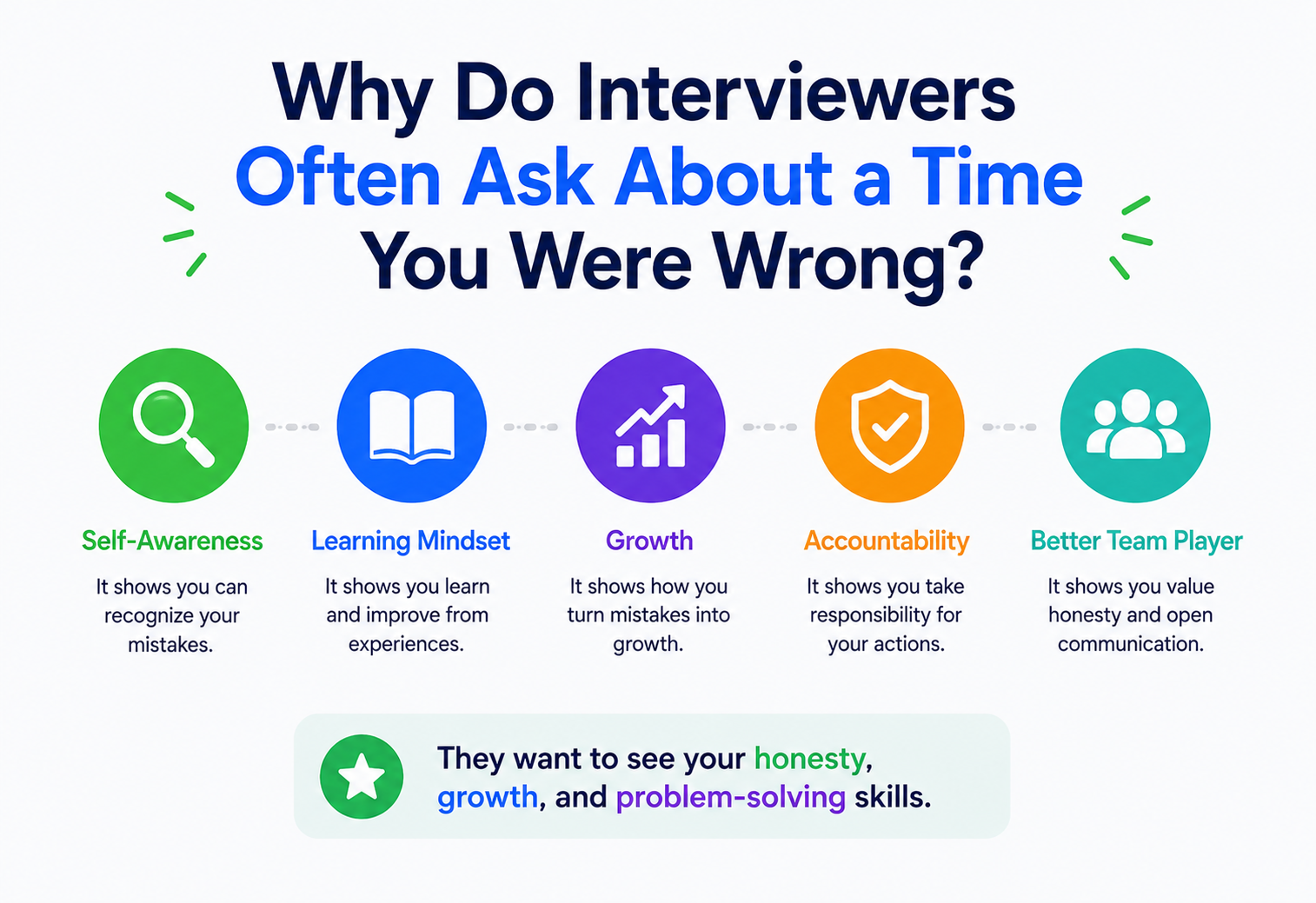
Why Do Interviewers Often Ask About “A Time You Were Wrong”?
A complete, beginner-friendly guide to one of the most common — and most misunderstood — behavioural interview questions. What interviewers are really testing, how to structure a great answer with STAR(R), and the mistakes that quietly sink otherwise strong candidates.
Introduction & History
Imagine two students take the same exam. One gets every question right the first time because the exam was easy for them. The other gets three questions wrong, realises the mistakes, fixes their method, and scores even higher on the next test. If you were hiring a tutor for a struggling child, who would you pick? Most people would pick the second student — not because they made mistakes, but because they showed they know how to learn from them. This simple idea is the entire reason interviewers ask, “Tell me about a time you were wrong.”
This question belongs to a style of interviewing called behavioural interviewing. Behavioural interviewing is built on a simple rule of psychology: past behaviour is the best predictor of future behaviour. Instead of asking “Are you a good team player?” — a question anyone can answer with “yes” — the interviewer asks for a real, specific story. A story is much harder to fake than an opinion about yourself.
Behavioural interviewing was formally developed in the 1970s by industrial psychologists, most notably through work at the University of Georgia that produced what is now called the Patterned Behaviour Description Interview. Companies discovered that hypothetical questions like “What would you do if a teammate missed a deadline?” produced answers full of good intentions but very little useful signal, because people are naturally good at imagining the “correct” answer. Real, past-tense stories are far more revealing, because they are constrained by what actually happened.
Over the following decades, large companies refined this approach into structured systems. Amazon built its entire interview process around 16 “Leadership Principles,” several of which are tested almost exclusively through stories about failure and learning. Google’s hiring research (widely known as Project Oxygen and later studies) found that self-awareness and the ability to learn from mistakes were strong predictors of on-the-job success, especially in leadership roles. Today, “Tell me about a time you were wrong” or its close cousins — “Tell me about a failure,” “Tell me about a time you received difficult feedback,” or “Tell me about a mistake you made at work” — appear in some form in nearly every serious interview process, from campus hiring to executive search.
By the end of this guide, you will understand exactly why this question exists, what interviewers listen for sentence by sentence, how to build and practise a strong answer using a proven framework, and which common mistakes quietly cost candidates the job even when the story itself was a good one.
1.1 A Short Timeline
1970s — The Patterned Behaviour Description Interview
Industrial psychologists at the University of Georgia formalise the idea that specific past stories predict future behaviour better than hypothetical “what would you do” questions.
1980s–1990s — Structured Behavioural Interviewing Spreads
Large employers adopt structured behavioural loops after research shows unstructured interviews are barely better than random at predicting job performance.
2000s — The Leadership Principles Era
Amazon codifies 16 leadership principles that are probed almost entirely through past-tense stories, including failure and self-correction stories.
2010s — Google’s Hiring Research
Project Oxygen and later internal studies find that “learning ability” and self-awareness predict success better than raw pedigree, reinforcing failure-story questions across the industry.
Today — A Near-Universal Question
Some version of “tell me about a time you were wrong” appears in nearly every serious interview process worldwide, from graduate hiring to executive search.
The Problem It Solves
Every interview question exists to solve a specific hiring risk. To understand this question, we first need to understand the risk it is designed to catch.
2.1 The Problem: Skills Can Be Verified, Character Often Cannot
A resume, a coding test, or a portfolio can tell an interviewer whether a candidate can do the job. But they say almost nothing about how the candidate will behave when things go wrong — and in every real job, things eventually go wrong. A brilliant engineer who cannot admit a mistake will hide bugs instead of raising them. A talented manager who blames their team for every failure will destroy morale. A confident salesperson who never questions their own approach will keep repeating the same losing pitch.
Technical interviews test competence. Behavioural interviews like this one test character under pressure — specifically, humility, self-awareness, accountability, and the ability to grow. These traits are notoriously difficult to observe directly in a 45-minute conversation, so interviewers use a proxy: they ask you to narrate a real memory and watch how you talk about yourself inside that memory.
2.2 Why This Specific Question, and Not Just “What Are Your Weaknesses?”
Many candidates confuse this question with the classic “What is your greatest weakness?” They are related but not identical. A weakness question can be answered in the abstract (“I’m not great at public speaking”). A “time you were wrong” question forces a concrete, verifiable story with a beginning, middle, and end — a specific decision, a specific consequence, and a specific change in behaviour afterward. This makes it much harder to give a rehearsed, generic non-answer, which is exactly why interviewers prefer it.
2.3 The Hiring Risk Being Reduced
Every organisation has been burned, at some point, by hiring someone who was technically capable but personally difficult — someone who covered up mistakes, blamed colleagues, repeated the same errors, or became defensive under feedback. This question is a low-cost, high-signal way to filter for that risk before a single day of employment has occurred.
2.4 The Hidden Cost of Hiring Someone Who Cannot Admit Fault
To really understand why companies invest interview time in this single question, it helps to picture the alternative. Imagine an engineer who ships a bug, notices it the next morning, but stays quiet because admitting it feels embarrassing. That bug now sits in production for days instead of hours, silently costing the company money, customer trust, or both. Multiply that pattern across a team of thirty people over a year, and the damage from unspoken mistakes can dwarf the damage from the mistakes themselves. The mistake was never really the problem — the silence around it was.
Organisational psychologists sometimes describe this as the difference between a single-loop failure and a double-loop failure. A single-loop failure is a one-time error that gets fixed and forgotten. A double-loop failure is when the same underlying cause keeps producing new errors because nobody stopped to examine the root cause. Employees who cannot honestly discuss their own mistakes rarely trigger the double-loop reflection that prevents repeat failures — for themselves or for the systems and teams around them. This is precisely the deeper competency the interview question is designed to sample.
2.5 A Question That Is Cheap to Ask but Expensive to Answer Badly
From the interviewer’s side, this question costs almost nothing — it fits inside two or three minutes of an existing conversation, requires no special equipment, and can be asked identically to every candidate for consistency. From the candidate’s side, however, a poorly handled answer can be surprisingly expensive, because it is one of the few moments in the interview where character, rather than competence, is directly on display. This asymmetry — low cost for the asker, high stakes for the answerer — is part of why the question has remained a permanent fixture of interviewing for more than fifty years, even as specific interview formats, tools, and trends have changed around it.
Core Concepts
Before building an answer, it helps to understand the handful of psychological concepts interviewers are quietly testing every time they ask this question.
Own Your Role
Can you accurately see your own role in what went wrong, instead of only seeing external causes?
No Deflection
Do you own the outcome, even the parts that were uncomfortable, rather than deflecting blame?
Ability Isn’t Fixed
A term popularised by psychologist Carol Dweck: the belief that abilities can improve through effort and learning, rather than being fixed traits.
Speak Up Early
Are you someone who could admit a mistake openly on a team, so it can be fixed quickly, instead of hiding it?
Recover, Don’t Repeat
Can you recover from a setback without becoming defensive, discouraged, or repeating the exact same error?
Reasonable at the Time
Was the mistake itself reasonable given what you knew at the time, or does it reveal poor decision-making?
3.1 Growth Mindset vs. Fixed Mindset
This distinction is worth understanding in more depth because it quietly shapes almost every good and bad answer to this question. People with a fixed mindset treat mistakes as proof of a permanent flaw — “I got it wrong, so I must not be good at this” — and therefore tend to avoid admitting error at all. People with a growth mindset treat mistakes as data — “I got it wrong, here is what that taught me, here is what I do differently now.” Interviewers are almost always listening for growth-mindset language, because it correlates strongly with how someone will handle the inevitable mistakes of a real job.
3.2 The Difference Between a Mistake and a Failure
A mistake is usually a specific decision or action that, in hindsight, was wrong — choosing the wrong technology, misreading a requirement, sending an email too early. A failure is often a larger outcome — a project that missed its goal, a product that did not succeed. Both are valid material for this question, but mistakes are often easier to tell well, because they involve a single clear decision point you can walk through step by step.
A 10-year-old forgets to water a class plant for a week because they assumed a classmate was doing it. The plant wilts. Later they say: “I should have just asked instead of assuming — now I always check first.” That one sentence contains the entire skeleton of a great professional answer: an assumption, a consequence, and a concrete change in behaviour.
3.3 The Anatomy of a Mistake: Cause, Decision, and Consequence
Every mistake worth telling in an interview has three separate parts, and understanding them separately makes it much easier to build a clear story later. The cause is the condition that set the mistake up — missing information, time pressure, an incorrect assumption, or simple inexperience. The decision is the specific choice you made given that cause — this is the part you are personally responsible for, and the part interviewers care about most. The consequence is what happened as a result — measurable where possible, such as time lost, money lost, trust damaged, or a relationship strained.
Weak answers blur these three parts together into a vague cloud of “things went badly.” Strong answers separate them cleanly: “Because I was new to the codebase (cause), I assumed the test suite covered this edge case and skipped writing a new test (decision), which let a billing bug reach production for two days (consequence).” Notice how each part answers a different question, and together they give the interviewer a complete, honest picture rather than an impression.

3.4 Why “I Take Feedback Well” Is Not the Same as Self-Awareness
Many candidates believe that describing themselves as receptive to feedback is the same as demonstrating self-awareness. It is not. Self-awareness means noticing your own error before being told, or at minimum, immediately recognising the truth of feedback once it arrives rather than needing to be convinced. A story where you only realised your mistake because someone else pointed it out repeatedly, and you initially resisted, actually demonstrates the opposite of what the question is testing — even if you eventually came around. The strongest stories show a moment of personal, internal recognition, not just external correction.
3.5 Cultural Framing: Humility Is Not Weakness
In some professional cultures, openly discussing a personal failure can feel uncomfortable, almost like a loss of face. It’s worth reframing this directly: in nearly every modern hiring context, especially at global technology and consulting firms, the ability to discuss failure calmly is read as a sign of confidence and seniority, not weakness. Junior employees and insecure leaders tend to protect their image at all costs; experienced, secure professionals can discuss a real mistake without their sense of competence being threatened by it. Interviewers are, in a subtle way, testing for that security.
The STAR Framework
Almost every strong answer to a behavioural question is built using a simple four-part structure called STAR: Situation, Task, Action, Result. For a “time you were wrong” question, a fifth element — Reflection — is essential, turning the framework into what many career coaches now call STAR(R).
| Letter | Meaning | What to Include |
|---|---|---|
| S — Situation | Context | Where and when this happened; enough detail to picture the scene, in 2–3 sentences. |
| T — Task | Your responsibility | What you were trying to achieve or decide, and why it mattered. |
| A — Action | What you did — and got wrong | The specific decision or action, stated plainly, without excessive self-punishment. |
| R — Result | The consequence | What actually happened because of the mistake — be honest, even if it was costly. |
| R — Reflection | The learning | What you changed afterward, and evidence that the change stuck (a later, similar situation handled better). |
Diagram explained: The Situation and Task (green) are simply context-setting — keep these short. The Action and Result (orange) are the “hard” part of the story, where the actual mistake and its cost live — this is where many candidates rush or soften the truth, which is a mistake in itself. The Reflection and Proof (indigo) are what actually separates a good answer from a forgettable one, because they show change, not just guilt.
4.1 A Worked Example Using STAR(R)
Notice how short the “guilt” portion is compared to the “learning” portion. That balance is intentional and matters more than most candidates realise.
What Interviewers Are Really Evaluating
It helps to think of the interviewer as running several small, silent checks while you talk — almost like a checklist running quietly in the background of the conversation.
5.1 Check 1 — Is This a Real Mistake, or a Disguised Brag?
The most common failed answer is the “humble brag” — “My biggest weakness is that I work too hard” dressed up as a mistake story. Interviewers hear this constantly and it almost always damages credibility rather than helping it.
5.2 Check 2 — Does the Size of the Mistake Match the Seniority of the Role?
A junior candidate describing a minor process mistake is appropriate. A candidate applying for a senior leadership role who can only describe a trivial mistake may raise doubts about whether they’ve truly owned high-stakes decisions.
5.3 Check 3 — Whose Fault Does the Candidate Say It Was?
This is the single biggest signal. Listen to your own language: how many sentences describe what you did versus what someone else did wrong? A story that quietly shifts blame to a teammate, a manager, or “the process” — even while technically answering the question — is one of the fastest ways to fail this question.
5.4 Check 4 — Is There Evidence of a Real, Lasting Change?
Saying “I learned to communicate better” is an opinion. Describing a specific new habit, tool, checklist, or behaviour — and, ideally, a later moment where that change was tested and held — is evidence. Interviewers are trained to notice the difference.
5.5 Check 5 — How Does the Candidate Feel, Right Now, About the Memory?
Genuine self-awareness usually comes with a calm, matter-of-fact tone — not defensiveness, and not excessive self-criticism. Both extremes are flagged, because both suggest the mistake hasn’t been fully processed.
Amazon’s “Are Right, A Lot” and “Earn Trust” leadership principles are explicitly tested through failure stories in almost every Amazon interview loop. Interviewers are trained to write down direct quotes and later score the story against a rubric — not a vague impression — specifically checking for ownership language versus blame language.
5.6 Check 6 — Does the Candidate Stay Composed When the Topic Gets Uncomfortable?
Interviewers are quietly watching your body language and pacing as much as your words. Do you slow down and speak carefully, or does your speech speed up and become scattered? Do you make eye contact while describing the consequence, or do you look away and rush past it? None of these signals is scored formally, but experienced interviewers use them to sanity-check whether the verbal story matches the emotional reality — a mismatch is often a sign the story has been over-rehearsed or softened.
5.7 A Side-by-Side Contrast
It’s often clearer to see the difference between a weak and strong answer placed next to each other, using the exact same underlying event.
| Weak Version | Strong Version |
|---|---|
| “We had a project that didn’t go well because the requirements kept changing and the client wasn’t clear about what they wanted.” | “I didn’t push hard enough early on to pin down the requirements in writing, which let ambiguity build up until it was expensive to fix. Now I always send a written summary after every requirements call.” |
| “I’m too much of a perfectionist, so sometimes I take a bit longer than others.” | “I once spent two extra days polishing a report nobody asked to be perfect, and missed a more urgent deadline as a result. I now ask upfront how polished something actually needs to be before I start.” |
Both weak examples technically answer the question. Both strong examples do the same work in roughly the same number of words, but shift the responsibility fully onto the candidate’s own decisions and end with a concrete, checkable change. This contrast is exactly what separates a forgettable answer from a memorable one.
The Life of an Answer: From Question to Decision
It’s useful to see the full journey your answer takes, from the moment it leaves your mouth to the moment it influences a hiring decision.
Diagram explained: Most candidates picture the interview as a live, one-time conversation that is quickly forgotten. In reality, at most structured companies, your exact words are written down and reused days later in a hiring debrief you’re not present for — which is why vague or defensive answers are so costly: they get re-read by people who never heard your tone of voice, only the words on the page.
6.1 Why the “Written Notes” Stage Matters So Much
A confident, warm delivery can soften a slightly weak answer in the room. But once your words are reduced to bullet points in a shared document, only the content survives. This is exactly why the specific, concrete language of the STAR(R) framework matters more than tone alone — the notes need to carry the substance on their own.
6.2 What a Hiring Debrief Actually Looks Like
At companies with a structured hiring process, every interviewer on a panel typically submits independent written feedback before anyone discusses the candidate together — this is deliberate, and it exists specifically to prevent one confident voice in the room from swaying everyone else’s opinion before they’ve formed their own. Only after everyone has submitted independent notes does the group meet to compare scores, resolve disagreements, and make a final call. If two interviewers scored your “time you were wrong” story very differently, that gap itself becomes a topic of discussion — and whoever can point to a specific, quoted phrase from your answer usually wins the argument, which is another reason concrete, memorable language matters more than a vague, pleasant impression.
6.3 How Long the Signal Actually Lasts
It’s worth knowing that your answer to this question doesn’t just influence the immediate hiring decision — at many companies, interview notes are retained and can be referenced again if you are considered for internal transfers, promotions, or even reapplication years later. A memorable, well-told story about growth can quietly work in your favour long after the original interview is over; a poorly handled one can occasionally resurface as a lingering, unspoken hesitation. This is a small but real reason to take the preparation for this question seriously, even though it may feel like “just one question” among many.
Advantages, Disadvantages & Trade-offs
Why Interviewers Like This Question
- Hard to fake convincingly — a specific, consistent story under follow-up questions is difficult to fabricate on the spot.
- Predicts on-the-job behaviour — how someone talks about a past mistake correlates with how they will likely handle the next one.
- Cheap and fast — unlike a multi-day work sample, it takes two or three minutes inside an existing interview slot.
- Reveals communication skill — the ability to explain a messy, real situation clearly is itself a valuable workplace skill.
Real Limitations of the Question
- Coachable answers reduce signal — because this question is so common, many candidates arrive with a heavily rehearsed answer, which can mask true self-awareness.
- Cultural and personality bias — some cultures and personality types are less comfortable openly discussing personal failure in a formal setting.
- Interviewer inconsistency — without a shared rubric, two interviewers can score the same story very differently based on personal taste.
- Recency and memory bias — candidates often default to whatever mistake is easiest to recall, not necessarily the most representative one.
This question trades a small amount of interview time for a large amount of predictive signal about character — but only when the candidate tells a real, specific story instead of a rehearsed, generic one.
7.1 How Mature Hiring Processes Reduce These Limitations
Well-run interview processes address these weaknesses in a few practical ways, similar to how a well-run production system adds redundancy to reduce the impact of any single point of failure. First, they use a shared, written rubric so that every interviewer scores answers against the same criteria rather than personal taste. Second, they train interviewers to ask two or three planned follow-up questions rather than accepting the first answer at face value, which quickly separates a real story from a rehearsed one. Third, they collect signal from multiple interviewers across multiple questions, so that no single answer — including this one — decides the outcome on its own. Understanding this should be reassuring to candidates: one imperfectly delivered answer rarely sinks an otherwise strong interview, especially at organisations that interview well.
How This Question Changes by Seniority
Just as a system design question gets harder as you interview for more senior engineering roles, this question’s expected “size” and “stakes” scale with seniority.
| Level | Expected Scope of the Mistake | What’s Being Tested |
|---|---|---|
| Intern / new grad | A personal task, assumption, or small process error | Basic self-awareness and coachability |
| Mid-level individual contributor | A technical or project-level decision with real consequences | Ownership of a decision inside a team context |
| Team lead / manager | A people or process decision affecting a team | How mistakes are handled when others are relying on you |
| Senior leader / executive | A strategic or organisational judgment call with wide impact | How failure is turned into organisational learning, not just personal learning |
A common mistake at senior levels is reusing an entry-level story — for example, an executive candidate describing a minor scheduling mix-up from years ago. This can unintentionally signal that the candidate has not taken enough real risk or ownership recently to have a story with genuine stakes.
8.1 What If You Have Little or No Work Experience?
Students, recent graduates, and career changers often worry they don’t have a “real” workplace mistake to draw on, but this concern is usually unfounded. Interviewers evaluating early-career candidates deliberately calibrate their expectations lower, and they know a strong answer at this stage will likely come from a class project, an internship, a student club, a part-time job, or even a personal project — not a high-stakes corporate decision. What matters at this level is not the size of the mistake but the clarity of the thinking: can you walk through cause, decision, and consequence cleanly, and can you show one specific thing you now do differently because of it? A well-told story about missing a deadline on a group assignment because you didn’t ask for help early enough can be just as convincing, at this level, as a senior engineer’s production outage story is at theirs.
8.2 What If You’re Changing Careers or Industries?
Career changers face a slightly different challenge: their most relevant mistake stories may come from a previous, unrelated field, which can feel like it “doesn’t count.” In practice, this is rarely a problem, because the underlying competencies this question tests — ownership, self-awareness, and growth — transfer completely across industries even when the technical details do not. A former teacher moving into project management can tell a story about misjudging how much support a struggling student needed, and connect the lesson learned directly to how they now check in with team members proactively rather than waiting for problems to surface on their own. The bridge between old field and new field is built in the reflection portion of the story, not in the technical details of the mistake itself.
Building a Reliable Story Bank
Just as a well-run system keeps backups ready before it needs them, strong candidates prepare a small “story bank” long before the interview, rather than trying to invent an answer live under pressure.
9.1 How Many Stories Do You Actually Need?
Most interview coaches recommend preparing three to five real stories that can each flex to answer several different behavioural questions — a time you were wrong, a time you failed, a time you received hard feedback, a time you disagreed with a decision. The same underlying memory can often serve two or three of these questions with only small adjustments in framing.
9.2 A Simple Three-Step Preparation Method
List Candidates
Write down five to eight real moments where something you did did not go as planned — big or small, recent or a few years old.
Score Them
For each one, ask: Is the outcome clear? Was it genuinely my decision? Did something concrete change afterward? Keep only the ones that pass all three checks.
Draft in STAR(R)
Write a five-sentence version of your top two or three stories, one sentence per STAR(R) element, and practise saying it out loud — not memorised word for word, but familiar enough to tell naturally.
Practise your story out loud to another person at least twice before the interview. Reading it silently feels ready; saying it out loud reveals awkward phrasing, missing details, and places where you accidentally start blaming someone else.
9.3 Keeping Your Story Bank Current
A story bank is not something you build once and use forever. Just as a production system needs periodic maintenance to stay reliable, your story bank benefits from a refresh every year or two, especially after a role change, a promotion, or a particularly formative project. An answer built entirely from your first job can start to feel thin once you have several years of more senior experience — interviewers may start to wonder, reasonably, whether you have made any noteworthy decisions since then. A simple habit that experienced interviewees use is to jot down a two-line note any time something goes wrong at work and they learn something from it, long before an interview is even on the horizon. This turns story preparation from a stressful scramble into a small, ongoing habit.
9.4 Matching Stories to the Role You’re Applying For
Where possible, choose a story from your bank that relates to a skill genuinely important for the job you want. A backend engineer interviewing for a role heavy on system reliability might emphasise a mistake related to testing or deployment discipline. A candidate moving into a people-management track might instead emphasise a mistake in how they communicated with or supported a teammate. The underlying STAR(R) structure stays the same, but choosing a topically relevant story adds an extra layer of relevance that a generic story cannot offer.

Honesty, Trust & the Risk of Faking It
It might be tempting to invent a “safe” mistake — something minor and painless, like “I used to be a perfectionist.” Experienced interviewers hear this dozens of times a year and typically respond with pointed follow-up questions specifically designed to test whether the story is real.
10.1 Why Fabricated or Overly Safe Answers Get Caught
Real memories contain small, specific, slightly messy details — an exact number, an exact reaction from a colleague, an exact timeframe. Invented or overly rehearsed stories tend to stay vague under follow-up questions like “What did your manager say when you told them?” or “What would you do differently if it happened again tomorrow?” The gap between a real story and a fabricated one usually shows up in the second or third follow-up question, not the first answer.
10.2 The Trust Cost of Getting Caught
Being caught giving a fabricated or evasive answer does more damage than the original mistake ever could. Interviewers are not primarily judging the size of your mistake — they are judging whether they can trust what you tell them. A small, honestly-told mistake almost always beats a polished, hollow one.
10.3 A Worked Example of a Follow-Up Question Exposing a Weak Answer
Interviewer: “Can you give me a specific time that actually caused a problem — a deadline you missed, or something a manager had to step in on?”
Candidate: “Um… I guess there wasn’t really one specific time, it’s more of a general tendency…”
This exchange takes less than thirty seconds, but it tells the interviewer a great deal — not about the candidate’s perfectionism, but about their willingness to give a safe, low-risk answer rather than a genuine one. Compare this to a candidate who has a real story ready and can answer the exact same follow-up with a specific date, a specific consequence, and a specific change, without missing a beat. The follow-up question is not a trick; it’s simply the fastest way to tell the difference between the two.
10.4 Why Honesty Here Builds Trust Faster Than Almost Anything Else in the Interview
There is a slightly counterintuitive effect worth naming directly: candidates often worry that admitting a real, costly mistake will make them look bad, when in practice the opposite tends to happen. A specific, honestly-told story — including the uncomfortable parts — creates a moment of genuine connection with the interviewer, who has almost certainly made a comparable mistake themselves at some point in their own career. This shared recognition often does more to build rapport and trust in two minutes than the rest of the interview combined, precisely because it is the one moment where the polished “interview version” of a candidate briefly steps aside.
Signals Interviewers Watch For
Think of this the way a monitoring dashboard watches for warning signs in a live system — interviewers are quietly watching for a similar set of “green” and “red” signals in your language.
| Green Signals (Build Trust) | Red Signals (Raise Concern) |
|---|---|
| Clear ownership language: “I decided,” “I missed,” “I should have” | Blame-shifting language: “they didn’t tell me,” “the process failed” |
| A specific, real consequence, even if uncomfortable | A vague or trivial “mistake” with no real cost |
| A concrete change in behaviour, tool, or process afterward | A generic lesson with no real evidence of change |
| Calm, reflective tone | Defensiveness, excessive justification, or excessive self-blame |
| Willingness to answer honest follow-up questions | Repeating the same rehearsed lines when asked to go deeper |
11.1 The Pronoun Test
One simple, informal check some experienced interviewers use is what might be called the “pronoun test.” Silently count how often a candidate’s story uses “I” versus “we,” “they,” or “the team,” particularly in the sentences describing the actual mistake and its cause. A healthy answer will naturally lean toward “I” in the action and result portions — because those are the parts you are personally responsible for — and can comfortably use “we” in the reflection portion, when describing a process or team-wide change you helped drive. A story that uses “we” throughout, especially in the part describing what went wrong, often signals discomfort with individual ownership, even if the candidate does not consciously realise they’re doing it.
11.2 Listening for Hedging Language
Phrases like “sort of,” “kind of,” “I guess,” or “it wasn’t really my fault, but…” are small but telling signals. Occasional hedging is completely normal and human. But when hedging clusters specifically around the moment the mistake is described, it can suggest the candidate has not fully processed or accepted what happened — which is exactly the kind of subtle signal a two-minute story is uniquely good at revealing, compared to a resume or reference check.
Preparing and Practising Your Answer
Just as a system is tested in staging before it reaches production, your story deserves a “rehearsal environment” before the real interview.
12.1 Practice Steps
- Write your story once in full detail — this draft is for you only, not for memorising word for word.
- Cut it down to roughly 90 seconds when spoken aloud — most strong behavioural answers land between 60 and 120 seconds.
- Say it to a friend, mentor, or even record yourself, and listen back for blame language or vague phrasing.
- Prepare answers to two likely follow-ups: “What would you do differently right now?” and “How did this change how you work today?”
- Re-check the balance: does the “learning” portion of the story take up at least as much time as the “mistake” portion?
Do not memorise your answer word for word. A word-perfect answer often sounds rehearsed and brittle under follow-up questions, and a single interruption can make you lose your place entirely. Instead, know the five STAR(R) beats cold, and let the exact wording vary naturally each time you tell it.
12.2 A Simple Template You Can Fill In Right Now
If you’re preparing for an interview soon, one of the fastest ways to get unstuck is to fill in a short template rather than staring at a blank page. Try completing each line below in a single sentence:
- Situation: “I was working on ____ at ____, and the context was ____.”
- Task: “I was specifically responsible for ____.”
- Action: “I decided to ____, which turned out to be wrong because ____.”
- Result: “As a result, ____ happened, which cost / affected ____.”
- Reflection: “Afterward, I changed ____, and later I proved this stuck when ____.”
Once each line is filled in with a single honest sentence, you already have a complete, well-structured answer — the only remaining work is smoothing the transitions between sentences so it sounds like natural speech rather than a checklist.
12.3 Timing Yourself the Right Way
A practical trick many candidates use is to record a timer while practising out loud, without stopping to restart if they stumble — the goal is to see how the story actually flows under mild pressure, not to produce a perfect recording. If the story consistently runs past two minutes, look first at the Situation and Task sections; these are almost always the easiest to trim, because interviewers need just enough context to follow along, not a full history of the project. If the story runs under forty-five seconds, it may be missing detail in the Result or Reflection sections, which are usually where the richest, most convincing detail belongs.
12.4 Practising for Follow-Up Questions Specifically
Because follow-up questions are where weak answers usually unravel, it’s worth deliberately practising them, not just the main story. Ask a friend or mentor to interrupt you mid-story with a pointed question — “Why didn’t you catch that earlier?” or “How did your manager react?” — and practise answering calmly without losing the thread of the original story. This single exercise, more than any other, is what separates candidates who sail through this question from those who freeze the moment the conversation goes off-script.
Answer Patterns vs. Anti-Patterns
Just as software has well-known good design patterns and well-known anti-patterns to avoid, interview answers to this question fall into recognisable categories.

13.1 Strong Patterns
The Process Fix
A mistake caused by a missing process, which you then helped build (like a checklist or review step) — shows systemic thinking.
The Assumption Check
A mistake from assuming instead of confirming, followed by a new habit of clarifying earlier — shows communication growth.
The Feedback Response
A mistake you didn’t fully see until someone pointed it out, and how you responded to that feedback — shows coachability.
13.2 Anti-Patterns to Avoid
The Humble Brag
“I work too hard” or “I care too much” disguised as a flaw. Interviewers recognise this instantly and it damages trust.
The Blame Shift
A story that is technically about you but spends most of its time describing someone else’s failure.
The Bottomless Pit
A story with heavy self-criticism and no clear resolution or lesson, which can leave the interviewer unsure of your resilience.
The Ancient History
A story so old or minor (e.g., from school, unrelated to work) that it fails to show any real professional stakes.
13.3 A Worked Rewrite: Turning an Anti-Pattern into a Strong Pattern
It can help to see an anti-pattern actually get fixed, step by step, rather than just described in the abstract.
This draft never actually says what the candidate did — it’s a story about other people’s timing problems. Here is the same underlying event, rewritten to centre the candidate’s own decision:
The facts of what happened are almost identical in both versions. The difference is entirely in where the responsibility sits and what changed afterward — which is exactly the shift interviewers are listening for.
13.4 Why “The Bottomless Pit” Pattern Fails Even Though It’s Honest
It’s worth pausing on this anti-pattern specifically, because it often comes from candidates being told to “be honest and vulnerable” without also being told to balance that honesty with resolution. A story that spends ninety seconds describing guilt, self-doubt, and everything that went wrong, then ends abruptly with “and that was really hard for me,” leaves the interviewer with an accurate but incomplete picture. It answers “were you wrong” convincingly, but never answers the second, more important half of the question: “and what are you like now, because of it?” Vulnerability without resolution can unintentionally raise doubts about resilience, even when the honesty itself is genuine and admirable.
Best Practices & Common Mistakes
14.1 Best Practices
- Choose a real mistake with a genuine, specific consequence — not a disguised strength.
- Keep the “situation” and “task” brief; spend most of your time on the action, result, and — most importantly — the reflection.
- Use ownership language throughout: “I decided,” “I missed,” “I changed.”
- End with evidence the lesson stuck — ideally a later moment where you applied it successfully.
- Match the size of the story to the seniority of the role you’re interviewing for.
- Keep your tone calm and matter-of-fact, not defensive and not overly self-critical.
14.2 Common Mistakes
- Picking a “fake” weakness that doesn’t cost anything to admit.
- Rambling without structure, leaving the interviewer unsure what actually happened.
- Over-apologising, which can read as low confidence rather than accountability.
- Skipping the reflection entirely and ending the story right at the failure.
- Reusing a story that’s too old to demonstrate who you are today.
- Freezing under follow-up questions because the original story wasn’t real or wasn’t fully thought through.
14.3 Why These Mistakes Happen Even to Well-Prepared Candidates
Interestingly, most of these mistakes are not caused by a lack of preparation — they’re caused by the wrong kind of preparation. A candidate who memorises a script word for word often produces a story that sounds smooth in isolation but collapses the moment a follow-up question breaks the memorised order. A candidate who prepares only a topic (“I’ll talk about that time the migration failed”) without ever writing the STAR(R) beats down on paper often ends up rambling, because they’re improvising the structure live under pressure, which is exactly the wrong moment to improvise structure. The fix for almost every item on this list is the same: write the five beats down in advance, practise them out loud more than once, and let the exact sentences vary naturally each time.
14.4 A Short Pre-Interview Checklist
| Check | Question to Ask Yourself |
|---|---|
| Real | Did this actually happen, with a real, checkable consequence? |
| Owned | Am I the one who made the decision that went wrong — not just present when it happened? |
| Sized | Does the scale of this mistake match the seniority of the role I’m interviewing for? |
| Resolved | Did I clearly change something afterward, and can I describe that change concretely? |
| Proven | Do I have a later example showing the change actually held up? |
| Timed | Can I tell the whole story, out loud, in under two minutes? |
Real-World Examples & Company Approaches
Abstract advice becomes much sharper once you see how real employers actually use this question in their interview loops.
Amazon
Amazon’s leadership principles “Are Right, A Lot” and “Earn Trust” are directly probed through failure stories. Interviewers are trained to bar-raise against a written rubric, specifically scoring for ownership language, the size of the mistake relative to the role, and evidence of lasting behaviour change — not simply whether a good story was told.
Google’s hiring research found that “learning ability” and self-awareness were stronger predictors of long-term success than raw academic pedigree, which is part of why structured behavioural questions — including failure and mistake stories — are woven throughout Google’s interview loops for both technical and non-technical roles.
Startups & Smaller Teams
At smaller companies, this question is often asked more casually and conversationally, but the underlying goal is identical: because a small team has less room to absorb a colleague who cannot admit or learn from mistakes, hiring managers weigh this signal especially heavily.
Healthcare & Aviation
Industries where mistakes can directly harm human safety, such as healthcare and aviation, have built entire cultures around what is often called a “just culture” — one where reporting your own error quickly is rewarded rather than punished. Interviews probe failure stories especially carefully.
Across industries — from finance to healthcare to consulting — the pattern is consistent: organisations that depend on trust, judgment, and continuous improvement treat this question not as a formality, but as one of the most information-dense two minutes of the entire interview.
Industries where mistakes can directly harm human safety go further than most and have built entire cultures around what is often called a “just culture” — one where reporting your own error quickly is rewarded rather than punished, because early, honest reporting saves lives. Hiring interviews in these fields often probe failure stories especially carefully, precisely because the cost of a culture of hidden mistakes is measured in patient or passenger safety, not just money.
In consulting and finance, where judgment calls under incomplete information happen daily, interviewers frequently ask this question to distinguish candidates who make thoughtful, well-reasoned decisions that occasionally turn out wrong from those who make careless ones — the story you tell, and how precisely you can trace your own reasoning at the time, is often used as a rough proxy for how sound your judgment will be on the next ambiguous decision.
15.1 What Changes Across Industries, and What Stays the Same
The surface details of a strong answer vary by field — an engineer’s story might involve a deployment, a nurse’s might involve a dosage or a handoff, a marketer’s might involve a campaign that missed its target. But underneath every strong answer, in every industry, the same four elements repeat: a specific, personally-owned decision; an honest account of the real consequence; a concrete change afterward; and evidence that the change has actually held up over time. Once you recognise this consistent shape, the question stops feeling like an unpredictable trap and starts feeling like a structure you can prepare for with confidence, no matter what field you work in.
Comparison With Related Questions
| Question | What It’s Really Testing | How It Differs |
|---|---|---|
| “Tell me about a time you were wrong” | Self-awareness and accountability for a specific decision | Requires a concrete, personal error you own |
| “Tell me about a failure” | Resilience after a larger, often multi-person outcome | Can involve factors outside your control, not just your own decision |
| “Tell me about your greatest weakness” | Self-knowledge in the abstract | Does not require a specific story or timeline |
| “Tell me about a time you received difficult feedback” | Coachability and reaction to outside input | The trigger is external (someone else’s feedback), not self-discovered |
| “Tell me about a conflict with a coworker” | Interpersonal skill and conflict resolution | Focuses on relationship dynamics rather than a personal error |
Many candidates prepare one flexible story and adapt the framing slightly for whichever of these questions actually gets asked — this is efficient and perfectly acceptable, as long as the core facts stay honest and consistent.
16.1 Why Interviewers Sometimes Ask More Than One of These in the Same Loop
It might seem redundant for a single interview loop to include both “tell me about a time you were wrong” and “tell me about a failure,” but this is usually intentional rather than an oversight. Different interviewers on the same panel are often assigned different competencies to probe, and a hiring team may deliberately want to see whether a candidate’s answers stay consistent with each other across separate conversations, sometimes with different interviewers who don’t compare notes until after both conversations are complete. Inconsistent details between two tellings of what turns out to be the same event is one of the more obvious ways a fabricated or exaggerated story gets caught, which is one more reason to always stay close to what genuinely happened rather than embellishing for effect.
16.2 A Note on Remote and Asynchronous Interviews
As more interviews happen over video calls or even asynchronous recorded platforms, the fundamentals of this question do not change, but a few practical details do. On video, pauses can feel longer and more noticeable than in person, so it helps to explicitly say “let me think for a second” rather than sitting in silence, which can otherwise read as hesitation about the story’s honesty rather than simple thoughtfulness. On recorded, one-way platforms with no live follow-up, it becomes even more important to proactively include the reflection and proof elements in your first answer, since there will be no interviewer to prompt you toward them with a follow-up question.
FAQ & A Note on Confidence Without Arrogance
The questions that come up most often when candidates first prepare for this interview question — followed by a short reflection on how to sound both honest and confident at the same time.
Yes, as long as it’s genuinely relevant and you can still clearly explain what changed afterward. In general, a story from the last two to five years of your work life tends to land better than something from school or very early adulthood, because it shows who you are closer to today.
This is a common feeling, but it usually means you haven’t looked hard enough, not that mistakes didn’t happen. Go through past projects, decisions, or feedback conversations specifically looking for moments where a choice you made didn’t turn out the way you expected — even a small one is usually enough if it’s real and you can show what changed.
Not necessarily. The best story is the one that most clearly shows ownership and a real change in behaviour — a medium-sized, well-explained mistake usually outperforms a dramatic one that’s hard to explain quickly or that raises serious doubts about your judgment.
Answer honestly and take a moment to think before responding — a short pause is completely normal. Because the story is real, you should be able to reason through a new follow-up question using the same facts, even if you didn’t rehearse that exact wording.
No — in fact, mistakes with real consequences for others are often stronger material, because they show you can be honest about impact rather than only picking something painless. What matters most is how clearly you own it and what changed afterward.
Most well-structured answers land naturally between 60 and 120 seconds when spoken aloud. Shorter can feel underdeveloped; much longer risks losing the interviewer’s attention before you reach the most important part — the reflection.
Yes — reusing a well-told, honest story across different interviewers in the same loop, or even across different companies, is completely normal and expected. What matters is that the facts stay consistent each time you tell it, since inconsistency between two tellings is one of the clearest signs a story isn’t entirely accurate.
Focus on the part of the situation you genuinely controlled, even within a messier, shared situation. For example, if a project failed partly due to factors outside your control, you can still find and describe the one decision that was yours — that’s the part the interviewer actually wants to hear about.
A brief, genuine moment of emotion when discussing a real setback is rarely held against you and can even reinforce that the story is authentic. If you need a second to collect your thoughts, it’s perfectly fine to pause briefly or say so directly rather than pushing through in a way that feels uncomfortable.
Yes, if it’s true and relevant — crediting someone who supported your growth afterward does not take away from your ownership of the original mistake, and it can add a layer of humility and team-awareness that strengthens the overall story.
17.1 A Note on Confidence Without Arrogance
One tension candidates often struggle to resolve is how to sound confident while describing something that went wrong. The two are not actually in conflict, but it can feel that way in the moment, especially for candidates who are naturally self-critical or naturally proud. The resolution lies in separating two different things: confidence in your current judgment versus regret about a past decision. It is entirely possible — and, to a skilled interviewer, very compelling — to say, in effect, “given what I knew at the time, I made a reasonable call that turned out to be wrong, and here is exactly what I know now that I didn’t know then.” This framing lets you be honest about the outcome without sounding either falsely humble or defensively proud, and it is often the single biggest shift that turns an average answer into a genuinely memorable one.
It also helps to remember that the interviewer asking this question has, in almost every case, been asked the exact same question themselves at some point in their own career. They are not looking for a flawless record — a flawless record would actually be a little suspicious, since it would suggest either very little real responsibility or very little honesty. They are looking for a specific kind of pattern: someone who takes real risks, occasionally gets things wrong the way every capable professional does, notices it, and comes out the other side sharper than before. Telling that story well is not about performing perfection. It is about proving, in miniature, that you are exactly the kind of person who gets better over time — which, in the end, is what every employer is actually trying to hire.
Summary & Key Takeaways
Interviewers ask about a time you were wrong because a resume can prove what you know, but only a real story can reveal how you handle being wrong — and in every real job, being wrong eventually happens to everyone. The question is not a trap designed to catch you out; it’s a low-cost, high-signal way to observe self-awareness, accountability, and growth mindset in action.
Summary
Behavioural interviewing, and this question in particular, exists because character under pressure cannot be verified from a resume, a portfolio, or a technical assessment. The question is designed to sample how you talk about yourself in the middle of a real memory — specifically the parts where you were responsible, where things went wrong, and where you either changed or didn’t. It has survived more than fifty years of shifting interview trends because it does that job better than almost any single alternative, and because it costs the interviewer almost nothing to ask.
The most reliable structure for answering it is the five-beat STAR(R) framework: Situation, Task, Action, Result, Reflection, with the reflection portion — the concrete change afterward and evidence that the change stuck — carrying most of the weight. Weak answers spend too much time on the mistake and not enough on the change; strong answers do the opposite. Preparation is not about memorising a script but about assembling a small “story bank” of two or three real events, practising them out loud, and being ready for the honest follow-up questions that separate real memories from rehearsed ones.
Key Takeaways
- This question is a core tool of behavioural interviewing, built on the principle that specific past stories predict future behaviour better than hypothetical answers.
- Interviewers are silently checking for ownership language, an appropriately sized mistake, and evidence of real, lasting change.
- The STAR(R) framework — Situation, Task, Action, Result, Reflection — is the most reliable way to structure a clear, complete answer.
- Avoid common anti-patterns: the humble brag, the blame shift, the bottomless pit, and the ancient-history story.
- Prepare a small story bank in advance, practise it out loud, and be ready for honest follow-up questions — fabricated or overly safe answers tend to unravel under scrutiny.
- The single most important shift most candidates need to make: spend less time on the mistake itself, and more time on what changed afterward — that is where the real signal lives.
A great answer to this question doesn’t make you look perfect — it makes you look trustworthy. And trustworthiness, far more than perfection, is what every interviewer is ultimately hiring for.