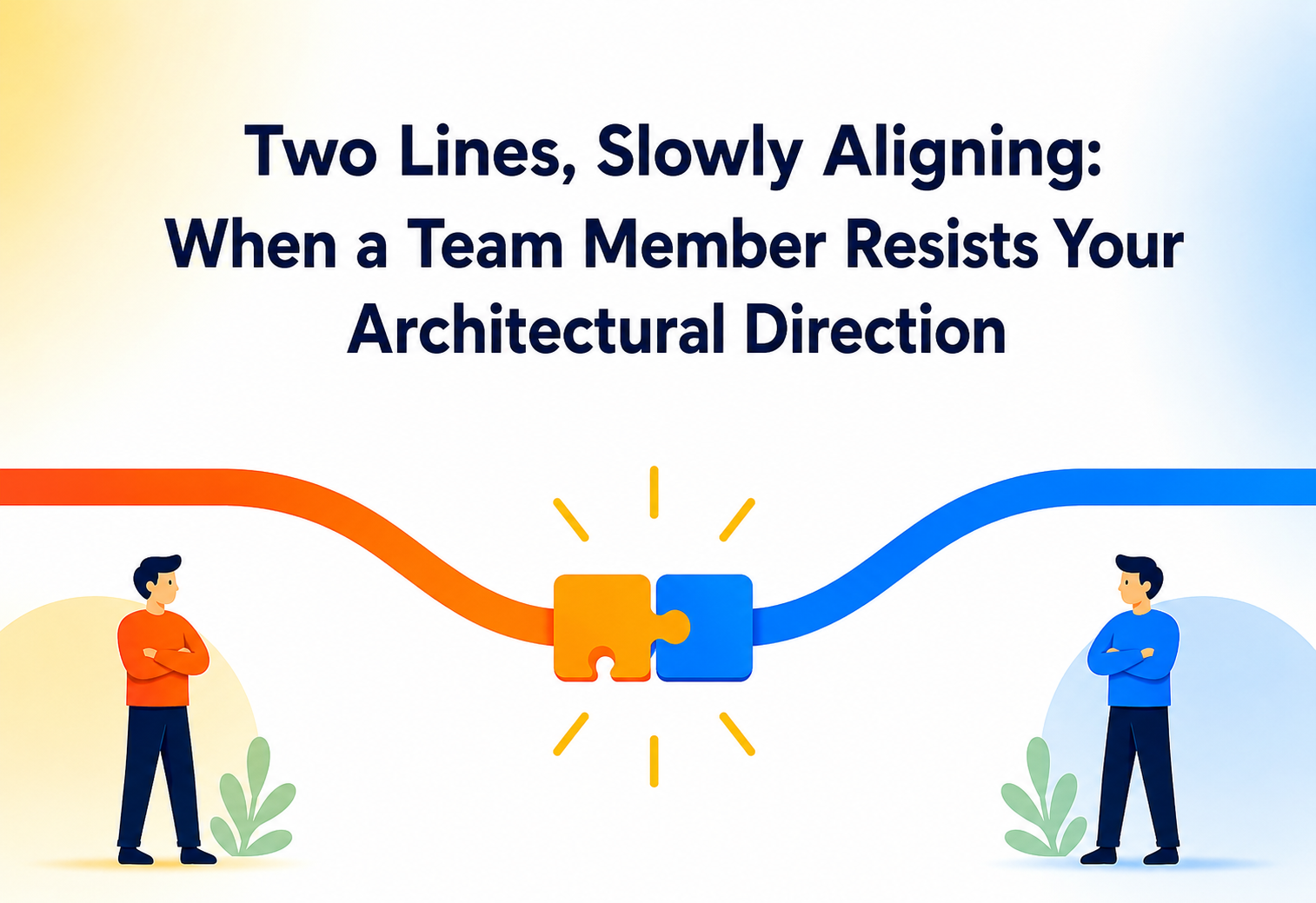
Two lines, drawn at different angles. Slowly, they can still meet.
When a team member keeps pushing back on your architectural direction, it rarely means the working relationship is broken. It usually means two people are seeing the same drawing from two different angles — and nobody has yet found the third position to stand in together.
The Review That Goes Sideways
Every design lead has one person, somewhere in their history, who made every review feel like a small negotiation. This is about what to do with that — without losing the person, the standard, or your own patience.
You’ve set the direction. It is not arbitrary — it comes from constraints the rest of the team cannot fully see yet: a client conversation, a structural limitation, a pattern that failed on the last project and cost three weeks to unwind. You lay it out in the review. And one person, again, pushes back. Not rudely. Just persistently. A counter-proposal. A raised eyebrow. A “have we considered” that circles back to an approach you already ruled out two meetings ago.
The easy read is that this person is difficult, or does not respect the hierarchy, or simply enjoys being contrarian. Sometimes that is even true. But far more often, what looks like resistance to you looks like advocacy from where they are standing — for an idea they believe in, for a standard they think is being compromised, or simply for the feeling of being asked rather than told. The frustrating part is that both readings can be correct in the same conversation: the direction can be right, and the way it landed can still have been wrong.
This piece is about the long middle ground between two bad options — overriding the resistance with authority, which teaches a talented person to go quiet instead of honest, and quietly appeasing it every time, which teaches the rest of the team that direction is negotiable by whoever pushes hardest. There is a third way, and it is slower than either, but it is the only one that holds up over a whole career of leading design teams rather than just one difficult project.
Picture a senior designer on your team — sharp, well-regarded by clients, three years into working with you. For two review cycles running, they have quietly redrawn a circulation sequence you had already settled on, framing it each time as “just exploring an alternative.” No confrontation. No raised voice. Just a slow, repeated redirection of the work back toward their own instinct, cycle after cycle, review after review.
The first time it happened, you barely noticed — a reasonable variation, presented as an option among options, easy enough to set aside with a short explanation. The second time, you felt a flicker of something closer to irritation, quickly suppressed, because raising it directly felt disproportionate to one redrawn hallway. By the third time, you had started rehearsing what you might say, and talking yourself out of saying it, because the person is good at their job, well-liked by the rest of the studio, and the last thing you want is a reputation as the lead who cannot take a different opinion.
This is, in miniature, exactly how most resistance situations actually unfold. They rarely arrive as a single dramatic confrontation you can point to and address head-on. They arrive as a pattern that accumulates just slowly enough that each individual instance feels too small to raise, until the accumulated version feels too large to raise casually — which is precisely the gap where most leads get stuck, saying nothing at all while the pattern quietly hardens into how this working relationship simply works now.
What Resistance Actually Is
“Resistance” is a single word standing in for several very different behaviours. Treating them all the same way is one of the most common mistakes a design lead makes.
It is worth slowing down and naming the differences — because two people can produce the exact same behaviour, a redrawn plan or a repeated counter-proposal, for entirely different reasons, and the right response to each is almost the opposite of the right response to the others.
Technical Disagreement
They think a different approach solves the brief better, and they can explain why in the language of the work itself — spans, code, cost, precedent. This is the healthiest kind, and it should be welcomed, even when it is inconvenient.
Ownership Grief
They had an idea, it was set aside, and the feeling underneath the pushback is not really about the merits — it is the quiet loss of watching something you cared about not get chosen.
Trust Deficit
They have been burned before — by a decision that turned out badly, or a leader who did not explain their reasoning — and the resistance is really a request for more visibility into how you are deciding, not a rejection of the decision itself.
Style Mismatch
They process out loud, through counter-proposals and alternatives, as a way of thinking rather than a way of objecting — and it can look identical to defiance if you are not used to how they work.
Quiet Disengagement
The most serious version, and the easiest to miss, because it often stops looking like resistance at all — the pushback fades not because they have agreed, but because they have stopped expecting to be heard.
Diagnose Before You Respond
Respond to a trust deficit with authority, and you deepen it. Respond to genuine technical disagreement by smoothing it over with reassurance, and you lose the one person willing to tell you when you are wrong. The first job, always, is to find out which one you are actually looking at — and that requires a conversation, not a guess.
Why It Happens More Than Leads Expect
Five recurring roots — each one, on its own, enough to turn perfectly good direction into a repeated argument.
3.1 The direction arrived without its reasoning
Most architectural direction, handed down in a review, is the visible tenth of a much larger decision — a client conversation, a budget constraint, a past failure — that the rest of the team never saw. When a lead states the conclusion without the reasoning behind it, even a very good decision can look, from the outside, like an arbitrary preference. People rarely resist a decision they understand. They resist a decision that feels like it appeared from nowhere.

3.2 Talented people have strong instincts, and strong instincts want somewhere to go
The same quality that makes someone an excellent designer — a genuine, trained sense for what is right — is exactly what makes them uncomfortable simply executing a direction they privately disagree with. This is not insubordination. It is the cost of hiring someone good, and it needs a structured outlet, not a lecture about following instructions.
3.3 A past leader taught them that pushback works, or that it does not
People generalise from their most recent manager. Someone who has been rewarded for pushing back in the past will keep doing it, sometimes past the point where it is useful. Someone who has been punished for it will go silent long before you would want them to — and that silence is far more dangerous than the pushback ever was, because you lose the information without ever knowing you lost it.
3.4 The relationship has not earned the authority yet
Formal authority — the title, the org-chart position — gets you compliance. It does not reliably get you trust, and trust is what makes someone follow a direction they do not fully agree with, on the belief that you have got a reason even if you have not explained it yet. Early in a working relationship, or after a rupture, that trust simply has not been built, and the resistance you are seeing may be less about this decision than about the relationship as a whole.
3.5 The decision might genuinely be wrong, or at least incomplete
It is worth saying plainly, because it is easy to forget in the moment: sometimes the resistance is correct. A direction handed down under time pressure, without enough input, can miss something a team member closer to the detail can see clearly. Ruling this out has to be a real step in the process, not a formality on the way to reasserting the original call.
Three of the five roots that keep resurfacing in every studio, big or small.
What It Costs to Get This Wrong in Either Direction
There are two ways to mishandle resistance, and they fail in opposite but equally expensive ways.
Overriding with authority
- Works in the short term — the drawing gets redrawn your way, the review ends, the schedule holds
- The person stops offering opinions in reviews, not because they have come around but because they have learned it costs more than it is worth
- You keep the compliance and lose the judgement — usually the more valuable of the two, especially from someone senior enough to be worth arguing with
- Quiet withdrawal often shows up first as fewer questions, then as fewer ideas, then as fewer people willing to disagree with anyone
Quietly appeasing every time
- Feels collaborative and non-hierarchical in the moment, and avoids the discomfort of an unresolved conversation
- Teaches the whole team that the loudest, most persistent voice sets the direction, regardless of the merits
- Exhausting for everyone else, including the person doing the pushing — who usually does not want unilateral authority; they want to be heard
- Corrodes trust in the leader far faster than any single hard decision ever could, because it is a pattern rather than an incident
A team does not resent a leader for holding a firm direction. It resents a leader who holds direction inconsistently — firm with some people, soft with others, depending on who argues hardest or who they would rather not upset.
Learning to Read the Pattern Early
This one is far easier to address in its first few weeks than after it has calcified into a known dynamic on the team. A few signals worth watching for — none alarming on its own, all worth naming as a set.
The counter-proposal that keeps returning
One good alternative is healthy engagement. The same alternative, quietly resubmitted every cycle regardless of the last conversation, is a pattern worth naming directly.
Agreement in the room, drift afterward
They nod in the review, then the next draft looks like the review never happened. This usually means the “yes” was not real, and something kept them from saying so out loud.
Enthusiasm only for their own ideas
Watch whether their energy in reviews tracks the quality of an idea or simply its author — a telling, if uncomfortable, thing to notice about anyone, including yourself.
Going quiet instead of pushing back
If someone who used to argue stops arguing altogether, that is rarely a sign they have been convinced. Silence that arrives suddenly is worth more attention than pushback that has been there all along.
Complaints reaching you secondhand
If frustration about your direction is reaching you through other team members rather than directly, the relationship has already lost its most important channel: the direct one.
None of these, on their own, mean the relationship is in trouble. They mean it is time for a direct, private, unhurried conversation — the kind that is much easier to have as a check-in than as damage control three months later.

What Actually Helps
Eight practical moves — each one available to any lead, on any project, in the middle of any review that is starting to go sideways.
6.1 Ask before you explain
The instinct, faced with pushback, is to explain your reasoning more thoroughly, on the theory that they simply have not understood it yet. Often, the more useful first move is the opposite: ask what they would do differently, and why, before you say another word about your own direction. Not as a rhetorical trap on the way to restating your position — as a genuine question, held open long enough to hear the real answer. Most people soften considerably the moment they feel actually heard, before you have conceded a single point.
6.2 Show your reasoning, not just your conclusion
Whenever it is possible to do so honestly, share the “why” behind a direction, including the parts that are outside the team’s usual view — the budget conversation, the client’s non-negotiable, the past failure you are trying not to repeat. A direction that comes with its reasoning attached is far easier to follow, even in disagreement, than one that arrives as a bare instruction. People do not need to agree with a decision to respect it. They need to believe it was actually made for a reason.
6.3 Separate the person from the position
It helps enormously to say, plainly, that disagreeing with a direction and being difficult are not the same thing, and that you do not experience one as the other. Many people who push back a lot are quietly bracing for the conversation where they are told they are “not a team player” — naming clearly that this is not that conversation tends to lower the temperature immediately, and opens room for a much more honest exchange.
6.4 Give the disagreement somewhere real to go
If someone has a genuinely strong alternative view, give it an actual test rather than a verbal dismissal — a quick study, a half-day exploration, a side-by-side comparison at the next review. This does two things: it takes the idea seriously enough to know for certain, and it gives a repeat objector a legitimate channel that is not “raise it again next week and hope.”
6.5 Hold the line once, clearly, when the decision is genuinely made
Not every disagreement should reopen the decision. Once you have heard the counter-argument fully, tested it if warranted, and still believe your original direction is right, say so plainly and just as warmly as you asked the question: “I have thought about this, I understand your case, and I want to go with the original direction for these reasons — I need us aligned on it now.” Vague, unresolved endings to these conversations are what causes the same disagreement to resurface every cycle.
6.6 Address a repeating pattern directly, not through the work
If the issue is not really about any single drawing but a recurring dynamic, say so outside of a design review, in a private conversation focused on the pattern itself rather than the latest instance of it. “I have noticed the last three reviews have gone a similar way” is a very different, much more productive conversation than re-litigating a floor plan for the fourth time.
6.7 Make room for disagreement earlier in the process, not just at the review
A great deal of resistance in formal reviews is really a symptom of the only real opportunity to disagree being a public, somewhat high-stakes meeting. Building in a quieter earlier checkpoint — a five-minute one-on-one the day before, or an open half hour for anyone to flag concerns before a direction is presented as settled — gives disagreement a lower-stakes home. People who feel they had a genuine earlier chance to object tend to hold far less residual resistance later, even when the direction does not change.
6.8 Match your explanation to how the person actually processes disagreement
Some people need to talk it through out loud before they can accept a direction; others need time alone with the drawings before they are ready to respond at all; a few need to see it fail once, in a small controlled way, before a warning lands. Trying to resolve every case of resistance with the same conversational style — usually the lead’s own preferred style — is a common reason good-faith efforts to address it quietly do not work. Ask, directly, how someone prefers to work through a disagreement, and you will usually get a straightforward, useful answer.
None of this asks you to be endlessly patient with genuinely disrespectful behaviour, or to treat every act of resistance as equally legitimate regardless of how it is delivered. There is a real difference between someone who disagrees with rigour and care, and someone whose pattern has become undermining, dismissive, or corrosive to the rest of the team. The approach here is for the far more common case — a capable person, disagreeing in good faith, whose disagreement has not yet found its proper channel.
The Conversations That Make the Difference
Three short scripts — not templates to memorise, but examples of what a genuinely useful version of each conversation actually sounds like.
7.1 Opening a direct, private conversation about a pattern
LEAD — “I want to talk about something, and I want to say up front this
isn’t a formal warning, it’s a conversation I should have started a couple
of reviews ago. I’ve noticed that the circulation direction we settled on
in week three has come back, redrawn your way, in each of the last three
reviews. I respect the thinking behind your version — I want to understand
it properly. But I also need to know we can land on one direction and both
build toward it, even in the reviews where it isn’t yours.”

TEAM MEMBER — “Honestly, I didn’t feel like the first decision really
considered the circulation issue on the east side. I kept bringing it back
because I didn’t think it landed.”

LEAD — “That’s useful, and I wish I’d known that after the first review,
not the fourth. Let’s actually test the east-side concern properly this
week, on its own, so we know for certain — and whichever way it lands,
I need us both building the same version afterward.”
7.2 Explaining reasoning that was not visible before
LEAD — “I should have said this in the review, and I’m saying it now
instead: the reason we’re not pursuing the exposed structure option isn’t
taste, it’s that the client’s insurer flagged it as a maintenance liability
on the last project, and we’re still repairing that relationship. That’s
not something the rest of the team would have any way of knowing, and it
made my direction look arbitrary. It wasn’t.”7.3 Holding the line, warmly, after genuinely hearing the case
LEAD — “I’ve sat with your version for two days, and I can see what it
solves. I still want to go with the original direction, mainly because
of the phasing constraint we discussed — but I want you to know the
alternative was taken seriously, not waved off. Can we agree the decision
is settled for this phase, with the door open to revisit it in the next
one if the constraint changes?”Each of these scripts does the same underlying thing: it treats the resistance as information rather than insubordination, without ever surrendering the actual decision to whoever argues longest. That combination — genuine curiosity, paired with a real, stated ending — is what most reliably turns a repeating standoff into a working relationship again.
7.4 How this shows up differently depending on who is resisting
The underlying approach stays the same, but it is worth naming how the dynamic tends to differ depending on where someone sits relative to you, because the same script does not land identically in every case.

A junior team member
Resistance here is often the least visible, because junior staff frequently do not feel safe enough to push back openly at all — what looks like agreement can simply be deference. If a junior designer does push back directly, it is worth treating it as a genuinely encouraging sign rather than an inconvenience, and being especially careful that the response does not teach them that speaking up was a mistake.
A senior peer or long-tenured collaborator
Here the resistance usually comes with real expertise behind it, earned over years, and deserves a correspondingly higher bar of engagement before you hold your ground. It is also where ego on both sides is most likely to quietly take over the conversation, since neither person wants to be seen deferring to the other in front of a team that is watching the dynamic closely.
Someone newly reporting to you after a reorganisation
Resistance in this situation is very often not really about the design at all — it is a test of whether the new working relationship can be trusted, running underneath whatever the stated disagreement happens to be. Extra patience and extra transparency about reasoning tend to resolve this faster than any amount of design-specific back and forth.
A remote or distributed team member
Written, asynchronous pushback — a comment thread, a redlined document — loses tone entirely, and disagreements that would resolve in two minutes of conversation can fester for days in text. Moving a repeating disagreement to a real conversation, even a short one, resolves far more of this category than another carefully worded written response ever will.
When the Resistance Is the Right Call
The part leads most often skip past — because sometimes the team member pushing back is simply correct, and the healthiest possible outcome of this whole process is changing your mind in front of the team.
It has to be said clearly, because it is easy to skip over: sometimes the resistance is right. This is not a loss of authority. Teams consistently report more trust in leaders who have been seen changing course on real evidence than in leaders who have never once been wrong in a review — the second pattern usually means disagreement stopped reaching them, not that their judgement is flawless.
The test worth applying honestly to yourself: would you make the same call if the suggestion had come from someone whose opinion you already respect completely, rather than from someone who has been wearing on your patience for two months? If the answer changes depending on who is asking, the resistance probably deserves a more serious look than it is getting.
Am I holding this direction because the reasoning still holds up, or because reversing it now would feel like losing an argument I have already had three times? The first is leadership. The second is pride borrowing leadership’s voice.
It is also worth remembering that changing your mind in front of a team does not need to be dramatic to be effective. It rarely requires an announcement or an apology tour — usually the most useful version is simply quiet and specific: “I looked at this again, you were right about the east elevation, here is the updated direction.” Said plainly, without excessive self-criticism or over-explanation, this tends to build far more credibility than it costs, because it demonstrates exactly the kind of good-faith listening you are asking everyone else on the team to extend to you.
Building the Kind of Trust That Prevents Most of This
Much of what looks like a resistance problem in the moment is really the downstream effect of trust that was never built earlier, when there was nothing urgent riding on it.
A few habits, kept up consistently over time, do more to prevent standoffs than any single well-handled conversation.
Explain the “why” as a habit, not an exception
Make sharing the reasoning behind a direction a normal, expected part of every review, rather than something reserved for the moments someone pushes back hard enough to demand it. This removes the sting of feeling like an explanation was extracted rather than freely given.
Ask for the strongest counter-case before you have committed publicly
Where possible, test a direction with the team, in private, before presenting it as decided in a full review. This gives real disagreement somewhere useful to go, before it is competing with the social cost of contradicting a decision in front of everyone else.
Notice and name good instincts even when they lose
When someone’s alternative does not get chosen, say specifically what was good about it, not as a consolation prize but because it is usually true, and because people remember whether their best thinking was acknowledged far longer than they remember whether it won.
Be visibly consistent across the whole team
Hold the same standard for pushback from your favourite collaborator as from the person you find hardest to manage. Nothing erodes trust in a leader’s direction faster than a team quietly noticing that the rules bend for some people and not others.
Frequently Asked Questions
What if the resistance is really about something personal, not the work at all?
Say so directly, gently, and separately from any design conversation: “this has started to feel like it is about more than the drawings — is there something going on I should know about?” Most people, asked plainly and without judgment, will tell you the truth, and it is almost always more productive to have that conversation once than to keep having a design argument that is secretly about something else.
How many times should you test someone’s alternative before holding the line?
Once, properly, is usually enough — a real look, not a token one. Testing the same alternative repeatedly, cycle after cycle, is not diligence, it is avoidance of the harder conversation about settling the decision for good.
What if the person is more senior in experience, even if not in title?
This deserves extra humility, not less directness. Acknowledge their experience openly, ask for their view early and seriously, and hold the same standard of a clear, stated ending to the conversation once a decision is genuinely made — deference on ego, not on the actual call.
When does this stop being a design disagreement and become a performance issue?
When the pattern moves from disagreeing about ideas to undermining decisions after they are made — working around them, speaking against them to others, or repeatedly ignoring an agreed direction without raising it directly. At that point, it is a conduct conversation, not a design one, and deserves the more formal process that conduct issues call for.
Is it ever right to just let someone build it their way, quietly, to avoid a fight?
Occasionally, and it is worth being honest about it rather than pretending it did not happen. If the stakes are genuinely low and the relationship matters more than the detail, choosing that path on purpose is a reasonable call. It stops being reasonable the moment it becomes the default way every disagreement gets resolved.
Should this kind of conversation happen in person, or is a written message ever enough?
Whenever possible, in person or on a call — tone carries most of the reassurance in these conversations, and it is easy for a written message to read as colder or more final than intended. A short written note afterward, summarising what was agreed, is a good complement to the conversation, but rarely a substitute for having it.

Before you close this — what is actually worth remembering
Resistance to direction is rarely a discipline problem, and treating it like one usually costs you exactly the judgement that made the person worth hiring in the first place.
- Find out which kind of resistance you are looking at before deciding how to respond to it.
- Share your reasoning as a habit, not just when someone pushes hard enough to demand it.
- Give a real, honest test to a genuine alternative — once, properly — rather than dismissing or endlessly re-litigating it.
- Hold the line clearly and warmly once a decision is truly made, and say so out loud.
- Stay honestly willing to be the one who changes course, in front of the team, when the case earns it.