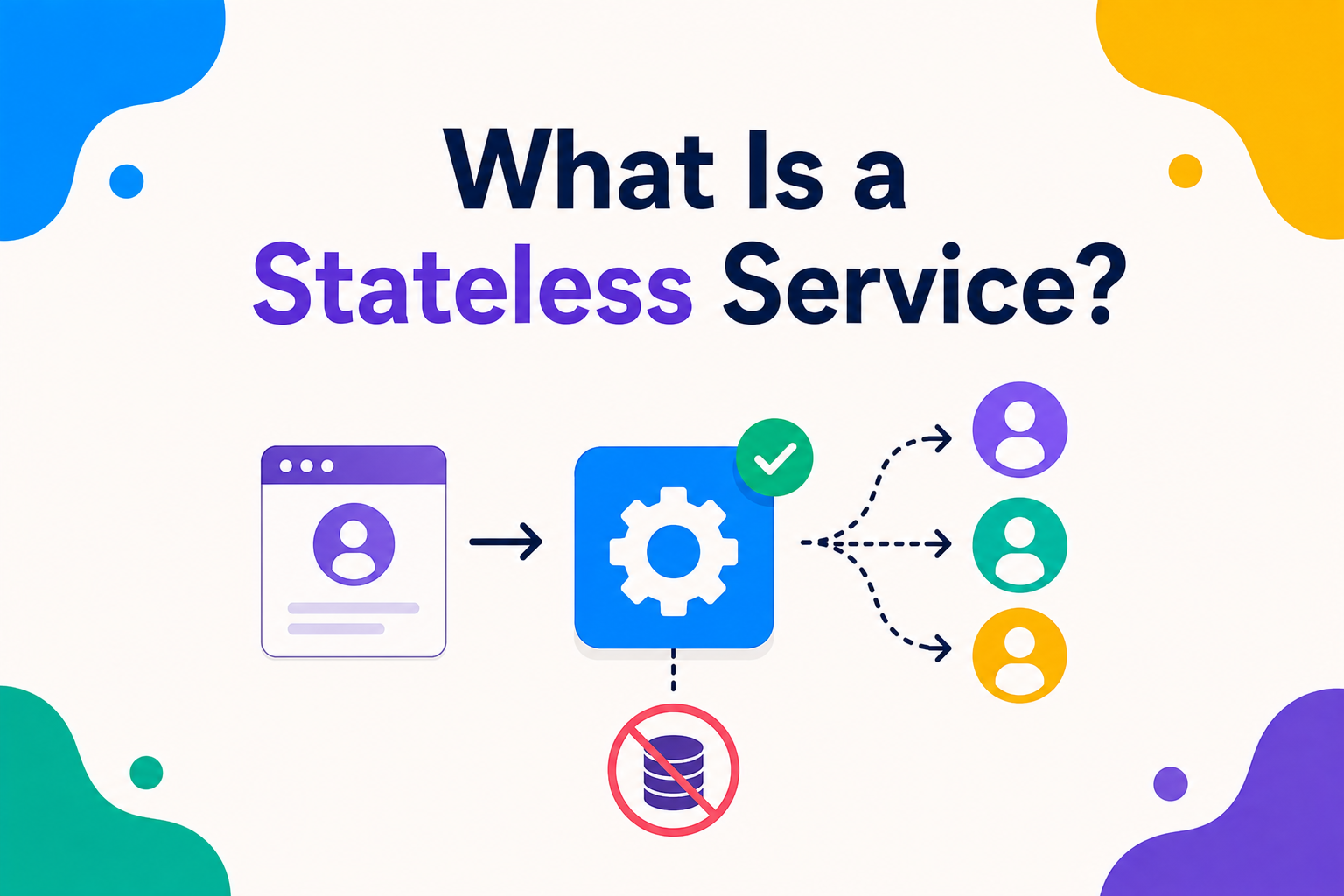
What Is a Stateless Service?
Some services remember you the moment you walk back in. Others greet every single visit as if it is the very first time, no memory of you at all — and yet that “forgetfulness” turns out to be one of the most powerful design choices in modern software. This complete guide is about that second kind of service, how it works, and why architects lean on it so heavily.
The Big Idea, in One Breath
A stateless service is the software equivalent of a friendly ticket‑taker at a fair: every request is judged entirely on its own, with nothing carried over from the last person in line.
Picture two very different helpers at a fair. The first is a friendly ticket‑taker at a carnival ride: every single person who walks up hands over a ticket, gets waved through, and that is the entire interaction. The ticket‑taker does not know your name, does not remember that you rode the same ride ten minutes ago, and does not care. Each ticket is judged entirely on its own — is it valid, yes or no — with nothing carried over from the last person in line.
The second helper is a librarian at the front desk who has known you for years. She remembers which books you borrowed last month, knows you are partway through a mystery series, and picks up every conversation exactly where the last one left off. She is keeping a running memory of you, specifically, across many separate visits.
Software services work the same way. Some services behave like the ticket‑taker: every request stands completely alone, carrying everything it needs within itself, with nothing remembered from before. These are called stateless services. Others behave like the librarian, quietly holding onto memory about you between visits — these are called stateful services, and they are worth understanding too, mostly by contrast.
This one idea — remembering nothing versus remembering everything — turns out to shape enormous decisions in how big websites, apps, and online systems are actually built behind the scenes, often in ways nobody using them ever notices.
Think about a vending machine. You put in your money, press a button, and out comes your snack. The machine does not remember what you bought yesterday, does not know your name, and treats every single purchase as a brand new, self‑contained event. That is exactly the spirit of a stateless service — no memory required, no history needed, just this one request, answered completely on its own.
Keep that vending machine picture in mind as you read on, because nearly every advantage, trade‑off, and design decision in this guide traces back to that same simple idea: a service that remembers nothing between requests behaves very differently — often much more simply — than one that does.
It is worth noticing, too, that most of the digital world you interact with every day is a careful blend of both kinds of behaviour. The moment you check your email, browse a store, or scroll through a feed, you are almost certainly bouncing between stateless building blocks and small pockets of genuine memory, woven together so smoothly that the seams are invisible. Understanding where each one is used, and why, is really what this whole guide is about.
A Short History of Statelessness
The idea is baked into one of the oldest pieces of internet plumbing still running: the HTTP protocol itself. What began as a practical choice in the early 1990s turned out to be quietly world‑changing decades later.
The idea of a stateless service is not a brand‑new invention — it is actually baked into one of the oldest and most successful pieces of internet plumbing still running today: the HTTP protocol, the very system your web browser uses to fetch every page you visit.
When the web was first designed in the early 1990s, its creators made a deliberate choice: every request a browser sends to a server would be treated as a completely fresh, independent event, with no built‑in memory of any request that came before it. At the time, this was mostly a practical decision — it kept early web servers simple and let them handle many visitors without needing to track who was who.
That decision turned out to be remarkably far‑sighted. As the web exploded in popularity through the 1990s and 2000s, that same statelessness became one of the biggest reasons the web could scale to billions of users at all. Because no server needed to remember any particular visitor, any server in a large group could answer any request, and new servers could be added to handle more traffic without any complicated handoff of memory between them.
Of course, people quickly wanted websites that could remember them — a shopping cart that did not forget its contents, a login that did not ask for a password on every single click. Engineers solved this by layering a little bit of memory back on top of a fundamentally stateless system, using tools like cookies and, later, tokens — approaches we will explore properly later in this guide. The underlying protocol stayed stateless; the “memory” was cleverly bolted on around it rather than built into its foundations.
The web itself was built stateless from day one. Almost everything that feels like it “remembers you” online is actually a clever trick layered carefully on top of that forgetful foundation.
Interestingly, the rise of mobile apps and cloud computing in the 2010s pushed statelessness even further, rather than away from it. As companies started running their software across enormous, constantly changing fleets of servers — some spinning up for a busy afternoon, others shutting down overnight — the old approach of keeping memory tucked inside any one particular machine became increasingly impractical. Statelessness, once mostly a quirk of how the web happened to be built, became a deliberate, celebrated architectural choice in its own right.
What a Stateless Service Really Is
A stateless service treats every incoming request as a brand new, self‑contained event, with no memory of anything that happened in any previous request. That single property is the quiet engine behind almost every benefit stateless design offers.
A stateless service is one that treats every incoming request as a brand new, self‑contained event, with no memory of anything that happened in any previous request. Nothing about a past interaction is stored on the server between one call and the next. Whatever information is needed to handle the request has to travel along with the request itself, or be looked up fresh from somewhere external.
This matters because of a subtle but powerful consequence: if a server holds no memory of you at all, then it genuinely does not matter which server answers your request. Any available machine in a whole fleet of identical servers can handle it equally well, because none of them needs to have “met you before.” That single property — interchangeability — is the quiet engine behind almost every benefit stateless design offers.
It is worth being precise about what statelessness is not. It does not mean a system cannot use a database, or cannot remember anything anywhere at all — plenty of stateless services read and write from databases constantly. What it means is that the service handling the request itself does not keep that memory sitting inside it, waiting for the same visitor to come back. Any long‑term memory lives somewhere external and shared, not tucked away inside one particular server.
If someone says “our API is stateless,” they mean this: you could send the exact same request to any one of a hundred identical copies of that service, on any given day, and get exactly the same answer every time.
Two ideas are worth carrying with you through the rest of this guide, because they explain almost every decision an engineering team makes about statelessness:
- Forgetting is a feature, not a flaw. A stateless service is not broken or incomplete — its lack of memory is a deliberate design choice that buys real advantages elsewhere.
- The client carries the context. Since the server will not remember, whoever is making the request has to include everything the server needs to know, every single time.
It is also worth noting that “stateless” describes the service itself, not the overall system it belongs to. A large application is almost always a mixture — some pieces stateless, some genuinely stateful — and calling the whole application “stateless” or “stateful” as a single label often oversimplifies what is really a layered, thoughtful mix of both approaches working together.
What “State” Actually Means
In software, state simply means any piece of information that describes the current condition of something — and that might need to be remembered for later use.
Before going any further, it helps to nail down exactly what “state” refers to, since the word gets thrown around loosely. In software, state simply means any piece of information that describes the current condition of something, and that might need to be remembered for later use.
Are you logged in?
Whether a particular visitor is currently signed in, and which account they are signed in as.
What’s in the cart?
The items a shopper has added, a form half‑filled‑in, or a game currently in progress.
Is the line still open?
Details about an ongoing network connection itself, like which encryption keys are currently in use.
What’s saved for good?
Long‑term data like a user’s saved address, order history, or account settings, stored in a database.
A stateless service specifically avoids holding onto the first three kinds of state itself, between one request and the next. The fourth kind — persistent, long‑term data — is usually still very much present, just tucked safely away in a shared database or storage system that any server can reach, rather than memorised by any single one of them.
Imagine a coat check at a theatre. The person taking your coat that night does not need to remember your face from last week’s show — but the coat itself (your “data”) is still safely stored on a rack, tagged with a numbered ticket you are holding. Anyone working the coat check tonight can hand your coat back, as long as you bring the ticket. The memory lives on the rack, not in any one worker’s head.
It helps to notice that these four kinds of state are not equally troublesome. Persistent state is the easiest to handle well, because databases have been purpose‑built for decades to store and share exactly this kind of long‑lived information safely across many machines. Session and connection state are the trickier ones, precisely because they tend to accumulate quietly, in small amounts, inside whichever server happens to be handling things at any given moment — which is exactly the kind of state a stateless design works hardest to avoid.

How It Actually Works
A stateless request‑response cycle follows a simple rhythm: the client sends everything the server needs in one message, the server acts on it, sends back a response, and then forgets the whole exchange ever happened.
In practice, a stateless request‑response cycle follows a fairly simple rhythm. A client — a web browser, a mobile app, another service — sends a request that includes absolutely everything the server needs to understand and act on it: who is asking, what they want, and any relevant details. The server processes that request using only what arrived in that single message, sends back a response, and then, crucially, forgets the whole exchange ever happened.
So how does a stateless service know who you are, if it insists on forgetting everything? The trick is that the client does the remembering instead, and simply resends the necessary proof with every single request. The most common tool for this is a token — a small, tamper‑resistant packet of information, often something called a JWT (JSON Web Token), that a server hands out once, after you log in, and that your browser or app then attaches to every future request as quiet proof of who you are.
The server does not need to look you up in some internal memory when that token arrives — it can simply check that the token is valid and has not been tampered with, read the details baked directly into it, and act accordingly. That single check replaces an entire remembered conversation.
A cookie storing a session ID and a token like a JWT solve a similar problem in very different ways — a session ID points back to memory stored on the server, while a token carries its own memory along with it, letting the server stay genuinely stateless.
There is a neat side effect of this design worth appreciating: because every request is self‑describing, it becomes far easier to inspect, log, and replay individual requests when something goes wrong. An engineer investigating a bug can often take one troublesome request, run it again in a test environment, and see exactly the same behaviour — something that is much harder to achieve when a request’s outcome secretly depends on invisible memory sitting inside a specific, possibly long‑gone server.
Cookies, Sessions, and Tokens
Real applications need to feel personal, so engineers have built a handful of different tools over the years for reintroducing a bit of memory without abandoning statelessness entirely.
Since real applications so often need to feel personal, engineers have built a handful of different tools over the years for reintroducing a bit of memory without abandoning the benefits of statelessness entirely. Knowing the difference between them clears up a lot of confusion.
Memory stays on the server
The server keeps a small record about you, and hands your browser only a simple ID pointing back to it — genuinely stateful under the hood.
A little note in your browser
A small piece of data your browser stores and automatically resends with future requests — often just carrying a session ID.
The memory travels with you
A signed packet containing your identity and permissions directly, letting the server verify it instantly without looking anything up.
Saved on your own device
Data kept entirely on the client’s device, never touching the server’s memory at all until it is explicitly sent along.
Server sessions and tokens solve a very similar problem in almost opposite ways. A server session keeps the actual memory close to the server, and simply asks the browser to remember a claim ticket for it — which quietly reintroduces the very server‑side memory that statelessness tries to avoid, and can tie a visitor to one particular server unless that memory is carefully shared. A token, on the other hand, keeps the memory with the client and lets any server verify it independently, preserving true statelessness on the server’s side.
A server session is like leaving your suitcase with a hotel bellhop and getting a numbered claim tag — you need to find that same hotel, and often that same storage room, to get it back. A token is more like carrying a sealed, signed letter of introduction in your own pocket — any hotel in the city can read it and know exactly who you are and what you are entitled to, without ever having met you before.
Most large‑scale systems today lean toward tokens specifically because they preserve genuine statelessness across a whole fleet of servers, while smaller systems with just one or two servers sometimes still use simple server sessions quite happily, since the scaling problems tokens solve simply have not shown up yet at that size.
It is worth noting that these approaches are not mutually exclusive within one larger system either. Some applications use a lightweight cookie purely to identify a returning visitor for analytics purposes, while relying entirely on tokens for anything security‑sensitive. Understanding which tool is doing which job — rather than treating “session,” “cookie,” and “token” as interchangeable buzzwords — makes a real difference when diagnosing a tricky bug or planning how a system should scale.
Stateless vs. Stateful Services
Seeing a stateless service standing right next to its counterpart — a stateful service that does hold onto memory of past interactions — is the fastest way to make the distinction stick.
To really understand a stateless service, it helps to see it standing right next to its counterpart: a stateful service, which does hold onto memory of past interactions, usually for as long as a session lasts.
| Question | Stateless Service | Stateful Service |
|---|---|---|
| Remembers past requests? | No — each one stands alone | Yes — session data is kept |
| Which server can answer? | Any available one | Often the same specific one |
| Scaling new copies | Simple — copies are interchangeable | Trickier — memory must sync or transfer |
| Failure recovery | Easy — retry on any server | Harder — session data may be lost |
| Typical examples | REST APIs, CDNs, serverless functions | Online banking, chat apps, live games |
Neither approach is universally “better” — plenty of excellent systems are stateful on purpose, because remembering things is genuinely the whole point of what they do. A live multiplayer game has to remember exactly where every player currently stands; there is no meaningful way to make that stateless. The real skill lies in recognising which parts of a system actually need memory, and keeping everything else as blissfully forgetful as possible.
Stateless does not mean “the system has no data anywhere.” It means the individual service handling your request does not personally remember you between calls — the data, if any exists, lives somewhere shared and external instead.
It is also worth remembering that this is not a permanent label carved in stone. A service built statefully today can often be redesigned to be stateless later, once the pain of scaling it becomes obvious — and plenty of stateless services quietly grow a small stateful component over time, as new features demand a bit of genuine memory. The boundary between the two is a design decision revisited over a system’s lifetime, not a one‑time verdict handed down at launch.
How to Spot a Stateless Service
Good stateless design still feels personal and seamless to the person using it, so a few tell‑tale signs help clear up the confusion from the outside.
Sometimes it is genuinely tricky to tell from the outside whether a service is stateless or not, since good stateless design can still feel personal and seamless to the person using it. A few tell‑tale signs help clear up the confusion.
Same input, same output
Send the exact same request twice, days apart, and get an identical result both times — nothing was “remembered” in between.
Doesn’t matter which one answers
The request works identically no matter which copy of the service, out of many, happens to pick it up.
Everything travels together
Requests tend to carry tokens, IDs, or full details rather than relying on a server to already “know” the answer.
Crashes barely matter
If one instance of the service restarts or crashes, nothing important is lost — nothing important was stored there to begin with.
A useful test engineers sometimes run mentally: imagine wiping every running copy of a service and replacing them all with brand new, freshly started ones, mid‑afternoon, without warning anyone. If the system keeps working normally and nobody notices a thing, that is a very strong sign the service was genuinely stateless.
A service can look stateful to a user — remembering their cart, their login, their preferences — while still being built statelessly underneath, simply by storing all of that in a shared database or a token rather than inside the service itself.
It is also worth watching how a system behaves during deployments. Teams shipping updates to a genuinely stateless service can typically replace old copies with new ones gradually, a few at a time, without any visible disruption. If updating a service requires careful, synchronised coordination to avoid losing anything, that is usually a clear sign real state is quietly involved somewhere in the process.

Where Stateless Services Actually Show Up
Statelessness is not a rare, academic idea — it is quietly running enormous portions of the internet every single second, from REST APIs to CDNs to serverless functions to payment processors.
Statelessness is not a rare, academic idea — it is quietly running enormous portions of the internet every single second. Here are some of the places it earns its keep.
The classic case
A well‑designed REST API is built so that each call carries everything the server needs, letting any server in a cluster answer any request.
Serving the same file, everywhere
Content delivery networks hand out static files — images, videos, scripts — from whichever nearby server is available, with no memory needed at all.
Built fresh, every call
Serverless platforms spin up a brand new, empty environment for each event, run the code, and discard everything afterward.
Small, interchangeable workers
Many microservices are deliberately kept stateless so any number of identical copies can be started or stopped as demand changes.
Load balancers — the traffic directors that decide which server handles which incoming request — also love statelessness for a very practical reason: when every server is interchangeable, a load balancer can spread traffic around freely, sending each new request wherever there is spare capacity, without needing to track “who talked to whom” before.
Search engines are another good example. When you type a question into a search box, the server answering you does not need to remember your previous search from ten minutes ago to give you a correct result right now — the query itself carries everything needed to produce an answer, which is exactly why search boxes feel instant and consistent no matter how many people are searching at once.
Payment processing is a quieter but especially telling example. When you tap your card or click “pay now,” the request that travels to the payment processor typically includes everything needed to complete that one transaction — the amount, the merchant, a token representing your card — rather than depending on the processor remembering anything about your last purchase. This matters enormously for reliability: a payment system genuinely cannot afford to lose track of a transaction because one particular server happened to be the one holding onto it.
Stateless Authorization, a Closer Look
Checking what a logged‑in visitor is allowed to do is a place where statelessness proves especially valuable — letting any server, anywhere, decide instantly whether to allow or deny an action.
One place statelessness proves especially valuable is in checking what a logged‑in visitor is allowed to do — a job called authorization, distinct from authentication, which simply confirms who somebody is in the first place.
Traditionally, working out someone’s permissions meant a server had to look them up, fetch their role and access rules from a database, and check the rules against whatever they were trying to do — real work, every single time, for every single request. A stateless approach flips that around: instead of the server fetching the answer, the client presents a signed token that already contains the relevant permissions, baked in at the moment it was issued.
Sign in once
A person logs in, and a central authority checks their identity and hands back a signed token describing who they are and what they are allowed to do.
Attach the token
Every future request includes that same token, riding along quietly in the background of each call.
Check, don’t fetch
The service receiving the request simply verifies the token’s signature and reads the permissions already written inside it — no database lookup required.
Allow or deny
Based purely on what is inside that one token, the service decides instantly whether to proceed or refuse.
This approach removes an entire category of slow, repeated lookups, and it means the authorization check itself can be handled by any server, anywhere, without needing to be near a shared memory of who is logged in. The trade‑off is that tokens need careful handling — they must be signed so they cannot be faked, sent only over secure connections, and given a sensible expiry time so a stolen token does not stay useful forever.
Stateless does not mean insecure by nature — but a stolen or poorly protected token can be just as dangerous as a stolen password, since it is effectively proof of identity that any server will accept at face value.
There is a subtler benefit worth mentioning too: stateless authorization checks are genuinely fast, because they skip a database round‑trip entirely. For a system checking permissions thousands of times a second — every button click, every page load, every background action — that saved lookup adds up to a meaningfully snappier experience for everyone using the system, without anyone needing to know why.
Real Systems, Real Choices
It helps to see statelessness playing out in systems people actually use daily, rather than staying purely theoretical.
It helps to see statelessness playing out in systems people actually use daily, rather than staying purely theoretical.
Modern web applications built around REST or GraphQL APIs are, more often than not, deliberately stateless at the API layer, precisely because the companies running them expect enormous, unpredictable swings in traffic. A retailer expecting a calm Tuesday and a chaotic Black Friday needs to add and remove server copies constantly — something statelessness makes almost trivially easy, since a brand new server can start answering requests correctly the very moment it boots up, with zero setup or handoff needed.
Streaming platforms delivering video or music to millions of people rely heavily on stateless content delivery — the actual video files are handed out by interchangeable servers scattered around the world, with no memory required about who is watching what. The parts of those same platforms that do need memory — your watch history, your subscription status — are usually handled by a separate, carefully managed stateful layer sitting behind the scenes.
Even artificial intelligence systems, including large language models, operate statelessly at their core during a single response: the model itself does not change or “remember” anything between one request and the next. What feels like an ongoing, remembered conversation is actually the previous messages being resent, in full, with every new request — a clever illusion of memory built entirely out of statelessness.
A system that feels deeply personal and memory‑rich to its users can still be built almost entirely out of stateless pieces underneath — the “memory” often lives in a shared database or a token, not inside any one server.
It is worth noting how differently this plays out across company sizes too. A small startup with a single server sometimes does not need to think hard about statelessness at all, since there is only one machine anyway and nothing to keep in sync. The real payoff shows up specifically once a company needs more than one server — which, for anything genuinely popular, tends to arrive sooner than most founders originally expect.
The Advantages of Statelessness
Statelessness has become such a dominant pattern in modern system design for genuinely good reasons — effortless scaling, easier testing, natural resilience, and a simpler mental model all in one package.
Statelessness has become such a dominant pattern in modern system design for genuinely good reasons.
What It’s Great At
- Scales beautifully — new identical copies can join or leave anytime
- Any available server can handle any request, simplifying load balancing
- Easier to test — the same input always produces the same output
- Simpler to debug — no hidden server memory to account for
- Naturally resilient — a crashed instance costs nothing important
Why Teams Still Choose It
- Lowers the operational burden of syncing memory across machines
- Plays nicely with modern tools like containers and serverless platforms
- Reduces the blast radius when something goes wrong
- Makes horizontal scaling close to effortless
- Keeps services simple enough for new engineers to reason about quickly
That last point deserves a moment of attention. A stateless service is, almost by definition, easier for a human brain to hold in its head — there is no invisible memory to track down, no question of “what did this server already know before this request arrived.” Every request is judged purely on its own contents, which is a wonderfully simple mental model to build software around.
There is also an underrated advantage around team collaboration. When services are stateless, different engineers, or even entirely different teams, can work on separate pieces of a system with far less fear of accidentally interfering with hidden memory someone else was relying on. Each piece can be reasoned about, tested, and deployed largely on its own — a genuine gift to any organisation trying to move quickly without constantly stepping on its own toes.
The Trade‑offs and Limits
Statelessness is not free of downsides, and pretending otherwise does a disservice to anyone actually trying to design real systems.
Statelessness is not free of downsides, and pretending otherwise does a disservice to anyone actually trying to design real systems.
The Honest Downsides
- Every request must carry more information, which can add network overhead
- Some genuinely stateful problems — live games, chat — resist forcing into a stateless shape
- Tokens and payloads need careful security handling
- Complex, multi‑step workflows can be awkward to express statelessly
- Repeated data lookups can shift load onto a shared database instead
Hidden Costs to Watch For
- A shared database that everything relies on can itself become a bottleneck
- Larger request payloads mean more data travelling the network each time
- Poorly designed tokens can leak more information than intended
- Teams sometimes force awkward statelessness onto naturally stateful problems
Going stateless does not make memory disappear — it just moves that memory somewhere else, usually to a shared database, cache, or the token itself. That memory still needs to be designed, secured, and looked after carefully.
It is also worth being honest that not every problem wants to be stateless. Multiplayer games, live collaborative document editors, and financial trading systems often genuinely benefit from a server holding tightly onto fast, in‑memory state, because the alternative — constantly re‑fetching everything from a shared store — would simply be too slow for what they need to do.
There is a useful way to frame this trade‑off: statelessness moves complexity rather than eliminating it. The complexity of remembering things does not vanish — it relocates from “many individual servers, each holding a little memory” to “one well‑designed shared system, holding all of it carefully.” That relocation is usually a very good trade, but it is still a real engineering job that needs proper attention, not a problem that simply disappears because a service was labelled stateless.
Statelessness in the Cloud
Cloud computing and statelessness grew up together, almost hand in hand — from disposable containers to serverless functions to auto‑scaling, the modern cloud practically assumes stateless design.
Cloud computing and statelessness grew up together, almost hand in hand, and it is easy to see why once you look at how cloud platforms actually operate.
Containers — the lightweight, portable packages that modern applications are often shipped in — were originally designed with statelessness very much in mind. A container is meant to be disposable: started, used, and thrown away without ceremony, replaced instantly by an identical twin if something goes wrong. That philosophy only really works smoothly when the container itself is not the only place holding onto anything important.
Serverless computing takes this even further. A serverless function typically starts completely fresh for every single triggering event, runs its code, and then vanishes entirely — there is no persistent server sitting around between calls at all. This model is only practical because the function is expected to be stateless; anything it needs to remember has to be fetched from, or written to, external storage every time.
Think of serverless functions like disposable cups at a water cooler. Nobody expects the same cup to be reused, refilled, or remembered — you grab a fresh one, use it, and it is gone. The water cooler itself (a shared database or storage system) is what actually holds anything worth keeping.
Kubernetes, a popular tool for managing large fleets of containers, reflects this split directly in its design: ordinary, interchangeable containers are the default and the easy path, while genuinely stateful workloads get a special, more careful treatment called a StatefulSet, precisely because they need extra care that stateless workloads simply do not.
Auto‑scaling — a cloud feature that automatically adds or removes servers based on how busy a system currently is — depends almost entirely on statelessness to work smoothly. If servers held onto private memory, suddenly removing one during a quiet period could quietly throw away something important. Because stateless servers hold nothing irreplaceable, auto‑scaling can add and remove capacity aggressively, confident that nothing valuable is ever lost in the process.
The Cost and Performance Picture
Whether statelessness actually saves money depends on where you are looking. It is worth separating the different kinds of cost involved rather than assuming it is simply “cheaper” in every respect.
Whether statelessness actually saves money depends on where you are looking, and it is worth separating the different kinds of cost involved rather than assuming it is simply “cheaper” in every respect.
On the server side, statelessness is usually a clear win. Because any server can handle any request, teams can run exactly as many copies as current traffic needs, adding more during a busy afternoon and removing them again once things calm down, without ever paying for idle machines sitting around “just in case” a particular visitor comes back. That flexibility translates directly into real savings on infrastructure bills.
| Cost Area | Stateless Approach | Stateful Approach |
|---|---|---|
| Server scaling | Cheap and flexible — add or remove freely | More rigid — tied to specific memory |
| Network traffic | Slightly higher — full context each request | Lower per request — server already knows |
| Database load | Can rise — more frequent lookups | Often lower — data stays cached locally |
| Operational effort | Lower — simpler to manage | Higher — needs sync and replication care |
On the network side, the picture is a little more mixed. Since every stateless request has to carry its own full context, individual messages can be somewhat larger than their stateful equivalents, where a server might already have most of what it needs sitting in memory. For most applications this difference is small and easily worth the trade, but for very high‑frequency, latency‑sensitive systems, it is a real cost worth measuring rather than assuming away.
There is also a cost that is easy to overlook: the shared database or cache that a stateless fleet leans on has to handle a steady stream of lookups that a purely stateful design might have avoided by keeping answers cached locally. A well‑designed system usually balances this with its own caching layer, positioned carefully so it does not quietly reintroduce the hidden‑state problem covered next.
Statelessness tends to trade a small amount of extra network chatter for a large amount of scaling flexibility — usually a very good deal, but worth confirming for systems where every millisecond truly matters.
One more cost worth naming honestly is the human learning curve. Engineers new to stateless design sometimes instinctively reach for a quick local variable out of habit, the same way someone used to a landline might forget a mobile phone does not need to stay near the wall. That habit fades with experience, but it is a real, if temporary, cost that teams adopting stateless patterns for the first time should plan for, rather than be surprised by.

The Hidden State Problem
A system can claim to be stateless while secretly depending on hidden memory somewhere — a well‑meaning local cache, a sticky session, a temporary file — that quietly undoes most of the benefits statelessness was supposed to provide.
Here is a tricky truth that catches many teams off guard: a system can claim to be stateless while secretly still depending on hidden memory somewhere, quietly undoing many of the benefits statelessness was supposed to provide.
The most common culprit is a local, in‑memory cache — a well‑meaning shortcut where a server saves a bit of recently used data in its own memory to answer faster next time, without realising that this quietly ties future requests to that one specific server. If a load balancer sends a related request to a different, identical‑looking server, that cache simply is not there, and something subtly breaks.
Sticky sessions are another sneaky example: a system might claim to be a stateless, load‑balanced cluster, but if it secretly needs the same visitor to always land on the same server to work correctly, it is not really stateless at all — it is a stateful system wearing a stateless costume. Spotting and removing this kind of hidden state is one of the more subtle but important skills in building genuinely scalable systems.
A good test of true statelessness: randomly kill any running copy of a service, mid‑traffic, without warning. If anything breaks or any data is lost, some hidden state was almost certainly hiding somewhere.
File uploads are a surprisingly common source of this problem. A service that temporarily saves an uploaded file to its own local disk while processing it — rather than immediately handing it off to shared storage — has quietly created hidden state, even if every other part of the service looks perfectly stateless. If that particular server disappears mid‑upload, the file goes with it, and the illusion of statelessness breaks at exactly the wrong moment.
Background jobs and scheduled tasks can hide similar traps. A service that kicks off a long‑running task and keeps tracking its progress purely in its own memory has quietly become the one place that task’s status lives — if that service restarts partway through, the task’s progress, or even knowledge that it was ever running at all, can simply vanish. Moving that tracking into a shared job queue or database, rather than a local variable, closes this gap cleanly.
Choosing the Right Path
Deciding whether a service should be stateless or stateful is not about picking a fashionable trend — it is about being honest about what the problem actually needs.
Deciding whether a service should be stateless or stateful is not about picking a fashionable trend — it is about being honest with what the problem actually needs.
Spiky, unpredictable
Systems expecting sudden bursts of traffic benefit enormously from statelessness, since new capacity can be added instantly.
Extremely fast, continuous
Live games, trading systems, and collaborative tools often need tightly‑held, fast local state to keep up.
Small teams lean stateless
Fewer engineers benefit from the simpler mental model and lower operational overhead statelessness offers.
Must never disagree
Systems where different servers absolutely cannot give conflicting answers may need careful, deliberate state management.
In practice, almost every real system ends up a thoughtful mixture: a mostly stateless outer layer — the API, the web servers, the authorization checks — wrapped around a smaller, carefully managed stateful core, usually a database or a small number of specialised services built specifically to hold memory well.
That guiding sentence captures how most experienced architects actually think about the decision: statelessness is treated as the sensible, low‑risk default, and a genuine, deliberate case has to be made before reaching for a stateful design instead — not the other way around.
A helpful exercise for any team weighing this decision is to ask a simple question about each individual piece of a system: “If I lost this piece’s memory right now, would anything genuinely break, or would the answer just be recomputed or refetched?” Pieces where the honest answer is “nothing would really break” are strong stateless candidates. Pieces where the answer is “yes, something precious would be gone forever” deserve the extra care that a deliberately stateful design provides.
A Worked Example, Start to Finish
Ideas like this are easiest to remember through a story, so imagine a small app called Trailmark, which lets hikers log the trails they have completed.
Ideas like this are easiest to remember through a story, so imagine a small app called Trailmark, which lets hikers log the trails they have completed. Here is how a stateless design might actually come together for it.
You log in
Trailmark checks your password once, then hands your phone a signed token describing who you are.
You log a hike
Your phone sends a request with the token attached, along with the trail name and distance — everything needed in one message.
Any server answers
Whichever Trailmark server happens to be free picks up the request, checks the token, saves the hike to a shared database, and replies.
A busy Saturday hits
Thousands of hikers log trails at once. Trailmark simply starts more identical servers, and each new one works correctly immediately, with zero setup.
One server crashes
A server hiccups and restarts mid‑afternoon. Nobody notices — no hiker’s data lived inside that one server to begin with.
Notice what never happened anywhere in that story: nobody had to figure out which specific server “remembered” a particular hiker, nobody lost data when a server restarted, and scaling up for a busy weekend required no special coordination at all. That calm, uneventful simplicity is exactly what good stateless design is meant to deliver.
The best stateless story is usually a boring one — servers come and go, traffic rises and falls, and nothing about the experience for the person using the app ever changes.
It is worth imagining, briefly, how differently this same story could have gone with a stateful design. If each Trailmark server remembered its own hikers locally, a busy Saturday would mean carefully directing each hiker back to “their” specific server every time, and a crash would mean lost hikes for whoever happened to be using that particular machine. None of that drama shows up in the stateless version — which is exactly the quiet, unglamorous payoff this whole approach is built to deliver.
Common Pitfalls
A handful of specific mistakes come up again and again when teams first adopt stateless design. Each one is worth naming plainly, so it can be spotted early — ideally before it causes a confusing production incident.
Sneaking in Local Memory
Adding a quick in‑memory cache “just to speed things up” is one of the easiest ways to accidentally turn a stateless service into a hidden stateful one, without anyone realising it happened.
Forcing Statelessness Onto the Wrong Problem
Some interactions — a live multiplayer match, a real‑time collaborative whiteboard — genuinely need fast, shared memory, and awkwardly forcing them into a stateless shape can create more complexity than it removes.

Oversized Tokens
Cramming too much information into a token to avoid a database lookup can bloat every single request, slow the network down, and accidentally expose more data than intended.
Ignoring Token Expiry and Revocation
A token that never expires, or cannot be revoked if stolen, quietly undermines the whole security model stateless authorization is supposed to provide.
Forgetting the Shared Store Still Needs Care
Moving memory out of individual servers and into a shared database does not make that database’s performance or reliability any less important — it just moves the responsibility somewhere new.
Assuming Statelessness Automatically Means Simplicity
Statelessness genuinely simplifies scaling, but it can quietly push complexity into request payloads, token design, and the shared data layer — complexity that still needs someone’s careful attention, just in a different place.
A team that proudly calls their system “stateless” without ever actually testing what happens when a server is killed mid‑request. Confidence without a real test is exactly how hidden state slips through unnoticed.
Best Practices for Building Stateless Services
Good stateless design tends to follow a handful of consistent habits, regardless of the specific technology involved.
Good stateless design tends to follow a handful of consistent habits, regardless of the specific technology involved.
- Send everything the request needs. Do not rely on a server “already knowing” something from before — include it explicitly.
- Push memory outward, deliberately. Store anything that must be remembered in a shared database, cache, or token — never inside one server’s private memory.
- Test by killing servers. Regularly and safely restart or replace running instances to confirm nothing important is quietly lost.
- Keep tokens lean and short‑lived. Include only what is needed, sign them properly, and set sensible expiry times.
- Watch the shared store’s health. A stateless fleet of servers is only as reliable as the shared database or cache they all depend on.
- Be honest about what truly needs memory. Do not force a fast‑moving, tightly coupled interaction into a stateless shape just for the sake of consistency.
- Document where memory actually lives. Make it obvious to every engineer which database, cache, or token holds which piece of information, so nobody accidentally reinvents local memory.
- Review dependencies on local disk or memory regularly. A quick audit every so often catches quietly creeping hidden state before it becomes a real production problem.
None of these habits require exotic tools or a large team — they are mostly a matter of staying disciplined about a single, simple promise: nothing important should ever live only inside one particular running copy of a service. Teams that hold firmly to that promise tend to enjoy calm, predictable scaling, while teams that quietly let it slip tend to discover the hard way, usually during their busiest and worst possible moment.
Before shipping a new service, ask: “If I doubled the number of running copies of this right now, with no other changes, would it just work?” A confident yes is a great sign of real statelessness.
Questions People Often Ask
A handful of questions about stateless services come up in nearly every conversation on this topic. Here are short, honest answers to the ones that surface most often.
Does stateless mean a system has no database at all?
No. Stateless simply means the individual service handling a request does not privately remember previous ones — a shared database can absolutely still be part of the picture.
Are stateless services always faster than stateful ones?
Not automatically. They are usually easier to scale, but individual requests can sometimes be slightly larger or need extra lookups, so raw speed depends on the specific design.
Can a single application be part stateless and part stateful?
Yes, and this is actually the most common real‑world setup — a stateless outer layer of APIs and web servers, wrapped around a smaller, carefully managed stateful core like a database.
Is a stateless service always more secure?
Not inherently — it shifts the security challenge rather than removing it, since tokens carrying identity and permissions need just as much careful protection as a server‑side session would.
Why do people say HTTP is stateless if websites clearly remember me?
HTTP itself is genuinely stateless — every request is independent at the protocol level. The “memory” you experience comes from cookies or tokens layered carefully on top, not from HTTP itself.
Do small personal projects need to worry about statelessness?
Usually not right away. A tiny personal project with one server rarely needs to think hard about this until it grows enough to need multiple servers working together.
What is the very first thing to check if a “stateless” service is misbehaving after scaling?
Look for local caches, temporary files, or in‑memory variables that quietly assume a request will always land on the same server as before — that is the most common hidden culprit.
Is REST the only way to build a stateless API?
No. REST is simply the most widely known style built around statelessness as a core rule, but other approaches, including some GraphQL and RPC‑style APIs, can also be designed statelessly if their creators choose to.
Key Takeaways
If you remember nothing else from this guide, remember the six ideas below — and the quiet habit of asking, before shipping any service, “would this still work if I doubled the number of running copies right now?”
Remember This
- A stateless service treats every request as brand new, with no memory kept from any previous interaction.
- Because it remembers nothing, any available server can answer any request equally well — a huge boost for scaling.
- The client, not the server, carries whatever context is needed, often through a signed token.
- Statelessness does not erase memory entirely — it moves it into a shared database, cache, or token instead.
- Not every problem wants to be stateless — fast, tightly coupled interactions often genuinely need shared memory.
- Most healthy systems combine a mostly stateless outer layer with a small, carefully managed stateful core.
At its heart, a stateless service is one of those quietly powerful ideas that shows up wherever software needs to stay calm under growth. From the very first web servers of the 1990s to the sprawling serverless platforms of today, the underlying insight has never really changed: keep individual services blissfully forgetful, place memory somewhere shared and well‑protected, and let any server help any visitor at any moment. Systems that respect that discipline tend to be the ones that grow, survive failure, and update themselves gracefully — entirely invisibly to the people relying on them every day.