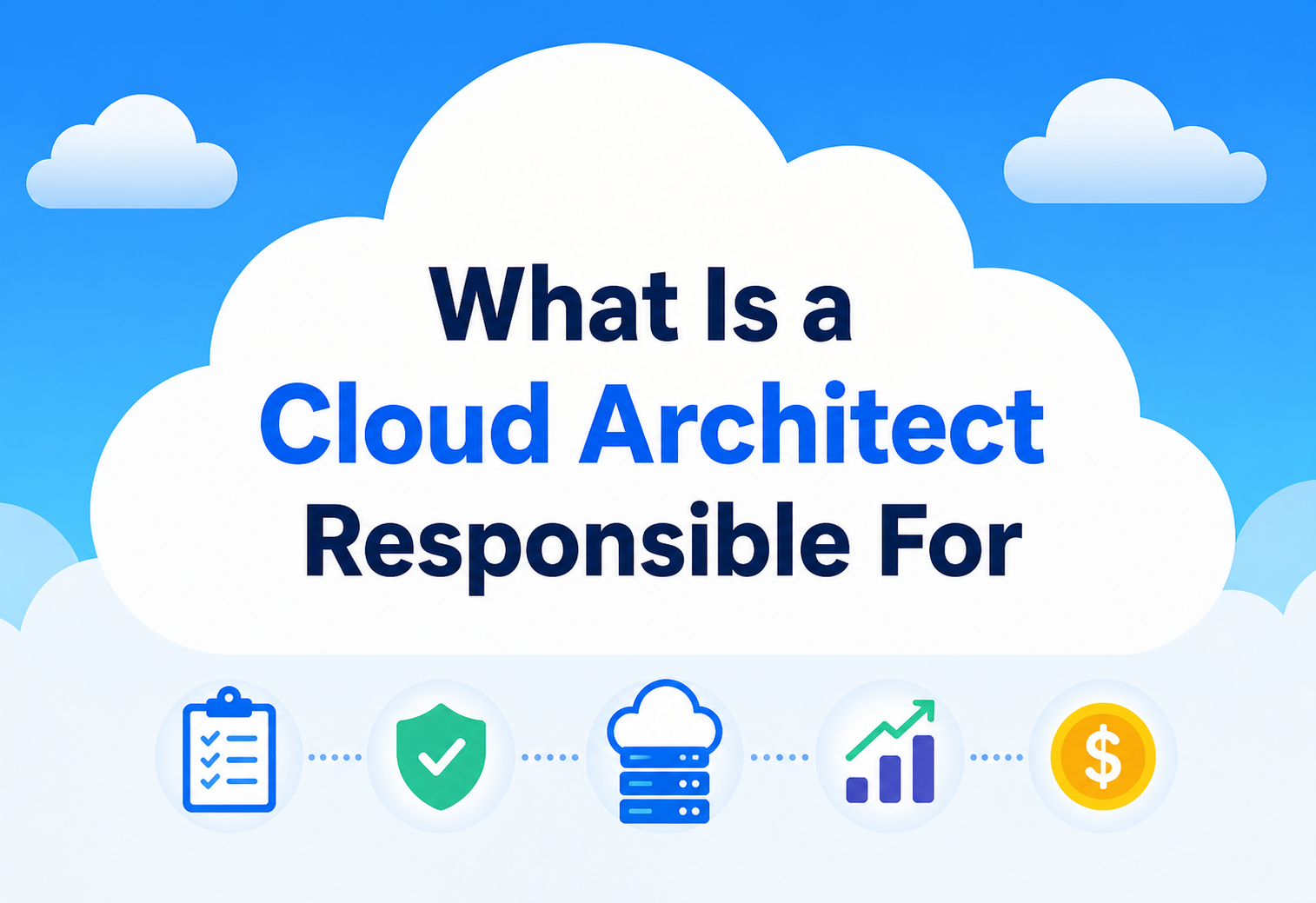
What Is a Cloud Architect Responsible For?
The person who decides which parts of your business run on someone else’s computers, how they connect back to yours, and what it costs to keep the lights on. A working map of the role, its choices, its people, and its day.
The Big Idea, in One Breath
A cloud architect designs how a company’s systems run on infrastructure it does not own — safely, cheaply, and without waking anyone up at 3 AM.
Every serious digital business now runs on infrastructure rented from someone else. The cloud architect is the person who decides which parts run there, how they are wired together, and what the contract with the provider actually protects against.
They do not usually write the application code, and they do not spend their days clicking around a console. They design the shape of the cloud footprint — regions, networks, accounts, guardrails, cost model, exit plan — and then hold the line while the delivery teams build inside it.
Think of a fully-serviced office tower. You could buy the building, hire the security staff, run the generator, replace the elevators. Or you could sign a lease, pay per square foot, and let the landlord run everything from the boilers to the badge readers. Cloud is the second option. The cloud architect is the person who reads the lease line by line, decides which floors your business needs, wires them into the rest of your operations, and remembers what happens on the day you decide to move out.
Some things are cheaper to rent than to own. Some things you never want to rent. The whole job is knowing which is which for your particular business.
What a Cloud Architect Really Is
Not a systems administrator. Not a DevOps engineer. A senior designer whose product is the shape of the cloud footprint.
Confusion starts because a lot of people touch the cloud console every day, and their titles overlap. Sorting them out is the fastest way to see what the architect actually owns.
Systems / SRE Engineer
Keeps things running: on-call, incidents, patching, capacity. Vertical scope, one platform deep.
Cloud / DevOps Engineer
Builds the pipelines, the Terraform, the deployments. Hands-on, day-to-day.
Cloud Architect
Designs the shape: which providers, which regions, which services, which accounts, which guardrails. Sets the frame the engineers work inside.
FinOps / Cost Analyst
Watches the bill. Partners with the architect on the design decisions that decide the bill’s shape.
In a small company one person covers all four hats. In a large one they separate cleanly, and the architect is the one setting reference architectures, standards and non-negotiables that let dozens of teams move in the same direction without stepping on each other.
Engineers make the cloud do the thing. Architects decide which thing, in which shape, and at what cost.
The Core Responsibilities
Six things stay on the cloud architect’s desk no matter what team they sit in.
Job descriptions vary, but the same six responsibilities show up in almost every cloud-architect role that is actually working.
Choose the deployment shape
Public, private, hybrid, multi-cloud. Which providers, which regions, which availability zones. Where each workload actually lives.
Design the landing zone
Account structure, network topology, identity, base policies. The neutral foundation every team ships on top of.
Pick the right services
Managed database or self-run? Kubernetes, serverless, or plain VMs? Load-balancer flavour. Queue technology. Every choice has knock-on effects.
Design for reliability and cost
SLAs, redundancy, disaster recovery, autoscaling. And the cost curve those choices produce.
Set the guardrails
What all teams must do. What they may never do. Encoded in policy, not just in slides.
Explain it, defend it, evolve it
Onboard new teams. Say no to shortcuts that break the shape. Migrate the design forward as the cloud, and the business, both change.
Notice what is not on the list. Writing the CloudFormation stack for one microservice, tuning a slow query, restoring last night’s backup. Those are engineering jobs. The architect gets involved when the failure is architectural — wrong service, wrong region, wrong account layout — not when it is operational.
Public, Private, Hybrid, and Multi-Cloud
Four deployment shapes. Each trades control against speed — and the architect is the person who tells you which trade you are actually making.
Every real cloud footprint is one of these four, or a mixture of them. Understanding what each one buys is most of the job.
Public cloud
AWS, Azure, GCP, and their peers. You rent capacity on shared infrastructure and pay per second, per gigabyte, per request. Cheapest to start, fastest to scale, hardest to predict at large scale.
Private cloud
Cloud-style tooling, but on infrastructure that is yours alone — either in your own data centre or a dedicated tenancy at a provider. Slower to change; wins where regulation, latency or control demand it.
Hybrid cloud
Some workloads on-prem or private, others public, wired together as one system. The default for large enterprises with existing data-centre investments and regulated data.
Multi-cloud
Two or more public providers in parallel. Reduces provider lock-in and lets you pick each provider’s best service, at the cost of running everything twice.
“Multi-cloud” used as a resume word rather than a design decision. If you are not solving a specific problem — a regulator, a resilience requirement, a real leverage on pricing — multi-cloud is usually just doubled complexity and half the discounts.
The Three Service Models
IaaS, PaaS, SaaS. The line between “you” and “them” moves up the stack.
The same physical machines can be rented to you at three very different heights. Which height you pick decides how much freedom, how much toil, and how much bill you carry.
IaaS — Infrastructure as a Service
Raw building blocks: virtual machines, disks, networks, load balancers. You bring the operating system, the runtime, the app, the data. Most freedom, most work. Good for lift-and-shift, custom stacks, and workloads with unusual requirements.
PaaS — Platform as a Service
The runtime is included. You push code; the provider runs it, patches it, scales it, watches it. Managed databases, container platforms, serverless functions, event brokers. Less freedom, far less toil.
SaaS — Software as a Service
The whole application is rented. Email, CRM, HR, video calls, source control. You configure and use; you do not build or run. Cheapest per person to operate, hardest to customise deeply.
Most real architectures are a mix. The internal platform layer might be IaaS, the data platform PaaS, the collaboration tools SaaS. A good cloud architect defends that mix — and knows exactly when moving up or down a level is worth it.
Security and Compliance
The cloud provider secures the cloud. The architect secures what runs inside it. The line is called shared responsibility, and it never moves in your favour by accident.
Cloud security is not about the provider being trustworthy — that is table stakes. It is about designing your side of the fence so that even a compromised credential, a misconfigured bucket, or a legitimate-but-mistaken engineer cannot take the whole system down.

Identity, first
Every human and every workload has an identity. No shared credentials. Multi-factor everywhere. Least privilege, granted narrowly and reviewed often.
Network segmentation
VPCs, subnets, security groups, private endpoints. Nothing exposed to the public internet by default; every crossing point deliberate.
Encryption in transit & at rest
TLS everywhere on the wire. Provider-managed or customer-managed keys on every storage service.
Guardrails as code
Preventive policies that block insecure configurations before they land. Detective policies that alert on drift.
Auditability
Every API call logged, retained, monitored. If something goes wrong you can reconstruct what happened, when, and by whom.
Compliance framing
GDPR, HIPAA, SOC 2, PCI — whichever apply to your business. The architect designs the platform so evidence is a by-product, not a fire drill.
The largest cloud incidents are almost never provider breaches. They are misconfigured storage, over-permissive IAM, or an old test account with a credential someone forgot. Guardrails exist to make those quiet mistakes impossible.
Cloud Architect vs. Cloud Engineer
The two roles work on the same platform. They think at different altitudes.
The clearest way to see the difference is to look at the same problem from both sides.
| Dimension | Cloud Architect | Cloud Engineer |
|---|---|---|
| Primary output | Reference architectures, standards, guardrails, decisions. | Working infrastructure, pipelines, deployments. |
| Time horizon | Months and years. | Days and sprints. |
| Typical question | “Which service, which region, which contract?” | “How do I make this deploy safely every day?” |
| Failure mode | Design that looks good but is too expensive or too risky to run. | Well-run platform that quietly encodes bad architectural choices. |
| Interfaces with | Business leaders, security, finance, other architects. | Developers, SREs, on-call, the platform team. |
Neither one succeeds alone. An architect with no strong engineering team ships beautiful PDFs. An engineering team with no architect ships fast, then discovers in year two that no two workloads look alike.
A Day in the Life
Meetings, whiteboards, and a lot of tabs open on the pricing calculator.
Morning: check the estate
Skim the security and cost dashboards. Anything new spiking? Any policy violations from overnight? Flag anything that needs a design conversation, not just a fix.
Mid-morning: architecture review
A delivery team walks through a new service. Discuss the data plane, the failure modes, the region strategy, the estimated monthly bill. Approve, or send back with specific asks.
Midday: business conversation
Meet a product owner. Half the meeting is roadmap and business context; half is talking through what that means for capacity, data residency and cost.
Afternoon: deep design block
Two undisturbed hours on something that matters: a migration plan, a new region rollout, a landing-zone refresh, a disaster-recovery drill design.
Late afternoon: standards and reviews
Review pull requests on the shared Terraform modules. Update a reference doc. Sign off on an exception request. Chase down the owner of an orphaned account.
Evening: reading and writing
Read one vendor blog. Compare pricing changes. Write a short decision note so the team does not have to relitigate it next quarter.
The Skills and Tools Toolbox
Three families — platforms, patterns, and people — and the architect needs at least strong competence in all three.
Nobody is world-class at everything on this list. The strongest cloud architects are excellent at one provider, very good at patterns, and unusually good at explaining trade-offs to non-technical stakeholders.
One cloud, deeply
Pick one of AWS, Azure or GCP and know it end-to-end — compute, storage, networking, identity, pricing. Depth in one beats surface knowledge in three.
Second cloud, working
Enough of a second provider to design honest multi-cloud, or at least to translate. Providers copy each other; the vocabulary shifts more than the ideas.
Networking & identity
VPC design, hybrid connectivity, DNS, TLS, IAM. The half of the cloud that engineers hope the architect gets right.
Reliability engineering
SLO thinking, error budgets, autoscaling, blast-radius design, disaster recovery. Not just uptime — graceful failure.
Infrastructure as code
Terraform or the provider’s native equivalent. Enough to design shared modules and review pull requests, even if you rarely write from scratch.
Cost engineering
Reserved instances, savings plans, spot, autoscaling economics, storage tiering, data-transfer pricing. FinOps in practice.
Written communication
Design docs a new engineer can read in one sitting, and a business stakeholder can skim without getting lost.
Influence without authority
Most affected teams do not report to you. Patience, politeness, and a good written trail beat top-down mandates every time.
Career Path and Certifications
A typical cloud architect did not start as one. Here is the shape of the road that gets you there.
Very few people become cloud architects straight out of school. The role sits on top of years of hands-on infrastructure, software or platform engineering. The most common paths look something like this.
Start hands-on
Systems administration, DevOps, backend engineering, or network engineering. Learn how a real production system behaves at 3 AM.
Go cloud-native
Move onto a cloud team. Ship real workloads. Break things. Fix them. Own an on-call rotation for at least a year.
Widen scope
Move from one service to a platform. From a platform to a set of related platforms. Start reviewing other teams’ designs.
Formalise the architect role
Take on cross-team responsibility. Own standards. Sit in architecture review boards. Report to a Head of Architecture or CTO.
Specialise or generalise
Either go deep — security, data, ML platform — or wide, into enterprise architecture and business strategy.
Certifications that actually help
Certifications will not make you a cloud architect. They can, however, force you to learn the parts of a provider you would otherwise avoid, and they signal seriousness on a CV. The commonly-respected ones:
Solutions Architect — Professional
Broad and deep across AWS. Assumes real hands-on time; not an entry-level paper.
Azure Solutions Architect Expert
Enterprise-oriented, pairs neatly with existing Microsoft footprints. Requires the AZ-104 associate first.
Professional Cloud Architect
Strong emphasis on business context and design trade-offs, not just service knowledge.
TOGAF, Kubernetes CKA, Terraform Associate
Useful supplements. Signal breadth beyond a single provider.
Common Challenges and Myths
The role attracts strong opinions from people who have not sat in the chair. A few of them are worth answering directly.
“Multi-cloud is always more resilient.”
Only if you have actually designed for it — identical services, replicated data, failover tested. A two-cloud footprint where each half depends on the other is not resilient; it is a system with twice the surface area to break. Multi-cloud is a tool, not a virtue.
“You can just move fast; security comes later.”
Security bolted on after the fact costs three times as much and covers half as much surface. Every serious cloud architecture treats security as a design constraint from day one — identity, network segmentation, encryption and audit are part of the first draft, not a follow-up sprint.
“The cloud architect’s job is basically done once the design is approved.”
The design is where the job starts, not where it ends. Cloud providers ship new services every week; regulations tighten; your business changes shape. A cloud architecture that is not being evolved is a cloud architecture that is quietly drifting out of alignment with reality.
“Anyone who knows one cloud platform well can do this job.”
Deep knowledge of one provider is a necessary condition, not a sufficient one. The role also demands cost thinking, security judgement, business context and communication skill. A senior engineer with none of those is not yet a cloud architect — they are a strong candidate for the training path.
Key Takeaways
The whole guide, compressed into a handful of lines you can carry into your next conversation about cloud.
Remember This
- The role is a designer, not an operator. The cloud architect designs the shape of the cloud footprint; engineers and SREs build and run inside that shape.
- Four shapes. Public, private, hybrid, multi-cloud. Each trades control for speed; there is no universally correct answer.
- Three service levels. IaaS, PaaS, SaaS. Pick the highest one you can live with; everything below it becomes someone else’s problem.
- Security is a design constraint, not a phase. Identity, network, encryption and audit belong in the first draft, not a later sprint.
- Guardrails beat mandates. Policies encoded as code prevent quiet mistakes; slide decks do not.
- Cost is architectural. The bill is a downstream effect of the design. A cloud architect who cannot forecast a bill is not a cloud architect.
- The design is alive. Providers change, workloads change, regulations change. A cloud architecture that is not being evolved is a cloud architecture that is quietly rotting.