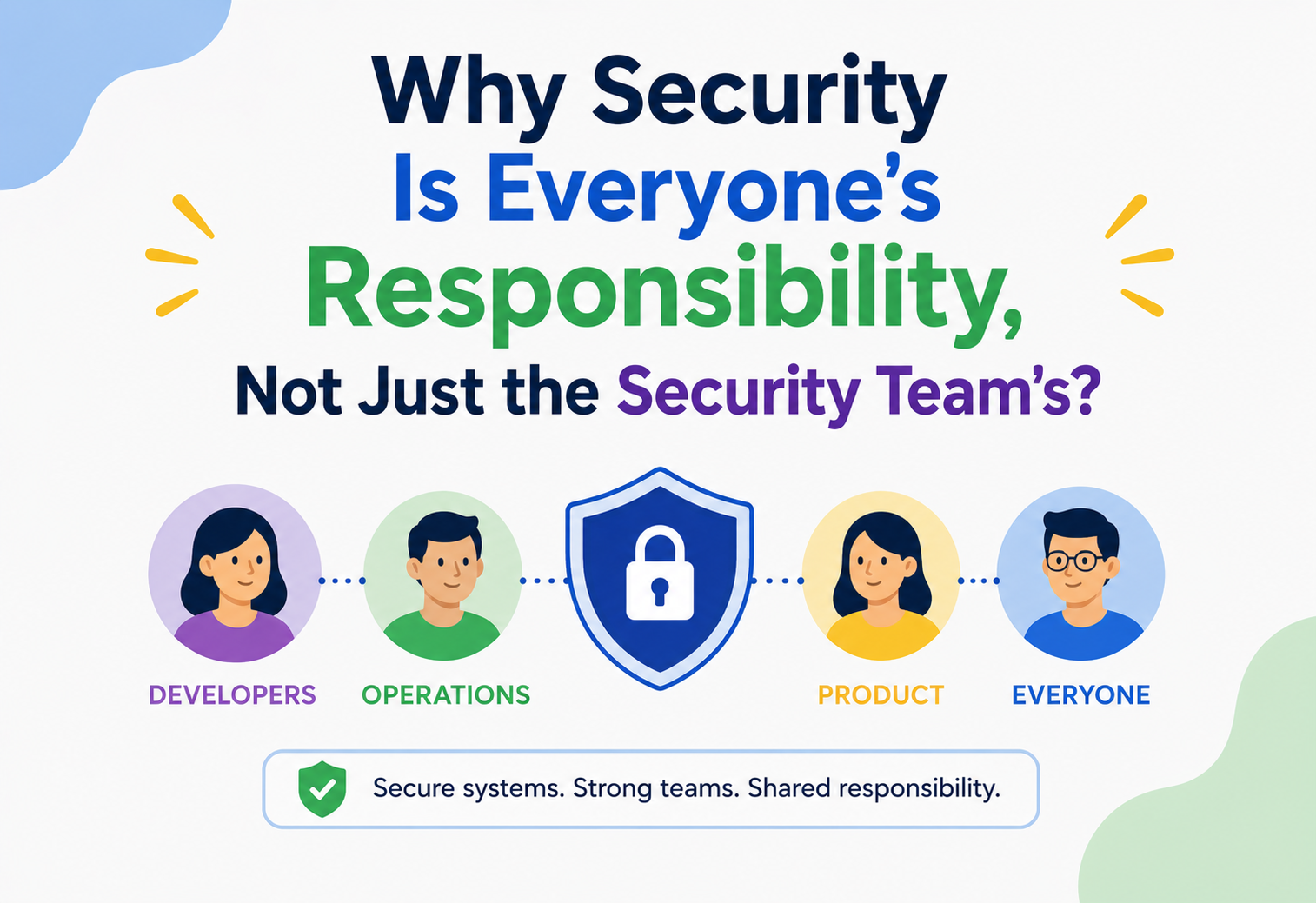
Why Security Is Everyone’s Responsibility — Not Just the Security Team’s?
A beginner-to-production guide to shared security ownership: why centralised security teams don’t scale, how responsibility spreads across engineering, and how to build a culture where every developer, architect, and operator is a security control.
The Guard at the Front Gate Isn’t Enough
Imagine an apartment building with one security guard sitting at the front gate. The guard checks every visitor, watches the cameras, and locks the gate every night. One day, a resident on the fifth floor props their balcony door open because it’s hot outside. Another resident lets a stranger “who forgot their keycard” in through a side door because it seemed rude not to. A contractor leaves a fire escape unlocked after finishing a repair. The guard did everything right — and the building still got robbed, because security was never actually the guard’s job alone. It was the job of everyone who lived there.
This is exactly the situation modern software organisations face, and it’s why you will hear architects, CTOs, and security leaders repeat a phrase that sounds almost like a slogan: “security is everyone’s responsibility.” It is not a slogan. It is a precise, technical description of how software actually gets broken into, and it reflects a hard lesson the industry learned the expensive way over roughly three decades.
A Short History of Who “Owned” Security
In the 1990s and early 2000s, most organisations treated security the way that apartment building treated its front gate: as a perimeter problem. You built a firewall, you hired a small security team to manage it, and everything inside the perimeter was implicitly trusted. Developers wrote application code; a separate security team worried about network boundaries, antivirus software, and intrusion detection. The two groups rarely spoke to each other, and application code was reviewed for security, if at all, only just before a major release — often by a security team member who had never seen the codebase before and had two days to review it.
This model made a kind of sense when applications were monoliths running inside a single data centre, behind a single firewall, with a handful of releases per year. But three shifts broke it permanently:
- The perimeter dissolved. Cloud computing, microservices, mobile apps, and remote work meant there was no longer a single “inside” to protect. Requests now cross dozens of trust boundaries — API gateways, third-party SaaS integrations, employee laptops on home Wi-Fi, and containers spun up and destroyed within minutes.
- Release velocity exploded. Teams moved from quarterly releases to daily or even hourly deployments through CI/CD pipelines. A security team of five people cannot manually review code that ships fifty times a day from twenty different squads.
- The attack surface moved into application code. Studies from OWASP and major breach reports have consistently shown that the overwhelming majority of real-world breaches now exploit application-layer weaknesses — broken authentication, injection flaws, misconfigured cloud storage, insecure APIs — not the network perimeter. These are precisely the areas that only developers, architects, and operators can control, because they live inside the code and infrastructure decisions made every day, not inside a firewall rule.
Out of this shift came a movement often called DevSecOps — the idea that security should be woven into every stage of the software delivery lifecycle rather than bolted on at the end by a separate team. The “everyone’s responsibility” framing is the cultural expression of that movement: it is a recognition that a small, centralised security team physically cannot inspect every line of code, every configuration file, and every API contract produced by an organisation shipping software continuously.
Think of the difference between a hospital that has one hygiene officer and a hospital where hand-washing is trained into every doctor, nurse, cleaner, and visitor. One hygiene officer cannot stand next to every hand at every moment. Infection control only works when the behaviour is distributed across everyone who touches a patient — and security works the same way across everyone who touches a system.
This guide walks through why that shift happened technically, what “shared responsibility” actually means at the architecture level, how it plays out in real systems (APIs, databases, cloud deployments, microservices), and how production organisations like Google, Netflix, and Capital One have institutionalised — or failed to institutionalise — this principle.
Why One Team Cannot Watch All the Doors
To understand why “everyone’s responsibility” isn’t just a nice phrase, it helps to look at the math and the mechanics of why a centralised security team cannot cover a modern engineering organisation on its own.
The Bottleneck Problem
Suppose a company has 400 engineers organised into 60 feature teams, each deploying to production multiple times per week. A central security team of 8 people cannot review every pull request, every architecture decision, every third-party library, and every cloud configuration change those 60 teams produce. Even if each security engineer worked flat out, the ratio is roughly 50 engineers to 1 security reviewer — and that reviewer also has to keep up with new vulnerability disclosures, incident response, audits, and compliance work.
When a security team becomes the sole checkpoint, one of two things happens in practice:
- Security becomes a bottleneck that slows every release, and engineering leadership eventually pressures the security team to “rubber stamp” reviews to keep shipping on schedule.
- Security gets bypassed quietly — teams route around the review process because waiting for the central team is incompatible with the release cadence the business demands.
Either outcome produces the same result: vulnerabilities ship to production, because the one team responsible for catching them structurally cannot see everything.
The Knowledge Problem
Security decisions are not made only in “security reviews.” They are made continuously, in dozens of small decisions a developer makes every day: which library to import, whether to validate a query parameter, whether an S3 bucket should be public, whether a new microservice needs authentication on an internal endpoint, whether a log statement accidentally prints a customer’s password. A central security team is rarely in the room for any of these micro-decisions — the person best positioned to make the secure choice is the engineer who is already writing that line of code, not a reviewer who sees it days or weeks later, if at all.
A junior developer building a simple “forgot password” form in a college project decides to store the reset token in plain text in the database because it’s faster to test. No “security team” ever reviews a student project — so the only thing standing between that decision and a real vulnerability is the developer’s own understanding of secure design. Multiply this by thousands of small decisions across an enterprise codebase, and you can see why the decision-maker’s own awareness matters more than any downstream review.
A platform engineer at a mid-size SaaS company provisions a new Kubernetes namespace for a team and, to save time, grants it a slightly too-broad IAM role because the narrower role “didn’t have the permission the team said they needed.” No security engineer is present for that provisioning step — it happens inside a Terraform pull request the platform engineer merges themselves. If that engineer doesn’t understand least-privilege access as part of their own job, the org has a standing over-permissioned identity that a central security team may not discover until an audit, or worse, an incident.
The Speed-versus-Safety Tension
Modern software delivery is optimised for speed: continuous integration, continuous deployment, feature flags, and rapid iteration. Every additional manual gate — including a mandatory central security review — adds friction and lead time. Organisations that try to resolve this tension by making the security team the sole gatekeeper end up choosing, implicitly, between slow-and-safe or fast-and-risky. The “everyone’s responsibility” model tries to resolve this differently: instead of adding a slow gate at the end, it pushes lightweight, automated, and cultural security practices into every stage so that speed and safety are not fighting each other.
What Actually Motivates the Shift
- Attack surface is distributed, so defence must be distributed. Every service, endpoint, dependency, and configuration file is a potential entry point, and each is owned by a different engineer or team.
- Vulnerabilities are cheapest to fix at the point of creation. Industry data on the cost of fixing defects consistently shows that a flaw caught while a developer is writing code costs a fraction of what it costs to fix after release, and orders of magnitude less than fixing it after a breach, complete with incident response, legal exposure, and reputational damage.
- Compliance and regulation increasingly expect it. Frameworks like SOC 2, ISO 27001, and PCI-DSS explicitly assess whether security awareness and controls are embedded across the organisation, not concentrated in a single team.
- Trust is the product. For most software companies, especially those handling personal or financial data, security incidents don’t just cost money — they destroy the trust the entire business is built on.
The rest of this guide explores exactly how this distributed responsibility is architected, implemented, and operationalised — not as an abstract value statement, but as concrete practices woven into system design, code, pipelines, and monitoring.
The Vocabulary of Shared Ownership
Before going deeper, let’s define the vocabulary this topic depends on. Each term below includes what it is, why it matters, and a simple example.
3.1 Shared Responsibility Model
What: A framework that explicitly divides security obligations between multiple parties — for example, between a cloud provider and its customer, or between a central security team and individual engineering teams — instead of assuming one party owns all of it.
Why: No single party has full visibility or control over every layer of a modern system, so responsibilities must be explicitly assigned to avoid gaps where everyone assumes “someone else” is handling it.
Analogy: A landlord is responsible for the building’s structure, wiring, and locks; the tenant is responsible for locking their own door and not leaving valuables in plain sight. Neither party alone can guarantee the apartment is safe.
Example: AWS secures the physical data centres and the hypervisor (security of the cloud); the customer secures their own IAM policies, application code, and data encryption choices (security in the cloud).
3.2 Shift-Left Security
What: Moving security activities — threat modelling, static analysis, dependency scanning — earlier (“left” on a timeline diagram) into the design and coding phases, instead of only at the end near release.
Why: The earlier a defect is found, the cheaper and safer it is to fix, and the developer who wrote the code has full context to fix it correctly.
Beginner example: A student’s IDE flags a hardcoded password as they type it, instead of a security auditor discovering it in production six months later.
Production example: Google’s internal build system runs static analysis and dependency vulnerability checks automatically on every code review, long before the code ever reaches a human security reviewer.
3.3 DevSecOps
What: An operating model and culture that integrates security practices into every phase of the DevOps pipeline (plan, code, build, test, release, deploy, operate, monitor) rather than treating it as a separate downstream phase.
Why: It aligns the pace of security work with the pace of software delivery, so security scales with the number of daily deployments instead of becoming a bottleneck.
Example: A CI pipeline that automatically fails a build if a dependency scan finds a critical CVE, without requiring a human security reviewer to intervene for every commit.
3.4 Security Champion
What: An engineer embedded inside a regular feature team (not the central security team) who receives extra security training and acts as the first point of contact for security questions within that team.
Why: Champions scale security expertise horizontally across the organisation without requiring every engineer to become a security specialist, and without requiring the central team to be present in every team’s daily work.
Example: A payments squad’s security champion reviews every pull request that touches card-data handling before it merges, escalating only genuinely ambiguous cases to the central security team.
3.5 Least Privilege
What: The principle that every user, service, or process should be granted only the minimum access required to do its job, and nothing more.
Why: It limits the “blast radius” of any single compromised credential, account, or service — an attacker who steals a low-privilege token can do far less damage than one who steals an admin token.
Analogy: A hotel keycard opens only your room and shared areas, not every room in the building, even though the front desk technically could issue a master key.
Software example: A microservice that only reads from a “products” table is given a database role with SELECT permission on that table alone — not full read/write access to the entire database.
3.6 Zero Trust
What: A security model that assumes no request — even one from inside the corporate network — should be trusted by default; every request must be authenticated and authorised explicitly, every time.
Why: It replaces the outdated “trusted internal network” assumption, which fails once attackers, compromised laptops, or misconfigured services exist inside the perimeter.
Production example: Google’s internal “BeyondCorp” model requires every internal service call to be authenticated and authorised, treating the corporate network the same way it treats the public internet.
3.7 Threat Modelling
What: A structured exercise, typically done by the people designing a system (not a separate security team), to identify what could go wrong — what assets need protecting, who might attack them, and how.
Why: It catches design-level security flaws before a single line of code is written, when they are cheapest to fix.
Example: Before building a new “share document with external users” feature, the team asks: “What happens if someone shares a link publicly by mistake? Can we detect and revoke it?”
3.8 Security Debt
What: The accumulated backlog of unresolved security weaknesses — much like technical debt — that builds up when security is deferred or skipped under deadline pressure.
Why: Like technical debt, it compounds: unpatched dependencies, unreviewed configurations, and untested authorisation logic accumulate risk that eventually becomes very expensive to pay down.
Two Layers That Make It Real
“Everyone’s responsibility” is not a vague cultural aspiration — it maps onto a concrete organisational and technical architecture. Understanding that architecture makes the principle actionable rather than a poster on the wall.
4.1 The Organisational Layer
Central Security / AppSec Team
Sets standards, builds shared tooling (SAST/DAST platforms, secret scanners), runs deep security reviews for high-risk changes, handles incident response, and trains the rest of the organisation. Small in size relative to engineering, high in leverage.
Security Champions
Embedded engineers inside feature teams who apply the standards day-to-day, triage low-risk questions locally, and escalate genuinely hard problems to the central team.
Platform / Infrastructure Team
Builds the “paved road” — secure-by-default templates for Kubernetes namespaces, CI/CD pipelines, IAM roles, and networking — so individual teams inherit good defaults instead of reinventing security from scratch.
Individual Engineers & Architects
Make the thousands of daily micro-decisions — input validation, authorisation checks, dependency choices — that determine actual security posture, since they hold the context the central team lacks.
4.2 The Technical Layer
Underneath the organisational structure sits a technical architecture that makes distributed responsibility enforceable rather than aspirational:
- Secure-by-default platforms: internal developer platforms that pre-configure encryption, authentication, and logging so that teams have to actively opt out of security rather than opt in.
- Policy-as-code: machine-enforced rules (e.g., Open Policy Agent, AWS Service Control Policies) that automatically block insecure configurations — like a public S3 bucket — regardless of who tries to create them.
- Automated pipelines: SAST (static application security testing), DAST (dynamic application security testing), software composition analysis (dependency scanning), and secret scanning wired directly into CI/CD, giving every engineer instant feedback.
- Identity and access management (IAM): centrally defined but individually scoped — every service and human identity gets its own least-privilege role, enforced by infrastructure, not by trust.
- Observability stack: logging, metrics, and tracing that any engineer — not just security specialists — can query to detect anomalies in the systems they own.
City road safety isn’t just the traffic police force’s job. Traffic engineers design roads with speed bumps and clear signage (platform team), driving schools teach every driver the rules (security champions and training), the department of transport writes and updates the laws (central security team), and the police enforce the rare violations (incident response). Safety emerges from all four layers working together, not from police alone standing at every intersection.
How Responsibility Flows Through a Real Day
Let’s trace what “shared responsibility” looks like moment-to-moment in a real engineering workflow, from the first design conversation to a production incident years later.
5.1 During Design
An architect proposes a new feature — say, letting users export their data as a downloadable file. Before a single line of code is written, the team (not a separate security team) runs a lightweight threat-modelling conversation: Who can request an export? Could someone request another user’s data by guessing an ID? Should the download link expire? This is security ownership happening at the architecture table, driven by the people who understand the feature best.
5.2 During Coding
A backend engineer implements the export endpoint. Their own understanding of secure coding practices — validating input, checking authorisation before returning data, avoiding predictable resource identifiers — determines whether the feature is safe, because no one else will see this code before it merges except a peer reviewer from the same team.
// INSECURE: relies on "security team will catch it later"
@GetMapping("/exports/{exportId}")
public ResponseEntity<byte[]> downloadExport(@PathVariable String exportId) {
    ExportFile file = exportRepository.findById(exportId);
    return ResponseEntity.ok(file.getData());
    // Any authenticated user who guesses/enumerates an exportId
    // can download ANY other user's export. No ownership check.
}

// SECURE: the developer owns this decision, not a downstream reviewer
@GetMapping("/exports/{exportId}")
public ResponseEntity<byte[]> downloadExport(
        @PathVariable String exportId,
        @AuthenticationPrincipal AppUser currentUser) {

    ExportFile file = exportRepository.findById(exportId)
        .orElseThrow(() -> new ResourceNotFoundException(exportId));

    if (!file.getOwnerId().equals(currentUser.getId())) {
        // Fail closed: deny by default, never assume trust
        throw new AccessDeniedException("Not authorized for this export");
    }

    if (file.isExpired()) {
        throw new ResourceGoneException("Export link has expired");
    }

    auditLogger.log(currentUser.getId(), "EXPORT_DOWNLOAD", exportId);
    return ResponseEntity.ok(file.getData());
}
Notice that no security team member wrote or reviewed this specific line-by-line logic before it shipped — the developer’s own judgment, shaped by training and secure-by-default platform patterns, is what prevented an Insecure Direct Object Reference (IDOR) vulnerability, one of the most common real-world API flaws.
5.3 During Build and Test
The moment the engineer opens a pull request, automated tooling — not a human — performs the first line of defence: static analysis flags risky patterns, a dependency scanner checks whether any imported library has a known CVE, and a secret scanner blocks the commit if an API key was accidentally hardcoded. This is where the “central team’s” leverage actually lives: they built the tooling once, and it now silently protects every one of the organisation’s thousands of daily commits without needing to review each one personally.
5.4 During Deployment
A platform engineer’s Terraform template already encodes least-privilege IAM roles, encrypted storage by default, and private networking as the default state. The feature team deploying their export service doesn’t need to be IAM experts — they inherit good defaults from infrastructure decisions made once by the platform team, and their own responsibility is simply not to override those defaults carelessly.
5.5 During Operation
Months later, the export feature is running in production. An on-call engineer — often not from the security team — notices in a dashboard that one account is downloading exports at an unusual rate at 3 a.m. Because that engineer understands what “normal” looks like for their own service, they are the first line of detection, long before any centralised security operations centre might notice the same anomaly buried in millions of other events.
At every single stage — design, code, build, deploy, operate — the person with the most context and the fastest ability to act is not the central security team. The central team’s real job is to build the guardrails, tools, and training that make the secure choice the easy choice for everyone else.
The Secure SDLC, End to End
The Secure Software Development Lifecycle (SSDLC) formalises the flow described above into repeatable stages, each with a distinct owner and distinct security activity. This is the backbone that makes “everyone’s responsibility” operational rather than aspirational.
| Stage | Primary Owner | Security Activity |
|---|---|---|
| Requirements | Product + Architect | Data classification: what data is sensitive? What regulations apply (GDPR, PCI-DSS)? |
| Design | Architect / Tech Lead | Threat modelling; define trust boundaries and auth requirements |
| Implementation | Developer | Secure coding standards, input validation, dependency vetting |
| Build / CI | Automated pipeline | SAST, software composition analysis, secret scanning |
| Testing | QA + Developer | DAST, security test cases, fuzzing for critical flows |
| Release | Release engineer | Artifact signing, change review, config validation |
| Deploy | Platform / DevOps | Least-privilege infra, network segmentation, secrets injection |
| Operate | SRE / On-call engineer | Monitoring, anomaly detection, patching |
| Respond | Whole org + Security | Incident response, postmortems, feedback into requirements |
Notice the feedback loop at the end: when the central security team does get involved — usually for the hardest, highest-impact problems — their output isn’t just “fix this one bug.” It’s an updated standard, a new automated check, or new training that prevents the same class of bug across the entire organisation going forward. This is what makes a small central team’s efforts scale across hundreds of engineers.
What You Gain, What You Pay
The distributed model is not a free lunch. Understanding what it gives you and what it costs you is what separates teams that adopt it successfully from teams that just repeat the slogan.
Scales with engineering velocity
Distributed security checks (automated + cultural) keep pace with dozens of daily deployments, unlike a manual central review queue.
Fixes issues at the cheapest point
Catching a flaw while a developer is writing the code is dramatically cheaper than catching it in production or after a breach.
Improves detection coverage
Hundreds of engineers watching their own services notice anomalies that a small central team, however skilled, would simply miss due to volume.
Builds durable culture
Security becomes a design habit rather than a compliance checkbox, improving posture even in code paths no formal review ever touches.
Inconsistent skill levels
Not every engineer has equal security training, so quality of “everyone’s” security decisions can vary widely without strong guardrails.
Diffusion of accountability risk
If “everyone” is responsible without clear ownership per system, it can collapse into “no one” being accountable when something goes wrong.
Requires sustained investment
Tooling, training, and paved-road platforms are expensive to build and maintain; without them, “everyone’s responsibility” becomes an empty slogan.
Alert fatigue and noise
Pushing scanning tools to every team can overwhelm engineers with false positives if the tooling isn’t well-tuned, causing them to ignore real findings.
Distributed responsibility, done well
Wins: matches release velocity, cheap-to-fix defects, distributed detection, durable culture.
Bills: ongoing investment in tools, training, and champion time.
Distributed responsibility, done badly
Wins: looks good on a value statement.
Bills: inconsistent skills, blurred ownership, alert fatigue, and a central team stretched to breaking point covering the gaps.
Mature organisations pair distributed responsibility with clear, non-negotiable ownership: every service has a named owning team, every security finding has a mandatory severity-based SLA, and the central security team retains final authority to block a release for critical, unresolved risk. Distributed responsibility does not mean the absence of accountability — it means accountability is pushed to the point of greatest context, backed by a central team that sets the floor everyone must meet.
Why This Model Grows With the Org
“Scalability” for a security model means: does security coverage keep growing proportionally as the engineering organisation and its release frequency grow? A centralised-only model does not scale — its coverage per engineer shrinks as headcount grows, because a small team’s total review capacity is roughly fixed while the volume of code, services, and configuration changes grows linearly or faster with headcount.
| Model | Coverage as org grows 10× | Bottleneck point |
|---|---|---|
| Central team reviews everything | Shrinks sharply — reviewers can’t keep pace | Human review capacity |
| Automated tooling only, no culture | Stays flat but misses design-level and business-logic flaws | Tooling blind spots (e.g., broken authorisation logic) |
| Distributed responsibility + automation + champions | Scales roughly linearly with headcount | Training and platform investment |
The distributed model scales because it converts a linear human bottleneck into a network effect: every new engineer added to the org also adds a new set of eyes on the systems they own, provided they’ve been given the training and tooling to use those eyes effectively. This mirrors a broader systems design principle familiar from other guides — the same reason a single database read replica doesn’t scale a read-heavy workload as well as horizontally distributing reads across many replicas.
A 50-person startup might reasonably route every pull request through its two security-minded senior engineers. At 2,000 engineers, that same pattern collapses instantly — which is exactly why companies like Google and Netflix invested heavily in automated guardrails and champion networks as they scaled, rather than simply hiring proportionally more central security reviewers.
Where Security and Uptime Meet
Security and reliability are deeply linked: a large share of production outages and reliability incidents trace back to security-adjacent causes — a misconfigured access policy that locks out a critical service, an expired certificate that breaks TLS handshakes fleet-wide, or a denial-of-service condition exploiting a poorly rate-limited endpoint. Treating security as everyone’s responsibility directly strengthens reliability, because the same engineers who keep a service available are the ones best placed to keep it secure.
- Certificate and secret rotation: Owning teams, not a central team, must build automated rotation for their own services’ TLS certificates and credentials, since an expired cert is both a security and an availability failure.
- Rate limiting and abuse protection: The team that owns an API is best placed to define sane rate limits for their specific traffic patterns, protecting both against attackers and against reliability-threatening load spikes.
- Failover with security intact: When a service fails over to a backup region, the owning team must ensure the failover path enforces the same authentication and encryption as the primary — a responsibility a central team, unfamiliar with that service’s failover mechanics, cannot own alone.
Numerous well-documented outages across the industry have been caused not by attackers, but by an internal team’s own misconfigured access control or an expired internal certificate that no single “security team” was tracking, because it belonged to a service only its owning team understood deeply. Reliability and security ownership converge at the team level for exactly this reason.
Turning a Value Into Enforced Behaviour
This section goes deeper into the specific technical mechanisms that operationalise distributed security ownership — the tools and practices that turn a cultural value into enforced behaviour.
10.1 The Cloud Shared Responsibility Model
Every major cloud provider formalises shared responsibility explicitly. Broadly:
| Layer | Cloud Provider’s Responsibility | Customer’s (Your Org’s) Responsibility |
|---|---|---|
| Physical data centres | ✓ Physical security, power, cooling | — |
| Hypervisor / host OS | ✓ Patching, isolation between tenants | — |
| Network infrastructure | ✓ Backbone, DDoS protection at scale | Configure security groups, VPCs correctly |
| Guest OS / containers | — | ✓ Patch your own OS images and containers |
| Application code | — | ✓ Secure coding, authorisation logic |
| Identity & access management | Provides the IAM system | ✓ Define least-privilege roles and policies |
| Data | — | ✓ Classification, encryption, access control |
This model is itself a formal, contractual embodiment of “everyone’s responsibility” — it explicitly rejects the idea that “the cloud provider handles security” and instead draws a precise boundary so both parties know exactly what they own.
10.2 Secure Coding as a Developer Discipline
@RestController
@RequestMapping("/api/v1/users")
public class UserSearchController {

    private static final Pattern SAFE_QUERY =
        Pattern.compile("^[a-zA-Z0-9 _.-]{1,64}$");

    @GetMapping("/search")
    public ResponseEntity<List<UserDto>> search(@RequestParam String q) {

        // Every engineer, not just the security team, is the last line
        // of defence against injection-style attacks on their endpoint.
        if (!SAFE_QUERY.matcher(q).matches()) {
            throw new InvalidRequestException("Invalid search query");
        }

        // Parameterised query — never string-concatenate user input
        List<UserDto> results = userRepository
            .findByDisplayNameContainingIgnoreCase(q);

        return ResponseEntity.ok(results);
    }
}
No amount of central security review can retroactively insert this discipline into a codebase with thousands of endpoints — it has to be a habit every engineer carries into every endpoint they write.
10.3 Policy-as-Code: Making the Platform Team a Security Enforcer
package terraform.security

deny[msg] {
  input.resource_type == "aws_s3_bucket"
  input.acl == "public-read"
  msg := sprintf(
    "Bucket '%s' cannot be public-read. All storage is private by default.",
    [input.name]
  )
}
This single policy, written once by a platform or security engineer, silently protects every team’s Terraform submission going forward — it is the clearest illustration of a small central team achieving organisation-wide coverage through automation rather than manual review.
10.4 The Human Layer: Security Awareness
Technical controls fail against social engineering — phishing, pretexting, and credential theft target humans directly, not code. This is why “everyone’s responsibility” extends beyond engineers to every employee: finance staff who approve wire transfers, support agents who reset passwords, and executives who are prime phishing targets. Regular training, simulated phishing exercises, and clear escalation paths are the non-technical half of distributed security ownership.
A bank vault can have the strongest lock in the world, but if a teller can be tricked into handing over the combination over the phone, the lock’s strength is irrelevant. Security awareness training is teaching every “teller” in the organisation — not just the vault engineers — to recognise manipulation.
The Team That Owns It Sees It First
Detection is where distributed responsibility becomes most visible day-to-day. A central security operations centre cannot meaningfully interpret logs from a service it doesn’t understand — the owning team’s engineers are the ones who know what “normal” traffic, error rates, and access patterns look like for their own system.
- Audit logging: Every team instruments their own service to log security-relevant events — logins, permission changes, data exports — in a structured, centrally aggregated format.
- Anomaly detection: Owning teams define what “abnormal” means for their service’s baseline (e.g., a sudden spike in failed login attempts on their endpoint), because a generic, org-wide threshold is often too noisy or too blind.
- Correlation IDs: Distributed tracing lets any engineer — not just a central team — follow a suspicious request across service boundaries to understand its full blast radius.
- Shared dashboards: Central security teams build shared observability tooling (SIEM platforms, alerting rules) that individual teams plug their own service’s signals into, combining centralised tooling with distributed expertise.
@Component
public class SecurityAuditLogger {

    private static final Logger auditLog =
        LoggerFactory.getLogger("SECURITY_AUDIT");

    public void logAccessDenied(String userId, String resource, String reason) {
        // Structured logging lets ANY on-call engineer, not just a
        // central SOC, query and alert on this event stream.
        auditLog.warn(
            "event=access_denied user={} resource={} reason={} ts={}",
            userId, resource, reason, Instant.now()
        );
    }

    public void logPrivilegedAction(String userId, String action, String targetId) {
        auditLog.info(
            "event=privileged_action user={} action={} target={} ts={}",
            userId, action, targetId, Instant.now()
        );
    }
}Teams sometimes assume “the security team monitors everything,” so they skip adding meaningful audit logs to their own service. In practice, if a service doesn’t log its own security-relevant events in a structured, queryable way, no central team — however well-staffed — can detect an attack against it after the fact.
Paved Roads and Signed Artifacts
Deployment is where organisational responsibility meets infrastructure reality. A few patterns illustrate how distributed ownership plays out operationally.
12.1 Paved-Road CI/CD Pipelines
Platform teams build a standard pipeline template that automatically includes SAST, dependency scanning, container image scanning, and secret detection. Individual teams inherit this by default when they adopt the standard pipeline — their responsibility becomes “don’t disable the guardrails,” a far lower bar than “build your own security tooling from scratch,” and one every team can realistically meet.
12.2 Infrastructure as Code Review
Terraform, CloudFormation, or Pulumi definitions are peer-reviewed by the owning team, just like application code, with policy-as-code tools (like the OPA example above) providing an automated backstop that catches what human review misses.
12.3 Immutable, Signed Artifacts
Container images are built once, signed, and scanned; every subsequent deployment verifies that signature. This removes a manual “is this build trustworthy?” decision from any individual, replacing it with a cryptographic guarantee anyone in the pipeline can rely on.
Every stage in this pipeline is owned by a different party — developer, CI system, platform team, Kubernetes cluster admin — and each has to do its part correctly for the whole chain to hold. This is distributed responsibility made literal in infrastructure.
Even the Invisible Layers Have Owners
Even “invisible” infrastructure layers carry distributed security responsibility — and the teams that own them are usually not the ones users would guess.
13.1 Databases
- Schema owners decide which columns hold sensitive data (PII, payment details) and must apply encryption-at-rest and field-level encryption where appropriate — a decision no central team can make without deep knowledge of the schema.
- Application engineers are responsible for using parameterised queries and ORM patterns that prevent SQL injection, since the query logic lives in their code, not the DBA’s.
- Database administrators / platform teams own connection encryption (TLS to the database), backup encryption, and role-based access at the database engine level.
13.2 Caching
Caching layers like Redis are a frequent, underestimated source of exposure — a team caching a full user profile object, including sensitive fields, in a shared cache accessible to multiple services can leak data across service boundaries. The team that decides what goes into a cache key owns the decision of whether that data belongs there at all.
13.3 Load Balancers and API Gateways
Centrally managed API gateways are one of the few places where a platform or security team can enforce baseline protections — TLS termination, WAF rules, global rate limiting — uniformly across every service behind them, regardless of whether the owning team remembered to configure it themselves. This makes the gateway layer a high-leverage point for the central team’s limited effort.
A central platform team configures the API gateway to reject any request without a valid JWT and to enforce a global rate limit of 100 requests/minute per IP by default. Individual teams can request exceptions, but the secure default protects every new service automatically from day one — no team has to remember to “add security” themselves.
Every Call Is a Trust Boundary
Microservice architectures multiply the number of trust boundaries in a system — every service-to-service call is a potential point of failure, and no single team can review every interaction across dozens or hundreds of services. This makes API and microservice security perhaps the clearest illustration of why security cannot belong to one team.
14.1 Service-to-Service Authentication
In a zero-trust microservices environment, every internal call — not just external ones — must be authenticated, typically via mutual TLS (mTLS) or short-lived service tokens. The team building a new microservice is responsible for integrating with this authentication layer correctly; a central team cannot retrofit authentication into a service whose internal logic it doesn’t understand.
@Configuration
@EnableWebSecurity
public class ServiceAuthConfig {

    @Bean
    public SecurityFilterChain filterChain(HttpSecurity http) throws Exception {
        http
            .authorizeHttpRequests(auth -> auth
                .requestMatchers("/internal/**").authenticated()
                .requestMatchers("/actuator/health").permitAll()
                .anyRequest().authenticated()
            )
            .oauth2ResourceServer(oauth2 -> oauth2
                .jwt(jwt -> jwt.jwtAuthenticationConverter(serviceJwtConverter()))
            );
        // Each service team owns getting THIS configuration right —
        // a central team cannot know every internal endpoint that
        // should or shouldn't require authentication.
        return http.build();
    }
}
14.2 API Contracts and Authorisation Boundaries
Every API endpoint is a promise about what data it will and won’t expose, and to whom. The team that owns an endpoint’s contract is uniquely positioned to enforce field-level authorisation — for instance, ensuring a “get order details” endpoint doesn’t leak another customer’s shipping address through an over-broad response object.
14.3 Fan-out Amplifies Small Mistakes
In a microservices architecture, a single insecure internal endpoint can be reached indirectly through several layers of fan-out — service A calls B calls C — meaning a vulnerability introduced by one team can be exploited through a completely different team’s public-facing feature. This interconnectedness is precisely why security can’t be siloed to whichever team happens to expose the public endpoint; every service in the call chain shares responsibility for the security of the overall request path.
Shapes That Help, Shapes That Fail
A handful of design patterns reinforce distributed responsibility — and a handful of anti-patterns quietly undermine it. Naming both makes them easier to catch in your own organisation.
Patterns That Reinforce Distributed Responsibility
- Secure defaults / paved roads: Make the secure path the path of least resistance, so engineers have to actively work to be insecure.
- Fail closed, not open: Authorisation checks should deny access by default when uncertain, rather than silently allowing it — a pattern every engineer should apply, not just security specialists.
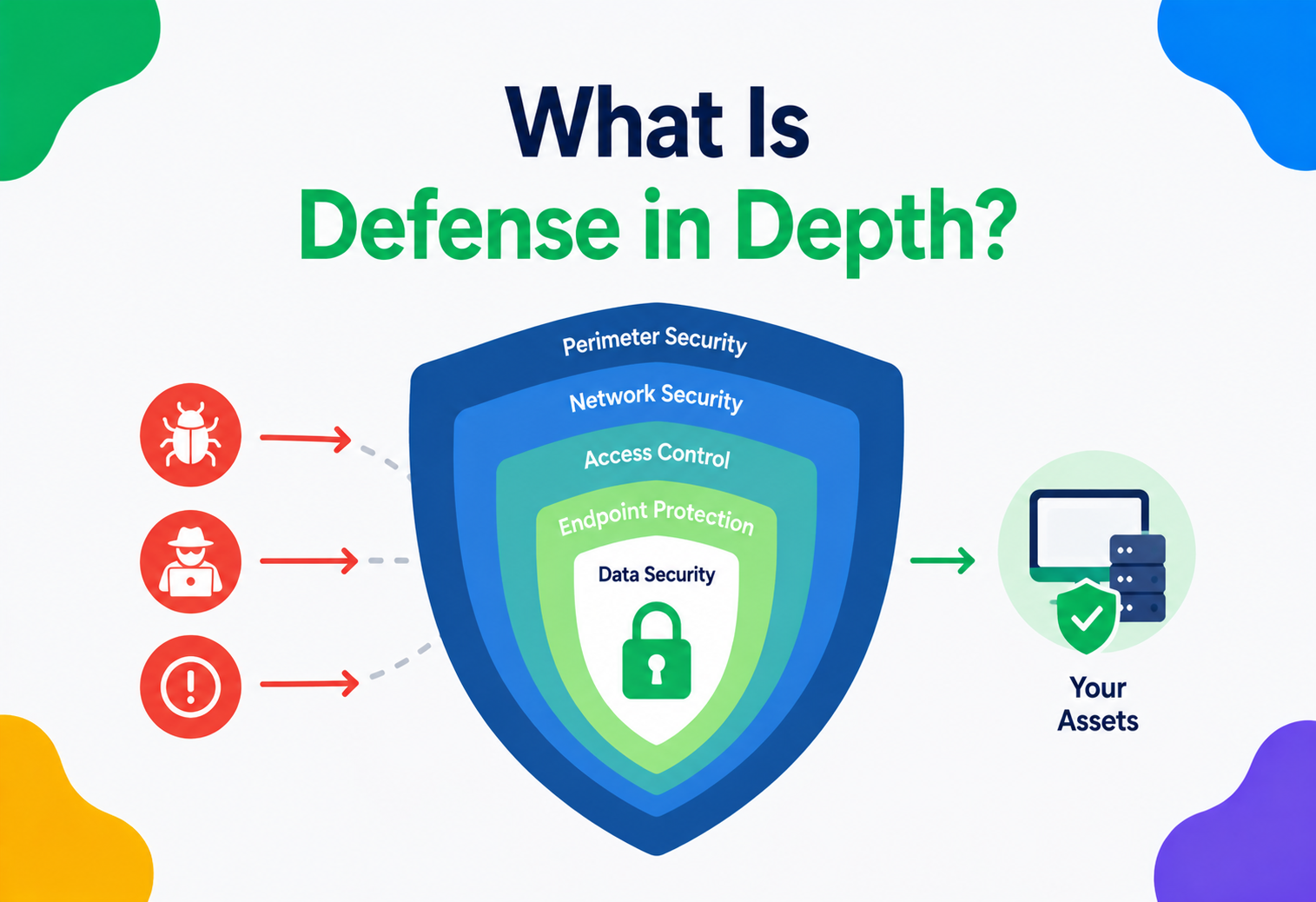
- Defence in depth: Layer independent controls (input validation, authorisation, network segmentation, monitoring) so that one team’s mistake doesn’t become a full compromise.
- Security champions network: Distribute expertise horizontally instead of relying on a single central bottleneck.
- Blameless postmortems: Treat security incidents as learning opportunities for the whole org, encouraging engineers to report near-misses rather than hide them.
Anti-patterns to Avoid
A mandatory but shallow annual training that satisfies a compliance checkbox without changing daily engineering behaviour.
A central team that blocks releases for security issues but provides no tooling, training, or paved road to help teams avoid those issues in the first place.
Declaring “security is everyone’s responsibility” without assigning a clear owning team per service, leading to gaps no one actually closes.
Pushing every security tool’s raw, unfiltered output to every engineer, producing so much noise that real findings get ignored.
Publicly blaming the engineer who introduced a bug discourages honest reporting and undermines the trust the whole model depends on.
Some organisations announce “security is everyone’s responsibility” as a cost-cutting justification for shrinking or eliminating their central security team altogether. This inverts the actual model: distributed responsibility only works when a strong, well-resourced central team is building the guardrails, tooling, and training that make everyone else’s job possible. Remove that team, and “everyone’s responsibility” collapses into “no one’s responsibility.”
Habits That Make the Model Work
Distributed responsibility is not one big habit — it is a small set of repeated, boring habits. The organisations that get it right treat these as investments, not overhead.
Best Practices
- Invest in a strong platform team. Secure defaults matter more than any policy document — make the secure path the easy path.
- Build a security champions program with real time allocation (not “extra unpaid work”) so champions can meaningfully participate.
- Automate what can be automated (SAST, dependency scanning, secret detection) so human attention is reserved for genuinely ambiguous, high-context decisions.
- Define clear ownership per service so “everyone” doesn’t dissolve into “no one” when an issue is found.
- Make security metrics visible — mean time to patch, percentage of services meeting baseline standards — the same way uptime and latency are tracked.
- Run blameless postmortems for security incidents, treating them as systemic learning opportunities, not individual failures.
- Train continuously, not annually — short, frequent, role-specific training beats a single long annual session.
- Give the central team veto power for critical risk — distributed responsibility should not remove the ability to halt a release for a genuinely critical, unresolved issue.
Common Mistakes
- Treating the phrase as a slogan rather than backing it with tooling, training, and time allocation.
- No feedback loop — findings from incidents never make it back into coding standards, linters, or training material.
- Overloading engineers with security work on top of an already full roadmap, without adjusting timelines or expectations.
- Ignoring the human layer — focusing entirely on code and infrastructure while neglecting phishing and social engineering awareness.
- Central team becomes purely reactive, spending all its time on incident response instead of building preventive guardrails.
What Google, Netflix, and a Big Breach Teach
The pattern shows up clearly — both in success stories and in cautionary tales — that outcomes are determined by decisions made outside the central security team, in the ordinary course of engineering and operations work.
Google — BeyondCorp and Internal Zero Trust
Google’s internal security model explicitly assumes no request should be trusted based on network location alone, requiring every internal service call to be authenticated and authorised. This only works because thousands of engineers across the company integrate with this model correctly in their own services — a central security team could never manually verify every internal call across Google’s scale.
Netflix — Chaos Engineering Extended to Security
Netflix popularised chaos engineering for reliability and has extended similar thinking to security, running internal exercises that test whether teams’ services hold up under simulated attack conditions, not just simulated infrastructure failure. Ownership of the outcome sits with the team running the service, not a central group parachuting in after the fact.
Capital One — A Cautionary Tale
The well-documented 2019 Capital One breach stemmed from a misconfigured web application firewall on a cloud-hosted resource, which allowed a former employee to exploit a server-side request forgery vulnerability and access millions of customer records. Post-incident analysis widely pointed to gaps in how cloud configuration responsibility was distributed and monitored between infrastructure and security functions — a real-world illustration of what happens when the “everyone’s responsibility” model has gaps in accountability or tooling.
OWASP — Industry-Wide Standardisation
The OWASP Foundation’s widely referenced Top 10 list of web application risks exists specifically because so many production vulnerabilities stem from application-layer decisions made by developers, not network-layer decisions made by security teams. Its continued relevance across the industry underscores that the majority of exploitable risk lives inside code that only developers write and review day-to-day.
In every case — whether a success story like Google’s Zero Trust rollout or a cautionary tale like a major cloud misconfiguration breach — the common thread is the same: outcomes were determined by decisions made by people outside the central security team, in the ordinary course of their engineering and operations work.
Common Questions, and What to Remember
The short round of questions people actually ask about “everyone’s responsibility” — followed by a portable summary you can carry into any architecture review.
Does “Everyone’s Responsibility” Mean We Don’t Need a Security Team?
No — it means the opposite. A strong central security team is what makes distributed responsibility possible, by building the tools, guardrails, and training that let every other engineer make secure decisions quickly and correctly.
How Do You Avoid “Everyone’s Responsibility” Becoming “No One’s Responsibility”?
By pairing the cultural principle with clear, explicit ownership — every service has a named owning team, every security finding has a defined severity and SLA, and accountability is never left ambiguous.
Isn’t It Unfair to Expect Every Developer to Be a Security Expert?
Developers aren’t expected to be security experts — they’re expected to follow secure defaults, use provided tooling, and know when to escalate to a champion or the central team. The bar is “make the secure choice easy to make,” not “become a specialist.”
How Does This Relate to Compliance Frameworks Like SOC 2 or ISO 27001?
These frameworks explicitly assess whether security controls and awareness are distributed across the organisation — auditors look for evidence of training, secure development practices, and access controls at the team level, not just a single centralised policy document.
What’s the Single Highest-Leverage Investment for Making This Model Work?
Secure-by-default platforms and automated pipeline checks. They convert a central team’s one-time engineering effort into continuous, org-wide protection without requiring manual review of every change.
Summary
Security is described as “everyone’s responsibility” because modern software systems are too large, too fast-moving, and too distributed for any single central team to manually inspect every decision that affects security. Attack surface lives inside application code, API contracts, cloud configurations, and everyday engineering choices — decisions made continuously by developers, architects, and operators, not just by a dedicated security function. The organisations that implement this principle successfully do so by pairing cultural ownership with concrete technical architecture: secure-by-default platforms, automated scanning pipelines, policy-as-code guardrails, embedded security champions, and clear per-service accountability — all backed by a strong, well-resourced central security team that builds and maintains that infrastructure rather than manually reviewing every change.
Key Takeaways
- Centralised-only security models don’t scale with modern release velocity and distributed architectures.
- Most real-world breaches exploit application-layer and configuration weaknesses that only engineers, not a perimeter-focused security team, can control.
- Distributed responsibility requires investment — secure defaults, automated tooling, training, and champion networks — or it becomes an empty slogan.
- Distributed responsibility does not mean the absence of accountability; clear per-service ownership is essential to avoid gaps.
- The central security team’s evolved role is force multiplication — building guardrails and tools — not being the sole gatekeeper.
- Security and reliability are deeply linked; the same engineers who keep systems available are best placed to keep them secure.
“Security is everyone’s responsibility” is not a slogan — it is a precise description of how modern systems actually stay safe: a strong central team builds the guardrails, and every engineer, architect, and operator makes the daily decisions those guardrails alone cannot make for them.
“The guard at the gate cannot lock every balcony door. Security only works when everyone who lives in the building knows it’s theirs to defend.”