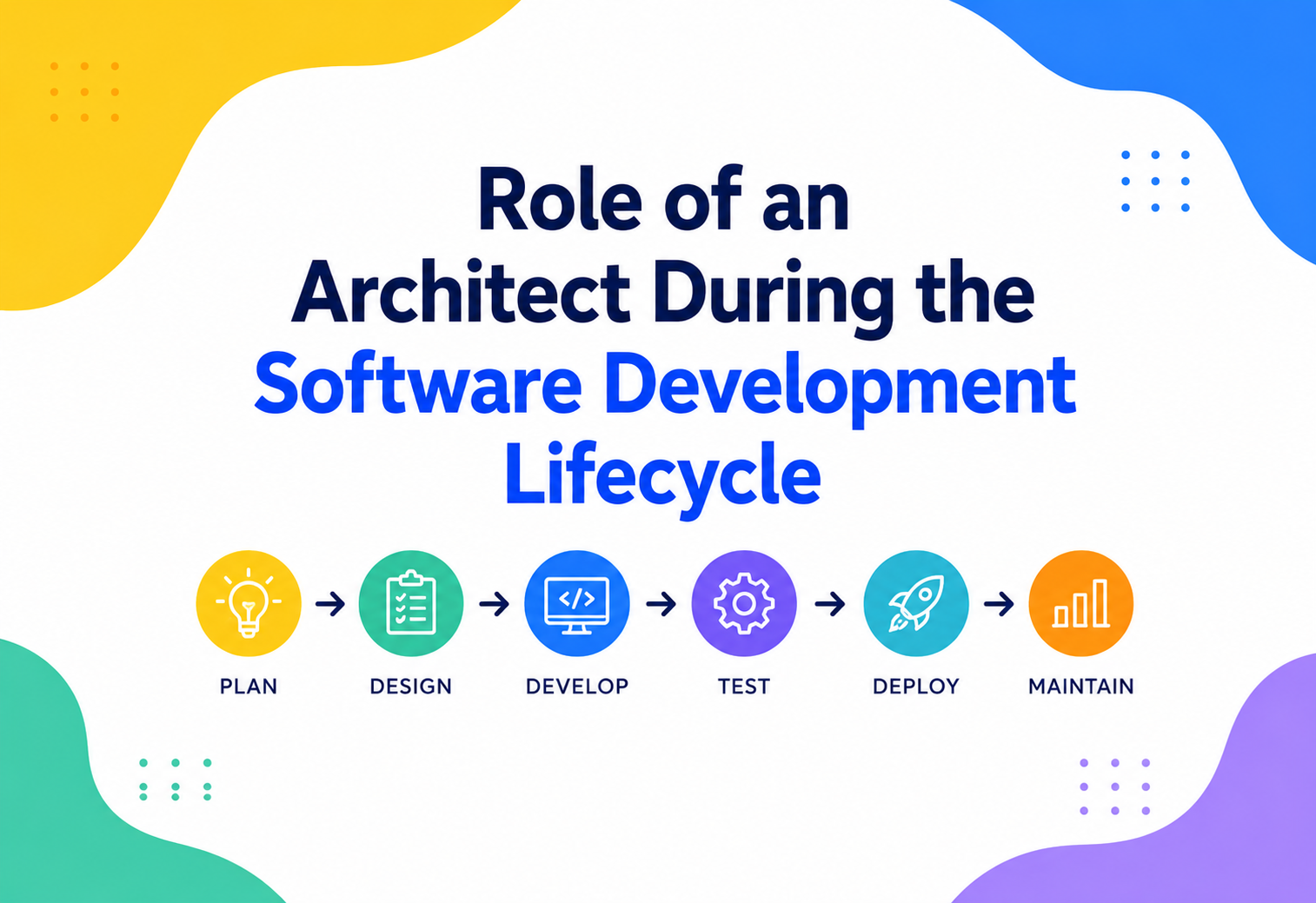
The Role of an Architect During the Software Development Lifecycle
Most people picture an architect drawing diagrams once, at the very start, and disappearing. In reality, a good architect’s fingerprints are on almost every stage of a project — from the first client conversation to years after launch.
The Big Idea, in One Breath
A film director doesn’t yell “action” once and disappear. A software architect works exactly the same way — close to a project through every stage, not just at the start.
Think about a film director. Their job isn’t just to yell “action” once and walk away. A good director is involved from the very first script read-through, through every day of filming, all the way to the final edit — constantly making sure hundreds of small decisions add up to the one vision they started with.
A software architect plays a strikingly similar role across a project’s life. Rather than appearing once with a diagram and vanishing, a genuinely effective architect stays close to a project through nearly every stage — shaping early requirements, guiding design, watching over development, supporting testing, and staying involved even after the software has shipped and real users are relying on it.
Think of building a house. The architect doesn’t just hand over blueprints and disappear. They visit the site during construction to make sure the builders are following the plan, adjust details when something unexpected turns up underground, and often check back in years later when the owners want to renovate. Software architects follow a similar rhythm across a project’s whole life.
Who a Software Architect Really Is
A single title, many shapes. Deep technical knowledge combined with steady communication — because a design only matters if the team actually follows it.
A software architect is an experienced technical professional responsible for the overall structure of a software system — the major components, how they connect, and the technology choices that will shape the project for years to come. Their job blends deep technical knowledge with steady communication, since a design only matters if the whole team actually understands and follows it.
Although their title suggests a single fixed job, the role flexes considerably depending on the project. In a small startup, one person might be architect, senior developer, and team lead all at once. In a large enterprise, several specialised architects might each own a different slice of the same system.

If someone asks “who’s the architect on this project?”, they are really asking: “Who’s responsible for making sure all these moving pieces actually fit together sensibly, from start to finish?”
Why the Role Exists
Without someone holding the big picture, projects drift. Coherence, risk reduction, and translation between business and technology are the quiet reasons the role exists at all.
Without someone holding the big picture, software projects tend to drift. Individual developers, each focused on their own piece, naturally optimise for what’s in front of them — which is exactly how systems end up with mismatched pieces that technically work but don’t fit together well as a whole.
The role also exists because someone needs to make the unglamorous, long-term calls — the ones that won’t show up as a visible feature to users, but will absolutely determine whether the system can grow gracefully or collapses under its own weight two years later.
The SDLC, at a Glance
Six phases from idea to something people keep using. Not a straight line — a rhythm most teams cycle through repeatedly.
Before mapping the architect’s role phase by phase, it helps to have the whole map in view. The Software Development Lifecycle, or SDLC, is simply the structured journey a piece of software travels from idea to something people actually use — and keep using.

| Phase | Main Question It Answers |
|---|---|
| Planning & Requirements | What problem are we actually solving, and for whom? |
| Design | How should the system be structured to solve it well? |
| Development | How do we build what was designed, correctly? |
| Testing | Does it actually work the way it is supposed to? |
| Deployment | How do we get it safely into people’s hands? |
| Maintenance | How do we keep it healthy and improve it over time? |
The SDLC isn’t a straight line teams walk once — most modern teams cycle through these phases repeatedly, in smaller, faster loops, refining the software a little more each time around.
The Architect’s Role, Phase by Phase
Six stops along the same map. What the architect is actually doing at each one — from listening to stakeholders to watching the system grow after launch.
With the map in place, here is what an architect is typically doing at each stop along the way.
Planning & Requirements
Sits with stakeholders to understand real goals and constraints, and flags technical risks or trade-offs before any commitments are locked in.
Design
Produces the actual architecture — component boundaries, technology choices, integration points — and documents the reasoning behind key decisions.
Development
Stays close to the team, answering design questions, reviewing critical code, and making sure real implementation doesn’t quietly drift from the intended structure.
Testing
Works with QA to make sure tests genuinely cover architectural risks — not just individual features — like performance under load or behaviour during failures.
Deployment
Reviews the release plan and infrastructure setup, making sure the system goes live in a way that matches how it was actually designed to run.
Maintenance
Keeps watching after launch, helping the system evolve gracefully as new features, growing traffic, and changing needs put fresh pressure on the original design.
Waterfall vs. Agile: A Changed Role
The architect’s day-to-day has shifted as teams moved from rigid, upfront processes toward faster, more iterative ones. Neither extreme wins — the middle almost always does.
The architect’s day-to-day involvement has shifted noticeably as software teams moved from older, rigid processes toward faster, more iterative ones — and it is worth understanding both, since many organisations still blend the two.
| Question | Traditional (Waterfall) Approach | Modern (Agile) Approach |
|---|---|---|
| When does design happen? | Mostly upfront, in one long, detailed phase | Continuously, in small pieces alongside development |
| Architect’s presence | Heavily involved early, less so later | Ideally involved lightly but consistently, throughout |
| Documentation style | Extensive, formal, produced upfront | Lightweight, updated as decisions are made |
| Risk | Costly to change direction once building begins | Risk of design decisions being made without an architect present |
Neither approach is automatically “correct.” Agile teams that sideline the architect entirely often pay for it later with inconsistent structure, while overly rigid upfront design can leave a team locked into decisions made with the least information they’ll ever have. The healthiest modern teams tend to land somewhere in between — light, frequent architectural involvement rather than one enormous phase or none at all.

Different Kinds of Architects
Four specialist flavours — solution, enterprise, application, infrastructure. Smaller teams often blend them into one person; larger ones split them across four.
“Software architect” isn’t always one single job title — larger organisations often split the role into specialists, each focused on a different scope.
Owns one specific solution
Designs the technical answer to one particular business problem, often across several connected systems.
Owns the whole landscape
Looks across an entire organisation’s systems, keeping strategy, standards, and long-term technology direction aligned.
Owns one application
Focuses on the internal structure of a single application — its layers, frameworks, and coding patterns.
Owns where things run
Designs the servers, networks, and cloud setup that applications depend on to actually function.
Smaller teams rarely need every specialist at once — often, one experienced architect wears several of these hats simultaneously, scaling their focus up or down as the project’s size demands.
Skills That Matter Most
Technical depth alone isn’t enough. The role sits at a crossroads: hands-on expertise, communication, judgement under uncertainty, and mentorship in roughly equal measure.
Technical depth alone doesn’t make someone an effective architect. The role sits at a genuine crossroads of ability, blending hands-on expertise with something closer to diplomacy.

Broad, practical knowledge
A solid grasp of systems, patterns, and trade-offs, built from real hands-on experience rather than theory alone.
Translating between worlds
The ability to explain the same decision clearly to a business executive and to a junior developer, in language each one understands.
Weighing trade-offs calmly
Comfort making decisions with incomplete information, knowing every architectural choice trades one benefit for another.
Growing the team, not just the system
Helping developers understand not just what to build, but why — building a stronger, more capable team over time.
Who Architects Work With
Rarely a solo pursuit. Sitting at the intersection of business, engineering, and operations — each with its own concerns and its own language — is where much of the real value comes from.
Architecture is rarely a solo pursuit. A large part of the role’s real value comes from sitting at the intersection of several very different groups of people, each with their own concerns and their own language.
A skilled architect moves comfortably between these groups, translating business priorities into technical direction, and technical constraints back into terms a business stakeholder can genuinely weigh and understand.
Benefits and Challenges of the Role
Real rewards — and real, well-documented pressure. Less about being the smartest person in the room, more about staying calm while helping others decide.
Being the person responsible for a system’s overall shape comes with real rewards — and real, well-documented pressure.
What Makes It Rewarding
- Significant influence over how a system actually turns out
- Constant variety, moving between technical and business conversations
- Deep satisfaction watching a well-designed system age gracefully
- Opportunities to mentor and grow less experienced engineers
What Makes It Hard
- Carrying accountability for decisions that affect many other people
- Balancing conflicting requests from business, engineering, and operations
- Constantly learning as tools, patterns, and technologies keep evolving
- Managing the discomfort of decisions made with incomplete information
Most experienced architects describe the role similarly: less about being the smartest person in the room, and more about staying calm, asking the right questions, and helping a whole team make better decisions together.
Common Pitfalls
Three recurring traps — disappearing after design, designing alone, freezing the architecture. Each quietly undermines the role’s real value.
Vanishing After the Design Phase
An architect who disappears once diagrams are approved leaves the team without support exactly when tricky, unforeseen decisions start showing up during real implementation.
Designing in Isolation
A design created without genuine input from the developers who’ll build it often looks elegant on paper but proves painful and impractical in practice.
Treating Architecture as a One-Time Event
Systems, requirements, and teams all change over time. An architecture frozen in its original form eventually stops fitting the problem it was built to solve.

Organisations that treat the architect role as optional overhead in the name of moving fast. Recent industry research shows many teams still suffer project delays and mismatched documentation precisely because architectural involvement wasn’t sustained throughout the project.
Key Takeaways
If you remember only these six ideas from the whole guide, you’ll be able to hold a confident, honest conversation about what a software architect actually does across a project’s whole life.
Remember This
- Every phase, not just design. A software architect’s real job spans nearly every phase of the SDLC, not just the initial design stage.
- Responsibilities shift. Core responsibilities move with each phase — from requirements and design, through development and testing, to deployment and maintenance.
- Waterfall to agile. The role has evolved from one big upfront phase toward lighter, more continuous involvement throughout.
- Different flavours. Larger organisations often split the role into specialists — solution, enterprise, application, and infrastructure architects.
- A blended skill set. The job blends deep technical skill with communication, judgement, and mentorship in roughly equal measure.
- Presence matters. Projects tend to suffer when architectural involvement fades after the design phase instead of continuing through the whole lifecycle.