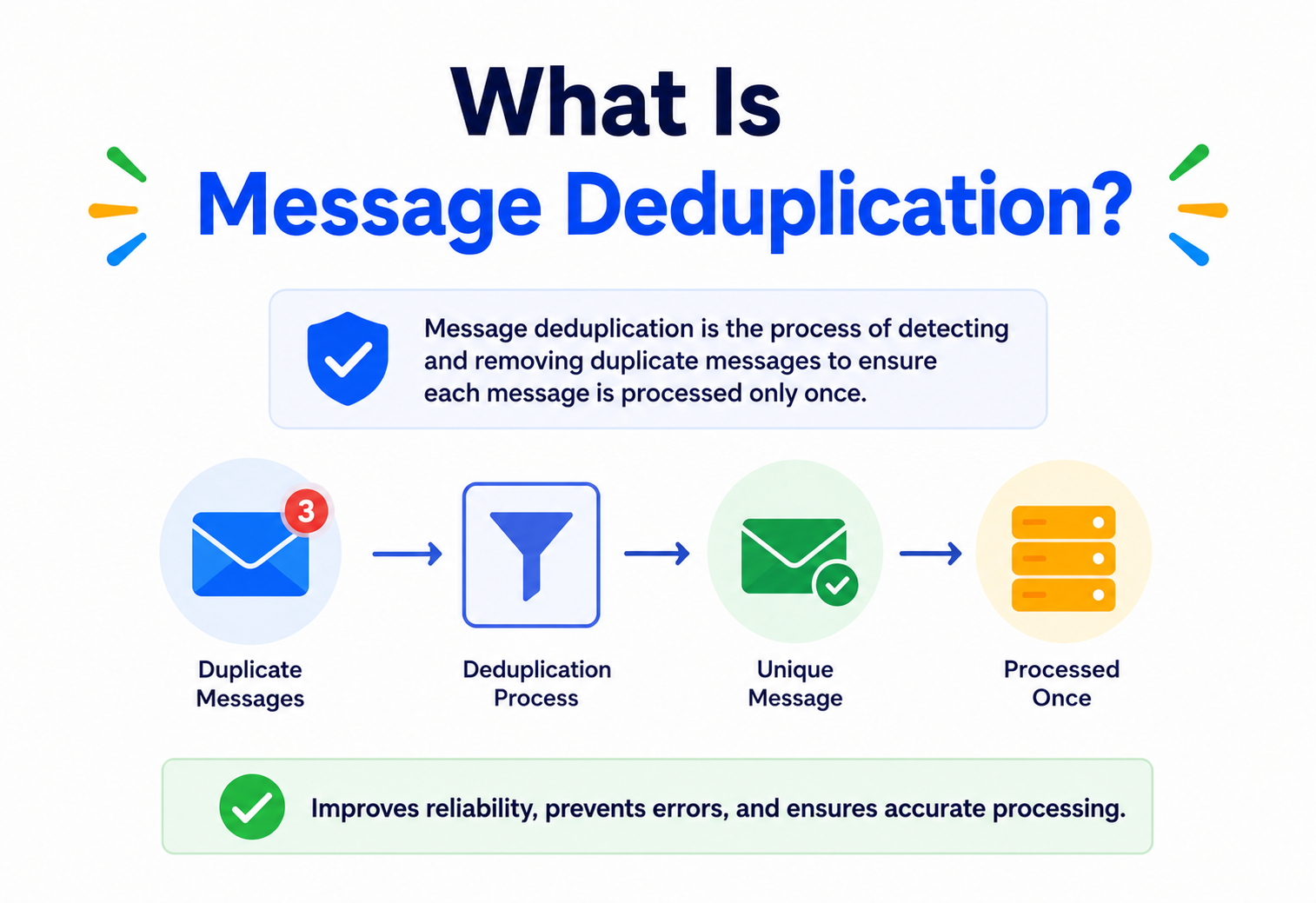
What Is Message Deduplication?
A ground‑up guide to why duplicate messages happen in distributed systems, how deduplication actually works under the hood, and how production systems like Kafka, SQS, and Stripe stop the same event from being processed twice.
Introduction & History
Imagine you’re texting a friend, and your phone shows “sending…” for a few seconds too long. You panic and hit send again. A moment later, your friend gets your message twice. That’s a duplicate message — and in everyday texting it’s a mild annoyance. But now imagine that instead of a text message, it’s a bank transfer, an order confirmation, or a “charge this credit card” instruction flowing through a company’s backend systems. Suddenly, a duplicate isn’t annoying — it’s a bug that charges someone twice or ships two identical packages.
Message deduplication is the practice of detecting and eliminating duplicate copies of a message so that a piece of work is processed exactly once (or at least, appears to have been processed exactly once), even though the underlying system may have delivered it more than one time.
This concept isn’t new. It has roots going back to early telecommunication networks, where operators worried about the same telegram being retransmitted due to line noise. As computing moved into networked and distributed systems in the 1970s and 1980s, the same problem resurfaced in a new form: computers talking to each other over unreliable networks, where a message could get lost, delayed, or accidentally sent twice.
1.1 A Short Timeline of the Idea
- 1970sTCP and sequence numbers. TCP, the backbone protocol of the internet, introduced sequence numbers so that a receiving computer could detect and discard duplicate network packets — an early, low‑level form of deduplication.
- 1980s–90sDatabase transactions. Relational databases popularized idempotent operations and unique constraints, letting applications reject a second attempt to insert the “same” record.
- 2000sEnterprise messaging queues. Message brokers like IBM MQ and JMS‑based systems introduced “message IDs” so consumers could recognize a message they’d already seen.
- 2010sDistributed streaming platforms. Apache Kafka, Amazon SQS, and Google Pub/Sub popularized “at‑least‑once delivery,” which pushed the responsibility of deduplication into application design, and later into the platforms themselves (Kafka’s idempotent producer, SQS FIFO’s dedup ID).
- 2020sEvent‑driven microservices at scale. As companies broke monoliths into hundreds of microservices communicating via events, deduplication became a first‑class architectural concern, baked into API design (“idempotency keys”) and payment systems.
Today, message deduplication is a foundational building block anywhere messages, events, or requests travel across an unreliable network — which, in a distributed system, is basically everywhere. What started as a niche concern for telecom engineers is now something every backend developer runs into within their first few months on the job, whether they realize it by that name or not.
Deduplication is the practice of recognising when two arriving messages represent the same logical event, and making sure your business logic runs only once for that event — even if the network happily delivers the message five times.
The Problem & Motivation
To understand why deduplication exists, you first need to understand why duplicates happen in the first place. The short answer: networks are unreliable, and systems that want to be reliable have to compensate by retrying. Retrying is exactly what creates duplicates.
2.1 Why Duplicates Happen
- Network timeouts: A client sends a request, the server processes it successfully, but the response gets lost on the way back. The client, having received no confirmation, assumes failure and retries — the server now does the same work twice.
- Producer retries: A message producer (like a service publishing an event) doesn’t get an acknowledgment from the broker in time, so it resends the message “just in case,” even though the broker actually received it the first time.
- Consumer crash before committing an offset: A consumer reads and processes a message, but crashes right before it tells the broker “I’m done with this one.” When it restarts, the broker — not knowing the message was processed — redelivers it.
- Load balancer / proxy retries: Infrastructure components sitting between services sometimes automatically retry failed calls without the application ever knowing.
- User‑driven duplication: A frustrated user double‑clicks “Submit” or “Pay Now,” firing off two nearly identical requests.
- Message broker redelivery guarantees: Many systems intentionally favor “at‑least‑once” delivery over “at‑most‑once,” because losing a message is usually worse than duplicating one — but this means duplicates are baked into the design by default.
Without deduplication, a payment service might charge a customer’s card twice for one purchase, an inventory system might decrement stock twice for a single order, or an email service might send the “your package has shipped” email five times. These aren’t hypothetical — they are some of the most common real‑world bugs in distributed systems.
2.2 The Core Motivation
The goal of deduplication is to give downstream systems the illusion of “exactly‑once processing,” even though the underlying transport only guarantees “at‑least‑once delivery.” Achieving true exactly‑once delivery at the network level is famously difficult (some say provably impossible in the general case), so instead, engineers build deduplication logic at the application or infrastructure layer to simulate that guarantee where it matters most.
Core Concepts
Before diving deeper, let’s build a shared vocabulary. Each of these terms will come up again and again.
WhatA discrete unit of data sent from a producer to a consumer — an event, a command, or a request.
WhatTwo or more messages that represent the exact same logical event, even if they arrive as separate physical deliveries.
WhatA property of an operation where performing it multiple times has the same effect as performing it once.
AnalogyThe mathematical root: pressing an elevator button that’s already lit doesn’t call the elevator twice.
WhatA unique identifier used to recognize “this is the same message I’ve seen before.” Often called an idempotency key, message ID, or dedup ID.
WhatThe time period during which the system remembers a message’s key and will reject repeats. After the window expires, memory is freed, and a repeated key would (in theory) be treated as new.
WhatA message is delivered zero or one times — it might get lost, but it will never be duplicated.
WhatA message is guaranteed to arrive, but might arrive more than once. This is the most common guarantee in real systems, and the reason deduplication exists.
WhatThe end result — as observed by the application — behaves as if the message was processed exactly once, achieved by combining at‑least‑once delivery with deduplication or idempotent handling.
3.9 A Simple Analogy
Think of a restaurant kitchen receiving orders on paper tickets. If a waiter is worried a ticket got lost, they might print a second copy “just to be safe” and clip it to the board again. A good kitchen has a system: each ticket has an order number, and the chef glances at the board — “I already made ticket #482, I’m not making it again” — even if a second copy of #482 shows up. That mental check the chef performs is exactly what a deduplication system does, just automated and running millions of times a second.
“Deduplication isn’t about preventing duplicates from being sent — it’s about preventing duplicates from being acted upon.”
Architecture & Components
A deduplication system, whether it lives inside a message broker, an API gateway, or a custom service, is generally made of the same handful of building blocks.
4.1 The Building Blocks
- Producer — The component that creates and sends the message. It may attach a unique key to help downstream systems detect duplicates.
- Dedup Key Generator — Logic (often on the producer, sometimes on the client) that derives a stable, unique identifier for each logical message.
- Dedup Store — A fast‑lookup data store (in‑memory cache, database, or specialized structure) that remembers which keys have already been seen.
- Dedup Checker / Filter — The piece of logic that, upon receiving a message, checks the dedup store: “have I seen this key before?”
- Consumer / Processor — The component that does the actual business work — charging a card, updating inventory — only if the dedup check passes.
- Expiration / Cleanup Policy — A mechanism (TTL, LRU eviction, scheduled job) that removes old keys from the dedup store so it doesn’t grow forever.
Where this logic physically lives varies a lot. It might be baked into the message broker itself (like Kafka’s idempotent producer), enforced at the API layer (an Idempotency-Key HTTP header), or implemented entirely inside application code using a database’s unique constraint.
Internal Working
Let’s zoom into how a dedup checker actually decides whether a message is new or a repeat.
5.1 Step 1 — Generating a Good Deduplication Key
The entire system hinges on this key being both unique (no two different logical messages share it) and deterministic (the same logical message always produces the same key, even when retried).
Think of it this way: a dedup key is like a fingerprint. Two different people should never share a fingerprint (uniqueness), and the same person’s fingerprint should look identical every time you scan it (determinism). If your “fingerprinting” process is sloppy — say, it changes slightly depending on lighting or angle — you’d fail to recognize the same person twice, which is exactly what happens when a dedup key accidentally includes a value that changes between retries, like a fresh timestamp or a random trace ID generated fresh on each attempt.
Common key strategies:
- Client‑generated UUID: The producer generates a random UUID once and reuses it on every retry of the same logical operation.
- Content hash: Compute a hash (e.g. SHA‑256) of the message’s meaningful fields. Identical content produces an identical hash, so accidental duplicates with the same payload are caught even if no explicit ID was attached.
- Business key: Use a naturally unique identifier from the domain, like orderId + paymentAttempt or userId + eventType + timestamp.
- Broker‑assigned sequence number: Some brokers assign a producer ID and monotonically increasing sequence number per message, letting the broker itself detect duplicate sends without any application code.
5.2 Step 2 — Looking Up the Key
When a message arrives, the dedup checker looks up its key in the dedup store. This needs to be fast — usually a single indexed lookup — because it sits directly in the critical path of every message.
5.3 Step 3 — Deciding and Recording
If the key is not found, the message is genuinely new. The system records the key (often atomically, in the same operation as processing) and proceeds. If the key is found, the message is a duplicate — the system discards it, or simply re‑sends the previously computed result without redoing the work.
A very common bug: checking “does this key exist?” and then, as a separate step, inserting the key and doing the work. Between those two steps, a second copy of the same message (processed by a different thread or server) can sneak through — this is a classic race condition. The fix is to make the “check and record” step a single atomic operation, usually via a unique database constraint or an atomic SETNX‑style cache command.
5.4 A Minimal Java Example
Here’s a simplified example using a database’s unique constraint to achieve atomic, race‑condition‑free deduplication:
public class PaymentProcessor {

    private final JdbcTemplate jdbc;

    public PaymentProcessor(JdbcTemplate jdbc) {
        this.jdbc = jdbc;
    }

    // idempotencyKey is generated once by the client and reused on every retry
    public PaymentResult processPayment(String idempotencyKey, PaymentRequest request) {
        try {
            // Atomic insert - fails with a constraint violation if the key already exists
            jdbc.update(
                "INSERT INTO processed_payments (idempotency_key, order_id, amount, created_at) " +
                "VALUES (?, ?, ?, NOW())",
                idempotencyKey, request.getOrderId(), request.getAmount()
            );
        } catch (DuplicateKeyException e) {
            // Someone already processed this exact request - return the cached result
            return fetchExistingResult(idempotencyKey);
        }

        // Only reached if the insert succeeded - this is genuinely the first attempt
        PaymentResult result = chargeCard(request);
        saveResult(idempotencyKey, result);
        return result;
    }
}
The key insight: the database’s UNIQUE constraint on idempotency_key does the heavy lifting. It turns “check, then act” into a single atomic operation, because the database itself refuses to let two rows share the same key — no matter how many threads or servers race to insert at the same time.
5.5 An In‑Memory Alternative Using an Atomic Cache Command
Not every system has a relational database sitting in the write path. When speed matters more than transactional guarantees, an in‑memory store like Redis offers an equivalent atomic primitive: SET key value NX EX ttl, which sets a key only if it does not already exist (“NX” — not exists), and automatically expires it after a given number of seconds. This single command does the “check and record” step atomically, without a separate read‑then‑write round trip.
public class RedisDedupChecker {

    private final StatefulRedisConnection<String, String> connection;
    private static final long WINDOW_SECONDS = 60 * 60 * 24; // 24-hour dedup window

    public RedisDedupChecker(StatefulRedisConnection<String, String> connection) {
        this.connection = connection;
    }

    // Returns true if this is the FIRST time we've seen this key
    public boolean markIfNew(String dedupKey) {
        RedisCommands<String, String> cmd = connection.sync();
        SetArgs args = SetArgs.Builder.nx().ex(WINDOW_SECONDS);
        String result = cmd.set(dedupKey, "seen", args);
        return "OK".equals(result); // null means the key already existed
    }
}
Notice how the expiration (ex) is baked directly into the same atomic call that records the key — there’s no separate cleanup job needed for this store, because Redis itself evicts the key once the window passes. This is one reason in‑memory caches with native TTL support are such a popular choice for high‑throughput deduplication.
5.6 Concurrency Considerations
Even with an atomic check‑and‑record primitive, concurrency still deserves careful thought. If two threads on the same server race to process the same key microseconds apart, the atomic operation guarantees only one of them “wins” and proceeds to do the actual work — but the losing thread needs a sensible fallback path, usually waiting briefly and then reading the winner’s cached result, rather than simply erroring out. This waiting behavior avoids a subtle problem: if thread B loses the race but the result from thread A isn’t written yet, thread B might return an empty or partial response to its caller. A short retry‑with‑backoff loop when reading the cached result handles this cleanly in practice.
Data Flow & Lifecycle
Let’s trace the full lifecycle of a message from creation to (possibly duplicate) delivery, and see exactly where deduplication intervenes.
6.1 The Lifecycle Stages
- Key assignment: The client or producer attaches a dedup key before the message is ever sent.
- Transmission: The message travels across the network, possibly retried due to timeouts.
- Interception: The dedup layer (gateway, broker, or consumer) receives the message and extracts the key.
- Lookup: The dedup store is checked for that key.
- Branch — new vs. duplicate: New messages proceed to processing; duplicates are short‑circuited.
- Recording: The key (and often the result) is stored, atomically with processing.
- Expiration: After the dedup window passes, the key is evicted to keep the store bounded in size.
If the dedup window is too short, a very late retry (say, after a 25‑hour network partition) might slip through as if it were new — causing a real duplicate. If the window is too long, the dedup store grows huge and lookups get slower or more expensive. Choosing the right window size is a genuine engineering trade‑off, not a “set and forget” decision.
Advantages, Disadvantages & Trade‑offs
Advantages
- Prevents costly business errors like double charges or duplicate shipments.
- Lets systems safely use “at‑least‑once” delivery, which is simpler and more reliable than trying to guarantee delivery exactly once at the network layer.
- Makes retries safe, which simplifies error‑handling code everywhere else.
- Improves user trust — a double‑click on “Pay” doesn’t cause a double charge.
- Enables safe automatic retries in client SDKs without extra caller effort.
Disadvantages / Costs
- Adds a lookup + write on every message, which costs latency and infrastructure.
- The dedup store itself needs to be reliable — if it goes down, you may lose your safety net entirely.
- Requires disciplined key design; a poorly chosen key can cause false duplicates (rejecting real messages) or false negatives (missing real duplicates).
- Storage grows with traffic, requiring careful TTL and eviction tuning.
- Distributed dedup stores introduce their own consistency challenges (see High Availability, below).
7.1 Key Trade‑off — Strictness vs. Cost
A dedup window of 7 days is safer than one of 5 minutes, but it’s also far more expensive to store and search. Systems typically size the window to match the realistic worst‑case retry delay in their environment — for example, “our mobile clients might retry up to 24 hours later if the device was offline,” so a 48‑hour window with margin is chosen.
Performance & Scalability
Because the dedup check sits in the hot path of every single message, its performance directly determines the throughput ceiling of the whole system.
8.1 Where the Bottlenecks Live
- Lookup latency: Every message pays the cost of a lookup. An in‑memory cache (like Redis) might add sub‑millisecond latency; a relational database with a unique index might add a few milliseconds; a poorly indexed table can add tens of milliseconds and become the system’s bottleneck.
- Write contention: Under high concurrency, many messages might race to write keys at once, causing lock contention on hot database pages or cache shards.
- Store growth: As the number of remembered keys grows, lookups can slow down unless the underlying data structure (hash index, B‑tree, bloom filter) scales well with size.
8.2 Scaling Techniques
Sharding by key
Split the dedup store across many nodes, routing each key (e.g. by hashing it) to a specific shard, so no single node becomes a bottleneck.
Bloom filters
A space‑efficient probabilistic structure that can quickly say “definitely not seen” or “possibly seen,” letting you skip expensive lookups for the vast majority of genuinely new messages.
TTL‑based expiry
Automatically expiring old keys (e.g. Redis’s built‑in TTL) keeps the working set small and fast, since old keys are unlikely to see legitimate retries anyway.
Batch writes
Where possible, batching key insertions reduces the number of round trips to the dedup store, improving throughput.
A Bloom filter deserves a beginner‑friendly explanation since it comes up so often here. Imagine a giant checklist made of light switches. To “remember” a key, you flip a few specific switches (determined by hashing the key) to ON. To check if a key was seen before, you check if all its corresponding switches are ON. If even one is OFF, you know for certain the key was never added. If all are ON, it’s probably seen — but rarely, by coincidence, a totally different key can flip on the same switches, causing a false positive. This trade‑off is usually worth it: Bloom filters use a tiny fraction of the memory a full key list would need, and you only fall back to a slower, precise check when the Bloom filter says “maybe.”
8.3 Data Structure Choices, Compared
Underneath every dedup store sits a fundamental data‑structure decision, and it’s worth understanding the trade‑offs the way a computer science course would present them:
- Hash table (hash map): Average O(1) lookup and insert. The workhorse behind Redis and most in‑memory dedup stores. Its main weakness is memory — every key (often 16–36 bytes for a UUID) plus overhead is stored in full.
- B‑tree index (relational databases): O(log n) lookup, but with strong ordering guarantees, which is why databases use it for unique constraints — it’s slightly slower than a pure hash table but supports range queries and integrates naturally with transactions.
- Bloom filter: O(k) lookup where k is the small, fixed number of hash functions used (commonly 3–7) — essentially constant time, and dramatically more memory‑efficient than storing full keys, at the cost of a tunable false‑positive rate.
- Cuckoo filter: A newer alternative to Bloom filters that additionally supports deleting individual keys (something classic Bloom filters can’t do safely), useful when you want to actively evict specific keys rather than relying purely on TTL‑based expiry.
Most large‑scale systems layer these: a Bloom or Cuckoo filter as a cheap first‑pass “definitely not a duplicate” check, backed by a precise hash table or database for the final confirmation. This two‑tier approach lets the system handle enormous volumes of genuinely new messages extremely cheaply, reserving the more expensive precise check for the rare cases that actually need it.
High Availability & Reliability
If the dedup store is a single point of failure, the entire safety guarantee collapses the moment it goes down. Production deduplication systems need to survive node failures without silently losing their memory of “what’s already been processed.”
9.1 Common Reliability Strategies
- Replication: The dedup store’s data is copied across multiple nodes (e.g. a Redis cluster with replicas, or a database with synchronous replication), so a single node failure doesn’t wipe out the memory of recent keys.
- Persistence: Even fast in‑memory caches usually write to disk (e.g. Redis AOF / RDB snapshots) so that a full restart doesn’t forget recent keys.
- Failover: Automated promotion of a replica to primary when the leader fails, minimizing the window where dedup checks might be unavailable.
- Graceful degradation policy: Deciding in advance what happens if the dedup store is temporarily unreachable — do you reject new messages (safe but reduces availability), or let them through unchecked (available but risks a duplicate)? This is a genuine business decision, not just a technical one.
A distributed dedup store faces the same fundamental trade‑off as any distributed data store: during a network partition, you must choose between availability (accept the message, risk a rare duplicate) and consistency (reject or delay the message until you’re sure no duplicate exists). Most production systems lean toward slightly relaxed consistency here, because a rare duplicate is usually less damaging than rejecting valid traffic outright — but this depends entirely on the business context (a payment system may choose differently than an analytics pipeline).
9.2 Disaster Recovery and Backup
Because the dedup store’s whole job is to “remember,” losing it entirely — through a catastrophic outage, a bad deployment, or an accidental data wipe — has a very specific consequence: any in‑flight retries that arrive after the loss will look brand new, and duplicates can slip through undetected until someone notices downstream (for example, a finance team spotting doubled transaction volume). This is different from most caches, where losing the data just costs you a bit of extra latency while it repopulates.
For this reason, production systems treat the dedup store’s backup and recovery plan seriously:
- Point‑in‑time snapshots: Regularly persisted snapshots of the dedup store allow recovery to a recent, known‑good state rather than starting from a completely empty memory.
- Cross‑region replication: For globally distributed systems, replicating the dedup store to a secondary region means a regional outage doesn’t erase the system’s memory of recent operations.
- Reconciliation jobs: Even with good backups, many teams run a periodic batch job that cross‑checks business records (like a payments ledger) for signs of duplicate processing, acting as a safety net underneath the real‑time dedup layer.
Security
Deduplication touches sensitive operations — payments, account changes, order processing — so it has its own security considerations.
- Key predictability: If dedup keys are easy to guess (like sequential integers), an attacker might be able to “poison” the dedup store by pre‑inserting a key, causing a legitimate future request with that same key to be silently dropped as a “duplicate.” Use cryptographically random or sufficiently unpredictable keys.
- Key scoping: A dedup key should typically be scoped per‑user or per‑tenant (e.g. userId + idempotencyKey), so one user’s key can’t collide with — or be spoofed to intercept — another user’s request.
- Replay‑attack confusion: Deduplication is not a substitute for authentication. An attacker replaying a captured, validly‑signed request isn’t stopped by deduplication logic designed for accidental retries — proper request signing, timestamps, and nonce validation are still needed for real replay‑attack protection.
- Sensitive data in the dedup store: If cached results (not just keys) are stored for fast duplicate responses, make sure that store is encrypted and access‑controlled just like any other data store holding sensitive information.
- Resource exhaustion: An attacker could try to flood the dedup store with a huge number of unique fake keys, aiming to exhaust memory or slow down lookups for real traffic — rate limiting and quotas help mitigate this.
Treat the dedup key the way you’d treat a session token: generate it securely, scope it tightly, and never let its value be guessable from public information like a sequential order number.
Monitoring, Logging & Metrics
You can’t tell if your deduplication system is working — or silently failing — without visibility into it.
Duplicate rate
The percentage of incoming messages identified as duplicates. A sudden spike often signals an upstream retry storm or a bug in a producer.
Dedup store latency
p50 / p95 / p99 latency of lookups and writes — since this sits in the hot path, regressions here directly hurt overall system latency.
Dedup store availability
Uptime and error rate of the store itself — critical, since its failure can compromise the whole guarantee.
Key collision / false‑positive rate
Especially relevant for Bloom‑filter‑based systems — tracks how often the probabilistic check says “maybe seen” when it actually wasn’t.
Store size / growth rate
Tracks whether TTL and eviction policies are keeping the store’s footprint bounded, or whether it’s growing unexpectedly.
Missed duplicates (post‑hoc)
Detected via downstream auditing — e.g. a payments reconciliation job spotting two charges for one order — signaling the dedup layer failed somewhere.
Good logging practice: whenever a message is identified as a duplicate, log the dedup key, the original processing timestamp, and the retry timestamp. This turns “duplicate detected” from an invisible internal event into a traceable, auditable fact — extremely useful when investigating a customer complaint like “why does my order history show this ordered twice, but I was only charged once?”
11.1 Tracing a Request Across the Dedup Boundary
In a microservices environment, it’s worth propagating a consistent trace ID (separate from the dedup key itself) through every hop of a request, including duplicate ones. This way, when an engineer looks at a distributed trace during an incident, they can see clearly: “attempt 1 timed out waiting on the payment gateway, attempt 2 arrived 4 seconds later and was correctly short‑circuited by the dedup layer, returning the cached result from attempt 1.” Without this level of tracing, duplicate‑related incidents are notoriously hard to reconstruct after the fact, because by the time someone investigates, the retry and the original request look identical in the logs unless the dedup key and trace ID are both captured.
Deployment & Cloud Considerations
Where you deploy your dedup store, and how it’s configured, has real consequences.
12.1 Common Deployment Patterns
- Managed in‑memory cache: Cloud‑managed Redis (AWS ElastiCache, GCP Memorystore) is a popular choice — fast, replicated, and someone else handles the operational burden.
- Native broker support: Many managed queues have deduplication built in, so you don’t need to run a separate store at all — for example, Amazon SQS FIFO queues support a MessageDeduplicationId with a built‑in 5‑minute dedup interval.
- Database unique constraints: If you already have a relational database in the request path (e.g. writing an order row), a unique constraint on the idempotency key column is often the simplest, most transactionally‑consistent option — no extra infrastructure needed.
- Multi‑region considerations: If your system spans regions, the dedup store either needs to be globally consistent (harder, slower) or you accept that dedup only works reliably within a region, and design your key routing so retries of the same logical message always land in the same region.
Many teams over‑engineer this. If your write path already touches a relational database, a unique constraint is often all you need — no separate cache cluster required. Reach for a dedicated in‑memory dedup store only when you have strict latency requirements or your write path doesn’t naturally touch a transactional store.
Databases, Caching & Load Balancing
The choice of underlying storage for the dedup layer is one of the most consequential design decisions.
| Store type | Strengths | Watch out for |
|---|---|---|
| Redis / in‑memory cache | Very low latency, native TTL support, atomic operations (SETNX) | Data‑loss risk if not persisted / replicated properly |
| Relational DB (unique constraint) | Strong consistency, transactional with the actual business write | Higher latency than in‑memory; index bloat over time |
| Distributed KV store (DynamoDB, Cassandra) | Horizontally scalable, good for very high throughput | Eventual consistency models can complicate the “atomic check” guarantee |
| Bloom filter (supplementary) | Extremely memory‑efficient pre‑filter | Probabilistic — needs a precise fallback store for confirmation |
13.1 Load Balancing Interplay
When a system is horizontally scaled behind a load balancer, retries of “the same” logical request might land on different backend instances. This is exactly why the dedup store usually can’t just be an in‑memory map on a single server — it needs to be centrally accessible (or consistently sharded) so that no matter which instance handles the retry, it sees the same memory of “have I processed this before?” Consistent hashing is often used to route a given key reliably to the same shard, minimizing cross‑node lookups.
APIs & Microservices
In a microservices world, deduplication commonly shows up at the API boundary using an idempotency key pattern — a convention popularized by payment APIs like Stripe.
14.1 The Idempotency‑Key HTTP Pattern
POST /v1/charges HTTP/1.1
Host: api.example.com
Idempotency-Key: 8f14e45f-ceea-4d59-8f7b-2f5c9c3f4a11
Content-Type: application/json

{
  "amount": 5000,
  "currency": "usd",
  "customer": "cus_9s6XKzkNRiz8i3"
}
The client generates the Idempotency-Key once, and reuses the exact same value on every retry attempt of this logical charge. The server:
- Looks up the key in its dedup store.
- If found, returns the previously computed response verbatim (same HTTP status, same body) without redoing the charge.
- If not found, processes the request, stores the key and response together, then returns the response.
14.2 Java Example — A Spring‑Based Idempotency Filter
@Component
public class IdempotencyFilter extends OncePerRequestFilter {

    private final IdempotencyStore store; // backed by Redis or a DB table

    public IdempotencyFilter(IdempotencyStore store) {
        this.store = store;
    }

    @Override
    protected void doFilterInternal(HttpServletRequest req,
                                     HttpServletResponse res,
                                     FilterChain chain) throws IOException, ServletException {

        String key = req.getHeader("Idempotency-Key");
        if (key == null || !"POST".equalsIgnoreCase(req.getMethod())) {
            chain.doFilter(req, res); // no key, or safe method - nothing to dedup
            return;
        }

        Optional<CachedResponse> cached = store.get(key);
        if (cached.isPresent()) {
            writeCachedResponse(res, cached.get()); // short-circuit, no reprocessing
            return;
        }

        // Wrap response so we can capture it after downstream processing
        ContentCachingResponseWrapper wrapped = new ContentCachingResponseWrapper(res);
        chain.doFilter(req, wrapped);

        store.saveIfAbsent(key, new CachedResponse(wrapped.getStatus(), wrapped.getContentAsByteArray()));
        wrapped.copyBodyToResponse();
    }
}
14.3 What Should the Client Do While Waiting?
A subtlety that trips up a lot of client implementations: what should happen if a retry with the same idempotency key arrives while the original request is still being processed, not after it finished? A naive dedup check might find no existing record yet (because the first attempt hasn’t finished), and mistakenly let the second attempt through as if it were new — causing the exact duplicate the whole system was built to prevent. Robust implementations solve this by recording an “in‑progress” marker for the key as soon as processing starts, before the actual business logic runs. A concurrent retry that finds an “in‑progress” marker can then wait briefly and poll for the final result, or return a distinct “still processing, please retry shortly” response, rather than racing ahead and duplicating the work.
14.4 Microservice Event Dedup
In event‑driven microservices, each service that consumes an event should treat that event’s ID as a dedup key — even if the message broker already tries to guarantee “exactly‑once” delivery, defense in depth at the consumer level protects against edge cases like consumer restarts mid‑processing.
Design Patterns & Anti‑Patterns
15.1 Good Patterns
- Idempotent consumer pattern: Design the consumer’s business logic itself to be naturally idempotent (e.g. “set inventory to X” instead of “decrement inventory by 1”), reducing reliance on a separate dedup layer entirely.
- Outbox pattern: Combine deduplication with the transactional outbox pattern to ensure a message is published exactly once relative to a database transaction, reducing duplicate publishing at the source.
- Idempotency key as part of the API contract: Requiring clients to supply their own key (rather than the server generating one) puts control in the hands of whoever knows if a retry is “the same” logical operation.
- Check‑record atomicity: Always perform the “check if seen” and “record as seen” as a single atomic operation.
15.2 Anti‑Patterns to Avoid
Anti‑pattern — auto‑incrementing IDs as dedup keys
They’re assigned after a message is accepted, so they can’t help detect a duplicate submission before that. By the time the ID exists, the write has already happened.
Fix — client‑generated UUID or business key
Attach a UUID (or a composite business key like orderId+attempt) on the client, before the first attempt is sent, so retries can reuse it.
Anti‑pattern — check, then act, as two separate steps
A textbook race condition: two threads both see “not seen,” both proceed to insert and do the work. Duplicate slips through unnoticed.
Fix — atomic check‑and‑record
Rely on a DB UNIQUE constraint or Redis SET NX so “insert if new” happens as one indivisible operation.
Anti‑pattern — no expiration policy
The dedup store grows unbounded until it becomes the system’s biggest cost or its slowest component. Eventually lookups get slow enough to breach SLAs.
Fix — TTL sized to worst‑case retry window
Pick a window (say 24–48 hours) matching the realistic maximum retry delay in your environment, plus a safety margin, and expire keys past that.
Anti‑pattern — deduping on the full message body
If the body contains a timestamp or trace ID that changes on every retry, every retry looks like a brand‑new message and dedup is silently defeated.
Fix — hash only stable fields, or use an explicit key
Either compute a content hash over only the fields that identify the logical operation, or (better) require an explicit client‑supplied idempotency key.
Anti‑pattern — assuming the broker covers the whole pipeline
Broker‑level dedup (like Kafka’s idempotent producer) only protects the producer‑to‑broker hop, not consumer‑side reprocessing after a crash.
Fix — defense in depth at each consumer
Every consumer that performs a side effect should keep its own record of which event IDs it has already handled, on top of any broker guarantees.
Best Practices & Common Mistakes
Design idempotent operations first
Before adding a dedup layer, ask if the operation itself can be made naturally idempotent — it’s often simpler and more robust than any amount of dedup infrastructure.
Let the client own the key
Client‑generated keys (attached before the first attempt) protect against duplicates even when the very first request never reaches the server at all.
Size your dedup window deliberately
Base it on the realistic worst‑case retry delay in your system, with a safety margin — not an arbitrary round number.
Cache the response, not just the fact
Storing the original response alongside the key lets you return an identical reply on retry, which is important for clients that expect a consistent contract.
Monitor duplicate rate as a health signal
An unusually high duplicate rate is often the first sign of an upstream bug — like a client retry loop with no backoff.
Test failure injection
Deliberately simulate broker or network failures in staging to verify that retries are actually absorbed correctly, rather than assuming the theory holds in practice.
Real‑World & Industry Examples
Stripe
Popularized the Idempotency-Key HTTP header pattern for payment APIs, now widely copied across the industry, letting clients safely retry a charge request without risking a double charge.
Amazon SQS FIFO queues
Supports a built‑in MessageDeduplicationId. Messages with the same ID sent within a 5‑minute interval are treated as duplicates and only delivered once.
Apache Kafka
The idempotent producer feature assigns each producer a unique ID and per‑partition sequence numbers, letting brokers detect and drop duplicate sends caused by producer‑side retries.
Uber
Uses idempotency keys extensively across trip and payment services, since a rider’s app might retry a “request ride” call over a flaky mobile connection — a duplicate ride request would be a serious user‑facing bug.
Netflix
Applies deduplication in its event‑driven data pipelines to ensure viewing‑history and billing events aren’t double‑counted when consumers restart or rebalance across partitions.
Banking / payment rails
Systems like ACH and card networks use transaction reference numbers as strict dedup keys, since a duplicated funds transfer is a regulatory and financial incident, not just a bug.
Across all these examples, the same underlying idea repeats: give every logical operation a stable identity, remember which identities have already been handled, and treat that memory as a first‑class, monitored piece of infrastructure — not an afterthought.
17.1 A Closer Look — How Kafka’s Idempotent Producer Works Internally
It’s worth walking through one example in more depth, because it illustrates several concepts from earlier sections working together. When a Kafka producer enables idempotence, the broker assigns it a unique Producer ID (PID) when it first connects. From that point on, every message the producer sends to a given partition is tagged with a monotonically increasing sequence number, starting at zero.
When the broker receives a message, it checks the sequence number against the last one it accepted from that same PID and partition. If the incoming sequence number is exactly one greater than the last accepted one, it’s genuinely new, and the broker accepts and stores it. If the sequence number is less than or equal to the last accepted one, the broker recognizes this as a duplicate — most likely caused by the producer not receiving an acknowledgment and retrying — and it simply re‑acknowledges the message without writing it a second time. This is a beautiful example of deduplication achieved through ordering and monotonic counters rather than an explicit key lookup, and it works because Kafka can guarantee message order within a single partition.
The important limitation to internalize: this only protects the producer‑to‑broker hop. If a consumer reads that message, starts processing it, and crashes before recording that it finished, Kafka’s idempotent producer feature does nothing to stop the consumer from re‑reading and reprocessing the same message after restart — that’s a completely separate problem, solved by consumer‑side idempotency or an application‑level dedup table, exactly as described earlier in this guide.
Frequently Asked Questions
Is deduplication the same as idempotency?
They’re closely related but not identical. Idempotency is a property of an operation — performing it multiple times has the same effect as once. Deduplication is a mechanism — actively detecting and rejecting repeat messages. You can achieve the same practical outcome either by making operations naturally idempotent, or by adding an explicit deduplication layer, or (most robustly) both together.
Can I just rely on my message broker to handle deduplication for me?
Partially. Broker‑level features (like Kafka’s idempotent producer or SQS FIFO’s dedup ID) protect specific hops in the pipeline — usually producer‑to‑broker. They typically don’t protect against a consumer crashing mid‑processing and being redelivered the same message later, so application‑level deduplication is still commonly needed for full protection.
How long should my deduplication window be?
Long enough to cover the realistic worst‑case retry delay your clients might experience (network partitions, mobile devices going offline, exponential backoff retry schedules), plus a safety margin. Many APIs use 24 hours as a reasonable default; payment systems sometimes go longer.
What happens if two truly different messages accidentally get the same dedup key?
This is called a key collision, and it causes a false duplicate — a legitimate new message gets wrongly discarded. It’s why dedup key design matters so much: keys should be unique enough (via UUIDs, strong hashes, or well‑chosen business identifiers) that accidental collisions are effectively impossible.
Does deduplication slow down my system?
It adds some latency (a lookup, and usually a write), but a well‑designed dedup store (in‑memory cache, indexed database column) typically adds well under a millisecond to a few milliseconds — a small cost compared to the damage a duplicate transaction can cause.
Is exactly‑once delivery actually achievable?
True exactly‑once delivery at the network transport level is extremely hard to guarantee in the general case, because you can never fully distinguish “the message was lost” from “the acknowledgment was lost” from the sender’s point of view. In practice, systems achieve exactly‑once processing — not delivery — by combining at‑least‑once delivery with deduplication or idempotent operations, which is a practical and widely‑used approximation.
Should every service in my architecture implement its own deduplication?
Generally, yes — at least every service that performs a side effect that would be harmful if repeated (charging money, sending a notification, decrementing inventory). It’s tempting to assume “the message broker already deduplicates this for me,” but as the Kafka example earlier showed, broker‑level guarantees typically only cover one specific hop in the pipeline. A service that reads events and performs its own irreversible actions should maintain its own record of which event IDs it has already handled, independent of what any upstream component promises.
What’s the difference between deduplication and rate limiting?
They’re often confused because both involve tracking recent activity, but they solve different problems. Rate limiting restricts how many requests a client can make in a given period, regardless of whether those requests are unique or repeated — its goal is protecting capacity. Deduplication is about recognizing that two specific requests represent the same logical operation — its goal is correctness. A system can absolutely need both at once: rate limiting to prevent abuse, and deduplication to keep retries safe.
Summary & Key Takeaways
Message deduplication exists because distributed systems favor reliable, retry‑friendly delivery over perfectly‑once delivery — and retries inevitably create duplicates. Rather than trying to eliminate duplicates at the network level (which is extraordinarily hard), well‑designed systems accept that duplicates will happen and build a dedicated layer to recognize and neutralize them before they cause real damage.
19.1 Key Takeaways
- 01Duplicates are a natural consequence of retries in unreliable networks — not a rare edge case, but an expected, everyday occurrence at scale.
- 02A good deduplication key must be unique, deterministic, and generated before the very first attempt — ideally by the client.
- 03The “check, then record” step must be atomic to avoid race conditions letting duplicates slip through.
- 04The dedup store itself needs to be fast, reliable, and monitored — it’s critical infrastructure, not an afterthought.
- 05Sizing the dedup window is a genuine trade‑off between safety and storage cost.
- 06Designing naturally idempotent operations often reduces how much you need to lean on deduplication infrastructure at all.
- 07Real‑world systems — from Stripe’s Idempotency‑Key header to Kafka’s idempotent producer to SQS FIFO queues — all converge on the same core idea: remember what you’ve already done, and don’t do it twice.
- 08Defense in depth wins: broker‑level dedup + consumer‑level dedup + reconciliation jobs together produce systems that keep working even when individual layers occasionally fail.
Deduplication is how a system says “I hear you the second, third, and fourth time — but I’ll only actually do the work once.”
“Give every logical operation a stable identity, remember which identities you’ve already handled, and treat that memory as a first‑class, monitored piece of infrastructure — not an afterthought.”