How Exponential Backoff Prevents Retry Storms
A ground-up, no-assumptions guide to why “just retry it” can accidentally take down an entire system — and how a simple math trick, applied consistently, keeps struggling services alive instead of drowning them.
Why “Just Retry It” Is a Trap
Exponential backoff is the deliberately widening pause between failed retries that keeps a struggling service from being finished off by the very clients trying to reach it. Before touching a single line of code, it is worth building the idea in plain words.
Imagine a power outage hits a neighbourhood. The instant power comes back on, every single air conditioner, refrigerator and water heater in every house tries to switch on again at the exact same moment. That sudden combined surge of demand can overload the power grid all over again — sometimes causing it to trip and fail a second time, right as it was trying to recover. Utility engineers have a name for this: cold load pickup. The fix is not to stop appliances from restarting — it is to stagger them, spreading the restarts out over time so the grid can handle the load gradually instead of all at once.
Software systems have the exact same problem, and it is called a retry storm (also known as a “thundering herd” in this context). When a service becomes slow or briefly unavailable, every client talking to it typically responds the same way: “that failed, let me try again.” If thousands of clients all retry at once, and then all retry again a moment later when that also fails, the retries themselves become a massive, self-inflicted wave of traffic — often far worse than the original problem, and capable of preventing the service from ever recovering.
Picture a single narrow doorway after a fire alarm goes off in a packed stadium. If everyone rushes the door at once, nobody gets through efficiently — the crowd jams the exit. If people leave in a more staggered, gradually increasing trickle, the doorway can actually process the flow of people far faster overall, even though each individual person might wait a little longer for their turn.
What is exponential backoff, in plain English?
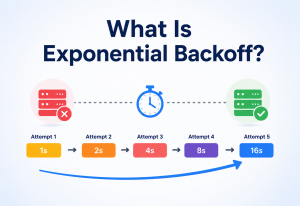
Exponential backoff is a retry strategy where, instead of retrying immediately after a failure, a client waits progressively longer between each attempt — and that waiting time roughly doubles (or grows by some other multiplying factor) with each consecutive failure. Attempt 1 fails, wait 1 second. Attempt 2 fails, wait 2 seconds. Attempt 3 fails, wait 4 seconds. Attempt 4 fails, wait 8 seconds — and so on. The word “exponential” refers to this doubling pattern, which mathematically is an exponential function of the retry count.
A Short History
The concept traces back to the earliest computer networks. In 1970, Ethernet’s inventor Robert Metcalfe and his colleagues at Xerox PARC faced a very literal version of this problem: multiple computers sharing a single physical cable would sometimes transmit data at the same instant, causing their signals to collide and corrupt each other. The fix, formalised as Binary Exponential Backoff in the Ethernet protocol (and later standardised in IEEE 802.3), had each computer wait a random, exponentially growing amount of time before retrying after a collision — spreading out the retries so the shared cable would not collide endlessly.
This same idea resurfaced constantly as computing scaled up: TCP itself uses exponential backoff for retransmission timeouts. DNS resolvers use it when a name server does not respond. As the web grew into distributed systems with thousands of interconnected microservices in the 2000s and 2010s, engineers at companies like Google, Amazon and Netflix rediscovered — sometimes the hard way, through real outages — that naive retry logic without backoff was a leading cause of cascading failures. Google’s Site Reliability Engineering (SRE) book, published in 2016, documents this extensively and helped popularise exponential backoff combined with “jitter” (randomness) as an industry-standard best practice, which the rest of this guide unpacks in detail.
What makes the idea so durable is that it addresses a shape of problem — many independent actors reacting identically to a shared failure — that recurs at every scale of computing, from a shared coaxial cable in a room to a fleet of ten million mobile devices reaching for the same backend. The mechanics change; the underlying mathematics of “spread the reactions out over time so they stop stacking on each other” does not.
Naive Retries Make Failures Worse
Why do we need this at all? What actually goes wrong without it? Naive retries are one of the most reliable ways to turn a brief hiccup into a self-sustained outage — and understanding exactly how is the motivation for everything that follows.
The problem: naive retries amplify failure
Retrying a failed request seems like an obviously good idea — networks are unreliable, servers occasionally hiccup, and often the very next attempt succeeds just fine. The trouble starts when we ask: what happens when many clients retry at the same time, immediately, with no delay?
Let us build intuition with numbers. Suppose a backend service normally handles 1,000 requests per second comfortably. It briefly slows down — maybe a database it depends on is under load — and starts timing out for 5 seconds. Every client with an in-flight request sees a failure and, following naive retry logic (“if it fails, try again right now”), immediately fires a second request. Now the service is not just receiving its normal 1,000 requests per second — it is receiving 2,000 (the normal traffic plus the retries), right at the moment it was already struggling. Some of those fail too, triggering a third wave, then a fourth. Very quickly, the “retry traffic” dwarfs the original traffic, and the service — which might have recovered on its own in a few seconds — is now buried under a self-inflicted avalanche it can never dig out of. This runaway feedback loop is exactly what is meant by a retry storm.
A retry storm is a positive feedback loop: failures cause retries, retries cause more load, more load causes more failures, which causes even more retries. Without something to break that loop, the system can remain in an overloaded, failing state indefinitely — even long after the original root cause (say, a brief database hiccup) has been fixed — because the retry traffic itself has become the new root cause.
Real motivating scenario
Picture a mobile app with ten million installed devices, all periodically checking in with a backend API. If that backend API has a two-minute outage during a deployment, all ten million devices’ next check-in attempt fails around the same time. If every device is coded to simply retry every 5 seconds until it succeeds, the moment the backend comes back online, it gets hit with a synchronised wall of ten million near-simultaneous requests — a self-inflicted denial-of-service attack, caused entirely by well-meaning retry logic. This is not a hypothetical: many real production outages have been caused or dramatically prolonged by exactly this pattern.
Exponential backoff attacks this problem directly on two fronts: it spreads retries out over increasingly longer intervals (reducing how much simultaneous load hits the recovering service), and — combined with randomness (“jitter,” covered in Section 03) — it desynchronises clients so they are not all retrying in lockstep. Together, these give a struggling service breathing room to actually recover instead of being re-overwhelmed the instant it shows signs of life.
It is worth being explicit that this is a problem you almost cannot see coming from a small-scale test. One or two developers hammering a service from a laptop will happily test naive retries and see no ill effects, because two synchronised retries add nothing meaningful to normal load. The failure mode only appears once the client population is large enough that its own retry behaviour becomes a first-class source of traffic in its own right — a threshold that is invisible on a developer’s machine and unmissable on a busy production day.
The Vocabulary of Retry Behaviour
Let us define every term carefully before going further. Each of these words shows up in retry libraries, design documents, and post-mortem write-ups — and small differences between them matter a great deal in practice.
Retry
A retry is simply re-attempting an operation that just failed, on the assumption the failure might be temporary (a “transient” failure) rather than permanent.
Backoff
Backoff means waiting before that retry, rather than retrying instantly. The core insight: a failure often means the target system is under stress, so retrying immediately adds to that stress at the worst possible moment. Waiting gives the system time to recover.
Exponential backoff, defined precisely
Exponential backoff calculates the wait time before attempt n using a formula like:
delay = base_delay × (multiplier ^ attempt_number)
e.g. with base_delay = 1s and multiplier = 2: 1s, 2s, 4s, 8s, 16s, 32s…
The delay grows exponentially, not linearly — the difference matters a lot. Linear backoff (1s, 2s, 3s, 4s…) grows slowly and can still allow a lot of retry pressure to build up. Exponential backoff (1s, 2s, 4s, 8s, 16s…) very quickly spreads attempts far apart, dramatically reducing sustained pressure on a struggling system after just a handful of failures.

Jitter
Jitter means adding randomness to the backoff delay so that many clients who failed at the same moment do not all retry at the same moment again. Without jitter, exponential backoff alone can still produce “thundering herd” waves — just spaced further apart in time, with all clients still perfectly synchronised within each wave. Jitter breaks that synchronisation by randomising the exact wait time within (or around) the calculated exponential window.
Exponential backoff without jitter is like telling every person in a crowded room “everyone leave in exactly 4 minutes” — they still all get up and leave in one synchronised clump, just later. Jitter is like telling each person “leave sometime between 2 and 6 minutes from now” — the crowd trickles out gradually instead of surging all at once.
Common jitter strategies
| Strategy | How It Works | Notes |
|---|---|---|
| Full Jitter | Wait a random duration between 0 and the calculated exponential delay. | Simple, highly effective at spreading load; recommended by AWS’s architecture blog as a strong default. |
| Equal Jitter | Wait half the calculated delay, plus a random amount up to the other half. | Guarantees some minimum wait, less aggressive spreading than full jitter. |
| Decorrelated Jitter | Each delay is randomised based on the previous delay, rather than purely on attempt count. | Produces good spread while still trending upward over time. |
Retry storm / thundering herd
As introduced above, a retry storm (a specific case of the broader “thundering herd” problem) is the runaway condition where synchronised, unthrottled retries from many clients overwhelm a system, often preventing recovery even after the original issue is resolved.
Maximum retry count and maximum delay cap
Exponential growth is powerful, but unbounded, it eventually produces absurd wait times (minutes, then hours). Production systems always define a maximum delay cap (e.g. never wait longer than 30 seconds) and a maximum retry count (e.g. give up after 5 attempts), after which the caller stops retrying and surfaces a clear failure instead of waiting indefinitely.
Idempotency
An operation is idempotent if performing it multiple times has the same effect as performing it once. Retrying only makes sense to do safely if the underlying operation is idempotent (or made idempotent via a unique request/idempotency key) — otherwise a retry after an ambiguous failure (did the first attempt actually succeed before the response was lost?) risks duplicate effects, like charging a customer’s card twice.
Why “exponential” specifically, and not some other growth curve?
It is worth pausing on why exponential growth, rather than, say, linear growth (adding a fixed amount each time) or a fixed constant delay, became the standard choice. The answer is about how quickly each option spreads load relative to how quickly it “gives up” on responsiveness.
| Growth Pattern | Delay Sequence (base=1s) | Behaviour |
|---|---|---|
| Constant | 1s, 1s, 1s, 1s, 1s… | Never adapts — if the system is still overloaded at attempt 5, it gets hit exactly as hard as at attempt 1. |
| Linear | 1s, 2s, 3s, 4s, 5s… | Adapts slowly — takes many attempts before delays become meaningfully large, so pressure stays elevated for longer. |
| Exponential | 1s, 2s, 4s, 8s, 16s… | Adapts quickly — within just a handful of attempts, delays become large enough to meaningfully relieve pressure on the target system. |
Exponential growth strikes a useful balance: it stays responsive for the first attempt or two (when the failure might genuinely be a one-off blip worth recovering from quickly), but rapidly backs off if the failure persists, which is exactly the behaviour you want when you do not know in advance whether you are dealing with a one-millisecond network hiccup or a five-minute outage.
Choosing the multiplier and base delay
The base delay sets the starting point (how long to wait after the very first failure), and the multiplier controls how aggressively the delay grows with each subsequent attempt. A multiplier of 2 (doubling) is the most common default, inherited directly from the original Ethernet backoff algorithm, but some systems use gentler multipliers (like 1.5x) for latency-sensitive interactive calls, or steeper ones for background batch jobs where user-perceived latency does not matter as much and protecting the downstream system matters more.
Choosing the base delay and multiplier is like deciding how apologetic to be after bumping into someone. A very small base delay says “sorry, my bad” and tries again almost immediately, appropriate if the bump was clearly nothing. A larger multiplier says “let me give you plenty of space before I come anywhere near you again,” appropriate when you suspect you have genuinely knocked them over and they need real time to recover.
Making Retry Logic Safe System-Wide
Zooming out from a single retry to the pieces that make retry logic safe across a whole system — retry policy, retry wrappers, circuit breakers, and server-side defences all working as a single, coordinated set of safeguards.
Retry Policy
The configuration defining backoff base delay, multiplier, jitter strategy, max attempts and max delay cap — usually attached to a specific type of client call.
Client-side Retry Wrapper
Code (often a library like Resilience4j, Spring Retry, or a service mesh sidecar) that wraps outgoing calls and automatically applies the retry policy on failure.
Circuit Breaker
A companion mechanism that stops calls entirely once failures cross a threshold, rather than continuing to retry a service that is clearly down (detailed in Section 09).
Server-side Load Shedding
The receiving service’s own defences — rate limiting, request queues with bounded size, and priority-based rejection — which work together with client-side backoff.
Where retry logic lives
Retry-with-backoff logic can live at several layers, often simultaneously: inside application code (explicit try/catch loops), inside HTTP client libraries (many modern HTTP clients support built-in retry policies), inside a service mesh sidecar (like Envoy in Istio, which can apply retry policies transparently without any application code changes), or inside message queue consumers (redelivery with backoff for failed message processing).
Minimal Java example: manual exponential backoff with jitter
import java.util.concurrent.ThreadLocalRandom;

public class BackoffRetry {

    public static String callWithBackoff(Callable<String> operation) throws Exception {
        int  maxAttempts = 5;
        long baseDelayMs = 200;
        long maxDelayMs  = 10_000;

        for (int attempt = 1; attempt <= maxAttempts; attempt++) {
            try {
                return operation.call(); // try the actual work
            } catch (Exception e) {
                if (attempt == maxAttempts) throw e; // give up, surface the failure

                // exponential delay, capped, with full jitter
                long exponentialDelay = Math.min(maxDelayMs, baseDelayMs * (1L << attempt));
                long jitteredDelay    = ThreadLocalRandom.current().nextLong(0, exponentialDelay);

                System.out.println("Attempt " + attempt + " failed, retrying in "
                    + jitteredDelay + "ms");
                Thread.sleep(jitteredDelay);
            }
        }
        throw new IllegalStateException("unreachable");
    }
}
This snippet is small on purpose — the operating pieces of exponential backoff really are just those few lines: an attempt counter, a capped exponential delay, a jittered random pick within it, and a hard stop when attempts are exhausted. Every mature retry library ultimately implements the same shape, wrapped in richer configuration and metrics.
Step-by-Step, What Actually Happens on Failure
What actually happens, step by step, when a call fails and backoff kicks in? Each of the six steps below is where a real production system either does the right thing or quietly plants the seed of an incident.
- Attempt: The client makes a call to the target service.
- Failure classification: The client checks whether the failure is retryable. Not all failures should be retried (more on this below) — a “bad request” error will never succeed no matter how many times it is retried, but a “timeout” or “503 Service Unavailable” often will.
- Delay calculation: If retryable, the client computes the next delay:
base_delay × multiplier^attempt, capped at a maximum, then applies jitter to randomise the exact value. - Wait: The client sleeps (or, in async systems, schedules a callback) for that delay — without blocking other unrelated work, ideally (tying back to asynchronous processing principles).
- Retry: After the delay, the client attempts the call again.
- Repeat or stop: Steps 2–5 repeat until either the call succeeds, a non-retryable failure occurs, or the maximum attempt count is reached — at which point the client gives up and surfaces a final failure to its own caller.
Which failures should be retried?
| Failure Type | Retry? | Why |
|---|---|---|
| Network timeout | Yes | Often transient — packet loss, brief congestion. |
| HTTP 503 Service Unavailable | Yes | Server explicitly signalling temporary overload. |
| HTTP 429 Too Many Requests | Yes, respecting Retry-After | Server explicitly asking the client to slow down. |
| HTTP 500 Internal Server Error | Cautiously | Could be transient or a persistent bug — often retried a small number of times. |
| HTTP 400 Bad Request | No | The request itself is malformed; retrying sends the same broken request again. |
| HTTP 401 / 403 (auth errors) | No (not without fixing credentials) | Retrying with the same bad credentials will never succeed. |
| HTTP 404 Not Found | No | The resource does not exist; retrying will not create it. |
Blindly retrying every failure type — including client errors like 400 or 404 — wastes resources on calls that can never succeed and adds needless load to an already-struggling service. Always classify failures before deciding to retry.
Respecting server-provided hints: Retry-After
Many APIs return an explicit Retry-After HTTP header when rejecting a request (particularly with 429 or 503 responses), telling the client exactly how long to wait. A well-behaved retry client should honour this hint when present, rather than blindly applying its own exponential formula — the server often has better information about its own recovery time than the client does.
One Request, Followed From First Attempt to Final Outcome
Let us trace one request through its full retry lifecycle, from first attempt to final outcome — and then zoom out to see the same lifecycle running across a whole population of clients at once.

What happens system-wide, not just for one client
Zooming out from a single client’s lifecycle to the whole population of clients calling a struggling service reveals why backoff and jitter matter so much collectively, not just individually:
- Onset of failure: The service begins failing or slowing (e.g. a downstream dependency degrades).
- Wave 1: All currently in-flight requests fail around the same time.
- Backoff dispersion: Each client independently computes a jittered delay before its next attempt — because of jitter, these delays are spread across a range rather than landing on the same instant.
- Wave 2, dispersed: Retries trickle in over a window of time instead of arriving as a single spike, giving the service a chance to process a manageable rate of both new and retried traffic.
- Gradual recovery: As the service catches up, an increasing fraction of both new requests and retries succeed.
- Convergence: Clients that succeeded stop retrying; only the shrinking minority still failing continue backing off, at ever-longer intervals, applying vanishing additional load.
Think of water draining from a sink through a small pipe. Dumping the whole sink at once (no backoff) floods over the sides. Pouring it back in a slow, staggered trickle (backoff with jitter) lets the same total amount of water drain through the same small pipe without ever overflowing.
What You Gain, What You Give Up
Exponential backoff earns its place by preventing self-inflicted outages, but nothing comes for free — the trade-offs are as important to name as the benefits.
Advantages
- Prevents retry storms: the central benefit — spreads out retry traffic so it does not compound into an overwhelming spike.
- Gives failing systems room to recover: reduced sustained pressure means a struggling service can actually catch up rather than being permanently re-overloaded.
- Improves overall success rate: counter-intuitively, individual requests often succeed more often under backoff than under aggressive immediate retrying, because the target system is not perpetually drowning.
- Simple to implement: the core algorithm is a few lines of code, and mature libraries exist in virtually every language.
- Composable: works well alongside circuit breakers, rate limiting, and load shedding as part of a broader resilience strategy.
Disadvantages
- Increased latency for the caller: waiting between retries means a failing request takes longer to either succeed or definitively fail, compared to failing fast with no retries at all.
- Does not fix the underlying problem: backoff manages symptoms of overload; it does not address why the service is struggling in the first place.
- Can mask persistent issues: if a dependency is truly down (not transient), retries with backoff just delay the inevitable failure, potentially hiding a real problem from users and monitoring for longer than a fail-fast approach would.
- Requires careful tuning: too aggressive (small base delay, high multiplier growth without enough cap) barely helps; too conservative (very long delays) frustrates users waiting on a request that could have succeeded sooner.
- Compounds across a call chain: if service A retries calls to service B, which itself retries calls to service C, delays and retry counts can compound unpredictably (see “retry amplification” in Section 14).
Trade-off summary
| Dimension | No Retries | Immediate Retries | Exponential Backoff + Jitter |
|---|---|---|---|
| Resilience to transient failures | Poor — any blip becomes visible failure | Good, until load spikes | Good, and stable under load |
| Risk of retry storm | None | High | Low |
| Latency on failure | Lowest (fails immediately) | Low per attempt, but many attempts fast | Higher per full retry sequence |
| Load on recovering service | N/A | Very high, synchronised | Spread out, manageable |
How Backoff Changes System-Wide Load
How does backoff behaviour actually change system-wide load, quantitatively? The answer is where most of exponential backoff’s reputation is earned — not from a single client’s perspective, but from the shape of load a struggling service actually sees.
Modelling the storm
Suppose N clients are all calling a service, and the service fails for a brief window, causing all N to experience a failure at roughly the same time. Under naive immediate retry, all N clients present their retry at essentially the same instant — the service sees a spike of roughly N extra requests concentrated in a very narrow time window, on top of its normal traffic. If N is large (thousands to millions, as in the mobile-app example from Section 02), this spike can be many multiples of the service’s normal capacity.
Under exponential backoff with full jitter, each client’s retry time is a random value drawn from a widening window (0 to base × 2^attempt). Statistically, this spreads those N retries across an increasingly wide interval instead of a single instant — the same N requests are now smoothed into something much closer to the service’s steady-state capacity, rather than one spike, dramatically reducing peak concurrent load even though total request volume over time is similar.
Why jitter is not optional at scale
It is worth being explicit about a subtlety: exponential backoff without jitter still produces synchronised waves — just spaced further apart (all clients that failed together will also all retry together, at 1s, then all together again at 2s, then all together again at 4s, and so on). At small scale this might be fine, but at scale (thousands+ of concurrent clients), each of those synchronised waves is itself a mini retry-storm. Google’s SRE guidance and AWS’s well-known “Exponential Backoff and Jitter” architecture blog post both emphasise that jitter, not just exponential growth, is the critical ingredient for preventing storms at real production scale.
| Strategy | Peak Concurrent Retry Load | Notes |
|---|---|---|
| Immediate retry, no backoff | Very high — full N at once | Prone to storms; can prevent recovery entirely. |
| Fixed delay, no jitter (e.g. always wait 2s) | High — full N, just delayed | Storm still happens, just later. |
| Exponential backoff, no jitter | Moderate — N per wave, waves spread further apart over time | Better, but still synchronised within each wave. |
| Exponential backoff + full jitter | Low — N smoothed across a growing window | Best practice; avoids synchronised waves entirely. |
Effect on overall system scalability
From a scalability standpoint, well-tuned backoff-with-jitter effectively decouples a client population’s retry behaviour from the target service’s real-time capacity — instead of retry volume scaling in lockstep with failure events (a dangerous positive feedback loop), it scales down automatically as attempt counts grow, self-limiting exactly when the target service needs relief the most. This means a system with well-implemented backoff can gracefully absorb transient dependency failures that would otherwise require significantly more spare capacity (over-provisioning) just to survive the retry spike, not the original load.
During large-scale outages (e.g. a major cloud provider region degrading), services that implement backoff with jitter typically recover within minutes once the root cause is fixed. Services relying on naive immediate retries have historically taken much longer to recover — sometimes requiring engineers to manually throttle traffic or take services offline entirely just to let the retry storm subside, because the storm itself, not the original issue, becomes the blocker to recovery.
A worked numeric example
Let us put concrete numbers on the intuition above. Suppose a service can comfortably handle 500 requests per second, and a dependency outage causes 5,000 concurrent clients to fail at the same instant.
- Immediate retry: All 5,000 clients retry within roughly the same second. Against a 500 req/s capacity, that is a 10x overload spike. Most of those retries fail too, and — with no delay — they retry again within the next second, sustaining the 10x overload indefinitely until something (an engineer, a circuit breaker, or client timeouts) intervenes.
- Exponential backoff, no jitter: All 5,000 clients wait ~1s, then retry together — still a 5,000-request spike in one second, a 10x overload, but now it also repeats at ~2s, ~4s, ~8s, etc., rather than every second. The service gets brief windows of relief between waves, but each wave is still large enough to potentially fail outright.
- Exponential backoff with full jitter: Each of the 5,000 clients picks a random retry time somewhere between 0 and their exponential window. On the first retry round (window 0–1s), those 5,000 attempts are spread across a full second — roughly 5,000 requests/second of added retry traffic, still above the 500 req/s baseline, but as attempts increase and windows widen (0–2s, 0–4s, 0–8s…), that same population spreads across ever-wider windows, quickly dropping well under the service’s 500 req/s capacity within just a few rounds.
The key mathematical insight: jitter turns a spike (a large number of events concentrated at one instant) into a spread (the same number of events distributed across an interval), and each successive exponential round widens that interval further, so the effective “requests per second” contributed by retries shrinks geometrically even though the total count of clients retrying stays the same.
Backoff Is One Piece of a Larger Toolkit
Backoff is one piece of a larger reliability toolkit. On its own it prevents storms; combined with circuit breakers, bulkheads, timeouts, and retry budgets, it becomes part of a genuine defence-in-depth strategy for high availability.
Circuit breakers
A circuit breaker tracks the failure rate of calls to a dependency. Once failures cross a threshold, the circuit “opens,” and further calls fail immediately (or return a fallback) without even attempting the network call — for a cooldown period. This complements backoff: backoff spaces out individual retries, while a circuit breaker stops the retry loop altogether once it is clear the dependency is genuinely down, avoiding wasted attempts and reducing load on the failing service to essentially zero during its worst moments.
Bulkheads
A bulkhead pattern isolates resources (e.g. separate thread pools or connection pools per downstream dependency) so that retries piling up against one failing dependency cannot exhaust resources needed to serve calls to other, healthy dependencies — named after the watertight compartments in a ship’s hull that stop one breach from sinking the whole vessel.
Timeouts
Every retryable call needs an explicit timeout. Without one, a slow (but not fully failed) dependency can hold connections and threads indefinitely, and the retry logic never even gets a chance to kick in because the original attempt never technically “fails” — it just hangs.
Retry budgets
A retry budget caps the overall proportion of a service’s total request volume that is allowed to be retries (e.g. “retries may never exceed 10% of total traffic”). If exceeded, the system stops issuing new retries even if individual clients would otherwise want to, protecting the whole system from cumulative retry load regardless of how well-tuned any single client’s backoff is.
Relying on exponential backoff alone, with no circuit breaker and no retry budget, still allows a slow, sustained trickle of load against a service that is fully down — not enough to cause a storm, but enough to prevent it from ever fully quieting down and completing its recovery, especially if the client population is very large.
Hedged requests: the opposite problem, briefly
It is worth noting a related but distinct pattern that sits at the opposite end of the spectrum from backoff: hedged requests, where a client proactively sends a second request to a different backend instance before the first has even failed, simply because it is taking longer than expected — used to reduce tail latency in systems where a small number of requests randomly get “stuck” behind a slow server. Hedging is deliberately not a failure-triggered retry, and it is typically used sparingly (e.g. only after waiting for the 95th-percentile expected latency) precisely because used carelessly, it has the same storm-inducing potential as an immediate retry — it adds load rather than removing it. The two patterns solve different problems: backoff reduces load after failure; hedging trades a small amount of extra load for lower tail latency during otherwise-healthy operation.
Retry Logic Has a Security Surface
Retry logic has a few security implications worth knowing. Reliability code is not usually thought of as a security surface — but it very much is one, and attackers who understand retry patterns can weaponise them.
- Retries as an amplification vector: an attacker can deliberately trigger failures (e.g. sending malformed requests that cause 5xx errors) specifically to induce large populations of legitimate clients to retry, weaponising the client base’s own resilience logic into a denial-of-service amplifier against the backend.
- Credential/token retry leaks: retrying authenticated calls means the same credentials or tokens are transmitted multiple times; ensure retries do not inadvertently log sensitive request bodies or headers on each attempt.
- Idempotency keys must be unguessable and scoped: when using idempotency keys to make retries of non-idempotent operations (like payments) safe, the keys must be generated securely and validated server-side, or an attacker could reuse or predict a key to interfere with another user’s request.
- Respecting Retry-After to avoid being blocked: ignoring server-provided backoff hints and retrying too aggressively can trigger IP-based rate limiting or temporary bans from the target service, which is both a reliability and, in shared-infrastructure contexts, a security/abuse concern.
- Denial-of-wallet risk: in cloud/serverless environments billed per invocation, an uncontrolled retry storm against your own downstream managed services (e.g. a database or third-party API billed per call) can translate directly into a large, unexpected cost — sometimes called a “denial-of-wallet” attack when triggered maliciously.
Treat retry policy the same way you treat rate limits — as a first-class piece of the security posture, not just a reliability tweak. A missing cap on retries is functionally a missing rate limit on your own outbound calls.
Retry Behaviour Needs Its Own Visibility
Retry behaviour needs its own visibility — it is easy for a growing retry storm to hide inside otherwise-normal-looking traffic graphs until it is severe.
| Metric | Why It Matters |
|---|---|
| Retry rate (retries as % of total requests) | A sudden spike is often the earliest signal of a downstream problem, sometimes before error rates alone make it obvious. |
| Retry count distribution (attempt 1 vs. attempt 2 vs. attempt 3…) | Reveals whether most calls succeed quickly or are grinding through many attempts — a sign of a struggling dependency. |
| Circuit breaker state changes | Frequent open/close cycling (“flapping”) indicates an unstable dependency or poorly tuned thresholds. |
| End-to-end latency including retries | The user-perceived latency, which can balloon even when each individual attempt is fast, simply due to backoff wait time accumulating. |
| Final failure rate (after all retries exhausted) | The truest measure of user-facing reliability — distinct from the transient per-attempt failure rate. |
Alerting on retry rate, not just error rate
A subtle but important practice: alert on retry rate as its own signal, not only on raw error rate. A service can have a perfectly normal-looking success rate while its retry rate silently climbs — because retries are successfully masking a growing number of first-attempt failures. By the time raw error rate visibly spikes, the retry storm may already be well underway.
Watching only the final success rate during a growing retry storm is like judging a ship’s safety only by whether it is still floating, while ignoring that it is taking on water and the pumps are working harder and harder to keep up. The pump effort (retry rate) is the leading indicator; sinking (final failure) is the lagging one.
How Retry-With-Backoff Ships in Real Infrastructure
How is retry-with-backoff actually deployed and configured in real infrastructure? Increasingly, the answer is “centrally, at an infrastructure layer,” rather than hand-rolled in every application.
Service mesh-level retries
In Kubernetes environments using a service mesh (Istio, Linkerd), retry policies — including backoff, jitter and max attempts — can be configured declaratively at the infrastructure layer, applying uniformly across services without every team needing to hand-roll retry logic in application code. This centralisation also makes retry budgets and circuit breaking easier to enforce consistently.
apiVersion: networking.istio.io/v1beta1
kind: VirtualService
metadata:
  name: payment-service
spec:
  hosts:
    - payment-service
  http:
    - route:
        - destination:
            host: payment-service
      retries:
        attempts: 4
        perTryTimeout: 2s
        retryOn: 5xx,reset,connect-failure
Cloud SDK built-in retry policies
Major cloud SDKs (AWS SDK, Google Cloud client libraries, Azure SDK) ship with exponential backoff and jitter enabled by default for their own API calls — a strong signal of how foundational this pattern is considered at scale. AWS’s SDKs, for instance, default to a capped exponential backoff with jitter for retryable errors like throttling responses.
Managed API gateways and throttling
API gateways (AWS API Gateway, Kong, Apigee) often return standard 429 responses with Retry-After headers when rate limits are hit, expecting well-behaved clients to back off accordingly — deployment-time rate limit configuration and client-side backoff need to be designed together, not independently.
Feature flags and dynamic tuning
Mature systems sometimes expose retry policy parameters (max attempts, base delay) as dynamically adjustable configuration (via a feature-flag or config service) rather than hardcoded values, so operators can tighten retry behaviour in real time during an incident without redeploying code.
Backoff Beyond the Application Tier
Retry-with-backoff is not just an application concern — the data layer and the traffic layer each interact with it in ways that can either amplify or absorb pressure on a struggling system.
Database connection retries
Database drivers frequently implement their own backoff for transient connection failures (e.g. a brief network blip to the database, or a failover event in a managed database cluster). Without backoff here, a database failover — already a stressful moment for the cluster — can be made significantly worse by every application instance hammering reconnection attempts simultaneously.
Caching as a backoff complement
Serving slightly stale data from a cache during a downstream failure (rather than retrying the live call repeatedly) is often a better user experience and a lighter load strategy than aggressive retrying. This is sometimes called “stale-while-revalidate”: serve the cached value immediately, and asynchronously attempt (with backoff) to refresh it in the background.

Load balancers and retry interaction
An important, often-overlooked interaction: if a load balancer sits in front of multiple backend instances, and a client retries a failed call, the retry should ideally be routed to a different healthy instance, not blindly back to the same possibly-still-struggling one. Load balancer health checks and connection draining help ensure retries land on instances more likely to succeed.
If a load balancer retries a failed request to a backend (say, 2 attempts), and that backend’s own client library retries its database call (say, 3 attempts), a single logical operation can silently balloon into up to 6 actual database calls. Multiply this across several hops in a microservices call chain, and total retry volume can grow multiplicatively, not additively — a serious, easy-to-miss scalability hazard.
Retry Behaviour Across a Chain of Services
In a microservices architecture, retries stop being a per-client concern and become a distributed one — the same policy applied naively at every hop can multiply into a load pattern nobody planned for.
Designing retry-friendly APIs
API providers can make life much easier for their clients’ retry logic by: returning clear, distinct status codes for retryable vs. non-retryable failures; including a Retry-After header whenever throttling or temporarily rejecting requests; and supporting idempotency keys for unsafe operations (like POST /payments) so clients can retry them safely.
Retry amplification across microservice chains
As introduced in Section 13, in a chain of microservices (A calls B calls C calls D), if every hop independently retries with its own policy, a single failure deep in the chain (at D) can trigger a multiplicative retry storm cascading back up through C, B and A — each layer retrying its own call, compounding the total load on D far beyond what any single layer’s retry count would suggest.
The standard mitigation: only retry at one layer of a call chain (typically the outermost, closest to the original caller) and have inner layers fail fast, or explicitly mark retried requests (e.g. via a header) so downstream services know not to retry further, preventing this multiplication.
gRPC and HTTP client retry support
Modern RPC frameworks like gRPC support declarative retry policies as part of service configuration (specifying max attempts, backoff parameters and which status codes are retryable), keeping this logic consistent and centrally configured rather than duplicated ad hoc across every client.
The Toolbox, and What to Keep Out of It
A handful of patterns keep showing up around exponential backoff because they solve real problems — and a handful of anti-patterns keep showing up because they look tempting until they take a system down.
Useful patterns
Exponential Backoff + Full Jitter
The industry-standard default combination (see Sections 03 and 08) for client-side retry timing.
Circuit Breaker
Stops retrying entirely once a dependency is clearly unhealthy, covered in Section 09.
Retry Budget
Caps total retry volume as a fraction of overall traffic, covered in Section 09.
Bulkhead
Prevents retries against one failing dependency from starving resources needed elsewhere.
Idempotency Key
Makes retries of unsafe (non-idempotent) operations, like payments, safe to repeat.
Single-hop Retry
Only one layer in a call chain retries, avoiding the amplification problem from Section 14.
Anti-patterns to avoid
Immediate Retry Loop
- Retrying with no delay at all — the fastest path to a self-inflicted retry storm.
Unbounded Retries
- No maximum attempt count or delay cap — can leave requests retrying for absurdly long periods, or effectively forever.
Backoff Without Jitter at Scale
- As detailed in Section 08, still produces synchronised waves — just less frequent ones.
Retry Everything
- Retrying non-retryable errors (bad requests, auth failures) wastes effort and adds needless load, as covered in Section 05.
Uncoordinated Multi-Layer Retries
- Leads to retry amplification across a microservices call chain, as covered in Section 14.
Retrying Without Timeouts
- A retry policy is meaningless if the underlying call can hang indefinitely before ever technically “failing” and triggering a retry.
The Short, Portable Checklist
Everything above collapses down into a compact, memorable checklist any team can use whenever they touch retry code — regardless of language, framework or scale.
Best practices
- Always use jitter, not just exponential growth — full jitter is a strong, well-tested default.
- Always set a max attempt count and a max delay cap, so retries can never run away indefinitely.
- Classify failures before retrying — only retry errors that are genuinely likely to be transient.
- Honour server-provided
Retry-Afterhints when present, rather than only relying on client-computed delays. - Pair backoff with a circuit breaker so a fully-down dependency stops receiving traffic entirely rather than a slow, endless trickle.
- Retry at only one layer of a call chain where possible, to avoid multiplicative amplification.
- Make retried operations idempotent, or use idempotency keys, especially for anything involving money, inventory, or other side effects.
- Monitor retry rate as a first-class, independent metric, not just final success/failure rate.
Common mistakes
- Assuming a fixed retry delay (“just wait 2 seconds and try again”) is “good enough” — it does not scale-adapt the way exponential backoff does and still produces synchronised waves.
- Forgetting jitter and being surprised when a retry storm still happens “even though we added backoff.”
- Testing retry logic only against a single client in isolation, never simulating what happens when thousands of clients fail and retry simultaneously — the failure mode only appears at scale.
- Not accounting for retry amplification across a multi-hop microservices chain, leading to surprising load multipliers during incidents.
- Retrying operations that are not idempotent without any deduplication mechanism, causing duplicate side effects (double charges, duplicate emails, duplicate orders).
- Setting retry timeouts longer than the caller’s own patience (e.g. a mobile app’s own network timeout), so the retry logic never even gets a chance to complete before the user gives up or the app itself times out first.
Using a mature retry library instead of hand-rolling it
While the manual implementation in Section 04 is useful for understanding the mechanics, production systems generally reach for a well-tested library rather than reimplementing backoff logic from scratch — subtle bugs in hand-rolled retry code (off-by-one attempt counts, forgetting to cap delay, forgetting jitter) are common and hard to notice until they cause an incident. In the Java ecosystem, Resilience4j is a widely used, lightweight library providing retry, circuit breaker, bulkhead and rate limiter modules that compose cleanly together.
RetryConfig config = RetryConfig.custom()
    .maxAttempts(5)
    .intervalFunction(IntervalFunction.ofExponentialRandomBackoff(
        Duration.ofMillis(200),   // base delay
        2.0,                       // multiplier
        0.5))                      // randomisation factor (jitter)
    .retryOnException(e -> e instanceof TransientServiceException)
    .build();

Retry retry = Retry.of("paymentService", config);

Supplier<String> decorated = Retry.decorateSupplier(retry,
    () -> paymentClient.charge(orderId));

String result = decorated.get(); // backoff + jitter handled automatically
Using a shared, well-tested library like this also makes it far easier to apply consistent retry policy across an entire codebase, and to tune parameters centrally (for example, tightening retry budgets fleet-wide during an active incident) without hunting down every hand-written retry loop individually.
Where This Pattern Has Earned Its Place
Exponential backoff is not an academic curiosity — it has been quietly holding real production systems together for more than fifty years. A quick tour of where it shows up, followed by two case studies that make its absence visible.
Ethernet (Xerox PARC / IEEE 802.3)
The original binary exponential backoff, invented in the 1970s to resolve collisions on a shared network cable — the direct ancestor of the pattern used across all of modern distributed computing.
AWS SDKs
AWS’s widely cited “Exponential Backoff and Jitter” architecture blog post formalised full jitter as a best practice, and every major AWS SDK implements capped exponential backoff with jitter by default for retryable API errors like throttling.
Google SRE
Google’s Site Reliability Engineering book dedicates significant discussion to retries and cascading failures, documenting real incidents where naive retry logic across services turned brief degradations into extended, self-sustaining outages — directly motivating retry budgets and jittered backoff as standard practice at Google.
Mobile Push / Check-in Systems
Large mobile platforms (app backends with tens of millions of devices) rely heavily on jittered backoff for periodic check-ins and push token refreshes specifically to avoid synchronised “wake up and call home” spikes after outages or mass app updates.
Case study: a flash-sale e-commerce outage
Consider an e-commerce platform running a flash sale. A surge of legitimate traffic briefly overwhelms the checkout service, causing a wave of timeouts. Client apps, coded with naive immediate retries, resend failed checkout requests instantly. The checkout service, already at its limit, now receives both the tail of the original surge and a wave of retries — its response times degrade further, causing yet more timeouts and yet more immediate retries. Without intervention, this can spiral into a prolonged outage that outlasts the actual flash-sale traffic spike by a wide margin, entirely due to the compounding retry loop.
Retrofitted with exponential backoff and full jitter, the same traffic surge instead produces a first wave of failures, followed by a smoothly rising, gradually widening trickle of retries rather than a second synchronised spike — giving the checkout service’s autoscaling and caching layers time to catch up, and typically resulting in a recovery time measured in a small number of minutes rather than a prolonged, self-inflicted outage.

Case study: DNS resolver storms
DNS provides another classic, widely documented example. When a DNS server briefly becomes unreachable, resolvers across the internet that depend on it will retry their lookups. Early, poorly designed DNS resolver implementations that retried aggressively and in a synchronised fashion have historically contributed to prolonging outages of popular DNS providers — the retry traffic from millions of resolvers effectively became a distributed denial-of-service event against the very server trying to recover. This is part of why DNS protocol guidance and modern resolver implementations explicitly recommend randomised retry intervals, mirroring the same jittered-backoff principle discussed throughout this guide, applied at internet scale rather than within a single company’s infrastructure.
The Questions People Keep Asking
A quick round of the questions that come up most often about exponential backoff — in interviews, in post-mortems, and in design reviews.
Is not retrying immediately better for the user, since it is faster?
For a single, isolated client, immediate retry can feel faster when it works. The problem appears at scale: when many clients all retry immediately after a shared failure, they collectively create the very overload that prevents any of them from succeeding — making things slower and worse for everyone, including that one user, compared to a system with well-tuned backoff that actually recovers.
Is jitter really necessary, or is exponential growth alone enough?
At small scale, exponential growth alone can be adequate. At real production scale (many concurrent clients failing together), backoff without jitter still produces synchronised retry waves — just spaced further apart. Jitter is what actually breaks that synchronisation, and is considered essential best practice by AWS, Google SRE and most production-grade retry libraries.
How many retry attempts should I allow?
There is no universal number — it depends on the operation’s latency budget, how critical success is, and downstream capacity. A common starting point is 3–5 attempts with a delay cap in the range of seconds (not minutes) for interactive, user-facing calls, and potentially more attempts with longer caps for background/asynchronous jobs where the user is not actively waiting.
Should every service implement its own retry logic?
Not necessarily independently at every layer — as covered in Section 14, uncoordinated retries at multiple hops in a call chain can multiply into retry amplification. Centralising retry policy (via a shared library, service mesh, or API gateway) and retrying at a single layer is generally safer than every team implementing ad hoc logic.
Does exponential backoff replace the need for a circuit breaker?
No — they solve related but distinct problems. Backoff spaces out individual retry attempts; a circuit breaker stops attempting entirely once a dependency is clearly unhealthy, avoiding wasted attempts altogether. Production-grade resilience typically uses both together.
What is the difference between a retry storm and a regular traffic spike?
A regular traffic spike is driven by external demand (e.g. more real users). A retry storm is self-inflicted — it is generated by the system’s own clients reacting to failure, and it uniquely tends to compound: more failures cause more retries, which cause more failures, in a way that a simple demand spike does not.
How is exponential backoff different from a rate limit?
A rate limit is a ceiling enforced by the server on how much traffic it will accept from a client (or in total). Exponential backoff is a discipline followed by the client on how often it will retry after a failure. They are complementary: rate limits are the last line of defence when clients are misbehaving; backoff is what keeps well-behaved clients from becoming the misbehaving ones in the first place.
Does backoff make debugging harder?
It can, if retries are silent. A request that eventually succeeds after four hidden failures looks identical to one that succeeded on the first try, unless the retry loop emits its own metrics and logs. That is why Section 11 treats retry rate and attempt-count distribution as first-class metrics — they are what makes retry behaviour observable rather than invisible.
What to Carry Forward
Retrying failed operations is a natural, sensible instinct — but done naively, at scale, it turns into one of the most common self-inflicted causes of prolonged outages: the retry storm. Exponential backoff, especially combined with jitter, is the well-established fix, spreading retries out over time and desynchronising clients so a struggling system gets the breathing room it needs to actually recover.
Key Takeaways
- Immediate, unthrottled retries create a dangerous positive feedback loop: failures cause retries, retries cause more load, more load causes more failures.
- Exponential backoff spaces out each client’s successive retry attempts, growing the wait time geometrically rather than linearly or not at all.
- Jitter — randomising the exact delay — is essential, not optional, at real production scale; without it, synchronised retry “waves” still occur, just less frequently.
- Backoff works best as part of a broader resilience toolkit: circuit breakers, retry budgets, bulkheads, idempotency keys and sensible timeouts all complement it.
- Always classify failures before retrying, cap both attempt count and maximum delay, and be alert to retry amplification across multi-hop service chains.
- The pattern itself dates back to 1970s Ethernet collision handling and has proven durable for over fifty years precisely because the underlying problem — many independent actors reacting identically to a shared failure — recurs at every layer of distributed computing.
A well-tuned retry policy is invisible when things are working, and it is the difference between a two-minute blip and a two-hour outage when something briefly goes wrong. Getting it right is one of the highest-leverage, lowest-cost investments in building genuinely resilient, scalable systems.
If there is one single habit worth carrying forward, it is this: whenever you write, review, or configure retry logic, ask three questions before shipping it. Is there a maximum attempt count and a maximum delay cap, so this can never retry forever? Is there jitter, so many clients failing together will not retry together? And is the operation being retried actually safe to run more than once? If the answer to all three is yes, you have already avoided the vast majority of real-world retry storms — and that is a genuinely rare, high-value guarantee to be able to make about any piece of production code.