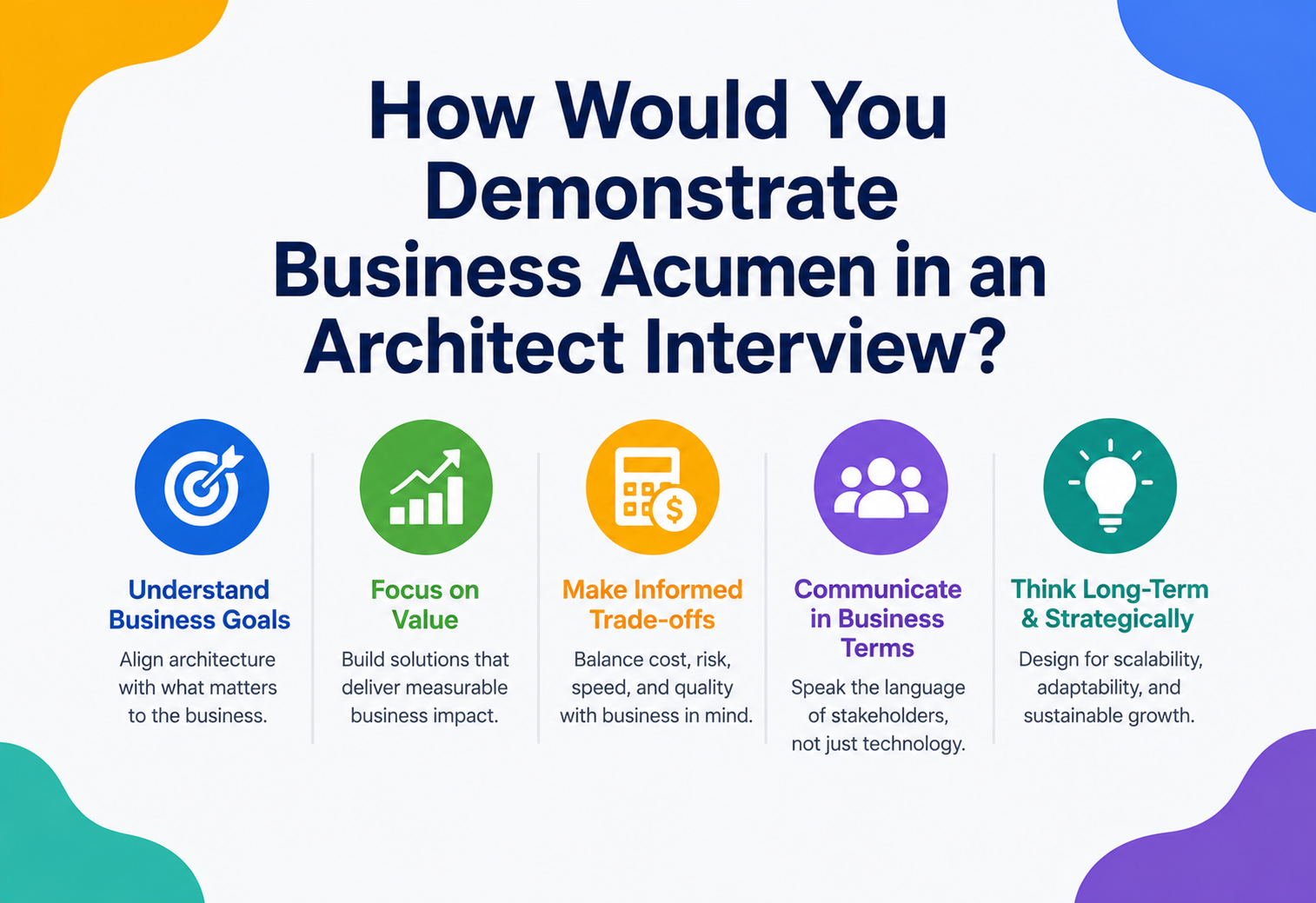
How Would You Demonstrate Business Acumen in an Architect Interview?
A question that sounds like a formality, but quietly separates architects who design systems from architects who are trusted to run a business through a keyboard. Let’s build your answer together, gently.
The Quiet Question in Every Architect Interview
Somewhere in the interview, after you’ve walked confidently through a distributed systems diagram or explained how you’d handle eventual consistency, someone leans forward and asks something quieter, almost casual: “How would you demonstrate business acumen in this role?” And suddenly the ground feels different under your feet.
It’s a fair thing to feel thrown by. Most of us didn’t train to be architects by studying balance sheets. We trained by reading about queues, caches, and consensus algorithms — not payback periods and opportunity cost. So when this question lands, it can feel like being asked, mid-marathon, to also recite a poem. Unrelated. Unfair, almost.
Except it isn’t unrelated at all. Every real architecture decision you’ve ever made — every choice between “build” and “buy,” every extra millisecond of latency you decided was acceptable, every time you told a team “not yet” on a nice-to-have feature — was already a business decision wearing a technical costume. This question is simply asking you to take the costume off for a moment, and show the reasoning underneath.
So let’s take our time here. I want to help you find language for something you likely already do instinctively, so that when this question arrives, you’re not scrambling to invent business sense on the spot — you’re simply describing the version of it you’ve been quietly practicing for years.
I’ve sat across the table from architects who could recite the CAP theorem in their sleep, freeze completely the moment a conversation turned toward cost or customer impact — not because they lacked the judgment, but because nobody had ever asked them to say that judgment out loud before. And I’ve watched the same people, given just a little structure and a few minutes to think, produce answers that were genuinely thoughtful, sometimes better than candidates with formal business training. The instinct is very often already there. This guide is just trying to help you find the words for it.
Why Interviewers Even Ask This
Companies don’t hire architects to admire elegant systems in isolation. They hire architects because complex, expensive decisions need to be made under uncertainty, and someone senior enough needs to own the consequences — not just the diagrams.
Business acumen, in this context, is really a proxy for a handful of very practical worries an interviewer is carrying.
Will you protect the budget?
Will you notice when a technically elegant solution is quietly an expensive indulgence the business can’t afford right now?
Will you translate, not just build?
Can you turn a leadership goal like “grow revenue in Southeast Asia” into an actual architectural priority list?
Will you weigh risk like an owner?
Will you treat the company’s money, reputation, and time the way an owner would — not just as someone executing a spec?
None of this means you need an MBA, or that you should suddenly start dropping finance jargon you don’t fully understand. What it means is that the interviewer is trying to find out whether you see the system you’re designing as connected to something larger — customers, revenue, cost, risk, timing — or whether, in your mind, the system is the whole story.
What’s quietly at stake if this lands poorly
It’s worth being honest about why companies weight this so heavily, especially at the architect level. A junior engineer who lacks business context is a manageable risk — someone senior will usually catch the gap before real money moves. But an architect sits close enough to real decisions that a blind spot here can be expensive in ways that are hard to walk back: a multi-quarter platform investment that never should have been greenlit, a migration that solved an elegant technical problem nobody outside engineering actually had, or a design so focused on theoretical scale that it quietly missed the deadline that mattered to an actual customer contract.
None of this means the interviewer expects you to have single-handedly prevented every bad business outcome in your career. It means they’re listening for whether these considerations are part of how you naturally think, or whether they’re an afterthought you only reach for when someone else raises it first.
The many disguises of the same question
Like most meaningful interview questions, this one rarely shows up wearing its own name. Recognizing its cousins helps you stay grounded no matter how it’s phrased.
- “How do you decide between build versus buy?” — a very literal cost-and-value question dressed as a technical one.
- “Tell me about a time you pushed back on a stakeholder’s request.” — testing whether you can hold a business conversation, not just a technical one, under friction.
- “How would you prioritize a backlog of ten proposed initiatives?” — asking you to reveal your internal model of value versus effort versus risk.
- “What’s the ROI of the last major architectural change you led?” — asking whether you tracked outcomes at all, or just shipped and moved on.
Underneath each version is the same quiet question: do you think in terms of consequences the business actually cares about, or only in terms of systems? Once you see that thread, every variation becomes far less intimidating, because you’re not solving five different puzzles — you’re answering one familiar friend, dressed differently each time.
The Well-Meaning Mistakes People Make
Before we build your answer, let’s gently name a few traps — not to make you anxious, but because naming them usually dissolves most of their power.
1. Reaching for jargon you don’t fully own
Some candidates, sensing the question wants “business language,” start reaching for terms like “synergy,” “value proposition,” or “leverage,” without anchoring them in anything real. Interviewers notice this instantly — buzzwords without a story behind them tend to read as performance rather than substance.
2. Treating it as a finance quiz
On the opposite end, some candidates panic and try to recall formulas — payback period equations, discounted cash flow, that one accounting elective from years ago. Nobody is testing your spreadsheet skills here. They’re testing your instinct for trade-offs, not your ability to compute a net present value on a whiteboard.
3. Talking about cost only in terms of cloud bills
Cost is real and matters, but business acumen is bigger than “I reduced our AWS bill by 30%.” It also includes time-to-market, customer trust, team morale, regulatory exposure, and opportunity cost — the things you didn’t get to build because you built this instead.
4. Forgetting to mention the moments you were wrong
A slightly too-polished answer, where every business call you ever made turned out perfectly, tends to raise a quiet eyebrow. Real business acumen includes the humility of having made a costly call that didn’t pan out, and having learned something durable from it.
You’re not being asked to prove you could run a P&L. You’re being asked to show that when you sit in a room full of engineers, you’re quietly also representing the customer, the budget, and the calendar — even when nobody else in the room is doing that job for you.
A fifth pitfall worth naming, because it is surprisingly common: answering the question the interviewer didn’t ask. If someone asks how you’d demonstrate business acumen, launching into a general career narrative or a detailed technical war story loses the thread. Answer the question that was asked, in the vocabulary of the question that was asked, and only then reach for a story that supports it.
The Mindset Shift: Architect as Translator
Here’s the shift that tends to unlock this whole question: stop thinking of business acumen as a separate skill you’re being tested on, and start thinking of yourself as the translator who stands between two rooms that don’t naturally speak the same language.
In one room, people talk in terms of latency budgets, schema migrations, and technical debt. In the other, people talk in terms of quarterly targets, customer churn, and board expectations. Most engineers are fluent in the first room. Most business leaders are fluent in the second. An architect with real business acumen is one of the few people in the building who can stand in the doorway between both rooms and carry a sentence across, intact, in both directions.
That reframing matters because it turns “prove your business acumen” from an interrogation into a demonstration you can actually perform live, in the interview itself — by simply translating one of your own technical stories into terms the business side of the table would immediately understand.

What this shift actually sounds like
“We migrated from a monolith to microservices, which improved our deployment frequency and reduced coupling between services.”
“We broke the monolith apart because our release cycle had slowed to once a month, and competitors were shipping weekly. After the migration, we went from monthly releases to several a week — which meant customer-requested fixes that used to take four weeks to reach production now shipped in days.”
Notice that the underlying technical work is identical in both versions. The second one simply keeps translating the “so what” for a listener who cares about customers and competitors, not just coupling and deployment pipelines. That habit of continuously translating — even when nobody in the room asked you to — is most of what business acumen looks like in practice.
The Four Currencies of Business Acumen
Whatever story you tell in this interview, it will land more convincingly if it visibly trades in one or more of four currencies that every business, regardless of industry, actually cares about. You don’t need to name them out loud — but if your story clearly touches at least one, the interviewer’s ears will perk up.
Money
Cost saved, cost avoided, revenue enabled, or capital freed up for something else.
Time
Speed to market, hours of manual work eliminated, or how quickly the business can now respond to change.
Risk
Outages avoided, compliance exposure reduced, or a single point of failure quietly removed before it became a headline.
Trust
Customer confidence, internal stakeholder confidence, or the credibility your engineering org has with the rest of the business.
Strong candidates often weave two currencies into the same story — for example, a decision that cost a little more money up front (Money) but removed a recurring risk of data loss (Risk), and did so in a way that let the sales team finally promise a service-level agreement they’d been afraid to offer before (Trust). You don’t need all four in one story. Even one, clearly named, moves your answer from “technical anecdote” to “business decision.”
A useful mental habit: after describing any technical outcome, silently ask yourself which of the four currencies it moved. If none of them shifted, the story is probably better saved for a purely technical question. If two shifted at once, it’s almost certainly your best material for this one.
A Gentle Framework: Context, Cost, Consequence, Communication
Think of this less as a rigid formula, and more as a shape to lean on when you’re organizing your thoughts under a bit of pressure.
Context — what business problem were you actually solving?
Before any technical detail, name the business situation plainly: a slow release cycle losing ground to competitors, a costly infrastructure bill eating into margins, a compliance deadline with real financial penalties attached. This single sentence tells the interviewer you knew why the work mattered before you knew how to do it.
“Our checkout service was going down during every major sale event, and each hour of downtime was costing the business a very real, calculable amount in lost transactions.”
Cost — what did the options actually cost, in more than one currency?
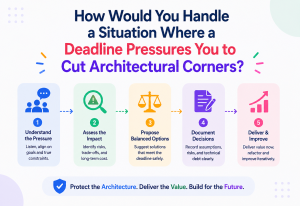
Briefly acknowledge that you weighed more than one path, and that each path had a real cost — in money, time, risk, or team capacity. This is where genuine business thinking becomes visible: showing that “the best technical solution” and “the right business decision” aren’t always the same sentence, and that you noticed the difference.
Consequence — what happened, and how do you know?
Name the outcome in terms the business itself would recognize and celebrate — revenue protected, incidents avoided, hours saved, a deal that closed because the platform could finally support it. If you can, mention how you or the business actually measured this; a vague “it went well” is far less convincing than “we tracked a specific metric before and after.”
Communication — how did you bring others along?
Close by naming, briefly, who you had to convince, and how. Architecture decisions with real business weight rarely happen in isolation — they involve a finance stakeholder, a product leader, a nervous VP. Showing that you carried the decision through a room of people, not just through a design document, is often the most convincing evidence of all.
Context proves you understood the “why” before the “how.” Cost proves you actually weighed trade-offs instead of picking the first clever idea. Consequence proves the decision mattered in the real world, not just on a whiteboard. Communication proves you can carry a business decision through actual humans — which is, in the end, most of what senior architecture work really is.
Picture a wooden desk with two objects sitting side by side. On the left, an open ledger, its pages ruled with faint green lines, columns of small figures adding themselves up in quiet order. On the right, an architecture sketch on cream paper, three boxes connected by dashed lines — a service, a database, a queue — the way an engineer would draw them on a whiteboard. Between them, a small stack of gold coins, catching a bit of light. That stack is the point of the illustration: the ledger and the blueprint have always belonged on the same desk, and business acumen is simply the practice of keeping them there together, instead of pretending one is more real than the other.
A Small, Friendly Glossary
You don’t need to become fluent in finance to demonstrate business acumen — but a handful of terms, used comfortably and correctly, can quietly signal that you’re not intimidated by this side of the conversation. Here they are, explained the way I’d explain them to a friend, not a textbook.
Total Cost of Ownership
Not just what something costs to build, but what it costs to run, maintain, and eventually replace. A cheap tool with expensive upkeep often loses to a pricier one that runs itself.
Return on Investment
Roughly: what you got back, compared to what you put in. You don’t need a formula memorized — you need the instinct to ask “was this worth it, and how would we know?”
Opportunity cost
The value of the next-best thing you didn’t get to do, because you chose this instead. Every “yes” to one project is a quiet “not yet” to several others.
Payback period
How long it takes for something’s benefits to outweigh what it cost to build. A migration that saves money starting in month two is a very different conversation than one that pays off in year four.
Technical debt (in business terms)
Not just “messy code” — it’s a loan against future speed. The business is quietly paying interest on it every sprint, whether or not anyone’s tracking it on a balance sheet.
CapEx versus OpEx
Roughly, money spent up front to build or own something (CapEx) versus ongoing operating costs to run or rent it (OpEx). It’s part of why some companies lean toward buying cloud capacity rather than owning hardware — the cost shows up differently on their books, not just differently in your architecture.
Runway
How long a company (or a specific budget) can keep operating before it runs out of money at the current spending rate. An architect with business acumen keeps at least a rough sense of how their decisions affect it, especially at smaller or earlier-stage companies.
You will not need most of these on any given day. Their value in an interview is less about frequency of use and more about signal: knowing that TCO exists as a concept, or that opportunity cost applies to your engineering roadmap the same way it applies to a founder’s time, quietly tells the room that the vocabulary of the other side isn’t a foreign language to you, even if it isn’t your first one.
Sample Answers for Common Scenarios
A few illustrative directions below, written for situations that tend to come up often. As before, please read these the way you’d read someone else’s notes — for the shape and the feeling, not for the exact words to repeat.
The classic “build versus buy” question
“When we needed a customer notification system, my instinct wasn’t ‘let’s build the most flexible version possible’ — it was to ask what the business actually needed in the next two quarters, and whether that need was core to our differentiation or simply table stakes. Since sending notifications reliably wasn’t something that made us unique to customers, we bought a proven vendor solution, which let our own engineers spend that quarter on the recommendation engine that actually drove revenue.”
Pushing back on a stakeholder’s request
“A product leader once asked for real-time inventory sync across all regions within the quarter. Technically possible, but the cost and risk were significant for a feature that, when I asked, only mattered for about eight percent of our customer base. I proposed a near-real-time version — a few minutes of lag instead of true real-time — that cost a fraction as much to build and carried far less operational risk, and walked the product leader through exactly why that trade-off made sense for the business right now. They agreed, and we shipped it in a third of the original timeline.”
Prioritizing a crowded backlog
“When I inherited a backlog of a dozen proposed architectural initiatives, I didn’t start with what was most technically interesting. I sat down with the business goals for the year, mapped each initiative against them, and was honest that a couple of technically elegant ideas simply didn’t move any needle the business currently cared about. We deprioritized those, and focused the team’s energy on the three initiatives that most directly supported the company’s stated growth goals — which made the roadmap conversation with leadership refreshingly short.”
Explaining a technical risk to non-technical leadership
“I once had to tell our executive team that our authentication service had a single point of failure that could take down login for the entire platform during peak hours. Rather than describing the architecture, I framed it the way they’d think about it: ‘right now, a single hardware failure could mean every customer is locked out during our busiest sales window, for however long it takes us to recover.’ That framing got the remediation work funded within a week, something a purely technical explanation had failed to do for two prior quarters.”
This direction is a good one to have ready because it shows a specific, often-overlooked business acumen skill: knowing how to make a technical risk felt by people who don’t live inside the system every day, without resorting to fear-mongering or oversimplifying the underlying problem.
Owning a decision that didn’t pan out
“I once recommended a fairly aggressive cost-cutting move on our infrastructure that looked great on paper, but underestimated how much manual engineering time it would take to maintain afterward. Within two quarters, it was clear the maintenance burden had quietly eaten most of the savings. I brought that data back to leadership myself, rather than waiting for someone else to notice, and we reversed course. I still think proposing it was the right instinct — the lesson wasn’t ‘don’t take cost risks,’ it was ‘always price in the ongoing labor, not just the sticker price.’”
How You Say It Matters as Much as What You Say
A story with genuine business substance can still land flat if it’s delivered nervously or defensively. A few small, human things to hold onto.
Use plain numbers, not vague adjectives
“Cut our infrastructure spend by roughly a third” is more convincing, and more human, than “significantly reduced costs.” Round numbers are fine — precision to the decimal isn’t the point, honesty is.
Stay calm about the numbers you don’t have
If you genuinely don’t know the exact dollar impact of a decision, say so plainly rather than inventing one. “I don’t have the precise figure, but directionally it was substantial” is honest and still useful.
Keep the business language natural, not performed
Use the terms from the glossary above the way you’d use any tool you actually understand — sparingly, and only where they fit, not sprinkled in to sound impressive.
Speak about stakeholders with respect
Even when describing a disagreement, describe the other person’s position fairly. It signals emotional maturity, which is itself a quiet form of business acumen.
One more small thing worth noticing about tone: pace. Business-flavored answers tend to be delivered faster than technical ones, because candidates are less at ease with the material. Slowing down by even half a beat — especially just before you name a number — makes the answer sound like something you’ve genuinely considered rather than something you’re reaching for. It is a small trick, and it works precisely because it is not a trick.
Phrases That Quietly Work Against You
None of these will sink an otherwise strong candidate on their own, but each does a little less work than the person saying it usually hopes.
What quietly underdelivers
- “I always think about the business impact” with no actual example attached
- Naming a big dollar figure you can’t explain if asked a follow-up
- Describing a stakeholder disagreement in a dismissive or condescending tone
- “I’m not really a numbers person” as a way of sidestepping the question
- Claiming sole credit for a result that was clearly a team or leadership decision
What quietly earns trust
- A specific decision, with the trade-off named honestly
- A rounded, defensible number you can explain if pressed
- Describing a disagreement in terms of both sides’ legitimate concerns
- “Here’s the business question I asked myself before the technical one”
- Sharing credit naturally, the way it actually happened
The pattern behind both columns is worth naming plainly: interviewers give more weight to sentences that could only have come from someone who actually lived through the moment. Generic claims and vague superlatives could be said by anyone. Specific rounded numbers, named stakeholders, and honestly-described disagreements could only have come from you. Aim for the sentences only you could have written.
Practicing Without Sounding Rehearsed
A little preparation goes a long way here, but the point is not to memorise. The point is to build enough familiarity with your own stories that the pressure of the room doesn’t erase them.
- Pick two stories in advance, not just one. One where the business decision was clean and successful, and one where it was messier or didn’t fully work out. Interviewers often ask for both, and having only the shiny version ready can feel thin under a follow-up question.
- Translate an old technical story into business language, out loud. Take a project you’re proud of and practice describing it to an imaginary non-technical friend, focusing only on why it mattered, not how it was built.
- Get comfortable saying a number you’re not fully certain of, honestly. Practice a phrase like “I don’t have the exact figure in front of me, but it was in the range of…” so it doesn’t feel like an admission of failure when it happens live.
- Research the company’s actual business model the night before. A sentence like “I imagine reliability during checkout matters enormously for you, given how seasonal your traffic is” shows you’ve thought about their business, not just prepared a generic answer.
It also helps to rehearse this out loud with someone who can play a slightly skeptical business stakeholder — asking “but how do you know that actually helped revenue?” or “what would you have done if the budget had been half that?” Getting comfortable defending your reasoning, rather than just reciting your outcome, is often what separates a good answer from a great one.
One more quiet habit worth building, well before any interview: start keeping a small, private running list of the business-relevant outcomes of your work as they happen, rather than trying to reconstruct them from memory months later under pressure. A short note — “reduced page load by 40%, which correlated with a measurable drop in cart abandonment that quarter” — written down while it’s fresh, becomes an honest, ready-made story later, instead of a vague memory you have to awkwardly estimate on the spot.
If you only do one thing to prepare, do this: write down your two stories — the clean win and the honest near-miss — in two or three sentences each, using at least one of the four currencies by name. Read it once before bed, and once in the morning. Then set it aside and trust that the instinct underneath those stories has been with you for years, long before tonight.
Questions People Ask Me About This Question
A few of the questions that come up most often once people start actually preparing for this. Each answer here is meant to be direct, not evasive.
What if I’ve mostly worked on internal tools, without an obvious revenue link?
Internal tools still have a business story — usually in time saved, risk reduced, or morale protected. A tool that saved an operations team fifteen hours a week, or prevented a class of manual errors that used to cause customer complaints, is a completely legitimate business acumen story. Revenue isn’t the only currency that counts.
Is it okay to admit I don’t know a financial term they use?
Yes, and it’s far better than nodding along and hoping. A simple, calm “I haven’t used that specific term before — could you say a bit more about what you mean by it?” reads as intellectual honesty, not weakness. Most interviewers respect that far more than a guessed, wrong answer.
Should I bring actual numbers or slides to prove my impact?
Generally not needed, and it can feel a little over-engineered for a conversational interview. Verbal, honestly-rounded figures are usually sufficient. If you have a portfolio or writing sample that includes real metrics, it’s fine to mention it exists, but you don’t need to perform a formal presentation here.
What if my company never measured the business impact of my work?
That’s genuinely common, and it’s fine to say so plainly: “Honestly, we didn’t formally track that metric at the time — if I’m being reflective, that’s something I’d want to change if I were in this role, because it’s hard to defend decisions you never measured.” That kind of answer often demonstrates more business maturity than a suspiciously precise number would.
How is this different from a “tell me about a trade-off you made” question?
They’re close cousins. A trade-off question can stay purely technical — performance versus simplicity, for instance. A business acumen question wants you to explicitly connect that trade-off back to money, time, risk, or trust. The same story can often answer both, as long as you make the business connection explicit rather than assuming the interviewer will infer it.
Is it bad if my honest answer involves a decision leadership made, not me?
Not at all — you can still demonstrate acumen through how you responded to that decision, questioned it constructively, or helped execute it wisely. Business acumen isn’t only about decisions you personally originated; it’s also visible in how thoughtfully you engage with decisions made above you.
What if the interviewer themselves seems purely technical, not business-focused?
Answer the question at the same depth regardless of who’s asking — the interview panel usually shares notes afterward, and a thoughtful business answer often gets relayed to the stakeholders who care most, even if the person in front of you isn’t one of them. It also signals that this way of thinking is simply part of who you are, not a performance you switch on only for the “business” interviewer.
Before You Go In
It’s easy to assume that business acumen belongs to people with a different kind of degree, or a different career path than yours. But in truth, most of the architects I’ve admired most learned this quietly, on the job — by noticing, project after project, that the “right” technical answer and the “right” business answer aren’t always the same sentence, and getting curious about that gap instead of ignoring it.
You’ve almost certainly been doing this work already, in ways you haven’t had to name out loud before. This interview is just the first time someone’s asked you to say it plainly. Take a breath, pick the real story, and let the numbers be a little rounded and a little honest. That will carry further than you expect.
And if, afterward, you think of a better example on the drive home — the way we always do — let that be alright too. This one conversation isn’t the sum of your judgment. It’s just the first time you’ve been asked to put it into words, out loud, for someone who’s trying to picture what it would be like to trust you with the ledger and the blueprint both.
The Whole Guide, in Nine Sentences
- Business acumen isn’t a second skill bolted onto architecture — it’s what architecture looks like once you stop pretending the business doesn’t exist.
- The question shows up in many disguises (build-vs-buy, prioritisation, pushback, ROI) — recognise them as the same friend, dressed differently.
- Avoid the four common traps: jargon-without-a-story, finance-quiz panic, cloud-bills-only cost thinking, and never mentioning a decision that missed.
- Reframe yourself as the translator standing between the engineering room and the business room, carrying sentences across intact.
- Trade in the four currencies of business acumen: money, time, risk, and trust.
- Lean on the Context → Cost → Consequence → Communication shape when your thoughts feel jumbled under pressure.
- Keep a small glossary in your back pocket — TCO, ROI, opportunity cost, payback, tech debt, CapEx vs OpEx, runway — used sparingly and correctly.
- Prepare two stories, not one: a clean win and an honest near-miss, each with at least one currency named plainly.
- Numbers rounded and a little honest beat numbers precise and a little invented, every time.