Why Is Security Considered a Non-Functional Requirement Rather Than a Feature?
A deep, ground-up guide to what “non-functional requirement” really means, why security gets that label instead of being treated like a checkbox feature, and how that single classification decision shapes architecture, budgets, testing, and disaster recovery for every system you’ll ever build.
Introduction & History
1.1 What people really mean when they ask this question
Imagine you hire a construction company to build you a house. You tell them: “I want three bedrooms, a kitchen with an island, and a garage that fits two cars.” Those are your functional requirements — the things the house must literally do or contain. Now imagine you never mention locks on the doors, a foundation that won’t crack in an earthquake, or wiring that won’t start a fire. Does that mean you don’t want those things? Of course not. You just didn’t think to list them, because you assumed any competent builder would include them by default. That assumption — that some qualities are so fundamental they don’t need to be requested as a “feature” — is exactly the idea behind calling security a non-functional requirement (NFR) rather than a feature.
In software engineering, this distinction has a long history. Early software engineering literature from the 1970s and 1980s (notably work by Barry Boehm on software quality models, and later the ISO/IEC 9126 and its successor ISO/IEC 25010 standards) drew a hard line between what a system does (functional requirements — “the app must let a user log in and transfer money”) and how well or how safely it does it (non-functional requirements — “the login and transfer must be protected against unauthorized access, must respond within 200 ms, and must survive a data center outage”).
For decades, security was treated as an afterthought bolted onto finished systems — largely because early computers were isolated, expensive, and used mostly by trusted specialists. As networks, the internet, and now cloud computing connected billions of untrusted parties to the same systems, security stopped being optional plumbing and became a foundational quality attribute. But crucially, it never became a “feature” in the product sense — it became something more like structural integrity: invisible when done right, catastrophic when missing.
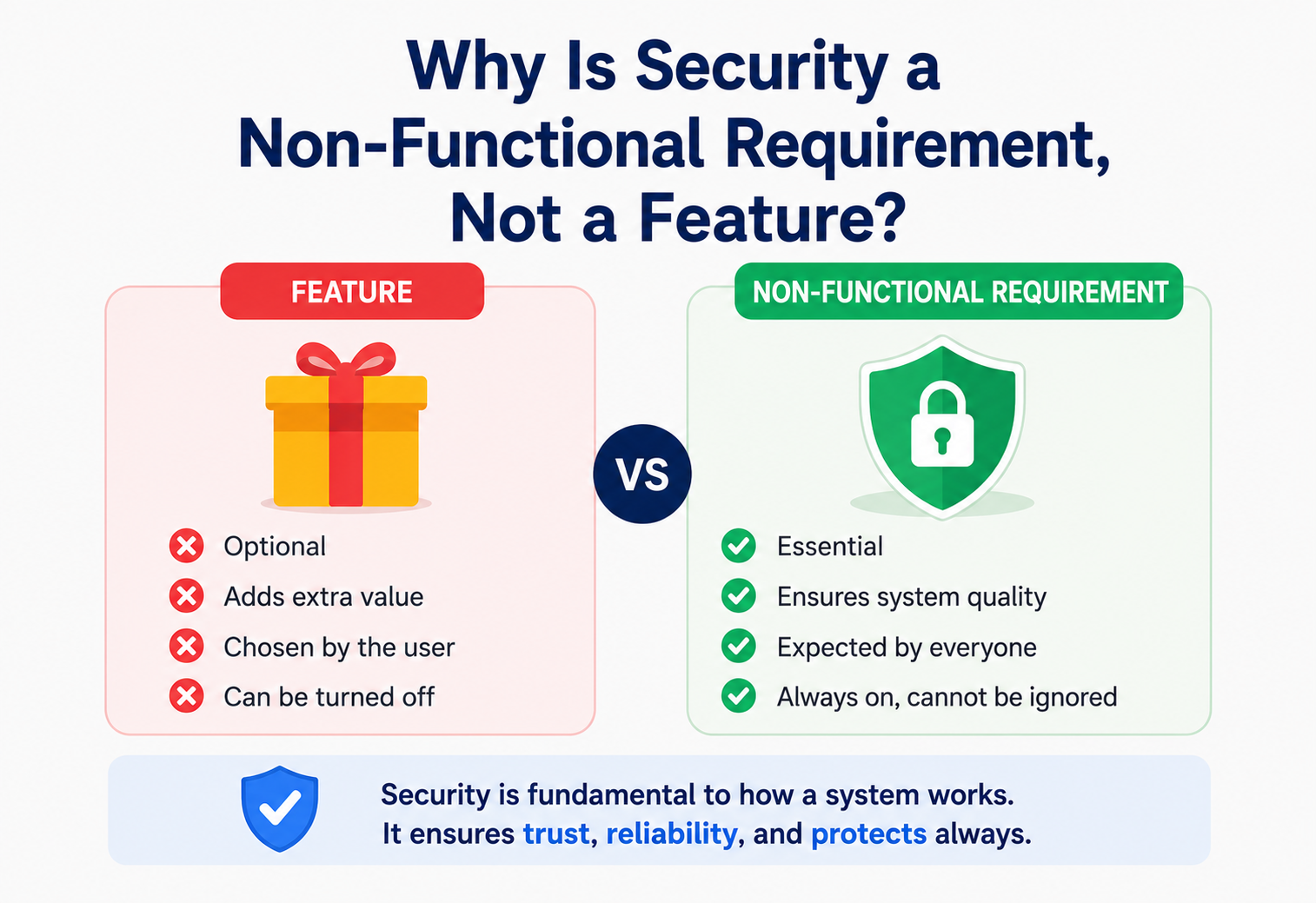
A “feature” is something a user asks for and can see or interact with directly (like a search bar). A “non-functional requirement” is a quality the whole system must have in order for its features to be trustworthy, fast, and safe — security, performance, availability, scalability, maintainability. You don’t “add” security the way you add a button; you weave it through everything.
1.2 How requirements engineering matured
To understand why this classification stuck, it helps to walk through how software requirements engineering matured as a discipline. In the earliest days of commercial computing, systems were mainframes locked in a single room, operated by trained staff who had already been vetted by their employer. There was essentially no concept of an “outside attacker” reaching in over a network, because there was no network to reach in over. Requirements documents from that era focused almost entirely on correctness: does the payroll batch job compute the right numbers? Does the inventory system track the right counts? Security, to the extent it existed, meant physical security — a locked door and a guard, not a line of code.
That changed with the arrival of time-sharing systems in the 1960s, where multiple users shared a single machine, and then accelerated dramatically with the spread of local area networks in the 1980s and the public internet in the 1990s. Suddenly, systems had to defend themselves against people who were never meant to have access at all. Early standards bodies responded by trying to formalize “software quality” as something broader than “does it produce correct output.” The ISO/IEC 9126 standard, published in 1991 and later superseded by ISO/IEC 25010 in 2011, explicitly listed security as one of several quality characteristics sitting alongside functionality, reliability, usability, efficiency, maintainability, and portability. This standardization effort is the direct ancestor of the functional/non-functional vocabulary software engineers use today, and it’s the reason security has never been filed under “features” in any serious engineering framework — it was placed, from the very first formal quality models, in the same bucket as reliability and performance.
It’s worth sitting with why that placement has proven so durable. A quality model isn’t just an academic exercise; it shapes how organizations write contracts, how auditors evaluate systems, and how engineering teams structure their work. Once security was formally recognized as a quality attribute rather than a deliverable feature, an entire ecosystem of practices grew up around that classification: security requirements engineering, threat modeling, secure design reviews, and eventually entire regulatory frameworks like PCI-DSS and HIPAA that mandate ongoing security processes rather than one-time security “features.” None of that infrastructure would make sense if security were just another item on a feature backlog.
The Problem & Motivation
2.1 Why this classification actually matters
This isn’t just an academic labeling exercise. How a team classifies security has real, expensive consequences. If security is seen as a “feature,” it ends up on a backlog, competing for priority against things like a redesigned checkout flow or a new dashboard widget. Product managers can look at that backlog and say, “let’s ship the dashboard first, security can wait for v2.” That’s a rational-sounding decision if security is just one feature among many — but it is a catastrophic decision if security is actually a property the entire system depends on to function safely at all.
Consider two teams building the same online banking app:
- Team A treats security as a feature. They build the login screen, the transfer screen, the statements screen — then near the end of the project, someone says “we should probably add some security,” and a junior developer bolts on basic password hashing and calls it done.
- Team B treats security as a non-functional requirement, exactly like performance or availability. From day one, every design decision — how data is stored, how services talk to each other, how errors are logged, how third-party libraries are vetted — is filtered through a security lens.
Team A will almost certainly ship a system with SQL injection vulnerabilities, plaintext secrets in config files, and no rate limiting on login attempts. Team B will ship something dramatically harder to break — not because they wrote a “security module,” but because security was never a module to begin with; it was a constraint shaping every module.
Treating security as a feature creates a false mental model where security can be deferred, descoped, or “added later” without consequence. Treating it as a non-functional requirement forces teams to recognize that a system which is fast, functional, and feature-rich but insecure is not actually a working system — it is a liability waiting to be exploited.
Core Concepts
Let’s build this up from first principles so the vocabulary is airtight.
3.1 Functional requirements (FRs)
A functional requirement describes a specific behavior — an input, a process, an output. “When a user clicks ‘Buy Now’, the system must charge their card and create an order record.” You can write a test that either passes or fails against a functional requirement. It answers the question: what does the system do?
3.2 Non-functional requirements (NFRs)
A non-functional requirement describes a quality or constraint that applies across many (often all) functional behaviors. It answers the question: how well, how safely, how reliably does the system do what it does? Common NFR categories include:
Security
Confidentiality, integrity, availability of data and access controls across every feature.
Performance
Response time, throughput, resource usage under load.
Scalability
Ability to handle growth in users, data, or transactions.
Reliability
Consistent correct behavior over time, low error rates.
Availability
Uptime guarantees, resilience to failure.
Maintainability
Ease of fixing bugs and adding capability later.
Usability
How easily real users can operate the system.
Portability
Ease of moving to new environments or platforms.
Notice something important: security isn’t graded pass/fail the way a single feature is. You don’t “finish” security the way you finish a login button. Instead, security is measured on a spectrum — how resistant is the system to a growing, evolving landscape of threats? This open-ended, cross-cutting, never-quite-“done” nature is the single biggest reason security sits in the NFR bucket.
3.3 The “cross-cutting concern” idea
Computer scientists use the term cross-cutting concern for something that touches many parts of a system rather than living in one place. Logging is a cross-cutting concern. So is performance. So is security. You can’t isolate security into a single file or class the way you can isolate “calculate shipping cost” — because every single feature, from login to logout, from the database query to the API response, has a security dimension.
3.4 Functional vs non-functional at a glance
| Aspect | Functional Requirement | Non-Functional Requirement (e.g. Security) |
|---|---|---|
| Answers | What must the system do? | How well/safely must it do it? |
| Testable as | Pass/fail on a specific scenario | Degree, resistance, coverage over time |
| Owned by | A single feature team | Every team, continuously |
| Example | “User can reset password” | “Password reset cannot be abused to take over accounts” |
| “Done” state | Ships and is complete | Never fully done — evolves with new threats |
Picture a restaurant kitchen. The menu — the dishes customers can order — is the functional requirement set. But no customer orders “food safety” the way they order a burger. Food safety is enforced through refrigeration temperatures, handwashing protocols, and cross-contamination rules that apply to every single dish on the menu, regardless of what it is. A burger cooked in a kitchen with poor food safety practices is not a “burger with a missing food-safety feature” — it’s a dangerous burger, full stop, because food safety isn’t a topping you can choose to add. Security in software works exactly the same way: it’s not a topping on a feature, it’s a property of the kitchen the feature was cooked in.
3.5 ISO/IEC 25010’s quality model
The current international standard for software product quality, ISO/IEC 25010, organizes non-functional characteristics into eight top-level categories: functional suitability, performance efficiency, compatibility, usability, reliability, security, maintainability, and portability. Security itself is further broken down into five sub-characteristics that are worth memorizing because they show up constantly in security requirements documents:
Confidentiality
Data is accessible only to those authorized to access it.
Integrity
The system prevents unauthorized access to, or modification of, programs or data.
Non-repudiation
Actions or events can be proven to have taken place, so a party cannot later deny having performed them.
Accountability
Actions of an entity can be traced uniquely to that entity.
Authenticity
The identity of a subject or resource can be proved to be the one claimed.
Notice that none of these five sub-characteristics describe a user-facing capability the way “search,” “checkout,” or “export” do. They describe qualities that every capability must possess. That is the formal, standards-body confirmation of the informal argument this article has been building: security is graded on a spectrum of “how well,” not a checkbox of “does it exist.”
Architecture & Where Security Lives
If you draw the architecture diagram of a typical web application — client, load balancer, API gateway, application servers, database, cache, message queue — you will not find a single component labeled “Security.” Instead, security requirements attach themselves to every component:
This is the architectural proof of the NFR classification: security requirements are properties of the edges and nodes of the whole graph, not a feature living at one node. Compare this to a functional feature like “export to CSV,” which genuinely does live in one box (the app server, probably one controller and one service class).
4.1 Trust boundaries
Architects use the term trust boundary to mark any point in a system where data crosses from one zone of trust into another — from the public internet into your API gateway, from an unauthenticated request into an authenticated session, from one microservice’s process space into another’s. Every trust boundary is a place where security controls must be actively enforced, because it’s a place where an assumption (“this data is safe, this caller is who they say they are”) can no longer be taken for granted. A system diagram with clearly marked trust boundaries is, in a very real sense, a security requirements document drawn as a picture — and you’ll notice trust boundaries don’t cluster around one component. They’re scattered throughout the whole architecture, at the client, at the gateway, at each internal service call, and at the database.
4.2 Why this differs from how a feature is architected
When architects design a genuinely functional feature — say, a recommendation engine — they draw one or two new boxes on the diagram: a recommendation service, maybe a feature store. The rest of the architecture is largely untouched. When architects account for security, they don’t draw a new box at all; instead, they annotate every existing box and every existing arrow with a constraint. That’s a fundamentally different design activity, and it’s why security work rarely shows up as a discrete “epic” that can be estimated, staffed, and closed the way a recommendation engine project can.
Internal Working — Baked-In vs Bolted-On
“Baked in” security means the constraint shapes the design before a line of feature code is written. “Bolted on” security means a working, insecure system gets a security layer wrapped around it afterward. Here’s what that looks like concretely, using a simple login feature in Java.
5.1 Bolted-on approach (security as an afterthought feature)
// Version 1: functional requirement satisfied, security ignored
public class LoginService {
    public boolean login(String username, String password) {
        String query = "SELECT * FROM users WHERE username='" + username +
                        "' AND password='" + password + "'";
        ResultSet rs = db.executeQuery(query); // SQL Injection risk!
        return rs.next();
    }
}
This code satisfies the functional requirement perfectly: a user with the right username and password logs in. But it is trivially exploitable — an attacker can submit ' OR '1'='1 as the password and log in as anyone. The feature “works.” The system is not safe.
5.2 Baked-in approach (security as a non-functional constraint)
// Version 2: security requirements shape the implementation
public class LoginService {
    private final PasswordEncoder encoder;   // e.g. BCrypt
    private final RateLimiter rateLimiter;   // prevents brute force
    private final AuditLogger auditLogger;   // records attempts

    public LoginResult login(String username, char[] password) {
        if (!rateLimiter.allow(username)) {
            auditLogger.log(username, "RATE_LIMITED");
            return LoginResult.tooManyAttempts();
        }
        String hashedStored = userRepository.findHashedPassword(username); // parameterized query
        boolean matches = encoder.matches(password, hashedStored);
        auditLogger.log(username, matches ? "SUCCESS" : "FAILURE");
        Arrays.fill(password, '�'); // wipe sensitive data from memory
        return matches ? LoginResult.success() : LoginResult.invalidCredentials();
    }
}
Notice that this second version doesn’t have a “security feature” you could point to and say “there it is.” Instead, security requirements (safe queries, hashed passwords, rate limiting, audit logging, memory hygiene) are distributed across every line. That distribution — not concentration into one module — is the internal-working signature of a true non-functional requirement.
If you can point at one file and say “that’s where security lives,” it’s probably being treated as a feature (and likely under-protecting the rest of the system). If security concerns are threaded through nearly every file, it’s being treated correctly as an NFR.
5.3 Layering further: input validation as a cross-cutting concern
Take something as ordinary as validating user input. A “feature-minded” team validates input only on the one screen where a security review happened to focus — say, the login form — and leaves every other form (profile update, comment box, file upload) unvalidated, on the assumption that “we already did security.” An “NFR-minded” team instead builds validation as a shared, reusable capability applied uniformly:
// A shared validation layer applied to every incoming request,
// not just the ones someone remembered to protect
public abstract class ValidatingController {
    protected final InputSanitizer sanitizer;
    protected final Validator validator;

    protected <T> T validateAndBind(HttpServletRequest req, Class<T> type) {
        T bound = requestBinder.bind(req, type);
        Set<ConstraintViolation<T>> violations = validator.validate(bound);
        if (!violations.isEmpty()) {
            throw new ValidationException(violations);
        }
        return sanitizer.sanitize(bound); // strips/escapes dangerous content
    }
}

// Every controller in the codebase extends this base class,
// so no individual developer has to remember to "add security"
public class CommentController extends ValidatingController {
    public void postComment(HttpServletRequest req) {
        CommentRequest comment = validateAndBind(req, CommentRequest.class);
        commentService.save(comment);
    }
}
The key architectural idea here is inheritance and composition used to make the secure path the only path. A developer adding a brand-new endpoint six months from now doesn’t need to remember “don’t forget input validation” as a separate to-do item; it’s structurally impossible to skip, because every controller in the codebase is built on top of the validating base class. This is what “baked in” really means in practice: security stops being a matter of individual discipline and becomes a property of the framework itself.
Data Flow & SDLC Lifecycle
Because security is an NFR, it must appear at every stage of the SDLC, not just at “build” time. This is the foundation of the modern DevSecOps movement — shifting security “left” (earlier) instead of treating it as a final gate before release.
Requirements & Design
Threat modeling (e.g. STRIDE) identifies what could go wrong before any code is written. Security requirements are written alongside functional ones, not after.
Development
Secure coding standards, code review checklists, and static analysis (SAST) catch issues like injection flaws as code is written.
Build & CI
Dependency and container scanning (SCA) block known-vulnerable libraries from ever reaching a build artifact.
Testing
Dynamic analysis (DAST) and penetration testing probe the running system the way an attacker would.
Deployment
Secrets management, infrastructure-as-code scanning, and least-privilege IAM roles protect the production environment itself.
Operations & Monitoring
SIEM tooling, anomaly detection, and incident response plans catch and contain breaches that do occur.
Decommission
Secure data deletion and access revocation close the loop when a system or service is retired.
A “feature,” by contrast, has a much shorter lifecycle: it’s designed, built, tested, shipped, and then largely left alone until someone requests a change. Security’s lifecycle never really ends — it loops continuously because the threat landscape itself keeps evolving (new vulnerabilities, new attacker techniques, new regulations).
6.1 A closer look at threat modeling
Since threat modeling is where the NFR mindset first enters the lifecycle, it’s worth understanding what it actually involves. The STRIDE framework, developed at Microsoft, gives engineers a simple checklist to apply to every component of a design, asking whether it’s vulnerable to: Spoofing (pretending to be someone else), Tampering (modifying data or code), Repudiation (denying having performed an action), Information disclosure (exposing data to unauthorized parties), Denial of service (making the system unavailable), and Elevation of privilege (gaining capabilities beyond what was granted). Running through this checklist for a new feature — say, a “share document with a colleague” feature — surfaces questions no functional requirement would ever prompt: What stops someone from spoofing the colleague’s identity? What stops the sharing link from being tampered with to grant broader access than intended? What happens if ten thousand share requests hit the system simultaneously? These questions get answered before a single line of code is written, which is precisely why threat modeling is the clearest single practice distinguishing NFR-minded teams from feature-minded ones.
6.2 Why the loop never closes
A functional feature, once verified against its acceptance criteria, stays correct indefinitely unless the requirements themselves change. Security is different because the “attacker” side of the equation keeps innovating independently of anything the engineering team does. A password hashing algorithm considered strong a decade ago (like unsalted MD5) is now considered dangerously weak, not because anyone’s code changed, but because computing power and attacker techniques advanced around it. This means security work includes an entire category with no functional-requirement equivalent: revisiting decisions that were correct when made and are no longer correct now, purely because the external world moved.
Advantages, Disadvantages & Trade-offs
Treating security as a genuine NFR (instead of a feature you can defer) has real costs as well as real benefits. Good engineering means being honest about both.
Benefits of treating security as an NFR
- Security decisions get made early, when they’re cheapest to implement.
- No single point of failure — protection is layered across the whole system.
- Forces cross-team ownership instead of “someone else’s job.”
- Aligns naturally with compliance frameworks (SOC 2, ISO 27001, PCI-DSS).
- Reduces the total cost of breaches, which vastly exceeds the cost of prevention.
Costs & trade-offs
- Slower initial development velocity — every design review takes longer.
- Harder to demo progress to non-technical stakeholders (“what did security work produce this sprint?”).
- Requires broadly distributed expertise, not just one specialist.
- Can be over-applied, adding friction to low-risk internal tools.
- Success is invisible — a breach that didn’t happen generates no headline, so it’s chronically under-resourced by leadership that rewards visible feature output.
Security researcher Bruce Schneier is often paraphrased for the idea that “security is a process, not a product” — a formulation that maps almost exactly onto the functional-vs-non-functional distinction this article is exploring.
7.1 Why organizations still under-invest despite knowing this
If the trade-offs are this well understood, why do so many organizations still treat security as an afterthought in practice, even when they’d agree in principle that it’s an NFR? The honest answer is incentive misalignment. Product managers are usually rewarded for shipping visible functionality that drives adoption or revenue in the current quarter. Security work, when done well, produces an absence — the absence of a breach that never happened, the absence of an incident nobody hears about. That absence is invisible in a quarterly business review, while a new feature is a bullet point in a release announcement. This asymmetry between visible, reward-generating feature work and invisible, risk-reducing NFR work is arguably the single biggest reason security still gets treated like a schedulable feature in practice, even at organizations that know better on paper. Recognizing this incentive problem explicitly — and building processes (like mandatory security sign-off gates, or a fixed percentage of every sprint reserved for non-functional work) that don’t rely on individual product managers volunteering to deprioritize their own feature — is often what separates organizations that talk about security as an NFR from organizations that actually practice it.
7.2 The cost asymmetry
There’s also a well-documented cost asymmetry that argues strongly for the NFR framing. Numerous industry studies on the cost of fixing defects have found that a security flaw caught during design (through threat modeling, before any code exists) costs a small fraction of what the same flaw costs to fix after the system has shipped and been exploited in production — factoring in incident response, legal exposure, regulatory fines, customer trust, and the engineering time spent on emergency remediation instead of planned work. A feature that ships a sprint late is a scheduling inconvenience. A security flaw that ships and gets exploited can be a multi-year, multi-million-dollar event. Treating security as an NFR — addressed at design time, continuously, across the whole system — is fundamentally a strategy for capturing the cheap end of that cost curve instead of the expensive end.
Performance & Scalability
Because security lives in the same NFR family as performance and scalability, the three constantly interact — sometimes in tension, sometimes reinforcing each other.
- Encryption overhead: TLS handshakes and at-rest encryption add CPU cost and latency. Modern hardware acceleration (AES-NI) has made this mostly negligible, but at extreme scale it still matters.
- Rate limiting vs. throughput: Protecting against brute-force or denial-of-service attacks means intentionally capping throughput for individual clients — a direct trade-off against raw scalability.
- Authentication checks on every request: Verifying a JWT or session token on every single API call adds a small but real latency cost, multiplied across millions of requests.
- Caching sensitive data: Caching is a major performance lever, but caching secrets or personal data insecurely creates a new attack surface — so security and performance decisions have to be co-designed, not sequenced.
This entanglement is further proof security can’t be a bolt-on feature: you cannot tune performance without simultaneously reasoning about the security implications of every optimization, and vice versa.
8.1 A concrete example — connection pooling and credential exposure
Consider database connection pooling, a textbook performance optimization that lets an application reuse a fixed number of database connections rather than opening a fresh one for every request. This dramatically improves throughput and reduces latency. But connection pools also introduce a security question that has nothing to do with performance on its face: how are the pool’s database credentials stored and rotated? A pool configured once at startup with a long-lived, over-privileged credential baked into a configuration file is a performance win and a security liability at the same time, wrapped in the very same piece of code. You cannot review the performance characteristics of a connection pool without also reviewing its credential handling — the two concerns are inseparable, which is exactly the signature of a true non-functional requirement.
8.2 Scalability and the expanding attack surface
As a system scales — more servers, more regions, more third-party integrations — its attack surface scales right alongside it. Every new server is a new machine that must be patched. Every new region is a new set of data residency and encryption requirements. Every new third-party integration is a new trust boundary. Teams that plan for scalability without simultaneously planning for the security implications of that scale routinely find themselves needing to retrofit access controls, secrets management, and monitoring across a much larger footprint than they would have if those concerns had scaled together from the start.
High Availability & Reliability
Availability (an NFR) and security (an NFR) are deeply linked: a system that isn’t secure isn’t reliably available either, because attackers can take it down. Denial-of-service (DoS) attacks, ransomware, and data-destroying breaches are all, fundamentally, availability failures caused by security failures.
Disaster recovery planning — normally filed under “reliability” — has to assume security incidents as one of its core failure scenarios, alongside hardware failure and natural disaster. A well-designed system has an incident response runbook the same way it has a database failover runbook, because from an availability standpoint, a ransomware attack and a data-center fire produce a similar outcome: the system is down.
Core Security Principles
10.1 The CIA triad
The foundational model for what “security” even means:
Confidentiality
Only authorized parties can read the data. Think encryption and access control.
Integrity
Data can’t be tampered with undetected. Think checksums, digital signatures, audit logs.
Availability
Authorized parties can access the system when they need it. Think redundancy, DoS protection.
10.2 Defense in depth
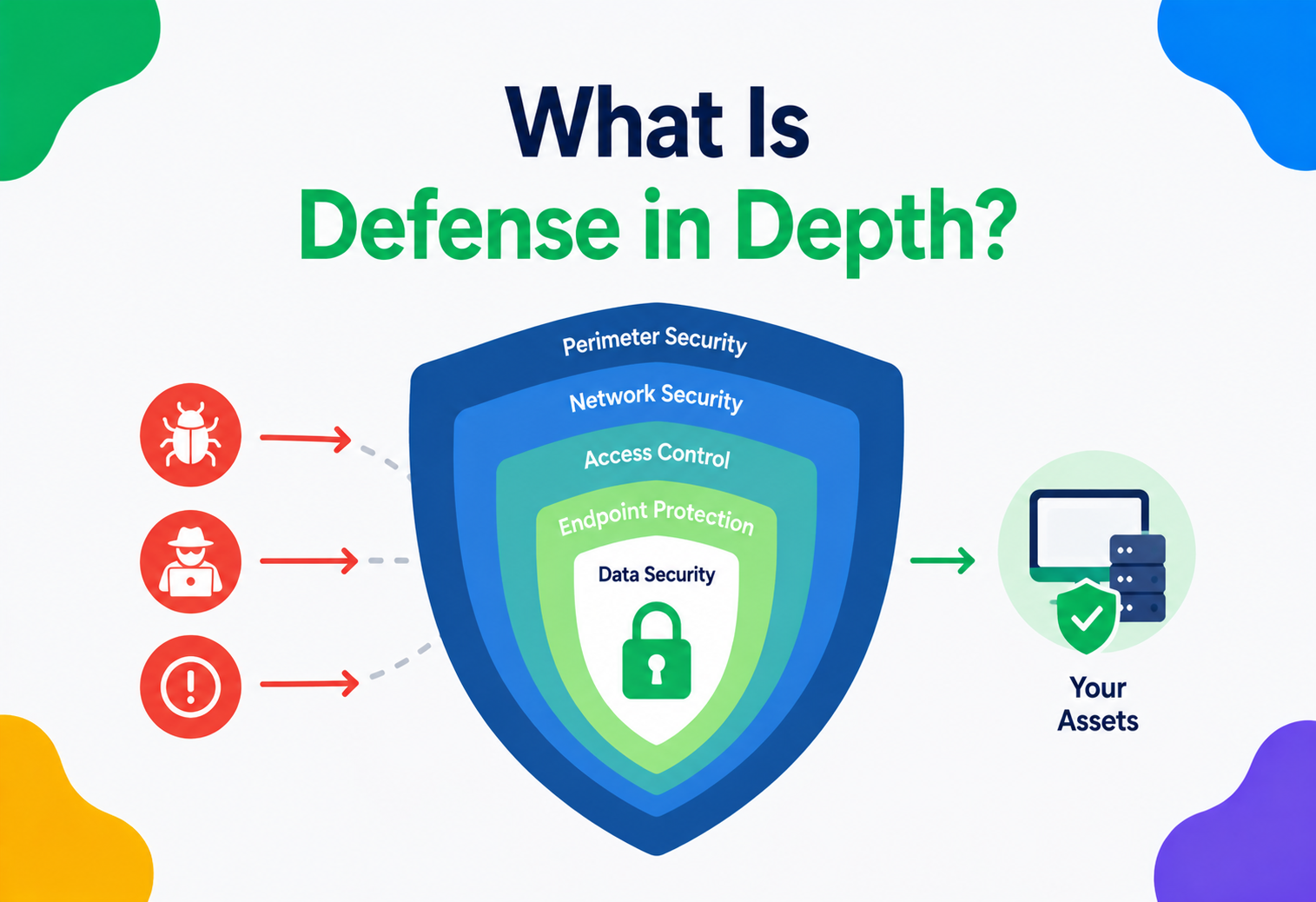
Never rely on a single control. Layer firewalls, authentication, authorization, encryption, and monitoring so that a failure in one layer doesn’t mean total compromise — much like a ship’s watertight compartments.
10.3 Principle of least privilege
Every user, process, and service should have exactly the access it needs to do its job — nothing more. A reporting microservice that only reads sales data should not have write access to the customer database.
10.4 Fail securely
When something breaks, it should break in a way that denies access, not grants it. An authentication check that throws an unexpected exception should never accidentally default to “logged in.”
// Fail-secure example in Java
public boolean isAuthorized(User user, Resource resource) {
    try {
        return accessControlService.check(user, resource);
    } catch (Exception e) {
        auditLogger.log("AUTH_CHECK_FAILED", user, e);
        return false; // deny by default, never allow on error
    }
}
10.5 Separation of duties
No single person or process should be able to complete a sensitive operation entirely on their own. A deployment pipeline where one engineer can write code, approve their own pull request, and push straight to production removes the natural checkpoint that catches mistakes and malicious changes alike. Requiring a second reviewer, or splitting “who can approve a payment” from “who can initiate one,” is a direct application of this principle.
10.6 Complete mediation
Every single access to every single resource must be checked, every single time — not cached from an earlier check and assumed to still be valid. A classic mistake is checking permissions once when a user opens a session and then trusting that decision for the rest of the session, even after their role or permissions change mid-session.
10.7 The OWASP Top 10 as a living NFR checklist
The Open Worldwide Application Security Project (OWASP) publishes a regularly updated list of the most critical web application security risks. Recent editions have included categories like broken access control, cryptographic failures, injection, insecure design, security misconfiguration, vulnerable and outdated components, identification and authentication failures, software and data integrity failures, security logging and monitoring failures, and server-side request forgery. What’s notable for this discussion is the list’s very existence and cadence: it is revised periodically because the threat landscape shifts, which is precisely the “never fully done” quality that separates an NFR from a feature. A feature backlog item, once implemented, doesn’t need to be revisited every few years because the definition of “correct” changed — but a security control absolutely does, because attackers adapt.
Monitoring, Logging & Metrics
Because security is an ongoing quality rather than a shipped feature, it needs continuous measurement, just like latency or error rate. Teams track metrics such as:
- Mean time to detect (MTTD) — how long an intrusion goes unnoticed.
- Mean time to respond (MTTR) — how long it takes to contain an incident once detected.
- Number of critical/high vulnerabilities open in dependency scans over time.
- Failed authentication attempts per user/IP, tracked for anomaly detection.
- Audit log completeness — percentage of sensitive operations that are logged.
These are dashboarded and alerted on continuously, in a SIEM (Security Information and Event Management) system, exactly the way performance dashboards track p99 latency. There is no “security feature complete” milestone — only ongoing measurement against a moving target.
11.1 Logging as a security control, not just a debugging aid
Engineers often think of logs primarily as a debugging tool — something you check after a functional bug is reported. But from a security standpoint, logs (particularly audit logs of sensitive actions like permission changes, data exports, and failed authentication attempts) are a control in their own right. Without them, an organization has no way to answer the most basic question after a suspected incident: what actually happened, and when? This is why compliance frameworks like PCI-DSS and SOC 2 mandate specific, tamper-resistant audit logging requirements rather than leaving logging entirely to developer discretion. A functional feature might log an error so a developer can fix a bug next sprint; a security-grade audit log must be complete, protected from tampering (often written to a separate, append-only store), and retained for a defined period regardless of whether anyone ever looks at it — because its value is realized only in the rare case of an investigation, much like a building’s fire suppression system earns its cost on the one day it’s actually needed.
Deployment & Cloud (DevSecOps)
In cloud environments, security requirements extend into infrastructure itself: IAM policies, network segmentation (VPCs, security groups), secrets managers (like AWS Secrets Manager or HashiCorp Vault), and infrastructure-as-code scanning that flags an overly permissive S3 bucket policy before it’s ever deployed.
Every stage of this pipeline enforces security automatically, without a human deciding “let’s add the security feature now.” That automation is only possible because security requirements were defined as gates applying to the whole pipeline — the NFR mindset expressed as tooling.
12.1 Immutable infrastructure and the shrinking attack window
Cloud-native teams increasingly favor immutable infrastructure — servers and containers that are never patched in place, only replaced wholesale with a freshly built, freshly scanned image. This pattern exists largely for security reasons: a server that’s been running for eight months has had eight months of opportunity to drift out of its intended configuration, accumulate manual changes nobody documented, and miss patches nobody remembered to apply. Rebuilding from a known-good, continuously scanned image on every deployment collapses that drift window down to hours or days. Notice that this is an operational and architectural decision, not a “feature” anyone requested — it exists purely to satisfy the non-functional requirement that the running system stays close to its intended, secure baseline.
12.2 Secrets management as infrastructure, not configuration
Early-stage teams often store database passwords or API keys directly in configuration files or environment variables checked into source control — a pattern that works functionally (the app connects to the database) but fails the security NFR catastrophically the moment that repository is ever exposed, even briefly. Mature deployment pipelines instead treat secrets as a managed, auditable, rotatable resource: a dedicated secrets manager issues short-lived credentials to services at runtime, logs every access, and can revoke or rotate a credential without a code deployment. This shift — from “secrets are just another config value” to “secrets are a security-critical resource with their own lifecycle” — is a direct consequence of recognizing security as a standing requirement rather than a one-time setup step.
APIs & Microservices
Microservice architectures multiply the surface area where security requirements apply. Each service-to-service call is a potential trust boundary. Common patterns include:
- Mutual TLS (mTLS) between services, so services authenticate each other, not just the end user.
- API gateways as a single enforcement point for authentication, rate limiting, and input validation before requests reach internal services.
- Token-based authorization (OAuth2/JWT) carrying scoped permissions, so a compromised service can’t silently act with full system privileges.
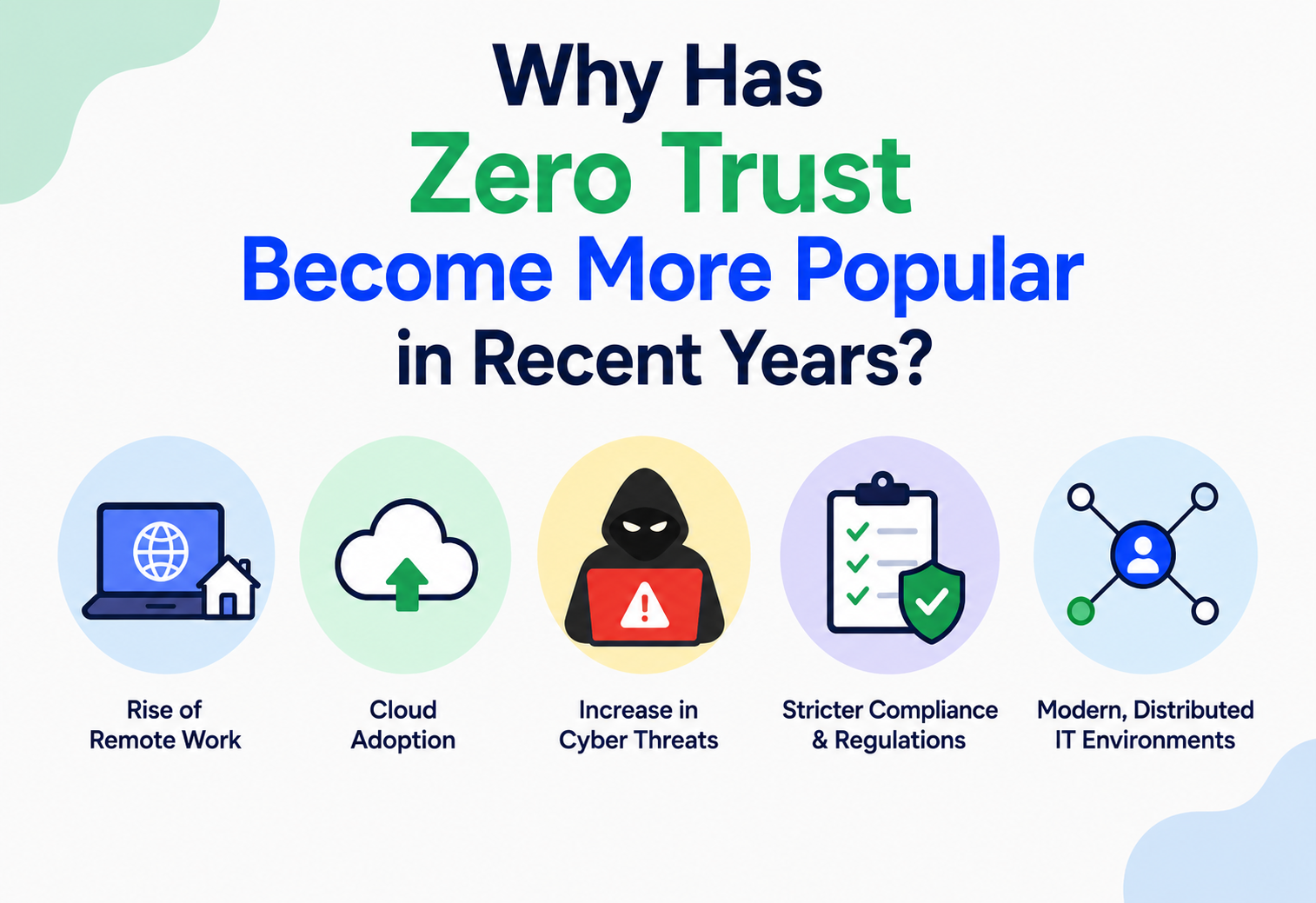
- Zero trust networking — no service is implicitly trusted just because it’s “inside” the network perimeter.
// Example: verifying a scoped JWT before processing a request
public void handleRequest(HttpServletRequest req) {
    String token = extractBearerToken(req);
    Jws<Claims> claims = jwtVerifier.verify(token); // throws if invalid/expired
    if (!claims.getBody().get("scope", String.class).contains("orders:write")) {
        throw new ForbiddenException("Insufficient scope");
    }
    // proceed only after both authentication and authorization pass
}
13.1 Service meshes and infrastructure-level enforcement
As the number of microservices grows into the dozens or hundreds, expecting every individual service team to correctly implement mTLS, retries, and access policies by hand becomes unrealistic — someone will get it wrong. Service mesh technologies (like Istio or Linkerd) address this by moving these cross-cutting security concerns out of application code entirely and into a shared infrastructure layer (a sidecar proxy deployed alongside every service instance). Application developers write ordinary business logic; the mesh transparently handles mutual authentication between services, encrypts traffic in transit, and enforces network-level policies about which services are even allowed to talk to which other services. This is arguably the most literal infrastructural expression of the NFR philosophy: instead of asking every team to remember to implement security correctly (a feature-style approach doomed to inconsistency), the security requirement is enforced once, centrally, for every service automatically.
Design Patterns & Anti-Patterns
14.1 Good patterns
- Secure by default — the out-of-the-box configuration is the safe one; insecure options must be explicitly opted into.
- Defense in depth — layered, redundant controls (see Section 10).
- Threat modeling as a design step — done before code, not after an incident.
- Principle of least privilege everywhere, including CI/CD service accounts.
14.2 Anti-patterns to watch for
Visible but ineffective controls (e.g., forcing frequent password rotation without meaningfully reducing risk) added to look compliant rather than to reduce actual risk.
Treating it as a feature to be scheduled, guaranteeing it never gets prioritized against revenue-generating work.
Centralizing all responsibility in one “security team,” which becomes a bottleneck and lets everyone else stop thinking about it.
Trusting anything already “inside” the network, ignoring insider threats and lateral movement.
14.3 The gatekeeper pattern
A recurring good pattern in distributed systems is placing a single, well-tested “gatekeeper” component (an API gateway, an authentication service, a policy engine) in front of many internal services, so that authentication and coarse-grained authorization logic exists in exactly one place instead of being reimplemented — inconsistently — by every team that builds a new service. This doesn’t eliminate the need for services to enforce their own fine-grained authorization (defense in depth still applies), but it dramatically reduces the number of places where a basic mistake, like forgetting to check whether a request is authenticated at all, can slip through.
14.4 The “penetrate and patch” anti-pattern
Perhaps the purest expression of treating security as a feature rather than an NFR is what practitioners call “penetrate and patch”: ship the system, wait for someone (ideally a researcher, not an attacker) to find a hole, patch that specific hole, and repeat. This reactive loop treats each vulnerability as an isolated bug to be fixed rather than a symptom of a systemic design weakness to be addressed. Teams stuck in this pattern often experience a steady drumbeat of “urgent security fixes” that never seems to end, because they’re treating the output of a non-functional weakness (a design that doesn’t validate input consistently, for example) as a series of unrelated functional bugs.
Best Practices & Common Mistakes
Write security requirements alongside functional ones
In every user story, add an explicit “abuse case” alongside the use case.
Automate what you can
SAST, SCA, and IaC scanning in CI turn security into a continuous gate, not a manual review.
Train every engineer
Security should not be one team’s specialty — it should be baseline literacy, like knowing basic performance profiling.
Practice incident response
Run tabletop exercises the way you’d run a disaster-recovery drill.
Measuring security success purely by “number of vulnerabilities fixed” rewards finding bugs after the fact rather than designing them out up front. Better metrics track how early issues are caught in the SDLC (shift-left effectiveness), not just how many are eventually resolved.
15.1 Building a security-literate culture
The most effective organizational practice, and often the hardest to implement, is making basic security literacy part of what it means to be a competent engineer at all — the same way most teams now expect every engineer, not just a dedicated “performance team,” to understand basic algorithmic complexity and avoid obviously slow code. This typically involves onboarding material that includes secure coding guidelines, lightweight training refreshed as new threat categories emerge, and code review norms where a reviewer flagging a missing input validation check is treated with the same seriousness as a reviewer flagging a missing null check. Organizations that centralize all security knowledge in a single specialist team tend to create a bottleneck where every change waits on a small group’s review — and worse, they create a culture where everyone else feels licensed to stop thinking about security at all, precisely the “someone else’s job” anti-pattern that undermines the NFR framing this entire article has been building toward.
Real-World Examples
Several well-documented breaches illustrate what goes wrong when security is deprioritized like an optional feature rather than engineered as a foundational requirement:
In each of the breach cases, the functional systems worked exactly as designed — customers could shop, apply for credit, get their HVAC serviced. It was the non-functional, cross-cutting quality of security that failed, precisely because it hadn’t been engineered with the same rigor as the visible features.
Organizations like Google (BeyondCorp zero-trust architecture) and Netflix (chaos engineering extended to security “chaos” testing) treat security as a continuously-tested property of their entire infrastructure — not a checklist item completed once per release.
Frequently Asked Questions
Isn’t authentication a feature? Users can see the login screen.
The login screen is a feature (functional requirement). But the guarantee that only the right person can use it — resistance to brute force, credential stuffing, session hijacking — is the non-functional security requirement layered underneath that visible feature.
Does calling security an NFR mean it’s less important than features?
No — quite the opposite. NFRs are often described as “quality attributes” precisely because they determine whether the functional features are trustworthy at all. A feature-rich but insecure app is arguably worse than a simple but secure one, because it actively puts users at risk.
Can security ever be a feature?
Specific security-related capabilities can be marketed as features — like “two-factor authentication” or “end-to-end encryption” as a selling point. But the underlying property of being resistant to compromise is still an NFR; the visible toggle is just one functional expression of a much larger non-functional commitment.
How do teams budget for something that’s never “done”?
Most mature organizations allocate a recurring percentage of engineering capacity (not a one-time project budget) to security work — similar to how performance and reliability get ongoing investment rather than a single “performance sprint.”
If security is never “done,” how do you know if you’re making progress?
Progress is tracked the same way it’s tracked for other open-ended NFRs like performance: through trend lines rather than a single finish line. Is the average time to patch a critical vulnerability shrinking? Is the percentage of code covered by automated security scanning increasing release over release? Is the number of services still relying on unsupported, unpatched dependencies falling? None of these metrics ever reach a permanent “100% and finished” state, but they can absolutely show a system getting steadily more resistant to compromise over time, exactly like a latency graph can show a system getting steadily faster without ever declaring performance “complete.”
Does agile/scrum have a place for NFRs like security if they don’t fit neatly into user stories?
Yes, though it takes deliberate effort. Many teams use a “definition of done” that includes security criteria (e.g., “no new high-severity findings in SAST/SCA scans,” “sensitive fields encrypted at rest”) applied to every story, rather than writing separate “security stories.” Others maintain a standing set of non-functional acceptance criteria that every sprint’s work must satisfy, alongside dedicated capacity for deeper security initiatives like threat modeling workshops or penetration test remediation.
Summary & Key Takeaways
Security is classified as a non-functional requirement because it is not a discrete capability a user requests and receives, but a pervasive quality that determines whether every functional capability can be trusted. It cannot be isolated into one module, completed once, or deferred without compromising the integrity of the whole system — exactly like performance, reliability, and scalability, the other members of its NFR family.
The next time a roadmap discussion frames security as “a feature we’ll get to after this release,” it’s worth returning to the house-building analogy from the very start of this guide. Nobody would accept a contractor who says “we’ll add the foundation after we finish the kitchen” — and yet software teams make the equivalent decision routinely, because the consequences of a weak foundation are invisible until the day the house actually needs to bear weight it wasn’t built for. Understanding security as a non-functional requirement, rather than a feature, is ultimately about making that invisible foundation visible early enough to matter — in the requirements document, in the architecture diagram, in the code review checklist, and in the everyday habits of every engineer touching the system, not just the ones with “security” in their job title.
Key takeaways
- Functional requirements describe what a system does; non-functional requirements describe how well and how safely it does it.
- Security is a cross-cutting concern — it touches every component of an architecture, not one isolated module.
- Treating security as a “feature” invites deferral and descoping; treating it as an NFR forces it into every design decision from day one.
- Security is deeply intertwined with the other NFRs — performance, availability, and reliability — and trade-offs must be co-designed, not sequenced.
- Because threats evolve continuously, security has no final “done” state — it requires ongoing measurement, monitoring, and investment, just like performance tuning.
- Real-world breaches (Equifax, Target, Capital One, Colonial Pipeline) consistently trace back to security being treated as optional or deferred rather than foundational.