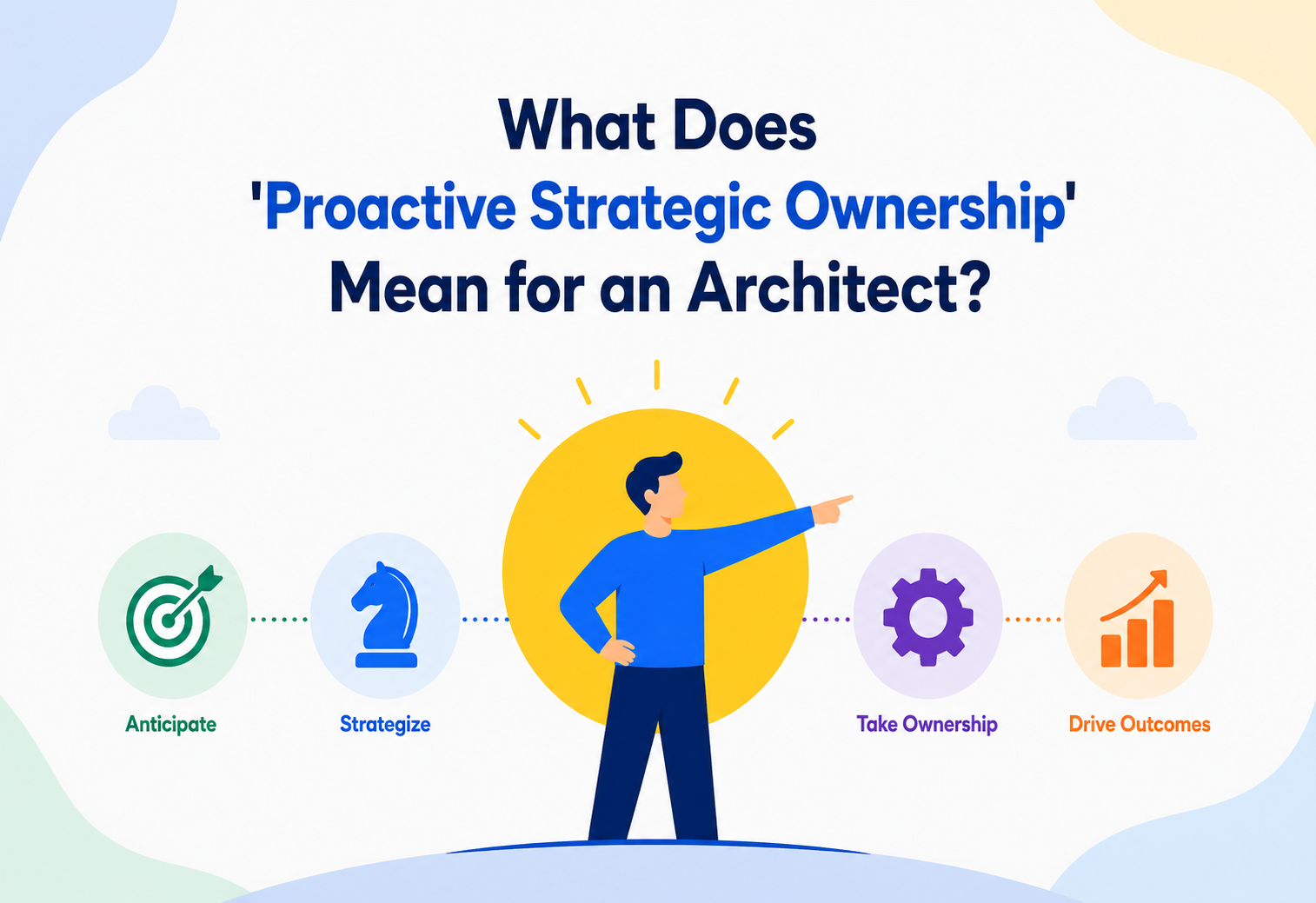
What Does “Proactive Strategic Ownership” Mean for an Architect?
A complete, beginner-friendly guide to one of the most talked-about but least-defined traits in software architecture — what it actually looks like, why companies pay a premium for it, and how you build it deliberately, one decision at a time.
Introduction & History
If you have ever read a job posting for a “Staff Architect,” “Principal Engineer,” or “Chief Architect,” you have probably seen the phrase “demonstrates proactive strategic ownership” buried somewhere in the requirements. It sounds impressive. It also sounds vague. Most candidates nod along, assume it means “be a good architect,” and move on. That vagueness is exactly the problem this guide solves.
To understand why this phrase exists at all, it helps to look at how the architect role has changed over the last three decades. In the 1990s and early 2000s, an “architect” in software was mostly a technical authority — someone who drew UML diagrams, chose the database engine, and made sure the system followed a blueprint before developers started typing code. The job was largely reactive: business stakeholders decided what to build, and the architect decided how to build it safely.
As companies like Amazon, Google, and Netflix grew into planet-scale systems in the 2000s and 2010s, something changed. The cost of a bad architectural decision stopped being “a slow page” and started being “a multi-million-dollar outage,” “a security breach that makes the news,” or “a rewrite that costs two years of engineering time.” At the same time, business strategy started moving faster than any top-down blueprint process could keep up with. Architects who simply waited for requirements to be handed to them became a bottleneck rather than an asset.
Out of this shift came a new expectation: architects should not just answer the question “how do we build this?” — they should also be asking, unprompted, “should we be building this at all, and what does the business not yet know it needs?” That forward-leaning, self-initiated behavior is what the industry eventually started calling proactive strategic ownership.
A Short Timeline of the Architect Role
| Era | What defined the role |
|---|---|
| ~1995–2005 The Blueprint Era | Architects act as technical draftsmen. Requirements come from the business; architecture is a downstream translation step. Ownership is limited to “did the system match the diagram.” |
| ~2006–2012 The Scale Era | Amazon’s “two-pizza teams,” Google’s SRE discipline, and the rise of AWS force architects to think about failure, cost, and operability — not just structure. Ownership starts including “what happens when this breaks at 3am.” |
| ~2013–2019 The Microservices & DevOps Era | Decisions decentralize. Architects can no longer control everything directly, so influence, documentation (like Architecture Decision Records), and cross-team alignment become core skills. Ownership becomes social, not just technical. |
| 2020–Present The Strategic Era | Cloud cost, AI adoption, security regulation, and platform consolidation move architecture decisions into boardroom conversations. Architects are expected to anticipate business direction, not just support it. “Proactive strategic ownership” becomes an explicit, named competency in leveling frameworks at companies like Amazon, Google, Microsoft, and Netflix. |
Whether you are a mid-level engineer aiming for a Staff title, or already an architect trying to figure out why your promotion packet keeps getting the feedback “needs more strategic ownership,” this guide breaks the phrase into concrete, observable behaviors you can practice and demonstrate — not just abstract personality traits.
Problem & Motivation
To understand why organizations care so much about this trait, it helps to look at its opposite first: reactive, task-level ownership. This is not a bad thing in itself — most engineers, and even many senior engineers, operate this way, and systems need people who execute reliably. But when an entire architecture function operates this way, specific failure patterns show up again and again.
The Ticket-Taker Trap
The architect only engages with problems once they arrive as a ticket, an escalation, or an incident. By the time the architect sees the issue, the cheap window to fix it has already closed.
The Silent Time Bomb
Everyone quietly knows a piece of infrastructure is aging out, a vendor contract is about to become a liability, or a compliance deadline is approaching — but no one owns raising it until it becomes an emergency.
The Permission-Seeking Loop
Talented engineers see a better path but wait for explicit authorization before acting, even when they have the standing and the data to make the call. Momentum dies in meetings that ask “whose job is this?”
The Local Optimum
Individual teams optimize their own service beautifully while the system as a whole drifts into duplicated effort, inconsistent tooling, or conflicting technology choices — because no one is watching the whole board.
Consider a simple, realistic example. A mid-sized e-commerce company’s checkout service is built on a payment gateway whose SDK will stop receiving security patches in eight months. A reactive architect finds out when a security scan flags it two weeks before the deadline, triggering a rushed, high-risk migration during peak shopping season. A proactive architect had already flagged the deprecation notice a year earlier, quietly scoped the migration, folded it into the normal roadmap, and it shipped calmly, three months ahead of the actual deadline, with time to spare for testing.
Both architects are technically competent. The difference is not skill — it is where their attention is pointed, and when they choose to act. That difference is the entire subject of this guide.
It’s worth being precise about why this gap exists at all, because it isn’t laziness or incompetence — it’s usually a structural problem with how attention gets allocated in a busy organization. Most engineering calendars are dominated by things with deadlines: sprint commitments, incidents, launches, meetings someone else scheduled. Nothing on that list is inherently strategic; it is simply urgent. Strategic work, almost by definition, is not yet urgent — that’s precisely what makes it strategic instead of tactical. A vendor deprecation notice eight months out will never out-compete a production incident happening right now for anyone’s immediate attention, unless someone deliberately protects time and mental space for it. Proactive strategic ownership is, in large part, the discipline of defending non-urgent-but-important work against the constant gravitational pull of the merely urgent.
There is also a trust dimension to this problem that is easy to underestimate. When an organization has too few people practicing proactive ownership, leadership has no choice but to build heavier top-down processes — mandatory architecture review boards, rigid approval gates, extensive documentation requirements — because they cannot trust that risks will surface on their own. Ironically, those heavy processes then make it even harder for individual engineers to act proactively, because every action now requires navigating more bureaucracy first. Organizations with a strong culture of proactive strategic ownership can often run with lighter governance, because they trust that the people closest to a system will raise concerns before they become crises. This is one of the clearest, if underappreciated, business cases for developing this trait deliberately across an engineering organization rather than treating it as a rare personality quirk found in a handful of “10x” architects.
— A pattern observed repeatedly in postmortems across the industry
This is also why “strategic” is paired with “ownership.” Being strategic without ownership produces architects who write insightful memos that nobody acts on. Having ownership without strategy produces architects who work incredibly hard on the wrong problems. The combination — thinking ahead and taking responsibility for outcomes — is what organizations are actually trying to hire and promote for.
Core Concepts
Let’s define each word carefully, because vague words are exactly what let this competency slide into “vibes” instead of something you can practice and measure.
Proactive
What it means: acting before being asked, based on information you already have access to, rather than waiting for a trigger event (a ticket, an outage, a directive from above).
Analogy: Think of a building’s facilities manager. A reactive manager fixes the elevator after it breaks down and traps someone inside. A proactive manager reads the maintenance log, notices the elevator has been making an unusual noise for three weeks, and schedules a repair during a quiet Sunday before it ever fails.
Beginner example: Noticing that your team’s build times have crept up by 40% over two months and raising it before it becomes a daily complaint in standup.
Software example: An architect who reviews cloud billing dashboards monthly (not just when Finance emails asking why the bill doubled) and catches an unused, auto-scaling staging environment costing $14,000/month before it becomes a quarter-end surprise.
Production example: Netflix’s Chaos Engineering practice exists precisely because someone decided to proactively break things on purpose, in a controlled way, rather than reactively learning about weaknesses from real customer-facing outages.
Strategic
What it means: connecting a technical decision to a business outcome — revenue, risk, cost, speed of delivery, customer trust, or competitive position — rather than optimizing for a metric in isolation (like “fewest lines of code” or “newest framework”).
Analogy: A strategic chess player doesn’t just capture the piece in front of them; they think about what capturing it opens up three moves later. A tactical player wins the exchange; a strategic player wins the game.
Beginner example: Choosing a boring, well-understood database over an exciting new one, because the team’s actual constraint is hiring speed and operational familiarity, not raw performance.
Software example: Recommending a monolith-first approach for a five-person startup, even though microservices are architecturally “more correct” in the abstract, because the business’s real risk is running out of runway before finding product-market fit, not scaling to a million users it doesn’t have yet.
Production example: Amazon’s early decision to expose internal services through APIs (later described in the famous “API mandate”) was a strategic architecture decision — it wasn’t just a technical cleanup, it directly enabled AWS to exist as a business years later.
Ownership
What it means: treating an outcome as yours to see through, including the uncomfortable parts — following up, unblocking others, absorbing blame when it goes wrong, and not considering the job done just because you sent a proposal email.
Analogy: A homeowner doesn’t call a landlord when the roof leaks — they either fix it or hire someone and manage that person, because it’s their house. A renter waits for someone else to be responsible.
Beginner example: If you raise a risk in a design review, following up two weeks later to confirm it was actually mitigated — not assuming raising it once was enough.
Software example: An architect who identifies that a shared authentication library has a subtle race condition doesn’t just file a ticket and move on — they patch it, notify every consuming team directly, and verify each team actually deployed the fix.
Production example: Google’s Site Reliability Engineering model formalizes ownership through the concept of an “error budget owner” — a named person or team accountable for a service’s reliability outcomes, not just its code.
The Three Ingredients, Combined
- Proactive → acts before being asked.
- Strategic → connects decisions to business outcomes.
- Ownership → sees outcomes through to completion.
- Together → Proactive Strategic Ownership → the person leadership trusts with ambiguous, high-leverage problems.
Proactive strategic ownership means noticing a business-relevant problem before anyone assigns it to you, deciding it matters enough to act on, and staying responsible for it until the outcome is real — not just proposed.
Why All Three Parts Have to Be Present at Once
It’s tempting to assume that having two out of three is “close enough,” but in practice, missing any single ingredient produces a specific, recognizable failure mode rather than a slightly weaker version of the same trait.
Proactive + Strategic, no Ownership
You get the “idea person” — someone whose insights are usually correct and business-relevant, but who never drives anything to completion. Their contributions show up as unread Slack messages and abandoned Google Docs, not shipped systems.
Proactive + Ownership, no Strategy
You get someone who works incredibly hard and finishes everything they start, but on problems that don’t move the needle for the business — reorganizing folder structures, chasing stylistic consistency, or rewriting working code for aesthetic reasons.
Strategic + Ownership, no Proactivity
You get a reliable executor who does excellent, business-aligned work — but only once it’s assigned. Valuable, but not the differentiator this guide is about; this is what most senior engineers already do well.
Recognizing which ingredient is missing in yourself, or in someone you’re mentoring, is often more useful than a generic instruction to “be more strategic.” A person who already has strong strategic judgment and follow-through mostly needs help building horizon-scanning habits. A person who generates plenty of proactive, strategic ideas mostly needs help with the unglamorous discipline of follow-through. The interventions are completely different, even though both people might receive the same vague feedback: “needs more strategic ownership.”
Anatomy of Ownership
Just like a distributed system has components that work together (a load balancer, an application layer, a database, a cache), strategic ownership has structural components. Understanding them individually makes the trait learnable instead of mystical.
Horizon Scanning
The ongoing habit of looking beyond your current sprint or quarter — reading vendor deprecation notices, industry trends, competitor moves, regulatory changes, and internal metrics that most people ignore because they aren’t on fire yet.
Prioritization Judgment
Not everything you notice deserves action. This is the skill of separating genuine strategic risk from interesting-but-irrelevant noise, using business impact and likelihood as your filter.
Initiation Without Permission
The willingness to start scoping, socializing, or even prototyping a solution before someone in a title above you has blessed it — while still respecting organizational boundaries around budget and authority.
Follow-Through to Outcome
Staying accountable through implementation, adoption, and measurement — not stopping at “I wrote the proposal.” This is what separates ownership from mere initiative.
These four components are sequential but also cyclical — the output of “follow-through” often becomes new input for the next round of horizon scanning, because shipping one strategic initiative usually reveals two more that were hidden behind it.
| Component | Reactive Equivalent | Typical Failure If Missing |
|---|---|---|
| Horizon Scanning | Waiting for an incident or directive | Problems are always discovered late, under pressure |
| Prioritization Judgment | Reacting to whoever complains loudest | Time is wasted on low-impact “interesting” problems |
| Initiation Without Permission | Waiting to be assigned | Good ideas die in queues waiting for someone else’s bandwidth |
| Follow-Through to Outcome | Considering a proposal sent as “done” | Great ideas exist only as slide decks, never as shipped systems |
It’s worth noticing that only one of these four components — Initiation Without Permission — is really about courage or boldness, which is often the trait people mistakenly assume is the whole story. The other three are much closer to ordinary professional discipline: paying attention consistently, thinking clearly about priorities, and finishing what you start. This is good news, because discipline is far more trainable than boldness. Most engineers who believe they “aren’t the proactive type” have actually just never built the habit of horizon scanning or the muscle of prioritization judgment — the initiation step, once the first three are solid, tends to follow naturally because the case for action becomes obvious rather than requiring a leap of nerve.
There is also a useful way to think about how these four components fail independently versus how they fail together. A person who is excellent at horizon scanning and prioritization but weak at initiation will accumulate a well-organized backlog of correctly identified risks that nobody acts on — which, from the business’s perspective, is barely distinguishable from not noticing the risks at all. Conversely, someone who initiates readily but skips validation and prioritization will burn organizational goodwill quickly, because their proposals arrive with inconsistent quality and the people around them can no longer tell which of their alarms are worth taking seriously. The four components function less like independent skills to be scored separately and more like a pipeline, where the strength of the whole system is limited by its weakest stage.
How It Works Day-to-Day
Abstractions are easy to agree with and hard to apply. Here is what proactive strategic ownership looks like in ordinary working hours, not in a leadership textbook.
In Meetings
A proactive architect doesn’t just answer the question that was asked in a design review. If a team proposes a new caching layer to fix a performance problem, the architect also asks: “Is this masking a deeper issue in how we’re querying the database? If we fix that root cause, do we still need this cache in six months?” They connect the immediate request to the underlying system trend.
In Documentation
They write things down before being asked to — Architecture Decision Records (ADRs) that explain not just what was decided but why, and what would need to change for the decision to be revisited. This turns their reasoning into an asset the whole organization can reuse, rather than tribal knowledge locked in their head.
In Roadmap Planning
Instead of only estimating the features product management asks for, they add a standing line item — “platform health” or “technical runway” — and defend it with data: cost trends, incident frequency, on-call burden, hiring difficulty for the current stack. They translate technical concerns into the language executives make decisions in: risk and money.
In Code Review and Design Review
They look for patterns across reviews, not just correctness in the review in front of them. If they’ve now seen three teams independently build their own retry logic, that’s a signal to propose a shared library — before a fourth team reinvents it slightly wrong.
A Proactive Initiative, Start to Finish
| Step | Actor | What happens |
|---|---|---|
| 1 | Market / business signal | Vendor deprecation notice, cost trend, or new regulation appears. |
| 2 | Architect | Notices, assesses impact and likelihood — not a formal request yet. |
| 3 | Architect → teams | Socialize early, gather technical constraints from people closest to the systems. |
| 4 | Architect → leadership | Frame as risk + cost, propose a timeline. |
| 5 | Leadership | Green-light (often informal, not a big approval gate). |
| 6 | Architect + teams | Coordinate implementation, ship incrementally. |
| 7 | Architect → leadership | Report outcome, close the loop. |
In One-on-Ones and Informal Conversations
A significant amount of proactive strategic work doesn’t happen in formal meetings at all — it happens in the margins, in a five-minute conversation before a 1:1 officially starts, or in a direct message sent after noticing something in a shared dashboard. Architects who practice this well tend to treat every conversation with an engineering manager, a product manager, or a fellow architect as a small opportunity to trade signals: “have you noticed X lately?” or “we’ve been seeing Y on our end, has your team run into anything similar?” Over time, this builds an informal but remarkably effective early-warning network that no dashboard or process can fully replace, because it surfaces the kind of soft, not-yet-quantifiable signals — a team’s growing frustration, a vendor relationship quietly souring — that don’t show up in any metric until much later.
In How They Handle Disagreement
Proactive strategic ownership also shows up in how an architect responds when their judgment is challenged. A reactive posture treats disagreement as a threat to be won or a distraction to be dismissed. A proactive, ownership-oriented posture treats disagreement as free information: if a thoughtful colleague pushes back on a proposal, that’s often an early signal about a risk or a stakeholder concern the architect hadn’t fully accounted for, and it’s worth updating the proposal, not just defending the original version. This is part of why strong strategic architects are often described as good listeners as much as good talkers — the horizon-scanning habit from Section 4 doesn’t switch off just because a decision has already been proposed.
Proactive strategic ownership does not mean acting alone or going around your organization’s decision-making process. The best architects proactively surface issues and drive early alignment — they don’t unilaterally deploy sweeping changes without socializing them. Ownership without communication reads as recklessness, not leadership.
Lifecycle of a Strategic Bet
Every strategic initiative an architect proactively drives goes through a predictable lifecycle. Understanding these stages helps you recognize which stage you’re stuck in when an initiative stalls.
| Stage | Name | What actually happens |
|---|---|---|
| Stage 1 | Signal Detection | Something is noticed — a metric trend, a support ticket pattern, a competitor’s product launch, an offhand comment in a retro. Most people filter this out as noise; the proactive architect logs it. |
| Stage 2 | Validation | Before acting, the architect checks: is this really a pattern, or a one-off? They pull data, talk to two or three people closest to the problem, and resist the urge to act on a single anecdote. |
| Stage 3 | Framing | The problem is translated into business terms — cost avoided, risk reduced, revenue enabled, time saved — because “this code is ugly” convinces no one, but “this pattern causes 30% of our P1 incidents” does. |
| Stage 4 | Coalition Building | The architect quietly gathers allies — an engineering manager who agrees, a staff engineer on an affected team, sometimes a friendly product manager — before bringing it to a wider or higher-stakes audience. |
| Stage 5 | Formal Proposal | A lightweight document (often an ADR or a one-page brief) is shared. Good proposals include the cost of doing nothing, not just the cost of the proposed change. |
| Stage 6 | Execution & Follow-Through | The architect stays engaged through implementation — unblocking teams, adjusting the plan as reality intrudes, and resisting the temptation to move on to the next interesting idea before this one actually ships. |
| Stage 7 | Measurement & Close-Out | The outcome is measured against the original framing (did incidents actually drop, did cost actually fall) and reported back — closing the loop builds credibility for the next proactive initiative. |
A common mistake is skipping Stage 2 (Validation) and going straight from noticing a problem to a dramatic proposal, which damages credibility if the “pattern” turns out to be a single unlucky week. An equally common mistake is stopping at Stage 5 — writing an excellent proposal and then treating it as finished, when the real value only exists after Stage 6.
It also helps to notice that these stages don’t always take equal amounts of calendar time, and that’s fine. Signal Detection might happen in a single moment — reading one line of a changelog — while Coalition Building might stretch across several weeks of quiet conversations before a proposal is ready to go wide. What matters is not moving quickly through every stage uniformly, but never skipping a stage entirely. Architects who become known for consistently sound strategic judgment are almost always the ones who resist the urge to compress Validation and Coalition Building under time pressure, even when the underlying signal feels urgent — because a rushed, unvalidated proposal that turns out to be wrong costs far more in trust than a few extra days spent getting it right would have cost in time.
It’s also worth explicitly separating this lifecycle from a formal project management process. None of these seven stages require a project manager, a ticket, or a committee to exist — they can happen entirely inside one engineer’s normal week, expressed through ordinary conversations, a short document, and consistent follow-up. The lifecycle describes a thinking pattern, not a bureaucratic procedure, and imposing unnecessary process on top of it is itself a common way well-meaning organizations accidentally discourage the very behavior they say they want to see more of.
Advantages, Disadvantages & Trade-offs
Like any strong trait, proactive strategic ownership has real costs, and pretending otherwise would be dishonest. A senior architect needs to know when to dial it up and when to dial it back.
Advantages
- Problems get solved while they are still cheap to solve.
- Builds deep organizational trust and expands the architect’s influence over time.
- Reduces the frequency of high-stress, reactive firefighting.
- Aligns technical decisions with business outcomes, making architecture legible to leadership.
- Creates institutional memory through documentation and framing habits.
Disadvantages / Risks
- Can consume significant time investigating issues that never materialize into real problems.
- Risk of overstepping — proposing solutions to problems a team didn’t ask help with, damaging trust.
- Can be perceived as empire-building if not paired with genuine humility and shared credit.
- Opportunity cost: time spent on strategic initiatives is time not spent on immediate delivery work.
- If follow-through is weak, proactive proposals pile up as “ideas graveyard,” hurting credibility.
The trade-off, put simply, is attention is finite. Every hour spent scanning the horizon for the next strategic risk is an hour not spent reviewing a pull request or unblocking a teammate today. Mature architects treat this explicitly as a budget — often informally reserving something like 10–20% of their time for horizon scanning and strategic work, rather than letting it happen only when everything else is quiet (which, in practice, is never).
Calibrating How Proactive to Be
Because the trait has real costs, the more useful question is rarely “should I be proactive?” but “how proactive should I be about this specific thing, right now?” A simple way to calibrate is to weigh two variables: the cost of being wrong and the cost of waiting. When both are low — a minor code style inconsistency, say — it’s rarely worth spending strategic energy on, even though it’s technically a valid observation. When the cost of waiting is high but the cost of being wrong is low — a vendor deprecation notice with a hard cutoff date — proactive action is almost always justified, because even an unnecessary early start rarely does real damage. The genuinely hard cases are where both costs are high: proposing a major architectural rewrite, for instance, where acting on a false signal could waste months of engineering time, but waiting too long could mean missing a critical window. Those cases deserve the full validation and coalition-building process described in Section 6, rather than either rushing in or staying silent.
Experienced architects also learn to distinguish between initiatives that need them personally to be proactive, and initiatives where the more strategic move is to proactively delegate the ownership to someone earlier in their career, as a growth opportunity. Taking on every worthwhile strategic initiative yourself is, somewhat counterintuitively, itself a failure of strategic thinking — it under-invests in the organization’s future capacity and creates exactly the single-point-of-failure risk discussed later in Section 9.
Scaling Ownership With Org Size
What “proactive strategic ownership” looks like is not fixed — it scales differently depending on the size and maturity of the organization, the same way a caching strategy that works for 10 requests per second looks completely different at 100,000 requests per second.
At a 10-Person Startup
Ownership is direct and personal. An architect (often also the CTO) proactively owns almost everything: infrastructure choices, security basics, vendor selection. The main strategic risk is usually premature optimization — over-engineering for scale the company doesn’t have yet.
At a 200-Person Scale-Up
Teams start to specialize. The architect’s proactive ownership shifts from doing the work directly to noticing where teams are duplicating effort or drifting apart technically, and building the connective tissue — shared libraries, common conventions, a lightweight architecture review process.
At a 5,000+ Person Enterprise
No single architect can horizon-scan the whole company. Proactive strategic ownership becomes about building systems that generate proactive behavior in others — architecture guilds, decision-record repositories, “smell” dashboards that surface drift automatically, and governance frameworks that make it easy for any engineer to raise a strategic concern and have it heard.
The Ownership Curve
- Small company → direct personal ownership of most decisions.
- Growing company → ownership of the connective tissue between teams.
- Large enterprise → ownership of systems that create proactive behavior at scale.
// A simple internal-tool pattern many large orgs use: making "ownership"
// a queryable property of a system, not just a tribal-knowledge fact.
public class ArchitectureDecisionRecord {
    private final String id;
    private final String title;
    private final String owner;          // person accountable, not just author
    private final ReviewStatus status;   // PROPOSED, ACCEPTED, SUPERSEDED
    private final LocalDate reviewByDate; // proactive re-check trigger
    private final List<String> businessDrivers;

    public boolean isDueForReview(LocalDate today) {
        return !today.isBefore(reviewByDate) && status == ReviewStatus.ACCEPTED;
    }

    public boolean isOrphaned(Set<String> activeEmployees) {
        // Flags decisions whose owner has left the team/company —
        // a common source of silently decaying architecture.
        return !activeEmployees.contains(owner);
    }
}
This small example illustrates a real pattern: large organizations increasingly encode “who owns this decision, and when should it be revisited” directly into their documentation systems, so proactive review becomes a scheduled, systemic behavior instead of something that depends on one person’s memory.
Beyond 20,000 People: Ownership as Culture, Not Process
At the very largest technology companies, even “systems that create proactive behavior” aren’t enough on their own, because no single architecture governance process can span every product line, region, and business unit. At this scale, proactive strategic ownership becomes primarily a cultural transmission problem: senior architects spend a meaningful portion of their time mentoring, writing internal guidance, and modeling the behavior publicly — commenting thoughtfully in design-review threads, sharing postmortems widely, giving internal talks — so that the underlying judgment propagates into thousands of engineers who will never work with them directly. The goal shifts from “I proactively catch the important risks” to “the organization, as a whole, reliably catches its own important risks,” which is a fundamentally different and much harder engineering-of-culture problem.
This is also why compensation and leveling frameworks at very large companies often describe “strategic ownership” quite differently at each level: a mid-level engineer is expected to own outcomes within their team; a senior engineer within their product area; a staff engineer across a group of related teams; and a principal or distinguished engineer across an entire organization or company. The underlying skill — noticing, validating, initiating, following through — doesn’t change. Only the radius of the system you’re expected to apply it to grows.
Resilience of Decisions
In distributed systems, “high availability” means a system keeps working even when individual components fail. The equivalent idea for strategic ownership is making sure important decisions and initiatives don’t collapse just because one person — often the architect who started them — leaves the team, goes on leave, or gets pulled onto something else.
Single Points of Failure in Ownership
If only one architect understands why a critical system was designed a certain way, that architect is a single point of failure, no different than an un-replicated database. The proactive move is to eliminate this risk before it becomes urgent — through documentation, pairing, and deliberately spreading context across at least two or three people.

Redundant Context
At least one other engineer or architect should understand the “why” behind any major decision — not just the “what.”
Written Decision Trails
ADRs and design docs act like a replicated log — anyone can reconstruct the reasoning even if the original author is unavailable.
Delegated Sub-Ownership
Breaking a large initiative into pieces with named owners means the whole thing doesn’t stall if the lead architect is out for two weeks.
Ask yourself: “If I were unreachable for a month starting today, would the three most important initiatives I proactively started stall, or continue?” If the honest answer is “stall,” that’s a resilience gap in your ownership model, not a compliment to your indispensability.
The “Bus Factor” Applied to Decisions, Not Just Code
Engineering teams are usually familiar with the idea of “bus factor” — the number of people who would need to be unexpectedly unavailable before a project stalls — applied to code ownership. The same concept applies directly to strategic decisions, and it’s worth tracking just as deliberately. A useful proactive habit is to periodically audit your organization’s most consequential architectural decisions and ask, for each one: how many people currently understand the full reasoning behind this, and could explain it to a skeptical new hire? If the answer for a critical decision is “one,” that decision has a bus factor of one, and closing that gap — through pairing, documentation, or a deliberate knowledge-transfer session — is itself a legitimate proactive strategic initiative, even though it produces no new features or measurable performance improvement.
This matters more than it might initially seem, because decisions with a low bus factor tend to decay silently. Long after the original architect has moved to a different team or company, a system continues running on assumptions nobody left can articulate. Eventually, someone proposes a change that violates one of those unstated assumptions, and the resulting incident is expensive precisely because the reasoning that would have prevented it was never made resilient in the first place.
Security & Risk Ownership
Security is one of the clearest arenas where the difference between reactive and proactive architects shows up — because the cost of reactivity in security is measured in breaches, fines, and reputational damage, not just slow features.
A reactive approach to security treats it as a checklist that gets run before a launch, or worse, only after an incident forces a review. A proactive architect treats security posture as something to continuously own: tracking dependency vulnerabilities before they’re exploited, questioning whether a new integration expands the attack surface unnecessarily, and asking “who has access to this, and do they still need it?” on a recurring basis rather than only during audits.
public class AccessReviewScheduler {

    private final AccessRepository accessRepository;
    private final NotificationService notifier;

    // A proactive architect designs systems that surface risk on a
    // schedule, rather than relying on someone remembering to check.
    public void runQuarterlyReview() {
        List<GrantedPermission> stalePermissions =
            accessRepository.findGrantedBefore(LocalDate.now().minusMonths(6));

        for (GrantedPermission permission : stalePermissions) {
            if (!permission.wasUsedInLast(90)) {
                notifier.flagForRevocation(permission);
            }
        }
    }
}
Notice that this is an architectural choice, not just a security team task — deciding that access review should be a scheduled, automated system behavior (rather than a manual, occasional audit) is exactly the kind of proactive, strategic call this guide is about. It converts “we should probably check access levels sometime” into a system property.
Security ownership becomes purely reactive when the only trigger for review is a compliance audit or an incident. By the time an auditor finds an issue, it has usually existed — unnoticed — for months or years.
Threat Modeling as a Proactive Habit, Not a Gate
Many organizations treat threat modeling as a mandatory gate that happens once, right before a system launches, performed because a checklist requires it rather than because anyone expects to learn something new. A proactive architect instead treats threat modeling as a living habit that gets revisited whenever the system changes meaningfully — a new third-party integration, a new class of user data being stored, a new region being served. The distinction matters because most real-world security gaps aren’t introduced at launch, when everyone is paying close attention; they’re introduced eighteen months later, in a routine-feeling change that nobody thought to re-examine through a security lens because the formal review process had already been “completed” long ago.
This same proactive instinct extends to compliance and regulatory risk more broadly. Regulations like data residency requirements or industry-specific standards change gradually and are usually announced well before enforcement begins. An architect who proactively tracks these changes — rather than waiting for the legal or compliance team to hand down a mandate — can often fold the necessary technical work into normal roadmap planning, spread over months, instead of facing a compressed, expensive scramble against a hard deadline that was visible all along.
Measuring Strategic Health
Just as systems need monitoring, logging, and metrics to know if they are healthy, architects need a way to measure whether their strategic ownership is real or just a self-flattering story they tell themselves. Here are signals that are actually observable.
| Signal | What It Tells You |
|---|---|
| Ratio of self-initiated vs. assigned initiatives | How much of your work originates from your own horizon scanning vs. being told what to do. |
| Lead time between signal and action | How long a known risk sits before someone (ideally you) acts on it. |
| Percentage of proposals that reach “shipped,” not just “approved” | Whether you follow through, or stop at the proposal stage. |
| Number of decisions with a named backup owner | Resilience of your ownership — see Section 9. |
| Frequency of “we should have caught this earlier” postmortem comments about your area | A direct, if uncomfortable, proactivity gap indicator. |
Some organizations formalize this with a lightweight internal dashboard — tracking open ADRs, their review dates, and their owners, similar to how an SRE team tracks error budgets. The specific tooling matters less than the discipline of actually looking at the data instead of relying on gut feeling about your own proactivity, which tends to be optimistic.
A Minimal Feedback Loop
- Horizon-scan log → something noticed.
- Validated as a real risk?
- No → archive with a short note explaining the reasoning.
- Yes → becomes a tracked initiative.
- Shipped within the target window?
- No → escalate or re-prioritize; do not silently drop.
- Yes → measured outcome logged and shared.
- Outcome feeds the next round of horizon scanning.
It’s worth being honest that most of these signals are hard to automate cleanly, especially the earlier stages of the loop — nobody has yet built a reliable system that detects “an architect noticed something worth investigating.” That step will likely always depend on human attention. What can be tracked mechanically, however, is everything downstream of the initial signal: how many ADRs exist, how many have overdue review dates, how many proposals were approved but never shipped, and how long the gap typically is between approval and delivery. Several organizations build lightweight internal tools — sometimes no more sophisticated than a shared spreadsheet with conditional formatting — that surface this information automatically, turning “am I actually being proactive?” from a subjective, once-a-year performance-review question into something you can check on a Tuesday afternoon.
Almost everyone rates their own proactivity more generously than an outside observer would. This isn’t dishonesty — it’s a natural consequence of remembering the initiatives you drove to completion far more vividly than the ones you noticed and quietly let slide. Tracking real numbers, even rough ones, is one of the few reliable correctives to this bias.
Patterns & Anti-Patterns
Some structural habits naturally protect proactive strategic ownership; others quietly destroy it. Being able to spot both categories in yourself and your team is one of the highest-leverage self-checks an architect can develop.
Healthy Patterns
- The Standing Agenda Item: reserving five minutes in a recurring leadership sync specifically for “risks and technical runway,” so strategic issues have a guaranteed outlet instead of competing with urgent items every single time.
- The Pre-Mortem: before a major initiative starts, proactively asking “imagine this failed in a year — why?” and adjusting the plan based on the answers.
- The Quiet Prototype: spending a small, bounded amount of time (a day, not a month) building a proof-of-concept for a risky idea before pitching it, so the proposal is grounded in evidence rather than speculation.
- The Two-Way Door Test: proactively distinguishing reversible decisions (make them fast, alone) from irreversible ones (slow down, build consensus) — borrowed from Amazon’s well-known decision-making framework.
Anti-Patterns
- Astronaut Architecture: being so focused on long-term strategic elegance that near-term delivery suffers, and the team starts to see “strategic thinking” as a synonym for “doesn’t ship.”
- The Lone Wolf Rewrite: proactively deciding a system needs to be replaced and starting the work without socializing it, resulting in wasted effort or team resentment when it collides with someone else’s plans.
- Proposal Hoarding: generating many strategic documents and decks but rarely driving any to completion — proactivity without ownership.
- Boiling the Ocean: trying to fix every strategic risk at once instead of prioritizing the two or three with the highest business impact, leading to burnout and diluted execution.
If a proactive idea cannot be explained in two sentences of business impact (“this reduces X risk / saves Y cost / unlocks Z opportunity”), it likely needs more validation before it’s ready to be pitched as a strategic initiative.
Most engineers can recognize both the healthy patterns and the anti-patterns immediately once they’re named, which points to something important: this competency is largely about self-awareness applied consistently, not about secret knowledge. The architects who are best known for strategic ownership are rarely doing anything mysterious — they are simply more disciplined than average about noticing which pattern they’re currently in, and correcting course quickly when they slip into an anti-pattern, rather than letting it become a habit that defines how others experience working with them.
Best Practices & Common Mistakes
Most of the difference between architects who consistently practice proactive strategic ownership and those who don’t comes down to a small number of unglamorous habits. The lists below capture what to do — and what to stop doing.
Best Practices
- Keep a running “signals” log. A simple document where you jot down anything odd you notice — a metric trend, a comment in a meeting, a vendor email — even if you don’t act on it immediately. Review it monthly.
- Set a recurring calendar block for horizon scanning. Treat it as seriously as any other meeting, or it will always lose to whatever is urgent that week.
- Translate every technical concern into business language before pitching it. “Reduces incident rate by an estimated 20%” lands better than “this code is not idiomatic.”
- Close the loop publicly. When a proactive initiative ships and produces results, share the outcome — this builds the trust that earns you room for the next one.
- Build in backup owners for anything strategically important, as discussed in Section 9.
- Practice writing the two-sentence business case for any concern before you bring it to a wider audience — if you can’t distill it that far, you likely need to understand the problem better before pitching it.
- Deliberately seek disconfirming evidence. Before pitching an initiative, actively look for reasons it might be a bad idea, rather than only gathering support for a conclusion you’ve already reached.
Common Mistakes
- Confusing volume with value. Raising ten minor concerns is not the same as raising one well-validated, high-impact one.
- Skipping validation. Acting on a single data point or one loud complaint, then losing credibility when it turns out not to be representative.
- Forgetting to bring people along. Proactive action that surprises stakeholders — even when technically correct — damages trust and slows future initiatives.
- Treating “proposed” as “done.” The single most common gap between architects who are seen as strategic owners and those who aren’t.
- Never saying no. Taking on every strategic idea personally instead of delegating or deprioritizing burns out the very people organizations rely on for this trait.
None of these practices require exceptional talent — they are, deliberately, closer to habits than to gifts. That’s the most encouraging way to think about proactive strategic ownership: it is far more a product of consistent, slightly boring discipline — a recurring calendar block, a running notes document, a habit of following up two weeks later — than of any dramatic insight or fearless personality. Engineers who assume they simply “aren’t wired that way” are usually underestimating how much of the trait is just process applied consistently over a long period of time, in the same way that a small, disciplined habit compounds into a large advantage over the long run, far more reliably than occasional bursts of inspiration ever could.
Real-World Examples
The trait shows up under many different names across the industry, but the underlying pattern is remarkably consistent. Below are a handful of well-known examples of proactive strategic ownership being built into how a company operates, rather than left to individual heroism.
The “Bar Raiser” and Ownership Leadership Principle
Amazon explicitly names “Ownership” as one of its Leadership Principles, describing leaders who “think long term and don’t sacrifice long-term value for short-term results” and who “never say ‘that’s not my job.’” Amazon’s internal architecture review process (the “two-pizza team” model combined with mandatory API-based service boundaries) was itself a proactive strategic decision made years before most competitors — it later directly enabled AWS.
Chaos Engineering as Proactive Risk Ownership
Netflix’s creation of Chaos Monkey (and later the broader Chaos Engineering discipline) is a textbook case of proactive strategic ownership: rather than waiting for infrastructure failures to reveal weaknesses in production during real incidents, Netflix engineers built tooling to deliberately trigger failures in a controlled way, treating resilience as something to be continuously and proactively tested rather than assumed.
Site Reliability Engineering and Error Budgets
Google’s SRE model formalizes proactive ownership through error budgets — a defined amount of acceptable unreliability that, once exceeded, proactively triggers a shift in team priorities toward stability, before leadership needs to mandate it. This turns “proactive risk ownership” into an automatic, data-driven organizational behavior rather than a personality trait some engineers happen to have.
Proactive Platform Consolidation
As Uber scaled to thousands of microservices, architecture teams proactively identified that uncoordinated service sprawl was creating duplicated effort and inconsistent reliability practices. Rather than waiting for a catastrophic failure to force the issue, they invested early in shared platform tooling and service mesh infrastructure, framing it explicitly in terms of engineering velocity and operational cost savings to secure organizational buy-in.
The Squad Model and Proactive Autonomy Guardrails
Spotify’s widely-referenced “Squad, Tribe, Chapter, Guild” organizational model was itself a proactive strategic decision — an attempt to preserve small-team autonomy and speed while the company scaled, rather than defaulting to the heavier coordination overhead most growing companies fall into by default. Notably, Spotify also proactively revisited and publicly walked back parts of this model years later when it stopped fitting the company’s actual size and needs — arguably an even stronger demonstration of strategic ownership than creating the model in the first place, since abandoning a well-known, publicly praised idea takes a particular kind of organizational honesty that many companies find much harder than launching something new.
Frequently Asked Questions
A short set of the questions that come up most often when engineers and their managers try to translate this trait into concrete behavior at work.
Is this the same thing as “being a self-starter”?
It’s related but narrower. Being a self-starter is a general work-style trait. Proactive strategic ownership specifically involves connecting that self-starting energy to business-relevant, architectural-scale problems and staying accountable for the outcome — not just starting things independently.
Can a junior engineer demonstrate this, or is it only for senior architects?
The scale is smaller, but the pattern is identical. A junior engineer who notices a recurring type of bug and proactively proposes a linting rule to prevent it — then champions the rollout — is demonstrating the exact same skill, just at team scope instead of company scope.
How do I show this in a resume or promotion packet without sounding vague?
Use the “signal → action → outcome” structure from Section 6. Instead of “demonstrated strategic ownership,” write something like: “Identified rising cloud costs from an unmonitored staging environment (signal), proposed and led a resource-tagging and auto-shutdown policy (action), reducing monthly spend by $14K (outcome).”
What if my organization actively discourages proactive initiative?
This does happen, particularly in highly hierarchical or process-heavy organizations. In that context, the proactive move is often smaller in scope — proactively documenting risks even if you can’t act on them yet, or proactively building the relationships and credibility needed to eventually get permission. It’s worth being honest with yourself about whether the environment will ever reward this trait, since that affects long-term career decisions.
How is this different from just being political or self-promoting?
The difference is substance and follow-through. Self-promotion emphasizes talking about accomplishments; proactive strategic ownership emphasizes producing real, measurable outcomes that happen to also be visible because you communicated about them clearly. If you strip away the communication and the outcome disappears too, it was self-promotion, not ownership.
Can too much proactive ownership hurt a team?
Yes — see Section 7 and the “Astronaut Architecture” anti-pattern in Section 12. Constantly pulling a team toward long-term strategic work at the expense of near-term delivery erodes trust just as much as being purely reactive does. Balance is part of the skill.
Does this trait look different in a remote or distributed team versus an in-office one?
The underlying skill is the same, but the mechanics of horizon scanning and coalition building change. In an office, a lot of proactive signal detection happens informally — overhearing a hallway conversation, noticing a teammate’s frustrated tone in a stand-up. In a distributed team, those signals have to be deliberately surfaced through written channels, so proactive architects in remote-first organizations often invest more heavily in async writing habits — clear Slack updates, well-organized documentation, recorded design discussions — simply to make sure the signals they’d otherwise pick up passively don’t get lost.
How do I avoid this becoming a source of burnout?
Treat the time you spend on proactive strategic work as a genuine, bounded budget rather than something squeezed into evenings and weekends — see the calibration discussion in Section 7. It also helps to actively delegate ownership of some initiatives to others, both to develop their skills and to avoid becoming the single bottleneck for every strategic idea your team produces, which is unsustainable and, as discussed in Section 9, also creates a resilience risk for the organization.
Summary & Key Takeaways
Proactive strategic ownership is not a personality type you either have or don’t — it’s a set of observable, learnable behaviors: scanning for signals before they become emergencies, filtering them with real judgment, initiating action without waiting for permission, and staying accountable until the outcome is real. It scales differently depending on where you and your organization are, has genuine trade-offs against near-term delivery focus, and is most powerful when it’s built into systems — documentation, review cadences, error budgets — rather than relying purely on individual heroics.
Key Takeaways
- It’s three skills, not one: being proactive (timing), being strategic (business relevance), and taking ownership (follow-through) — weakness in any one undermines the whole trait.
- Validation matters as much as initiative. Acting fast on unverified signals damages credibility faster than acting slowly on verified ones.
- Ownership isn’t finished at the proposal. The gap between “shipped ideas” and “great decks” is where most architects actually get judged.
- Build resilience into your ownership — decisions should survive you being unavailable, through documentation and shared context.
- It’s a budgeted activity, not an unlimited one. Senior architects deliberately reserve time for it rather than hoping it happens in the margins.
- At scale, build systems that create this behavior in others — error budgets, ADR repositories, review cadences — rather than trying to personally horizon-scan an entire large organization.
If you take one habit from this guide, make it the “signals log” from Section 13 — a simple, ongoing record of things you notice but haven’t acted on yet. Revisit it monthly. Over a year, it becomes the single clearest evidence, for yourself and for anyone evaluating you, of whether you actually practice proactive strategic ownership or just talk about it.