What is a Post-Incident Review (Postmortem)? — A Complete Guide
A complete, beginner-to-production walk-through of understanding, running, and improving with post-incident reviews — the process every serious engineering organisation uses to turn outages into durable institutional wisdom.
Introduction & History
Every serious engineering organisation eventually discovers the same quiet truth: the value of an outage is not in the outage itself, but in what you learn from it afterwards — and only if you actually sit down and do the learning deliberately, in writing, together.
Imagine you are driving a car and you get into a small accident. A careless driver would just get the car fixed and drive off, ready to make the exact same mistake next week. A responsible driver does something different: they sit down, think about exactly what happened, why it happened, and what they can change — maybe adjusting their mirrors, maybe leaving earlier, maybe avoiding a certain intersection at rush hour. That second driver is doing, in spirit, exactly what a software team does when it writes a post-incident review, more commonly called a postmortem.
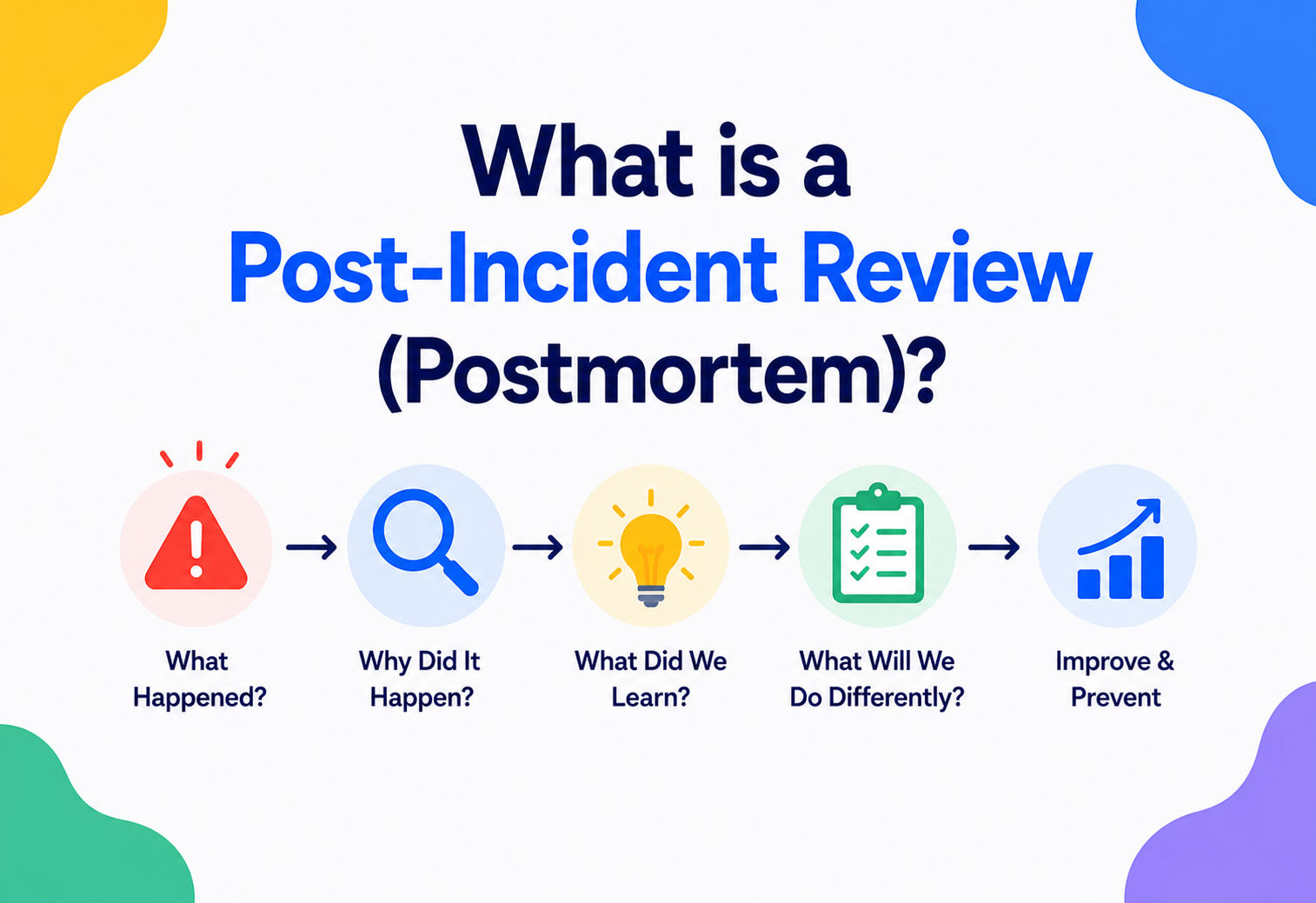
A post-incident review is a structured document and a process that a team creates after something goes wrong in a live software system — a website goes down, an app stops working, data gets corrupted, or customers cannot check out of a shopping cart. The review answers three simple but powerful questions: What happened? Why did it happen? What are we going to do so it either does not happen again, or hurts less if it does?
The term “postmortem” literally comes from Latin: post meaning “after” and mortem meaning “death.” Doctors have used the word for centuries to describe an examination of a body after death, to determine the cause. Software engineers borrowed this word because the spirit is identical — you are examining a “death” (an outage, a failure, an incident) after the fact, to understand its cause, except instead of a body, you are examining a system, and instead of a coroner, you have an engineering team.
1.1 Where the practice comes from
The discipline of blameless postmortems, as practised in modern tech companies, traces its roots to two different worlds that eventually merged:
- Aviation and industrial safety (1940s onward). After plane crashes, industrial accidents, and nuclear incidents (like Three Mile Island in 1979), safety investigators developed rigorous methods for finding “root causes” without simply blaming the last person who touched the controls. They realised that blaming individuals hides the real, systemic causes and discourages people from reporting problems honestly.
- The U.S. Army’s After-Action Review (AAR). Since the 1970s, the military has run structured debriefs after every exercise and mission, asking: What was supposed to happen? What actually happened? Why was there a difference? What can we learn?
- Site Reliability Engineering (SRE) at Google (mid-2000s onward). Google formalised “blameless postmortems” as a core practice in running planet-scale infrastructure, later described publicly in the influential book Site Reliability Engineering (2016). This is the direct ancestor of how most modern software companies run postmortems today.
- Etsy’s “Just Culture” work (2012 onward). Etsy’s engineering team, influenced by human-factors researcher Sidney Dekker, publicly championed blameless postmortems and helped popularise the idea across the wider tech industry through blog posts and conference talks.
Today, virtually every serious technology company — from small startups to Amazon, Netflix, Google, Microsoft, Uber, and Slack — runs some version of this process. It has become as fundamental to running production software as version control or automated testing.
Think of a postmortem like a “black box” recording review after an airplane incident. Investigators do not ask “whose fault was this?” so they can punish someone. They ask “what sequence of conditions made this possible?” so they can redesign the system — the cockpit warnings, the maintenance schedule, the pilot training — so that the same sequence can never happen again, or is caught much earlier next time.
The Problem & Motivation
Why do we need a formal process for this at all? Could not the on-call engineer just fix the bug, ship the fix, and move on? In small systems with a few users, maybe. But as systems grow — more servers, more services, more customers, more money on the line — a few dangerous patterns start to appear if you do not have a formal review process.
2.1 The problems a postmortem solves
Knowledge evaporates
The engineer who fixed the 3 A.M. outage knows exactly what happened. Three months later, they have forgotten the details, or they have left the company. Without a written record, that hard-won knowledge disappears completely and quietly.
The same incident repeats
Without analysis of the root cause, teams often fix only the surface symptom (e.g., “restart the server”) rather than the underlying design flaw (e.g., “the server runs out of memory under load because of a leak”). The same category of outage then recurs again and again.
Fear discourages honesty
If engineers believe that reporting a mistake will get them blamed, punished, or humiliated, they start hiding problems, downplaying severity, or avoiding the on-call rotation altogether. This is far more dangerous than the original incident, because it means leadership loses visibility into real risk.
No systemic learning
An individual fixing one server does not necessarily improve the other nine servers running the same flawed code, or the other teams who built similar systems with the same weak assumption. A shared, searchable record lets the whole organisation learn, not just one team.
2.2 A concrete beginner example
Suppose an online bookstore’s checkout page suddenly starts showing “Error 500” to customers for 40 minutes on a Friday evening — historically the busiest shopping window of the week. Engineers scramble, find that a background job filled up the database’s disk space, delete some old log files, and the site recovers. Everyone breathes a sigh of relief and goes back to their weekend.
Without a postmortem, here is what likely happens: three months later, the same background job fills up the disk again — perhaps on Black Friday, the biggest shopping day of the year — because nobody actually understood why the job was writing so much data, and nobody set up an alert to catch it early. A postmortem forces the team to ask “why,” repeatedly, until they reach the real root cause (e.g., “the job was not rotating / deleting old logs automatically, and we had no disk-usage alert”), and then commit to concrete fixes (add log rotation, add a disk-usage alarm, add a dashboard).
A ride-sharing app’s payment service crashes because a downstream currency-conversion API silently started returning malformed data. The symptom is “payments failing.” The root cause, found through a postmortem’s “5 Whys” analysis, might be: the payment service had no input validation on external API responses, and no circuit breaker to detect and isolate the failing dependency. The fix is not just “call the vendor to complain” — it is “add schema validation and a circuit breaker,” a change that prevents an entire category of future failures, not just this one.
Core Concepts
Before we go further, let us build up the vocabulary, one simple term at a time. Each of these will come up repeatedly through the rest of this guide, and mixing them up in a design review is a fast way to talk past your colleagues.
3.1 Incident
What: Any unplanned event where a system is not behaving the way it is supposed to for users — it might be completely down, running very slowly, showing wrong information, or silently losing data.
Why it matters: An incident is the trigger event. Not every bug is an incident — an incident specifically means real (or seriously risked) impact to users or the business.
Analogy: Like a fire alarm going off in a building — something is currently wrong and needs an immediate, coordinated response.
Example: A shopping website’s payment page returns errors for 20 minutes.
3.2 Postmortem / Post-Incident Review (PIR)
What: The formal write-up and discussion that happens after the incident is resolved, analysing what happened and creating a plan to prevent recurrence.
Why it matters: This is the “learning” step — it converts a one-time painful event into permanent organisational knowledge.
Analogy: The detailed accident report an airline writes after any safety event, whether a crash or a near-miss.
3.3 Blameless culture
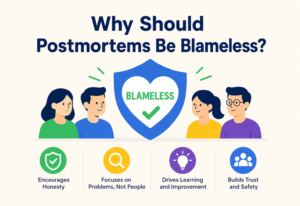
What: A working agreement that a postmortem’s purpose is to understand systems and processes, never to punish or shame the individuals involved.
Why it matters: People only tell the truth about what really happened — including their own mistakes — if they trust they will not be punished for it. Blame destroys that trust and, therefore, destroys the accuracy of the review.
Analogy: A hospital’s “morbidity and mortality” conference, where doctors openly discuss cases that went wrong, focusing on process improvements rather than shaming the treating physician.
3.4 Root cause / contributing factors
What: The underlying reason(s) an incident was possible, as opposed to just the immediate trigger. Modern practice usually prefers the plural “contributing factors” over a single “root cause,” because most real incidents have several factors that combined together.
Why it matters: Fixing only the trigger (e.g., “a bad deploy”) without fixing the contributing factors (e.g., “no automated rollback,” “no canary testing,” “the alert was muted”) means the same class of incident can still recur through a different trigger.
Analogy: A fire needs fuel, oxygen, and a spark — remove any one and there is no fire. An incident is rarely one single cause; it is a combination of conditions that all lined up.
3.5 Timeline
What: A precise, minute-by-minute (or second-by-second) reconstruction of events: when the problem began, when it was detected, when it was diagnosed, when it was fixed, and when it was confirmed resolved.
Why it matters: Without an accurate timeline, you cannot measure your response performance (detection time, response time, resolution time) or spot where the process was slow.
3.6 Severity level
What: A category (often SEV-1 through SEV-4, or P1 through P4) describing how bad an incident is, based on user impact, revenue impact, and data risk.
Why it matters: Not every incident deserves the same depth of review. A SEV-1 (major outage) deserves a full formal postmortem with executive visibility; a SEV-4 (minor, low-impact glitch) might get a short informal note.
3.7 Action items
What: Concrete, owned, and dated follow-up tasks that come out of the review — for example, “Add a disk-usage alert (Owner: Priya, Due: next sprint).”
Why it matters: A postmortem with no action items is just a story. The action items are what actually change the system and prevent recurrence.
3.8 MTTD, MTTR, and related metrics
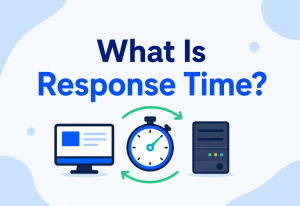
What: Mean Time To Detect (how long before you noticed something was wrong), Mean Time To Resolve / Recover (how long the total incident lasted), Mean Time To Acknowledge, and Mean Time Between Failures.
Why it matters: These numbers, tracked over many incidents, tell you whether your monitoring and response processes are actually improving over time, rather than only feeling like they are.
3.9 Error budget
What: A concept from Site Reliability Engineering: if your service level objective (SLO) is 99.9% uptime, your “error budget” is the remaining 0.1% of allowed downtime / errors in a given period. Incidents consume this budget.
Why it matters: It gives teams a data-driven, non-emotional way to decide “are we shipping too fast and breaking things, or can we afford to take more risks this quarter?”
Think of an error budget like a monthly data plan on your phone. You are allowed, say, 10 GB per month (your “budget” of acceptable downtime). If you use it all up in the first week by streaming too many videos (having too many incidents), you have to slow down and be more careful for the rest of the month (freeze risky deploys and focus on stability) until the budget resets.
Architecture & Components of a Postmortem Process
A mature postmortem process is not just “someone writes a document.” It is a small system in its own right, with defined components, inputs, and outputs — just like any software architecture. Let us break down the pieces.
4.1 Component: Incident Record
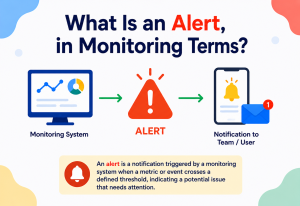
The raw data source. Every mature incident-management tool (PagerDuty, Opsgenie, FireHydrant, Jira Service Management, or an internal tool) keeps a structured record: when the alert fired, who was paged, what actions were taken, and what chat messages were exchanged. This becomes the raw material the postmortem draws from.
4.2 Component: Postmortem Template
A standard document structure (often a wiki page or Markdown template) that every postmortem follows, so readers across the company always know where to find the same kind of information. A typical template includes:
- Summary — 2–3 sentences: what broke, for how long, and who was affected.
- Impact — quantified: number of users affected, revenue lost, SLA breaches, data affected.
- Timeline — timestamped sequence of detection, diagnosis, mitigation, and resolution.
- Root cause / contributing factors — the “why,” usually derived using a structured technique (see Section 5).
- What went well — genuinely useful to reinforce good behaviours (fast detection, good communication).
- What went poorly / where we got lucky — honest gaps, including near-misses that could have made things worse.
- Action items — a table of concrete fixes, each with an owner and due date.
- Supporting data — graphs, logs, and links to dashboards or chat transcripts.
4.3 Component: Incident Commander / Facilitator
A designated role (not necessarily the person who fixes the bug) responsible for coordinating the response during the incident and, afterward, facilitating the blameless review meeting — keeping discussion focused on systems, not people.
4.4 Component: Review Meeting
A scheduled, time-boxed meeting (commonly 30–60 minutes) where the team most involved in the incident — plus interested stakeholders — walk through the draft together, fill gaps in the timeline, and agree on the final list of action items.
4.5 Component: Action Item Tracker
A system (often the same ticketing tool used for regular engineering work, like Jira or Linear) where each action item becomes a trackable ticket with an owner and due date, so it does not silently disappear once the meeting ends.
4.6 Component: Postmortem Repository
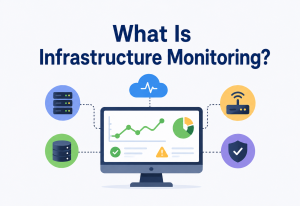
A searchable, company-wide archive of all past postmortems (often in Confluence, Notion, or a dedicated incident tool). This is what allows an engineer joining a new team to search “have we ever had database connection pool exhaustion before?” and learn from history instead of repeating it.
At larger companies, “postmortem review” itself becomes a second-order process: a periodic (often monthly or quarterly) meta-review across all postmortems from that period, looking for repeated root causes across different teams (e.g., “five different teams this quarter had incidents caused by unbounded retry loops”) — a pattern invisible to any single team looking only at their own incidents.
Internal Working — How the Analysis Actually Happens
The heart of a postmortem is the analysis: how do you go from “the checkout page returned errors” to “we need to add a circuit breaker and a retry limit”? Several structured techniques exist to make this repeatable and rigorous rather than a vague conversation.
5.1 Technique 1 — The “5 Whys”
Originally developed at Toyota for manufacturing defects, this simple technique asks “why” repeatedly (not necessarily exactly five times) until you reach a systemic cause rather than a surface symptom.
Symptom: The website went down.
Why 1: Why? Because the database ran out of connections.
Why 2: Why? Because a new feature opened a database connection per request and never closed it.
Why 3: Why? Because the code review missed the missing “close connection” call.
Why 4: Why? Because there is no automated static-analysis check for unclosed resources.
Why 5: Why? Because the team has not yet adopted a linter rule for resource leaks.
Result: The action item is not “fix the one bug” — it is “add an automated linter rule that catches unclosed database connections for every future pull request.”
5.2 Technique 2 — Fishbone (Ishikawa) Diagram
A visual technique that organises potential contributing factors into categories — commonly People, Process, Technology, and Environment — to make sure the analysis does not tunnel-vision on just “the code.”
5.3 Technique 3 — Timeline Reconstruction
Before you can find causes, you must agree on facts. The facilitator pulls timestamps from monitoring dashboards, alert logs, deploy logs, and chat transcripts (e.g., Slack) and merges them into one single, agreed-upon sequence of events, in UTC, to avoid timezone confusion across a distributed team.
5.4 Technique 4 — Contributing Factors Table (CAST / STAMP-inspired)
Instead of a single root cause, more advanced organisations (following safety-science methods like Nancy Leveson’s STAMP / CAST framework) map out every factor that had to be true for the incident to happen, and classify each as a “trigger,” “amplifier” (something that made it worse), or “mitigator” (something that limited the damage or helped resolve it faster).
| Factor Type | Description | Example |
|---|---|---|
| Trigger | The event that started the incident | A configuration change was deployed with a typo |
| Amplifier | Something that made the impact worse or the diagnosis slower | No alert existed for this specific failure mode, so it took 25 minutes to notice |
| Mitigator | Something that limited damage or helped resolution | An automatic rollback system reverted the bad config within 3 minutes of being triggered manually |
5.5 A small Java tool to help structure this analysis
Below is a simple, illustrative Java class that models a postmortem’s contributing factors and generates a clean summary — the kind of small internal tool many platform teams build to standardise their postmortem documents.
import java.util.*;

public class PostmortemAnalyzer {

    enum FactorType { TRIGGER, AMPLIFIER, MITIGATOR }

    record ContributingFactor(String description, FactorType type) {}

    private final String incidentTitle;
    private final List<ContributingFactor> factors = new ArrayList<>();

    public PostmortemAnalyzer(String incidentTitle) {
        this.incidentTitle = incidentTitle;
    }

    public void addFactor(String description, FactorType type) {
        factors.add(new ContributingFactor(description, type));
    }

    // Groups factors by type so the report highlights triggers vs amplifiers vs mitigators
    public Map<FactorType, List<String>> groupedFactors() {
        Map<FactorType, List<String>> grouped = new EnumMap<>(FactorType.class);
        for (FactorType type : FactorType.values()) {
            grouped.put(type, new ArrayList<>());
        }
        for (ContributingFactor f : factors) {
            grouped.get(f.type()).add(f.description());
        }
        return grouped;
    }

    public String renderReport() {
        StringBuilder sb = new StringBuilder();
        sb.append("Postmortem Analysis: ").append(incidentTitle).append("n");
        sb.append("=".repeat(40)).append("n");
        groupedFactors().forEach((type, items) -> {
            sb.append("n").append(type).append(":n");
            items.forEach(item -> sb.append("  - ").append(item).append("n"));
        });
        return sb.toString();
    }

    public static void main(String[] args) {
        PostmortemAnalyzer analyzer = new PostmortemAnalyzer("Checkout Service Outage - July 2026");
        analyzer.addFactor("Config deploy contained a typo in the timeout value", FactorType.TRIGGER);
        analyzer.addFactor("No alert existed for elevated 5xx rate on checkout", FactorType.AMPLIFIER);
        analyzer.addFactor("Automatic rollback reverted the bad config within 3 minutes", FactorType.MITIGATOR);

        System.out.println(analyzer.renderReport());
    }
}
This is intentionally simple — the real value of such a tool in production is that it forces every incident to be described in the same structured shape (trigger / amplifier / mitigator), which makes it possible to later aggregate hundreds of postmortems and find patterns (see Section 8 on scalability).
Data Flow & Lifecycle of a Postmortem
Let us walk through the complete lifecycle of an incident from the very first alert to the postmortem being closed out, since this “data flow” view helps clarify exactly when and how information moves between people and systems.
6.1 Stage 1 — Detection
Either an automated monitor (an alert on error rate, latency, or a failed health check) or a human (a customer complaint, a support ticket, an engineer noticing something odd) detects that something is wrong. The “time to detect” clock starts the moment the problem actually began, and the “detection lag” is the gap between that moment and when someone actually noticed.
6.2 Stage 2 — Response
An on-call engineer (or team) is paged. For serious incidents, an Incident Commander is named — a role, borrowed from emergency services, whose job is purely to coordinate (assign tasks, manage communication, track time), while other engineers focus on diagnosis and fixing.
6.3 Stage 3 — Mitigation and Resolution
The team applies a fix — this might be a full root-cause fix, but more often, especially under pressure, it is a fast mitigation (rollback a deploy, restart a service, fail over to a backup region, add capacity) that stops the bleeding, followed later by a deeper fix.
6.4 Stage 4 — Postmortem Drafting
Within a short window after resolution (commonly 24–72 hours, while memory is fresh), someone — often the Incident Commander or a designated author — drafts the postmortem document using the standard template, pulling in the timeline, graphs, and initial impact numbers.
6.5 Stage 5 — Review Meeting
The team (and sometimes a wider audience) meets to walk through the draft, fill in gaps, debate the root cause analysis, and finalise the action items. This is where the “blameless” ground rules matter most (see Section 5 and Section 15).
6.6 Stage 6 — Publication
The finished postmortem is published into a shared, searchable repository — visible at minimum to the wider engineering organisation, and at many companies (like GitLab and Cloudflare) even published publicly on the company’s status page or blog.
6.7 Stage 7 — Follow-through
Action items are tracked as real tickets, with owners and due dates, and their completion is monitored — often reviewed again at a fixed interval (e.g., 30 days later) to check whether they were actually done, not just written down and forgotten.
6.8 Stage 8 — Aggregation / Meta-Learning
Periodically, someone (often in an SRE or Reliability Engineering function) reviews trends across many postmortems: are the same root causes appearing across different teams? Is MTTR improving or getting worse over time? This closes the loop back into engineering practices, tooling investments, and even hiring and training decisions.
Advantages, Disadvantages & Trade-offs
No single approach to running postmortems is free. There are real benefits to the discipline, and there are real costs — and mature engineering leaders go into the process with clear eyes about both, rather than treating it as an unquestioned ritual.
7.1 Advantages
| Advantage | Why it matters |
|---|---|
| Prevents recurrence | Fixing root causes, not just symptoms, stops entire categories of failure, not just one instance. |
| Builds institutional memory | New engineers can read past postmortems and learn “gotchas” without having to personally suffer through them. |
| Improves trust and psychological safety | A blameless process signals that honesty is valued over the appearance of perfection, encouraging people to report problems early. |
| Surfaces systemic weaknesses | Patterns across many postmortems reveal architectural or process weak points invisible in any single incident. |
| Improves customer trust (when shared externally) | Public postmortems (as done by GitLab, Cloudflare, AWS) demonstrate transparency and technical seriousness to customers. |
| Data for prioritisation | Turns “we should probably fix that someday” into measured, evidence-backed engineering priorities. |
7.2 Disadvantages & Costs
| Disadvantage | Why it happens / how to mitigate |
|---|---|
| Time cost | Writing a good postmortem and holding a review meeting can take several hours of skilled engineering time — a real cost that must be budgeted, not treated as free. |
| Can become a “paperwork” ritual | If the organisation does not actually track action items to completion, postmortems become documents nobody reads and a process people resent. |
| Risk of blame creeping back in | Without active facilitation and leadership modelling, “blameless” language can be undermined in practice (e.g., performance reviews subtly penalising people named in postmortems). |
| Analysis paralysis | Overly long, overly formal reviews for minor incidents waste engineering time that could go toward actual fixes. |
| False sense of closure | Writing the document can feel like “solving” the problem even when action items are never completed — the illusion of progress without the substance. |
7.3 Key trade-off: depth vs. speed
Every organisation must decide how much rigour to apply relative to incident severity. Too little rigour on a severe incident risks repeating an expensive failure. Too much rigour on a trivial incident wastes engineering time that could be spent building. Most mature organisations solve this with a tiered process tied to severity level.
| Severity | Typical Review Depth | Audience |
|---|---|---|
| SEV-1 (major outage / data loss / security breach) | Full formal postmortem, dedicated review meeting, executive read-out | Whole engineering org, leadership, sometimes customers |
| SEV-2 (significant but partial impact) | Full written postmortem, team-level review meeting | Team + adjacent teams |
| SEV-3 (minor, limited impact) | Short written summary, async review | Team only |
| SEV-4 (near-miss, no user impact) | One-paragraph note in a shared log | Team only, for pattern-tracking |
Performance & Scalability of the Postmortem Process
It might seem strange to talk about “scalability” for a process that involves humans writing documents, but exactly the same engineering principles apply: as the number of incidents and teams grows, a process that worked fine for 5 incidents a month can completely break down at 500 incidents a month across 50 teams. Let us look at what breaks and how organisations scale the practice.
8.1 What breaks at scale
- Volume overload. At a company running thousands of services, requiring a full formal review for every single incident is unsustainable — hence the severity-tiered approach above.
- Inconsistent quality. Without a shared template and training, some teams write excellent postmortems and others write vague ones (“we fixed it, moving on”), making cross-team learning impossible.
- Undiscoverable knowledge. A pile of 10,000 unstructured documents in a wiki is effectively unsearchable. Structured metadata (severity, affected service, root-cause category, tags) becomes essential once volume grows.
- Action item debt. At scale, unfinished action items across hundreds of postmortems can silently pile up into significant unaddressed risk — like technical debt, but for reliability.
8.2 How organisations scale postmortem practice
- Templates and tooling automation. Incident-management platforms (like PagerDuty, FireHydrant, Jeli, or an internal tool) auto-generate a postmortem draft pre-filled with the timeline pulled directly from alerts and chat logs, cutting authoring time dramatically.
- A dedicated reliability / SRE function. A small central team owns the process itself — training facilitators, maintaining the template, and running the periodic cross-team trend analysis — rather than leaving quality entirely up to each team’s discipline.
- Tagging and categorisation. Structured fields like
root_cause_category,affected_service, andseveritylet the organisation run analytics across postmortems (e.g., “which root-cause category caused the most total downtime-minutes this quarter?”). - Sampling for low-severity incidents. Rather than reviewing every minor incident individually, some organisations batch-review a sample of low-severity incidents together in a single recurring meeting, looking for patterns.
Companies operating at Netflix or Amazon scale often build internal tooling that automatically correlates a new incident’s signature (affected service, error type, alert name) against past postmortems, surfacing “this looks similar to INC-4521 from March — did we actually fix the root cause then?” This is essentially applying search and pattern-matching to reliability data, turning tribal knowledge into a queryable system.
High Availability & Reliability Connection
Postmortems are one of the core practices that make high availability (HA) actually achievable in the real world, rather than just a number on a slide. Let us connect the dots between an individual incident review and the reliability of a whole platform over time.
9.1 From incidents to Service Level Objectives (SLOs)
Most reliable systems define a Service Level Objective — for example, “99.95% of checkout requests succeed within 500 ms, measured monthly.” Every incident consumes part of the “error budget” that this SLO allows. A rigorous postmortem process is what turns each budget-consuming incident into a data point that either (a) proves the SLO is being protected by good engineering, or (b) reveals it is being violated by systemic weaknesses that need investment.
9.2 Redundancy and failover informed by postmortems
Many of the most important reliability investments a company makes — adding a second data centre, adding automatic failover, introducing circuit breakers, adding retries with backoff — are directly traceable to lessons learned in specific postmortems. Reliability is rarely designed perfectly up front; it accumulates through this feedback loop of “incident happens → root cause found → resilience mechanism added.”

Think of a building’s fire-safety systems — sprinklers, fire doors, smoke alarms, evacuation routes. These were not all designed on day one by a genius architect who thought of everything. Building codes evolved over decades specifically because of postmortems on real fires: after the 1911 Triangle Shirtwaist Factory fire in New York, building codes were rewritten to require unlocked exits and fire escapes. Software reliability engineering evolves the same way — incident by incident, postmortem by postmortem.
9.3 Chaos engineering as a proactive complement
Some organisations (Netflix being the most famous example, with its “Chaos Monkey” tooling) deliberately inject failures into production systems to find weaknesses before a real incident does. The output of a chaos experiment is analysed almost identically to a postmortem — same blameless spirit, same root-cause analysis, same action items — except the “incident” was intentional and controlled.
9.4 Reliability metrics driven by postmortem data
| Metric | What it measures | Postmortem’s role |
|---|---|---|
| MTTD (Mean Time To Detect) | How fast problems are noticed | Postmortems reveal detection gaps and drive new alerting |
| MTTR (Mean Time To Resolve) | How fast problems are fixed once known | Postmortems reveal process bottlenecks (e.g., “took 20 minutes to find the right on-call person”) |
| Change Failure Rate | What fraction of deploys cause incidents | Postmortems attributing incidents to deploys drive investment in canarying and automated rollback |
| Recurrence Rate | How often the same root-cause category repeats | Direct measure of whether the postmortem process is actually working |
Security-Focused Postmortems
When the incident is a security event — a data breach, unauthorised access, a leaked credential, or a successful phishing attack — the postmortem process changes shape in important ways, even though the blameless spirit remains the same.
10.1 How security postmortems differ
- Broader stakeholders. Legal, compliance, communications / PR, and sometimes law enforcement or regulators must be involved, not just engineering.
- Different timelines matter. Beyond detection and resolution, security reviews track “dwell time” (how long an attacker was present undetected) and “time to containment” separately from “time to full remediation.”
- Evidence preservation. Unlike an ordinary outage where you can freely restart servers, a security incident may require preserving logs, memory dumps, and disk images as evidence before any cleanup — sometimes called a “forensic hold.”
- Disclosure obligations. Depending on jurisdiction and industry (e.g., GDPR in Europe, HIPAA for health data in the US, PCI-DSS for payment data), a security postmortem may trigger legal requirements to notify affected users or regulators within a specific time window.
- Blast radius analysis. Security reviews specifically ask “what could the attacker have accessed?” — often broader than what they are proven to have accessed — because the review must account for uncertainty conservatively.
10.2 Common root-cause categories in security postmortems
| Category | Example | Typical Fix |
|---|---|---|
| Credential exposure | An API key was accidentally committed to a public code repository | Secret scanning in CI/CD, automatic key rotation, git history scrubbing |
| Missing access controls | An internal admin panel had no authentication requirement | Enforce authentication and authorisation by default (fail closed, not open) |
| Unpatched vulnerability | A known CVE in a dependency was exploited before patching | Automated dependency scanning and faster patch SLAs |
| Social engineering | An employee was phished for their credentials | Mandatory hardware security keys (phishing-resistant MFA), security training |
Security postmortems must be handled with extra care around what gets published widely. Publishing exact exploit details before a fix is fully deployed everywhere can help attackers replicate the attack elsewhere. Many organisations publish a redacted or delayed version externally while keeping the full technical detail internal to those with a need to know.
Monitoring, Logging & Metrics — The Raw Material of Every Postmortem
A postmortem is only as good as the evidence available to reconstruct what happened. This is why strong observability (monitoring, logging, and metrics) is a prerequisite for a good postmortem process, not a separate concern.
11.1 The three pillars of observability, and their postmortem role
| Pillar | What it is | Role in a postmortem |
|---|---|---|
| Metrics | Numeric time-series data (e.g., requests per second, error rate, CPU usage) | Establishes precisely when a problem began and ended, and its magnitude |
| Logs | Discrete, timestamped text records of individual events | Provides the detailed “what exactly happened” evidence — stack traces, error messages, request IDs |
| Traces | A record of a single request’s journey across multiple services | Pinpoints exactly which downstream service or database call was the actual failure point in a complex, multi-service request |
11.2 Building a good timeline from telemetry
A well-run incident response captures screenshots and exports of dashboards at the moment of the incident (dashboards are often not permanently retained at full resolution, so exporting them during the incident matters). The postmortem author then stitches together: alert-firing timestamps, deploy timestamps (from CI/CD logs), chat message timestamps (from the incident’s dedicated Slack channel or similar), and resolution-confirmation timestamps, all normalised to UTC.
A payments team notices, while writing their postmortem, that their dashboard showed elevated latency 12 minutes before the alert fired. This single observation becomes an action item on its own: “Lower the alert threshold for payment-service p99 latency from 800 ms to 400 ms,” directly improving MTTD for the next incident.
11.3 A simple Java example: computing MTTR from incident records
Below is a small illustrative program showing how raw incident timestamps (the kind pulled from a monitoring / logging system) get turned into the kind of aggregate reliability metric that feeds into postmortem trend reviews.
import java.time.Duration;
import java.time.Instant;
import java.util.*;

public class ReliabilityMetrics {

    record Incident(String id, Instant detectedAt, Instant resolvedAt, int severity) {
        Duration resolutionTime() {
            return Duration.between(detectedAt, resolvedAt);
        }
    }

    public static Duration meanTimeToResolve(List<Incident> incidents) {
        long totalSeconds = incidents.stream()
                .mapToLong(i -> i.resolutionTime().toSeconds())
                .sum();
        return Duration.ofSeconds(totalSeconds / Math.max(1, incidents.size()));
    }

    public static Map<Integer, Duration> meanTimeToResolveBySeverity(List<Incident> incidents) {
        Map<Integer, List<Incident>> grouped = new TreeMap<>();
        for (Incident i : incidents) {
            grouped.computeIfAbsent(i.severity(), k -> new ArrayList<>()).add(i);
        }
        Map<Integer, Duration> result = new TreeMap<>();
        grouped.forEach((severity, list) -> result.put(severity, meanTimeToResolve(list)));
        return result;
    }

    public static void main(String[] args) {
        List<Incident> incidents = List.of(
            new Incident("INC-101", Instant.parse("2026-06-01T14:03:00Z"),
                                     Instant.parse("2026-06-01T14:47:00Z"), 1),
            new Incident("INC-102", Instant.parse("2026-06-05T09:15:00Z"),
                                     Instant.parse("2026-06-05T09:25:00Z"), 3),
            new Incident("INC-103", Instant.parse("2026-06-14T22:00:00Z"),
                                     Instant.parse("2026-06-14T22:52:00Z"), 1)
        );

        System.out.println("Overall MTTR: " + meanTimeToResolve(incidents));
        System.out.println("MTTR by severity: " + meanTimeToResolveBySeverity(incidents));
    }
}
In a real system, this kind of aggregation runs continuously across every incident’s data, feeding dashboards that leadership reviews monthly or quarterly to judge whether reliability investments (from Section 9) are actually paying off.
Deployment, Cloud & Tooling
Modern postmortem practice is deeply intertwined with the tools teams use to deploy and operate cloud infrastructure. Let us look at the tooling landscape and how cloud-native practices shape the process.
12.1 Categories of supporting tools
| Category | Purpose | Examples |
|---|---|---|
| Alerting / on-call | Detect problems and notify the right humans | PagerDuty, Opsgenie, VictorOps |
| Incident coordination | Structured incident-response workflow, roles, and communication | FireHydrant, incident.io, Jeli, internal “war room” bots |
| Observability | Metrics, logs, and traces for diagnosis and timeline-building | Datadog, Grafana + Prometheus, Honeycomb, New Relic |
| Postmortem documentation | Structured, templated documents, often auto-populated | Confluence, Notion, Google Docs with templates, dedicated postmortem tools |
| Action item tracking | Ensures fixes actually get built | Jira, Linear, GitHub Issues |
12.2 How cloud-native deployment practices connect to postmortems
- Canary deployments and feature flags. A common postmortem action item is “roll out changes gradually to a small percentage of traffic first,” letting a bad change be caught and rolled back automatically before it reaches all users.
- Infrastructure as Code (IaC). When infrastructure is defined in version-controlled code (Terraform, CloudFormation), postmortems can point to the exact commit that introduced a misconfiguration, and the fix can include an automated policy check (e.g., using a tool like OPA / Conftest) to prevent the same class of misconfiguration in the future.
- Immutable infrastructure and automated rollback. Cloud environments that can automatically revert to a known-good previous version dramatically shorten MTTR — a very common postmortem-driven investment.
- Multi-region / multi-AZ architecture. Many postmortems in cloud environments conclude with “we need to fail over to a second Availability Zone or Region automatically,” directly improving the HA properties discussed in Section 9.
Many cloud providers publish their own postmortems for major outages — for example, AWS publishes detailed “Post-Event Summaries” for significant regional outages, and Google Cloud and Cloudflare do the same. These are worth reading because they show, at extreme scale, how the same techniques covered in this guide (timeline, contributing factors, action items) apply even to infrastructure serving millions of companies.
APIs, Microservices & Distributed Systems
Postmortems become both more important and more complex once a system is broken into many independent services communicating over networks — the world of microservices. A single user-facing failure might be caused by a chain of five or six services, each individually “working correctly” in isolation.
13.1 Why distributed systems make postmortems harder
- No single source of truth. Each microservice has its own logs and metrics; reconstructing a timeline means correlating data across many independent systems, often using a shared “trace ID” or “correlation ID” that follows a request across service boundaries.
- Cascading failures. A slowdown in one low-level service (say, a shared authentication service) can cause timeouts and retries in dozens of dependent services, creating a “thundering herd” that looks, at first glance, like many unrelated incidents happening at once.
- Ownership ambiguity. When Service A calls Service B calls Service C, and C fails, it may be unclear which team should “own” writing the postmortem — best practice is that the team whose users were most impacted leads the writing, with contributions from every team in the causal chain.
13.2 Common distributed-systems root causes seen in postmortems
| Root Cause Pattern | Description | Typical Fix |
|---|---|---|
| Missing timeouts | Service A waits forever for Service B’s response, exhausting Service A’s own thread pool | Set explicit, sane timeouts on every network call |
| Retry storms | Every client retries a failing call immediately, multiplying load on an already-struggling service | Exponential backoff with jitter, and circuit breakers |
| Lack of bulkheading | One slow dependency exhausts a shared connection pool used by unrelated requests too | Isolate resource pools per-dependency (“bulkhead” pattern) |
| Schema / contract mismatch | One service changes its API response shape without warning downstream consumers | API versioning, contract testing, backward-compatible changes only |
| Shared single point of failure | Many “independent” microservices all depend on one shared database or auth service | Redundancy for shared dependencies, graceful degradation when they are unavailable |
13.3 Distributed tracing as the postmortem’s best friend
Modern distributed tracing systems (built on standards like OpenTelemetry) let an engineer take one single failed customer request and see a “waterfall” of every service it touched, with exact timing for each hop. This turns what used to be hours of manual log-correlation into minutes of visual inspection — dramatically speeding up both incident diagnosis and postmortem timeline construction.
Design Patterns & Anti-Patterns in Postmortem Practice
A handful of patterns show up over and over in effective postmortem cultures, and a handful of anti-patterns show up over and over in the ones that quietly rot. Learning to recognise both is one of the fastest ways for a senior engineer to raise the reliability floor of a whole organisation.
14.1 Good patterns
| Pattern | Description |
|---|---|
| Blameless framing | Language focuses on systems and decisions, never on individual competence (“the deploy process allowed an untested config change” rather than “Sam pushed a bad config”). |
| Timeboxed drafting window | Draft written within 24–72 hours, while memory is fresh, before details fade. |
| Multiple contributing factors | Explicitly resisting the urge to declare one single “root cause,” since real incidents are almost always multi-causal. |
| Actionable, owned, dated items | Every action item names a specific owner and a specific due date — vague items like “improve monitoring” get rejected in review. |
| Public / wide sharing by default | Postmortems are shared broadly (not hidden), so other teams can learn from them proactively. |
| Celebrating what went well | Explicitly noting good decisions and lucky breaks, reinforcing behaviours worth repeating and revealing near-misses worth addressing. |
14.2 Anti-patterns to avoid
| Anti-pattern | Why it is harmful |
|---|---|
| “Root cause: human error” | This is almost never a useful conclusion — it stops the analysis exactly where it should begin. Ask why the system allowed that human error to cause an outage in the first place. |
| Naming and shaming | Even subtly (“the engineer who deployed without testing”) discourages future honesty and volunteer participation in incident response. |
| Action items with no owner | An action item assigned to “the team” or nobody in particular reliably never gets done. |
| Postmortem theatre | Going through the motions of writing a document that nobody reads and whose action items are never tracked — worse than no process, because it creates false confidence. |
| Overly long, jargon-heavy documents | If a postmortem cannot be understood by someone outside the immediate team, it fails at its purpose of spreading organisational learning. |
| Skipping low-severity incidents entirely | Near-misses often contain the cheapest, earliest warning signs of a much bigger future incident — ignoring them wastes valuable, low-cost data. |
Writing a postmortem that identifies excellent action items, but assigning them lower priority than “regular” feature work indefinitely. If reliability action items always lose the prioritisation fight against new features, the error budget concept from Section 3 exists specifically to force this trade-off into the open with data, rather than leaving it as an invisible, chronic risk.
Best Practices & Common Mistakes
If the earlier sections were about how a postmortem works, this one is the concise, tactical checklist experienced facilitators keep in their head when they sit down to write, or when they walk into a review meeting.
15.1 Best practices
- Write it while it is fresh. Draft within a day or two of resolution; details fade fast, and reconstructing a timeline weeks later is far less accurate.
- Use a consistent template. Consistency across the organisation is what makes postmortems searchable and comparable over time.
- Separate facts from opinions in the timeline. The timeline section should be pure, verifiable fact (with timestamps); interpretation and analysis belong in a separate section.
- Involve a neutral facilitator for serious incidents. Someone not personally responsible for the mistake keeps the discussion focused on systems, not individuals.
- Quantify impact precisely. “Some users experienced errors” is far weaker than “approximately 12,400 checkout attempts failed over 38 minutes, representing an estimated $47,000 in delayed revenue.”
- Track action items like real engineering work. They should live in the same ticketing system as regular features, with the same visibility and accountability.
- Review completion rates regularly. Periodically check what percentage of action items across all postmortems actually got completed — a low rate is itself an organisational problem worth its own postmortem-style analysis.
- Make postmortems widely readable. Write for an engineer outside the immediate team; avoid unexplained acronyms and internal shorthand.
- Include “what went well.” This is not just morale-boosting fluff — it identifies which existing safeguards worked and should be reinforced or replicated elsewhere.
- Practise with low-stakes incidents first. Teams new to the blameless process build the habit and trust more safely on minor incidents before their first major outage.
15.2 Common mistakes
- Treating the postmortem meeting as a status update rather than genuine collaborative analysis.
- Stopping the “why” analysis at the first plausible answer instead of digging to a systemic, fixable cause.
- Letting the loudest voice in the room dominate the narrative instead of gathering input from everyone involved, including quieter or more junior engineers who may have crucial details.
- Forgetting to close the loop — never circling back to check whether action items were actually completed.
- Writing postmortems only for major incidents and ignoring the steady stream of smaller signals that often predict the next big one.
- Using the postmortem process punitively during performance reviews, which permanently damages trust in the “blameless” promise, often for years afterward.
Real-World Industry Examples
Reading how the largest and most reliability-focused technology companies actually run this process is one of the fastest ways to internalise which parts of the theory matter most in practice — and which are optional depending on your context.
Codifying “blameless” as policy
Google’s Site Reliability Engineering practice, described publicly in their SRE book, made “blameless postmortems” an explicit, named cultural value, with detailed internal templates and even postmortem “readability” reviewers who help polish documents for organisation-wide clarity before wide distribution.
Correction of Error (COE)
Amazon’s internal process, called COE, requires a very disciplined “5 Whys” structure and is famously rigorous — teams are expected to keep asking “why” until they reach a cause that is genuinely actionable and systemic, not superficial. AWS also publishes external post-event summaries for major regional service disruptions, giving the public a rare look into hyperscale infrastructure failures.
Chaos engineering as complement
Netflix pioneered deliberately injecting failures into production (Chaos Monkey and the broader Simian Army toolset) specifically so that the organisation can run “postmortem-style” analysis on controlled, non-customer-impacting failures, hardening the system before a real incident forces the lesson.
Publicly championing blamelessness
Etsy’s engineering blog and public talks (drawing on human-factors researcher Sidney Dekker’s “Just Culture” work) were highly influential in spreading blameless postmortem practice across the wider tech industry in the early 2010s, well beyond Etsy’s own walls.
Radically public postmortems
GitLab is known for publishing detailed postmortems — including a widely-discussed 2017 database incident — publicly and in real time, including admitting significant mistakes (like backup processes that had silently been failing for months). This radical transparency became a widely cited example of postmortems building customer trust rather than damaging it.
Public, technically deep postmortems
Cloudflare regularly publishes deeply technical public blog-post postmortems for major outages affecting large portions of the internet, walking through exact configuration changes, BGP routing details, or software bugs — widely read and respected across the industry as educational material in their own right.
Real-time distributed systems
Companies operating real-time, high-throughput marketplace systems (matching riders with drivers, or similar dynamic-pricing systems) frequently encounter distributed-systems failure patterns (Section 13) — cascading timeouts, retry storms — and have published engineering blog posts describing postmortem-driven adoption of circuit breakers and bulkheading across their microservice fleets.
A recurring theme across nearly every public postmortem from these companies: the root cause is almost never “one engineer made a mistake.” It is almost always a combination of a plausible-seeming change, a missing safeguard (no canary, no automated test, no alert), and an amplifying factor (a busy holiday, a coincidental second issue, a slow page-out chain) that combined to create real impact. This consistently validates the “contributing factors, not single root cause” philosophy from Section 5.
Frequently Asked Questions
A handful of the questions that come up most often when engineers or engineering leaders start seriously introducing postmortem practice into a team, answered plainly — without pretending the answers are simpler than they really are.
Is a postmortem the same thing as an incident report?
They are closely related but not identical. An incident report is often a shorter, more immediate summary (sometimes written during or right after the incident, for stakeholders who need to know quickly). A postmortem is the deeper, more deliberate analysis written afterward, focused on root causes and prevention, not just “what happened and is it fixed now.”
Who should write the postmortem?
Typically the Incident Commander or a designated author from the most-affected team drafts it, but it should be reviewed and contributed to by everyone involved in the response — the goal is a shared, agreed-upon account, not one person’s individual perspective.
How long should a postmortem be?
Long enough to be complete, short enough to be read. Many teams target one to three pages for the narrative, with supporting graphs and logs linked rather than pasted in at full length. If it takes more than 15–20 minutes to read, most readers will not finish it.
Do we need a postmortem for every single incident?
No — this is why severity-tiering (Section 7) exists. Minor, low-impact incidents typically get a brief note rather than a full formal review, to keep the process sustainable at scale.
What if the root cause really was a mistake someone made?
Humans will always make mistakes — that is a given, not a root cause. The useful question is always “why did the system allow that mistake to cause customer impact?” A well-designed system is resilient to individual human error by design (through review processes, automated checks, canary rollouts, and rollback mechanisms).
Should postmortems be shared outside the immediate team?
For anything beyond the most minor incidents, yes — wide sharing (within appropriate confidentiality boundaries, especially for security incidents per Section 10) is exactly what turns individual team pain into organisation-wide learning.
What tools do teams typically use to run this process?
Common combinations include an alerting / on-call tool (PagerDuty, Opsgenie), an observability stack (Datadog, Grafana / Prometheus, Honeycomb), a documentation tool with a shared template (Confluence, Notion, Google Docs), and a ticketing system for action items (Jira, Linear) — see Section 12 for more detail.
How do you measure whether the postmortem process itself is working?
Track metrics like: percentage of action items completed on time, recurrence rate of the same root-cause category, and trends in MTTD / MTTR over time (Section 9). A process that produces documents but does not move these numbers is a sign that something (often follow-through, not the writing itself) needs improvement.
Summary & Key Takeaways
Postmortems, done well, are one of the highest-leverage engineering practices in the entire discipline — and done badly, they become one of the emptiest rituals. The difference is entirely in whether the organisation takes the discipline seriously enough to follow through on what it uncovers.
Key takeaways to carry with you
- A post-incident review (postmortem) is the structured process of analysing an incident after it is resolved, to understand what happened, why it happened, and how to prevent it (or reduce its impact) in the future.
- The practice descends from aviation / industrial safety investigation, military after-action reviews, and was formalised for software by Google’s SRE practice and popularised further by companies like Etsy.
- Blamelessness is not a soft, feel-good add-on — it is a functional requirement. Without psychological safety, people hide the truth, and the analysis becomes worthless.
- Real incidents almost always have multiple contributing factors, not one single root cause — techniques like the 5 Whys and fishbone diagrams help surface all of them.
- A good postmortem has a clear structure: summary, quantified impact, timeline, contributing factors, what went well / poorly, and — most importantly — concrete, owned, dated action items.
- The process must be tiered by severity to remain sustainable as an organisation scales to hundreds or thousands of incidents.
- Postmortems are deeply connected to reliability engineering (error budgets, SLOs), to distributed-systems architecture (timeouts, circuit breakers, bulkheads), and to deployment practice (canaries, automated rollback, Infrastructure as Code).
- Security incidents require additional care around legal disclosure obligations, evidence preservation, and controlled information sharing.
- The single most important discipline separating a real postmortem culture from “postmortem theatre” is following through on action items and tracking whether the process is actually reducing recurrence over time.
- Companies like Google, Amazon, Netflix, Etsy, GitLab, and Cloudflare have each, in their own way, proven that this discipline — turning painful failures into durable engineering knowledge — is one of the highest-leverage practices in running reliable software at scale.
In the end, a postmortem is simply institutionalised curiosity about failure — the discipline of never letting a hard-won lesson evaporate, and never letting the same mistake cost the organisation twice.