What Is a Bounded Context in Microservices?
A complete, beginner‑friendly guide to one of the most important ideas in modern software design — explained so clearly that even a curious 10‑year‑old could follow the story, yet deep enough for production engineering and system‑design interviews. Domain‑driven. Team‑shape aware. Amazon / Netflix / Uber real‑world.
Introduction & History
Imagine a big school. Inside that school there is a Library, a Kitchen, a Sports Department, and a Hospital Room (the school clinic). Each of these places has its own rules, its own workers, and its own way of talking about things.
In the Library, the word “member” means a student who has borrowed a book. In the Kitchen, “member” might mean a student who has a lunch card. In the Hospital Room, “member” could mean a student who has a health record. Same word — “member” — but it means something slightly different in each place, and that is completely fine, because each place only cares about the meaning that matters to it.
Nobody gets confused, because each department has a clear boundary. The librarian never tries to prescribe medicine, and the nurse never tries to stamp library cards. Each department is an expert in its own small world, and they talk to each other only when they truly need to — for example, the Hospital Room might tell the Kitchen “this student is allergic to peanuts.”
This school is a perfect real‑life picture of a concept from software architecture called a Bounded Context. In this tutorial, you will learn exactly what a bounded context is, why it was invented, how it connects to microservices, and how to use it correctly in real production systems.
A bounded context is like a department in a school (or a room in a house). Each room has its own purpose, its own furniture, and its own rules — and the walls between rooms stop confusion from leaking in.
Where did this idea come from?
The term “Bounded Context” was introduced by software engineer Eric Evans in his highly influential 2003 book, Domain‑Driven Design: Tackling Complexity in the Heart of Software. Evans was trying to solve a very old and very human problem: when many people build a large piece of software together, they start using the same words to mean different things, and this causes bugs, miscommunication, and messy code.
Domain‑Driven Design, usually shortened to DDD, is an approach to designing software that puts the real‑world business (“the domain”) at the center of the design, instead of putting the database or the framework at the center. Bounded Context is one of the most important building blocks of DDD.
For many years after the book was published, bounded context stayed mostly inside the world of enterprise software design discussions. But everything changed around 2012–2015, when the microservices architecture style became extremely popular, championed by companies like Netflix, Amazon, and later described publicly by writers like Martin Fowler and James Lewis. Suddenly, engineering teams everywhere had a very practical question: “Ok, we want to break our giant application into small services. But where exactly do we draw the lines?”
The answer the industry landed on, almost universally, was: use bounded contexts as the boundaries for your microservices. This single idea has since become one of the most quoted, most interviewed‑about, and most misunderstood concepts in modern backend architecture.
If you ask ten senior engineers “how do you decide the size of a microservice?”, at least seven of them will say some version of “one microservice per bounded context.” Understanding this concept deeply is one of the fastest ways to level up as a backend or system design engineer.
Problem & Motivation
The monolith and the “big ball of mud”
To understand why bounded context matters, we first need to understand the pain it was created to remove. Picture a single, large application — a monolith — that handles an entire e‑commerce business: catalog, orders, payments, shipping, customer support, and marketing, all living inside one codebase, one database, and one deployment unit.
In the beginning, with three developers and a small database, this feels simple. But as the company grows, more developers join, more features are added, and slowly something dangerous happens: everything starts touching everything else. A change to how “Customer” is stored for the Marketing team accidentally breaks the Shipping team’s code, because both teams were sharing the very same Customer class.
This tangled, hard‑to‑change mess has a famous nickname in software circles: the Big Ball of Mud. It is not a formal pattern — it is an anti‑pattern, a warning label for what happens when a system grows without clear internal boundaries.
Imagine one giant desk shared by the librarian, the nurse, the chef, and the sports coach — all their papers, tools, and notes piled together. Every time the chef needs a pen, they might accidentally move the nurse’s medicine chart. That’s what a tangled monolith feels like for developers.
The word “Customer” problem
Here is the deepest and most important problem that bounded context solves, and it is worth slowing down for. In a large business, the same English word often means genuinely different things to different teams:
| Word | Meaning in Sales team | Meaning in Billing team | Meaning in Support team |
|---|---|---|---|
| Customer | A lead who might buy something; has interests, campaigns, discount eligibility | A billing account with a payment method, invoices, tax ID | A person with a support ticket history, satisfaction score |
| Order | A potential deal being negotiated | A financial transaction that must be invoiced | Something a customer is asking “where is my order?” about |
| Product | An item to market and promote | A line item with a price and tax category | Something the customer received (or didn’t) and might return |
If all these teams try to force one single, giant Customer class to satisfy everyone’s needs, that class becomes enormous, fragile, and nobody fully understands it anymore. Every team is scared to change it because it might break someone else’s feature.
Eric Evans’s insight was simple but powerful: stop trying to make one universal model that fits everyone. Instead, accept that different parts of the business naturally have different models, and draw an explicit boundary around each one. Inside that boundary, the words mean exactly one thing, and everyone agrees on the meaning. That boundary is the bounded context.
Why not just use good class design?
A common beginner question is: “Why can’t we just write cleaner code, better classes, and better comments to avoid this?” The answer is that this is not fundamentally a code‑quality problem — it is a language and communication problem between human teams. No amount of clever code refactoring fixes the fact that the Sales team and the Billing team genuinely think about “Customer” differently, because their jobs are different. Bounded context accepts this reality instead of fighting it.
Bounded context is not primarily a technical pattern — it is primarily a modeling and communication tool. The technical boundary (a microservice, a module, a database) is just the enforcement mechanism for a boundary that already exists in the business itself.
Core Concepts
3.1 Domain
WhatThe domain is the overall subject area — the whole business problem your software is trying to solve. For an e‑commerce company, the domain is “online retail.” For a bank, the domain is “financial services.”
WhyBefore you can design software well, you need a name for “the real‑world thing we are modeling.”
AnalogyThe domain is the entire school itself — all the teaching, learning, feeding, and caring for students that happens inside it.
3.2 Subdomain
What it is: A domain is usually too big to think about all at once, so we split it into subdomains — smaller, focused areas of the business. E‑commerce might split into: Catalog, Ordering, Payments, Shipping, Customer Support, and Marketing.
Subdomains come in three flavors:
- Core subdomain — the part that makes the business special and competitive (for Amazon, this might be their recommendation and logistics engine).
- Supporting subdomain — necessary, but not the thing that makes you unique (order history tracking, for example).
- Generic subdomain — common to almost every business, and often solved with existing tools (authentication, email sending, invoicing).
Subdomains are the departments of the school: Library, Kitchen, Sports, Hospital Room, Admissions Office.
3.3 Bounded Context — the star of this tutorial
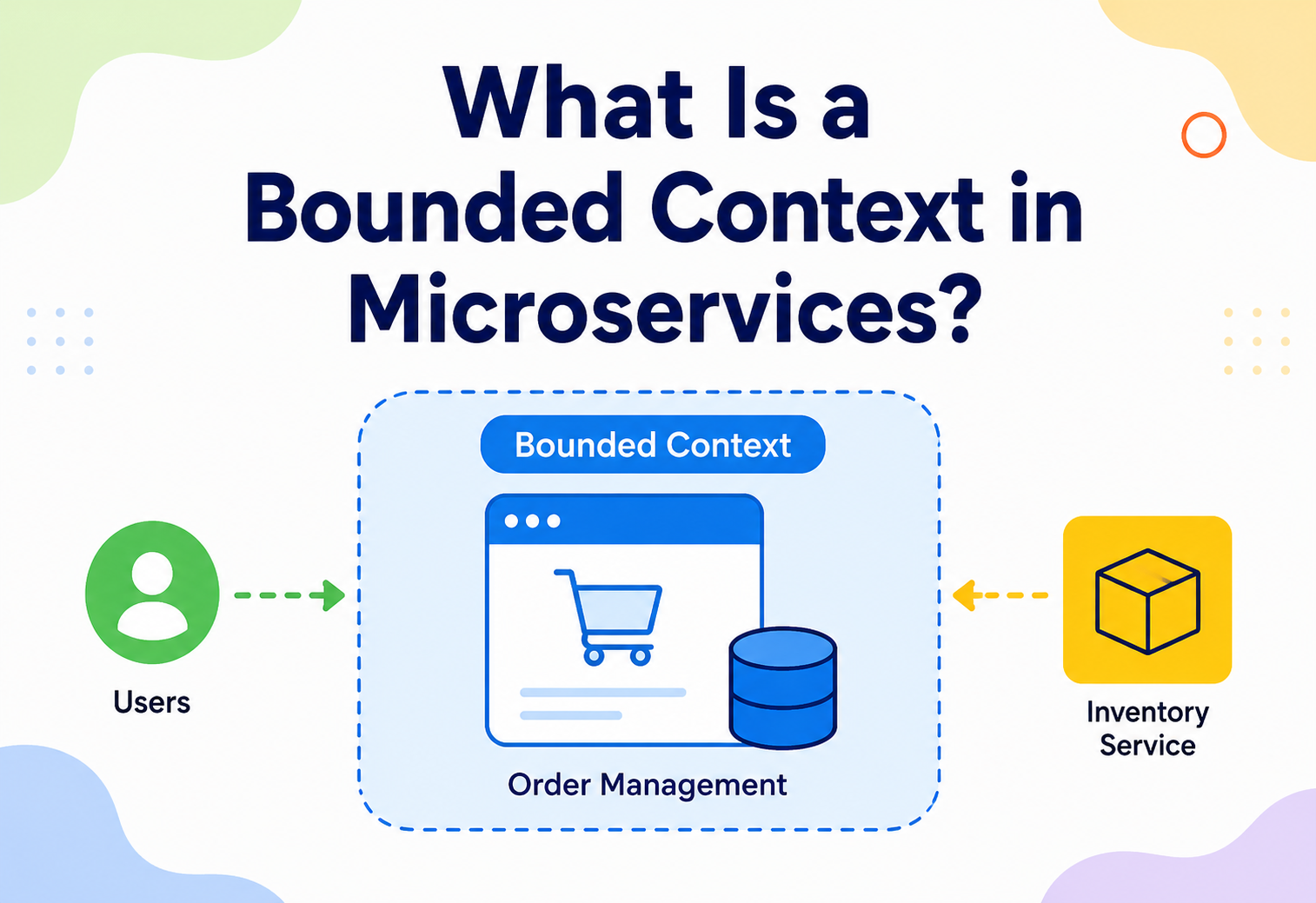
WhatA bounded context is an explicit boundary — a line drawn around a part of the software — inside which a specific business model, and the specific language used to describe it, is consistent, unambiguous, and internally complete. Outside that boundary, the same words may mean something different, and that is fully expected and allowed.
WhyTo stop one team’s meaning of a word from silently colliding with another team’s meaning of the same word, and to give each team a self‑contained area they can change confidently without fear of breaking someone else’s world.
Where usedIn DDD‑based system design, in microservices architecture (as the natural boundary for a service), in database schema design, and in team organization (this connects to a famous idea called Conway’s Law, covered later).
A bounded context is a room with a closed door and a name plate on it — “Billing,” “Shipping,” “Support.” Inside the room, everyone agrees exactly what every tool and word means. To get something from another room, you have to knock and ask properly (through a defined interface), not just walk in and grab things.
Think of a food delivery app. The Restaurant Menu screen and the Delivery Tracking screen both talk about a “Delivery Address,” but the Menu screen just needs to know the address exists to check if the restaurant delivers there, while the Delivery Tracking screen needs the exact GPS coordinates, floor number, and delivery instructions. Two different bounded contexts caring about the same real‑world idea in different depths.
3.4 Ubiquitous Language
What it is: A shared vocabulary, agreed upon by both business experts and developers, used consistently everywhere inside one bounded context — in conversations, in documentation, in class names, and in code.
Why it exists: So that when a business expert says “a Shipment is Dispatched,” a developer can go straight to a class called Shipment with a method called dispatch() — no translation needed, no guessing.
It’s like every department in the school agreeing on their own internal glossary, printed on the wall, so new staff members instantly understand what every term means in that room.
3.5 Context Map
What it is: A diagram (and a way of thinking) that shows all your bounded contexts and how they relate to and communicate with each other.
Why it exists: Individual bounded contexts are not islands — the business as a whole still needs to work together. The context map is the master picture that shows those connections and what kind of relationship each pair of contexts has (we will explore relationship types in the “APIs & Microservices” section).
3.6 Aggregate, Entity, and Value Object (a quick primer)
These three DDD building blocks live inside a bounded context:
- Entity — an object with a distinct identity that persists over time, even if its attributes change (a
Customerwith a unique ID stays “the same customer” even if their name or address changes). - Value Object — an object defined entirely by its attributes, with no separate identity (a
Moneyobject of “$50” is interchangeable with any other “$50” — you don’t ask “which $50 is this?”). - Aggregate — a cluster of entities and value objects treated as one unit for the purposes of data changes, with one “root” entity controlling access (an
Orderaggregate might containOrderLinevalue objects, and all changes go through theOrderroot).
Fig 1 — A domain breaks down into subdomains, and each subdomain is realized in software as one or more bounded contexts.
Architecture & Components
Now let’s zoom into what actually sits inside a bounded context, and how a set of bounded contexts becomes a microservices architecture.
4.1 What lives inside one bounded context
In a well‑designed microservice built around a bounded context, you typically find:
4.2 One microservice, one bounded context (usually)
The most common and recommended mapping is: one bounded context = one microservice = one team owning it = one independently deployable database. This is often summarized as the Database‑per‑Service pattern, and it is the single most important rule for keeping microservices truly independent.
A bounded context does not always have to become exactly one microservice. A small, simple bounded context might sometimes share a service with another small one early in a project. But a microservice should never span more than one bounded context — that is the rule that must never be broken, because it recreates the tangled‑model problem inside a “microservice” wrapper.
4.3 Layered architecture inside a context
Most production bounded contexts use a layered (or “hexagonal” / “onion”) internal architecture so that business logic stays independent of frameworks and databases.
Fig 2 — A layered architecture inside one bounded context. Notice the Domain Layer at the center — it knows nothing about databases or HTTP.
4.4 A tiny Java sketch of a bounded context’s domain model
Here is a small, deliberately simplified Java example showing how the Order bounded context might model an order — notice how it only cares about what “Order” means for placing and tracking orders, and nothing about billing or shipping details.
// --- Domain layer: Order bounded context ---
public class Order {
    private final OrderId id;
    private CustomerId customerId;      // just an ID reference, not a full Customer object
    private List<OrderLine> lines = new ArrayList<>();
    private OrderStatus status;

    public Order(OrderId id, CustomerId customerId) {
        this.id = id;
        this.customerId = customerId;
        this.status = OrderStatus.DRAFT;
    }

    public void addLine(ProductId productId, int quantity, Money unitPrice) {
        if (status != OrderStatus.DRAFT) {
            throw new IllegalStateException("Cannot modify a submitted order");
        }
        lines.add(new OrderLine(productId, quantity, unitPrice));
    }

    public void submit() {
        if (lines.isEmpty()) {
            throw new IllegalStateException("Cannot submit an empty order");
        }
        this.status = OrderStatus.SUBMITTED;
        // In production: raise an OrderSubmitted domain event here
    }
}
Notice that Order does not store a customer’s email, address, or payment card — it only stores a CustomerId. That is bounded context discipline in action.
Internal Working — How Teams Actually Find Boundaries
A very common beginner question is: “This all sounds nice in theory, but how do I actually draw these boundary lines on a real project?” There is a well‑known collaborative technique for this called Event Storming, invented by Alberto Brandolini.
5.1 Event Storming, step by step
- Gather people: Put business experts and engineers in one room (or one virtual whiteboard).
- Write domain events: Everyone writes, on orange sticky notes, things that happen in the business, in past tense — “Order Placed,” “Payment Captured,” “Shipment Dispatched,” “Item Returned.”
- Arrange in time order: Lay all the sticky notes out left to right, in the order they usually happen.
- Add commands and actors: Add blue notes for commands that trigger events (“Place Order”) and yellow notes for who triggers them (“Customer,” “Warehouse Staff”).
- Look for natural clusters: Groups of events that talk about the same nouns and involve the same people usually reveal a bounded context. A cluster around “Order Placed, Order Cancelled, Order Line Added” hints strongly at an Ordering context. A separate cluster around “Payment Authorized, Payment Captured, Refund Issued” hints at a Payments context.
- Draw the boundary lines: Once the clusters are visible, draw a boundary line around each — these lines become candidate bounded contexts.
Event Storming is like spreading out a giant story of “everything that happens in a school day” on sticky notes, then noticing that some notes naturally huddle together — all the “borrowing a book,” “returning a book,” “reserving a book” notes cluster near each other, which tells you “ah, that’s the Library department’s story.”
5.2 Linguistic boundaries as a signal
Another practical technique: listen carefully to how business experts talk. If the Sales team gets uncomfortable or starts qualifying a word (“well, a customer in our world means someone we’ve talked to, even if they haven’t bought anything yet”) — that discomfort is a strong signal that a new bounded context boundary exists right there.
5.3 Team boundaries and Conway’s Law
Computer scientist Melvin Conway observed in 1967 that organizations tend to design systems that mirror their own communication structure — famously known as Conway’s Law. In practice: if you have one team responsible for Orders and a separate team responsible for Payments, your bounded contexts will naturally tend to align with those team boundaries, and it is usually wise to let them, rather than fighting the organization’s shape.
Many organizations now deliberately use the “Inverse Conway Maneuver” — they first design the team structure they want, then let bounded contexts and microservices naturally form along those team lines, instead of designing the architecture first and forcing teams to match it later.
Data Flow & Lifecycle
Once you have multiple bounded contexts, they still need to cooperate. This section explains how data flows safely across boundaries without breaking the whole point of having boundaries.
6.1 The Anti‑Corruption Layer (ACL)
What it is: A translation layer placed at the edge of a bounded context that converts incoming data from another context’s model into this context’s own model, so that foreign concepts never leak in raw and “corrupt” the local model.
Why it exists: Without it, if the Shipping context calls the Order context’s API and just stores whatever fields come back, any future change to the Order context’s data shape can silently break Shipping.
An anti‑corruption layer is like a translator at an international meeting. The Sales department (speaking “Sales language”) and the Shipping department (speaking “Shipping language”) don’t talk directly and assume they mean the same thing — a translator converts the message into terms the listening department actually understands and expects.
6.2 Example data flow: placing an order end‑to‑end
Fig 3 — Placing an order touches four bounded contexts. Each context keeps its own local data and only shares the minimum needed information, mostly through events.
6.3 Two communication styles: synchronous and asynchronous
| Style | How it works | When to use it |
|---|---|---|
| Synchronous (REST / gRPC) | Context A calls Context B directly and waits for a response | When A genuinely needs an immediate answer to proceed, e.g. “is payment authorized right now?” |
| Asynchronous (events via a message broker) | Context A publishes an event; interested contexts subscribe and react later | When B doesn’t need to respond immediately, and A shouldn’t be blocked or broken if B is temporarily down |
Modern production systems favor asynchronous, event‑driven communication between bounded contexts wherever possible, because it reduces the coupling between services — Context A does not even need to know which other contexts are listening.
6.4 Lifecycle of data across a boundary
- Data is born and owned inside exactly one bounded context (the “source of truth”).
- Other contexts that need a copy of that data get it through a well‑defined contract — an API response or an event payload — never by reading another context’s database directly.
- The receiving context stores only the fields it needs, translated into its own local model, often called a “local cache” or “read model” of the foreign data.
- When the source data changes, an update event is published so subscribers can refresh their local copy — this is a form of eventual consistency, which we will discuss further in the CAP theorem section.
Never let two bounded contexts share the same database tables directly. This is one of the fastest ways to destroy the benefits of bounded contexts — it silently glues two “independent” services back together, and a schema change in one breaks the other without warning.
Advantages, Disadvantages & Trade‑offs
7.1 Advantages
- Clear ownership: Every piece of data and logic has exactly one home and one responsible team.
- Safer changes: A team can change their internal model freely, as long as they don’t break their published contract with others.
- Reduced cognitive load: New engineers only need to understand one context deeply, not the entire company’s data model.
- Independent scaling: A high‑traffic context (like Catalog browsing) can scale separately from a low‑traffic one (like Returns processing).
- Independent deployment: Teams can release on their own schedule without waiting for a giant, synchronized release.
- Better alignment with the business: The software structure actually mirrors how the real business thinks and organizes itself.
7.2 Disadvantages
- Distributed system complexity: You now have network calls, retries, timeouts, and partial failures where you used to have simple in‑process function calls.
- Data duplication: The same real‑world fact (like a customer’s name) may be copied into several contexts’ local models, which needs careful synchronization.
- Eventual consistency confusion: Because updates propagate via events, there can be a short window where different contexts disagree about the current state.
- Harder end‑to‑end debugging: A single business process (like “place an order”) now spans multiple services, multiple logs, and multiple databases.
- Upfront design effort: Finding the right boundaries takes real modeling work; getting it wrong is expensive to fix later.
7.3 The core trade-off
Bounded context trades simplicity of a single unified model for autonomy of many smaller, focused models. For a small startup with three developers and one small database, a single unified model may genuinely be simpler and faster. Bounded contexts pay off as the team, the codebase, and the business complexity grow.
If a small team can still hold the whole domain model in their heads comfortably and changes rarely conflict, you probably don’t need to split into multiple bounded contexts yet. Bounded context is a tool for taming complexity — don’t add the tool before the complexity exists.
Performance & Scalability
8.1 Independent scaling
Because each bounded context is its own deployable service with its own resources, you can scale each one according to its own traffic pattern. In an e‑commerce platform during a big sale event, the Catalog and Search contexts might need to scale to handle 50x normal read traffic, while the Returns context stays at normal size — you only pay for extra compute where it’s actually needed.
8.2 The N+1 network call trap
A common performance mistake when first splitting a monolith into bounded contexts is calling another context’s API inside a loop — for example, fetching 100 orders and then calling the Customer context once per order to get customer names, resulting in 100 extra network round trips.
Use batch endpoints (e.g. “get customer details for these 100 IDs in one call”) or maintain a local, denormalized read copy of the fields you need often, updated via events, so you rarely need a live cross‑context call in a hot path.
8.3 CQRS for cross-context read performance
Command Query Responsibility Segregation (CQRS) is a pattern where the model used to write data is separated from the model used to read data. Inside bounded context design, this often shows up as a context building its own optimized “read model” by subscribing to events from other contexts, instead of querying them live every time.
Fig 4 — A Search context builds its own fast, denormalized read model by listening to events, instead of calling other contexts live on every user search.
8.4 Partitioning and sharding inside a context
As a single bounded context grows very large — think of a Catalog context at a company with hundreds of millions of products — even its own dedicated database can become a bottleneck. The common fix is partitioning (sometimes called sharding): splitting the context’s data across multiple physical database instances, usually based on a chosen key, such as product category or region.
Because the bounded context boundary already isolates this data from every other context, partitioning decisions can be made freely inside the context without asking any other team’s permission — another quiet benefit of good boundaries. A common approach is consistent hashing, which spreads keys evenly across shards and minimizes how much data needs to move when a shard is added or removed.
Imagine the school Library becomes so large that one room can’t hold every book. The librarian splits it into “Fiction Room” and “Non‑Fiction Room” — still one Library department, one set of librarians, one set of rules, just physically spread across two rooms for practical reasons. That’s partitioning inside a bounded context.
8.5 Rate limiting and backpressure
To protect a bounded context from being overwhelmed by a sudden traffic spike from another context (or from external clients), production systems apply rate limiting (rejecting or delaying requests beyond a threshold) and backpressure (signaling upstream callers or event producers to slow down when a service is close to its capacity). Message queues like Kafka naturally support backpressure because consumers pull messages at their own pace rather than being forced to accept everything immediately.
High Availability & Reliability
9.1 Failure isolation
One of the biggest reliability wins of well‑drawn bounded contexts is failure isolation. If the Recommendations context crashes, a well‑designed e‑commerce app should still let customers browse, add to cart, and check out — recommendations are simply hidden or replaced with a fallback. This is possible only because Recommendations is a separate bounded context with a separate deployment.
9.2 Circuit breakers and timeouts
When one context calls another synchronously, that call must always have a timeout and ideally a circuit breaker — a mechanism that detects repeated failures and “opens” temporarily, immediately failing fast (or returning a fallback) instead of piling up slow, doomed requests and taking down the caller too.
// Simplified circuit breaker sketch (conceptual, using a library like Resilience4j)
CircuitBreaker paymentBreaker = CircuitBreaker.ofDefaults("paymentContext");

Supplier<PaymentResult> call = CircuitBreaker
    .decorateSupplier(paymentBreaker, () -> paymentClient.authorize(orderId, amount));

PaymentResult result = Try.ofSupplier(call)
    .recover(throwable -> PaymentResult.pendingRetry())
    .get();
The Order Context stays healthy even when the Payment Context becomes slow or unavailable — the breaker trips and a safe fallback is returned instead of a cascade of timeouts.
9.3 Eventual consistency and the CAP theorem
The CAP theorem, formulated by Eric Brewer, states that a distributed system can only fully guarantee two of these three properties at the same time during a network problem: Consistency (everyone sees the same data at the same instant), Availability (every request gets a response), and Partition Tolerance (the system keeps working even if parts can’t talk to each other).
Because bounded contexts communicate over a network (which can always partition), most microservice systems choose AP (Availability + Partition Tolerance) for cross‑context data, accepting eventual consistency rather than trying to force perfect real‑time consistency across services, which would require slow, fragile distributed locking.
Imagine the Library tells the front office “this book was returned” by sending a note through the school’s mail system rather than shouting instantly across the building. For a minute or two, the front office’s records might be slightly out of date — but the whole school keeps running smoothly instead of freezing every time one department updates something.
9.4 Disaster recovery per context
Because each bounded context typically owns its own database, disaster recovery can also be scoped per context — backup frequency, replication regions, and recovery time objectives (RTO) can differ for a critical context like Payments versus a less critical one like Marketing Newsletter Preferences.
Security
10.1 Boundary = trust boundary
A bounded context boundary is a natural place to also enforce a security boundary. Each context should validate and authorize every incoming request independently — never assume “this request already came through another trusted service, so I don’t need to check again.”
10.2 Data minimization across contexts
When one context shares data with another (via API or event), it should share the minimum fields necessary — this both respects the bounded context’s own model and follows the security principle of data minimization, especially important for sensitive fields like payment card numbers or health information.
Publishing an event like “CustomerUpdated” that includes the customer’s entire raw database row, including sensitive fields other contexts never asked for and shouldn’t store. Always design event payloads deliberately, field by field.
10.3 Service‑to‑service authentication
Inside a microservices system, calls between bounded contexts are typically secured with mutual TLS (mTLS) and / or short‑lived service tokens (like OAuth2 client‑credentials tokens or a service mesh’s built‑in identity), so that only known, authorized services can call each other, and every call is encrypted in transit.
10.4 Compliance boundaries
Bounded contexts also make regulatory compliance easier to reason about. If only the Payments context stores card data, then PCI‑DSS compliance auditing can focus tightly on that one context’s infrastructure, instead of auditing an entire sprawling monolith.
Monitoring, Logging & Metrics
11.1 Distributed tracing
Once a single business action (like “place an order”) spans multiple bounded contexts, you need distributed tracing to follow that one action’s journey across every service it touched. A trace ID is generated at the very first entry point and passed along with every downstream call and event, so tools like Jaeger, Zipkin, or vendor tools (Datadog, New Relic, Honeycomb) can stitch together the full story.
Fig 5 — One trace ID connects the spans (individual timed steps) across every bounded context involved in a single user action.
11.2 Per‑context metrics — the “golden signals”
Each bounded context / microservice should expose its own metrics, commonly following the four golden signals from Google’s SRE practice:
- Latency — how long requests take
- Traffic — how many requests are coming in
- Errors — what fraction of requests fail
- Saturation — how close the service is to its resource limits
11.3 Structured, correlated logging
Every log line across every context should include the trace ID (and often a business ID like orderId), formatted as structured JSON, so that engineers can search across services in tools like ELK (Elasticsearch / Logstash / Kibana), Loki, or Splunk and reconstruct exactly what happened during an incident.
11.4 Context‑level dashboards and alerting
Because each context has its own team and its own service‑level objectives (SLOs), it typically gets its own dashboard and its own alert thresholds — the Payments team is paged for Payments errors, not for a slow Recommendations query, keeping on‑call responsibilities cleanly scoped.
Deployment & Cloud
12.1 Independent deployability
A core promise of aligning microservices with bounded contexts is that each context can be built, tested, and deployed independently, on its own schedule, typically through its own CI/CD pipeline.
Fig 6 — Each bounded context deploys as its own set of containers with its own database, isolated in Kubernetes namespaces, behind a shared API Gateway.
12.2 Containers, Kubernetes, and namespaces
In modern cloud deployments, each bounded context is usually packaged as one or more Docker containers, deployed as a Kubernetes Deployment, often isolated into its own namespace with its own resource quotas, network policies, and secrets — reinforcing the bounded context’s boundary at the infrastructure level too.
12.3 API Gateway and service mesh
An API Gateway sits at the edge, routing external client requests to the right bounded context’s service, and often handles cross‑cutting concerns like authentication, rate limiting, and request logging. Internally, a service mesh (like Istio or Linkerd) can manage service‑to‑service traffic, retries, mTLS, and observability transparently.
12.4 Independent CI/CD pipelines
Each bounded context typically has its own repository (or a clearly separated folder in a monorepo) and its own pipeline: build → test → containerize → deploy to staging → deploy to production, often using canary releases or blue‑green deployments so a bad Payments release, for example, never has to wait for or block a Catalog release.
Databases, Caching & Load Balancing
13.1 Database‑per‑service
Each bounded context should own its database exclusively — no other context is allowed to query it directly. This is the single most important rule for keeping bounded contexts truly independent, and violating it is the most common reason a “microservices” system quietly turns back into a distributed monolith.
| Bounded Context | Typical Database Choice | Why |
|---|---|---|
| Catalog | Document store (e.g. MongoDB, Elasticsearch) | Flexible, nested product data; fast search |
| Orders | Relational (e.g. PostgreSQL) | Strong transactional guarantees for order lines and totals |
| Payments | Relational, often with strict encryption | Financial accuracy and auditability |
| Session / Cart | In‑memory store (e.g. Redis) | Very fast reads / writes; data is often short‑lived |
| Recommendations | Graph or specialized ML store | Relationship‑heavy data, similarity queries |
Because each bounded context owns its own database, different contexts are free to pick the database technology that fits their own data shape best — this freedom is called “polyglot persistence,” and it’s one of the underrated benefits of proper bounded context boundaries.
13.2 Caching within and across contexts
A context can freely cache its own data internally (e.g. caching a frequently‑read product in Redis inside the Catalog context). A context can also cache a local, translated copy of another context’s data — for example, the Order context caching just the customer’s name and shipping address, refreshed whenever a “CustomerAddressChanged” event arrives.
13.3 Load balancing
Each bounded context’s service typically runs multiple replica instances behind a load balancer, distributing incoming requests (usually round‑robin or least‑connections) so that no single instance becomes a bottleneck, and so that if one instance crashes, traffic simply shifts to the healthy ones — another reliability benefit that flows naturally from bounded‑context‑based service splitting.
APIs, Microservices & Context Mapping Patterns
The context map introduced in Section 3 uses specific, named relationship patterns to describe how two bounded contexts connect. Knowing these names is extremely useful for architecture interviews.
| Pattern | Meaning | Example |
|---|---|---|
| Shared Kernel | Two contexts deliberately share a small, common piece of model / code, tightly coordinated | Two closely related teams sharing a small “Money” value object library |
| Customer–Supplier | One context (supplier) provides data / services that another (customer) depends on; the supplier considers the customer’s needs in planning | Catalog (supplier) provides product data that Order (customer) depends on |
| Conformist | The downstream context just accepts the upstream model as‑is, with no influence over it | A small internal tool that simply conforms to a big vendor’s fixed API shape |
| Anti‑Corruption Layer | Downstream context translates the upstream model into its own model, protecting itself | Order context translating a legacy ERP system’s clunky product data into its own clean model |
| Open Host Service | A context exposes a well‑defined, stable public API / protocol meant for many consumers | A Payments context exposing a documented public REST API for many internal teams |
| Published Language | A shared, well‑documented data format (often paired with Open Host Service) used for communication | A standard “OrderSubmitted” event schema, versioned and documented for all subscribers |
| Separate Ways | Two contexts have no meaningful relationship and simply don’t integrate | An internal HR system and the public Product Catalog |
| Big Ball of Mud | No clear boundaries at all (this is the anti‑pattern, included in the map to name the problem) | The tangled legacy monolith itself |
Fig 7 — A sample context map showing four different relationship patterns between bounded contexts.
14.1 API contract design between contexts
Because bounded contexts are meant to evolve independently, the API (REST endpoint shape, gRPC proto, or event schema) between them becomes a formal contract. Good practice includes semantic versioning of APIs, backward‑compatible schema evolution (adding optional fields instead of renaming existing ones), and contract testing tools (like Pact) that catch breaking changes before deployment.
// Example: a stable, versioned event contract published by the Order context
public class OrderSubmittedEventV1 {
    public String orderId;
    public String customerId;
    public List<OrderLineDTO> lines;
    public String currency;
    public BigDecimal totalAmount;
    public Instant submittedAt;
    // Note: internal fields like discount rules or draft history are
    // deliberately NOT exposed here — only what other contexts need.
}
The event is a public promise. Renaming or removing a field here is a breaking change; adding an optional field is safe.
A frequently asked question: “How do bounded contexts talk to each other without becoming tightly coupled?” The strongest answer combines three ideas: (1) communicate through a well‑defined, versioned contract, not internal models; (2) prefer asynchronous events over synchronous calls where possible; (3) apply an anti‑corruption layer when integrating with a context you don’t control.
Design Patterns & Anti‑patterns
15.1 Helpful patterns
Aggregate pattern
Enforce all changes to a cluster of related objects through one root, keeping business rules consistent within a context.
Domain Events
A context announces “something important happened” (e.g. OrderSubmitted) so other contexts can react without tight coupling.
Saga pattern
Coordinates a multi‑step business process across several bounded contexts using a sequence of local transactions and compensating actions if something fails partway (e.g. if Payment fails after Order was created, a compensating “CancelOrder” step runs).
Strangler Fig pattern
Gradually carve bounded contexts out of a legacy monolith by routing more and more traffic to new services over time, until the old monolith can be safely retired.
Fig 8 — A Saga pattern in action — when a later step fails, earlier steps are undone with compensating actions instead of a distributed transaction lock.
15.2 Anti-patterns to avoid
Services are physically separate (different deployments) but so tightly coupled (shared database, synchronous call chains, shared code) that they must be deployed together and fail together. You get all the complexity of microservices with none of the benefits.
Entities that are just plain data holders (getters / setters only) with all the real business logic dumped into separate “service” classes, which weakens the whole point of a rich, expressive bounded context model.
Two contexts making many small synchronous calls back and forth to complete one operation, creating fragile, slow chains.
One bounded context slowly absorbs more and more responsibilities until it becomes a mini‑monolith itself (often “User” or “Account” contexts fall into this trap).
As covered earlier, multiple contexts reading / writing the same tables directly, silently destroying independence.
If two “separate” bounded contexts almost always have to be deployed together because their code constantly breaks each other, you don’t actually have two bounded contexts yet — you have one bounded context that has been physically split too early.
Best Practices & Common Mistakes
16.1 Best practices
- Business firstStart with the business, not the database. Talk to domain experts and run event storming sessions before drawing any technical diagrams.
- LanguageName things using the ubiquitous language. Class names, API endpoint names, and event names should match exactly what business experts say, not generic technical jargon.
- Right sizeKeep contexts as small as they need to be, and no smaller. Over‑splitting creates excessive network chatter; under‑splitting recreates the monolith.
- EventsPrefer events over direct database access for sharing data between contexts.
- ContractsVersion your contracts (APIs and event schemas) from day one.
- MapDocument the context map and keep it visible and updated as the architecture evolves.
- OwnershipLet one team own one bounded context end‑to‑end, including its on‑call responsibility.
16.2 Common mistakes beginners make
- Splitting bounded contexts purely by technical layer (e.g. “Frontend Context,” “Database Context”) instead of by business capability.
- Creating a bounded context for every single database table, resulting in dozens of tiny, chatty “nano‑services.”
- Copying an entire external table into a new context “just in case it’s needed later,” creating unnecessary coupling and stale data risk.
- Forgetting to update the context map when a new integration is added, leaving the architecture undocumented and confusing for new engineers.
- Trying to achieve strong, real‑time consistency across contexts using distributed transactions (like two‑phase commit), which is slow, fragile, and fights against the natural independence of the contexts.
Before finalizing a bounded context boundary, ask: Does this group of concepts have its own vocabulary? Does one team naturally own all of it? Can it be deployed and scaled independently without constant coordination? If yes to all three, you likely have a good boundary.
Real‑world & Industry Examples
Amazon is widely cited as one of the earliest large‑scale adopters of a service‑oriented approach that closely resembles bounded contexts, famously enforced through Jeff Bezos’s internal mandate that teams could only communicate through service interfaces, never through shared internal data structures — a strong, top‑down enforcement of bounded context discipline that helped Amazon later build AWS itself as a byproduct of this internal service architecture.
Netflix operates hundreds of microservices, each generally aligned to a specific business capability — separate services exist for things like viewing history, recommendations, billing, and content metadata — each with its own database and its own team, communicating largely through asynchronous events and well‑defined APIs, closely matching bounded‑context‑driven design.
Uber’s platform separates concerns like Trip Management, Pricing, Driver Matching, and Payments into distinct services, each evolving its own internal model — pricing’s understanding of a “trip” (fare calculation factors) differs meaningfully from trip management’s understanding of the same trip (state machine of ride progress), a textbook illustration of bounded context in a real, massive‑scale system.
In core banking systems, “Account” typically means different things across bounded contexts: the Account Opening context cares about KYC (Know Your Customer) documents and eligibility; the Core Ledger context cares about balances and transaction integrity; the Card Issuance context cares about linking physical / virtual cards to an account. Each context maintains its own precise model of “Account” for its own purpose.
Just like the school’s Library, Kitchen, Sports Department, and Hospital Room each keep their own records and only share what’s truly needed, these companies’ engineering teams keep their own bounded contexts, sharing only well‑defined, minimal information across boundaries — at a scale of millions of users instead of a few hundred students.
FAQ, Summary & Key Takeaways
Frequently Asked Questions
Is a bounded context the same thing as a microservice?
Not exactly. A bounded context is a modeling boundary — a boundary around meaning and business logic. A microservice is a technical / deployment boundary. In good architecture, they usually line up one‑to‑one, but conceptually, bounded context comes first, and the microservice is simply the technical implementation of that boundary.
Can two microservices belong to the same bounded context?
Yes, sometimes — for example, if a context needs a separate service purely for scalability reasons (like separating “write” and “read” services under CQRS), both can still logically belong to the same bounded context, sharing the same domain model and ubiquitous language.
How big should a bounded context be?
There is no fixed size in lines of code or number of tables. The right test is conceptual: does it represent one coherent area of the business, with one consistent language, that one team can reasonably own? Size follows from that answer, not the other way around.
What’s the difference between a bounded context and a subdomain?
A subdomain is a way of describing the business itself (a real‑world concept, independent of software). A bounded context is a software design boundary you create in response to a subdomain. Ideally they map closely, but a subdomain can sometimes be served by more than one bounded context, or a bounded context can span more than one small subdomain, depending on team and system realities.
Do small startups need bounded contexts?
Usually not on day one. Many successful systems start as a well‑organized monolith with clear internal module boundaries (sometimes called a “modular monolith”) that already respect bounded‑context thinking in code organization, and only split into separate deployed services once team size or scaling needs justify the added operational complexity.
What happens when two bounded contexts disagree about the same real‑world fact?
This is normal and expected in a distributed system, not a bug to panic over. Because each context holds its own local copy of shared facts, there is a brief window after an update where contexts can be out of sync — this is the eventual consistency trade‑off discussed earlier. The key safeguard is designing every event and API contract so that the source‑of‑truth context is always unambiguous: only one context is ever allowed to be “right” about a given fact, and everyone else treats their local copy as a cache that will catch up shortly.
How do bounded contexts relate to DDD’s “strategic” vs “tactical” patterns?
DDD is often split into two levels. Strategic design is the big‑picture work of identifying subdomains, drawing bounded context boundaries, and mapping their relationships — this is what this tutorial has mostly focused on. Tactical design is the smaller‑scale toolkit used inside one bounded context to build the actual domain model — entities, value objects, aggregates, repositories, and domain events, which were introduced briefly in Sections 3 and 15. A healthy microservices system needs both: good strategic boundaries, and good tactical modeling inside each one.
Summary
A bounded context is an explicit boundary within which a specific business model and its vocabulary stay consistent and unambiguous. It was introduced by Eric Evans in Domain‑Driven Design to solve the problem of the same word meaning different things to different teams inside one large, tangled system. In modern microservices architecture, the bounded context has become the standard, recommended boundary for deciding how big or small a service should be — one bounded context, one microservice, one owning team, one database, communicating with others through well‑defined APIs and events rather than shared internal models.
Key Takeaways
- 01A bounded context protects meaning — the same word can safely mean different things in different contexts, as long as each context is internally consistent.
- 02Ubiquitous language keeps business experts and code speaking the same words inside one context.
- 03The context map documents how bounded contexts relate — shared kernel, customer‑supplier, conformist, anti‑corruption layer, open host service, and more.
- 04Database‑per‑service and event‑driven communication are the two most important technical rules for keeping bounded contexts truly independent.
- 05Event Storming is a practical, collaborative technique for discovering real bounded context boundaries from business conversations.
- 06Bounded context trades the simplicity of one unified model for the autonomy, scalability, and resilience of many smaller, focused models — a trade‑off that pays off as complexity grows, not necessarily on day one.
- 07Distributed Monolith and Shared Database are the two anti‑patterns that quietly destroy the benefits of bounded contexts — avoid them above all else.
The next time you’re unsure where to draw a line between two services, go back to the school analogy: would the librarian and the nurse ever be confused about what “member” means? If the answer is no, you’ve probably found a real bounded context boundary.
“Stop trying to make one universal model that fits everyone. Accept that different parts of the business naturally have different models — and draw an explicit boundary around each one.”