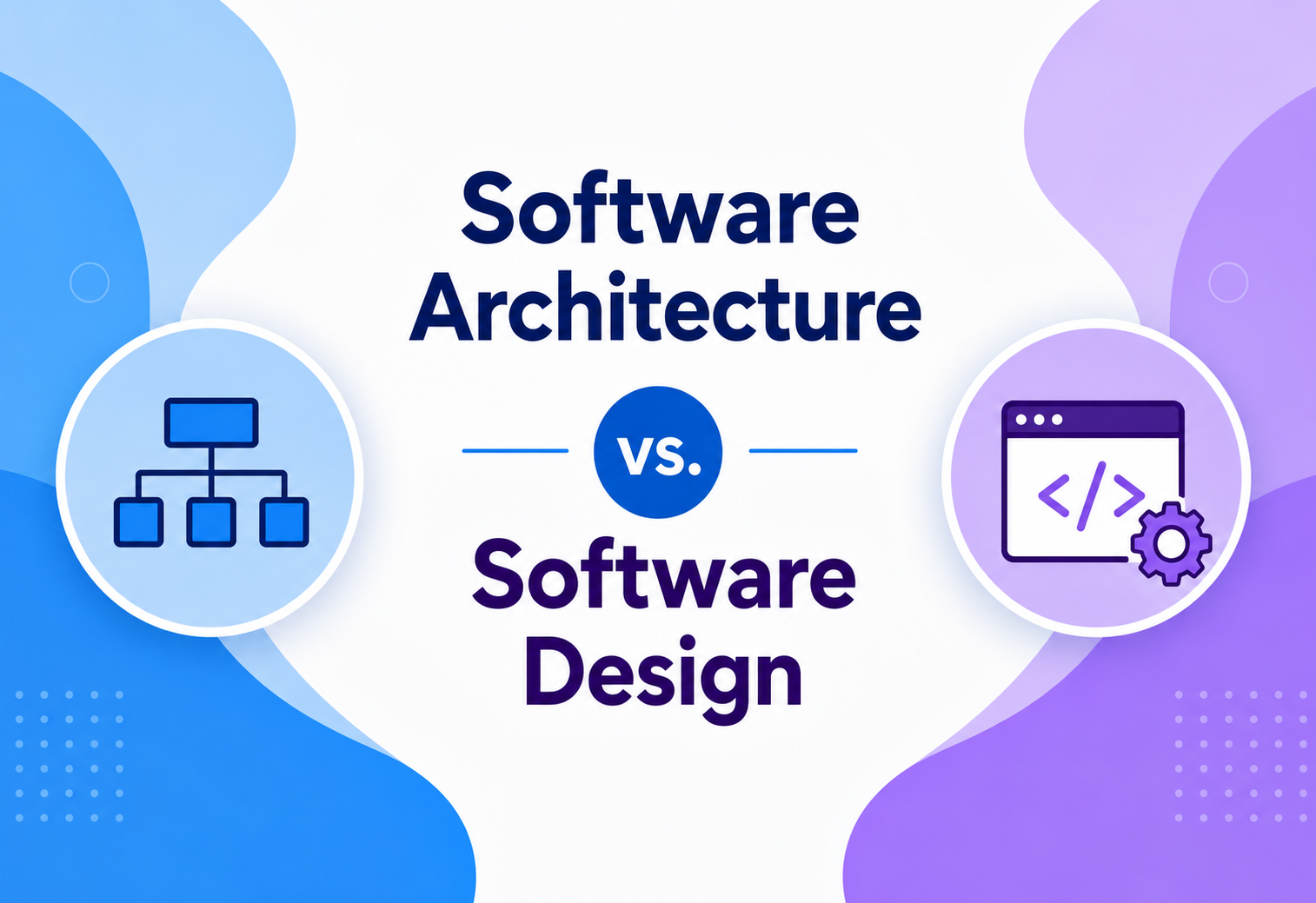
Software Architecture vs. Software Design?
Two words that get used interchangeably in every planning meeting — and yet they mean genuinely different things. Here is how to finally tell them apart and why it matters more than you would think.
The Big Idea, in One Breath
Two words that get used interchangeably in every planning meeting — and yet they answer completely different questions.
Picture opening a new restaurant. Long before the first plate leaves the pass, someone has to make the decisions that literally cannot be un-made later: where the kitchen sits relative to the dining room, how many covers the space can hold, where the gas and drainage lines run, how deliveries reach the back door without crossing the guest flow. Get those wrong and no amount of clever cooking will fix them.
Once the place is open, a different set of decisions plays out every single day. What is on tonight’s menu? How is the fish plated? Which cook handles the pass and which the grill? None of that changes where the kitchen sits — it works within the constraints the kitchen already imposes.
Software has exactly the same split. Software architecture is the early, hard-to-undo, system-shaping work. Software design is the detailed, close-in work that happens inside each piece the architecture has already carved out.

Think about the kitchen’s floor plan versus tonight’s menu. The floor plan is decided once and lived with. The menu evolves every week. Both matter, and neither can compensate for a bad decision in the other one.
What Software Architecture Really Is
Architecture is the highest-level shape of the system — the pieces, the connections, and the ground rules everything else has to live inside.
Software architecture is the highest-level structure of a system: the major components, how they are arranged, how they communicate, and the invariants that keep the whole thing coherent as it grows. It is decided early because it defines the boundaries every later choice has to respect.
Most of an architect’s attention goes to questions that affect the whole system at once rather than any single piece of it:
- One application, or many smaller services co-operating over a network?
- Where does data physically live, and how does it flow between the pieces?
- How does the system stay standing when traffic spikes ten-fold?
- Which stack, cloud, or messaging system best fits the priorities?
- How does the design keep evolving safely five years from now?
These decisions shape the system’s quality attributes — the “-ilities” like scalability, reliability, security and maintainability — long before any specific screen or button exists. That is why architecture reads as a blueprint: it does not tell you what colour to paint a wall, but it absolutely decides where the walls are allowed to go.
When someone asks “what’s the architecture of this app?”, they want the big shapes — one service or many, where the data lives, how the pieces connect — not the internal code of any single feature.
What Software Design Really Is
Design is what happens inside one piece once architecture has already decided that piece exists and what it is responsible for.
Software design is the detailed planning of an individual piece after architecture has already staked out where it sits. It answers a much narrower question, one component at a time: given that this module has to do this specific job, exactly how should its insides be built?
This is where classes acquire names, functions get their shape, database tables get their columns, and screens get their layout logic. A designer — often the same engineer who then writes the code — works out things like:
- Which classes and functions make up this one module, and what does each own?
- How is data validated, transformed, and persisted inside this feature?
- Which reusable coding patterns keep this piece easy to extend later?
- How are errors, edge cases, and unusual inputs handled here?
Good detailed design leans on a well-known toolbox: the SOLID principles (each class does one job well, each is open to extension but closed to random edits, and so on) and reusable design patterns like Singleton, Factory, Observer or Model-View-Controller. None of these decide the shape of the whole system — they decide how to write clean code inside a piece the architecture has already carved out.

When someone asks “what’s the design of the login feature?”, they want to know how that one feature is built internally — not how the whole application is organised.
Side by Side: The Key Differences
Once you see the two next to each other, the fog usually lifts fast. The comparison below is the one that tends to stick.
Put both definitions in the same frame and the practical differences become clear:
| Aspect | Software Architecture | Software Design |
|---|---|---|
| Main question | What are we building, and why this way? | How exactly do we build this one part? |
| Scope | The entire system | One module, class, or feature |
| Timing | Mostly early, then revisited as the system evolves | Continuous, throughout every sprint |
| Typical owner | Architect, tech lead, senior engineers | Individual developers, feature teams |
| Cost to change later | High — often requires touching many parts at once | Low to moderate — usually contained to one area |
| Typical tools | Architecture patterns: layered, microservices, event-driven | Design patterns: Singleton, Factory, Observer, MVC |
None of these lines are perfectly sharp. Reasonable engineers can and do disagree about where architecture ends and detailed design begins on any given project — and that is fine. What matters more than the exact line is knowing which direction a decision leans, so the right person makes it at the right time.
The Building Blocks of Each
Both fields work with parts, connections and rules — just at completely different zoom levels.
Both disciplines are made of “parts, connections, and rules” — but they operate at completely different scales. Architecture uses big, coarse blocks. Design uses small, fine ones.
Architecture’s blocks are things like services, modules and databases, connected by APIs, queues or shared storage, governed by system-wide rules. Design’s blocks are classes, functions and data structures, connected by direct calls and object references, governed by rules that live inside a single file. Zoom out far enough and you are doing architecture. Zoom in far enough and you are doing design.
Patterns at Two Altitudes
Both fields have decades of reusable, battle-tested solutions — but the patterns from one world rarely get confused with the other once you see them side by side.
Architecture Patterns — shape the whole system
Presentation, logic, data
The system is split into horizontal layers that each talk only to the one below.
Many small, independent services
Each service owns one job and can be built, deployed and scaled on its own.
React to what happened
Parts announce events; interested parts react whenever they are ready.
Run only when needed
Code executes in response to triggers, without a team managing servers directly.
Design Patterns — shape one piece of code
Exactly one instance
Guarantees only a single shared object exists, such as one connection manager.
Delegate the creation
Hands off the job of building an object to a dedicated helper, hiding the details.
Notify the listeners
Lets one object automatically inform others whenever its state changes.
Separate the concerns
Splits a feature into what is shown, what is stored, and what controls the flow.
Calling a design pattern like “MVC” an architecture, or calling “microservices” a design pattern, is one of the most common mix-ups in the field. The giveaway is scale: does the pattern shape the whole system, or just one corner of it?
The Reversibility Test
A simple, practical test experienced engineers use when the exact line is unclear.
Because the line between architecture and design is not perfectly sharp, experienced engineers lean on a practical test rather than a strict definition: if undoing this decision later would mean tearing into many other parts of the system, it is architecture. If undoing it only affects the one piece it lives in, it is design.
Try it on a few real examples. Choosing PostgreSQL over MongoDB touches how many services store and query data — architecture. Choosing to name a helper function validateEmail() instead of checkEmail() affects nobody outside that file — design. Choosing whether two services talk over REST or a message queue changes how every team writes their integration code — architecture. Choosing whether a loop is written with for or while — design, every time.
How They Work Together — A Walkthrough
Neither discipline is complete without the other. Here is how they actually cooperate on a real feature.
Neither discipline stands on its own. Architecture without design stays a set of boxes on a whiteboard that never ships. Design without architecture becomes a pile of beautifully-written modules that do not fit together. Here is how the two actually cooperate, using an e-commerce site as the example.
Architecture sets the stage
The team decides the app will be split into Catalog, Cart, and Checkout services, communicating over REST APIs, each with its own database.
Design fills in one service
A developer designs the internals of the Cart service: which classes handle incoming requests, validate the cart, and persist state.
Design pushes back on architecture
Building the cart reveals that pricing depends on data the Checkout service already owns — a signal that a boundary needs adjusting.
Architecture adapts
The architect adds a lightweight pricing event so Checkout can share the numbers Cart needs, without either service reaching into the other’s data.
This back-and-forth is healthy, not a failure. Architecture gives design a stage to build on; design’s real-world discoveries occasionally hand information back up so the stage itself can improve.
Who Does the Work, and When
In small teams, one person wears both hats. In larger organisations, the roles are usually split — but they always overlap.
In a small team, the same person often wears both hats on different days of the week. In a larger organisation, the two roles are usually held by different people working closely together.

Owns the “what and why”
Chooses the system’s shape, technology stack, and non-negotiable rules; documents the reasoning so it survives staff turnover.
Owns the “how”
Turns architectural boundaries into working classes, functions and screens, and reports back when something does not fit.
The architect draws the roads on the city map. The developer decides how each individual building along that road is actually constructed.
Common Myths, Cleared Up
Three misconceptions that keep resurfacing in code reviews and planning meetings — and the reality behind each.
“Architecture is just design at a bigger size.”
Not quite. It is not a size difference — it is a difference in what kind of question is being answered. Architecture decides what the system is and why it is shaped this way; design decides how one already-decided piece gets built. Making a design bigger does not turn it into architecture.
“Only huge systems need architecture.”
Even a small weekend project benefits from a few minutes of upfront thinking about where data lives and how pieces connect. Skipping this on a small project usually just means the architecture happens by accident instead of on purpose — and accidental architecture is much harder to fix later.
“Architecture decisions can never change.”
They can — and healthy systems change them on purpose, when the evidence calls for it. What makes a decision “architectural” is not permanence; it is that changing it costs more and touches more of the system than a typical design change would.

Treating every technical disagreement as an “architecture debate”. Most day-to-day disagreements in code review are actually design disagreements — useful, but they do not need the whole team in the room.
Why the Difference Actually Matters
This is not vocabulary trivia — mixing the two up has real, practical costs on a project.
Confusing the two is not a harmless slip. Getting the distinction right or wrong changes how decisions get routed, how teams spend meeting time, and how much rework a project accumulates.
Getting it right
- The right people are in the room for the right decisions
- Teams know which changes need wide review and which do not
- New engineers understand the system faster, layer by layer
Getting it wrong
- Small design choices get escalated to slow, unnecessary committees
- Big structural risks get buried inside one developer’s pull request
- Nobody documents “why”, so the same debates repeat every few months
A useful habit: whenever a decision comes up, ask the reversibility question from earlier in this guide. That one question routes the decision to the right forum — a quick chat for design, a proper design-review meeting for architecture — and saves a surprising amount of wasted time.
Key Takeaways
The five ideas from this guide worth carrying with you into any conversation about system-level or module-level decisions.
What to Remember
- Architecture is the system-wide plan; design is the detailed work inside each piece the architecture has already carved out.
- Zoom is the giveaway. Architecture works with services, databases and APIs; design works with classes, functions and data structures.
- Use the reversibility test. If undoing the decision touches many parts, it is architecture. If it only touches one, it is design.
- The two constantly inform each other. Design surfaces real-world friction that occasionally pushes architecture to adjust.
- Naming this distinction correctly is the difference between fast, well-routed decisions and slow, over-escalated ones.