The Quiet Skill That Makes Stakeholder Meetings Actually Work
Everyone in the room can hear. Far fewer are actually listening. Thirteen chapters on why that difference decides whether your next meeting builds trust — or quietly erodes it — and what it takes, in small, ordinary moments, to sit on the right side of that line.
The Silence That Holds a Good Meeting Together
There is a particular kind of silence that happens in a good stakeholder meeting. It is not an awkward silence, and it is not the silence of people waiting for their turn to talk. It is the silence right after someone finishes a hard sentence — a worry, a concession, a half-formed idea they were not sure they should say out loud — and the room simply holds it for a second before responding. That pause is where trust is built. It costs nothing. And almost nobody does it on purpose.
Most of what follows is really an argument for taking that pause seriously. Not because it is some clever technique, but because it is the smallest visible piece of a much larger skill: the willingness to actually be present, in a room full of people who all have something to protect, and to give what they say enough weight for a second or two before you jump in with what you already thought before they opened their mouths.
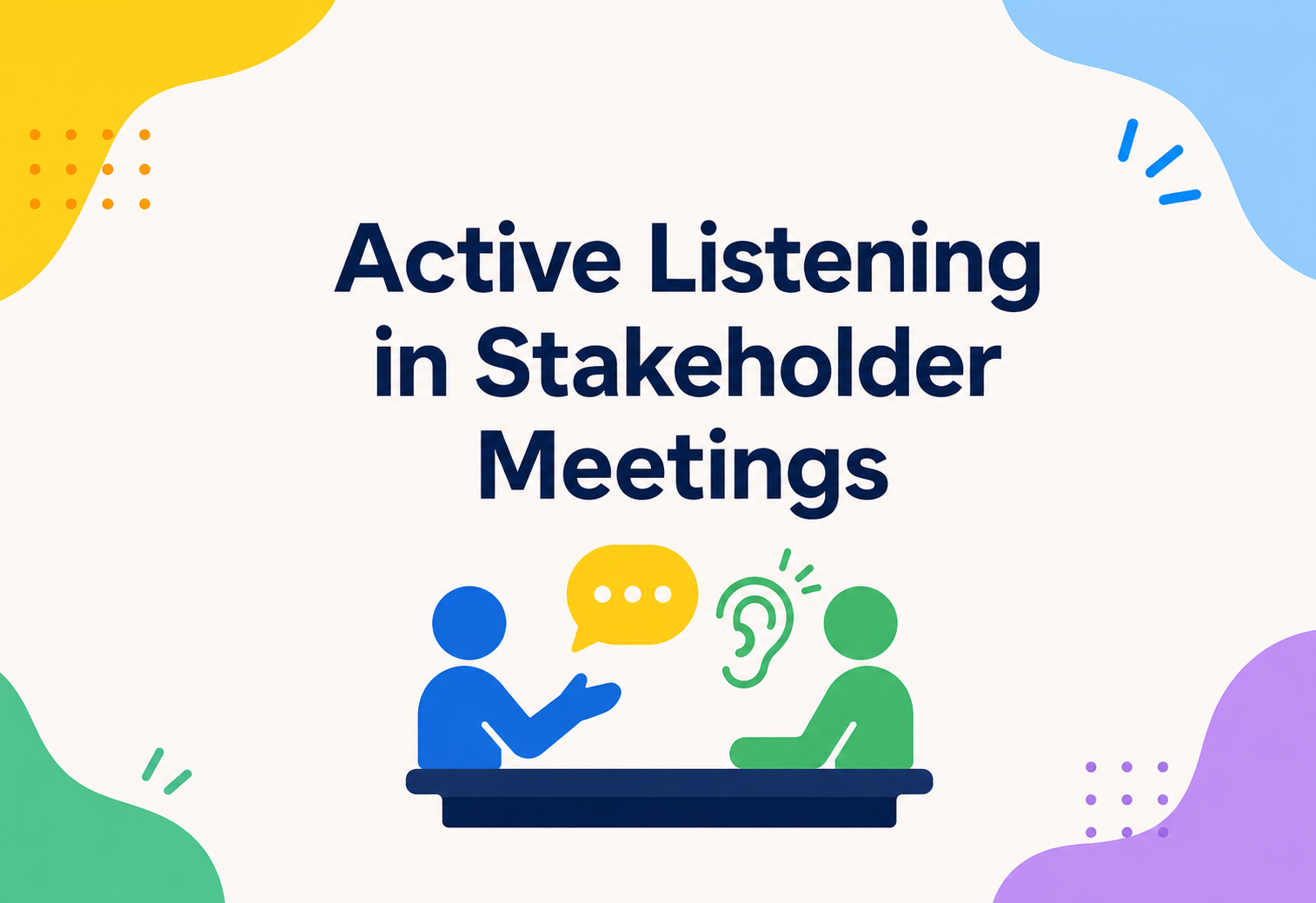
The word we usually use for this is active listening. It is a phrase that has been softened by overuse, wrapped into so many training decks and workshop titles that it can now sound like a euphemism for “nodding politely.” This piece is an attempt to unwrap it — to describe what it actually looks like, why stakeholder meetings need it more than most conversations, and what tends to happen, quietly and expensively, when it is missing.
None of this is exotic, and none of it is new. You have almost certainly done real active listening before — with a close friend describing a hard week, or a family member working through a decision out loud. The skill already exists in you. What tends to disappear is the willingness to bring it into a conference room, where the agenda is tight, the stakes feel high, and everyone, including you, is a little bit performing competence instead of actually paying attention.

Isn’t Listening Just… Listening?
We use the word “listening” so casually that it barely means anything anymore. Someone says “I hear you” while typing an email. A project lead nods through a status update while mentally drafting their next slide. A stakeholder says “go on, I’m listening” and then interrupts four seconds later with a counterpoint they had clearly prepared before the other person even opened their mouth. Sound is entering the ears. Understanding is not entering the mind. These are not the same activity, even though they look identical from across the table.
Active listening is the version of listening that actually does something. It is the difference between a microphone and a translator. A microphone picks up sound faithfully and does nothing with it. A translator receives the sound, holds it, works out what it actually means given everything else they know about the speaker and the situation, and then reflects that meaning back in a way the speaker can confirm or correct. That reflecting-back part is the whole trick. Without it, you are just a very attentive microphone.
Passive Hearing Looks Like
- Nodding on a rhythm, not in response to content
- Planning your reply while the other person is still talking
- Waiting for a pause to insert your point
- Remembering the meeting’s decisions, not its doubts
- Treating silence as dead air to fill
Active Listening Looks Like
- Following the shape of an idea before judging it
- Asking “what makes you say that?” and meaning it
- Reflecting back what you heard before you respond
- Noticing what someone chose not to say
- Letting a pause sit long enough for more to surface
The two columns above look almost too obvious once they are set side by side. That is part of the point. Nothing in the right-hand column is a hidden technique — it is what most of us already do when we care personally about the person in front of us. What the right column really describes is what happens when we choose to bring that same quality of attention into a room where the person in front of us is being addressed as “the stakeholder” rather than as themselves.
Think of it like the difference between a security camera and a witness. Both are “watching” the same scene. Only one of them can tell you afterward what actually happened — because only one of them was doing more than passively recording. A passive hearer, at best, plays back what was said. An active listener can tell you what was meant, what was held back, and where the real hinge of the conversation actually was.
Why Stakeholder Meetings Need This More Than Most Conversations Do
A stakeholder meeting is a strange kind of gathering. It is not a casual chat, and it is usually not a room full of people who agree with each other. You have got a product owner who is protecting a roadmap, a finance lead who is protecting a budget, a customer representative who is protecting an experience, an engineer who is protecting feasibility, and a sponsor who is protecting a deadline they promised to someone above them. Everyone in that room is carrying something they are responsible for, and most of them are, at least a little, worried about being overruled, misunderstood, or made to look like the obstacle.
That combination — high stakes, competing priorities, and people who do not fully trust each other yet — is exactly the environment where listening degrades fastest. Under pressure, people default to defending their position rather than understanding anyone else’s. And here is the uncomfortable part: the more senior or invested someone is, the more likely they are to talk first, talk longest, and get listened to regardless of whether what they are saying is actually the most useful thing in the room. Volume and seniority are not the same thing as insight, but in an unmanaged meeting, they often get treated that way.
Active listening is the counterweight to all of that. It is the practice that says: before we decide who is right, let us make sure we actually understand what everyone means. Not what we assume they mean based on their job title. Not what we are afraid they mean. What they actually, specifically mean, in their own words, confirmed back to them.
This is the part most of us forget most easily — the quietest person in the room is often holding the risk everyone else missed. You have to actually make space for them, not just leave a gap and hope. A gap that nobody explicitly invites into tends to get filled by the loudest voice, not the most useful one.
Stakeholder meetings also tend to compress a lot of context into very little time. Someone might mention, almost in passing, that “the vendor contract renews in six weeks” or “legal flagged something about this last quarter” — a sentence that, if actually caught and followed up on, changes the whole conversation. If you are only half-listening, that sentence slides right past you, and three weeks later it resurfaces as a crisis that “nobody mentioned.” Except someone did mention it. Nobody was listening closely enough to catch it.
The Quiet Damage of Not Listening Well
Poor listening rarely announces itself. It does not cause a dramatic blow-up in the meeting where it happens. Instead, it shows up two weeks later, disguised as something else entirely — which is a large part of why the cost stays so hard to trace and, therefore, so easy to keep paying.
It shows up as scope creep, when a requirement someone clearly stated in the kickoff gets “discovered” for the first time in week six. It shows up as a stakeholder who stops speaking up in meetings, not because they have run out of opinions, but because they have learned that offering one gets them talked over. It shows up as rework, when a team builds exactly what was asked for on paper, but not what was actually needed, because nobody paused to ask what problem the request was really trying to solve. And it shows up, most expensively of all, as broken trust — the kind where a stakeholder starts copying three extra people on every email “just to be safe,” because they no longer believe the meeting itself is where decisions get made honestly.
There is also a subtler cost that is easy to miss: the erosion of goodwill. People remember, on some level, whether they felt understood in a meeting or just managed through it. A stakeholder who leaves feeling unheard does not usually complain about it directly. They just show up to the next meeting a little more guarded, a little more likely to negotiate everything in writing, a little less willing to give the benefit of the doubt when something goes wrong. Multiply that across a project’s lifetime and you get a working relationship that runs on suspicion instead of collaboration — not because anyone did anything dramatic, but because nobody was quite listening.
The thing that makes this damage so persistent is that no single instance of it feels serious enough to name at the time. Nobody walks out of a meeting saying “that decision cost us three weeks in October.” The pattern only becomes visible in retrospect, once the accumulated small misses have compounded into something big enough to be undeniable — usually the point at which the fix is much more expensive than the listening would have been.

Listening Actually Starts Before the Meeting Begins
It is tempting to think of active listening as something that switches on the moment you sit down and someone starts talking. In practice, a lot of the groundwork happens earlier, in the ten quiet minutes before the meeting even starts, and most of us skip it because the calendar does not leave room for it.
Skimming the notes from the last conversation with this stakeholder — not just the decisions, but the offhand comments, the thing they mentioned they were worried about, the question they asked that never quite got answered — changes how you show up. You walk in already tracking a thread instead of starting cold. It signals, without you having to say a word, that what they said last time actually mattered enough to be remembered. Few things build trust faster than a stakeholder realising you followed up on something they only mentioned in passing weeks ago.
There is also a simple, underused habit worth adopting: sending a short note before a difficult meeting, asking what the stakeholder most wants to make sure gets discussed. Not a formal agenda item, just a genuine question — “before we meet, is there anything on your mind about this that you want to make sure we cover?” People often say things in a quiet written message that they would never volunteer cold in a room full of others. Reading that message carefully, before the meeting starts, is itself an act of listening, even though no one has spoken yet.
And it is worth being honest about your own state walking in. Arriving frazzled, five minutes late, straight out of a meeting that went badly, means you are carrying tension into a room that has nothing to do with it. A minute of quiet before you join — even just closing your eyes and taking a breath at your desk — is not indulgent. It is what makes room for actual attention once the meeting starts, instead of a performance of attention layered over a mind that is still somewhere else.
The common thread across all three of those small habits — reviewing prior notes, inviting quiet input before the meeting, arriving with a clear head — is that they all shift a little bit of the listening work upstream, where it is cheaper and calmer, out of the compressed, high-pressure minutes of the meeting itself. That upstream work is largely invisible to everyone else. It is also, quietly, most of the difference between someone who listens well and someone who intends to.
What Active Listening Is Actually Made Of
It helps to break “active listening” down into its parts, because as a single vague concept it is hard to practice. As a set of specific behaviours, it is very learnable — and each of the six pieces below can be worked on independently, in almost any conversation you happen to be in.
1. Attention that isn’t divided
This is the unglamorous foundation everything else sits on. Closing the laptop lid, not just minimising the window. Putting the phone face-down and out of habit’s reach. Looking at the person speaking rather than at your notes or the next slide. None of this feels like a “skill” — it feels like basic manners — but in practice it is the thing people skip most often, because multitasking during meetings has quietly become normal. The problem is that stakeholders can tell. They may not say anything, but they register whether you looked up when they spoke.
2. Following before evaluating
There is a habit worth unlearning: the instinct to start forming your rebuttal the moment someone says something you disagree with. Active listening asks you to delay that. Let the person finish their whole thought — the reasoning, not just the conclusion — before you start building your response. Most disagreements in stakeholder meetings are actually disagreements about assumptions, not about the final point, and you cannot see the assumption if you stopped listening at the first sentence you did not like.
3. Reflecting back what you heard
This is the single highest-leverage habit in this entire piece, so it is worth sitting with. After someone shares something substantial, say back — in your own words, briefly — what you understood them to mean. “So if I am hearing you right, the concern is not the timeline itself, it is that we have not confirmed the vendor can actually hit it. Is that fair?” This does three things at once: it proves you were listening, it catches misunderstandings while they are still cheap to fix, and it gives the speaker a chance to refine their own thought, because hearing it said back often clarifies it even for them.
4. Asking questions that open things up, not shut them down
There is a real difference between “Are you sure about that?” and “What is driving that concern?” The first sounds like a challenge, and people respond to challenges by getting defensive. The second sounds like curiosity, and people respond to curiosity by actually explaining themselves — which is usually exactly what the room needs. Good open questions in a stakeholder meeting sound like: “What would need to be true for this to work?” “What is the risk you are most worried about here?” “What am I missing?”
5. Noticing what the body is saying
A lot of the real signal in a meeting does not come through in words. Someone who agrees verbally but leans back and crosses their arms is telling you something the transcript will not capture. Someone whose voice quickens slightly when a certain topic comes up has probably hit a nerve worth returning to gently, later, maybe privately. In a video call, this gets harder — more on that shortly — but even a flattened, delayed hesitation before someone answers “yes, that works for us” is worth noticing rather than steamrolling past.
6. Letting silence do its job
Silence makes most people uncomfortable, and in a meeting that discomfort often gets resolved by someone — usually whoever is most senior or most eager — jumping in to fill it. But a short silence after a question is often exactly when the most honest answer is forming. If you can tolerate three or four extra seconds of quiet, you will frequently hear something truer than what would have come out immediately.
Read as a set, these six behaviours describe the room where the pause is allowed to last a second longer than usual — where attention is undivided, judgement is delayed, understanding is confirmed out loud, questions open doors instead of closing them, non-verbal signals are noticed, and silence is treated as part of the conversation rather than an emergency to end. None of it is heroic. All of it is chooseable.
Small Habits You Can Actually Use in Your Next Meeting
Big ideas are easy to agree with and hard to remember under pressure. So here are a handful of concrete moves — small enough to actually carry into a real meeting, even a tense one, and specific enough that you can decide, before you sit down, which one or two you are going to try first.
The Echo, Kept Short
One sentence, in your own words, before you respond. “So the core worry is timeline risk, not budget — got it.” It costs five seconds and prevents most misunderstandings before they compound.
Name What You Noticed
“You paused there — is there more to that?” Gently naming a hesitation, without pressure, often invites the real concern out into the open, especially from someone who was not sure it was their place to raise it.
The Two-Question Rule
Before offering your own opinion on a contested point, ask at least two clarifying questions first. It slows you down just enough to actually understand the position you are about to respond to.
Write Their Words, Not Your Summary
When taking notes, capture a phrase in the stakeholder’s own language rather than immediately translating it into your team’s internal shorthand. It preserves nuance you will want later.
Save the “But” for Later
Try responding with “and” instead of “but” when you want to add a different view. “And there is also the vendor risk to weigh” keeps a door open that “but the real issue is…” tends to close.
Close the Loop Out Loud
At the end of a discussion, say plainly what you heard and what happens next: “Here is what I am taking away, and here is who owns the follow-up.” It turns listening into visible action, which is what actually builds trust.
None of these require a personality change. They are small, almost mechanical adjustments to how you move through a conversation. But stacked together across a single hour-long meeting, they change the entire texture of the room. People start finishing their sentences instead of trailing off because they assume no one is tracking anyway. They start volunteering the inconvenient detail instead of burying it, because they have noticed that inconvenient details get taken seriously here instead of brushed past.
You do not need to bring all six into your next meeting. Pick one — probably the echo, since it has the highest leverage — and use it three times in the next thirty minutes. Notice what happens to the tone of the room. It is much easier to build a durable habit out of one behaviour used consistently than out of six behaviours attempted anxiously all at once.
Listening When People Disagree With You
It is easy to talk about active listening in the abstract. It gets much harder the moment a stakeholder says something you think is simply wrong — a technical claim that is not accurate, a timeline that is not realistic, a priority you genuinely believe is misguided. This is where most people’s listening quietly switches off, replaced by a kind of internal rehearsal for the correction they are about to deliver.
It helps to separate two things that often get fused together: understanding a position and agreeing with it. You can fully, accurately understand why a stakeholder believes something, restate it well enough that they would say “yes, exactly,” and still disagree with their conclusion. In fact, disagreeing well is much easier once you have done that — because now you are responding to their actual reasoning instead of a flattened, slightly unfair version of it that your brain constructed while you were busy not listening.
There is also a practical benefit here that is easy to underestimate: stakeholders who feel genuinely understood, even when they are overruled, tend to accept the outcome far better than stakeholders who feel dismissed, even when they technically got their way. A “no” delivered after real listening lands differently than a “no” delivered as a reflex. One sounds like a decision. The other sounds like a wall.
It also helps to remember that disagreement in a stakeholder meeting is rarely about the surface-level topic being argued. A fight about a launch date is often, underneath, a fight about who bears the risk if the date slips. A fight about a feature scope is often a fight about whose team looks bad in front of leadership if it is cut. Active listening, applied patiently, tends to surface that underlying layer — and once it is visible, the actual disagreement often turns out to be much smaller and more solvable than the version that was being argued on the surface.
A useful move in a genuinely tense moment is to name the disagreement plainly, out loud, without heat: “It sounds like we see the risk here differently — can we both lay out what we are each worried about before deciding anything?” This does something subtle but powerful: it turns two people talking past each other into two people examining the same problem from different angles, side by side, instead of head-on. It is a small reframe, but it changes the emotional shape of the whole conversation.

An Ordinary Tuesday, Told the Way It Usually Goes
Picture a fairly unremarkable stakeholder meeting. A project is three months in, mostly on track, and the meeting is really just a routine check-in — the kind that is easy to run on autopilot. Partway through, the operations lead mentions, almost as an aside while a slide is loading, that “the regional team has been a bit slow getting us data lately, but it is probably nothing.” The meeting moves on. Nobody writes it down. It did not sound urgent, and there were three other agenda items still to cover.
Six weeks later, that “probably nothing” turns out to be a staffing shortage on the regional team that has been quietly delaying a dependency the whole project needs. What looked like a passing comment was, in hindsight, the first and clearest warning anyone gave. It just arrived wrapped in a hedge — “probably nothing” — the kind of soft, self-minimising phrase people often use when they are not fully sure something is worth everyone’s attention, but some part of them suspects it might be.
This happens constantly, in almost exactly this shape. People rarely announce a real concern with the confidence it deserves, especially in a room where they are not certain it is their place to raise it. It gets softened, minimised, tucked into a sentence that sounds like small talk. Active listening is largely the practice of noticing those moments and gently pulling on them instead of letting them pass — not with alarm, just with a small, genuine “wait, tell me a bit more about that.” Half the time, it really is nothing. The other half, it is the whole story, arriving early, in disguise, waiting to see if anyone is paying close enough attention to notice.
The tell is almost always the same: a real concern wrapped in a small hedge. “Probably nothing,” “maybe I am overreacting,” “just a thought,” “this may not matter but…” When you hear one of those openings in a stakeholder meeting, treat it as a quiet flag rather than a disclaimer. The hedge is usually not the speaker’s real confidence level. It is the price of admission for saying the thing at all — and once you make room for it, the actual concern is often a lot sharper than the wrapping suggested.
Active Listening When the Meeting Is a Grid of Faces
Video calls have made active listening measurably harder, and it is worth naming why instead of pretending the skill transfers automatically. In person, a huge amount of listening happens through peripheral cues — posture, the tiny shift someone makes when they are about to speak, the shared glance two people exchange when a comment lands oddly. Almost none of that survives a video grid. You get a small rectangle of someone’s face, sometimes frozen mid-syllable by a bad connection, competing for attention with your own notifications, your own reflection, and eleven other rectangles.
A few adjustments genuinely help. Speaking a person’s name before asking them something signals clearly that you are addressing them specifically, which matters more on a call where it is easy to assume a question was general. Leaving a slightly longer pause after asking something also matters, because the tiny lag in most video calls means people’s usual conversational timing is thrown off — what feels like silence to you may just be someone waiting a beat to make sure they are not about to talk over you. And turning your own camera on, even briefly, when someone is sharing something that matters, gives them at least one visible face to read instead of a wall of black tiles.
It is also worth being honest that some of the richest listening moments — the follow-up chat after the meeting, the “hey, got a minute” hallway conversation — simply do not happen by default on remote teams. They have to be recreated on purpose: a short one-on-one scheduled specifically to ask “how did that meeting actually feel for you?” does real work that a group call, however well-run, usually cannot do on its own.
Video calls also make it much easier to hide inattention behind a well-lit face. Because the visible signal is tiny — just a rectangle of expression — a completely distracted listener and a completely present one can look almost identical for long stretches. On camera, active listening has to be a little more visible than it needs to be in person: the small verbal acknowledgement, the named question, the on-camera nod, the deliberately spoken echo. What was implicit in the room has to be made explicit through the glass.
Why This Pays Off Slowly, Then All at Once
Active listening rarely produces a dramatic result in the meeting where it happens. Nobody applauds because you asked a good clarifying question. The payoff is cumulative, and it shows up later, in ways that are easy to miss if you are only looking at any single meeting in isolation.
A stakeholder who has been genuinely listened to over several meetings starts behaving differently. They start raising concerns earlier, while they are still small and cheap to address, instead of letting them build up until they are forced to escalate. They start giving you the benefit of the doubt when something inevitably goes sideways, because they have a track record of being heard rather than managed. They start being an ally in the harder conversations — the budget cuts, the scope negotiations, the moments when your team needs someone senior to vouch for a decision — because trust, once it has actually been earned through being heard, tends to get repaid.
This is, in a quiet way, the entire argument for taking active listening seriously as a professional skill rather than a soft nicety. It is not about being nice for its own sake. It is one of the most efficient ways to reduce risk on a project, because most project risk is really relationship risk wearing a technical costume — and relationship risk is built or dismantled, meeting by meeting, largely through whether people feel understood.
None of this is guaranteed by any single meeting. That is exactly the point. What compounds is the pattern — the small, unremarkable evidence, accumulated across weeks, that being honest in this room is worth the risk. Once that pattern is established, everything else about the working relationship gets cheaper: decisions move faster, conflicts stay smaller, and the meeting itself starts feeling less like a negotiation and more like a shared effort. That is what you are really building, quietly, when you take the time to listen well.
A Few Honest Questions About Doing This in Real Life
Short, direct answers to the questions that come up most often once someone starts taking active listening seriously enough to actually try it under pressure — instead of just agreeing with it in principle from a safe distance.
What if there genuinely isn’t time to slow down and reflect everything back?
You do not need to echo every sentence — that would be exhausting for everyone, including you. Reserve it for the moments that matter: a stated concern, a number, a commitment, anything that would be expensive to get wrong. A thirty-minute meeting can absorb three or four well-placed reflections without losing any pace at all. What it cannot absorb is a major misunderstanding discovered two weeks later.
What if I’m not the one running the meeting — can I still shape how listening happens?
Yes, and often more easily than you would expect. You do not need authority to ask a clarifying question, echo something back, or gently invite a quieter colleague into the conversation. In fact, when someone without the loudest title in the room models real listening, it tends to shift the whole tone faster than when the meeting’s official leader does the same thing — because it reads as genuine interest rather than facilitation technique.
What about stakeholders who talk a lot and rarely let anyone else in?
This is common, and it is rarely personal — it is often just how someone processes their own anxiety about a project. Rather than interrupting, try catching a natural pause and reflecting back what they have said so far before gently redirecting: “That is really helpful context — before we go further, can I check what the rest of the group is thinking on this point?” It acknowledges them fully first, which usually makes the redirect land far more smoothly than cutting in would.

Isn’t all of this a bit slow for a busy team with a deadline?
It can feel that way in the moment, which is exactly why it gets skipped under pressure. But the maths tends to run the other way over time: five extra minutes of careful listening in a planning meeting is almost always cheaper than the days of rework that follow a misunderstood requirement. Slow, in this one specific sense, is usually the faster path — it just does not feel like it while you are in the room.
Won’t reflecting back sound patronising if I do it too visibly?
It can, if it is done as a technique on display rather than as genuine curiosity. The difference tends to sit in tone: an echo delivered warmly, in your own words, as a check rather than a rehearsed formula (“so what I am hearing is…” every single time) is very rarely experienced as condescending. What people react badly to is the shape of a training exercise being performed at them. Keep it plain, keep it in your own voice, and it will almost always feel like care rather than method.
What about people who genuinely don’t want to be listened to — they just want a decision?
Some stakeholders, especially very senior ones, really do value speed over reflection in most meetings. Active listening does not mean turning every exchange into a therapy session; it means being present enough to notice what this particular person needs from this particular conversation. For a decisive stakeholder, the highest form of listening is often the crisp confirmation — “understood, we will do X by Friday” — delivered promptly, without a long meandering restatement first.
Traps, a Gentle Checklist, and One Last Thought
One chapter, three small things worth carrying with you: the traps that even people who genuinely want to listen well tend to fall into, a short checklist you can actually take into a meeting, and the thought that quietly holds the whole piece together.
A Few Traps Worth Watching For
Even people who genuinely want to listen well fall into some predictable habits. None of these make someone a bad colleague — they are just easy defaults worth noticing in yourself.
Listening to Respond, Not to Understand
Rehearsing your reply while someone is still talking guarantees you miss the last, often most important, part of what they said.
Solving Before Understanding
Jumping straight to a fix can shut down a stakeholder who was not actually asking for one yet — sometimes they just need the problem acknowledged first.
Letting the Loudest Voice Set the Record
The person who speaks first and most confidently is not always right — and an unmanaged meeting quietly treats them as if they are.
Treating Silence as Agreement
Someone who says nothing may simply have learned that speaking up does not change the outcome — that is worth investigating, not assuming away.
Confusing Politeness With Listening
Nodding warmly while quietly disagreeing and planning to do things your own way afterward is not listening — it just looks like it from the outside.
A Gentle Checklist for Your Next Stakeholder Meeting
You do not need to remember everything in this piece. If you carry only a handful of these into your next meeting, you will likely notice a real difference in how the room responds to you.
What to Actually Do
- Arrive with the laptop lid closed, notebook open. A small signal, but people notice it more than you would expect.
- Let every important point get echoed back before you move on. “So what I am hearing is…” — cheap insurance against costly misunderstandings.
- Watch for the person who has not spoken. A direct, warm invitation — “what is your read on this?” — often surfaces the most useful thing said all meeting.
- Ask two questions before you offer an opinion on anything contested. It slows you down just enough to respond to what was actually said.
- Close with a spoken summary, not just written notes. Say what you heard, what was decided, and who owns what — out loud, in the room, before anyone leaves.
The Meeting Isn’t Really About the Agenda
Every stakeholder meeting has an agenda on paper — a status update, a decision to make, a risk to review. But underneath that agenda, something else is always happening: a group of people quietly deciding, meeting after meeting, whether this is a room where being honest is worth the risk. Whether raising the inconvenient concern gets it addressed, or gets it politely filed away. Whether disagreeing out loud is safe, or something to save for a private message afterward.
Active listening is how that decision gets made in your favour. Not through a grand gesture, and not through a single meeting where you got everything right. Through the accumulation of small, unremarkable moments — the echoed sentence, the extra beat of silence, the question asked instead of the assumption made — repeated often enough that people stop bracing themselves before they speak. That is the whole skill, really. Not a technique to master, but a habit of actually being there, in the room, for the person talking.
The quiet skill in all of this is not really about words at all. It is about attention — where you choose to put it, and how much of it you are willing to give to the person in front of you, before the part of you that already has a reply steps in. Give a little more of it, more often, to the meetings that seem to matter least. The ones that actually matter will take care of themselves once the habit is there.