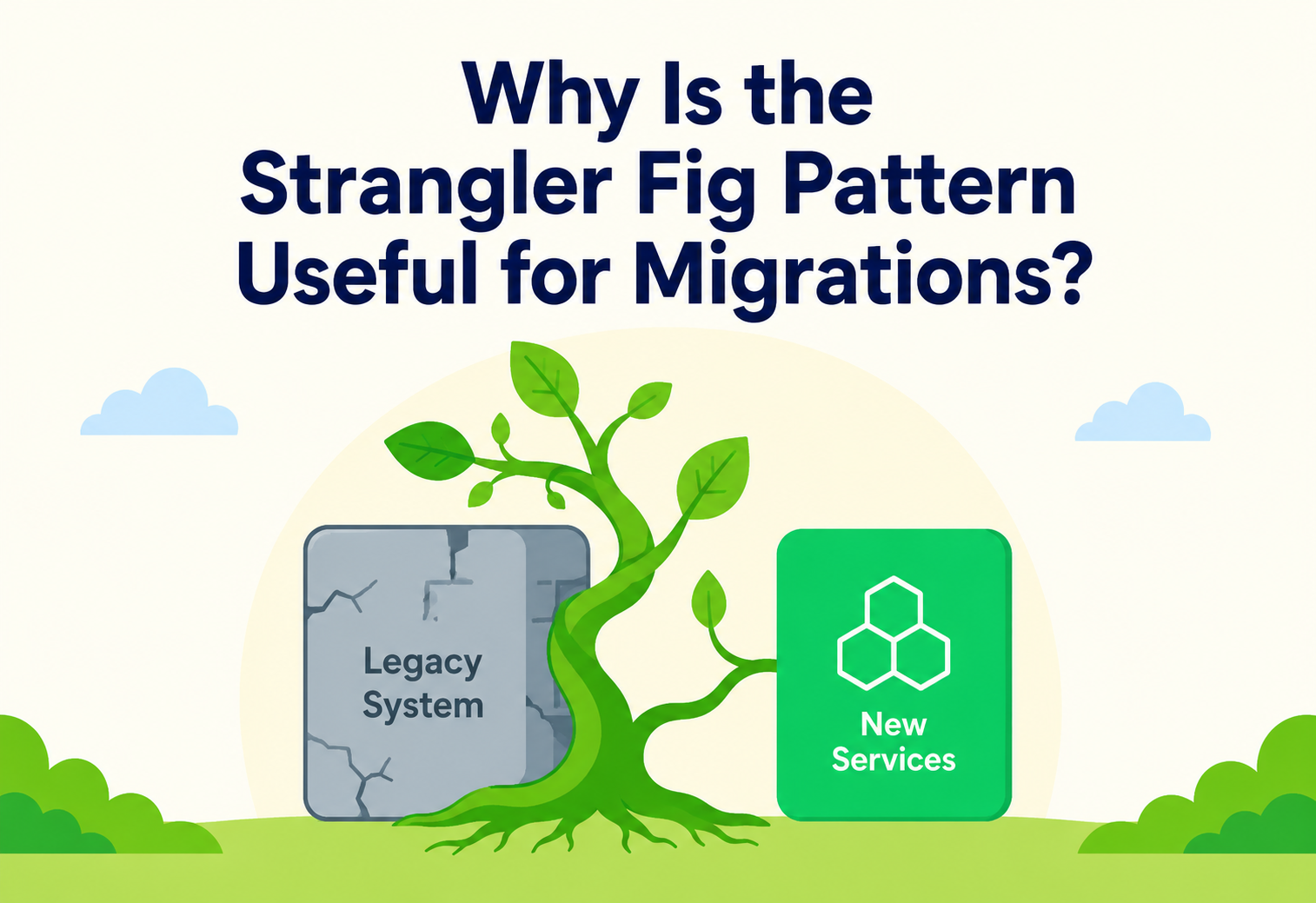
Why Is the Strangler Fig Pattern Useful for Migrations?
A complete, beginner-friendly guide focused on the “why” — the concrete risks it removes, the value it delivers early, and how it beats a big-bang rewrite in almost every real-world migration.
Introduction & History
Before the theory, let’s ground the pattern in an image anyone can picture — because it really is that intuitive.
Imagine you’re asked to replace every part of a bicycle while someone is still riding it down the road. That sounds impossible — but what if you could swap one part at a time, while the bike keeps rolling? First the pedals, tested while riding slowly. Then a wheel, tested carefully. Then the seat, then the handlebars, then the frame itself — piece by piece, with the rider never having to get off and walk. By the end, every original part is gone, replaced with new ones, and the rider never stopped moving. That is the entire promise of the Strangler Fig Pattern, and it’s exactly why it is so valuable for real-world software migrations: it lets you replace an old system’s parts one at a time, while the business keeps running, instead of stopping everything for a risky, all-at-once swap.
The pattern gets its name from the strangler fig plant, which grows slowly around a host tree, gradually taking over its structural role, until the original tree can die away and rot completely, leaving the fig standing on its own, in the same place, having never left a gap where “no tree” existed. Software architect Martin Fowler named this pattern in 2004 after noticing how much safer this gradual approach was compared to the traditional “rewrite everything, then launch it all on one day” approach that so often failed in the software industry.
1.1 · Why this specific question — “why is it useful” — matters
Knowing what a pattern is isn’t enough to use it well. Engineers, architects, and engineering leaders constantly have to justify why a particular technical approach is worth the time and money it costs. This tutorial focuses specifically on building that justification — the concrete, provable reasons the Strangler Fig Pattern reduces risk, protects revenue, and produces better outcomes than the alternatives, with evidence and reasoning you could use to convince a skeptical manager, a nervous stakeholder, or an interviewer testing your system-design judgment.
Problem & Motivation
To see why the Strangler Fig Pattern is useful, first look at what goes wrong without it.
To understand why the Strangler Fig Pattern is useful, we first need to understand, in concrete terms, what goes wrong without it. Let’s use one running example: a fictional airline’s 20-year-old Booking System, written in an old technology stack, running on one large server, that the whole company depends on every single minute of every day.
Beginner example
Imagine you’re repainting a house that a family is still living in. Option A: kick the family out for two months, repaint everything at once, then let them back in — risky, because if something goes wrong (wrong paint colour ordered, a wall discovered to have hidden damage), the family has nowhere to live and everything is delayed. Option B: repaint one room at a time while the family keeps living in the house, moving from room to room as each one finishes — slower overall, but the family is never without a home, and if you discover a problem in the kitchen, it doesn’t stop you from finishing the already-repainted bedroom.
2.1 · The five concrete failure modes of a “big-bang” migration
All-or-nothing launch risk
Every big-bang rewrite has one single moment where the switch is flipped for the entire system at once. If anything is wrong, the entire business is affected immediately, not just one small piece.
Delayed value
The business gets zero benefit from months or years of investment until the very end, making it hard to justify continued funding, and easy for the project to get cancelled partway through when budgets tighten.
Requirements drift
While the new system is being built, the business keeps needing new features. Those features often still get added to the old system, meaning the new system is chasing a moving target and may already be behind on day one.
Hidden legacy behaviour
Old systems accumulate small business rules and edge-case fixes over years that were never documented. A full rewrite frequently misses many of these until they cause a production incident after cutover.
Difficult rollback
Once real data has started flowing into a brand-new system after a full cutover, reversing course back to the old system can be almost as risky and complex as the original migration.
2.2 · The motivation, stated plainly
The core motivation for the Strangler Fig Pattern is this: reduce the size of every risky decision. Instead of one enormous, irreversible decision (“cut over the entire booking system tonight”), you make dozens or hundreds of small, reversible decisions (“route 5% of seat-selection traffic to the new service”). Small, reversible decisions are dramatically safer, easier to test, easier to monitor, and easier to undo — and this single idea is the thread running through every benefit covered in this tutorial.
Core Concepts
Five ideas do most of the heavy lifting behind the pattern. Master these and everything else falls into place.
3.1 · Incremental risk reduction
What it is: The principle of breaking one large risky action into many small, individually low-risk actions, so that the maximum possible damage from any single mistake (“blast radius”) is kept small.
Why it exists: Humans and organisations are much better at managing many small, recoverable risks than one enormous, unrecoverable one — the same reason a tightrope walker uses a series of careful small steps rather than one giant leap.
Where it’s used: Software migrations, canary releases, feature-flag rollouts, financial-trading risk limits, and safety engineering generally.
Analogy
Crossing an icy pond is much safer by testing each step’s ice thickness before putting your full weight down, rather than sprinting across and hoping the whole pond holds. Each small tested step is the “incremental” part; being able to step back if the ice cracks is the “reversible” part.
3.2 · Facade / router
What it is: A component sitting in front of both the legacy and new systems, deciding for each request which system should handle it.
Why it’s central to the “why useful” story: The facade is precisely the mechanism that turns migration from one giant irreversible action into many small reversible ones — it’s the tool that makes incremental risk reduction actually possible in practice, not just in theory.
3.3 · Continuous value delivery
What it is: Structuring work so that useful, usable improvements reach the business regularly throughout a project, rather than all being bundled up and released only at the very end.
Why it exists: Stakeholders, budgets, and business priorities change over time. A project that only pays off at the very end is fragile — if priorities shift or budgets shrink halfway through, all that investment can be lost with nothing to show for it.
Analogy
It’s the difference between a farmer harvesting a few crops every month versus planting one giant field that can only be harvested, all at once, two years from now. If a storm hits in month 18, the second farmer loses everything; the first farmer has already banked many months of harvest.
3.4 · Reversibility
What it is: The property that a decision or change can be undone quickly, cheaply, and safely if it turns out to be wrong.
Why it exists: No migration plan is ever perfect. Reversibility means mistakes cost minutes or hours to fix, instead of days, data-recovery efforts, or full incident response.
3.5 · Sunk-cost protection
What it is: Structuring a project so that if it’s ever stopped partway through (for budget, priority, or organisational reasons), the work already completed still has standalone value, rather than being wasted.
Why it’s relevant here: Since the Strangler Fig Pattern migrates and ships one feature at a time, even a migration that’s only 40% complete has delivered 40% of its improvements into production already — unlike a big-bang rewrite that’s 90% complete but 0% deployed, which delivers exactly zero value if cancelled.
Architecture & Components
Let’s look at the architecture specifically through the lens of why each piece contributes to making the migration safer and more valuable.
| Component | Why it contributes to “usefulness” |
|---|---|
| Facade / Router | Turns a single big cutover decision into many small, independently reversible routing decisions. |
| Legacy System (shrinking) | Continues delivering business value for every feature not yet migrated — the business never “pauses” waiting for the migration. |
| New System(s) (growing) | Each piece, once migrated, can be improved, scaled, and maintained independently — delivering ongoing value immediately, not just “someday.” |
| Monitoring & Comparison Tooling | Provides the evidence needed to make each small migration decision confidently, rather than migrating blindly. |
Internal Working
Here is the step-by-step mechanics, framed around exactly where the risk-reduction benefit comes from at each step.
Add the facade with zero behaviour change
Why this step is useful on its own: Before migrating anything, you validate that your routing mechanism works correctly, with 100% of traffic still going to the trusted legacy system. This isolates “does my facade work?” as its own small, testable risk, separate from “does my new feature work?”
Build the new implementation for one feature
Why this step is useful on its own: The new implementation can be developed and tested thoroughly in isolation, without any pressure to be “ready for everything” — only ready for this one well-defined slice of functionality.
Run in shadow mode
Why this step is useful: You get real production evidence of correctness with literally zero risk to real users, since the new system’s output isn’t used for real decisions yet — only compared against the legacy system’s output.
Shift a small percentage of real traffic
Why this step is useful: If something is wrong, only a small percentage of requests are affected, and for a short time, before monitoring catches it and traffic is shifted back.
Increase percentage gradually, monitoring at each step
Why this step is useful: Confidence is built up gradually and measurably, with hard evidence (metrics) at each stage, instead of a single leap of faith.
Full cutover for that one feature
Why this step is useful: By the time you reach 100%, you’ve already effectively “rehearsed” this exact cutover at 1%, 10%, 25%, and 50% — dramatically de-risking the final step compared to a cutover with no rehearsal at all.
Repeat for the next feature
Why this step is useful: Lessons learned from each migrated feature (what monitoring worked, what edge cases were missed, how the team communicated) directly improve the safety and speed of every subsequent feature’s migration.
5.1 · Java example — gradual rollout with built-in safety metrics
@RestController
public class SeatSelectionFacadeController {

    private final LegacyBookingClient legacyClient;
    private final SeatSelectionServiceClient newClient;
    private final RolloutConfig rolloutConfig;
    private final MetricsRecorder metrics; // records success/failure per system

    @PostMapping("/api/seats/select")
    public ResponseEntity<SeatSelectionResponse> selectSeat(@RequestBody SeatRequest request) {

        int rolloutPercent = rolloutConfig.getPercentFor("seat-selection");
        int bucket = Math.abs(request.getBookingId().hashCode()) % 100;
        boolean useNewSystem = bucket < rolloutPercent;

        try {
            SeatSelectionResponse response = useNewSystem
                ? newClient.selectSeat(request)
                : legacyClient.selectSeat(request);

            metrics.recordSuccess(useNewSystem ? "new" : "legacy");
            return ResponseEntity.ok(response);

        } catch (Exception e) {
            metrics.recordFailure(useNewSystem ? "new" : "legacy");
            if (useNewSystem) {
                // Automatic safety fallback: if new system fails, try legacy immediately
                return ResponseEntity.ok(legacyClient.selectSeat(request));
            }
            throw e;
        }
    }
}
Notice the automatic fallback to the legacy system if the new system throws an error. This is a direct, concrete example of “usefulness” in code form: a single failed call to the new system doesn’t fail the customer’s request at all — it’s instantly and invisibly rescued by the still-running legacy system.
Data Flow & Lifecycle
Data is usually the hardest part of a migration — and it’s exactly where the pattern pays off the most.
6.1 · Why gradual data-lifecycle management matters
Data is usually the hardest part of any migration, and it’s exactly where the Strangler Fig Pattern’s incremental approach pays off the most. Instead of migrating an entire, possibly multi-terabyte legacy database in one risky operation, you migrate the data needed for one feature at a time, verify it thoroughly, and only then move to the next.
6.2 · The lifecycle of confidence, not just data
What’s really flowing through this lifecycle isn’t just data — it’s confidence. Each stage (shadow mode, 1% traffic, 10% traffic, full cutover) exists to accumulate evidence that lets the team honestly say, “we have real proof this works,” rather than “we hope this works.” This measurable, evidence-based confidence-building is one of the single biggest reasons this pattern is preferred over a rewrite, where confidence can only really be tested once, all at once, on launch day.
Why It’s Useful — The Core Reasons (Deep Dive)
This section directly answers the tutorial’s central question with the most important, concrete reasons, each explained in depth.
7.1 · Reason 1 — small blast radius
If a migrated feature has a bug, only that feature (and often only a percentage of its traffic) is affected — not the whole system. Compare this to a big-bang rewrite, where a single bug discovered on launch day can affect 100% of all functionality at once, because everything cut over simultaneously.
Practical example
If the new Seat Selection Service has a bug affecting international flights specifically, and it’s currently only receiving 10% of traffic, at most 10% of international-flight seat selections are affected, for however long it takes monitoring to catch and roll back the issue — a tiny fraction of the business, for a short time, instead of the whole booking system, for an unknown duration.
7.2 · Reason 2 — fast, cheap rollback
Because routing is typically controlled by configuration or feature flags (not a full deployment), rolling back a bad migration step can take seconds to minutes. A big-bang rewrite’s rollback, by contrast, often requires reversing database migrations, restoring backups, and possibly explaining data loss to customers — a process that can take hours or days, if it’s even fully possible.
7.3 · Reason 3 — continuous, provable business value
Every migrated feature is a real, delivered improvement the moment it reaches 100% traffic — faster performance, better reliability, or new capabilities the legacy system couldn’t support. Stakeholders see tangible wins throughout the project, not just a promise of value at some future date.
7.4 · Reason 4 — learning compounds over time
The first migrated feature teaches the team about tooling gaps, monitoring blind spots, and legacy quirks. Every subsequent feature benefits from those lessons, making later migrations faster and safer than earlier ones — the opposite of a big-bang rewrite, where all the learning happens too late to help, on launch day itself.
7.5 · Reason 5 — organisational and budget resilience
If company priorities shift, budgets shrink, or the project needs to pause for six months, a strangler-fig migration can simply pause at whatever point it has reached — with all completed migrations still fully working in production. A paused big-bang rewrite, however, is typically an unusable half-finished system delivering zero value, and often has to be either finished at high cost or abandoned entirely, wasting the investment already made.
7.6 · Reason 6 — reduced cognitive load per change
Engineers only need to deeply understand one feature’s worth of legacy behaviour at a time, rather than needing to understand and correctly reproduce an entire legacy system’s behaviour before any of it can be tested in production. This makes the work achievable by smaller teams, in parallel, without requiring a small group of “rewrite heroes” to hold the entire legacy system’s behaviour in their heads at once.
7.7 · Reason 7 — compatible with modern delivery practices
The pattern naturally fits with continuous integration / continuous delivery (CI/CD), feature flags, canary releases, and observability tooling that most modern engineering organisations already use — meaning teams don’t need to invent a brand-new delivery process just for the migration; they extend practices they already trust.
The single-sentence version, for interviews
If asked “why is the Strangler Fig Pattern useful for migrations?” in an interview, the strongest one-sentence answer is: “It converts one large, irreversible, high-risk decision into many small, reversible, evidence-based decisions, each of which delivers real value immediately and teaches the team something that makes the next decision safer.”
Advantages, Disadvantages & Trade-offs
Every architectural choice has two honest sides. Here they are laid out plainly.
Advantages (the “why”)
- Small blast radius per change.
- Fast, cheap rollback.
- Continuous delivered business value.
- Compounding team learning.
- Resilient to budget / priority changes.
- Fits existing CI/CD and observability tooling.
Disadvantages (the honest cost)
- Slower total time-to-full-completion than an idealised (rarely achieved) perfect rewrite.
- Two systems must be operated, monitored, and secured simultaneously for a period.
- Data synchronisation between legacy and new systems is genuinely hard engineering work.
- Without discipline, migrations can stall indefinitely (see Section 16 anti-patterns).
- Requires upfront investment in a facade / routing layer before any feature-level value appears.
- Requires genuine engineering discipline in finding good “seams” in the legacy system.
Key trade-off, restated
The Strangler Fig Pattern is useful specifically because it accepts a longer overall timeline in exchange for converting a single catastrophic risk into many small, manageable ones. Whether this trade-off is worth it depends on how catastrophic a failed big-bang cutover would actually be for your specific system — for a company’s core revenue-generating system (like a booking engine or checkout flow), it almost always is worth it.
Performance & Scalability
Gradual rollout isn’t just safer for correctness — it’s a better performance test than anything a lab can produce.
9.1 · Why gradual migration protects performance
A big-bang cutover exposes a brand-new system to 100% of production load on day one, with no prior real-world performance data. If the new system has an undiscovered performance bottleneck (a missing database index, an inefficient algorithm, a connection pool sized too small), the impact hits every single user simultaneously. The Strangler Fig Pattern’s gradual traffic ramp-up (1% → 10% → 50% → 100%) means performance problems are discovered and fixed while only a small fraction of traffic is affected, and the new system can be scaled up incrementally, matching real observed load rather than guessed capacity planning.
9.2 · Independent scalability as an early, compounding benefit
Every feature migrated to a new, independently deployable service can be scaled on its own from that point forward — a benefit that starts accruing immediately after each migration step, rather than only at the very end of the whole project.
High Availability & Reliability
The single biggest availability risk in any migration is a full outage during cutover. Here’s how the pattern bounds that risk.
10.1 · Why incremental migration protects uptime
The single biggest availability risk in any migration is a full outage during cutover. Because the Strangler Fig Pattern never asks 100% of the system to change state at once, the theoretical maximum outage caused by any single migration step is bounded by how much traffic that step currently controls — which starts small and only grows as confidence (Section 6.2) increases.
10.2 · Automatic fallback as a reliability multiplier
As shown in the Java example in Section 5, a well-built facade can automatically fall back to the legacy system if the new system fails — meaning the new system’s reliability only needs to be “good enough that failures are rare,” not “perfect,” during the transition period, since the legacy system acts as a safety net the whole time.
10.3 · Disaster-recovery implications
Keeping the legacy system operational and untouched (aside from shrinking traffic) throughout the migration also means the organisation’s existing disaster-recovery plans, backups, and runbooks for the legacy system remain valid and useful for longer — rather than needing an entirely new, unproven disaster-recovery plan to exist perfectly on day one of a full cutover.
11.1 · Why incremental migration is easier to secure
Security reviews, penetration testing, and compliance audits can be scoped to one migrated feature at a time, rather than needing to certify an entire new system’s security posture in one giant review before any of it can go live. This lets security teams keep pace with development instead of becoming a last-minute bottleneck before a single big launch.
11.2 · Centralising authentication at the facade
Handling authentication and authorisation once, at the facade layer, before routing to either legacy or new systems, avoids duplicating (and potentially inconsistently implementing) security logic in multiple places — reducing the chance of a security gap being introduced during migration.
Security consideration
Running two systems simultaneously does temporarily increase the number of components needing security attention. This cost is real, but it’s usually far smaller and more manageable than the security risk of a rushed, once-only review of an entire new system under launch-day time pressure — which is often when security shortcuts get taken.
Monitoring, Logging & Metrics
Monitoring is the engine that turns the pattern’s theoretical safety into practical safety.
12.1 · Why monitoring is the engine that makes this pattern trustworthy
Every claim in Section 7 (small blast radius, fast rollback, compounding learning) depends entirely on having monitoring good enough to detect problems quickly. Without strong observability, a “small” percentage of bad traffic could still go unnoticed for a long time, eroding the pattern’s core safety benefit.
12.2 · The essential migration dashboard
- Traffic split per feature — what % is on legacy vs. new, updated live.
- Error-rate delta — new system’s error rate minus legacy’s, so regressions are obvious at a glance.
- Latency delta — same comparison for response times.
- Rollback count — how many times has a migration step been reverted? A rising trend signals the team may be moving faster than its confidence actually supports.
- Time-to-detect and time-to-rollback — how fast can the team notice and fix a problem? This single metric is the practical measurement of “how safe is our safety net, really.”
Deployment & Cloud
The pattern is far easier to adopt today than it was in 2004 — because the cloud handles most of the plumbing for you.
13.1 · Why cloud platforms make this pattern even more useful today than in 2004
When Fowler first named this pattern, teams often had to hand-build routing and traffic-splitting logic. Today, managed API gateways, service meshes (like Istio and Linkerd), and cloud load balancers provide traffic-splitting, canary deployment, and automatic rollback capabilities out of the box — dramatically lowering the upfront engineering cost of adopting this pattern, which strengthens the case for using it compared to years past.
13.2 · Infrastructure-as-Code for reversible environments
Defining both legacy-facing and new-service infrastructure using Infrastructure-as-Code (e.g., Terraform) means environments used during migration testing (staging, shadow-mode environments) can be created, torn down, and recreated cheaply and consistently — reinforcing the pattern’s reversibility principle at the infrastructure level, not just the traffic-routing level.
13.3 · Cost optimisation during migration
Running two systems simultaneously does have a real infrastructure cost. However, because functionality is migrated incrementally, teams can right-size legacy infrastructure downward as traffic shifts away from it (e.g., reducing legacy server counts as load decreases), rather than paying for full-capacity legacy infrastructure until one single decommissioning day — spreading and reducing the “running two systems” cost over time instead of bearing it at full intensity throughout.
Databases, Caching & Load Balancing
Data is the highest-risk part of any migration. The pattern lets you take it a bite at a time.
14.1 · Why incremental data migration reduces the single hardest risk
Migrating an entire legacy database in one operation risks corruption, downtime, or data loss at a scale affecting the whole business. Migrating data feature-by-feature (only the data needed for whichever capability is currently being strangled) means any data-migration bug affects a bounded, well-understood subset of records, and can be validated with focused reconciliation checks (Section 6.1) before moving on.
14.2 · Load balancing as a byproduct benefit
As more features move to new, horizontally-scalable services, the legacy system’s load naturally decreases over time, often relieving performance pressure on the legacy database and infrastructure well before the migration is fully complete — an early, compounding benefit rather than something that only appears at the finish line.
APIs & Microservices
The pattern is the standard on-ramp to microservices — and for good reason.
15.1 · Why this pattern is the standard on-ramp to microservices specifically
Microservices migrations are especially risky to do as a big bang, because you’re not just changing technology — you’re changing the entire way services communicate, deploy, and scale. The Strangler Fig Pattern lets an organisation learn how to operate microservices (monitoring, service discovery, distributed tracing, independent deployment pipelines) one service at a time, building organisational capability gradually rather than needing every team to become microservices experts simultaneously on day one.
Design Patterns & Anti-patterns
Two patterns that make the strangler fig work, and two anti-patterns that quietly kill it.
16.1 · Pattern — percentage-based canary migration
Already described throughout this tutorial — gradually increasing the percentage of traffic sent to the new system while watching metrics closely. Its usefulness comes specifically from converting “will this work?” into “here is live evidence that this is working, at increasing scale.”
16.2 · Pattern — dual write with reconciliation
Writing to both legacy and new data stores during migration, with an automated job comparing them for drift. Useful because it catches data bugs early, while both systems are still available to cross-check each other — a safety net that disappears the moment the legacy system is retired, so it must be used during the migration window, not after.
16.3 · Anti-pattern — skipping shadow mode “to save time”
Some teams, eager to move faster, skip shadow mode and jump straight to sending real traffic to a brand-new, unproven system. This discards one of the pattern’s biggest safety benefits — the ability to gain confidence with zero risk — in exchange for a speed gain that is usually small compared to the risk it reintroduces. It effectively turns a safe incremental migration back into a series of small “big bangs.”
16.4 · Anti-pattern — migrating without tracking progress
If nobody maintains a clear, visible record of which features are migrated, in-progress, or still legacy, the organisation loses the ability to make an evidence-based case for continued investment — undermining exactly the “continuous, provable value” benefit (Section 7.3) that makes this pattern worth doing in the first place.
Best Practices & Common Mistakes
The playbook the best teams follow — and the traps the rest fall into.
17.1 · Best practices
Choose your first migration target to maximise learning, not just business value
A moderately important, moderately complex feature often teaches the team more than the easiest or the hardest possible choice.
Publish the migration dashboard widely
So stakeholders can see continuous, real progress and value, reinforcing organisational support for finishing the migration.
Treat every rollback as a valuable data point, not a failure
A fast, clean rollback is the system working exactly as designed.
Automate reconciliation checks
Between legacy and new data stores rather than relying on manual spot checks, since manual checks don’t scale as more features migrate simultaneously.
Set and communicate an explicit legacy-retirement target
To prevent the migration from being perceived (or becoming) an open-ended, never-finishing effort.
17.2 · Common mistakes
| Mistake | Why it hurts |
|---|---|
| Underinvesting in the facade itself | Treating it as “just routing” rather than critical, highly available infrastructure — the facade’s uptime becomes the whole system’s uptime. |
| Migrating multiple large features simultaneously | Dilutes the “small blast radius” benefit that makes the pattern useful in the first place. |
| Failing to communicate migration progress outside the engineering team | Makes it harder to justify continued investment when budgets tighten. |
| Assuming the pattern eliminates all risk | Rather than significantly reducing and containing it — some risk (especially around deep data migration challenges) remains real work. |
Real-World & Industry Examples
These aren’t textbook cases — they’re the exact migrations behind services you use every day.
Netflix
Netflix has spoken publicly about its long, deliberate migration from a monolithic DVD-rental-era system to a large-scale, cloud-native microservices architecture over several years. This gradual approach let Netflix keep its service running and improving continuously throughout one of the most significant infrastructure transformations in the streaming industry’s history, rather than risking an all-at-once cutover of a system its entire business depended on.
Amazon
Amazon’s well-known internal move toward service-oriented architecture happened gradually, capability by capability, over an extended period rather than through a single rewrite — directly reflecting the “why useful” reasoning in this tutorial: an e-commerce platform of that scale simply could not afford the risk of an all-at-once cutover during peak shopping periods.
Uber
As Uber scaled rapidly, it moved away from an early monolithic core toward independently deployable services incrementally, extracting capabilities like trip management, pricing, and payments over time. This let the company keep shipping new features and handling explosive ride growth throughout the transition, instead of freezing feature development to focus entirely on a rewrite.
Government IT modernisation
Several large government technology modernisation efforts, after earlier, well-publicised full-rewrite failures that ran far over budget or were cancelled outright, have shifted toward incremental modernisation strategies explicitly because of the risk-reduction and continuous-value arguments covered in this tutorial — the political and public-accountability costs of a failed big-bang public-sector rewrite make the case for incremental migration especially strong in that context.
FAQ
The five questions that come up in almost every migration planning meeting — answered plainly.
Q1 · Isn’t a full rewrite sometimes actually faster and cheaper overall?
In an idealised world with perfect requirements, perfect execution, and zero surprises, a full rewrite could theoretically be faster. In practice, most real-world legacy systems have enough hidden complexity that full rewrites frequently take longer than planned, and the incremental approach’s risk reduction and continuous value usually outweigh a purely theoretical speed advantage.
Q2 · Does this pattern guarantee the migration will succeed?
No — it significantly reduces and contains risk, and provides continuous evidence and value along the way, but it doesn’t eliminate the need for good engineering judgment, adequate monitoring, or organisational commitment to actually finish the migration.
Q3 · Is it useful for small systems too, or only large ones?
The core benefits (small blast radius, fast rollback, continuous value) apply at any scale, but the overhead of building a facade and dual-running two systems is more easily justified for larger, higher-stakes systems. For a very small, low-risk internal tool, a simpler direct rewrite might genuinely be more cost-effective.
Q4 · What’s the biggest single reason companies choose this pattern over a rewrite?
Almost universally, it comes down to risk tolerance for business-critical systems: companies cannot accept the possibility of a full outage or major data issue affecting their core revenue-generating system, and the Strangler Fig Pattern is the most well-proven way to avoid that specific risk.
Q5 · How do you know when it’s actually working, versus just adding complexity?
Track the migration-dashboard metrics from Section 12.2 over time. If error rates and latency for migrated features are comparable to or better than the legacy system’s, migration velocity is steady or improving, and rollback counts are low and decreasing, the pattern is delivering its intended benefits.
Summary & Key Takeaways
One paragraph of summary, ten one-line takeaways, and one sentence to remember.
The Strangler Fig Pattern is useful for migrations because it fundamentally changes the shape of risk involved in replacing a legacy system. Instead of one enormous, irreversible, high-stakes decision made with limited evidence, it creates a series of small, reversible, evidence-backed decisions — each one delivering real business value the moment it’s completed, each one teaching the team something that makes the next decision safer, and each one able to be paused, rolled back, or adjusted without threatening the whole system or the whole project.
Key takeaways
- The pattern converts one giant, irreversible migration risk into many small, reversible ones — this is the single biggest reason it’s useful.
- Rollback is fast and cheap (a configuration/flag change) instead of a full incident response, because routing decisions live outside the deployed code itself.
- Business value is delivered continuously throughout the migration, not just at the very end — protecting the project against budget cuts, priority shifts, or cancellation.
- Each migrated feature teaches lessons that make subsequent migrations faster and safer, creating compounding organisational learning that a one-shot rewrite can never produce.
- Shadow mode and gradual traffic ramp-up let teams gather real production evidence of correctness and performance with little to no risk, replacing “hope” with measurable confidence.
- The legacy system doubles as a live safety net throughout the migration, via automatic fallback, meaning the new system doesn’t need to be flawless from day one.
- Modern cloud platforms, service meshes, and API gateways have made adopting this pattern far cheaper and easier than when it was first named in 2004, strengthening the case for it today.
- The pattern’s honest cost is a longer overall timeline and the temporary complexity of running two systems — a trade-off almost always worth making for business-critical systems.
- Real companies — Netflix, Amazon, Uber, and large government modernisation programs — have all chosen this approach specifically to avoid the catastrophic risk profile of a full, all-at-once cutover.
- The single clearest summary: it’s useful because it turns migration from a leap of faith into a series of small, provable steps.
The one idea to remember
The Strangler Fig Pattern is useful because it turns a single catastrophic decision into many recoverable ones — and every single recoverable decision along the way ships real business value in production.