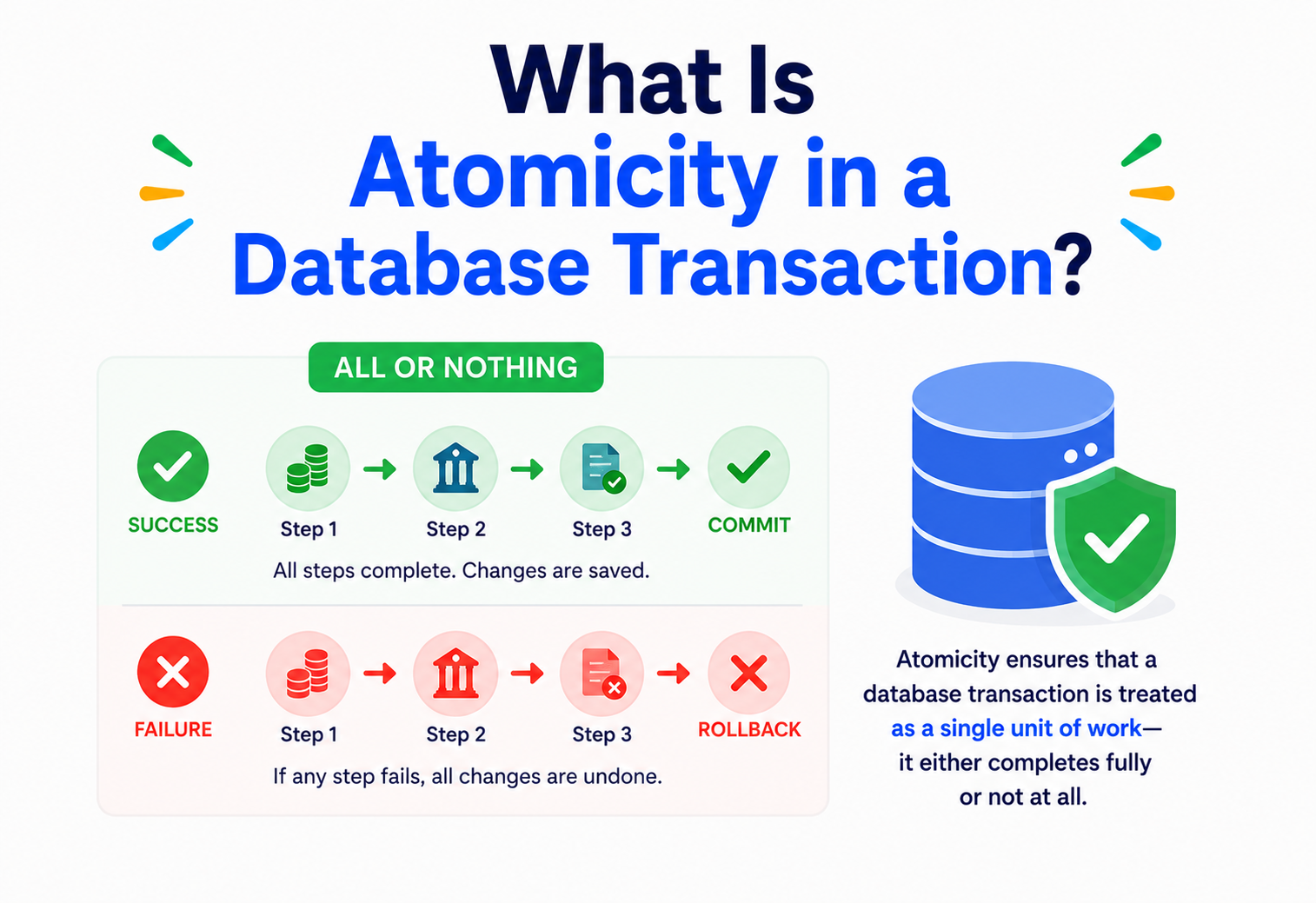
What Is Atomicity in a Database Transaction?
A complete, beginner‑friendly guide to the “A” in ACID — why databases refuse to do things halfway, how they pull this off internally, and what it means for the software you build every day. By the end you will be able to reason confidently about why banks, e‑commerce sites, and cloud databases can all promise “this either fully happened or it never happened.”
Introduction and History
Atomicity is the oldest, most durable idea in database engineering — the promise that a group of related operations behaves like one indivisible step, so partial failures can never leave your data in a broken, half‑finished state.
Imagine you are sending money to a friend using a banking app. You tap “Send,” the app shows a spinner for a second, and then it says “Done.” Behind that one tap, the database had to do at least two separate things: take money out of your account and put money into your friend’s account. What happens if the app crashes, the network drops, or the server loses power right after the first step but before the second one? Did your money simply vanish?
In a well‑built system, the answer is always no. Either both steps happen, or neither happens. There is no in‑between state where money has left your account but never arrived anywhere. This “all‑or‑nothing” guarantee is called atomicity, and it is one of the oldest and most important ideas in database engineering.
The word “atomic” comes from the Greek word atomos, meaning “indivisible” — something that cannot be cut into smaller pieces. Ancient philosophers used it to describe the smallest possible unit of matter. Database engineers borrowed the word for a similar reason: an atomic transaction is a unit of work that cannot be split. It either completes fully or it does not happen at all — there is no partial version of it.
A short history
The idea of transactional atomicity was formalised in the 1970s and early 1980s, as computer scientists began building the first serious database management systems (DBMS) for banks, airlines, and government agencies. Jim Gray, a computer scientist at IBM who later won the Turing Award, is widely credited with laying the groundwork for transaction processing theory. His 1981 paper “The Transaction Concept: Virtues and Limitations” described transactions as units of work that should be atomic, consistent, isolated, and durable — the ideas that Andreas Reuter and Theo Härder later packaged into the acronym ACID in 1983.
Early systems like IBM’s IMS and System R (the research project that eventually became IBM DB2) pioneered techniques such as write‑ahead logging and two‑phase commit to make atomicity a reality, not just a theory. These same core techniques — refined and optimised — still run inside PostgreSQL, MySQL, Oracle, SQL Server, and even modern cloud‑native databases like Amazon Aurora and Google Spanner today.
1970s — IMS & System R
Early IBM systems pioneer write‑ahead logging and two‑phase commit for real production workloads.
1981 — Jim Gray’s transaction paper
“The Transaction Concept: Virtues and Limitations” formally defines atomic, consistent, isolated, durable units of work.
1983 — ACID coined
Andreas Reuter and Theo Härder package Gray’s ideas into the four‑letter shorthand engineers still use today.
1992 — ARIES recovery algorithm
C. Mohan and colleagues at IBM formalise the analysis/redo/undo recovery approach that mainstream databases still follow.
2010s+ — Distributed ACID
Systems like Google Spanner and CockroachDB extend classic atomicity across continents using Paxos/Raft and clock synchronisation.
Think about mailing a letter. You cannot mail “half” a letter — either the whole envelope goes into the mailbox, or you keep it in your hand. There is no state where the post office has “sort of” received your letter. A database transaction works the same way: it is either fully delivered to the database, or it is as if it never happened.
Why does this matter so much today, decades after the idea was invented? Because every serious application you use — e‑commerce checkouts, ride‑hailing fare calculations, payroll systems, hospital record systems, airline booking engines — relies on atomicity to keep its data trustworthy. Without it, systems would randomly leave data in broken, half‑finished states, and nobody could trust any number they saw on a screen.
The Problem Atomicity Solves
To understand why atomicity exists, it helps to imagine a world without it. Multi‑step operations, concurrent users, and crashing hardware all conspire to leave data in unreliable, half‑finished states unless something guarantees “all steps, or no steps.”
The multi‑step operation problem
Most real‑world business operations are not single, isolated actions. They are a sequence of smaller steps that must succeed together. Consider a simple online purchase:
- Check that the item is in stock.
- Reduce the stock count by 1.
- Charge the customer’s card.
- Create an order record.
- Send a confirmation email.
Each one of these is a separate operation on the database (or even on separate systems). If your server crashes after step 2 but before step 3, the stock count has already gone down — but the customer was never charged and no order was created. Now your inventory numbers are wrong, and you have effectively given away a product for free. If the crash happens after step 3 but before step 4, the customer’s card was charged, but there is no order in your system to fulfil. The customer paid for nothing.
Every one of these partial‑failure scenarios is a real bug that happens in production systems that do not handle transactions correctly. Support teams spend hours manually reconciling “phantom charges” and “ghost orders” caused by exactly this kind of half‑finished operation.
The concurrent access problem
Things get even messier when many users hit the database at the same time. Imagine two people trying to book the very last seat on a flight at the same instant. Without proper transactional control, both requests could read “1 seat available,” both could proceed to book it, and now you have sold the same seat twice. Atomicity, when combined with its sibling property isolation, ensures each transaction behaves as if it were the only one running, and each one either fully commits or fully rolls back without leaving partial evidence for others to see.
The crash recovery problem
Hardware fails. Processes get killed. Servers reboot for security patches. Power grids hiccup. Any database that claims to be reliable must answer a hard question: if the machine dies in the middle of writing data, what state is the data left in when it comes back up? Atomicity — together with durability — is the guarantee that lets a database say, with confidence, “Whatever transactions were in flight when we crashed have either been fully applied or fully undone. There are no half‑written records.”
Think of a chef assembling a burger for an order. If the kitchen catches fire halfway through assembly, the waiter should not serve a half‑built burger to the customer and call it done. Either the full burger goes out, or the whole order gets cancelled and remade. A messy, half‑finished burger served as if it were complete is worse than no burger at all — because the customer thinks they got what they ordered.
This is precisely the motivation behind atomicity: multi‑step operations need a mechanism that guarantees “all steps happen” or “no steps happen,” even in the presence of crashes, power failures, network partitions, and concurrent users. Everything else in this tutorial is really just an explanation of the machinery that makes this promise possible.
Core Concepts
Before going further, let’s pin down exactly what a transaction is, what atomicity guarantees, and how the “A” sits alongside the other three ACID properties.
What is a transaction?
A transaction is a group of one or more database operations (reads and writes) that are treated as a single logical unit of work. A transaction has a clear beginning and a clear end. It begins when you say “start transaction” (explicitly or implicitly), and it ends in one of exactly two ways:
- Commit — every change made during the transaction is saved permanently.
- Rollback (Abort) — every change made during the transaction is undone completely, as if it never happened.
There is no third outcome. A transaction never ends up “half‑committed.”
Picture a to‑do list app where “Move a task from Today to Done” actually involves two database writes: delete the task from the “Today” table, and insert it into the “Done” table. If you wrap both writes in one transaction, the task can never disappear from Today without appearing in Done, and it can never appear in Done while still sitting in Today.
What is atomicity, precisely?
Atomicity is the guarantee that a transaction is treated as a single, indivisible unit: all of its operations succeed, or none of them do. If any single operation within the transaction fails — because of a constraint violation, a crash, a deadlock, an out‑of‑disk‑space error, or any other reason — the database automatically undoes every change the transaction had already made, restoring the data to exactly how it looked before the transaction started.
Atomicity means “no partial writes are ever visible” — a transaction is like a single atomic step from the outside world’s point of view, even though it might be made of many smaller steps internally.
Atomicity’s place in ACID
Atomicity is one of four properties that together define a reliable transaction, known by the acronym ACID:
| Letter | Property | What it guarantees |
|---|---|---|
| A | Atomicity | All operations in a transaction succeed, or none do. |
| C | Consistency | A transaction moves the database from one valid state to another valid state, respecting all rules and constraints. |
| I | Isolation | Concurrent transactions do not interfere with each other’s intermediate states. |
| D | Durability | Once a transaction commits, its changes survive crashes and power loss. |
These four properties support each other. Atomicity mostly deals with failure (what happens when something goes wrong mid‑transaction), while durability deals with permanence (what happens after a transaction has succeeded). Isolation deals with concurrency (what other transactions can see while yours is running). Consistency is the umbrella result: if atomicity, isolation, and the application’s own business rules all hold, the database stays logically correct.
Think of ACID like the rules for a stage performance. Atomicity says the whole scene happens or it is cut entirely — no half‑acted scenes make it to the audience. Consistency says the story still makes sense afterward. Isolation says each actor rehearses in their own room so nobody sees another actor’s unfinished lines. Durability says once the show airs live, it is recorded and cannot be un‑broadcast.
Atomic at what level?
It is worth being precise about the boundary of atomicity. It applies to the transaction as a unit — not to the database as a whole, and not to a single row update spanning multiple unrelated transactions. If Transaction A updates three rows and Transaction B (a completely separate transaction) updates two different rows at the same time, atomicity says nothing about coordinating A and B together — that is isolation’s job. Atomicity only promises that everything inside A happens together, and everything inside B happens together.
Statement‑level vs transaction‑level atomicity
Most modern relational databases actually give you atomicity at two levels:
- Statement‑level atomicity: a single SQL statement (like an
UPDATEthat touches 10,000 rows) either fully applies to all matching rows or none of them, even without an explicit transaction. - Transaction‑level atomicity: a group of multiple statements, explicitly wrapped in
BEGIN ... COMMIT, either all apply or none do.
BEGIN TRANSACTION;

UPDATE accounts SET balance = balance - 500 WHERE account_id = 'A100';
UPDATE accounts SET balance = balance + 500 WHERE account_id = 'B200';

COMMIT;
If the second UPDATE fails for any reason — say, account B200 does not exist — the database automatically rolls back the first UPDATE too. Account A100 keeps its original balance, exactly as if nothing had been attempted.
Architecture and Components
Atomicity is not magic — it is engineered using a small set of well‑understood components that live inside every relational database engine. Each piece has a very specific job, and together they add up to the all‑or‑nothing guarantee.
1. The transaction manager
This is the component that keeps track of which transactions are currently active, coordinates their start and end, and decides whether a transaction should commit or roll back. It assigns each transaction a unique transaction ID and tracks its state (active, partially committed, committed, failed, aborted).
2. The Write‑Ahead Log (WAL)
This is the single most important piece of machinery behind atomicity (and durability). Before the database changes any actual data page on disk, it first writes a record describing that change to a separate, sequential log file — the write‑ahead log. Only after the log record is safely written does the database modify the real data.
The rule is simple: log the intention to change something before you actually change it. This way, if the system crashes right after the change, the log still has a trustworthy record of exactly what was supposed to happen, and the database can use it to finish the job or undo it during recovery.
Different databases have their own names for this mechanism, but the concept is identical:
- PostgreSQL: WAL (Write‑Ahead Log)
- MySQL (InnoDB): Redo log + Undo log
- Oracle: Redo log + Undo/Rollback segments
- SQL Server: Transaction log
3. Undo (rollback) records
Alongside the log that records “what changed,” databases also keep track of “what it looked like before” — these are undo records. If a transaction needs to be rolled back (either because the application asked for it, or because of a crash), the database replays these undo records in reverse order to erase the transaction’s effects.
4. Redo records
Redo records capture “what should happen” for changes that were committed but might not yet be reflected in the actual on‑disk data files (because writing to disk is expensive, and databases batch and delay these writes for performance). If the system crashes after a commit but before the data file itself was updated, the redo log lets the database “replay” the committed change during recovery.
5. The buffer / cache manager
Databases do not write every single change straight to disk immediately — that would be far too slow. Instead, changed data lives in memory (in the buffer pool / page cache) and gets flushed to disk periodically. Atomicity’s log‑based machinery is precisely what allows this optimisation to be safe: even though the “real” data on disk may lag behind, the log always has the full, ordered truth.
6. The lock manager
While not directly responsible for atomicity itself, the lock manager works closely with it. It prevents two transactions from stepping on each other’s uncommitted changes, which keeps the “rollback” operation clean and predictable.
Think of a construction crew renovating a house. Before knocking down any wall, they take detailed photos and measurements (the write‑ahead log) and note the original layout (the undo record). If the renovation gets cancelled halfway through, they use those notes to put everything back exactly as it was — nail for nail. If the renovation is approved and finished, the notes let an inspector confirm every step really happened, even if some paperwork is filed later (the redo log).
Internal Working: How Atomicity Is Actually Implemented
Now let’s go one level deeper and look at the two dominant techniques databases use to implement atomicity: logging with undo/redo, and shadow paging. Nearly every production database today uses the first approach, so we will spend most of our time there.
Technique 1: Write‑Ahead Logging (WAL) with undo/redo
Here is the step‑by‑step sequence a database follows for a transaction using WAL:
- Begin: The transaction manager creates a new transaction ID and marks the transaction as “active.”
- Execute statements: For every change (insert, update, delete), the engine first writes a log record describing the change — including enough information to redo it (the new value) and undo it (the old value) — to the write‑ahead log buffer.
- Flush log to disk: Before any modified data page is written to disk, the corresponding log record must already be safely on disk. This rule is called the Write‑Ahead Logging protocol, and it is the backbone of crash‑safe atomicity.
- Modify in‑memory pages: The actual data pages in the buffer pool are updated. These may or may not be flushed to disk right away.
- Commit: When the application issues
COMMIT, the engine writes a special “commit” log record to the WAL and flushes it to disk. Only after this commit record is durably on disk does the database consider the transaction officially successful. - Rollback (if needed): If the application issues
ROLLBACK, or if any statement inside the transaction errors out, the engine walks backward through the log records for that transaction and applies the “old value” (undo information) to reverse every change made so far.
“Log first, then data.” No data page is ever allowed to reach disk before its corresponding log entry does. This single rule is what makes crash recovery possible and deterministic.
Crash recovery: the ARIES algorithm
Most modern relational databases (PostgreSQL, MySQL/InnoDB, and many others) use variations of an algorithm called ARIES (Algorithm for Recovery and Isolation Exploiting Semantics), developed by IBM researcher C. Mohan and colleagues in 1992. When a database restarts after a crash, it runs recovery in three phases:
| Phase | What happens |
|---|---|
| Analysis | Scan the log to determine which transactions were active (uncommitted) and which data pages might be “dirty” (modified in memory but not flushed) at the moment of the crash. |
| Redo | Replay every logged change since the last checkpoint — even for transactions that will later be undone — to bring the database back to the exact state it was in at the moment of the crash. This is called “repeating history.” |
| Undo | Roll back any transactions that were still active (not committed) at crash time, using the undo records, so their partial work disappears completely. |
Suppose a transaction updates 3 rows and then the power goes out right before COMMIT is logged. On restart, the Analysis phase notices this transaction never wrote a commit record. The Redo phase might still reapply its changes temporarily (to rebuild an accurate picture of memory), but the Undo phase then reverses all 3 row changes because the transaction was never officially committed. The net effect: all 3 changes vanish, exactly matching atomicity’s promise.
Technique 2: Shadow paging (historical / alternative approach)
An older, less common technique is shadow paging. Instead of logging individual changes, the database keeps two page tables: a “current” page table (which the transaction modifies, working on brand‑new copies of pages) and a “shadow” page table (the original, untouched version). If the transaction commits, the current page table atomically replaces the shadow page table with a single pointer swap. If it aborts, the current page table is simply discarded, and the shadow (original) page table remains valid. Modern copy‑on‑write filesystems and some NoSQL/NewSQL databases (and SQLite’s older modes) use ideas closely related to this. Its downside is heavier disk usage and page fragmentation, which is why WAL‑based logging dominates in mainstream relational databases today.
Savepoints: partial rollback within a transaction
Sometimes you do not want to undo an entire transaction — just part of it. A savepoint is a named marker inside a transaction that you can roll back to without discarding everything before it.
BEGIN TRANSACTION;

UPDATE inventory SET stock = stock - 1 WHERE sku = 'X1';
SAVEPOINT after_stock_update;

UPDATE payments SET status = 'charged' WHERE order_id = 987;
-- Suppose this fails a business rule check
ROLLBACK TO SAVEPOINT after_stock_update;

-- retry payment logic here, or COMMIT / ROLLBACK the whole transaction
COMMIT;
Savepoints do not violate atomicity — the whole transaction is still all‑or‑nothing from the outside. They just give you finer control over what happens inside the transaction before that final all‑or‑nothing decision is made.
Data Flow and Transaction Lifecycle
Every transaction moves through a well‑defined set of states from birth to conclusion. Understanding this state machine makes atomicity much easier to reason about — and easier to debug when something goes sideways.
Walking through each state
| State | Meaning |
|---|---|
| Active | The transaction has begun and is executing statements. Changes exist only in memory / the log buffer. |
| Partially Committed | The last statement has executed, but the transaction manager has not yet confirmed the commit is safe (e.g., constraints still need checking, log still needs flushing). |
| Committed | The commit log record has been durably written. The transaction’s effects are now permanent and visible to others. |
| Failed | Something went wrong — a constraint violation, deadlock, disk error, or explicit rollback request. |
| Aborted | All changes have been undone using undo records. The database looks as if the transaction never started. |
This is like a legal contract signing. Both parties can negotiate and mark up drafts all day (Active state). But the contract only becomes binding at the moment both signatures are witnessed and notarised (Committed). If either party walks away before that moment, all the draft markups are void — nobody is bound by anything (Aborted).
Java example: transaction lifecycle with JDBC
Here is a plain JDBC example that shows atomicity in action — a bank transfer that either fully succeeds or fully rolls back.
public void transferFunds(Connection conn, String fromAcct, String toAcct, BigDecimal amount) throws SQLException {
    boolean originalAutoCommit = conn.getAutoCommit();
    try {
        conn.setAutoCommit(false); // begin transaction

        try (PreparedStatement debit = conn.prepareStatement(
                "UPDATE accounts SET balance = balance - ? WHERE account_id = ?")) {
            debit.setBigDecimal(1, amount);
            debit.setString(2, fromAcct);
            debit.executeUpdate();
        }

        try (PreparedStatement credit = conn.prepareStatement(
                "UPDATE accounts SET balance = balance + ? WHERE account_id = ?")) {
            credit.setBigDecimal(1, amount);
            credit.setString(2, toAcct);
            credit.executeUpdate();
        }

        conn.commit(); // all-or-nothing: both updates become permanent together
    } catch (SQLException ex) {
        conn.rollback(); // undo the debit if the credit failed (or vice versa)
        throw ex;
    } finally {
        conn.setAutoCommit(originalAutoCommit);
    }
}
Notice the structure: both writes happen inside a try block, and any exception triggers conn.rollback() before the exception is re‑thrown. This is the classic pattern for guaranteeing atomicity in application code that talks to a database directly.
Java example: declarative atomicity with Spring
In real‑world Java applications, most teams avoid manual commit()/rollback() calls and instead rely on a framework like Spring, which wraps a method in a transaction automatically.
@Service
public class TransferService {

    private final AccountRepository accountRepository;

    public TransferService(AccountRepository accountRepository) {
        this.accountRepository = accountRepository;
    }

    @Transactional
    public void transfer(String fromAcct, String toAcct, BigDecimal amount) {
        Account from = accountRepository.findById(fromAcct).orElseThrow();
        Account to = accountRepository.findById(toAcct).orElseThrow();

        from.debit(amount);
        to.credit(amount);

        accountRepository.save(from);
        accountRepository.save(to);
        // If any exception is thrown anywhere above, Spring automatically
        // rolls back both saves. If the method returns normally, Spring commits.
    }
}
The @Transactional annotation tells Spring’s transaction manager to open a transaction before the method runs and commit it after the method returns successfully — or roll it back if an unchecked exception escapes the method. This is atomicity enforced declaratively, without the developer manually writing commit/rollback logic.
Advantages, Disadvantages and Trade‑offs
Atomicity is not free — it trades a little bit of raw speed for a large amount of correctness. Naming both sides of that bargain plainly makes it easier to decide when strict atomicity is worth every millisecond it costs.
✓ Advantages
- Data integrity: no more phantom half‑updates — every multi‑step business operation either fully lands or fully disappears.
- Simpler application logic: developers do not need to write complex manual “undo my last three writes” logic; the database does it automatically.
- Safe crash recovery: systems can restart after failures with a guaranteed‑clean data state, without manual intervention or data audits.
- Predictable concurrent behaviour: combined with isolation, atomicity prevents other transactions from ever observing a half‑finished operation.
✗ Disadvantages / Costs
- Performance overhead: writing to the log before writing to data, flushing logs to disk on every commit, and holding locks all add latency compared to a system with no transactional guarantees.
- Storage overhead: undo and redo logs consume extra disk space, and long‑running transactions can bloat these logs significantly.
- Complexity at scale: making atomicity work across multiple databases or services (distributed transactions) is significantly harder and slower than within a single database.
- Contention: transactions that touch the same rows must often wait for each other (via locks), which can create bottlenecks under heavy concurrent load.
The core trade‑off
Atomicity trades a little bit of raw speed for a large amount of correctness and peace of mind. In almost every domain that deals with money, inventory, medical records, or legal agreements, this trade‑off is an easy call: incorrect data is far more expensive than a few extra milliseconds of latency. But in domains where raw throughput matters more than perfect consistency — like ingesting high‑volume clickstream analytics events — many systems intentionally relax these guarantees (this is part of why NoSQL databases with weaker consistency models became popular for certain workloads).
Performance and Scalability
Atomicity’s performance cost is real but well‑understood, and there is a mature bag of tricks — from group commit to MVCC — that lets modern databases pay the price cheaply.
Where the cost comes from
Atomicity’s performance cost mainly comes from three places:
- Log flushing (fsync): to guarantee durability of a commit, the log record must be physically written to durable storage before the database can tell the client “success.” This disk sync is one of the slowest operations in the whole stack.
- Locking: rows or pages touched by an active transaction are typically locked until commit or rollback, which can block other transactions.
- Undo/redo bookkeeping: every write generates extra log data that must be maintained, indexed, and eventually cleaned up.
Common optimisation techniques
| Technique | How it helps |
|---|---|
| Group commit | Batch multiple transactions’ commit log flushes into a single disk sync, amortising the fsync cost across many transactions. |
| Write‑ahead log buffering | Keep log records in an in‑memory buffer and flush in large sequential chunks rather than tiny random writes. |
| Row‑level locking (vs table‑level) | Reduces contention by only locking the specific rows a transaction touches, not the whole table. |
| MVCC (Multi‑Version Concurrency Control) | Lets readers see a consistent snapshot without blocking writers, reducing lock contention significantly (used by PostgreSQL, MySQL/InnoDB, Oracle). |
| Short transactions | The shorter a transaction is open, the less time it holds locks and the smaller its log footprint — a key application‑level best practice. |
| SSD / NVMe storage | Drastically reduces the latency of the fsync operations that WAL depends on. |
The single biggest performance lever most application developers control is transaction length. Keep transactions as short as possible — do your expensive computation, API calls, or file I/O before opening a transaction, not inside it.
Scalability considerations
Atomicity, as classically implemented, assumes a single coordinating log and a single point of truth for “did this commit or not.” This works beautifully on one machine but becomes a genuine engineering challenge once you scale horizontally across many machines — which is exactly the topic of the next section.
High Availability and Distributed Atomicity
So far, we have discussed atomicity within a single database. Modern systems, though, are often distributed — a single “operation” might update data in two entirely different databases, in two shards, or across two different microservices. Getting all‑or‑nothing behaviour across independent systems that fail independently of each other is a whole new engineering challenge.
Two‑Phase Commit (2PC)
The classic academic answer is the Two‑Phase Commit protocol. A coordinator node manages the transaction across multiple participant nodes (databases) using two rounds of communication:
- Phase 1 — Prepare: the coordinator asks every participant, “Can you commit this transaction?” Each participant does all the work needed to guarantee it can commit (writes its own log records, acquires locks) and replies “yes” (ready) or “no.”
- Phase 2 — Commit/Abort: if every participant said “yes,” the coordinator tells everyone to commit. If even one participant said “no” (or timed out), the coordinator tells everyone to abort.
2PC is a blocking protocol. If the coordinator crashes right after participants say “ready” but before it sends the final decision, those participants are stuck holding locks indefinitely, unsure whether to commit or abort. This is why 2PC, while theoretically correct, is used carefully and sparingly in high‑availability production systems — it can turn one node’s failure into a cluster‑wide outage.
Three‑Phase Commit (3PC)
3PC adds an extra “pre‑commit” phase and timeouts to reduce (but not fully eliminate) the blocking problem of 2PC, at the cost of extra network round trips. In practice, 3PC is rarely used in production because it still cannot fully tolerate network partitions correctly (a consequence of the CAP theorem, discussed below), and consensus‑based approaches have largely taken its place for critical coordination.
Consensus protocols: Paxos and Raft
Modern distributed databases (like Google Spanner, CockroachDB, and etcd, which backs Kubernetes) use consensus algorithms such as Paxos or the more understandable Raft to reliably agree on the order and outcome of operations across a cluster of replicas, even when some nodes fail. These protocols solve a similar underlying problem to 2PC (getting distributed nodes to agree) but are designed to tolerate node failures without blocking the whole system, using a leader‑election and majority‑quorum mechanism.
The CAP theorem and atomicity
The CAP theorem, formulated by Eric Brewer, states that a distributed system can provide at most two of three guarantees simultaneously during a network partition: Consistency, Availability, and Partition tolerance. Since network partitions are unavoidable in real distributed systems, this really becomes a choice between consistency and availability when the network is split.
This matters for atomicity because strict all‑or‑nothing distributed transactions (like 2PC) favour consistency — they will make participants wait or abort rather than risk an inconsistent commit, which can reduce availability during a network partition. Systems that prioritise availability instead (many NoSQL databases) often relax strict atomicity across nodes and instead offer atomicity only within a single node or document, accepting eventual consistency elsewhere.
The Saga pattern: atomicity without 2PC
Because 2PC does not scale well across independent microservices, the industry largely moved to a different approach for distributed “atomic‑like” operations: the Saga pattern. Instead of one giant atomic transaction, a saga breaks the operation into a sequence of local transactions, each with a corresponding compensating transaction that can undo its effect if a later step fails.
Sagas trade strict, instantaneous atomicity for eventual, cooperative atomicity — the system may pass through visibly inconsistent intermediate states (an order marked “pending” while a compensation runs), but it guarantees it will eventually reach a consistent end state. This is a deliberate, well‑understood trade‑off in microservice architecture, and we will revisit it in the Microservices section.
Replication and atomicity
High‑availability databases replicate data to standby nodes so a failure of the primary does not lose data. Synchronous replication (used by systems like PostgreSQL with synchronous standbys, or Google Spanner) waits for a majority of replicas to acknowledge a commit before confirming it to the client — this preserves atomicity and durability even if the primary fails immediately after. Asynchronous replication is faster but introduces a small window where a “committed” transaction could be lost if the primary crashes before replicating — a trade‑off many systems accept for lower latency.
Security Considerations
Atomicity is not primarily a security feature, but it intersects with security in a few important ways — from preventing exploitable race conditions to giving forensic investigators a reliable audit trail.
- Preventing exploitable inconsistent states: race conditions caused by missing or poorly‑scoped transactions (for example, a “check funds, then debit” sequence that is not atomic) are a classic source of financial fraud bugs — attackers can exploit the gap between the check and the write to double‑spend or over‑withdraw.
- Audit logs double as security trails: the same write‑ahead log that guarantees atomicity often becomes a valuable forensic record during a security incident, showing exactly what changed and when.
- Denial‑of‑service via long transactions: an attacker (or a careless developer) who opens transactions and never closes them can exhaust locks or log space, effectively starving the system — a good reason to enforce transaction timeouts.
- Rollback and sensitive data: rolled‑back transactions can sometimes leave traces in logs or undo segments; systems with strict compliance requirements (PCI‑DSS, HIPAA) must carefully manage log retention and encryption.
A “check‑then‑act” pattern split across two separate, non‑atomic database calls (e.g., check account balance in one query, then debit in a second, unrelated query) is a textbook race condition. Always perform the check and the write inside the same atomic transaction, ideally using a single conditional statement (UPDATE ... WHERE balance >= amount) rather than two round trips.
Monitoring, Logging and Metrics
In production, teams monitor several signals related to transactional health — and each one, watched consistently, is often the first quiet warning that something is starting to go wrong.
| Metric | Why it matters |
|---|---|
| Transaction commit rate / rollback rate | A sudden spike in rollbacks often signals application bugs, constraint violations, or contention problems. |
| Average transaction duration | Long‑running transactions hold locks longer and bloat undo/WAL logs — a common cause of performance degradation. |
| WAL / redo log generation rate | Helps size disk throughput and plan for replication lag under heavy write load. |
| Lock wait time / deadlock count | Indicates contention hotspots; frequent deadlocks usually point to inconsistent lock ordering in application code. |
| Checkpoint frequency and duration | Checkpoints bound how much log needs to be replayed during crash recovery — too infrequent, and recovery time balloons. |
| Replication lag | Especially relevant for distributed atomicity guarantees — high lag risks losing “committed” data during failover. |
Most production databases expose these metrics through built‑in views (like PostgreSQL’s pg_stat_activity and pg_stat_database, or MySQL’s information_schema and Performance Schema), which teams typically pipe into monitoring tools like Prometheus, Grafana, Datadog, or cloud‑native equivalents (Amazon CloudWatch, Google Cloud Monitoring) to build dashboards and alerts.
Set an alert on transactions that have been open longer than a defined threshold (say, 30 seconds for an OLTP workload). Long‑open transactions are one of the most common root causes of production incidents — they silently accumulate locks and bloat, often traced back to a forgotten commit() call or a transaction accidentally wrapping a slow external API call.
Deployment and Cloud Considerations
When deploying transactional databases in the cloud, atomicity guarantees interact with infrastructure choices in surprisingly deep ways — storage type, replication topology, and even the physical distance between data centres all matter.
- Managed database services (Amazon RDS/Aurora, Google Cloud SQL/Spanner, Azure SQL Database) handle WAL, checkpointing, and crash recovery for you, but you still need to configure durability settings correctly — for example, whether commits wait for synchronous replicas.
- Storage choice matters: network‑attached storage (like AWS EBS) versus local NVMe affects fsync latency, which directly affects commit throughput.
- Multi‑region deployments introduce a fundamental trade‑off between commit latency (waiting for a far‑away region to acknowledge) and disaster resilience. Google Spanner’s TrueTime‑based approach and CockroachDB’s Raft‑based replication are notable engineering solutions to make globally‑distributed atomic transactions practical.
- Backups and point‑in‑time recovery are built directly on top of the WAL — most databases can replay logs up to a specific timestamp to restore a consistent, atomic snapshot of the database after a data‑loss incident.
- Disaster recovery drills should specifically test that failover does not silently lose “committed” transactions — this is where the durability half of ACID gets tested for real.
Amazon Aurora separates compute from a distributed, log‑structured storage layer. Instead of shipping whole data pages, Aurora ships only the redo log records to its storage nodes, which then apply them independently. This design, built directly on the logging principles behind atomicity, is a major reason Aurora can achieve high throughput while maintaining strong durability guarantees across multiple availability zones.
Databases, Caching and Load Balancing
Different database families offer atomicity at very different scopes, and once you add caches and read replicas in front, staying honest about “what is actually atomic here?” becomes an architectural discipline of its own.
Atomicity across different database types
| Database type | Atomicity support |
|---|---|
| Traditional RDBMS (PostgreSQL, MySQL, Oracle, SQL Server) | Full ACID transactions across multiple tables and rows, via WAL/undo‑redo logging. |
| Document stores (MongoDB, modern versions) | Atomic within a single document by default; multi‑document ACID transactions available since MongoDB 4.0, at a performance cost. |
| Key‑value stores (Redis, DynamoDB) | Atomic single‑key operations; multi‑key atomicity requires explicit support (Redis transactions/Lua scripts, DynamoDB TransactWriteItems). |
| Wide‑column stores (Cassandra, HBase) | Traditionally atomic only at the single‑row/partition level; lightweight transactions (Cassandra’s IF clauses) use Paxos‑like consensus for limited multi‑step atomicity. |
| NewSQL (Google Spanner, CockroachDB, YugabyteDB) | Full distributed ACID transactions across nodes, using consensus protocols (Paxos/Raft) instead of classic 2PC alone. |
Caching and atomicity
Caches (like Redis or Memcached sitting in front of a database) are a common source of atomicity‑adjacent bugs. If your application updates the database and the cache as two separate steps, a crash between them leaves the cache and database disagreeing — the cache is now “lying.” Common mitigations include:
- Cache invalidation instead of cache updates: delete the cached value rather than trying to update it, forcing the next read to fetch fresh data from the (atomically updated) database.
- Write‑through caching with transactional outbox patterns: record the cache‑invalidation intent as part of the same database transaction, then process it reliably afterward (see the Outbox Pattern in the next section).
Load balancing and transaction routing
In read‑replica architectures, load balancers often route read queries to replicas and write queries to the primary. This is safe for atomicity as long as writes always go to the primary (or the current Raft/Paxos leader in a consensus‑based cluster), and applications are aware that reads from a replica might briefly lag behind the primary due to replication delay — a nuance that matters especially right after a write, a scenario often called “read‑your‑own‑writes” consistency.
APIs and Microservices
Atomicity was originally designed for a single database. Microservice architectures deliberately split data across many independently‑owned databases — which means the clean, single‑log atomicity we described earlier simply is not available across service boundaries. This section covers how modern API and microservice design handles that reality.
The core challenge
Imagine an e‑commerce checkout that spans three microservices: Inventory, Payment, and Shipping — each with its own database. A single API call from the client needs all three to succeed together, but you cannot wrap three separate databases in one classic BEGIN...COMMIT transaction without resorting to something like 2PC, which (as discussed) creates tight coupling and availability risk between services that are supposed to be independent.
The Saga pattern, revisited
As introduced earlier, the Saga pattern is the dominant solution. There are two common ways to implement it:
| Style | How it works |
|---|---|
| Choreography | Each service listens for events from the others and reacts independently — no central coordinator. Simple for small sagas, but hard to trace and debug as the number of steps grows. |
| Orchestration | A central orchestrator service explicitly calls each step in order and triggers compensations on failure. Easier to monitor and reason about, at the cost of a new coordinating component. |
The transactional outbox pattern
A subtle but common bug in distributed systems: a service updates its own database and publishes an event to a message broker (like Kafka or RabbitMQ) as two separate operations. If the service crashes between them, you get exactly the kind of partial failure atomicity was invented to prevent — the local update happened, but nobody downstream ever heard about it (or vice versa).
The Outbox Pattern solves this by writing the event into an “outbox” table in the same local database transaction as the business data change — giving you atomicity for free, since it is all one local transaction. A separate background process then reliably reads from the outbox table and publishes the event to the message broker, retrying until it succeeds.
Idempotency: the necessary companion to sagas
Because saga steps and compensations may be retried after timeouts or crashes, every step and every compensation must be idempotent — running it twice must produce the same result as running it once. APIs commonly implement this using an idempotency key supplied by the client, which the server uses to detect and safely ignore duplicate requests.
When designing a payment or order‑creation API, always accept an Idempotency‑Key header and store which keys have already been processed (and their result) inside the same atomic transaction that performs the business logic. This lets clients safely retry on timeout without risking a double charge.
Design Patterns and Anti‑patterns
Certain patterns show up again and again in codebases that get atomicity right, and certain anti‑patterns show up just as reliably in codebases that get it wrong. Naming both makes them easier to spot in code review.
Good patterns
One session per operation
Group all changes for a business operation into one object/session that is committed or rolled back as a whole (common in ORMs like Hibernate, Entity Framework, and Spring’s persistence layer).
Piggy‑back on the local txn
Piggyback event publishing on the same local transaction as the business write, so “did the message get sent?” becomes “did this transaction commit?”
Multi‑service workflows
Coordinate multi‑service workflows with explicit compensations — either choreographed via events or centrally orchestrated.
Detect conflicts at commit
Use version numbers to detect concurrent modification at commit time instead of holding long‑lived locks, improving throughput while preserving atomic, all‑or‑nothing writes.
Do the minimum, quickly
Do only the minimum database work necessary inside a transaction boundary; everything else belongs outside.
Anti‑patterns to avoid
Slow calls inside a txn
Making external API calls, sending emails, or doing heavy computation inside an open database transaction. This holds locks and log resources hostage to the speed of a slow external system.
Tight coupling by accident
Tightly coupling independently‑deployed services with synchronous 2PC undermines the whole point of microservice independence and creates cascading availability risk.
Broken half‑applied state
Catching an exception without re‑throwing it (and without explicitly rolling back) can leave a transaction in a broken, half‑applied state, especially with frameworks that auto‑commit unless told otherwise.
Race condition waiting to happen
Reading a value, deciding based on it, and writing separately (in two different queries/transactions) instead of using a single atomic conditional statement.
Batch job wrapped in one txn
Wrapping an entire batch job or bulk import into one enormous transaction, causing massive log growth, long lock hold times, and painful rollbacks if anything fails near the end.
Historically distinct actions
A compensating transaction in a saga does not erase history the way a database rollback does — it adds a new, opposite action (e.g., “refund” instead of “un‑charge”). Designing compensations as true database rollbacks is a common and costly mistake.
A very common real bug: a developer wraps a transaction around a database write and then an outbound HTTP call to a third‑party payment gateway inside the same transaction. If the gateway is slow, the database transaction stays open and locks accumulate — sometimes bringing down unrelated parts of the application that need the same locked rows.
Best Practices and Common Mistakes
A handful of simple habits, applied consistently, prevent the vast majority of real‑world atomicity bugs — almost all of which live in application code, not in the database engine itself.
Best practices
- Keep transactions short: do preparation and validation work before opening the transaction; only put actual database writes inside it.
- Choose the right isolation level: understand the trade‑offs between Read Committed, Repeatable Read, and Serializable — stricter isolation adds safety but reduces concurrency.
- Always handle rollback explicitly in application code that does not use a declarative framework — never assume a failed statement automatically ends the transaction cleanly in every driver/database combination.
- Use framework‑level transaction management (like Spring’s
@Transactionalor an ORM’s Unit of Work) rather than hand‑rolling commit/rollback everywhere, to reduce human error. - Design idempotent operations wherever retries are possible — which is almost everywhere in distributed systems.
- Use the outbox pattern when a transaction needs to also trigger an external side effect like a message or event.
- Set sensible transaction and lock timeouts so a stuck transaction fails fast instead of silently blocking the whole system.
- Test crash scenarios deliberately (kill the process mid‑transaction in staging) to confirm your atomicity assumptions actually hold for your specific stack.
Common mistakes
- Assuming atomicity across multiple independent database connections or services without an explicit distributed transaction mechanism.
- Forgetting to set
autoCommit(false)before manual transaction control in JDBC‑style code, resulting in every statement quietly auto‑committing individually. - Nesting transactions incorrectly, not realising many databases do not support true nested transactions (only savepoints).
- Mixing DDL (schema changes) and DML (data changes) in one transaction on databases where DDL implicitly commits (a notable gotcha in MySQL).
- Ignoring that a rollback itself can fail (e.g., due to disk‑full conditions) and not having monitoring for that rare but serious scenario.
Real‑World Industry Examples
The idea of “all or nothing” sounds abstract until you see it powering banking ledgers, order pipelines, ride matches, and even the control plane of Kubernetes itself.
Banking: core ledger systems
Every major bank’s core banking ledger relies on strict atomicity for debit/credit pairs. A transfer, a fee deduction, or an interest payment always touches at least two ledger entries (double‑entry bookkeeping), and these systems are built specifically so those entries can never be applied independently.
E‑commerce: Amazon‑scale order processing
Large e‑commerce platforms combine local atomic transactions (for reserving inventory within one service) with saga‑style orchestration across order, payment, and fulfilment services, precisely because a single global transaction across dozens of independently‑scaled services would be both impractical and fragile at that scale.
Ride‑hailing: fare and driver‑matching systems
Platforms like Uber must atomically match a rider with exactly one driver and lock in a fare, even under enormous concurrent demand during surge periods. Getting this wrong either double‑books a driver or leaves a rider unmatched — both directly harm the business, which is why matching engines are built with careful attention to atomic, race‑condition‑free updates.
Cloud infrastructure: etcd and Kubernetes
Kubernetes stores all cluster state in etcd, a distributed key‑value store built on the Raft consensus algorithm. Every change to cluster state (deploying a pod, scaling a service) is applied atomically and consistently across etcd’s replicated nodes, which is what allows Kubernetes clusters to survive individual node failures without corrupting cluster state.
Globally distributed SQL: Google Spanner
Google Spanner extends classic ACID transactions across globally distributed data centres using a novel time‑synchronisation mechanism called TrueTime, combined with Paxos‑based replication. This lets Spanner offer full, strict atomic transactions even when the data involved is physically stored on different continents — a capability that would have been considered nearly impossible when Jim Gray first wrote about transactions in 1981.
Notice the pattern across every example: as systems get bigger and more distributed, engineers do not abandon atomicity — they get more creative about where to apply it (small, local, fast transactions) and how to stitch those local guarantees together (sagas, outbox, consensus protocols) to approximate the same all‑or‑nothing feeling at a larger scale.
FAQ, Summary and Key Takeaways
A short round of common questions, followed by a plain‑English summary and the takeaways worth writing down for later.
Is atomicity the same as isolation?
No. Atomicity is about a single transaction’s own steps completing fully or not at all. Isolation is about how concurrent transactions see (or do not see) each other’s in‑progress changes. They work together but solve different problems.
Does atomicity guarantee correctness of business logic?
No. Atomicity only guarantees that whatever operations you defined either all happen or none happen. If your business logic itself is wrong (e.g., you forgot to update a related table), atomicity will not catch that — that is closer to what the “Consistency” property, combined with correct application design, is meant to address.
Can a SELECT (read‑only) statement need atomicity?
Individually, a single read does not “fail halfway” the way a write can. But a transaction containing multiple reads that must all reflect the same consistent point in time relies on isolation more than atomicity — though it is still commonly wrapped in a transaction for that reason.
Why can’t we just always use Two‑Phase Commit for everything distributed?
2PC is blocking and creates tight coupling between services — one participant’s crash can stall the entire transaction across every other participant, which conflicts with the availability and independence goals of most modern distributed and microservice systems. That is why sagas, outbox patterns, and consensus‑based databases are generally preferred today.
What’s the difference between rollback and a saga compensation?
A rollback undoes changes that were never permanently committed — it is like they never happened. A compensating transaction in a saga reverses the effect of a change that was already committed locally, by performing a new, opposite action (like a refund instead of erasing a charge).
Does NoSQL mean “no atomicity”?
Not exactly. Most NoSQL databases still guarantee atomicity at some scope — typically a single document or a single key — even if they do not offer full multi‑row, multi‑table atomicity by default. Some, like MongoDB, have added broader multi‑document transaction support over time.
Summary
Atomicity is the guarantee that a database transaction’s operations happen as one indivisible unit — fully, or not at all. It exists to protect systems from the chaos of partial failures: crashes, network drops, concurrent access, and every other way multi‑step operations can go wrong halfway through. Internally, databases achieve this mostly through write‑ahead logging, undo and redo records, and well‑defined recovery algorithms like ARIES. Across distributed systems and microservices, strict atomicity becomes harder to guarantee cheaply, which is why patterns like Sagas, the Outbox pattern, idempotent APIs, and consensus protocols like Raft and Paxos have become essential tools for approximating the same guarantee at scale.
Key Takeaways
- Atomicity means all‑or‑nothing: a transaction either fully commits or fully rolls back — there is no in‑between.
- Write‑ahead logging is the fundamental mechanism that makes atomicity (and durability) possible, even across crashes.
- ARIES‑style recovery (Analysis, Redo, Undo) is how most production databases restore a clean state after a crash.
- Atomicity gets significantly harder — and more expensive — once you cross database or service boundaries.
- Two‑Phase Commit works but is blocking; modern distributed systems prefer consensus protocols or the Saga pattern for scalable, resilient coordination.
- The Outbox pattern and idempotency keys are essential, practical tools for preserving atomic‑like guarantees in microservice and API design.
- Keep transactions short, avoid slow external calls inside them, and always handle rollback explicitly — the biggest real‑world atomicity bugs come from application code, not the database engine itself.
Once atomicity feels solid, the natural next topics to study are Isolation Levels (Read Committed vs Repeatable Read vs Serializable), Multi‑Version Concurrency Control (MVCC), and the CAP theorem in depth — all of which build directly on the foundation you have just learned here.