What Is the CAP Theorem?
Whenever a computer system is split across many machines, it runs into a moment where it must choose between two good things and can’t have both. Here is what that moment is, why it can never be avoided, and how real systems decide what to do about it.
The Big Idea, in One Breath
Three friends. Three notepads. One noisy stadium. That tiny moment when they can’t hear each other is really the whole CAP theorem, hiding in plain sight.
Imagine three friends keeping track of the score during a big game, each sitting in a different corner of a huge stadium, each writing the score on their own little notepad. As long as they can shout across to each other, all three notepads stay perfectly matched. But the moment the crowd gets too loud for them to hear one another, each friend has a choice to make: stop updating their notepad and wait until the noise dies down, or keep writing down the score based on whatever they last heard, even if it might now be slightly wrong.
That exact dilemma — being unable to talk to each other for a moment, and having to decide whether to pause or to guess — is the entire heart of a famous idea in computer science called the CAP theorem. It explains something every big website, banking app, and online game secretly has to deal with: when parts of a system spread across different computers lose the ability to talk to each other, even for a split second, something has to give.
Picture a big family group chat, split between two phones that suddenly lose signal at the same time. One person on each phone still wants to send a message. Phone A can either refuse to send anything until the signal comes back (so nothing gets out of order), or send the message anyway, even though nobody on Phone B’s side will see it right away (so the message doesn’t just sit there unsent). Neither choice is “wrong” — but you cannot have both perfect ordering and instant sending at the exact same moment the signal is down.
The letters C, A, and P were first put together and explained clearly around the late 1990s, by a researcher thinking carefully about how systems spread across many computers actually behave in the real world, not just on a whiteboard. Since then, the idea has become one of the most talked-about, and honestly one of the most misunderstood, concepts in the entire world of large-scale computer systems. This guide aims to explain it the plain, honest way — without the confusion that often surrounds it.
What CAP Really Stands For
Three simple qualities, one uncomfortable rule: when the network breaks, at most two of them can be fully kept at the same time.
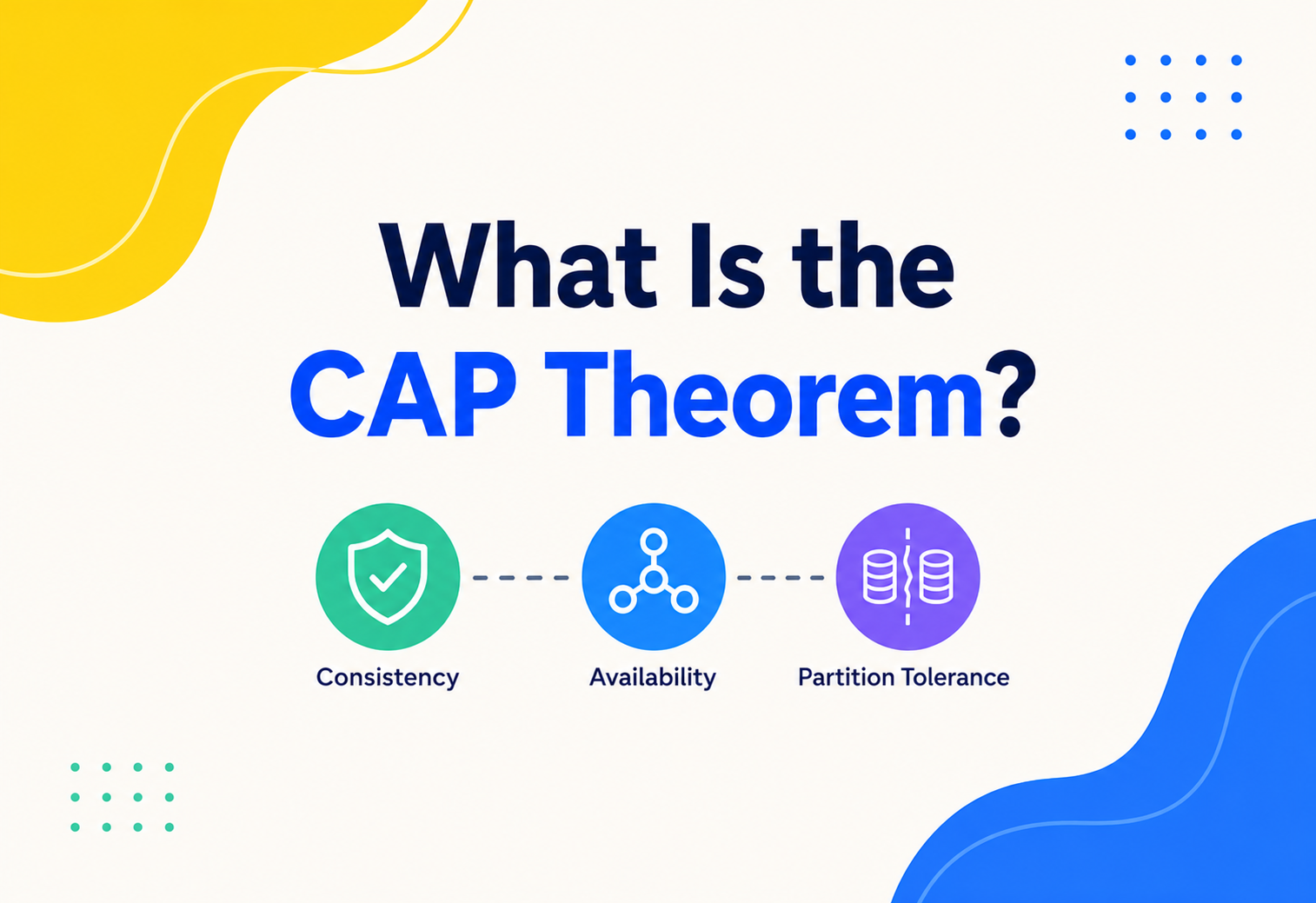
CAP is simply short for three qualities that matter enormously in any system spread across multiple computers, often called a distributed system:
- Consistency (C) — every computer in the system shows the exact same, most up-to-date piece of information at the exact same moment.
- Availability (A) — every request gets an answer, even if that answer comes from a computer that hasn’t heard the very latest update yet.
- Partition tolerance (P) — the system keeps working even when the network connecting its computers breaks or drops messages for a while.
The CAP theorem states something surprisingly simple once you say it plainly: when the network connecting a distributed system’s computers actually breaks (which it eventually always does, sooner or later), the system can keep either perfect consistency or full availability — but not both — for as long as that break lasts. It cannot magically keep all three promises perfectly at the same time during that gap.
If someone asks “is your system CP or AP?”, they are really asking: “When your network hiccups for a second, would you rather pause and stay accurate, or keep answering and risk being slightly out of date?”
Why the Trade-off Is Unavoidable
The trade-off isn’t a lack of cleverness — it is basic physics meeting basic geography. Cables break. Distance matters. Users don’t wait forever.
It is natural to wonder — with clever enough engineering, couldn’t a system just always be consistent, always be available, and always survive network breaks, all at once? The honest answer is no, and the reason comes down to basic physics and geography, not a lack of cleverness.
Networks Break — It’s Not a Matter of “If,” Only “When”
Cables get physically cut, routers overheat, undersea internet lines get bumped by ships, and data centres briefly lose their connection to each other. When computers are spread across different buildings, cities, or even countries, some kind of temporary network gap between them is essentially guaranteed to happen eventually, no matter how good the equipment is.
During That Gap, a Real Decision Must Be Made
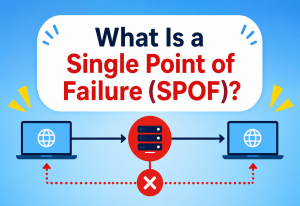
The instant that gap appears, any computer that receives a request has exactly two options: refuse to fully answer until it can confirm it has the latest information from the others (protecting consistency, at the cost of availability), or answer immediately using whatever information it currently has (protecting availability, at the cost of possibly being slightly outdated). There is no third, secret option that avoids choosing — the gap itself forces the decision.
Waiting Forever Isn’t Realistic Either
In theory, a system could just wait patiently until the network heals before answering anything. But real users are not patient, and many businesses cannot survive a system that goes silent every time there is a network hiccup. That practical reality is exactly why so many well-known systems quietly lean toward availability rather than perfect consistency, at least for certain kinds of requests.
Networks fail sometimes
Physical cables, hardware, and long distances make some connection loss unavoidable over time.
A choice is forced
The moment a connection breaks, waiting or answering becomes an unavoidable fork in the road.
Users won’t wait forever
A system that goes silent during every hiccup quickly loses the trust of the people using it.
Bigger systems, bigger risk
The more computers and locations involved, the more often some connection between them is likely to wobble.
It helps to remember that this trade-off only becomes forced during an actual network gap. The rest of the time, when everything is connected and healthy, a well-built system can usually offer both consistency and availability together without any real conflict. CAP is really a story about what happens in that one uncomfortable moment when the network briefly misbehaves — not a permanent, everyday punishment.
It is worth adding that these gaps happen far more often than most people outside of engineering ever realise. A single cloud data centre might experience a brief internal network hiccup many times a year without anyone outside ever noticing, simply because the systems involved were built with exactly this kind of trade-off already planned for. The goal was never to prevent every possible gap — that is simply not achievable — but to make sure the system behaves sensibly and predictably the moment one occurs.
The Three Letters, Explained Slowly
One letter at a time, with its own small story. Rushing through all three together is where most confusion starts.
Let’s take each of the three letters on its own, one at a time, with its own small story, since rushing through all three together is where most confusion starts.
Consistency — Everyone Sees the Same Truth
Picture a classroom whiteboard that every student can see from wherever they sit. The moment the teacher writes something new on it, every single student sees the exact same updated information instantly, with zero delay and zero disagreement. That is what perfect consistency feels like inside a computer system — no matter which computer you ask, you always get the newest, matching answer.
Availability — Someone Always Answers
Now imagine a very reliable friend who always answers your text message, no matter what, even if their reply is sometimes based on slightly old news because they haven’t checked their other messages yet. They never leave you on read — you always get a reply. That is availability: every request gets a response, even during a rough patch, even if that response might not reflect the very latest update.
Partition Tolerance — Staying Alive Through a Broken Connection
Picture two walkie-talkies that briefly lose signal while their owners walk through a tunnel. Partition tolerance means each owner can keep using their walkie-talkie normally the whole time, instead of it simply switching off the moment the signal drops. The system as a whole keeps functioning, even though its parts have temporarily lost touch with one another.
CAP vs. ACID vs. BASE
Three sets of letters that keep showing up in the same conversations. Here is a small map to keep them from tangling in your head.
These three sets of letters often appear in the same conversations, so here is a simple way to keep them apart.
| Idea | What It’s Really About | Simple Way to Remember It |
|---|---|---|
| CAP | What a distributed system can promise during a network break | “Pick 2 of 3 when things go wrong.” |
| ACID | Rules that keep a single database’s transactions safe and correct | “Every transaction is all-or-nothing and trustworthy.” |
| BASE | A looser style that favours availability, accepting brief inconsistency | “Answer now, tidy up the details soon after.” |
ACID is about keeping a single database’s individual transactions safe — like making sure a bank transfer either fully completes or doesn’t happen at all, never getting stuck halfway. CAP is a completely different, bigger question about what happens across many separate computers when they lose touch with each other. BASE is essentially a philosophy some engineers adopt as a direct response to CAP — deliberately leaning toward availability and accepting that things will become consistent again a little later, rather than instantly.
CP, AP, and CA Systems
Since a system can’t have all three qualities perfectly during a partition, engineers describe systems by which two they lean on most heavily.
Since a system can’t have all three CAP qualities perfectly during a network break, engineers describe systems by which two they lean on most heavily.
CP Systems — Consistency + Partition Tolerance
These systems refuse to answer with possibly wrong information. If they can’t confirm they have the latest data, they simply wait or return an error rather than guess. This fits situations where a wrong answer is far worse than a delayed one.
Strengths
- Data is always trustworthy when it does answer
- Great fit for money, medical records, ticket booking
- No confusing conflicting answers to sort out later
Trade-offs
- Can go temporarily silent during a network hiccup
- Users may see errors instead of answers
- Feels less “always on” than users might expect
AP Systems — Availability + Partition Tolerance
These systems always answer, even during a network break, accepting that the answer might be a moment behind the very latest update. This fits situations where showing something — even slightly old — beats showing nothing at all.
Strengths
- Always responsive, even during network trouble
- Great fit for social feeds, product listings, likes/views counts
- Feels smooth and “always on” to users
Trade-offs
- Different users may briefly see slightly different data
- Needs a plan to reconcile mismatches once reconnected
- Wrong for anything where accuracy is non-negotiable
CA Systems — Consistency + Availability
A system can only promise both consistency and availability if it never has to survive a network partition at all — usually because everything runs on one single machine, or one very tightly connected cluster in one place. The instant that system spreads across multiple locations connected by a network that can fail, this option quietly disappears, because true partition tolerance becomes unavoidable in the real world.
In practice, almost every large, real-world distributed system must be either CP or AP, because network partitions are simply a fact of life once a system spans more than one location. “CA” mostly exists as a theoretical corner case, not a realistic everyday choice.
It also helps to know that CP and AP are not strict, all-or-nothing labels stamped onto a system forever. Many modern databases actually let engineers tune this behaviour, sometimes even per individual request, leaning slightly more toward consistency for one type of read and slightly more toward availability for another. Thinking of CP and AP as two ends of a dial, rather than two separate boxes, is often a more accurate — and more useful — way to picture how real systems behave.
A Deep-Dive Example
One concrete moment, drawn out in detail: an online shop, two data centres, and eight seconds of network silence between them.
Let’s walk through one concrete moment in detail, because it shows exactly how this plays out. Imagine an online shop with its inventory system split across two data centres — one on the east coast, one on the west coast — so that customers everywhere get fast answers. Suddenly, for eight seconds, the network link between the two coasts drops.
Notice something important here: a real online shop rarely picks just one of these choices for its entire system. The actual payment step, where real money changes hands, very often behaves like a CP system, refusing to proceed unless everything can be confirmed. Meanwhile, something like the number of people currently viewing that same product might comfortably behave like an AP system, since showing a number that is a few seconds stale causes no real harm. Good architects don’t apply CAP as one blanket rule — they apply it thoughtfully, piece by piece, based on what each specific piece of data actually needs.
It is also worth noticing how short that eight-second gap really was, and how rarely most users would even notice it happening. This is part of why CAP trade-offs can feel invisible in everyday life, even though they are constantly at work behind the scenes. Most network partitions are brief — a few seconds here, a few seconds there — but at the massive scale of a busy website serving millions of requests a day, even a handful of short gaps adds up to real decisions being made constantly, every single day, all across the system.
How Architects Actually Choose
Not a coin flip. Five honest questions that turn CAP from a debate into a decision.
Deciding whether a piece of a system should lean CP or AP isn’t a coin flip — it follows a fairly clear line of honest questions.
Ask What a Wrong Answer Actually Costs
Would showing slightly outdated information cause real harm, or just a tiny, harmless inconvenience?
Ask What Silence Actually Costs
Would refusing to answer for a few seconds upset users badly, or would they barely notice?
Look at Each Piece of Data Separately
Money, medical, and legal data usually lean CP. Feeds, counters, and recommendations usually lean AP.
Plan for Reconciliation
For AP choices, decide in advance how mismatched data gets tidied up once the network heals.
Write the Decision Down
Record which choice was made for which data, and why, so future engineers understand the reasoning.
This is really the same skill seen throughout software architecture: naming the trade-off honestly, matching the choice to what actually matters for that specific situation, and writing down the reasoning so it isn’t forgotten. CAP simply gives that skill a very concrete, well-studied playground to practise in.
Going Further: The PACELC Idea
CAP describes what happens during a network partition. PACELC extends the story to all the ordinary time when everything is connected and running smoothly.
CAP describes what happens during a network partition — but what about all the normal time when everything is connected and healthy? A later, extended idea called PACELC fills in that missing piece, and it is worth knowing because it captures how real systems actually behave most of the time.
PACELC reads like this: if a Partition happens, choose between Availability and Consistency (that’s the original CAP part) — Else, even when there is no partition at all, still choose between Latency (how fast an answer comes back) and Consistency (how sure you are it’s the very latest answer). In other words, even on a perfectly healthy day with no network trouble whatsoever, a system still quietly trades a little bit of speed for a little bit of extra certainty, or the other way around, every single time it answers a request.
Partition happens
The network between parts of the system has broken.
Choose one
Answer anyway (Availability) or wait for certainty (Consistency).
No partition right now
Everything is connected and working normally.
Choose one
Answer fast (Latency) or double-check first (Consistency).
PACELC is a gentle reminder that trade-offs in distributed systems don’t disappear the instant the network is healthy again — they simply become quieter and less dramatic, hiding inside everyday decisions about how quickly to answer versus how thoroughly to double-check.
Common Misunderstandings
Five myths that keep resurfacing about CAP, and the honest one-line answer to each.
“You Must Sacrifice One Letter Forever”
A common myth is that choosing CP means giving up availability completely and permanently, or that choosing AP means giving up consistency completely and permanently. In reality, the trade-off only truly bites during an actual network partition. The rest of the time, a well-built system can behave very well on both fronts.
“Partition Tolerance Is Optional”
Some newcomers treat the “P” as something you can simply choose to skip, the same way you’d choose between C and A. In truth, any system spread across more than one machine connected by a real network must accept that a partition will eventually happen — it isn’t really a choice, it is closer to a fact of life the design must be ready for.
“One Choice Fits the Whole System”
As the shopping example showed earlier, a real system is rarely purely CP or purely AP everywhere. Thoughtful teams make this decision separately for different kinds of data, based on what each one actually needs, rather than picking one label for the entire application.
“CAP Means the System Is Badly Designed”
Running into the CAP trade-off is not a sign of a flawed system — it is a sign of an honest one. Every distributed system faces this exact same limit; the only real difference between systems is whether the team consciously chose their answer, or stumbled into it by accident without realising a choice was even being made.
“Bigger Companies Have Somehow Solved This”
It is tempting to assume that with enough money and enough brilliant engineers, a company could simply build its way past the CAP limit entirely. In reality, even the largest, best-funded systems in the world still make CP or AP choices constantly — they’ve just gotten very skilled at making those choices quietly, quickly, and in ways that rarely bother ordinary users. The limit itself hasn’t been broken by anyone; it has simply been managed exceptionally well.
Teams that confidently claim their system is “always fully consistent and always fully available, no matter what.” That claim usually means the team hasn’t yet been tested by a real network partition — not that they’ve somehow beaten a well-proven limit.
How the Choice Evolves Over Time
A CP or AP decision made on day one isn’t set in stone. As scale, users, and stakes grow, thoughtful teams revisit and rebalance.
A CP-or-AP decision that made sense for a small, single-country app can look completely different once that same app grows to serve people across many continents, where network partitions become more frequent simply because there is more distance and more equipment involved. Healthy teams don’t treat their original CAP choice as permanent — they revisit it as the system’s scale, users, and stakes change.
A feature that started as “just a nice-to-have” — like a simple counter of how many people liked a post — might comfortably stay AP forever, since the cost of being briefly wrong stays low no matter how big the app gets. But a feature that starts small and later starts handling real money or sensitive information often needs to be re-examined and shifted firmly toward CP, because the cost of being briefly wrong has grown along with the feature’s importance.
Think about two friends splitting up to shop for a class party, agreeing to text each other before buying anything expensive, but free to buy small snacks on their own without checking in first. That small, sensible rule works fine for a class of twenty. If that same “buddy system” suddenly had to coordinate shopping for an entire school of two thousand students, the old casual rule might need to become far stricter for the expensive items, even while staying casual for the small ones. Systems grow and their trade-off choices grow with them.
Writing down which choice was made, and why, becomes especially valuable here. A short note explaining “this piece of data is AP because being briefly wrong is harmless, and this piece is CP because it touches real money” turns an invisible design decision into something the whole team can revisit calmly and confidently, rather than rediscovering the hard way during an actual outage.
Key Takeaways
If you remember only these seven ideas from the whole guide, you’ll be able to hold a confident CAP conversation with almost anyone.
Remember This
- Three qualities, one honest limit. CAP stands for Consistency, Availability, and Partition tolerance — three qualities a distributed system wants, but cannot all guarantee perfectly during a network break.
- Only true during a partition. The trade-off only truly forces a choice during an actual network partition, not during normal, healthy operation.
- CP or AP in the real world. Since partitions are unavoidable in any system spread across multiple machines, real systems are almost always either CP (favouring accuracy) or AP (favouring uptime).
- Different from ACID and BASE. CAP is different from ACID (which protects a single database’s transactions) and BASE (a philosophy that leans into availability on purpose).
- Per-data, not per-system. Thoughtful teams apply CP or AP choices per type of data, not as one blanket rule for an entire system.
- PACELC completes the picture. PACELC extends the idea to everyday, healthy operation, where systems still quietly trade speed for certainty.
- Not a flaw, a fact. Hitting the CAP limit isn’t a design flaw — it is a universal fact every distributed system must consciously plan for.