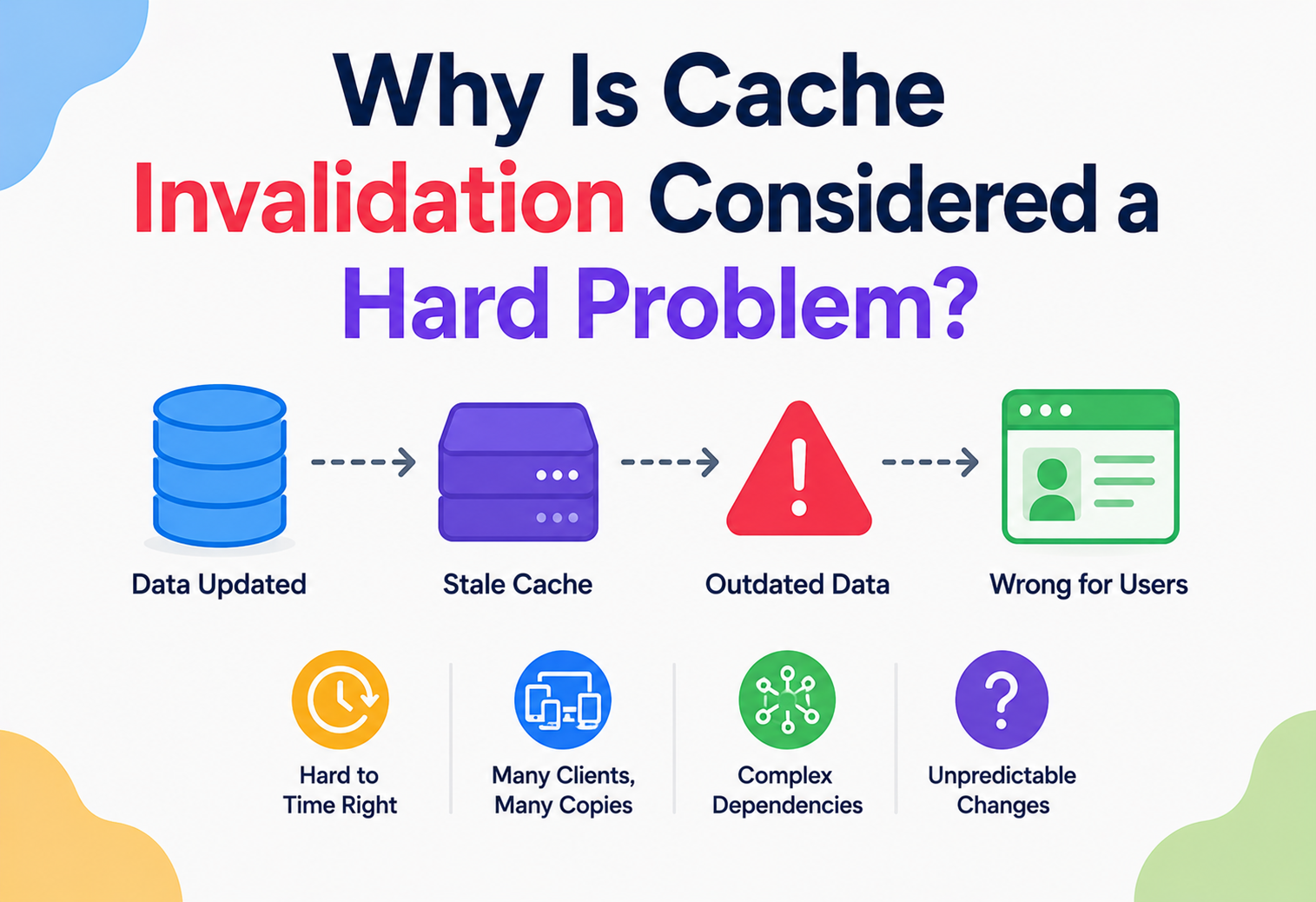
Why Is Cache Invalidation Considered a Hard Problem?
There is an old programmer’s joke that there are only two truly hard problems in computer science: naming things, and knowing when to throw away information that has gone stale. This complete guide is entirely about that second one — why deciding “this saved copy is no longer trustworthy” turns out to be one of the trickiest puzzles in all of software design.
The Big Idea, in One Breath
A whiteboard on the fridge is a perfect cache — fast, convenient, usually right. The moment nobody updates it after practice moves, you have just experienced cache invalidation failing in the wild.
Imagine your family keeps a whiteboard on the fridge listing everyone’s weekly schedule, so nobody has to keep calling each other to ask “what time is soccer practice again?” It is a wonderful shortcut — quick to glance at, saves a lot of phone calls, and usually right. But one day, practice gets moved to a different time, and somebody forgets to update the whiteboard. Now the whiteboard is technically still sitting there, still easy to read, still confident‑looking — and completely wrong.
That whiteboard is, in a very real sense, a cache — a saved copy of information kept nearby so nobody has to go fetch the real, original answer every single time. And the moment practice time changes without anyone updating the board, you have just experienced cache invalidation failing in the wild: the system did not know its saved copy had gone stale, and kept confidently handing out the wrong answer.
Computer systems face this exact whiteboard problem millions of times a second, at a scale that makes a family fridge look laughably simple. There is a well‑known saying among programmers that there are only two genuinely hard problems in computer science: naming things well, and knowing exactly when a cached copy of information has become untrustworthy and needs to be thrown out or refreshed. This guide is dedicated entirely to that second problem — why it is so much trickier than it first appears, and what engineers do about it.
Think of a restaurant menu printed on paper versus a chalkboard special written fresh each morning. The printed menu is fast and cheap to hand out to every table, but if the kitchen runs out of the fish special, every single printed menu is now quietly lying to customers until someone notices and does something about it. Caching is exactly this trade‑off: speed and convenience, purchased at the risk of occasionally being out of date.
What makes this topic worth a deep, careful look is not that the idea is complicated to explain — as you have just seen, it fits neatly into a whiteboard and a fridge. What makes it hard is that the idea is deceptively simple to describe, and remarkably difficult to get right in practice, at scale, across many different systems, all changing constantly, all at once. This guide walks through exactly why that gap between “easy to explain” and “hard to solve” exists, and what experienced engineers do to manage it.

A Quick Refresher on Caching
A cache is simply a saved, nearby copy of information that would otherwise take longer or more effort to fetch from its original source. The idea is simple; keeping the copies honest is where the trouble lives.
Before tackling why invalidation is so hard, it helps to be clear on what a cache actually is. A cache is simply a saved, nearby copy of information that would otherwise take longer or more effort to fetch from its original, “real” source. Instead of walking all the way to the library every time you want to check a fact, you jot the fact down on a sticky note on your desk — that sticky note is your cache.
Computers use caches constantly, at every layer imaginable: a web browser caches images so a page loads instantly the second time you visit; a phone app caches your recent messages so they appear the moment you open it, even before checking the internet; a huge website caches the results of a complicated calculation so it does not have to redo that same expensive work for the millionth visitor who asks the exact same question.
Caching, on its own, is a wonderfully simple idea, and it works brilliantly the vast majority of the time. The real trouble only shows up the moment the original information changes — because now there is a decision to make: does the saved copy get thrown away, refreshed, or left alone a little longer? That single decision, repeated correctly at massive scale, turns out to be astonishingly difficult to get right every single time.
It is worth noting that caching is not an all‑or‑nothing switch either. A system can cache aggressively in one place and barely at all in another, depending on how often that particular information changes and how much it matters if it is briefly wrong. This is one of the first judgement calls a thoughtful architect makes, long before the harder question of invalidation even enters the conversation — deciding, piece by piece, what is actually worth caching in the first place.
What “Invalidation” Actually Means
Cache invalidation is the process of recognising that a saved copy is no longer trustworthy, and doing something about it — usually by deleting it, marking it stale, or replacing it with a fresh copy.
Cache invalidation is the process of recognising that a saved copy of information is no longer trustworthy, and doing something about it — usually either deleting it, marking it as stale, or replacing it with a fresh copy. It is the crucial second half of caching that does not get nearly as much attention as the flashy speed benefits, even though it is often the harder half by far.
Most introductions to caching spend nearly all of their time on the exciting part: how much faster everything becomes once a cache is added. Invalidation is the quieter, less glamorous cousin, rarely mentioned in the same breath, even though it is the part that determines whether a caching system is trustworthy or quietly dangerous. A cache that is fast but wrong is arguably worse than no cache at all, because at least a system with no cache is consistently telling the truth, even if slowly.
Here is the uncomfortable truth at the heart of this entire topic: a cache, by its very nature, is a copy living somewhere separate from the original. The moment the original changes, there is no magical, automatic connection that instantly updates every single copy sitting out there. Someone, or something, has to notice the change and actively decide what to do about every affected cached copy — and doing that correctly, every time, turns out to be remarkably difficult.
A Short History: Where the Famous Joke Comes From
The line about the two hard problems in computer science has been repeated for decades. What has not changed is how true it stays as computer systems keep growing larger, faster, and more distributed.
The line about the “two hard problems in computer science” has been repeated so often over the years that its exact origin has become a little fuzzy, the way old jokes often do — passed from one engineer to another, each retelling it slightly differently. What is not fuzzy at all is how true it has remained, decade after decade, as computer systems have grown vastly larger and more complicated than whoever first said it could have imagined.
Caching itself is almost as old as computing. Even the earliest computers used small, fast pockets of memory to hold frequently needed information close to the processor, because fetching from slower storage every single time was painfully inefficient. As the internet grew, caching exploded far beyond a single machine’s memory — web browsers began caching images and pages, companies built entire networks of servers around the world dedicated purely to caching popular content closer to visitors, and large databases developed increasingly clever caching layers of their own.
With every new layer of caching added over the decades, the invalidation half of the problem grew right alongside it. More places holding copies of information naturally means more places that need to be told when that information changes. What started as a fairly contained challenge on a single machine gradually became a sprawling, distributed puzzle spanning browsers, servers, databases, and networks all over the world — which is exactly why the problem has not gotten any easier to joke about, even as the tools for solving it have improved dramatically.
It is a useful reminder that some of the hardest problems in engineering are not hard because nobody has thought about them carefully. Cache invalidation has been studied, discussed, and worked on by extremely capable engineers for decades, and countless clever tools and techniques now exist to help manage it. The problem persists not from a lack of effort, but because it is woven into the fundamental nature of keeping separate copies of information in sync across systems that are, by design, independent of one another.

Why We Cache in the First Place
Nobody can simply avoid caching altogether and sidestep the invalidation problem, because the speed and cost benefits are just too enormous to pass up.
It is worth pausing to appreciate just how tempting caching is, because that temptation is exactly what makes the invalidation problem so unavoidable — nobody can simply choose to avoid caching altogether and sidestep the whole issue, because the speed benefits are often too enormous to pass up.
Answers in a blink
Reading a saved copy is often thousands of times faster than recalculating or re‑fetching the original information.
Less work, less money
Every request answered from a cache is one less expensive calculation or database lookup a system has to perform.
A backup when things are slow
If the original source is temporarily overwhelmed, a cache can keep answering requests smoothly in the meantime.
Serving huge crowds
A popular piece of information can be served to millions of people from a cache, without hammering the original source millions of times.
Given all of that, it is easy to see why caching shows up absolutely everywhere in modern computing, from your web browser to the largest systems on the planet. But every one of those benefits comes bundled with the same quiet catch: a copy that is not automatically kept in sync with the original, and someone has to take responsibility for noticing when that copy needs to change.
This is really the central tension running through the entire topic: the very features that make caching so valuable — distance from the original, independence, speed — are the exact same features that make keeping it correctly synchronised so difficult. You cannot have the benefit of a nearby, fast copy without also accepting the risk that comes from it being separate from the source of truth. Understanding this trade‑off, rather than resenting it, is the first real step toward managing it well.
The Core of the Problem
Invalidation asks a system to answer a question that sounds simple but is secretly enormous: “has this changed, and does everyone who has a copy of it know yet?”
At its heart, cache invalidation is hard because it asks a system to answer a question that sounds simple but is secretly enormous: “has this changed, and does everyone who has a copy of it know yet?” Answering that question correctly requires a system to track not just the information itself, but every single place that information might currently be copied to, and to reliably notify every one of those places the instant something changes.
Notice how many separate things need to go right for that question to be answered correctly, every single time. The system needs to notice the change in the first place. It needs to know exactly which cached copies, out of potentially many, are affected by that particular change. It needs a reliable way to reach every one of them. And it needs all of this to happen fast enough that the window of possible wrongness stays small and manageable. Miss any one of these steps, even occasionally, and stale information slips through.
This is genuinely different from most other problems in software engineering. Writing code to save a copy of something is refreshingly simple — most programming languages can do it in a single line. But writing code that reliably knows, across every possible situation, exactly when that saved copy should no longer be trusted, touches on some of the deepest and thorniest challenges in all of computing: timing, communication between separate systems, and the impossibility of guaranteeing that a message always arrives exactly when it should.
It also helps to notice that this is not really one problem — it is a whole family of related problems wearing the same name. Knowing a change happened is one challenge. Knowing which cached copies are affected by that particular change is another. Reliably telling all of those copies is a third. And deciding what to do if that message never quite arrives is a fourth. Each of these sub‑problems is manageable on its own; it is the combination of all four, happening continuously, across a constantly changing system, that earns cache invalidation its fearsome reputation.
Reason One: There Are Almost Always Too Many Copies
In a small system there might be one cache to worry about. In a real, large‑scale system, the same piece of information can end up copied in surprisingly many places at once.
In a small, simple system, there might be just one cache to worry about. In a real, large‑scale system, the very same piece of information can end up copied in surprisingly many places at once — a browser cache on your device, a server cache close to you, a database cache further back, and sometimes several more layers besides. Each one of these was added by a different engineer, at a different time, for a perfectly good reason.
What makes this diagram slightly deceptive is that real systems are usually messier still. Some of these caching layers might themselves cache copies of each other, creating chains rather than a clean, simple fan‑out. A change might need to pass through two or three caching layers in sequence before it even reaches the layer closest to a visitor, adding extra delay and extra opportunities for something to go slightly wrong along the way.
Now imagine the original information changes just once. That single change potentially needs to reach every one of those five separate caches, each one built with different tools, running on different schedules, and sometimes owned by entirely different teams who do not even talk to each other regularly. Missing even one of them means some unlucky visitor, somewhere, sees outdated information — and there is often no easy way to know in advance which visitor that will be, or when.
This layering effect tends to grow worse, not better, as a system matures. Early on, a small app might have just one cache, added by one engineer, easy to reason about completely. As the system grows, more caching layers get added, each one solving a real, immediate performance problem at the time — but nobody ever quite goes back and draws the full picture of every single cache now sitting between a visitor and the original information. Years later, a seemingly simple question like “why is this user still seeing the old price?” can require tracing through five or six different caching layers just to find where the stale copy is hiding.
Reason Two: Timing Is Cruel
Even with just one cache to manage, timing alone creates a nasty puzzle. The window between the source changing and the cache catching up can be shrunk — but never fully closed.
Even with just one single cache to manage, timing alone creates a nasty puzzle. Between the moment the real information changes and the moment the cache gets updated, there is always some window — sometimes a fraction of a second, sometimes much longer — during which the cache is confidently handing out an answer that is no longer true.
This gap can never be reduced all the way to zero, no matter how fast the underlying hardware and network happen to be. Information about a change has to physically travel from wherever it happened to wherever the cache lives, and that travel always takes some non‑zero amount of time. Engineers can shrink this window dramatically, sometimes down to mere milliseconds, but they can never fully close it — which means the possibility of staleness is a permanent, unavoidable feature of caching, not a temporary limitation waiting to be engineered away.
Worse, computers rarely do things one at a time in a perfectly tidy order. Multiple changes can happen to the same piece of information in extremely quick succession, sometimes from different parts of a system at almost exactly the same instant. If an update to invalidate the cache arrives in a different order than the changes actually happened, the cache can end up holding onto an answer that is even older than the one it just replaced — a confusing, hard‑to‑reproduce bug that engineers refer to as a race condition.
Two updates racing to invalidate the same cached entry at nearly the same moment. Depending on which one “wins,” the cache can end up stuck showing the older of the two versions — technically invalidated, but wrong all the same.
Here is a concrete way to picture this: imagine an item’s price is quickly discounted, then a moment later quietly corrected back to its original price because of a pricing error. If the “discount” invalidation message happens to arrive at the cache slightly after the “correction” message, purely due to a small, random delay in how the two messages travelled, the cache ends up confidently showing the discounted price, even though it is now the wrong one. Nobody made a mistake in the code exactly — the mistake was a matter of split‑second timing, which is precisely the kind of bug that is brutally difficult to reproduce and fix, because it might only happen one time in ten thousand.

Reason Three: You Don’t Always Control Every Copy
Some caches live entirely outside a system’s control — in browsers, search engines, partner APIs. All you can do is send polite hints and trust them to be respected.
Here is a particularly frustrating wrinkle: some caches live entirely outside a system’s control. A web browser caches a page based on instructions a website gives it, but once that instruction is sent, the website has no direct way to reach into a stranger’s browser and force it to throw the old copy away. The website can only politely suggest how long the browser should trust its copy for, and then hope for the best.
This lack of direct control is not a rare edge case — it is actually the normal situation for a huge share of the caching that happens across the internet. Search engines cache copies of web pages to answer queries quickly. Other websites and apps cache content they have fetched from your service to display it faster to their own visitors. None of these caches answer to the original system directly; they each make their own decisions, on their own schedules, based only on the hints and suggestions they were given.
It is a bit like handing out flyers with today’s store hours printed on them. Once someone takes a flyer home, you cannot chase them down to update it if the hours change next week. All you can do is print “valid until” on the flyer in the first place, and trust people to eventually notice it is expired.
This limitation shapes a lot of real‑world design decisions in quiet, easy‑to‑miss ways. Teams often deliberately choose shorter expiry times for information they do not fully control the caching of, accepting a bit less speed benefit in exchange for a shorter possible window of staleness. It is a pragmatic compromise, born from accepting a hard truth: you can influence caches you do not own, but you can rarely command them outright.
This same challenge shows up between different companies and systems too. A large service might share information with a partner company, who caches it on their own servers, using their own rules, entirely outside the original service’s reach. When that information changes, there is often no reliable, instant way to tell every external system holding a copy — only indirect signals, like a shorter expiry time, or an occasional refresh request, neither of which guarantees the correction lands the moment it is needed.
A Gentle Word on “Consistency”
Consistency describes how tightly a system insists all of its copies must agree at any instant. Cache invalidation is not simply a bug — it is the visible evidence of a deliberate consistency trade‑off.
Engineers have a specific term for how tightly a system insists all of its copies must agree at any given instant: consistency. Understanding this idea helps explain why cache invalidation is not simply a bug to be squashed, but a genuine, ongoing trade‑off that every system has to consciously choose a position on.
A strongly consistent system insists that every copy, everywhere, must reflect a change before anyone is allowed to see it — which is extremely safe, but can slow a system down enormously, since it must pause and check that every copy agrees before responding to anyone. An eventually consistent system, by contrast, accepts that there might be a short window where different copies briefly disagree, in exchange for staying fast and responsive the rest of the time. It promises the disagreement will resolve itself soon — “eventually” — rather than promising it will never happen at all.
Most large, everyday systems — social media feeds, product listings, search results — deliberately choose eventual consistency, because a visitor briefly seeing a half‑second‑old version of something is a far smaller problem than the entire system slowing to a crawl trying to guarantee perfect, instant agreement everywhere. Cache invalidation, viewed through this lens, is not a design flaw — it is the visible, everyday evidence of a system that has consciously chosen speed over perfect, constant agreement, and is now managing the small, temporary gaps that choice creates.
This is also why experienced architects tend to get a little uneasy when someone promises a caching system with “zero staleness, ever.” That promise usually means either the system is not really being tested under real, messy, high‑traffic conditions yet, or the team has quietly paid for that promise with a much slower, more expensive system than most situations actually require. A more honest, more useful goal is usually “staleness kept small enough, and consequences kept low enough, that nobody is meaningfully harmed by it” — a target that is realistic, achievable, and still demanding enough to take seriously.
Reason Four: Getting It Wrong Can Genuinely Hurt
A cache invalidation mistake is not always harmless. Depending on what is being cached, a stale copy can cost real money, break trust, or open up a genuine security gap.
If a cache invalidation mistake simply meant a slightly outdated cat picture loaded on a webpage, nobody would call this a “hard problem” worth writing about. The reason it is taken so seriously is that stale, incorrect cached information can cause real, sometimes serious damage, depending on what is being cached.
It is worth being specific about why this matters so much to how engineers approach the problem. A bug that is merely embarrassing gets fixed calmly, on a normal schedule. A bug that costs real money, breaks trust, or creates a security gap gets treated very differently — with more careful review, more layers of protection, and often a much more conservative caching strategy than would otherwise be used. The stakes attached to a particular piece of information should always shape how much effort goes into keeping its cached copies trustworthy.
Selling something that’s sold out
A stale product‑availability cache can let a customer “buy” an item that was actually sold minutes earlier, creating an order nobody can fulfil.
Showing the wrong balance
A stale account balance shown to a customer, even briefly, can lead to real confusion, complaints, or incorrect decisions being made.
Letting the wrong person in
A cached “you’re allowed to access this” answer that is not updated after access is revoked can create a genuine security problem.
Old information during a crisis
Showing outdated emergency information during a genuinely urgent, fast‑changing situation can have very real consequences.
This is exactly why engineers cannot simply shrug off invalidation mistakes as a minor inconvenience. Every decision about how aggressively to cache something, and how quickly to invalidate it, is really a careful balancing act between speed and correctness — and the right balance depends enormously on how much it would actually cost to be wrong, even briefly.
A useful habit many experienced architects follow is grading information by how expensive staleness would actually be, then matching the caching strategy to that grade. A blog post’s view count being briefly out of date costs almost nothing. A hospital’s record of which medication a patient has already been given being briefly out of date could cost a great deal. Treating every piece of cached information with the same level of caution wastes effort on the low‑stakes cases; treating every piece of cached information casually risks real harm on the high‑stakes ones. The skill lies in telling the two apart early and deliberately.
This grading exercise is worth doing explicitly, in writing, rather than leaving it to individual engineers’ instincts on a case‑by‑case basis. A short, shared list of “what we cache aggressively” versus “what we treat with extra caution” gives an entire team a consistent, predictable standard to build against, rather than each new feature quietly reinventing its own answer to a question that deserves careful, considered thought.

Common Invalidation Strategies
Engineers have developed several invalidation strategies over the years, each with its own honest trade‑offs. None is perfect, which is part of why the problem stays hard.
Given how tricky this problem is, engineers have developed several different strategies over the years, each with its own strengths and its own honest trade‑offs. None of them is perfect, which is itself part of why this remains such a hard problem. Understanding the main options helps explain why real systems so often combine more than one.
It helps to think of these strategies less as competing answers, where one is simply “correct” and the rest are mistakes, and more as different tools suited to different jobs. A carpenter does not use the same tool for every task, and an architect designing a large system does not reach for the same invalidation strategy for every piece of cached information either. The following overview walks through the most common options, roughly in order from simplest to most involved.
Time‑Based Expiry (TTL)
The simplest approach is to give every cached copy an expiry timer, often called a time to live, or TTL. Once that timer runs out, the cache automatically treats the information as stale and fetches a fresh copy next time it is needed. It is wonderfully simple, but it forces a guessing game — set the timer too long, and stale information lingers; set it too short, and you lose much of the speed benefit caching was supposed to provide in the first place.
Strengths
- Simple to understand and implement
- Does not require the original source to actively notify anyone
- Naturally self‑heals over time
Trade‑offs
- Always allows some window of staleness
- Picking the right expiry time is genuinely difficult
- Wastes effort refreshing things that have not actually changed
Write‑Through Caching
In this approach, every time the original information changes, the cache is updated immediately, right alongside the real source, as part of the very same operation. This keeps the cache reliably fresh, at the cost of making every single update slightly slower, since two things now need to happen instead of one.
Write‑Behind (or Write‑Back) Caching
This approach flips write‑through around: changes are made to the cache first, and the original source is updated a little afterward, in the background. It keeps everyday updates feeling fast, since the visitor does not have to wait for the slower original source to be updated before getting a response. The trade‑off is a brief window where the cache is actually ahead of the original source, which introduces its own small risk if something goes wrong before that background update finishes.
Cache‑Aside (Lazy Loading)
Here, the cache starts out empty for a given piece of information. The first time it is requested, the system fetches it from the original source, stores a copy, and hands it back. Every request after that is served from the cache until it is invalidated or expires. This is one of the most widely used patterns in practice, largely because it only stores what is actually being asked for, rather than pre‑loading everything just in case.
Event‑Based Invalidation
Here, the original source actively announces “something changed!” the moment it happens, and every cache listening for that announcement immediately throws away or refreshes its copy. This can be very fast and accurate, but it depends entirely on every single cache reliably hearing the announcement — and, as covered earlier, messages between separate systems do not always arrive perfectly, on time, or in the right order.
Manual or “Purge on Demand” Invalidation
Sometimes a human — often an engineer responding to a reported problem — manually tells a specific cache to clear itself out. This is a useful last resort, but it obviously does not scale well as the only strategy, since it depends on a person noticing something is wrong in the first place.
| Strategy | Best For | Main Risk |
|---|---|---|
| Time‑Based (TTL) | Information that changes fairly predictably | Stale data during the “still valid” window |
| Write‑Through | Information that must always be fresh | Slower writes, more coordination needed |
| Write‑Behind | Fast, frequent updates where a small delay is acceptable | A brief window where cache and source can disagree |
| Cache‑Aside | Information requested unpredictably or rarely | The very first request is always slower |
| Event‑Based | Fast‑changing, important information | Missed or delayed notifications |
| Manual Purge | Rare emergencies and one‑off fixes | Relies entirely on a human noticing the problem |
Most large, real‑world systems do not rely on just one of these strategies alone — they blend several together, using time‑based expiry as a safety net underneath a more active, event‑based approach, so that even if a notification is somehow missed, the cache will eventually correct itself once its timer runs out.
Choosing between these strategies is rarely a purely technical decision made in isolation — it is usually a conversation involving how the information is used, how often it changes, and what a team can realistically build and maintain given their time and tools. A small team might reasonably choose the simplicity of time‑based expiry everywhere, accepting a bit more staleness in exchange for far less engineering effort, while a larger team with more resources might invest in a more precise, event‑based approach for their most critical information.
When It Goes Wrong in Real Life
Cache invalidation mistakes are so common that experienced engineers treat “check the cache” as one of the very first things to investigate when a large system starts behaving strangely for no obvious reason.
Cache invalidation mistakes are so common, and so notoriously tricky, that experienced engineers often treat “check the cache” as one of the very first things to investigate when something in a large system starts behaving strangely for no obvious reason.
An old price sticks around
A store updates a product’s price, but a caching layer somewhere keeps showing the old price to some customers for a while afterward.
Deleted content reappears
Someone deletes a post or comment, but a cached copy elsewhere on the platform keeps showing it to certain visitors as if it still exists.
Access that won’t update
A user’s permissions are changed, but a cached version of their old permissions keeps being used until it finally expires.
Two systems disagree
One part of a system shows updated information while another part, relying on a different cache, still shows the old version at the same time.
Notice the pattern running through every single one of these: nothing was fundamentally broken. The original information was correct, the update genuinely happened — the only failure was that some cached copy, somewhere, did not get the message in time. This is precisely why cache invalidation earns its reputation as a “hard problem” rather than simply a bug to be fixed once and forgotten: it is a whole category of subtle, recurring challenges rather than a single mistake with a single permanent fix.

A Closer Look: A Busy Online Store
Picture a popular online store during a big sale, where a particular jacket has exactly one item left in stock. Two shoppers, on opposite sides of the world, both add it to their cart within the same second. Behind the scenes, one of them successfully completes their purchase, and the stock count drops to zero. But the “sold out” update takes a brief moment to ripple through every caching layer — the database cache, the app server cache, the content delivery network — and during that brief moment, the second shopper’s screen still cheerfully shows “in stock,” letting them complete a purchase for an item that no longer exists. The store now has an angry customer, a refund to process, and a customer service ticket, all traceable back to a handful of milliseconds where a cached copy had not yet caught up with reality.
What makes this example so instructive is how ordinary it is. No unusual traffic spike, no rare error, no obviously broken code — just two shoppers, one product, and a few milliseconds of unavoidable delay between a real‑world event and every cached copy of it catching up. Multiply this same basic pattern across the millions of tiny changes happening inside a large system every day, and it becomes clear why engineers treat cache invalidation with so much respect, rather than as a solved, forgettable detail.
Signs Your Caching Strategy Has a Problem
A handful of warning signs tend to appear together when a system’s caching and invalidation strategy needs attention. Recognising them early saves a great deal of confusing debugging later.
A handful of warning signs tend to appear together when a system’s caching and invalidation strategy needs attention, and recognising them early saves a great deal of confusing debugging later.
- Support tickets mention “it looked different when I refreshed”, a classic sign that different requests are hitting different, out‑of‑sync cached copies, since a genuinely consistent system would show the same answer every time.
- A fix “works sometimes” when a team updates something and reports mixed success — some testers see it, some do not, depending on which cache they happened to hit, which is a strong clue that invalidation is not reaching every layer reliably.
- Engineers routinely tell customers to “try clearing your cache” as a first troubleshooting step, quietly acknowledging that invalidation is not fully trusted and that the burden of fixing it has shifted onto the customer.
- Nobody can confidently draw a diagram of every cache in the system, suggesting caching layers have grown organically without anyone tracking the full picture, which makes it nearly impossible to reason about invalidation with any real confidence.
None of these signs mean a system is poorly built — many perfectly successful, large‑scale systems show a few of them at various points. What matters is treating these signs as useful, actionable information rather than background noise to be tolerated indefinitely.
A healthy habit many teams adopt is a regular, calm review of their caching setup — not waiting for a crisis to force the conversation, but periodically asking “does every cache in our system still make sense, and do we still trust that it is being invalidated correctly?” Systems that build this kind of review into their normal routine tend to catch small problems while they are still small, rather than discovering them all at once during a stressful, high‑visibility incident.
Best Practices for Taming the Problem
A handful of grounded habits tend to separate teams that manage invalidation well from teams that fight it constantly. None are exotic; all are worth adopting deliberately.
- Cache less than you are tempted to. Every additional cache is one more place that can go stale — only cache information where the speed benefit clearly outweighs the risk.
- Set expiry times deliberately, not by default. Think honestly about how quickly this particular piece of information tends to change, rather than copying a generic setting from elsewhere.
- Prefer a small number of caching layers over many. Fewer copies means fewer places that need to be told about every single change.
- Make invalidation visible and testable. Build in ways to check whether a cache actually cleared correctly, rather than just hoping it did.
- Have a manual “emergency purge” option ready. Even the best automated strategy occasionally needs a human safety net for the rare, serious mistake.
- Accept a small amount of staleness where the stakes are genuinely low. Chasing perfect freshness everywhere often is not worth the added complexity it demands.
- Log invalidation events, not just the changes themselves. Being able to see exactly when a cache was told to update — and confirm it actually did — turns a mysterious bug into a quick, traceable check.
Ask honestly: “what is the worst thing that happens if this cached information is wrong for the next thirty seconds?” The answer to that single question should heavily shape how aggressively a team invests in solving invalidation for that particular piece of data.
It is worth adding one more habit to this list, easy to overlook but genuinely valuable: document every cache as it is added, including what it stores, how long it is trusted for, and how it gets invalidated. Future engineers — sometimes the very same engineer, eighteen months later — will thank whoever took the time to write this down, because tracing an invalidation bug through an undocumented caching layer is one of the more frustrating ways to spend an afternoon.
Common Myths Worth Clearing Up
A handful of misunderstandings about caching and invalidation come up again and again, even among engineers who work with these systems every day.
Myth: A shorter expiry time always fixes staleness problems
Not entirely true. A shorter expiry time shrinks the window of possible staleness, but it does not eliminate the underlying timing and coordination challenges — and setting it too short can quietly undo most of the performance benefit the cache was added for in the first place.
Myth: Cache invalidation is just a technical detail, not a design decision
Not true. As this guide has shown, how a system handles invalidation directly affects real users, real money, and sometimes real safety. It deserves the same careful, upfront thought as any other major architectural choice.
Myth: Once you pick a strategy, the problem is solved for good
Not true, unfortunately. Systems grow, new caching layers get added over time, and traffic patterns shift. A strategy that worked well at a smaller scale often needs to be revisited as a system grows larger and more complex.
Myth: Bigger, more expensive systems do not have this problem
Not true — if anything, larger systems tend to have more caching layers, which means more places that need to stay in sync, not fewer. Scale does not remove this challenge; it multiplies it.
Myth: If a system uses eventual consistency, it does not really care about correctness
Not true, and this one is worth taking seriously. Choosing eventual consistency is not carelessness — it is a deliberate, well‑reasoned trade‑off, made after weighing speed against a brief, bounded, carefully managed window of possible disagreement. Plenty of extremely careful, well‑engineered systems choose eventual consistency precisely because they have thought hard about correctness and decided that a small, temporary gap is an acceptable price for staying fast and available.
Questions People Often Ask
A few questions about cache invalidation come up again and again, in conversations ranging from casual curiosity to serious architecture reviews. Here are short, honest answers to the ones that surface most often.
Is cache invalidation really one of the hardest problems in computer science?
It is often said half‑jokingly, but the underlying point is genuinely serious. Compared to many other programming challenges, invalidation touches on timing, communication between separate systems, and human judgement about acceptable risk — a combination that resists simple, universal solutions.
Can’t we just avoid caching altogether to sidestep the problem?
Technically yes, but the cost is usually far too high. Without caching, large systems would be dramatically slower and far more expensive to run, since every single request would need to fetch or recalculate everything from scratch, every single time.
Why not just make every cache expire almost instantly?
Because that would remove almost all of the speed benefit that made caching worthwhile in the first place. The whole point of a cache is to avoid repeating expensive work — expiring it too quickly means doing that expensive work almost every time anyway.
Is there a perfect solution that avoids all staleness?
Not in any general sense. There will always be some gap, however small, between a change happening and every cached copy learning about it, simply because information takes time to travel between separate systems. The goal is shrinking that gap and managing the consequences, not eliminating it entirely.
Do bigger companies have this problem solved better than smaller ones?
Larger companies typically have more sophisticated tools and more experienced teams handling this challenge, but they also usually have far more caches, spread across far more systems, which brings its own extra complexity. It is less that the problem gets “solved” at scale and more that it gets carefully, continuously managed.
Why is it called “invalidation” instead of just “deleting”?
Because the response to a stale copy is not always deletion. Sometimes it is simply marking the copy as “don’t trust this anymore, go fetch a fresh version” without physically removing it yet, especially if there is value in still having something to show while a fresh copy is being fetched.
Is there any way to test cache invalidation before it causes a real problem?
Yes — many teams deliberately simulate changes in a safe testing environment and check whether every expected cache correctly updates afterward. Building this kind of check into regular testing routines catches gaps long before they affect real users.
Does every single piece of software need to worry about this?
Not equally. A small personal project with barely any caching, or information that almost never changes, can afford to think about this far less carefully. The more a system grows, the more it caches, and the more that cached information changes, the more seriously this problem deserves to be taken.
Words Worth Knowing
A short glossary gathering the key terms from this guide, worth a quick glance any time one of these words comes up again in a conversation about caching, staleness, and the honest trade‑offs between them.
A saved, nearby copy
Information kept close at hand so it does not need to be recalculated or re‑fetched from its original source every time.
Marking a copy untrustworthy
The process of recognising a cached copy is out of date and removing, refreshing, or flagging it accordingly.
Time to live
A timer attached to a cached copy, after which it is automatically treated as expired and refreshed.
An outdated copy
Cached information that no longer matches the current, real version of the original source.
A timing tangle
A bug caused by two things happening in an unexpected order, especially common when multiple updates arrive close together.
Update together
A caching approach where the cache is updated at the exact same moment as the original source.
Agreement, given a little time
A design choice where copies of information are allowed to briefly disagree, with the promise they will match again soon.
Where the real answer lives
The original, authoritative place information comes from, which every cached copy is ultimately trying to reflect.
A Day in the Life of One Small Change
To bring everything together, it helps to follow a single, ordinary update all the way through a system, watching cache invalidation do its quiet, essential work.
A price gets updated
An employee corrects a pricing mistake in the store’s main database — the “real” source of truth changes in an instant.
An invalidation message goes out
The system announces “this product changed,” and every cache subscribed to that announcement starts listening for it.
The nearby caches update quickly
The application server’s cache and a fast internal cache both receive the message within milliseconds and refresh their copies.
A distant cache takes a little longer
A caching server on the other side of the world, busy with its own traffic, takes a few extra seconds to process the same message.
A safety net catches anything missed
Even if one caching layer somehow never receives the message, its own expiry timer eventually forces a fresh copy anyway, closing the gap for good.
Within a matter of seconds — sometimes less — every cache in the system agrees again, and the brief window of possible staleness closes. Multiply this single ordinary update by the thousands of changes happening across a large system every minute, and it becomes clear why cache invalidation is not a rare, occasional challenge — it is a constant, ongoing balancing act, quietly running in the background of nearly everything a large system does.
What makes this whole process worth admiring, rather than just tolerating, is how invisible it is when it works well. Nobody thanks a caching system for correctly updating a price in under a second — they simply see the right price and move on with their day. It is only when one small piece of this quiet, constant choreography slips, even briefly, that anyone notices at all, which is exactly why getting it right, consistently, is considered such a genuine mark of careful, thoughtful system design.
Key Takeaways
We began with a whiteboard on a fridge and a printed restaurant menu, and ended up walking through race conditions, consistency models, and safety nets built from expiry timers. One honest truth sits underneath all of it.
We began with a whiteboard on a fridge and a printed restaurant menu, and ended up walking through race conditions, consistency models, and safety nets built from expiry timers. Underneath all of it sits one simple, honest truth: any time information is copied somewhere, that copy needs a plan for staying trustworthy, and building that plan well is genuinely, famously difficult — not because the idea is complicated, but because getting it right, every time, across every system, timing window, and edge case, asks a great deal of any engineering team. The next time an app shows you exactly the right information, instantly, even during its busiest moment, spare a small thought for the quiet, constant work happening behind the scenes to make sure that fast answer was also the correct one.
Remember This
- A cache is simply a saved, nearby copy of information, kept to avoid repeating expensive or slow work.
- Cache invalidation is the process of recognising when that saved copy is no longer trustworthy and doing something about it — deleting, refreshing, or flagging it.
- The same piece of information often ends up copied across many separate caches, each of which needs to hear about every change.
- Timing, message delivery, and situations outside a system’s direct control all make perfectly reliable invalidation genuinely difficult.
- Getting invalidation wrong can have real consequences, which is why teams treat it as a serious design decision, not an afterthought.
- No single strategy solves the problem completely — most real systems blend several approaches and accept a small, managed amount of risk.