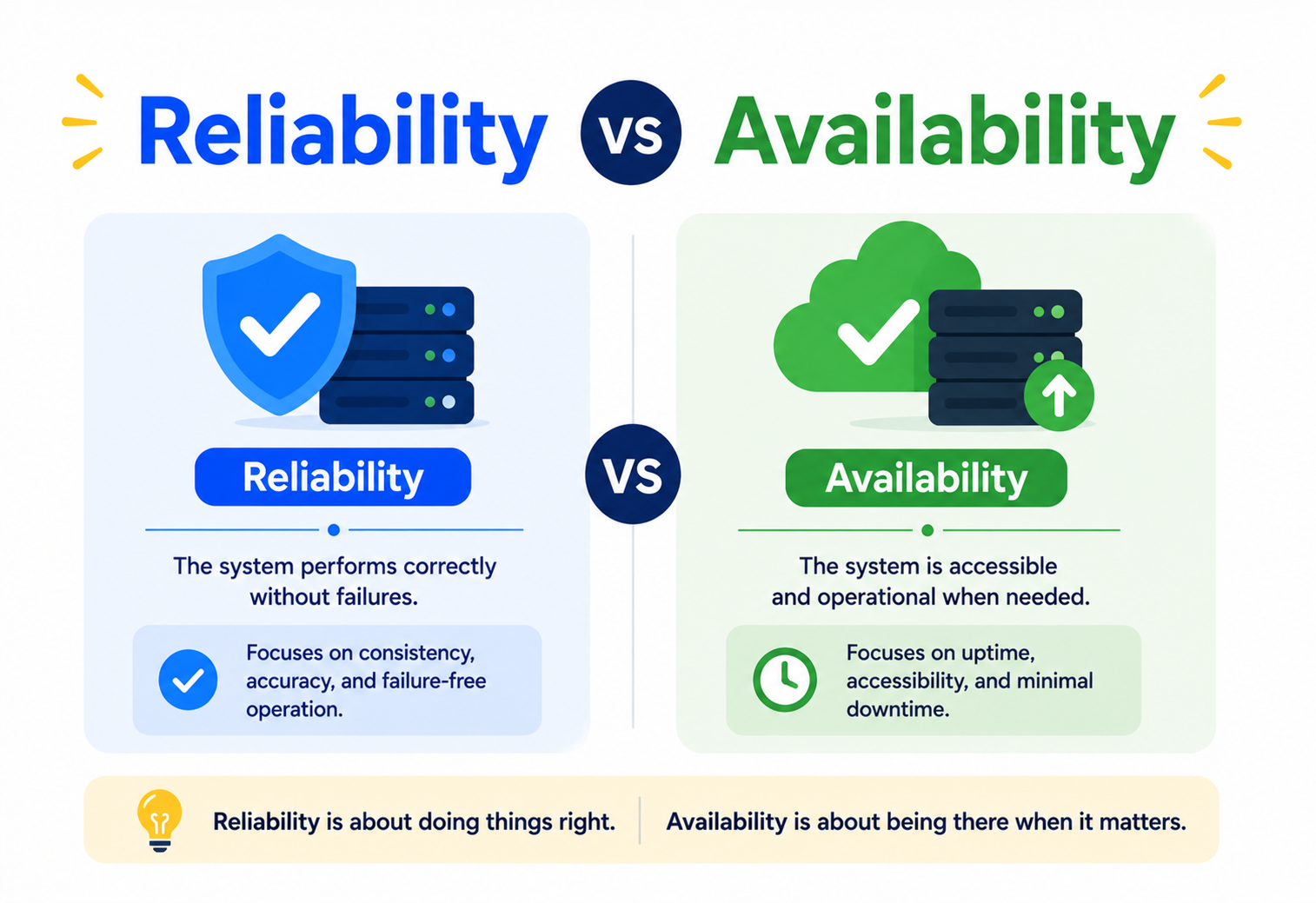
Reliability vs Availability?
“Is it up?” and “can I trust it?” sound like the same question. They aren’t. Mixing them up is one of the most common — and most costly — misunderstandings in all of software engineering. Let’s finally untangle them for good.
The Big Idea, in One Breath
Availability is about presence — is the system there? Reliability is about trust — is what it just said actually correct? Both are needed; neither one implies the other.
Imagine two different weather forecasters. The first one is on air every single morning without fail, rain or shine, sharp at 7 a.m. — but their forecasts are wrong about half the time. The second forecaster is almost always accurate when they do speak, but they only manage to show up on air about three days out of five. Which one is more useful to you? It depends entirely on what you need — and that’s exactly the tension at the heart of reliability versus availability.
The first forecaster is highly available — always there, always reachable — but not very reliable, because you can’t trust what they say. The second forecaster is highly reliable when they show up, but not very available, because you can’t count on them being there at all. A truly great forecaster, the one you’d actually want, needs to be both: present every morning, and correct when they speak.
Think of two classmates you might ask for help with homework. One always answers your message within a minute, but sometimes gives you the wrong answer. The other takes a day to reply, but when they finally do, the answer is always spot on. Neither one is the “complete package” on their own — and the classmate you’d trust most with something important is the one who’s both quick to respond and consistently correct.
This guide exists because so many engineering conversations quietly assume these two words mean the same thing, right up until a system that “never goes down” still manages to lose someone’s order, or double-charge their card, and nobody can quite explain how the dashboards stayed green the whole time. Once you can see the difference clearly, that kind of confusing situation stops being a mystery — it becomes a predictable, explainable pattern, and one you can design around deliberately.

Two Different Questions
Before comparing them, it helps to define each one cleanly, on its own terms, without borrowing language from the other.
Is it there right now?
The percentage of time a system is up and responding, out of all the time it was expected to be reachable. It says nothing about whether the response is correct.
Is it right, consistently?
The probability that a system performs its intended function correctly, over a stated period of time. It says nothing about how quickly, or how often, it responds.
Notice the shape of these two definitions carefully — they’re measuring genuinely different things. Availability is a question about presence: is the door open? Reliability is a question about trustworthiness: when you walk through that open door, do you get what you actually came for? A system can answer “yes” to one of these questions and “no” to the other, and understanding exactly how that happens is the whole point of this guide.
Availability is about whether the lights are on. Reliability is about whether anybody’s actually telling the truth once you get inside.
It also helps to notice what each definition deliberately leaves out. Availability’s definition says nothing about correctness — a system could be up and returning complete nonsense, and by the strict definition of availability alone, it would still count as “available,” simply because it responded. Reliability’s definition, in turn, says nothing about speed or reachability — a system that takes an unusually long time to respond, or that’s only reachable during a narrow window each day, can still be perfectly reliable, as long as whatever it eventually produces is correct. Neither definition was ever meant to describe the whole picture on its own; each one was built to isolate a single, specific concern.
Why People Mix Them Up
The confusion between these two terms isn’t really anyone’s fault — it comes from a very natural, very common assumption: that a system responding at all must mean it’s working correctly. Most of the time, in ordinary daily life, that assumption is close enough to true that nobody thinks twice about it.
Both use similar words
“Uptime,” “downtime,” and “outage” get casually applied to both ideas, blurring a distinction that’s actually quite sharp underneath.
The same event can hurt both
A server crash can simultaneously make a system unavailable and cause it to lose or corrupt data — one event, two separate consequences.
Monitoring often only shows one side
Many teams only track “is it up,” leaving reliability — whether responses are actually correct — completely unmeasured and invisible.
We conflate presence with trust
Just like assuming a shop that’s open must also be honest, it’s natural — but incorrect — to assume a system that’s responding must also be right.
This confusion has real consequences. A team that only watches availability dashboards can celebrate “99.95% uptime this month” while quietly missing that a meaningful chunk of those responses were actually wrong — duplicate charges, incorrect balances, or corrupted records — because nothing about an incorrect-but-fast response ever tripped an availability alert in the first place.
There’s also a simpler, more human reason the confusion persists: availability is easy to feel, while reliability often isn’t, at least not immediately. If a website won’t load, you know it instantly — there’s a visible error, a spinning icon, an obvious signal something is wrong. If a website loads perfectly but quietly shows you last week’s price instead of today’s, there’s usually no visible signal at all. Your brain has no natural alarm bell for “this looks fine but is secretly wrong,” which is exactly why reliability problems tend to go unnoticed for far longer than availability problems, both by users and, frequently, by the very engineers building the system.

The Four-Quadrant Model
The clearest way to see the difference is to imagine both qualities as two separate dials, each one independently turned up or down. That gives four distinct combinations, and every real system sits somewhere inside one of them.
Seeing all four boxes side by side makes something important obvious: neither quality, on its own, guarantees a good system. The “Fast but Wrong” box can be genuinely dangerous, because a system that’s always responding creates the illusion of trustworthiness while quietly getting things wrong underneath. The “Slow but Trustworthy” box is frustrating but honest — at least when it does respond, you know you can believe it. The bottom-left box is the one every architect works hardest to avoid, and the top-right box is the one every serious system aims for.
It’s worth pointing out that a system rarely stays fixed in one box forever. A service might start in the “Sweet Spot,” gradually accumulate small, unnoticed reliability bugs as new features get bolted on, and slowly drift toward “Fast but Wrong” without anyone ever making a single deliberate decision to let that happen. This is exactly why revisiting both numbers regularly matters more than checking them once and assuming the system will simply stay wherever it started.
Comparing the Formulas
Putting the two side by side in their mathematical form makes the difference even sharper, because they’re not just conceptually different — they’re calculated from entirely different kinds of evidence.
| Quality | Formula | What It’s Built From |
|---|---|---|
| Availability | Uptime ÷ (Uptime + Downtime) | Time — how many minutes the system was reachable versus unreachable. |
| Reliability | Correct Outcomes ÷ Total Outcomes | Correctness — how many results, out of everything the system produced, were actually right. |
Availability’s formula only ever needs a clock — it counts minutes of “up” against minutes of “down,” and nothing more. Reliability’s formula needs something far more demanding: a way to actually judge whether each individual result was correct, which usually means comparing outputs against known-good answers, running independent checks, or tracking whether a promised action — like a payment — genuinely completed the way it was supposed to. This is precisely why availability tends to get measured first, in almost every organisation — it’s simply easier to count — while reliability, though arguably more important, often gets measured later, or not as thoroughly.
If your monitoring can answer “was it up?” but not “was it right?”, you’re only measuring half of what actually matters to the people using your system.
There’s a deeper reason this asymmetry matters: it shapes what gets built first. Because a clock-based measurement is so much simpler to set up than a correctness-based one, many teams end up with mature, detailed availability monitoring years before they ever build equivalent reliability monitoring — not because reliability matters less, but because it’s genuinely harder to instrument. Recognising this gap is often the first step toward closing it, since a team that knows its reliability measurement is thin can prioritise building it out, rather than mistakenly assuming that a healthy-looking uptime graph already tells the whole story.
A Worked Example: Calculating Both Together
Numbers make this far less abstract. Imagine a small online bookstore’s checkout system over the course of one particularly busy month, with 100,000 checkout attempts in total.
| Event | Count | Affects |
|---|---|---|
| Checkout attempts | 100,000 | — |
| Attempts that failed to load at all (server down) | 150 | Availability |
| Attempts that loaded, but charged the wrong amount | 80 | Reliability |
| Attempts that loaded, but silently lost the order | 40 | Reliability |
Working through the availability side first: 150 out of 100,000 attempts never even reached the system, giving an availability figure of 99.85%. On its own, that number looks genuinely respectable — close to “three nines,” a target plenty of businesses would be happy with.
Now working through reliability: of the 99,850 checkouts that did successfully load, 120 of them (80 wrong charges plus 40 lost orders) produced an incorrect outcome. That works out to a reliability figure of roughly 99.88% — a number that, interestingly, looks almost identical to the availability figure, yet describes a completely different set of 120 real customers who were actually charged incorrectly or lost their order entirely, despite the system technically “working” the whole time from an uptime perspective.
Two numbers that look almost identical on a dashboard can represent two entirely different groups of affected customers, with entirely different root causes and entirely different fixes required.
This is exactly why a single blended “system health” score is so risky. If the bookstore’s team only tracked one combined number, they might never realise that 120 real people were affected by a data-correctness bug that has nothing to do with server capacity — a problem that no amount of adding extra servers would ever fix, because the servers were never the issue in the first place.

Can You Have One Without the Other?
Yes — and seeing exactly how helps cement the difference permanently. Let’s walk through both directions.
High Availability, Low Reliability
Picture a search engine that always loads instantly, every single time, but occasionally returns results for the wrong search term due to a caching bug — showing yesterday’s results for today’s query. The service is technically “up” 100% of the time. But a meaningful share of what it returns is quietly, invisibly wrong. Availability numbers look perfect. Reliability is actually poor.
Low Availability, High Reliability
Now picture a nightly batch system that processes financial transactions once every 24 hours, and is otherwise completely offline the rest of the day. By the strict definition of availability, it’s “down” for the vast majority of its life. But every single calculation it produces, on the one occasion each day it does run, is scrupulously correct. Availability numbers look poor. Reliability is excellent.
These aren’t just hypothetical thought experiments — variations of both patterns show up constantly in real production systems, which is exactly why treating “uptime” as a stand-in for overall system health is such a risky habit.
It’s worth stretching this a step further with a slightly less obvious case: a system that’s both low in availability and low in reliability at the same time. Picture an aging internal tool that crashes several times a week and, even during the stretches it’s technically running, frequently produces inconsistent results because nobody has maintained it properly in years. This “double negative” combination is more common than teams like to admit, especially in older, neglected systems — and it’s usually a strong sign that a genuine rebuild, not another quick patch, is what the situation actually calls for.

Real-World Examples in Each Quadrant
A mature payment network
Processes millions of transactions a day, almost never goes offline, and gets the amount, currency, and recipient correct essentially every single time.
A poorly tested recommendation engine
Responds instantly to every request, but occasionally recommends items that are out of stock or no longer exist, because its underlying data quietly drifted out of sync.
An overnight regulatory reporting job
Only runs once a day and offers no real-time access, but every figure it produces is painstakingly checked and can be relied upon completely.
A neglected internal legacy tool
Crashes frequently, and even when it happens to be running, its outputs are inconsistent enough that nobody fully trusts them without double-checking manually.
Looking at these four side by side, a pattern emerges: businesses generally tolerate weaknesses in availability far more easily than weaknesses in reliability. Users grumble about a slow or occasionally offline tool, but they actively lose trust — sometimes permanently — in a tool that quietly gives them wrong information while looking perfectly healthy. This is a big part of why experienced architects treat reliability as the deeper, more foundational promise of the two.
It’s also worth noting how differently each quadrant tends to get discovered. Availability problems are usually found immediately, by monitoring tools or by users themselves, simply because “nothing is happening” is impossible to miss. Reliability problems, on the other hand, are often discovered much later — sometimes weeks later, during a routine audit, a customer complaint, or a reconciliation process that finally catches numbers that don’t add up. That delay between something going wrong and someone noticing is precisely what makes reliability failures so much more expensive to clean up once they’re finally found.
How They Support Each Other
Despite being distinct, availability and reliability aren’t strangers — in well-designed systems, they frequently reinforce one another, even though neither one automatically guarantees the other.
Redundancy is a good example of this overlap. Adding a backup server primarily protects availability — if one server goes down, the backup keeps things reachable. But if that backup server is also correctly synchronised and independently verified, it protects reliability too, by ensuring the backup gives the same correct answer the primary would have given. The same piece of engineering effort, applied thoughtfully, can strengthen both qualities at once.
The opposite is also true: some techniques that help one can quietly hurt the other if applied carelessly. Aggressively retrying every failed request might raise availability numbers — the system “eventually” responds — while actually harming reliability, if those retries create duplicate actions or apply the same update twice. This is exactly why architects can’t treat these two qualities as separate checklists to tick off independently; every design decision needs to be examined for its effect on both.
Good engineering habits often lift both qualities together. Careless shortcuts can quietly trade one away to boost the other.
A useful mental habit, when evaluating any proposed change to a system, is to ask two separate questions rather than one combined one: “how does this affect whether the system responds?” and, entirely separately, “how does this affect whether the response is correct?” Some changes — like adding a well-tested backup database — score well on both. Others — like relaxing validation checks to speed up response times — might genuinely help the first question while quietly hurting the second. Keeping the two questions apart, even when they feel related, is what prevents a well-intentioned fix from becoming tomorrow’s incident report.

Which One Should You Prioritise?
In an ideal world, every system would be both perfectly available and perfectly reliable. In the real world, time, budget, and engineering effort are limited, and teams often have to decide, deliberately, which quality deserves more attention for a given system.
| System Type | Usually Prioritise | Why |
|---|---|---|
| Social media feed | Availability | A brief, occasional glitch in ranking is far less costly than the app being unreachable during a busy moment. |
| Banking and payments | Reliability | An incorrect balance or duplicated charge causes real harm, even if the system responded instantly. |
| Medical record systems | Reliability | Wrong information can directly endanger a patient, even if the system was technically reachable the whole time. |
| Live customer support chat | Availability | Being reachable when a customer needs help usually matters more than occasional minor imperfections in the experience. |
| Flight control and safety systems | Both, equally, non-negotiably | Neither quality can be meaningfully sacrificed without directly risking human life. |
The honest, guiding question is always the same one: “what actually happens if this system responds instantly with the wrong answer, versus what happens if it simply doesn’t respond at all?” Whichever consequence is worse, for the specific system in front of you, points toward where the engineering effort should be spent first.
It’s also worth remembering that this priority isn’t fixed forever, even for the same system. A tool that started life as a simple internal dashboard, where occasional inaccuracies were harmless, might later become the basis for real financial decisions, at which point its reliability requirements should rise sharply to match its new importance — even if nothing about the system’s actual availability needs has changed at all. Revisiting this prioritisation periodically, as a system’s role in the business evolves, is just as important as setting it correctly the first time.
Techniques That Improve Both
Fortunately, several engineering practices genuinely strengthen both qualities at the same time, rather than forcing a trade-off between them.
Catch problems on both fronts
Continuous checks can detect a server that’s down (availability) as well as one that’s returning suspicious or incorrect data (reliability).
Safe to repeat, safe to trust
Retrying a failed request improves availability, and making that retry idempotent protects reliability by preventing duplicated side effects.
Catches issues before launch
Thorough tests reduce the bugs that cause both crashes (hurting availability) and silent wrong answers (hurting reliability).
You can’t fix what you can’t see
Detailed logging and monitoring reveal both outages and quiet correctness problems, long before they escalate into a real crisis.
The common thread running through all of these techniques is visibility. A team that can clearly see both whether their system is up, and whether its answers are correct, is in a far stronger position to improve either quality deliberately — rather than accidentally improving one while unknowingly damaging the other.
Careful, gradual software releases deserve a mention here too, since they touch both qualities at once from a different angle. Rolling a change out to a small slice of traffic first, and watching closely before expanding it further, limits the blast radius if the change turns out to crash the system (protecting availability) just as much as it limits the blast radius if the change turns out to quietly corrupt data (protecting reliability). It’s a rare example of a single habit that defends against the worst outcomes on both fronts simultaneously, which is exactly why it’s considered such a foundational practice in mature engineering teams.
Common Measurement Pitfalls
Treating “200 OK” as Proof of Correctness
A server responding successfully only proves the server was reachable — it says nothing about whether the data inside that response was actually right. Teams that only track response codes are, without realising it, measuring availability while believing they’re measuring overall health.

Ignoring Silent Failures
A system that catches an internal error and quietly returns a default or empty result, instead of a clear failure, can look perfectly available while its reliability quietly erodes underneath, one unnoticed mistake at a time.
Averaging Away the Bad Days
A monthly average can hide a single terrible day entirely. A system that was perfectly reliable for twenty-nine days and catastrophically wrong for one can still show an impressive-looking monthly average, even though real users were genuinely harmed on that one bad day.
Assuming Fast Recovery Means No Lasting Damage
When a system goes down and comes back up quickly, it’s tempting to treat the incident as fully resolved. But if that outage caused a handful of requests to be processed incompletely — an order half-saved, a payment partially applied — the availability problem may have ended in minutes, while the reliability problem it left behind can quietly linger for days or weeks until someone notices the mismatched records.
Any dashboard that only shows a single combined “health” number is very likely hiding whether that health score comes from strong availability, strong reliability, or an uneven mix of both.
Bringing Them Together in an SLO
Mature engineering teams don’t just pick one quality to watch — they define separate, explicit targets for each, usually as part of a broader Service Level Objective, so that neither one can quietly slip through the cracks unnoticed.
Define an Availability SLO
“99.9% of requests should receive a response within 500 milliseconds” — a clear, time-based promise.
Define a Reliability SLO
“99.95% of completed transactions should be free of data errors” — a clear, correctness-based promise, tracked entirely separately.
Track Both, Independently
Report each number on its own, resisting the temptation to blend them into a single, less meaningful combined score.
Alert on Both, Separately
Make sure engineers are paged not only when the system goes down, but also when its correctness quietly starts slipping.
This separation might feel like extra bookkeeping at first, but it pays for itself quickly. A team with two clear, independent numbers can say precisely what’s wrong when something goes off track — “we’re available but not reliable this week” tells a completely different story, and points toward a completely different fix, than “we’re reliable but not available.” Collapsing both into one fuzzy score erases exactly the distinction that makes the fix obvious.
Some of the most disciplined engineering organisations go a step further, giving each SLO its own dedicated error budget and its own dedicated owner, so that neither one can be quietly deprioritised just because the other happens to be having a good month. This structure ensures that a team celebrating a flawless quarter of uptime doesn’t get a free pass to ignore a slowly worsening reliability trend sitting right beside it — both promises are treated as equally real, and equally worth defending.
Key Takeaways
Remember This
- Availability asks “is it reachable right now?” Reliability asks “is what it just told me actually correct?” — two genuinely different questions.
- A system can be highly available and unreliable, highly reliable and unavailable, or — ideally — both at once.
- Availability is measured with a clock; reliability is measured by judging correctness, which is inherently harder to track.
- Users tend to forgive unavailability more easily than unreliability, because wrong-but-confident answers quietly erode trust.
- Some techniques, like idempotent retries and health checks, genuinely strengthen both qualities at once — others quietly trade one for the other if applied carelessly.
- Which quality to prioritise depends entirely on the real-world cost of each kind of failure for the specific system in question.
- Mature teams track availability and reliability as two separate, explicit promises, rather than blending them into a single number that hides which one is actually struggling.