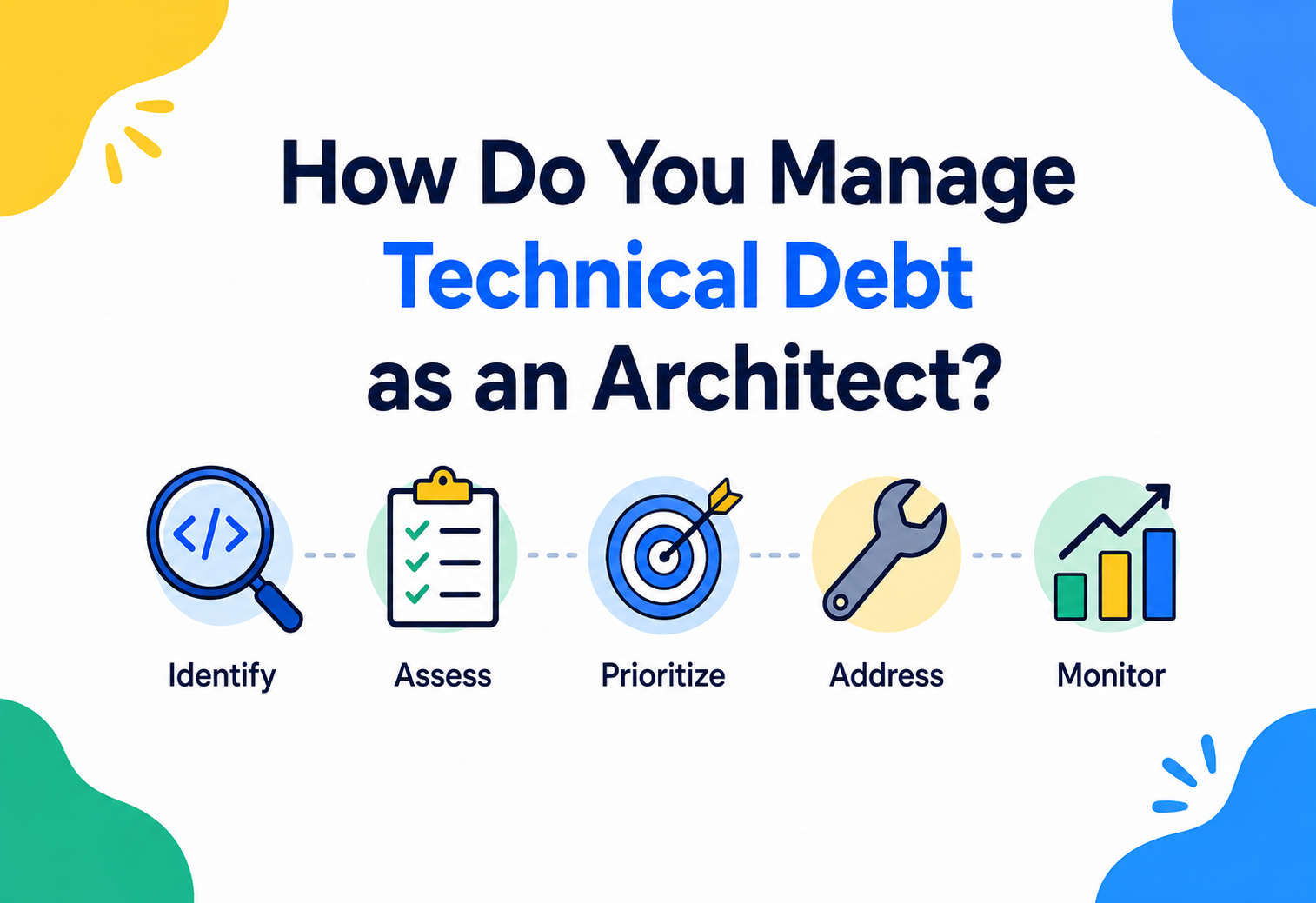
How Do You Manage Technical Debt as an Architect?
A complete, beginner-to-production guide to understanding, measuring, prioritizing, and paying down technical debt — the way senior software architects actually do it at companies like Netflix, Amazon, and Google.
Introduction & History
Imagine you owe a friend ten dollars. That’s fine — you’ll pay it back next week. But now imagine you keep borrowing ten dollars every week, from ten different friends, and you never pay any of it back. Soon, you’re not building anything new with that money — you’re spending all your time just trying to keep your friends from being angry with you. Interest piles up. Trust erodes. Eventually, you can’t borrow anymore, and you can’t build anymore either.
That, in a nutshell, is technical debt. It’s not a bug. It’s not a crash. It’s something quieter and far more dangerous: the accumulated cost of choosing a fast, easy solution today over a better, slower solution that would have made tomorrow easier.
1.1 Where the term came from
The phrase “technical debt” was coined in 1992 by Ward Cunningham, one of the original signers of the Agile Manifesto and the inventor of the wiki. Cunningham was trying to explain to a non-technical finance team why the software his team had shipped quickly needed more work before new features could be added. He borrowed the language of finance because it was the fastest way to make businesspeople understand a purely engineering idea: shipping code that isn’t quite right is like taking out a loan — you get speed now, but you’ll pay interest later.
Cunningham’s original point is often misunderstood. He wasn’t saying “bad code is inevitable, don’t worry about it.” He was saying something more precise: sometimes it’s a smart, deliberate business decision to ship an imperfect design quickly so you can learn from real users — as long as you go back and refactor once you understand the problem better. The “debt” is not the sin. Never repaying the debt is the sin.

Think of your codebase like a kitchen. Deciding to use the same cutting board for onions and garlic to save time (because you’re mid-dinner-rush) is fine — as long as you clean it properly before the next dish. Technical debt is what happens when you keep using that same board for meat, fish, and vegetables, day after day, and never clean it. Eventually, no dish you make is safe to serve.
1.2 Why architects specifically care about this
A junior developer worries about whether their code works today. An architect worries about whether the entire system can keep changing safely for the next five years. Technical debt is fundamentally an architecture-level concern because:
- It compounds across the whole system, not just one file or one team.
- It affects every future feature, not just the feature that created it.
- Fixing it after the fact is 10–100x more expensive than preventing it, similar to how fixing a bug in production costs far more than catching it in code review.
- It’s invisible to non-technical stakeholders until it causes a visible failure — at which point it’s often too late to fix cheaply.
This is why “managing technical debt” is one of the core, permanent responsibilities of a software architect — right alongside designing new systems. This guide walks through exactly how experienced architects think about it, measure it, prioritize it, and pay it down, using real production practices from companies that operate at massive scale.
The Problem & Motivation
Why does technical debt matter enough to deserve its own discipline inside architecture? Because left unmanaged, it doesn’t just slow you down — it can quietly kill a product, a team’s morale, and eventually a company.
2.1 The core problem — velocity decay
Every engineering team starts fast. In the first few months of a new product, features ship in days. But as the codebase grows without discipline, something predictable happens: the same team, doing the same kind of work, takes longer and longer to ship the same-sized feature. This is called velocity decay, and it is the single most common symptom of unmanaged technical debt.
23%
of developer time, on average, is spent dealing with technical debt and bad code, per Stripe’s Developer Coefficient study.
42%
of developer time at large enterprises can go toward maintenance-related work instead of new features.
3–5x
the typical cost multiplier to fix a design flaw after release versus catching it during design.
2.2 Why it’s easy to ignore — until it isn’t
Technical debt has a uniquely dangerous property: it doesn’t show up on any dashboard by default. A slow API shows up in latency graphs. A crash shows up in error logs. But “this module is impossible to change safely” shows up nowhere — until an engineer tries to change it, and it takes three weeks instead of three days, and nobody can explain why to the product manager.
Business stakeholders fund what they can see. Technical debt is invisible by default, which means architects must actively make it visible — through metrics, registries, and stories — or it will never get funded, no matter how badly it’s hurting the team.
2.3 The three forces that create debt
- Time pressure — deadlines force shortcuts: skipping tests, hardcoding values, copy-pasting instead of abstracting.
- Knowledge gaps — a team simply doesn’t yet know the “right” way to solve a problem, so they build the best solution they know today, which looks wrong in hindsight.
- Changing requirements — the system was correctly designed for yesterday’s requirements, but the business has moved on, and the architecture hasn’t caught up.
Notice that none of these forces are about laziness or incompetence. This is critical: technical debt is not a moral failing. It’s an economic and organizational reality. An architect’s job is not to eliminate debt (that’s impossible) — it’s to make debt a visible, managed, and intentional part of the system’s economics, the same way a CFO manages financial debt.
2.4 The human cost, not just the technical cost
It’s tempting to think of technical debt purely as a code problem, but its most damaging effects are often organizational. Engineers working in a heavily indebted codebase experience more frustration, more late-night incident calls, and a persistent feeling that they can never quite finish anything cleanly. Over time, this drives away exactly the senior engineers a team can least afford to lose — the ones with the institutional knowledge to actually navigate the mess. New hires, meanwhile, take far longer to become productive, because a tangled, undocumented system takes months to understand instead of weeks. A codebase’s health is, in a very real sense, also a statement about how much an organization respects its engineers’ time.
Think about the last time you tried to assemble furniture using instructions someone else had already half-followed incorrectly, then abandoned. You spend more time figuring out what they already did wrong than you would have spent building it correctly from scratch. That’s exactly what it feels like for a new engineer joining a team with years of unmanaged technical debt.
2.5 Why “we’ll fix it later” so rarely happens
Every engineering team has said “we’ll clean this up later” at some point. The uncomfortable truth is that, without a structural mechanism forcing it, later almost never comes — because there is always a new feature competing for the same time, and new features have visible deadlines while debt paydown does not. This is precisely why the rest of this guide focuses so heavily on making debt visible and giving it dedicated, protected capacity: hope is not a strategy, but a register, a metric, and a reserved percentage of every sprint are.
Core Concepts
Before we build the practice, let’s learn the vocabulary and mental models that every good debt-management approach depends on.
3.1 The Debt Quadrant (Martin Fowler)
Software architect Martin Fowler extended Cunningham’s metaphor into a 2×2 quadrant that every architect should know by heart. It separates debt by two questions: Was it deliberate? and Was it reckless or prudent?
“We know, but we must ship now”
“We know this isn’t the best design, but we must ship now and we understand the trade-off.” A conscious, informed business decision.
“Just ship it”
“We don’t have time for good design, let’s just ship.” No plan to repay it, no acknowledgment of the risk.
“Now that we’ve built it…”
“Now that we’ve built it, we understand the domain better and see how we should have designed it.” Learning-driven, unavoidable.
“What’s layering?”
Debt created purely from a lack of skill or awareness, without anyone realizing it at the time.
The architect’s real job is to push debt creation into the top-left quadrant (deliberate and prudent) as much as possible, and to build guardrails — code review, mentoring, static analysis — that shrink the bottom-right quadrant (inadvertent and reckless), because that’s the debt nobody chose and nobody is tracking.

3.2 Principal and interest — the financial metaphor, taken seriously
In finance, a loan has a principal (the amount borrowed) and interest (the ongoing cost of not repaying it). Technical debt works the same way:
- Principal — the actual cost of doing the proper refactor: rewriting the module correctly, adding the missing tests, splitting the tangled service apart.
- Interest — the ongoing tax you pay every single day the debt isn’t repaid: slower feature delivery, more bugs, harder onboarding for new engineers, higher on-call burden.
Imagine a shared Java class called OrderUtils that has ballooned to 4,000 lines because every developer just adds “one more static method” instead of designing a proper module. The principal is the two weeks it would take to properly break it into PricingService, ShippingCalculator, and DiscountEngine. The interest is the extra 30 minutes every developer spends each week just trying to find the right method inside that giant file, multiplied across every developer, every week, forever — until someone pays down the principal.
3.3 Types of technical debt
| Type | What it looks like | Typical cause |
|---|---|---|
| Code debt | Duplicated logic, poor naming, missing abstractions | Time pressure, inexperience |
| Design/architecture debt | Tangled module boundaries, tight coupling, “god classes” | Requirements drift, lack of upfront design |
| Test debt | Low coverage, flaky tests, no integration tests | Deadlines, undervaluing QA |
| Documentation debt | Outdated or missing docs, tribal knowledge | Docs seen as “extra,” not core work |
| Infrastructure debt | Outdated dependencies, unpatched servers, manual deploys | “If it isn’t broken, don’t touch it” thinking |
| Security debt | Known vulnerabilities left unpatched, weak auth flows | Deprioritized against feature work |
| People/process debt | Single point of knowledge failure (“bus factor” of 1) | No documentation, no pairing, no rotation |
Netflix engineers openly talk about “paved roads” — the officially supported, well-tested way of building a service — versus the “dirt roads” that individual teams sometimes take under pressure. Their architecture team’s job includes actively pulling teams back onto paved roads before dirt-road shortcuts calcify into permanent architecture debt.
3.4 The SQALE method — turning code smells into a single debt number
One widely used industry model for quantifying debt is SQALE (Software Quality Assessment based on Lifecycle Expectations). It works by assigning a “remediation cost” — a rough time estimate — to every code quality violation a static analyzer finds, then summing them all up into one number: the total estimated hours needed to bring the codebase back to a clean state. Tools like SonarQube use a version of this model to calculate the “debt ratio” mentioned later in this guide. The value of SQALE isn’t perfect precision — it’s that it gives every stakeholder, technical or not, a single shared number to talk about, the same way a bank balance gives a shared number for a financial conversation.
3.5 Debt versus a simple bug
Beginners often confuse technical debt with bugs, but they are different things. A bug is a place where the system behaves incorrectly right now. Technical debt is a place where the system behaves correctly right now, but the design makes future correct behavior harder, riskier, or slower to build. A messy but working checkout flow isn’t a bug — it’s debt. The moment that messiness causes an order to double-charge a customer, it has produced a bug as a symptom of the underlying debt.
Where Debt Lives — Components of a Debt-Aware System
Managing debt isn’t just a mindset — it needs concrete artifacts and components, the same way managing money needs a bank account and a budget spreadsheet, not just good intentions.
4.1 The technical debt register
This is the single most important tool an architect maintains. It’s a living list — often a Jira epic, a Confluence page, or a dedicated tool — where every known piece of debt is written down with:
- Description — what is wrong, in plain language.
- Location — which service, module, or class.
- Impact — what breaks or slows down because of it.
- Cost to fix — rough estimate: hours, days, weeks.
- Risk if ignored — low / medium / high / critical.
- Owner — who is responsible for eventually fixing it.
A debt register turns an invisible, emotional argument (“this code is bad!”) into a visible, prioritizable backlog item, exactly like a financial ledger turns “we’re spending too much” into a line-item budget.
4.2 Static analysis and code quality gates
Tools like SonarQube, Checkstyle, PMD, and SpotBugs automatically scan Java codebases for code smells, duplication, complexity, and security issues, and calculate an estimated “debt ratio” — the cost to fix all detected issues divided by the cost to build the whole application from scratch.
4.3 Architecture Decision Records (ADRs)
An ADR is a short document that captures why a particular architectural decision was made, including trade-offs considered and rejected. ADRs are one of the best tools for distinguishing “deliberate, prudent” debt from “inadvertent” debt, because they leave a paper trail of intent.
4.4 Debt-paydown capacity in sprint planning
Mature engineering organizations reserve a fixed percentage of every sprint — commonly 10–20% — exclusively for debt paydown, refactoring, and maintenance, rather than new features. This is a structural, calendar-level component, not just a policy statement.
Internal Working — How Architects Actually Manage Debt
This is the heart of the guide: the actual day-to-day mechanics an architect uses.
5.1 Step 1 — Make the invisible visible
The architect’s first job is detection. This happens through a mix of:
- Automated scanning — static analysis tools running in CI on every pull request.
- Developer surveys — regularly asking engineers “what slows you down the most?” Often the most accurate signal, because humans notice friction long before metrics catch up.
- Incident retrospectives — every production incident is checked for an underlying debt cause, not just the immediate trigger.
- Code review patterns — repeated review comments about the same file or pattern are a strong debt signal.
5.2 Step 2 — Quantify, don’t just describe
“This code is messy” doesn’t get budget approved. “This module causes 40% of our production incidents and adds an average of 3 extra days to every feature that touches it” gets budget approved. Architects translate qualitative pain into quantitative, business-relevant numbers.

A payments team at a fintech company measured that their legacy PaymentProcessor class touched 60% of all production hotfixes over six months. That single number — not a code review complaint — was what finally got two full sprints approved for a redesign.
5.3 Step 3 — Prioritize using a risk/cost matrix
Not all debt deserves attention. Architects prioritize using a simple two-axis model: business impact versus cost to fix.
| Low cost to fix | High cost to fix | |
|---|---|---|
| High business impact | Do immediately (quick wins) | Plan as a dedicated initiative |
| Low business impact | Fix opportunistically, during related work | Document and defer; revisit only if impact changes |
5.4 Step 4 — Fund it like a real project
Large debt paydown (e.g., splitting a monolith, replacing a messaging system) is treated as its own initiative with a sponsor, a roadmap, and success metrics — exactly like a new product feature. Architects write the same kind of business case for debt paydown as they would for new functionality: expected engineering-hours saved per quarter, incident reduction, and time-to-market improvement.
5.5 A simple Java example — tracking debt as code
Some teams go further than a spreadsheet and encode debt directly into the codebase using annotations, so it shows up during builds and code reviews.
// A custom annotation to mark and track technical debt directly in code
import java.lang.annotation.*;

@Retention(RetentionPolicy.RUNTIME)
@Target({ElementType.TYPE, ElementType.METHOD})
public @interface TechDebt {
    String reason();
    String owner();
    Priority priority() default Priority.MEDIUM;
    String ticketId() default "";

    enum Priority { LOW, MEDIUM, HIGH, CRITICAL }
}

// Usage inside a real class
@TechDebt(
    reason = "Uses synchronous HTTP call instead of async messaging; blocks thread pool under load",
    owner = "payments-team",
    priority = TechDebt.Priority.HIGH,
    ticketId = "ARCH-4821"
)
public class LegacyInvoiceService {

    public InvoiceResult generateInvoice(Order order) {
        // Synchronous call to a downstream service - known bottleneck
        return httpClient.post("/invoices", order);
    }
}
A simple reflection-based scanner can then run in CI to generate a live report of every @TechDebt-annotated class, cross-reference it with the ticket system, and fail the build if a CRITICAL item has been open for more than a set number of days — turning debt tracking from a manual chore into an enforced, automated process.
Data Flow & Lifecycle of a Debt Item
Just like a bug ticket has a lifecycle (open → triaged → in progress → resolved), a technical debt item has its own well-defined lifecycle that architects manage.
6.1 Stage-by-stage breakdown
- Identification — debt is spotted, either by a human (developer, architect) or a tool (static analysis, monitoring alert).
- Logging — it’s written into the register with enough context that someone unfamiliar with the code could understand it six months later.
- Triage — the architect assigns a severity and links it to affected business metrics (latency, incident rate, delivery speed).
- Prioritization — during planning, it’s ranked against other debt items and new feature work using the risk/cost matrix.
- Scheduling — it’s placed into a specific sprint or dedicated “hardening” period.
- Remediation — the actual refactor, rewrite, or upgrade happens, ideally behind tests that prove behavior hasn’t changed.
- Verification — metrics are re-measured to confirm the fix actually reduced the pain (fewer incidents, faster delivery).
- Closure & documentation — the register entry is closed, and the ADR or design doc is updated so the “why” isn’t lost.
Many teams stop at step 6 (remediation) and skip step 7 (verification). Without verification, you can’t prove the refactor actually helped — which makes it much harder to get budget approved for the next one.
Advantages, Disadvantages & Trade-offs
It might sound strange, but a good architect doesn’t try to reach “zero debt.” Zero debt usually means you moved too slowly and a competitor beat you to market. The goal is managed debt, not zero debt.
7.1 Why architects sometimes deliberately choose to take on debt
| Advantage of taking debt (short-term) | Disadvantage if left unmanaged (long-term) |
|---|---|
| Faster time-to-market; ship and learn from real users | Slower feature velocity over time (velocity decay) |
| Validate a business idea before investing in “perfect” architecture | Increased bug rate and production incidents |
| Free up engineering time for higher-priority work now | Higher onboarding cost for new engineers |
| Meet a critical deadline (e.g., regulatory, contractual) | Team morale drops; skilled engineers may leave |
| Reduced upfront cost and complexity | Compounding “interest” makes the eventual fix more expensive |
A startup building an MVP might hardcode shipping costs to “$5 flat” instead of building a full shipping-rate calculation engine. That’s smart, deliberate debt — building the full engine before knowing if the product will even succeed would waste weeks. The trade-off only becomes a problem if, a year later with 50,000 orders a day, nobody has gone back to replace that hardcoded value.
7.2 The trade-off triangle
Every architectural decision balances three forces: speed, quality, and scope. You can typically optimize for two of the three at a time. Technical debt is what happens when you optimize for speed and scope, at the cost of quality — a completely valid choice, as long as it’s made consciously and revisited later.
7.3 A simple decision framework architects use
When a team is deciding whether to take on debt in the moment, a useful question set is: Do we know enough about this problem yet to build the “right” version? If not, prudent debt may genuinely be the smarter choice, because building the wrong “right” version wastes more time than building a known-imperfect version and learning from it. The second question is: Can we clearly state what “paying this back” will look like, and roughly when? If the answer is a vague shrug, that’s a strong signal the debt is drifting from deliberate into reckless territory, and it deserves a second look before the team commits to it.
An e-commerce team building a brand-new recommendation feature might deliberately hardcode a simple “most popular items” algorithm instead of building a full machine learning pipeline on day one. If the feature succeeds and proves valuable, the team then has real usage data to design a much better algorithm — data they simply would not have had if they had spent the first three months building the “perfect” system nobody had yet validated was worth building.
Performance & Scalability Impact
Technical debt is rarely just an aesthetic problem — it directly degrades real, measurable system performance.
- N+1 query patterns left unfixed in an ORM layer can turn a 50ms API call into a 4-second one once data volume grows.
- Tight coupling between services means scaling one component forces you to scale unrelated components too, wasting infrastructure cost.
- Missing caching layers, added as “we’ll do it later,” mean every traffic spike hits the database directly instead of an in-memory cache.
- Synchronous chains of calls (Service A calls B calls C calls D, all blocking) multiply latency and reduce the maximum throughput the system can handle.
A common scaling debt pattern: a single shared database table used by five different microservices. It’s fast to build initially, but as traffic grows, that one table becomes a bottleneck that limits the scalability of the entire platform — no amount of adding more application servers can fix a database that has become the single point of contention.
8.1 A Java example — debt that silently kills scalability
// BEFORE: works fine with 100 users, becomes a bottleneck at 100,000
public class OrderService {

    public List<OrderSummary> getOrderSummaries(Long customerId) {
        List<Order> orders = orderRepository.findByCustomerId(customerId);
        List<OrderSummary> summaries = new ArrayList<>();

        for (Order order : orders) {
            // N+1 problem: one extra DB query PER order, every single time
            Customer customer = customerRepository.findById(order.getCustomerId());
            summaries.add(new OrderSummary(order, customer.getName()));
        }
        return summaries;
    }
}

// AFTER: paying down the debt with a single batched fetch
public class OrderService {

    public List<OrderSummary> getOrderSummaries(Long customerId) {
        List<Order> orders = orderRepository.findByCustomerId(customerId);

        Set<Long> customerIds = orders.stream()
            .map(Order::getCustomerId)
            .collect(Collectors.toSet());

        // Single batched query instead of N queries
        Map<Long, Customer> customerMap = customerRepository
            .findAllById(customerIds).stream()
            .collect(Collectors.toMap(Customer::getId, c -> c));

        return orders.stream()
            .map(o -> new OrderSummary(o, customerMap.get(o.getCustomerId()).getName()))
            .collect(Collectors.toList());
    }
}
This single, small refactor is a perfect example of “prudent” debt repayment: cheap to fix early, extremely expensive to fix once it’s deployed across dozens of call sites in a large codebase.
High Availability & Reliability
Unmanaged technical debt is one of the single biggest predictors of production incidents. Reliability engineering teams at large companies routinely find that a small number of “debt hotspots” in the codebase are responsible for a disproportionate share of outages.

9.1 How debt undermines reliability
- Missing retries and timeouts in older integrations cause cascading failures when a downstream dependency slows down.
- No circuit breakers around legacy calls mean a single failing service can take down the entire request chain.
- Inconsistent error handling (“sometimes we return null, sometimes we throw, sometimes we return an empty list”) makes failure modes unpredictable and hard to test.
- Outdated dependencies may have known, unpatched reliability bugs that newer versions have already fixed.
Reliability isn’t just about writing new resilience code — it’s equally about ensuring old code doesn’t quietly undermine the resilience patterns the rest of the system depends on. A single legacy service without a circuit breaker can defeat circuit breakers everywhere else in the call chain.
9.2 Debt-aware reliability practice — the “blast radius” review
Mature architecture teams regularly ask: “If this specific piece of debt causes a failure, how far does the damage spread?” A debt item with a small blast radius (affects one non-critical internal tool) is treated very differently from one with a large blast radius (affects the checkout flow for all customers), even if the code itself looks similarly messy.
9.3 Post-incident debt discovery
One of the most reliable sources of high-value debt items is the humble post-incident review. When a production outage happens, a good retrospective doesn’t stop at “what triggered this specific failure” — it also asks “what underlying design decision made this failure possible, or made it worse once it started?” That second question routinely surfaces debt that had been quietly tolerated for months or years, simply because it had never yet caused visible damage. Architects who build a habit of feeding every incident retrospective back into the debt register end up with a naturally prioritized list, because the items on it have already proven, in production, that they matter.
Security Debt
Security debt deserves its own category because, unlike most technical debt, it doesn’t just slow you down — it can create active, exploitable risk.
- Unpatched dependencies with known CVEs (Common Vulnerabilities and Exposures) sitting in production.
- Hardcoded secrets or credentials left in source code from early prototyping.
- Weak or inconsistent authentication patterns across different services built at different times.
- Missing input validation in older endpoints that predate the team’s current security standards.
Imagine your house has ten doors. Nine have modern smart locks. One, installed years ago before you knew better, still uses a key you copied for a contractor who no longer works for you. That single old door is your security debt — and it only takes one door for a burglar to get in, no matter how good the other nine are.
10.1 Why security debt needs a different prioritization model
Regular technical debt is prioritized by cost versus business impact. Security debt must also weigh exploitability and blast radius if exploited. Architects typically use a severity scoring system like CVSS (Common Vulnerability Scoring System) alongside the normal debt register to make sure critical security items can never simply “lose” a prioritization debate to a feature request — they get a separate, non-negotiable SLA (for example, “critical vulnerabilities patched within 72 hours, no exceptions”).
Monitoring, Logging & Metrics for Technical Debt
You cannot manage what you don’t measure. Architects instrument technical debt the same way they instrument system performance.
11.1 Key metrics architects track
| Metric | What it tells you |
|---|---|
| Code churn | Files changed very frequently often indicate an unstable design that hasn’t found its correct shape yet |
| Cyclomatic complexity | How many independent paths exist through a function; high complexity means high risk and hard-to-test code |
| Test coverage trend | Coverage dropping over time signals accumulating test debt |
| Debt ratio (SonarQube) | Estimated cost to fix all known issues, as a percentage of the cost to rebuild the app from scratch |
| Mean time to change (lead time) | How long a similarly-sized feature takes to ship over time; a rising trend signals velocity decay |
| Incident correlation | Percentage of production incidents traceable back to a known, logged debt item |
| Dependency freshness | How many major/minor versions behind each library is, and how many have known vulnerabilities |
11.2 Building a debt dashboard
Most mature organizations wire these metrics into a real-time dashboard (Grafana, Datadog, or a custom internal tool) so that debt trends are visible the same way CPU usage or error rates are visible — not something that requires a special meeting to discover.
Chasing a single number, like “reduce SonarQube debt ratio to under 5%,” as a goal in itself. Metrics are a compass, not a destination — some genuinely complex, business-critical code will always score as “high complexity” on a naive tool, and that’s fine.
11.3 Leading indicators versus lagging indicators
Good debt monitoring mixes two kinds of signals. Lagging indicators tell you the damage has already happened — an incident count, a missed deadline, a customer complaint. Leading indicators — rising cyclomatic complexity, a falling test coverage trend, growing code churn in a single file — warn an architect that debt is building up before it causes a visible failure. A mature debt-monitoring practice weighs leading indicators more heavily in day-to-day decisions, because by the time a lagging indicator fires, the cost of the underlying debt has usually already multiplied several times over.
Deployment & Cloud Considerations
Infrastructure and deployment pipelines accumulate their own distinct category of debt, often overlooked because it lives outside the application codebase.
- Manual deployment steps that “only Raj knows how to do” are a classic single-point-of-failure debt item.
- Unpinned or outdated base container images silently drift away from security patches over time.
- Missing infrastructure-as-code — servers configured by hand in a cloud console can never be reliably reproduced if they’re lost.
- No blue-green or canary deployment strategy means every release is high-risk, all-or-nothing.
A common cloud migration debt pattern is “lift and shift” — moving an on-premise application to the cloud without redesigning it to take advantage of cloud-native scaling, managed databases, or auto-healing infrastructure. It gets you to the cloud fast, but leaves behind an expensive pile of architecture debt that must eventually be repaid to unlock real cloud benefits like elastic auto-scaling and pay-per-use cost efficiency.
12.1 Paying down deployment debt — a Java + CI example
A concrete, common fix is replacing manual deployment steps with automated pipeline stages, including an automated dependency and vulnerability check as a build gate.
// build.gradle snippet: fail the build automatically on critical CVEs,
// converting "we hope someone checks this" into an enforced gate
plugins {
    id 'org.owasp.dependencycheck' version '9.0.9'
}

dependencyCheck {
    failBuildOnCVSS = 7.0   // fail build if any dependency has a CVSS score >= 7 (high/critical)
    suppressionFile = 'dependency-check-suppressions.xml'
    format = 'ALL'
}
This turns “we should really update our dependencies sometime” from a hopeful sticky note into an automatic, unbypassable check on every single build — one of the highest-leverage, lowest-effort ways to prevent security and infrastructure debt from accumulating unnoticed.
12.2 Infrastructure-as-code as debt prevention
One of the most effective long-term investments against deployment debt is treating infrastructure itself as version-controlled code — using tools like Terraform, Pulumi, or AWS CloudFormation — rather than manual console clicks. When infrastructure lives in a Git repository, changes go through the same code review, testing, and rollback safety net as application code, which prevents an entire category of “nobody remembers why this server is configured this way” debt from ever forming in the first place.

A manually configured server is like a house built without blueprints — if it burns down, nobody can rebuild it exactly as it was. Infrastructure-as-code is the blueprint: if the house burns down, you run the blueprint again and get the exact same house back, in minutes instead of weeks.
Databases, Caching & Load Balancing
Data-layer debt is uniquely expensive because it involves live, stateful information — you can’t simply redeploy a schema the way you can redeploy application code.
13.1 Database schema debt
Database changes are uniquely expensive to fix later because they involve live, stateful data — you can’t just redeploy a new version. Common patterns include:
- Columns whose meaning has drifted from their name (a column called
statusthat now holds five unrelated concepts). - Missing indexes added “temporarily” during an incident, never reviewed again.
- No foreign key constraints, allowing orphaned or inconsistent data to accumulate silently.
13.2 Caching debt
Caches introduced quickly under production pressure often skip proper invalidation strategy, leading to the well-known joke among engineers: “there are only two hard problems in computer science: cache invalidation, naming things, and off-by-one errors.” Debt here shows up as stale data bugs that are maddeningly difficult to reproduce.
13.3 Load balancing debt
Sticky sessions added early for convenience (routing a user’s requests to the same server every time) become a scaling and reliability liability later, since they prevent even traffic distribution and complicate rolling deployments.
A schema migration is like renovating the plumbing in a house that people still live in — you can’t just knock down a wall; you need a careful, staged plan (add the new pipe, migrate water flow gradually, remove the old pipe only once nothing depends on it) or you’ll flood the kitchen. This is why database debt is often the most feared, and most postponed, category of technical debt.
13.4 Safe migration pattern — expand-and-contract
APIs & Microservices
Distributed systems introduce their own unique flavor of technical debt: debt that lives between services, not just inside them.
14.1 API versioning debt
An API shipped without a versioning strategy becomes nearly impossible to change safely once external or internal consumers depend on its exact shape. Retrofitting versioning after the fact requires supporting both old and new consumers simultaneously — pure interest payment on a debt that would have cost almost nothing to prevent at the start.
14.2 Service boundary erosion
Microservices are supposed to be independently deployable. Boundary erosion happens when, under time pressure, one service starts directly querying another service’s private database “just this once” — and that “just this once” becomes a permanent, undocumented coupling that makes the two services impossible to deploy or scale independently ever again.
A microservices architecture with eroded boundaries is often worse than a well-organized monolith — you get all the operational complexity of distributed systems (network calls, partial failures, eventual consistency) with none of the promised independence benefit.
14.3 A Java example — repaying API versioning debt
// BEFORE: no versioning - any change breaks every existing client
@RestController
@RequestMapping("/orders")
public class OrderController {

    @GetMapping("/{id}")
    public OrderResponse getOrder(@PathVariable Long id) {
        return orderService.getOrder(id);
    }
}

// AFTER: explicit versioning lets you evolve the API without breaking existing consumers
@RestController
@RequestMapping("/v2/orders")
public class OrderControllerV2 {

    @GetMapping("/{id}")
    public OrderResponseV2 getOrder(@PathVariable Long id) {
        // v2 adds richer shipping details without breaking v1 consumers,
        // which continue to be served by the old, still-running controller
        return orderService.getOrderWithShippingDetails(id);
    }
}
14.4 The Strangler Fig pattern for microservices debt
Named after a vine that slowly grows around a tree and eventually replaces it, this pattern lets architects incrementally replace a legacy service without a risky “big bang” rewrite.
14.5 Eventual consistency debt
Distributed systems often trade strict, immediate consistency for availability and scalability, using patterns like the Saga pattern or event-driven architectures. This is usually the right trade-off — but it becomes debt when a team implements “eventually consistent” behavior without a proper compensation mechanism for when things go wrong. For example, an order-and-inventory saga that debits stock but has no reliable way to roll back that debit if payment later fails will quietly produce phantom inventory shortages that are extremely difficult to trace back to their root cause weeks later.
In a monolith, an unhandled edge case is usually caught by a single database transaction rolling back automatically. In a distributed system, there is no automatic rollback across services — the compensation logic must be explicitly designed and tested, or it becomes one of the most expensive and hardest-to-diagnose forms of debt a system can carry.
Design Patterns & Anti-patterns
A short vocabulary of the patterns that make debt paydown safe and repeatable — and the anti-patterns that quietly make everything worse.
15.1 Patterns that help manage debt
| Pattern | How it helps |
|---|---|
| Strangler Fig | Incrementally replace legacy systems without a risky full rewrite |
| Branch by Abstraction | Introduce an abstraction layer so old and new implementations can coexist during migration |
| Feature Flags | Decouple deployment from release, allowing safe, gradual rollout of debt fixes |
| Anti-Corruption Layer | Isolate a legacy or messy external system behind a clean interface, preventing its debt from spreading |
| Expand-Contract Migration | Safely evolve database schemas and APIs with zero downtime |
15.2 Anti-patterns that make debt worse
Throwing away a working system to rebuild “the right way” from scratch. Famous for running over budget, over time, and often failing to ship at all, because it ignores everything the old system quietly got right.
Never dedicating explicit time to debt because each individual shortcut seems small; the team wakes up two years later in a codebase nobody wants to touch.
One engineer secretly rewriting a large module alone, without review or shared understanding, creating a different kind of debt: knowledge concentrated in one person’s head.
“Cleaning up” code with no safety net of automated tests, which frequently introduces new bugs while trying to fix old ones.
The Strangler Fig pattern exists specifically as the answer to the Big Bang Rewrite anti-pattern. Nearly every successful large-scale legacy migration in the industry — including well-documented efforts at companies like Amazon and Shopify — uses incremental strangulation, not a full rewrite.
Best Practices & Common Mistakes
A short, tactical checklist of what to do — and what to avoid — when actually managing debt on a real team.
16.1 Best practices
- Make debt visible — maintain a living register; never let debt exist only in engineers’ memories.
- Reserve dedicated capacity — 10–20% of every sprint for paydown, protected from being silently reassigned to features.
- Tie debt to business metrics — always translate “messy code” into incident rate, delivery speed, or cost impact.
- Write ADRs — document the “why” behind every deliberate trade-off, so future engineers don’t mistake intentional debt for a mistake.
- Automate detection — static analysis, dependency scanning, and test coverage checks running on every build, not manual audits every six months.
- Prevent, don’t just cure — invest in code review quality, mentoring, and design review to shrink the “inadvertent, reckless” quadrant.
- Celebrate paydown work — treat a successful refactor with the same visibility and recognition as a successful new feature launch.
16.2 Common mistakes
- Treating all debt as equally urgent — burns political capital on low-impact cleanups while critical items wait.
- Never revisiting deferred debt — logging an item and never scheduling a follow-up review turns the register into a graveyard nobody trusts.
- Framing debt paydown purely in technical language to business stakeholders instead of business impact — guarantees it loses every prioritization conversation.
- Refactoring with no tests as a safety net — trading one kind of risk for another.
- Letting “we’ll fix it later” replace an actual plan — “later” without a date, owner, and ticket is not a plan; it’s a wish.
16.3 Setting up lightweight debt governance
You don’t need a heavyweight committee to manage debt well. Most successful teams run something like this: a short, recurring (often monthly or quarterly) architecture review where the top handful of debt items — ranked by the risk/cost matrix from earlier in this guide — are presented alongside their business impact. Decisions are made in that meeting about what gets scheduled next, what gets deferred, and what gets closed as no-longer-relevant. This keeps the register alive and trusted, instead of becoming a write-only graveyard that nobody ever revisits. The key discipline is keeping the list short: a debt register with 400 open items is not more useful than one with 15 — it’s just noise that makes the real priorities harder to see.
Allowing the debt register to become a dumping ground for every minor style disagreement or personal preference. A register cluttered with low-value nitpicks trains stakeholders to stop taking it seriously, which is exactly the opposite of what an architect needs when a genuinely critical item finally needs urgent funding.
Real-World Industry Examples
Every one of these examples shares the same pattern: debt paydown was made visible, given dedicated resources, and tied to a clear business outcome — never left as a vague hope that engineers would “get to it eventually.”
Paved roads & chaos
Netflix’s architecture and platform teams maintain “paved roads” — pre-built, well-tested infrastructure paths for common needs like service creation, deployment, and observability. Teams are free to go off the paved road under pressure, but doing so is tracked and revisited, preventing shortcuts from silently becoming permanent architecture. Netflix also pioneered Chaos Engineering, deliberately injecting failures in production to surface hidden reliability debt before it causes a real outage.
Two-pizza teams & ownership
Amazon’s move to small, autonomous teams that fully own a service — including its on-call burden — created a strong incentive structure: teams that accumulate debt in their own service feel the pain of that debt directly (through on-call pages), which naturally motivates paydown without needing top-down enforcement.
Code health rotations
Google’s internal engineering culture places heavy emphasis on “readability reviews” and dedicated code health rotations, where engineers spend focused time exclusively on cleanup, testing, and refactoring across the shared codebase, treating code health as a first-class, ongoing responsibility rather than an occasional emergency project.
Project Inversion
LinkedIn famously paused most new feature development for several months in 2011 to focus entirely on infrastructure and technical debt paydown, an initiative internally called “Project Inversion.” It’s one of the most cited real-world examples of an organization treating debt paydown as a first-class, company-wide initiative rather than background noise — and it’s widely credited with enabling LinkedIn’s subsequent scaling.
Continuous deployment
Etsy’s engineering culture became famous for deploying to production dozens of times per day, backed by heavy automated testing and monitoring. Counterintuitively, this high deployment frequency reduced technical debt accumulation, because each change was small, reviewed quickly, and easy to roll back — compared to the traditional pattern of big, risky, infrequent releases where corners get cut to hit a large deadline.
Scala-to-JVM consolidation
In its early years, Twitter’s original Ruby on Rails monolith struggled to handle rapid user growth, becoming a widely cited case study in architecture debt caused by a technology choice that no longer matched the required scale. The company’s multi-year migration to a JVM-based, service-oriented architecture is a textbook example of large-scale, deliberate debt repayment: expensive, risky, but ultimately necessary to keep the platform reliable at a much larger scale than the original design anticipated.
Every one of these examples shares the same pattern: debt paydown was made visible, given dedicated resources, and tied to a clear business outcome — never left as a vague hope that engineers would “get to it eventually.”
FAQ, Summary & Key Takeaways
The questions teams most often ask about technical debt — followed by the compact version worth carrying with you into the next planning meeting.
Is all technical debt bad?
No. Deliberate, prudent debt — taken on consciously with a plan to repay it — is a normal and often smart business decision. The danger is debt that is either reckless (no thought given to the trade-off) or never repaid.
How much time should a team spend paying down debt?
There’s no universal number, but 10–20% of sprint capacity, reserved consistently every sprint, is a common and effective baseline used across the industry. The right number depends on the age and criticality of the system.
Who is responsible for managing technical debt — architects or developers?
Both, but with different roles. Developers identify and flag debt as they encounter it day to day. Architects are responsible for making it visible at a system-wide level, prioritizing it against business goals, and securing the resources to pay it down.
How do you convince leadership to invest in paying down debt?
Translate technical pain into business metrics: incident rate, delivery speed, engineering cost, and customer impact. A dollar figure or a “features per quarter” number gets funded far more reliably than a description of messy code.
What’s the difference between refactoring and rewriting?
Refactoring improves the internal structure of existing code without changing its external behavior, done incrementally and safely under test coverage. Rewriting replaces the system entirely, which is riskier, slower, and should be a last resort — the Strangler Fig pattern is almost always the safer middle path.
Can a brand-new codebase already have technical debt?
Yes. Debt isn’t about age — it’s about the gap between the current design and the ideal design given what you know today. A brand-new project built under a tight deadline, with shortcuts taken deliberately or by accident, can start accumulating debt from day one, sometimes before it even reaches production.
Should junior engineers be involved in managing technical debt?
Absolutely, and they often should be involved early. Junior engineers frequently encounter debt firsthand while implementing features, making them a valuable source of detection. Involving them in the register and paydown process also builds architectural judgment much faster than only ever building new features.
Key takeaways
- Technical debt is the cost of choosing a faster, easier solution now over a better one that would make future change cheaper.
- Not all debt is bad — deliberate, prudent debt is a normal and sometimes smart trade-off; the danger lies in debt that is reckless or never repaid.
- Architects manage debt through visible artifacts: a debt register, ADRs, static analysis, and metrics dashboards — not through memory or good intentions alone.
- Debt must be quantified in business terms (incidents, delivery speed, cost) to compete successfully for prioritization against new features.
- Patterns like Strangler Fig, Branch by Abstraction, and Expand-Contract migrations let teams repay debt incrementally and safely, without risky big-bang rewrites.
- The best organizations — Netflix, Amazon, Google, LinkedIn — treat debt paydown as a funded, first-class initiative, not an afterthought squeezed in “if there’s time.”
Managing technical debt is, at its core, a practice of honesty: being honest about the trade-offs you’re making today, and disciplined about coming back to settle them tomorrow. That discipline — more than any single tool or pattern — is what separates architecture that ages gracefully from architecture that collapses under its own weight.