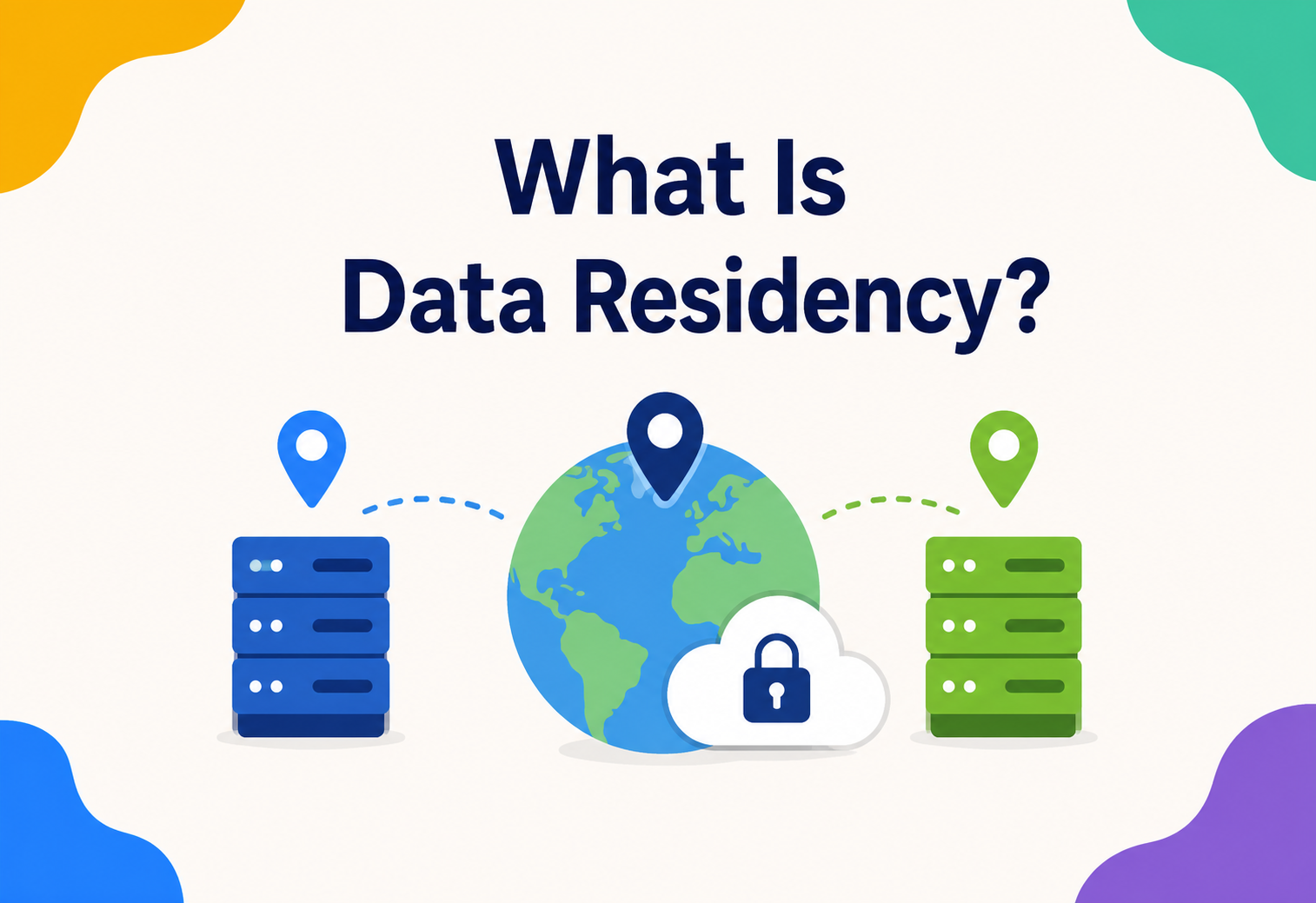
What Is Data Residency?
A beginner-friendly, deep-dive guide to where your data lives, why that location matters legally and technically, and how modern systems are architected around it — from GDPR and cloud regions to region-aware code, backups, and audits.
Where Your Data Physically Lives
Data residency is the idea that data must physically live — meaning it is stored on a server, in a data center, sitting in a real geographic location — within a specific country or region, usually because a law, a regulation, or a company policy says so.
Think of it like a library rule that says “books about local history must stay in the local branch, they cannot be shipped to another city.” The book (your data) is a real object living on a real shelf (a real server), and the rule constrains which shelf it is allowed to sit on. As harmless as that sounds, this single constraint has quietly reshaped how large software systems are designed, deployed, and audited across the world.
To understand why this idea exists, it helps to look at how computing itself grew up. In the 1960s and 1970s, computers were enormous, expensive machines that lived inside a single building. If a company in France had a computer, its data physically could not leave France — there was no network fast enough or cheap enough to move it anywhere else. Data residency was not a policy back then; it was simply a fact of physics and cost.
Everything changed with the rise of the internet in the 1990s and, more importantly, with the arrival of cloud computing in the mid-2000s. Cloud computing means renting computing power and storage from a company like Amazon, Google, or Microsoft instead of buying and running your own physical machines. Suddenly a small business in Germany could store its customer data on a server sitting in the United States, Ireland, or Singapore, often without even knowing exactly which one. The convenience was enormous, but a new problem was born: countries and regions started asking, “wait — our citizens’ private information is now sitting on a computer we have no control over, in a country whose laws we don’t write. Is that acceptable?”
Governments responded with laws. The European Union’s General Data Protection Regulation (GDPR), which came into force in 2018, was one of the most influential of these laws. It placed strict rules on how personal data about EU citizens could be moved outside the EU. Other countries followed with their own versions: Russia’s data localization law (2015), China’s Cybersecurity Law and Personal Information Protection Law, India’s Digital Personal Data Protection Act, and Australia’s privacy amendments for health records, among many others. Data residency, once just a side effect of old, slow technology, became a deliberate legal and architectural requirement that modern engineers must design for on purpose.
Imagine mailing a letter that, by law, is never allowed to leave your home country’s postal system. Data residency is that same rule, but for the ones-and-zeros that make up your personal information, medical records, or financial history — it doesn’t just care about who reads the letter, it cares about which country the envelope physically sits in.
It is also worth understanding that data residency is not a single global standard — it is a patchwork of hundreds of overlapping national and regional rules, each written by a different government with different priorities. Some countries care mostly about financial data, others about health data, others about anything touching national security, and others about all personal data equally. A company operating in twenty countries may effectively be juggling twenty different rulebooks at once, and the engineering systems that store and move data have to be flexible enough to satisfy all of them simultaneously, sometimes for the very same customer if that customer’s data touches multiple jurisdictions (for example, a French citizen using a service while traveling in Japan).
Another useful historical thread to pull on is the story of undersea internet cables. Long before “the cloud” was a marketing term, the physical infrastructure of the internet itself — cables running along ocean floors connecting continents — already made data residency a geopolitical topic. Countries began negotiating who could tap, monitor, or route traffic through these cables, long before anyone talked about GDPR or cloud regions. Data residency, in other words, sits on top of a much older story about who controls the physical infrastructure that information travels across, and that older story is why today’s laws feel so deeply tied to national infrastructure and sovereignty rather than being purely about software policy.
The Problem & Motivation Behind Data Residency
Why does any of this matter? Let us break down the real-world problems that data residency tries to solve — because none of these rules were written for fun. Each one exists because of a specific harm that a specific government wanted to prevent.
1. Legal jurisdiction and sovereignty
When your data sits inside a country’s borders, that country’s courts and law enforcement can typically demand access to it, following that country’s own legal process. This is called data sovereignty — the idea that data is subject to the laws of the nation where it is physically stored. If a hospital in Canada stores patient records on a server in the United States, then, in certain situations, U.S. law (such as the CLOUD Act) could compel the American cloud provider to hand over that data to U.S. authorities — even though the patient and hospital have nothing to do with the U.S. That is a real conflict of interest that governments and companies want to avoid.
2. Privacy and citizen protection
Citizens want assurance that their most sensitive information — health records, financial details, biometric data — is not floating around uncontrolled, subject to foreign surveillance laws that may have much weaker protections than their home country’s laws. Physical location becomes a proxy for legal accountability: if the data sits in your country, your country’s privacy commissioner has clear jurisdiction to defend the person the data describes.
3. Regulatory compliance
Many industries (banking, healthcare, government) are legally required to keep certain categories of data within specific borders. Failing to comply is not just embarrassing — it can mean multi-million-dollar fines, loss of operating licenses, or a company being banned from a market entirely. Compliance officers in these industries are directly responsible for demonstrating, on demand, that regulated data has never accidentally crossed a border it was not allowed to cross.
4. Trust and market access
Sometimes it is not the law strictly forcing residency, but the market. A government agency in Germany may simply refuse to buy a software product unless the vendor can prove the data stays in Germany. Companies that ignore this lose massive contracts, often to smaller local competitors who built for regional storage from day one.
Without Residency Controls
- Regulatory fines (GDPR fines can reach 4% of global annual revenue)
- Loss of customer trust after a cross-border data incident
- Legal disputes between conflicting national laws
- Being blocked from entering regulated markets (health, finance, government)
- Emergency architectural rewrites forced by a sudden legal ruling
With Good Residency Design
- Legal compliance across every market you operate in
- Increased customer and government trust
- Reduced legal exposure to foreign subpoenas
- Competitive advantage when bidding for regulated contracts
- Predictable, auditable data flows that survive scrutiny
5. Geopolitical tension and conflicting laws
Sometimes two countries’ laws directly contradict each other for the same piece of data. A well-known example is the tension between the EU’s GDPR (which restricts sending EU personal data to countries without “adequate” privacy protection) and the U.S. CLOUD Act (which allows U.S. law enforcement to demand data held by American companies, even if that data physically sits on a server in another country). A European company using an American cloud provider can find itself technically caught between two governments’ expectations at once. This exact tension produced the 2020 “Schrems II” court decision in Europe, which struck down an earlier framework (called Privacy Shield) that had allowed EU-to-US data transfers, forcing thousands of companies to re-examine their entire data architecture almost overnight.
6. Economic and industrial policy motivations
Not every data residency requirement is purely about protecting individual citizens. Some countries also see it as industrial policy: forcing global companies to build local data centers means local jobs, local tax revenue, and reduced dependence on foreign technology companies. This motivation is sometimes described critically as “digital protectionism,” and it explains why data residency requirements can be strict even for data that is not obviously sensitive, like general business records or non-personal analytics data.
Understanding these overlapping motivations — legal, privacy-driven, regulatory, commercial, geopolitical, and economic — helps explain why data residency cannot be solved with one simple technical trick. It is a genuinely multidisciplinary problem sitting at the intersection of law, diplomacy, business strategy, and software architecture, and the strongest engineering teams treat it that way rather than assuming a single “flip a switch” fix exists.
Why this matters even more today than a decade ago
The volume of personal data collected by everyday software has grown enormously with the rise of mobile apps, connected devices, and now artificial intelligence systems that often need large amounts of training data to function well. At the same time, geopolitical tension between major world powers has increased scrutiny over where sensitive data physically sits and who might be able to access it under foreign legal authority. These two trends together — more data being collected than ever before, and more governments actively legislating where it must live — mean that data residency has moved from a niche legal concern discussed mainly by specialized compliance teams into a mainstream architectural requirement that essentially every engineer building consumer or enterprise software should understand at a basic level, even if they never personally write the regional routing code themselves.
Core Concepts You Need to Know
Before going deeper, let us define the key vocabulary in plain language. Each of these terms shows up constantly in real conversations about data residency, and confusing one for another is a common beginner mistake that leads to whole systems being designed against the wrong requirement.
Data Residency
The physical location (country or region) where data is stored at rest. It answers the question: “Where does the data currently sit?”
Data Sovereignty
The legal principle that data is subject to the laws of the country it is physically located in. It answers: “Whose laws govern this data?”
Data Localization
A stricter, often government-mandated requirement that certain data must be stored and processed only inside a country’s borders, with no exceptions.
Data in Transit
Data that is currently moving across a network, for example, from your laptop to a server. Encryption during transit is critical.
Data at Rest
Data sitting still, saved on a disk, database, or backup tape. This is the state most residency laws focus on.
Cross-Border Transfer
The act of moving data from a server in one country to a server in another. Many laws add restrictions specifically here.
Region & Availability Zone
In cloud computing, a “region” is a large geographic area (e.g., eu-west-1 for Ireland); an “availability zone” is one data center within that region.
Data Classification
Labeling data by sensitivity (public, internal, confidential, restricted) so residency rules can be applied to the right data, not everything blindly.
It is worth pausing on the difference between residency and sovereignty because beginners often merge them. Residency is a purely physical/geographic fact — like a street address. Sovereignty is a legal consequence that follows from that address — like which country’s police department has jurisdiction over that street. You can satisfy residency (data stored in Germany) while still worrying about sovereignty (a foreign parent company headquartered elsewhere might still be legally compelled to hand over that German-stored data under its home country’s laws — this is exactly the scenario the U.S. CLOUD Act created controversy around).
“If my data is stored in the right country, I’ve solved data residency.” Not quite — you also need to control where backups, logs, caches, and support/admin access happen, since all of these can silently move data across a border.
More vocabulary worth knowing
Beyond the basic cards above, a few more terms come up constantly once you start reading real regulatory documents or cloud provider whitepapers.
- Adequacy decision: A formal ruling by one government (commonly the EU) declaring that another country’s privacy laws are “adequate,” meaning data can flow there without extra legal paperwork. Countries without an adequacy decision require additional legal safeguards before data can be sent there.
- Standard Contractual Clauses (SCCs): Pre-approved legal contract templates that companies can sign to make an otherwise-restricted cross-border data transfer legally acceptable, essentially promising to protect the data to an equivalent standard even outside its home region.
- Subprocessor: Any third-party vendor that a company relies on to help deliver its service (an email provider, a payment processor, an analytics tool) that also touches customer data — and therefore also needs to respect the same residency rules as the primary company.
- Data controller vs. data processor: The “controller” is the organization that decides why and how personal data is used (e.g., an app company); the “processor” is an organization that handles data on the controller’s behalf (e.g., a cloud hosting provider). Residency obligations typically apply to both, but in different ways.
- Personally Identifiable Information (PII): Any piece of data that can be used, alone or combined with other data, to identify a specific individual — a name, an email address, a government ID number, or even a combination of birthdate and postal code.
- Anonymization vs. pseudonymization: Anonymized data has had all identifying details permanently and irreversibly removed, so it is no longer considered personal data under most laws. Pseudonymized data has identifying details replaced with a reversible code, meaning it can technically still be traced back to a person and is usually still treated as regulated personal data.
Getting comfortable with this vocabulary matters because contracts, regulatory audits, and vendor security questionnaires will use these exact words. A team that conflates “anonymized” with “pseudonymized,” for instance, might mistakenly believe a dataset is safe to move across borders freely when the law still considers it fully regulated personal data.
A tour of the global regulatory landscape
Because so much of data residency is driven by law, it helps to have at least a beginner-level map of the major regulations engineers are likely to encounter. None of these require you to become a lawyer, but recognizing the names and their general shape will help you understand why a compliance team is asking for a particular architectural change.
| Regulation | Region | What it broadly requires |
|---|---|---|
| GDPR | European Union | Restricts transferring personal data outside the EU unless the destination country has an adequacy decision or the transfer uses an approved legal mechanism such as Standard Contractual Clauses. |
| CCPA / CPRA | California, USA | Grants Californians rights over their personal data and requires businesses to disclose data sharing practices, though it is less strict than GDPR about physical storage location. |
| LGPD | Brazil | Modeled closely on GDPR, restricting cross-border transfer of Brazilian citizens’ personal data outside approved conditions. |
| PIPL | China | Requires critical data and personal information collected in China to be stored domestically, with government security assessments required before export. |
| Data Localization Law | Russia | Requires the primary storage of Russian citizens’ personal data to occur on servers physically located within Russia. |
| DPDP Act | India | Establishes rules for processing digital personal data of Indian citizens, including government powers to restrict transfers to specific countries. |
| HIPAA | United States (healthcare) | Does not strictly mandate in-country storage but requires strong security and access controls for protected health information, which often leads organizations to adopt regional isolation voluntarily. |
Notice the pattern: nearly every major economy has developed its own version of this rulebook independently, usually within the last decade, generally becoming stricter over time rather than more relaxed. A reasonable assumption for any team building new global software today is that more countries will add similar rules in the future, not fewer, which is exactly why building flexible, region-aware architecture from the start pays off even before every rule technically applies to you yet. Treating this landscape as fixed and finished would be a mistake; the safest engineering posture is to assume the map of regulations you see today is simply a snapshot of a still-evolving picture, and to build systems flexible enough to add a new region or a new rule without requiring a ground-up rewrite each time.

Why “where is the cloud region” is not a simple question
A subtlety that trips up many beginners: even once you pick “the EU” as your region, cloud providers may still replicate certain supporting metadata (like billing records or system health telemetry) to a global control plane located elsewhere by default. Reading a cloud provider’s specific data residency documentation for each individual service you use — not just their marketing page — is essential, because different services within the same provider can have different residency guarantees.
Architecture of a Data-Residency-Aware System
Designing a system that respects data residency is not just “pick a data center.” It requires several coordinated components working together, each responsible for a different slice of the same rule: keep the right data in the right place.
Key architectural components
- Regional data stores: Separate physical or logical databases per region (e.g., an EU database cluster and a US database cluster) so data never needs to cross borders to be read or written.
- Data routing / geo-routing layer: A component (often at the API gateway or load balancer level) that inspects an incoming request and directs it to the correct regional backend based on the user’s declared country or account region.
- Tenant/account metadata service: A lookup table that stores which region each customer (tenant) belongs to, so the system always knows “this user’s data must go to the EU cluster.”
- Encryption & key management per region: Encryption keys are often required to be generated and stored in the same region as the data itself, using a regional Key Management Service (KMS).
- Regional backup and disaster recovery: Backups must also stay within the approved region — a backup copy sent to a data center abroad can violate the very rule the primary database was designed to satisfy.
- Access control and support tooling: Systems that make sure customer-support staff sitting in a different country cannot casually pull up cross-border data without going through a compliant, logged process.
The diagram above shows the simplest form of a “siloed regions” architecture: each region is a fully self-contained slice of the system — its own API, its own database, and its own encryption keys — with a single routing layer at the front deciding which slice a request belongs to. Nothing about a European user’s data ever needs to touch a machine in the United States, and vice versa.
Metadata that is allowed to cross borders
Not everything needs to be regionally locked. Often, purely operational metadata — like “this account exists” or an anonymized aggregate count used for billing — is allowed to be replicated globally, since it does not itself reveal anything private about a person. Good architecture separates regulated data (must stay local) from non-regulated metadata (can be global) so the system does not become needlessly slow or complex.
Layered architecture view
It helps to think of a data-residency-aware system as having three distinct layers, each with a different scope:
| Layer | Scope | Example |
|---|---|---|
| Global control plane | Worldwide, non-sensitive | Deployment tooling, service health dashboards, tenant-to-region directory |
| Regional data plane | Locked to one region | Customer databases, file storage, encryption keys, backups |
| Edge / presentation | Globally distributed, content-aware | CDN caching of static, non-personal assets like images or public web pages |
The mistake many teams make early on is building only two layers — “global” and “everything else” — without clearly separating the data plane from the control plane. This makes it very easy to accidentally let something sensitive slip into what was meant to be a purely operational, globally-replicated system.
The tenant directory service in more detail
The small global directory service mentioned above deserves special attention because it is often the single most security-critical component in the entire architecture, despite being tiny. It typically stores nothing more than a tenant identifier, a region code, and perhaps a timestamp — but if an attacker could tamper with this directory, they could potentially trick the system into routing a user’s request to the wrong region’s servers. For this reason, this directory is usually protected with its own strict access controls, heavily audited, and designed to be as small and simple as possible, following the security principle that smaller, simpler components are easier to secure and easier to prove correct.
Handling shared services that genuinely need to be global
Not every component can realistically be duplicated per region. Things like a company’s public marketing website, its status page showing system uptime, or its billing invoicing system (which often needs to aggregate revenue figures for financial reporting purposes) frequently remain global by design. The key architectural discipline is drawing a clear, well-documented line between what must be regional (anything touching regulated personal data) and what may safely remain global (content and systems that never touch that data), and then enforcing that line with the same technical rigor described throughout this guide — rather than allowing the “it’s just shared infrastructure” label to become an excuse for skipping proper review.
How Data Residency Actually Works Internally
Let us walk through what happens, step by step, the moment a new user signs up for a service that supports data residency — from the sign-up form itself all the way down to the individual database connection that the running application code opens.
Region declaration
During sign-up, the user (or their company’s admin) selects or is automatically assigned a home region, e.g., “European Union,” based on billing address, IP geolocation, or an explicit dropdown choice.
Tenant metadata write
The system writes a small record — just an identifier and a region tag — into a lightweight global directory service. This record itself typically contains no sensitive personal data, so it is safe to keep it globally replicated for fast lookups.
Provisioning in the correct region
Backend automation creates the user’s actual data storage (database schema, object storage bucket, encryption key) exclusively inside the chosen region’s infrastructure.
Every subsequent request is routed
From now on, every API call for that user first hits the global directory to learn “this user belongs to eu-west-1,” then the gateway forwards the request only to servers running in that region.
Data never silently replicates elsewhere
Systems like backups, search indexes, analytics pipelines, and caches are all configured with the same regional boundary, so no downstream process accidentally copies data across a border.
A simple Java example: a region-aware repository
Here is a simplified Java example showing how an application might pick the correct database connection based on a user’s assigned region, instead of always using one single global database.
public class RegionAwareUserRepository {

    private final Map<String, DataSource> regionDataSources;
    private final TenantRegionDirectory directory;

    public RegionAwareUserRepository(Map<String, DataSource> regionDataSources,
                                     TenantRegionDirectory directory) {
        this.regionDataSources = regionDataSources;
        this.directory = directory;
    }

    public User findUserById(String userId) {
        // Step 1: look up which region this user's data lives in
        String region = directory.getRegionForUser(userId);

        // Step 2: pick the DataSource (connection pool) for that region only
        DataSource regionalDb = regionDataSources.get(region);
        if (regionalDb == null) {
            throw new IllegalStateException(
                "No database configured for region: " + region);
        }

        // Step 3: query only the regional database, never a global one
        try (Connection conn = regionalDb.getConnection()) {
            PreparedStatement stmt = conn.prepareStatement(
                "SELECT * FROM users WHERE id = ?");
            stmt.setString(1, userId);
            ResultSet rs = stmt.executeQuery();
            return rs.next() ? User.fromResultSet(rs) : null;
        } catch (SQLException e) {
            throw new RuntimeException(
                "Failed to fetch user from region " + region, e);
        }
    }
}
Notice the key idea: the code never touches “the database” as a single global thing. It always resolves a region first, then only ever talks to the database that belongs to that region. This one pattern — resolve region, then route — is the internal heartbeat of almost every real data residency implementation, no matter how large or complex the system gets.
Enforcing the boundary at the API gateway too
Relying only on application code to “remember” to look up the region is risky, because a single forgotten line of code in one microservice could accidentally query the wrong region. Mature systems add a second layer of enforcement at the network or gateway level, so that even a buggy application cannot physically reach a database outside its assigned region. Here is a simplified example of a request filter that rejects any request whose declared region does not match the region the current service is actually running in.
public class RegionBoundaryFilter implements Filter {

    // e.g., "eu-west-1", set at deployment time
    private final String currentServiceRegion;

    public RegionBoundaryFilter(String currentServiceRegion) {
        this.currentServiceRegion = currentServiceRegion;
    }

    @Override
    public void doFilter(ServletRequest request, ServletResponse response,
                         FilterChain chain) throws IOException, ServletException {
        HttpServletRequest httpRequest = (HttpServletRequest) request;
        String requestedRegion = httpRequest.getHeader("X-Tenant-Region");

        if (requestedRegion == null
                || !requestedRegion.equals(currentServiceRegion)) {
            HttpServletResponse httpResponse = (HttpServletResponse) response;
            httpResponse.sendError(HttpServletResponse.SC_FORBIDDEN,
                "This service instance only serves region: " + currentServiceRegion);
            return; // stop here, do not let the request continue
        }

        // region matches, allow request to proceed
        chain.doFilter(request, response);
    }
}
This kind of filter acts like a border checkpoint sitting in front of every single service instance. Even if an upstream bug somehow sent a request to the wrong regional cluster, this checkpoint would refuse to process it, converting what could have been a silent compliance violation into a loud, immediately visible error that engineers can fix quickly.
Why defense in depth matters here
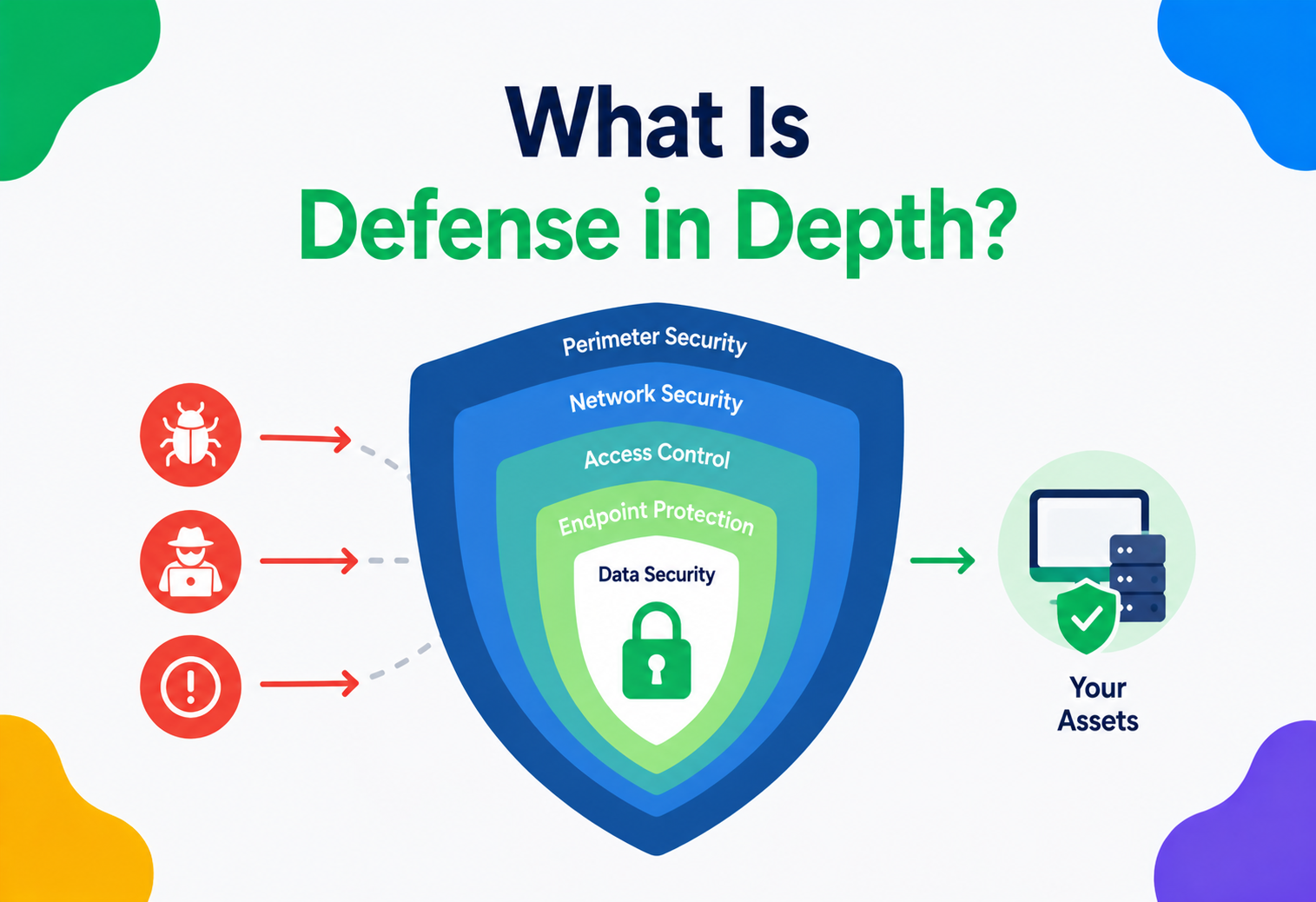
Notice that we now have two independent layers enforcing the same rule: the application-level repository code that looks up the correct region, and the gateway-level filter that double-checks the region again. This overlapping protection is called defense in depth — the idea that you should never rely on just one single safeguard for something this important, because any one component can have a bug. If the first layer fails, the second layer catches the mistake before real harm is done.
Extending the pattern to a third layer: infrastructure-level network policy
Beyond application code and gateway filters, the strongest implementations add a third, even lower-level layer using cloud network policy itself — configuring virtual private cloud (VPC) routing rules and firewall policies so that a database in the EU region is not even network-reachable from a server physically running in the US region, regardless of what any application code says. This third layer acts as a final backstop: even if both the application logic and the gateway filter somehow failed simultaneously, the network itself would still refuse the connection attempt, because the two servers simply have no network path between them at all. Together, these three layers — application, gateway, and network — form a genuinely resilient boundary that does not depend on any single piece of code being perfect.
Data Flow & Lifecycle
Data does not just sit still forever — it is created, used, backed up, sometimes moved for legitimate operational reasons, and eventually deleted. Data residency must be enforced at every stage of that lifecycle, not just at creation time.
Every arrow in that diagram stays inside one region’s box in a real deployment — the backup arrow at the bottom is often the one engineers forget, accidentally configuring a single global backup bucket that quietly undoes all the careful regional separation built earlier.
The full lifecycle stages
- Creation: Data is generated (a user signs up, uploads a file, submits a form) and immediately written to the correct regional store.
- Processing: Any computation on the data (analytics, machine learning, search indexing) should ideally run in the same region, or use privacy-preserving techniques if cross-region processing is unavoidable.
- Storage & backup: Primary storage and backup copies both remain in-region, including disaster recovery replicas.
- Access: Support staff, developers, and automated systems accessing the data must be logged, and access from outside the approved region may need extra approval or may be blocked entirely.
- Transfer (if ever needed): Any legitimate cross-border transfer (e.g., a user relocates countries) must go through documented legal mechanisms, such as Standard Contractual Clauses under GDPR.
- Deletion: When data is deleted, it must be purged from the region it lived in, including backups, according to the retention policy — not left lingering because “it’s just a backup somewhere.”
What happens when a user changes country
One of the trickiest lifecycle events is when a person genuinely moves — say, a customer relocates permanently from Germany to Canada. Does their historical data need to physically move too? The answer depends on the specific law, but many organizations handle this with a formal “regional migration” process: a controlled, logged, one-time transfer that follows the correct legal transfer mechanism (such as signing updated Standard Contractual Clauses), rather than an ordinary background replication job. This process is usually slow and deliberate on purpose, since it is a rare, high-stakes event rather than routine traffic.
Retention and the “right to be forgotten”
Many privacy laws, including GDPR, grant individuals a “right to erasure” (sometimes called “the right to be forgotten”) — the ability to request that a company permanently delete their personal data. Implementing this correctly across a regional architecture means the deletion request must actually reach every regional copy: the primary database, the regional backups, any regional search index, and any regional cache — otherwise a supposedly “deleted” record could quietly reappear from an overlooked backup months later, which is itself a compliance failure.
Legal transfer mechanisms in the data flow
When a cross-border transfer genuinely is necessary and legally justified, engineers typically need to work with legal teams to select the correct mechanism before any data physically moves. Common mechanisms include: relying on an adequacy decision if one exists between the two countries involved; signing Standard Contractual Clauses that legally bind the receiving party to protect the data to an equivalent standard; obtaining explicit, informed consent from the individual for that specific transfer, when permitted; or relying on a narrow legal exception, such as a transfer necessary to fulfill a contract the individual directly requested. Whichever mechanism is chosen, good engineering practice logs which mechanism authorized each specific cross-border transfer, so the organization can prove, months or years later, exactly why a particular piece of data was allowed to move.
Advantages, Disadvantages & Trade-offs
No architectural choice is free. Regional isolation buys legal safety and often better local performance, but it costs money, engineering time, and operational complexity — and the balance shifts depending on how many regions you serve.
Advantages
- Legal and regulatory compliance in every market served
- Stronger customer trust and brand reputation
- Reduced exposure to foreign government data requests
- Lower latency for local users, since data is physically closer to them
- Easier to win government and enterprise contracts requiring local storage
Disadvantages
- Significantly higher infrastructure cost — duplicate systems per region
- Increased engineering complexity — routing, replication, consistency all get harder
- Slower global features (e.g., cross-region search or analytics become difficult)
- Operational overhead — more regions mean more monitoring, more on-call surface area
- Harder disaster recovery if a whole region’s infrastructure fails and you cannot fail over abroad
The central trade-off is almost always cost and complexity versus compliance and trust. A small startup serving only one country does not need any of this. A global company serving regulated industries in a dozen countries may need a completely different data architecture per region, effectively running several smaller companies’ worth of infrastructure stitched together by a thin global layer.
A simple way to think about the cost multiplier
A useful mental model: if a single-region deployment costs a baseline amount of money to run, a fully siloed multi-region deployment does not simply cost twice as much for two regions — it often costs closer to two full baselines, because each region needs its own minimum redundancy, its own on-call monitoring, and its own operational overhead, none of which can be shared across the border. This is why many organizations deliberately avoid the fully siloed pattern until a specific legal or contractual requirement genuinely forces it, preferring the shared control-plane pattern described earlier in the architecture section whenever it is legally sufficient.
Weighing risk against cost quantitatively
Some organizations formalize this trade-off using a simple risk calculation: estimated regulatory fine exposure multiplied by the probability of an incident, compared against the ongoing engineering and infrastructure cost of full regional isolation. While this kind of calculation can never perfectly predict legal outcomes, it helps leadership teams make an informed, deliberate choice rather than either ignoring the risk entirely or over-engineering a solution far beyond what the actual regulatory exposure justifies.
Performance & Scalability Considerations
Splitting data by region can actually help performance in some ways and hurt it in others — understanding both sides is what lets engineers set honest expectations for the product team.
Where it helps
A user in Tokyo talking to a server in Tokyo will always get faster responses than talking to a server in Virginia, simply because network signals take time to travel — this delay is called latency. Regional architectures naturally place data closer to the people using it, which is good for speed. For latency-sensitive workloads like real-time chat, video conferencing, or interactive editing, regional deployment is arguably a feature customers can feel, not just a compliance chore.
Where it hurts
Any feature that needs to look across all regions at once — like a company-wide search, a global leaderboard, or a worldwide fraud-detection model — becomes much harder. You either need to query every region separately and merge results (slow and complex), or maintain a separate, carefully anonymized global aggregate dataset (extra engineering work).
Scalability strategies
- Horizontal sharding by region: Treat each region as its own shard. Adding a new region is like adding a new independent slice, which scales cleanly.
- Read replicas within a region: Rather than sending reads across borders for speed, add more read replicas inside the same region to handle load.
- Edge caching with residency-aware invalidation: Content Delivery Networks (CDNs) can cache non-sensitive content at edge locations, but must be configured so sensitive data never gets cached in a non-compliant country’s edge node.
- Asynchronous, anonymized global rollups: Instead of moving raw personal data, compute anonymized summary statistics locally, then send only those summaries to a global reporting system.
Measuring the real cost of regional isolation
Teams sometimes assume that splitting a system into regions is “free” from a performance standpoint, since each region only serves its own local users. In practice, there are two hidden performance costs worth watching closely: first, smaller regions may have less total server capacity available, meaning a sudden traffic spike in a smaller region can be harder to absorb than it would be in one giant global pool of servers; second, any feature that genuinely needs cross-region data (fraud detection comparing patterns across countries, for example) now pays a real latency and engineering cost to gather that data safely and legally, where before it might have been a single simple query.
Capacity planning per region
Because each region is now its own semi-independent system, capacity planning (deciding how many servers, how much storage, and how much database throughput to provision) must be done per region rather than for the system as a whole. A region serving a smaller population might need proportionally less infrastructure, but still needs its own minimum viable redundancy — you cannot simply divide global capacity evenly across regions and call it done.
A worked example
Imagine a company with 90% of its customers in the United States and 10% in the European Union. A naive approach might provision infrastructure proportionally, giving the EU region roughly one tenth the capacity of the US region. But even a small region still needs at least two availability zones for basic redundancy, a fully staffed on-call rotation capable of responding to incidents, and enough headroom to absorb a sudden regional traffic spike, such as a successful marketing campaign launching specifically in Europe. In practice, the EU region often ends up costing considerably more than 10% of total infrastructure spend, precisely because of this fixed baseline cost that does not shrink proportionally with a smaller user base.
High Availability & Reliability
High availability (HA) means a system keeps working even when something breaks — a server crashes, a disk fails, or an entire data center goes offline. Normally, the easiest way to achieve HA is to replicate data to a data center in a different country as a backup. But data residency rules can forbid exactly that.
How to achieve HA while respecting residency
- Multi-availability-zone deployment within one region: Instead of failing over to another country, fail over to a different data center (availability zone) within the same approved region.
- In-region multi-master replication: Run multiple database replicas across zones in the same region so a single zone failure does not cause downtime.
- Regional disaster recovery drills: Regularly test failing over between zones inside the region to make sure the “in-region only” recovery plan actually works.
- Exception handling for true disasters: Some regulations allow limited, temporary cross-border failover during a declared disaster, but this must be pre-approved and clearly documented, not improvised during an outage.
A region with only one physical data center offers weaker disaster protection than a global system that can fail over anywhere. Compliance sometimes means accepting a slightly higher risk of regional outage in exchange for legal correctness.
Understanding replication consistency in this context
Consistency, in database terms, refers to whether every copy of your data agrees with every other copy at any given moment. When replicas are spread across zones within a single region, the physical distance between them is small (often just a few kilometers), so keeping them tightly synchronized is fast and reliable. Trying to keep the same tight synchronization across zones in different countries would introduce much longer delays, so region-locked HA actually tends to produce simpler, more predictable consistency behavior than a naive worldwide replication scheme would.
Recovery Point Objective and Recovery Time Objective per region
Two common reliability metrics are the Recovery Point Objective (RPO) — how much data loss is acceptable, measured in time, if a failure happens right now — and the Recovery Time Objective (RTO) — how long the system is allowed to stay down before service must be restored. In a residency-constrained system, both of these targets must be achievable using only in-region infrastructure, which sometimes means investing in more availability zones within a single region rather than assuming a distant backup region will always be available to lean on.
A concrete zone failover walkthrough
Suppose a region has three availability zones, and the primary database runs in zone A with synchronous replicas in zones B and C. If zone A suddenly experiences a hardware failure, the system automatically promotes the replica in zone B to become the new primary, typically within seconds, while application servers are redirected to the new primary through the regional load balancer. Because zones B and C are physically close to zone A — often just a few kilometers apart, connected by dedicated low-latency links — this failover can happen quickly and with minimal data loss, all without a single byte ever needing to leave the approved region.
Security in Data Residency
Security and data residency overlap heavily, because a big part of “why does location matter” is really about “who can access this data, and under what legal authority.”
Core security practices
- Encryption at rest and in transit: Data is scrambled using cryptographic algorithms both while stored (at rest) and while traveling across networks (in transit), so that even if intercepted, it is unreadable without the correct key.
- Regional key management: Encryption keys are generated and stored using a regional Key Management Service (KMS), so that even a cloud provider’s staff in another country technically cannot decrypt the data without going through that region’s controlled key service.
- Role-based access control (RBAC): Only specific roles (e.g., “EU support engineer”) can access data belonging to that region, enforced by the software itself, not just by policy documents.
- Audit logging: Every single access to sensitive, regionally-restricted data is logged with who accessed it, when, and why, so that compliance teams can prove residency rules were followed.
- Data masking and tokenization: Replacing sensitive fields with meaningless placeholder tokens for any process (like global analytics) that does not strictly need the real value.
Encryption alone does not satisfy most data residency laws. The physical location of the storage still matters, even if the data is unreadable without a key — the law usually cares about where the bytes sit, not just whether they are scrambled.
The “insider access” problem
A subtle security risk in global companies is that a well-meaning engineer or support agent in one country might have technical access to systems in a completely different region simply because global admin accounts are convenient. Strong data residency security design intentionally makes this inconvenient on purpose: administrative permissions are scoped per region, so an engineer based in the United States genuinely cannot browse a European customer’s raw data without a documented, time-limited, logged exception process — sometimes called “break glass” access, since it is meant to feel deliberately unusual, like breaking a glass panel to reach a fire alarm.
Zero trust principles applied to residency
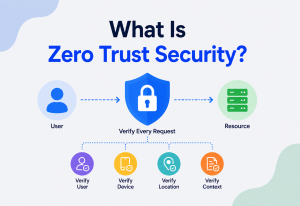
Zero trust is a security philosophy that assumes no request should be automatically trusted just because it came from inside the company’s own network — every request must prove who it is and what it is allowed to do, every time. Applied to data residency, this means a request should never be allowed to reach a regional database purely because “it came from our internal network” — it must also prove it is carrying an approved region tag and passing through the correct regional checkpoint, exactly like the filter example shown earlier in the internal working section.
Building a data classification framework
Effective residency security starts before any code is written, with a clear data classification framework that labels every field an application collects. A typical framework might use four tiers: public data that anyone may see freely; internal data meant only for employees; confidential data meant only for specific authorized roles; and restricted data, the highest tier, covering health records, government identifiers, or biometric information, which receives the strictest regional and access controls of all. Once every database column and API field is labeled this way, engineers can apply residency rules precisely to the data that actually needs them, rather than either over-restricting harmless public data or, worse, under-restricting genuinely sensitive fields because nobody took the time to label them clearly.
Monitoring, Logging & Metrics
You cannot prove compliance with data residency rules unless you can actually observe and prove where your data is going. This is where monitoring and logging become not just an engineering nicety, but a legal necessity.
What to monitor
- Cross-region traffic alerts: Automated alerts that fire if any request or replication job attempts to move regulated data outside its approved region.
- Access logs per region: Detailed logs of who accessed which regional dataset, retained for the period required by the relevant regulation.
- Backup location audits: Regular automated checks confirming backups are physically stored only in approved regions.
- Key usage metrics: Monitoring which region’s KMS was used to encrypt or decrypt data, catching any accidental use of the wrong region’s key.
- Compliance dashboards: A single view for auditors and regulators showing residency status across all regions at a glance.
Metrics here are less about “requests per second” and more about “compliance per second” — teams often build dedicated dashboards purely to answer the question, “can we prove, right now, that no regulated data has crossed a border it was not supposed to?”
Alerting thresholds worth setting
Good monitoring is only useful if someone actually gets paged when something goes wrong. Teams commonly set automated alerts for: any single cross-region network call carrying a customer data payload; any backup job whose destination bucket does not match its expected region; any encryption key usage event originating from a KMS in the wrong region; and any support-tool access to regional customer data lacking a linked support ticket. Each of these alerts, when it fires, should be treated with the same urgency as a security incident, not as routine noise, because in a regulated environment, a single confirmed violation can trigger mandatory legal disclosure obligations within a matter of days.
Audit readiness
Regulators and enterprise customers frequently request formal audits (like SOC 2 or ISO 27001 reports) that specifically examine data residency controls. Good logging practice means these audits can be answered by simply exporting existing dashboards and logs, rather than scrambling to reconstruct history after the fact. Mature organizations treat “could we pass an audit today, with zero preparation time” as an ongoing operational metric, not a once-a-year fire drill.
Tooling commonly used
In practice, teams stitch together several categories of tooling to achieve this level of observability: cloud-native monitoring services (like CloudWatch, Azure Monitor, or Google Cloud Operations) configured with region-specific dashboards; centralized log aggregation tools configured with strict per-region log storage rather than one shared global log store; data loss prevention (DLP) tools that scan outbound network traffic for patterns resembling regulated personal data; and cloud security posture management (CSPM) tools that continuously scan cloud configuration for resources accidentally created in the wrong region. None of these tools alone solves data residency, but together they form the observability backbone that lets an organization catch problems quickly rather than discovering them during a painful, reactive audit.
Deployment & Cloud Considerations
Major cloud providers (Amazon Web Services, Microsoft Azure, Google Cloud Platform) organize their infrastructure into regions (large geographic areas) made up of multiple availability zones (physically separate data centers within that region). This structure maps almost perfectly onto data residency needs.
Deployment strategies
- Single-region deployment: The simplest approach — the entire application runs in one region. Works well for companies serving only one country or bloc (e.g., only the EU).
- Multi-region, siloed deployment: Completely separate deployments per region, each with its own database, application servers, and keys, coordinated by a thin global routing layer. This is the most common pattern for global companies with strict residency needs.
- Multi-region with shared control plane: Data planes (where actual customer data lives) are regional and isolated, but a lightweight, non-sensitive control plane (deployment tooling, monitoring dashboards) is shared globally for efficiency.
- Sovereign cloud offerings: Some providers now offer specially certified “sovereign” regions, operated with extra legal and staffing restrictions (e.g., only citizens of that country can administer the infrastructure) to meet the strictest government requirements.
Amazon Web Services
Offers Regions (e.g., eu-central-1 in Frankfurt) plus specialized options like AWS European Sovereign Cloud for the strictest EU requirements.
Microsoft Azure
Provides “Azure geographies” that guarantee data residency within a geopolitical boundary, plus Azure Government and sovereign cloud variants.
Google Cloud
Offers regional resource locations and “Assured Workloads” plus sovereign controls for regulated industries and governments.
Local & Sovereign Providers
Country-specific clouds (like OVHcloud in France or Aruba in Italy) exist specifically to offer residency guarantees no foreign provider can legally match.
Infrastructure as Code and residency guardrails
Infrastructure as Code (IaC) means defining servers, databases, and networking using version-controlled configuration files rather than manually clicking through a cloud console. Teams serious about residency often add automated “policy as code” checks on top of their IaC pipeline — for example, a rule that automatically rejects any deployment configuration that tries to create a database resource in a disallowed country, catching mistakes before they ever reach production rather than discovering them during an audit months later.
Choosing a deployment strategy based on scale
Smaller companies often start with a single-region deployment and only introduce multi-region silos once they win their first customer or contract that legally requires it — building the full multi-region architecture prematurely can waste significant engineering time solving a problem the business does not have yet. The best practice is to design the data model and code so that adding new regions later is straightforward, without necessarily building every region on day one.
Personnel and operational sovereignty
The strictest sovereign cloud offerings extend the residency concept beyond just where data sits, to who is even allowed to operate the infrastructure. Some government contracts require that only citizens of that specific country, often holding an appropriate security clearance, may perform system administration, technical support, or on-call incident response for the infrastructure hosting that country’s data. This means a global company’s usual “follow the sun” support model, where an incident is handed off to whichever team is awake regardless of location, may need a special exception carved out specifically for sovereign workloads, staffed only by an approved local team even during off-hours.
Databases, Caching & Load Balancing
The database, the cache, and the load balancer are the three layers where region discipline breaks most often in practice — because these components are shared infrastructure by default, and shared infrastructure is exactly what residency rules do not permit for regulated data.
Database design
The most common database pattern for residency is sharding by region, where “sharding” simply means splitting one big dataset into smaller pieces (shards) based on some key — in this case, the user’s assigned country or region. Each shard is a fully independent database, often running on entirely separate physical infrastructure, so there is no ambiguity about where any single row of data lives.
Some systems use a global metadata database (small, non-sensitive, replicated everywhere) paired with regional data databases (large, sensitive, strictly regional) — this two-tier approach keeps lookups fast globally while keeping the actual content safely regional.
Caching considerations
Caching (temporarily storing a copy of data closer to where it is needed, for speed) must respect the same boundaries. A cache node in the wrong country holding even a temporary copy of restricted data can be a compliance violation, even though the cache is meant to be “just for performance.” Teams typically deploy region-scoped caches (e.g., a separate Redis cluster per region) rather than one giant global cache.
Load balancing
A load balancer is a component that spreads incoming requests across multiple servers so no single server gets overwhelmed. In a residency-aware system, load balancing happens in two layers: first, a global geo-load-balancer decides which region a request should go to (based on the user’s assigned region, not just their current network location); second, a normal regional load balancer spreads that request across the servers within the chosen region.
A simple Java example: region-scoped cache lookup
Just like the database repository example earlier, caching code needs the same region-first discipline. Below is a simplified example showing a caching layer that always checks the correct regional cache before falling back to the regional database — never a global, shared cache.
public class RegionAwareCacheService {

    // one Redis client per region
    private final Map<String, CacheClient> regionCaches;
    private final RegionAwareUserRepository userRepository;

    public RegionAwareCacheService(Map<String, CacheClient> regionCaches,
                                   RegionAwareUserRepository userRepository) {
        this.regionCaches    = regionCaches;
        this.userRepository  = userRepository;
    }

    public User getUser(String userId, String region) {
        CacheClient cache = regionCaches.get(region);
        if (cache == null) {
            throw new IllegalStateException(
                "No cache configured for region: " + region);
        }

        User cached = cache.get(userId, User.class);
        if (cached != null) {
            // fast path, served entirely from the correct regional cache
            return cached;
        }

        // cache miss: fetch from the regional database,
        // then populate only the regional cache
        User user = userRepository.findUserById(userId);
        cache.set(userId, user, Duration.ofMinutes(10));
        return user;
    }
}
Notice that the cache client itself is selected using the same regional map pattern used for databases earlier. This consistency across every layer — database, cache, and even message queues — is what makes a residency-aware system auditable: an engineer reviewing the code can quickly confirm that every data-touching component follows the identical “look up region, then use only that region’s resource” rule.
Message queues and event streaming
Many modern systems use message queues or event streaming platforms (like Kafka or managed cloud pub/sub services) to pass data between services asynchronously. These, too, must be deployed per region when carrying regulated data, since a shared global message topic could easily become an invisible cross-border data pipe if a producer or consumer in the wrong region accidentally subscribes to it.
Search and indexing services
Full-text search engines and analytics indexes (such as Elasticsearch or OpenSearch clusters) present a special challenge because they often copy data out of the primary database into a separate, differently-structured index optimized for fast searching. It is easy to forget that this copy is still a copy, subject to the same residency rules as the original — a search cluster deployed globally for convenience, while the primary database is correctly regional, is one of the more common real-world compliance gaps discovered during audits, precisely because it is not the “main” database and so escapes casual scrutiny.
APIs & Microservices
In a microservices architecture — where an application is broken into many small, independent services instead of one giant program — data residency adds an extra dimension to service design. Each service that touches personal data typically needs its own regional deployment, not just the database.
API design patterns for residency
- Region in the request path or header: APIs often expose region explicitly, e.g.,
https://eu.api.example.com/usersversushttps://us.api.example.com/users, making the boundary obvious to developers and auditors alike. - Service mesh region tagging: A service mesh (infrastructure layer managing service-to-service communication) can be configured to physically block calls between services in different regions if those calls would move regulated data.
- API gateways as the single entry enforcement point: Rather than trusting every individual microservice to enforce residency correctly, the API gateway acts as a single checkpoint that all traffic must pass through, simplifying auditing.
A microservice in Region A calling a “helper” microservice in Region B to do some processing can accidentally leak regulated data across the border, even if both services belong to the same company. Every inter-service call carrying sensitive data must be reviewed for residency impact.
Versioning and shared libraries across regions
When every region runs its own copy of the same microservices, teams still want to avoid maintaining twenty slightly different codebases. The common solution is to keep a single shared codebase and shared libraries, but deploy that same code independently into each region with region-specific configuration (database connection details, KMS key identifiers, allowed outbound network destinations). This way, a bug fix or new feature is written once and rolled out everywhere, while the actual runtime behavior — and the physical location data touches — remains strictly separated per region.
Testing residency behavior automatically
Because humans make mistakes, mature teams write automated integration tests that specifically try to violate residency rules on purpose, in a safe test environment, to confirm the system correctly blocks them. For example, a test might simulate a request claiming to be from the EU region but targeting the US database connection, then assert that the system rejects it with the expected error, exactly like the filter shown earlier. Running these tests automatically on every code change catches regressions long before they ever reach real customer data.
Documenting residency guarantees in API contracts
Well-run engineering organizations treat residency guarantees as part of the public contract of an API, not just an internal implementation detail. This means API documentation explicitly states which region a given endpoint serves, what happens if a client sends a request tagged for the wrong region, and what recourse a customer has if they later discover they were assigned to the wrong region by mistake. Making these guarantees explicit and discoverable — rather than something a customer has to ask a salesperson about — builds the same kind of trust that data residency is meant to protect in the first place.
Design Patterns & Anti-patterns
A handful of structural patterns keep showing up in successful residency implementations, and a handful of anti-patterns keep tripping up teams that skip them. Learning both lists shortens the road considerably.
Good patterns
- Silo pattern: Fully independent stack per region — simplest to reason about, easiest to audit, but the most expensive to run.
- Pod pattern: A shared application layer with region-specific data stores plugged in underneath, balancing cost and compliance.
- Metadata/data split pattern: Keep a tiny global index of “who lives where” separate from the large regional stores holding the actual sensitive content.
Anti-patterns (mistakes to avoid)
- The “global database with a region column” trap: Simply adding a “region” column to one giant shared database does not satisfy most residency laws, because the underlying physical server is still in one place.
- Forgetting logs and backups: Enforcing residency on primary data but shipping error logs or backups to a centralized, globally-located logging service.
- Hardcoding region assumptions: Writing code that assumes “everyone is in one region” makes it painful to expand later — always design the region lookup as a first-class concept from day one.
- Ignoring third-party subprocessors: Using a third-party email, analytics, or support tool that stores data in an unapproved country, even though your own infrastructure is compliant.
The federated pattern
A middle-ground pattern worth naming explicitly is the federated pattern, where each region operates a mostly independent deployment, but a small set of carefully anonymized, aggregated statistics are federated upward into a central global reporting system — similar in spirit to how federated learning lets machine learning models improve using data spread across many devices without that raw data ever leaving those devices. This pattern lets a company get company-wide business insight (total revenue, overall growth trends) without ever centralizing the raw, regulated customer records that produced those insights.
Anti-pattern: the “temporary” cross-region debug copy
One of the most common real-world violations is not architectural at all — it is a well-meaning engineer copying a snapshot of regional production data to their own laptop or a personal cloud storage account “just to debug an issue quickly,” fully intending to delete it afterward. Because this bypasses every architectural safeguard at once, strong organizations combat it with policy, training, and technical controls (like disabling bulk data export entirely for regional production systems) rather than relying on good intentions alone.
Comparing the patterns side by side
| Pattern | Compliance Strength | Relative Cost | Best Fit For |
|---|---|---|---|
| Silo pattern | Strongest | Highest | Heavily regulated industries like banking and government |
| Pod pattern | Strong | Moderate | Mid-size SaaS companies serving several regulated regions |
| Metadata/data split | Good, with careful review | Lower | Companies needing fast global lookups alongside regional data |
| Federated pattern | Good for aggregates only | Low, on top of existing regional systems | Global reporting and analytics needs |
Best Practices & Common Mistakes
The list below distills the practical lessons of the previous chapters into a single, glanceable checklist that engineering leads can use before locking in a new architecture or reviewing an existing one.
Best Practices
- Classify data sensitivity early so you know exactly what needs strict residency versus what does not
- Treat region as a first-class field in your data model from the very first schema design
- Automate residency compliance checks in your deployment pipeline, not just manual audits
- Include backups, logs, caches, and third-party vendors in your residency scope
- Document legal basis for any unavoidable cross-border transfer
Common Mistakes
- Assuming encryption alone satisfies residency requirements
- Treating residency as a “compliance checkbox” handled only at launch, not maintained over time
- Allowing engineers unrestricted, unlogged cross-region debugging access
- Not testing disaster recovery within the region-only constraint before a real outage happens
Building a data residency governance program
Beyond individual engineering practices, larger organizations typically stand up a formal governance program to keep residency compliant over time, since systems constantly change and a one-time architecture review becomes outdated quickly. A typical governance program includes: a data classification policy defining exactly which data categories require residency controls; a data map (sometimes called a “record of processing activities”) documenting exactly where every category of data physically lives and why; a vendor review process that checks every new third-party tool for its own residency guarantees before it is approved for use; and periodic re-certification, where each region’s compliance status is formally re-verified on a recurring schedule, not just once at launch.
Cross-functional ownership
One easy-to-miss best practice is recognizing that data residency cannot be owned by engineering alone. Legal teams must interpret the actual regulatory text, security teams must implement and monitor technical controls, and product teams must design features (like region selection during sign-up) that make the whole system usable for customers. The strongest organizations create a shared, cross-functional working group specifically for data residency, rather than treating it as purely an engineering checkbox or purely a legal document exercise.
Real-World & Industry Examples
The best way to understand how data residency shapes real architecture is to look at how large, well-known companies and regulated industries have responded to it in public. Each of the examples below tells a slightly different story about the same underlying pressure.
Microsoft
Microsoft built “EU Data Boundary” commitments for its Microsoft 365 and Azure customers, guaranteeing that customer data and its processing stay within the European Union, directly in response to GDPR pressure and European regulator concerns following the Schrems II court ruling that invalidated an earlier EU-US data transfer agreement.
Amazon Web Services
AWS launched the “AWS European Sovereign Cloud,” a physically and logically separate cloud infrastructure operated entirely within the EU, including EU-resident-only staff for operations, to serve the most demanding government and regulated-industry customers.
Salesforce
Salesforce offers “Hyperforce,” an architecture that lets customers choose exactly which country or region their Salesforce data resides in, replacing an older architecture where customers had far less control over data location.
Banking sector
Many countries require that core banking transaction data physically remain within national borders. Global banks operating in dozens of countries often run genuinely separate core banking systems per country specifically because of this requirement, rather than one unified global system.
Healthcare sector
Health data is among the most tightly regulated categories anywhere. Countries like Australia require certain health records to stay within national borders, and hospital software vendors design entirely separate regional deployments to serve these markets.
SAP
Enterprise software giant SAP built dedicated regional cloud data centers specifically so government and public-sector customers in individual countries could run SAP’s cloud products while guaranteeing their data never left national borders, a requirement that became a deciding factor in many public-sector procurement contracts.
China’s data localization requirements
China’s Cybersecurity Law and subsequent Personal Information Protection Law require that “critical information infrastructure operators” store personal data collected within China on servers physically located in China, with special government approval required before any cross-border transfer. Global companies operating in China, including major automakers and technology firms, have had to build entirely separate Chinese data infrastructure, sometimes operated through local joint-venture partners, purely to comply.
Russia’s data localization law
Since 2015, Russian law has required that companies collecting personal data on Russian citizens store the primary copy of that data on servers physically inside Russia. Several major global social media and technology platforms were fined or blocked from operating in Russia after failing to comply with this requirement, illustrating how seriously some governments enforce these rules.

Slack and enterprise data residency add-ons
Workplace messaging platform Slack introduced a paid “data residency” add-on specifically so large enterprise customers, particularly in regulated industries and government, could choose to store their organization’s messages and files within a specific geographic region, illustrating how residency has become a monetizable enterprise feature in its own right, not just a background compliance detail.
Automotive and connected vehicle data
Modern connected cars generate enormous volumes of location and behavioral data. Several countries now require that data generated by vehicles operating within their borders be stored domestically, leading global automakers to build regional cloud infrastructure specifically for vehicle telemetry, separate from their global engineering and manufacturing systems.
Frequently Asked Questions
These are the questions that come up again and again in real conversations with engineers, product managers, and executives who are just starting to work with data residency requirements.
Is data residency the same thing as data privacy?
No. Privacy is about controlling who can see or use personal data, regardless of where it is stored. Residency is specifically about the physical location of storage. A system can have strong privacy but poor residency (data is well-protected but stored in the wrong country), or the reverse.
Does encrypting data solve residency requirements?
Generally, no. Most laws care about the physical location of storage, not just whether the data is encrypted. Encryption is a security best practice that should be layered on top of, not instead of, proper regional storage.
Can a small startup ignore data residency?
It depends entirely on which markets and industries the startup serves. A startup serving only customers in its home country with no regulated data category may not need to worry about it at all initially. But it becomes urgent quickly once serving regulated industries or international customers.
What is the difference between data residency and data localization?
Data residency is often used loosely to describe general geographic storage preferences. Data localization usually refers to stricter, government-mandated laws requiring certain data types to never leave a country, sometimes with no exceptions even for backups or disaster recovery.
Do all countries have the same data residency rules?
No — rules vary enormously by country and even by industry within a country. This is why global companies often need a flexible, per-region architecture rather than a one-size-fits-all approach.
Does using a major cloud provider automatically guarantee data residency compliance?
Not automatically. Cloud providers give you the tools — regions, sovereign clouds, regional key management — but it is still the customer’s responsibility to actually configure their application to use the correct region consistently across databases, backups, logs, and third-party integrations. Compliance is a shared responsibility between the cloud provider and the company building on top of it.
What happens if a company violates data residency laws?
Consequences vary by jurisdiction and severity, but commonly include financial penalties (which under GDPR can reach up to 4% of a company’s global annual revenue for the most serious violations), mandatory corrective action plans, loss of specific operating licenses, and significant reputational damage that can affect customer trust for years afterward.
Can AI and machine learning models be trained without violating data residency?
Yes, but it requires care. Common approaches include training separate regional models using only that region’s local data, using privacy-preserving techniques like federated learning where raw data never leaves its region, or training on properly anonymized data that no longer counts as personal data under the relevant law.
Is data residency only relevant to large global companies?
No. Even a small company can be required to meet data residency rules if it serves customers in a regulated industry (healthcare, finance, government) or a country with strict localization laws, regardless of the company’s own size or country of origin.
How is data residency different from data governance?
Data governance is the broader discipline of managing data quality, ownership, access, and lifecycle across an organization. Data residency is one specific concern within that broader discipline, focused narrowly on physical storage location. A good governance program will typically include residency as one of several policies it enforces, alongside things like data quality standards and retention schedules.
Can a single database table hold data from multiple regions if it is properly labeled?
Generally this does not satisfy most residency requirements, because the underlying physical server is still located in only one place. Even if rows are logically labeled by country, if the actual disk storing those rows sits in the wrong country, the residency requirement is not met. This is precisely why sharding into fully separate regional databases, rather than a labeled global one, is the standard accepted approach.
What role does a Data Protection Officer play in data residency?
A Data Protection Officer (DPO), a role required under GDPR for many organizations, is responsible for overseeing an organization’s data protection strategy and compliance, including reviewing data residency architecture decisions, advising on cross-border transfer mechanisms, and serving as a point of contact for regulators. Engineers designing residency-aware systems often work closely with the DPO to make sure technical decisions align with the organization’s documented legal obligations.
What to Carry Forward
If there is one idea worth carrying away from this entire guide, it is this: data residency is not a compliance checkbox — it is an architectural constraint that quietly shapes almost every layer of a serious global system, from the database schema to the on-call rotation.
A system designed with residency in mind from the beginning stays boring on audit day, because there is nothing surprising to find. A system that ignored residency until a regulator, a customer, or a court forced the conversation almost always pays for that delay in emergency rewrites, contractual renegotiations, and lost trust. The chapters above walked through what data residency is, why laws around it exist, how to translate those laws into concrete architecture, and how to keep that architecture honest over time. The following points distill everything above into a short, memorable checklist.
Key Takeaways
- Data residency is about where data physically lives, driven by law, regulation, and trust — not just technical convenience.
- It grew from a side effect of early, location-bound computers into a deliberate legal requirement after cloud computing made data mobile and laws like GDPR emerged in response.
- Core architecture relies on regional data stores, region-aware routing, regional encryption keys, and regional backups working together.
- Every stage of the data lifecycle — creation, processing, backup, access, transfer, and deletion — must respect the same regional boundary.
- The central trade-off is cost and engineering complexity versus legal compliance and customer trust.
- Common failure points are backups, logs, caches, and third-party vendors — not just the primary database.
- Major clouds now offer purpose-built sovereign and regional infrastructure specifically to make compliant architecture easier to build.
- Defense in depth matters: enforce region boundaries at the application layer and again at the gateway or network layer, so a single mistake never becomes a violation.
- Data residency is a genuinely cross-functional responsibility, requiring legal, security, product, and engineering teams to collaborate rather than treating it as any single team’s isolated task.
- Because regulations only tend to grow stricter and more numerous over time, designing flexible, region-aware systems early tends to save significant rework later, even for companies not yet legally required to comply.
Data residency is the deliberate, engineered promise that a person’s data will live only where the law and the people it describes have agreed it may live — enforced not by good intentions but by architecture, monitoring, and habit.
Design your systems so that residency is not a topic anyone has to argue about on audit day — because the code, the deployments, and the dashboards already answer the question quietly, correctly, and the same way every single time.