What Is Multi‑Master Replication?
A complete, beginner‑friendly walk‑through of how databases let more than one server accept writes at the same time — why it exists, how it really works under the hood, and where it can hurt you if you are not careful.
Introduction & History
Imagine a classroom where only the teacher is allowed to write on the whiteboard. If a student wants to add something, they must raise their hand, walk up, and wait for the teacher to write it for them. This works fine in a small classroom. But now imagine a school with 500 classrooms spread across five different cities, and every single change to every whiteboard in every city has to go through one teacher sitting in one room. That teacher becomes exhausted, slow, and if that teacher gets sick for a day, nothing can be written anywhere in the world. That one‑teacher system is exactly how a traditional database works when it uses single‑master replication. Multi‑master replication is what happens when we say: “Let’s allow a trusted teacher in every city to write on their own local whiteboard, and let’s make sure all the whiteboards eventually show the same thing.”
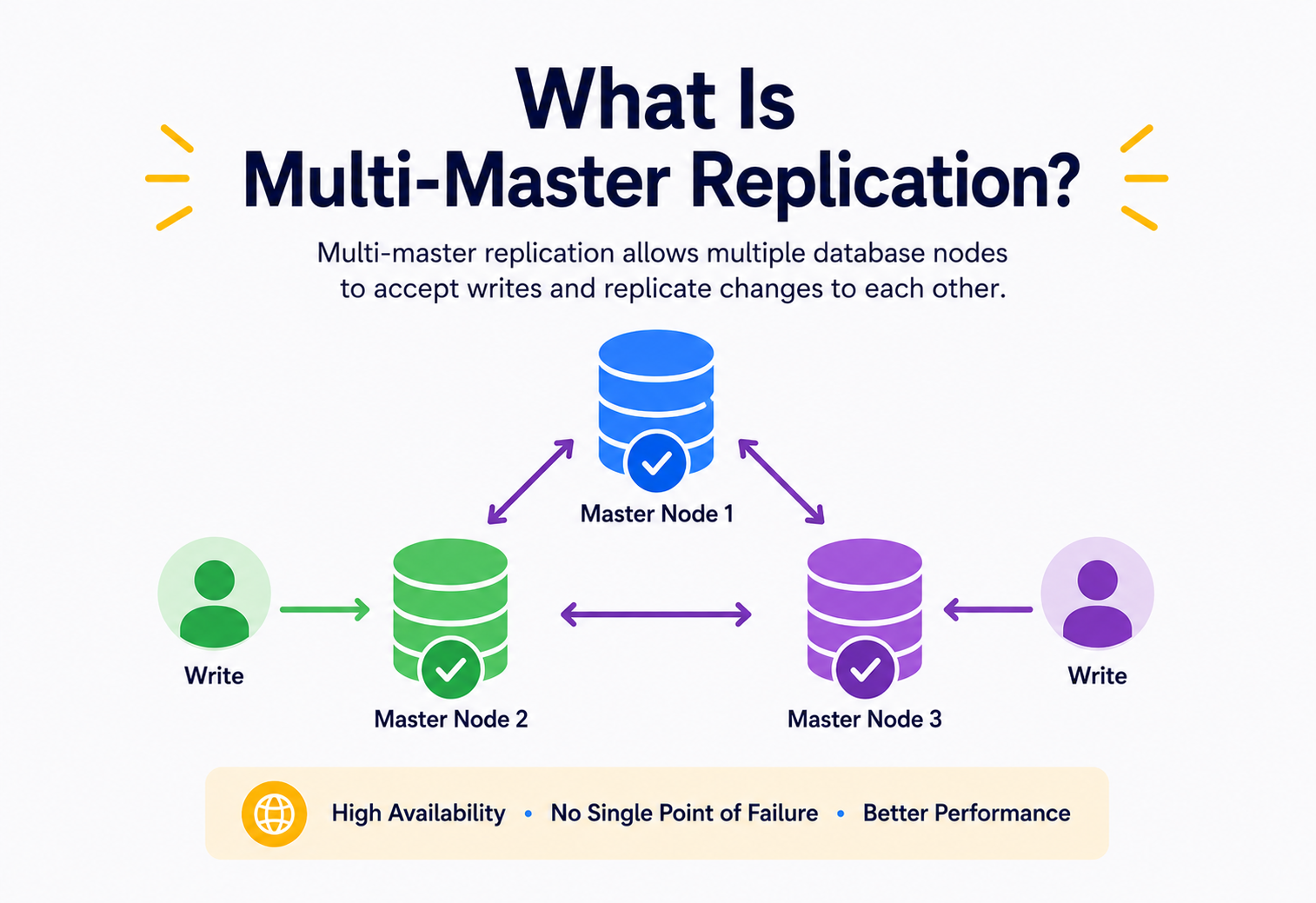
In technical terms, multi‑master replication (also called multi‑primary replication, or sometimes active‑active replication) is a database architecture pattern where more than one database node (server) is allowed to accept write operations (INSERT, UPDATE, DELETE) at the same time, and those writes are then copied (“replicated”) to all the other nodes so that, eventually, every node has the same data.
1.1 Where Did This Idea Come From?
Databases have always had one core job: store data safely and let people read and change it. In the earliest days of computing (1960s–1970s), a database usually lived on a single, large mainframe computer. There was only one copy of the data, so there was nothing to “replicate.” If that machine broke, the company’s data was gone or unavailable until it was fixed.
As businesses grew and the internet appeared in the 1990s, two new pressures showed up:
- Pressure 1 — Users everywhere: A company like an airline or bank started having customers not just in one city but across an entire country, and later, the entire world.
- Pressure 2 — One machine is not enough: A single computer can only handle so many read and write requests per second before it becomes overloaded.
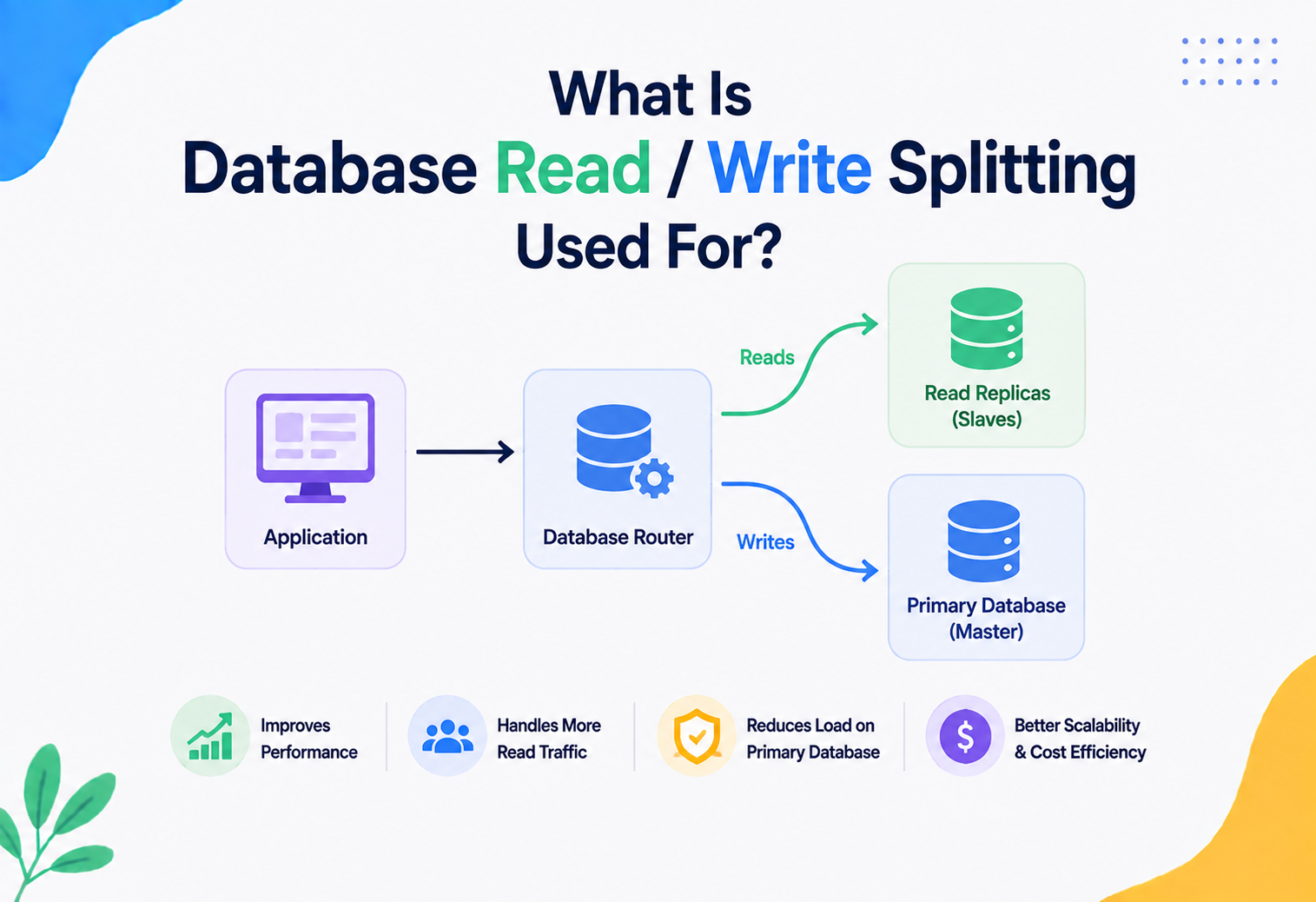
The first fix engineers built was single‑master (primary‑replica) replication: one “master” database accepts all writes, and it copies its changes to one or more “replica” (or “slave”) databases that are mostly used for reading data. This spread out the read traffic and gave a backup copy of the data. This pattern is still extremely common today and works well for a huge number of applications.
But single‑master replication still has that one‑teacher problem: only one node can accept writes. If your users are spread across California, Mumbai, and Tokyo, every write from a Tokyo user has to travel all the way to wherever the single master server lives — maybe in a data center in Virginia, USA. That trip across the ocean and back can take 200 to 300 milliseconds, which feels slow to a real user tapping a button on their phone.
By the late 1990s and especially through the 2000s, as companies like Amazon, Google, and eBay grew into truly global businesses, engineers started asking: “What if we let a database server in each region accept writes locally, and figure out how to merge everyone’s changes together afterward?” This question led to the birth of multi‑master replication as a serious, widely used pattern. Systems like Lotus Notes (in the 1990s, for collaborative documents), and later distributed databases such as Cassandra, CouchDB, Riak, and multi‑master setups of MySQL and PostgreSQL, all popularized different flavors of this idea. Today, most large‑scale, globally distributed systems — including parts of Amazon’s shopping cart infrastructure, Google’s Spanner, and many messaging and gaming platforms — use some form of multi‑master or multi‑leader replication.
1.2 A Brief Timeline
- 1960s–70sDatabases live on a single mainframe. One copy of the data; nothing to replicate. If the machine dies, the data is unavailable.
- 1980s–90sSingle‑master (primary‑replica) replication emerges: one writer, many read‑only followers. Great for read scale, still fragile for writes.
- 1990sLotus Notes popularizes multi‑master ideas for collaborative documents that must sync across offices.
- 2000sAmazon, Google, eBay, and others push the pattern to production for global user bases. Amazon’s 2007 Dynamo paper crystallizes the trade‑offs.
- 2010sCassandra, Riak, CouchDB, MySQL Group Replication, Galera, and PostgreSQL BDR make multi‑master accessible to mainstream teams.
- TodayManaged multi‑region multi‑master services (DynamoDB Global Tables, Cosmos DB, Spanner, CockroachDB) hide much of the plumbing behind a simple API.
Think of a shared family shopping list app used by everyone in a household, but each family member sometimes has no internet connection. Mom adds “milk” while she is offline at the gym. Dad adds “bread” while he is offline at work. Later, when both phones reconnect to the internet, the app must combine both changes into a single list containing both “milk” and “bread.” Multi‑master replication is the technology that makes this kind of “everyone can edit, then we merge later” system possible for databases at massive scale.
Replication simply means “making and keeping copies of the same data on more than one machine.” Multi‑master means more than one of those machines is allowed to accept new writes, instead of just one.
The Problem & Motivation
Before we go deeper, let’s clearly understand why anyone would want multiple masters at all. Every good engineering pattern exists because it solves a real, painful problem. Let’s list the problems with having only a single master.
2.1 Problem 1 — Distance Makes Writes Slow
The speed of light is fixed. It is physically impossible to send data faster than light can travel, even through the best fiber optic cable. If your single master database sits in a data center in the United States, and a user in Australia tries to save their data, that request has to physically travel across the ocean and back — often 250 milliseconds or more round trip, before the user even sees “Saved!” on their screen. Multiply that by millions of users doing this thousands of times a day, and the delay becomes a real, painful user‑experience problem.
Imagine you live in Delhi but every letter you write must first be mailed to New York, approved there, and then mailed back to Delhi before your friend next door can read it. That is what single‑master writes feel like for users far away from the master server.
2.2 Problem 2 — A Single Point of Failure
If there is only one master and that one server crashes — because of a hardware failure, a power outage, a software bug, or a network cable being cut — then no one anywhere in the world can write new data until either that server comes back up or a new master is manually or automatically promoted. For businesses like banks, airlines, or e‑commerce platforms that operate 24 hours a day, even a few minutes of “cannot write” downtime can mean lost sales, angry customers, and real financial damage.
2.3 Problem 3 — Write Throughput Ceiling
A single machine, no matter how powerful, has limits on how many write operations per second it can process. As an application grows to millions of users, the number of writes per second (new orders, new messages, new game moves, new sensor readings) can grow beyond what one machine can handle, even with the best hardware money can buy.
2.4 Problem 4 — Regional Laws and Data Residency
Many countries now have laws that require certain types of data (health records, financial data, personal data) to be stored and processed within that country’s own borders. If you only have one master database in one country, you cannot easily satisfy these laws for a global user base.
None of these problems are “nice to have” concerns. They are the exact reasons that companies like Amazon, Google, and WhatsApp invested years of engineering effort into building multi‑master and multi‑leader systems. Interviewers love asking about multi‑master replication precisely because it sits at the center of these very real, very expensive trade‑offs.
2.5 The Motivation, in One Sentence
Multi‑master replication exists so that users anywhere in the world can write data to a server physically close to them, quickly and even while other parts of the system are down, while the system works in the background to make sure everyone’s data eventually matches.
That last phrase — “eventually matches” — is one of the most important ideas in this entire tutorial. Keep it in mind. We will explain it fully in the next section.
Core Concepts
Before we can understand how multi‑master replication works internally, we need a solid vocabulary. We will explain each term the same way every time: what it is, why it exists, where it’s used, a simple analogy, and a practical example.
WhatA node is simply one running instance of a database server — one machine (physical or virtual) that stores a copy of the data.
WhyWe need a word for “one participant” in a system that has many participants working together.
WhereEvery distributed database — MySQL, PostgreSQL, Cassandra, MongoDB — refers to its individual servers as nodes.
AnalogyOne branch of a bank is one “node.” The bank as a whole is the entire distributed system made of many branches.
ExampleA company might run three nodes: one in Mumbai, one in Frankfurt, and one in Virginia, each holding a full copy of the same customer database.
WhatA master (also called a primary) is a database node that is allowed to accept write operations directly from applications.
WhySomeone has to be the “source of truth” that first records a change before it spreads to others.
WhereIn single‑master systems, there is exactly one. In multi‑master systems, there are two or more.
AnalogyA master is like a bank branch that is allowed to open new accounts and process withdrawals on the spot, rather than having to phone head office first.
WhatA replica is a node that receives copies of changes made elsewhere. In pure single‑master systems, replicas usually only serve reads, not writes.
WhyTo spread out read traffic and to provide backup copies of data in case the master fails.
AnalogyA replica is like a photocopy of the bank’s master ledger kept in a different building, updated every time the original changes.
WhatA setup where two or more nodes each act as a master — each can accept writes independently, and each replicates its changes to the others.
WhyTo remove the single point of failure and the “far‑away master” latency problem described earlier.
AnalogyInstead of one head office approving every transaction, every bank branch is trusted to approve its own transactions immediately, and branches send each other nightly (or instant) summaries so all branches stay in sync.
ExampleA global chat application where a user in London sends a message that is written to the London node, and a user in Tokyo sends a message that is written to the Tokyo node — both writes succeed instantly, locally, and are later merged.
WhatThe time delay between when a write happens on one node and when that same write shows up on another node.
WhyBecause copying data across a network — sometimes across continents — is never instantaneous.
AnalogyIt’s like sending a postcard to a friend in another country. You wrote it today, but they won’t read it until it physically arrives, days later.
ExampleIf replication lag is 200 milliseconds, a customer in Mumbai might update their profile picture, and for a fraction of a second, a friend viewing their profile from a Frankfurt node might still see the old picture.
WhatA situation where two different masters accept two different, competing changes to the same piece of data at roughly the same time, before either change has been replicated to the other.
WhyBecause multiple masters work independently and don’t ask each other for permission before writing, two people can accidentally change the same thing at once.
AnalogyImagine two editors of the same shared document, both offline, both changing paragraph 3 to say something different. When their laptops reconnect to the internet, whose version of paragraph 3 should win?
ExampleUser A, connected to the Delhi node, changes their shipping address to “Address X.” At nearly the same moment, User A (using another device) connected to the Singapore node changes it to “Address Y.” Both writes succeed locally. This is a write conflict that must be resolved.
WhatThe set of rules or algorithms a system uses to decide which change “wins” when a conflict like the one above happens.
WhyBecause the system must end up in one consistent, agreed‑upon state, not two different states forever.
We will cover the actual strategies (Last‑Write‑Wins, Vector Clocks, CRDTs, application‑level merge) in detail in the Internal Working section.
WhatA guarantee that says: “If no new writes happen, all replicas will eventually converge to the same value — but at any given instant, different nodes might temporarily show different data.”
WhyMulti‑master systems trade strict, instant consistency for speed and availability. This trade‑off is formalized by the CAP theorem, which we cover shortly.
AnalogyNews about a goal in a football match spreads through a stadium crowd gradually — the people near the incident know instantly, people at the far end of the stadium find out a few seconds later through word of mouth, but eventually everyone knows the same thing.
WhatA small data structure attached to each piece of data that records, per node, how many times that node has updated this data. It helps the system figure out whether one version of the data “happened before” another, or whether they happened independently (a true conflict).
AnalogyImagine every branch of a company keeps its own numbered stamp: “Mumbai stamp #5,” “Tokyo stamp #3.” By comparing stamps, you can tell if one document is a direct descendant of another, or if two people edited unrelated versions at the same time.
WhatA rule, proven by computer scientist Eric Brewer in 2000, that says a distributed data system can only fully guarantee two out of these three properties at the same time:
- Consistency (C): Every read gets the most recent write, everywhere.
- Availability (A): Every request gets a (non‑error) response, even during failures.
- Partition Tolerance (P): The system keeps working even if the network between nodes is cut or delayed.
Since real networks do experience partitions (a cut cable, a router failure, a slow link), Partition Tolerance is usually non‑negotiable for any distributed system. This means, in practice, engineers must choose between Consistency and Availability during a network partition. Multi‑master replication is a classic “AP” choice — it favors Availability (every master keeps accepting writes) over strict Consistency (all nodes agreeing instantly).
AnalogyIf two branches of a bank lose their phone line to head office, they can either (a) stop serving customers until the line is fixed (choosing Consistency over Availability) or (b) keep serving customers with their local records and reconcile differences once the phone line is back (choosing Availability over Consistency). Multi‑master systems choose option (b).
WhatA property of an operation where applying it once, or applying it many times, produces the exact same result.
WhyIn distributed systems, the same replicated write might accidentally be delivered and applied more than once (for example, after a network retry). Idempotent operations make this safe.
AnalogyPressing an elevator button that is already lit up does not call two elevators — pressing it once or five times has the same effect.
Example“Set balance to $500” is idempotent — running it twice still leaves the balance at $500. “Add $500 to balance” is NOT idempotent — running it twice adds $1000 by mistake. This distinction matters enormously when designing replication logs.
Architecture & Components
Let’s now look at the actual pieces that make up a multi‑master replicated system, and how they fit together.
4.1 The Building Blocks
- Master Nodes: Two or more database servers, each capable of accepting writes.
- Replication Log (WAL / Binlog / Oplog): Every master keeps an ordered, append‑only record of every change it makes, called a Write‑Ahead Log (in PostgreSQL), Binary Log (in MySQL), or Oplog (in MongoDB). This log is what gets shipped to other nodes.
- Replication Channel / Transport: The network pathway (often TCP‑based, sometimes message queues like Kafka) used to ship log entries from one node to another.
- Conflict Detector & Resolver: Logic (built into the database or the application) that spots when two masters changed the same data and decides the final value.
- Clients / Applications: The actual apps (web servers, mobile backends) that send read and write requests, usually to the nearest or most convenient master.
- Load Balancer / Router (optional): A layer that directs each client’s request to an appropriate master, often based on geography.
Notice the key difference from single‑master: the arrows between the nodes go in both directions. In single‑master replication, the arrows would only point one way — from the one master out to the replicas.
4.2 Topologies (Ways to Connect Multiple Masters)
There isn’t just one way to wire multiple masters together. Common topologies include:
a) All‑to‑All (Mesh) Topology
Every master directly replicates to every other master, as shown in Fig 4.1. This is simple to reason about but the number of connections grows quickly: with 3 masters you need 3 connections, but with 10 masters you’d need up to 45 connections.
b) Circular (Ring) Topology
Each master only talks to its “next” neighbor in a circle; changes travel around the ring until they reach everyone. This uses fewer connections but a single broken link can stop changes from reaching part of the ring, and it takes longer (more “hops”) for data to reach far‑away nodes.
c) Star Topology
One central “hub” master relays changes between several “spoke” masters, who don’t talk to each other directly. This reduces connections but makes the hub a soft dependency (though not a single point of failure for writes, since spokes can still accept writes locally).
Most production systems with more than 4–5 master nodes avoid full mesh because of the connection‑count explosion, and instead use smarter gossip‑based propagation (like Cassandra) where nodes exchange information about what other nodes know, spreading changes efficiently without needing every node to connect to every other node.
4.3 Synchronous vs. Asynchronous Replication
| Aspect | Synchronous replication | Asynchronous replication |
|---|---|---|
| Write confirmed to client | Only after other node(s) confirm they received it | Immediately, before other nodes receive it |
| Speed | Slower (waits on network round‑trip) | Faster (no waiting) |
| Data loss risk on crash | Very low | Possible (unreplicated writes can be lost) |
| Common use | Financial transactions, small clusters in same data center | Global multi‑master, most large‑scale systems |
Most true multi‑master systems use asynchronous replication between distant nodes, because waiting for a confirmation from a server on another continent for every single write would make the system painfully slow. This is exactly why eventual consistency and conflict resolution become necessary — the speed we gain comes with the responsibility of handling temporary disagreement.
Internal Working
This is the heart of the tutorial: how does a multi‑master system actually decide what happens when two nodes write conflicting data? Let’s walk through it step by step.
5.1 Step 1 — Capturing the Change
When an application writes to a master node, that node first writes the change to its local replication log (an ordered, append‑only file) before or as it applies the change to the actual table. Every entry in this log typically includes:
- The actual change (e.g. “set column email to new@x.com for row with id 42”)
- A timestamp
- A unique identifier for the node that made the change
- A version marker (like a vector clock entry or a monotonically increasing sequence number)
5.2 Step 2 — Shipping the Change
The node then sends this log entry to the other master nodes, either directly (point‑to‑point) or through a message broker like Apache Kafka, which many modern systems use as a durable, ordered “delivery truck” for replication events.
5.3 Step 3 — Applying the Change on Other Nodes
When a remote node receives the log entry, it tries to apply the same change locally. If that row hasn’t been touched by anyone else since the last sync, this is simple — the change just gets applied, and now both nodes agree.
5.4 Step 4 — Detecting a Conflict
Sometimes, the remote node discovers that the very same row was also changed locally, by a different write, before this incoming change arrived. Now there are two competing versions of the truth. The system must detect this using the version markers mentioned above — usually by comparing vector clocks or sequence numbers to see if one write is a “descendant” of the other, or if they are “siblings” (a true conflict).
5.5 Step 5 — Resolving the Conflict
This is where different databases make different design choices. Here are the most common strategies used in real systems:
Strategy A: Last‑Write‑Wins (LWW)
What it is: Every write carries a timestamp. When a conflict is found, the write with the latest (largest) timestamp simply overwrites the other.
Why it’s popular: It’s extremely simple to implement and reason about.
Downside: Clocks on different machines are never perfectly synchronized (this is called “clock skew”), so “latest” isn’t always truly the most recent action from a human perspective — and worse, one user’s legitimate change can be silently thrown away without anyone being told.
Two people write on the same sticky note at almost the same time. Whoever’s pen touched the paper a millisecond “later” (according to a slightly inaccurate clock) gets to keep their note; the other person’s note is thrown in the trash without them knowing.
Strategy B: Vector Clocks with Application‑Level Merge
What it is: The system detects a true conflict (using vector clocks) but, instead of silently picking a winner, it keeps both versions and asks the application (or sometimes the end user) to decide how to merge them.
Where it’s used: Amazon’s original Dynamo database (which inspired DynamoDB and Riak) famously used this approach for shopping carts — if two devices added different items to a cart while offline, both additions were kept and merged into one cart with all items, rather than one replacing the other.
If two friends independently add items to a shared shopping list while offline, when the lists reconnect, the smart move is to combine both new items, not throw one list away.
Strategy C: Conflict‑Free Replicated Data Types (CRDTs)
What it is: Special data structures that are mathematically designed so that no matter what order changes are applied in, or how many times, all nodes always converge to the same correct result automatically — no manual conflict resolution step needed at all.
Example: A “grow‑only counter” CRDT where each node tracks its own increments separately, and the total is just the sum of all nodes’ counts. Two nodes incrementing at the same time never conflict — you just add both increments together.
Where it’s used: Collaborative text editors (like the technology behind Google Docs‑style concurrent editing) and Redis’s CRDT‑based active‑active database use CRDTs to let multiple people type in the same document from different locations without ever losing a keystroke.
Strategy D: Custom Application Logic / Business Rules
What it is: The database just flags the conflict and hands it to custom code written by the application team, which applies business‑specific rules — for example, “the higher account balance always wins” or “manual review queue for conflicting medical records.”
| Strategy | Simplicity | Data loss risk | Best for |
|---|---|---|---|
| Last‑Write‑Wins | Very simple | Higher | Caches, non‑critical settings, simple logs |
| Vector Clock + Merge | Moderate | Low (keeps both) | Shopping carts, collaborative lists |
| CRDTs | Complex to design, simple to use once built | None by design | Counters, collaborative editors, presence / state sync |
| Custom business logic | Complex | Depends on rules | Financial data, healthcare, regulated industries |
5.6 A Tiny Java Example — Detecting a Version Conflict
Here is a simplified Java snippet showing how a system might compare version numbers (a very simplified stand‑in for a vector clock) to detect whether an incoming replicated write conflicts with the local version:
public class ReplicaConflictChecker {

    // Returns true if the incoming write conflicts with local data
    public boolean isConflict(RecordVersion local, RecordVersion incoming) {
        // If incoming version is a direct descendant of local, no conflict
        if (incoming.getVersion() > local.getVersion()
                && incoming.getParentNodeId().equals(local.getNodeId())) {
            return false;
        }
        // If both changed independently since last sync, it's a real conflict
        return local.getNodeId() != incoming.getNodeId()
                && local.getVersion() >= incoming.getBaseVersion();
    }

    public RecordVersion resolve(RecordVersion local, RecordVersion incoming) {
        // Example: Last-Write-Wins using timestamp
        return incoming.getTimestamp() > local.getTimestamp() ? incoming : local;
    }
}
This is intentionally simplified — real production systems (like Cassandra or DynamoDB) use far more robust versions of this idea, but the core logic is the same: compare version information, decide if there’s a real conflict, then apply a resolution rule.
Data Flow & Lifecycle
Let’s trace the complete life of a single write, from the moment a user taps “Save” to the moment every node in the world agrees on the final value.
Step‑by‑step explanation
- User submits a write. Say a user in Delhi updates their delivery address in a shopping app.
- Nearest master receives it. Thanks to smart routing (often via DNS‑based geo‑routing or a load balancer), the request goes to the Mumbai node, not a distant one.
- Write‑ahead log entry created. Before touching the actual table, the database records the intended change durably — this protects against losing the write if the server crashes half a second later.
- Change applied locally. The actual row is updated in the Mumbai node’s copy of the table.
- User gets a fast response. Because the Mumbai node didn’t wait for Frankfurt or Virginia to confirm anything, the user sees “Address updated!” almost instantly — often in under 20 milliseconds.
- Replication kicks off in the background. The log entry is shipped asynchronously to the other master nodes.
- Each receiving node checks for conflicts. Using version markers, it decides if this is a simple, safe update, or a true conflict with something that happened locally.
- Resolution applied where needed. Either the change is applied directly, or a resolution strategy runs.
- Convergence. After a short delay (replication lag — usually tens to hundreds of milliseconds, sometimes longer across continents or during network issues), all nodes agree on the same final value.
The user experience is fast (step 5 happens almost immediately) precisely because the harder work (steps 6–9) happens in the background, after the user has already moved on. This is the entire point of the “eventual” in eventual consistency — the system deliberately delays the expensive global agreement step so it doesn’t block the user.
Advantages, Disadvantages & Trade‑offs
7.1 Advantages
| Advantage | Explanation |
|---|---|
| Low write latency worldwide | Users write to a nearby node instead of a distant single master. |
| No single point of failure for writes | If one master goes down, others keep accepting writes without any manual “promote a new master” step. |
| Higher write throughput | Write load is spread across multiple machines instead of one. |
| Better regional compliance | Data can be kept and processed within specific countries / regions to satisfy local laws. |
| Resilience to network partitions | Each region keeps functioning locally even if it temporarily loses contact with other regions. |
7.2 Disadvantages
| Disadvantage | Explanation |
|---|---|
| Write conflicts | Two masters can accept contradictory changes to the same data, requiring resolution logic. |
| Eventual, not immediate, consistency | Different nodes can briefly show different data — unacceptable for some use cases (e.g. checking an exact bank balance before a large withdrawal). |
| Increased operational complexity | More moving parts: more nodes, more network links, more monitoring, more failure scenarios to plan for. |
| Harder debugging | A bug caused by a rare conflict‑resolution edge case can be very difficult to reproduce and trace. |
| Schema changes are trickier | Changing a table’s structure must be carefully coordinated across all masters to avoid breaking replication. |
7.3 The Central Trade‑off
Multi‑master replication is fundamentally a trade: you give up the simplicity of “there is only ever one correct, up‑to‑the‑millisecond version of the data” in exchange for speed, resilience, and global reach. This is why it is not automatically the “better” choice — it is the right choice only when your application can tolerate brief windows of disagreement between nodes, and when write conflicts can be sensibly resolved.
Avoid multi‑master replication for use cases where absolute, immediate consistency is non‑negotiable and conflicting writes cannot be safely merged — for example, core ledger balance updates in banking systems, seat allocation in an airplane (you cannot sell the same seat twice), or inventory counts for the very last unit of a product. These typically need strong consistency mechanisms like distributed consensus (covered below) or single‑master designs with fast failover instead.
Performance & Scalability
8.1 Write Scalability
Because multiple nodes can each accept writes independently, multi‑master systems can scale write throughput horizontally — adding more master nodes (usually in more geographic regions) increases the total number of writes per second the whole system can absorb. This is fundamentally different from single‑master systems, where adding more replicas only helps with read scalability, not write scalability, since all writes still funnel through one machine.
8.2 Read Scalability
Reads are naturally fast in multi‑master systems too, since a client can usually read from its local, nearby node without waiting on any other node — though this local read might occasionally be a few hundred milliseconds “behind” the absolute latest global state (this is the eventual consistency trade‑off again).
8.3 Latency Comparison
| Architecture | Write latency (user in Sydney, master in Virginia) | Write latency (multi‑master, local node in Sydney) |
|---|---|---|
| Typical value | ~220–260 ms round trip | ~5–20 ms (local network only) |
This tenfold‑or‑greater latency improvement is often the single biggest, most measurable reason companies adopt multi‑master architectures for globally distributed applications.
8.4 Concurrency Considerations
Because multiple nodes accept writes concurrently, engineers must think carefully about concurrency at two levels:
- Within a single node: Standard database concurrency control — locks, MVCC (Multi‑Version Concurrency Control), and transaction isolation levels — still applies exactly as it would on any single database server.
- Across nodes: This is the new challenge multi‑master introduces — two nodes making concurrent changes to the same logical data without any shared lock between them, which is exactly why conflict detection and resolution exist.
8.5 Data Structures That Help
Under the hood, high‑performance multi‑master systems commonly rely on:
- Hash rings / consistent hashing — to decide which node(s) “own” or are responsible for replicating a piece of data, and to make adding / removing nodes cheap (Cassandra and DynamoDB use this heavily).
- Merkle trees — tree structures of hashes that let two nodes quickly compare large datasets and find exactly which small portions differ, without transferring the entire dataset. This makes “anti‑entropy” repair (fixing nodes that fell behind) efficient.
- Skip lists / LSM trees — efficient on‑disk structures (used in Cassandra, RocksDB) that make high‑throughput writes fast, which matters even more when every node must sustain its own full write load.
Imagine comparing two enormous library catalogs. Instead of checking every single book one by one, you first compare a short “summary number” for each shelf. Only shelves whose summary numbers differ need a closer look. Merkle trees do this same trick with hashes of hashes, so two databases with millions of rows can find their differences by comparing just a handful of numbers.
8.6 Scalability Ceiling
Multi‑master doesn’t scale infinitely for free. As you add more master nodes, the volume of cross‑node replication traffic (and potential conflicts) grows too. Systems like Cassandra manage this using gossip protocols and tunable consistency levels rather than full mesh replication, which keeps overhead manageable even with hundreds of nodes.
High Availability & Reliability
9.1 Why Multi‑Master Naturally Improves Availability
Because every master node can independently accept writes, the failure of any single node does not stop the rest of the system from working. Compare this to single‑master systems, where the crash of the one master requires an automated or manual “failover” process — promoting a replica to become the new master — which typically causes some seconds (or, in poorly designed systems, minutes) of write unavailability.
9.2 Quorum‑Based Reliability
What it is: Many multi‑master systems (Cassandra, DynamoDB) let you require a “quorum” — a minimum number of nodes — to acknowledge a write or a read before it’s considered successful, instead of trusting just one node.
Why it exists: A quorum gives you a tunable dial between speed and safety. For example, “write to at least 2 out of 3 replicas” balances fast writes against protection from a single node’s failure losing your data.
A jury doesn’t need all 12 members to agree unanimously on every small procedural decision — sometimes a majority vote (a quorum) is considered “good enough” to proceed safely.
Formula often used: For strong consistency, systems typically require W + R > N, where N is total replicas, W is nodes that must confirm a write, and R is nodes that must respond to a read. This guarantees any read overlaps with the most recent write.
9.3 Disaster Recovery
Because full copies of the data already live in multiple, geographically separate data centers, multi‑master systems provide a strong natural form of disaster recovery: if an entire data center is destroyed (fire, earthquake, extended power failure), the other regions already have a nearly‑current copy of all data and can keep the business running with minimal data loss — usually just whatever hadn’t finished replicating out at the moment of the disaster.
9.4 Anti‑Entropy and Self‑Healing
Production systems run background “anti‑entropy” processes (using tools like Merkle trees, mentioned earlier) that periodically compare data across nodes and automatically repair any node that has silently drifted out of sync — for example, due to a temporary network glitch that caused a replicated message to be lost.
9.5 Consensus Algorithms (When Strong Guarantees Are Needed)
Not every part of a multi‑master system needs to tolerate loose eventual consistency. For operations that truly need strict agreement (like electing a cluster coordinator, or managing schema changes safely), systems use consensus algorithms such as Raft or Paxos. These algorithms let a group of nodes agree on a single value or decision even if some nodes fail, by requiring a majority vote before anything is considered “decided.”
Consensus algorithms work like a formal parliamentary vote: a proposal only passes if a majority of members vote for it, and once passed, it cannot be silently reversed by a small minority.
Interestingly, Google’s Spanner database blends both worlds: it uses Paxos for strong consistency within small groups of replicas, combined with a globally synchronized clock system (called TrueTime) to offer strong consistency at planet‑scale — showing that the line between “multi‑master” and “strongly consistent” isn’t always a hard wall; modern systems mix techniques based on what each piece of data needs.
Security
Multi‑master replication introduces its own set of security considerations, because now there are multiple entry points where data can be written, and multiple network links carrying sensitive replication traffic.
10.1 Securing the Replication Channel
The connections between master nodes must be encrypted (typically using TLS/SSL), because replication traffic contains the actual raw data changes flowing across the public internet or shared cloud networks between regions. Without encryption, this traffic could be intercepted.
10.2 Authentication Between Nodes
Each master node must strongly verify the identity of any other node trying to connect and replicate data to it — usually via mutual TLS certificates or pre‑shared replication credentials — to prevent a rogue or compromised machine from injecting fake writes into the cluster.
10.3 More Write Entry Points = Larger Attack Surface
Because every master accepts writes directly, an attacker who compromises credentials or exploits a vulnerability at any single regional node can potentially inject malicious data that then automatically spreads to every other node in the world through normal replication. This is an important trade‑off to communicate to security teams: multi‑master increases resilience against outages, but each additional write entry point must be defended with equal rigor.
“More masters” means “more doors.” Every master node needs the same level of firewalling, access control, input validation, and monitoring as you would give to a single master — there is no such thing as a “less important” master node from a security standpoint.
10.4 Conflict Resolution and Data‑Integrity Attacks
If your system uses timestamp‑based Last‑Write‑Wins conflict resolution, and an attacker can influence a node’s system clock or submit writes with manipulated timestamps, they could potentially force their malicious write to “win” over a legitimate one. This is one more reason many security‑conscious systems prefer vector‑clock‑based or consensus‑based resolution over naive timestamp comparison for sensitive data.
10.5 Auditability
Because changes can originate from any node, security teams need centralized, tamper‑evident audit logging that captures which node, which user, and which application accepted each write — otherwise, tracing the origin of a suspicious change across a multi‑region system becomes very difficult.
Monitoring, Logging & Metrics
You cannot safely run a multi‑master system without strong observability, because the entire architecture depends on background processes (replication, conflict resolution, anti‑entropy) that are invisible to end users but critical to correctness.
11.1 Key Metrics to Track
| Metric | What it tells you |
|---|---|
| Replication lag (per node pair) | How far behind each node is from the others — rising lag can signal network trouble or overload. |
| Conflict rate | How often write conflicts are being detected — a sudden spike may indicate a bug or a hot, contended record. |
| Write throughput per node | Whether write load is balanced across regions or concentrated unevenly. |
| Node health / heartbeat | Whether each master is alive and reachable by its peers. |
| Queue depth of pending replication events | Whether a node is falling behind in processing incoming changes. |
| Anti‑entropy repair rate | How much silent data drift is being detected and fixed automatically. |
11.2 Logging Practices
Every write should be logged with a unique identifier (often called a “trace ID” or “correlation ID”) that stays attached to that change as it travels through replication, so engineers can follow a single write’s entire journey across every node it touches — this is essential for debugging conflict‑resolution issues after the fact.
11.3 Alerting
Teams typically set alert thresholds such as: “page an engineer if replication lag between any two nodes exceeds 5 seconds” or “alert if conflict rate on the ‘inventory’ table exceeds 1% of writes,” because these are early warning signs of either a network problem or a data‑modeling problem that needs attention before it becomes a bigger issue.
11.4 Distributed Tracing
Tools like OpenTelemetry, Jaeger, or Zipkin help visualize how a single logical operation (e.g. “place order”) flows across multiple services and multiple database nodes, which is invaluable when debugging why a customer briefly saw stale or conflicting data.
Monitoring a multi‑master cluster is like being an air traffic controller watching many planes (nodes) that are all flying independently but must never collide. You don’t fly the planes yourself, but you constantly watch their positions, speeds, and any warning signs so you can intervene before two planes get too close.
Deployment & Cloud
12.1 Typical Deployment Pattern
In modern cloud environments, multi‑master clusters are usually deployed with one or more nodes per major cloud region (for example, AWS’s ap-south-1 for Mumbai, eu-central-1 for Frankfurt, and us-east-1 for Virginia). Managed services like Amazon Aurora Global Database, Azure Cosmos DB, Google Cloud Spanner, and CockroachDB Cloud offer multi‑region, multi‑master‑style capabilities largely out of the box, handling much of the underlying replication and failover machinery for you.
12.2 Infrastructure as Code
Because a multi‑master cluster has many identical‑but‑regional components, teams almost always define the infrastructure using tools like Terraform or Pulumi, so that adding a new regional master node (say, expanding into Southeast Asia) is a repeatable, version‑controlled process rather than manual, error‑prone setup.
12.3 Rolling Upgrades
Upgrading database software version‑by‑version across a multi‑master cluster must be done carefully, one node at a time, ensuring the cluster can tolerate a temporary mix of old and new software versions talking to each other during the rollout — a capability usually called “rolling upgrade support,” which must be explicitly tested and supported by the database vendor.
12.4 Schema Migrations
Changing a table’s structure (adding a column, changing a data type) in a multi‑master system requires special care, because a schema change applied on one node must eventually apply cleanly everywhere, without breaking in‑flight replication of rows that reference the old schema. Common safe practices include: adding new columns as optional / nullable first, deploying application code that can handle both old and new schema versions simultaneously, and only removing old columns after every node and every application instance has fully migrated.
12.5 Cost Considerations
Running multiple full master nodes across regions is inherently more expensive than a single‑master setup with lightweight read replicas — you’re paying for full write‑capable compute and storage in every region, plus the network egress cost of cross‑region replication traffic, which cloud providers typically charge for. Teams often start with 2–3 regions matching their largest user bases, rather than deploying a master in every possible region from day one.
Before committing to a full multi‑master deployment, many teams start with a single‑master, multi‑region read replica setup (cheaper, simpler) and only move to true multi‑master once they have clear evidence — such as measured write‑latency complaints from a specific region — that the added complexity is worth the payoff.
Databases, Caching & Load Balancing
13.1 Real Databases That Support Multi‑Master
| Database | Multi‑master approach |
|---|---|
| Apache Cassandra | Fully peer‑to‑peer; every node is equal and can accept writes; uses tunable consistency levels and gossip protocol. |
| Amazon DynamoDB (Global Tables) | Multi‑region active‑active tables with last‑writer‑wins conflict resolution based on timestamps. |
| CouchDB | Multi‑master with revision trees and manual / automatic conflict resolution, designed for offline‑first apps. |
| MySQL Group Replication / Galera Cluster | Multi‑primary MySQL clusters using certification‑based replication to prevent conflicting commits. |
| PostgreSQL (via BDR / Citus / pglogical extensions) | Adds multi‑master capability on top of PostgreSQL’s traditionally single‑master design. |
| CockroachDB | Distributed SQL database, multi‑master by design, using the Raft consensus algorithm per data range. |
| Google Cloud Spanner | Globally distributed, strongly consistent multi‑master using Paxos and synchronized clocks (TrueTime). |
13.2 Caching in a Multi‑Master World
Caching layers (like Redis or Memcached) add an extra wrinkle: if you cache a value read from one master node, and a conflicting write is later resolved differently on another node, your cache can become stale in a way that’s harder to detect than normal cache staleness. Common solutions include short cache TTLs (time‑to‑live) for frequently‑conflicting data, or cache invalidation messages broadcast alongside replication events so caches are cleared promptly when the underlying data changes.
13.3 Load Balancing Strategies
Because there are multiple valid masters, load balancers for multi‑master systems typically route based on:
- Geography (GeoDNS): Send each user to the nearest regional master, minimizing latency.
- Sticky sessions: Keep a given user’s requests going to the same node for a while, to avoid them seeing their own write “disappear” temporarily due to replication lag (a subtle but very real user‑experience bug).
- Health‑aware routing: Automatically stop sending traffic to any node that is unhealthy or lagging too far behind, until it recovers.
Imagine you just told the receptionist at the Mumbai branch of a bank to update your phone number. If your very next question goes to a totally different branch that hasn’t heard about your update yet, you might be confused to see your old number still listed. Sticky sessions solve this by making sure your follow‑up questions go back to the Mumbai branch you just talked to, at least for a little while.
APIs & Microservices
14.1 How Applications Talk to a Multi‑Master Cluster
From an application developer’s point of view, most multi‑master databases still expose a familiar interface — SQL for relational multi‑master systems like Galera or CockroachDB, or a key‑value / document API for systems like DynamoDB and Cassandra. The database driver or client library is usually responsible for knowing which node(s) to talk to, often using the geography‑aware or health‑aware routing described earlier.
14.2 Microservices and “Database per Service”
In a microservices architecture, it’s common for each service to own its own database. When a particular service needs to serve a global user base with low latency, that service’s team may choose a multi‑master database specifically for their service, while other services (with less demanding latency needs) stick to simpler single‑master setups. This means a single company’s overall system often uses a mix of replication strategies, chosen per service based on that service’s actual requirements — not a single company‑wide rule.
14.3 API Design Implications
Because writes can be eventually consistent, APIs built on top of multi‑master databases often need to communicate this honestly to API consumers. Some practical patterns:
- Read‑your‑own‑writes guarantee: The API ensures that immediately after a user’s own write, that same user’s subsequent reads (even from a different node) will reflect their change — often implemented via sticky routing or by returning cached “known‑good” values right after a write.
- Idempotency keys: Write APIs (like “place order”) often require the client to send a unique idempotency key, so that if a network retry causes the same request to arrive twice, the API can safely recognize the duplicate and avoid processing it twice — critical in distributed systems where retries are common.
- Conflict feedback: Some APIs expose conflict information back to the client application (for example, “your change was merged with another update”) rather than hiding it entirely, especially for collaborative applications.
14.4 A Java Example — Idempotent Write via REST API
@RestController
@RequestMapping("/orders")
public class OrderController {

    private final OrderService orderService;

    public OrderController(OrderService orderService) {
        this.orderService = orderService;
    }

    @PostMapping
    public ResponseEntity<OrderResponse> createOrder(
            @RequestHeader("Idempotency-Key") String idempotencyKey,
            @RequestBody OrderRequest request) {

        // If this idempotency key was already processed by ANY master node,
        // return the previously stored result instead of creating a duplicate order.
        Optional<OrderResponse> existing = orderService.findByIdempotencyKey(idempotencyKey);
        if (existing.isPresent()) {
            return ResponseEntity.ok(existing.get());
        }

        OrderResponse response = orderService.createOrder(request, idempotencyKey);
        return ResponseEntity.status(HttpStatus.CREATED).body(response);
    }
}
This pattern matters even more in multi‑master systems: the same request might be retried and land on a different master node than the first attempt, so the idempotency key check must itself be something that gets reliably replicated and checked across all nodes.
Design Patterns & Anti‑Patterns
15.1 Good Patterns
Pattern — Conflict‑Free Data Modeling
Design your data so conflicts are naturally rare or naturally mergeable. For example, instead of storing “account balance” as a single number that different nodes might update conflictingly, store a log of individual transactions (deposits and withdrawals) and calculate the balance by summing them. Two nodes adding different transactions never conflict — they simply both get added, similar to a CRDT counter.
Pattern — Partition by Owner
Where possible, design your data so a given “unit” of data (e.g. one specific user’s profile) is normally always written from one particular home region, even though technically any master could accept the write. This dramatically reduces the actual conflict rate in practice, because true concurrent conflicting writes to the exact same record become rare — most users only use one device / region most of the time.
Pattern — Sticky Read‑Your‑Writes
As discussed in the APIs section, routing a user’s reads back to the node that handled their most recent write (for a short window) avoids the confusing experience of “my change disappeared.”
15.2 Anti‑Patterns
Anti‑pattern — treating multi‑master like single‑master
Deploying a multi‑master database but writing application code that assumes strict, immediate consistency everywhere — e.g. reading a value, checking a condition, and writing an update, without accounting for the fact that another node might have changed that same value in between. This “read‑check‑write” pattern is dangerous in eventually consistent systems unless proper concurrency control (like conditional writes or optimistic locking with version checks) is used.
Fix — optimistic locking + conditional writes
Use version columns / vector clocks / compare‑and‑set. Every update sends the version it read; the database rejects the update if that version is stale, and the app retries with the newer state.
Anti‑pattern — ignoring conflict rates
Deploying multi‑master and never measuring how often real conflicts happen. Teams sometimes discover, only after a painful production incident, that a particular “hot” record (like a popular product’s inventory count) was being conflictingly updated thousands of times a day, silently losing data through naive Last‑Write‑Wins resolution.
Fix — instrument conflict rate per table
Emit a metric on every detected conflict tagged by table / key prefix. Alert when any key breaches a threshold; redesign hot keys as event logs or CRDT counters.
Anti‑pattern — wall‑clock time as the only conflict judge
Relying purely on system clock timestamps to resolve conflicts is risky because clocks on different machines can drift out of sync by seconds or more, causing “later” writes to sometimes lose to genuinely earlier ones just because of clock skew.
Fix — logical clocks + causal tracking
Use vector clocks or version vectors alongside (or instead of) timestamps, so causality is decided by observed history, not by unreliable physical clocks.
Anti‑pattern — one giant row updated by everyone
Storing frequently‑changing, highly‑shared data (like a single “global counter of total site visitors”) as one row that every master tries to update directly creates a conflict hotspot.
Fix — per‑node partial counters
Let each node maintain its own partial counter, and sum them together when reading the total — the CRDT counter idea from earlier.
Best Practices & Common Mistakes
16.1 Best Practices
- Measure before you architect. Only adopt multi‑master after confirming, with real latency and traffic data, that a single‑master (with regional read replicas) truly cannot meet your needs.
- Choose the right conflict resolution strategy per data type. Don’t apply one blanket strategy everywhere — use CRDT counters for counts, vector‑clock merges for lists / sets, and careful business logic for anything financial or safety‑critical.
- Design for idempotency everywhere. Every write operation your system performs, and every retry your clients might trigger, should be safe to apply more than once.
- Invest early in monitoring. Replication lag and conflict‑rate dashboards are not optional extras for multi‑master systems — they are core operational necessities from day one.
- Keep schema changes backward‑compatible. Always support “old and new schema at once” during rollout windows.
- Test failure scenarios deliberately. Regularly and deliberately disconnect nodes from each other in a staging environment (a practice sometimes called “chaos engineering”) to confirm your conflict resolution and recovery logic actually behaves the way you expect.
- Document consistency guarantees for your team. Make sure every engineer building on top of the database understands exactly what guarantees it does and does not provide, so they don’t accidentally write code that assumes strict consistency.
16.2 Common Mistakes
- Assuming “eventually” means “within milliseconds,” always. Under heavy load or network trouble, “eventually” can stretch to seconds or, rarely, much longer — code and alerting should account for this.
- Forgetting about deletes. A deleted record on one node can accidentally “come back to life” if another node replicates an older update for that same record after the delete — production multi‑master systems handle this using special “tombstone” markers that record a deletion explicitly, rather than simply removing the row.
- Under‑provisioning cross‑region network bandwidth. Replication traffic can spike heavily during traffic surges, and insufficient bandwidth between regions directly increases replication lag and conflict windows.
- Not training on‑call engineers on conflict‑resolution debugging. This is a genuinely unusual class of bug for engineers coming from single‑master backgrounds, and it deserves dedicated onboarding material and runbooks.
If asked in an interview “would you use multi‑master replication for X?”, a strong answer always starts by asking about X’s actual consistency requirements and traffic geography, rather than assuming multi‑master is automatically better. Showing that you understand the trade‑off — not just the mechanism — is what distinguishes a senior‑level answer.
Real‑World & Industry Examples
17.1 Amazon — Shopping Cart (Dynamo)
Amazon’s original Dynamo paper (2007) described using multi‑master replication with vector clocks specifically for the shopping cart service. The design reasoning was simple: it is far worse for a customer to lose an item from their cart due to an unavailable “master” server than it is to occasionally show them a cart that briefly merges two versions of their cart contents. Availability was prioritized over strict consistency for this specific use case.
17.2 Apache Cassandra — Used by Netflix, Instagram, Uber
Cassandra’s fully peer‑to‑peer, multi‑master architecture (no node is special) is used heavily by companies needing massive write throughput across global regions — Netflix, for example, has used Cassandra extensively for tracking viewing activity and other high‑volume data across its global footprint, benefiting from Cassandra’s tunable consistency and lack of a single write bottleneck.
17.3 CouchDB and Offline‑First Mobile Apps
CouchDB’s multi‑master design, including its built‑in support for syncing with a local, on‑device database called PouchDB, has made it popular for offline‑first applications — apps that must keep working even with no internet connection, syncing changes automatically once connectivity returns. This is used in fieldwork applications for NGOs, healthcare data collection in remote areas, and point‑of‑sale systems that must keep selling even during an internet outage.
17.4 Google Spanner — Global Financial and Ad Systems
Google’s Spanner database, used internally for systems like Google’s advertising infrastructure, combines multi‑region distribution with strong consistency guarantees using the Paxos consensus algorithm and a globally synchronized clock system (TrueTime). It demonstrates that “multi‑master” and “strongly consistent” aren’t strictly opposites — with enough engineering investment, you can get both, though at real infrastructure cost and complexity.
17.5 Gaming Platforms — Multiplayer State Sync
Many multiplayer game backends use multi‑master‑style state replication so that players connected to different regional game servers can see a consistent (or near‑consistent) shared game world, using conflict resolution rules specifically tuned for game logic (for example, “closest player’s action wins” for simultaneous conflicting moves).
17.6 Active Directory / LDAP — Enterprise Identity Systems
Microsoft’s Active Directory has long supported multi‑master replication for domain controllers, allowing IT administrators at different company offices around the world to create or modify user accounts locally, with changes syncing across all domain controllers — a design choice made specifically so that no single office’s server outage can block employees at other offices from logging in or being provisioned.
FAQ, Summary & Key Takeaways
18.1 Frequently Asked Questions
Is multi‑master replication the same as sharding?
No. Sharding splits your data into separate pieces, each piece living on a different server (so each server holds only part of the total data). Multi‑master replication keeps the same data copied across multiple servers, each of which can accept writes. Many large systems actually use both together — sharding to split data across many groups of servers, and multi‑master replication within each shard’s group for resilience and regional speed.
Does multi‑master replication mean I lose ACID transactions?
Not necessarily, but it changes what you get “for free.” Within a single node, normal ACID transaction guarantees (Atomicity, Consistency, Isolation, Durability) still apply as usual. Across nodes, you generally lose the guarantee that a transaction is instantly and atomically visible everywhere at once — unless the system specifically uses a strong consensus protocol (like Spanner or CockroachDB does) to provide cross‑node atomicity, at the cost of extra latency.
Is multi‑master replication the same as “active‑active”?
These terms are used almost interchangeably in most real‑world conversations and interviews. “Active‑active” emphasizes that multiple sites are simultaneously live and serving traffic (as opposed to “active‑passive,” where a backup site sits idle until needed). Multi‑master replication is usually the underlying database mechanism that makes an active‑active architecture possible.
How do I decide between single‑master and multi‑master for my project?
Ask three questions: (1) Do my users span multiple distant regions where write latency actually matters to them? (2) Can my data model tolerate brief, resolvable disagreement between nodes? (3) Does my team have the operational maturity (monitoring, on‑call training) to run a more complex system? If any answer is “no,” a well‑run single‑master setup with regional read replicas and fast automated failover is often the wiser, simpler starting point.
Can multi‑master replication lose data?
Yes, it’s possible under certain conflict resolution strategies, most notably naive Last‑Write‑Wins, where one legitimate change can be silently discarded. Systems that need to guarantee no data is ever silently lost typically use vector‑clock‑based merging, CRDTs, or keep all conflicting versions for manual or application‑level resolution instead.
What is “split‑brain,” and how is it different from a normal conflict?
Split‑brain describes a more severe version of the network‑partition problem, where two parts of a cluster both believe they are the sole authority and continue operating independently for an extended period, potentially diverging significantly before reconciliation. It’s less a single conflict and more a prolonged period where large amounts of data drift apart. Good multi‑master systems include specific detection and healing mechanisms for long partitions, not just individual row‑level conflicts.
18.2 Summary
Multi‑master replication solves a real, painful problem: a single database server cannot serve a fast, always‑available experience to users scattered across the entire globe. By letting more than one node accept writes, systems gain lower latency, better fault tolerance, and higher write throughput — but they must pay for these benefits with the operational complexity of detecting and resolving write conflicts, and by accepting eventual, rather than instant, consistency across all nodes. The right conflict‑resolution strategy (Last‑Write‑Wins, vector clocks, CRDTs, or custom business logic) depends entirely on what kind of data you’re protecting and how bad it would be for a user to see two versions of it briefly disagree.
18.3 Key Takeaways
- 01It’s a trade‑off, not a free upgrade — you trade strict, instant consistency for speed, availability, and global reach.
- 02Conflicts are inevitable — any system with multiple write points must have a clear, tested plan for resolving conflicting writes.
- 03Not every dataset needs it — financial ledgers, seat bookings, and other “exactly‑once” critical data usually need stronger consistency tools instead.
- 04Monitoring is non‑negotiable — replication lag and conflict‑rate dashboards are core infrastructure, not optional extras.
- 05Real systems mix strategies — modern platforms often combine multi‑master, sharding, and even strong consensus for different parts of the same product.
- 06Design data to avoid conflicts — good data modeling (logs of events instead of single mutable values) reduces conflicts far more effectively than clever resolution algorithms alone.
- 07Idempotency and correlation IDs everywhere — every write should be safe to retry, and every write should be traceable end‑to‑end across nodes.
- 08Prefer partitioning by owner — keeping a piece of data mostly written from one home region turns most theoretical conflicts into non‑conflicts in practice.
Multi‑master replication lets many servers say “yes, I can write that right now,” and then quietly works out any disagreements in the background so that, eventually, everyone tells the same story.
“Multi‑master isn’t about having many bosses. It’s about giving every region the authority to say ‘yes’ locally — and doing the diplomatic work of reconciling those ‘yeses’ in the background.”